


IEC 61935-1:2015
(Main)Specification for the testing of balanced and coaxial information technology cabling - Part 1: Installed balanced cabling as specified in ISO/IEC 11801 and related standards
Specification for the testing of balanced and coaxial information technology cabling - Part 1: Installed balanced cabling as specified in ISO/IEC 11801 and related standards
IEC 61935-1:2015(E) specifies reference measurement procedures for cabling parameters and the requirements for field tester accuracy to measure cabling parameters identified in ISO/IEC 11801. References in this standard to ISO/IEC 11801 mean ISO/IEC 11801 or equivalent cabling standards. This International Standard applies when the cable assemblies are constructed of cables complying with the IEC 61156 family of standards, and connecting hardware as specified in the IEC 60603-7 family of standards or IEC 61076-3-104, IEC 61076-3-110, IEC 61076-2-101 and IEC 61076-2-109. Where cables and/or connectors do not comply with these standards, then additional tests may be required. This edition includes the following significant technical changes with respect to the previous edition:
a) the upper frequency goes up to 1 000 MHz;
b) test methods are now included for exogenous (alien) crosstalk;
c) a new Annex A has been added for uncertainty and variability of field test results.
General Information
- Status
- Published
- Publication Date
- 15-Dec-2015
- Technical Committee
- TC 46 - Cables, wires, waveguides, RF connectors, RF and microwave passive components and accessories
- Drafting Committee
- WG 9 - TC 46/WG 9
- Current Stage
- DELPUB - Deleted Publication
- Start Date
- 26-Sep-2019
- Completion Date
- 13-Feb-2026
Relations
- Effective Date
- 10-Feb-2026
- Effective Date
- 05-Sep-2023
- Effective Date
- 05-Sep-2023
- Effective Date
- 05-Sep-2023
Overview
IEC 61935-1:2015 specifies reference measurement procedures and field tester accuracy requirements for installed balanced information‑technology cabling as defined in ISO/IEC 11801 and equivalent cabling standards. It provides guidance for laboratory and field verification of electrical cabling parameters and applies when cable assemblies use cables complying with the IEC 61156 family and connecting hardware specified in the IEC 60603‑7 family or related IEC 61076 connector standards. This 2015 edition extends the upper test frequency to 1 000 MHz, adds standardized tests for exogenous (alien) crosstalk, and introduces Annex A covering uncertainty and variability of field test results.
Key topics and requirements
- Reference measurement procedures for electrical properties - defines how to measure and report key parameters using calibrated equipment (e.g., network analysers).
- Field tester accuracy - minimum accuracy and calibration requirements for portable testers used in acceptance and verification testing.
- Measured parameters (examples covered):
- Insertion loss (attenuation)
- Propagation delay and delay skew
- Near‑end crosstalk (NEXT) and power‑sum NEXT
- Far‑end crosstalk (FEXT), ACR‑N and ACR‑F
- Return loss
- DC loop resistance and resistance unbalance
- Unbalance attenuation and coupling attenuation
- Power‑sum alien crosstalk (PS ANEXT) and PS AACR‑F (exogenous crosstalk)
- Test configurations and setups - termination methods, balun and test lead requirements, coaxial vs balanced measurements.
- Reporting and uncertainty - standard formats for test reports and Annex A guidance on variability and measurement uncertainty.
Practical applications and users
IEC 61935‑1 is used for:
- Acceptance testing and certification of structured cabling installations (offices, data centres, industrial networks).
- Installation verification and quality assurance by cabling contractors and installation engineers.
- Troubleshooting and performance validation by network operations and maintenance teams.
- Product and component testing by manufacturers and test laboratories to verify compliance with cabling specifications.
- Procurement and contract specifications, ensuring test criteria and field‑tester accuracy are clearly defined.
Typical users: cabling installers, test technicians, system integrators, data centre operators, telecommunications engineers, certification labs, and standards/compliance professionals.
Related standards
- ISO/IEC 11801 (structured cabling specifications)
- IEC 61156 (cable construction standards)
- IEC 60603‑7 and IEC 61076 series (connector standards)
Keywords: IEC 61935-1, cabling testing, balanced cabling, field tester accuracy, alien crosstalk, ISO/IEC 11801, IEC 61156, structured cabling testing, data center cabling.

IEC 61935-1:2015 - Specification for the testing of balanced and coaxial information technology cabling - Part 1: Installed balanced cabling as specified in ISO/IEC 11801 and related standards Released:12/16/2015 Isbn:9782832230572
Get Certified
Connect with accredited certification bodies for this standard

TL 9000 QuEST Forum
Telecommunications quality management system.

ANCE
Mexican certification and testing association.

Intertek Slovenia
Intertek testing, inspection, and certification services in Slovenia.
Sponsored listings
Frequently Asked Questions
IEC 61935-1:2015 is a standard published by the International Electrotechnical Commission (IEC). Its full title is "Specification for the testing of balanced and coaxial information technology cabling - Part 1: Installed balanced cabling as specified in ISO/IEC 11801 and related standards". This standard covers: IEC 61935-1:2015(E) specifies reference measurement procedures for cabling parameters and the requirements for field tester accuracy to measure cabling parameters identified in ISO/IEC 11801. References in this standard to ISO/IEC 11801 mean ISO/IEC 11801 or equivalent cabling standards. This International Standard applies when the cable assemblies are constructed of cables complying with the IEC 61156 family of standards, and connecting hardware as specified in the IEC 60603-7 family of standards or IEC 61076-3-104, IEC 61076-3-110, IEC 61076-2-101 and IEC 61076-2-109. Where cables and/or connectors do not comply with these standards, then additional tests may be required. This edition includes the following significant technical changes with respect to the previous edition: a) the upper frequency goes up to 1 000 MHz; b) test methods are now included for exogenous (alien) crosstalk; c) a new Annex A has been added for uncertainty and variability of field test results.
IEC 61935-1:2015(E) specifies reference measurement procedures for cabling parameters and the requirements for field tester accuracy to measure cabling parameters identified in ISO/IEC 11801. References in this standard to ISO/IEC 11801 mean ISO/IEC 11801 or equivalent cabling standards. This International Standard applies when the cable assemblies are constructed of cables complying with the IEC 61156 family of standards, and connecting hardware as specified in the IEC 60603-7 family of standards or IEC 61076-3-104, IEC 61076-3-110, IEC 61076-2-101 and IEC 61076-2-109. Where cables and/or connectors do not comply with these standards, then additional tests may be required. This edition includes the following significant technical changes with respect to the previous edition: a) the upper frequency goes up to 1 000 MHz; b) test methods are now included for exogenous (alien) crosstalk; c) a new Annex A has been added for uncertainty and variability of field test results.
IEC 61935-1:2015 is classified under the following ICS (International Classification for Standards) categories: 33.120.10 - Coaxial cables. Waveguides. The ICS classification helps identify the subject area and facilitates finding related standards.
IEC 61935-1:2015 has the following relationships with other standards: It is inter standard links to EN IEC 61918:2018/A1:2022, IEC 61935-1:2009/COR1:2010, IEC 61935-1:2009, IEC 61935-1:2019. Understanding these relationships helps ensure you are using the most current and applicable version of the standard.
IEC 61935-1:2015 is available in PDF format for immediate download after purchase. The document can be added to your cart and obtained through the secure checkout process. Digital delivery ensures instant access to the complete standard document.
Standards Content (Sample)
IEC 61935-1 ®
Edition 4.0 2015-12
INTERNATIONAL
STANDARD
colour
inside
Specification for the testing of balanced and coaxial information technology
cabling –
Part 1: Installed balanced cabling as specified in ISO/IEC 11801 and related
standards
All rights reserved. Unless otherwise specified, no part of this publication may be reproduced or utilized in any form
or by any means, electronic or mechanical, including photocopying and microfilm, without permission in writing from
either IEC or IEC's member National Committee in the country of the requester. If you have any questions about IEC
copyright or have an enquiry about obtaining additional rights to this publication, please contact the address below or
your local IEC member National Committee for further information.
IEC Central Office Tel.: +41 22 919 02 11
3, rue de Varembé Fax: +41 22 919 03 00
CH-1211 Geneva 20 info@iec.ch
Switzerland www.iec.ch
About the IEC
The International Electrotechnical Commission (IEC) is the leading global organization that prepares and publishes
International Standards for all electrical, electronic and related technologies.
About IEC publications
The technical content of IEC publications is kept under constant review by the IEC. Please make sure that you have the
latest edition, a corrigenda or an amendment might have been published.
IEC Catalogue - webstore.iec.ch/catalogue Electropedia - www.electropedia.org
The stand-alone application for consulting the entire The world's leading online dictionary of electronic and
bibliographical information on IEC International Standards, electrical terms containing more than 30 000 terms and
Technical Specifications, Technical Reports and other definitions in English and French, with equivalent terms in 15
documents. Available for PC, Mac OS, Android Tablets and additional languages. Also known as the International
iPad. Electrotechnical Vocabulary (IEV) online.
IEC publications search - www.iec.ch/searchpub IEC Glossary - std.iec.ch/glossary
The advanced search enables to find IEC publications by a More than 60 000 electrotechnical terminology entries in
variety of criteria (reference number, text, technical English and French extracted from the Terms and Definitions
committee,…). It also gives information on projects, replaced clause of IEC publications issued since 2002. Some entries
and withdrawn publications. have been collected from earlier publications of IEC TC 37,
77, 86 and CISPR.
IEC Just Published - webstore.iec.ch/justpublished
Stay up to date on all new IEC publications. Just Published IEC Customer Service Centre - webstore.iec.ch/csc
details all new publications released. Available online and If you wish to give us your feedback on this publication or
also once a month by email. need further assistance, please contact the Customer Service
Centre: csc@iec.ch.
IEC 61935-1 ®
Edition 4.0 2015-12
INTERNATIONAL
STANDARD
colour
inside
Specification for the testing of balanced and coaxial information technology
cabling –
Part 1: Installed balanced cabling as specified in ISO/IEC 11801 and related
standards
INTERNATIONAL
ELECTROTECHNICAL
COMMISSION
ICS 33.120.10 ISBN 978-2-8322-3057-2
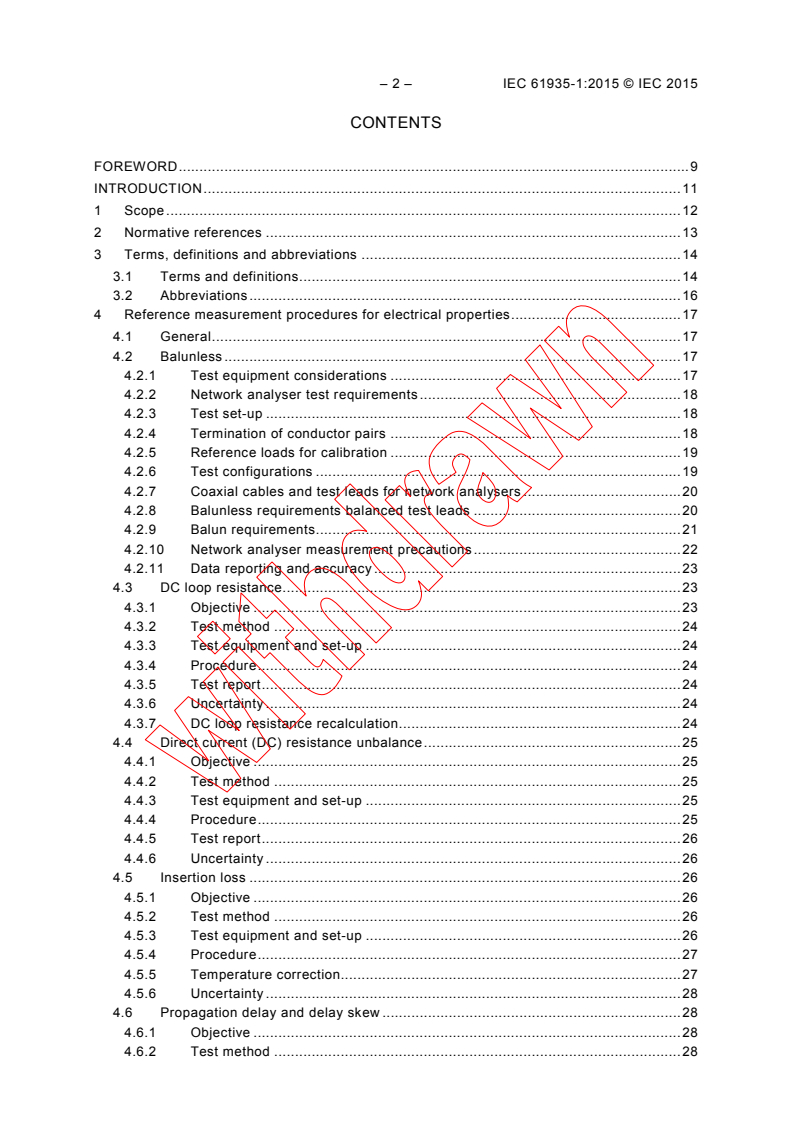
– 2 – IEC 61935-1:2015 © IEC 2015
CONTENTS
FOREWORD . 9
INTRODUCTION . 11
1 Scope . 12
2 Normative references . 13
3 Terms, definitions and abbreviations . 14
3.1 Terms and definitions . 14
3.2 Abbreviations . 16
4 Reference measurement procedures for electrical properties . 17
4.1 General . 17
4.2 Balunless . 17
4.2.1 Test equipment considerations . 17
4.2.2 Network analyser test requirements . 18
4.2.3 Test set-up . 18
4.2.4 Termination of conductor pairs . 18
4.2.5 Reference loads for calibration . 19
4.2.6 Test configurations . 19
4.2.7 Coaxial cables and test leads for network analysers . 20
4.2.8 Balunless requirements balanced test leads . 20
4.2.9 Balun requirements. 21
4.2.10 Network analyser measurement precautions . 22
4.2.11 Data reporting and accuracy . 23
4.3 DC loop resistance. 23
4.3.1 Objective . 23
4.3.2 Test method . 24
4.3.3 Test equipment and set-up . 24
4.3.4 Procedure . 24
4.3.5 Test report . 24
4.3.6 Uncertainty . 24
4.3.7 DC loop resistance recalculation . 24
4.4 Direct current (DC) resistance unbalance . 25
4.4.1 Objective . 25
4.4.2 Test method . 25
4.4.3 Test equipment and set-up . 25
4.4.4 Procedure . 25
4.4.5 Test report . 26
4.4.6 Uncertainty . 26
4.5 Insertion loss . 26
4.5.1 Objective . 26
4.5.2 Test method . 26
4.5.3 Test equipment and set-up . 26
4.5.4 Procedure . 27
4.5.5 Temperature correction. 27
4.5.6 Uncertainty . 28
4.6 Propagation delay and delay skew . 28
4.6.1 Objective . 28
4.6.2 Test method . 28
4.6.3 Test equipment and set-up . 28
4.6.4 Procedure . 28
4.6.5 Test report . 29
4.6.6 Uncertainty . 29
4.7 Near-end cross-talk (NEXT) and power sum NEXT . 29
4.7.1 Objective . 29
4.7.2 Test method . 29
4.7.3 Test equipment and set-up . 29
4.7.4 Procedure . 30
4.7.5 Test report . 31
4.7.6 Uncertainty . 31
4.8 Attenuation to crosstalk ratio, near end (ACR-N) and power sum ACR-N . 31
4.8.1 Objective . 31
4.8.2 Test method . 31
4.8.3 Test equipment and set-up . 32
4.8.4 Procedure and calculation . 32
4.8.5 Test report . 32
4.8.6 Uncertainty . 32
4.9 Far-end cross-talk (FEXT) and power sum FEXT . 32
4.9.1 Objective . 32
4.9.2 Test method . 32
4.9.3 Test equipment and set-up . 32
4.9.4 Procedure . 33
4.9.5 Test report . 34
4.9.6 Uncertainty of FEXT measurements . 34
4.10 Attenuation to crosstalk ratio, far end (ACR-F) . 34
4.10.1 Objective . 34
4.10.2 Calculation . 34
4.10.3 Test report . 35
4.10.4 Uncertainty . 35
4.11 Return loss . 35
4.11.1 Objective . 35
4.11.2 Test method . 35
4.11.3 Test equipment and set-up . 35
4.11.4 Procedure . 36
4.11.5 Test report . 36
4.11.6 Uncertainty . 36
4.12 PS Alien near end crosstalk (PS ANEXT – Exogenous crosstalk) . 36
4.12.1 Objective . 36
4.12.2 Test method . 36
4.12.3 Test equipment and set-up . 36
4.12.4 Procedure . 37
4.13 PS Attenuation to alien crosstalk ratio, far end crosstalk (PS AACR-F –
Exogenous crosstalk) . 39
4.13.1 Objective . 39
4.13.2 Test method . 39
4.13.3 Test equipment and set-up . 39
4.13.4 Procedure . 40
4.14 Unbalance attenuation, near end . 43
– 4 – IEC 61935-1:2015 © IEC 2015
4.14.1 Objective . 43
4.14.2 Test method . 43
4.14.3 Test equipment and set-up . 43
4.14.4 Procedure . 44
4.14.5 Test report . 46
4.14.6 Uncertainty . 46
4.15 Unbalance attenuation, far end . 47
4.15.1 Objective . 47
4.15.2 Test method . 47
4.15.3 Test equipment and set-up . 47
4.15.4 Procedure . 48
4.15.5 Test report . 49
4.15.6 Uncertainty . 49
4.16 Coupling attenuation . 49
5 Field test measurement requirements for electrical properties . 49
5.1 Introductory remark . 49
5.2 Cabling configurations tested . 50
5.3 Field test parameters . 50
5.3.1 General . 50
5.3.2 Inspection of workmanship and connectivity testing . 50
5.3.3 Propagation delay and delay skew . 52
5.3.4 Length . 52
5.3.5 Insertion loss . 53
5.3.6 NEXT, power sum NEXT . 53
5.3.7 ACR-N and power sum ACR-N . 54
5.3.8 ELFEXT, power sum ELFEXT, ACR-F, power sum ACR-F . 54
5.3.9 Return loss . 56
5.3.10 Direct current (DC) loop resistance . 56
5.4 Power sum alien crosstalk . 56
5.4.1 Objective . 56
5.4.2 Test method . 56
5.4.3 Test equipment and set-up . 56
5.4.4 Measuring ANEXT loss . 57
5.4.5 Measuring AFEXT loss . 57
5.4.6 Procedure . 58
5.4.7 Calculation of PS ANEXT and PS AACR-F from measured data . 58
5.4.8 Selection of test ports . 61
5.4.9 Test report . 63
5.4.10 Uncertainty of PS alien crosstalk measurements. 63
5.5 Data reporting and accuracy . 63
5.5.1 General . 63
5.5.2 Detailed results . 64
5.5.3 Summary results . 65
5.5.4 Reporting requirements for power sum alien crosstalk . 69
5.5.5 General . 69
5.5.6 Consistency checks for field testers . 69
5.5.7 Evaluation of consistency tests . 70
5.5.8 Administration system applicability . 70
5.5.9 Test equipment adapter cords for link testing . 70
5.5.10 User cords and channel testing . 70
6 Field tester measurement accuracy requirements . 70
6.1 General . 70
6.2 Measurement accuracy specifications common to level IIE, level III, level
IIIE, level IV and level V field testers . 74
6.3 Accuracy performance requirements for Level IIE field testers . 74
6.4 Accuracy performance requirements for level III field testers . 76
6.5 Accuracy performance requirements for level IIIE field testers . 78
6.6 Accuracy performance requirements for level IV field testers . 79
6.7 Accuracy performance requirements for level V field testers . 81
6.8 Field tester requirements applicable to alien crosstalk measurements . 83
6.9 Procedures for determining field tester parameters . 83
6.9.1 General . 83
6.9.2 Output signal balance (OSB) . 84
6.9.3 Common mode rejection (CMR) . 84
6.9.4 Residual NEXT . 85
6.9.5 Dynamic accuracy . 86
6.9.6 Source/load return loss . 86
6.9.7 Random noise floor. 87
6.9.8 Residual FEXT . 87
6.9.9 Directivity . 88
6.9.10 Tracking . 88
6.9.11 Source match . 89
6.9.12 Return loss of remote termination . 89
6.9.13 Constant error term of the propagation delay measurement function . 89
6.9.14 Error constant term proportional to propagation delay of the propagation
delay measurement function . 89
6.9.15 Constant error term of the delay skew measurement function . 90
6.9.16 Constant error term of the length measurement function . 90
6.9.17 Error constant proportional to the length of measurement function
(assuming the cables are taken from the same drum) . 90
6.9.18 Constant error term of the DC resistance measurement function . 90
6.9.19 Error constant term proportional to DC resistance of the DC resistance
measurement function . 90
6.9.20 Measurement floor for alien crosstalk testing during field testing . 90
6.10 Measurement error models . 92
6.10.1 General . 92
6.10.2 Error model for the insertion loss measurement function . 92
6.10.3 Error model for the NEXT measurement function . 92
6.10.4 Error model for the power sum NEXT measurement function . 93
6.10.5 Error model for the ACR-N measurement function . 93
6.10.6 Error model for the power sum ACR-N measurement function. 94
6.10.7 Error model for the ELFEXT or ACR-F measurement function . 94
6.10.8 Error model for the power sum ELFEXT and PS ACR-F measurement
functions . 95
6.10.9 Error model for the return loss measurement function . 95
6.10.10 Error model for the propagation delay measurement function. 96
6.10.11 Error model for the delay skew measurement function . 97
6.10.12 Error model for the length measurement function . 97
6.10.13 Error model for the DC loop resistance measurement function . 97
– 6 – IEC 61935-1:2015 © IEC 2015
6.11 Network analyzer measurement comparisons . 97
6.11.1 General . 97
6.11.2 Adapters . 98
6.11.3 Comparison methods . 100
Annex A (informative) Uncertainty and variability of field test results . 104
A.1 General . 104
A.2 Marginal results reporting . 104
A.3 Nominal accuracy . 104
A.4 Variability in link measurements not included in the measurement accuracy . 105
A.5 Variability in channel measurements . 105
A.6 Field tester accuracy checks . 106
A.6.1 General . 106
A.6.2 Manipulating cords of link adapter . 106
A.6.3 Exchanging adapters to main and remote field tester units . 106
A.6.4 Location of main and remote field tester units . 106
A.6.5 Use of previously characterized links . 106
A.6.6 Use separately characterized links using laboratory equipment . 106
A.6.7 Guidelines for correct installation testing . 107
Annex B (normative) Reference laboratory test configuration for alien crosstalk testing . 108
B.1 General . 108
B.2 Test parameters . 108
B.3 Link and channel construction . 108
B.4 Determination of number of disturbing links or channels . 109
B.5 Computation of results . 110
B.6 Test report . 110
Annex C (informative) General information on power sum alien crosstalk performance
of installations . 111
Annex D (informative) Baluns. 112
Bibliography . 113
Figure 1 – Resistor load . 18
Figure 2 – Reference planes for permanent link, CP link and channel . 20
Figure 3 – 180° hybrid used as a balun . 21
Figure 4 – DC loop resistance measurement . 24
Figure 5 – DC resistance unbalance measurement . 26
Figure 6 – Insertion loss test configuration . 27
Figure 7 – NEXT test configuration . 30
Figure 8 – FEXT test configuration . 33
Figure 9 – Return loss test configuration . 35
Figure 10 – ANEXT measurement . 37
Figure 11 – Alien far end crosstalk measurement . 40
Figure 12 – Unbalance attenuation, near end test configuration . 44
Figure 13 – Back-to-back balun differential mode insertion loss measurement . 45
Figure 14 – Back-to-back balun common mode insertion loss measurement . 45
Figure 15 – Unbalance performance test of the measurement balun . 46
Figure 16 – Unbalance attenuation far end test configuration . 48
Figure 17 – Correct pairing . 51
Figure 18 – Incorrect pairing . 52
Figure 19 – Schematic diagram to measure channel ANEXT loss . 57
Figure 20 – AFEXT loss measurement test configuration . 58
Figure 21 – Flow chart of the alien crosstalk test procedure . 62
Figure 22 – Example of equipment tolerance region (NEXT) . 64
Figure 23 – Block diagram for measuring output signal balance . 84
Figure 24 – Block diagram to measure common mode rejection . 85
Figure 25 – Block diagram for measuring residual NEXT . 86
Figure 26 – Block diagram for measuring dynamic accuracy . 86
Figure 27 – Principle of measurement of residual FEXT . 87
Figure 28 – Principle of alternate measurement of residual FEXT . 88
Figure 29 – Alien crosstalk measurement floor test for the channel test configuration . 91
Figure 30 – Alien crosstalk measurement floor test for the link test configurations . 91
Figure 31 – Construction details of special patch cord adapter . 98
Figure 32 – Interfaces to channel by field test and laboratory equipment to compare
test results . 99
Figure 33 – Interfaces to link test configuration by field test and laboratory equipment
to compare test results . 100
Figure 34 – Sample scatter plot . 102
Figure A.1 – Source of variability during link testing . 105
Figure D.1 – Configurations for qualifying test baluns . 112
Table 1 – Mixed mode S-parameter nomenclature . 21
Table 2 – Test balun performance characteristics . 22
Table 3 – Estimated uncertainty of unbalance, near end measurement . 47
Table 4 – Estimated uncertainty of unbalance, far end measurement . 49
Table 5 – Summary of reporting requirements for field test equipment (1 of 3) . 66
Table 6 – Minimum reporting requirement for PS ANEXT and PS AACR-F . 69
Table 7 – Worst case propagation delay, delay skew, DC resistance and length
measurement accuracy for level IIE, level III, level IV and level V test instruments . 71
Table 8 – Worst case insertion loss, NEXT, ACR-N, ELFEXT/ACR-F and return loss
measurement accuracy for Level IIE test instruments . 72
Table 9 – Worst case insertion loss, NEXT, ACR-N, ELFEXT/ACR-F and return loss
measurement accuracy for Level III test instruments . 72
Table 10 – Worst case insertion loss, NEXT, ACR-N, ELFEXT/ACR-F and return loss
measurement accuracy for level IIIE test instruments. 73
Table 11 – Worst case insertion loss, NEXT, ACR-N, ELFEXT/ACR-F and return loss
measurement accuracy for level IV test instruments . 73
Table 12 – Worst case insertion loss, NEXT, ACR-N, ACR-F and return loss
measurement accuracy for level V . 74
Table 13 – Propagation delay, delay skew, DC resistance and length accuracy
performance specifications . 74
Table 14 – Level IIE field tester accuracy performance parameters per IEC guidelines . 75
Table 15 – Level III field tester accuracy performance parameters per IEC guidelines . 77
Table 16 – Level IIIE field tester accuracy performance parameters per IEC guidelines . 78
– 8 – IEC 61935-1:2015 © IEC 2015
Table 17 – Level IV field tester accuracy performance parameters per IEC guidelines . 80
Table 18 – Level V field tester accuracy performance parameters per IEC guidelines . 82
INTERNATIONAL ELECTROTECHNICAL COMMISSION
____________
SPECIFICATION FOR THE TESTING OF BALANCED
AND COAXIAL INFORMATION TECHNOLOGY CABLING –
Part 1: Installed balanced cabling as specified
in ISO/IEC 11801 and related standards
FOREWORD
1) The International Electrotechnical Commission (IEC) is a worldwide organization for standardization comprising
all national electrotechnical committees (IEC National Committees). The object of IEC is to promote
international co-operation on all questions concerning standardization in the electrical and electronic fields. To
this end and in addition to other activities, IEC publishes International Standards, Technical Specifications,
Technical Reports, Publicly Available Specifications (PAS) and Guides (hereafter referred to as “IEC
Publication(s)”). Their preparation is entrusted to technical committees; any IEC National Committee interested
in the subject dealt with may participate in this preparatory work. International, governmental and non-
governmental organizations liaising with the IEC also participate in this preparation. IEC collaborates closely
with the International Organization for Standardization (ISO) in accordance with conditions determined by
agreement between the two organizations.
2) The formal decisions or agreements of IEC on technical matters express, as nearly as possible, an international
consensus of opinion on the relevant subjects since each technical committee has representation from all
interested IEC National Committees.
3) IEC Publications have the form of recommendations for international use and are accepted by IEC National
Committees in that sense. While all reasonable efforts are made to ensure that the technical content of IEC
Publications is accurate, IEC cannot be held responsible for the way in which they are used or for any
misinterpretation by any end user.
4) In order to promote international uniformity, IEC National Committees undertake to apply IEC Publications
transparently to the maximum extent possible in their national and regional publications. Any divergence
between any IEC Publication and the corresponding national or regional publication shall be clearly indicated in
the latter.
5) IEC itself does not provide any attestation of conformity. Independent certification bodies provide conformity
assessment services and, in some areas, access to IEC marks of conformity. IEC is not responsible for any
services carried out by independent certification bodies.
6) All users should ensure that they have the latest edition of this publication.
7) No liability shall attach to IEC or its directors, employees, servants or agents including individual experts and
members of its technical committees and IEC National Committees for any personal injury, property damage or
other damage of any nature whatsoever, whether direct or indirect, or for costs (including legal fees) and
expenses arising out of the publication, use of, or reliance upon, this IEC Publication or any other IEC
Publications.
8) Attention is drawn to the Normative references cited in this publication. Use of the referenced publications is
indispensable for the correct application of this publication.
9) Attention is drawn to the possibility that some of the elements of this IEC Publication may be the subject of
patent rights. IEC shall not be held responsible for identifying any or all such patent rights.
International Standard IEC 61935-1 has been prepared by IEC technical committee 46:
Cables, wires, waveguides, R.F. connectors, R.F. and microwave passive components and
accessories.
This fourth edition cancels and replaces the third edition, published in 2009, and constitutes a
technical revision.
This edition includes the following significant technical changes with respect to the previous
edition:
a) the upper frequency goes up to 1 000 MHz;
b) test methods are now included for exogenous (alien) crosstalk;
c) a new Annex A has been added for uncertainty and variability of field test results.
– 10 – IEC 61935-1:2015 © IEC 2015
The text of this standard is based on the following documents:
FDIS Report on voting
46/574/FDIS 46/587/RVD
Full information on the voting for the approval of this standard can be found in the report on
voting indicated in the above table.
This publication has been drafted in accordance with the ISO/IEC Directives, Part 2.
A list of all parts in the IEC 61935 series, published under the general title Specification for
the testing of balanced and coaxial information technology cabling, can be found on the IEC
website.
The committee has decided that the contents of this publication will remain unchanged until
the stability date indicated on the IEC web site under "http://webstore.iec.ch" in the data
related to the specific publication. At this date, the publication will be
• reconfirmed,
• withdrawn,
• replaced by a revised edition, or
• amended.
A bilingual version of this publication may be issued at a later date.
IMPORTANT – The 'colour inside' logo on the cover page of this publication indicates
that it contains colours which are considered to be useful for the correct
understanding of its contents. Users should therefore print this document using a
colour printer.
INTRODUCTION
Telecommunication cabling, once specified uniquely by each telecommunications application,
has evolved into a generic cabling system. Telecommunications applications now use the
ISO/IEC 11801 cabling standard to meet their cabling requirements. Formerly, connectivity
tests and visual inspection were deemed sufficient to verify a cabling installation. Now users
need more comprehensive testing in order to ensure that the link will support
telecommunications applications that are designed to operate on the generic cabling system.
This part of IEC 61935 addresses reference laboratory and field test methods and provides a
comparison of these methods.
Transmission performance depends on cable characteristics, connecting hardware, patch
cords and cross-connect cabling, the total number of connections and the care with which
they are installed and maintained. This standard provides test methods for installed cabling
and pre-fabricated cable assemblies. These test methods, where appropriate, are based on
those used for components of the cable assembly.
This Part 1 contains the test methods required for installed cabling. Part 2 contains the test
methods required for patch cords and work area cords.
– 12 – IEC 61935-1:2015 © IEC 2015
SPECIFICATION FOR THE TESTING OF BALANCED
AND COAXIAL INFORMATION TECHNOLOGY CABLING –
Part 1: Installed balanced cabling as specified
in ISO/IEC 11801 and related standards
1 Scope
This part of IEC 61935 specifies reference measurement procedures for cabling parameters
and the requirements for field tester accuracy to measure cabling parameters identified in
ISO/IEC 11801. References in this standard to ISO/IEC 11801 mean ISO/IEC 11801 or
equivalent cabling standards.
This International Standard applies when the cable assemblies are constructed of cables
complying with the IEC 61156 family of standards, and connecting hardware as specified in
the IEC 60603-7 family of standards or IEC 61076-3-104, IEC 61076-3-110, IEC 61076-2-101
and IEC 61076-2-109. Where cables and/or connectors do no
...
Questions, Comments and Discussion
Ask us and Technical Secretary will try to provide an answer. You can facilitate discussion about the standard in here.
Loading comments...