

IEC TR 61366-3:1998
(Main)Hydraulic turbines, storage pumps and pump-turbines - Tendering documents - Part 3: Guidelines for technical specifications for Pelton turbines
General Information
- Abstract
IEC TR 61366-3:1998, which is a technical report, is intended to assist in the preparation of Tendering documents and Tendering proposals and in the evaluation of tenders for hydraulic machines. This part of IEC 61366 provides guidelines for Pelton turbines.
- Status
- Published
- Publication Date
- 10-Mar-1998
- Technical Committee
- TC 4 - Hydraulic turbines
- Drafting Committee
- WG 19 - TC 4/WG 19
- Current Stage
- PPUB - Publication issued
- Start Date
- 11-Mar-1998
- Completion Date
- 31-Jan-1998
Overview
IEC TR 61366-3:1998 is an IEC technical report that provides guidelines for preparing tendering documents and technical specifications for Pelton turbines. Published as part of the IEC 61366 series on hydraulic turbines, storage pumps and pump‑turbines, this type‑3 report offers state‑of‑the‑art guidance to assist Employers, contractors and consultants in drafting clear, project‑specific tender requirements and in evaluating tenders for Pelton machines. It is a companion document to Part 1 (general guidance) and to the other machine‑specific parts in the series.
Key topics and technical requirements
This guidance focuses on structuring and specifying critical elements of Pelton turbine procurement without prescribing numeric design details. Major topics covered include:
- Scope of work and limits of contract - clear delineation between Employer and Contractor responsibilities.
- Design conditions - definition of hydraulic and mechanical design inputs required for tendering.
- Performance guarantees and technical performance - recommended clauses for efficiency, output and acceptance criteria.
- Mechanical design criteria - material, construction and mechanical integrity considerations for Pelton runners, buckets, shafts and housings.
- Component specifications - requirements for injectors, deflectors, nozzle systems, housings, seals and bearings.
- Testing and inspection - shop inspection, model acceptance tests, installation, commissioning and field acceptance tests.
- Documentation and deliverables - design documentation, drawings, test reports and spare parts lists.
- Auxiliary systems and instrumentation - bearing lubrication, cooling, control and protection instrumentation and access equipment.
Practical applications and users
IEC TR 61366-3:1998 is practical guidance for:
- Project owners and Employers drafting tendering documents for hydroelectric projects with Pelton turbines.
- Engineering consultants preparing technical specifications and evaluating technical bids.
- Manufacturers and contractors developing compliant tender proposals.
- Project managers and procurement teams needing standard structure for contract scope, testing and acceptance. Use cases include preparing bid documents, defining performance guarantees, specifying shop and site tests, and aligning manufacturer deliverables with project requirements.
Related standards
- IEC 61366-1: General and annexes (use together with Part 3)
- Other parts of IEC 61366 series (Francis, Kaplan/propeller, tubular, pump‑turbines, storage pumps)
- IEC 60050 (IEV), IEC 60027, IEC 60417 (terminology and symbols) - referenced for general terminology and symbols.
IEC TR 61366-3:1998 is a non‑normative, informative resource to improve clarity, reduce tendering risk and standardize technical specifications for Pelton turbine procurement.
Get Certified
Connect with accredited certification bodies for this standard

DNV
DNV is an independent assurance and risk management provider.

Lloyd's Register
Lloyd's Register is a global professional services organisation specialising in engineering and technology.
DNV Energy Systems
Energy and renewable energy certification.
Sponsored listings
Frequently Asked Questions
IEC TR 61366-3:1998 is a technical report published by the International Electrotechnical Commission (IEC). Its full title is "Hydraulic turbines, storage pumps and pump-turbines - Tendering documents - Part 3: Guidelines for technical specifications for Pelton turbines". This standard covers: IEC TR 61366-3:1998, which is a technical report, is intended to assist in the preparation of Tendering documents and Tendering proposals and in the evaluation of tenders for hydraulic machines. This part of IEC 61366 provides guidelines for Pelton turbines.
IEC TR 61366-3:1998, which is a technical report, is intended to assist in the preparation of Tendering documents and Tendering proposals and in the evaluation of tenders for hydraulic machines. This part of IEC 61366 provides guidelines for Pelton turbines.
IEC TR 61366-3:1998 is classified under the following ICS (International Classification for Standards) categories: 27.140 - Hydraulic energy engineering. The ICS classification helps identify the subject area and facilitates finding related standards.
IEC TR 61366-3:1998 is available in PDF format for immediate download after purchase. The document can be added to your cart and obtained through the secure checkout process. Digital delivery ensures instant access to the complete standard document.
Standards Content (Sample)
TECHNICAL
IEC
REPORT
61366-3
First edition
1998-03
Hydraulic turbines, storage pumps
and pump-turbines –
Tendering documents –
Part 3:
Guidelines for technical specifications
for Pelton turbines
Turbines hydrauliques, pompes d’accumulation
et pompes-turbines –
Documents d’appel d’offres –
Partie 3:
Guide des spécifications techniques pour les turbines Pelton
Reference number
IEC 61366-3:1998(E)
Numbering
As from 1 January 1997 all IEC publications are issued with a designation in the
60000 series.
Consolidated publications
Consolidated versions of some IEC publications including amendments are
available. For example, edition numbers 1.0, 1.1 and 1.2 refer, respectively, to the
base publication, the base publication incorporating amendment 1 and the base
publication incorporating amendments 1 and 2.
Validity of this publication
The technical content of IEC publications is kept under constant review by the IEC,
thus ensuring that the content reflects current technology.
Information relating to the date of the reconfirmation of the publication is available
in the IEC catalogue.
Information on the revision work, the issue of revised editions and amendments may
be obtained from IEC National Committees and from the following IEC sources:
• IEC Bulletin
• IEC Yearbook
On-line access*
• Catalogue of IEC publications
Published yearly with regular updates
(On-line access)*
Terminology, graphical and letter symbols
For general terminology, readers are referred to IEC 60050: International
Electrotechnical Vocabulary (IEV).
For graphical symbols, and letter symbols and signs approved by the IEC for
general use, readers are referred to publications IEC 60027: Letter symbols to be
used in electrical technology, IEC 60417: Graphical symbols for use on equipment.
Index, survey and compilation of the single sheets Graphical symbols
and IEC 60617:
for diagrams.
IEC publications prepared by the same technical committee
The attention of readers is drawn to the end pages of this publication which list the
IEC publications issued by the technical committee which has prepared the present
publication.
* See web site address on title page.
TECHNICAL
IEC
REPORT – TYPE 3
61366-3
First edition
1998-03
Hydraulic turbines, storage pumps
and pump-turbines –
Tendering documents –
Part 3:
Guidelines for technical specifications
for Pelton turbines
Turbines hydrauliques, pompes d’accumulation
et pompes-turbines –
Documents d’appel d’offres –
Partie 3:
Guide des spécifications techniques pour les turbines Pelton
IEC 1998 Copyright - all rights reserved
No part of this publication may be reproduced or utilized in any form or by any means, electronic or
mechanical, including photocopying and microfilm, without permission in writing from the publisher.
International Electrotechnical Commission 3, rue de Varembé Geneva, Switzerland
Telefax: +41 22 919 0300 e-mail: inmail@iec.ch IEC web site http: //www.iec.ch
Commission Electrotechnique Internationale
PRICE CODE
V
International Electrotechnical Commission
For price, see current catalogue
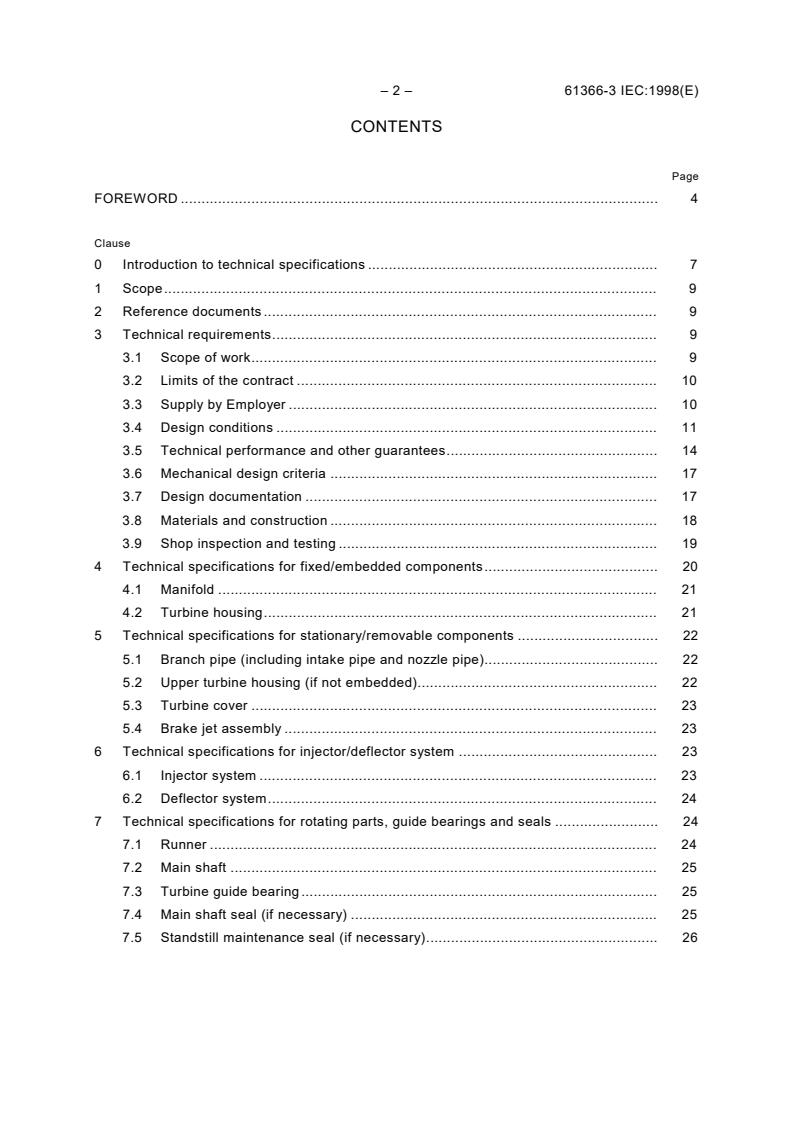
– 2 – 61366-3 IEC:1998(E)
CONTENTS
Page
FOREWORD . 4
Clause
0 Introduction to technical specifications . 7
1 Scope. 9
2 Reference documents . 9
3 Technical requirements. 9
3.1 Scope of work. 9
3.2 Limits of the contract . 10
3.3 Supply by Employer . 10
3.4 Design conditions . 11
3.5 Technical performance and other guarantees. 14
3.6 Mechanical design criteria . 17
3.7 Design documentation . 17
3.8 Materials and construction . 18
3.9 Shop inspection and testing . 19
4 Technical specifications for fixed/embedded components. 20
4.1 Manifold . 21
4.2 Turbine housing. 21
5 Technical specifications for stationary/removable components . 22
5.1 Branch pipe (including intake pipe and nozzle pipe). 22
5.2 Upper turbine housing (if not embedded). 22
5.3 Turbine cover . 23
5.4 Brake jet assembly . 23
6 Technical specifications for injector/deflector system . 23
6.1 Injector system . 23
6.2 Deflector system. 24
7 Technical specifications for rotating parts, guide bearings and seals . 24
7.1 Runner . 24
7.2 Main shaft . 25
7.3 Turbine guide bearing. 25
7.4 Main shaft seal (if necessary) . 25
7.5 Standstill maintenance seal (if necessary). 26
61366-3 © IEC:1998(E) – 3 –
Clause Page
8 Technical specifications for thrust bearing (when specified as part of the
hydraulic machine). 26
8.1 Design data . 26
8.2 Bearing support . 26
8.3 Bearing assembly . 26
8.4 Oil injection pressure system . 27
9 Technical specifications for miscellaneous components . 27
9.1 Walkways, access platforms and stairs . 27
9.2 Lifting fixtures. 27
9.3 Special tools. 27
9.4 Standard tools . 27
9.5 Turbine pit hoist. 27
9.6 Nameplate. 27
9.7 Runner cart and rails (if required) . 28
9.8 Access door to turbine housing interior (if required). 28
10 Technical specifications for auxiliary systems. 28
10.1 Bearing lubrication system . 28
10.2 Cooling water system for runner. 28
10.3 Tailwater air admission system . 28
10.4 Turbine pit drainage. 28
11 Technical specifications for instrumentation . 29
11.1 Controls. 29
11.2 Indication. 29
11.3 Protection. 29
12 Spare parts. 29
13 Model acceptance tests . 29
14 Site installation and commissioning tests . 30
14.1 General . 30
14.2 Installation procedures. 30
14.3 Tests during installation . 31
14.4 Commissioning tests. 31
15 Field acceptance tests . 31
15.1 Scope and reports . 31
15.2 Inspection of cavitating pitting. 31
– 4 – 61366-3 IEC:1998(E)
INTERNATIONAL ELECTROTECHNICAL COMMISSION
____________
HYDRAULIC TURBINES, STORAGE PUMPS AND PUMP-TURBINES –
TENDERING DOCUMENTS –
Part 3: Guidelines for technical specifications
for Pelton turbines
FOREWORD
1) The IEC (International Electrotechnical Commission) is a worldwide organization for standardization comprising
all national electrotechnical committees (IEC National Committees). The object of the IEC is to promote
international co-operation on all questions concerning standardization in the electrical and electronic fields. To
this end and in addition to other activities, the IEC publishes International Standards. Their preparation is
entrusted to technical committees; any IEC National Committee interested in the subject dealt with may
participate in this preparatory work. International, governmental and non-governmental organizations liaising
with the IEC also participate in this preparation. The IEC collaborates closely with the International Organization
for Standardization (ISO) in accordance with conditions determined by agreement between the two
organizations.
2) The formal decisions or agreements of the IEC on technical matters express, as nearly as possible, an
international consensus of opinion on the relevant subjects since each technical committee has representation
from all interested National Committees.
3) The documents produced have the form of recommendations for international use and are published in the form
of standards, technical reports or guides and they are accepted by the National Committees in that sense.
4) In order to promote international unification, IEC National Committees undertake to apply IEC International
Standards transparently to the maximum extent possible in their national and regional standards. Any
divergence between the IEC Standard and the corresponding national or regional standard shall be clearly
indicated in the latter.
5) The IEC provides no marking procedure to indicate its approval and cannot be rendered responsible for any
equipment declared to be in conformity with one of its standards.
6) Attention is drawn to the possibility that some of the elements of this International Standard may be the subject
of patent rights. The IEC shall not be held responsible for identifying any or all such patent rights.
The main task of IEC technical committees is to prepare International Standards. In
exceptional circumstances, a technical committee may propose the publication of a technical
report of one of the following types:
• type 1, when the required support cannot be obtained for the publication of an International
Standard, despite repeated efforts;
• type 2, when the subject is still under technical development or where for any other reason
there is the future but no immediate possibility of an agreement on an International
Standard;
• type 3, when a technical committee has collected data of a different kind from that which is
normally published as an International Standard, for example "state of the art".
Technical reports of types 1 and 2 are subject to review within three years of publication to
decide whether they can be transformed into International Standards. Technical reports of
type 3 do not necessarily have to be reviewed until the data they provide are considered to be
no longer valid or useful.
IEC 61366-3, which is a technical report of type 3, has been prepared by IEC technical
committee 4: Hydraulic turbines.
61366-3 © IEC:1998(E) – 5 –
The text of this technical report is based on the following documents:
Committee draft Report on voting
4/110/CDV 4/122/RCV
Full information on the voting for the approval of this technical report can be found in the report
on voting indicated in the above table.
Technical Report IEC 61366-3 is one of a series which deals with Tendering documents for
hydraulic turbines, storage pumps and pump-turbines. The series consists of seven parts:
Part 1: General and annexes (IEC 61366-1)
Part 2: Guidelines for technical specification for Francis turbines (IEC 61366-2)
Part 3: Guidelines for technical specification for Pelton turbines (IEC 61366-3)
Part 4: Guidelines for technical specification for Kaplan and propeller turbines (IEC 61366-4)
Part 5: Guidelines for technical specification for tubular turbines (IEC 61366-5)
Part 6: Guidelines for technical specification for pump-turbines (IEC 61366-6)
Part 7: Guidelines for technical specification for storage pumps (IEC 61366-7)
Parts 2 to 7 are "stand-alone" publications which when used with Part 1 contain guidelines for a
specific machine type (i.e. Parts 1 and 4 represent the combined guide for Kaplan and
propeller turbines). A summary of the proposed contents for a typical set of Tendering
documents is given in the following table 1 and annex A. Table 1 summarizes the arrangement
of each part of this guide and serves as a reference for the various chapters and sections of
the Tendering documents (see 3.2 of this part).
A bilingual edition of this technical report may be issued at a later date.
Table 1 – Summary of guide for the preparation of Tendering Documents for hydraulic turbines, storage pumps and pump-turbines
CONTENTS OF GUIDE IEC 61366-1 TO IEC 61366-7 SAMPLE TABLE OF CONTENTS OF TENDERING DOCUMENTS (TD)
(Example for the Francis turbines; see 61366-1, annex A)
Part Clause Title Chapter Title
1 General and annexes 1 Tendering requirements
1– 2 Project information
1 1 Object and scope of this guide 3 General conditions
1 2 Reference documents and definitions 4 Special conditions
1 3 Arrangement of Tendering Documents 5 General requirements
1 4 Guidelines for tendering requirements 6 Technical specifications
1 5 Guidelines for project information 6.1 Technical requirements
1 6 Guidelines for general conditions, special conditions and general 6.1.1 Scope of work
requirements 6.1.2 Limits of the contract
6.1.3 Supply by Employer
1 Annexes 6.1.4 Design conditions
6.1.5 Performance and other guarantees
A Sample table of contents of Tendering Documents for Francis turbines 6.1.6 Mechanical design criteria
B Comments on factors for evaluation of tenders 6.1.7 Design documentation
C Check list for tender form 6.1.8 Materials and construction
D Examples of technical data sheets 6.1.9 Shop inspection and testing
E Technical performance guarantees 6.2 Technical specifications for fixed/embedded components
F Example of cavitation pitting guarantees 6.3 Technical specifications for stationary/removable components
G Check list for model test specifications 6.4 Technical specifications for guide vane regulating apparatus
H Sand erosion considerations 6.5 Technical specifications for rotating parts, bearings and seals
6.6 Technical specifications for thrust bearings
2 to 7 Technical specifications 6.7 Technical specifications for miscellaneous components
6.8 Technical specifications for auxiliary systems
2 Francis turbines 6.9 Technical specifications for instrumentation
3 Pelton turbines 6.10 Spare parts
4 Kaplan and propeller turbines 6.11 Model tests
5 Tubular turbines 6.12 Installation and commissioning
6 Pump-turbines 6.13 Field acceptance tests
7 Storage pumps
61366-3 © IEC:1998(E) – 7 –
HYDRAULIC TURBINES, STORAGE PUMPS AND PUMP-TURBINES –
TENDERING DOCUMENTS –
Part 3: Guidelines for technical specifications
for Pelton turbines
0 Introduction to technical specifications
The main purpose of the technical specifications is to describe the specific technical
requirements for the hydraulic machine for which the Tendering documents (TD) are being
issued. To achieve clarity and to avoid confusion in contract administration, the Employer
should not specify anything in the technical specifications which is of importance only to the
preparation of the tender. Such information and instructions should be given only in the
Instructions to Tenderers (ITT). Accordingly, the ITT may refer to other chapters and sections
the Tendering documents but not vice versa. As a general rule the word "Tenderer" should be
confined in use only to TD chapter 1 "Tendering requirements"; elsewhere the term
"Contractor" should be used.
Special attention should be given to items of a project specific nature such as materials,
protective coating systems, mechanical piping systems, electrical systems and instrumentation.
It is common for the Employer to use technical standards for such items which would apply to
all contracts for a particular project or projects. In this event, detailed technical standards
should be specified in TD chapter 5 "General requirements".
Technical specifications for the various types of hydraulic machines included in this guide are
provided in the following parts:
– Francis turbines (Part 2);
– Pelton turbines (Part 3);
– Propeller and Kaplan turbines (Part 4);
– Tubular turbines (Part 5);
– Pump-turbines (Part 6);
– Storage pumps (Part 7).
The guidelines for preparation of Pelton turbine specifications include technical specifications
for the following:
– Design conditions: Project arrangement, hydraulic conditions, specified conditions, mode of
operation, generator characteristics, synchronous condenser characteristics, transient
behaviour data, stability of the system, noise, vibration, pressure fluctuations and safety
requirements.
– Technical performance and other guarantees:
ypower;
ydischarge (if required);
yefficiency;
ymaximum momentary pressure;
yminimum momentary pressure;
ymaximum momentary overspeed;
ymaximum steady-state runaway speed;
– 8 – 61366-3 © IEC:1998(E)
ycavitation pitting;
yhydraulic thrust;
ymaximum weights and dimensions for transportation, erection and maintenance.
– Mechanical design criteria: design standards, stresses and deflections and special design
considerations (earthquake acceleration, etc.).
– Design documentation: Contractor’s input needed for the Employer's design, Contractor's
drawings and data, Contractor's review of the Employer's design and technical reports by
Contractor.
– Materials and construction: material selection and standards, quality assurance procedures,
shop methods, corrosion protection and painting.
– Shop inspection and testing: general requirements and reports, material tests and
certificates, dimensional checks, shop assembly and tests.
– Fixed/embedded components: manifold for multi-jet turbines and turbine housing.
– Stationary/removable components: branch pipe for horizontal turbines, upper turbine
housing (if not embedded), turbine cover, brake jet assembly).
– Injector and deflector systems: nozzles, needles, needle servomotors, deflectors or cut-in
deflectors, deflector servomotors, links, needle-deflector combining mechanism and oil
piping.
– Rotating parts, bearings and seals: runner, main shaft, guide bearing with oil supply,
oil/water cooler, shaft seal.
– Thrust bearing (when part of the hydraulic machine supply): bearing support, thrust block,
rotating ring, thrust bearing pads and pivots, oil sump with oil supply (common with guide
bearing, if any), oil/water coolers, instrumentation.
– Miscellaneous components: walkways, lifting fixtures, special tools, standard tools, turbine
pit hoist, nameplate, runner inspection platform (if required).
– Auxiliary systems: bearing lubrication system (if required), tailwater air admission system,
turbine pit drainage (if required), turbine housing ventilation, tailwater depression (if
required).
– Instrumentation: controls, indication and protection.
– Spare parts: basic spare parts.
– Model acceptance tests: test requirements.
– Site installation and commissioning tests: Installation procedures and commissioning tests.
– Field acceptance tests: scope of field tests, reports and inspection of cavitation pitting.
An example of the proposed table of contents for Tendering documents for a Francis turbine is
given in annex A of IEC 61366-1. The example does not include technical specifications for the
control system, or high-pressure side valves which, at the Employer’s option, may be included
in the Tendering documents for the Pelton turbine or may be specified in separate Tendering
documents.
Chapter 6 (technical specifications) of the Tendering documents should be arranged as follows:
6.1 Technical requirements;
6.2 Technical specifications for fixed/embedded components;
6.3 Technical specifications for stationary/removable components;
6.4 Technical specifications for deflector/cut-in deflector regulating apparatus;
6.5 Technical specifications for rotating parts, guide bearings and seals;
6.6 Technical specifications for thrust bearing;
6.7 Technical specifications for miscellaneous components;
6.8 Technical specifications for auxiliary systems;
6.9 Technical specifications for instrumentation;
61366-3 © IEC:1998(E) – 9 –
6.10 Spare parts;
6.11 Model acceptance tests;
6.12 Site installation and commissioning tests;
6.13 Field acceptance tests.
1 Scope
This Technical Report, referred to herein as “Guide”, is intended to assist in the preparation of
Tendering documents and Tendering proposals and in the evaluation of tenders for hydraulic
machines. This part of IEC 61366 provides guidelines for Pelton turbines.
2 Reference documents
IEC 60041:1992, Field acceptance tests to determine the hydraulic performance of hydraulic
turbines, storage pumps and pump-turbines
IEC 60193:1965, International code for model acceptance tests of hydraulic turbines
IEC 60308:1970, International code for testing of speed governing systems for hydraulic
turbines
IEC 60545:1976, Guide for commissioning, operation an maintenance of hydraulic turbines
IEC 60609-2:1997, Cavitation pitting evaluation in hydraulic turbines, storage pumps and
pump-turbines – Part 2: Evaluation in Pelton turbines
IEC 60994:1991, Guide for field measurement of vibrations and pulsations in hydraulic
machines (turbines, storage pumps and pump-turbines)
IEC 60995:1991, Determination of the prototype performance from model acceptance tests of
hydraulic machines with consideration of scale effects
1)
IEC 61362, Guide to specification of hydro-turbine control systems
ISO 3740:1980, Acoustics – Determination of sound power levels of noise sources – Guidelines
for the use of basic standards and for the propagation of noise test codes
3 Technical requirements
3.1 Scope of work
This subclause should describe the scope of work and the responsibilities which are to be
2)
conferred upon the Contractor. The general statement of scope of work presented in TD
section 2.1 (5.1) shall be consistent with what is presented here. In a similar manner, pay items
in the tender form, TD section 1.2 (subclause 4.2) should be defined directly from TD
subsection 6.1.1.
The scope of work should begin with a general statement which outlines the various elements
of the work including (where applicable) the design, model testing, supply of materials and
labour, fabrication, machining, quality assurance, quality control, shop assembly, shop testing,
spare parts, transportation to site, site installation, commissioning, acceptance testing,
warranty and other services specified or required for the items of work. The general statement
should be followed by a specific and detailed list of the major items which the Employer wishes
to have as separate payment items in the tender form, for example:
___________
1)
To be published.
2)
All references to Tendering documents (TD) apply to annex A of IEC 61366-1.
– 10 – 61366-3 © IEC:1998(E)
Item Description
1 Two (2) vertical shaft Pelton type hydraulic turbines each with a specified power of not
less than 180 000 kW under a specified specific hydraulic energy of 11 500 J/kg
(specified head of 1 172 m);
2 Turbine model testing;
3 Tools, slings and handling devices required for maintenance of the turbines;
4 Transportation and delivery to site;
5 Site installation, commissioning, and acceptance testing of the turbines;
6 Preparation and submission of operation and maintenance manual and training of
Employer's operating and maintenance staff in the optimum use of these manuals; and
7 Spare parts required for operation and maintenance.
3.2 Limits of the contract
This subclause, making reference to Employer's drawings and data, should describe the limits
of the contract considering the following:
– details of the design and supply limits of the high and low-pressure sides of the machine;
– details, location, and responsibility for field connection of manifold/branch pipe to penstock
or valve on high-pressure side;
– details and location of the downstream termination of the turbine housing (including
inspection platform, if required);
– details and location of gate(s) on low-pressure side (if required);
– orientation and location of turbine/generator shaft flange interface;
– responsibility for supply and installation of flange coupling bolts, nuts and guards at
generator/turbine coupling, including drilling jig;
– responsibility for supply and installation of bolts, nuts, gaskets at piping terminations;
– termination of governor piping;
– termination of manifold dewatering piping;
– termination of manifold or branch pipe air exhaust piping (if any);
– termination of pit drainage piping (if required);
– termination of bearing lubricating oil piping (if required);
– termination of shaft seal piping (if specified);
– termination of cooling water piping for bearings;
– turbine mounted thrust bearing (if desired);
– termination points and junction boxes for wiring for power, control, indication, protection,
and lighting;
– compressed air for service and other functions.
NOTE – Contract limits will change if other major items of equipment (such as hydro-turbine control systems,
valves, gates, generators, excitation systems, control metering and relaying systems, switchgear, and power
transformers) are included with the hydraulic machine in a common set of Tendering documents.
3.3 Supply by Employer
This subclause should be complementary to 5.6 of IEC 61366-1 (TD section 2.6) and should
list the items and services which will be the responsibility of the Employer. The following items
should be considered:
– services during site installation and testing;
– temporary enclosures for site storage of turbine parts or for erection;
61366-3 © IEC:1998(E) – 11 –
– installation in primary concrete of small items provided by the Contractor, such as anchors,
sole plates, and piping;
– concrete for embedment of turbine components-supply, placement and controls, including
monitoring and verification during and after concrete placement by others;
– grout injection, if required, either within or around turbine components;
– powerhouse crane and operator;
– connections to powerhouse air, oil and water piping systems;
– supply of filtered water for turbine shaft seal (if by Employer);
– electrical wiring and hardware external to specified termination points;
– electric motor starters and controls;
– control, annunciation and protection systems external to specified termination points;
– external lubricating oil storage, distribution, and purification systems;
– lubricants, bearing and governor oil to the Contractor's specifications.
It should be stated that any materials or services required for installation and commissioning of
the units, and not specifically mentioned in the above list of the Employer supplied items and
services are to be provided by the Contractor under contract.
3.4 Design conditions
3.4.1 Project arrangement
The project arrangement should contain the Employer's detailed description together with
general arrangement drawings (by the Employer) of the powerhouse and waterways at the low
and high-pressure sides including channels, galleries, penstocks, surge tanks, gates, valves,
etc. The description should be an extension of the applicable data provided in TD chapter 2
"Project information". The data shall be sufficiently clear so that the Contractor is aware of
physical conditions which may influence its detailed design.
In any event, the Employer should retain responsibility for specifying values of all parameters
on which guarantees are based, as part of the overall design of the plant. This applies
particularly to the correct inlet and outlet conditions and in co-ordination of the interaction
between the hydraulic machine and the waterways.
3.4.2 Hydraulic conditions
This subclause should present the hydraulic conditions under which the Employer proposes to
operate the completed facility such as:
– range of specific hydraulic energy (head) of the plant;
– specific hydraulic energy losses between headwater level and high-pressure reference
section of the machine (E );
L 3-1
– specific hydraulic energy (head) of the machine (see subclause 2.5);
– headwater levels, maximum, minimum and normal and when no water is flowing;
– tailwater levels, maximum, minimum and normal, and when no water is flowing;
– tailwater level as a function of discharge;
– power or discharge values in the range of specific hydraulic energy (head);
– maximum specific hydraulic energy (head) for runaway speed guarantee;
– range of water temperatures;
– water quality analysis (chemical, corrosive nature, biological, and suspended solids);
– range of ambient (interior and exterior) temperatures and humidity (tropical environment or
extreme cold needs to be clearly defined).
– 12 – 61366-3 © IEC:1998(E)
3.4.3 Specified conditions
a) Modes of operation: As an extension to TD section 2.5, the Employer should provide
sufficient data to enable the Contractor to understand the Employer's intended mode(s) of
operation, e.g. base load or peaking. Data should include, wherever possible, the
anticipated number of start-stops per year and the capacity factor of the plant. Special
operating uses shall also be clearly identified such as synchronous condenser, spinning
reserve, isolated and black start operations and requirements, waterway/penstock draining-
through turbine.
b) Power (P), Specific Hydraulic Energy (E) [Head (H)], and Discharge (Q): The specified
specific hydraulic energy (head) and discharge of the machine are determined from an
analysis of available discharge, specific hydraulic energy (head) of the plant and hydraulic
losses external to the machine with respect to statistical duration (refer to 2.3 to 2.6 of
IEC 61366-1). The relevant power can be established from a predetermined value of
efficiency.
If the range of specific hydraulic energy (head) is wide, more than one specified value for E,
Q and P may need to be selected to define the operational range of the machine.
In the case of an unregulated turbine and if there are any limitations on maximum discharge
at any specific hydraulic energy (head), the Employer shall provide adequate data in the
technical specifications to enable the Contractor to optimize turbine design while respecting
these limitations.
c) Speed: The choice of speed of the unit has an impact on turbine, generator costs and
powerhouse costs. The choice of speed may be influenced by strength considerations.
Reduced turbine efficiency and cavitation may be introduced by increasing speed beyond a
certain limit.
In most cases, the project schedule dictates an early decision with respect to speed. Under
such conditions, discussions should be held with potential suppliers of turbines and
generators to fix a preferred speed; alternative proposals may be invited in the ITT.
d) Direction of rotation: The direction of rotation of the turbine is dictated by the optimum
orientation of the manifold pipe with respect to intake, penstock and powerhouse costs. The
direction should be specified clockwise or counter-clockwise looking from the generator
toward the turbine.
3.4.4 Generator characteristics
The specifications should state the principal characteristics of the generators to which the
turbines will be coupled, for example:
– capacity (kVA);
– power factor;
– frequency (normal and exceptional range);
– inertia or flywheel effect of generator;
– preferred speed (if established);
– preferred bearing arrangement (if established);
– approximate diameter of rotor (if available).
3.4.5 Transient behaviour data
The Employer should, during preliminary design phase of the project and prior to turbine
selection, determine the various factors relating to power acceptance and power rejection by
the turbine. These factors may include:
– acceptable variation in electrical system frequency;
– inertia of the rotating parts or mechanical starting time;
– details of high-pressure conduit for the turbine, including surge tank, if used;
61366-3 © IEC:1998(E) – 13 –
– water starting time;
– velocity of pressure wave (sound velocity in the water passages);
– turbine needle opening and closing times;
– high-pressure side valve/gate opening and closing time;
– transient pressure variations in the turbine manifold/branch pipe and penstock;
– transient water level variations in the turbine housing;
– pressure fluctuations at high-pressure side of turbine.
Transient data established by the Employer should be provided and those data which require
verification by the Contractor should be specified. Other data not specified by the Employer
may have to be established by the Contractor. (Refer to guarantees in subclauses 3.5.5 and
3.5.6).
3.4.6 Stability of the system
The hydro-turbine control system should be specified in accordance with IEC 61362. The
performance of the hydro-turbine control system should be specified in accordance to
IEC 60308. The Employer should furnish the information necessary to predict possible
resonance in the water passages of the power plant and in the unit. Admissible limits may be
specified for fluctuation of turbine shaft torque.
3.4.7 Noise
Noise level limits may be legislated by national or local statutes. Noise abatement measures
may be the combined responsibility of the Employer and the Contractor. Reference should be
made by the Employer to ISO 3740 together with other standards, statutes or guides to
establish noise level measurement and acceptance criteria. The limits and the means by which
they can be achieved should be specified in TD subsection 6.1.4.7.
NOTE – The Employer should be aware that any additional protection to reduce noise level may have a substantial
effect on the cost of the machine.
3.4.8 Vibration
The specifications should require that the machine operates through its full range of specified
conditions without vibration which would be detrimental to its service life. Reference should be
made by the Employer to IEC 60994 together with other standards or guides to establish
deflection measurements and acceptance criteria. In any event, limits of vibration may be
established for steady-state conditions and for normal transient regimes as criteria for final
acceptance.
3.4.9 Sand erosion considerations
Risk of sand erosion may influence the design and operation of the hydraulic machine. In this
event, the technical specifications should indicate the content of suspended solids, their type,
hardness, size and shape. See IEC 61366-1, annex H.
3.4.10 Safety requirements
The Employer should state specific safety requirements which shall be met in the design of the
turbine. These requirements are in addition to the general safety related items outlined in 5.6 of
IEC 61366-1.
– 14 – 61366-3 © IEC:1998(E)
3.5 Technical performance and other guarantees
3.5.1 General
Hydraulic performance guarantees for hydraulic machines are presented in clause 3 of
IEC 60041. The main guarantees to be specified are outlined in IEC 61366-1, annex E and
should be read in conjunction with IEC 60041.
The main steady-state hydraulic performance guarantees (i.e. power, discharge, efficiency and
runaway speed) may be verified by field acceptance tests or by model tests. Guarantees may
be referred directly to the hydraulic performance of the prototype computed from model tests
with allowance for scale effects or to the hydraulic performance of the model (without scale
effects). Refer to IEC 60193.
The Employer should establish and specify the parameters on which the performance
guarantees are to be based. These parameters include plant specific hydraulic energy (plant
head) and energy losses external to the high-pressure reference section of the machine. The
Employer should retain responsibility for specifying acceptable inlet and outlet conditions of the
machine and for co-ordinating the study of the interaction between the machine and the
external waterways under transient and steady-state oscillating conditions.
In those cases where it is not possible to perform field acceptance tests under specified
conditions, refer to IEC 60041.
The Employer should specify measurement methods and measurement uncertainties which are
contractually applied if different than those established by relevant IEC publications.
In addition to specifying the guaranteed performance provisions in the technical specification, it
is important that the Employer summarize these provisions in TD subsection 1.1.13 of the ITT.
Also, it is desirable that the manner in which Tenderers present and state their performance
guarantees be clearly specified.
The Employer should select the appropriate level and type of performance guarantees for the
machine taking into consideration the intended mode of operation and the importance of the
machine in the electrical system.
When it is necessary to include other aspects of the machine under performance guarantees
(such as stability, noise, and vibration). The Employer should include these provisions at the
end of this clause taking into consideration that available data may not be sufficient based on
extended experience. In any event, conditions under which guarantees are evaluated shall be
specified.
3.5.2 Guaranteed power
In specifying the guarantee for power, refer to TD subsection 6.1.4.3 of Specified conditions
(see IEC 61366-1, annex A), and state clearly the basis of the guarantee. It is necessary in this
subclause, to establish the contractual obligations of the Contractor if the guaranteed power is
not met. The method(s) of measurements, method of comparison with guarantees and
application of IEC 60041 shall be defined.
3.5.3 Guaranteed minimum discharge
It is normally not necessary to specify a particularly low, continuous and stable discharge
guarantee for Pelton turbines. This may, however, be considered in cases of sand erosion. the
Employer should indicate the expected duration of operation and any special discharge
conditions. The method of measurement should be specified.
61366-3 © IEC:1998(E) – 15 –
3.5.4 Guaranteed efficiency
The Employer shall establish and specify:
a) Basis of guarantee; model or prototype.
b) Method proposed to measure guaranteed efficiency
– by field acceptance tests of one or more prototype turbines (see IEC 60041),
– by model acceptance tests in the Contractor's laboratory or in another laboratory
acceptable to both parties using test results with a mutually agreed step-up formula
(see IEC 60193).
c) Efficiency weighting formula to allow the Tenderer to optimize the guaranteed efficiency in
the normal operating range of the turbine with respect to both power and specific hydraulic
energy (head) while taking into consideration the value specified by the Employer for gain
or loss in efficiency.
d) Applicable codes (see 2.1 of this guide).
e) Measurement methods and preliminary estimated measurement uncertainties to be
contractually applied if different than those established by relevant IEC publications.
f) Contractual consequences, if any, of the Contractor's failure to fulfil the guaranteed
efficiency or of the Contractor exceeding its guaranteed efficiency (penalty or premium).
The technical data sheets (IEC 61366-1, annex D) of the tender forms should provide space for
Tenderers to record the guaranteed weighted efficiency.
In large multi-unit projects which justify the expense, the Employer may choose to preselect
two or more competing Tenderers for the performance of turbine model tests at the Employer's
expense. In this event, results of the model tests can be used in the final award of the contract
to the successful Tenderer.
3.5.5 Guaranteed maximum/minimum momentary pressure
It is usual for the Contractor to guarantee momentary pressure even when there is no
contractual responsibility for complete design of the plant. (Refer to annex E, E.2.6). The
Contractor should be required to calculate and guarantee the maximum momentary pressure
under load rejection from specified conditions (specified power and specified specific hydraulic
energy) and under the most unfavourable transient conditions established by the Employer.
However, the Employer shall specify all relevant data because of the involvement and influence
of the electrical generator, speed regulator, and waterway system in the transient phenomenon
(see 3.4.5).
3.5.6 Guaranteed maximum momentary overspeed
The maximum momentary overspeed is the overspeed attained under the most unfavourable
transient conditions. Under certain conditions, it may exceed maximum steady-state runaway
speed. The maximum momentary overspeed should be guaranteed by Contractor. However,
the Employer shall specify all relevant data because of the involvement and influence of the
electrical generator, speed regulator, and waterway system in the transient phenomenon
(see 3.4.5).
3.5.7 Guaranteed maximum steady-state runaway speed
The specifications should require that th
...