

IEC 60794-1-2:2021
(Main)Optical fibre cables - Part 1-2: Generic specification - Basic optical cable test procedures - General guidance
General Information
- Abstract
IEC 60794-1-2:2021 applies to optical fibre cables for use with telecommunications equipment and devices employing similar techniques, and to cables having a combination of both optical fibres and electrical conductors. An objective of this document is to define general requirements and methodology guidance applicable to all of the cable test methods of IEC 60794-1 (all parts). A second objective of this document is to provide the end user with an overview of the different test methods contained in the different parts of the IEC 60794-1 series. This fifth edition cancels and replaces the fourth edition published in 2017. This edition constitutes a technical revision. This edition includes the following significant technical change with respect to the previous edition:
- addition of cross-reference tables listing the new test method numbers and the previous test method numbers.
- Status
- Published
- Publication Date
- 14-Jan-2021
- Technical Committee
- SC 86A - Fibres and cables
- Current Stage
- PPUB - Publication issued
- Start Date
- 15-Jan-2021
- Completion Date
- 19-Jan-2021
Buy Documents
IEC 60794-1-2:2021 RLV - Optical fibre cables - Part 1-2: Generic specification - Basic optical cable test procedures - General guidance Released:1/15/2021
IEC 60794-1-2:2021 - Optical fibre cables - Part 1-2: Generic specification - Basic optical cable test procedures - General guidance Released:1/15/2021
Overview - IEC 60794-1-2:2021 (Optical fibre cables - General guidance)
IEC 60794-1-2:2021 is the 5th edition of the IEC generic specification providing general guidance on basic optical cable test procedures. It applies to optical fibre cables used with telecommunications equipment and to hybrid cables that include both optical fibres and electrical conductors. The standard’s prime objectives are to:
- Define general requirements and methodology guidance applicable to all cable test methods in the IEC 60794-1 series.
- Give end users an overview of the different test methods and the new numbering scheme (IEC 60794-1-Xnn).
- Provide practical guidance on test format, atmospheric conditions, calibration, preconditioning and reporting.
This edition adds cross-reference tables linking the new test method numbers to previous method identifiers (see Annex A).
Key topics and technical requirements
The document focuses on foundational test-method guidance rather than individual test protocols. Key technical topics include:
- Test procedure format: recommended structure - object, sample, apparatus, procedure, requirement, details to specify and report.
- Standard and expanded atmospheric conditions:
- Standard: +23 °C ±5 °C, relative humidity 20–70%.
- Expanded (default): +25 °C ±15 °C, relative humidity 5–95%.
- Calibration and uncertainty assessment: calibration process requirements and guidance on assessing measurement uncertainties.
- Preconditioning and qualification sampling: guidance on sample preparation and appropriate sampling plans for qualification tests.
- Optical launch conditions and standard test wavelengths: recommended optical launch and wavelength conventions (see Table 2 and Table 3 in the standard).
- Safety, environmental aspects, symbols and abbreviations: uniform terminology and reporting expectations.
- Cross-reference mapping: Annex A lists mappings from legacy method letters (E, F, G, H) to the new IEC 60794-1-Xnn numbering (examples provided in the standard).
Practical applications - who uses this standard
IEC 60794-1-2:2021 is essential for organizations involved in optical cable development, testing and deployment:
- Cable manufacturers - to structure test programs and ensure consistent method application across product lines.
- Independent test laboratories and certification bodies - to standardize test setup, calibration and reporting.
- Telecommunications operators and network planners - to understand test method scope and interpret supplier test data.
- Standards committees and procurement teams - for consistent referencing of test methods and reviewing conformity claims.
Related standards (normative references)
- IEC 60794-1-1 (Generic specification - General)
- IEC 60794-1-21 / -22 / -23 / -24 (Mechanical, Environmental, Cable element, Electrical test method compendia)
- IEC 60793 series (Optical fibre attenuation and monitoring methods)
This guidance document is a practical resource for designing, executing and interpreting optical fibre cable tests and for migrating to the updated IEC 60794-1 test numbering scheme.
Relations
- Effective Date
- 05-Sep-2023
Buy Documents
IEC 60794-1-2:2021 RLV - Optical fibre cables - Part 1-2: Generic specification - Basic optical cable test procedures - General guidance Released:1/15/2021
IEC 60794-1-2:2021 - Optical fibre cables - Part 1-2: Generic specification - Basic optical cable test procedures - General guidance Released:1/15/2021
Get Certified
Connect with accredited certification bodies for this standard

ANCE
Mexican certification and testing association.

Intertek Slovenia
Intertek testing, inspection, and certification services in Slovenia.

LNE (Laboratoire National de Métrologie et d'Essais)
French national laboratory for metrology and testing.
Sponsored listings
Frequently Asked Questions
IEC 60794-1-2:2021 is a standard published by the International Electrotechnical Commission (IEC). Its full title is "Optical fibre cables - Part 1-2: Generic specification - Basic optical cable test procedures - General guidance". This standard covers: IEC 60794-1-2:2021 applies to optical fibre cables for use with telecommunications equipment and devices employing similar techniques, and to cables having a combination of both optical fibres and electrical conductors. An objective of this document is to define general requirements and methodology guidance applicable to all of the cable test methods of IEC 60794-1 (all parts). A second objective of this document is to provide the end user with an overview of the different test methods contained in the different parts of the IEC 60794-1 series. This fifth edition cancels and replaces the fourth edition published in 2017. This edition constitutes a technical revision. This edition includes the following significant technical change with respect to the previous edition: - addition of cross-reference tables listing the new test method numbers and the previous test method numbers.
IEC 60794-1-2:2021 applies to optical fibre cables for use with telecommunications equipment and devices employing similar techniques, and to cables having a combination of both optical fibres and electrical conductors. An objective of this document is to define general requirements and methodology guidance applicable to all of the cable test methods of IEC 60794-1 (all parts). A second objective of this document is to provide the end user with an overview of the different test methods contained in the different parts of the IEC 60794-1 series. This fifth edition cancels and replaces the fourth edition published in 2017. This edition constitutes a technical revision. This edition includes the following significant technical change with respect to the previous edition: - addition of cross-reference tables listing the new test method numbers and the previous test method numbers.
IEC 60794-1-2:2021 is classified under the following ICS (International Classification for Standards) categories: 33.180.10 - Fibres and cables. The ICS classification helps identify the subject area and facilitates finding related standards.
IEC 60794-1-2:2021 has the following relationships with other standards: It is inter standard links to IEC 60794-1-2:2017. Understanding these relationships helps ensure you are using the most current and applicable version of the standard.
IEC 60794-1-2:2021 is available in PDF format for immediate download after purchase. The document can be added to your cart and obtained through the secure checkout process. Digital delivery ensures instant access to the complete standard document.
Standards Content (Sample)
IEC 60794-1-2 ®
Edition 5.0 2021-01
REDLINE VERSION
INTERNATIONAL
STANDARD
colour
inside
Optical fibre cables –
Part 1-2: Generic specification – Basic optical cable test procedures – General
guidance
All rights reserved. Unless otherwise specified, no part of this publication may be reproduced or utilized in any form
or by any means, electronic or mechanical, including photocopying and microfilm, without permission in writing from
either IEC or IEC's member National Committee in the country of the requester. If you have any questions about IEC
copyright or have an enquiry about obtaining additional rights to this publication, please contact the address below or
your local IEC member National Committee for further information.
IEC Central Office Tel.: +41 22 919 02 11
3, rue de Varembé info@iec.ch
CH-1211 Geneva 20 www.iec.ch
Switzerland
About the IEC
The International Electrotechnical Commission (IEC) is the leading global organization that prepares and publishes
International Standards for all electrical, electronic and related technologies.
About IEC publications
The technical content of IEC publications is kept under constant review by the IEC. Please make sure that you have the
latest edition, a corrigendum or an amendment might have been published.
IEC publications search - webstore.iec.ch/advsearchform IEC online collection - oc.iec.ch
The advanced search enables to find IEC publications by a Discover our powerful search engine and read freely all the
variety of criteria (reference number, text, technical publications previews. With a subscription you will always
committee, …). It also gives information on projects, replaced have access to up to date content tailored to your needs.
and withdrawn publications.
Electropedia - www.electropedia.org
IEC Just Published - webstore.iec.ch/justpublished
The world's leading online dictionary on electrotechnology,
Stay up to date on all new IEC publications. Just Published
containing more than 22 000 terminological entries in English
details all new publications released. Available online and
and French, with equivalent terms in 18 additional languages.
once a month by email.
Also known as the International Electrotechnical Vocabulary
(IEV) online.
IEC Customer Service Centre - webstore.iec.ch/csc
If you wish to give us your feedback on this publication or
need further assistance, please contact the Customer Service
Centre: sales@iec.ch.
IEC 60794-1-2 ®
Edition 5.0 2021-01
REDLINE VERSION
INTERNATIONAL
STANDARD
colour
inside
Optical fibre cables –
Part 1-2: Generic specification – Basic optical cable test procedures – General
guidance
INTERNATIONAL
ELECTROTECHNICAL
COMMISSION
ICS 33.180.10 ISBN 978-2-8322-9291-4
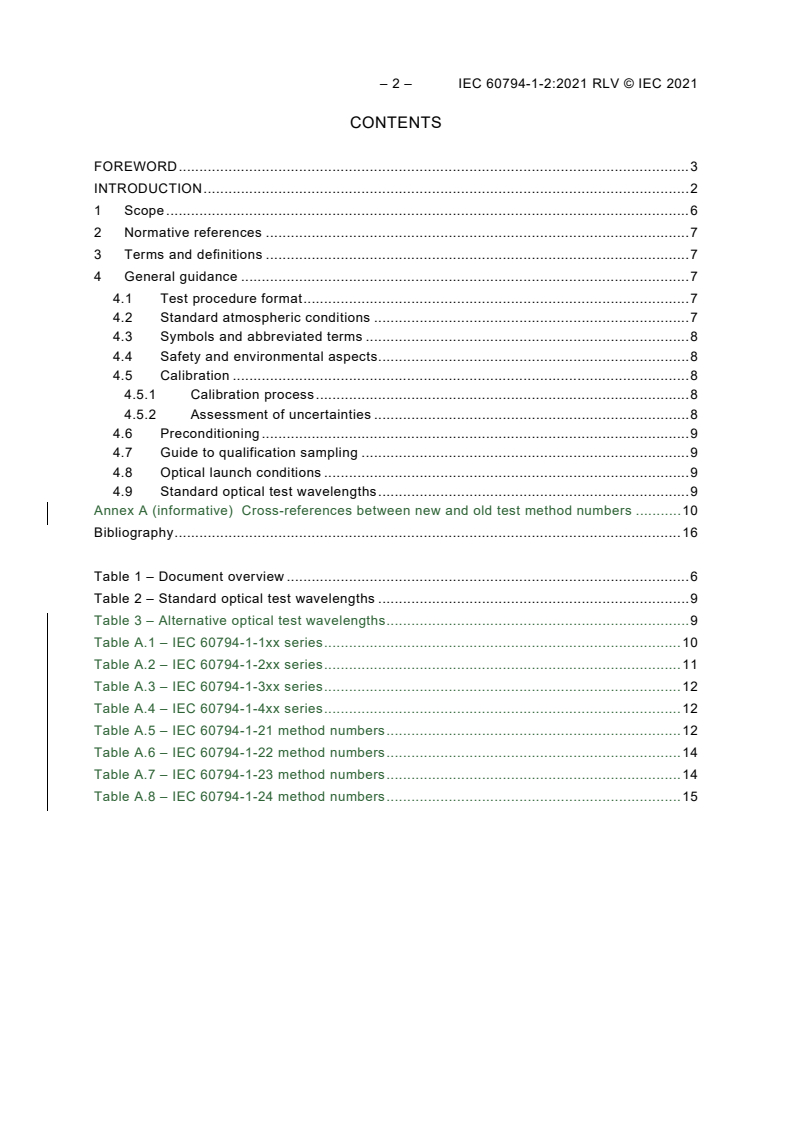
– 2 – IEC 60794-1-2:2021 RLV © IEC 2021
CONTENTS
FOREWORD . 3
INTRODUCTION . 2
1 Scope . 6
2 Normative references . 7
3 Terms and definitions . 7
4 General guidance . 7
4.1 Test procedure format . 7
4.2 Standard atmospheric conditions . 7
4.3 Symbols and abbreviated terms . 8
4.4 Safety and environmental aspects. 8
4.5 Calibration . 8
4.5.1 Calibration process . 8
4.5.2 Assessment of uncertainties . 8
4.6 Preconditioning . 9
4.7 Guide to qualification sampling . 9
4.8 Optical launch conditions . 9
4.9 Standard optical test wavelengths . 9
Annex A (informative) Cross-references between new and old test method numbers . 10
Bibliography . 16
Table 1 – Document overview . 6
Table 2 – Standard optical test wavelengths . 9
Table 3 – Alternative optical test wavelengths . 9
Table A.1 – IEC 60794-1-1xx series . 10
Table A.2 – IEC 60794-1-2xx series . 11
Table A.3 – IEC 60794-1-3xx series . 12
Table A.4 – IEC 60794-1-4xx series . 12
Table A.5 – IEC 60794-1-21 method numbers . 12
Table A.6 – IEC 60794-1-22 method numbers . 14
Table A.7 – IEC 60794-1-23 method numbers . 14
Table A.8 – IEC 60794-1-24 method numbers . 15
INTERNATIONAL ELECTROTECHNICAL COMMISSION
____________
OPTICAL FIBRE CABLES –
Part 1-2: Generic specification –
Basic optical cable test procedures –
General guidance
FOREWORD
1) The International Electrotechnical Commission (IEC) is a worldwide organization for standardization comprising
all national electrotechnical committees (IEC National Committees). The object of IEC is to promote international
co-operation on all questions concerning standardization in the electrical and electronic fields. To this end and
in addition to other activities, IEC publishes International Standards, Technical Specifications, Technical Reports,
Publicly Available Specifications (PAS) and Guides (hereafter referred to as "IEC Publication(s)"). Their
preparation is entrusted to technical committees; any IEC National Committee interested in the subject dealt with
may participate in this preparatory work. International, governmental and non-governmental organizations liaising
with the IEC also participate in this preparation. IEC collaborates closely with the International Organization for
Standardization (ISO) in accordance with conditions determined by agreement between the two organizations.
2) The formal decisions or agreements of IEC on technical matters express, as nearly as possible, an international
consensus of opinion on the relevant subjects since each technical committee has representation from all
interested IEC National Committees.
3) IEC Publications have the form of recommendations for international use and are accepted by IEC National
Committees in that sense. While all reasonable efforts are made to ensure that the technical content of IEC
Publications is accurate, IEC cannot be held responsible for the way in which they are used or for any
misinterpretation by any end user.
4) In order to promote international uniformity, IEC National Committees undertake to apply IEC Publications
transparently to the maximum extent possible in their national and regional publications. Any divergence between
any IEC Publication and the corresponding national or regional publication shall be clearly indicated in the latter.
5) IEC itself does not provide any attestation of conformity. Independent certification bodies provide conformity
assessment services and, in some areas, access to IEC marks of conformity. IEC is not responsible for any
services carried out by independent certification bodies.
6) All users should ensure that they have the latest edition of this publication.
7) No liability shall attach to IEC or its directors, employees, servants or agents including individual experts and
members of its technical committees and IEC National Committees for any personal injury, property damage or
other damage of any nature whatsoever, whether direct or indirect, or for costs (including legal fees) and
expenses arising out of the publication, use of, or reliance upon, this IEC Publication or any other IEC
Publications.
8) Attention is drawn to the Normative references cited in this publication. Use of the referenced publications is
indispensable for the correct application of this publication.
9) Attention is drawn to the possibility that some of the elements of this IEC Publication may be the subject of patent
rights. IEC shall not be held responsible for identifying any or all such patent rights.
This redline version of the official IEC Standard allows the user to identify the changes made to
the previous edition IEC 60794-1-2:2017. A vertical bar appears in the margin wherever a change
has been made. Additions are in green text, deletions are in strikethrough red text.
– 4 – IEC 60794-1-2:2021 RLV © IEC 2021
International Standard IEC 60794-1-2 has been prepared by subcommittee 86A: Fibres and
cables, of IEC technical committee 86: Fibre optics.
This fifth edition cancels and replaces the fourth edition published in 2017. This edition
constitutes an technical revision.
This edition includes the following significant technical change with respect to the previous
edition:
a) addition of cross-reference tables listing the new test method numbers and the previous test
method numbers.
The text of this International Standard is based on the following documents:
CDV Report on voting
86A/2009/CDV 86A/2057/RVC
Full information on the voting for the approval of this International Standard can be found in the
report on voting indicated in the above table.
This International Standard is to be used in conjunction with IEC 60794-1-1.
This publication has been drafted in accordance with the ISO/IEC Directives, Part 2.
A list of all parts in the IEC 60794 series, published under the general title Optical fibre cables,
can be found on the IEC website.
The committee has decided that the contents of this document will remain unchanged until the
stability date indicated on the IEC web site under "http://webstore.iec.ch" in the data related to
the specific publication. At this date, the document will be
• reconfirmed,
• withdrawn,
• replaced by a revised edition, or
• amended.
IMPORTANT – The 'colour inside' logo on the cover page of this publication indicates that it
contains colours which are considered to be useful for the correct understanding of its
contents. Users should therefore print this document using a colour printer.
INTRODUCTION
IEC 60794-1-2:2013 comprised a detailed cross-reference table to the new document set, and
general guidance was given in IEC 60794-1-20. These two specifications have been combined
in this document, which allows for IEC 60794-1-20 to be withdrawn.
A decision has been reached to reorganize the IEC 60794-1-2 set of test methods into single-
subject documents. This will be a migration as the existing test methods are revised and as new
test methods are promulgated, rather than a wholesale rewrite. Part of this migration is a
decision to maintain the traditional letter-number classification and to use a numbering system
which maintains connection to the existing numbering system.
The new test method numbering format has been agreed, in line with IEC Secretariat guidelines,
to help the cross-referencing from old to new and that will make the updating of the relevant
sectional and product specifications easier. Cross-reference tables listing the new test method
numbers and the previous test method numbers have been included (see Annex A, Table A.1
to Table A.8).
The format agreed is as follows:
IEC 60794-1-Xnn
where
nd
X = 2 digit of the old 2-digit reference;
nn = incremental number (starting with old test method number).
For example:
IEC 60794-1-21 method E1 (tensile) becomes IEC 60794-1-101;
IEC 60794-1-22 method F5 (water penetration) becomes IEC 60794-1-205;
IEC 60794-1-23 method G7 (tube kinking) becomes IEC 60794-1-307;
IEC 60794-1-24 method H2 (lightning) becomes IEC 60794-1-402.
Annex A has been added to this document containing a cross-reference between the old and
new number scheme.
– 6 – IEC 60794-1-2:2021 RLV © IEC 2021
OPTICAL FIBRE CABLES –
Part 1-2: Generic specification –
Basic optical cable test procedures –
General guidance
1 Scope
This part of IEC 60794-1 applies to optical fibre cables for use with telecommunications
equipment and devices employing similar techniques, and to cables having a combination of
both optical fibres and electrical conductors.
The prime objective of this document is to provide the end user with an overview about the
content of different parts of the IEC 60794-1 series numbered -2X. Table 1 shows the different
parts.
An objective of this document is to define general requirements and methodology guidance
applicable to all of the cable test methods of IEC 60794-1 (all parts).
A second objective of this document is to provide the end user with an overview of the different
test methods contained in the different parts of the IEC 60794-1 series, numbered -Xnn.
Table 1 shows the different parts.
Table 1 – Document overview
Test methods IEC reference Previous Test method category
compendium reference letter
reference
General guidance IEC 60794-1-2 IEC 60794-1-2 -
Mechanical IEC 60794-1-1nn IEC 60794-1-21:2015 Methods E
Environmental IEC 60794-1-2nn IEC 60794-1-22:2017 Methods F
Cable elements IEC 60794-1-3nn IEC 60794-1-23:2019 Methods G
Electrical IEC 60794-1-4nn IEC 60794-1-24:2014 Methods H
NOTE 1 The compendium reference specifications detailed in column 3 will continue in force until all of the test
methods therein are revised into the single-subject documents using the new numbering scheme.
NOTE 2 For existing test methods, "nn" is the test method number. For new test methods, "nn" is an incremental
number following the last test method number for that test category.
NOTE 3 Several numbers in the test method numbering sequence are missing. The reasons for these omissions
are historical. To avoid confusion, the existing numbering sequence has been retained.
These documents define test procedures to be used in establishing uniform requirements for
the geometrical, transmission, material, mechanical, ageing (environmental exposure) and
climatic properties of optical fibre cables, and electrical requirements where appropriate.
Throughout the documents, the wording "optical cable" can also include optical fibre units,
microduct fibre units, etc.
The secondary objective of this document is to provide the end user with useful guidance when
testing optical fibre cables.
2 Normative references
The following documents are referred to in the text in such a way that some or all of their content
constitutes requirements of this document. For dated references, only the edition cited applies.
For undated references, the latest edition of the referenced document (including any
amendments) applies.
IEC 60793-1-40, Optical fibres – Part 1-40: Attenuation measurement methods and test
procedures – Attenuation
IEC 60793-1-46, Optical fibres – Part 1-46: Measurement methods and test procedures –
Monitoring of changes in optical transmittance
IEC 60793-2-40, Optical fibres – Part 2-40: Product specifications – Sectional specification for
category A4 multimode fibres
IEC 60794-1-1:2015, Optical fibre cables – Generic specification – General
IEC 60794-1-21:2015, Optical fibre cables – Part 1-21: Generic specification – Basic optical
cable test procedures – Mechanical tests methods
IEC 60794-1-22:2017, Optical fibre cables – Part 1-22: Generic specification – Basic optical
cable test procedures – Environmental test methods
IEC 60794-1-23:2019, Optical fibre cables – Part 1-23: Generic specification – Basic optical
cable test procedures – Cable element test methods
IEC 60794-1-24:2014, Optical fibre cables – Part 1-24: Generic specification – Basic optical
cable test procedures – Electrical test methods
3 Terms and definitions
For the purposes of this document, the terms and definitions given in IEC 60794-1-1 apply.
ISO and IEC maintain terminological databases for use in standardization at the following
addresses:
• IEC Electropedia: available at http://www.electropedia.org/
• ISO Online browsing platform: available at http://www.iso.org/obp
4 General guidance
4.1 Test procedure format
The standard descriptive order of each test method is in general as follows: object, sample,
apparatus, procedure, requirement, details to be specified, details to be reported. Additional
clauses may be inserted, whilst maintaining this general order.
4.2 Standard atmospheric conditions
Two sets of allowable ambient conditions for cable testing are defined for use in testing in this
document:
a) Standard test conditions
– temperature: +23 °C ± 5 ºC
– 8 – IEC 60794-1-2:2021 RLV © IEC 2021
– pressure: site ambient
– relative humidity: 20 % to 70 %
b) Expanded test conditions
– temperature: +25 °C ± 15 ºC
– pressure: site ambient
– relative humidity: 5 % to 95 %
Unless otherwise stated in the particular test, the expanded test conditions shall be used as the
default atmospheric conditions when performing tests. The standard test conditions are only for
use when specifically requested.
NOTE A tightly-controlled temperature range is considered unnecessary for most cable tests.
Consideration shall be given to the effects of temperature differences and variations on
electronic and optical test equipment that may be used in performing the tests. It may be
necessary to maintain such equipment at the controlled atmospheric conditions by appropriate
means.
4.3 Symbols and abbreviated terms
Symbols and abbreviated terms are given in IEC 60794-1-1.
4.4 Safety and environmental aspects
All applicable safety and environmental regulations shall be met.
4.5 Calibration
4.5.1 Calibration process
Ensure the apparatus is calibrated and adjusted in accordance with the manufacturer’s
instructions before use in order to minimize measurement uncertainty.
Record relevant information of the calibration process, such as the calibrated value and
uncertainty of the reference material or test equipment used.
4.5.2 Assessment of uncertainties
Measurement uncertainty may be defined as the range within which the true value of a
measured quantity (the measure) is estimated to lie, within a given likelihood (or confidence
level) [1] . The measurement uncertainty normally comprises several components, some of
which may be estimated using statistical techniques (known as type A uncertainties) whilst
others may be estimated on the basis of experience or other information (known as type B
uncertainties). Components of uncertainty, or variance, are additive, and a confidence interval
may be calculated for the measurements based on the sum of the variance components.
A typical build-up of uncertainty may include the following sources of uncertainty:
– calibration uncertainty of reference materials or equipment used – normally stated on the
calibration certificates of the standards;
– transfer uncertainty – estimated changes in the certified values of reference materials or
equipment since they were calibrated;
– operational uncertainty – estimated effects of environmental conditions, such as temper-
ature and humidity;
___________
Numbers in square brackets refer to the Bibliography.
– statistical (random) uncertainty in the measurement of the specimen and the calibration
standard – due to, for example, electrical noise, vibration, data quantization, etc.
4.6 Preconditioning
Most tests are performed at ambient conditions or begin at ambient conditions, as per in
accordance with 4.2. The intent is that the preconditioning achieve thermal stability. Some test
methods address thermal stability in an explicit and detailed manner. Unless otherwise
specified, samples shall be preconditioned at ambient conditions for a minimum of 12 h prior to
the test.
4.7 Guide to qualification sampling
For qualification purposes, it should only be necessary to test a subset of the fibre and/or
element counts that represent a product range. Not all fibres within a cable are required to be
tested to qualify a cable. A guide to qualification sampling is found in IEC 60794-1-1. Not all
tests are required for a cable design. It depends upon the application and relevant specification.
4.8 Optical launch conditions
Optical measurements shall follow conditions as described in the IEC 60793-1 series, in
particular IEC 60793-1-40 for attenuation and IEC 60793-1-46 for monitoring changes in optical
transmittance by transmitted power or backscattering.
4.9 Standard optical test wavelengths
The standard optical test wavelengths for type testing of cabled optical fibre, performed per in
accordance IEC 60794-1-1, are as given in Table 2, unless otherwise specified in the individual
test or in the detail specification.
Table 2 – Standard optical test wavelengths
Fibre type Wavelength
Single-mode 1 550 nm ± 10 nm
Multimode 1 300 nm ± 20 nm
NOTE Other test wavelengths can require different tolerance ranges.
Single-mode fibres which are specified for performance in the L band are tested at 1 625 nm,
as given in Table 3. In this case, specific performance criteria shall be specified at 1 625 nm by
the relevant specification.
For multimode fibres that are optimized for wavelengths lower than 1 300 nm (e.g. 850 nm, as
given in Table 3), the highest specified wavelength shall be tested. In this case, the 1 300 nm
test criteria specified in the relevant specification shall be used. Category A4 multimode fibres
shall be tested at the applicable sub-category wavelength given in IEC 60793-2-40.
Table 3 – Alternative optical test wavelengths
Fibre type Wavelength
Single-mode 1 625 nm ± 10 nm
Multimode 850 nm ± 20 nm
NOTE Other test wavelengths can require different tolerance ranges.
Specified changes in optical performance include an allowance for measurement repeatability.
– 10 – IEC 60794-1-2:2021 RLV © IEC 2021
Annex A
(informative)
Cross-references between new and old test method numbers
Table A.1 to Table A.8 show the cross-references between new and old test method numbers.
Table A.1 – IEC 60794-1-1xx series
New IEC 60794-1-1xx IEC 60794-1-21 method
Title
series number number
IEC 60794-1-101 Tensile performance Method E1
IEC 60794-1-102 Abrasion Method E2
Method A: Abrasion resistance of optical fibre cable Method E2A
sheaths
Method B: Abrasion resistance of optical fibre cable Method E2B
markings
IEC 60794-1-103 Crush Method E3
Method A: Plate/plate Method E3A
Method B: Mandrel/plate Method E3B
IEC 60794-1-104 Impact Method E4
IEC 60794-1-105 Stripping force stability of cabled optical fibres Method E5A
IEC 60794-1-106 Repeated bending Method E6
IEC 60794-1-107 Torsion Method E7
IEC 60794-1-108 Flexing Method E8
- Snatch (deleted) Method E9
IEC 60794-1-110 Kink Method E10
IEC 60794-1-111 Bend Method E11
Method A: Standard test procedure Method E11A
Method B: Alternative test procedure Method E11B
- Cut-through resistance (deleted) Method E12
IEC 60794-1-113 Shotgun damage Method E13
Method A: Shotgun test Method E13A
Method B: Shotgun simulation Method E13B
- [Title unknown] (deleted) Method E16
IEC 60794-1-117 Bending stiffness Method E17
Method A: Three-point bend Method E17A
Method B: Cantilever bend Method E17B
Method C: Buckling bend Method E17C
IEC 60794-1-118 Bending under tension Method E18A
IEC 60794-1-119 Aeolian vibration Method E19
IEC 60794-1-120 Cable coiling performance Method E20
IEC 60794-1-121 Sheath pull-off force for optical fibre cable for use in Method E21
patch cords
IEC 60794-1-122 Buffered fibre movement under compression in optical Method E22
fibre cables for use in patch cords
IEC 60794-1-123 Microduct route verification test Method E23
IEC 60794-1-124 Installation test for microduct cabling Method E24
New IEC 60794-1-1xx Title IEC 60794-1-21 method
series number number
IEC 60794-1-125 Rip cord functional test Method E25
IEC 60794-1-126 Galloping Method E26
IEC 60794-1-127 Indoor simulated installation test Method E27
IEC 60794-1-128 Cable and fibre mechanical reliability test Method E28
IEC 60794-1-129 Straight midspan access to optical elements Method E29
IEC 60794-1-130 Coefficient of friction between cables Method E30
IEC 60794-1-131 Microduct inner clearance test Method E31
IEC 60794-1-132 Creep behaviour tension test (for ADSS) Method E32
IEC 60794-1-133 Multiple cable coiling and uncoiling performance Method E33
IEC 60794-1-134 Coefficient of dynamic friction between cables Method E34
IEC 60794-1-135 Sheave test (primarily for OPGW and OPAC) Method E18B
Table A.2 – IEC 60794-1-2xx series
New IEC 60794-1-2xx Title IEC 60794-1-22 method
series number number
60794-1-201 Temperature cycling Method F1
- Deleted Method F2
- Deleted Method F3
- Deleted Method F4
60794-1-205 Water penetration Method F5
Method A: Water penetration (circumferential) Method F5A
Method B: Water penetration (end-on) Method F5B
Method C: Water penetration (end-on, for cables with Method F5C
swellable water blocking material)
- Deleted Method F6
60794-1-207 Nuclear radiation Method F7
60794-1-208 Pneumatic resistance Method F8
60794-1-209 Ageing Method F9
60794-1-210 Underwater cable resistance to hydrostatic pressure Method F10
60794-1-211 Sheath shrinkage Method F11
60794-1-212 Temperature cycling of cables to be terminated with Method F12
connectors
60794-1-213 Microduct pressure withstand Method F13
60794-1-214 Cable UV resistance test Method F14
60794-1-215 Cable external freezing test Method F15
60794-1-216 Compound flow (drip) Method F16
60794-1-217 Cable shrinkage test (fibre protrusion) Method F17
60794-1-218 Mid-span temperature cycling test for exposed buffer Method F18
tubes
60794-1-219 Material compatibility Method F19
– 12 – IEC 60794-1-2:2021 RLV © IEC 2021
Table A.3 – IEC 60794-1-3xx series
New IEC 60794-1-3xx Title IEC 60794-1-23 method
series number number
60794-1-301 Bend test for cable elements Method G1
60794-1-302 Ribbon dimensions and geometry – Visual method Method G2
60794-1-303 Ribbon dimensions – Aperture gauge Method G3
- Ribbon dimensions – Dial gauge (deleted) Method G4
60794-1-305 Ribbon tear (separability) Method G5
60794-1-306 Ribbon torsion Method G6
60794-1-307 Tube kinking Method G7
60794-1-308 Ribbon residual twist test Method G8
60794-1-309 Bleeding and evaporation Method G9
60794-1-310 Stripping Method G10
Stripping force stability of cabled optical fibres Method G10A
Strippability of optical fibre ribbons Method G10B
Strippability of buffered optical fibres Method G10C
60794-1-311 Tensile strength and elongation at break of buffer Method G11A
tubes and micro tubes
60794-1-312 Elongation of buffer tubes and micro tubes at low Method G11B
temperature
Table A.4 – IEC 60794-1-4xx series
New IEC 60794-1-4xx Title IEC 60794-1-24 method
series number number
60794-1-401 Short-circuit test (for OPGW and OPAC) Method H1
60794-1-402 Lightning test method for optical aerial cables along Method H2
electric power lines (OPGW and OPAC)
60794-1-403 Electrical continuity test of cable metallic elements Method H3
Table A.5 – IEC 60794-1-21 method numbers
IEC 60794-1-21 method Title New IEC 60794-1-Xxx
number series number
Method E1 Tensile performance 60794-1-101
Method E2 Abrasion 60794-1-102
Method E2A Abrasion resistance of optical fibre cable sheaths 60794-1-102 Method A
Method E2B Abrasion resistance of optical fibre cable markings 60794-1-102 Method B
Method E3 Crush 60794-1-103
Method E3A Plate/plate 60794-1-103 Method A
Method E3B Mandrel/plate 60794-1-103 Method B
Method E4 Impact 60794-1-104
Method E5A Stripping force stability of cabled optical fibres 60794-1-105
Method E5B Strippability of optical fibre ribbons 60794-1-313
Method E5C Strippability of buffered optical fibres 60794-1-314
Method E6 Repeated bending 60794-1-106
Method E7 Torsion 60794-1-107
IEC 60794-1-21 method Title New IEC 60794-1-Xxx
number series number
Method E8 Flexing 60794-1-108
Method E9 Snatch (deleted) -
Method E10 Kink 60794-1-110
Method E11 Bend 60794-1-111
Method E11A Standard test procedure 60794-1-111 Method A
Method E11B Alternative test procedure 60794-1-111 Method B
Method E12 Cut-through resistance (deleted) -
Method E13 Shotgun damage 60794-1-113
Method E13A Shotgun test 60794-1-113 Method A
Method E13B Shotgun simulation 60794-1-113 Method B
Method E14 Compound flow (drip) 60794-1-216
Method E15 Bleeding and evaporation 60794-1-309
Method E16 [Title unknown] (deleted) -
Method E17 Bending stiffness 60794-1-117
Method E17A Three-point bend 60794-1-117 Method A
Method E17B Cantilever bend 60794-1-117 Method B
Method E17C Buckling bend 60794-1-117 Method C
Method E18A Bending under tension 60794-1-118
Method E18B Sheave test (primarily for OPGW and OPAC) 60794-1-135
Method E19 Aeolian vibration 60794-1-119
Method E20 Cable coiling performance 60794-1-120
Method E21 Sheath pull-off force for optical fibre cable for use in 60794-1-121
patch cords
Method E22 Buffered fibre movement under compression in optical 60794-1-122
fibre cables for use in patch cords
Method E23 Microduct route verification test 60794-1-123
Method E24 Installation test for microduct cabling 60794-1-124
Method E25 Rip cord functional test 60794-1-125
Method E26 Galloping 60794-1-126
Method E27 Indoor simulated installation test 60794-1-127
Method E28 Cable and fibre mechanical reliability test 60794-1-128
Method E29 Straight midspan access to optical elements 60794-1-129
Method E30 Coefficient of friction between cables 60794-1-130
Method E31 Microduct inner clearance test 60794-1-131
Method E32 Creep behaviour tension test (for ADSS) 60794-1-132
Method E33 Multiple cable coiling and uncoiling performance 60794-1-133
Method E34 Coefficient of dynamic friction between cables 60794-1-134
– 14 – IEC 60794-1-2:2021 RLV © IEC 2021
Table A.6 – IEC 60794-1-22 method numbers
IEC 60794-1-22 method Title New IEC 60794-1-2xx
number series number
Method F1 Temperature cycling 60794-1-201
Method F2 Deleted -
Method F3 Deleted -
Method F4 Deleted -
Method F5 Water penetration 60794-1-205
Method F5A Water penetration (circumferential) 60794-1-205 Method A
Method F5B Water penetration (end-on) 60794-1-205 Method B
Method F5C Water penetration (end-on, for cables with swellable 60794-1-205 Method C
water blocking material)
Method F6 Deleted -
Method F7 Nuclear radiation 60794-1-207
Method F8 Pneumatic resistance 60794-1-208
Method F9 Ageing 60794-1-209
Method F10 Underwater cable resistance to hydrostatic pressure 60794-1-210
Method F11 Sheath shrinkage 60794-1-211
Method F12 Temperature cycling of cables to be terminated with 60794-1-212
connectors
Method F13 Microduct pressure-withstand 60794-1-213
Method F14 Cable UV resistance test 60794-1-214
Method F15 Cable external freezing test 60794-1-215
Method F16 Compound flow (drip) 60794-1-216
Method F17 Cable shrinkage test (fibre protrusion) 60794-1-217
Method F18 Mid-span temperature cycling test for exposed buffer 60794-1-218
tubes
Method F19 Material compatibility 60794-1-219
Table A.7 – IEC 60794-1-23 method numbers
IEC 60794-1-23 method Title New IEC 60794-1-3xx
number series number
Method G1 Bend test for cable elements 60794-1-301
Method G2 Ribbon dimensions and geometry – Visual method 60794-1-302
Method G3 Ribbon dimensions – Aperture gauge 60794-1-303
Method G4 Ribbon dimensions – Dial gauge (deleted) -
Method G5 Ribbon tear (separability) 60794-1-305
Method G6 Ribbon torsion 60794-1-306
Method G7 Tube kinking 60794-1-307
Method G8 Ribbon residual twist test 60794-1-308
Method G9 Bleeding and evaporation 60794-1-309
Method G10 Stripping 60794-1-310
Method G10A Stripping force stability of cabled optical fibres 60794-1-310 Method A
Method G10B Strippability of optical fibre ribbons 60794-1-310 Method B
Method G10C Strippability of buffered optical fibres 60794-1-314 Method C
Method G11 Tensile strength and elongation at break of buffer 60794-1-311
tubes
Method G11A Elongation of buffer tubes at low temperature 60794-1-312
Table A.8 – IEC 60794-1-24 method numbers
IEC 60794-1-24 method Title New IEC 60794-1-4xx
number series number
Method H1 Short-circuit test (for OPGW and OPAC) 60794-1-401
Method H2 Lightning test method for optical aerial cables along 60794-1-402
electric power lines (OPGW and OPAC)
Method H3 Electrical continuity test of cable metallic elements 60794-1-403
– 16 – IEC 60794-1-2:2021 RLV © IEC 2021
Bibliography
IEC 60794-1-21, Optical fibre cables – Part 1-21: Generic specification – Basic optical cable
test procedures – Mechanical test methods
IEC 60794-1-22, Optical fibre cables – Part 1-22: Generic specification – Basic optical cable
test procedures – Environmental test methods
IEC 60794-1-23, Optical fibre cables – Part 1-23: Generic specification – Basic optical cable
test procedures – Cable element test methods
IEC 60794-1-24, Optical fibre cables – Part 1-24: Generic specification – Basic optical cable
test procedures – Electrical test methods
[1] ISO/IEC Guide 98-3:2008, Uncertainty of measurement – Guide to the expression of
uncertainty in measurement (GUM:1995)
___________
IEC 60794-1-2 ®
Edition 5.0 2021-01
INTERNATIONAL
STANDARD
NORME
INTERNATIONALE
Optical fibre cables –
Part 1-2: Generic specification – Basic optical cable test procedures – General
guidance
Câbles à fibres optiques –
Partie 1-2: Spécification générique – Procédures fondamentales d'essais des
câbles optiques – Recommandations générales
– 2 – IEC 60794-1-2:2021 © IEC 2021
CONTENTS
FOREWORD . 3
INTRODUCTION . 5
1 Scope . 6
2 Normative references . 7
3 Terms and definitions . 7
4 General guidance . 7
4.1 Test procedure format . 7
4.2 Standard atmospheric conditions . 7
4.3 Symbols and abbreviated terms . 8
4.4 Safety and environmental aspects. 8
4.5 Calibration . 8
4.5.1 Calibration process . 8
4.5.2 Assessment of uncertainties . 8
4.6 Preconditioning . 9
4.7 Guide to qualification sampling . 9
4.8 Optical launch conditions . 9
4.9 Standard optical test wavelengths . 9
Annex A (informative) Cross-references between new and old test method numbers . 10
Bibliography . 16
Table 1 – Document overview . 6
Table 2 – Standard optical test wavelengths . 9
Table 3 – Alternative optical test wavelengths . 9
Table A.1 – IEC 60794-1-1xx series . 10
Table A.2 – IEC 60794-1-2xx series . 11
Table A.3 – IEC 60794-1-3xx series . 12
Table A.4 – IEC 60794-1-4xx series . 12
Table A.5 – IEC 60794-1-21 method numbers . 12
Table A.6 – IEC 60794-1-22 method numbers . 14
Table A.7 – IEC 60794-1-23 method numbers . 14
Table A.8 – IEC 60794-1-24 method numbers . 15
INTERNATIONAL ELECTROTECHNICAL COMMISSION
____________
OPTICAL FIBRE CABLES –
Part 1-2: Generic specification –
Basic optical cable test procedures –
General guidance
FOREWORD
1) The International Electrotechnical Commission (IEC) is a worldwide organization for standardization comprising
all national electrotechnical committees (IEC National Committees). The object of IEC is to promote international
co-operation on all questions concerning standardization in the electrical and electronic fields. To this end and
in addition to other activities, IEC publishes International Standards, Technical Specifications, Technical Reports,
Publicly Available Specifications (PAS) and Guides (hereafter referred to as "IEC Publication(s)"). Their
preparation is entrusted to technical committees; any IEC National Committee interested in the subject dealt with
may participate in this preparatory work. International, governmental and non-governmental organizations liaising
with the IEC also participate in this preparation. IEC collaborates closely with the International Organization for
Standardization (ISO) in accordance with conditions determined by agreement between the two organizations.
2) The formal decisions or agreements of IEC on technical matters express, as nearly as possible, an international
consensus of opinion on the relevant subjects since each technical committee has representation from all
interested IEC National Committees.
3) IEC Publications have the form of recommendations for international use and are accepted by IEC National
Committees in that sense. While all reasonable efforts are made to ensure that the technical content of IEC
Publications is accurate, IEC cannot be held responsible for the way in which they are used or for any
misinterpretation by any end user.
4) In order to promote international uniformity, IEC National Committees undertake to apply IEC Publications
transparently to the maximum extent possible in their national and regional publications. Any divergence between
any IEC Publication and the corresponding national or regional publication shall be clearly indicated in the latter.
5) IEC itself does not provide any attestation of conformity. Independent certification bodies provide conformity
assessment services and, in some areas, access to IEC marks of conformity. IEC is not responsible for any
services carried out by independent certification bodies.
6) All users should ensure that they have the latest edition of this publication.
7) No liability shall attach to IEC or its directors, employees, servants or agents including individual experts and
members of its technical committees and IEC National Committees for any personal injury, property damage or
other damage of any nature whatsoever, whether direct or indirect, or for costs (including legal fees) and
expenses arising out of the publication, use of, or reliance upon, this IEC Publication or any other IEC
Publications.
8) Attention is drawn to the Normative references cited in this publication. Use of the referenced publications is
indispensable for the correct application of this publication.
9) Attention is drawn to the possibility that some of the elements of this IEC Publication may be the subject of patent
rights. IEC shall not be held responsible for identifying any or all such patent rights.
International Standard IEC 60794-1-2 has been prepared by subcommittee 86A: Fibres and
cables, of IEC technical committee 86: Fibre optics.
This fifth edition cancels and replaces the fourth edition published in 2017. This edition
constitutes an technical revision.
This edition includes the following significant technical change with respect to the previous
edition:
a) addition of cross-reference tables listing the new test method numbers and the previous test
method numbers.
---------
...
IEC 60794-1-2 ®
Edition 5.0 2021-01
INTERNATIONAL
STANDARD
NORME
INTERNATIONALE
Optical fibre cables –
Part 1-2: Generic specification – Basic optical cable test procedures – General
guidance
Câbles à fibres optiques –
Partie 1-2: Spécification générique – Procédures fondamentales d'essais des
câbles optiques – Recommandations générales
All rights reserved. Unless otherwise specified, no part of this publication may be reproduced or utilized in any form
or by any means, electronic or mechanical, including photocopying and microfilm, without permission in writing from
either IEC or IEC's member National Committee in the country of the requester. If you have any questions about IEC
copyright or have an enquiry about obtaining additional rights to this publication, please contact the address below or
your local IEC member National Committee for further information.
Droits de reproduction réservés. Sauf indication contraire, aucune partie de cette publication ne peut être reproduite ni
utilisée sous quelque forme que ce soit et par aucun procédé, électronique ou mécanique, y compris la photocopie et
les microfilms, sans l'accord écrit de l'IEC ou du Comité national de l'IEC du pays du demandeur. Si vous avez des
questions sur le copyright de l'IEC ou si vous désirez obtenir des droits supplémentaires sur cette publication, utilisez
les coordonnées ci-après ou contactez le Comité national de l'IEC de votre pays de résidence.
IEC Central Office Tel.: +41 22 919 02 11
3, rue de Varembé info@iec.ch
CH-1211 Geneva 20 www.iec.ch
Switzerland
About the IEC
The International Electrotechnical Commission (IEC) is the leading global organization that prepares and publishes
International Standards for all electrical, electronic and related technologies.
About IEC publications
The technical content of IEC publications is kept under constant review by the IEC. Please make sure that you have the
latest edition, a corrigendum or an amendment might have been published.
IEC publications search - webstore.iec.ch/advsearchform IEC online collection - oc.iec.ch
The advanced search enables to find IEC publications by a Discover our powerful search engine and read freely all the
variety of criteria (reference number, text, technical publications previews. With a subscription you will always have
committee, …). It also gives information on projects, replaced access to up to date content tailored to your needs.
and withdrawn publications.
Electropedia - www.electropedia.org
IEC Just Published - webstore.iec.ch/justpublished
The world's leading online dictionary on electrotechnology,
Stay up to date on all new IEC publications. Just Published
containing more than 22 000 terminological entries in English
details all new publications released. Available online and once
and French, with equivalent terms in 18 additional languages.
a month by email.
Also known as the International Electrotechnical Vocabulary
(IEV) online.
IEC Customer Service Centre - webstore.iec.ch/csc
If you wish to give us your feedback on this publication or need
further assistance, please contact the Customer Service
Centre: sales@iec.ch.
A propos de l'IEC
La Commission Electrotechnique Internationale (IEC) est la première organisation mondiale qui élabore et publie des
Normes internationales pour tout ce qui a trait à l'électricité, à l'électronique et aux technologies apparentées.
A propos des publications IEC
Le contenu technique des publications IEC est constamment revu. Veuillez vous assurer que vous possédez l’édition la
plus récente, un corrigendum ou amendement peut avoir été publié.
Recherche de publications IEC - Découvrez notre puissant moteur de recherche et consultez
webstore.iec.ch/advsearchform gratuitement tous les aperçus des publications. Avec un
La recherche avancée permet de trouver des publications IEC abonnement, vous aurez toujours accès à un contenu à jour
en utilisant différents critères (numéro de référence, texte, adapté à vos besoins.
comité d’études, …). Elle donne aussi des informations sur les
projets et les publications remplacées ou retirées. Electropedia - www.electropedia.org
Le premier dictionnaire d'électrotechnologie en ligne au monde,
IEC Just Published - webstore.iec.ch/justpublished
avec plus de 22 000 articles terminologiques en anglais et en
Restez informé sur les nouvelles publications IEC. Just
français, ainsi que les termes équivalents dans 16 langues
Published détaille les nouvelles publications parues.
additionnelles. Egalement appelé Vocabulaire
Disponible en ligne et une fois par mois par email.
Electrotechnique International (IEV) en ligne.
Service Clients - webstore.iec.ch/csc
Si vous désirez nous donner des commentaires sur cette
publication ou si vous avez des questions contactez-nous:
sales@iec.ch.
IEC online collection - oc.iec.ch
IEC 60794-1-2 ®
Edition 5.0 2021-01
INTERNATIONAL
STANDARD
NORME
INTERNATIONALE
Optical fibre cables –
Part 1-2: Generic specification – Basic optical cable test procedures – General
guidance
Câbles à fibres optiques –
Partie 1-2: Spécification générique – Procédures fondamentales d'essais des
câbles optiques – Recommandations générales
INTERNATIONAL
ELECTROTECHNICAL
COMMISSION
COMMISSION
ELECTROTECHNIQUE
INTERNATIONALE
ICS 33.180.10 ISBN 978-2-8322-9248-8
– 2 – IEC 60794-1-2:2021 © IEC 2021
CONTENTS
FOREWORD . 3
INTRODUCTION . 5
1 Scope . 6
2 Normative references . 7
3 Terms and definitions . 7
4 General guidance . 7
4.1 Test procedure format . 7
4.2 Standard atmospheric conditions . 7
4.3 Symbols and abbreviated terms . 8
4.4 Safety and environmental aspects. 8
4.5 Calibration . 8
4.5.1 Calibration process . 8
4.5.2 Assessment of uncertainties . 8
4.6 Preconditioning . 9
4.7 Guide to qualification sampling . 9
4.8 Optical launch conditions . 9
4.9 Standard optical test wavelengths . 9
Annex A (informative) Cross-references between new and old test method numbers . 10
Bibliography . 16
Table 1 – Document overview . 6
Table 2 – Standard optical test wavelengths . 9
Table 3 – Alternative optical test wavelengths . 9
Table A.1 – IEC 60794-1-1xx series . 10
Table A.2 – IEC 60794-1-2xx series . 11
Table A.3 – IEC 60794-1-3xx series . 12
Table A.4 – IEC 60794-1-4xx series . 12
Table A.5 – IEC 60794-1-21 method numbers . 12
Table A.6 – IEC 60794-1-22 method numbers . 14
Table A.7 – IEC 60794-1-23 method numbers . 14
Table A.8 – IEC 60794-1-24 method numbers . 15
INTERNATIONAL ELECTROTECHNICAL COMMISSION
____________
OPTICAL FIBRE CABLES –
Part 1-2: Generic specification –
Basic optical cable test procedures –
General guidance
FOREWORD
1) The International Electrotechnical Commission (IEC) is a worldwide organization for standardization comprising
all national electrotechnical committees (IEC National Committees). The object of IEC is to promote international
co-operation on all questions concerning standardization in the electrical and electronic fields. To this end and
in addition to other activities, IEC publishes International Standards, Technical Specifications, Technical Reports,
Publicly Available Specifications (PAS) and Guides (hereafter referred to as "IEC Publication(s)"). Their
preparation is entrusted to technical committees; any IEC National Committee interested in the subject dealt with
may participate in this preparatory work. International, governmental and non-governmental organizations liaising
with the IEC also participate in this preparation. IEC collaborates closely with the International Organization for
Standardization (ISO) in accordance with conditions determined by agreement between the two organizations.
2) The formal decisions or agreements of IEC on technical matters express, as nearly as possible, an international
consensus of opinion on the relevant subjects since each technical committee has representation from all
interested IEC National Committees.
3) IEC Publications have the form of recommendations for international use and are accepted by IEC National
Committees in that sense. While all reasonable efforts are made to ensure that the technical content of IEC
Publications is accurate, IEC cannot be held responsible for the way in which they are used or for any
misinterpretation by any end user.
4) In order to promote international uniformity, IEC National Committees undertake to apply IEC Publications
transparently to the maximum extent possible in their national and regional publications. Any divergence between
any IEC Publication and the corresponding national or regional publication shall be clearly indicated in the latter.
5) IEC itself does not provide any attestation of conformity. Independent certification bodies provide conformity
assessment services and, in some areas, access to IEC marks of conformity. IEC is not responsible for any
services carried out by independent certification bodies.
6) All users should ensure that they have the latest edition of this publication.
7) No liability shall attach to IEC or its directors, employees, servants or agents including individual experts and
members of its technical committees and IEC National Committees for any personal injury, property damage or
other damage of any nature whatsoever, whether direct or indirect, or for costs (including legal fees) and
expenses arising out of the publication, use of, or reliance upon, this IEC Publication or any other IEC
Publications.
8) Attention is drawn to the Normative references cited in this publication. Use of the referenced publications is
indispensable for the correct application of this publication.
9) Attention is drawn to the possibility that some of the elements of this IEC Publication may be the subject of patent
rights. IEC shall not be held responsible for identifying any or all such patent rights.
International Standard IEC 60794-1-2 has been prepared by subcommittee 86A: Fibres and
cables, of IEC technical committee 86: Fibre optics.
This fifth edition cancels and replaces the fourth edition published in 2017. This edition
constitutes an technical revision.
This edition includes the following significant technical change with respect to the previous
edition:
a) addition of cross-reference tables listing the new test method numbers and the previous test
method numbers.
– 4 – IEC 60794-1-2:2021 © IEC 2021
The text of this International Standard is based on the following documents:
CDV Report on voting
86A/2009/CDV 86A/2057/RVC
Full information on the voting for the approval of this International Standard can be found in the
report on voting indicated in the above table.
This International Standard is to be used in conjunction with IEC 60794-1-1.
This publication has been drafted in accordance with the ISO/IEC Directives, Part 2.
A list of all parts in the IEC 60794 series, published under the general title Optical fibre cables,
can be found on the IEC website.
The committee has decided that the contents of this document will remain unchanged until the
stability date indicated on the IEC web site under "http://webstore.iec.ch" in the data related to
the specific publication. At this date, the document will be
• reconfirmed,
• withdrawn,
• replaced by a revised edition, or
• amended.
INTRODUCTION
A decision has been reached to reorganize the IEC 60794-1-2 set of test methods into single-
subject documents. This will be a migration as the existing test methods are revised and as new
test methods are promulgated, rather than a wholesale rewrite. Part of this migration is a
decision to maintain the traditional letter-number classification and to use a numbering system
which maintains connection to the existing numbering system.
The new test method numbering format has been agreed, in line with IEC Secretariat guidelines,
to help the cross-referencing from old to new and that will make the updating of the relevant
sectional and product specifications easier. Cross-reference tables listing the new test method
numbers and the previous test method numbers have been included (see Annex A, Table A.1
to Table A.8).
The format agreed is as follows:
IEC 60794-1-Xnn
where
nd
X = 2 digit of the old 2-digit reference;
nn = incremental number (starting with old test method number).
For example:
IEC 60794-1-21 method E1 (tensile) becomes IEC 60794-1-101;
IEC 60794-1-22 method F5 (water penetration) becomes IEC 60794-1-205;
IEC 60794-1-23 method G7 (tube kinking) becomes IEC 60794-1-307;
IEC 60794-1-24 method H2 (lightning) becomes IEC 60794-1-402.
Annex A has been added to this document containing a cross-reference between the old and
new number scheme.
– 6 – IEC 60794-1-2:2021 © IEC 2021
OPTICAL FIBRE CABLES –
Part 1-2: Generic specification –
Basic optical cable test procedures –
General guidance
1 Scope
This part of IEC 60794-1 applies to optical fibre cables for use with telecommunications
equipment and devices employing similar techniques, and to cables having a combination of
both optical fibres and electrical conductors.
An objective of this document is to define general requirements and methodology guidance
applicable to all of the cable test methods of IEC 60794-1 (all parts).
A second objective of this document is to provide the end user with an overview of the different
test methods contained in the different parts of the IEC 60794-1 series, numbered -Xnn.
Table 1 shows the different parts.
Table 1 – Document overview
Test methods IEC reference Previous Test method category
compendium reference letter
reference
General guidance IEC 60794-1-2 IEC 60794-1-2 -
Mechanical IEC 60794-1-1nn IEC 60794-1-21:2015 Methods E
Environmental IEC 60794-1-2nn IEC 60794-1-22:2017 Methods F
Cable elements IEC 60794-1-3nn IEC 60794-1-23:2019 Methods G
Electrical IEC 60794-1-4nn IEC 60794-1-24:2014 Methods H
NOTE 1 The compendium reference specifications detailed in column 3 will continue in force until all of the test
methods therein are revised into the single-subject documents using the new numbering scheme.
NOTE 2 For existing test methods, "nn" is the test method number. For new test methods, "nn" is an incremental
number following the last test method number for that test category.
NOTE 3 Several numbers in the test method numbering sequence are missing. The reasons for these omissions
are historical. To avoid confusion, the existing numbering sequence has been retained.
These documents define test procedures to be used in establishing uniform requirements for
the geometrical, transmission, material, mechanical, ageing (environmental exposure) and
climatic properties of optical fibre cables, and electrical requirements where appropriate.
Throughout the documents, the wording "optical cable" can also include optical fibre units,
microduct fibre units, etc.
The secondary objective of this document is to provide the end user with useful guidance when
testing optical fibre cables.
2 Normative references
The following documents are referred to in the text in such a way that some or all of their content
constitutes requirements of this document. For dated references, only the edition cited applies.
For undated references, the latest edition of the referenced document (including any
amendments) applies.
IEC 60793-1-40, Optical fibres – Part 1-40: Attenuation measurement methods
IEC 60793-1-46, Optical fibres – Part 1-46: Measurement methods and test procedures –
Monitoring of changes in optical transmittance
IEC 60793-2-40, Optical fibres – Part 2-40: Product specifications – Sectional specification for
category A4 multimode fibres
IEC 60794-1-1, Optical fibre cables – Generic specification – General
IEC 60794-1-21:2015, Optical fibre cables – Part 1-21: Generic specification – Basic optical
cable test procedures – Mechanical tests methods
IEC 60794-1-22:2017, Optical fibre cables – Part 1-22: Generic specification – Basic optical
cable test procedures – Environmental test methods
IEC 60794-1-23:2019, Optical fibre cables – Part 1-23: Generic specification – Basic optical
cable test procedures – Cable element test methods
IEC 60794-1-24:2014, Optical fibre cables – Part 1-24: Generic specification – Basic optical
cable test procedures – Electrical test methods
3 Terms and definitions
For the purposes of this document, the terms and definitions given in IEC 60794-1-1 apply.
ISO and IEC maintain terminological databases for use in standardization at the following
addresses:
• IEC Electropedia: available at http://www.electropedia.org/
• ISO Online browsing platform: available at http://www.iso.org/obp
4 General guidance
4.1 Test procedure format
The standard descriptive order of each test method is in general as follows: object, sample,
apparatus, procedure, requirement, details to be specified, details to be reported. Additional
clauses may be inserted, whilst maintaining this general order.
4.2 Standard atmospheric conditions
Two sets of allowable ambient conditions for cable testing are defined for use in testing in this
document:
a) Standard test conditions
– temperature: +23 °C ± 5 ºC
– pressure: site ambient
– 8 – IEC 60794-1-2:2021 © IEC 2021
– relative humidity: 20 % to 70 %
b) Expanded test conditions
– temperature: +25 °C ± 15 ºC
– pressure: site ambient
– relative humidity: 5 % to 95 %
Unless otherwise stated in the particular test, the expanded test conditions shall be used as the
default atmospheric conditions when performing tests. The standard test conditions are only for
use when specifically requested.
NOTE A tightly-controlled temperature range is considered unnecessary for most cable tests.
Consideration shall be given to the effects of temperature differences and variations on
electronic and optical test equipment that may be used in performing the tests. It may be
necessary to maintain such equipment at the controlled atmospheric conditions by appropriate
means.
4.3 Symbols and abbreviated terms
Symbols and abbreviated terms are given in IEC 60794-1-1.
4.4 Safety and environmental aspects
All applicable safety and environmental regulations shall be met.
4.5 Calibration
4.5.1 Calibration process
Ensure the apparatus is calibrated and adjusted in accordance with the manufacturer’s
instructions before use in order to minimize measurement uncertainty.
Record relevant information of the calibration process, such as the calibrated value and
uncertainty of the reference material or test equipment used.
4.5.2 Assessment of uncertainties
Measurement uncertainty may be defined as the range within which the true value of a
measured quantity (the measure) is estimated to lie, within a given likelihood (or confidence
level) [1] . The measurement uncertainty normally comprises several components, some of
which may be estimated using statistical techniques (known as type A uncertainties) whilst
others may be estimated on the basis of experience or other information (known as type B
uncertainties). Components of uncertainty, or variance, are additive, and a confidence interval
may be calculated for the measurements based on the sum of the variance components.
A typical build-up of uncertainty may include the following sources of uncertainty:
– calibration uncertainty of reference materials or equipment used – normally stated on the
calibration certificates of the standards;
– transfer uncertainty – estimated changes in the certified values of reference materials or
equipment since they were calibrated;
– operational uncertainty – estimated effects of environmental conditions, such as temper-
ature and humidity;
___________
Numbers in square brackets refer to the Bibliography.
– statistical (random) uncertainty in the measurement of the specimen and the calibration
standard – due to, for example, electrical noise, vibration, data quantization, etc.
4.6 Preconditioning
Most tests are performed at ambient conditions or begin at ambient conditions, in accordance
with 4.2. The intent is that the preconditioning achieve thermal stability. Some test methods
address thermal stability in an explicit and detailed manner. Unless otherwise specified,
samples shall be preconditioned at ambient conditions for a minimum of 12 h prior to the test.
4.7 Guide to qualification sampling
For qualification purposes, it should only be necessary to test a subset of the fibre and/or
element counts that represent a product range. Not all fibres within a cable are required to be
tested to qualify a cable. A guide to qualification sampling is found in IEC 60794-1-1. Not all
tests are required for a cable design. It depends upon the application and relevant specification.
4.8 Optical launch conditions
Optical measurements shall follow conditions as described in IEC 60793-1-40 for attenuation
and IEC 60793-1-46 for monitoring changes in optical transmittance by transmitted power or
backscattering.
4.9 Standard optical test wavelengths
The standard optical test wavelengths for type testing of cabled optical fibre, performed in
accordance IEC 60794-1-1, are as given in Table 2, unless otherwise specified in the individual
test or in the detail specification.
Table 2 – Standard optical test wavelengths
Fibre type Wavelength
Single-mode 1 550 nm ± 10 nm
Multimode 1 300 nm ± 20 nm
NOTE Other test wavelengths can require different tolerance ranges.
Single-mode fibres which are specified for performance in the L band are tested at 1 625 nm,
as given in Table 3. In this case, specific performance criteria shall be specified at 1 625 nm by
the relevant specification.
For multimode fibres that are optimized for wavelengths lower than 1 300 nm (e.g. 850 nm, as
given in Table 3), the highest specified wavelength shall be tested. In this case, the 1 300 nm
test criteria specified in the relevant specification shall be used. Category A4 multimode fibres
shall be tested at the applicable sub-category wavelength given in IEC 60793-2-40.
Table 3 – Alternative optical test wavelengths
Fibre type Wavelength
Single-mode 1 625 nm ± 10 nm
Multimode 850 nm ± 20 nm
NOTE Other test wavelengths can require different tolerance ranges.
Specified changes in optical performance include an allowance for measurement repeatability.
– 10 – IEC 60794-1-2:2021 © IEC 2021
Annex A
(informative)
Cross-references between new and old test method numbers
Table A.1 to Table A.8 show the cross-references between new and old test method numbers.
Table A.1 – IEC 60794-1-1xx series
New IEC 60794-1-1xx IEC 60794-1-21 method
Title
series number number
IEC 60794-1-101 Tensile performance Method E1
IEC 60794-1-102 Abrasion Method E2
Method A: Abrasion resistance of optical fibre cable Method E2A
sheaths
Method B: Abrasion resistance of optical fibre cable Method E2B
markings
IEC 60794-1-103 Crush Method E3
Method A: Plate/plate Method E3A
Method B: Mandrel/plate Method E3B
IEC 60794-1-104 Impact Method E4
IEC 60794-1-105 Stripping force stability of cabled optical fibres Method E5A
IEC 60794-1-106 Repeated bending Method E6
IEC 60794-1-107 Torsion Method E7
IEC 60794-1-108 Flexing Method E8
- Snatch (deleted) Method E9
IEC 60794-1-110 Kink Method E10
IEC 60794-1-111 Bend Method E11
Method A: Standard test procedure Method E11A
Method B: Alternative test procedure Method E11B
- Cut-through resistance (deleted) Method E12
IEC 60794-1-113 Shotgun damage Method E13
Method A: Shotgun test Method E13A
Method B: Shotgun simulation Method E13B
- [Title unknown] (deleted) Method E16
IEC 60794-1-117 Bending stiffness Method E17
Method A: Three-point bend Method E17A
Method B: Cantilever bend Method E17B
Method C: Buckling bend Method E17C
IEC 60794-1-118 Bending under tension Method E18A
IEC 60794-1-119 Aeolian vibration Method E19
IEC 60794-1-120 Cable coiling performance Method E20
IEC 60794-1-121 Sheath pull-off force for optical fibre cable for use in Method E21
patch cords
IEC 60794-1-122 Buffered fibre movement under compression in optical Method E22
fibre cables for use in patch cords
IEC 60794-1-123 Microduct route verification test Method E23
IEC 60794-1-124 Installation test for microduct cabling Method E24
New IEC 60794-1-1xx Title IEC 60794-1-21 method
series number number
IEC 60794-1-125 Rip cord functional test Method E25
IEC 60794-1-126 Galloping Method E26
IEC 60794-1-127 Indoor simulated installation test Method E27
IEC 60794-1-128 Cable and fibre mechanical reliability test Method E28
IEC 60794-1-129 Straight midspan access to optical elements Method E29
IEC 60794-1-130 Coefficient of friction between cables Method E30
IEC 60794-1-131 Microduct inner clearance test Method E31
IEC 60794-1-132 Creep behaviour tension test (for ADSS) Method E32
IEC 60794-1-133 Multiple cable coiling and uncoiling performance Method E33
IEC 60794-1-134 Coefficient of dynamic friction between cables Method E34
IEC 60794-1-135 Sheave test (primarily for OPGW and OPAC) Method E18B
Table A.2 – IEC 60794-1-2xx series
New IEC 60794-1-2xx Title IEC 60794-1-22 method
series number number
60794-1-201 Temperature cycling Method F1
- Deleted Method F2
- Deleted Method F3
- Deleted Method F4
60794-1-205 Water penetration Method F5
Method A: Water penetration (circumferential) Method F5A
Method B: Water penetration (end-on) Method F5B
Method C: Water penetration (end-on, for cables with Method F5C
swellable water blocking material)
- Deleted Method F6
60794-1-207 Nuclear radiation Method F7
60794-1-208 Pneumatic resistance Method F8
60794-1-209 Ageing Method F9
60794-1-210 Underwater cable resistance to hydrostatic pressure Method F10
60794-1-211 Sheath shrinkage Method F11
60794-1-212 Temperature cycling of cables to be terminated with Method F12
connectors
60794-1-213 Microduct pressure withstand Method F13
60794-1-214 Cable UV resistance test Method F14
60794-1-215 Cable external freezing test Method F15
60794-1-216 Compound flow (drip) Method F16
60794-1-217 Cable shrinkage test (fibre protrusion) Method F17
60794-1-218 Mid-span temperature cycling test for exposed buffer Method F18
tubes
60794-1-219 Material compatibility Method F19
– 12 – IEC 60794-1-2:2021 © IEC 2021
Table A.3 – IEC 60794-1-3xx series
New IEC 60794-1-3xx Title IEC 60794-1-23 method
series number number
60794-1-301 Bend test for cable elements Method G1
60794-1-302 Ribbon dimensions and geometry – Visual method Method G2
60794-1-303 Ribbon dimensions – Aperture gauge Method G3
- Ribbon dimensions – Dial gauge (deleted) Method G4
60794-1-305 Ribbon tear (separability) Method G5
60794-1-306 Ribbon torsion Method G6
60794-1-307 Tube kinking Method G7
60794-1-308 Ribbon residual twist test Method G8
60794-1-309 Bleeding and evaporation Method G9
60794-1-310 Stripping Method G10
Stripping force stability of cabled optical fibres Method G10A
Strippability of optical fibre ribbons Method G10B
Strippability of buffered optical fibres Method G10C
60794-1-311 Tensile strength and elongation at break of buffer Method G11A
tubes and micro tubes
60794-1-312 Elongation of buffer tubes and micro tubes at low Method G11B
temperature
Table A.4 – IEC 60794-1-4xx series
New IEC 60794-1-4xx Title IEC 60794-1-24 method
series number number
60794-1-401 Short-circuit test (for OPGW and OPAC) Method H1
60794-1-402 Lightning test method for optical aerial cables along Method H2
electric power lines (OPGW and OPAC)
60794-1-403 Electrical continuity test of cable metallic elements Method H3
Table A.5 – IEC 60794-1-21 method numbers
IEC 60794-1-21 method Title New IEC 60794-1-Xxx
number series number
Method E1 Tensile performance 60794-1-101
Method E2 Abrasion 60794-1-102
Method E2A Abrasion resistance of optical fibre cable sheaths 60794-1-102 Method A
Method E2B Abrasion resistance of optical fibre cable markings 60794-1-102 Method B
Method E3 Crush 60794-1-103
Method E3A Plate/plate 60794-1-103 Method A
Method E3B Mandrel/plate 60794-1-103 Method B
Method E4 Impact 60794-1-104
Method E5A Stripping force stability of cabled optical fibres 60794-1-105
Method E5B Strippability of optical fibre ribbons 60794-1-313
Method E5C Strippability of buffered optical fibres 60794-1-314
Method E6 Repeated bending 60794-1-106
Method E7 Torsion 60794-1-107
IEC 60794-1-21 method Title New IEC 60794-1-Xxx
number series number
Method E8 Flexing 60794-1-108
Method E9 Snatch (deleted) -
Method E10 Kink 60794-1-110
Method E11 Bend 60794-1-111
Method E11A Standard test procedure 60794-1-111 Method A
Method E11B Alternative test procedure 60794-1-111 Method B
Method E12 Cut-through resistance (deleted) -
Method E13 Shotgun damage 60794-1-113
Method E13A Shotgun test 60794-1-113 Method A
Method E13B Shotgun simulation 60794-1-113 Method B
Method E14 Compound flow (drip) 60794-1-216
Method E15 Bleeding and evaporation 60794-1-309
Method E16 [Title unknown] (deleted) -
Method E17 Bending stiffness 60794-1-117
Method E17A Three-point bend 60794-1-117 Method A
Method E17B Cantilever bend 60794-1-117 Method B
Method E17C Buckling bend 60794-1-117 Method C
Method E18A Bending under tension 60794-1-118
Method E18B Sheave test (primarily for OPGW and OPAC) 60794-1-135
Method E19 Aeolian vibration 60794-1-119
Method E20 Cable coiling performance 60794-1-120
Method E21 Sheath pull-off force for optical fibre cable for use in 60794-1-121
patch cords
Method E22 Buffered fibre movement under compression in optical 60794-1-122
fibre cables for use in patch cords
Method E23 Microduct route verification test 60794-1-123
Method E24 Installation test for microduct cabling 60794-1-124
Method E25 Rip cord functional test 60794-1-125
Method E26 Galloping 60794-1-126
Method E27 Indoor simulated installation test 60794-1-127
Method E28 Cable and fibre mechanical reliability test 60794-1-128
Method E29 Straight midspan access to optical elements 60794-1-129
Method E30 Coefficient of friction between cables 60794-1-130
Method E31 Microduct inner clearance test 60794-1-131
Method E32 Creep behaviour tension test (for ADSS) 60794-1-132
Method E33 Multiple cable coiling and uncoiling performance 60794-1-133
Method E34 Coefficient of dynamic friction between cables 60794-1-134
– 14 – IEC 60794-1-2:2021 © IEC 2021
Table A.6 – IEC 60794-1-22 method numbers
IEC 60794-1-22 method Title New IEC 60794-1-2xx
number series number
Method F1 Temperature cycling 60794-1-201
Method F2 Deleted -
Method F3 Deleted -
Method F4 Deleted -
Method F5 Water penetration 60794-1-205
Method F5A Water penetration (circumferential) 60794-1-205 Method A
Method F5B Water penetration (end-on) 60794-1-205 Method B
Method F5C Water penetration (end-on, for cables with swellable 60794-1-205 Method C
water blocking material)
Method F6 Deleted -
Method F7 Nuclear radiation 60794-1-207
Method F8 Pneumatic resistance 60794-1-208
Method F9 Ageing 60794-1-209
Method F10 Underwater cable resistance to hydrostatic pressure 60794-1-210
Method F11 Sheath shrinkage 60794-1-211
Method F12 Temperature cycling of cables to be terminated with 60794-1-212
connectors
Method F13 Microduct pressure-withstand 60794-1-213
Method F14 Cable UV resistance test 60794-1-214
Method F15 Cable external freezing test 60794-1-215
Method F16 Compound flow (drip) 60794-1-216
Method F17 Cable shrinkage test (fibre protrusion) 60794-1-217
Method F18 Mid-span temperature cycling test for exposed buffer 60794-1-218
tubes
Method F19 Material compatibility 60794-1-219
Table A.7 – IEC 60794-1-23 method numbers
IEC 60794-1-23 method Title New IEC 60794-1-3xx
number series number
Method G1 Bend test for cable elements 60794-1-301
Method G2 Ribbon dimensions and geometry – Visual method 60794-1-302
Method G3 Ribbon dimensions – Aperture gauge 60794-1-303
Method G4 Ribbon dimensions – Dial gauge (deleted) -
Method G5 Ribbon tear (separability) 60794-1-305
Method G6 Ribbon torsion 60794-1-306
Method G7 Tube kinking 60794-1-307
Method G8 Ribbon residual twist test 60794-1-308
Method G9 Bleeding and evaporation 60794-1-309
Method G10 Stripping 60794-1-310
Method G10A Stripping force stability of cabled optical fibres 60794-1-310 Method A
Method G10B Strippability of optical fibre ribbons 60794-1-310 Method B
Method G10C Strippability of buffered optical fibres 60794-1-314 Method C
Method G11 Tensile strength and elongation at break of buffer 60794-1-311
tubes
Method G11A Elongation of buffer tubes at low temperature 60794-1-312
Table A.8 – IEC 60794-1-24 method numbers
IEC 60794-1-24 method Title New IEC 60794-1-4xx
number series number
Method H1 Short-circuit test (for OPGW and OPAC) 60794-1-401
Method H2 Lightning test method for optical aerial cables along 60794-1-402
electric power lines (OPGW and OPAC)
Method H3 Electrical continuity test of cable metallic elements 60794-1-403
– 16 – IEC 60794-1-2:2021 © IEC 2021
Bibliography
[1] ISO/IEC Guide 98-3:2008, Uncertainty of measurement – Guide to the expression of
uncertainty in measurement (GUM:1995)
___________
– 18 – IEC 60794-1-2:2021 © IEC 2021
SOMMAIRE
AVANT-PROPOS . 19
INTRODUCTION . 21
1 Domaine d’application . 22
2 Références normatives . 23
3 Termes et définitions . 23
4 Recommandations générales . 23
4.1 Format de la procédure d’essai . 23
4.2 Conditions atmosphériques normalisées . 24
4.3 Symboles et termes abrégés . 24
4.4 Sécurité et aspects liés à l'environnement . 24
4.5 Étalonnage . 24
4.5.1 Processus d'étalonnage . 24
4.5.2 Évaluation des incertitudes . 24
4.6 Préconditionnement . 25
4.7 Guide pour l'échantillonnage d'homologation . 25
4.8 Conditions d’injection optique . 25
4.9 Longueurs d’onde d'essais optiques normalisées . 25
Annexe A (informative) Correspondances entre les numéros des nouvelles et des
anciennes méthodes d'essai . 27
Bibliographie . 33
Tableau 1 – Vue d'ensemble des documents . 22
Tableau 2 – Longueurs d’onde d'essais optiques normalisées . 25
Tableau 3 – Longueurs d’onde d'essais optiques alternatives . 26
Tableau A.1 – Série IEC 60794-1-1xx . 27
Tableau A.2 – Série IEC 60794-1-2xx . 28
Tableau A.3 – Série IEC 60794-1-3xx . 29
Tableau A.4 – Série IEC 60794-1-4xx . 29
Tableau A.5 – IEC 60794-1-21 numéros des méthodes . 30
Tableau A.6 – IEC 60794-1-22 numéros des méthodes . 31
Tableau A.7 – IEC 60794-1-23 numéros des méthodes . 32
Tableau A.8 – IEC 60794-1-24 numéros de méthodes . 32
COMMISSION ÉLECTROTECHNIQUE INTERNATIONALE
____________
CÂBLES À FIBRES OPTIQUES –
Partie 1-2: Spécification générique –
Procédures fondamentales d'essais des câbles optiques –
Recommandations générales
AVANT-PROPOS
1) La Commission Electrotechnique Internationale (IEC) est une organisation mondiale de normalisation composée
de l'ensemble des comités électrotechniques nationaux (Comités nationaux de l'IEC). L’IEC a pour objet de
favoriser la coopération internationale pour toutes les questions de normalisation dans les domaines de
l'électricité et de l'électronique. A cet effet, l'IEC – entre autres activités – publie des Normes internationales,
des Spécifications techniques, des Rapports techniques, des Spécifications accessibles au public (PAS) et des
Guides (ci-après dénommés "Publication(s) de l'IEC"). Leur élaboration est confiée à des comités d'études, aux
travaux desquels tout Comité national intéressé par le sujet traité peut participer. Les organisations
internationales, gouvernementales et non gouvernementales, en liaison avec l’IEC, participent également aux
travaux. L’IEC collabore étroitement avec l'Organisation Internationale de Normalisation (ISO), selon des
conditions fixées par accord entre les deux organisations.
2) Les décisions ou accords officiels de l'IEC concernant les questions techniques représentent, dans la mesure du
possible, un accord international sur les sujets étudiés, étant donné que les Comités nationaux de l'IEC intéressés
sont représentés dans chaque comité d’études.
3) Les Publications de l'IEC se présentent sous la forme de recommandations internationales et sont agréées
comme telles par les Comités nationaux de l'IEC. Tous les efforts raisonnables sont entrepris afin que l'IEC
s'assure de l'exactitude du contenu technique de ses publications; l'IEC ne peut pas être tenue responsable de
l'éventuelle mauvaise utilisation ou interprétation qui en est faite par un quelconque utilisateur final.
4) Dans le but d'encourager l'uniformité internationale, les Comités nationaux de l'IEC s'engagent, dans toute la
mesure possible, à appliquer de façon transparente les Publications de l'IEC dans leurs publications nationales
et régionales. Toutes divergences entre toutes Publications de l'IEC et toutes publications nationales ou
régionales correspondantes doivent être indiquées en termes clairs dans ces dernières.
5) L'IEC elle-même ne fournit aucune attestation de conformité. Des organismes de certification indépendants
fournissent des services d'évaluation de conformité et, dans certains secteurs, accèdent aux marques de
conformité de l’IEC. L’IEC n'est responsable d'aucun des services effectués par les organismes de certification
indépendants.
6) Tous les utilisateurs doivent s'assurer qu'ils sont en possession de la dernière édition de cette publication.
7) Aucune responsabilité ne doit être imputée à l'IEC, à ses administrateurs, employés, auxiliaires ou mandataires,
y compris ses experts particuliers et les membres de ses comités d'études et des Comités nationaux de l'IEC,
pour tout préjudice causé en cas de dommages corporels et matériels, ou de tout autre dommage de quelque
nature que ce soit, directe ou indirecte, ou pour supporter les coûts (y compris les
...