


IEC TS 60034-25:2022
(Main)Rotating electrical machines - Part 25: AC electrical machines used in power drive systems - Application guide
Rotating electrical machines - Part 25: AC electrical machines used in power drive systems - Application guide
IEC TS 60034-25:2022 describes the performance characteristics of AC electrical machines for use on converter supplies. For electrical machines specifically designed for converter duty application design features are defined. It also specifies the interface parameters and interactions between the electrical machine and the converter including installation guidance as part of a power drive system, but except for the voltage at the power interface which is described in IEC TS 61800-8. This fourth edition of IEC TS 60034-25 cancels and replaces the third edition, This edition includes the following significant technical changes with respect to the previous edition:
a. The definitions of a converter capable motor and a converter duty motor are added.
b. Clause 18 modified to include the performance expectations of a converter capable motor.
c. Clause 8 modified to update shaft currents section.
d. Annex D added to define the derating requirements.
General Information
- Status
- Published
- Publication Date
- 26-Jun-2022
- Technical Committee
- TC 2 - Rotating machinery
- Drafting Committee
- MT 9 - TC 2/MT 9
- Current Stage
- PPUB - Publication issued
- Start Date
- 27-Jun-2022
- Completion Date
- 17-Jun-2022
Relations
- Effective Date
- 05-Sep-2023
Overview
IEC TS 60034-25:2022 - "Rotating electrical machines - Part 25: AC electrical machines used in power drive systems - Application guide" - is a technical specification from the IEC that guides selection, design and installation of AC electrical machines operated from converter supplies (power drive systems). The fourth edition updates definitions, performance expectations and installation/derating guidance for machines used with modern converters while excluding the supply voltage interface (see IEC TS 61800-8).
Key topics and technical requirements
This application guide addresses practical machine and system interactions when feeding AC machines from converters. Major topics include:
- System characteristics: torque/speed capability, duty cycles, cooling and resonant speed bands.
- Losses and thermal effects: additional losses from converter supply, efficiency determination and temperature impacts on life expectancy.
- Acoustic and mechanical behavior: noise, vibration and torsional oscillation considerations for variable-speed operation.
- Insulation stress: winding voltage stresses, terminal overvoltages and mitigation methods.
- Bearing currents and shaft currents: sources of high-frequency bearing currents, common-mode effects and protection measures; Clause 8 updated for shaft currents.
- Installation guidance: earthing, bonding, cabling, output reactors, du/dt and sinusoidal filters, and motor termination units.
- Machine-specific guidance: permanent magnet (PM), cage induction and synchronous machines, including high-voltage and current-source converter cases.
- Derating: Annex D defines derating requirements for converter-fed machines.
- New definitions and requirements: converter capable motor and converter duty motor, plus performance expectations for converter-capable designs (Clause 18).
Practical applications and who uses this standard
IEC TS 60034-25:2022 is valuable for:
- Motor and drive manufacturers specifying design features for converter operation (e.g., insulation, bearing protection).
- Drive integrators and system engineers selecting motors for industrial power drive systems (pumps, fans, compressors, conveyors, process drives).
- Test and commissioning engineers applying installation, earthing and filter recommendations to reduce bearing currents and overvoltages.
- Specifiers, asset owners and maintenance teams assessing derating, lifetime effects and retrofit risks for motor–converter installations.
- Standards committees and safety assessors ensuring compatibility between converters and machines.
Related standards
- IEC TS 61800-8 - referenced for voltage at the power interface (excluded from this TS).
- Other IEC 60034 series documents - for general rotating machine characteristics and tests.
Keywords: IEC TS 60034-25:2022, rotating electrical machines, AC electrical machines, power drive systems, converter supply, converter capable motor, converter duty motor, bearing currents, insulation stress, derating, filters, installation guidance.


IEC TS 60034-25:2022 - Rotating electrical machines - Part 25: AC electrical machines used in power drive systems - Application guide
REDLINE IEC TS 60034-25:2022 CMV - Rotating electrical machines - Part 25: AC electrical machines used in power drive systems - Application guide Released:6/27/2022 Isbn:9782832239575
Frequently Asked Questions
IEC TS 60034-25:2022 is a technical specification published by the International Electrotechnical Commission (IEC). Its full title is "Rotating electrical machines - Part 25: AC electrical machines used in power drive systems - Application guide". This standard covers: IEC TS 60034-25:2022 describes the performance characteristics of AC electrical machines for use on converter supplies. For electrical machines specifically designed for converter duty application design features are defined. It also specifies the interface parameters and interactions between the electrical machine and the converter including installation guidance as part of a power drive system, but except for the voltage at the power interface which is described in IEC TS 61800-8. This fourth edition of IEC TS 60034-25 cancels and replaces the third edition, This edition includes the following significant technical changes with respect to the previous edition: a. The definitions of a converter capable motor and a converter duty motor are added. b. Clause 18 modified to include the performance expectations of a converter capable motor. c. Clause 8 modified to update shaft currents section. d. Annex D added to define the derating requirements.
IEC TS 60034-25:2022 describes the performance characteristics of AC electrical machines for use on converter supplies. For electrical machines specifically designed for converter duty application design features are defined. It also specifies the interface parameters and interactions between the electrical machine and the converter including installation guidance as part of a power drive system, but except for the voltage at the power interface which is described in IEC TS 61800-8. This fourth edition of IEC TS 60034-25 cancels and replaces the third edition, This edition includes the following significant technical changes with respect to the previous edition: a. The definitions of a converter capable motor and a converter duty motor are added. b. Clause 18 modified to include the performance expectations of a converter capable motor. c. Clause 8 modified to update shaft currents section. d. Annex D added to define the derating requirements.
IEC TS 60034-25:2022 is classified under the following ICS (International Classification for Standards) categories: 29.160.01 - Rotating machinery in general. The ICS classification helps identify the subject area and facilitates finding related standards.
IEC TS 60034-25:2022 has the following relationships with other standards: It is inter standard links to IEC TS 60034-25:2014. Understanding these relationships helps ensure you are using the most current and applicable version of the standard.
You can purchase IEC TS 60034-25:2022 directly from iTeh Standards. The document is available in PDF format and is delivered instantly after payment. Add the standard to your cart and complete the secure checkout process. iTeh Standards is an authorized distributor of IEC standards.
Standards Content (Sample)
IEC TS 60034-25 ®
Edition 4.0 2022-06
TECHNICAL
SPECIFICATION
colour
inside
Rotating electrical machines –
Part 25: AC electrical machines used in power drive systems – Application guide
All rights reserved. Unless otherwise specified, no part of this publication may be reproduced or utilized in any form
or by any means, electronic or mechanical, including photocopying and microfilm, without permission in writing from
either IEC or IEC's member National Committee in the country of the requester. If you have any questions about IEC
copyright or have an enquiry about obtaining additional rights to this publication, please contact the address below or
your local IEC member National Committee for further information.
IEC Secretariat Tel.: +41 22 919 02 11
3, rue de Varembé info@iec.ch
CH-1211 Geneva 20 www.iec.ch
Switzerland
About the IEC
The International Electrotechnical Commission (IEC) is the leading global organization that prepares and publishes
International Standards for all electrical, electronic and related technologies.
About IEC publications
The technical content of IEC publications is kept under constant review by the IEC. Please make sure that you have the
latest edition, a corrigendum or an amendment might have been published.
IEC publications search - webstore.iec.ch/advsearchform IEC Products & Services Portal - products.iec.ch
The advanced search enables to find IEC publications by a Discover our powerful search engine and read freely all the
variety of criteria (reference number, text, technical publications previews. With a subscription you will always have
committee, …). It also gives information on projects, replaced access to up to date content tailored to your needs.
and withdrawn publications.
Electropedia - www.electropedia.org
IEC Just Published - webstore.iec.ch/justpublished
The world's leading online dictionary on electrotechnology,
Stay up to date on all new IEC publications. Just Published
containing more than 22 300 terminological entries in English
details all new publications released. Available online and once
and French, with equivalent terms in 19 additional languages.
a month by email.
Also known as the International Electrotechnical Vocabulary
(IEV) online.
IEC Customer Service Centre - webstore.iec.ch/csc
If you wish to give us your feedback on this publication or need
further assistance, please contact the Customer Service
Centre: sales@iec.ch.
IEC TS 60034-25 ®
Edition 4.0 2022-06
TECHNICAL
SPECIFICATION
colour
inside
Rotating electrical machines –
Part 25: AC electrical machines used in power drive systems – Application guide
INTERNATIONAL
ELECTROTECHNICAL
COMMISSION
ICS 29.160.01 ISBN 978-2-8322-2003-0
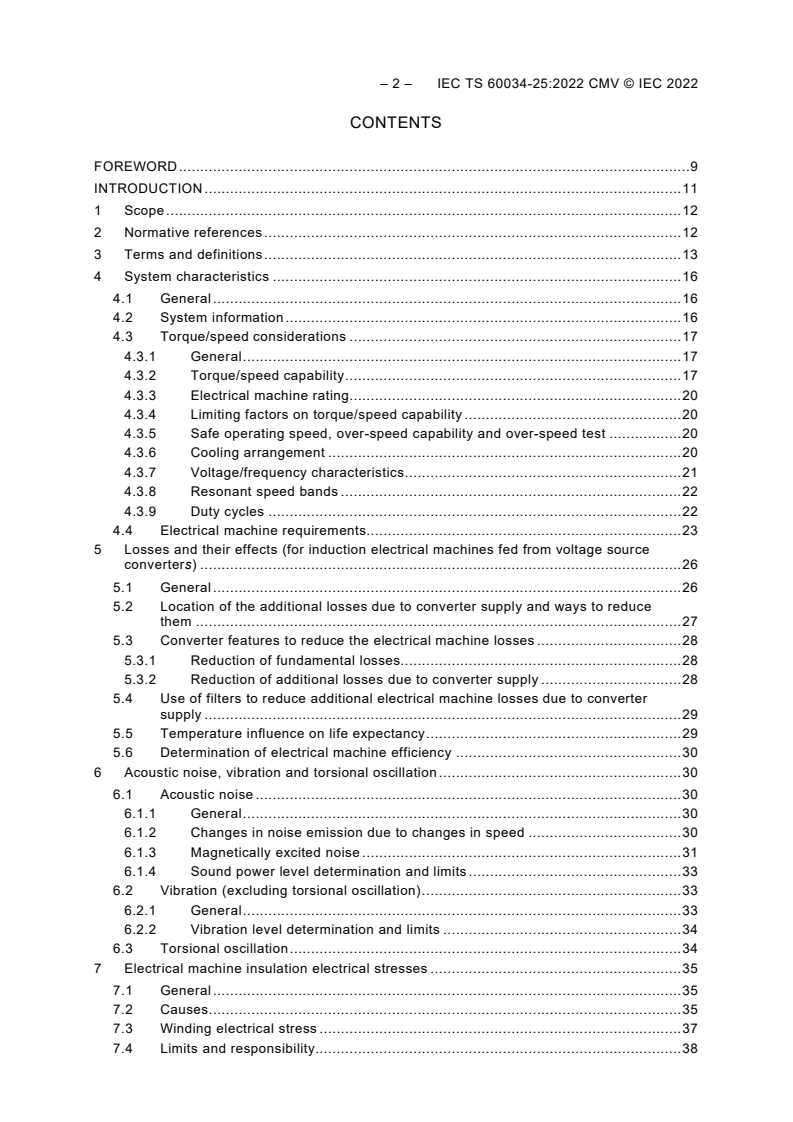
– 2 – IEC TS 60034-25:2022 © IEC 2022
CONTENTS
FOREWORD . 9
INTRODUCTION . 11
1 Scope . 12
2 Normative references . 12
3 Terms and definitions . 13
4 System characteristics . 16
4.1 General . 16
4.2 System information . 16
4.3 Torque/speed considerations . 16
4.3.1 General . 16
4.3.2 Torque/speed capability . 17
4.3.3 Electrical machine rating. 18
4.3.4 Limiting factors on torque/speed capability . 18
4.3.5 Safe operating speed, over-speed capability and over-speed test . 19
4.3.6 Cooling arrangement . 19
4.3.7 Voltage/frequency characteristics . 20
4.3.8 Resonant speed bands . 20
4.3.9 Duty cycles . 21
4.4 Electrical machine requirements . 21
5 Losses and their effects (for induction electrical machines fed from voltage source
converters) . 24
5.1 General . 24
5.2 Location of the additional losses due to converter supply and ways to reduce
them . 25
5.3 Converter features to reduce the electrical machine losses . 26
5.3.1 Reduction of fundamental losses . 26
5.3.2 Reduction of additional losses due to converter supply . 26
5.4 Use of filters to reduce additional electrical machine losses due to converter
supply . 27
5.5 Temperature influence on life expectancy . 27
5.6 Determination of electrical machine efficiency . 28
6 Acoustic noise, vibration and torsional oscillation . 28
6.1 Acoustic noise . 28
6.1.1 General . 28
6.1.2 Changes in noise emission due to changes in speed . 28
6.1.3 Magnetically excited noise . 29
6.1.4 Sound power level determination and limits . 31
6.2 Vibration (excluding torsional oscillation) . 31
6.2.1 General . 31
6.2.2 Vibration level determination and limits . 32
6.3 Torsional oscillation . 32
7 Electrical machine insulation electrical stresses . 33
7.1 General . 33
7.2 Causes . 33
7.3 Winding electrical stress . 35
7.4 Limits and responsibility . 36
7.4.1 Electrical machines design for low voltage (≤ 1 000 V) . 36
7.4.2 Electrical machines designed for medium and high voltage (> 1 000 V) . 37
7.5 Methods of reduction of voltage stress . 37
7.6 Insulation stress limitation . 38
8 Bearing currents . 39
8.1 Sources of bearing currents in converter-fed electrical motors . 39
8.1.1 General . 39
8.1.2 Circulating currents due to magnetic asymmetry . 39
8.1.3 Electrostatic build-up . 39
8.1.4 High-frequency effects in converter operation . 39
8.2 Generation of high-frequency bearing currents . 41
8.2.1 Common mode voltage . 41
8.2.2 Motor HF equivalent circuit and the resulting bearing current types . 42
8.2.3 Circulating current . 44
8.2.4 Rotor ground current . 44
8.2.5 Electrostatic Discharge Machining (EDM) currents . 45
8.3 Consequences of excessive bearing currents. 46
8.4 Preventing high-frequency bearing current damage . 50
8.4.1 Basic approaches . 50
8.4.2 Other preventive measures . 51
8.4.3 Other factors and features influencing the bearing currents . 54
8.5 Additional considerations for electrical motors fed by high voltage source
converters . 54
8.5.1 General . 54
8.5.2 Bearing protection of cage induction, brushless synchronous and
permanent magnet electrical motors . 54
8.5.3 Bearing protection for slip-ring electrical motors and for synchronous
electrical motors with brush excitation . 54
8.6 Bearing current protection for electrical motors fed by high-voltage current
source converters . 55
9 Installation . 55
9.1 Earthing, bonding and cabling . 55
9.1.1 General . 55
9.1.2 Earthing . 55
9.1.3 Bonding of electrical machines . 55
9.1.4 Electrical machine power cables for high switching frequency
converters . 56
9.2 Reactors and filters . 61
9.2.1 General . 61
9.2.2 Output reactors . 61
9.2.3 Voltage limiting filter (du/dt filter) . 61
9.2.4 Sinusoidal filter . 61
9.2.5 Electrical machine termination unit . 61
9.3 Power factor correction . 62
9.4 Integral electrical machines (integrated electrical machine and drive
modules) . 63
10 Additional considerations for permanent magnet (PM) synchronous electrical
machines fed by voltage source converters . 63
10.1 System characteristics . 63
10.2 Losses and their effects . 63
– 4 – IEC TS 60034-25:2022 © IEC 2022
10.3 Noise, vibration and torsional oscillation . 64
10.4 Electrical machine insulation electrical stresses . 64
10.5 Bearing currents . 64
10.6 Particular aspects of permanent magnets . 64
11 Additional considerations for cage induction electrical machines fed by high
voltage source converters . 64
11.1 General . 64
11.2 System characteristics . 65
11.3 Losses and their effects . 66
11.3.1 Additional losses in the stator and rotor winding . 66
11.3.2 Measurement of additional losses . 66
11.4 Noise, vibration and torsional oscillation . 66
11.5 Electrical machine insulation electrical stresses . 67
11.5.1 General . 67
11.5.2 Electrical machine terminal overvoltage . 67
11.5.3 Stator winding voltage stresses in converter applications. 67
11.6 Bearing currents . 69
12 Additional considerations for synchronous electrical machines fed by voltage
source converters . 69
12.1 System characteristics . 69
12.2 Losses and their effects . 69
12.3 Noise, vibration and torsional oscillation . 69
12.4 Electrical machine insulation electrical stresses . 69
12.5 Bearing currents . 70
13 Additional considerations for cage induction electrical machines fed by block-type
current source converters . 70
13.1 System characteristics (see Figure 35 and Figure 36) . 70
13.2 Losses and their effects . 71
13.3 Noise, vibration and torsional oscillation . 73
13.4 Electrical machine insulation electrical stresses . 73
13.5 Bearing currents . 73
13.6 Additional considerations for six-phase cage induction electrical machines . 74
14 Additional considerations for synchronous electrical machines fed by LCI . 74
14.1 System characteristics . 74
14.2 Losses and their effects . 75
14.3 Noise, vibration and torsional oscillation . 75
14.4 Electrical machine insulation electrical stresses . 75
14.5 Bearing currents . 75
15 Additional considerations for cage induction electrical machines fed by pulsed
current source converters (PWM CSI) . 76
15.1 System characteristics (see Figure 39) . 76
15.2 Losses and their effects . 77
15.3 Noise, vibration and torsional oscillation . 77
15.4 Electrical machine insulation electrical stresses . 77
15.5 Bearing currents . 77
16 Wound rotor induction (asynchronous) electrical machines supplied by voltage
source converters in the rotor circuit . 77
16.1 System characteristics . 77
16.2 Losses and their effects . 77
16.3 Noise, vibration and torsional oscillation . 78
16.4 Electrical machine insulation electrical stresses . 78
16.5 Bearing currents . 78
17 Other electrical machine/converter systems . 78
17.1 Drives supplied by cyclo-converters . 78
17.2 Wound rotor induction (asynchronous) electrical machines supplied by
current source converters in the rotor circuit . 80
18 Special consideration for standard fixed-speed induction electrical machines in the
scope of IEC 60034-12 when fed from voltage source converter and motor
requirements to be considered a converter capable motor . 80
18.1 General . 80
18.2 Torque derating during converter operation . 82
18.2.1 General . 82
18.2.2 Self-cooled motors . 83
18.2.3 Non self-cooled motors . 84
18.3 Losses and their effects . 84
18.4 Noise, vibrations and torsional oscillation . 84
18.5 Electrical machine insulation electrical stresses . 84
18.5.1 General . 84
18.5.2 Converter capable motor . 85
18.6 Bearing currents in converter capable motors . 85
18.7 Speed range mechanical limits. 86
18.7.1 General . 86
18.7.2 Maximum speed . 86
18.7.3 Minimum speed . 86
18.8 Overload torque capability . 87
18.9 Excess overload current limits . 87
18.9.1 General . 87
18.9.2 Converter capable motor . 87
18.10 Volts/Hz ratio and voltage boost. 87
18.11 Resonance. 87
18.12 Hazardous area operation . 87
18.12.1 General . 87
18.12.2 Converter capable motor . 88
18.13 Unusual service conditions . 89
18.13.1 Converter capable motors . 89
18.13.2 Unusual converter-fed applications . 89
19 Additional considerations for synchronous reluctance electrical machine fed by
voltage source converters . 89
19.1 System characteristics . 89
19.2 Losses and their effects . 89
19.3 Noise, vibration and torsional oscillation . 89
19.4 Electrical machine insulation electrical stresses . 89
19.5 Bearing currents . 89
19.6 Particular aspects of synchronous reluctance electrical machines . 90
Annex A (informative) Converter characteristics . 91
A.1 Converter control types . 91
A.1.1 General . 91
A.1.2 Converter type considerations . 92
– 6 – IEC TS 60034-25:2022 © IEC 2022
A.2 Converter output voltage generation (for voltage source converters) . 92
A.2.1 Pulse width modulation (PWM) . 92
A.2.2 Hysteresis (sliding mode) . 93
A.2.3 Influence of switching frequency . 93
A.2.4 Multi-level converters. 94
A.2.5 Parallel converter operation . 95
Annex B (informative) Output characteristics of 2 level voltage source converter
spectra . 96
Annex C (informative) Voltages to be expected at the power interface between
converter and electrical machine . 100
Annex D (informative) Speed and harmonic capability of converter capable induction
motor . 104
D.1 General . 104
D.2 Harmonic capability of converter capable motors . 104
D.3 Speed capability and derating in variable torque application . 105
D.4 Speed capability and derating in a constant torque application . 105
Bibliography . 107
Figure 1 – Torque/speed capability . 17
Figure 2 – Current required by motor . 18
Figure 3 – Examples of possible converter output voltage/frequency characteristics . 20
Figure 4 – Example for the dependence of the electrical machine losses caused by
harmonics P related to the losses P at operating frequency f , on the switching
h, f1 1
frequency f in case of 2 level voltage source converter supply . 25
s
Figure 5 – Example of measured losses P as a function of frequency f and supply type . 26
L
Figure 6 – Additional losses ∆P of an electrical machine (same electrical machine as
L
Figure 5) due to converter supply, as a function of pulse frequency f , at 50 Hz
p
rotational frequency . 27
Figure 7 – Relative fan noise as a function of fan speed . 29
Figure 8 – Vibration modes of the stator core . 30
Figure 9 – Typical surges at the terminals of an electrical machine fed from a PWM
converter . 33
Figure 10 – Typical voltage surges on one phase at the converter and at the electrical
machine terminals (2 ms/division) . 34
Figure 11 – Individual short rise-time surge from Figure 10 (1 μs/division) . 34
Figure 12 – Definition of the rise-time t of the voltage pulse at the electrical machine
r
terminals . 35
Figure 13 – First turn voltage as a function of the rise-time . 36
Figure 14 – Discharge pulse occurring as a result of converter generated voltage surge
at electrical machine terminals (100 ns/division) . 38
Figure 15 – Classification of bearing currents . 39
Figure 16 – Parasitic impedances to earth of drive system components . 40
Figure 17 – Common mode voltage a) determination b) waveform example . 41
Figure 18 – HF equivalent circuit diagram (a) of a motor (b) geometrical representation
of capacitances . 42
Figure 19 – Graphical representation of the different high frequency bearing current
types in the drive unit highlighting the involved physical components . 43
Figure 20 – Principle of circulating currents formation . 44
Figure 21 – Rotor ground current principle . 45
Figure 22 – Example of measured EDM-current pulses for a 400 V and 500 kW
induction motor in converter operation . 46
Figure 23 – Photographs of damaged motor bearings . 47
Figure 24 – Bonding strap from electrical machine terminal box to electrical machine
frame . 56
Figure 25 – Examples of shielded electrical machine cables and connections . 57
Figure 26 – Parallel symmetrical cabling of high-power converter and electrical
machine . 58
Figure 27 – Converter connections with 360º HF cable glands showing the Faraday
cage . 59
Figure 28 – Electrical machine end termination with 360º connection . 59
Figure 29 – Cable shield connection . 60
Figure 30 – Characteristics of preventative measures . 62
Figure 31 – Schematic of typical three-level converter . 65
Figure 32 – Output voltage and current from typical three-level converter . 65
Figure 33 – Typical first turn voltage ∆U (as a percentage of the line-to-ground voltage)
as a function of du/dt . 67
Figure 34 – Medium-voltage and high-voltage form-wound coil insulating and voltage
stress control materials . 68
Figure 35 – Schematic of block-type current source converter . 70
Figure 36 – Current and voltage waveforms of block-type current source converter . 70
Figure 37 – Influence of converter supply on the losses of a cage induction electrical
machine (frame size 315 M, design N) with rated values of torque and speed . 72
Figure 38 – Schematic and voltage and current waveforms for a synchronous electrical
machine supplied from a current source converter . 74
Figure 39 – Schematic of pulsed current source converter . 76
Figure 40 – Voltages and currents of pulsed current source converter . 76
Figure 41 – Schematic of cyclo-converter . 78
Figure 42 – Voltage and current waveforms of a cyclo-converter . 79
Figure 43 – Diagram comparing converter capable motor to converter duty motor . 81
Figure 44 – Fundamental voltage U as a function of operating frequency f . 82
1 1
Figure 45 – Torque derating factor for cage induction electrical machines of design N,
IC 411 (self-circulating cooling) as a function of operating frequency f (example) . 83
Figure A.1 – Effects of switching frequency on electrical machine and converter losses. 93
Figure A.2 – Effects of switching frequency on acoustic noise . 94
Figure A.3 – Effects of switching frequency on torque ripple . 94
Figure B.1 – Waveform of line-to-line voltage U for voltage source converter supply
LL
with switching frequency f = 30 × f (example) . 96
s 1
Figure B.2 – Typical output voltage frequency spectra for a constant frequency PWM
control versus hysteresis control . 97
Figure B.3 – Typical output voltage frequency spectra for random frequency PWM
versus hysteresis control . 97
Figure B.4 – Typical output voltage frequency spectra for a two-phase modulated
control versus hysteresis modulation . 98
– 8 – IEC TS 60034-25:2022 © IEC 2022
Figure B.5 – Typical time characteristics of electrical machine current for a Constant
frequency PWM control versus hysteresis control . 98
Figure B.6 – Typical time characteristics of electrical machine current for a two-phase
modulated control versus hysteresis modulation . 99
Figure C.1 – Example of typical voltage curves and parameters of a two level inverter
versus time at the electrical machine terminals (phase to phase voltage; taken from
IEC TS 61800-8) . 100
Figure D.1 – Derating curve for harmonic voltages . 105
Figure D.2 – Torque capability at reduced speeds due to the effects of reduced cooling
(applyies to 50 Hz or 60 Hz design N) . 106
Table 1 – Significant factors affecting torque/speed capability . 19
Table 2 – Electrical machine design considerations . 22
Table 3 – Electrical machine parameters for the tuning of the converter . 23
Table 4 – Operating voltage at the terminals in units of U where the electrical
N
machines may operate reliably without special agreements between manufacturers and
system integrators . 37
Table 5 – Different grades of roller bearing damages . 48
Table 6 – Effectiveness of bearing current counter measures . 52
INTERNATIONAL ELECTROTECHNICAL COMMISSION
____________
ROTATING ELECTRICAL MACHINES –
Part 25: AC electrical machines used in power drive systems –
Application guide
FOREWORD
1) The International Electrotechnical Commission (IEC) is a worldwide organization for standardization comprising
all national electrotechnical committees (IEC National Committees). The object of IEC is to promote international
co-operation on all questions concerning standardization in the electrical and electronic fields. To this end and
in addition to other activities, IEC publishes International Standards, Technical Specifications, Technical Reports,
Publicly Available Specifications (PAS) and Guides (hereafter referred to as “IEC Publication(s)”). Their
preparation is entrusted to technical committees; any IEC National Committee interested in the subject dealt with
may participate in this preparatory work. International, governmental and non-governmental organizations liaising
with the IEC also participate in this preparation. IEC collaborates closely with the International Organization for
Standardization (ISO) in accordance with conditions determined by agreement between the two organizations.
2) The formal decisions or agreements of IEC on technical matters express, as nearly as possible, an international
consensus of opinion on the relevant subjects since each technical committee has representation from all
interested IEC National Committees.
3) IEC Publications have the form of recommendations for international use and are accepted by IEC National
Committees in that sense. While all reasonable efforts are made to ensure that the technical content of IEC
Publications is accurate, IEC cannot be held responsible for the way in which they are used or for any
misinterpretation by any end user.
4) In order to promote international uniformity, IEC National Committees undertake to apply IEC Publications
transparently to the maximum extent possible in their national and regional publications. Any divergence between
any IEC Publication and the corresponding national or regional publication shall be clearly indicated in the latter.
5) IEC itself does not provide any attestation of conformity. Independent certification bodies provide conformity
assessment services and, in some areas, access to IEC marks of conformity. IEC is not responsible for any
services carried out by independent certification bodies.
6) All users should ensure that they have the latest edition of this publication.
7) No liability shall attach to IEC or its directors, employees, servants or agents including individual experts and
members of its technical committees and IEC National Committees for any personal injury, property damage or
other damage of any nature whatsoever, whether direct or indirect, or for costs (including legal fees) and
expenses arising out of the publication, use of, or reliance upon, this IEC Publication or any other IEC
Publications.
8) Attention is drawn to the Normative references cited in this publication. Use of the referenced publications is
indispensable for the correct application of this publication.
9) Attention is drawn to the possibility that some of the elements of this IEC Publication may be the subject of patent
rights. IEC shall not be held responsible for identifying any or all such patent rights.
IEC TS 60034-25 has been prepared by IEC technical committee 2: Rotating machinery. It is a
Technical Specification.
This fourth edition of IEC TS 60034-25 cancels and replaces the third edition, published in 2014.
This edition includes the following significant technical changes with respect to the previous
edition:
a) The definitions of a converter capable motor and a converter duty motor are added.
b) Clause 18 modified to include the performance expectations of a converter capable motor.
c) Clause 8 modified to update shaft currents section.
d) Annex D added to define the derating requirements.
– 10 – IEC TS 60034-25:2022 © IEC 2022
The text of this Technical Specification is based on the following documents:
Draft Report on voting
2/2067/DTS 2/2097/RVDTS
Full information on the voting for its approval can be found in the report on voting indicated in
the above table.
The language used for the development of this Technical Specification is English.
This document was drafted in accordance with ISO/IEC Directives, Part 2, and developed in
accordance with ISO/IEC Directives, Part 1 and ISO/IEC Directives, IEC Supplement, available
at www.iec.ch/members_experts/refdocs. The main document types developed by IEC are
described in greater detail at www.iec.ch/standardsdev/publications.
A list of all parts in the IEC 60034 series, published under the general title Rotating electrical
machines, can be found on the IEC website.
The committee has decided that the contents of this document will remain unchanged until the
stability date indicated on the IEC website under webstore.iec.ch in the data related to the
specific document. At this date, the document will be
• reconfirmed,
• withdrawn,
• replaced by a revised edition, or
• amended.
IMPORTANT – The 'colour inside' logo on the cover page of this publication indicates that it
contains colours which are considered to be useful for the correct understanding of its
contents. Users should therefore print this document using a colour printer.
INTRODUCTION
The performance characteristics and operating data for converter-fed electrical machines are
influenced by the complete drive system, comprising supply system, converter, cabling,
electrical machine, mechanical shafting and control equipment. Each of these components
exists in numerous technical variants. Any values quoted in this document are thus indicative
only.
In view of the complex technical interrelations within the system and the variety of operating
conditions, it is beyond the scope and object of this document to specify numerical or limiting
values for all the quantities which are of importance for the design of the power drive system.
To an increasing extent, it is the practice that power drive systems consist of components
produced by different manufacturers. The object of this document is to explain, as far as
possible, the influence of these components on the design of the electrical machine and its
performance characteristics.
This document deals with both AC electrical machines which are specifically designed for
converter supply and converter-fed electrical machines within the scope of IEC 60034-12, which
are designed originally for mains supp
...
IEC TS 60034-25 ®
Edition 4.0 2022-06
COMMENTED VERSION
TECHNICAL
SPECIFICATION
colour
inside
Rotating electrical machines –
Part 25: AC electrical machines used in power drive systems – Application guide
All rights reserved. Unless otherwise specified, no part of this publication may be reproduced or utilized in any form
or by any means, electronic or mechanical, including photocopying and microfilm, without permission in writing from
either IEC or IEC's member National Committee in the country of the requester. If you have any questions about IEC
copyright or have an enquiry about obtaining additional rights to this publication, please contact the address below or
your local IEC member National Committee for further information.
IEC Secretariat Tel.: +41 22 919 02 11
3, rue de Varembé info@iec.ch
CH-1211 Geneva 20 www.iec.ch
Switzerland
About the IEC
The International Electrotechnical Commission (IEC) is the leading global organization that prepares and publishes
International Standards for all electrical, electronic and related technologies.
About IEC publications
The technical content of IEC publications is kept under constant review by the IEC. Please make sure that you have the
latest edition, a corrigendum or an amendment might have been published.
IEC publications search - webstore.iec.ch/advsearchform IEC Products & Services Portal - products.iec.ch
The advanced search enables to find IEC publications by a
Discover our powerful search engine and read freely all the
variety of criteria (reference number, text, technical publications previews. With a subscription you will always
committee, …). It also gives information on projects, replaced have access to up to date content tailored to your needs.
and withdrawn publications.
Electropedia - www.electropedia.org
IEC Just Published - webstore.iec.ch/justpublished
The world's leading online dictionary on electrotechnology,
Stay up to date on all new IEC publications. Just Published
containing more than 22 300 terminological entries in English
details all new publications released. Available online and
and French, with equivalent terms in 19 additional languages.
once a month by email.
Also known as the International Electrotechnical Vocabulary
(IEV) online.
IEC Customer Service Centre - webstore.iec.ch/csc
If you wish to give us your feedback on this publication or
need further assistance, please contact the Customer Service
Centre: sales@iec.ch.
IEC TS 60034-25 ®
Edition 4.0 2022-06
COMMENTED VERSION
TECHNICAL
SPECIFICATION
colour
inside
Rotating electrical machines –
Part 25: AC electrical machines used in power drive systems – Application guide
INTERNATIONAL
ELECTROTECHNICAL
COMMISSION
ICS 29.160.01 ISBN 978-2-8322-3957-5
– 2 – IEC TS 60034-25:2022 CMV © IEC 2022
CONTENTS
FOREWORD .9
INTRODUCTION . 11
1 Scope . 12
2 Normative references . 12
3 Terms and definitions . 13
4 System characteristics . 16
4.1 General . 16
4.2 System information . 16
4.3 Torque/speed considerations . 17
4.3.1 General . 17
4.3.2 Torque/speed capability . 17
4.3.3 Electrical machine rating . 20
4.3.4 Limiting factors on torque/speed capability . 20
4.3.5 Safe operating speed, over-speed capability and over-speed test . 20
4.3.6 Cooling arrangement . 20
4.3.7 Voltage/frequency characteristics . 21
4.3.8 Resonant speed bands . 22
4.3.9 Duty cycles . 22
4.4 Electrical machine requirements . 23
5 Losses and their effects (for induction electrical machines fed from voltage source
converters) . 26
5.1 General . 26
5.2 Location of the additional losses due to converter supply and ways to reduce
them . 27
5.3 Converter features to reduce the electrical machine losses . 28
5.3.1 Reduction of fundamental losses . 28
5.3.2 Reduction of additional losses due to converter supply . 28
5.4 Use of filters to reduce additional electrical machine losses due to converter
supply . 29
5.5 Temperature influence on life expectancy . 29
5.6 Determination of electrical machine efficiency . 30
6 Acoustic noise, vibration and torsional oscillation . 30
6.1 Acoustic noise . 30
6.1.1 General . 30
6.1.2 Changes in noise emission due to changes in speed . 30
6.1.3 Magnetically excited noise . 31
6.1.4 Sound power level determination and limits . 33
6.2 Vibration (excluding torsional oscillation) . 33
6.2.1 General . 33
6.2.2 Vibration level determination and limits . 34
6.3 Torsional oscillation . 34
7 Electrical machine insulation electrical stresses . 35
7.1 General . 35
7.2 Causes. 35
7.3 Winding electrical stress . 37
7.4 Limits and responsibility . 38
7.4.1 Electrical machines design for low voltage (≤ 1 000 V) . 38
7.4.2 Electrical machines designed for medium and high voltage (> 1 000 V) . 39
7.5 Methods of reduction of voltage stress . 40
7.6 Insulation stress limitation . 40
8 Bearing currents . 41
8.1 Sources of bearing currents in converter-fed electrical machines motors . 41
8.1.1 General . 41
8.1.2 Circulating currents due to magnetic asymmetry . 41
8.1.3 Electrostatic build-up . 41
8.1.4 High-frequency voltages effects in converter operation . 41
8.2 Generation of high-frequency bearing currents . 42
8.2.1 General .
8.2.2 Circulating current .
8.2.3 Shaft earthing current .
8.2.4 Capacitive discharge current .
8.2.1 Common mode voltage . 44
8.2.2 Motor HF equivalent circuit and the resulting bearing current types . 45
8.2.3 Circulating current . 47
8.2.4 Rotor ground current . 48
8.2.5 Electrostatic Discharge Machining (EDM) currents . 49
8.3 Common-mode circuit .
8.3.1 General .
8.3.2 System common-mode current flow .
8.3 Consequences of excessive bearing currents . 51
8.4 Stray capacitances .
8.4.1 General .
8.4.2 Major component of capacitance .
8.4.3 Other capacitances .
8.4 Preventing high-frequency bearing current damage . 58
8.4.1 Basic approaches . 58
8.4.2 Other preventive measures . 58
8.4.3 Other factors and features influencing the bearing currents . 61
8.5 Additional considerations for electrical machines motors fed by high voltage
source converters . 62
8.5.1 General . 62
8.5.2 Bearing protection of cage induction, brushless synchronous and
permanent magnet electrical machines motors . 62
8.5.3 Bearing protection for slip-ring electrical machines motors and for
synchronous electrical machines motors with brush excitation. 62
8.6 Bearing current protection for electrical machines motors fed by high-voltage
current source converters . 62
9 Installation . 62
9.1 Earthing, bonding and cabling . 62
9.1.1 General . 62
9.1.2 Earthing . 63
9.1.3 Bonding of electrical machines . 63
9.1.4 Electrical machine power cables for high switching frequency
converters . 64
9.2 Reactors and filters . 69
9.2.1 General . 69
– 4 – IEC TS 60034-25:2022 CMV © IEC 2022
9.2.2 Output reactors . 69
9.2.3 Voltage limiting filter (du/dt filter) . 69
9.2.4 Sinusoidal filter . 69
9.2.5 Electrical machine termination unit . 69
9.3 Power factor correction . 70
9.4 Integral electrical machines (integrated electrical machine and drive
modules) . 71
10 Additional considerations for permanent magnet (PM) synchronous electrical
machines fed by voltage source converters . 71
10.1 System characteristics . 71
10.2 Losses and their effects . 71
10.3 Noise, vibration and torsional oscillation . 72
10.4 Electrical machine insulation electrical stresses . 72
10.5 Bearing currents . 72
10.6 Particular aspects of permanent magnets . 72
11 Additional considerations for cage induction electrical machines fed by high
voltage source converters . 72
11.1 General . 72
11.2 System characteristics . 73
11.3 Losses and their effects . 74
11.3.1 Additional losses in the stator and rotor winding . 74
11.3.2 Measurement of additional losses . 74
11.4 Noise, vibration and torsional oscillation . 74
11.5 Electrical machine insulation electrical stresses . 75
11.5.1 General . 75
11.5.2 Electrical machine terminal overvoltage. 75
11.5.3 Stator winding voltage stresses in converter applications . 75
11.6 Bearing currents . 77
12 Additional considerations for synchronous electrical machines fed by voltage
source converters . 77
12.1 System characteristics . 77
12.2 Losses and their effects . 77
12.3 Noise, vibration and torsional oscillation . 77
12.4 Electrical machine insulation electrical stresses . 77
12.5 Bearing currents . 78
13 Additional considerations for cage induction electrical machines fed by block-type
current source converters . 78
13.1 System characteristics (see Figure 35 and Figure 36) . 78
13.2 Losses and their effects . 79
13.3 Noise, vibration and torsional oscillation . 81
13.4 Electrical machine insulation electrical stresses . 81
13.5 Bearing currents . 81
13.6 Additional considerations for six-phase cage induction electrical machines . 82
14 Additional considerations for synchronous electrical machines fed by LCI . 82
14.1 System characteristics . 82
14.2 Losses and their effects . 84
14.3 Noise, vibration and torsional oscillation . 84
14.4 Electrical machine insulation electrical stresses . 84
14.5 Bearing currents . 84
15 Additional considerations for cage induction electrical machines fed by pulsed
current source converters (PWM CSI) . 84
15.1 System characteristics (see Figure 39) . 84
15.2 Losses and their effects . 85
15.3 Noise, vibration and torsional oscillation . 85
15.4 Electrical machine insulation electrical stresses . 85
15.5 Bearing currents . 86
16 Wound rotor induction (asynchronous) electrical machines supplied by voltage
source converters in the rotor circuit . 86
16.1 System characteristics . 86
16.2 Losses and their effects . 86
16.3 Noise, vibration and torsional oscillation . 86
16.4 Electrical machine insulation electrical stresses . 86
16.5 Bearing currents . 86
17 Other electrical machine/converter systems . 87
17.1 Drives supplied by cyclo-converters . 87
17.2 Wound rotor induction (asynchronous) electrical machines supplied by
current source converters in the rotor circuit . 88
18 Special consideration for standard fixed-speed induction electrical machines in the
scope of IEC 60034-12 when fed from voltage source converter and motor
requirements to be considered a converter capable motor . 89
18.1 General . 89
18.2 Torque derating during converter operation . 90
18.2.1 General . 90
18.2.2 Self-cooled motors . 91
18.2.3 Non self-cooled motors . 92
18.3 Losses and their effects . 92
18.4 Noise, vibrations and torsional oscillation . 92
18.5 Electrical machine insulation electrical stresses . 92
18.5.1 General . 92
18.5.2 Converter capable motor. 93
18.6 Bearing currents in converter capable motors . 94
18.7 Speed range mechanical limits . 95
18.7.1 General . 95
18.7.2 Maximum safe operating speed . 95
18.7.3 Minimum speed . 95
18.8 Overload torque capability . 96
18.9 Excess overload current limits . 96
18.9.1 General . 96
18.9.2 Converter capable motor. 96
18.10 Volts/Hz ratio and voltage boost . 96
18.11 Resonance . 96
18.12 Hazardous area operation . 97
18.12.1 General . 97
18.12.2 Converter capable motor. 97
18.13 Unusual service conditions . 98
18.13.1 Converter capable motors . 98
18.13.2 Unusual converter-fed applications . 98
19 Additional considerations for synchronous reluctance electrical machine fed by
voltage source converters . 98
– 6 – IEC TS 60034-25:2022 CMV © IEC 2022
19.1 System characteristics . 98
19.2 Losses and their effects . 98
19.3 Noise, vibration and torsional oscillation . 99
19.4 Electrical machine insulation electrical stresses . 99
19.5 Bearing currents . 99
19.6 Particular aspects of synchronous reluctance electrical machines . 99
Annex A (informative) Converter characteristics . 100
A.1 Converter control types . 100
A.1.1 General . 100
A.1.2 Converter type considerations . 101
A.2 Converter output voltage generation (for voltage source converters) . 101
A.2.1 Pulse width modulation (PWM). 101
A.2.2 Hysteresis (sliding mode) . 102
A.2.3 Influence of switching frequency . 102
A.2.4 Multi-level converters. 103
A.2.5 Parallel converter operation . 104
Annex B (informative) Output characteristics of 2 level voltage source converter
spectra . 105
Annex C (informative) Voltages to be expected at the power interface between
converter and electrical machine . 109
Annex D (informative) Speed and harmonic capability of converter capable induction
motor . 113
D.1 General . 113
D.2 Harmonic capability of converter capable motors . 113
D.3 Speed capability and derating in variable torque application . 114
D.4 Speed capability and derating in a constant torque application . 114
Bibliography . 116
List of comments . 117
Figure 1 – Torque/speed capability . 18
Figure 2 – Converter output current .
Figure 2 – Current required by motor . 19
Figure 3 – Examples of possible converter output voltage/frequency characteristics . 22
Figure 4 – Example for the dependence of the electrical machine losses caused by
harmonics P related to the losses P at operating frequency f , on the switching
h, f1 1
frequency f in case of 2 level voltage source converter supply . 27
s
Figure 5 – Example of measured losses P as a function of frequency f and supply type . 28
L
Figure 6 – Additional losses ∆P of an electrical machine (same electrical machine as
L
Figure 5) due to converter supply, as a function of pulse frequency f , at 50 Hz
p
rotational frequency . 29
Figure 7 – Relative fan noise as a function of fan speed . 31
Figure 8 – Vibration modes of the stator core . 32
Figure 9 – Typical surges at the terminals of an electrical machine fed from a PWM
converter . 35
Figure 10 – Typical voltage surges on one phase at the converter and at the electrical
machine terminals (2 ms/division) . 36
Figure 11 – Individual short rise-time surge from Figure 10 (1 μs/division) . 36
Figure 12 – Definition of the rise-time t of the voltage pulse at the electrical machine
r
terminals . 37
Figure 13 – First turn voltage as a function of the rise-time . 38
Figure 14 – Discharge pulse occurring as a result of converter generated voltage surge
at electrical machine terminals (100 ns/division) . 40
Figure 15 – Possible bearing currents .
Figure 16 – Electrical machine capacitances .
Figure 17 – Bearing pitting due to electrical discharge (pit diameter 30 µm to 50 µm) .
Figure 18 – Fluting due to excessive bearing current .
Figure 15 – Classification of bearing currents . 41
Figure 16 – Parasitic impedances to earth of drive system components . 42
Figure 17 – Common mode voltage a) determination b) waveform example . 45
Figure 18 – HF equivalent circuit diagram (a) of a motor (b) geometrical representation
of capacitances . 46
Figure 19 – Graphical representation of the different high frequency bearing current
types in the drive unit highlighting the involved physical components . 47
Figure 20 – Principle of circulating currents formation . 48
Figure 21 – Rotor ground current principle . 49
Figure 22 – Example of measured EDM-current pulses for a 400 V and 500 kW
induction motor in converter operation . 50
Figure 23 – Photographs of damaged motor bearings . 53
Figure 24 – Bonding strap from electrical machine terminal box to electrical machine
frame . 64
Figure 25 – Examples of shielded electrical machine cables and connections . 65
Figure 26 – Parallel symmetrical cabling of high-power converter and electrical
machine . 66
Figure 27 – Converter connections with 360º HF cable glands showing the Faraday
cage . 67
Figure 28 – Electrical machine end termination with 360º connection . 67
Figure 29 – Cable shield connection . 68
Figure 30 – Characteristics of preventative measures . 70
Figure 31 – Schematic of typical three-level converter . 73
Figure 32 – Output voltage and current from typical three-level converter . 73
Figure 33 – Typical first turn voltage ∆U (as a percentage of the line-to-ground voltage)
as a function of du/dt . 75
Figure 34 – Medium-voltage and high-voltage form-wound coil insulating and voltage
stress control materials . 76
Figure 35 – Schematic of block-type current source converter . 78
Figure 36 – Current and voltage waveforms of block-type current source converter . 78
Figure 37 – Influence of converter supply on the losses of a cage induction electrical
machine (frame size 315 M, design N) with rated values of torque and speed . 80
Figure 38 – Schematic and voltage and current waveforms for a synchronous electrical
machine supplied from a current source converter . 83
Figure 39 – Schematic of pulsed current source converter . 84
Figure 40 – Limiting curve of admissible impulse voltage Û / U (peak value of line to
LL N
line voltage including voltage reflection and damping/rated voltage) at the electrical
machine terminals as a function of the rise-time t .
r
– 8 – IEC TS 60034-25:2022 CMV © IEC 2022
Figure 40 – Voltages and currents of pulsed current source converter . 85
Figure 41 – Schematic of cyclo-converter . 87
Figure 42 – Voltage and current waveforms of a cyclo-converter . 87
Figure 43 – Diagram comparing converter capable motor to converter duty motor . 89
Figure 44 – Fundamental voltage U as a function of operating frequency f . 90
1 1
Figure 45 – Torque derating factor for cage induction electrical machines of design N,
IC 0141411 (self-circulating cooling) as a function of operating frequency f (example) . 91
Figure A.1 – Effects of switching frequency on electrical machine and converter losses . 102
Figure A.2 – Effects of switching frequency on acoustic noise. 103
Figure A.3 – Effects of switching frequency on torque ripple . 103
Figure B.1 – Waveform of line-to-line voltage U for voltage source converter supply
LL
with switching frequency f = 30 × f (example) . 105
s 1
Figure B.2 – Typical output voltage frequency spectra of converter output voltage for a
constant frequency PWM control versus hysteresis control . 106
Figure B.3 – Typical output voltage frequency spectra of converter output voltage for
random frequency PWM versus hysteresis control . 106
Figure B.4 – Typical spectra of converter output voltage frequency spectra for a two-
phase modulated control versus hysteresis modulation. 107
Figure B.5 – Typical time characteristics of electrical machine current for a Constant
frequency PWM control versus hysteresis control . 107
Figure B.6 – Typical time characteristics of electrical machine current for a two-phase
modulated control versus hysteresis modulation . 108
Figure C.1 – Example of typical voltage curves and parameters of a two level inverter
versus time at the electrical machine terminals (phase to phase voltage; taken from
IEC TS 61800-8) . 109
Figure D.1 – Derating curve for harmonic voltages . 114
Figure D.2 – Torque capability at reduced speeds due to the effects of reduced cooling
(applyies to 50 Hz or 60 Hz design N) . 115
Table 1 – Significant factors affecting torque/speed capability . 20
Table 2 – Electrical machine design considerations . 24
Table 3 – Electrical machine parameters for the tuning of the converter . 25
Table 4 – Operating voltage at the terminals in units of U where the electrical
N
machines may operate reliably without special agreements between manufacturers and
system integrators . 39
Table 5 – Different grades of roller bearing damages . 54
Table 6 – Effectiveness of bearing current counter measures . 59
INTERNATIONAL ELECTROTECHNICAL COMMISSION
____________
ROTATING ELECTRICAL MACHINES –
Part 25: AC electrical machines used in power drive systems –
Application guide
FOREWORD
1) The International Electrotechnical Commission (IEC) is a worldwide organization for standardization comprising
all national electrotechnical committees (IEC National Committees). The object of IEC is to promote international
co-operation on all questions concerning standardization in the electrical and electronic fields. To this end and
in addition to other activities, IEC publishes International Standards, Technical Specifications, Technical Reports,
Publicly Available Specifications (PAS) and Guides (hereafter referred to as “IEC Publication(s)”). Their
preparation is entrusted to technical committees; any IEC National Committee interested in the subject dealt with
may participate in this preparatory work. International, governmental and non-governmental organizations liaising
with the IEC also participate in this preparation. IEC collaborates closely with the International Organization for
Standardization (ISO) in accordance with conditions determined by agreement between the two organizations.
2) The formal decisions or agreements of IEC on technical matters express, as nearly as possible, an international
consensus of opinion on the relevant subjects since each technical committee has representation from all
interested IEC National Committees.
3) IEC Publications have the form of recommendations for international use and are accepted by IEC National
Committees in that sense. While all reasonable efforts are made to ensure that the technical content of IEC
Publications is accurate, IEC cannot be held responsible for the way in which they are used or for any
misinterpretation by any end user.
4) In order to promote international uniformity, IEC National Committees undertake to apply IEC Publications
transparently to the maximum extent possible in their national and regional publications. Any divergence between
any IEC Publication and the corresponding national or regional publication shall be clearly indicated in the latter.
5) IEC itself does not provide any attestation of conformity. Independent certification bodies provide conformity
assessment services and, in some areas, access to IEC marks of conformity. IEC is not responsible for any
services carried out by independent certification bodies.
6) All users should ensure that they have the latest edition of this publication.
7) No liability shall attach to IEC or its directors, employees, servants or agents including individual experts and
members of its technical committees and IEC National Committees for any personal injury, property damage or
other damage of any nature whatsoever, whether direct or indirect, or for costs (including legal fees) and
expenses arising out of the publication, use of, or reliance upon, this IEC Publication or any other IEC
Publications.
8) Attention is drawn to the Normative references cited in this publication. Use of the referenced publications is
indispensable for the correct application of this publication.
9) Attention is drawn to the possibility that some of the elements of this IEC Publication may be the subject of patent
rights. IEC shall not be held responsible for identifying any or all such patent rights.
This commented version (CMV) of the official standard IEC TS 60034-25:2022 edition 4.0
allows the user to identify the changes made to the previous IEC TS 60034-25:2014
edition 3.0. Furthermore, comments from IEC TC 2 experts are provided to explain the
reasons of the most relevant changes, or to clarify any part of the content.
A vertical bar appears in the margin wherever a change has been made. Additions are in
green text, deletions are in strikethrough red text. Experts' comments are identified by a
blue-background number. Mouse over a number to display a pop-up note with the
comment.
This publication contains the CMV and the official standard. The full list of comments is
available at the end of the CMV.
– 10 – IEC TS 60034-25:2022 CMV © IEC 2022
IEC TS 60034-25 has been prepared by IEC technical committee 2: Rotating machinery. It is a
Technical Specification.
This fourth edition of IEC TS 60034-25 cancels and replaces the third edition, published in 2014.
This edition includes the following significant technical changes with respect to the previous
edition: 1
a) The definitions of a converter capable motor and a converter duty motor are added.
b) Clause 18 modified to include the performance expectations of a converter capable motor.
c) Clause 8 modified to update shaft currents section.
d) Annex D added to define the derating requirements.
The text of this Technical Specification is based on the following documents:
Draft Report on voting
2/2067/DTS 2/2097/RVDTS
Full information on the voting for its approval can be found in the report on voting indicated in
the above table.
The language used fo
...
The article discusses IEC TS 60034-25:2022, which is a standard that provides guidelines for AC electrical machines used in power drive systems. It describes the performance characteristics and design features of electrical machines specifically designed for converter duty application. The standard also specifies the interface parameters and interactions between the electrical machine and the converter, as well as installation guidance. However, it does not cover the voltage at the power interface, which is addressed in another standard. The fourth edition of IEC TS 60034-25 includes several technical changes, such as the addition of definitions for a converter capable motor and a converter duty motor, modifications to clause 18 regarding performance expectations of a converter capable motor, updates to the shaft currents section in clause 8, and the inclusion of Annex D which defines derating requirements.
記事のタイトル:IEC TS 60034-25:2022-回転電気機械-パート25:電力駆動システムで使用される交流電気機械-応用ガイド 記事内容:IEC TS 60034-25:2022は、コンバータ供給に使用される交流電気機械の性能特性について説明しています。コンバータ用途に特化した電気機械の設計特徴が定義されています。また、電気機械とコンバータのインターフェースパラメータと相互作用も指定し、電力駆動システムとしての設置ガイドも提供していますが、電源インターフェースの電圧については別の規格で説明されています。IEC TS 60034-25の第4版は、第3版を取り消し、代わりに使用されます。この版には、以下の重要な技術的変更が含まれています。 a. コンバータ対応モータとコンバータ義務モータの定義が追加されました。 b. 第18項が修正され、コンバータ対応モータの性能期待値を含むようになりました。 c. 第8項が修正され、シャフト電流のセクションが更新されました。 d. 附属のDが追加され、減耗要件が定義されています。
기사 제목: IEC TS 60034-25:2022 - 회전 전기기 - 제25부: 전력 구동 시스템에서 사용되는 교류 전기기 - 응용 가이드 기사 내용: IEC TS 60034-25:2022는 컨버터 공급에 사용되는 교류 전기기의 성능 특성을 설명합니다. 컨버터 용도에 특화된 전기기의 설계 특징을 정의합니다. 또한, 전기기와 컨버터 간의 인터페이스 매개 변수와 상호작용을 지정하며, 전력 구동 시스템의 일부로서의 설치 가이드를 제공하지만, 전압은 IEC TS 61800-8에서 설명되는 것을 제외합니다. 이 IEC TS 60034-25의 4판은 3판을 취소하고 대체합니다. 이 버전에는 다음과 같은 이전 버전과 비교하여 중요한 기술적인 변경 사항이 포함되어 있습니다. a. 컨버터 가능한 모터와 컨버터 의무 모터의 정의가 추가되었습니다. b. 18조가 수정되어 컨버터 가능한 모터의 성능 기대치를 포함합니다. c. 8조가 수정되어 축 전류 섹션을 업데이트합니다. d. 첨부 D가 추가되어 감소 요구사항을 정의합니다.
Questions, Comments and Discussion
Ask us and Technical Secretary will try to provide an answer. You can facilitate discussion about the standard in here.
Loading comments...