


IEC 61577-3:2002
(Main)Radiation protection instrumentation - Radon and radon decay product measuring instruments - Part 3: Specific requirements for radon decay product measuring instruments
Radiation protection instrumentation - Radon and radon decay product measuring instruments - Part 3: Specific requirements for radon decay product measuring instruments
Describes the specific requirements for testing instruments intended for measuring the activity concentration of airborne radon decay products and/or the volume potential alpha energy. Covers test procedures, radiation characteristics, electrical, mechanical, safety and environmental characteristics as well as identification certificates.
Instrumentation pour la radioprotection - Instruments de mesure du radon et des descendants du radon - Partie 3: Exigences spécifiques concernant les instruments de mesure des descendants du radon
Décrit les exigences spécifiques pour tester les instruments destinés au mesurage de l'activité volumique des descendants du radon en suspension dans l'air et/ou de l'énergie alpha potentielle volumique. Couvre les procédures d'essai, les caractéristiques du rayonnement, les caractéristiques électriques, mécaniques, de sécurité et environnementales ainsi que les certificats d'identification.
General Information
- Status
- Published
- Publication Date
- 11-Apr-2002
- Technical Committee
- SC 45B - Radiation protection instrumentation
- Current Stage
- DELPUB - Deleted Publication
- Start Date
- 09-Dec-2011
- Completion Date
- 14-Feb-2026
Relations
- Effective Date
- 05-Sep-2023
Overview
IEC 61577-3:2002 is an international standard published by the International Electrotechnical Commission (IEC) that defines the specific requirements for radon decay product measuring instruments used in radiation protection instrumentation. This third part of the series focuses on instruments designed to measure the activity concentration of airborne radon decay products and the volume potential alpha energy. It provides detailed guidance on the testing procedures, radiation characteristics, electrical, mechanical, safety, and environmental aspects, as well as requirements for identification certificates.
This standard ensures that radon decay product measuring instruments comply with stringent quality and performance criteria necessary for reliable radiation protection and environmental monitoring.
Key Topics
Scope and Object: Establishes essential requirements and testing methods for radon decay product measuring instruments ensuring accuracy and reliability.
General Characteristics:
- Measurement range and minimum detectable activity.
- Factors influencing measurements such as temperature, humidity, and atmospheric pressure.
- Check and verification sources for instrument calibration.
Technical Characteristics:
- Subassemblies of air sampling, measurement, control, and power supply.
- Construction requirements tailored for robustness and precision.
Testing Procedures:
- Definition of test conditions, including standard and varying influence factors.
- Tests on radiation performance involving solid reference sources and reference atmospheres.
- Environmental performance testing against ambient gamma radiation, temperature, humidity, and atmospheric pressure.
- Electrical performance validation covering power supply stability, warm-up time, and measurement stability.
- Mechanical performance and durability tests.
Documentation and Certification:
- Detailed requirements for test reports and identification certificates.
- Guidelines for user manuals covering usage and maintenance.
Applications
The IEC 61577-3:2002 standard is highly relevant for:
Radiation Protection: Ensuring accurate measurement of radon decay products to assess environmental health risks and implement adequate safety measures.
Environmental Monitoring: Facilitating precise radon monitoring in workplaces, residential buildings, and public spaces prone to radon exposure.
Instrument Manufacturers: Providing manufacturers with comprehensive testing and construction guidelines to produce compliant radiation protection instruments.
Health and Safety Compliance: Enabling regulatory bodies and laboratories to verify instrument performance and certify compliance with radiation safety regulations.
Research and Development: Supporting R&D activities in improving radon measuring technologies through well-defined testing frameworks.
Related Standards
IEC 61577-1:2002 – Radiation protection instrumentation – Radon and radon decay product measuring instruments – Part 1: General requirements.
IEC 61577-2:2002 – Radiation protection instrumentation – Radon and radon decay product measuring instruments – Part 2: Specific requirements for radon measuring instruments.
ISO and national standards for radon measurement and environmental radiation protection that complement IEC 61577-3 by covering additional instrumentation or procedures.
International Basic Safety Standards for radiation protection which incorporate guidelines on radon monitoring and mitigation.
By adhering to IEC 61577-3:2002, stakeholders can ensure high-quality radon decay product measuring instruments that contribute to effective radiation protection, accurate environmental assessments, and compliancy with international safety standards. This standard plays a key role in safeguarding public health through reliable radon monitoring technologies.
Buy Documents
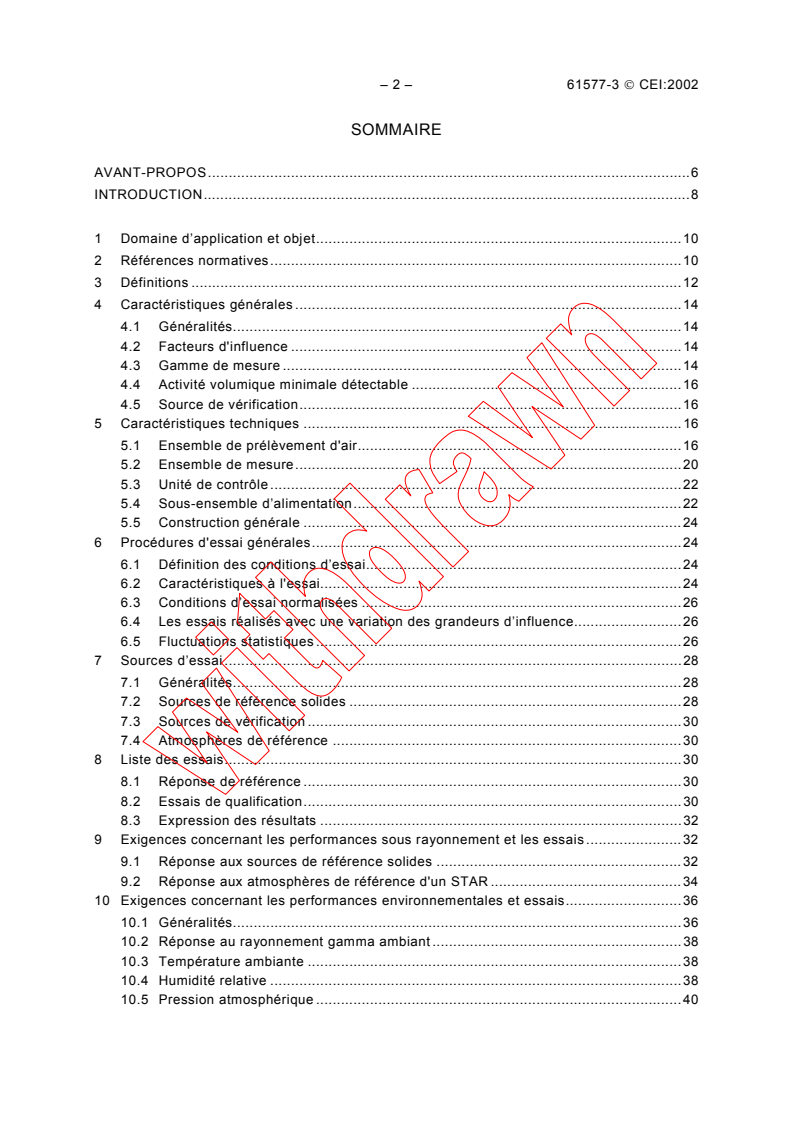
IEC 61577-3:2002 - Radiation protection instrumentation - Radon and radon decay product measuring instruments - Part 3: Specific requirements for radon decay product measuring instruments Released:4/12/2002
Get Certified
Connect with accredited certification bodies for this standard

NSF International
Global independent organization facilitating standards development and certification.

CIS Institut d.o.o.
Personal Protective Equipment (PPE) certification body. Notified Body NB-2890 for EU Regulation 2016/425 PPE.

Kiwa BDA Testing
Building and construction product certification.
Sponsored listings
Frequently Asked Questions
IEC 61577-3:2002 is a standard published by the International Electrotechnical Commission (IEC). Its full title is "Radiation protection instrumentation - Radon and radon decay product measuring instruments - Part 3: Specific requirements for radon decay product measuring instruments". This standard covers: Describes the specific requirements for testing instruments intended for measuring the activity concentration of airborne radon decay products and/or the volume potential alpha energy. Covers test procedures, radiation characteristics, electrical, mechanical, safety and environmental characteristics as well as identification certificates.
Describes the specific requirements for testing instruments intended for measuring the activity concentration of airborne radon decay products and/or the volume potential alpha energy. Covers test procedures, radiation characteristics, electrical, mechanical, safety and environmental characteristics as well as identification certificates.
IEC 61577-3:2002 is classified under the following ICS (International Classification for Standards) categories: 13.280 - Radiation protection. The ICS classification helps identify the subject area and facilitates finding related standards.
IEC 61577-3:2002 has the following relationships with other standards: It is inter standard links to IEC 61577-3:2011. Understanding these relationships helps ensure you are using the most current and applicable version of the standard.
IEC 61577-3:2002 is available in PDF format for immediate download after purchase. The document can be added to your cart and obtained through the secure checkout process. Digital delivery ensures instant access to the complete standard document.
Standards Content (Sample)
NORME CEI
INTERNATIONALE IEC
61577-3
INTERNATIONAL
Première édition
STANDARD
First edition
2002-04
Instrumentation pour la radioprotection –
Instruments de mesure du radon
et des descendants du radon –
Partie 3:
Exigences spécifiques concernant les instruments
de mesure des descendants du radon
Radiation protection instrumentation –
Radon and radon decay product
measuring instruments –
Part 3:
Specific requirements for radon decay
product measuring instruments
Numéro de référence
Reference number
CEI/IEC 61577-3:2002
Numérotation des publications Publication numbering
Depuis le 1er janvier 1997, les publications de la CEI As from 1 January 1997 all IEC publications are
sont numérotées à partir de 60000. Ainsi, la CEI 34-1 issued with a designation in the 60000 series. For
devient la CEI 60034-1. example, IEC 34-1 is now referred to as IEC 60034-1.
Editions consolidées Consolidated editions
Les versions consolidées de certaines publications de la The IEC is now publishing consolidated versions of its
CEI incorporant les amendements sont disponibles. Par publications. For example, edition numbers 1.0, 1.1
exemple, les numéros d’édition 1.0, 1.1 et 1.2 indiquent and 1.2 refer, respectively, to the base publication,
respectivement la publication de base, la publication de the base publication incorporating amendment 1 and
base incorporant l’amendement 1, et la publication de the base publication incorporating amendments 1
base incorporant les amendements 1 et 2. and 2.
Informations supplémentaires Further information on IEC publications
sur les publications de la CEI
Le contenu technique des publications de la CEI est The technical content of IEC publications is kept
constamment revu par la CEI afin qu'il reflète l'état under constant review by the IEC, thus ensuring that
actuel de la technique. Des renseignements relatifs à the content reflects current technology. Information
cette publication, y compris sa validité, sont dispo- relating to this publication, including its validity, is
nibles dans le Catalogue des publications de la CEI available in the IEC Catalogue of publications
(voir ci-dessous) en plus des nouvelles éditions, (see below) in addition to new editions, amendments
amendements et corrigenda. Des informations sur les and corrigenda. Information on the subjects under
sujets à l’étude et l’avancement des travaux entrepris consideration and work in progress undertaken by the
par le comité d’études qui a élaboré cette publication, technical committee which has prepared this
ainsi que la liste des publications parues, sont publication, as well as the list of publications issued,
également disponibles par l’intermédiaire de: is also available from the following:
• Site web de la CEI (www.iec.ch) • IEC Web Site (www.iec.ch)
• Catalogue des publications de la CEI • Catalogue of IEC publications
Le catalogue en ligne sur le site web de la CEI The on-line catalogue on the IEC web site
(www.iec.ch/catlg-f.htm) vous permet de faire des (www.iec.ch/catlg-e.htm) enables you to search
recherches en utilisant de nombreux critères, by a variety of criteria including text searches,
comprenant des recherches textuelles, par comité technical committees and date of publication. On-
d’études ou date de publication. Des informations line information is also available on recently
en ligne sont également disponibles sur les issued publications, withdrawn and replaced
nouvelles publications, les publications rempla- publications, as well as corrigenda.
cées ou retirées, ainsi que sur les corrigenda.
• IEC Just Published
• IEC Just Published
Ce résumé des dernières publications parues
This summary of recently issued publications
(www.iec.ch/JP.htm) est aussi disponible par
(www.iec.ch/JP.htm) is also available by email.
courrier électronique. Veuillez prendre contact
Please contact the Customer Service Centre (see
avec le Service client (voir ci-dessous) pour plus
below) for further information.
d’informations.
• Service clients
• Customer Service Centre
Si vous avez des questions au sujet de cette
If you have any questions regarding this
publication ou avez besoin de renseignements
publication or need further assistance, please
supplémentaires, prenez contact avec le Service
contact the Customer Service Centre:
clients:
Email: custserv@iec.ch
Email: custserv@iec.ch
Tél: +41 22 919 02 11
Tel: +41 22 919 02 11
Fax: +41 22 919 03 00
Fax: +41 22 919 03 00
.
NORME CEI
INTERNATIONALE IEC
61577-3
INTERNATIONAL
Première édition
STANDARD
First edition
2002-04
Instrumentation pour la radioprotection –
Instruments de mesure du radon
et des descendants du radon –
Partie 3:
Exigences spécifiques concernant les instruments
de mesure des descendants du radon
Radiation protection instrumentation –
Radon and radon decay product
measuring instruments –
Part 3:
Specific requirements for radon decay
product measuring instruments
IEC 2002 Droits de reproduction réservés Copyright - all rights reserved
Aucune partie de cette publication ne peut être reproduite ni No part of this publication may be reproduced or utilized in any
utilisée sous quelque forme que ce soit et par aucun procédé, form or by any means, electronic or mechanical, including
électronique ou mécanique, y compris la photocopie et les photocopying and microfilm, without permission in writing from
microfilms, sans l'accord écrit de l'éditeur. the publisher.
International Electrotechnical Commission, 3, rue de Varembé, PO Box 131, CH-1211 Geneva 20, Switzerland
Telephone: +41 22 919 02 11 Telefax: +41 22 919 03 00 E-mail: inmail@iec.ch Web: www.iec.ch
CODE PRIX
U
PRICE CODE
Commission Electrotechnique Internationale
International Electrotechnical Commission
Международная Электротехническая Комиссия
Pour prix, voir catalogue en vigueur
For price, see current catalogue
– 2 – 61577-3 CEI:2002
SOMMAIRE
AVANT-PROPOS.6
INTRODUCTION.8
1 Domaine d’application et objet.10
2 Références normatives.10
3 Définitions .12
4 Caractéristiques générales .14
4.1 Généralités.14
4.2 Facteurs d'influence .14
4.3 Gamme de mesure .14
4.4 Activité volumique minimale détectable .16
4.5 Source de vérification.16
5 Caractéristiques techniques .16
5.1 Ensemble de prélèvement d'air.16
5.2 Ensemble de mesure.20
5.3 Unité de contrôle .22
5.4 Sous-ensemble d’alimentation.22
5.5 Construction générale .24
6 Procédures d'essai générales.24
6.1 Définition des conditions d’essai.24
6.2 Caractéristiques à l'essai.24
6.3 Conditions d’essai normalisées .26
6.4 Les essais réalisés avec une variation des grandeurs d’influence.26
6.5 Fluctuations statistiques .26
7 Sources d’essai .28
7.1 Généralités.28
7.2 Sources de référence solides .28
7.3 Sources de vérification .30
7.4 Atmosphères de référence .30
8 Liste des essais.30
8.1 Réponse de référence .30
8.2 Essais de qualification.30
8.3 Expression des résultats .32
9 Exigences concernant les performances sous rayonnement et les essais .32
9.1 Réponse aux sources de référence solides .32
9.2 Réponse aux atmosphères de référence d'un STAR .34
10 Exigences concernant les performances environnementales et essais.36
10.1 Généralités.36
10.2 Réponse au rayonnement gamma ambiant .38
10.3 Température ambiante .38
10.4 Humidité relative .38
10.5 Pression atmosphérique .40
61577-3 IEC:2002 – 3 –
CONTENTS
FOREWORD.7
INTRODUCTION.9
1 Scope and object.11
2 Normative references .11
3 Definitions .13
4 General characteristics.15
4.1 General .15
4.2 Influence factors.15
4.3 Range of measurement .15
4.4 Minimum detectable activity concentration.17
4.5 Check source .17
5 Technical characteristics .17
5.1 Air sampling subassembly .17
5.2 Measurement subassembly .21
5.3 Control subassembly .23
5.4 Power supply subassembly .23
5.5 General construction .25
6 General test procedures .25
6.1 Definition of test conditions .25
6.2 Characteristics under test.25
6.3 Standard test conditions.27
6.4 Tests performed with variation of the influence quantities.27
6.5 Statistical fluctuation .27
7 Test sources.29
7.1 General .29
7.2 Solid reference sources.29
7.3 Check sources .31
7.4 Reference atmospheres .31
8 Test nomenclature.31
8.1 Reference response .31
8.2 Qualification tests.31
8.3 Expression of results.33
9 Radiation performance requirements and tests .33
9.1 Response to solid reference sources.33
9.2 Response to reference atmospheres of a STAR facility .35
10 Environmental performance requirements and tests .37
10.1 General .37
10.2 Response to ambient gamma radiation.39
10.3 Ambient temperature .39
10.4 Relative humidity.39
10.5 Atmospheric pressure.41
– 4 – 61577-3 CEI:2002
11 Exigences concernant les performances électriques et essais .40
11.1 Fluctuations statistiques .40
11.2 Alimentation .40
11.3 Variation de l’alimentation .42
11.4 Temps de préchauffage.42
11.5 Stabilité d’indication de l’ensemble de mesure .44
12 Essais supplémentaires concernant l'ensemble de prélèvement .44
12.1 Essais du circuit d’air .44
12.2 Contrôle du débit.44
12.3 Temps de mise à l’équilibre thermique .46
12.4 Estimation du débit de fuite externe.46
12.5 Effet des variations de tension de l’alimentation .46
13 Exigences concernant les performances mécaniques et essais .48
13.1 Exigences .48
13.2 Méthode d'essai .48
14 Stockage et transport .48
15 Documentation .48
15.1 Rapport d’essais de type .48
15.2 Certificat d’identification .48
16 Manuel d'utilisation et de maintenance .50
Tableau 1 – Conditions de référence et conditions d'essai normalisées .50
Tableau 2 – Essais réalisés dans des conditions d’essai normalisées.50
Tableau 3 – Essais réalisés avec une variation des grandeurs d’influence.52
Tableau 4 – Essais du circuit d’air .52
61577-3 IEC:2002 – 5 –
11 Electrical performance requirements and tests .41
11.1 Statistical fluctuation .41
11.2 Power supply.41
11.3 Power supply variation .43
11.4 Warm-up time.43
11.5 Stability of indication of the measuring subassembly .45
12 Additional tests of the sampling assembly .45
12.1 Tests of the air circuit.45
12.2 Flow-rate control .45
12.3 Warm-up time.47
12.4 Estimation of the external leakage flow-rate .47
12.5 Effect of supply voltage variations .47
13 Mechanical performance requirements and tests .49
13.1 Requirements.49
13.2 Test method .49
14 Storage and transportation .49
15 Documentation .49
15.1 Type test report.49
15.2 Identification certificate .49
16 Operation and maintenance manual .51
Table 1 – Reference conditions and standard test conditions .51
Table 2 – Tests performed under standard test conditions .51
Table 3 – Tests performed with variation of influence quantities.53
Table 4 – Tests of the air circuit.53
– 6 – 61577-3 CEI:2002
COMMISSION ÉLECTROTECHNIQUE INTERNATIONALE
____________
INSTRUMENTATION POUR LA RADIOPROTECTION –
INSTRUMENTS DE MESURE DU RADON
ET DES DESCENDANTS DU RADON –
Partie 3: Exigences spécifiques concernant les instruments
de mesure des descendants du radon
AVANT-PROPOS
1) La CEI (Commission Électrotechnique Internationale) est une organisation mondiale de normalisation
composée de l'ensemble des comités électrotechniques nationaux (Comités nationaux de la CEI). La CEI a
pour objet de favoriser la coopération internationale pour toutes les questions de normalisation dans les
domaines de l'électricité et de l'électronique. A cet effet, la CEI, entre autres activités, publie des Normes
internationales. Leur élaboration est confiée à des comités d'études, aux travaux desquels tout Comité national
intéressé par le sujet traité peut participer. Les organisations internationales, gouvernementales et non
gouvernementales, en liaison avec la CEI, participent également aux travaux. La CEI collabore étroitement
avec l'Organisation Internationale de Normalisation (ISO), selon des conditions fixées par accord entre les
deux organisations.
2) Les décisions ou accords officiels de la CEI concernant les questions techniques représentent, dans la mesure
du possible, un accord international sur les sujets étudiés, étant donné que les Comités nationaux intéressés
sont représentés dans chaque comité d’études.
3) Les documents produits se présentent sous la forme de recommandations internationales. Ils sont publiés
comme normes, spécifications techniques, rapports techniques ou guides et agréés comme tels par les
Comités nationaux.
4) Dans le but d'encourager l'unification internationale, les Comités nationaux de la CEI s'engagent à appliquer de
façon transparente, dans toute la mesure possible, les Normes internationales de la CEI dans leurs normes
nationales et régionales. Toute divergence entre la norme de la CEI et la norme nationale ou régionale
correspondante doit être indiquée en termes clairs dans cette dernière.
5) La CEI n’a fixé aucune procédure concernant le marquage comme indication d’approbation et sa responsabilité
n’est pas engagée quand un matériel est déclaré conforme à l’une de ses normes.
6) L’attention est attirée sur le fait que certains des éléments de la présente Norme internationale peuvent faire
l’objet de droits de propriété intellectuelle ou de droits analogues. La CEI ne saurait être tenue pour
responsable de ne pas avoir identifié de tels droits de propriété et de ne pas avoir signalé leur existence.
La Norme internationale CEI 61577-3 a été établie par le sous-comité 45B: Instrumentation
pour la radioprotection, du comité d'études 45 de la CEI: Instrumentation nucléaire.
Le texte de cette norme est issu des documents suivants:
FDIS Rapport de vote
45B/351/FDIS 45B/358/RVD
Le rapport de vote indiqué dans le tableau ci-dessus donne toute information sur le vote ayant
abouti à l'approbation de cette norme.
Cette publication a été rédigée selon les Directives ISO/CEI, Partie 3.
Le comité a décidé que le contenu de cette publication ne sera pas modifié avant 2006.
A cette date, la publication sera
• reconduite;
• supprimée;
• remplacée par une édition révisée, ou
• amendée.
61577-3 IEC:2002 – 7 –
INTERNATIONAL ELECTROTECHNICAL COMMISSION
____________
RADIATION PROTECTION INSTRUMENTATION –
RADON AND RADON DECAY PRODUCT
MEASURING INSTRUMENTS –
Part 3: Specific requirements for radon decay product
measuring instruments
FOREWORD
1) The IEC (International Electrotechnical Commission) is a worldwide organization for standardization comprising
all national electrotechnical committees (IEC National Committees). The object of the IEC is to promote
international co-operation on all questions concerning standardization in the electrical and electronic fields. To
this end and in addition to other activities, the IEC publishes International Standards. Their preparation is
entrusted to technical committees; any IEC National Committee interested in the subject dealt with may
participate in this preparatory work. International, governmental and non-governmental organizations liaising
with the IEC also participate in this preparation. The IEC collaborates closely with the International
Organization for Standardization (ISO) in accordance with conditions determined by agreement between the
two organizations.
2) The formal decisions or agreements of the IEC on technical matters express, as nearly as possible, an
international consensus of opinion on the relevant subjects since each technical committee has representation
from all interested National Committees.
3) The documents produced have the form of recommendations for international use and are published in the form
of standards, technical specifications, technical reports or guides and they are accepted by the National
Committees in that sense.
4) In order to promote international unification, IEC National Committees undertake to apply IEC International
Standards transparently to the maximum extent possible in their national and regional standards. Any
divergence between the IEC Standard and the corresponding national or regional standard shall be clearly
indicated in the latter.
5) The IEC provides no marking procedure to indicate its approval and cannot be rendered responsible for any
equipment declared to be in conformity with one of its standards.
6) Attention is drawn to the possibility that some of the elements of this International Standard may be the subject
of patent rights. The IEC shall not be held responsible for identifying any or all such patent rights.
International Standard IEC 61577-3 has been prepared by subcommittee 45B: Radiation
protection instrumentation, of IEC technical committee 45: Nuclear instrumentation.
The text of this standard is based on the following documents:
FDIS Report on voting
45B/351/FDIS 45B/358/RVD
Full information on the voting for the approval of this standard can be found in the report on
voting indicated in the above table.
This publication has been drafted in accordance with the ISO/IEC Directives, Part 3.
The committee has decided that the contents of this publication will remain unchanged until 2006.
At this date, the publication will be
• reconfirmed;
• withdrawn;
• replaced by a revised edition, or
• amended.
– 8 – 61577-3 CEI:2002
INTRODUCTION
La présente Norme internationale fait partie d'une série relative aux instruments de mesure
du radon et des descendants du radon ainsi qu'aux systèmes d'essai avec atmosphères
1)
contenant du radon (acronyme STAR) . Cette série comprend les parties suivantes:
Partie 1: Exigences générales
Partie 2: Exigences spécifiques concernant les instruments de mesure du radon
Partie 3: Exigences spécifiques concernant les instruments de mesure des descendants du
radon
2)
Partie 4: Instruments de mesure rapide de l’énergie alpha potentielle dans les mines .
La partie 1 traite des caractéristiques générales d'essai et d'étalonnage des instruments de
mesure du radon et des descendants du radon et aussi des caractéristiques générales des
instruments de mesure du radon et des descendants du radon.
________
1)
Système de test en atmosphères contenant du radon, parfois aussi appelé chambres à radon. Voir la CEI 61577-1.
2)
A l'étude. Disponible actuellement sous la référence CEI 61263.
61577-3 IEC:2002 – 9 –
INTRODUCTION
This International Standard is part of a series covering radon and radon decay product
1)
measuring instruments as well as systems for test atmospheres with radon (acronym STAR) .
This series consists of the following parts:
Part 1: General requirements
Part 2: Specific requirements for radon measuring instruments
Part 3: Specific requirements for radon decay product measuring instruments
2)
Part 4: Instruments for rapid measurement of potential alpha energy in mines .
Part 1 covers the general characteristics of tests and calibrations of radon and radon decay
product measuring instruments as well as general characteristics of radon and radon
decay product measuring instruments.
________
1)
System for test atmospheres with radon, sometimes called radon chambers. See IEC 61577-1.
2)
Under consideration. Presently available under reference IEC 61263.
– 10 – 61577-3 CEI:2002
INSTRUMENTATION POUR LA RADIOPROTECTION –
INSTRUMENTS DE MESURE DU RADON
ET DES DESCENDANTS DU RADON –
Partie 3: Exigences spécifiques concernant les instruments
de mesure des descendants du radon
1 Domaine d’application et objet
Les exigences de la présente partie de la CEI 61577 sont applicables aux instruments qui
sont utilisés pour mesurer l'activité volumique des descendants du radon et/ou de l'énergie
alpha potentielle volumique sur les lieux de travail, dans les habitations ou à l'extérieur.
En pratique, la norme s’applique à tous les types d’instruments qui utilisent des méthodes
basées sur un prélèvement instantané, un prélèvement en continu et des méthodes de
mesure intégrées qui incluent un équipement électronique. La mesure de l’activité collectée
par un dispositif de prélèvement, par exemple un filtre, peut être réalisée soit pendant le
prélèvement soit à la fin d’un cycle de mesure.
Les procédures d’essai générales et les différents types d’instrumentation utilisés pour la
mesure de l’activité volumique des descendants du radon sont décrits dans la CEI 61577-1.
L'objet de cette partie de la CEI 61577 est de décrire les exigences spécifiques pour tester
les instruments destinés au mesurage de l'activité volumique des descendants du radon en
suspension dans l'air et/ou de l'énergie alpha potentielle volumique.
Ces exigences précisent les procédures d’essai, les caractéristiques du rayonnement,
les caractéristiques électriques, mécaniques, de sécurité et environnementales ainsi que les
certificats d’identification.
Les exigences sont à appliquer en conformité avec les principes généraux concernant le
prélèvement des aérosols radioactifs de l'ISO 2889.
2 Références normatives
Les documents de référence suivants sont indispensables pour l'application de ce document.
Pour les références datées, seule l'édition citée s'applique. Pour les références non datées, la
dernière édition du document de référence s'applique (y compris les éventuels
amendements).
CEI 60050(393):1996, Vocabulaire Electrotechnique International (VEI) – Chapitre 393:
Instrumentation nucléaire: Phénomènes physiques et notions fondamentales
CEI 60050(394):1995, Vocabulaire Electrotechnique International (VEI) – Chapitre 394:
Instrumentation nucléaire: Instruments
CEI 60068 (toutes les parties), Essais d'environnement
CEI 60068-2-27:1987, Essais d'environnement – Deuxième partie: Essais – Essai Ea et
guide: Chocs
CEI 60181:1964, Inventaire d'appareils électriques de mesure utilisés en relation avec les
rayonnements ionisants
CEI 60181A:1965, Premier complément
61577-3 IEC:2002 – 11 –
RADIATION PROTECTION INSTRUMENTATION –
RADON AND RADON DECAY PRODUCT
MEASURING INSTRUMENTS –
Part 3: Specific requirements for radon decay product
measuring instruments
1 Scope and object
The requirements of this part of IEC 61577 are applicable to instruments which are used to
measure radon decay product activity concentration and/or volume potential alpha energy in
work-places, in dwellings and outdoors.
The standard applies practically to all types of instruments that are based on grab sampling,
continuous sampling technique and integrating measurement methods which include
electronic equipment. The measurement of activity retained by a sampling device, for example
a filtering device, can be made both during sampling or after the completion of a collection
cycle.
General testing procedures and the different types of instrumentation used for measuring
radon decay product activity concentration are described in IEC 61577-1.
The object of this part of IEC 61577 is to describe the specific requirements for testing
instruments intended for measuring the activity concentration of airborne radon decay
products and/or the volume potential alpha energy.
These requirements specify test procedures, radiation characteristics, electrical, mechanical,
safety and environmental characteristics as well as identification certificates.
Requirements are to be applied in accordance with the general principles for sampling
airborne radioactive materials of ISO 2889.
2 Normative references
The following referenced documents are indispensable for the application of this document.
For dated references, only the edition cited applies. For undated references, the latest edition
of the referenced document (including any amendments) applies.
IEC 60050(393):1996, International Electrotechnical Vocabulary (IEV) – Chapter 393: Nuclear
instrumentation: Physical phenomena and basic concepts
IEC 60050(394):1995, International Electrotechnical Vocabulary (IEV) – Chapter 394: Nuclear
instrumentation: Instruments
IEC 60068 (all parts), Environmental testing
IEC 60068-2-27:1987, Environmental testing – Part 2: Tests – Test Ea and guidance: Shock
IEC 60181:1964, Index of electrical measuring apparatus used in connection with ionizing
radiation
IEC 60181A:1965, First supplement
– 12 – 61577-3 CEI:2002
CEI 60761-2:2002, Equipements de surveillance en continu de la radioactivité dans les
effluents gazeux – Partie 2: Exigences particulières aux moniteurs d'aérosols radioactifs, y
compris les aérosols transuraniens
CEI 61577-1:2000, Instrumentation pour la radioprotection – Instruments de mesure du radon
et des descendants du radon – Partie 1: Règles générales
ISO 2889:1975, Principes généraux pour le prélèvement des matières radioactives contenues
dans l'air
3 Définitions
Pour les besoins de la présente partie de la CEI 61577, les définitions suivantes s'appliquent,
ainsi que celles figurant dans les CEI 60050(393), CEI 60050(394), CEI 60181, CEI 60181A
et CEI 61577-1.
3.1
valeur conventionnellement vraie d'une grandeur
meilleure estimation de la valeur d’une grandeur déterminée par un étalon primaire ou
secondaire ou par un instrument de référence qui aura été étalonné par rapport à un étalon
primaire ou secondaire
3.2
erreur intrinsèque relative E
l’erreur intrinsèque relative E, exprimée en pourcentage, est donnée par la formule:
E(%) = (Q – Q ) 100/Q
i t t
où
Q est la valeur indiquée;
i
Q est la valeur conventionnellement vraie
t
3.3
coefficient de variation
rapport de l’écart type σ à la moyenne arithmétique x d’un ensemble de mesures x donné par
i
la formule
n
(x − x )
∑ i
i =1
V = σ/ x = 1/ x
n − 1
3.4
réponse de référence R
ref
réponse à l’activité de la source de référence de l’instrument soumis aux conditions d’essai
normalisées
3.5
temps de réponse
retard entre l’exposition initiale du détecteur à une valeur donnée de la grandeur à mesurer et
l’obtention de 90 % de la lecture de l’équilibre ou, pour les ensembles intégrateurs (pente),
90 % de la valeur d’équilibre de la première dérivée de l’indication, relativement au temps
61577-3 IEC:2002 – 13 –
IEC 60761-2:2002, Equipment for continuous monitoring of radioactivity in gaseous effluents –
Part 2: Specific requirements for radioactive aerosol monitors including transuranic aerosols
IEC 61577-1:2000, Radiation protection instrumentation – Radon and radon decay product
measuring instruments – Part 1: General requirements
ISO 2889:1975, General principles for sampling airborne radioactive materials
3 Definitions
For the purpose of this part of IEC 61577, the following definitions apply as well as those
given in IEC 60050(393), IEC 60050(394), IEC 60181, IEC 60181A and IEC 61577-1.
3.1
conventionally true value of a quantity
best estimate of the value of a quantity determined by a primary or secondary standard, or by
a reference instrument that has been calibrated against a primary or secondary standard
3.2
relative intrinsic error E
the relative intrinsic error E, expressed as a percentage, is given by the relationship:
E(%) = (Q – Q ) 100/Q
i t t
where
Q is the indicated value;
i
Q is the conventionally true value
t
3.3
coefficient of variation
ratio of the standard deviation σ to the arithmetic mean x of a set of measurements x given
i
by the formula
n
(x − x )
∑ i
i = 1
V = σ/ x = 1/ x
n − 1
3.4
reference response R
ref
response of the instrument under standard test conditions to the reference source activity
3.5
response time
time delay between the initial exposure of the detection assembly to a given value of the
measurement quantity and the attainment of 90 % of the equilibrium reading, or for integrating
(slope) assemblies, 90 % of the equilibrium value of the first derivative of the indication, with
respect to time
– 14 – 61577-3 CEI:2002
4 Caractéristiques générales
4.1 Généralités
Les descendants du radon en suspension dans l'air étant des aérosols, les moyens d'échantil-
lonnage doivent, au moins, être en conformité avec l'ISO 2889 et la CEI 60761-2. De plus, les
particularités physiques des descendants du radon doivent être prises en compte.
Les mesures des descendants du radon sont basées sur la détection des rayonnements dus à
la désintégration des descendants du radon collectés sur un système de filtration.
Les instruments de mesure des descendants du radon utilisent généralement une méthode de
prélèvement des particules en suspension sur un support tel qu’un filtre associé à un
ensemble de détection.
Ce filtre peut être changé manuellement par l'opérateur ou automatiquement à l'aide d'un
rouleau. Le système de détection doit être adapté au rayonnement à considérer et en rapport
avec les performances de l'appareil de mesure.
Beaucoup d'instruments sont disponibles sur le marché. La CEI 61577-1 présente une liste
des principales méthodes de mesure ainsi que leur principe physique. Différents types
d'instruments utilisés pour la mesure des descendants du radon sont aussi répertoriés.
4.2 Facteurs d'influence
L'aptitude d'un moniteur d'aérosol est influencée par plusieurs facteurs tels que le type de
détecteur et ses performances, le mode de fonctionnement et l’efficacité du système de
prélèvement.
L'efficacité de prélèvement des descendants du radon dépend, dans des circonstances
particulières, de la granulométrie des particules, de la vitesse et de la direction du vent, et de
la capacité d'échantillonnage du dispositif de filtration.
Le débit de prélèvement et la forme de l’entrée d’air peuvent modifier la cinétique de diffusion
et le dépôt par diffusion des descendants du radon.
L’efficacité de certains média filtrants, peut changer pendant le prélèvement car les
poussières collectées modifient la dynamique de collecte et de rétention.
En fonction des caractéristiques techniques de l’ensemble de prélèvement et de détection,
l’humidité peut modifier les performances du dispositif de prélèvement.
L’influence exercée par la variation de la durée de prélèvement dans des conditions stables
doit être évaluée.
4.3 Gamme de mesure
La gamme totale de mesure, dans laquelle les exigences de cette norme sont respectées, doit
être appropriée à l'utilisation de l'instrument et doit faire l’objet d’un accord entre le fabricant
et l’utilisateur.
L'instrument de mesure doit avoir des gammes de travail conformes à la CEI 61577-1, afin
d'être qualifié pour des mesures à l'extérieur, à l'intérieur ou dans les mines.
61577-3 IEC:2002 – 15 –
4 General characteristics
4.1 General
Since radon decay products found in the air are aerosols, the means for sampling shall at
least conform to ISO 2889 and to IEC 60761-2. Besides this, the physical particularities of
radon decay products shall be taken into account.
Radon decay product measurements are based on radiation detection of the decays of radon
decay products trapped on a filtering device.
The equipment for radon decay product measurement generally includes some means of
collection of airborne particulate on a sampling medium such as a filter and a suitable
detection assembly.
This filter can be changed manually by the operator or can exist in the form of a tape moving
automatically. The detection system shall be appropriate to the radiation of interest and
consistent with the performance of measurement apparatus.
Many instruments are available on the market. IEC 61577-1 gives a list of the main
measurement methods as well as their physical principles. Different types of instruments used
for measuring radon decay products are also listed.
4.2 Influence factors
The capability of an aerosol monitor is affected by a number of factors including detector type
and performance, mode of operation and effectiveness of sampling system.
The sampling efficiency of radon decay products is dependent, in particular circumstances, on
particle size distribution, wind speed and direction, and the sampling capability of the filtering
device.
The sampling flow-rate and the inlet design may influence diffusion kinetics and plate-out of
radon decay products.
The efficiency of some retention media may change during sampling as retained dust may
alter capture and retention dynamics.
Depending on the technical characteristics of the sampling and detection assembly, moisture
may affect the performances of the sampling device.
The influence of different sampling times under steady-state conditions shall be evaluated.
4.3 Range of measurement
The total effective range of measurement, within which the requirements of this standard are
met, shall be appropriate to the purpose of the equipment and shall be agreed upon between
manufacturer and purchaser.
The measurement equipment shall have working ranges in accordance with IEC 61577-1,
in order to be qualified for outdoor, indoor or underground measurement.
– 16 – 61577-3 CEI:2002
4.4 Activité volumique minimale détectable
L’activité volumique minimale détectable exigée dépendra de l’application en question. Elle
doit donc faire l’objet d’un accord entre le fabricant et l’utilisateur. Le fabricant doit préciser
l’activité volumique minimale détectable qu’il est possible d’obtenir pour les radionucléides
concernés.
4.5 Source de vérification
La source de vérification fournie avec l’ensemble doit, si possible, être conçue pour pouvoir
être placée dans le dispositif de prélèvement d’aérosols en conservant la même géométrie
que celle de l’ensemble filtre-détecteur.
5 Caractéristiques techniques
Les caractéristiques techniques des instruments concernés par cette norme peuvent se
résumer de la manière suivante.
– L’instrument doit pouvoir prélever un volume d’air connu (ou un débit d’air connu)
à travers un dispositif de prélèvemen
...
Questions, Comments and Discussion
Ask us and Technical Secretary will try to provide an answer. You can facilitate discussion about the standard in here.
Loading comments...