


IEC TS 63222-1:2026
(Main)Power quality management - Part 1: General guidelines
General Information
- Abstract
IEC TS 63222-1:2026 is intended to provide provisions associated to the main use cases regarding recognized engineering practices applicable to power quality management in public electric power supply networks. It summarizes the operation in power quality management and investigates the current standards, for requirement of power quality assessment work, as well as to promote the development of power quality management best practices. The power quality management domain groups use cases and associated power quality requirement common to network management, including customer support network operation, network and extension planning. This document captures possible "common and repeated usage" of power quality management under the format of "use case". Use case implementations are given for information purpose only. This document derives the common requirement as provisions by further standardization activities, in terms of actors interacting with the given system. The interface requirement is considered for later standardization activities. The relationship of the stakeholders in power quality management, such as network operator, network user, etc, are discussed in the document.
This second edition cancels and replaces the first edition published in 2022. This edition includes the following significant technical changes with respect to the previous edition:
- this document completes the use cases planned in IEC 63222-1:2022: four business use cases and three system use cases are added;
- this document makes adjustments to the wording of certain phrases and technical details in IEC 63222-1:2022.
- Status
- Published
- Publication Date
- 25-Mar-2026
- Technical Committee
- TC 8 - System aspects of electrical energy supply
- Drafting Committee
- WG 11 - TC 8/WG 11
- Current Stage
- PPUB - Publication issued
- Start Date
- 26-Mar-2026
- Completion Date
- 10-Apr-2026
Buy Documents
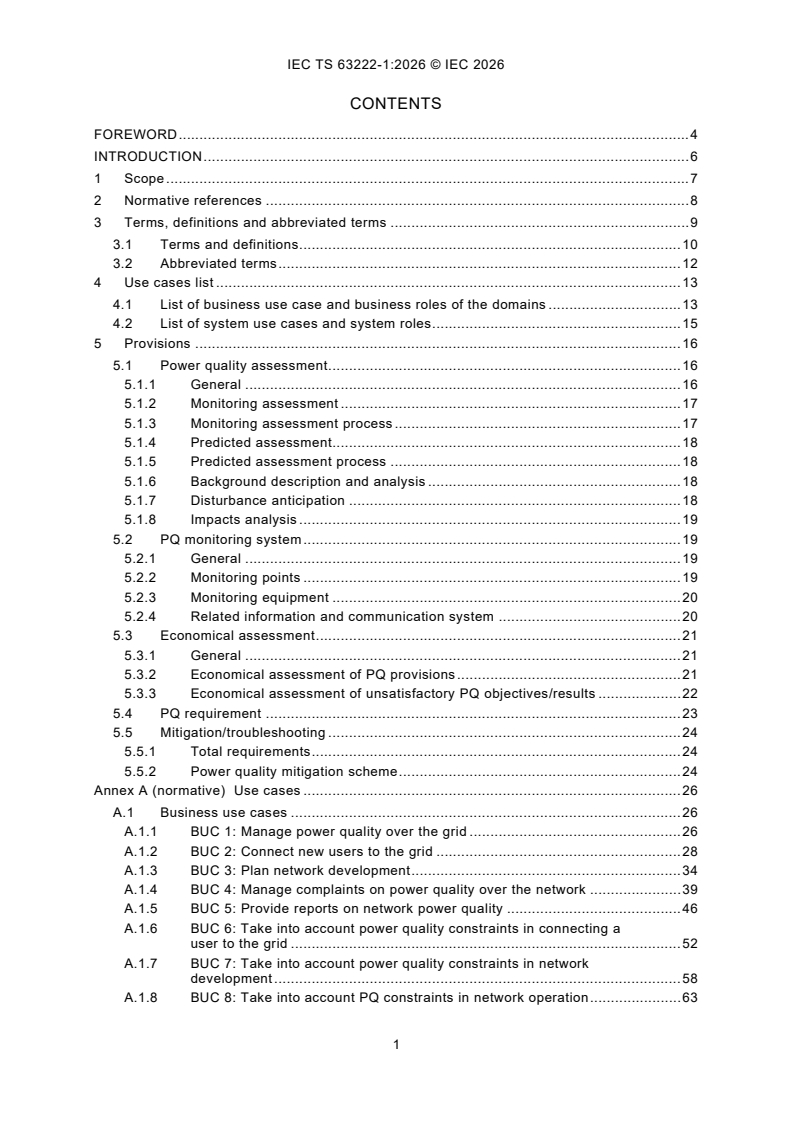
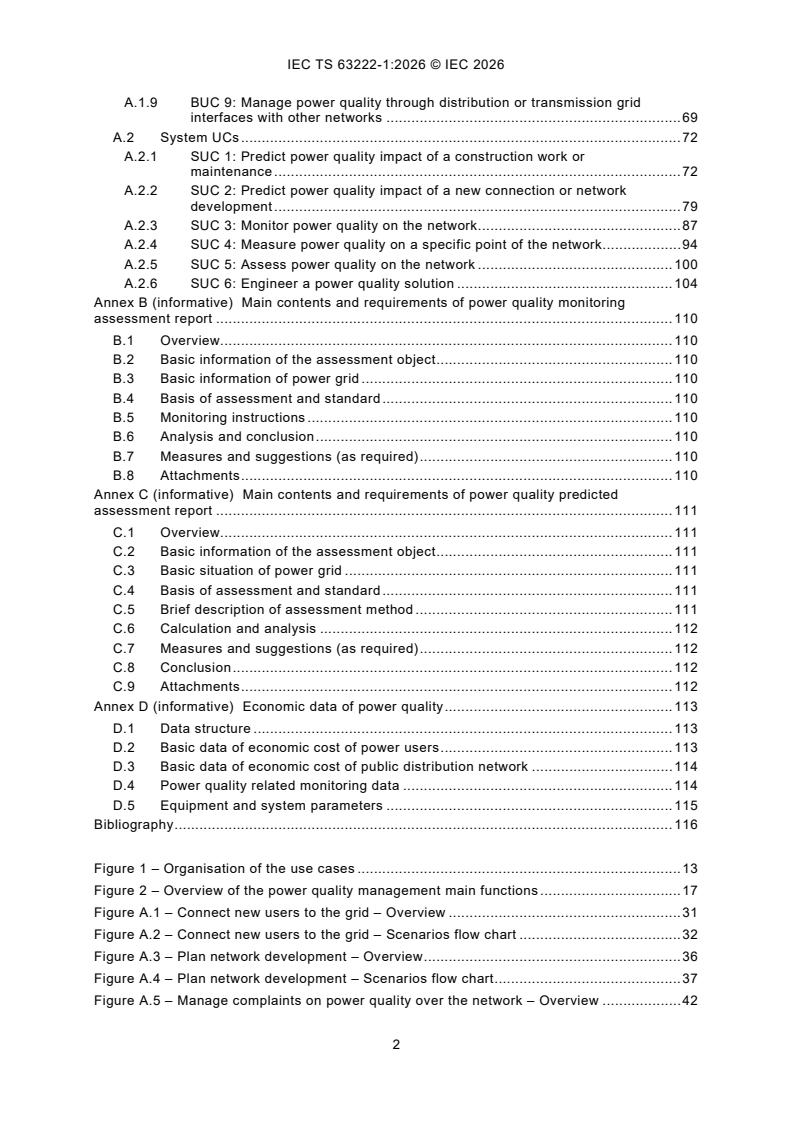
IEC TS 63222-1:2026 - Power quality management - Part 1: General guidelines
REDLINE IEC TS 63222-1:2026 RLV - Power quality management - Part 1: General guidelines
Overview
IEC TS 63222-1:2026 - Power Quality Management - Part 1: General Guidelines is a comprehensive technical specification developed by the International Electrotechnical Commission (IEC). It establishes general guidelines for power quality management in public electric power supply networks. This standard provides essential provisions for recognized engineering practices, supports power quality assessment requirements, and promotes the development of best practices for utility network management. The document captures and organizes frequent operational scenarios (use cases) and offers a systematic approach to improve power quality across electric grids, supporting both day-to-day operation and the planning stages of electrical infrastructure.
Key Topics
IEC TS 63222-1:2026 covers several critical aspects of power quality management:
- Power Quality Assessment: Guidance on both monitoring and predicted assessment of power quality, including methodologies for field testing, data analysis, and reporting.
- Use Case Framework: The standard defines business and system use cases related to power quality, covering a wide range of scenarios from grid management and customer complaints to network expansion and integration of new users.
- Role of Stakeholders: Defines interactions between network operators, users, regulatory authorities, and equipment providers, emphasizing coordinated management and communication.
- Assessment Methods: Introduces standardized approaches for economic assessment, mitigation actions, and troubleshooting insufficient power quality.
- Monitoring Systems: Identifies requirements for effective power quality monitoring, including the selection of monitoring points, required equipment, and supporting information systems.
- Economic Evaluation: Provisions for analyzing the economic impact of power quality problems, ensuring that both technical performance and financial efficiency are considered.
Applications
IEC TS 63222-1:2026 is highly relevant in various real-world contexts for the management and optimization of electric power quality:
- Utility Network Operations: Helps distribution and transmission operators implement structured processes to monitor, assess, and improve the quality of supply, handle complaints, and maintain overall network stability.
- Infrastructure Planning and Development: Supports assessment and integration of new users, expansion projects, and the connection of distributed energy resources by taking power quality into account during the planning and implementation stages.
- Customer Support and Communication: Provides guidelines for resolving customer complaints related to voltage sags, swells, flicker, interruptions, and harmonics, aiming for improved customer satisfaction.
- System Reliability: Encourages the adoption of robust monitoring systems and standardized reporting, contributing to predictable, reliable power delivery, and minimizing disruptions in supply.
- Regulatory Compliance: Assists stakeholders in meeting legal and regulatory standards for power quality-ensuring compatibility with recommended limits and measurement techniques according to the relevant IEC series.
Related Standards
IEC TS 63222-1:2026 references and is complemented by several other important standards in the field:
- IEC 61000 Series: Electromagnetic compatibility (EMC) standards, particularly parts addressing limits for harmonics, voltage fluctuations, and measurement techniques (e.g., IEC 61000-3-2, IEC 61000-4-30).
- IEC TS 62749: Assessment of power quality-characteristics of electricity supplied by public networks.
- IEC TS 63222-2: Power quality management-Part 2: Power quality monitoring system.
- IEC TR 61850-90-17: Communication of power quality data using IEC 61850.
- IEC 61968-9: Enterprise interfaces for meter reading and control.
- ISO 10002: Quality management-Guidelines for complaints handling in organizations.
By providing a holistic, use case-driven approach, IEC TS 63222-1:2026 supports electric utilities, engineers, and stakeholders with the necessary tools for effective power quality management, ensuring higher reliability, regulatory alignment, and enhanced service for end users.
Relations
- Effective Date
- 05-Sep-2023
Buy Documents
IEC TS 63222-1:2026 - Power quality management - Part 1: General guidelines
REDLINE IEC TS 63222-1:2026 RLV - Power quality management - Part 1: General guidelines
Get Certified
Connect with accredited certification bodies for this standard

IMQ S.p.A. (Certification)
Italian electrical product certification.

SLG Prüf- und Zertifizierungs GmbH
German testing and certification body.

UL Solutions
Global safety science company with testing, inspection and certification.
Sponsored listings
Frequently Asked Questions
IEC TS 63222-1:2026 is a technical specification published by the International Electrotechnical Commission (IEC). Its full title is "Power quality management - Part 1: General guidelines". This standard covers: IEC TS 63222-1:2026 is intended to provide provisions associated to the main use cases regarding recognized engineering practices applicable to power quality management in public electric power supply networks. It summarizes the operation in power quality management and investigates the current standards, for requirement of power quality assessment work, as well as to promote the development of power quality management best practices. The power quality management domain groups use cases and associated power quality requirement common to network management, including customer support network operation, network and extension planning. This document captures possible "common and repeated usage" of power quality management under the format of "use case". Use case implementations are given for information purpose only. This document derives the common requirement as provisions by further standardization activities, in terms of actors interacting with the given system. The interface requirement is considered for later standardization activities. The relationship of the stakeholders in power quality management, such as network operator, network user, etc, are discussed in the document. This second edition cancels and replaces the first edition published in 2022. This edition includes the following significant technical changes with respect to the previous edition: - this document completes the use cases planned in IEC 63222-1:2022: four business use cases and three system use cases are added; - this document makes adjustments to the wording of certain phrases and technical details in IEC 63222-1:2022.
IEC TS 63222-1:2026 is intended to provide provisions associated to the main use cases regarding recognized engineering practices applicable to power quality management in public electric power supply networks. It summarizes the operation in power quality management and investigates the current standards, for requirement of power quality assessment work, as well as to promote the development of power quality management best practices. The power quality management domain groups use cases and associated power quality requirement common to network management, including customer support network operation, network and extension planning. This document captures possible "common and repeated usage" of power quality management under the format of "use case". Use case implementations are given for information purpose only. This document derives the common requirement as provisions by further standardization activities, in terms of actors interacting with the given system. The interface requirement is considered for later standardization activities. The relationship of the stakeholders in power quality management, such as network operator, network user, etc, are discussed in the document. This second edition cancels and replaces the first edition published in 2022. This edition includes the following significant technical changes with respect to the previous edition: - this document completes the use cases planned in IEC 63222-1:2022: four business use cases and three system use cases are added; - this document makes adjustments to the wording of certain phrases and technical details in IEC 63222-1:2022.
IEC TS 63222-1:2026 is classified under the following ICS (International Classification for Standards) categories: 29.020 - Electrical engineering in general. The ICS classification helps identify the subject area and facilitates finding related standards.
IEC TS 63222-1:2026 has the following relationships with other standards: It is inter standard links to IEC TS 63222-1:2021. Understanding these relationships helps ensure you are using the most current and applicable version of the standard.
IEC TS 63222-1:2026 is available in PDF format for immediate download after purchase. The document can be added to your cart and obtained through the secure checkout process. Digital delivery ensures instant access to the complete standard document.
Standards Content (Sample)
IEC TS 63222-1 ®
Edition 2.0 2026-03
TECHNICAL
SPECIFICATION
Power quality management -
Part 1: General guidelines
ICS 29.020 ISBN 978-2-8327-1125-5
All rights reserved. Unless otherwise specified, no part of this publication may be reproduced or utilized in any form or
by any means, electronic or mechanical, including photocopying and microfilm, without permission in writing from either
IEC or IEC's member National Committee in the country of the requester. If you have any questions about IEC copyright
or have an enquiry about obtaining additional rights to this publication, please contact the address below or your local
IEC member National Committee for further information.
IEC Secretariat Tel.: +41 22 919 02 11
3, rue de Varembé info@iec.ch
CH-1211 Geneva 20 www.iec.ch
Switzerland
About the IEC
The International Electrotechnical Commission (IEC) is the leading global organization that prepares and publishes
International Standards for all electrical, electronic and related technologies.
About IEC publications
The technical content of IEC publications is kept under constant review by the IEC. Please make sure that you have the
latest edition, a corrigendum or an amendment might have been published.
IEC publications search - IEC Products & Services Portal - products.iec.ch
webstore.iec.ch/advsearchform Discover our powerful search engine and read freely all the
The advanced search enables to find IEC publications by a publications previews, graphical symbols and the glossary.
variety of criteria (reference number, text, technical With a subscription you will always have access to up to date
committee, …). It also gives information on projects, content tailored to your needs.
replaced and withdrawn publications.
Electropedia - www.electropedia.org
The world's leading online dictionary on electrotechnology,
IEC Just Published - webstore.iec.ch/justpublished
Stay up to date on all new IEC publications. Just Published containing more than 22 500 terminological entries in English
details all new publications released. Available online and and French, with equivalent terms in 25 additional languages.
once a month by email. Also known as the International Electrotechnical Vocabulary
(IEV) online.
IEC Customer Service Centre - webstore.iec.ch/csc
If you wish to give us your feedback on this publication or
need further assistance, please contact the Customer
Service Centre: sales@iec.ch.
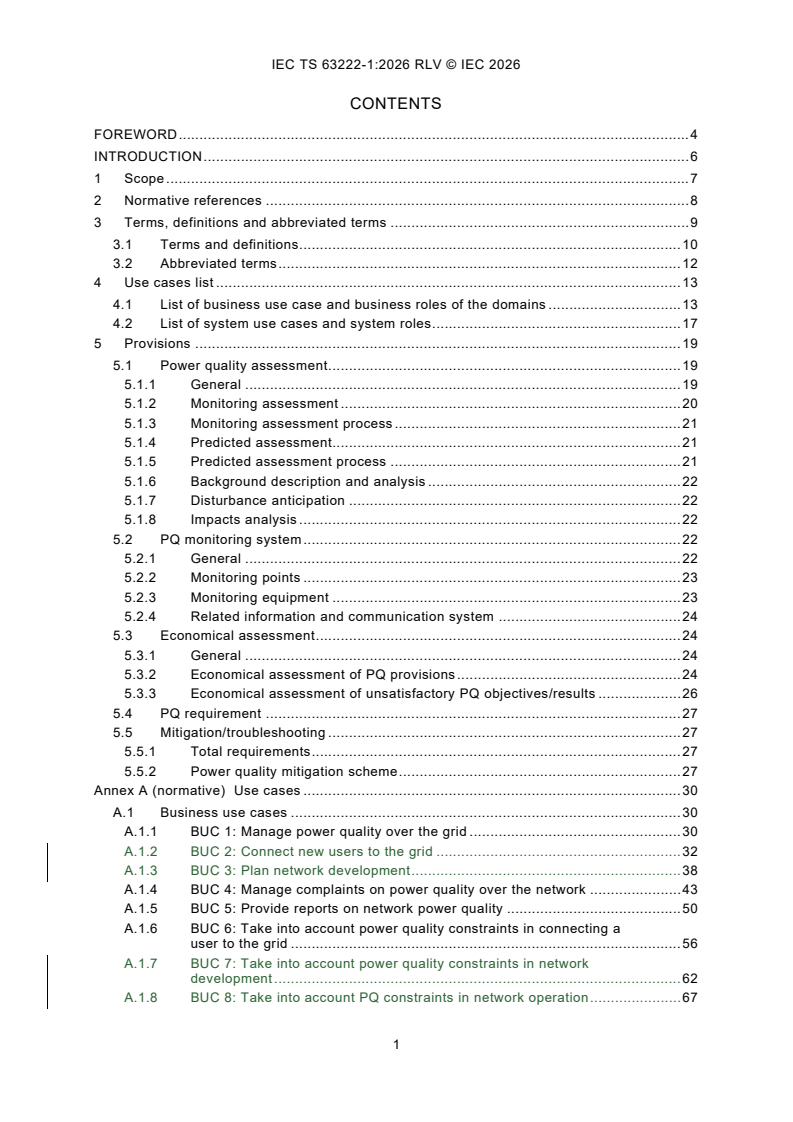
CONTENTS
FOREWORD . 4
INTRODUCTION . 6
1 Scope . 7
2 Normative references . 8
3 Terms, definitions and abbreviated terms . 9
3.1 Terms and definitions . 10
3.2 Abbreviated terms . 12
4 Use cases list . 13
4.1 List of business use case and business roles of the domains . 13
4.2 List of system use cases and system roles . 15
5 Provisions . 16
5.1 Power quality assessment . 16
5.1.1 General . 16
5.1.2 Monitoring assessment . 17
5.1.3 Monitoring assessment process . 17
5.1.4 Predicted assessment. 18
5.1.5 Predicted assessment process . 18
5.1.6 Background description and analysis . 18
5.1.7 Disturbance anticipation . 18
5.1.8 Impacts analysis . 19
5.2 PQ monitoring system . 19
5.2.1 General . 19
5.2.2 Monitoring points . 19
5.2.3 Monitoring equipment . 20
5.2.4 Related information and communication system . 20
5.3 Economical assessment . 21
5.3.1 General . 21
5.3.2 Economical assessment of PQ provisions . 21
5.3.3 Economical assessment of unsatisfactory PQ objectives/results . 22
5.4 PQ requirement . 23
5.5 Mitigation/troubleshooting . 24
5.5.1 Total requirements . 24
5.5.2 Power quality mitigation scheme . 24
Annex A (normative) Use cases . 26
A.1 Business use cases . 26
A.1.1 BUC 1: Manage power quality over the grid . 26
A.1.2 BUC 2: Connect new users to the grid . 28
A.1.3 BUC 3: Plan network development . 34
A.1.4 BUC 4: Manage complaints on power quality over the network . 39
A.1.5 BUC 5: Provide reports on network power quality . 46
A.1.6 BUC 6: Take into account power quality constraints in connecting a
user to the grid . 52
A.1.7 BUC 7: Take into account power quality constraints in network
development . 58
A.1.8 BUC 8: Take into account PQ constraints in network operation . 63
A.1.9 BUC 9: Manage power quality through distribution or transmission grid
interfaces with other networks . 69
A.2 System UCs . 72
A.2.1 SUC 1: Predict power quality impact of a construction work or
maintenance . 72
A.2.2 SUC 2: Predict power quality impact of a new connection or network
development . 79
A.2.3 SUC 3: Monitor power quality on the network. 87
A.2.4 SUC 4: Measure power quality on a specific point of the network. 94
A.2.5 SUC 5: Assess power quality on the network . 100
A.2.6 SUC 6: Engineer a power quality solution . 104
Annex B (informative) Main contents and requirements of power quality monitoring
assessment report . 110
B.1 Overview. 110
B.2 Basic information of the assessment object . 110
B.3 Basic information of power grid . 110
B.4 Basis of assessment and standard . 110
B.5 Monitoring instructions . 110
B.6 Analysis and conclusion . 110
B.7 Measures and suggestions (as required) . 110
B.8 Attachments . 110
Annex C (informative) Main contents and requirements of power quality predicted
assessment report . 111
C.1 Overview. 111
C.2 Basic information of the assessment object . 111
C.3 Basic situation of power grid . 111
C.4 Basis of assessment and standard . 111
C.5 Brief description of assessment method . 111
C.6 Calculation and analysis . 112
C.7 Measures and suggestions (as required) . 112
C.8 Conclusion . 112
C.9 Attachments . 112
Annex D (informative) Economic data of power quality . 113
D.1 Data structure . 113
D.2 Basic data of economic cost of power users . 113
D.3 Basic data of economic cost of public distribution network . 114
D.4 Power quality related monitoring data . 114
D.5 Equipment and system parameters . 115
Bibliography . 116
Figure 1 – Organisation of the use cases . 13
Figure 2 – Overview of the power quality management main functions . 17
Figure A.1 – Connect new users to the grid – Overview . 31
Figure A.2 – Connect new users to the grid – Scenarios flow chart . 32
Figure A.3 – Plan network development – Overview . 36
Figure A.4 – Plan network development – Scenarios flow chart . 37
Figure A.5 – Manage complaints on power quality over the network – Overview . 42
Figure A.6 – Manage complaints on power quality over the network – Scenarios flow
chart . 43
Figure A.7 – Manage complaints on power quality over the network – Use case
relationship . 44
Figure A.8 – Provide reports on network power quality – Overview . 49
Figure A.9 – Provide reports on network power quality – Scenarios flow chart . 50
Figure A.10 – Take into account power quality constraints in connecting a user to the
grid – Overview . 55
Figure A.11 – Take into account power quality constraints in connecting a user to the
grid – Overview . 56
Figure A.12 – Take into account power quality constraints in network development –
Overview . 61
Figure A.13 – Take into account power quality constraints in network development –
Scenarios flow chart . 62
Figure A.14 – Take into account PQ constraints in network operation – Overview . 66
Figure A.15 – Take into account PQ constraints in network operation – Flow chart . 67
Figure A.16 – Manage power quality through distribution or transmission grid interfaces
with other networks – Overview . 71
Figure A.17 – Predict power quality impact of a construction work or maintenance –
Overview . 75
Figure A.18 – Predict power quality impact of a construction work or maintenance –
Scenarios flow chart . 76
Figure A.19 – Predict quality impact of a new connection or network development –
Overview . 83
Figure A.20 – Predict quality impact of a new connection or network development –
Scenarios flow chart . 84
Figure A.21 – Monitor power quality on the network – Overview . 90
Figure A.22 – Monitor power quality on the network – Scenarios flow chart. 91
Figure A.23 – Measure power quality on a specific point of the network – Overview . 96
Figure A.24 – Measure power quality on a specific point of the network – Scenarios
flow chart . 97
Figure A.25 – Assess power quality on the network – Overview . 103
Figure A.26 – Engineer a power quality solution – Overview . 107
Figure A.27 – Engineer a power quality solution – Scenarios flow chart . 107
Table 1 – Content of IEC TS 63222-1 . 7
Table 2 – Abbreviated terms of IEC TS 63222-1 . 12
Table 3 – Lists of business use cases . 14
Table 4 – Business roles of IEC TS 63222-1 . 15
Table 5 – Lists of the system use cases . 15
Table 6 – Lists of system roles . 16
INTERNATIONAL ELECTROTECHNICAL COMMISSION
____________
Power quality management -
Part 1: General guidelines
FOREWORD
1) The International Electrotechnical Commission (IEC) is a worldwide organization for standardization comprising
all national electrotechnical committees (IEC National Committees). The object of IEC is to promote international
co-operation on all questions concerning standardization in the electrical and electronic fields. To this end and
in addition to other activities, IEC publishes International Standards, Technical Specifications, Technical Reports,
Publicly Available Specifications (PAS) and Guides (hereafter referred to as "IEC Publication(s)"). Their
preparation is entrusted to technical committees; any IEC National Committee interested in the subject dealt with
may participate in this preparatory work. International, governmental and non-governmental organizations liaising
with the IEC also participate in this preparation. IEC collaborates closely with the International Organization for
Standardization (ISO) in accordance with conditions determined by agreement between the two organizations.
2) The formal decisions or agreements of IEC on technical matters express, as nearly as possible, an international
consensus of opinion on the relevant subjects since each technical committee has representation from all
interested IEC National Committees.
3) IEC Publications have the form of recommendations for international use and are accepted by IEC National
Committees in that sense. While all reasonable efforts are made to ensure that the technical content of IEC
Publications is accurate, IEC cannot be held responsible for the way in which they are used or for any
misinterpretation by any end user.
4) In order to promote international uniformity, IEC National Committees undertake to apply IEC Publications
transparently to the maximum extent possible in their national and regional publications. Any divergence between
any IEC Publication and the corresponding national or regional publication shall be clearly indicated in the latter.
5) IEC itself does not provide any attestation of conformity. Independent certification bodies provide conformity
assessment services and, in some areas, access to IEC marks of conformity. IEC is not responsible for any
services carried out by independent certification bodies.
6) All users should ensure that they have the latest edition of this publication.
7) No liability shall attach to IEC or its directors, employees, servants or agents including individual experts and
members of its technical committees and IEC National Committees for any personal injury, property damage or
other damage of any nature whatsoever, whether direct or indirect, or for costs (including legal fees) and
expenses arising out of the publication, use of, or reliance upon, this IEC Publication or any other IEC
Publications.
8) Attention is drawn to the Normative references cited in this publication. Use of the referenced publications is
indispensable for the correct application of this publication.
9) IEC draws attention to the possibility that the implementation of this document may involve the use of (a)
patent(s). IEC takes no position concerning the evidence, validity or applicability of any claimed patent rights in
respect thereof. As of the date of publication of this document, IEC had not received notice of (a) patent(s), which
may be required to implement this document. However, implementers are cautioned that this may not represent
the latest information, which may be obtained from the patent database available at https://patents.iec.ch. IEC
shall not be held responsible for identifying any or all such patent rights.
IEC TS 63222-1 has been prepared by IEC technical committee 8: System aspects of electrical
energy supply. It is a Technical Specification.
This second edition cancels and replaces the first edition published in 2022. This edition
constitutes a technical revision.
This edition includes the following significant technical changes with respect to the previous
edition:
a) this document completes the use cases planned in IEC 63222-1:2022: four business use
cases and three system use cases are added;
b) this document makes adjustments to the wording of certain phrases and technical details in
IEC 63222-1:2022.
The text of this Technical Specification is based on the following documents:
Draft Report on voting
8/1793/DTS 8/1803/RVDTS
Full information on the voting for its approval can be found in the report on voting indicated in
the above table.
The language used for the development of this Technical Specification is English.
This document was drafted in accordance with ISO/IEC Directives, Part 2, and developed in
accordance with ISO/IEC Directives, Part 1 and ISO/IEC Directives, IEC Supplement, available
at www.iec.ch/members_experts/refdocs. The main document types developed by IEC are
described in greater detail at www.iec.ch/publications.
A list of all parts in the IEC 63222 series, published under the general title Power quality
management, can be found on the IEC website.
The committee has decided that the contents of this document will remain unchanged until the
stability date indicated on the IEC website under webstore.iec.ch in the data related to the
specific document. At this date, the document will be
– reconfirmed,
– withdrawn, or
– revised.
INTRODUCTION
With the development of smart grid and massive deployment of renewable energy, power quality
issues have received attention not only from system operators and customers (especially with
sensitive power quality loads) but also from market regulators with the demands to provide
information on the actual power quality level. Power quality management of the grid is a
systematic project which includes the whole process of planning, operation, assessment and
mitigation. The characteristics of power supplier, load characteristics of power consumer and
external environment will affect the power quality of the grid. This document focuses on the
whole process management and is the general guideline for the IEC 63222 series.
Traditional electrified railways, steel mills and other non-linear loads are the main pollution
sources of the power quality. In recent years, the new loads such as new energy and electric
vehicles have brought new challenges to power quality management. The rapid popularization
and application of high-tech precision technology has also put forward new requirements for
high-quality power supply and consumption system.
Power quality is an important issue for electricity supply network operators; it is also important
to handle it at planning and operation stages. In order to achieve power quality target, reduce
power quality impacts/losses and improve the economic efficiency of the system, power quality
regulation and supervision of the operating power system is crucial, as well as a well-considered
power quality planning before project implementation, such as system expansion, construction
and grid connection of the distributed generation. Besides, the users at the end of power system
should also be taken into consideration. Power quality problems can cause system instability,
equipment abnormal operation and supply interruption. Power quality management is a method
to avoid further power quality problems after project implementation.
The standard system in power quality management provides a technical basis for improving
power management level and standardizing power quality industry and market. As the general
guideline of the IEC 63222 series, this document summarizes the power quality indicators and
assessment methods, and analyses the overall power quality level by monitoring assessment
and predicted assessment. Monitoring system and field test are used to assess the power
quality level at different nodes of the grid and solve users' power quality complaints and other
practical problems. Connection and monitoring points are reasonably selected to assess the
power quality levels of the grid in operation stage, and it also contributes to the power quality
mitigation. In addition, the economical assessment of power quality is regulated in the document.
Power quality management use cases in different typical scenarios are shown in Annex A.
1 Scope
This part of IEC 63222, which is a Technical Specification, is intended to provide provisions
associated to the main use cases regarding recognized engineering practices applicable to
power quality management in public electric power supply networks. It summarizes the
operation in power quality management and investigates the current standards, for requirement
of power quality assessment work, as well as to promote the development of power quality
management best practices.
The power quality management domain groups use cases and associated power quality
requirement common to network management, including customer support network operation,
network and extension planning.
This document captures possible "common and repeated usage" of power quality management
under the format of "use case". Use case implementations are given for information purpose
only. This document derives the common requirement as provisions by further standardization
activities, in terms of actors interacting with the given system. The interface requirement is
considered for later standardization activities. The relationship of the stakeholders in power
quality management, such as network operator, network user, etc, are discussed in the
document. Table 1 highlights the domains and business use cases described.
Table 1 – Content of IEC TS 63222-1
Domain Content Scope
Described with 5 business use cases Continuous monitoring operation for public
power grid
1) Manage power quality over the grid.
2) Manage power quality through
distribution or transmission grid
interfaces with other network.
3) Take into account power quality
constraints in network operation.
4) Provide reports on network power
quality.
Power quality
5) Manage complaints on power quality
monitoring
over the network.
assessment
6) Manage power quality through
distribution or transmission grid
interfaces with other network.
Described with 4 system use cases
1) Measure power quality on a specific
point of the network.
2) Monitor power quality on the network.
3) Engineer a power quality solution.
4) Assess power quality on the network.
Domain Content Scope
Described with 7 business use cases Power quality assessment of new
construction, reconstruction or expansion
1) Manage power quality over the grid.
projects in the grid
2) Connect new user to the grid.
3) Plan network development.
4) Take into account power quality
constraints in connecting a user to the
grid.
5) Take into account power quality
constraints in network development.
6) Provide reports on network power
Power quality
quality.
predicted
assessment
Described with 6 system use cases
1) Predict power quality impact of a
construction work or maintenance.
2) Predict power quality impact of a new
connection or network development.
3) Measure power quality on a specific
point of the network.
4) Monitor power quality on the network.
5) Engineer a power quality solution.
6) Assess power quality on the network
2 Normative references
The following documents are referred to in the text in such a way that some or all of their content
constitutes requirements of this document. For dated references, only the edition cited applies.
For undated references, the latest edition of the referenced document (including any
amendments) applies.
IEC 61000-3 (all parts), Electromagnetic compatibility (EMC) - Part 3: Limits
IEC 61000-3-2, Electromagnetic compatibility (EMC) - Part 3-2: Limits - Limits for harmonic
current emissions (equipment input current ≤ 16 A per phase)
IEC 61000-3-3, Electromagnetic compatibility (EMC) - Part 3-3: Limits - Limitation of voltage
changes, voltage fluctuations and flicker in public low-voltage supply system, for equipment
with rated current ≤ 16 A per phase and not subject to conditional connection
IEC TS 61000-3-4, Electromagnetic compatibility (EMC) - Part 3-4: Limits - Limitation of
emission of harmonic currents in low-voltage power supply systems for equipment with rated
current greater than 16 A
IEC TS 61000-3-5, Electromagnetic compatibility (EMC) - Part 3-5: Limits - Limitation of voltage
fluctuations and flicker in low-voltage power supply systems for equipment with rated current
greater than 75 A
IEC TR 61000-3-6, Electromagnetic compatibility (EMC) - Part 3-6: Limits - Assessment of
emission limits for the connection of distorting installations to MV, HV and EHV power systems
IEC TR 61000-3-7, Electromagnetic compatibility (EMC) - Part 3-7: Limits - Assessment of
emission limits for the connection of fluctuating load installations to MV, HV and EHV power
systems
IEC 61000-3-8, Electromagnetic compatibility (EMC) - Part 3: Limits - Section 8: Signalling on
low-voltage electrical installations - Emission levels, frequency bands and electromagnetic
disturbance levels
IEC 61000-3-11, Electromagnetic compatibility (EMC) - Part 3-11: Limits - Limitation of voltage
changes, voltage fluctuations and flicker in public low-voltage supply systems - Equipment with
rated current ≤ 75 A and subject to conditional connection
IEC 61000-3-12, Electromagnetic compatibility (EMC) - Part 3-12: Limits - Limits for harmonic
currents produced by equipment connected to public low-voltage systems with input current >16
A and ≤ 75 A per phase
IEC TR 61000-3-13, Electromagnetic compatibility (EMC) - Part 3-13: Limits - Assessment of
emission limits for the connection of unbalanced installations to MV, HV and EHV power
systems
IEC TR 61000-3-14, Electromagnetic compatibility (EMC) - Assessment of emission limits for
harmonics, interharmonics, voltage fluctuations and unbalance for the connection of disturbing
installations to LV power systems
IEC 61000-4 (all parts), Electromagnetic compatibility (EMC) - Part 4: Testing and measurement
techniques
IEC 61000-4-15, Electromagnetic compatibility (EMC) - Part 4-15: Testing and measurement
techniques - Flickermeter - Functional and design specifications
IEC 61000-4-30:2015, Electromagnetic compatibility (EMC) - Part 4-30: Testing and
measurement techniques - Power quality measurement methods
IEC TR 61850-90-17:2017, Communication networks and systems for power utility automation
- Part 90-17: Using IEC 61850 to transmit power quality data
IEC 61968-9:2024, Enterprise business function interfaces for utility operations - Part 9:
Interfaces for meter reading and control
IEC TS 62749:2020, Assessment of power quality - Characteristics of electricity supplied by
public networks
IEC TS 63222-2:2023, Power quality management - Part 2: Power quality monitoring system
ISO 10002:2018, Quality management - Customer satisfaction - Guidelines for complaints
handling in organizations
3 Terms, definitions and abbreviated terms
For the purposes of this document, the following terms and definitions apply.
ISO and IEC maintain terminology databases for use in standardization at the following
addresses:
– IEC Electropedia: available at https://www.electropedia.org/
– ISO Online browsing platform: available at https://www.iso.org/obp
3.1 Terms and definitions
3.1.1
power quality
characteristics of the electricity at a given point on an electrical power system, evaluated
against a set of reference technical parameters
[SOURCE: IEC 60050-617:2009, 617-01-05, modified - The words "electric current, voltage and
frequencies" have been replaced with "electricity". The note has been removed.]
3.1.2
power quality indices
technical parameters characterizing the quality of electricity, measured at a given point,
relevant for the assessment of the quality of the electricity delivered by a network operator
[SOURCE: IEC TS 62749:2020, 3.29]
3.1.3
nominal voltage
voltage by which a system is designated or identified
[SOURCE: IEC 61000-4-30:2015, 3.18, modified - The symbol "U " has been removed.]
n
3.1.4
voltage unbalance
condition in which the RMS values of the phase voltages (fundamental
component) or the phase angles between consecutive phases are not all equal
Note 1 to entry: The degree of the inequality is usually expressed as the ratios of the negative- and zero-sequence
components to the positive-sequence component.
Note 2 to entry: In this document, voltage unbalance is considered in relation to 3-phase systems.
[SOURCE: IEC 60050-161:1990, 161-08-09, modified - The words in parentheses
"(fundamental component)" have been added, as well as the notes to entry.]
3.1.5
voltage deviation
difference between the supply voltage at a given instant and the declared supply voltage
3.1.6
flicker
impression of unsteadiness of visual sensation induced by a light stimulus whose luminance or
spectral distribution fluctuates with time
[SOURCE: IEC 60050-161:1990, 161-08-13]
3.1.7
voltage dip
sudden reduction of the voltage at a point in an electrical system followed by voltage recovery
after a short period of time from a few cycles to a few seconds
[SOURCE: IEC 60050-161:1990, 161-08-10]
3.1.8
short interruption
disappearance of the supply voltage for a time interval whose duration is between two specified
limits
Note 1 to entry: A short interruption is considered to be a reduction of the supply voltage to less than 1 % of the
nominal voltage, with the lower limit of the duration typically a few tenths of a second, and its upper limit typically in
the order of one minute (or, in some cases up to three minutes).
[SOURCE: IEC 60050-161:1990,161-08-20]
3.1.9
harmonic component
sinusoidal component of a periodic quantity having a harmonic frequency
[SOURCE: IEC 60050-551:2001, 551-20-07, modified – The note has been deleted.]
3.1.10
harmonic frequency
frequency which is an integer multiple greater than one of the fundamental frequency or of the
reference fundamental frequency
[SOURCE: IEC 60050-551:2001, 551-20-05]
3.1.11
interharmonic component
sinusoidal component of a periodic quantity having an interharmonic frequency
Note 1 to entry: For practical analysis, an approximation of the periodicity may be necessary.
[SOURCE: IEC 60050-551:2001, 551-20-08]
3.1.12
interharmonic frequency
frequency which is a non-integer multiple of the reference fundamental frequency
[SOURCE: IEC 60050-551:2001, 551-20-06]
3.1.13
system operator
network operator
party responsible for safe and reliable operation of a part of the electric power system in a
certain area and for connection to other parts of the electric power system
[SOURCE: IEC 60050-617:2009, 617-02-09]
3.1.14
power network user
network user
power system user
system user
party supplying electric power and energy to, or being supplied with electric power and energy
from, a transmission system or a distribution system
[SOURCE: IEC 60050-617:2009, 617-02-07, modified - The first and second preferred terms
have been inverted.]
3.1.15
stakeholder
individual, group or organization that has an interest in an organization or activity
Note 1 to entry: Usually a stakeholder can affect or is affected by the organization or the activity.
[SOURCE: IEC 60050-904:2014, 904-01-10, modified - The note to entry has been deleted.]
3.1.16
system average RMS variation frequency index
power quality index that provides a count or rate of one or more of the following: voltage dips,
swells, interruptions for a system
Note 1 to entry: See IEC TS 62749:2020.
3.1.17
distribution system operator
party operating a distribution system
[SOURCE: IEC 60050-617:2009, 617-02-10, modified - The equivalent terms "distribution
network operator and "distributor" have been deleted.]
3.1.18
transmission system operator
party operating a transmission system
[SOURCE: IEC 60050-617:2009, 617-02-11, modified - The equivalent term "transmission
network operator" has been deleted.]
3.2 Abbreviated terms
Abbreviated terms used in the text are defined in Table 2.
Table 2 – Abbreviated terms of IEC TS 63222-1
Definition
Abbreviated term
active power filter
APF
battery energy storage system
BESS
business use case
BUC
dynamic voltage restorer
DVR
electromagnetic compatibility
EMC
flexible AC transmission systems
FACTS
logical node
LN
point of supply
POS
power quality
PQ
real time clock
RTC
rapid voltage change
RVC
system average RMS variation frequency index
SARFI
supervisory control and data acquisition
SCADA
static synchronous compensator
STATCOM
system use case
SUC
static var compensator
SVC
uninterrupted power supply
UPS
voltage source converter
VSC
4 Use cases list
4.1 List of business use case and business roles of the domains
The business use cases list is not exhaustive, and it is likely to grow as new use cases come
to light. The organisation of the use cases in the document and the links between them are
shown in Figure 1. Annex A gives the details of use cases.
Figure 1 – Organisation of the use cases
Table 3 lists and provides a brief description of the business use cases. In Clause A.1, the
business use cases are introduced in detail.
Table 3 – Lists of business use cases
Index of the Identified business Associated domain Brief description
business use case use case
UC63222-B001 Manage power quality Network and extension The business use case describes
over the grid planning, network the system operator main
operation, customer processes to manage power
support quality disturbances for the
reliability of the power system
and ensure continuity and quality
of the electrical energy provided
to the grid users at their
connection point to the grid.
UC63222-B002 Connect new user to Maintenance and This business use case outlines
the grid construction, network and the key workflows and technical
extension planning, requirements for new user grid
network operation, connections. The user includes
customer support but are not limited to high-
voltage/low-voltage users,
distributed energy resources
(DERs), electric vehicles (EVs).
UC63222-B003 Plan network Maintenance and This business use case
development construction, network and describes the main process of
extension planning, power grid development
network operation, planning, which mainly includes
customer support site selection planning,
construction plan and
development approval.
UC63222-B004 Manage complaints on Network and extension The business use case describes
power quality over the planning, network the system operator main
network operation, customer processes to resolve a power
support quality issue on a specific point
of the network.
UC63222-B005 Provide reports on Network and extension The business use case describes
network power quality planning, network the system operator main
operation, customer processes to retrieve, build,
support analyse power quality data and
report on it for different
commitments.
UC63222-B006 Take into account Network and extension This business use case
power quality planning, network describes the power quality
constraints in operation, customer constraints should be considered
connecting a user to the support for new user connection.
grid
UC63222-B007 Take into account Maintenance and This business use case
power quality construction, network and describes the power quality
constraints in network extension planning, constraints should be considered
development network operation, for network development.
customer support
UC63222-B008 Take into account Network and extension This business use case
power quality planning, network describes the power quality
constraints in network operation, customer control method and workflow in
operation support the power grid operation.
UC63222-B009 Manage power quality Network and extension The business use case analyses
through distribution or planning, network the power quality impact
transmission grid operation, customer between different grids, including
interfaces with other support but not limited to the interfaces
networks between high voltage and low
voltage, transmission and
distribution network.
Table 4 lists the business roles that have been identified so far in the business use cases
provided in Clause A.1.
Table 4 – Business roles of IEC TS 63222-1
Business roles Definition
System operator 3.1.13
Power quality complaints Party responsible for customer relationship and customer support on power quality
responsible issue on part of the electric power system in a certain area
Network operation Entity responsible for the planning, operation, maintenance, and the development
responsible in given areas of the electricity network
Grid user A party connected to the grid that is either consuming or producing electricity, or
both. Grid users include consumers, producers, and prosumers
(Electricity) supplier Party having a contract to supply electric power and energy to a customer
(IEV 617-02-08)
Conceding authority Authority that owns (a part of) the distribution grid and delegates its operation to a
distribution grid operator in a system where electricity distribution is operated as a
concession.
The conceding authority is usually a local authority or a municipality.
Authority that is responsible for preparing or adopting regulations (IEV 901-03-11).
Regulator
It is responsible for exercising autonomous authority over electricity markets and
the associated synchronous electricity grids. Equivalent to Regulatory Authority.
Organizational entity that analyses and transforms specified requirements into
Designer
acceptable design solutions which meet the regulations and specifications.
Organizational entity co
...
IEC TS 63222-1 ®
Edition 2.0 2026-03
TECHNICAL
SPECIFICATION
REDLINE VERSION
Power quality management -
Part 1: General guidelines
ICS 29.020 ISBN 978-2-8327-1180-4
All rights reserved. Unless otherwise specified, no part of this publication may be reproduced or utilized in any form or
by any means, electronic or mechanical, including photocopying and microfilm, without permission in writing from either
IEC or IEC's member National Committee in the country of the requester. If you have any questions about IEC copyright
or have an enquiry about obtaining additional rights to this publication, please contact the address below or your local
IEC member National Committee for further information.
IEC Secretariat Tel.: +41 22 919 02 11
3, rue de Varembé info@iec.ch
CH-1211 Geneva 20 www.iec.ch
Switzerland
About the IEC
The International Electrotechnical Commission (IEC) is the leading global organization that prepares and publishes
International Standards for all electrical, electronic and related technologies.
About IEC publications
The technical content of IEC publications is kept under constant review by the IEC. Please make sure that you have the
latest edition, a corrigendum or an amendment might have been published.
IEC publications search - IEC Products & Services Portal - products.iec.ch
webstore.iec.ch/advsearchform Discover our powerful search engine and read freely all the
The advanced search enables to find IEC publications by a publications previews, graphical symbols and the glossary.
variety of criteria (reference number, text, technical With a subscription you will always have access to up to date
committee, …). It also gives information on projects, content tailored to your needs.
replaced and withdrawn publications.
Electropedia - www.electropedia.org
The world's leading online dictionary on electrotechnology,
IEC Just Published - webstore.iec.ch/justpublished
Stay up to date on all new IEC publications. Just Published containing more than 22 500 terminological entries in English
details all new publications released. Available online and and French, with equivalent terms in 25 additional languages.
once a month by email. Also known as the International Electrotechnical Vocabulary
(IEV) online.
IEC Customer Service Centre - webstore.iec.ch/csc
If you wish to give us your feedback on this publication or
need further assistance, please contact the Customer
Service Centre: sales@iec.ch.
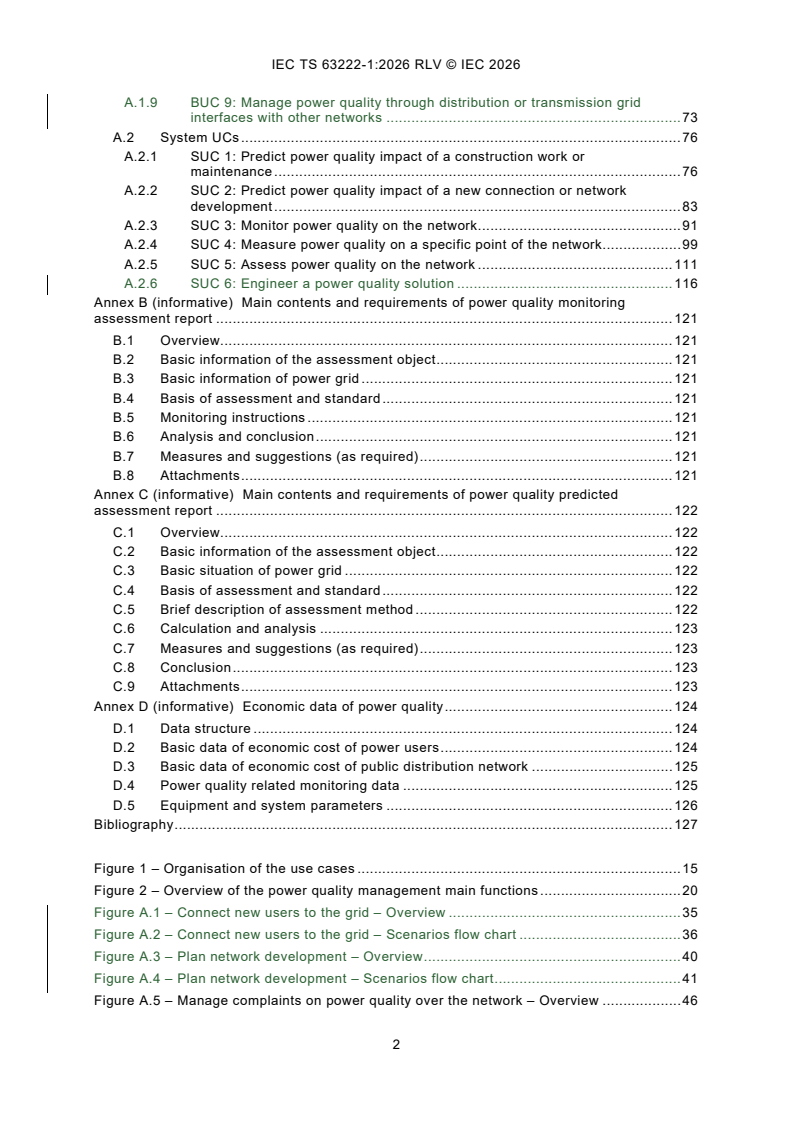
CONTENTS
FOREWORD . 4
INTRODUCTION . 6
1 Scope . 7
2 Normative references . 8
3 Terms, definitions and abbreviated terms . 9
3.1 Terms and definitions . 10
3.2 Abbreviated terms . 12
4 Use cases list . 13
4.1 List of business use case and business roles of the domains . 13
4.2 List of system use cases and system roles . 17
5 Provisions . 19
5.1 Power quality assessment . 19
5.1.1 General . 19
5.1.2 Monitoring assessment . 20
5.1.3 Monitoring assessment process . 21
5.1.4 Predicted assessment. 21
5.1.5 Predicted assessment process . 21
5.1.6 Background description and analysis . 22
5.1.7 Disturbance anticipation . 22
5.1.8 Impacts analysis . 22
5.2 PQ monitoring system . 22
5.2.1 General . 22
5.2.2 Monitoring points . 23
5.2.3 Monitoring equipment . 23
5.2.4 Related information and communication system . 24
5.3 Economical assessment . 24
5.3.1 General . 24
5.3.2 Economical assessment of PQ provisions . 24
5.3.3 Economical assessment of unsatisfactory PQ objectives/results . 26
5.4 PQ requirement . 27
5.5 Mitigation/troubleshooting . 27
5.5.1 Total requirements . 27
5.5.2 Power quality mitigation scheme . 27
Annex A (normative) Use cases . 30
A.1 Business use cases . 30
A.1.1 BUC 1: Manage power quality over the grid . 30
A.1.2 BUC 2: Connect new users to the grid . 32
A.1.3 BUC 3: Plan network development . 38
A.1.4 BUC 4: Manage complaints on power quality over the network . 43
A.1.5 BUC 5: Provide reports on network power quality . 50
A.1.6 BUC 6: Take into account power quality constraints in connecting a
user to the grid . 56
A.1.7 BUC 7: Take into account power quality constraints in network
development . 62
A.1.8 BUC 8: Take into account PQ constraints in network operation . 67
A.1.9 BUC 9: Manage power quality through distribution or transmission grid
interfaces with other networks . 73
A.2 System UCs . 76
A.2.1 SUC 1: Predict power quality impact of a construction work or
maintenance . 76
A.2.2 SUC 2: Predict power quality impact of a new connection or network
development . 83
A.2.3 SUC 3: Monitor power quality on the network. 91
A.2.4 SUC 4: Measure power quality on a specific point of the network. 99
A.2.5 SUC 5: Assess power quality on the network . 111
A.2.6 SUC 6: Engineer a power quality solution . 116
Annex B (informative) Main contents and requirements of power quality monitoring
assessment report . 121
B.1 Overview. 121
B.2 Basic information of the assessment object . 121
B.3 Basic information of power grid . 121
B.4 Basis of assessment and standard . 121
B.5 Monitoring instructions . 121
B.6 Analysis and conclusion . 121
B.7 Measures and suggestions (as required) . 121
B.8 Attachments . 121
Annex C (informative) Main contents and requirements of power quality predicted
assessment report . 122
C.1 Overview. 122
C.2 Basic information of the assessment object . 122
C.3 Basic situation of power grid . 122
C.4 Basis of assessment and standard . 122
C.5 Brief description of assessment method . 122
C.6 Calculation and analysis . 123
C.7 Measures and suggestions (as required) . 123
C.8 Conclusion . 123
C.9 Attachments . 123
Annex D (informative) Economic data of power quality . 124
D.1 Data structure . 124
D.2 Basic data of economic cost of power users . 124
D.3 Basic data of economic cost of public distribution network . 125
D.4 Power quality related monitoring data . 125
D.5 Equipment and system parameters . 126
Bibliography . 127
Figure 1 – Organisation of the use cases . 15
Figure 2 – Overview of the power quality management main functions . 20
Figure A.1 – Connect new users to the grid – Overview . 35
Figure A.2 – Connect new users to the grid – Scenarios flow chart . 36
Figure A.3 – Plan network development – Overview . 40
Figure A.4 – Plan network development – Scenarios flow chart . 41
Figure A.5 – Manage complaints on power quality over the network – Overview . 46
Figure A.6 – Manage complaints on power quality over the network – Scenarios flow
chart . 47
Figure A.7 – Manage complaints on power quality over the network – Use case
relationship . 48
Figure A.8 – Provide reports on network power quality – Overview . 53
Figure A.9 – Provide reports on network power quality – Scenarios flow chart . 54
Figure A.10 – Take into account power quality constraints in connecting a user to the
grid – Overview . 59
Figure A.11 – Take into account power quality constraints in connecting a user to the
grid – Overview . 60
Figure A.12 – Take into account power quality constraints in network development –
Overview . 65
Figure A.13 – Take into account power quality constraints in network development –
Scenarios flow chart . 66
Figure A.14 – Take into account PQ constraints in network operation – Overview . 70
Figure A.15 – Take into account PQ constraints in network operation – Flow chart . 71
Figure A.16 – Manage power quality through distribution or transmission grid interfaces
with other networks – Overview . 75
Figure A.17 – Predict power quality impact of a construction work or maintenance –
Overview . 79
Figure A.18 – Predict power quality impact of a construction work or maintenance –
Scenarios flow chart . 80
Figure A.19 – Predict quality impact of a new connection or network development –
Overview . 87
Figure A.20 – Predict quality impact of a new connection or network development –
Scenarios flow chart . 88
Figure A.21 – Monitor power quality on the network – Overview . 95
Figure A.22 – Monitor power quality on the network – Scenarios flow chart. 96
Figure A.23 – Measure power quality on a specific point of the network – Overview . 102
Figure A.24 – Measure power quality on a specific point of the network – Scenarios
flow chart . 103
Figure A.25 – Assess power quality on the network – Overview . 115
Figure A.26 – Engineer a power quality solution – Overview . 118
Figure A.27 – Engineer a power quality solution – Scenarios flow chart . 119
Table 1 – Content of IEC TS 63222-1 . 7
Table 2 – Abbreviated terms of IEC TS 63222-1 . 12
Table 3 – Lists of business use cases . 15
Table 4 – Business roles of IEC TS 63222-1 . 17
Table 5 – Lists of the system use cases . 18
Table 6 – Lists of system roles . 19
INTERNATIONAL ELECTROTECHNICAL COMMISSION
____________
Power quality management -
Part 1: General guidelines
FOREWORD
1) The International Electrotechnical Commission (IEC) is a worldwide organization for standardization comprising
all national electrotechnical committees (IEC National Committees). The object of IEC is to promote international
co-operation on all questions concerning standardization in the electrical and electronic fields. To this end and
in addition to other activities, IEC publishes International Standards, Technical Specifications, Technical Reports,
Publicly Available Specifications (PAS) and Guides (hereafter referred to as "IEC Publication(s)"). Their
preparation is entrusted to technical committees; any IEC National Committee interested in the subject dealt with
may participate in this preparatory work. International, governmental and non-governmental organizations liaising
with the IEC also participate in this preparation. IEC collaborates closely with the International Organization for
Standardization (ISO) in accordance with conditions determined by agreement between the two organizations.
2) The formal decisions or agreements of IEC on technical matters express, as nearly as possible, an international
consensus of opinion on the relevant subjects since each technical committee has representation from all
interested IEC National Committees.
3) IEC Publications have the form of recommendations for international use and are accepted by IEC National
Committees in that sense. While all reasonable efforts are made to ensure that the technical content of IEC
Publications is accurate, IEC cannot be held responsible for the way in which they are used or for any
misinterpretation by any end user.
4) In order to promote international uniformity, IEC National Committees undertake to apply IEC Publications
transparently to the maximum extent possible in their national and regional publications. Any divergence between
any IEC Publication and the corresponding national or regional publication shall be clearly indicated in the latter.
5) IEC itself does not provide any attestation of conformity. Independent certification bodies provide conformity
assessment services and, in some areas, access to IEC marks of conformity. IEC is not responsible for any
services carried out by independent certification bodies.
6) All users should ensure that they have the latest edition of this publication.
7) No liability shall attach to IEC or its directors, employees, servants or agents including individual experts and
members of its technical committees and IEC National Committees for any personal injury, property damage or
other damage of any nature whatsoever, whether direct or indirect, or for costs (including legal fees) and
expenses arising out of the publication, use of, or reliance upon, this IEC Publication or any other IEC
Publications.
8) Attention is drawn to the Normative references cited in this publication. Use of the referenced publications is
indispensable for the correct application of this publication.
9) IEC draws attention to the possibility that the implementation of this document may involve the use of (a)
patent(s). IEC takes no position concerning the evidence, validity or applicability of any claimed patent rights in
respect thereof. As of the date of publication of this document, IEC had not received notice of (a) patent(s), which
may be required to implement this document. However, implementers are cautioned that this may not represent
the latest information, which may be obtained from the patent database available at https://patents.iec.ch. IEC
shall not be held responsible for identifying any or all such patent rights.
This redline version of the official IEC Standard allows the user to identify the changes made
to the previous edition IEC TS 63222-1:2022. A vertical bar appears in the margin wherever a
change has been made. Additions are in green text, deletions are in strikethrough red text.
IEC TS 63222-1 has been prepared by IEC technical committee 8: System aspects of electrical
energy supply. It is a Technical Specification.
This second edition cancels and replaces the first edition published in 2022. This edition
constitutes a technical revision.
This edition includes the following significant technical changes with respect to the previous
edition:
a) this document completes the use cases planned in IEC 63222-1:2022: four business use
cases and three system use cases are added;
b) this document makes adjustments to the wording of certain phrases and technical details in
IEC 63222-1:2022.
The text of this Technical Specification is based on the following documents:
Draft Report on voting
8/1793/DTS 8/1803/RVDTS
Full information on the voting for its approval can be found in the report on voting indicated in
the above table.
The language used for the development of this Technical Specification is English.
This document was drafted in accordance with ISO/IEC Directives, Part 2, and developed in
accordance with ISO/IEC Directives, Part 1 and ISO/IEC Directives, IEC Supplement, available
at www.iec.ch/members_experts/refdocs. The main document types developed by IEC are
described in greater detail at www.iec.ch/publications.
A list of all parts in the IEC 63222 series, published under the general title Power quality
management, can be found on the IEC website.
The committee has decided that the contents of this document will remain unchanged until the
stability date indicated on the IEC website under webstore.iec.ch in the data related to the
specific document. At this date, the document will be
– reconfirmed,
– withdrawn, or
– revised.
INTRODUCTION
With the development of smart grid and massive deployment of renewable energy, power quality
issues have received attention not only from system operators and customers (especially with
sensitive power quality loads) but also from market regulators with the demands to provide
information on the actual power quality level. Power quality management of the grid is a
systematic project which includes the whole process of planning, operation, assessment and
mitigation. The characteristics of power supplier, load characteristics of power consumer and
external environment will affect the power quality of the grid. This document focuses on the
whole process management and is the general guideline for the IEC 63222 series.
Traditional electrified railways, steel mills and other non-linear loads are the main pollution
sources of the power quality. In recent years, the new loads such as new energy and electric
vehicles have brought new challenges to power quality management. The rapid popularization
and application of high-tech precision technology has also put forward new requirements for
high-quality power supply and consumption system.
Power quality is an important issue for electricity supply network operators; it is also important
to handle it at planning and operation stages. In order to achieve power quality target, reduce
power quality impacts/losses and improve the economic efficiency of the system, power quality
regulation and supervision of the operating power system is necessary crucial, as well as a
well-considered power quality planning before project implementation is also needed, such as
system expansion, construction and grid connection of the distributed generation. Besides, the
users at the end of power system should also be taken into consideration. Power quality
problems can cause system instability, equipment abnormal operation and supply interruption.
Power quality management is a method to avoid further power quality problems after project
implementation.
The standard system in power quality management provides a technical basis for improving
power management level and standardizing power quality industry and market. As the general
guideline of the IEC 63222 series, this document summarizes the power quality indicators and
assessment methods, and analyses the overall power quality level by monitoring assessment
and predicted assessment. Monitoring system and field test are used to assess the power
quality level at different nodes of the grid and solve users' power quality complaints and other
practical problems. Connection and monitoring points are reasonably selected to assess the
power quality levels of the grid in operation stage, and it also contributes to the power quality
mitigation. In addition, the economical assessment of power quality is regulated in the document.
Power quality management use cases in different typical scenarios are shown in Annex A.
1 Scope
This part of IEC 63222, which is a Technical Specification, is intended to provide provisions
associated to the main use cases regarding recognized engineering practices applicable to
power quality management in public electric power supply networks. It summarizes the
operation in power quality management and investigates the current standards, for requirement
of power quality assessment work, as well as to promote the development of power quality
management best practices.
The power quality management domain groups use cases and associated power quality
requirement common to network management, including customer support network operation,
network and extension planning.
This document captures possible "common and repeated usage" of power quality management
under the format of "use case". Use case implementations are given for information purpose
only. This document derives the common requirement as provisions by further standardization
activities, in terms of actors interacting with the given system. The interface requirement is
considered for later standardization activities. The relationship of the stakeholders in power
quality management, such as network operator, network user, etc, are discussed in the
document. Table 1 highlights the domains and business use cases described.
Table 1 – Content of IEC TS 63222-1
Domain Content Scope
Described with 5 business use cases Continuous monitoring operation for public
power grid
1) Manage power quality over the grid.
2) Manage power quality through
distribution or transmission grid
interfaces with other network.
3) Take into account power quality
constraints in network operation.
4) Provide reports on network power
quality.
5) Manage complaints on power quality
over the network.
Power quality
6) Manage power quality through
monitoring
distribution or transmission grid
assessment
interfaces with other network.
Described with 4 system use cases
1) Measure power quality on a specific
point of the network.
2) Monitor power quality on the network.
3) Engineer a power quality provision
solution.
4) Assess power quality on the network.
5) Assess the emission limit related to
power quality technical parameters in
power system.
Domain Content Scope
Described with 7 business use cases Power quality assessment of new
construction, reconstruction or expansion
1) Manage power quality over the grid.
projects in the grid
2) Connect new user to the grid.
3) Plan network development.
4) Take into account power quality
constraints in connecting a user to the
grid.
5) Take into account power quality
constraints in network development.
6) Provide reports on network power
quality.
Power quality Described with 6 system use cases
predicted
1) Predict power quality impact of a
assessment
construction work or maintenance.
2) Predict power quality impact of a new
connection or network development.
3) Measure power quality on a specific
point of the network.
4) Monitor power quality on the network.
5) Engineer a power quality provision
solution.
6) Assess power quality on the network
7) Assess the emission limit related to
power quality technical parameters in
power system.
2 Normative references
The following documents are referred to in the text in such a way that some or all of their content
constitutes requirements of this document. For dated references, only the edition cited applies.
For undated references, the latest edition of the referenced document (including any
amendments) applies.
IEC 61000-3 (all parts), Electromagnetic compatibility (EMC) - Part 3: Limits
IEC 61000-3-2, Electromagnetic compatibility (EMC) - Part 3-2: Limits - Limits for harmonic
current emissions (equipment input current ≤ 16 A per phase)
IEC 61000-3-3, Electromagnetic compatibility (EMC) - Part 3-3: Limits - Limitation of voltage
changes, voltage fluctuations and flicker in public low-voltage supply system, for equipment
with rated current ≤ 16 A per phase and not subject to conditional connection
IEC TS 61000-3-4, Electromagnetic compatibility (EMC) - Part 3-4: Limits - Limitation of
emission of harmonic currents in low-voltage power supply systems for equipment with rated
current greater than 16 A
IEC TS 61000-3-5, Electromagnetic compatibility (EMC) - Part 3-5: Limits - Limitation of voltage
fluctuations and flicker in low-voltage power supply systems for equipment with rated current
greater than 75 A
IEC TR 61000-3-6, Electromagnetic compatibility (EMC) - Part 3-6: Limits - Assessment of
emission limits for the connection of distorting installations to MV, HV and EHV power systems
IEC TR 61000-3-7, Electromagnetic compatibility (EMC) - Part 3-7: Limits - Assessment of
emission limits for the connection of fluctuating load installations to MV, HV and EHV power
systems
IEC 61000-3-8, Electromagnetic compatibility (EMC) - Part 3: Limits - Section 8: Signalling on
low-voltage electrical installations - Emission levels, frequency bands and electromagnetic
disturbance levels
IEC 61000-3-11, Electromagnetic compatibility (EMC) - Part 3-11: Limits - Limitation of voltage
changes, voltage fluctuations and flicker in public low-voltage supply systems - Equipment with
rated current ≤ 75 A and subject to conditional connection
IEC 61000-3-12, Electromagnetic compatibility (EMC) - Part 3-12: Limits - Limits for harmonic
currents produced by equipment connected to public low-voltage systems with input current >16
A and ≤ 75 A per phase
IEC TR 61000-3-13, Electromagnetic compatibility (EMC) - Part 3-13: Limits - Assessment of
emission limits for the connection of unbalanced installations to MV, HV and EHV power
systems
IEC TR 61000-3-14, Electromagnetic compatibility (EMC) - Assessment of emission limits for
harmonics, interharmonics, voltage fluctuations and unbalance for the connection of disturbing
installations to LV power systems
IEC 61000-4 (all parts), Electromagnetic compatibility (EMC) - Part 4: Testing and measurement
techniques
IEC 61000-4-15, Electromagnetic compatibility (EMC) - Part 4-15: Testing and measurement
techniques - Flickermeter - Functional and design specifications
IEC 61000-4-30:2015, Electromagnetic compatibility (EMC) - Part 4-30: Testing and
measurement techniques - Power quality measurement methods
IEC 61850 (all parts), Communication networks and systems for power utility automation
IEC TR 61850-90-17:2017, Communication networks and systems for power utility automation
- Part 90-17: Using IEC 61850 to transmit power quality data
IEC 61968-9:2013, Application integration at electric utilities − System interfaces for distribution
management − Part 9: Interfaces for meter reading and control
IEC 61968-9:2024, Enterprise business function interfaces for utility operations - Part 9:
Interfaces for meter reading and control
IEC TS 62749:2020, Assessment of power quality - Characteristics of electricity supplied by
public networks
IEC TS 63222-2:2023, Power quality management - Part 2: Power quality monitoring system
ISO 10002:2018, Quality management - Customer satisfaction - Guidelines for complaints
handling in organizations
3 Terms, definitions and abbreviated terms
For the purposes of this document, the following terms and definitions apply.
ISO and IEC maintain terminology databases for use in standardization at the following
addresses:
– IEC Electropedia: available at https://www.electropedia.org/
– ISO Online browsing platform: available at https://www.iso.org/obp
3.1 Terms and definitions
3.1.1
power quality
characteristics of the electricity at a given point on an electrical power system, evaluated
against a set of reference technical parameters
[SOURCE: IEC 60050-617:2009, 617-01-05, modified - The words "electric current, voltage and
frequencies" have been replaced with "electricity". The note has been removed.]
3.1.2
power quality indices
technical parameters characterizing the quality of electricity, measured at a given point,
relevant for the assessment of the quality of the electricity delivered by a network operator
[SOURCE: IEC TS 62749:2020, 3.29]
3.1.3
nominal voltage
voltage by which a system is designated or identified
[SOURCE: IEC 61000-4-30:2015, 3.18, modified - The symbol "U " has been removed.]
n
3.1.4
voltage unbalance
condition in which the RMS values of the phase voltages (fundamental
component) or the phase angles between consecutive phases are not all equal
Note 1 to entry: The degree of the inequality is usually expressed as the ratios of the negative- and zero-sequence
components to the positive-sequence component.
Note 2 to entry: In this document, voltage unbalance is considered in relation to 3-phase systems.
[SOURCE: IEC 60050-161:1990, 161-08-09, modified - "phase voltages" has been changed to
"phase voltages (fundamental component)", notes to entry have been added The words in
parentheses "(fundamental component)" have been added, as well as the notes to entry.]
3.1.5
voltage deviation
difference between the supply voltage at a given instant and the declared supply voltage
3.1.6
flicker
impression of unsteadiness of visual sensation induced by a light stimulus whose luminance or
spectral distribution fluctuates with time
[SOURCE: IEC 60050-161:1990, 161-08-13]
3.1.7
voltage dip
sudden reduction of the voltage at a point in an electrical system followed by voltage recovery
after a short period of time from a few cycles to a few seconds
[SOURCE: IEC 60050-161:1990, 161-08-10]
3.1.8
short interruption
disappearance of the supply voltage for a time interval whose duration is between two specified
limits
Note 1 to entry: A short interruption is considered to be a reduction of the supply voltage to less than 1 % of the
nominal voltage, with the lower limit of the duration typically a few tenths of a second, and its upper limit typically in
the order of one minute (or, in some cases up to three minutes).
[SOURCE: IEC 60050-161:1990,161-08-20]
3.1.9
harmonic component
sinusoidal component of a periodic quantity having a harmonic frequency
[SOURCE: IEC 60050-551:2001, 551-20-07, modified – The note has been deleted.]
3.1.10
harmonic frequency
frequency which is an integer multiple greater than one of the fundamental frequency or of the
reference fundamental frequency
[SOURCE: IEC 60050-551:2001, 551-20-05]
3.1.11
interharmonic component
sinusoidal component of a periodic quantity having an interharmonic frequency
Note 1 to entry: For practical analysis, an approximation of the periodicity may be necessary.
[SOURCE: IEC 60050-551:2001, 551-20-08]
3.1.12
interharmonic frequency
frequency which is a non-integer multiple of the reference fundamental frequency
[SOURCE: IEC 60050-551:2001, 551-20-06]
3.1.13
system operator
network operator
party responsible for safe and reliable operation of a part of the electric power system in a
certain area and for connection to other parts of the electric power system
[SOURCE: IEC 60050-617:2009, 617-02-09]
3.1.14
power network user
network user
power system user
system user
party supplying electric power and energy to, or being supplied with electric power and energy
from, a transmission system or a distribution system
[SOURCE: IEC 60050-617:2009, 617-02-07, modified - The first and second preferred terms
have been inverted.]
3.1.15
stakeholder
individual, group or organization that has an interest in an organization or activity
Note 1 to entry: Usually a stakeholder can affect or is affected by the organization or the activity.
[SOURCE: IEC 60050-904:2014, 904-01-10, modified - The note to entry has been deleted.]
3.1.16
system average RMS variation frequency index
SARFI
power quality index that provides a count or rate of one or more of the following: voltage dips,
swells, and/or interruptions for a system
Note 1 to entry: See IEC TS 62749:2020.
3.1.17
distribution system operator
party operating a distribution system
[SOURCE: IEC 60050-617:2009, 617-02-10, modified - The equivalent terms "distribution
network operator and "distributor" have been deleted.]
3.1.18
transmission system operator
party operating a transmission system
[SOURCE: IEC 60050-617:2009, 617-02-11, modified - The equivalent term "transmission
network operator" has been deleted.]
3.2 Abbreviated terms
Abbreviated terms used in the text are defined in Table 2.
Table 2 – Abbreviated terms of IEC TS 63222-1
Definition
Abbreviated term
active power filter
APF
battery energy storage system
BESS
business use case
BUC
dynamic voltage restorer
DVR
electromagnetic compatibility
EMC
flexible AC transmission systems
FACTS
logical node
LN
point of Common Coupling
PCC
point of supply
POS
power quality
PQ
real time clock
RTC
rapid voltage change
RVC
system average RMS variation frequency index
SARFI
supervisory control and data acquisition
SCADA
static synchronous compensator
STATCOM
system use case
SUC
static var compensator
SVC
uninterrupted power supply
UPS
voltage source converter
VSC
4 Use cases list
4.1 List of business use case and business roles of the domains
The business use cases list is not exhaustive, and it is likely to grow as new use cases come
to light. The organisation of the use cases in the document and the links between them are
shown in Figure 1. Annex A gives the details of use cases.
Figure 1 – Organisation of the use cases
Table 3 lists and provides a brief description of the business use cases that have been identified
so far (they do not cover the entire domain business use cases). In Clause A.1, the business
use cases are introduced in detail.
Table 3 – Lists of business use cases
Index of the Identified business Associated domain Brief description
business use case use case
UC63222-B001 Manage power quality Network and extension The business use case describes
over the grid planning, network the system operator main
operation, customer processes to manage power
support quality disturbances for the
reliability of the power system
and ensure continuity and quality
of the electrical energy provided
to the grid users at their
connection point to the grid.
UC63222-B002 Connect new user to Maintenance and This business use case outlines
the grid construction, network and the key workflows and technical
extension planning, requirements for new user grid
network operation, connections. The user includes
customer support but are not limited to high-
voltage/low-voltage users,
distributed energy resources
(DERs), electric vehicles (EVs).
UC63222-B003 Plan network Maintenance and This business use case
development construction, network and describes the main process of
extension planning, power grid development
network operation, planning, which mainly includes
customer support site selection planning,
construction plan and
development approval.
UC63222-B0024 Manage complaints on Customer support, The business use case describes
power quality over the Network operation, the system operator main
network network and extension processes to resolve a power
planning Network and quality issue on a specific point
extension planning, of the network.
network operation,
customer support
UC63222-B0035 Provide reports on Customer support, The business use case describes
network power quality Network operation, the system operator main
network and extension processes to retrieve, build,
planning Network and analyse power quality data and
extension planning, report on it for different
network operation, commitments.
customer support
UC63222-B0046 Take into account Customer support, New user is connected to the
power quality Network operation, grid, which can meet the power
constraints in Network and extension quality of load and the grid. This
connecting a user to the planning Network and business use case describes the
grid extension planning, power quality constraints should
network operation, be considered for new user
customer support connection.
UC63222-B007 Take into account Maintenance and This business use case
power quality construction, network and describes the power quality
constraints in network extension planning, constraints should be considered
development network operation, for network development.
customer support
UC63222-B008 Take into account Network and extension This business use case
power quality planning, network describes the power quality
constraints in network operation, customer control method and workflow in
operation support the power grid operation.
UC63222-B009 Manage power quality Network and extension The business use case analyses
through distribution or planning, network the power quality impact
transmission grid operation, customer between different grids, including
interfaces with other support but not limited to the interfaces
networks between high voltage and low
voltage, transmission and
distribution network.
...