

IEC 60974-8:2009
(Main)Arc welding equipment - Part 8: Gas consoles for welding and plasma cutting systems
General Information
- Abstract
IEC 60974-8:2009 specifies safety and performance requirements for gas consoles intended to be used with combustible gases or oxygen. These gas consoles are designed to supply gases for use in arc welding, plasma cutting, gouging and allied processes in non-explosive atmospheres. The significant changes with respect to the previous edition are the following:
- removal of intrinsically safe design;
- introduction of gas mixing function;
- new informative rating plate layout;
- induced changes due to publication of IEC 60974-1, edition 3.
- Status
- Published
- Publication Date
- 10-Feb-2009
- Technical Committee
- TC 26 - Electric welding
- Current Stage
- DELPUB - Deleted Publication
- Start Date
- 23-Apr-2021
- Completion Date
- 09-Aug-2021
Overview
IEC 60974-8:2009 is an international standard developed by the International Electrotechnical Commission (IEC) that specifies safety and performance requirements for gas consoles used in arc welding and plasma cutting systems. These gas consoles handle combustible gases or oxygen and are designed to supply gases for welding, plasma cutting, gouging, and allied processes in non-explosive atmospheres. This second edition introduces important technical revisions, including the removal of intrinsically safe design, the addition of a gas mixing function, and updates aligned with IEC 60974-1, edition 3.
This standard applies both to external gas consoles and internal gas consoles integrated within welding power sources, ensuring comprehensive guidelines for safe and efficient operation of gas delivery systems used in industrial welding applications.
Key Topics
Safety and Performance Requirements
The standard defines critical safety measures to prevent fire and explosion, proper insulation, and protection against electric shock during normal and fault conditions. It governs the design and operational parameters to mitigate risk in gas supply equipment for welding and plasma cutting.Gas Mixing Function
IEC 60974-8:2009 introduces provisions for gas consoles capable of mixing gases safely, thus supporting multi-gas welding and cutting operations with precise control of gas blends.Testing and Compliance
Detailed test requirements are outlined, including type tests, routine tests, and conformity checks of components based on the procedures referenced in IEC 60974-1. This encompasses visual inspections, leak tests, heating tests, and electrical safety verifications.Mechanical and Thermal Requirements
The standard specifies construction criteria such as enclosure design to ensure safe gas handling, provisions for gas line purging to avoid explosive atmospheres, thermal endurance tests for maximum allowable temperatures, and robust protection against fire hazards.Markings and Instructions
It requires clear and informative rating plates with newly introduced layouts and mandates comprehensive user instructions and safety markings, ensuring end-users are fully informed about proper installation, operation, and maintenance.Integration with Welding Power Sources
When gas consoles are internal to power sources, IEC 60974-8 works in conjunction with IEC 60974-1 to ensure holistic safety across welding equipment.
Applications
Arc Welding Systems
Gas consoles complying with IEC 60974-8 are used to supply and regulate oxygen and combustible gases for various arc welding processes, enhancing safety and process consistency.Plasma Cutting and Gouging
Gas delivery systems meeting this standard are essential for plasma cutting and gouging machines, providing reliable gas flow control to optimize cutting precision and operator safety.Mechanized Welding Installations
The standard supports automated and mechanized plasma systems, with annex diagrams illustrating integrated gas console configurations that facilitate industrial-scale production.Industrial Manufacturing and Fabrication
Industries utilizing welding and cutting such as automotive, shipbuilding, construction, and metal fabrication benefit from standardized gas consoles that minimize operational hazards and downtime.
Related Standards
IEC 60974-1: Arc Welding Equipment – Part 1: Welding Power Sources
Provides general requirements for welding power sources; it is essential to use IEC 60974-8 in conjunction with IEC 60974-1 for internal gas consoles.IEC 60529: Degrees of Protection Provided by Enclosures (IP Code)
Specifies the protection levels for enclosures used in gas consoles to prevent ingress of solids and liquids that may affect safety and function.IEC 60050-151: International Electrotechnical Vocabulary – Part 151: Electrical and Magnetic Devices
Defines terminology relevant to electrical components within gas consoles, ensuring consistency and clarity in international communications.
Practical Value
Implementing IEC 60974-8:2009-compliant gas consoles ensures enhanced safety for operators and equipment by mitigating risks associated with combustible gases. The standard’s focus on gas mixing capabilities provides flexibility for diverse welding applications while maintaining safety. It also facilitates compliance with international safety regulations, reduces liability risks, and supports manufacturers in designing reliable gas handling systems for arc welding and plasma cutting.
By adhering to this standard, organizations can ensure operational efficiency, conformity with global standards, and improved protection against explosion hazards in welding environments. This positions IEC 60974-8 as a vital benchmark for engineers, safety managers, and equipment manufacturers involved in the welding industry.
Relations
- Effective Date
- 05-Sep-2023
- Effective Date
- 05-Sep-2023
Get Certified
Connect with accredited certification bodies for this standard

DVS-ZERT GmbH
German welding certification society.
CARES (UK Certification Authority for Reinforcing Steels)
UK certification for reinforcing steels and construction.
EWF/IIW (European/International Welding Federation)
International welding personnel certification.
Sponsored listings
Frequently Asked Questions
IEC 60974-8:2009 is a standard published by the International Electrotechnical Commission (IEC). Its full title is "Arc welding equipment - Part 8: Gas consoles for welding and plasma cutting systems". This standard covers: IEC 60974-8:2009 specifies safety and performance requirements for gas consoles intended to be used with combustible gases or oxygen. These gas consoles are designed to supply gases for use in arc welding, plasma cutting, gouging and allied processes in non-explosive atmospheres. The significant changes with respect to the previous edition are the following: - removal of intrinsically safe design; - introduction of gas mixing function; - new informative rating plate layout; - induced changes due to publication of IEC 60974-1, edition 3.
IEC 60974-8:2009 specifies safety and performance requirements for gas consoles intended to be used with combustible gases or oxygen. These gas consoles are designed to supply gases for use in arc welding, plasma cutting, gouging and allied processes in non-explosive atmospheres. The significant changes with respect to the previous edition are the following: - removal of intrinsically safe design; - introduction of gas mixing function; - new informative rating plate layout; - induced changes due to publication of IEC 60974-1, edition 3.
IEC 60974-8:2009 is classified under the following ICS (International Classification for Standards) categories: 25.160.30 - Welding equipment. The ICS classification helps identify the subject area and facilitates finding related standards.
IEC 60974-8:2009 has the following relationships with other standards: It is inter standard links to IEC 60974-8:2004, IEC 60974-8:2021. Understanding these relationships helps ensure you are using the most current and applicable version of the standard.
IEC 60974-8:2009 is available in PDF format for immediate download after purchase. The document can be added to your cart and obtained through the secure checkout process. Digital delivery ensures instant access to the complete standard document.
Standards Content (Sample)
IEC 60974-8 ®
Edition 2.0 2009-02
INTERNATIONAL
STANDARD
NORME
INTERNATIONALE
Arc welding equipment –
Part 8: Gas consoles for welding and plasma cutting systems
Matériel de soudage à l’arc –
Partie 8: Consoles de gaz pour soudage et systèmes de coupage plasma
All rights reserved. Unless otherwise specified, no part of this publication may be reproduced or utilized in any form or by
any means, electronic or mechanical, including photocopying and microfilm, without permission in writing from either IEC or
IEC's member National Committee in the country of the requester.
If you have any questions about IEC copyright or have an enquiry about obtaining additional rights to this publication,
please contact the address below or your local IEC member National Committee for further information.
Droits de reproduction réservés. Sauf indication contraire, aucune partie de cette publication ne peut être reproduite
ni utilisée sous quelque forme que ce soit et par aucun procédé, électronique ou mécanique, y compris la photocopie
et les microfilms, sans l'accord écrit de la CEI ou du Comité national de la CEI du pays du demandeur.
Si vous avez des questions sur le copyright de la CEI ou si vous désirez obtenir des droits supplémentaires sur cette
publication, utilisez les coordonnées ci-après ou contactez le Comité national de la CEI de votre pays de résidence.
IEC Central Office
3, rue de Varembé
CH-1211 Geneva 20
Switzerland
Email: inmail@iec.ch
Web: www.iec.ch
About the IEC
The International Electrotechnical Commission (IEC) is the leading global organization that prepares and publishes
International Standards for all electrical, electronic and related technologies.
About IEC publications
The technical content of IEC publications is kept under constant review by the IEC. Please make sure that you have the
latest edition, a corrigenda or an amendment might have been published.
ƒ Catalogue of IEC publications: www.iec.ch/searchpub
The IEC on-line Catalogue enables you to search by a variety of criteria (reference number, text, technical committee,…).
It also gives information on projects, withdrawn and replaced publications.
ƒ IEC Just Published: www.iec.ch/online_news/justpub
Stay up to date on all new IEC publications. Just Published details twice a month all new publications released. Available
on-line and also by email.
ƒ Electropedia: www.electropedia.org
The world's leading online dictionary of electronic and electrical terms containing more than 20 000 terms and definitions
in English and French, with equivalent terms in additional languages. Also known as the International Electrotechnical
Vocabulary online.
ƒ Customer Service Centre: www.iec.ch/webstore/custserv
If you wish to give us your feedback on this publication or need further assistance, please visit the Customer Service
Centre FAQ or contact us:
Email: csc@iec.ch
Tel.: +41 22 919 02 11
Fax: +41 22 919 03 00
A propos de la CEI
La Commission Electrotechnique Internationale (CEI) est la première organisation mondiale qui élabore et publie des
normes internationales pour tout ce qui a trait à l'électricité, à l'électronique et aux technologies apparentées.
A propos des publications CEI
Le contenu technique des publications de la CEI est constamment revu. Veuillez vous assurer que vous possédez
l’édition la plus récente, un corrigendum ou amendement peut avoir été publié.
ƒ Catalogue des publications de la CEI: www.iec.ch/searchpub/cur_fut-f.htm
Le Catalogue en-ligne de la CEI vous permet d’effectuer des recherches en utilisant différents critères (numéro de référence,
texte, comité d’études,…). Il donne aussi des informations sur les projets et les publications retirées ou remplacées.
ƒ Just Published CEI: www.iec.ch/online_news/justpub
Restez informé sur les nouvelles publications de la CEI. Just Published détaille deux fois par mois les nouvelles
publications parues. Disponible en-ligne et aussi par email.
ƒ Electropedia: www.electropedia.org
Le premier dictionnaire en ligne au monde de termes électroniques et électriques. Il contient plus de 20 000 termes et
définitions en anglais et en français, ainsi que les termes équivalents dans les langues additionnelles. Egalement appelé
Vocabulaire Electrotechnique International en ligne.
ƒ Service Clients: www.iec.ch/webstore/custserv/custserv_entry-f.htm
Si vous désirez nous donner des commentaires sur cette publication ou si vous avez des questions, visitez le FAQ du
Service clients ou contactez-nous:
Email: csc@iec.ch
Tél.: +41 22 919 02 11
Fax: +41 22 919 03 00
IEC 60974-8 ®
Edition 2.0 2009-02
INTERNATIONAL
STANDARD
NORME
INTERNATIONALE
Arc welding equipment –
Part 8: Gas consoles for welding and plasma cutting systems
Matériel de soudage à l’arc –
Partie 8: Consoles de gaz pour soudage et systèmes de coupage plasma
INTERNATIONAL
ELECTROTECHNICAL
COMMISSION
COMMISSION
ELECTROTECHNIQUE
PRICE CODE
INTERNATIONALE
Q
CODE PRIX
ICS 25.160 ISBN 978-2-88910-362-1
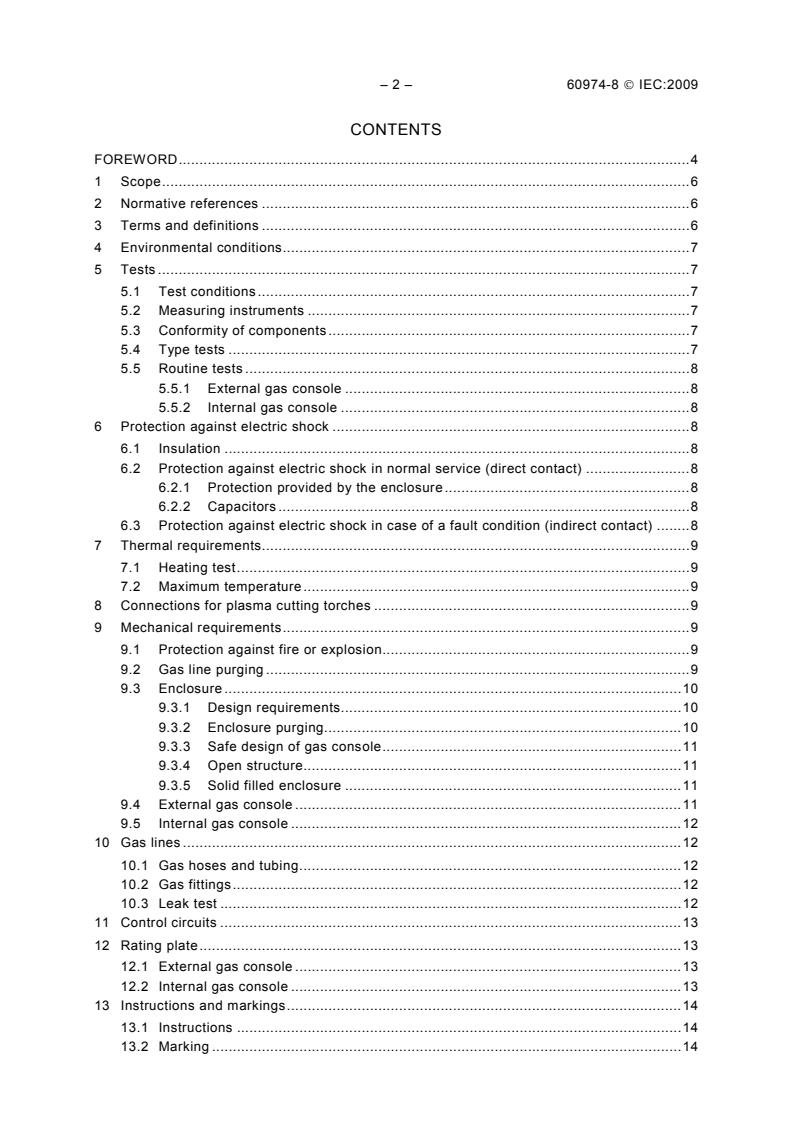
– 2 – 60974-8 © IEC:2009
CONTENTS
FOREWORD.4
1 Scope.6
2 Normative references .6
3 Terms and definitions .6
4 Environmental conditions.7
5 Tests .7
5.1 Test conditions.7
5.2 Measuring instruments .7
5.3 Conformity of components.7
5.4 Type tests .7
5.5 Routine tests .8
5.5.1 External gas console .8
5.5.2 Internal gas console .8
6 Protection against electric shock .8
6.1 Insulation .8
6.2 Protection against electric shock in normal service (direct contact) .8
6.2.1 Protection provided by the enclosure.8
6.2.2 Capacitors .8
6.3 Protection against electric shock in case of a fault condition (indirect contact) .8
7 Thermal requirements.9
7.1 Heating test.9
7.2 Maximum temperature.9
8 Connections for plasma cutting torches .9
9 Mechanical requirements.9
9.1 Protection against fire or explosion.9
9.2 Gas line purging .9
9.3 Enclosure .10
9.3.1 Design requirements.10
9.3.2 Enclosure purging.10
9.3.3 Safe design of gas console.11
9.3.4 Open structure.11
9.3.5 Solid filled enclosure .11
9.4 External gas console .11
9.5 Internal gas console .12
10 Gas lines .12
10.1 Gas hoses and tubing.12
10.2 Gas fittings.12
10.3 Leak test .12
11 Control circuits .13
12 Rating plate.13
12.1 External gas console .13
12.2 Internal gas console .13
13 Instructions and markings.14
13.1 Instructions .14
13.2 Marking .14
60974-8 © IEC:2009 – 3 –
Annex A (informative) Mechanized plasma system diagram .15
Annex B (informative) Example of a rating plate layout .16
Bibliography.17
Figure A.1 – Example of a mechanized plasma system .15
Figure B.1 – Principle of a rating plate .16
Table 1 – Colour coding and marking.12
– 4 – 60974-8 © IEC:2009
INTERNATIONAL ELECTROTECHNICAL COMMISSION
___________
ARC WELDING EQUIPMENT –
Part 8: Gas consoles for welding and plasma cutting systems
FOREWORD
1) The International Electrotechnical Commission (IEC) is a worldwide organization for standardization comprising
all national electrotechnical committees (IEC National Committees). The object of IEC is to promote
international co-operation on all questions concerning standardization in the electrical and electronic fields. To
this end and in addition to other activities, IEC publishes International Standards, Technical Specifications,
Technical Reports, Publicly Available Specifications (PAS) and Guides (hereafter referred to as “IEC
Publication(s)”). Their preparation is entrusted to technical committees; any IEC National Committee interested
in the subject dealt with may participate in this preparatory work. International, governmental and non-
governmental organizations liaising with the IEC also participate in this preparation. IEC collaborates closely
with the International Organization for Standardization (ISO) in accordance with conditions determined by
agreement between the two organizations.
2) The formal decisions or agreements of IEC on technical matters express, as nearly as possible, an international
consensus of opinion on the relevant subjects since each technical committee has representation from all
interested IEC National Committees.
3) IEC Publications have the form of recommendations for international use and are accepted by IEC National
Committees in that sense. While all reasonable efforts are made to ensure that the technical content of IEC
Publications is accurate, IEC cannot be held responsible for the way in which they are used or for any
misinterpretation by any end user.
4) In order to promote international uniformity, IEC National Committees undertake to apply IEC Publications
transparently to the maximum extent possible in their national and regional publications. Any divergence
between any IEC Publication and the corresponding national or regional publication shall be clearly indicated in
the latter.
5) IEC provides no marking procedure to indicate its approval and cannot be rendered responsible for any
equipment declared to be in conformity with an IEC Publication.
6) All users should ensure that they have the latest edition of this publication.
7) No liability shall attach to IEC or its directors, employees, servants or agents including individual experts and
members of its technical committees and IEC National Committees for any personal injury, property damage or
other damage of any nature whatsoever, whether direct or indirect, or for costs (including legal fees) and
expenses arising out of the publication, use of, or reliance upon, this IEC Publication or any other IEC
Publications.
8) Attention is drawn to the Normative references cited in this publication. Use of the referenced publications is
indispensable for the correct application of this publication.
9) Attention is drawn to the possibility that some of the elements of this IEC Publication may be the subject of
patent rights. IEC shall not be held responsible for identifying any or all such patent rights.
International Standard IEC 60974-8 has been prepared by IEC technical committee 26:
Electric welding.
This standard is to be used in conjunction with IEC 60974-1.
This second edition cancels and replaces the first edition published in 2004. This edition
constitutes a technical revision.
The significant changes with respect to the previous edition are the following:
• removal of intrinsically safe design;
• introduction of gas mixing function;
• new informative rating plate layout;
• induced changes due to publication of IEC 60974-1, edition 3.
60974-8 © IEC:2009 – 5 –
The text of this standard is based on the following documents:
CDV Report on voting
26/381/CDV 26/391/RVC
Full information on the voting for the approval of this standard can be found in the report on
voting indicated in the above table.
The French version of this standard has not been voted upon.
This publication has been drafted in accordance with the ISO/IEC Directives, Part 2.
The committee has decided that the contents of this publication will remain unchanged until
the maintenance result date indicated on the IEC web site under http://webstore.iec.ch in the
data related to the specific publication. At this date, the publication will be
• reconfirmed;
• withdrawn;
• replaced by a revised edition, or
• amended.
– 6 – 60974-8 © IEC:2009
ARC WELDING EQUIPMENT –
Part 8: Gas consoles for welding and plasma cutting systems
1 Scope
This part of IEC 60974 specifies safety and performance requirements for gas consoles
intended to be used with combustible gases or oxygen. These gas consoles are designed to
supply gases for use in arc welding, plasma cutting, gouging and allied processes in non-
explosive atmospheres.
The gas console can be external or internal to the power source enclosure. In the latter case,
this standard also applies to the power source.
NOTE See Annex A for mechanised plasma system diagram.
2 Normative references
The following referenced documents are indispensable for the application of this document.
For dated references, only the edition cited applies. For undated references, the latest edition
of the referenced document (including any amendments) applies.
IEC 60050-151, International Electrotechnical Vocabulary – Part 151: Electrical and magnetic
devices
IEC 60529, Degrees of protection provided by enclosures (IP Code)
IEC 60974-1:2005, Arc welding equipment − Part 1: Welding power sources
3 Terms and definitions
For the purposes of this document, the following terms and definitions, as well as those of
IEC 60050-151and IEC 60974-1, apply.
3.1
gas console
device for gas-flow routing, mixing or both that contains electrical apparatus in a single or
multiple enclosure, or open structure
3.2
lower explosion limit
LEL
concentration of flammable gas or vapour in air, below which the gas atmosphere is not
explosive
[IEV 426-02-09, modified] [1]
———————
Figures in square brackets refer to the bibliography.
60974-8 © IEC:2009 – 7 –
3.3
lower flammability limit
LFL
minimum concentration of combustible gas in a mixture where a combustion can be ignited by
an ignition source
3.4
upper explosion limit
UEL
concentration of flammable gas or vapour in air, above which the gas atmosphere is not
explosive
[IEV 426-02-10, modified]
3.5
upper flammability limit
UFL
maximum concentration of combustible gas in a mixture where a combustion can be ignited by
an ignition source
3.6
external gas console
gas console not incorporated in a power source
3.7
internal gas console
gas console incorporated in a power source
3.8
single-fault condition
condition in which one means for protection against hazard is defective
NOTE If a singe-fault condition results unavoidably in another single-fault condition, the two failures are
considered as one single-fault condition.
[IEC 61010-1, definition 3.5.11, modified] [7]
4 Environmental conditions
As specified in Clause 4 of IEC 60974-1.
5 Tests
5.1 Test conditions
As specified in 5.1 of IEC 60974-1.
5.2 Measuring instruments
As specified in 5.2 of IEC 60974-1.
5.3 Conformity of components
As specified in 5.3 of IEC 60974-1.
5.4 Type tests
As specified in 5.4 of IEC 60974-1.
– 8 – 60974-8 © IEC:2009
The other tests included in this standard may be carried out in any convenient sequence.
5.5 Routine tests
5.5.1 External gas console
All routine tests shall be carried out on each external gas console in the following sequence:
a) general visual inspection, see 3.7 of IEC 60974-1;
b) continuity of protective circuit, see 10.4.2 of IEC 60974-1;
c) dielectric strength, see 6.1.5 of IEC 60974-1;
d) leak test, see 10. 3 ;
e) general visual inspection, see 3.7 of IEC 60974-1.
5.5.2 Internal gas console
All routine tests, as specified in 5.5 of IEC 60974-1, shall be carried out on each internal gas
console, with the following addition:
g) leak test, see 10. 3 .
6 Protection against electric shock
6.1 Insulation
As specified in 6.1 of IEC 60974-1, with the following exception:
Printed circuit boards shall be enclosed, coated, or encapsulated.
6.2 Protection against electric shock in normal service (direct contact)
6.2.1 Protection provided by the enclosure
The minimum degree of protection for gas consoles shall be IP21S in accordance with
IEC 60529.
Conformity shall be checked by
a) applying the articulated finger and ball, as specified in IEC 60529, to any openings and
ensuring it does not contact any hazardous parts; and
b) verifying that immediately after the water test, as specified in IEC 60529, the unit satisfies
insulation resistance and the dielectric strength tests and is able to operate.
No power is applied to the unit while performing these tests.
6.2.2 Capacitors
As specified in 6.2.2 of IEC 60974-1.
6.3 Protection against electric shock in case of a fault condition (indirect contact)
As specified in 6.3 of IEC 60974-1.
60974-8 © IEC:2009 – 9 –
7 Thermal requirements
7.1 Heating test
As specified in 7.1 of IEC 60974-1.
For an external gas console, only the relevant tests are performed.
7.2 Maximum temperature
The temperature at any point shall not exceed the ignition temperature of any combustible
gas intended to be used in the gas console.
Conformity shall be checked by operating the gas console as specified by the manufacturer
a) with the combinations of gas(es) and flow rates which creates the worst-case condition, as
specified by the manufacturer;
b) with the cooling liquid as specified by the manufacturer.
8 Connections for plasma cutting torches
As specified in 11.4.6 of IEC 60974-1, where the torch connects to the gas console.
9 Mechanical requirements
As specified in Clause 14 of IEC 60974-1, with the following additions.
9.1 Protection against fire or explosion
The gas console shall be designed to prevent fire or explosion under normal operating
conditions and under a single-fault condition (for example, defective valve, hose, etc.).
Where a gas console uses a combustible gas, any circuit, subassembly, or component shall
not be capable of creating temperatures or a spark with sufficient energy to cause an ignition.
Where a gas console uses a combustible gas in a mixture, the mixture shall not be included
within flammability limit that is defined by LFL and UFL.
Conformity shall be checked by
a) design evaluation and calculations of the circuits, subassembly, or component verification;
or
b) applying a fault (for example, open circuit, short circuit, and/or restriction of movement) to
the circuits, subassembly, or component until an event occurs (for example, a spark which
does not cause ignition, fuse opens, unit shuts down, etc.) or a steady-state temperature
is achieved.
9.2 Gas line purging
The gas console shall have a means to purge gas lines when changing to a different type of
gas (for example, oxidizing or oxygen containing to combustible) to reduce the risk of fire or
explosion. In some cases, a small amount of combustible gas or oxygen may accumulate in
the torch. This volume shall be small enough so that no risk can result.
The purging shall occur after each change in gas routing or when the previous gas routing is
unknown.
– 10 – 60974-8 © IEC:2009
NOTE 1 A means of accomplishing this can be by purging the lines with a sufficient volume of an inert gas.
NOTE 2 When a risk of fire or explosion exists in the gas lines due to changing gas, the purging can be performed
with the following pressure cycle:
1. reduce the pressure of the gas console circuit to atmosphere pressure;
2. purge the gas console circuit with the purging gas;
3. increase the pressure to the maximum pressure of purging gas;
4. reduce the pressure of the gas console circuit to atmosphere pressure.
Conformity shall be checked by risk analysis and the following test.
The gas lines, when installed with all devices (valves, fittings, etc.) shall be filled with a
combustible gas and measured with a gas detector. Immediately after, the gas lines shall be
purged according to the instruction manual. Once purging has been completed, the contents
of the gas lines shall be measured with the gas detector to ensure that the lines have been
purged to a level lower than the lower flammability level (LFL) of the gas. If more than one
combustible gas is used, the test shall be repeated for each combustible gas.
9.3 Enclosure
9.3.1 Design requirements
The gas console (external or internal) shall be designed to withstand or prevent an explosion.
This shall be accomplished by complying with at least one of the requirements in 9. 3. 2
through 9. 3. 4.
NOTE All tests described below are dangerous, and it is recommended that they are performed by qualified
personnel.
9.3.2 Enclosure purging
Purging means typically include positive pressure of an inert gas and forced ventilation (e.g.
use of a non-arcing fan). Any automatic means to purge the gas console enclosure of
combustible gases shall be activated before other electrical devices are energized.
Where a fan or other device is used for purging, a malfunction shall be indicated and the
system shall be prevented from continuing to operate.
After purging, the level of combustible gas shall not exceed the lower explosion level (LEL).
Conformity shall be checked in a draught-free environment by a) or b) below.
a) Simulate a continuous gas leak inside the enclosure equal to the maximum flow rate and
pressure as specified by the manufacturer. Monitor and adjust the gas in the enclosure
until saturation or stabilization occurs. Activate the purging device(s) and monitor the gas
to ensure it reaches the LEL before a potential ignition source is energized. Repeat for
each type of combustible gas used.
b) Place a simulated arcing device inside the purged enclosure. Monitor and adjust the gas in
the enclosure until saturation or stabilization occurs. Operate all purging means and
initiate start-up sequence. Energize the arcing device to simulate the electronics start-up,
and operate continuously ensuring that no ignition occurs. Repeat for each type of
combustible gas used.
NOTE 1 A safe level of gas is 50 % of the LEL.
NOTE 2 The leak rate needs to be considered when performing these tests.
60974-8 © IEC:2009 – 11 –
9.3.3 Safe design of gas console
9.3.3.1 Prevention of ignition
The gas console shall be designed to prevent an ignition caused by a gas leak in the
enclosure.
Conformity shall be checked by completing the following test.
a) Place the energized equipment, i.e. the external gas console or the power source with
internal gas console, in a bag (or similar).
b) Simulate a gas leak inside the equipment to create an internal explosive atmosphere.
c) Monitor the mixture until it is halfway between the LEL and the UEL of the gas.
d) Operate the gas console for a period of at least 1 h, during which all components
capable of causing ignition are cycled at least 100 times.
e) Verify that no ignition occurred during the operating period.
f) Ignite the bag (or similar) to confirm that a flammable mixture was present.
9.3.3.2 Integrity of the enclosure
The enclosure, i.e the external gas console or the power source with internal gas console,
shall withstand an explosion without degradation of the protective continuity circuit.
Conformity shall be checked by completing the following test.
a) Place the non-energized equipment, i.e. the external gas console or the power source
with internal gas console, in a bag (or similar).
b) Simulate a gas leak inside the equipment to create an internal explosive atmosphere.
c) Monitor the mixture until it is halfway between the LEL and the UEL of the gas.
d) Ignite the flammable mixture using an arcing device installed in the equipment to
create an explosion.
e) Verify that there was no flying debris.
f) Verify there is no contact with live hazardous parts using the jointed test finger
specified in IEC 60529.
g) Verify the continuity of the protective circuit by visual inspection and measurement.
9.3.4 Open structure
An open-structure gas console designed with no enclosure or a partial enclosure that cannot
accumulate a combustible mixture and cause an explosion shall be considered safe.
Conformity shall be checked by design review.
9.3.5 Solid filled enclosure
A gas console designed with an enclosure that does not contain any empty volume that can
accumulate oxygen or a combustible mixture shall be considered safe.
Conformity shall be checked by design review.
9.4 External gas console
Where combustible gases are used, the external gas console shall only enclose the electric
and non-electric apparatus (for example, electromagnetic valves, metering devices, flow
meters, control circuits) required to route gases to the torch.
– 12 – 60974-8 © IEC:2009
Conformity shall be checked by visual inspection.
9.5 Internal gas console
Where combustible gases are used, the internal gas console gas lines and gas components
shall be separated by a barrier from the power source’s live components within the same
enclosure. Gas console control circuits may be located on either side of the barrier.
Conformity shall be checked by visual inspection.
10 Gas lines
10.1 Gas hoses and tubing
Gas hoses and tubing shall be suitable for the application. Gas hoses and tubing shall be
rated for the maximum pressure at the maximum rated temperature in accordance with the
product ratings.
Supply gas hoses shall be properly colour-coded or marked as specified in Table 1. Where
gas supply circuit conveys more than one type of gas, gas hoses and tubing need not be
marked provided the design prevents misconnections.
Table 1 – Colour coding and marking
Gas Colour of cover
Acetylene and other combustible gases (except LPG, MPS, natural gas, red methane) Red
Oxygen Blue
Air, nitrogen, argon, CO Black
LPG, MPS, natural gas, methane orange Orange
All fuel gases (included in this table) red-orange Red-orange
NOTE 1 The manufacturer should be consulted on the suitability of the hose for use with hydrogen or propylene.
NOTE 2 This table is taken from ISO 3821. [8]
Conformity shall be checked by visual inspection and the test given in 10.3.
10.2 Gas fittings
Supply gas fittings shall not be interchangeable (for example, size, thread type) to avoid
mixing fuel gases with inert gases or oxygen/air.
Conformity shall be checked by visual inspection.
10.3 Leak test
Assemblies through which gas flows shall be capable of operating under the rated inlet
pressure at the rated operating temperature, without a hazardous leak as specified by the
manufacturer.
Conformity shall be checked by a test specified by the manufacturer to ensure a safe
assembly.
NOTE Air or inert gas used for this test should not contain contaminants that could degrade components used
with O .
60974-8 © IEC:2009 – 13 –
11 Control circuits
Control circuits not connected to the welding circuit shall meet the following requirements.
a) The operating voltage of control circuits shall not exceed 250 V.
b) A transformer with separate windings shall be used for supplying the control circuits.
c) Overvoltage protection shall be provided.
d) Overcurrent protection shall be provided.
e) Single-fault conditions that may impair safety shall be evaluated.
f) Transformer secondary, except for SELV, circuits shall be grounded.
g) Insulation of bundled conductors shall be rated to the highest voltage of any of the
conductors.
h) Software and logic circuits shall not affect safety negatively.
i) Control circuits that leave the enclosure shall be isolated from the primary circuit by
double or reinforced insulation.
NOTE 1 These requirements are based on IEC 60204-1[2].
Conformity shall be checked by measurement or analysis, as appropriate.
NOTE 2 Types of control circuits:
a) control circuits that are internal to the welding/cutting equipment enclosure;
b) control circuits intended for interface between the power source and peripheral equipment designed by the
manufacturer;
c) control circuits intended for interfacing between the power source and other types of ancillary equipment;
d) control circuits intended for inside the gas console.
12 Rating plate
12.1 External gas console
As specified in Clause 15 of IEC 60974-1, with the following modifications (as applicable):
a) type of gas(es) used;
b) maximum inlet gas pressure;
c) maximum gas flow rating for each gas.
Annex B for an example of a rating plate layout that may be used for an external gas
See
console.
12.2 Internal gas console
For a gas console within a welding power source enclosure, the rating of the welding power
source specified in Clause 15 of IEC 60974-1, shall be used with the following additions:
a) standard reference;
b) type of gas(es) used;
c) maximum inlet gas pressure;
d) maximum gas flow rating for each gas.
– 14 – 60974-8 © IEC:2009
13 Instructions and markings
Each gas console shall be delivered with instructions and markings.
13.1 Instructions
As specified in 17.1 of IEC 60974-1, with the following additions (as applicable):
a) information for selection and connection of gas hoses and I/O cables;
b) EMC information specific to installation and operation of equipment specified in this
standard;
c) information regarding gas purging (for example, after each change in gas routing);
d) ventilation requirements for installation;
e) gas flow rates and maximum pressures;
f) information regarding the gas source (for example, purity);
g) statement that flashback arrestors are required (unless not available for specific gases or
required pressures) to prevent fire from propagating back to the gas supply;
h) recommended life and replacement of internal flexible hoses for combustible gas and
oxygen;
i) information about contamination of oxygen lines;
j) general information specific to installation and operation of equipment specified in this
standard (e.g. torch location relative to gas console and its supply).
NOTE The torch used in arc welding, plasma cutting and gouging is an obvious source of ignition necessary for
its intended function.
Conformity shall be checked by visual inspection.
13.2 Marking
As specified in 17.2 of IEC 60974-1, (as applicable) and with the following addition.
Each gas connection shall be legibly and indelibly marked. The gas connections shall be
marked with the maximum pressure and the type(s) of gas(es).
Conformity shall be checked by visual inspection.
60974-8 © IEC:2009 – 15 –
Annex A
(informative)
Mechanized plasma system diagram
AC power
Liquid
cooling system
Power
IEC 60974-2
source
IEC 60974-1
Cable-hose
I/O cable
assembly
(relevant
standards)
Arc striking
Control circuit
Console
IEC 60974-3
IEC 60974-1
IEC 60974-8
Cable-hose
assembly of
the torch
IEC 60974-7
Torch valve
assembly
IEC 60974-1
Torch
Water
IEC 60974-7
muffler
IEC 231/09
Figure A.1 – Example of a mechanized plasma system
– 16 – 60974-8 © IEC:2009
Annex B
(informative)
Example of a rating plate layout
100 %
4 DUTY
CYCLE
U I
1 1max
5 6
1~ 50 (60) Hz
MAX. MAX. INPUT FLOW RATE
PRESSURE OF GAS
7 8
IEC 2879/03
Key
1 Name and address of the manufacturer or distributor or importer and optionally a trademark and the country of
origin, if required
2 Reference to this standard conforming that the gas console complies with its requirements
3 Type (identification) as given by the manufacturer and traceability of design and manufacturing data, for
example, serial number
4 Type of gases used (for example, H or O )
2 2
5 Rated supply voltage: V
6 Rated maximum supply current: A
7 Maximum inlet gas pressure: MPa (bar)
8 Maximum gas flow rating for each gas: l/min
9 Degree of protection rating: IPXX
Figure B.1 – Principle of a rating plate
60974-8 © IEC:2009 – 17 –
Bibliography
[1] IEC 60050-426:2008, International Electrotechnical Vocabulary – Part 426: Equipment for
explosive atmospheres
[2] IEC 60204-1, Safety of machinery − Electrical equipment of machines – Part 1: General
requirements
[3] IEC 60664-1, Insulation coordination for equipment within low-voltage systems − Part 1:
Principles, requirements and tests
[4] IEC 60974-2, Arc welding equipment − Part 2: Liquid cooling system
[5] IEC 60974-3, Arc welding equipment − Part 3: Arc striking and stabilizing devices
[6] IEC 60974-7, Arc welding equipment − Part 7: Torches
[7] IEC 61010-1:2001, Safety requirements for electrical equipment for measurement,
control, and laboratory use – Part 1: General requirements
[8] ISO 3821, Gas welding equipment − Rubber hoses for welding, cutting and allied
processes
[9] ISO 12170, Gas welding equipment − Thermoplastic hoses for welding and allied
processes
___________
– 18 – 60974-8 © CEI:2009
SOMMAIRE
AVANT-PROPOS.20
1 Domaine d’application .22
2 Références normatives.22
3 Termes et définitions .22
4 Conditions ambiantes .23
5 Essais .23
5.1 Conditions d'essais .23
5.2 Appareils de mesure .23
5.3 Conformité des composants .23
5.4 Essais de type.23
5.5 Essais individuels de série .24
5.5.1 Console de gaz externe.24
5.5.2 Console de gaz interne.24
6 Protection contre les chocs électriques.24
6.1 Isolation .24
6.2 Protection contre les chocs électriques en service normal (contact direct).24
6.2.1 Protection procurée par l’enveloppe .24
6.2.2 Condensateurs .24
6.3 Protection contre les chocs électriques en cas de défaut (contact indirect) .24
7 Exigences thermiques .25
7.1 Essai d’échauffement .25
7.2 Température maximale.25
8 Raccordements pour les torches de coupage plasma .25
9 Exigences mécaniques .25
9.1 Protection contre le feu ou l’explosion .25
9.2 Purge des conduites de gaz .25
9.3 Enveloppe .26
9.3.1 Exigences de conception .26
9.3.2 Purge de l’enveloppe.26
9.3.3 Conception sûre de la console de gaz .27
9.3.4 Structure ouverte.28
9.3.5 Enveloppe pleine.28
9.4 Console de gaz externe.28
9.5 Console de gaz interne.28
10 Conduites de gaz .28
10.1 Conduites et tuyaux de gaz .28
10.2 Raccords de gaz .29
10.3 Essai d’étanchéité .29
11 Circuits de commande .29
12 Plaque signalétique .30
12.1 Console de gaz externe.30
12.2 Console de gaz interne.30
13 Instructions et marquages .30
13.1 Instructions .30
13.2 Marquage.31
60974-8 © CEI:2009 – 19 –
Annexe A (informative) Diagramme de système plasma mécanisé .32
Annexe B (informative) Exemple de disposition de plaque signalétique.33
Bibliographie.34
Figure A.1 – Exemple d’un système plasma mécanisé .32
Figure B.1 – Principe de la plaque signalétique .33
Tableau 1 – Code couleur et marquage .28
– 20 – 60974-8 © CEI:2009
COMMISSION ÉLECTROTECHNIQUE INTERNATIONALE
___________
MATÉRIEL DE SOUDAGE À L’ARC –
Partie 8: Consoles de gaz pour soudage
et systèmes de coupage plasma
AVANT-PROPOS
1) La CEI (Commission Électrotechnique Internationale) est une organisation mondiale de normalisation
composée de l'ensemble des comités électrotechniques nationaux (Comités nationaux de la CEI). La CEI a
pour objet de favoriser la coopération internationale pour toutes les questions de normalisation dans les
domaines de l'électricité et de l'électronique. A cet effet, la CEI, entre autres activités, publie des Normes
Internationales, des Spécifications
...