

IEC 61196-1-326:2026
(Main)Coaxial communication cables - Part 1-326: Test methods - Clamps test
General Information
- Abstract
IEC 61196-1-326:2026 specifies the test methods of clamps for laying coaxial communication cable, including mechanical test methods and environmental test methods.
This document applies to clamps for laying coaxial communication cables, including feeder and radiating cables. For requirements not covered in IEC 61914, clamps for other types of cables can also refer to this document.
This second edition cancels and replaces the first edition published in 2022. This edition constitutes a technical revision.
This edition includes the following significant technical changes with respect to the previous edition:
a) Addition of Clause 4 to Clause 15.
- Status
- Published
- Publication Date
- 14-Apr-2026
- Technical Committee
- SC 23A - Cable management systems
- Drafting Committee
- JWG 21 - TC 23/SC 23A/JWG 21
- Current Stage
- PPUB - Publication issued
- Start Date
- 15-Apr-2026
- Completion Date
- 15-May-2026
Overview
IEC 61196-1-326:2026 is an international standard developed by the International Electrotechnical Commission (IEC), specifically addressing the test methods for clamps used in laying coaxial communication cables. This document details both mechanical and environmental test procedures to evaluate the performance, suitability, and durability of cable clamps, including applications for feeder and radiating cables. The second edition, published in 2026, introduces expanded testing provisions from Clause 4 to Clause 15, representing a technical revision over the previous edition.
By following the requirements in IEC 61196-1-326, manufacturers, installers, and testing laboratories can ensure that clamps for coaxial communication cables are robust and reliable under various operational and environmental conditions. For clamps not fully covered in IEC 61914, guidance from this standard can also be referenced.
Key Topics
IEC 61196-1-326:2026 outlines comprehensive mechanical and environmental test methods for cable clamps, emphasizing practical reliability and safety:
Mechanical Test Methods
- Clamping force: Assessment of the clamp’s ability to securely hold feeder or radiating cables under load.
- Normal tensile force: Evaluates clamp performance when subjected to tension perpendicular to the mounting base, simulating wind or installation stresses.
- Shear force: Tests clamp security against forces parallel to the mounting surface.
- Suitability test: Verifies general compatibility and installation quality.
- Fastener torque test: (Applicable to feeder clamps) Checks the resilience of the clamp’s fastening mechanism.
- High cycle fatigue: Assesses clamp performance under repeated cycling loads to simulate long-term service conditions.
Environmental Test Methods
- Climatic sequence: Exposes clamps to a series of temperature and humidity conditions to determine environmental robustness.
- Salt mist: Simulates corrosive environments to gauge resistance to salt-induced degradation.
- Solar radiation: (For outdoor clamps) Evaluates durability under sunlight exposure.
- Cold temperature installation: Checks clamp performance during installation at low temperatures.
- Fire-resistance: Assesses fireproof clamps' ability to maintain cable support during fire events.
These tests use standardized procedures and reporting to ensure consistency and comparability across manufacturers and installations, supporting international quality assurance for coaxial cable clamp applications.
Applications
IEC 61196-1-326:2026 is essential for various stakeholders in the electrical and telecommunication sectors, including:
- Manufacturers: Assists in the development, quality control, and certification of cable clamps for coaxial infrastructure.
- System designers and engineers: Ensures appropriate selection of clamps capable of withstanding mechanical stress and harsh environmental conditions, enhancing network reliability.
- Installation and maintenance teams: Provides assurance that clamps, when installed in telecommunication towers, tunnels, buildings, or outdoor environments, will maintain structural integrity over time.
- Test laboratories: Establishes uniform test protocols to confirm conformity to international standards.
This standard is particularly relevant in sectors that require coaxial communication cables to be securely fastened in challenging environments, such as cellular base stations, railway tunnels, broadcasting facilities, and industrial buildings.
Related Standards
A number of related standards are frequently referenced alongside IEC 61196-1-326:2026 to ensure comprehensive compliance:
- IEC 61196 series: Sectional and product specifications for various coaxial cables (including IEC 61196-4 for radiating cables and IEC 61196-11 for semi-rigid cables).
- IEC 61914: Specifies requirements for cable cleats to secure and retain cables; where relevant, clamps may also be tested using methods from this document.
- Environmental Standards:
- IEC 60068-2-1/-2/-5/-30: Series of environmental testing methods covering cold, heat, solar radiation, and damp cycles.
- ISO 9227: Salt spray corrosion testing.
- ISO 834-1: Fire-resistance tests for building elements.
Implementing IEC 61196-1-326:2026 in conjunction with these standards boosts the overall resilience and safety of coaxial communication cable deployments, ensuring long-term network performance and regulatory compliance worldwide.
Relations
- Effective Date
- 20-Oct-2023
Get Certified
Connect with accredited certification bodies for this standard

ANCE
Mexican certification and testing association.

Intertek Slovenia
Intertek testing, inspection, and certification services in Slovenia.

LNE (Laboratoire National de Métrologie et d'Essais)
French national laboratory for metrology and testing.
Sponsored listings
Frequently Asked Questions
IEC 61196-1-326:2026 is a standard published by the International Electrotechnical Commission (IEC). Its full title is "Coaxial communication cables - Part 1-326: Test methods - Clamps test". This standard covers: IEC 61196-1-326:2026 specifies the test methods of clamps for laying coaxial communication cable, including mechanical test methods and environmental test methods. This document applies to clamps for laying coaxial communication cables, including feeder and radiating cables. For requirements not covered in IEC 61914, clamps for other types of cables can also refer to this document. This second edition cancels and replaces the first edition published in 2022. This edition constitutes a technical revision. This edition includes the following significant technical changes with respect to the previous edition: a) Addition of Clause 4 to Clause 15.
IEC 61196-1-326:2026 specifies the test methods of clamps for laying coaxial communication cable, including mechanical test methods and environmental test methods. This document applies to clamps for laying coaxial communication cables, including feeder and radiating cables. For requirements not covered in IEC 61914, clamps for other types of cables can also refer to this document. This second edition cancels and replaces the first edition published in 2022. This edition constitutes a technical revision. This edition includes the following significant technical changes with respect to the previous edition: a) Addition of Clause 4 to Clause 15.
IEC 61196-1-326:2026 is classified under the following ICS (International Classification for Standards) categories: 33.120.10 - Coaxial cables. Waveguides. The ICS classification helps identify the subject area and facilitates finding related standards.
IEC 61196-1-326:2026 has the following relationships with other standards: It is inter standard links to IEC 61196-1-326:2022. Understanding these relationships helps ensure you are using the most current and applicable version of the standard.
IEC 61196-1-326:2026 is available in PDF format for immediate download after purchase. The document can be added to your cart and obtained through the secure checkout process. Digital delivery ensures instant access to the complete standard document.
Standards Content (Sample)
IEC 61196-1-326 ®
Edition 2.0 2026-04
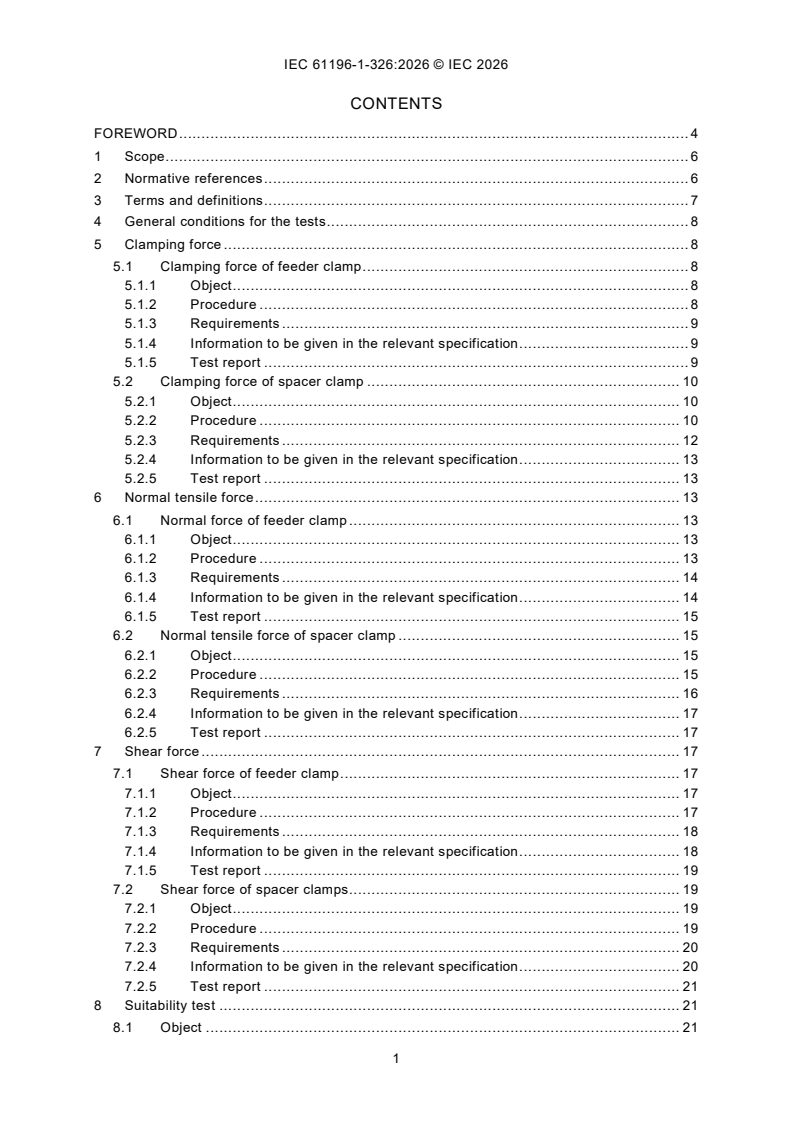
INTERNATIONAL
STANDARD
Coaxial communication cables -
Part 1-326: Test methods - Clamps test
ICS 33.120.10 ISBN 978-2-8327-1206-1
All rights reserved. Unless otherwise specified, no part of this publication may be reproduced or utilized in any form or
by any means, electronic or mechanical, including photocopying and microfilm, without permission in writing from either
IEC or IEC's member National Committee in the country of the requester. If you have any questions about IEC copyright
or have an enquiry about obtaining additional rights to this publication, please contact the address below or your local
IEC member National Committee for further information.
IEC Secretariat Tel.: +41 22 919 02 11
3, rue de Varembé info@iec.ch
CH-1211 Geneva 20 www.iec.ch
Switzerland
About the IEC
The International Electrotechnical Commission (IEC) is the leading global organization that prepares and publishes
International Standards for all electrical, electronic and related technologies.
About IEC publications
The technical content of IEC publications is kept under constant review by the IEC. Please make sure that you have the
latest edition, a corrigendum or an amendment might have been published.
IEC publications search - IEC Products & Services Portal - products.iec.ch
webstore.iec.ch/advsearchform Discover our powerful search engine and read freely all the
The advanced search enables to find IEC publications by a
publications previews, graphical symbols and the glossary.
variety of criteria (reference number, text, technical With a subscription you will always have access to up to date
committee, …). It also gives information on projects, content tailored to your needs.
replaced and withdrawn publications.
Electropedia - www.electropedia.org
IEC Just Published - webstore.iec.ch/justpublished The world's leading online dictionary on electrotechnology,
Stay up to date on all new IEC publications. Just Published containing more than 22 500 terminological entries in English
details all new publications released. Available online and and French, with equivalent terms in 25 additional languages.
once a month by email. Also known as the International Electrotechnical Vocabulary
(IEV) online.
IEC Customer Service Centre - webstore.iec.ch/csc
If you wish to give us your feedback on this publication or
need further assistance, please contact the Customer
Service Centre: sales@iec.ch.
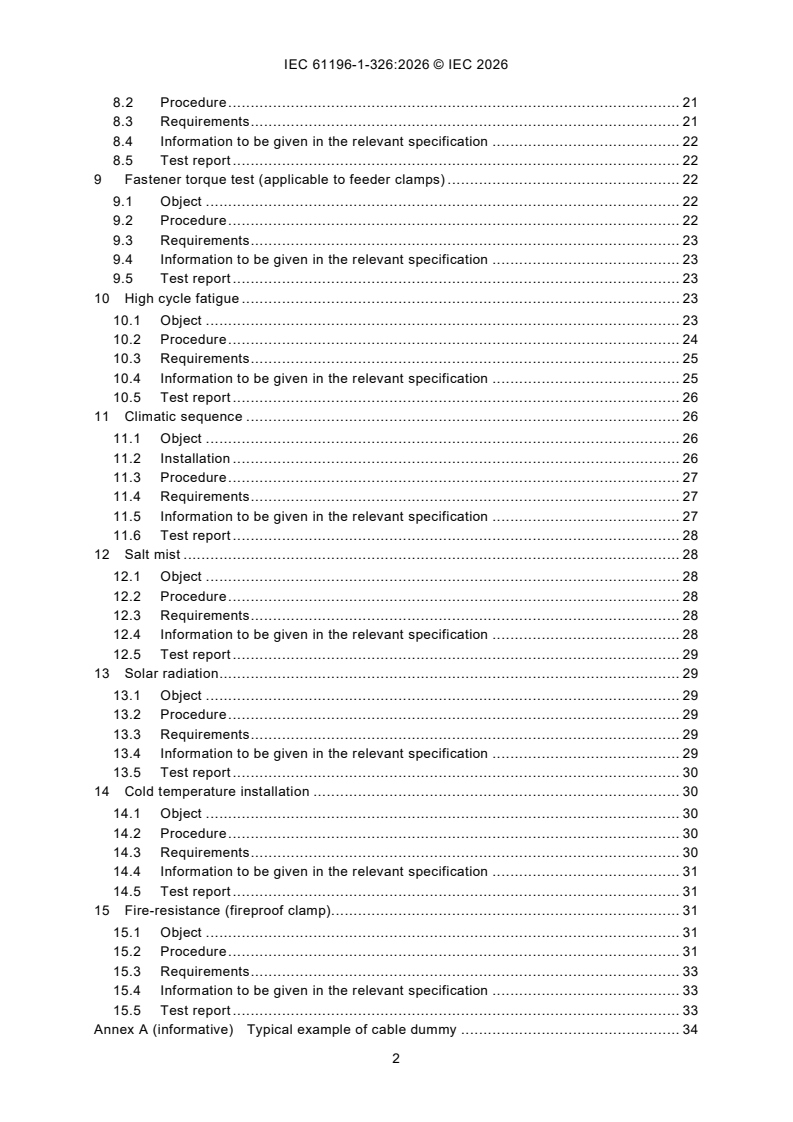
CONTENTS
FOREWORD . 4
1 Scope . 6
2 Normative references . 6
3 Terms and definitions . 7
4 General conditions for the tests . 8
5 Clamping force . 8
5.1 Clamping force of feeder clamp . 8
5.1.1 Object . 8
5.1.2 Procedure . 8
5.1.3 Requirements . 9
5.1.4 Information to be given in the relevant specification . 9
5.1.5 Test report . 9
5.2 Clamping force of spacer clamp . 10
5.2.1 Object . 10
5.2.2 Procedure . 10
5.2.3 Requirements . 12
5.2.4 Information to be given in the relevant specification . 13
5.2.5 Test report . 13
6 Normal tensile force . 13
6.1 Normal force of feeder clamp . 13
6.1.1 Object . 13
6.1.2 Procedure . 13
6.1.3 Requirements . 14
6.1.4 Information to be given in the relevant specification . 14
6.1.5 Test report . 15
6.2 Normal tensile force of spacer clamp . 15
6.2.1 Object . 15
6.2.2 Procedure . 15
6.2.3 Requirements . 16
6.2.4 Information to be given in the relevant specification . 17
6.2.5 Test report . 17
7 Shear force . 17
7.1 Shear force of feeder clamp . 17
7.1.1 Object . 17
7.1.2 Procedure . 17
7.1.3 Requirements . 18
7.1.4 Information to be given in the relevant specification . 18
7.1.5 Test report . 19
7.2 Shear force of spacer clamps . 19
7.2.1 Object . 19
7.2.2 Procedure . 19
7.2.3 Requirements . 20
7.2.4 Information to be given in the relevant specification . 20
7.2.5 Test report . 21
8 Suitability test . 21
8.1 Object . 21
8.2 Procedure . 21
8.3 Requirements . 21
8.4 Information to be given in the relevant specification . 22
8.5 Test report . 22
9 Fastener torque test (applicable to feeder clamps) . 22
9.1 Object . 22
9.2 Procedure . 22
9.3 Requirements . 23
9.4 Information to be given in the relevant specification . 23
9.5 Test report . 23
10 High cycle fatigue . 23
10.1 Object . 23
10.2 Procedure . 24
10.3 Requirements . 25
10.4 Information to be given in the relevant specification . 25
10.5 Test report . 26
11 Climatic sequence . 26
11.1 Object . 26
11.2 Installation . 26
11.3 Procedure . 27
11.4 Requirements . 27
11.5 Information to be given in the relevant specification . 27
11.6 Test report . 28
12 Salt mist . 28
12.1 Object . 28
12.2 Procedure . 28
12.3 Requirements . 28
12.4 Information to be given in the relevant specification . 28
12.5 Test report . 29
13 Solar radiation . 29
13.1 Object . 29
13.2 Procedure . 29
13.3 Requirements . 29
13.4 Information to be given in the relevant specification . 29
13.5 Test report . 30
14 Cold temperature installation . 30
14.1 Object . 30
14.2 Procedure . 30
14.3 Requirements . 30
14.4 Information to be given in the relevant specification . 31
14.5 Test report . 31
15 Fire-resistance (fireproof clamp) . 31
15.1 Object . 31
15.2 Procedure . 31
15.3 Requirements . 33
15.4 Information to be given in the relevant specification . 33
15.5 Test report . 33
Annex A (informative) Typical example of cable dummy . 34
Annex B (informative) Feeder clamp . 35
Bibliography . 40
Figure 1 – Schematic diagram of test for clamping force of feeder clamps for single
and multiple cable runs . 9
Figure 2 – Schematic diagram of test for clamping force of spacer clamps . 12
Figure 3 – Schematic diagram of normal force of feeder clamp . 14
Figure 4 – Schematic diagram of normal tensile force of spacer clamp . 16
Figure 5 – Schematic diagram of shear force of feeder clamp . 18
Figure 6 – Schematic diagram of shear force . 20
Figure 7 – Schematic diagram of fastener force test . 23
Figure 8 – Schematic diagram of test for high cycle fatigue . 24
Figure 9 – Oscillating load . 25
Figure 10 – Setup for horizontal cable installation . 26
Figure 11 – Setup for vertical cable installation . 27
Figure 12 – Schematic diagram of fire resistance test . 32
Figure 13 – Standard temperature rise curve . 32
Figure A.1 – Cable dummy . 34
Figure B.1 – Schematic diagram of half-shell clamps with screw lock . 37
Figure B.2 – Schematic diagram of spring clamps . 38
Figure B.3 – Schematic diagram of form fit clamp . 39
INTERNATIONAL ELECTROTECHNICAL COMMISSION
____________
Coaxial communication cables -
Part 1-326: Test methods - Clamps test
FOREWORD
1) The International Electrotechnical Commission (IEC) is a worldwide organization for standardization comprising
all national electrotechnical committees (IEC National Committees). The object of IEC is to promote international
co-operation on all questions concerning standardization in the electrical and electronic fields. To this end and
in addition to other activities, IEC publishes International Standards, Technical Specifications, Technical Reports,
Publicly Available Specifications (PAS) and Guides (hereafter referred to as "IEC Publication(s)"). Their
preparation is entrusted to technical committees; any IEC National Committee interested in the subject dealt with
may participate in this preparatory work. International, governmental and non-governmental organizations liaising
with the IEC also participate in this preparation. IEC collaborates closely with the International Organization for
Standardization (ISO) in accordance with conditions determined by agreement between the two organizations.
2) The formal decisions or agreements of IEC on technical matters express, as nearly as possible, an international
consensus of opinion on the relevant subjects since each technical committee has representation from all
interested IEC National Committees.
3) IEC Publications have the form of recommendations for international use and are accepted by IEC National
Committees in that sense. While all reasonable efforts are made to ensure that the technical content of IEC
Publications is accurate, IEC cannot be held responsible for the way in which they are used or for any
misinterpretation by any end user.
4) In order to promote international uniformity, IEC National Committees undertake to apply IEC Publications
transparently to the maximum extent possible in their national and regional publications. Any divergence between
any IEC Publication and the corresponding national or regional publication shall be clearly indicated in the latter.
5) IEC itself does not provide any attestation of conformity. Independent certification bodies provide conformity
assessment services and, in some areas, access to IEC marks of conformity. IEC is not responsible for any
services carried out by independent certification bodies.
6) All users should ensure that they have the latest edition of this publication.
7) No liability shall attach to IEC or its directors, employees, servants or agents including individual experts and
members of its technical committees and IEC National Committees for any personal injury, property damage or
other damage of any nature whatsoever, whether direct or indirect, or for costs (including legal fees) and
expenses arising out of the publication, use of, or reliance upon, this IEC Publication or any other IEC
Publications.
8) Attention is drawn to the Normative references cited in this publication. Use of the referenced publications is
indispensable for the correct application of this publication.
9) IEC draws attention to the possibility that the implementation of this document may involve the use of (a)
patent(s). IEC takes no position concerning the evidence, validity or applicability of any claimed patent rights in
respect thereof. As of the date of publication of this document, IEC had not received notice of (a) patent(s), which
may be required to implement this document. However, implementers are cautioned that this may not represent
the latest information, which may be obtained from the patent database available at https://patents.iec.ch. IEC
shall not be held responsible for identifying any or all such patent rights.
IEC 61196-1-326 has been prepared by subcommittee 23A: Cable management systems, of
IEC technical committee 23: Electrical accessories. It is an International Standard.
This second edition cancels and replaces the first edition published in 2022. This edition
constitutes a technical revision.
This edition includes the following significant technical changes with respect to the previous
edition:
a) Addition of Clause 4 to Clause 15.
The text of this International Standard is based on the following documents:
Draft Report on voting
23A/1112/FDIS 23A/1114/RVD
Full information on the voting for its approval can be found in the report on voting indicated in
the above table.
The language used for the development of this International Standard is English.
This document was drafted in accordance with ISO/IEC Directives, Part 2, and developed in
accordance with ISO/IEC Directives, Part 1 and ISO/IEC Directives, IEC Supplement, available
at www.iec.ch/members_experts/refdocs. The main document types developed by IEC are
described in greater detail at www.iec.ch/publications.
A list of all the parts in the IEC 61196 series, published under the general title Coaxial
communication cables, can be found on the IEC website
The committee has decided that the contents of this document will remain unchanged until the
stability date indicated on the IEC website under webstore.iec.ch in the data related to the
specific document. At this date, the document will be
– reconfirmed,
– withdrawn, or
– revised.
1 Scope
This part of IEC 61196 specifies the test methods of clamps for laying coaxial communication
cable, including mechanical test methods and environmental test methods.
This document applies to clamps for laying coaxial communication cables, including feeder and
radiating cables. For requirements not covered in IEC 61914, clamps for other types of cables
can also refer to this document.
This document includes the following test methods:
a) mechanical test methods:
1) clamping force (Clause 5);
2) normal tensile force (Clause 6);
3) shear force (Clause 7);
4) suitability test (Clause 8);
5) fastener torque test (applicable to feeder clamps) (Clause 9);
6) high cycle fatigue (Clause 10).
b) environmental test methods:
1) climatic sequence (Clause 11);
2) salt mist (Clause 12);
3) solar radiation (applicable to outdoor clamps) (Clause 13);
4) cold temperature installation (Clause 14);
5) fire-resistance (fireproof clamp) (Clause 15).
This document does not apply to cable cleats, which are covered by IEC 61914.
NOTE Cable cleats complying with IEC 61914 can be additionally tested in accordance with this document, where
relevant.
2 Normative references
The following documents are referred to in the text in such a way that some or all of their content
constitutes requirements of this document. For dated references, only the edition cited applies.
For undated references, the latest edition of the referenced document (including any
amendments) applies.
IEC 60068-2-1, Environmental testing - Part 2-1: Tests - Test A: Cold
IEC 60068-2-2, Environmental testing - Part 2-2: Tests - Test B: Dry heat
IEC 60068-2-5, Environmental testing - Part 2-5: Tests - Test S: Simulated solar radiation at
ground level and guidance for solar radiation testing and weathering
IEC 60068-2-30, Environmental testing - Part 2-30: Tests - Test Db: Damp heat, cyclic
(12 h + 12 h cycle)
IEC 61196-1-112, Coaxial communication cables - Part 1-112: Electrical test methods - Test for
return loss and voltage standing wave ratio
IEC 61196-4, Coaxial communication cables - Part 4: Sectional specification for radiating
cables
IEC 61196-11, Coaxial communication cables - Part 11: Sectional specification for semi-rigid
cables with polyethylene (PE) dielectric
ISO 834-1:2025, Fire-resistance tests - Elements of building construction - Part 1: General
requirements
ISO 9227, Corrosion tests in artificial atmospheres – Salt spray tests
3 Terms and definitions
For the purposes of this document, the terms and definitions given in IEC 61196-4,
IEC 61196-11 and the following apply.
ISO and IEC maintain terminology databases for use in standardization at the following
addresses:
– IEC Electropedia: available at https://www.electropedia.org/
– ISO Online browsing platform: available at https://www.iso.org/obp
3.1
feeder clamp
device for clamping and fixing coaxial communication cables (feeder cable) which comply with
IEC 61196-11 (see Annex B)
3.1.1
clip
part of clamp which can hold a cable
Note 1 to entry: One clamp can have more than one clip.
3.2
spacer clamp
mechanical device to install a radiating cable at a certain distance from the base or steel rope
3.2.1
suspended clamp
spacer clamp to install a radiating cable on suspension steel ropes
3.2.2
cantilever clamp
spacer clamp to install a radiating cable at a certain distance from the base
3.3
fireproof clamp
clamp with a fireproof device which can prevent the cable falling down when a fire accident
happens
3.4
fireproof device
device which can prevent the cable falling down when a fire accident happens
3.5
DUT
device under test
particular item that is being tested or measured or observed
Note 1 to entry: In this document, the DUT refers to the clamp under test.
3.6
shear force
F
s
force that is parallel to the fixing base of the DUT
Note 1 to entry: See F in Annex B.
s
3.7
normal force
F
n
force that is perpendicular to the fixing base of the DUT
Note 1 to entry: See F in Annex B.
n
4 General conditions for the tests
Clamps (DUT) shall be tested according to the following general conditions:
a) unless otherwise specified, the tests shall be carried out in standard atmospheric conditions
as follows:
1) temperature: (23 ± 2) °C;
2) relative humidity:(45 to 55) %;
3) air pressure: (86 to 106) kPa;
b) unless otherwise specified, tests shall be carried out with clamps assembled and installed
as in normal use according to the manufacturer's or responsible vendor's instructions;
c) tests of non-metallic clamps or composite clamps shall not be commenced earlier than 168 h
after manufacture;
d) when toxic or hazardous processes are used, precautions should be taken to safeguard the
person performing the test;
e) the total applied load for each of the load tests shall have a tolerance of 0 % to + 3 %;
f) all lengths and distances for test arrangements shall not exceed a tolerance of ± 5 %.
5 Clamping force
5.1 Clamping force of feeder clamp
5.1.1 Object
This test is to determine the ability of the feeder clamp to hold the specified clamping force.
5.1.2 Procedure
Test procedure is as follows:
a) Install a feeder clamp (DUT) on a suitable base material as specified for a vertical cable
installation.
b) Install one piece of feeder cable with a length of approximately 200 mm in each clip of the
clamp. Depending on the cable diameter and flexibility another length can be selected. The
cable piece(s) shall be in a straight condition. A highly flexible type of cable shall require an
additional support to keep it straight. The additional support shall only be in lose mechanical
contact to the cable.
The cable piece(s) shall have the specified minimum outer diameter which the feeder clamp
can hold. Acceptable tolerances of cable diameter: diameter smaller than 30 mm: + 2 %,
diameter of 30 mm and larger: +1 %. Mark the initial clamp position on the cable pieces'
jacket.
Key
1 clips
2 cables
3 fixing
4 base (cement concrete blocks conforming to the designation, metal construction, etc.)
Figure 1 – Schematic diagram of test for clamping force of feeder clamps
for single and multiple cable runs
c) Apply a specified force F for 1 min to each cable as shown in Figure 1.
d) Remove all the force F and measure the displacement of each cable piece and DUT.
e) After the test, the components shall be examined for compliance with the requirements
according to 5.1.3.
NOTE The measured displacement is always dependent on the specific cable and its surface condition. The result
is therefore only valid for one type of manufacturer and can vary between different manufacturers.
5.1.3 Requirements
After the test, the displacement of the feeder cable piece(s) shall not be more than 5 % of the
cable's diameter if not specified otherwise.
5.1.4 Information to be given in the relevant specification
The following information shall be given in the relevant specification:
a) F value for clamping force;
b) maximum allowed displacement of the cable and clamp;
c) any deviation from the standard procedure.
5.1.5 Test report
The test report should at least include the following information:
a) information summary:
1) test procedure and method;
2) type of clamp and cable tested;
3) the clamping force F applied;
4) name of the test equipment used, validity of the measurement;
b) results after the test:
1) the actual displacement of the cable and clamp;
2) the appearance of the feeder clamp.
5.2 Clamping force of spacer clamp
5.2.1 Object
This test is to determine the ability of the spacer clamp to hold the specified clamping force.
5.2.2 Procedure
Test procedure is as follows:
a) Select a radiating cable with a length of about 200 mm. Its outer diameter should be the
minimum cable outer diameter that the clamp can hold. Acceptable tolerances of cable
diameter: diameter smaller than 30mm: + 2 %, diameter of 30 mm and larger: +1 %. Install
a spacer clamp under test (DUT) into the test device in the normal manner and install the
radiating cable into DUT in a normal installation manner, as shown in Figure 2.
b) For suspended clamp:
1) apply a specified force F for 1 min to the integrated messenger wire of the radiating
cable as shown in Figure 2a) or the radiating cable as shown in Figure 2b). Remove the
force F and measure the remaining displacement between the suspended clamp and
the radiating cable;
2) apply the specified force F to the steel rope. Remove the force F and measure the
2 2
remaining displacement between the suspended clamp and steel rope.
c) For cantilever clamp:
1) for cantilever clamp for self-supporting radiating cable: Apply the specified force F for
1 min to the integrated messenger wire of the radiating cable as shown in Figure 2c).
Remove the force F and measure the remaining displacement between cantilever clamp
and steel rope;
2) for cantilever clamp for non-self-supporting radiating cable: Apply a specified force F
for 1 min to the radiating cable as shown in Figure 2d). Remove the force F and
measure the remaining displacement between cantilever clamp and the radiating cable.
NOTE The measured displacement is always dependent on the specific cable and its surface condition. The
result is therefore only valid for one type of manufacturer and can vary between different manufacturers.
d) After the test, the components of the DUT shall be examined for compliance with the
requirements according to 5.2.3.
Key
1 suspended clamp
2 self-supporting radiating cable
3 fixing
4 integrated messenger wire of the radiating cable
5 steel rope
6 test device
a) Suspended clamp for self-supporting radiating cable
Key
1 suspended clamp
2 non-self-supporting radiating cable
3 fixing
4 steel rope
b) Suspended clamp for non-self-supporting radiating cable
Key
1 cantilever clamp
2 self-supporting radiating cable
3 fixing
4 integrated messenger wire of the radiating cable
5 base (cement concrete blocks conforming to the designation, etc.)
6 anchor
c) Cantilever clamp for self-supporting radiating cable
Key
1 cantilever clamp
2 non-self-supporting radiating cable
3 fixing
4 base (cement concrete blocks conforming to the designation, etc.)
5 anchor
d) Cantilever clamp for non-self-supporting radiating cable
Figure 2 – Schematic diagram of test for clamping force of spacer clamps
5.2.3 Requirements
After the test, the spacer clamps shall meet the requirements specified in the detailed product
specification.
5.2.4 Information to be given in the relevant specification
The following information shall be given in the relevant specification:
a) for suspended clamp: F and F values for clamping force;
1 2
b) for cantilever clamp: F value for clamping force;
c) maximum allowed displacement of the cable and clamp;
d) any deviation from the standard procedure.
5.2.5 Test report
The test report should at least include the following information:
a) information summary:
1) test procedure and method;
2) type of clamp and cable tested;
3) the clamping force F applied;
4) name of the test equipment used, validity of the measurement;
b) results after the test:
1) changes in cable appearance quality characteristics;
2) the actual displacement of the cable and clamp.
6 Normal tensile force
6.1 Normal force of feeder clamp
6.1.1 Object
This test shall verify the ability of a feeder clamp to withstand a load caused by wind on an
antenna tower in both axial directions to the fixation.
NOTE Depending on the installation scenario on site and the incident angle of the wind, turbulence can occur which
can then create a dynamic load on the cable and indirectly on the clamp. This test only checks for the ability to
withstand a static load.
6.1.2 Procedure
The test procedure is as follows:
a) Install a clamp (DUT) on the specified base material and insert cable dummy (-ies) (see
Annex A) as specified. The clamp shall be placed in the middle of the cable dummy (-ies),
as shown in one of the optional test setups of Figure 3.
b) Pull: apply force F (see Annex B) to both ends of the cable dummy (-ies) by using a tension
n
tester at a speed of 5 mm per minute until the maximum specified force is reached. Keep
the force constant for 1 min. Release the force.
c) Push: apply force F (see Annex B) to both ends of the cable dummy (-ies) by using a tension
n
tester at a speed of 5 mm per minute until the maximum specified force is reached. Keep
the force constant for 1 min. Release the force.
d) When a clamp has two or more clips, all clips should be tested at the same time.
Dimensions in millimetres
a) Pull
b) Push
Key
1 clamp
2 cable dummy
3 test jig
4 base (cement concrete blocks conforming to the designation, etc.)
Figure 3 – Schematic diagram of normal force of feeder clamp
6.1.3 Requirements
The DUT including fixing material shall not show any damage or permanent deformation. The
cable dummy (-ies) shall be firmly held in place.
6.1.4 Information to be given in the relevant specification
The following information shall be given in the relevant specification:
– normal force F .
n
6.1.5 Test report
The test report should at least include the following information:
a) information summary:
1) type of clamp tested;
2) test procedure and method;
3) force value F for normal load;
n
4) name of the test equipment used, validity of the measurement;
5) schematic picture of the force direction of DUT;
b) results after the test:
1) pass or fail;
2) changes in clamps' appearance after the test.
6.2 Normal tensile force of spacer clamp
6.2.1 Object
This test is to verify the ability of a clamp to withstand a load caused by wind in the tunnel.
6.2.2 Procedure
The test procedure is as follows:
a) Install a clamp (DUT) and insert a cable dummy (see Annex A) in a normal installation
manner. The clamp should be located in the middle of the cable dummy; test setups are
optional as shown in Figure 4a), the test jig is flexible ; and as shown in Figure 4b), the test
jig is rigid.
b) Apply force F to both ends of the cable dummy by using a test jig at a speed of 5 mm per
n
minute until the specified maximum force that the clamp can withstand is reached. Keep the
force for 1 min.
Dimensions in millimetres
a) Schematic diagram example A
b) Schematic diagram example B
Key
1 cantilever clamp
2 cable dummy
3 test jig
4 anchor
5 base (cement concrete blocks conforming to the designation, etc.)
Figure 4 – Schematic diagram of normal tensile force of spacer clamp
6.2.3 Requirements
The maximum normal tensile force of clamps shall meet the requirements specified in the
detailed product specification.
6.2.4 Information to be given in the relevant specification
The following information shall be given in the relevant specification:
a) maximum normal tensile force for clamps;
b) application speed, if other than 5 mm per minute;
c) any deviation from the standard procedure.
6.2.5 Test report
The test report should at least include the following information:
a) information summary:
1) test procedure;
2) test method, including test basis and test conditions:
i) type of clamp tested;
ii) drawing speed;
3) name of the test equipment used, validity of the measurement;
b) results after the test:
1) test results maximum tensile value and qualification, including test curves.
7 Shear force
7.1 Shear force of feeder clamp
7.1.1 Object
This test is to verify the ability of a feeder clamp to withstand a load caused by wind load on an
antenna tower.
NOTE Depending on the installation scenario on site and the incident angle of the wind, turbulence can occur and
create a dynamic load on the cable and indirectly also on the clamp. This test only checks for the ability to withstand
a static load.
7.1.2 Procedure
The test procedure is as follows:
a) Install a clamp (DUT) on the specified base material and insert cable dummy (-ies) (see
Annex A) as specified. The clamp shall be placed in the middle of the cable dummy (-ies),
as shown in Figure 5. Figure 5a) and Figure 5b) show optional test setups.
b) Apply force F (see Annex B) to both ends of the cable dummy (-ies) by using a test jig at a
s
speed of 5 mm per minute until the maximum specified force is reached. Keep the force
constant for 1 min. Release the force.
c) When a clamp has two or more clips, all clips should be tested at the same time.
a) Pull
b) Push
Key
1 clips
2 cable dummies
3 test jig
4 anchor
5 base (cement concrete blocks conforming to the designation, etc.)
Figure 5 – Schematic diagram of shear force of feeder clamp
7.1.3 Requirements
The DUT including fixing material shall not show any damage or permanent deformation. The
cable dummy (-ies) shall be firmly held in place.
7.1.4 Information to be given in the relevant specification
The following information shall be given in the relevant specification:
– the shear force F
s
7.1.5 Test report
The test report should at least include the following information:
a) information summary:
1) type of clamp tested;
2) test procedure and method;
3) force value F for shear load;
s
4) name of the test equipment used, validity of the measurement;
5) schematic picture of the force direction of DUT;
b) results after the test:
1) pass or fail;
2) changes in the clamp's appearance after the test.
7.2 Shear force of spacer clamps
7.2.1 Object
The purpose of the test is to simulate the shear force formed by the radiating cable on the clamp
when an external force acts on the radiating cable perpendicular to the anchoring direction.
7.2.2 Procedure
The test procedure is as follows:
a) Install a spacer clamp and insert a cable dummy (see Annex A) in a normal installation
manner, as shown in Figure 6; Figure 6a) and Figure 6b) show optional test setups.
b) Apply force F to both ends of the cable by a test jig at speed of 5 mm per minute until the
s
maximum specified force is reached. Keep the force constant for 1 min. Release the force.
Dimensions in millimetres
a) Schematic diagram example A
b) Schematic diagram example B
Key
1 cantilever clamp
2 cable dummy
3 test jig
4 anchor
5 base (cement concrete blocks conforming to the designation, etc.)
Figure 6 – Schematic diagram of shear force
7.2.3 Requirements
The DUT including fixing material shall not show any damage or permanent deformation. The
cable dummy shall be firmly held in place.
7.2.4 Information to be given in the relevant specification
The following information shall be given in the relevant specification:
a) maximum shear force for spacer clamps;
b) application speed, if other than 5 mm per minute;
c) any deviation from the standard procedure.
7.2.5 Test report
The test report should at least include the following information:
a) information summary:
1) test procedure;
2) test standards and requirements;
3) test method, including test basis and test conditions:
i) type of clamp;
ii) drawing speed;
4) name of the test equipment used and validity of the measurement;
b) results after the test:
the maximum shear value of the test results and the qualification judgement, including test
curves.
8 Suitability test
8.1 Object
The purpose of this test is to test the suitability of the clamps to the cable to be installed.
8.2 Procedure
The test procedure shall be as follows:
a) Cut a 1 m to 2 m length from a qualified coaxial cable with an outer diameter equal to the
maximum which the clamp under test (DUT) can hold. Acceptable tolerances of cable
diameter: diameter smaller than 30 mm: +2 %, diameter of 30 mm and larger: +1 %.
b) Connect a pair of suitable connectors at both ends of the cable to make an assembly.
c) Measure the initial return loss of the cable assembly according to IEC 61196-1-112.
d) Randomly select a clamp which has passed the clamping force test in Clause 5 and install
it on the cable in a normal manner and keep for 20 min.
e) Remeasure and record the return loss of the cable in the same frequency band as in item c).
f) When the clamp has two or more clips, repeat above a) and e) to test other clips separately.
For each clip a new piece of cable shall be installed and is cut from the same qualified
coaxial cable.
8.3 Requirements
After the test, the clamp meets the following requirements:
a) the clamp shall not show any damage or permanent deformations. The cable jacket shall
not be cracked.
NOTE 1 Imprints of the inner clamp structure can lead to long term stress cracks of the cable jacket.
b) the return loss of the cable shall be within the cable specifications.
NOTE 2 A cable is usually installed with multiple clamps. Very often clamps are equally spaced. In the worst case,
a superposition of reflections at all individual clamp leads to return loss spikes at frequencies having a half
wavelength equivalent to the clamp spacing, as well as their harmonics.
8.4 Information to be given in the relevant specification
The following information shall be given in the relevant specification:
a) the outer diameter of the cable, the inner diameter of the clamp;
b) specification of installation hardware, and, if applicable, recommended torque values;
c) result of visual inspection of the cable jacket;
d) maximum change of initial return loss for the cable after suitability test, as specified.
8.5 Test report
The test report sh
...