

ISO 12487:2026
(Main)Medical electrical equipment - Clinical performance evaluation of clinical thermometers
- Abstract
ISO 12487:2026 This document specifies the requirements and methods for the clinical investigation of medical electrical (ME) equipment used to measure the body temperature in indirect measurement mode.
This document covers both intermittently and continuously measuring clinical thermometers.
NOTE 1 This document does not apply to clinical thermometers measuring the body temperature in direct measurement mode.
NOTE 2 For clinical thermometers in direct measurement mode determining the technical accuracy in accordance with ISO 80601-2-56:—1) is considered sufficient.
This document is applicable to clinical thermometers with claimed measurement time shorter than 60 seconds (for methods such as oral or rectal measurement), or shorter than 5 minutes (for methods such as axillary measurement), and which are treated as predictive type thermometers and fall under the scope of this document.
This document specifies additional disclosure requirements.
This document does not apply to the clinical investigation of a screening thermographs for human febrile temperature screening whose laboratory accuracy requirements are described in IEC 80601-2-59.
This document does not apply to pulmonary artery catheter for the determination of cardiac output by thermodilution.
NOTE 3 ISO 80601-2-56:—1) does include pulmonary artery catheter for the determination of cardiac output by thermodilution.
- Status
- Published
- Publication Date
- 20-May-2026
- Technical Committee
- SC 62D - Particular medical equipment, software, and systems
- Drafting Committee
- JWG 8 - Clinical thermometers
- Current Stage
- PPUB - Publication issued - 60 Publication
- Start Date
- 22-May-2026
- Due Date
- 27-Jul-2026
- Completion Date
- 27-Jul-2026
Buy Documents

ISO 12487:2026 - Medical electrical equipment - Clinical performance evaluation of clinical thermometers

iso12487{ed1.0}fr - Appareils électromédicaux - Évaluation de la performance clinique des thermometres médicaux
ISO 12487:2026 is an ISO International Standard, prepared with IEC collaboration, for the clinical performance evaluation of clinical thermometers. It specifies requirements and methods for the clinical investigation of medical electrical equipment used to measure body temperature in indirect measurement mode, including intermittent and continuous clinical thermometers.
The standard matters when a manufacturer or evaluator needs clinical evidence for a thermometer that does more than direct temperature sensing. It also sets additional disclosure requirements for the information supplied with the device and for the clinical investigation report.
What does ISO 12487:2026 specify?
ISO 12487:2026 specifies how to plan, run, analyze, and report a clinical investigation for medical electrical thermometers that measure body temperature indirectly. The document is aimed at clinical thermometers that claim short measuring times and are treated as predictive type thermometers, and it includes requirements for what must be disclosed to users and in the clinical report.
The scope covers both intermittently and continuously measuring clinical thermometers. It excludes direct measurement mode thermometers, screening thermographs for febrile screening, and pulmonary artery catheters for thermodilution-based cardiac output determination.
The document is organized into these main clauses:
- Clause 1 - Scope
- Clause 2 - Normative references
- Clause 3 - Terms and definitions
- Clause 4 - General requirements
- Clause 5 - Clinical investigation
- Clause 6 - Data analysis
- Clause 7 - Acceptance criteria
| Annex | What it covers |
|---|---|
| Annex A | Informative recommendations and justifications for selected requirements |
| Annex B | Informative guide to disclosure requirements in accompanying information and clinical reports |
| Annex C | Informative alphabetical index of defined terms |
What are the key requirements of ISO 12487:2026?
ISO 12487:2026 requires a clinical investigation for indirect-measurement thermometers and treats that investigation as a type test. In practice, this means the device is checked on human subjects under controlled conditions, not only against laboratory equipment.
Clinical investigation approach
Clause 4.1 says the investigation must consider the interaction between the thermometer and the subject. Where physical interference between probes matters, the sequential method is used; where temperature change between readings matters, the simultaneous method is used. This is important because indirect thermometers can be affected by timing, placement, and environmental conditions.
Clause 4.2 requires compliance with ISO 14155:2026 good clinical practice, with the more specific requirements of ISO 12487:2026 taking precedence where they overlap. For a manufacturer, that means the clinical protocol, conduct, and records must follow recognized human-subject study practice as well as the thermometer-specific rules.
Clause 4.4 requires the accompanying information to state that a clinical investigation compliant with this document has been performed. This matters because users and buyers need a visible claim of the clinical basis for the device.
Subjects, sites, and test conditions
Clause 5.1 sets the subject population. The minimum number of subjects is 75, and every operating mode must be verified separately with its own minimum group. Age distribution must match the assigned age groups stated in the accompanying information, with at least 25 subjects per age group.
Clause 5.1.3 requires the sample to include both lower and higher body-temperature subjects, with at least 30% below 37.5 °C and at least 30% above 37.5 °C. In practice, this prevents a study from being dominated by normal temperatures and missing performance problems at elevated temperatures.
Clause 5.1.4 requires the site used for reference measurement to match the indicated site in principle, and any difference must be justified and disclosed. If a device has multiple modes that represent different indicated sites, each site needs a separate clinical investigation. That matters because the thermometer may use different algorithms for different body sites.
Reference thermometer and procedure
Clause 5.2.1 requires ambient temperature and humidity to be recorded, to remain within the assigned range in the device information, and to be disclosed in the clinical report. This helps show that the test was run in conditions the device claims to support.
Clause 5.2.2 requires subject preparation before and during the investigation so the body temperature is stable. The subject should be exposed to the same ambient conditions, remain as still as possible, avoid unnatural warming or cooling of the site, and follow the site-specific instructions such as keeping the axilla closed. The clause also allows subject exclusion where inflammation, recent antipyretic use, or other confounding conditions could distort the result.
Clause 5.2.3 requires a traceable reference thermometer with corrected laboratory accuracy of at least ±0.1 °C, used according to its instructions. For predictive thermometers, a direct or DUT test mode thermometer can be used as the reference after thermal equilibrium. This is important because the whole clinical comparison depends on the quality of the reference measurement.
Clause 5.2.4 requires a device intended for use with a probe cover to be tested with the probe cover, and a new cover must be used for each subject. That reflects real use and avoids cross-contamination or measurement bias from worn accessories.
How readings are taken and judged
Clause 5.3 gives two procedures: one for thermometers with temporal prediction and one for thermometers with site conversion. Both require repeated measurements on subjects and repeated reference readings within a short period, so the device output can be compared fairly.
Clause 6.1 requires correction of reference thermometer readings using its calibration information. Clause 6.2 defines clinical bias as the average difference between DUT readings and corrected reference readings, and asks for separate evaluation below and above 37.5 °C. Clause 6.4 defines clinical repeatability from repeated readings on the same subject. These calculations matter because the standard evaluates both average offset and short-term stability, not just a single pass/fail reading.
Clause 7 sets the acceptance criteria:
- clinical bias within ±0.30 °C
- standard deviation of clinical bias at or below 0.60 °C
- clinical repeatability at or below 0.20 °C
What terms does ISO 12487:2026 define?
- site d'application - The body location where the probe directly interacts with the patient, either by contact or non-contact.
- site indiqué - The body site to which the displayed temperature refers, which may be different from the site d'application.
- mode de mesurage indirect - A mode where the displayed temperature is not simply the direct thermal equilibrium reading of the site, often because prediction or site conversion is used.
- thermomètre médical - A medical electrical device used at a body site that indicates temperature for a reference site.
- thermomètre de référence - A traceable reference thermometer with specified accuracy and uncertainty, used to provide the comparison value in the investigation.
- biais clinique - The mean difference between DUT readings and the reference thermometer readings for the intended reference site.
- répétabilité clinique - The combined within-subject standard deviation from repeated readings on the same subject by the same operator in a short time.
- DSE - The thermomètre médical soumis à l'essai, meaning the device under clinical investigation.
Who uses ISO 12487:2026?
ISO 12487:2026 is used by manufacturers of clinical thermometers that work in indirect mode, especially products with predictive algorithms or site conversion. It is also used by clinical investigation teams, test laboratories, regulatory and quality staff, and document control teams preparing accompanying information and clinical reports.
For practice, the standard is useful when people need to design a clinical study, select a suitable reference thermometer, choose subjects, set inclusion and exclusion criteria, or decide whether a device’s clinical evidence is strong enough for release, assessment, or procurement.
Which standards are used with ISO 12487:2026?
| Standard | What it contributes |
|---|---|
| ISO 14155:2026 | Good clinical practice for medical device investigations in human subjects |
| ISO 80601-2-56 | Direct-measurement technical accuracy background and related terminology for body temperature thermometers |
| IEC 80601-2-59:2017+AMD1:2023 | Context for febrile screening thermographs, which are outside this document’s scope |
| ISO 20417:2026 | Definitions for accompanying information and instructions for use |
| ISO 14971:2019 | Risk terminology used in the definitions |
| IEC 60601-1:2005+AMD1:2012+AMD2:2020 | Core medical electrical equipment terminology used in the definitions |
What does the ISO 12487:2026 document contain?
ISO 12487:2026 contains the full clinical-investigation framework for indirect body-temperature thermometers, from scope and terminology through acceptance criteria. It includes one numbered table of age groups in Clause 5 and two disclosure tables in Annex B, one for accompanying information and one for the clinical report.
The document also includes formulas for correcting reference thermometer readings and for calculating clinical bias, its standard deviation, and clinical repeatability. Annex A adds explanatory justifications, including a figure showing an example comparison plot, while Annex C provides an alphabetical index of all defined terms.
Buy Documents
ISO 12487:2026 - Medical electrical equipment - Clinical performance evaluation of clinical thermometers
iso12487{ed1.0}fr - Appareils électromédicaux - Évaluation de la performance clinique des thermometres médicaux
Get Certified
Connect with accredited certification bodies for this standard

BSI Group
BSI (British Standards Institution) is the business standards company that helps organizations make excellence a habit.

TÜV Rheinland
TÜV Rheinland is a leading international provider of technical services.

TÜV SÜD
TÜV SÜD is a trusted partner of choice for safety, security and sustainability solutions.
Sponsored listings
Frequently Asked Questions
ISO 12487:2026 is a standard published by the International Electrotechnical Commission (IEC). Its full title is "Medical electrical equipment - Clinical performance evaluation of clinical thermometers". This standard covers: ISO 12487:2026 This document specifies the requirements and methods for the clinical investigation of medical electrical (ME) equipment used to measure the body temperature in indirect measurement mode. This document covers both intermittently and continuously measuring clinical thermometers. NOTE 1 This document does not apply to clinical thermometers measuring the body temperature in direct measurement mode. NOTE 2 For clinical thermometers in direct measurement mode determining the technical accuracy in accordance with ISO 80601-2-56:—1) is considered sufficient. This document is applicable to clinical thermometers with claimed measurement time shorter than 60 seconds (for methods such as oral or rectal measurement), or shorter than 5 minutes (for methods such as axillary measurement), and which are treated as predictive type thermometers and fall under the scope of this document. This document specifies additional disclosure requirements. This document does not apply to the clinical investigation of a screening thermographs for human febrile temperature screening whose laboratory accuracy requirements are described in IEC 80601-2-59. This document does not apply to pulmonary artery catheter for the determination of cardiac output by thermodilution. NOTE 3 ISO 80601-2-56:—1) does include pulmonary artery catheter for the determination of cardiac output by thermodilution.
ISO 12487:2026 This document specifies the requirements and methods for the clinical investigation of medical electrical (ME) equipment used to measure the body temperature in indirect measurement mode. This document covers both intermittently and continuously measuring clinical thermometers. NOTE 1 This document does not apply to clinical thermometers measuring the body temperature in direct measurement mode. NOTE 2 For clinical thermometers in direct measurement mode determining the technical accuracy in accordance with ISO 80601-2-56:—1) is considered sufficient. This document is applicable to clinical thermometers with claimed measurement time shorter than 60 seconds (for methods such as oral or rectal measurement), or shorter than 5 minutes (for methods such as axillary measurement), and which are treated as predictive type thermometers and fall under the scope of this document. This document specifies additional disclosure requirements. This document does not apply to the clinical investigation of a screening thermographs for human febrile temperature screening whose laboratory accuracy requirements are described in IEC 80601-2-59. This document does not apply to pulmonary artery catheter for the determination of cardiac output by thermodilution. NOTE 3 ISO 80601-2-56:—1) does include pulmonary artery catheter for the determination of cardiac output by thermodilution.
ISO 12487:2026 is classified under the following ICS (International Classification for Standards) categories: 11.040.55 - Diagnostic equipment. The ICS classification helps identify the subject area and facilitates finding related standards.
ISO 12487:2026 is available in PDF format for immediate download after purchase. The document can be added to your cart and obtained through the secure checkout process. Digital delivery ensures instant access to the complete standard document.
Standards Content (Sample)
Contents
- Introduction
- 1 Scope
- 2 Normative references
- 3 Terms and definitions
- 3.1 accompanying information
- 3.2 application site
- 3.3 clinical accuracy
- 3.4 clinical bias
- 3.5 clinical investigation
- 3.6 clinical investigation report
- 3.7 clinical repeatability
- 3.8 clinical thermometer
- 3.9 clinical thermometer-under-test
- 3.10 direct measurement mode
- 3.11 essential performance
- 3.12 indicated site
- 3.13 indirect measurement mode
- 3.14 instructions for use
- 3.15 laboratory accuracy
- 3.16 manufacturer
- 3.17 medical electrical equipment
- 3.18 output temperature
- 3.19 patient
- 3.20 probe
- 3.21 probe cover
- 3.22 procedure
- 3.23 process
- 3.24 rated
- 3.25 reference site
- 3.26 reference thermometer
- 3.27 risk
- 3.28 sensor
- 3.29 site conversion
- 3.30 test mode
- 3.31 thermal equilibrium
- 3.32 time prediction
- 3.33 type test
- 3.34 verification
- 4 General requirements
- 4.1 Clinical investigation methods
- 4.2 Good clinical practice
- 4.3 Status of previous clinical investigations
- 4.4 Disclosure of summary of clinical investigation
- 5 Clinical investigation
- 5.1 Subject requirements
- 5.2 Clinical investigation method with a reference thermometer
- 5.3 Procedure
- 6 Data analysis
- 6.1 Correction of the readings of the reference thermometer
- 6.2 Clinical bias calculation
- 6.3 Standard deviation of the clinical bias calculation
- 6.4 Clinical repeatability calculation
- 7 Acceptance criteria
- 7.1 Clinical bias
- 7.2 Standard deviation of the clinical bias
- 7.3 Clinical repeatability
- Annex A
- Annex B
- Annex C
- Bibliography
Introduction
Determining body temperature is an important procedure that is clinically used to assess the status of patients as well as blood pressure, SpO and pulse rate. This document is intended to provide the necessary
requirements for the clinical investigation to ensure that the essential performance of these clinical thermometer is at an adequate level.
In this document, the following print types are used.
- Requirements and definitions: roman type.
- Terms defined in Clause 3 of this document or as noted: italic type.
- Informative material appearing outside of tables, such as notes, examples and references: in smaller type. Normative text of tables is also in a smaller type.
In this document, the following verbal forms are used:
- “shall” indicates a requirement;
- “should” indicates a recommendation;
- “may” indicates a permission;
- “can” is used to describe a possibility or capability; and
- “must” is used to indicate an external constraint.
International Standard ISO 12487:2026(en) Medical electrical equipment — Clinical performance evaluation of clinical thermometers
1 Scope
This document specifies the requirements and methods for the clinical investigation of medical electrical (ME) equipment used to measure the body temperature in indirect measurement mode. This document covers both intermittently and continuously measuring clinical thermometers. NOTE 1 This document does not apply to clinical thermometers measuring the body temperature in direct measurement mode.
NOTE 2 For clinical thermometers in direct measurement mode determining the technical accuracy in accordance 1) with ISO 80601-2-56:— is considered sufficient.
This document is applicable to clinical thermometers with claimed measurement time shorter than 60 seconds (for methods such as oral or rectal measurement), or shorter than 5 minutes (for methods such as axillary measurement), and which are treated as predictive type thermometers and fall under the scope of this document.
This document specifies additional disclosure requirements.
This document does not apply to the clinical investigation of a screening thermographs for human febrile temperature screening whose laboratory accuracy requirements are described in IEC 80601-2-59. This document does not apply to pulmonary artery catheter for the determination of cardiac output by thermodilution.
1) NOTE 3 ISO 80601-2-56:— does include pulmonary artery catheter for the determination of cardiac output by thermodilution.
2 Normative references
The following documents are referred to in the text in such a way that some or all of their content constitutes requirements of this document. For dated references, only the edition cited applies. For undated references, the latest edition of the referenced document (including any amendments) applies. ISO 14155:2026, Clinical investigation of medical devices for human subjects — Good clinical practice
3 Terms and definitions
For the purposes of this document, the following terms and definitions apply. ISO and IEC maintain terminology databases for use in standardization at the following addresses:
- ISO Online browsing platform: available at https:// www .iso .org/ obp - IEC Electropedia: available at https:// www .electropedia .org/ NOTE An alphabetized index of defined terms is found in Annex C. 1) Third edition under preparation. Stage at the time of balloting: ISO/DIS 80601-2-56.
ISO 12487:2026(en)
3.1 accompanying information
information supplied by the manufacturer (3.16) with or marked on a medical device or accessory for the user or responsible organization, particularly regarding safe use Note 1 to entry: The accompanying information is regarded as part of the medical device or accessory. Note 2 to entry: The accompanying information can consist of the label, marking, instructions for use (3.14), technical description, installation manual, quick reference guide, etc. and can address the installation, use, processing, maintenance and disposal of the medical device or accessory.
Note 3 to entry: Accompanying information is not necessarily a written or printed document but can involve auditory, visual, or tactile materials and multiple media types (e.g. CD-ROM, DVD-ROM, USB stick, website). [SOURCE: ISO 20417:2026, 3.2, modified — Notes 4 and 5 to entry and the figure have been deleted.]
3.2 application site
measuring site body location of a patient (3.19) that the probe (3.20) directly interacts with EXAMPLE Ear canal, oral (sublingual pocket), axilla (armpit), rectum, centre of forehead, temple, inner canthus, temporal artery, bladder.
Note 1 to entry: Measurement at the application site is either contact or non-contact (e.g. infrared). [SOURCE: ISO 80601-2-56:—, 201.3.220, modified —“application site” has been added as a preferred term, the Example was changed and Note 1 to entry was added.]
3.3 clinical accuracy
closeness of agreement between the output temperature (3.18) of a clinical thermometer (3.8) and the reference value of the temperature of the reference site (3.25) that the clinical thermometer purports to represent [SOURCE: ISO 80601-2-56:—, 201.3.205]
3.4 clinical bias
Δ cb mean difference between output temperatures (3.18) of a clinical thermometer (3.8) and a reference thermometer (3.26) for the intended reference site (3.25) Note 1 to entry: The application site (3.2) can be the same as or different from the reference site.
3.5 clinical investigation
clinical trial clinical study systematic investigation in one or more human subjects, undertaken to assess the clinical performance, effectiveness or safety of a medical device [SOURCE: ISO 14155:2026, 3.9]
3.6 clinical investigation report
clinical study report document describing the design, conduct, statistical analysis and results of a clinical investigation (3.5) [SOURCE: ISO 14155:2026, 3.11]
ISO 12487:2026(en)
3.7 clinical repeatability
σ repeat pooled standard deviation (over a selected group of subjects) of changes in multiple output temperatures (3.18) taken from the same subject at the same application site (3.2) with the same clinical thermometer (3.8) by the same operator within a relatively short time [SOURCE: ASTM E1965-98, 3.2.10, modified — focus changed from “ear canal temperature” to the more general “application site” and the parenthetical part “(over a selected group of subjects)” was included.]
3.8 clinical thermometer
medical electrical (ME) equipment (3.17) used for measuring at the application site (3.2) and indicating the temperature at the reference site (3.25) Note 1 to entry: The application site can be the same as the reference site. [SOURCE: ISO 80601-2-56:—, 201.3.206, modified — “measuring site” has been replaced with “application site”.]
3.9 clinical thermometer-under-test
DUT clinical thermometer (3.8) undergoing clinical investigation (3.5)
3.10 direct measurement mode
operating mode of a clinical thermometer (3.8) where the output temperature (3.18) represents the temperature of the application site (3.2) with which the probe (3.20) is in thermal equilibrium (3.31) [SOURCE: ISO 80601-2-56:—, 201.3.207, modified — “measuring site” has been replaced with “application site”.]
3.11 essential performance
performance of a clinical function, other than that related to basic safety, where loss or degradation beyond the limits specified by the manufacturer (3.16) results in an unacceptable risk (3.27) Note 1 to entry: Essential performance is most easily understood by considering whether its absence or degradation would result in an unacceptable risk.
[SOURCE: IEC 60601-1:2005+AMD1: 2012+ AMD2: 2020, 3.27]
3.12 indicated site
indicated body site body site to which the output temperature (3.18) of the clinical thermometer (3.8) refers EXAMPLE 1 Ear canal, oral (sublingual pocket), axilla, rectum, core body. Note 1 to entry: The indicated site may differ from the application site (3.2). EXAMPLE 2 Site conversion (3.29) clinical thermometers.
Note 2 to entry: There is guidance or rationale for this definition contained in A.2.1.
ISO 12487:2026(en)
3.13 indirect measurement mode
operating mode of a clinical thermometer (3.8) where the output temperature (3.18) represents the temperature of an application site (3.2) with which the probe (3.20) is not in thermal equilibrium (3.31) or where the application site is not the indicated site (3.12) Note 1 to entry: Infrared clinical thermometers are not typically in thermal equilibrium with the application site and are therefore typically in indirect measurement mode.
Note 2 to entry: Clinical thermometers with claimed measurement time shorter than 60 seconds (for methods such as oral or rectal measurement), or shorter than 5 minutes (for methods such as axillary measurement) are considered in indirect measurement mode.
[SOURCE: ISO 80601-2-56:—, 201.3.214, modified — “measuring site” has been replaced with “application site”; “or where the application site is not the indicated site” was added to the definition; Note 2 to entry was added.]
3.14 instructions for use
IFU package insert portion of the accompanying information (3.1) that is - directed to the user, and - essential for the safe and effective use of a medical device or accessory [SOURCE: ISO 20417:2026, 3.16, modified — Notes to entry have been deleted.]
3.15 laboratory accuracy
closeness of agreement between the output temperature (3.18) of a clinical thermometer (3.8) and a reference thermometer (3.26) when measuring a reference temperature source (e.g. water bath or black body) under laboratory conditions Note 1 to entry: Laboratory accuracy is sometimes referred to as maximum permissible error. [SOURCE: ISO 80601-2-56:—, 201.3.217, modified — added to the definition “when measuring a reference temperature source (e.g. water bath or black body) under laboratory conditions”.]
3.16 manufacturer
natural or legal person with responsibility for the design, manufacture, packaging, or labelling of medical electrical (ME) equipment (3.17), assembling an ME system, or adapting ME equipment or an ME system, regardless of whether these operations are performed by that person or on his behalf by (an)other person(s) [SOURCE: IEC 60601-1:2005+AMD1: 2012+ AMD2: 2020, 3.55, modified — Notes to entry have been deleted.]
3.17 medical electrical equipment
ME equipment electrical equipment having an applied part or transferring energy to or from the patient (3.19) or detecting such energy transfer to or from the patient and which is:
a) provided with not more than one connection to a particular supply mains; and b) intended by its manufacturer (3.16) to be used:
1) in the diagnosis, treatment, or monitoring of a patient; or 2) for compensation or alleviation of disease, injury or disability
ISO 12487:2026(en) Note 1 to entry: ME equipment includes those accessories as defined by the manufacturer that are necessary to enable the normal use of the ME equipment.
[SOURCE: IEC 60601-1:2005+AMD1: 2012+ AMD2: 2020, 3.63, modified — Notes 2 to 5 to entry have been deleted.]
3.18 output temperature
temperature indicated by a clinical thermometer (3.8) Note 1 to entry: Methods of indication can include printed, spoken, displayed and remotely displayed. [SOURCE: ISO 80601-2-56:—, 201.3.223, modified — replaced “thermometer” with “clinical thermometer”.]
3.19 patient
living being (person or animal) undergoing a medical, surgical or dental procedure (3.22) Note 1 to entry: A patient can be an operator.
[SOURCE: IEC 60601-1:2005+AMD1: 2012+ AMD2: 2020, 3.76]
3.20 probe
part of a clinical thermometer (3.8) that provides a thermal coupling between the sensor (3.28) and the patient (3.19) Note 1 to entry: Thermal coupling can be contact or non-contact. [SOURCE: ISO 80601-2-56:—, 201.3.225]
3.21 probe cover
disposable or reusable accessory of a clinical thermometer (3.8) that provides a sanitary barrier between the probe (3.20) and the patient (3.19) [SOURCE: ISO 80601-2-56:—, 201.3.227]
3.22 procedure
specified way to carry out an activity or a process (3.23) [SOURCE: IEC 60601-1:2005+AMD1: 2012+ AMD2: 2020, 3.88]
3.23 process
set of interrelated or interacting activities that use inputs to deliver an intended result Note 1 to entry: Whether the “intended result” of a process is called output, product or service depends on the context of the reference.
Note 2 to entry: Inputs to a process are generally the outputs of other processes and outputs of a process are generally the inputs to other processes.
Note 3 to entry: Two or more interrelated and interacting processes in series can also be referred to as a process. [SOURCE: IEC 60601-1:2005+AMD1: 2012+ AMD2: 2020, 3.89]
3.24 rated
<value> term referring to a value assigned by the manufacturer (3.16) for a specified operating condition [SOURCE: IEC 60601-1:2005+AMD1: 2012+ AMD2: 2020, 3.97]
ISO 12487:2026(en)
3.25 reference site
reference body site body site where the reference thermometer (3.26) measures temperature as the reference value for clinical investigation (3.5) EXAMPLE Ear canal, oral (sublingual pocket), axilla, rectum, bladder.
3.26 reference thermometer
thermometer with a specified accuracy and associated uncertainty, whose calibration is traceable to a national standard of temperature, measuring in equilibrium either at the reference site (3.25) in direct measurement mode (3.10) or for laboratory application
3.27 risk
combination of the probability of occurrence of harm and the severity of that harm [SOURCE: ISO 14971:2019, 3.18]
3.28 sensor
part of the clinical thermometer (3.8) that converts thermal energy into an electrical signal [SOURCE: ISO 80601-2-56:—, 201.3.231]
3.29 site conversion
process (3.23) of measuring temperature at a measurement site and converting the value to another site [SOURCE: ISO 80601-2-56:—, 201.3.232]
3.30 test mode
state of a clinical thermometer (3.8) where the output temperature (3.18) represents the temperature measured by the sensor (3.28) and does not include site conversion (3.29) or time prediction (3.32) Note 1 to entry: The test mode is used for the determination of the laboratory accuracy (3.15) of the clinical thermometer. Note 2 to entry: The test mode does not necessarily need to be an additional mode and may be the direct measurement mode (3.10) of the clinical thermometer.
[SOURCE: ISO 80601-2-56:—, 201.3.239]
3.31 thermal equilibrium
measurement status after which the further output temperature (3.18) change is < 0,1 °C/16 seconds Note 1 to entry: For methods such as oral or rectal measurement.
3.32 time prediction
process (3.23) of predicting the temperature of an application site (3.2) before thermal equilibrium (3.31) has been reached [SOURCE: ISO 80601-2-56:—, 201.3.240, modified — “measurement site” has been replaced with “application site”.]
ISO 12487:2026(en)
3.33 type test
test on a representative sample of the equipment with the objective of determining if the equipment, as designed and manufactured, can meet the requirements of this document [SOURCE: IEC 60601-1:2005+AMD1: 2012+ AMD2: 2020, 3.135]
3.34 verification
confirmation through the provision of objective evidence that specified requirements have been fulfilled Note 1 to entry: The objective evidence needed for a verification can be the result of an inspection or of other forms of determination such as performing alternative calculations or reviewing documents. Note 2 to entry: The activities carried out for verification are sometimes called a qualification process. Note 3 to entry: The term “verified” is used to designate the corresponding status. [SOURCE: IEC 60601-1:2005+AMD1: 2012+ AMD2: 2020, 3.138]
4 General requirements
NOTE There is guidance or rationale for this Clause contained in A.2.2.
4.1 Clinical investigation methods
The following basic principles shall apply to the clinical investigation methods according to this document. a) Clinical thermometers in indirect measurement mode shall undergo clinical investigation according to this document.
b) The clinical investigation shall be considered a type test. NOTE The representative sample used for this type test can consist of one or multiple clinical thermometers. c) Unless otherwise specified in this document, the manufacturer shall consider:
1) the sequential method when the physical interference between the probes of the clinical thermometer and the reference thermometer is concerned; 2) the simultaneous method when the temperature variation between measurements is concerned. d) The clinical investigation should include a wide variety of representative cases in the test conditions for testing clinical thermometers, which are markedly dependent on:
1) ambient temperature; EXAMPLE 1 Cases representing near the lower and higher ends of the operating temperature range in the accompanying information.
2) distance between the clinical thermometer and the measurement site; or EXAMPLE 2 Cases representing near the shorter and longer ends of the measurement distance range in the accompanying information.
3) body temperature.
EXAMPLE 3 Cases representing near the lower and higher ends of the body temperature range in the accompanying information.
Check conformity by inspection of the clinical investigation report.
ISO 12487:2026(en)
4.2 Good clinical practice
The following basic principles shall apply to the clinical investigation according to this document. a) All clinical investigations shall comply with the requirements of ISO 14155:2026. b) Clinical investigation with invasive reference site with skin puncture or invasive application site with skin puncture should not be used for patients or subjects solely for the purpose of investigating clinical thermometer performance.
NOTE Some authorities having jurisdiction have additional requirements. c) The requirements of this document, which are more specific than the corresponding requirements of ISO 14155:2026, shall prevail.
Check conformity by application of the requirements of ISO 14155:2026.
4.3 Status of previous clinical investigations
The clinical investigation results for clinical thermometers that have been successfully clinically investigated according to previous editions of ISO 80601-2-56:
...
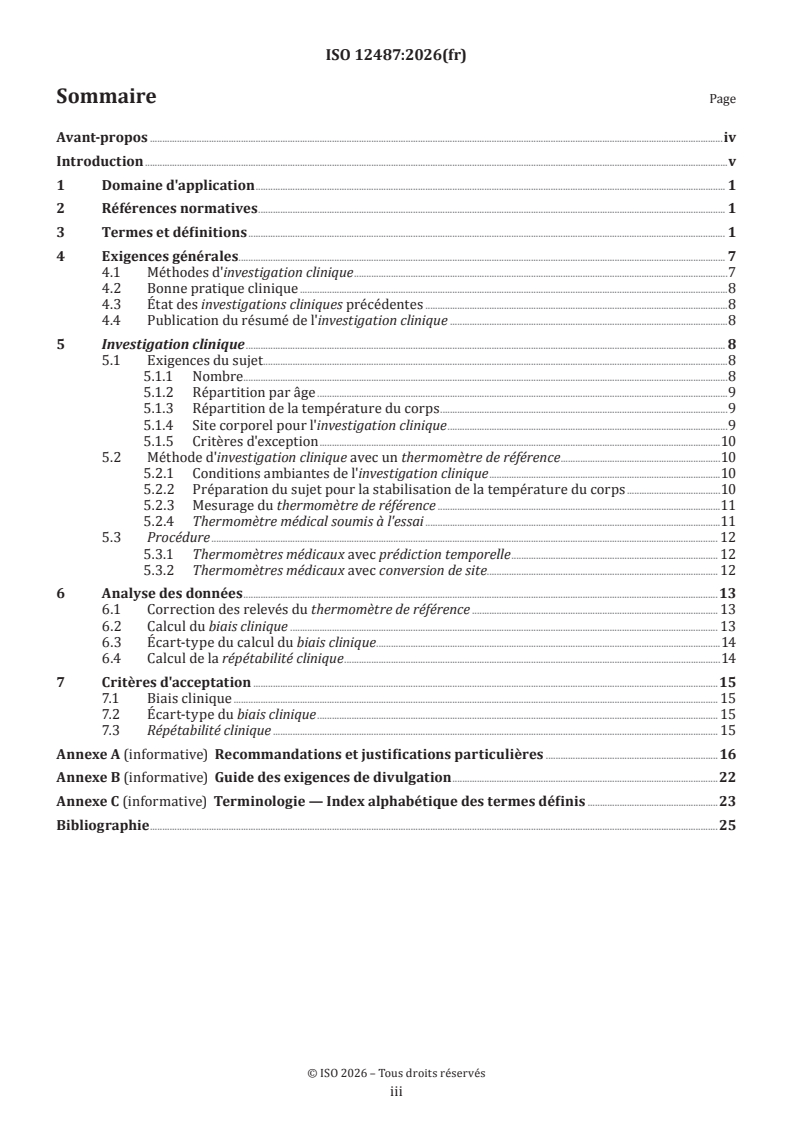
Contents
- Introduction
- 1 Domaine d'application
- 2 Références normatives
- 3 Termes et définitions
- 3.1 informations d'accompagnement
- 3.2 site d'application
- 3.3 exactitude clinique
- 3.4 biais clinique
- 3.5 investigation clinique
- 3.6 rapport d'investigation clinique
- 3.7 répétabilité clinique
- 3.8 thermomètre médical
- 3.9 thermomètre médical soumis à l'essai
- 3.10 mode de mesurage direct
- 3.11 performances essentielles
- 3.12 site indiqué
- 3.13 mode de mesurage indirect
- 3.14 instructions d'utilisation
- 3.15 exactitude de laboratoire
- 3.16 fabricant
- 3.17 appareil électromédical
- 3.18 température indiquée
- 3.19 patient
- 3.20 sonde
- 3.21 protection de sonde
- 3.22 procédure
- 3.23 processus
- 3.24 assignée
- 3.25 site de référence
- 3.26 thermomètre de référence
- 3.27 risque
- 3.28 capteur
- 3.29 conversion du site
- 3.30 mode d’essai
- 3.31 équilibre thermique
- 3.32 prédiction temporelle
- 3.33 essai de type
- 3.34 vérification
- 4 Exigences générales
- 4.1 Méthodes d'investigation clinique
- 4.2 Bonne pratique clinique
- 4.3 État des investigations cliniques précédentes
- 4.4 Publication du résumé de l'investigation clinique
- 5 Investigation clinique
- 5.1 Exigences du sujet
- 5.2 Méthode d'investigation clinique avec un thermomètre de référence
- 5.3 Procédure
- 6 Analyse des données
- 6.1 Correction des relevés du thermomètre de référence
- 6.2 Calcul du biais clinique
- 6.3 Écart-type du calcul du biais clinique
- 6.4 Calcul de la répétabilité clinique
- 7 Critères d'acceptation
- 7.1 Biais clinique
- 7.2 Écart-type du biais clinique
- 7.3 Répétabilité clinique
- Annexe A
- Annexe B
- Annexe C
- Bibliographie
Introduction
La détermination de la température du corps est une procédure importante qui est cliniquement utilisée pour évaluer l'état des patients ainsi que la tension artérielle, la SpO et le pouls. Le présent document
vise à fournir les exigences nécessaires pour l'investigation clinique afin de s'assurer que les performances essentielles de ces thermomètres médicaux sont à un niveau adéquat. Dans le présent document, les types de polices suivants sont utilisés:
- exigences et définitions: caractères romains;
- termes définis à l'Article 3 de la norme générale, dans le présent document ou en note: caractères italiques;
- éléments informatifs situés hors des tableaux, tels que les notes, exemples et références: petits caractères. Le texte normatif à l'intérieur des tableaux est également en petits caractères. Dans le présent document, les formes verbales suivantes sont utilisées:
- «doit» exprime une exigence;
- «il convient de» exprime une recommandation;
- «peut» («may») exprime une permission;
- «peut» («can») est utilisé pour décrire une possibilité ou une capacité; et
- «doit» («must») est utilisé pour exprimer une contrainte externe.
Norme internationale ISO 12487:2026(fr) Appareils électromédicaux — Évaluation de la performance clinique des thermomètres médicaux
1 Domaine d'application
Le présent document spécifie les exigences et les méthodes relatives à l'investigation clinique d'appareils électromédicaux (EM) utilisé pour mesurer la température du corps en mode de mesurage indirect. Le présent document couvre à la fois les thermomètres médicaux intermittents et continus. NOTE 1 Le présent document ne s'applique pas aux thermomètres médicaux mesurant la température du corps en mode de mesurage direct.
NOTE 2 Pour les thermomètres médicaux en mode de mesurage direct, la détermination de l'exactitude technique 1) conformément à l'ISO 80601-2-56:— est considérée suffisante.
Ce document s'applique aux thermomètres médicaux dont le temps de mesurage déclaré est inférieur à 60 secondes (pour les méthodes telles que le mesurage oral ou rectal), ou inférieur à 5 minutes (pour les méthodes telles que le mesurage axillaire), et qui sont traités en tant que thermomètres à extrapolation et relèvent du domaine d'application du présent document.
Le présent document spécifie des exigences de publications supplémentaires. Le présent document ne s'applique pas à l'investigation clinique d'un imageur thermique pour le dépistage de la température de fébrilité humaine dont les exigences en termes d'exactitude de laboratoire sont décrites dans l'IEC 80601-2-59.
Le présent document ne s'applique pas au cathéter de l'artère pulmonaire pour la détermination du débit cardiaque par thermodilution.
1) NOTE 3 L'ISO 80601-2-56:— comprend le cathéter de l'artère pulmonaire pour la détermination du débit cardiaque par thermodilution.
2 Références normatives
Les documents suivants sont cités dans le texte de sorte qu'ils constituent, pour tout ou partie de leur contenu, des exigences du présent document. Pour les références datées, seule l'édition citée s'applique. Pour les références non datées, la dernière édition du document de référence s'applique (y compris les éventuels amendements).
ISO 14155:2026, Investigation clinique des dispositifs médicaux pour sujets humains — Bonnes pratiques cliniques
3 Termes et définitions
Pour les besoins du présent document, les termes et définitions suivants s'appliquent. L'ISO et l'IEC tiennent à jour des bases de données terminologiques destinées à être utilisées en normalisation, consultables aux adresses suivantes:
- ISO Online browsing platform: disponible à l'adresse https:// www .iso .org/ obp - IEC Electropedia: disponible à l'adresse https:// www .electropedia .org/ 1) Troisième édition en cours d'élaboration. Stade à la date de vote: ISO/DIS 80601-2-56.
ISO 12487:2026(fr) NOTE Un index alphabétique des termes définis est disponible à l'Annexe C.
3.1 informations d'accompagnement
informations fournies par le fabricant (3.16) accompagnant ou marquées sur un dispositif médical ou un accessoire à destination de l'utilisateur ou de l'organisme responsable, en particulier concernant une utilisation sûre Note 1 à l'article: Les informations d'accompagnement sont considérées comme faisant partie intégrante du dispositif médical ou de l'accessoire.
Note 2 à l'article: Les informations d'accompagnement peuvent comprendre l'étiquette, le marquage, les instructions d'utilisation (3.14), la description technique, le manuel d'installation, le guide de référence rapide, etc., et peuvent traiter de l'installation, de l'utilisation, du traitement, de la maintenance et de la mise au rebut du dispositif médical ou de l'accessoire.
Note 3 à l'article: Les informations d'accompagnement ne sont pas nécessairement écrites ou imprimées, mais peuvent comprendre des supports sonores, visuels ou tactiles et des médias multiples (par exemple: CD-ROM, DVD-ROM, clé USB, site Internet).
[SOURCE: ISO 20417:2026, 3.2, modifiée — Notes 4 et 5 à l'article et la figure ont été supprimées.]
3.2 site d'application
site de mesurage emplacement corporel d'un patient (3.19) avec lequel la sonde (3.20) interagit directement EXEMPLE Canal de l'oreille, bouche (voie sublinguale), axilla (aisselle), rectum, centre du front, tempe, canthus interne, artère temporale, vessie.
Note 1 à l'article: Le mesurage au site d'application est soit un contact, soit un non-contact (par exemple infrarouge). [SOURCE: L'ISO 80601‑2‑56:—, 201.3.220, modifiée —»site d'application» a été ajoutée en tant que terme privilégié, l'Exemple a été modifié et la Note 1 à l'article a été ajoutée.]
3.3 exactitude clinique
étroitesse de l’accord entre la température indiquée (3.18) d’un thermomètre médical (3.8) et la valeur de référence de la température du site de référence (3.25) que le thermomètre médical prétend représenter [SOURCE: ISO 80601‑2‑56:—, 201.3.205]
3.4 biais clinique
Δ cb différence moyenne entre les températures indiquées (3.18) d'un thermomètre médical (3.8) et d'un thermomètre de référence (3.26) pour le site de référence (3.25) visé Note 1 à l'article: Le site de mesurage (3.2) peut être identique ou différent du site corporel de référence.
3.5 investigation clinique
essai clinique étude clinique investigation systématique portant sur un ou plusieurs sujets humains, entreprise en vue d'évaluer la performance clinique, l'efficacité ou la sécurité d'un dispositif médical [SOURCE: ISO 14155:2026, 3.9]
ISO 12487:2026(fr)
3.6 rapport d'investigation clinique
étude scientifique clinique document décrivant le schéma de conception, l'exécution, l'analyse statistique et les résultats d'une investigation clinique (3.5) [SOURCE: ISO 14155:2026, 3.11]
3.7 répétabilité clinique
σ repeat écart‑type combiné (sur un groupe sélectionné de sujets) des modifications de plusieurs températures indiquées (3.18) prises sur le même sujet au même site d'application (3.2) avec le même thermomètre médical (3.8) par le même opérateur sur une période de temps relativement courte [SOURCE: ASTM E1965‑98, 3.2.10, modifiée— la focalisation est passée de la «température du conduit auditif» au «site d'application» plus général et la partie entre parenthèses «(sur un groupe sélectionné de sujets)»a été incluse.]
3.8 thermomètre médical
appareil électromédical (EM) (3.17) utilisé pour le mesurage au site d'application (3.2) et indiquant la température au site de référence (3.25) Note 1 à l'article: Le site d'application peut être identique au site de référence. [SOURCE: ISO 80601‑2‑56:—, 201.3.206, modifié — «site de mesure» a été remplacé par «site d'application».]
3.9 thermomètre médical soumis à l'essai
DSE thermomètre médical (3.8) soumis à une investigation clinique (3.5)
3.10 mode de mesurage direct
mode de fonctionnement d'un thermomètre médical (3.8) dans lequel la température indiquée (3.18) représente la température du site d'application (3.2) avec lequel la sonde (3.20) est en équilibre thermique (3.31) [SOURCE: ISO 80601‑2‑56:—, 201.3.207, modifié — «site de mesure» a été remplacé par «site d'application».]
3.11 performances essentielles
performance d'une fonction clinique différente de celle relative à la sécurité de base, pour laquelle la perte ou la dégradation au-delà des limites précisées par le fabricant (3.16) entraîne un risque (3.27) inacceptable Note 1 à l'article: Le terme performance essentielle est plus facilement compris lorsqu'on examine si son absence ou sa dégradation donnerait lieu à un risque inacceptable.
[SOURCE: IEC 60601‑1:2005+AMD1: 2012+ AMD2: 2020, 3.27]
3.12 site indiqué
site corporel indiqué site corporel auquel se réfère la température indiquée (3.18) du thermomètre clinique (3.8) EXEMPLE 1 Canal de l'oreille, oral (voies sublinguales), axilla, rectum, tronc. Note 1 à l'article: Le site indiqué peut différer du site d'application (3.2). EXEMPLE 2 Thermomètres cliniques à conversion sur site (3.29).
ISO 12487:2026(fr) Note 2 à l'article: Le paragraphe A.2.1 contient des recommandations ou justifications concernant la présente définition.
3.13 mode de mesurage indirect
mode de fonctionnement d'un thermomètre médical (3.8) dans lequel la température indiquée (3.18) représente la température d'un site d'application (3.2) avec lequel la sonde (3.20) n'est pas en équilibre thermique (3.31) ou dans lequel le site d'application n'est pas le site indiqué (3.12) Note 1 à l'article: Les thermomètres médicaux infrarouges ne sont généralement pas en équilibre thermique avec le site d'application et sont donc généralement en mode de mesurage indirect. Note 2 à l'article: Les thermomètres médicaux dont le temps de mesurage déclaré est inférieur à 60 secondes (pour les méthodes telles que le mesurage oral ou rectal), ou inférieur à 5 minutes (pour les méthodes telles que le mesurage axillaire), sont considérés dans le mode de mesurage indirect. [SOURCE: ISO 80601‑2‑56:—, 201.3.214, modifié— «site de mesure» a été remplacé par «site d'application»; «ou dans lequel le site d'application n'est pas le site indiqué» a été ajouté à la définition; la Note 2 à l'article a été ajoutée.]
3.14 instructions d'utilisation
notice partie des informations d'accompagnement (3.1) qui est:
- destinée à l' utilisateur, et
- essentielle pour l'utilisation sûre et efficace d'un dispositif médical ou d'un accessoire [SOURCE: ISO 20417:2026, 3.16, modifié — Les notes à l'article ont été supprimées.]
3.15 exactitude de laboratoire
proximité de l'accord entre la température indiquée (3.18) d'un thermomètre clinique (3.8) et un thermomètre de référence (3.26) lors de la mesure d'une source de température de référence (par exemple bain d'eau ou corps noir) dans des conditions de laboratoire Note 1 à l'article: L’exactitude de laboratoire est parfois appelée erreur admissible maximale. [SOURCE: ISO 80601‑2‑56:—, 201.3.217, modifié — ajouté à la définition «lors de la mesure d'une source de température de référence (par exemple bain d'eau ou corps noir) dans des conditions de laboratoire».]
3.16 fabricant
personne physique ou légale responsable de la conception, de la fabrication, de l'emballage ou de l'étiquetage des appareils électromédicaux EM (3.17), assemblant un système EM ou adaptant des appareils électromédicaux EM ou un système EM, que ces opérations soient réalisées par la personne ou en son nom par une ou plusieurs autres personnes [SOURCE: IEC 60601‑1:2005+AMD1: 2012+ AMD2: 2020, 3.55, modifié — Les Notes à l'article ont été supprimées.]
3.17 appareil électromédical
équipement électrique ayant une partie appliquée ou transférant de l'énergie vers ou depuis le patient (3.19) ou détectant ce transfert d'énergie vers ou depuis le patient et qui est:
a) fourni avec pas plus d'une connexion à un réseau d'alimentation particulier; et b) destiné à être utilisé par son fabricant (3.16):
1) dans le diagnostic, le traitement ou la surveillance d'un patient; ou
ISO 12487:2026(fr) 2) pour compenser ou atténuer une maladie, une blessure ou un handicap Note 1 à l'article: L'appareil électromédical comprend les accessoires tels qu’ils sont définis par le fabricant qui sont nécessaires pour permettre l’utilisation normale de l'appareil électromédical. [SOURCE: IEC 60601‑1:2005+AMD1: 2012+ AMD2: 2020, 3.63, modifié — Les Notes 2 à 5 à l'article ont été supprimées.]
3.18 température indiquée
température indiquée par un thermomètre médical (3.8) Note 1 à l'article: Les méthodes d’indication peuvent comprendre: l’impression, la déclaration orale, l’affichage et l’affichage distant.
[SOURCE: ISO 80601‑2‑56:—, 201.3.223, modifié — «thermomètre» remplacé par «thermomètre médical».]
3.19 patient
être vivant (personne ou animal) soumis à une procédure (3.22) de nature médicale, chirurgicale ou dentaire Note 1 à l'article: Un patient peut être un opérateur.
[SOURCE: IEC 60601‑1:2005+AMD1: 2012+ AMD2: 2020, 3.76]
3.20 sonde
partie d’un thermomètre médical (3.8) qui assure un couplage thermique entre le capteur (3.28) et le patient (3.19) Note 1 à l'article: Le couplage thermique peut être avec contact ou sans contact. [SOURCE: ISO 80601‑2‑56:—, 201.3.225]
3.21 protection de sonde
accessoire jetable ou réutilisable d’un thermomètre médical (3.8) qui fournit une barrière sanitaire entre la sonde (3.20) et le patient (3.19) [SOURCE: ISO 80601‑2‑56:—, 201.3.227]
3.22 procédure
manière spécifique de mener à bien une activité ou un processus (3.23) [SOURCE: IEC 60601‑1:2005+AMD1: 2012+ AMD2: 2020, 3.88]
3.23 processus
ensemble d'activités corrélées ou en interaction qui utilisent des éléments d'entrée pour produire un résultat escompté Note 1 à l'article: La désignation du «résultat escompté» d’un processus par élément de sortie, produit ou service dépend du contexte de la référence.
Note 2 à l'article: Les éléments d’entrée d’un processus sont généralement les éléments de sortie d’autres processus et les éléments de sortie d’un processus sont généralement les éléments d’entrée d’autres processus. Note 3 à l'article: Deux processus, ou plus, corrélés et en interaction en série peuvent également être qualifiés de processus.
[SOURCE: IEC 60601‑1:2005+AMD1: 2012+ AMD2: 2020, 3.89]
ISO 12487:2026(fr)
3.24 assignée
<valeur> terme qui fait référence à une valeur attribuée par le fabricant (3.16) pour une condition de fonctionnement spécifiée [SOURCE: IEC 60601‑1:2005+AMD1: 2012+ AMD2: 2020, 3.97]
3.25 site de référence
site corporel de référence site corporel où le thermomètre de référence (3.26) mesure la température comme valeur de référence pour l'investigation clinique (3.5) EXEMPLE Canal de l'oreille, oral (voies sublinguales), axilla, rectum, vessie.
3.26 thermomètre de référence
thermomètre avec une précision spécifiée et l'incertitude associée, dont l'étalonnage est traçable par rapport à une norme nationale de température, mesurant en équilibre au site de référence (3.25) dans le mode de mesure directe (3.10) ou pour une application en laboratoire
3.27 risque
combinaison de la probabilité de la survenue d'un dommage et de sa gravité [SOURCE: ISO 14971:2019, 3.18]
3.28 capteur
partie du thermomètre médical (3.8) qui convertit l’énergie thermique en signal électrique [SOURCE: ISO 80601‑2‑56:—, 201.3.231]
3.29 conversion du site
processus (3.23) de mesurage de la température au niveau d'un site de mesurage et de conversion de la valeur à un autre site [SOURCE: ISO 80601‑2‑56:—, 201.3.232]
3.30 mode d’essai
état d'un thermomètre médical (3.8) dans lequel la température indiquée (3.18) représente la température indiquée par le capteur (3.28) et n'inclut pas la conversion du site (3.29) ou la prédiction temporelle (3.32) Note 1 à l'article: Le mode d’essai est utilisé pour la détermination de l’exactitude de laboratoire (3.15) du thermomètre médical.
Note 2 à l'article: Le mode d'essai n'a pas nécessairement besoin d'être un mode supplémentaire et peut être le mode de mesurage direct (3.10) du thermomètre médical.
[SOURCE: ISO 80601‑2‑56:—, 201.3.239]
3.31 équilibre thermique
état de mesure après quoi la variation ultérieure de température indiquée (3.18) est < 0,1 °C/16 s Note 1 à l'article: Pour les méthodes telles que la mesure orale ou rectale.
ISO 12487:2026(fr)
3.32 prédiction temporelle
processus (3.23) de prévision de la température d'un site d'application (3.2) avant que l'équilibre thermique (3.31) n'ait été atteint [SOURCE: ISO 80601‑2‑56:—, 201.3.240, modifié — «site de mesurage» a été remplacé par «site d'application».]
3.33 essai de type
essai sur un spécimen représentatif de l'appareil en vue de déterminer si celui-ci, tel qu'il est conçu et construit, peut satisfaire aux exigences du présent document [SOURCE: IEC 60601‑1:2005+AMD1: 2012+ AMD2: 2020, 3.135]
3.34 vérification
confirmation par des preuves tangibles que les exigences spécifiées ont été satisfaites Note 1 à l'article: Les preuves objectives requises pour la vérification peuvent être le résultat d'un contrôle ou d'autres formes de détermination, telles que la réalisation de calculs ou l'examen de documents. Note 2 à l'article: Les activités réalisées pour la vérification sont parfois appelées processus de qualification. Note 3 à l'article: Le terme «vérifié» est utilisé pour désigner l'état correspondant. [SOURCE: IEC 60601‑1:2005+AMD1: 2012+ AMD2: 2020, 3.138]
4 Exigences générales
NOTE Le paragraphe A.2.2 contient des recommandations ou justifications concernant le présent Article.
4.1 Méthodes d'investigation clinique
Les principes de base suivants doivent s'appliquer aux méthodes d'investigation clinique conformément au présent document.
a) Les thermomètres cliniques en mode de mesurage indirecte doivent subir une investigation clinique conformément au présent document.
b) L'investigation clinique doit être considérée comme un essai de type. NOTE L'échantillon représentatif utilisé pour cet essai de type peut comprendre un ou plusieurs thermomètres médicaux.
c) Sauf spécification contraire dans le présent document, le fabricant doit prendre en compte:
1) la méthode séquentielle lorsque l'interférence physique entre les sondes du thermomètre médical et du thermomètre de référence est concernée; 2) la méthode simultanée lorsque la variation de température entre les mesurages est concernée. d) Il convient que l'investigation clinique inclue un large éventail de cas représentatifs dans les conditions d'essai pour les thermomètres cliniques, qui dépendent fortement de:
1) température ambiante; EXEMPLE 1 Cas représentant à proximité des extrémités inférieure et supérieure de la plage de températures de fonctionnement dans les informations d'accompagnement. 2) distance entre le thermomètre clinique et le site de mesurage; ou EXEMPLE 2 Cas représentant à proximité des extrémités plus courtes et plus longues de la plage de distance de mesurage dans les informations d'accompagnement.
ISO 12487:2026(fr) 3) température corporelle.
EXEMPLE 3 Cas représentant à proximité des extrémités inférieure et supérieure de la plage de températures corporelle dans les informations d'accompagnement. Vérifier la conformité par examen du rapport d'investigation clinique.
4.2 Bonne pratique clinique
Les principes de base suivants doivent s'appliquer à l'investigation clinique conformément au présent document.
a) Toutes les investigations cliniques doivent être conformes aux exigences spécifiées dans l'ISO 14155:2026. b) Il convient de ne pas utiliser l'investigation clinique avec le site de référence invasif avec ponction cutanée ou le site d'application invasif avec ponction cutanée pour les patients ou les sujets uniquement dans le but d'examiner les performances du thermomètre médical.
...