

IEC 62037-1:2025
(Main)Passive RF and microwave devices, intermodulation level measurement - Part 1: General requirements and measuring methods
General Information
- Abstract
IEC 62037-1:2025 deals with the general requirements and measuring methods for intermodulation (IM) level measurement of passive RF and microwave components, which can be caused by the presence of two or more transmitting signals. The test procedures given in this document give the general requirements and measurement methods required to characterize the level of unwanted IM signals using two transmitting signals. The IEC 62037 series addresses the measurement of PIM but does not cover the long-term reliability of a product with reference to its performance. This third edition cancels and replaces the second edition published in 2021. This edition constitutes a technical revision.
This edition includes the following significant technical changes with respect to the previous edition:
a) added clarification that PIM generation is typically frequency dependent and noted that testing with swept or multiple fixed frequencies often provides more accurate results;
b) identified multi-port PIM analyzers as a possible test set-up topography;
c) added specification that test power level does not exceed the power handling capability of the DUT;
d) updated test specification to include missing parameters needed to properly define a PIM test;
e) added clarification that PIM test reports include the maximum PIM value measured over the test duration;
f) corrected error in Figure 3 that was erroneously changed in IEC 62037-1:2021.
- Status
- Published
- Publication Date
- 25-Feb-2025
- Technical Committee
- TC 46 - Cables, wires, waveguides, RF connectors, RF and microwave passive components and accessories
- Drafting Committee
- WG 6 - TC 46/WG 6
- Current Stage
- PPUB - Publication issued
- Start Date
- 26-Feb-2025
- Completion Date
- 28-Mar-2025
Buy Documents
IEC 62037-1:2025 RLV - Passive RF and microwave devices, intermodulation level measurement - Part 1: General requirements and measuring methods Released:26. 02. 2025
IEC 62037-1:2025 - Passive RF and microwave devices, intermodulation level measurement - Part 1: General requirements and measuring methods/26/2025
Overview
IEC 62037-1:2025 specifies general requirements and measuring methods for intermodulation (IM) level measurement of passive RF and microwave components. Focused on passive intermodulation (PIM) caused by two or more transmitting signals, this third edition updates test procedures, reporting rules and test-set topographies to better characterize unwanted IM products over frequency. The standard addresses two‑tone IM testing, forward/reverse measurement directions, and practical measurement set-ups but does not cover long‑term product reliability.
Key topics and technical requirements
- Two‑tone test principle: measurement using two equal-power test tones (f1, f2) to detect IM products (typically third-order: 2f1±f2, 2f2±f1).
- Frequency dependence: clarification that PIM is typically frequency‑dependent; recommends swept or multiple fixed‑frequency testing for more accurate characterization.
- Test set‑ups: defines reverse (reflected) and forward (transmitted) measurement topologies and recognizes multi‑port PIM analyzers as acceptable test equipment.
- Power handling limits: requires that test power levels do not exceed the DUT’s power handling capability.
- Test specification completeness: updated to include parameters essential to define a PIM test (frequency range, power levels, measurement duration, resolution bandwidth, direction, etc.).
- Reporting requirements: test reports must include the maximum PIM value measured over the test duration and key test conditions.
- Measurement errors & calibration: guidance on residual system error, low‑PIM terminations and measurement uncertainty (see annexes for termination configurations and test considerations).
- Annex guidance: includes practical configurations for low‑PIM terminations and considerations such as stepped sweeps, fixed‑frequency testing, dynamic testing and heating effects.
Applications and who uses it
IEC 62037-1:2025 is essential for:
- RF and microwave component manufacturers (antennas, connectors, cables, combiners, filters) for product characterization and quality control.
- Test laboratories and certification bodies performing PIM measurements and vendor acceptance testing.
- Mobile network operators and RF installers assessing site hardware (antennas, jumpers, passive components) to mitigate interference and ensure network performance.
- Designers of passive RF systems specifying PIM requirements in procurement and compliance documentation.
Keywords: IEC 62037-1:2025, PIM, passive intermodulation, RF testing, microwave components, intermodulation level measurement, DUT, two‑tone test, multi‑port PIM analyzer.
Related standards (if applicable)
- Other parts of the IEC 62037 series (see IEC webstore for the full list) provide complementary, part‑specific procedures and normative details across the PIM measurement series.
Relations
- Effective Date
- 05-Sep-2023
Buy Documents
IEC 62037-1:2025 RLV - Passive RF and microwave devices, intermodulation level measurement - Part 1: General requirements and measuring methods Released:26. 02. 2025
IEC 62037-1:2025 - Passive RF and microwave devices, intermodulation level measurement - Part 1: General requirements and measuring methods/26/2025
Get Certified
Connect with accredited certification bodies for this standard

ANCE
Mexican certification and testing association.

Intertek Slovenia
Intertek testing, inspection, and certification services in Slovenia.

LNE (Laboratoire National de Métrologie et d'Essais)
French national laboratory for metrology and testing.
Sponsored listings
Frequently Asked Questions
IEC 62037-1:2025 is a standard published by the International Electrotechnical Commission (IEC). Its full title is "Passive RF and microwave devices, intermodulation level measurement - Part 1: General requirements and measuring methods". This standard covers: IEC 62037-1:2025 deals with the general requirements and measuring methods for intermodulation (IM) level measurement of passive RF and microwave components, which can be caused by the presence of two or more transmitting signals. The test procedures given in this document give the general requirements and measurement methods required to characterize the level of unwanted IM signals using two transmitting signals. The IEC 62037 series addresses the measurement of PIM but does not cover the long-term reliability of a product with reference to its performance. This third edition cancels and replaces the second edition published in 2021. This edition constitutes a technical revision. This edition includes the following significant technical changes with respect to the previous edition: a) added clarification that PIM generation is typically frequency dependent and noted that testing with swept or multiple fixed frequencies often provides more accurate results; b) identified multi-port PIM analyzers as a possible test set-up topography; c) added specification that test power level does not exceed the power handling capability of the DUT; d) updated test specification to include missing parameters needed to properly define a PIM test; e) added clarification that PIM test reports include the maximum PIM value measured over the test duration; f) corrected error in Figure 3 that was erroneously changed in IEC 62037-1:2021.
IEC 62037-1:2025 deals with the general requirements and measuring methods for intermodulation (IM) level measurement of passive RF and microwave components, which can be caused by the presence of two or more transmitting signals. The test procedures given in this document give the general requirements and measurement methods required to characterize the level of unwanted IM signals using two transmitting signals. The IEC 62037 series addresses the measurement of PIM but does not cover the long-term reliability of a product with reference to its performance. This third edition cancels and replaces the second edition published in 2021. This edition constitutes a technical revision. This edition includes the following significant technical changes with respect to the previous edition: a) added clarification that PIM generation is typically frequency dependent and noted that testing with swept or multiple fixed frequencies often provides more accurate results; b) identified multi-port PIM analyzers as a possible test set-up topography; c) added specification that test power level does not exceed the power handling capability of the DUT; d) updated test specification to include missing parameters needed to properly define a PIM test; e) added clarification that PIM test reports include the maximum PIM value measured over the test duration; f) corrected error in Figure 3 that was erroneously changed in IEC 62037-1:2021.
IEC 62037-1:2025 is classified under the following ICS (International Classification for Standards) categories: 33.040.20 - Transmission systems. The ICS classification helps identify the subject area and facilitates finding related standards.
IEC 62037-1:2025 has the following relationships with other standards: It is inter standard links to IEC 62037-1:2021. Understanding these relationships helps ensure you are using the most current and applicable version of the standard.
IEC 62037-1:2025 is available in PDF format for immediate download after purchase. The document can be added to your cart and obtained through the secure checkout process. Digital delivery ensures instant access to the complete standard document.
Standards Content (Sample)
IEC 62037-1 ®
Edition 3.0 2025-02
REDLINE VERSION
INTERNATIONAL
STANDARD
Passive RF and microwave devices, intermodulation level measurement –
Part 1: General requirements and measuring methods
All rights reserved. Unless otherwise specified, no part of this publication may be reproduced or utilized in any form
or by any means, electronic or mechanical, including photocopying and microfilm, without permission in writing from
either IEC or IEC's member National Committee in the country of the requester. If you have any questions about IEC
copyright or have an enquiry about obtaining additional rights to this publication, please contact the address below or
your local IEC member National Committee for further information.
IEC Secretariat Tel.: +41 22 919 02 11
3, rue de Varembé info@iec.ch
CH-1211 Geneva 20 www.iec.ch
Switzerland
About the IEC
The International Electrotechnical Commission (IEC) is the leading global organization that prepares and publishes
International Standards for all electrical, electronic and related technologies.
About IEC publications
The technical content of IEC publications is kept under constant review by the IEC. Please make sure that you have the
latest edition, a corrigendum or an amendment might have been published.
IEC publications search - webstore.iec.ch/advsearchform IEC Products & Services Portal - products.iec.ch
The advanced search enables to find IEC publications by a Discover our powerful search engine and read freely all the
variety of criteria (reference number, text, technical publications previews, graphical symbols and the glossary.
committee, …). It also gives information on projects, replaced With a subscription you will always have access to up to date
and withdrawn publications. content tailored to your needs.
IEC Just Published - webstore.iec.ch/justpublished
Electropedia - www.electropedia.org
Stay up to date on all new IEC publications. Just Published
The world's leading online dictionary on electrotechnology,
details all new publications released. Available online and once
containing more than 22 500 terminological entries in English
a month by email.
and French, with equivalent terms in 25 additional languages.
Also known as the International Electrotechnical Vocabulary
IEC Customer Service Centre - webstore.iec.ch/csc
(IEV) online.
If you wish to give us your feedback on this publication or need
further assistance, please contact the Customer Service
Centre: sales@iec.ch.
IEC 62037-1 ®
Edition 3.0 2025-02
REDLINE VERSION
INTERNATIONAL
STANDARD
Passive RF and microwave devices, intermodulation level measurement –
Part 1: General requirements and measuring methods
INTERNATIONAL
ELECTROTECHNICAL
COMMISSION
ICS 33.040.20 ISBN 978-2-8327-0285-7
– 2 – IEC 62037-1:2025 RLV © IEC 2025
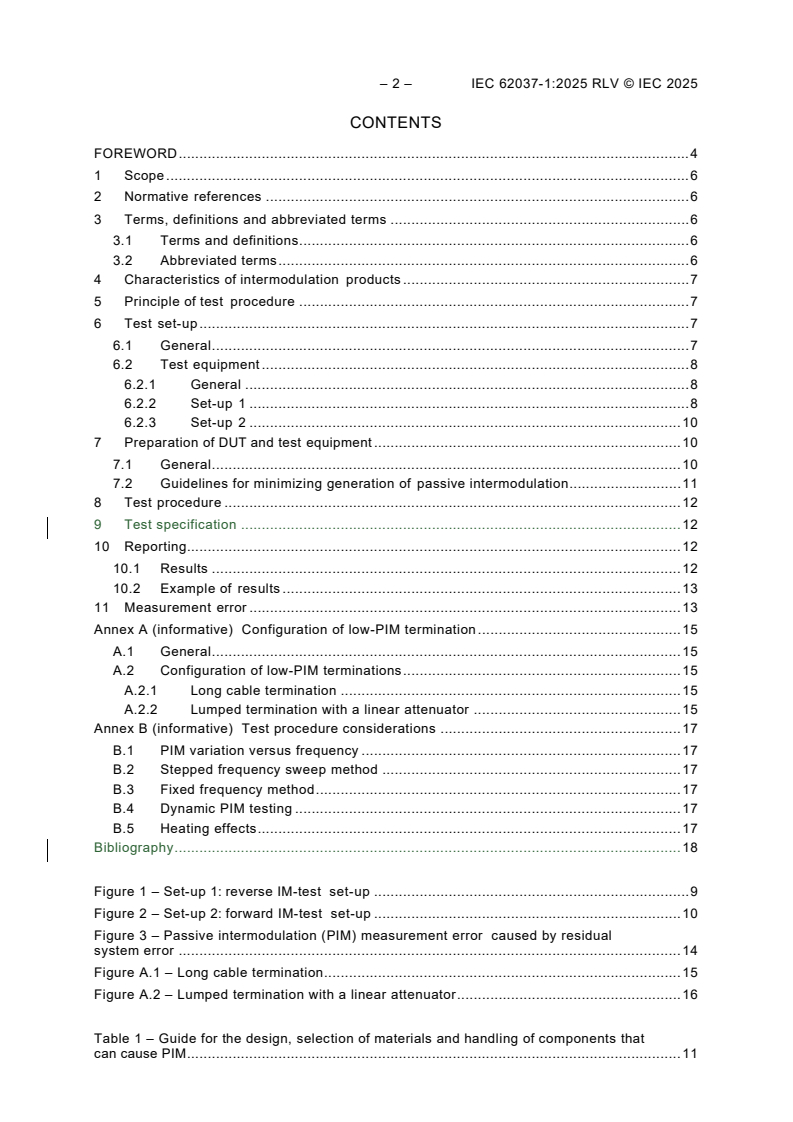
CONTENTS
FOREWORD . 4
1 Scope . 6
2 Normative references . 6
3 Terms, definitions and abbreviated terms . 6
3.1 Terms and definitions . 6
3.2 Abbreviated terms . 6
4 Characteristics of intermodulation products . 7
5 Principle of test procedure . 7
6 Test set-up . 7
6.1 General . 7
6.2 Test equipment . 8
6.2.1 General . 8
6.2.2 Set-up 1 . 8
6.2.3 Set-up 2 . 10
7 Preparation of DUT and test equipment . 10
7.1 General . 10
7.2 Guidelines for minimizing generation of passive intermodulation . 11
8 Test procedure . 12
9 Test specification . 12
10 Reporting. 12
10.1 Results . 12
10.2 Example of results . 13
11 Measurement error . 13
Annex A (informative) Configuration of low-PIM termination . 15
A.1 General . 15
A.2 Configuration of low-PIM terminations . 15
A.2.1 Long cable termination . 15
A.2.2 Lumped termination with a linear attenuator . 15
Annex B (informative) Test procedure considerations . 17
B.1 PIM variation versus frequency . 17
B.2 Stepped frequency sweep method . 17
B.3 Fixed frequency method . 17
B.4 Dynamic PIM testing . 17
B.5 Heating effects . 17
Bibliography . 18
Figure 1 – Set-up 1: reverse IM-test set-up . 9
Figure 2 – Set-up 2: forward IM-test set-up . 10
Figure 3 – Passive intermodulation (PIM) measurement error caused by residual
system error . 14
Figure A.1 – Long cable termination . 15
Figure A.2 – Lumped termination with a linear attenuator . 16
Table 1 – Guide for the design, selection of materials and handling of components that
can cause PIM . 11
Table 2 – Test set-up conditions . 12
– 4 – IEC 62037-1:2025 RLV © IEC 2025
INTERNATIONAL ELECTROTECHNICAL COMMISSION
____________
PASSIVE RF AND MICROWAVE DEVICES,
INTERMODULATION LEVEL MEASUREMENT –
Part 1: General requirements and measuring methods
FOREWORD
1) The International Electrotechnical Commission (IEC) is a worldwide organization for standardization comprising
all national electrotechnical committees (IEC National Committees). The object of IEC is to promote international
co-operation on all questions concerning standardization in the electrical and electronic fields. To this end and
in addition to other activities, IEC publishes International Standards, Technical Specifications, Technical Reports,
Publicly Available Specifications (PAS) and Guides (hereafter referred to as “IEC Publication(s)”). Their
preparation is entrusted to technical committees; any IEC National Committee interested in the subject dealt with
may participate in this preparatory work. International, governmental and non-governmental organizations liaising
with the IEC also participate in this preparation. IEC collaborates closely with the International Organization for
Standardization (ISO) in accordance with conditions determined by agreement between the two organizations.
2) The formal decisions or agreements of IEC on technical matters express, as nearly as possible, an international
consensus of opinion on the relevant subjects since each technical committee has representation from all
interested IEC National Committees.
3) IEC Publications have the form of recommendations for international use and are accepted by IEC National
Committees in that sense. While all reasonable efforts are made to ensure that the technical content of IEC
Publications is accurate, IEC cannot be held responsible for the way in which they are used or for any
misinterpretation by any end user.
4) In order to promote international uniformity, IEC National Committees undertake to apply IEC Publications
transparently to the maximum extent possible in their national and regional publications. Any divergence between
any IEC Publication and the corresponding national or regional publication shall be clearly indicated in the latter.
5) IEC itself does not provide any attestation of conformity. Independent certification bodies provide conformity
assessment services and, in some areas, access to IEC marks of conformity. IEC is not responsible for any
services carried out by independent certification bodies.
6) All users should ensure that they have the latest edition of this publication.
7) No liability shall attach to IEC or its directors, employees, servants or agents including individual experts and
members of its technical committees and IEC National Committees for any personal injury, property damage or
other damage of any nature whatsoever, whether direct or indirect, or for costs (including legal fees) and
expenses arising out of the publication, use of, or reliance upon, this IEC Publication or any other IEC
Publications.
8) Attention is drawn to the Normative references cited in this publication. Use of the referenced publications is
indispensable for the correct application of this publication.
9) IEC draws attention to the possibility that the implementation of this document may involve the use of (a)
patent(s). IEC takes no position concerning the evidence, validity or applicability of any claimed patent rights in
respect thereof. As of the date of publication of this document, IEC had not received notice of (a) patent(s), which
may be required to implement this document. However, implementers are cautioned that this may not represent
the latest information, which may be obtained from the patent database available at https://patents.iec.ch. IEC
shall not be held responsible for identifying any or all such patent rights.
This redline version of the official IEC Standard allows the user to identify the changes
made to the previous edition IEC 62037-1:2021. A vertical bar appears in the margin
wherever a change has been made. Additions are in green text, deletions are in
strikethrough red text.
IEC 62037-1 has been prepared by IEC technical committee 46: Cables, wires, waveguides, RF
connectors, RF and microwave passive components and accessories. It is an International
Standard.
This third edition cancels and replaces the second edition published in 2021. This edition
constitutes a technical revision.
This edition includes the following significant technical changes with respect to the previous
edition:
a) added clarification that PIM generation is typically frequency dependent and noted that
testing with swept or multiple fixed frequencies often provides more accurate results;
b) identified multi-port PIM analyzers as a possible test set-up topography;
c) added specification that test power level does not exceed the power handling capability of
the DUT;
d) updated test specification to include missing parameters needed to properly define a PIM
test;
e) added clarification that PIM test reports include the maximum PIM value measured over the
test duration;
f) corrected error in Figure 3 that was erroneously changed in IEC 62037-1:2021.
The text of this International Standard is based on the following documents:
Draft Report on voting
46/1035/FDIS 46/1043/RVD
Full information on the voting for its approval can be found in the report on voting indicated in
the above table.
The language used for the development of this International Standard is English.
This document was drafted in accordance with ISO/IEC Directives, Part 2, and developed in
accordance with ISO/IEC Directives, Part 1 and ISO/IEC Directives, IEC Supplement, available
at www.iec.ch/members_experts/refdocs. The main document types developed by IEC are
described in greater detail at www.iec.ch/publications.
A list of all the parts in the IEC 62037 series, published under the general title Passive RF and
microwave devices, intermodulation level measurement, can be found on the IEC website.
The committee has decided that the contents of this document will remain unchanged until the
stability date indicated on the IEC website under webstore.iec.ch in the data related to the
specific document. At this date, the document will be
• reconfirmed,
• withdrawn, or
• revised.
– 6 – IEC 62037-1:2025 RLV © IEC 2025
PASSIVE RF AND MICROWAVE DEVICES,
INTERMODULATION LEVEL MEASUREMENT –
Part 1: General requirements and measuring methods
1 Scope
This part of IEC 62037 deals with the general requirements and measuring methods for
intermodulation (IM) level measurement of passive RF and microwave components, which can
be caused by the presence of two or more transmitting signals.
The test procedures given in this document give the general requirements and measurement
methods required to characterize the level of unwanted IM signals using two transmitting signals.
The IEC 62037 series addresses the measurement of PIM but does not cover the long-term
reliability of a product with reference to its performance.
2 Normative references
The following documents are referred to in the text in such a way that some or all of their content
constitutes requirements of this document. For dated references, only the edition cited applies.
For undated references, the latest edition of the referenced document (including any
amendments) applies.
IEC 62037 (all parts), Passive RF and microwave devices, intermodulation level measurement
There are no normative references in this document.
3 Terms, definitions and abbreviated terms
3.1 Terms and definitions
No terms and definitions are listed in this document.
ISO and IEC maintain terminology databases for use in standardization at the following
addresses:
• IEC Electropedia: available at https://www.electropedia.org/
• ISO Online browsing platform: available at https://www.iso.org/obp
3.2 Abbreviated terms
CATV community antenna television
CFEC carbon fibre epoxy composite
CW continuous wave
DUT device under test
IM intermodulation
PCB printed circuit board
PIM passive intermodulation
RBW resolution bandwidth
VDA vacuum deposited aluminium
4 Characteristics of intermodulation products
PIM interference is caused by sources of non-linearity of mostly unknown nature, location and
behaviour. A few examples are inter-metallic contacts, choice of materials, corrosion products,
dirt, etc. Most of these effects are subject to changes over time due to mechanical stress,
temperature changes, variations in material characteristics (cold flow, etc.) and climatic
changes.
The generation of intermodulation products originates from point sources inside a DUT and
propagates equally in all available directions.
The generation of passive intermodulation (PIM) products does not necessarily follow the law
of the usual non-linear equation of quadratic form. Therefore, accurate calculation to other
power levels causing the intermodulation is not possible and PIM comparisons should be made
at the same power level.
an be frequency dependent. When PIM generation is frequency
Furthermore, PIM generation c
dependent, the PIM performance shall be investigated over the specified frequency band.
Furthermore, PIM generation is typically frequency dependent and shall be investigated over
the specified frequency band. Testing with swept or multiple fixed frequencies often provides
more accurate results. See Annex B for additional information.
5 Principle of test procedure
Test signals of frequencies f and f with equal specified test port power levels are combined
1 2
and fed to the DUT. The test signals should contain a harmonic or self-intermodulation signal
level at least 10 dB lower than the expected level generated in the DUT.
The PIM is measured over the specified frequency range. The intermodulation products of order
(2f ± f ), (2f ± f ), etc., are measured.
1 2 2 1
In most cases, the third order intermodulation signals represent the worst-case condition of
unwanted signals generated; therefore, the measurement of these signals characterizes the
DUT in a sufficient way. However, the test set-ups given in Clause 6 are suitable for measuring
other intermodulation products.
In other systems (such as CATV), the third order intermodulation signals may might not be as
applicable in characterizing the DUT.
Intermodulation can be measured in the reverse and forward direction. Reverse and forward
refer to the direction of propagation of the most powerful carrier.
6 Test set-up
6.1 General
Experience shows that the generation of intermodulation products originates from point sources
inside a device under test (DUT) and propagates equally in all available directions. Therefore,
either the reverse (reflected) or the forward (transmitted) intermodulation signal can be
measured.
and are for
Two different test set-ups are described in Figure 1 and Figure 2 6.2.2 and 6.2.3
reference only. Other topologies are possible such as multi-port PIM analyzers.
– 8 – IEC 62037-1:2025 RLV © IEC 2025
Set-up 1 is for measuring the reverse (reflected) intermodulation signal only, and set-up 2 is for
measuring the forward (transmitted) intermodulation signal. The measurement method (reverse
or forward) is dependent upon the DUT. The set-ups may be assembled from standard
microwave or radio link hardware selected for this particular application. All components shall
be checked for lowest self-intermodulation generation.
Experience shows that devices containing magnetic materials (circulators, isolators, etc.) can
be prominent sources of intermodulation signal generation.
See Annex B for additional set-up considerations.
6.2 Test equipment
6.2.1 General
Two signal sources or signal generators with power amplifiers are required to reach the
specified test port power. The combining and diplexing device can comprise a circulator, hybrid
junction, coupler or filter network.
The test set-up self-intermodulation generated (including contribution of the load) should be at
least 10 dB below the level to be measured on the DUT. The associated error may can be
obtained from Figure 3.
The DUT shall be terminated by a load for the specified power if necessary. The receiving
bandpass filter, tuned for the desired intermodulation signal, is followed by a low noise amplifier
(if required) and a receiver.
See Annex B for additional set-up considerations.
6.2.2 Set-up 1
The set-up shown in Figure 1 is for measuring the reverse (reflected) IM-product and is
therefore suitable for one-port and multi-port DUTs. On multi-port DUTs, the unused ports shall
be connected to a linear termination. See Annex A for information on low PIM terminations.
a) Generators
The generators shall provide continuous wave (CW) signals of the specified test port power.
They shall have sufficient frequency stability to ensure that the IM-product can be detected
properly by the receiver. The generators may be pulsed on and off while testing to reduce
power consumption.
Some limitations apply when using pulsed generators. See Annex B for test procedure
considerations when using equipment with pulsed generators.
a) Transmit-filters
The filters are bandpass filters tuned to the particular frequencies. They isolate the
and f .
generators from each other and filter out the harmonics of f
1 2
b) Combining and diplexing device
This device is used for combining the signals f and f , delivering them to the test port and
1 2
provides a port for the extraction of the reverse (reflected) signal f .
IM
c) Receive-filter
This filter is used for isolating the input of the receiver from the signals f and f to the extent
1 2
that IM-products are not generated within the receiver.
d) Test port
The DUT is connected to P4. The specified input power shall be at the DUT, with any set-
up loss between the receiver and the DUT compensated for.
e) Termination
When a multi-port DUT is measured, the DUT shall be connected to a sufficiently linear
termination (low intermodulation) of suitable power handling capability.
f) Receiver
The receiver shall be sensitive enough to detect a signal of the expected power level.
The receiver response time shall be sufficiently short to allow acquisition of rapid changes
in amplitude. Sensitivity can be increased by a low noise preamplifier. Frequency stability
shall be sufficient for the proper detection of the IM-signal.
When the PIM measurement result is close to the thermal noise floor of the receiver, the
receiver sensitivity can be improved by reducing the resolution bandwidth (RBW).
Furthermore, by using the averaging mode rather than the max-hold mode, a further
improvement can be achieved, since the max-hold mode essentially measures the maximum
thermal noise peak, while the averaging mode results in a measurement that is closer to the
RMS value.
Figure 1 – Set-up 1: reverse IM-test set-up
– 10 – IEC 62037-1:2025 RLV © IEC 2025
6.2.3 Set-up 2
The set-up shown in Figure 2 is for measuring the forward (transmitted) IM-product and is
therefore suitable only for two- or multi-port DUTs.
All components are the same as those of set-up 1, except for those as noted below.
a) Combining and diplexing device
The extraction-port P3 on this device shall be terminated to prevent reflection of the IM-
signals.
b) Diplexing device
The signals f , f and f are split to P6 and P7. This device, together with an additional
1 2 IM
receive-filter, is used for the extraction of the intermodulation signals.
Figure 2 – Set-up 2: forward IM-test set-up
7 Preparation of DUT and test equipment
7.1 General
The DUT and test equipment shall be carefully checked for proper power handling range,
frequency range, cleanliness and correct interconnection dimensions. All connector interfaces
shall be tightened to the applicable IEC specification or, if none exists, to the manufacturer's
recommended specification.
See Annex B for additional set-up considerations.
7.2 Guidelines for minimizing generation of passive intermodulation
The following guidelines and Table 1 should be considered and adhered to wherever possible.
a) Non-linear materials should not be used in or near the current paths.
b) Current densities should be minimized in the conduction paths (e.g. Tx channel), by using
larger conductors.
c) Minimize metallic junctions, avoid loose contacts and rotating joints.
d) Minimize the exposure of loose contacts, rough surfaces and sharp edges to RF power.
e) Keep thermal variations to a minimum, as the expansion and contraction of metals can create
non-linear contacts.
f) Use brazed, soldered or welded joints if possible, but ensure these joints are good and have
no non-linear materials, cracks, contamination or corrosion.
g) Avoid having tuning screws or moving parts in the high current paths; if necessary, ensure
all joints are tight and clean, and preferably, free from vibration.
h) Cable lengths in general should be minimized and the use of high quality, low-IM cable is
essential.
i) Minimize the use of non-linear components such as high-PIM loads, circulators, isolators and
semiconductor devices.
j) Achieve good sufficient isolation between the high-power transmit signals and the low power
receive signals by filtering and physical separation.
Table 1 – Guide for the design, selection of materials and handling
of components that can be susceptible to cause PIM generation
Part, material or procedure Recommendations
Interfaces Minimize the total number.
Connectors Minimize the number of connectors used. Use high quality, low-
PIM connectors mated with proper torque.
Inter-metallic connections Each inter-metallic connection should be evaluated in terms of
criticality for the total PIM level. Methods of controlling the
performance are high contact pressure, insulation, soldering,
brazing, etc.
Ferromagnetic materials Not recommended (non-linear).
Non-magnetic stainless steel Not recommended (contains iron).
Circulators, isolators and other ferrite devices Not recommended.
Sharp edges Avoid if it results in high current density.
Terminations or attenuators Should be evaluated before use.
Hermetic seals/gaskets Evaluate before use and avoid ferromagnetic materials.
Printed circuit boards (PCBs) Materials, processes and design should all be considered and
evaluated. Use low-PIM materials; be careful with material
impurities, contamination and etching residuals. The copper
trace should be finished to prevent corrosion.
Dissimilar metals Not recommended (risk of galvanic corrosion).
Dielectric material Use clean, high-quality material. Ensure it does not contain
electrically conductive particles.
Machined dielectric materials Use clean non-contaminated tools for machining.
Welded, soldered or brazed joints Well executed and thoroughly cleaned, they provide satisfactory
results. Shall be carefully inspected.
Carbon fibre epoxy composite (CFEC) Generally acceptable for use in reflector and support structures,
provided the fibres are not damaged. Should be evaluated if
high flux density (e.g. > 10 mW /cm ) is expected.
– 12 – IEC 62037-1:2025 RLV © IEC 2025
Part, material or procedure Recommendations
Standard multilayer thermal blankets made of Special design required.
vacuum deposited aluminium (VDA) on
biaxially-oriented polyethylene terephthalate
film or polyimide film
Cleanliness Maintain clean and dry surfaces.
Plating The thickness of the plating should be at least three times
greater than the skin depth of the wave resulting from the skin
effect at the lowest relevant frequency.
8 Test procedure
Table 2 gives certain conditions for test set-up 1 and test set-up 2.
Table 2 – Test set-up conditions
Test set-up 1 Test set-up 2
The set-up shall be verified for correct signal levels applied to the DUT. For mobile communication systems, it is
generally recommended to use 2 × 20 W (43 dBm) at the test port of the DUT, unless otherwise specified. Other
systems can require different power levels (higher or lower). The power level used shall not exceed the power
handling capability of the DUT. See Annex B for heating effect considerations.
The minimum number of test frequencies and/or frequency spacing shall be specified.
For lowest measurement uncertainty, the receiver shall be calibrated at the expected IM-level with a calibrated
signal-source as indicated in Figure 1 and Figure 2.
The termination shall be connected directly to the test P5 of the diplexing device shall be connected directly
port P4 and the self-intermodulation level of the set-up to P4 of the combining and summing device and the
recorded. self-intermodulation level of the set-up recorded.
For low measurement uncertainties, the level of self-intermodulation should be at least 10 dB below the specified
value for the DUT.
Test the DUT as given in the specific set-up and procedure in the appropriate test set-up.
An additional mechanical shock test may be carried out during the test sequence.
9 Test specification
Test specifications shall specify the following:
a) test power level;
b) IM product order to be measured;
c) test type (forward or reverse IM);
d) frequency band(s) or specific frequencies within the band(s) to be measured;
e) dynamic stimulus requirements while testing;
f) maximum allowable PIM level.
10 Reporting
10.1 Results
The input power at individual frequencies should be specified. The values of f and f should
1 2
be specified.
The PIM level and frequency should be specified.
Reports shall include the maximum PIM value measured over the test duration. Depending on
DUT type, there can be additional report requirements defined in the detail specification. See
detail specifications for additional report requirements.
10.2 Example of results
The result is expressed as an absolute magnitude in dBm or relative magnitude in dBc,
referenced to the power of a single carrier.
The relationship between a measured IM value of –120 dBm can be converted to dBc.
EXAMPLE:
f = 936 MHz, f = 958 MHz, f = 914 MHz
IM
1 2 3
P(f ) = P(f ) = 20 W (+43 dBm) IM = –163 dBc (–120 dBm)
1 2 3
11 Measurement error
The total measurement uncertainty (δT) can be calculated by the following formula:
22 2
RSS = δA + δP ++δP δD
( ) ( ) ( )
( )
mg
22 2
δT = δA + δP ++δP δD
( ) ( ) ( )
( )
mg
where
δA is the uncertainty of the attenuator;
δP is the uncertainty of the power meter;
m
δP is the uncertainty of the generator 3;
g
δD is the uncertainty due to the difference between self-intermodulation of the test bench
and intermodulation of the DUT (taken from Figure 3).
Mismatch errors are not included in the given formula.
– 14 – IEC 62037-1:2025 RLV © IEC 2025
Figure 3 – Passive intermodulation (PIM) measurement error
caused by residual system error
Annex A
(informative)
Configuration of low-PIM termination
A.1 General
Annex A provides information on low-PIM terminations.
A.2 Configuration of low-PIM terminations
A.2.1 Long cable termination
High-PIM terminations can often consist of resistive materials. Therefore, long coaxial cables
are used as a low-PIM termination (see Figure A.1). The following guidelines are in no particular
order of significance but should be considered and adhered to wherever possible.
a) Avoid braided cables. Cables with a single centre conductor should be used. Semi-rigid
cables would be a good choice from the practical viewpoint.
b) Avoid using cables with high-PIM materials and high-PIM plating. Plating with silver and tin
would be a good choice. Plating should be sufficiently thicker than the skin depth at the lowest
fundamental frequency.
c) A seamless cable configuration is the best for terminations because minimizing cable-
connection is essential to achieve low-PIM. When the termination is composed of several
short cables, the longest one should be used at the nearest side to the DUT.
d) Choose the cable with sufficient power-handling capability.
e) Choose the cable length sufficient for power absorption at the lowest fundamental frequency
considering the isolation performance between the receive signals and transmit signals.
f) Use a connector with low-PIM characteristics.
Figure A.1 – Long cable termination
A.2.2 Lumped termination with a linear attenuator
A low-PIM cable can be considered as a linear attenuator. The combination of the linear
attenuator and a high-PIM lumped load as shown in Figure A.2 may be used as a low-PIM
termination. The following procedure is presented for designing a low-PIM termination.
a) Measure the PIM characteristics of the lumped termination as a function of the fundamental
power and determine the PIM-increase ratio X (dB).
b) Determine the required attenuation of the linear attenuator X (dB) using the following
c
formula:
Y Y −+(XX1)
term RDL c
=
– 16 – IEC 62037-1:2025 RLV © IEC 2025
c) Design the required length of the cable for the linear attenuator using the following formula:
X αl×
cm
where
Y is the PIM of the lumped termination for P , in dBm;
RDL in
Y is the PIM level required for the low-PIM termination in dBm;
term
X is the PIM increase against the 1 dB increase of each input tone, in dB;
X is the attenuation of the linear attenuator, in dB;
c
α is the attenuation ratio of the cable, in dB/m;
l is the cable length, in m.
m
Figure A.2 – Lumped termination with a linear attenuator
=
Annex B
(informative)
Test procedure considerations
B.1 PIM variation versus frequency
Due to the phase interaction of the connectors and the length of the transmission line when
measured in the reverse (reflected) mode, the frequency at which maximum PIM occurs within
the band can vary. The following methods may can be used to determine maximum PIM.
B.2 Stepped frequency sweep method
An accepted method of sweeping is to fix f at the low end of the transmit band and step f f
1 2
down, starting at the top of the band for all combination of frequencies that result in IM in the
receive band. If desired, this procedure can be reversed by fixing f at the highest frequency in
up, starting at the bottom of the band.
the transmit band and then stepping f
B.3 Fixed frequency method
Assemblies of varying lengths can be made to ensure that the PIM adds in phase. Assemble two
additional DUTs. The first one is to be λ/6 longer and the second one is to be λ/3 longer at
the receive frequency of test. The PIM of the three assemblies is measured to determine which
DUT exhibits maximum PIM.
Multiple fixed frequencies may can be used in lieu of varying the cable length.
B.4 Dynamic PIM testing
A fixed frequency, non-pulsed PIM test equipment provides the highest probability of detection
of short duration PIM events when performing dynamic tests. Multiple dynamic impacts are
recommended when using pulsed PIM test equipment or when sweeping the test generators to
improve the probability of PIM event detection.
B.5 Heating effects
The magnitude of PIM generated by a PIM source can change as the temperature of the DUT
changes. The PIM magnitude can increase or can decrease depending on the physical
characteristic of the PIM source. Utilizing non-pulsed PIM analyzers, implementing longer test
durations and testing at higher power levels will impart higher average power into the DUT and
can more accurately simulate heating effects in high-power mobile communications systems.
– 18 – IEC 62037-1:2025 RLV © IEC 2025
Bibliography
IEC 62037-1:2021, Passive RF and microwave devices, intermodulation level measurement –
Part 1: General requirements and measuring methods
___________
IEC 62037-1 ®
Edition 3.0 2025-02
INTERNATIONAL
STANDARD
NORME
INTERNATIONALE
Passive RF and microwave devices, intermodulation level measurement –
Part 1: General requirements and measuring methods
Dispositifs RF et à micro-ondes passifs, mesure du niveau d'intermodulation –
Partie 1: Exigences générales et méthodes de mesure
– 2 – IEC 62037-1:2025 © IEC 2025
CONTENTS
FOREWORD . 4
1 Scope . 6
2 Normative references . 6
3 Terms, definitions and abbreviated terms . 6
3.1 Terms and definitions . 6
3.2 Abbreviated terms . 6
4 Characteristics of intermodulation products . 7
5 Principle of test procedure . 7
6 Test set-up . 7
6.1 General . 7
6.2 Test equipment . 8
6.2.1 General . 8
6.2.2 Set-up 1 . 8
6.2.3 Set-up 2 . 10
7 Preparation of DUT and test equipment . 10
7.1 General . 10
7.2 Guidelines for minimizing generation of passive intermodulation . 11
8 Test procedure . 12
9 Test specification . 12
10 Reporting. 12
10.1 Results . 12
10.2 Example of results . 13
11 Measurement error . 13
Annex A (informative) Configuration of low-PIM termination . 14
A.1 General . 14
A.2 Configuration of low-PIM terminations . 14
A.2.1 Long cable termination . 14
A.2.2 Lumped termination with a linear attenuator . 14
Annex B (informative) Test procedure considerations . 16
B.1 PIM variation versus frequency . 16
B.2 Stepped frequency sweep method . 16
B.3 Fixed frequency method . 16
B.4 Dynamic PIM testing . 16
B.5 Heating effects . 16
Bibliography . 17
Figure 1 – Set-up 1: reverse IM-test set-up . 9
Figure 2 – Set-up 2: forward IM-test set-up . 10
Figure 3 – Passive intermodulation (PIM) measurement error caused by residual
system error . 13
Figure A.1 – Long cable termination . 14
Figure A.2 – Lumped termination with a linear attenuator . 15
Table 1 – Guide for the design, selection of materials and handling of components that
can cause PIM . 11
Table 2 – Test set-up conditions . 12
– 4 – IEC 62037-1:2025 © IEC 2025
INTERNATIONAL ELECTROTECHNICAL COMMISSION
____________
PASSIVE RF AND MICROWAVE DEVICES,
INTERMODULATION LEVEL MEASUREMENT –
Part 1: General requirements and measuring methods
FOREWORD
1) The International Electrotechnical Commission (IEC) is a worldwide organization for standardization comprising
all national electrotechnical committees (IEC National Committees). The object of IEC is to promote international
co-operation on all questions concerning standardization in the electrical and electronic fields. To this end and
in addition to other activities, IEC publishes International Standards, Technical Specifications, Technical Reports,
Publicly Available Specifications (PAS) and Guides (hereafter referred to as “IEC Publication(s)”). Their
preparation is entrusted to technical committees; any IEC National Committee interested in the subject dealt with
may participate in this preparatory work. International, governmental and non-governmental organizations liaising
...
IEC 62037-1 ®
Edition 3.0 2025-02
INTERNATIONAL
STANDARD
NORME
INTERNATIONALE
Passive RF and microwave devices, intermodulation level measurement –
Part 1: General requirements and measuring methods
Dispositifs RF et à micro-ondes passifs, mesure du niveau d'intermodulation –
Partie 1: Exigences générales et méthodes de mesure
All rights reserved. Unless otherwise specified, no part of this publication may be reproduced or utilized in any form
or by any means, electronic or mechanical, including photocopying and microfilm, without permission in writing from
either IEC or IEC's member National Committee in the country of the requester. If you have any questions about IEC
copyright or have an enquiry about obtaining additional rights to this publication, please contact the address below or
your local IEC member National Committee for further information.
Droits de reproduction réservés. Sauf indication contraire, aucune partie de cette publication ne peut être reproduite ni
utilisée sous quelque forme que ce soit et par aucun procédé, électronique ou mécanique, y compris la photocopie et
les microfilms, sans l'accord écrit de l'IEC ou du Comité national de l'IEC du pays du demandeur. Si vous avez des
questions sur le copyright de l'IEC ou si vous désirez obtenir des droits supplémentaires sur cette publication, utilisez
les coordonnées ci-après ou contactez le Comité national de l'IEC de votre pays de résidence.
IEC Secretariat Tel.: +41 22 919 02 11
3, rue de Varembé info@iec.ch
CH-1211 Geneva 20 www.iec.ch
Switzerland
About the IEC
The International Electrotechnical Commission (IEC) is the leading global organization that prepares and publishes
International Standards for all electrical, electronic and related technologies.
About IEC publications
The technical content of IEC publications is kept under constant review by the IEC. Please make sure that you have the
latest edition, a corrigendum or an amendment might have been published.
IEC publications search - webstore.iec.ch/advsearchform IEC Products & Services Portal - products.iec.ch
The advanced search enables to find IEC publications by a Discover our powerful search engine and read freely all the
variety of criteria (reference number, text, technical publications previews, graphical symbols and the glossary.
committee, …). It also gives information on projects, replaced With a subscription you will always have access to up to date
and withdrawn publications. content tailored to your needs.
IEC Just Published - webstore.iec.ch/justpublished
Electropedia - www.electropedia.org
Stay up to date on all new IEC publications. Just Published
The world's leading online dictionary on electrotechnology,
details all new publications released. Available online and once
containing more than 22 500 terminological entries in English
a month by email.
and French, with equivalent terms in 25 additional languages.
Also known as the International Electrotechnical Vocabulary
IEC Customer Service Centre - webstore.iec.ch/csc
(IEV) online.
If you wish to give us your feedback on this publication or need
further assistance, please contact the Customer Service
Centre: sales@iec.ch.
A propos de l'IEC
La Commission Electrotechnique Internationale (IEC) est la première organisation mondiale qui élabore et publie des
Normes internationales pour tout ce qui a trait à l'électricité, à l'électronique et aux technologies apparentées.
A propos des publications IEC
Le contenu technique des publications IEC est constamment revu. Veuillez vous assurer que vous possédez l’édition la
plus récente, un corrigendum ou amendement peut avoir été publié.
Recherche de publications IEC - IEC Products & Services Portal - products.iec.ch
webstore.iec.ch/advsearchform Découvrez notre puissant moteur de recherche et consultez
La recherche avancée permet de trouver des publications IEC gratuitement tous les aperçus des publications, symboles
en utilisant différents critères (numéro de référence, texte, graphiques et le glossaire. Avec un abonnement, vous aurez
comité d’études, …). Elle donne aussi des informations sur les toujours accès à un contenu à jour adapté à vos besoins.
projets et les publications remplacées ou retirées.
Electropedia - www.electropedia.org
IEC Just Published - webstore.iec.ch/justpublished
Le premier dictionnaire d'électrotechnologie en ligne au monde,
Restez informé sur les nouvelles publications IEC. Just
avec plus de 22 500 articles terminologiques en anglais et en
Published détaille les nouvelles publications parues.
français, ainsi que les termes équivalents dans 25 langues
Disponible en ligne et une fois par mois par email.
additionnelles. Egalement appelé Vocabulaire
Electrotechnique International (IEV) en ligne.
Service Clients - webstore.iec.ch/csc
Si vous désirez nous donner des commentaires sur cette
publication ou si vous avez des questions contactez-nous:
sales@iec.ch.
IEC 62037-1 ®
Edition 3.0 2025-02
INTERNATIONAL
STANDARD
NORME
INTERNATIONALE
Passive RF and microwave devices, intermodulation level measurement –
Part 1: General requirements and measuring methods
Dispositifs RF et à micro-ondes passifs, mesure du niveau d'intermodulation –
Partie 1: Exigences générales et méthodes de mesure
INTERNATIONAL
ELECTROTECHNICAL
COMMISSION
COMMISSION
ELECTROTECHNIQUE
INTERNATIONALE
ICS 33.040.20 ISBN 978-2-8327-0270-3
– 2 – IEC 62037-1:2025 © IEC 2025
CONTENTS
FOREWORD . 4
1 Scope . 6
2 Normative references . 6
3 Terms, definitions and abbreviated terms . 6
3.1 Terms and definitions . 6
3.2 Abbreviated terms . 6
4 Characteristics of intermodulation products . 7
5 Principle of test procedure . 7
6 Test set-up . 7
6.1 General . 7
6.2 Test equipment . 8
6.2.1 General . 8
6.2.2 Set-up 1 . 8
6.2.3 Set-up 2 . 10
7 Preparation of DUT and test equipment . 10
7.1 General . 10
7.2 Guidelines for minimizing generation of passive intermodulation . 11
8 Test procedure . 12
9 Test specification . 12
10 Reporting. 12
10.1 Results . 12
10.2 Example of results . 13
11 Measurement error . 13
Annex A (informative) Configuration of low-PIM termination . 14
A.1 General . 14
A.2 Configuration of low-PIM terminations . 14
A.2.1 Long cable termination . 14
A.2.2 Lumped termination with a linear attenuator . 14
Annex B (informative) Test procedure considerations . 16
B.1 PIM variation versus frequency . 16
B.2 Stepped frequency sweep method . 16
B.3 Fixed frequency method . 16
B.4 Dynamic PIM testing . 16
B.5 Heating effects . 16
Bibliography . 17
Figure 1 – Set-up 1: reverse IM-test set-up . 9
Figure 2 – Set-up 2: forward IM-test set-up . 10
Figure 3 – Passive intermodulation (PIM) measurement error caused by residual
system error . 13
Figure A.1 – Long cable termination . 14
Figure A.2 – Lumped termination with a linear attenuator . 15
Table 1 – Guide for the design, selection of materials and handling of components that
can cause PIM . 11
Table 2 – Test set-up conditions . 12
– 4 – IEC 62037-1:2025 © IEC 2025
INTERNATIONAL ELECTROTECHNICAL COMMISSION
____________
PASSIVE RF AND MICROWAVE DEVICES,
INTERMODULATION LEVEL MEASUREMENT –
Part 1: General requirements and measuring methods
FOREWORD
1) The International Electrotechnical Commission (IEC) is a worldwide organization for standardization comprising
all national electrotechnical committees (IEC National Committees). The object of IEC is to promote international
co-operation on all questions concerning standardization in the electrical and electronic fields. To this end and
in addition to other activities, IEC publishes International Standards, Technical Specifications, Technical Reports,
Publicly Available Specifications (PAS) and Guides (hereafter referred to as “IEC Publication(s)”). Their
preparation is entrusted to technical committees; any IEC National Committee interested in the subject dealt with
may participate in this preparatory work. International, governmental and non-governmental organizations liaising
with the IEC also participate in this preparation. IEC collaborates closely with the International Organization for
Standardization (ISO) in accordance with conditions determined by agreement between the two organizations.
2) The formal decisions or agreements of IEC on technical matters express, as nearly as possible, an international
consensus of opinion on the relevant subjects since each technical committee has representation from all
interested IEC National Committees.
3) IEC Publications have the form of recommendations for international use and are accepted by IEC National
Committees in that sense. While all reasonable efforts are made to ensure that the technical content of IEC
Publications is accurate, IEC cannot be held responsible for the way in which they are used or for any
misinterpretation by any end user.
4) In order to promote international uniformity, IEC National Committees undertake to apply IEC Publications
transparently to the maximum extent possible in their national and regional publications. Any divergence between
any IEC Publication and the corresponding national or regional publication shall be clearly indicated in the latter.
5) IEC itself does not provide any attestation of conformity. Independent certification bodies provide conformity
assessment services and, in some areas, access to IEC marks of conformity. IEC is not responsible for any
services carried out by independent certification bodies.
6) All users should ensure that they have the latest edition of this publication.
7) No liability shall attach to IEC or its directors, employees, servants or agents including individual experts and
members of its technical committees and IEC National Committees for any personal injury, property damage or
other damage of any nature whatsoever, whether direct or indirect, or for costs (including legal fees) and
expenses arising out of the publication, use of, or reliance upon, this IEC Publication or any other IEC
Publications.
8) Attention is drawn to the Normative references cited in this publication. Use of the referenced publications is
indispensable for the correct application of this publication.
9) IEC draws attention to the possibility that the implementation of this document may involve the use of (a)
patent(s). IEC takes no position concerning the evidence, validity or applicability of any claimed patent rights in
respect thereof. As of the date of publication of this document, IEC had not received notice of (a) patent(s), which
may be required to implement this document. However, implementers are cautioned that this may not represent
the latest information, which may be obtained from the patent database available at https://patents.iec.ch. IEC
shall not be held responsible for identifying any or all such patent rights.
IEC 62037-1 has been prepared by IEC technical committee 46: Cables, wires, waveguides, RF
connectors, RF and microwave passive components and accessories. It is an International
Standard.
This third edition cancels and replaces the second edition published in 2021. This edition
constitutes a technical revision.
This edition includes the following significant technical changes with respect to the previous
edition:
a) added clarification that PIM generation is typically frequency dependent and noted that
testing with swept or multiple fixed frequencies often provides more accurate results;
b) identified multi-port PIM analyzers as a possible test set-up topography;
c) added specification that test power level does not exceed the power handling capability of
the DUT;
d) updated test specification to include missing parameters needed to properly define a PIM
test;
e) added clarification that PIM test reports include the maximum PIM value measured over the
test duration;
f) corrected error in Figure 3 that was erroneously changed in IEC 62037-1:2021.
The text of this International Standard is based on the following documents:
Draft Report on voting
46/1035/FDIS 46/1043/RVD
Full information on the voting for its approval can be found in the report on voting indicated in
the above table.
The language used for the development of this International Standard is English.
This document was drafted in accordance with ISO/IEC Directives, Part 2, and developed in
accordance with ISO/IEC Directives, Part 1 and ISO/IEC Directives, IEC Supplement, available
at www.iec.ch/members_experts/refdocs. The main document types developed by IEC are
described in greater detail at www.iec.ch/publications.
A list of all the parts in the IEC 62037 series, published under the general title Passive RF and
microwave devices, intermodulation level measurement, can be found on the IEC website.
The committee has decided that the contents of this document will remain unchanged until the
stability date indicated on the IEC website under webstore.iec.ch in the data related to the
specific document. At this date, the document will be
• reconfirmed,
• withdrawn, or
• revised.
– 6 – IEC 62037-1:2025 © IEC 2025
PASSIVE RF AND MICROWAVE DEVICES,
INTERMODULATION LEVEL MEASUREMENT –
Part 1: General requirements and measuring methods
1 Scope
This part of IEC 62037 deals with the general requirements and measuring methods for
intermodulation (IM) level measurement of passive RF and microwave components, which can
be caused by the presence of two or more transmitting signals.
The test procedures given in this document give the general requirements and measurement
methods required to characterize the level of unwanted IM signals using two transmitting signals.
The IEC 62037 series addresses the measurement of PIM but does not cover the long-term
reliability of a product with reference to its performance.
2 Normative references
There are no normative references in this document.
3 Terms, definitions and abbreviated terms
3.1 Terms and definitions
No terms and definitions are listed in this document.
ISO and IEC maintain terminology databases for use in standardization at the following
addresses:
• IEC Electropedia: available at https://www.electropedia.org/
• ISO Online browsing platform: available at https://www.iso.org/obp
3.2 Abbreviated terms
CATV community antenna television
CFEC carbon fibre epoxy composite
CW continuous wave
DUT device under test
IM intermodulation
PCB printed circuit board
PIM passive intermodulation
RBW resolution bandwidth
VDA vacuum deposited aluminium
4 Characteristics of intermodulation products
PIM interference is caused by sources of non-linearity of mostly unknown nature, location and
behaviour. A few examples are inter-metallic contacts, choice of materials, corrosion products,
dirt, etc. Most of these effects are subject to changes over time due to mechanical stress,
temperature changes, variations in material characteristics (cold flow, etc.) and climatic
changes.
The generation of intermodulation products originates from point sources inside a DUT and
propagates equally in all available directions.
The generation of passive intermodulation (PIM) products does not necessarily follow the law
of the usual non-linear equation of quadratic form. Therefore, accurate calculation to other
power levels causing the intermodulation is not possible and PIM comparisons should be made
at the same power level.
Furthermore, PIM generation is typically frequency dependent and shall be investigated over
the specified frequency band. Testing with swept or multiple fixed frequencies often provides
more accurate results. See Annex B for additional information.
5 Principle of test procedure
Test signals of frequencies f and f with equal specified test port power levels are combined
1 2
and fed to the DUT. The test signals should contain a harmonic or self-intermodulation signal
level at least 10 dB lower than the expected level generated in the DUT.
The PIM is measured over the specified frequency range. The intermodulation products of order
(2f ± f ), (2f ± f ), etc., are measured.
1 2 2 1
In most cases, the third order intermodulation signals represent the worst-case condition of
unwanted signals generated; therefore, the measurement of these signals characterizes the
DUT in a sufficient way. However, the test set-ups given in Clause 6 are suitable for measuring
other intermodulation products.
In other systems (such as CATV), the third order intermodulation signals might not be applicable
in characterizing the DUT.
Intermodulation can be measured in the reverse and forward direction. Reverse and forward
refer to the direction of propagation of the most powerful carrier.
6 Test set-up
6.1 General
Experience shows that the generation of intermodulation products originates from point sources
inside a device under test (DUT) and propagates equally in all available directions. Therefore,
either the reverse (reflected) or the forward (transmitted) intermodulation signal can be
measured.
Two different test set-ups are described in 6.2.2 and 6.2.3 and are for reference only. Other
topologies are possible such as multi-port PIM analyzers.
– 8 – IEC 62037-1:2025 © IEC 2025
Set-up 1 is for measuring the reverse (reflected) intermodulation signal only, and set-up 2 is for
measuring the forward (transmitted) intermodulation signal. The measurement method (reverse
or forward) is dependent upon the DUT. The set-ups may be assembled from standard
microwave or radio link hardware selected for this particular application. All components shall
be checked for lowest self-intermodulation generation.
Experience shows that devices containing magnetic materials (circulators, isolators, etc.) can
be prominent sources of intermodulation signal generation.
See Annex B for additional set-up considerations.
6.2 Test equipment
6.2.1 General
Two signal sources or signal generators with power amplifiers are required to reach the
specified test port power. The combining and diplexing device can comprise a circulator, hybrid
junction, coupler or filter network.
The test set-up self-intermodulation generated (including contribution of the load) should be at
least 10 dB below the level to be measured on the DUT. The associated error can be obtained
from Figure 3.
The DUT shall be terminated by a load for the specified power if necessary. The receiving
bandpass filter, tuned for the desired intermodulation signal, is followed by a low noise amplifier
(if required) and a receiver.
See Annex B for additional set-up considerations.
6.2.2 Set-up 1
The set-up shown in Figure 1 is for measuring the reverse (reflected) IM-product and is
therefore suitable for one-port and multi-port DUTs. On multi-port DUTs, the unused ports shall
be connected to a linear termination. See Annex A for information on low PIM terminations.
a) Generators
The generators shall provide continuous wave (CW) signals of the specified test port power.
They shall have sufficient frequency stability to ensure that the IM-product can be detected
properly by the receiver. The generators may be pulsed on and off while testing to reduce
power consumption.
Some limitations apply when using pulsed generators. See Annex B for test procedure
considerations when using equipment with pulsed generators.
b) Transmit-filters
The filters are bandpass filters tuned to the particular frequencies. They isolate the
and f .
generators from each other and filter out the harmonics of f
1 2
c) Combining and diplexing device
This device is used for combining the signals f and f , delivering them to the test port and
1 2
provides a port for the extraction of the reverse (reflected) signal f .
IM
d) Receive-filter
This filter is used for isolating the input of the receiver from the signals f and f to the extent
1 2
that IM-products are not generated within the receiver.
e) Test port
The DUT is connected to P4. The specified input power shall be at the DUT, with any set-
up loss between the receiver and the DUT compensated for.
f) Termination
When a multi-port DUT is measured, the DUT shall be connected to a sufficiently linear
termination (low intermodulation) of suitable power handling capability.
g) Receiver
The receiver shall be sensitive enough to detect a signal of the expected power level.
The receiver response time shall be sufficiently short to allow acquisition of rapid changes
in amplitude. Sensitivity can be increased by a low noise preamplifier. Frequency stability
shall be sufficient for the proper detection of the IM-signal.
When the PIM measurement result is close to the thermal noise floor of the receiver, the
receiver sensitivity can be improved by reducing the resolution bandwidth (RBW).
Furthermore, by using the averaging mode rather than the max-hold mode, a further
improvement can be achieved, since the max-hold mode essentially measures the maximum
thermal noise peak, while the averaging mode results in a measurement that is closer to the
RMS value.
Figure 1 – Set-up 1: reverse IM-test set-up
– 10 – IEC 62037-1:2025 © IEC 2025
6.2.3 Set-up 2
The set-up shown in Figure 2 is for measuring the forward (transmitted) IM-product and is
therefore suitable only for two- or multi-port DUTs.
All components are the same as those of set-up 1, except for those as noted below.
a) Combining and diplexing device
The extraction-port P3 on this device shall be terminated to prevent reflection of the IM-
signals.
b) Diplexing device
The signals f , f and f are split to P6 and P7. This device, together with an additional
1 2 IM
receive-filter, is used for the extraction of the intermodulation signals.
Figure 2 – Set-up 2: forward IM-test set-up
7 Preparation of DUT and test equipment
7.1 General
The DUT and test equipment shall be carefully checked for proper power handling range,
frequency range, cleanliness and correct interconnection dimensions. All connector interfaces
shall be tightened to the applicable IEC specification or, if none exists, to the manufacturer's
recommended specification.
See Annex B for additional set-up considerations.
7.2 Guidelines for minimizing generation of passive intermodulation
The following guidelines and Table 1 should be considered and adhered to wherever possible.
a) Non-linear materials should not be used in or near the current paths.
b) Current densities should be minimized in the conduction paths (e.g. Tx channel), by using
larger conductors.
c) Minimize metallic junctions, avoid loose contacts and rotating joints.
d) Minimize the exposure of loose contacts, rough surfaces and sharp edges to RF power.
e) Keep thermal variations to a minimum, as the expansion and contraction of metals can create
non-linear contacts.
f) Use brazed, soldered or welded joints if possible, but ensure these joints have no non-linear
materials, cracks, contamination or corrosion.
g) Avoid having tuning screws or moving parts in the high current paths; if necessary, ensure
all joints are tight and clean, and preferably, free from vibration.
h) Cable lengths in general should be minimized and the use of high quality, low-IM cable is
essential.
i) Minimize the use of non-linear components such as high-PIM loads, circulators, isolators and
semiconductor devices.
j) Achieve sufficient isolation between the high-power transmit signals and the low power
receive signals by filtering and physical separation.
Table 1 – Guide for the design, selection of materials and handling
of components that can cause PIM
Part, material or procedure Recommendations
Interfaces Minimize the total number.
Connectors Minimize the number of connectors used. Use high quality, low-
PIM connectors mated with proper torque.
Inter-metallic connections Each inter-metallic connection should be evaluated in terms of
criticality for the total PIM level. Methods of controlling the
performance are high contact pressure, insulation, soldering,
brazing, etc.
Ferromagnetic materials Not recommended (non-linear).
Non-magnetic stainless steel Not recommended (contains iron).
Circulators, isolators and other ferrite devices Not recommended.
Sharp edges Avoid if it results in high current density.
Terminations or attenuators Should be evaluated before use.
Hermetic seals/gaskets Evaluate before use and avoid ferromagnetic materials.
Printed circuit boards (PCBs) Materials, processes and design should all be considered and
evaluated. Use low-PIM materials; be careful with material
impurities, contamination and etching residuals. The copper
trace should be finished to prevent corrosion.
Dissimilar metals Not recommended (risk of galvanic corrosion).
Dielectric material Use clean, high-quality material. Ensure it does not contain
electrically conductive particles.
Machined dielectric materials Use clean non-contaminated tools for machining.
Welded, soldered or brazed joints Well executed and thoroughly cleaned, they provide satisfactory
results. Shall be carefully inspected.
Carbon fibre epoxy composite (CFEC) Generally acceptable for use in reflector and support structures,
provided the fibres are not damaged. Should be evaluated if
high flux density (e.g. > 10 mW /cm ) is expected.
– 12 – IEC 62037-1:2025 © IEC 2025
Part, material or procedure Recommendations
Standard multilayer thermal blankets made of Special design required.
vacuum deposited aluminium (VDA) on
biaxially-oriented polyethylene terephthalate
film or polyimide film
Cleanliness Maintain clean and dry surfaces.
Plating The thickness of the plating should be at least three times
greater than the skin depth of the wave resulting from the skin
effect at the lowest relevant frequency.
8 Test procedure
Table 2 gives certain conditions for test set-up 1 and test set-up 2.
Table 2 – Test set-up conditions
Test set-up 1 Test set-up 2
The set-up shall be verified for correct signal levels applied to the DUT. For mobile communication systems, it is
generally recommended to use 2 × 20 W (43 dBm) at the test port of the DUT, unless otherwise specified. Other
systems can require different power levels (higher or lower). The power level used shall not exceed the power
handling capability of the DUT. See Annex B for heating effect considerations.
The minimum number of test frequencies and frequency spacing shall be specified.
For lowest measurement uncertainty, the receiver shall be calibrated at the expected IM-level with a calibrated
signal-source as indicated in Figure 1 and Figure 2.
The termination shall be connected directly to the test P5 of the diplexing device shall be connected directly
port P4 and the self-intermodulation level of the set-up to P4 of the combining and summing device and the
recorded. self-intermodulation level of the set-up recorded.
For low measurement uncertainties, the level of self-intermodulation should be at least 10 dB below the specified
value for the DUT.
Test the DUT as given in the specific set-up and procedure in the appropriate test set-up.
An additional mechanical shock test may be carried out during the test sequence.
9 Test specification
Test specifications shall specify the following:
a) test power level;
b) IM product order to be measured;
c) test type (forward or reverse IM);
d) frequency band(s) or specific frequencies within the band(s) to be measured;
e) dynamic stimulus requirements while testing;
f) maximum allowable PIM level.
10 Reporting
10.1 Results
Reports shall include the maximum PIM value measured over the test duration. Depending on
DUT type, there can be additional report requirements defined in the detail specification. See
detail specifications for additional report requirements.
10.2 Example of results
The result is expressed as an absolute magnitude in dBm or relative magnitude in dBc,
referenced to the power of a single carrier.
The relationship between a measured IM value of –120 dBm can be converted to dBc.
EXAMPLE:
f = 936 MHz, f = 958 MHz, f = 914 MHz
IM
1 2 3
P(f ) = P(f ) = 20 W (+43 dBm) IM = –163 dBc (–120 dBm)
1 2 3
11 Measurement error
The total measurement uncertainty (δT) can be calculated by the following formula:
22 2
δT =
δA + δP ++δP δD
( ) ( ) ( )
( )
mg
where
δA is the uncertainty of the attenuator;
δP is the uncertainty of the power meter;
m
δP is the uncertainty of the generator 3;
g
δD is the uncertainty due to the difference between self-intermodulation of the test bench
and intermodulation of the DUT (taken from Figure 3).
Mismatch errors are not included in the given formula.
Figure 3 – Passive intermodulation (PIM) measurement error
caused by residual system error
– 14 – IEC 62037-1:2025 © IEC 2025
Annex A
(informative)
Configuration of low-PIM termination
A.1 General
Annex A provides information on low-PIM terminations.
A.2 Configuration of low-PIM terminations
A.2.1 Long cable termination
High-PIM terminations can often consist of resistive materials. Therefore, long coaxial cables
are used as a low-PIM termination (see Figure A.1). The following guidelines are in no particular
order of significance but should be considered and adhered to wherever possible.
a) Avoid braided cables. Cables with a single centre conductor should be used. Semi-rigid
cables would be a good choice from the practical viewpoint.
b) Avoid using cables with high-PIM materials and high-PIM plating. Plating with silver and tin
would be a good choice. Plating should be sufficiently thicker than the skin depth at the lowest
fundamental frequency.
c) A seamless cable configuration is the best for terminations because minimizing cable-
connection is essential to achieve low-PIM. When the termination is composed of several
short cables, the longest one should be used at the nearest side to the DUT.
d) Choose the cable with sufficient power-handling capability.
e) Choose the cable length sufficient for power absorption at the lowest fundamental frequency
considering the isolation performance between the receive signals and transmit signals.
f) Use a connector with low-PIM characteristics.
Figure A.1 – Long cable termination
A.2.2 Lumped termination with a linear attenuator
A low-PIM cable can be considered as a linear attenuator. The combination of the linear
attenuator and a high-PIM lumped load as shown in Figure A.2 may be used as a low-PIM
termination. The following procedure is presented for designing a low-PIM termination.
g) Measure the PIM characteristics of the lumped termination as a function of the fundamental
power and determine the PIM-increase ratio X (dB).
h) Determine the required attenuation of the linear attenuator X (dB) using the following
c
formula:
Y Y −+(XX1)
term RDL c
=
i) Design the required length of the cable for the linear attenuator using the following formula:
X αl×
cm
where
Y is the PIM of the lumped termination for P , in dBm;
RDL in
Y is the PIM level required for the low-PIM termination in dBm;
term
X is the PIM increase against the 1 dB increase of each input tone, in dB;
X is the attenuation of the linear attenuator, in dB;
c
α is the attenuation ratio of the cable, in dB/m;
l is the cable length, in m.
m
Figure A.2 – Lumped termination with a linear attenuator
=
– 16 – IEC 62037-1:2025 © IEC 2025
Annex B
(informative)
Test procedure considerations
B.1 PIM variation versus frequency
Due to the phase interaction of the connectors and the length of the transmission line when
measured in the reverse (reflected) mode, the frequency at which maximum PIM occurs within
the band can vary. The following methods can be used to determine maximum PIM.
B.2 Stepped frequency sweep method
An accepted method of sweeping is to fix f at the low end of the transmit band and step f down,
starting at the top of the band for all combination of frequencies that result in IM in the receive
band. If desired, this procedure can be reversed by fixing f at the highest frequency in the
up, starting at the bottom of the band.
transmit band and then stepping f
B.3 Fixed frequency method
Assemblies of varying lengths can be made to ensure that the PIM adds in phase. Assemble two
additional DUTs. The first one is to be λ/6 longer and the second one is to be λ/3 longer at
the receive frequency of test. The PIM of the three assemblies is measured to determine which
DUT exhibits maximum PIM.
Multiple fixed frequencies can be used in lieu of varying the cable length.
B.4 Dynamic PIM testing
A fixed frequency, non-pulsed PIM test equipment provides the highest probability of detection
of short duration PIM events when performing dynamic tests. Multiple dynamic impacts are
recommended when using pulsed PIM test equipment or when sweeping the test generators to
improve the probability of PIM event detection.
B.5 Heating effects
The magnitude of PIM generated by a PIM source can change as the temperature of the DUT
changes. The PIM magnitude can increase or can decrease depending on the physical
characteristic of the PIM source. Utilizing non-pulsed PIM analyzers, implementing longer test
durations and testing at higher power levels will impart higher average power into the DUT and
can more accurately simulate heating effects in high-power mobile communications systems.
Bibliography
IEC 62037-1:2021, Passive RF and microwave devices, intermodulation level measurement –
Part 1: General requirements and measuring methods
___________
– 18 – IEC 62037-1:2025 © IEC 2025
SOMMAIRE
AVANT-PROPOS . 20
1 Domaine d’application . 22
2 Références normatives . 22
3 Termes, définitions et abréviations . 22
3.1 Termes et définitions . 22
3.2 Abréviations . 22
4 Caractéristiques des produits d’intermodulation . 23
5 Principe de procédure d’essai . 23
6 Montage d’essai . 23
6.1 Généralités . 23
6.2 Matériel d’essai . 24
6.2.1 Généralités . 24
6.2.2 Montage 1 . 24
6.2.3 Montage 2 . 26
7 Préparation du dispositif en essai et du matériel d’essai . 26
7.1 Généralités . 26
7.2 Lignes directrices pour la réduction de la génération d’intermodulation
passive . 27
8 Procédure d’essai . 28
9 Spécification d’essai . 28
10 Rapport . 29
10.1 Résultats . 29
10.2 Exemple de résultats . 29
11 Erreur de mesure. 29
Annexe A (informative) Configuration d’une terminaison de faible intermodulation
passive . 31
A.1 Généralités . 31
A.2 Configuration de terminaisons de faible intermodulation passive . 31
A.2.1 Terminaison de câble long . 31
A.2.2 Terminaison localisée avec un affaiblisseur linéaire . 32
Annexe B (informative) Considérations relatives à la procédure d’essai . 33
B.1 Variation de l’intermodulation passive en fonction de la fréquence . 33
B.2 Méthode du balayage en fréquence échelonné . 33
B.3 Méthode de la fréquence fixe . 33
B.4 Essais dynamiques d’intermodulation passive . 33
B.5 Effets de la chaleur . 33
Bibliographie . 34
Figure 1 – Montage 1: Montage d'essai de l'intermodulation inverse . 25
Figure 2 – Montage 2: Montage d'essai de l'intermodulation directe . 26
Figure 3 – Erreur de mesure de l’intermodulation passive (PIM) provoquée par une
erreur du système résiduel . 30
Figure A.1 – Terminaison de câble long . 31
Figure A.2 – Terminaison localisée avec un affaiblisseur linéaire . 32
Tableau 1 – Guide pour la conception, la sélection de matériaux et la manipulation de
composants pouvant générer une intermodulation passive (PIM) . 27
...