


IEC 60794-1-20:2014
(Main)Optical fibre cables - Part 1-20: Generic specification - Basic optical cable test procedures - General and definitions
General Information
- Abstract
IEC 60794-1-20:2014 applies to optical fibre cables for use with telecommunication equipment and devices employing similar techniques, and to cables having a combination of both optical fibres and electrical conductors. The object of this standard is to define test procedures to be used in establishing uniform requirements for the geometrical, transmission, material, mechanical, ageing (environmental exposure) and climatic properties of optical fibre cables, and electrical requirements where appropriate. Throughout this standard the wording "optical cable" may also include optical fibre units, microduct fibre units, etc. Keywords: optical fibre test procedures, uniform requirements
This publication is to be read in conjunction with IEC 60794-1-1:2011,
- Status
- Replaced
- Publication Date
- 16-Jan-2014
- Technical Committee
- SC 86A - Fibres and cables
- Current Stage
- DELPUB - Deleted Publication
- Start Date
- 09-Feb-2017
- Completion Date
- 15-Feb-2017
Relations
- Effective Date
- 05-Sep-2023
Get Certified
Connect with accredited certification bodies for this standard

ANCE
Mexican certification and testing association.

Intertek Slovenia
Intertek testing, inspection, and certification services in Slovenia.

LNE (Laboratoire National de Métrologie et d'Essais)
French national laboratory for metrology and testing.
Sponsored listings
Frequently Asked Questions
IEC 60794-1-20:2014 is a standard published by the International Electrotechnical Commission (IEC). Its full title is "Optical fibre cables - Part 1-20: Generic specification - Basic optical cable test procedures - General and definitions". This standard covers: IEC 60794-1-20:2014 applies to optical fibre cables for use with telecommunication equipment and devices employing similar techniques, and to cables having a combination of both optical fibres and electrical conductors. The object of this standard is to define test procedures to be used in establishing uniform requirements for the geometrical, transmission, material, mechanical, ageing (environmental exposure) and climatic properties of optical fibre cables, and electrical requirements where appropriate. Throughout this standard the wording "optical cable" may also include optical fibre units, microduct fibre units, etc. Keywords: optical fibre test procedures, uniform requirements This publication is to be read in conjunction with IEC 60794-1-1:2011,
IEC 60794-1-20:2014 applies to optical fibre cables for use with telecommunication equipment and devices employing similar techniques, and to cables having a combination of both optical fibres and electrical conductors. The object of this standard is to define test procedures to be used in establishing uniform requirements for the geometrical, transmission, material, mechanical, ageing (environmental exposure) and climatic properties of optical fibre cables, and electrical requirements where appropriate. Throughout this standard the wording "optical cable" may also include optical fibre units, microduct fibre units, etc. Keywords: optical fibre test procedures, uniform requirements This publication is to be read in conjunction with IEC 60794-1-1:2011,
IEC 60794-1-20:2014 is classified under the following ICS (International Classification for Standards) categories: 33.180.10 - Fibres and cables. The ICS classification helps identify the subject area and facilitates finding related standards.
IEC 60794-1-20:2014 has the following relationships with other standards: It is inter standard links to IEC 60794-1-2:2017. Understanding these relationships helps ensure you are using the most current and applicable version of the standard.
IEC 60794-1-20:2014 is available in PDF format for immediate download after purchase. The document can be added to your cart and obtained through the secure checkout process. Digital delivery ensures instant access to the complete standard document.
Standards Content (Sample)
IEC 60794-1-20 ®
Edition 1.0 2014-01
INTERNATIONAL
STANDARD
NORME
INTERNATIONALE
colour
inside
Optical fibre cables –
Part 1-20: Generic specification – Basic optical cable test procedures – General
and definitions
Câbles à fibres optiques –
Partie 1-20: Spécification générique – Procédures fondamentales d’essais des
câbles optiques – Généralités et définitions
All rights reserved. Unless otherwise specified, no part of this publication may be reproduced or utilized in any form
or by any means, electronic or mechanical, including photocopying and microfilm, without permission in writing from
either IEC or IEC's member National Committee in the country of the requester. If you have any questions about IEC
copyright or have an enquiry about obtaining additional rights to this publication, please contact the address below or
your local IEC member National Committee for further information.
Droits de reproduction réservés. Sauf indication contraire, aucune partie de cette publication ne peut être reproduite
ni utilisée sous quelque forme que ce soit et par aucun procédé, électronique ou mécanique, y compris la photocopie
et les microfilms, sans l'accord écrit de l'IEC ou du Comité national de l'IEC du pays du demandeur. Si vous avez des
questions sur le copyright de l'IEC ou si vous désirez obtenir des droits supplémentaires sur cette publication, utilisez
les coordonnées ci-après ou contactez le Comité national de l'IEC de votre pays de résidence.
IEC Central Office Tel.: +41 22 919 02 11
3, rue de Varembé Fax: +41 22 919 03 00
CH-1211 Geneva 20 info@iec.ch
Switzerland www.iec.ch
About the IEC
The International Electrotechnical Commission (IEC) is the leading global organization that prepares and publishes
International Standards for all electrical, electronic and related technologies.
About IEC publications
The technical content of IEC publications is kept under constant review by the IEC. Please make sure that you have the
latest edition, a corrigenda or an amendment might have been published.
IEC Catalogue - webstore.iec.ch/catalogue Electropedia - www.electropedia.org
The stand-alone application for consulting the entire The world's leading online dictionary of electronic and
bibliographical information on IEC International Standards, electrical terms containing more than 30 000 terms and
Technical Specifications, Technical Reports and other definitions in English and French, with equivalent terms in 14
documents. Available for PC, Mac OS, Android Tablets and additional languages. Also known as the International
iPad. Electrotechnical Vocabulary (IEV) online.
IEC publications search - www.iec.ch/searchpub IEC Glossary - std.iec.ch/glossary
The advanced search enables to find IEC publications by a More than 55 000 electrotechnical terminology entries in
variety of criteria (reference number, text, technical English and French extracted from the Terms and Definitions
committee,…). It also gives information on projects, replaced clause of IEC publications issued since 2002. Some entries
and withdrawn publications. have been collected from earlier publications of IEC TC 37,
77, 86 and CISPR.
IEC Just Published - webstore.iec.ch/justpublished
Stay up to date on all new IEC publications. Just Published IEC Customer Service Centre - webstore.iec.ch/csc
details all new publications released. Available online and If you wish to give us your feedback on this publication or
also once a month by email. need further assistance, please contact the Customer Service
Centre: csc@iec.ch.
A propos de l'IEC
La Commission Electrotechnique Internationale (IEC) est la première organisation mondiale qui élabore et publie des
Normes internationales pour tout ce qui a trait à l'électricité, à l'électronique et aux technologies apparentées.
A propos des publications IEC
Le contenu technique des publications IEC est constamment revu. Veuillez vous assurer que vous possédez l’édition la
plus récente, un corrigendum ou amendement peut avoir été publié.
Catalogue IEC - webstore.iec.ch/catalogue Electropedia - www.electropedia.org
Application autonome pour consulter tous les renseignements
Le premier dictionnaire en ligne de termes électroniques et
bibliographiques sur les Normes internationales,
électriques. Il contient plus de 30 000 termes et définitions en
Spécifications techniques, Rapports techniques et autres
anglais et en français, ainsi que les termes équivalents dans
documents de l'IEC. Disponible pour PC, Mac OS, tablettes
14 langues additionnelles. Egalement appelé Vocabulaire
Android et iPad.
Electrotechnique International (IEV) en ligne.
Recherche de publications IEC - www.iec.ch/searchpub
Glossaire IEC - std.iec.ch/glossary
Plus de 55 000 entrées terminologiques électrotechniques, en
La recherche avancée permet de trouver des publications IEC
en utilisant différents critères (numéro de référence, texte, anglais et en français, extraites des articles Termes et
comité d’études,…). Elle donne aussi des informations sur les Définitions des publications IEC parues depuis 2002. Plus
projets et les publications remplacées ou retirées. certaines entrées antérieures extraites des publications des
CE 37, 77, 86 et CISPR de l'IEC.
IEC Just Published - webstore.iec.ch/justpublished
Service Clients - webstore.iec.ch/csc
Restez informé sur les nouvelles publications IEC. Just
Published détaille les nouvelles publications parues. Si vous désirez nous donner des commentaires sur cette
Disponible en ligne et aussi une fois par mois par email. publication ou si vous avez des questions contactez-nous:
csc@iec.ch.
IEC 60794-1-20 ®
Edition 1.0 2014-01
INTERNATIONAL
STANDARD
NORME
INTERNATIONALE
colour
inside
Optical fibre cables –
Part 1-20: Generic specification – Basic optical cable test procedures – General
and definitions
Câbles à fibres optiques –
Partie 1-20: Spécification générique – Procédures fondamentales d’essais des
câbles optiques – Généralités et définitions
INTERNATIONAL
ELECTROTECHNICAL
COMMISSION
COMMISSION
ELECTROTECHNIQUE
PRICE CODE
INTERNATIONALE
CODE PRIX M
ICS 33.180.10 ISBN 978-2-8322-1365-0
– 2 – 60794-1-20 © IEC:2014
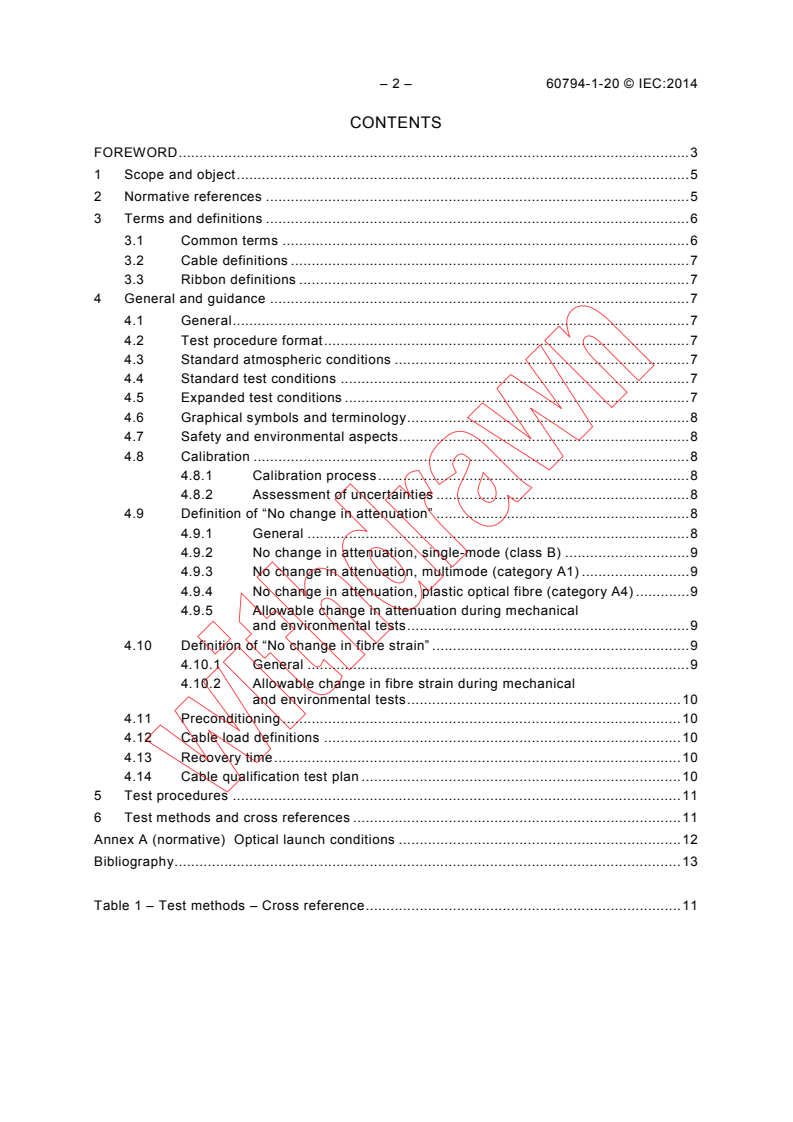
CONTENTS
FOREWORD . 3
1 Scope and object . 5
2 Normative references . 5
3 Terms and definitions . 6
3.1 Common terms . 6
3.2 Cable definitions . 7
3.3 Ribbon definitions . 7
4 General and guidance . 7
4.1 General . 7
4.2 Test procedure format . 7
4.3 Standard atmospheric conditions . 7
4.4 Standard test conditions . 7
4.5 Expanded test conditions . 7
4.6 Graphical symbols and terminology . 8
4.7 Safety and environmental aspects . 8
4.8 Calibration . 8
4.8.1 Calibration process . 8
4.8.2 Assessment of uncertainties . 8
4.9 Definition of “No change in attenuation” . 8
4.9.1 General . 8
4.9.2 No change in attenuation, single-mode (class B) . 9
4.9.3 No change in attenuation, multimode (category A1) . 9
4.9.4 No change in attenuation, plastic optical fibre (category A4) . 9
4.9.5 Allowable change in attenuation during mechanical
and environmental tests . 9
4.10 Definition of “No change in fibre strain” . 9
4.10.1 General . 9
4.10.2 Allowable change in fibre strain during mechanical
and environmental tests . 10
4.11 Preconditioning . 10
4.12 Cable load definitions . 10
4.13 Recovery time . 10
4.14 Cable qualification test plan . 10
5 Test procedures . 11
6 Test methods and cross references . 11
Annex A (normative) Optical launch conditions . 12
Bibliography . 13
Table 1 – Test methods – Cross reference . 11
60794-1-20 © IEC:2014 – 3 –
INTERNATIONAL ELECTROTECHNICAL COMMISSION
____________
OPTICAL FIBRE CABLES –
Part 1-20: Generic specification –
Basic optical cable test procedures –
General and definitions
FOREWORD
1) The International Electrotechnical Commission (IEC) is a worldwide organization for standardization comprising
all national electrotechnical committees (IEC National Committees). The object of IEC is to promote
international co-operation on all questions concerning standardization in the electrical and electronic fields. To
this end and in addition to other activities, IEC publishes International Standards, Technical Specifications,
Technical Reports, Publicly Available Specifications (PAS) and Guides (hereafter referred to as “IEC
Publication(s)”). Their preparation is entrusted to technical committees; any IEC National Committee interested
in the subject dealt with may participate in this preparatory work. International, governmental and non-
governmental organizations liaising with the IEC also participate in this preparation. IEC collaborates closely
with the International Organization for Standardization (ISO) in accordance with conditions determined by
agreement between the two organizations.
2) The formal decisions or agreements of IEC on technical matters express, as nearly as possible, an international
consensus of opinion on the relevant subjects since each technical committee has representation from all
interested IEC National Committees.
3) IEC Publications have the form of recommendations for international use and are accepted by IEC National
Committees in that sense. While all reasonable efforts are made to ensure that the technical content of IEC
Publications is accurate, IEC cannot be held responsible for the way in which they are used or for any
misinterpretation by any end user.
4) In order to promote international uniformity, IEC National Committees undertake to apply IEC Publications
transparently to the maximum extent possible in their national and regional publications. Any divergence
between any IEC Publication and the corresponding national or regional publication shall be clearly indicated in
the latter.
5) IEC itself does not provide any attestation of conformity. Independent certification bodies provide conformity
assessment services and, in some areas, access to IEC marks of conformity. IEC is not responsible for any
services carried out by independent certification bodies.
6) All users should ensure that they have the latest edition of this publication.
7) No liability shall attach to IEC or its directors, employees, servants or agents including individual experts and
members of its technical committees and IEC National Committees for any personal injury, property damage or
other damage of any nature whatsoever, whether direct or indirect, or for costs (including legal fees) and
expenses arising out of the publication, use of, or reliance upon, this IEC Publication or any other IEC
Publications.
8) Attention is drawn to the Normative references cited in this publication. Use of the referenced publications is
indispensable for the correct application of this publication.
9) Attention is drawn to the possibility that some of the elements of this IEC Publication may be the subject of
patent rights. IEC shall not be held responsible for identifying any or all such patent rights.
International Standard IEC 60794-1-20 has been prepared by subcommittee 86A: Fibres and
cables, of IEC technical committee 86: Fibre optics.
This first edition of IEC 60794-1-20 cancels and replaces the general and guidance part of the
second edition of IEC 60794-1-2 published in 2003. It constitutes a technical revision.
It has been decided to split the second edition of IEC 60794-1-2 into six new documents:
– IEC 60794-1-2:2003, Optical fibre cables – Part 1-2: Generic specification – Basic optical
cable test procedures (second edition)
– IEC 60794-1-2:2013, Optical fibre cables –Part 1-2: Generic specification – Cross
reference table for optical cable test procedures (third edition)
– IEC 60794-1-20, Optical fibre cables – Part 1-20: Generic specification – Basic optical
cable test procedures – General and definitions
– 4 – 60794-1-20 © IEC:2014
– IEC 60794-1-21, Optical fibre cables – Part 1-21: Generic specification – Basic optical
cable test procedures – Mechanical tests methods
– IEC 60794-1-22, Optical fibre cables – Part 1-22: Generic specification – Basic optical
cable test procedures – Environmental tests methods
– IEC 60794-1-23, Optical fibre cables – Part 1-23: Generic specification – Basic optical
cable test procedures – Cable elements tests methods
– IEC 60794-1-24, Optical fibre cables – Part 1-24: Generic specification – Basic optical
cable test procedures – Electrical tests methods
This standard is intended to be used in conjunction with IEC 60794-1-1: Optical fibre cables –
Part 1-1: Generic specification – General.
The text of this standard is based on the following documents:
CDV Report on voting
86A/1476/CDV 86A/1514/RVC
Full information on the voting for the approval of this standard can be found in the report on
voting indicated in the above table.
This publication has been drafted in accordance with the ISO/IEC Directives, Part 2.
A list of all the parts in the IEC 61754 series, under the general title Optical fibre cables, can
be found on the IEC website.
The committee has decided that the contents of this publication will remain unchanged until
the stability date indicated on the IEC web site under "http://webstore.iec.ch" in the data
related to the specific publication. At this date, the publication will be
• reconfirmed,
• withdrawn,
• replaced by a revised edition, or
• amended.
IMPORTANT – The 'colour inside' logo on the cover page of this publication indicates
that it contains colours which are considered to be useful for the correct
understanding of its contents. Users should therefore print this document using a
colour printer.
60794-1-20 © IEC:2014 – 5 –
OPTICAL FIBRE CABLES –
Part 1-20: Generic specification –
Basic optical cable test procedures –
General and definitions
1 Scope and object
This part of IEC 60794 applies to optical fibre cables for use with telecommunication
equipment and devices employing similar techniques, and to cables having a combination of
both optical fibres and electrical conductors.
The object of this standard is to define test procedures to be used in establishing uniform
requirements for the geometrical, transmission, material, mechanical, ageing (environmental
exposure) and climatic properties of optical fibre cables, and electrical requirements where
appropriate.
Throughout this standard the wording “optical cable” may also include optical fibre units,
microduct fibre units, etc.
2 Normative references
The following documents, in whole or in part, are normatively referenced in this document and
are indispensable for its application. For dated references, only the edition cited applies. For
undated references, the latest edition of the referenced document (including any
amendments) applies.
IEC 60793-1 (all parts 1), Optical fibres – Measurement methods and test procedures
IEC 60793-1-40, Optical fibres – Measurement methods and test procedures – Attenuation
IEC 60793-1-41, Optical fibres – Part 1-41: Measurement methods and test procedures –
Bandwidth
IEC 60793-1-46, Optical fibres: Measurement methods and test procedures – Monitoring of
changes in optical transmittance
IEC 60793-1-48, Optical fibres – Part 1-48: Measurement methods and test procedures –
Polarization mode dispersion
IEC 60793-2 (all parts), Optical fibres
IEC 60793-2-10, Optical fibres – Part 2-10: Product specifications – Sectional specification for
category A1 multimode fibres
IEC 60793-2-40, Optical fibres – Part 2-10: Product specifications – Sectional specification for
category A4 multimode fibres
IEC 60793-2-50, Optical fibres – Part 2-10: Product specifications – Sectional specification for
class B single-mode fibres
IEC 60794-1 (all parts), Optical fibre cables – Part 1: Generic specification
– 6 – 60794-1-20 © IEC:2014
IEC 60794-1-1, Optical fibre cables – Part 1-1: Generic specification – General
IEC 60794-1-2:2013, Optical fibre cables –Part 1-2: Generic specification – Cross reference
table for optical cable test procedures (third edition)
IEC 60794-2 (all parts), Optical fibre cables – Part 2: Indoor cables
IEC 60794-3 (all parts), Optical fibre cables – Part 3: Outdoor cables
IEC 60794-3-20, Optical fibre cables – Part 3-20: Outdoor cables – Family specification for
self-supporting aerial telecommunication cables
IEC 60794-4, Optical fibre cables:– Part 4: Aerial optical cables along electrical power lines
IEC 60794-5, Optical fibre cables – Part 5: Sectional specification – Microduct cabling for
installation by blowing
IEC 61931, Fibre optic – Terminology
IEC/TR 62362, Selection of optical fibre cable specifications relative to mechanical, ingress,
climatic or electromagnetic characteristics – Guidance
ISO/IEC 98-3, Uncertainty of measurement – Part 3: Guide to the expression of uncertainty in
measurement (GUM:1995)
ISO/IEC Guide 99, International vocabulary of metrology – Basic and general concepts and
associated terms (VIM)
ISO/IEC 11801, Information technology – Generic cabling for customer premises
3 Terms and definitions
For the purposes of this document, the terms and definitions in the IEC 60793-2 series,as well
as the following, apply.
3.1 Common terms
3.1.1
multimode fibre
MMF
fibre conforming to IEC 60793-2-10
3.1.2
single-mode fibre
SMF
fibre conforming to IEC 60793-2-50
3.1.3
plastic optical fibre
POF
fibre conforming to IEC 60793-2-40
3.1.4
low water peak
LWP
fibre – single-mode fibre conforming to IEC 60793-2-50, category B1.3
60794-1-20 © IEC:2014 – 7 –
3.1.5
bend-insensitive fibre
single-mode fibre conforming to IEC 60793-2-50, category B6
3.1.6
laser optimized multimode fibre
multimode fibre conforming to IEC 60793-2-10, implementations A1a.2 or A1a.3
3.2 Cable definitions
For the purposes of this document, the terms and definitions in IEC 60794-1-1, IEC 60794-2,
IEC 60794-3, IEC 60794-4 and IEC 60794-5 apply.
3.3 Ribbon definition
3.3.1
ribbon
several optical fibres, typically 4, 8 and 12, joined together in a flat formation.
4 General and guidance
4.1 General
Not all tests are required for a cable design. It depends on the application and the detail
specification.
4.2 Test procedure format
The standard order of each test method is in general as follows. Additional clauses may be
inserted, whilst maintaining this general order:
– object;
– sample;
– apparatus;
– procedure;
– requirement;
– details to be specified;
– details to be reported.
4.3 Standard atmospheric conditions
Two sets of allowable ambient conditions for cable testing are defined for use in testing in this
specification:
4.4 Standard test conditions
– temperature +23 °C ± 5 °C;
– pressure site ambient;
– relative humidity 20 % to 70 %.
4.5 Expanded test conditions
– temperature + 25 °C ± 15 °C;
– pressure site ambient;
– relative humidity 5 % to 95 %.
– 8 – 60794-1-20 © IEC:2014
The standard test conditions shall be used as the default ambient criteria when performing
tests. The expanded test conditions are allowed for ambient criteria when performing tests.
NOTE A tightly controlled temperature range is considered unnecessary for most cable tests.
Consideration should be given to the effects of temperature differences and variations on
electronic and optical test equipment that may be used in performing the tests. It may be
necessary to maintain such equipment at the controlled test conditions by appropriate means.
4.6 Graphical symbols and terminology
See IEC 61931.
4.7 Safety and environmental aspects
All applicable safety and environmental regulations shall be met. Where compliance to
ISO/IEC 11801 is required, the information described in IEC/TR 62362 shall be taken into
account.
4.8 Calibration
4.8.1 Calibration process
Ensure the apparatus is calibrated and adjusted in accordance with the manufacturer's
instructions before use in order to minimize measurement uncertainty.
Record relevant information of the calibration process, such as the calibrated value and
uncertainty of the reference material or test equipment used. ISO/IEC Guide 99-12 refers.
4.8.2 Assessment of uncertainties
Measurement uncertainty may be defined as the range within which the true value of a
measured quantity (the measured) is estimated to lie, within a given likelihood (or confidence
level). The measurement uncertainty normally comprises several components, some of which
may be estimated using statistical techniques (known as type A uncertainties) whilst others
may be estimated on the basis of experience or other information (known as type B
uncertainties). Components of uncertainty, or variance, are additive, and a confidence interval
may be calculated for the measurements based on the sum of the variance components.
A typical build-up of uncertainty may include the following sources of uncertainty:
– calibration uncertainty of reference materials or equipment used – normally stated on the
calibration certificates of the standards;
– transfer uncertainty – estimated changes in the certified values of reference materials or
equipment since they were calibrated;
– operational uncertainty – estimated effects of environmental conditions, such as temper-
ature and humidity.
– statistical (random) uncertainty in the measurement of the specimen and the calibration
standard – due to, for example, electrical noise, vibration, data quantization, etc.
4.9 Definition of “No change in attenuation”
4.9.1 General
For some of the parameters specified in this standard, the objective is no change in
attenuation.
___________
See ISO/IEC Guide 98-3.
60794-1-20 © IEC:2014 – 9 –
These parameters may be affected by measurement uncertainty arising from measurement
errors or calibration errors due to a lack of suitable reference standards. Acceptance criteria
shall be interpreted with respect to this consideration.
4.9.2 No change in attenuation, single-mode (class B)
The total uncertainty of measurement for this standard shall be ≤ ± 0,05 dB for attenuation or
± 0,05 dB/km for attenuation coefficient. Any measured value within this range shall be
considered as “no change in attenuation”.
The requirement for these parameters is indicated as “no change (≤ ± 0,05 dB or
≤ ± 0,05 dB/km)”.
By agreement between customer and supplier, minor deviation from this limit may be
accepted at some low frequency, e.g. less than 10 %. However, for mechanical tests no
deviation in excess of 0,15 dB shall be accepted. For environmental tests, no deviation in
excess of 0,10 dB/km shall be accepted.
4.9.3 No change in attenuation, multimode (category A1)
The total uncertainty of measurement for this standard shall be ≤ ± 0,2 dB for attenuation or
≤ ± 0,2 dB/km for attenuation coefficient.
Any measured value within this range shall be considered as “no change in attenuation”.
The requirement for these parameters is indicated as “no change
(≤ ± 0,2 dB or ≤ ± 0,2 dB/km)”.
By agreement between customer and supplier, minor deviation from this limit may be
accepted at some low frequency, e.g. less than 10 %. However for mechanical tests no
deviation in excess of 0,5 dB shall be accepted. For environmental tests no deviation in
excess of 0,5 dB/km shall be accepted.
4.9.4 No change in attenuation, plastic optical fibre (category A4)
The total uncertainty of measurement for this standard shall be ≤ ± 2 % for attenuation.
Any measured value within this range shall be considered as “no change in attenuation”.
The requirement for these parameters is indicated as “No change (≤ + 2 %)”.
For mechanical tests no deviation excess of 2 % shall be allowed.
For environmental tests no change, as defined in the relevant specification.
4.9.5 Allowable change in attenuation during mechanical and environmental tests
Depending on fibre type, single-mode or multimode, cable design and application the
allowable change criteria might differ.
4.10 Definition of “No change in fibre strain”
4.10.1 General
For some of the parameters specified in this standard, the objective is no change in strain.
– 10 – 60794-1-20 © IEC:2014
These parameters may be affected by measurement uncertainty arising from measurement
errors or calibration errors due to a lack of suitable reference standards. Acceptance criteria
shall be interpreted with respect to this consideration.
The total uncertainty of measurement for this standard shall be ± 0,05 % (this value to be
checked) strain.
Any measured value within this range shall be considered as “no change in strain”.
4.10.2 Allowable change in fibre strain during mechanical and environmental tests
Unless otherwise specified in the detail specification, these values are as follows:
– 20 % of proof strain for long-term loads;
– 60 % of proof strain for short term loads.
4.11 Preconditioning
Most tests are performed at ambient conditions or begin at ambient conditions, per 4.3. The
intent is that the preconditioning achieve thermal stability. Unless otherwise specified,
precondition samples at ambient conditions for a minimum of 12 h prior to the test.
4.12 Cable load definitions
Long-term load: T A load which, for the purposes of the tests herein, represents a load
L
that a cable may be expected to experience over long periods of time,
including its entire lifetime. This is the rated maximum load for which a
cable is subject in long term tests.
Short-term load: T Often called the rated installation load. This is the maximum load for
S
which a cable is rated, i.e. the load that represents the maximum
specified load for the cable.
The cable load definitions for aerial cables differ. See IEC 60794-3-20 and IEC 60794-4.
4.13 Recovery time
Recovery time, typically 5 min, is the time allowed for any of the tests before performing the
after test measurement.
4.14 Cable qualification test plan
A minimum of one cable per cable design family shall be tested. When testing different sheath
configurations within a design family, only the tests that are affected by the design change
need to be performed.
In case of changes in cable design, only tests that are affected by the design change need to
be performed.
A minimum of 10 fibres from each cable sample shall be measured for attenuation change.
Cables with fewer than 10 fibres shall have all fibres tested.
The cable being tested may contain working fibres or may contain working and dummy/scrap
fibres. The tested fibres shall be dispersed throughout the working units. For cables with
multiple tube designs, non-working tubes or filler rods may be deployed, but they should be
used in such a manner that they do not affect the performance of the test. The manufacturer
shall position the working units within a cable such that they will be subjected to the full force
of the test.
60794-1-20 © IEC:2014 – 11 –
Ribbon cables shall contain working fibres in the first, last, and middle ribbon position. The
working fibre being tested shall be located at both edges and in the middle of each of these
ribbons.
For stranded loose tube cable design, a single layer and dual layer cable shall be tested.
Single layer designs shall have at least two tubes opposite of each other. Dual layer designs
shall have four units positioned 90° apart. A minimum of two units shall be positioned in each
layer. Cable length shall be long enough to obtain reasonable results for the optical test
method being used.
In mechanical tests, the cable under test may be strung through several test apparatus in
succession.
5 Test procedures
The following measurement procedures describe tests for optical cables and cable elements.
Not all tests are required for all applications. Several numbers in the test numbering sequence
were missing in IEC 60794-1-2:2003 (second edition). These tests were proposed in the
development of that standard, but were dropped before the first edition. Other test numbers
are listed but declared to be not applicable in this or previous editions. In order to avoid
confusion, all such numbers are listed in order in this standard with notes on their disposition.
6 Test methods and cross references
The test methods are described in the following standards as shown in Table 1.
The latest (third) edition (September 2013) of IEC 60794-1-2 provides a method of existing
references to the test methods to be directed to this specification and those of Table 1.
References to the test methods may be made via IEC 60794-1-2 or directly to the standards
of Table 1.
Table 1 – Test methods – Cross reference
IEC standard Test method Tests
IEC 60794-1-21 E-series Mechanical
IEC 60794-1-22 F-series Environmental
IEC 60794-1-23 G-series Cable elements
IEC 60794-1-24 H-series Electrical
– 12 – 60794-1-20 © IEC:2014
Annex A
(normative)
Optical launch conditions
Optical measurements shall follow conditions as described in the IEC 60793-1 series, in
particular IEC 60793-1-40 for attenuation and IEC 60793-1-46 for monitoring changes in
optical transmittance by transmitted power or backscattering. When applicable in the detail
specification, IEC 60793-1-41 for bandwidth and IEC 60793-1-48 for PMD shall also be
followed.
60794-1-20 © IEC:2014 – 13 –
Bibliography
IEC 60068-2-14, Environmental testing – Part 2-14: Tests – Tetst N: Change of temperature
IEC 60227-2, Polyvinyl chloride insulated cables of rated voltages up to and including
450/750 V – Part 2: Test methods
IEC 60544 (all parts), Electrical insulating materials – Determination of the effects of ionizing
radiation
IEC 60793-1-22, Optical fibres – Part 1-22: Measurement methods and test procedures –
Length measurement
IEC 60793-1-32, Optical fibres – Part 1-32: Measurement methods and test procedures –
Coating strippability
IEC 60793-1-54, Optical fibres – Part 1-54: Measurement methods and test procedures –
Gamma irradiation
IEC 60794-1-2:2003, Optical fibre cables – Part 1-2: Generic specification – Basic optical
cable test procedures
IEC/TR 62362, Selection of optical fibre cable specifications relative to mechanical, ingress,
climatic or electromagnetic characteristics – Guidance
_____________
– 14 – 60794-1-20 © IEC:2014
SOMMAIRE
AVANT-PROPOS . 15
1 Domaine d'application et objet . 17
2 Références normatives . 17
3 Termes et définitions . 18
3.1 Termes communs. 18
3.2 Définitions des câbles . 19
3.3 Définitions des rubans . 19
4 Généralités et lignes directrices . 19
4.1 Généralités . 19
4.2 Format de la procédure d’essai. . 19
4.3 Conditions atmosphériques normales . 20
4.4 Conditions d’essai normales . 20
4.5 Conditions d’essai élargies . 20
4.6 Symboles graphiques et terminologie . 20
4.7 Sécurité et aspects liés à l'environnement. 20
4.8 Étalonnage . 20
4.8.1 Processus d'étalonnage . 20
4.8.2 Évaluation des incertitudes . 20
4.9 Définition de l'absence de variation d'affaiblissement . 21
4.9.1 Généralités . 21
4.9.2 Absence de variation de l'affaiblissement, unimodale
(classe B) . 21
4.9.3 Absence de variation de l’affaiblissement, multimodale
(catégorie A1) . 21
4.9.4 Absence de variation de l'affaiblissement, fibre optique
plastique (catégorie A4) . 22
4.9.5 Modification admissible de l'affaiblissement au cours des
essais mécaniques et d'environnement . 22
4.10 Définition de «l'absence de variation de la contrainte sur la fibre» . 22
4.10.1 Généralités . 22
4.10.2 Modification admissible de la contrainte sur la fibre au cours
des essais mécaniques et d'environnement . 22
4.11 Préconditionnement . 22
4.12 Définitions des charges sur les câbles . 22
4.13 Temps de rétablissement . 23
4.14 Plan d'essai de la qualification des câbles . 23
5 Procédure d’essai . 23
6 Méthodes d’essai et références croisées . 24
Annexe A (normative) Conditions d’injection optique . 25
Bibliographie . 26
Tableau 1 – Méthodes d'essais – Références croisées . 24
60794-1-20 © IEC:2014 – 15 –
COMMISSION ÉLECTROTECHNIQUE INTERNATIONALE
____________
CÂBLES À FIBRES OPTIQUES –
Partie 1-20: Spécification générique –
Procédures fondamentales d’essais des câbles optiques –
Généralités et définitions
AVANT-PROPOS
1) La Commission Electrotechnique Internationale (IEC) est une organisation mondiale de normalisation
composée de l'ensemble des comités électrotechniques nationaux (Comités nationaux de l’IEC). L’IEC a pour
objet de favoriser la coopération internationale pour toutes les questions de normalisation dans les domaines
de l'électricité et de l'électronique. A cet effet, l’IEC – entre autres activités – publie des Normes
internationales, des Spécifications techniques, des Rapports techniques, des Spécifications accessibles au
public (PAS) et des Guides (ci-après dénommés "Publication(s) de l’IEC"). Leur élaboration est confiée à des
comités d'études, aux travaux desquels tout Comité national intéressé par le sujet traité peut participer. Les
organisations internationales, gouvernementales et non gouvernementales, en liaison avec l’IEC, participent
également aux travaux. L’IEC collabore étroitement avec l'Organisation Internationale de Normalisation (ISO),
selon des conditions fixées par accord entre les deux organisations.
2) Les décisions ou accords officiels de l’IEC concernant les questions techniques représentent, dans la mesure
du possible, un accord international sur les sujets étudiés, étant donné que les Comités nationaux de l’IEC
intéressés sont représentés dans chaque comité d’études.
3) Les Publications de l’IEC se présentent sous la forme de recommandations internationales et sont agréées
comme telles par les Comités nationaux de l’IEC. Tous les efforts raisonnables sont entrepris afin que l’IEC
s'assure de l'exactitude du contenu technique de ses publications; l’IEC ne peut pas être tenue responsable de
l'éventuelle mauvaise utilisation ou interprétation qui en est faite par un quelconque utilisateur final.
4) Dans le but d'encourager l'uniformité internationale, les Comités nationaux de l’IEC s'engagent, dans toute la
mesure possible, à appliquer de façon transparente les Publications de l’IEC dans leurs publications nationales
et régionales. Toutes divergences entre toutes Publications de l’IEC et toutes publications nationales ou
régionales correspondantes doivent être indiquées en termes clairs dans ces dernières.
5) L’IEC elle-même ne fournit aucune attestation de conformité. Des organismes de certification indépendants
fournissent des services d'évaluation de conformité et, dans certains secteurs, accèdent aux marques de
conformité de l’IEC. L’IEC n'est responsable d'aucun des services effectués par les organismes de certification
indépendants.
6) Tous les utilisateurs doivent s'assurer qu'ils sont en possession de la dernière édition de cette publication.
7) Aucune responsabilité ne doit être imputée à l’IEC, à ses administrateurs, employés, auxiliaires ou
mandataires, y compris ses experts particuliers et les membres de ses comités d'études et des Comités
nationaux de l’IEC, pour tout préjudice causé en cas de dommages corporels et matériels, ou de tout autre
dommage de quelque nature que ce soit, directe ou indirecte, ou pour supporter les coûts (y compris les frais
de justice) et les dépenses découlant de la publication ou de l'utilisation de cette Publication de l’IEC ou de
toute autre Publication de l’IEC, ou au crédit qui lui est accordé.
8) L'attention est attirée sur les références normatives citées dans cette publication. L'utilisation de publications
référencées est obligatoire pour une application correcte de la présente publication.
9) L’attention est attirée sur le fait que certains des éléments de la présente Publication de l’IEC peuvent faire
l’objet de droits de brevet. L’IEC ne saurait être tenue pour responsable de ne pas avoir identifié de tels droits
de brevets et de ne pas avoir signalé leur existence.
La Norme Internationale IEC 60794-1-20 a été établie par le sous-comité 86A: Fibres et
câbles, du comité d'études 86 de l'IEC: Fibres optiques.
Cette première édition de l'IEC 60794-1-20 annule et remplace la partie généralités et guide
de la seconde édition de l'IEC 60794-1-2 publiée en 2003. Cette édition constitue une révision
technique.
Il a été décidé de diviser la seconde édition de l'IEC 60794-1-2 en six nouveaux documents:
– IEC 60794-1-2:2003, Câbles à fibres optiques – Partie 1-2: Spécification générique –
Procédures fondamentales d’essais des câbles optiques
– 16 – 60794-1-20 © IEC:2014
– IEC 60794-1-2:2013, Optical fibre cables – Part 1-2: Generic specification – Cross
reference table for optical cable test procedures (third edition)
(disponible en anglais seulement)
– IEC 60794-1-20, Câbles à fibres optiques – Partie 1-20: Spécification générique –
Procédures fondamentales d’essais des câbles optiques – Généralités et définitions
– IEC 60794-1-21, Câbles à fibres optiques – Partie 1-21: Spécification générique –
Procédures fondamentales d’essais des câbles optiques – Méthodes d'essai mécaniques
– IEC 60794-1-22, Câbles à fibres optiques – Partie 1-22: Spécification générique –
Procédures fondamentales d’essais des câbles optiques – Méthodes d'essai
d'environnement
– IEC 60794-1-23, Câbles à fibres optiques – Partie 1-23: Spécification générique –
Procédures fondamentales d’essais des câbles optiques – Méthodes d'essai des éléments
de câble
– IEC 60794-1-24, Câbles à fibres optiques – Partie 1-24: Spécification générique –
Procédures fondamentales d’essais des câbles optiques – Méthodes d'essai électriques
La présente norme est destinée à être lue conjointement à l'
...