

IEC 61400-25-2:2015
(Main)Wind turbines - Part 25-2: Communications for monitoring and control of wind power plants - Information models
General Information
- Abstract
IEC 61400-25-2:2015 specifies the information model of devices and functions related to wind power plant applications. In particular, it specifies the compatible logical node names, and data names for communication between wind power plant components. This includes the relationship between logical devices, logical nodes and data. The names defined in the IEC 61400-25 series are used to build the hierarchical object references applied for communicating with components in wind power plants. Main changes with respect to the previous edition consist of:
- harmonization with newer editions of IEC 61850 standards;
- reduction of overlap between standards and simplification by increased referencing,
- extension of data objects for operation of smart grids,
- extended and enhanced semantics for existing data objects, etc.
- Status
- Published
- Publication Date
- 29-Jun-2015
- Technical Committee
- TC 88 - Wind energy generation systems
- Drafting Committee
- JWG 25 - TC 88/JWG 25
- Current Stage
- PPUB - Publication issued
- Start Date
- 30-Jun-2015
- Completion Date
- 15-Jul-2015
Overview
IEC 61400-25-2:2015 is an international standard published by the International Electrotechnical Commission (IEC) that defines the information models for communications in wind power plants. Specifically, it details the naming conventions and data structures for devices and functions involved in the monitoring and control of wind turbines and associated plant components. This standard is a crucial part of the IEC 61400-25 series aimed at ensuring interoperability and effective communication in wind power plant systems.
The 2015 edition introduces improvements such as:
- Harmonization with newer editions of IEC 61850 standards,
- Reduction of overlapping standards and simplification through referencing,
- Extensions for smart grid operation data objects,
- Enhanced semantics for existing data objects.
By providing a comprehensive information model, IEC 61400-25-2 supports reliable and standardized data exchange for wind power plant automation and monitoring systems.
Key Topics
Logical Node Classes and Data Naming
The standard specifies detailed logical node classes (LN) that represent components and functions within a wind power plant, such as:
- Wind turbine general information (WTUR),
- Rotor, transmission, generator, and converter information,
- Wind power plant general data (WPPD),
- Meteorological data (WMET),
- Alarm and availability information.
These logical nodes are used to build hierarchical object references, enabling precise and standardized communications between plant components and control systems.
Common Data Classes (CDC)
IEC 61400-25-2 defines common data classes, including:
- Setpoint values,
- Status values,
- Alarms and commands,
- Event counting,
- Timing and state data.
These classes ensure consistent data representation across devices and facilitate data interoperability.
Extensions for Smart Grids
The 2015 update expands data objects to support:
- Operation of smart grids integrating wind power,
- Advanced control functions like active and reactive power control,
- Enhanced semantics for more precise data interpretation.
Integration with IEC 61850
This standard is harmonized with IEC 61850, a key international standard for power utility automation, enabling wind power plants to integrate seamlessly into broader electrical network management systems.
Applications
IEC 61400-25-2:2015 is essential for:
- Wind power plant manufacturers: To design communication-compliant devices and components with clear data structures for monitoring and control.
- System integrators: To implement interoperable automation and SCADA systems in wind farms, reducing integration complexity.
- Grid operators: To facilitate real-time monitoring, management, and control of wind power generation assets, improving grid stability.
- Smart grid developers: To incorporate wind power plants intelligently into distributed energy resource management frameworks.
- Maintenance teams: To leverage unified alarm and status data models for effective diagnostics and predictive maintenance.
The standard improves communication reliability, reduces implementation costs, and supports future-proof wind power plant architectures.
Related Standards
- IEC 61400-25-1: General communication requirements for monitoring and control of wind power plants.
- IEC 61400-25-3: Information exchange models and service definitions.
- IEC 61400-25-4: Mapping to communication profile.
- IEC 61850 series: Communication networks and systems in substations, providing the base for harmonization.
- IEC 61400-12: Wind turbine power performance measurements for validating wind plant efficiency.
Using IEC 61400-25-2 in conjunction with these standards offers a comprehensive framework for wind power plant communication and control, enabling interoperability and standardization across the renewable energy industry.
Keywords: IEC 61400-25-2, wind power plant communication, wind turbine monitoring, logical node classes, common data classes, IEC 61850 harmonization, smart grid integration, wind energy standardization, wind turbine control systems, wind power plant data models.
Relations
- Effective Date
- 05-Sep-2023
Get Certified
Connect with accredited certification bodies for this standard

DNV
DNV is an independent assurance and risk management provider.

Lloyd's Register
Lloyd's Register is a global professional services organisation specialising in engineering and technology.
DNV Energy Systems
Energy and renewable energy certification.
Sponsored listings
Frequently Asked Questions
IEC 61400-25-2:2015 is a standard published by the International Electrotechnical Commission (IEC). Its full title is "Wind turbines - Part 25-2: Communications for monitoring and control of wind power plants - Information models". This standard covers: IEC 61400-25-2:2015 specifies the information model of devices and functions related to wind power plant applications. In particular, it specifies the compatible logical node names, and data names for communication between wind power plant components. This includes the relationship between logical devices, logical nodes and data. The names defined in the IEC 61400-25 series are used to build the hierarchical object references applied for communicating with components in wind power plants. Main changes with respect to the previous edition consist of: - harmonization with newer editions of IEC 61850 standards; - reduction of overlap between standards and simplification by increased referencing, - extension of data objects for operation of smart grids, - extended and enhanced semantics for existing data objects, etc.
IEC 61400-25-2:2015 specifies the information model of devices and functions related to wind power plant applications. In particular, it specifies the compatible logical node names, and data names for communication between wind power plant components. This includes the relationship between logical devices, logical nodes and data. The names defined in the IEC 61400-25 series are used to build the hierarchical object references applied for communicating with components in wind power plants. Main changes with respect to the previous edition consist of: - harmonization with newer editions of IEC 61850 standards; - reduction of overlap between standards and simplification by increased referencing, - extension of data objects for operation of smart grids, - extended and enhanced semantics for existing data objects, etc.
IEC 61400-25-2:2015 is classified under the following ICS (International Classification for Standards) categories: 27.180 - Wind turbine energy systems. The ICS classification helps identify the subject area and facilitates finding related standards.
IEC 61400-25-2:2015 has the following relationships with other standards: It is inter standard links to IEC 61400-25-2:2006. Understanding these relationships helps ensure you are using the most current and applicable version of the standard.
IEC 61400-25-2:2015 is available in PDF format for immediate download after purchase. The document can be added to your cart and obtained through the secure checkout process. Digital delivery ensures instant access to the complete standard document.
Standards Content (Sample)
IEC 61400-25-2 ®
Edition 2.0 2015-06
INTERNATIONAL
STANDARD
NORME
INTERNATIONALE
colour
inside
Wind turbines –
Part 25-2: Communications for monitoring and control of wind power plants –
Information models
Eoliennes –
Partie 25-2: Communications pour la surveillance et la commande des centrales
éoliennes – Modèles d’information
All rights reserved. Unless otherwise specified, no part of this publication may be reproduced or utilized in any form
or by any means, electronic or mechanical, including photocopying and microfilm, without permission in writing from
either IEC or IEC's member National Committee in the country of the requester. If you have any questions about IEC
copyright or have an enquiry about obtaining additional rights to this publication, please contact the address below or
your local IEC member National Committee for further information.
Droits de reproduction réservés. Sauf indication contraire, aucune partie de cette publication ne peut être reproduite
ni utilisée sous quelque forme que ce soit et par aucun procédé, électronique ou mécanique, y compris la photocopie
et les microfilms, sans l'accord écrit de l'IEC ou du Comité national de l'IEC du pays du demandeur. Si vous avez des
questions sur le copyright de l'IEC ou si vous désirez obtenir des droits supplémentaires sur cette publication, utilisez
les coordonnées ci-après ou contactez le Comité national de l'IEC de votre pays de résidence.
IEC Central Office Tel.: +41 22 919 02 11
3, rue de Varembé Fax: +41 22 919 03 00
CH-1211 Geneva 20 info@iec.ch
Switzerland www.iec.ch
About the IEC
The International Electrotechnical Commission (IEC) is the leading global organization that prepares and publishes
International Standards for all electrical, electronic and related technologies.
About IEC publications
The technical content of IEC publications is kept under constant review by the IEC. Please make sure that you have the
latest edition, a corrigenda or an amendment might have been published.
IEC Catalogue - webstore.iec.ch/catalogue Electropedia - www.electropedia.org
The stand-alone application for consulting the entire The world's leading online dictionary of electronic and
bibliographical information on IEC International Standards, electrical terms containing more than 30 000 terms and
Technical Specifications, Technical Reports and other definitions in English and French, with equivalent terms in 15
documents. Available for PC, Mac OS, Android Tablets and additional languages. Also known as the International
iPad. Electrotechnical Vocabulary (IEV) online.
IEC publications search - www.iec.ch/searchpub IEC Glossary - std.iec.ch/glossary
The advanced search enables to find IEC publications by a More than 60 000 electrotechnical terminology entries in
variety of criteria (reference number, text, technical English and French extracted from the Terms and Definitions
committee,…). It also gives information on projects, replaced clause of IEC publications issued since 2002. Some entries
and withdrawn publications. have been collected from earlier publications of IEC TC 37,
77, 86 and CISPR.
IEC Just Published - webstore.iec.ch/justpublished
Stay up to date on all new IEC publications. Just Published IEC Customer Service Centre - webstore.iec.ch/csc
details all new publications released. Available online and If you wish to give us your feedback on this publication or
also once a month by email. need further assistance, please contact the Customer Service
Centre: csc@iec.ch.
A propos de l'IEC
La Commission Electrotechnique Internationale (IEC) est la première organisation mondiale qui élabore et publie des
Normes internationales pour tout ce qui a trait à l'électricité, à l'électronique et aux technologies apparentées.
A propos des publications IEC
Le contenu technique des publications IEC est constamment revu. Veuillez vous assurer que vous possédez l’édition la
plus récente, un corrigendum ou amendement peut avoir été publié.
Catalogue IEC - webstore.iec.ch/catalogue Electropedia - www.electropedia.org
Application autonome pour consulter tous les renseignements
Le premier dictionnaire en ligne de termes électroniques et
bibliographiques sur les Normes internationales,
électriques. Il contient plus de 30 000 termes et définitions en
Spécifications techniques, Rapports techniques et autres
anglais et en français, ainsi que les termes équivalents dans
documents de l'IEC. Disponible pour PC, Mac OS, tablettes
15 langues additionnelles. Egalement appelé Vocabulaire
Android et iPad.
Electrotechnique International (IEV) en ligne.
Recherche de publications IEC - www.iec.ch/searchpub
Glossaire IEC - std.iec.ch/glossary
La recherche avancée permet de trouver des publications IEC Plus de 60 000 entrées terminologiques électrotechniques, en
en utilisant différents critères (numéro de référence, texte, anglais et en français, extraites des articles Termes et
comité d’études,…). Elle donne aussi des informations sur les Définitions des publications IEC parues depuis 2002. Plus
projets et les publications remplacées ou retirées. certaines entrées antérieures extraites des publications des
CE 37, 77, 86 et CISPR de l'IEC.
IEC Just Published - webstore.iec.ch/justpublished
Service Clients - webstore.iec.ch/csc
Restez informé sur les nouvelles publications IEC. Just
Published détaille les nouvelles publications parues. Si vous désirez nous donner des commentaires sur cette
Disponible en ligne et aussi une fois par mois par email. publication ou si vous avez des questions contactez-nous:
csc@iec.ch.
IEC 61400-25-2 ®
Edition 2.0 2015-06
INTERNATIONAL
STANDARD
NORME
INTERNATIONALE
colour
inside
Wind turbines –
Part 25-2: Communications for monitoring and control of wind power plants –
Information models
Eoliennes –
Partie 25-2: Communications pour la surveillance et la commande des centrales
éoliennes – Modèles d’information
INTERNATIONAL
ELECTROTECHNICAL
COMMISSION
COMMISSION
ELECTROTECHNIQUE
INTERNATIONALE
ICS 27.180 ISBN 978-2-8322-2726-8
– 2 – IEC 61400-25-2:2015 © IEC 2015
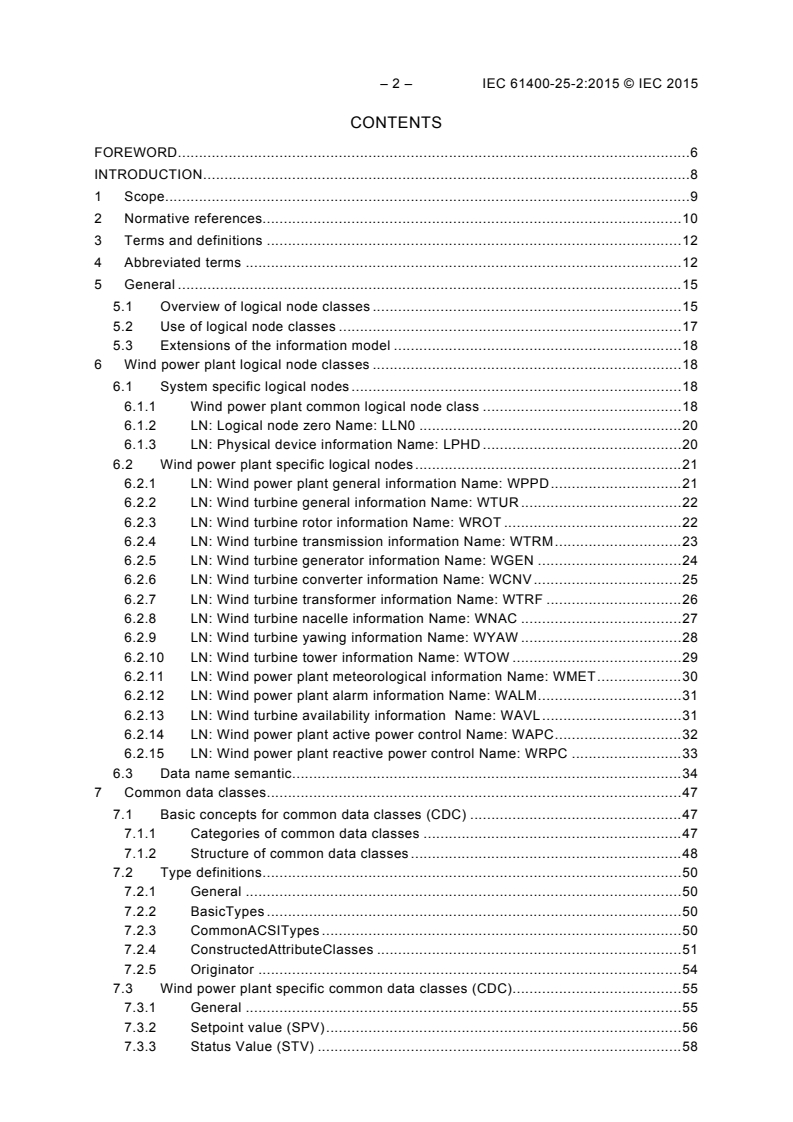
CONTENTS
FOREWORD . 6
INTRODUCTION . 8
1 Scope . 9
2 Normative references. 10
3 Terms and definitions . 12
4 Abbreviated terms . 12
5 General . 15
5.1 Overview of logical node classes . 15
5.2 Use of logical node classes . 17
5.3 Extensions of the information model . 18
6 Wind power plant logical node classes . 18
6.1 System specific logical nodes . 18
6.1.1 Wind power plant common logical node class . 18
6.1.2 LN: Logical node zero Name: LLN0 . 20
6.1.3 LN: Physical device information Name: LPHD . 20
6.2 Wind power plant specific logical nodes . 21
6.2.1 LN: Wind power plant general information Name: WPPD . 21
6.2.2 LN: Wind turbine general information Name: WTUR . 22
6.2.3 LN: Wind turbine rotor information Name: WROT . 22
6.2.4 LN: Wind turbine transmission information Name: WTRM . 23
6.2.5 LN: Wind turbine generator information Name: WGEN . 24
6.2.6 LN: Wind turbine converter information Name: WCNV . 25
6.2.7 LN: Wind turbine transformer information Name: WTRF . 26
6.2.8 LN: Wind turbine nacelle information Name: WNAC . 27
6.2.9 LN: Wind turbine yawing information Name: WYAW . 28
6.2.10 LN: Wind turbine tower information Name: WTOW . 29
6.2.11 LN: Wind power plant meteorological information Name: WMET . 30
6.2.12 LN: Wind power plant alarm information Name: WALM . 31
6.2.13 LN: Wind turbine availability information Name: WAVL . 31
6.2.14 LN: Wind power plant active power control Name: WAPC . 32
6.2.15 LN: Wind power plant reactive power control Name: WRPC . 33
6.3 Data name semantic . 34
7 Common data classes . 47
7.1 Basic concepts for common data classes (CDC) . 47
7.1.1 Categories of common data classes . 47
7.1.2 Structure of common data classes . 48
7.2 Type definitions . 50
7.2.1 General . 50
7.2.2 BasicTypes . 50
7.2.3 CommonACSITypes . 50
7.2.4 ConstructedAttributeClasses . 51
7.2.5 Originator . 54
7.3 Wind power plant specific common data classes (CDC). 55
7.3.1 General . 55
7.3.2 Setpoint value (SPV) . 56
7.3.3 Status Value (STV) . 58
7.3.4 Alarm (ALM) . 58
7.3.5 Command (CMD) . 60
7.3.6 Event counting (CTE) . 61
7.3.7 State timing (TMS) . 63
7.3.8 Alarm Set Status (AST) . 65
7.4 Common data classes inherited from IEC 61850-7-3 . 65
7.4.1 CDCs from IEC 61850-7-3 (unchanged) . 65
7.4.2 CDCs from IEC 61850-7-3 (specialised) . 66
7.5 Common data class attribute semantics . 68
Annex A (informative) Information model for statistical data and historical statistical
data . 73
A.1 General . 73
A.2 Model for statistical and historical statistical data . 73
A.3 Logical node extension for statistical data . 76
A.3.1 Data for calculation method for analogue and statistical analogue
values . 76
A.3.2 Data name semantics . 76
A.4 Common data class for statistical data . 78
A.4.1 Object reference setting group common data class (ORG) . 78
Annex B (normative) Value range for units and multiplier . 80
Annex C (normative) Logical nodes for state log, analogue log and report information . 83
C.1 LN: Wind turbine state log information Name: WSLG . 83
C.2 LN: Wind turbine analogue log information Name: WALG . 85
C.3 LN: Wind turbine report information Name: WREP . 88
Annex D (informative) Wind power plant controller . 90
D.1 General . 90
D.2 Active power control functions . 91
D.3 Reactive power control functions . 94
Annex E (informative) List of mandatory logical nodes and data . 97
E.1 General . 97
Annex F (informative) Control authority management . 99
F.1 General . 99
F.2 Functional description . 99
F.2.1 Local mode . 99
F.2.2 Local mode at station level . 99
F.3 Logical Node representation . 100
F.3.1 Local mode . 100
F.3.2 Diagram description . 100
F.4 Local mode at station level . 101
F.4.1 General . 101
F.4.2 Diagram description . 101
Figure 1 – Conceptual communication model of the IEC 61400-25 series . 10
Figure 2 – Relationship of logical nodes . 15
Figure 3 – Use of instances of logical nodes . 18
Figure A.1 – Conceptual model of statistical and historical statistical data (1) . 74
Figure A.2 – Conceptual model of statistical and historical statistical data (2) . 75
– 4 – IEC 61400-25-2:2015 © IEC 2015
Figure D.1 – Conceptual structure of the wind power plant control functions . 90
Figure D.2 – Schematic illustration of the active power limitation control function . 91
Figure D.3 – Schematic illustration of the gradient power control function . 92
Figure D.4 – Schematic illustration of the delta power control function . 92
Figure D.5 – Schematic illustration of a combined control – including gradient, delta
and active power limitation control . 93
Figure D.6 – Schematic illustration of the apparent power control function . 93
Figure D.7 – Schematic illustration of the reactive power control function . 94
Figure D.8 – Schematic illustration of the power factor control function . 95
Figure D.9 – Schematic illustration of the voltage control function using reactive power
control . 96
Figure F.1 – Local mode . 100
Figure F.2 – Local mode at station level . 101
Table 1 – System specific logical nodes . 15
Table 2 – Wind power plant general logical nodes . 16
Table 3 – Logical nodes for modelling a wind turbine . 16
Table 4 – Logical nodes for modelling a non-turbine device . 17
Table 5 – Wind power plant common logical node class . 19
Table 6 – Logical node zero class . 20
Table 7 – Physical device information class . 21
Table 8 – LN: Wind power plant general information (WPPD) . 21
Table 9 – LN: Wind turbine general information (WTUR) . 22
Table 10 – LN: Wind turbine rotor information (WROT) . 23
Table 11 – LN: Wind turbine transmission information (WTRM) . 24
Table 12 – LN: Wind turbine generator information (WGEN). 25
Table 13 – LN: Wind turbine converter information (WCNV) . 26
Table 14 – LN: Wind turbine transformer information (WTRF) . 27
Table 15 – LN: Wind turbine nacelle information (WNAC) . 28
Table 16 – LN: Wind turbine yawing information (WYAW) . 29
Table 17 – LN: Wind turbine tower information (WTOW) . 29
Table 18 – LN: Wind power plant meteorological information (WMET) . 30
Table 19 – LN: Wind power plant alarm information (WALM) . 31
Table 20 – LN: Wind turbine availability (WAVL) . 32
Table 21 – LN: Wind power plant active power control information (WAPC) . 33
Table 22 – LN: Wind power plant reactive power control information (WRPC) . 34
Table 23 – Data name semantic . 35
Table 24 – General table structure of a common data class (CDC) . 48
Table 25 – Common data class attributes . 49
Table 26 – Conditions for the presence of an attribute . 49
Table 27 – Basic types . 50
Table 28 – AnalogueValue . 51
Table 29 – TimeStamp type . 52
Table 30 – TimeQuality definition . 53
Table 31 – TimeAccuracy . 53
Table 32 – Quality . 54
Table 33 – Unit . 54
Table 34 – Originator . 55
Table 35 – Values for orCat . 55
Table 36 – Wind power plant specific common data classes. 56
Table 37 – CDC: Setpoint value (SPV) . 57
Table 38 – CDC: Status Value (STV) . 58
Table 39 – CDC: Alarm (ALM) . 59
Table 40 – CDC: Command (CMD) . 61
Table 41 – CDC: Event counting (CTE) . 62
Table 42 – CDC: State timing (TMS) . 64
Table 43 – CDC: Alarm Set Status (AST) . 65
Table 44 – Specialized common data classes . 66
Table 45 – Wind power plant device name plate common data class specification
WDPL . 67
Table 46 – Common data class attribute semantic . 68
Table A.1 – Description of Data . 77
Table A.2 – Object reference setting group common data class specification. 78
Table B.1 – SI units: base units . 80
Table B.2 – SI units: derived units . 80
Table B.3 – SI units: extended units . 81
Table B.4 – SI units: industry specific units. 81
Table B.5 – Multiplier . 82
Table C.1 – LN: Wind turbine state log information (WSLG) . 84
Table C.2 – LN: Wind turbine analogue log information (WALG) . 86
Table C.3 – LN: Wind turbine report information (WREP) . 89
Table E.1 – Mandatory system specific logical nodes . 97
Table E.2 – Mandatory wind turbine specific logical nodes . 97
Table E.3 – Mandatory wind power plant specific common data classes (CDC) . 97
Table E.4 – Mandatory common data classes inherited from IEC 61850-7-3 . 97
Table E.5 – Mandatory common data classes inherited from IEC 61850-7-3 and
specialised . 98
– 6 – IEC 61400-25-2:2015 © IEC 2015
INTERNATIONAL ELECTROTECHNICAL COMMISSION
____________
WIND TURBINES –
Part 25-2: Communications for monitoring and
control of wind power plants – Information models
FOREWORD
1) The International Electrotechnical Commission (IEC) is a worldwide organization for standardization comprising
all national electrotechnical committees (IEC National Committees). The object of IEC is to promote
international co-operation on all questions concerning standardization in the electrical and electronic fields. To
this end and in addition to other activities, IEC publishes International Standards, Technical Specifications,
Technical Reports, Publicly Available Specifications (PAS) and Guides (hereafter referred to as “IEC
Publication(s)”). Their preparation is entrusted to technical committees; any IEC National Committee interested
in the subject dealt with may participate in this preparatory work. International, governmental and non-
governmental organizations liaising with the IEC also participate in this preparation. IEC collaborates closely
with the International Organization for Standardization (ISO) in accordance with conditions determined by
agreement between the two organizations.
2) The formal decisions or agreements of IEC on technical matters express, as nearly as possible, an international
consensus of opinion on the relevant subjects since each technical committee has representation from all
interested IEC National Committees.
3) IEC Publications have the form of recommendations for international use and are accepted by IEC National
Committees in that sense. While all reasonable efforts are made to ensure that the technical content of IEC
Publications is accurate, IEC cannot be held responsible for the way in which they are used or for any
misinterpretation by any end user.
4) In order to promote international uniformity, IEC National Committees undertake to apply IEC Publications
transparently to the maximum extent possible in their national and regional publications. Any divergence
between any IEC Publication and the corresponding national or regional publication shall be clearly indicated in
the latter.
5) IEC itself does not provide any attestation of conformity. Independent certification bodies provide conformity
assessment services and, in some areas, access to IEC marks of conformity. IEC is not responsible for any
services carried out by independent certification bodies.
6) All users should ensure that they have the latest edition of this publication.
7) No liability shall attach to IEC or its directors, employees, servants or agents including individual experts and
members of its technical committees and IEC National Committees for any personal injury, property damage or
other damage of any nature whatsoever, whether direct or indirect, or for costs (including legal fees) and
expenses arising out of the publication, use of, or reliance upon, this IEC Publication or any other IEC
Publications.
8) Attention is drawn to the Normative references cited in this publication. Use of the referenced publications is
indispensable for the correct application of this publication.
9) Attention is drawn to the possibility that some of the elements of this IEC Publication may be the subject of
patent rights. IEC shall not be held responsible for identifying any or all such patent rights.
International Standard IEC 61400-25-2 has been prepared by IEC technical committee 88:
Wind turbines.
The text of this standard is based on the following documents:
FDIS Report on voting
88/539FDIS 88/551/RVD
Full information on the voting for the approval of this standard can be found in the report on
voting indicated in the above table.
This publication has been drafted in accordance with the ISO/IEC Directives, Part 2.
The scope of revision includes:
• harmonization with Common Data Classes in Edition 2 of IEC 61850-7-3,
• harmonization with Logical node classes in Edition 2 of IEC 61850-7-4,
• harmonization with Information models in IEC 61850-7-410 and IEC 61850-7-420,
• reduction of overlap between standards and simplification by increased referencing,
• extension of Data objects for operation of smart grids (in US and other areas),
• extended and enhanced semantics for existing data objects,
and includes the following significant technical changes with respect to the previous edition:
a) The model on alarm handling has been revised and the logical node WALM and
associated cdc’s have been modified.
b) A new logical node class WPPD that represents general data for non-turbine devices has
been added.
c) A new logical node class WAVL that represents availibilty data has been added.
d) WMET has been revised and harmonized with MMET. If MMET is extended with data
object for altitude and ice then WMET may be deleted in future editions.
e) External Met sensors (WndDir, WndSpd, Humidity, Pressure, Temperature) have been
removed from WNAC and moved to WMET.
f) Some data types, such as CtxInt, are not supported by IEC 61850 so other data types
need to be used.
g) Abbreviations have been changed to resolve inconsistencies with IEC 61850. This affects
several data names.
h) Enumeration values and definitions in the standard have been harmonized.
i) Additional data objects regarding smart grid have been added.
j) Wind power specific CDCs that in Edition 1 contained subsets of attributes of CDCs from
IEC 61850-7-3 now implicitly include all attributes of these CDCs.
k) Technical issues related to IEC 61400-25-2:2006 have been resolved and results
incorporated in the standard.
l) The presence conditions for statistical information has been modified compared to
IEC 61850-7-4:2010.
This second edition cancels and replaces the first edition published in 2006. This edition
constitutes a technical revision.
A list of all parts of the IEC 61400 series, under the general title Wind turbines, can be found
on the IEC website.
The committee has decided that the contents of this publication will remain unchanged until
the stability date indicated on the IEC website under "http://webstore.iec.ch" in the data
related to the specific publication. At this date, the publication will be
• reconfirmed,
• withdrawn,
• replaced by a revised edition, or
• amended.
IMPORTANT – The 'colour inside' logo on the cover page of this publication indicates
that it contains colours which are considered to be useful for the correct
understanding of its contents. Users should therefore print this document using a
colour printer.
– 8 – IEC 61400-25-2:2015 © IEC 2015
INTRODUCTION
The IEC 61400-25 series defines communication for monitoring and control of wind power
plants. The modeling approach of the IEC 61400-25 series has been selected to provide
abstract definitions of classes and services such that the specifications are independent of
specific protocol stacks, implementations, and operating systems. The mapping of these
abstract classes and services to a specific communication profile is not within the scope of
this part of the IEC 61400-25 series but within the scope of IEC 61400-25-4.
To reach interoperability, all data in the information model need a strong definition with regard
to syntax and semantics. The semantics of the data are mainly provided by names assigned
to logical nodes and data they contain, as defined in this part of the IEC 61400-25 series.
Interoperability is easiest if as many as possible of the data are defined as mandatory.
It should be noted that data with full semantics is only one of the elements required to achieve
interoperability. Since data and services are hosted by intelligent electronic devices (IED), a
proper device model is needed along with compatible domain specific services (see
IEC 61400-25-3).
This part is used to specify the abstract definitions of a logical device class, logical node
classes, data classes, and abstract common data classes. These abstract definitions are
mapped into concrete object definitions that are to be used for a particular protocol.
The compatible logical node name, data object name and data attribute name definitions
found in this part and the associated semantics are fixed.
NOTE 1 Performance of the IEC 61400-25 series implementations is application-specific. The IEC 61400-25
series does not guarantee a certain level of performance. This is beyond the scope of the IEC 61400-25 series.
However, there is no underlying limitation in the communications technology to prevent high-speed application
(millisecond level responses).
NOTE 2 Authorisation processes using PKI, role based access control as e.g. defined in the IEC 62351 series of
standards or other security and access safety methods are beyond the scope of this standard.
WIND TURBINES –
Part 25-2: Communications for monitoring
and control of wind power plants –
Information models
1 Scope
The focus of the IEC 61400-25 series is on the communications between wind power plant
components such as wind turbines and actors such as SCADA systems. Internal
communication within wind power plant components is outside the scope of the IEC 61400-25
series.
The IEC 61400-25 series is designed for a communication environment supported by a client-
server model. Three areas are defined, that are modelled separately to ensure the scalability
of implementations:
1) wind power plant information models,
2) information exchange model, and
3) mapping of these two models to a standard communication profile.
The wind power plant information model and the information exchange model, viewed
together, constitute an interface between client and server. In this conjunction, the wind power
plant information model serves as an interpretation frame for accessible wind power plant
data. The wind power plant information model is used by the server to offer the client a
uniform, component-oriented view of the wind power plant data. The information exchange
model reflects the whole active functionality of the server. The IEC 61400-25 series enables
connectivity between a heterogeneous combination of client and servers from different
manufacturers and suppliers.
As depicted in Figure 1, the IEC 61400-25 series defines a server with the following aspects:
– information provided by a wind power plant component, for example “wind turbine rotor
speed” or “total power production of a certain time interval”, is modelled and made
available for access;
– services to exchange values of the modelled information defined in IEC 61400-25-3;
– mapping to a communication profile, providing a protocol stack, to carry the exchanged
values from the modelled information (IEC 61400-25-4).
The IEC 61400-25 series only defines how to model the information, information exchange
and mapping to specific communication protocols. The standard excludes a definition of how
and where to implement the communication interface, the application program interface and
implementation recommendations. However, the objective of the standard is that the
information associated with a single wind power plant component (such as a wind turbine) is
accessible through a corresponding logical device.
IEC 61400-25-2 specifies the information model of devices and functions related to wind
power plant applications. In particular, it specifies the compatible logical node names, and
data names for communication between wind power plant components. This includes the
relationship between logical devices, logical nodes and data. The names defined in the
IEC 61400-25 series are used to build the hierarchical object references applied for
communicating with components in wind power plants.
– 10 – IEC 61400-25-2:2015 © IEC 2015
This part of IEC 61400-25 specifies common attribute types and common data classes related
to wind turbine applications. In particular it specifies common data classes for:
• setpoint value,
• status value,
• alarm,
• command,
• event counting,
• state timing,
• alarm set status.
IEC
Figure 1 – Conceptual communication model of the IEC 61400-25 series
Devices implementing the information model of this part choose one or more logical nodes as
required by the application.
NOTE 1 The IEC 61400-25 series focuses on the common, non-vendor-specific information. Those information
items that tend to vary greatly between vendor-specific implementations can for example be specified in bilateral
agreements or by user groups.
NOTE 2 This part does not provide tutorial material.
2 Normative references
The following documents, in whole or in part, are normatively referenced in this document and
are indispensable for its application. For dated references, only the edition cited applies. For
undated references, the latest edition of the referenced document (including any
amendments) applies.
IEC 61400-25 (all parts), Wind turbines – Part 25: Communications for monitoring and control
of wind power plants
IEC 61400-25-1, Wind turbines – Part 25-1: Communications for monitoring and control of
wind power plants – Overall description of principles and models
IEC 61400-25-3:2015, Wind turbines – Part 25-3: Communications for monitoring and control
of wind power plants – Information exchange models
IEC 61400-25-4:___ , Wind turbines – Part 25-4: Communications for monitoring and ontrol of
wind power plants – Mapping to communication profile
IEC TS 61400-26-1:2011, Wind turbines – Part 26-1: Time-based availability for wind turbine
generating systems
IEC 61850-5, Communication networks and systems for power utility automation – Part 5:
Communication requirements for functions and device models
IEC 61850-7-1:2011, Communication networks and systems for power utility automation –
Part 7-1: Basic communication structure – Principles and models
IEC 61850-7-2:2010, Communication networks and systems for power utility automation –
Part 7-2: Basic information and communication structure – Abstract communication service
interface (ACSI)
IEC 61850-7-3:2010, Communication networks and systems for power utility automation –
Part 7-3: Basic communication structure – Common data classes
IEC 61850-7-4:2010, Communication networks and systems for power utility automation –
Part 7-4: Basic communication structure – Compatible logical node classes and data object
classes
ISO 639 (all parts), Codes for the representation of names of languages
ISO 80000-1, Quantities and units – Part 1: General
ISO 3166 (all parts), Codes for the representation of names of countries and their
subdivisions
IEEE 754, Standard for Binary Floating-Point Arithmetic
______________
To be published.
– 12 – IEC 61400-25-2:2015 © IEC 2015
3 Terms and definitions
For the purposes of this document, the terms and definitions given in IEC 61400-25-1 as well
as the following apply.
3.1
conditional
attribute of a common data class provided by an implementation of the IEC 61400-25 series if
a certain condition corresponding with the attribute is true
3.2
mandatory
defined content shall be provided in compliance with the IEC 61400-25 series
3.3
optional
defined content can be optionally provided in compliance with the IEC 61400-25 series
4 Abbreviated terms
CDC Common Data Class
DC Data Class
IED Intelligent Electronic Device
LCB Log Control Block
LD Logical Device
LN Logical Node
LPHD Logical node Physical Device Information
RCB Report Control Block
SBO Select Before Operate
WPP Wind Power Plant
WT Wind Turbine
XML Extensible Markup Language
Abbreviated terms used to build names of data objects found in LNs shall be as listed below.
EXAMPLE RotPos is constructed by using two names "Rot" which stands for Rotor and "Pos" which stands for
"Position". Thus the concatenated name represents a "Rotor Position”.
Term Description Term Description
A Current Ena Enabled, enable, allow operation
AC AC, alternating current Env Environment
Acs Access Eq Equalization, equal
Act Action, activity, active, activate Exp Expired
Alm Alarm Expt Export
Alt Altitude Ext Excitation
An Analogue Fil Filter, filtration, filtration system
Ane Anemometer Fll Fall
Ang Angle Flsh Flash, flashing
Avl Availability Gbx Gearbox
Bec Beacon Gn Generator
Beh Behaviour Gr Group
Bl Blade Gra Gradient
Blb Bulb Gri Grid
Blk Block, blocked Gs Grease
Brg Bearing Gust Gust
Brk Brake Health Health
Cab Cable Hi High, highest
Cap Capability, capacity Hor Horizontal
Ccw Counter clockwise Ht Heating, heating system
Chk Check Htex Heat-exchanger
Chr Characteristic Hub Hub
Cl Cooling, cooling system Hum Humidity
Clc Calculate, calculated, calculation Hy Hydraulic, hydraulic system
Cloud Cloud Hz Frequency
Cmd Command Ia Information available
Cnt Counter, counting Iafm Information available force majeure
Cnv Converter Iano Information available nonoperative
Ctl Control Ianofo Information available nonoperative forced
outage
Cut Cut, cut-out, cut-in
Ianopca Information available nonoperative
Cvr Cover, cover level
planned corrective actions
Cw Clockwise
Ianos Information available nonoperative
DC DC, direct current suspended
Dcl DC-link Ianosm Information available nonoperative
scheduled maintenance
Dct Direct
Iao Information available operative
Dehum De-humidifier
Iaog Information available operative generating
Del Delta
Iaogfp Information available operative generating
Den Density
with full performance
Dev Device
Iaogpp Information available operative generating
Dew Dew
with partial performance
Dff Diffuse
Iaong Information available operative
nongenerating
Dir Direction
Iaongel Information available operative
Dl Daylight
nongenerating out of electrical
Dmd Demand
specification
Dn Down, downstream
Iaongen Information available operative
nongenerating out of environmental
Drp Droop
specification
Dsp Displacement
Iao
...