


IEC 62822-1:2016
(Main)Electric welding equipment - Assessment of restrictions related to human exposure to electromagnetic fields (0 Hz to 300 GHz) - Part 1: Product family standard
Electric welding equipment - Assessment of restrictions related to human exposure to electromagnetic fields (0 Hz to 300 GHz) - Part 1: Product family standard
IEC 62822-1:2016 is a product family standard, applies to equipment for resistance welding, arc welding and allied processes designed for occupational use by professionals and for use by laymen.
Matériels de soudage électrique - Évaluation des restrictions relatives à l'exposition humaine aux champs électromagnétiques (0 Hz à 300 GHz) - Partie 1: Norme de famille de produits
L'IEC 62822-1:2016, qui est une norme de famille de produits s'applique aux matériels de soudage par résistance, de soudage à l'arc et techniques connexes conçus pour un usage professionnel et non professionnel.
General Information
- Status
- Published
- Publication Date
- 29-Mar-2016
- Technical Committee
- TC 26 - Electric welding
- Drafting Committee
- WG 5 - TC 26/WG 5
- Current Stage
- PPUB - Publication issued
- Start Date
- 30-Mar-2016
- Completion Date
- 31-Mar-2016
Overview
IEC 62822-1:2016 is an international standard published by the International Electrotechnical Commission (IEC) addressing the assessment of restrictions related to human exposure to electromagnetic fields (EMF) in electric welding equipment. This product family standard covers electromagnetic fields in the frequency range from 0 Hz to 300 GHz and applies specifically to resistance welding, arc welding, and allied welding processes.
Designed for both professional occupational use and layman operators, IEC 62822-1:2016 provides a comprehensive framework for evaluating and controlling EMF emissions from welding equipment to ensure safety and regulatory compliance. This standard supports manufacturers, safety engineers, and regulatory bodies in assessing human exposure risks related to electromagnetic emissions during welding operations.
Key Topics
Scope and Application
Covers electric welding equipment with emphasis on occupational and general public exposure limits related to electromagnetic fields from 0 Hz to 300 GHz.Human Exposure Restrictions
Focuses on assessing restrictions for non-thermal and thermal effects caused by magnetic and electric fields generated during welding, including:- Non-thermal effects of magnetic and electric fields
- Contact currents
- Output current ripple influences
- Thermal effects due to exposure
Assessment Methods
Defines evaluation techniques including:- Time and spatial averaging of EMF measurements
- Handling pulsed or non-sinusoidal welding currents
- Addressing measurement uncertainties with permissible expanded uncertainty values
Assessment Conditions
Details requirements for realistic testing configurations and operating modes under which welding equipment must be assessed, including worst-case scenarios for EMF exposure.User Instructions and Marking
Specifies product documentation and marking requirements related to:- Exposure limits and indices
- Safe operation distances
- Information on risks for individuals with medical implants (e.g., pacemakers)
- Projectile risk warnings linked to magnetic fields
Annexes with Regulatory Guidance
Informative annexes provide references to:- European Union EMF legislation and exposure restrictions
- Guidelines from ICNIRP (International Commission on Non-Ionizing Radiation Protection)
- IEEE exposure standards for occupational and general public safety
- General information templates on EMF safety
Applications
IEC 62822-1:2016 plays a critical role in safeguarding health and safety in workplaces and environments where electric welding equipment is used. Key applications include:
Manufacturing Compliance
Assisting manufacturers in designing welding equipment that complies with international EMF exposure standards, ensuring the safety of operators and bystanders.Safety Assessment and Certification
Enabling safety inspectors and certification bodies to verify that welding equipment meets the necessary requirements for electromagnetic field exposure limits before market release or workplace deployment.Workplace Safety Management
Guiding occupational health professionals in implementing safety measures and exposure control strategies for welding personnel, minimizing risks from EMF exposure during welding activities.Product Documentation and Labeling
Supporting clear communication through marking and instruction related to EMF exposure risks, ensuring informed and safe equipment usage by professionals and laymen alike.
Related Standards
IEC 62822 Series
Part 1 focuses on the product family standard for welding equipment EMF exposure. Subsequent parts cover additional specific aspects and test methods.ICNIRP Guidelines
Provides internationally recognized exposure limits and guidance on non-ionizing radiation protection for workers and the general public.European Union EMF Directive
Aligns with EU legislation that regulates occupational and general population exposure to electromagnetic fields, referenced in Annex A of IEC 62822-1.IEEE C95 Standards
Offers complementary exposure limits and assessment methodologies for EMF safety in occupational and general environments.ISO/IEC Joint Standards
Collaborations between IEC and ISO on electrotechnical safety and compliance frameworks ensuring harmonized international practices.
Keywords: IEC 62822-1, electric welding equipment, electromagnetic fields, EMF exposure limits, occupational safety, arc welding, resistance welding, EMF assessment, ICNIRP guidelines, EU EMF directive, electromagnetic compatibility, human exposure assessment, welding safety standards
Buy Documents
IEC 62822-1:2016 - Electric welding equipment - Assessment of restrictions related to human exposure to electromagnetic fields (0 Hz to 300 GHz) - Part 1: Product family standard Released:3/30/2016
Get Certified
Connect with accredited certification bodies for this standard

National Aerospace and Defense Contractors Accreditation Program (NADCAP)
Global cooperative program for special process quality in aerospace.
CARES (UK Certification Authority for Reinforcing Steels)
UK certification for reinforcing steels and construction.
DVS-ZERT GmbH
German welding certification society.
Sponsored listings
Frequently Asked Questions
IEC 62822-1:2016 is a standard published by the International Electrotechnical Commission (IEC). Its full title is "Electric welding equipment - Assessment of restrictions related to human exposure to electromagnetic fields (0 Hz to 300 GHz) - Part 1: Product family standard". This standard covers: IEC 62822-1:2016 is a product family standard, applies to equipment for resistance welding, arc welding and allied processes designed for occupational use by professionals and for use by laymen.
IEC 62822-1:2016 is a product family standard, applies to equipment for resistance welding, arc welding and allied processes designed for occupational use by professionals and for use by laymen.
IEC 62822-1:2016 is classified under the following ICS (International Classification for Standards) categories: 25.160.30 - Welding equipment. The ICS classification helps identify the subject area and facilitates finding related standards.
IEC 62822-1:2016 is available in PDF format for immediate download after purchase. The document can be added to your cart and obtained through the secure checkout process. Digital delivery ensures instant access to the complete standard document.
Standards Content (Sample)
IEC 62822-1 ®
Edition 1.0 2016-03
INTERNATIONAL
STANDARD
NORME
INTERNATIONALE
Electric welding equipment – Assessment of restrictions related to human
exposure to electromagnetic fields (0 Hz to 300 GHz) –
Part 1: Product family standard
Matériels de soudage électrique – Évaluation des restrictions relatives à
l'exposition humaine aux champs électromagnétiques (0 Hz à 300 GHz) –
Partie 1: Norme de famille de produits
All rights reserved. Unless otherwise specified, no part of this publication may be reproduced or utilized in any form
or by any means, electronic or mechanical, including photocopying and microfilm, without permission in writing from
either IEC or IEC's member National Committee in the country of the requester. If you have any questions about IEC
copyright or have an enquiry about obtaining additional rights to this publication, please contact the address below or
your local IEC member National Committee for further information.
Droits de reproduction réservés. Sauf indication contraire, aucune partie de cette publication ne peut être reproduite
ni utilisée sous quelque forme que ce soit et par aucun procédé, électronique ou mécanique, y compris la photocopie
et les microfilms, sans l'accord écrit de l'IEC ou du Comité national de l'IEC du pays du demandeur. Si vous avez des
questions sur le copyright de l'IEC ou si vous désirez obtenir des droits supplémentaires sur cette publication, utilisez
les coordonnées ci-après ou contactez le Comité national de l'IEC de votre pays de résidence.
IEC Central Office Tel.: +41 22 919 02 11
3, rue de Varembé Fax: +41 22 919 03 00
CH-1211 Geneva 20 info@iec.ch
Switzerland www.iec.ch
About the IEC
The International Electrotechnical Commission (IEC) is the leading global organization that prepares and publishes
International Standards for all electrical, electronic and related technologies.
About IEC publications
The technical content of IEC publications is kept under constant review by the IEC. Please make sure that you have the
latest edition, a corrigenda or an amendment might have been published.
IEC Catalogue - webstore.iec.ch/catalogue Electropedia - www.electropedia.org
The stand-alone application for consulting the entire The world's leading online dictionary of electronic and
bibliographical information on IEC International Standards, electrical terms containing 20 000 terms and definitions in
Technical Specifications, Technical Reports and other English and French, with equivalent terms in 15 additional
documents. Available for PC, Mac OS, Android Tablets and languages. Also known as the International Electrotechnical
iPad. Vocabulary (IEV) online.
IEC publications search - www.iec.ch/searchpub IEC Glossary - std.iec.ch/glossary
The advanced search enables to find IEC publications by a 65 000 electrotechnical terminology entries in English and
variety of criteria (reference number, text, technical French extracted from the Terms and Definitions clause of
committee,…). It also gives information on projects, replaced IEC publications issued since 2002. Some entries have been
and withdrawn publications. collected from earlier publications of IEC TC 37, 77, 86 and
CISPR.
IEC Just Published - webstore.iec.ch/justpublished
Stay up to date on all new IEC publications. Just Published IEC Customer Service Centre - webstore.iec.ch/csc
details all new publications released. Available online and If you wish to give us your feedback on this publication or
also once a month by email. need further assistance, please contact the Customer Service
Centre: csc@iec.ch.
A propos de l'IEC
La Commission Electrotechnique Internationale (IEC) est la première organisation mondiale qui élabore et publie des
Normes internationales pour tout ce qui a trait à l'électricité, à l'électronique et aux technologies apparentées.
A propos des publications IEC
Le contenu technique des publications IEC est constamment revu. Veuillez vous assurer que vous possédez l’édition la
plus récente, un corrigendum ou amendement peut avoir été publié.
Catalogue IEC - webstore.iec.ch/catalogue Electropedia - www.electropedia.org
Application autonome pour consulter tous les renseignements
Le premier dictionnaire en ligne de termes électroniques et
bibliographiques sur les Normes internationales,
électriques. Il contient 20 000 termes et définitions en anglais
Spécifications techniques, Rapports techniques et autres
et en français, ainsi que les termes équivalents dans 15
documents de l'IEC. Disponible pour PC, Mac OS, tablettes
langues additionnelles. Egalement appelé Vocabulaire
Android et iPad.
Electrotechnique International (IEV) en ligne.
Recherche de publications IEC - www.iec.ch/searchpub
Glossaire IEC - std.iec.ch/glossary
La recherche avancée permet de trouver des publications IEC 65 000 entrées terminologiques électrotechniques, en anglais
en utilisant différents critères (numéro de référence, texte, et en français, extraites des articles Termes et Définitions des
comité d’études,…). Elle donne aussi des informations sur les publications IEC parues depuis 2002. Plus certaines entrées
projets et les publications remplacées ou retirées. antérieures extraites des publications des CE 37, 77, 86 et
CISPR de l'IEC.
IEC Just Published - webstore.iec.ch/justpublished
Service Clients - webstore.iec.ch/csc
Restez informé sur les nouvelles publications IEC. Just
Published détaille les nouvelles publications parues. Si vous désirez nous donner des commentaires sur cette
Disponible en ligne et aussi une fois par mois par email. publication ou si vous avez des questions contactez-nous:
csc@iec.ch.
IEC 62822-1 ®
Edition 1.0 2016-03
INTERNATIONAL
STANDARD
NORME
INTERNATIONALE
Electric welding equipment – Assessment of restrictions related to human
exposure to electromagnetic fields (0 Hz to 300 GHz) –
Part 1: Product family standard
Matériels de soudage électrique – Évaluation des restrictions relatives à
l'exposition humaine aux champs électromagnétiques (0 Hz à 300 GHz) –
Partie 1: Norme de famille de produits
INTERNATIONAL
ELECTROTECHNICAL
COMMISSION
COMMISSION
ELECTROTECHNIQUE
INTERNATIONALE
ICS 25.160; 25.160.30 ISBN 978-2-8322-3269-9
– 2 – IEC 62822-1:2016 © IEC 2016
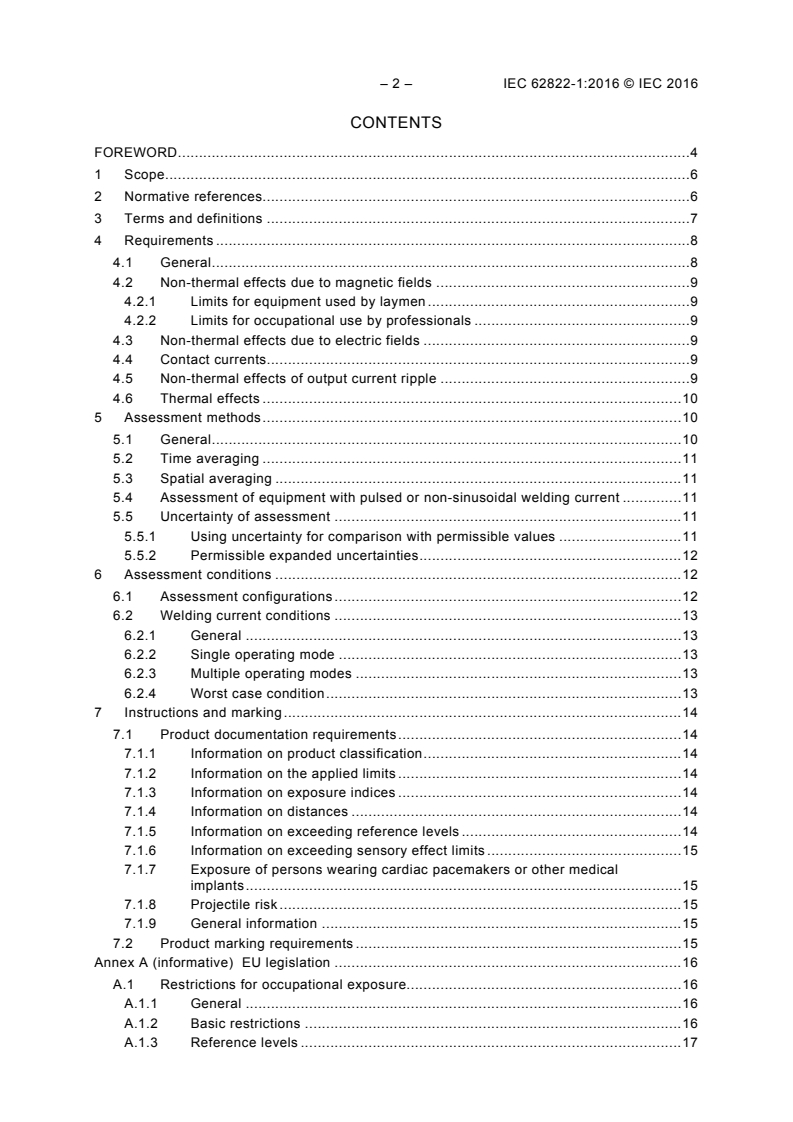
CONTENTS
FOREWORD . 4
1 Scope . 6
2 Normative references. 6
3 Terms and definitions . 7
4 Requirements . 8
4.1 General . 8
4.2 Non-thermal effects due to magnetic fields . 9
4.2.1 Limits for equipment used by laymen . 9
4.2.2 Limits for occupational use by professionals . 9
4.3 Non-thermal effects due to electric fields . 9
4.4 Contact currents . 9
4.5 Non-thermal effects of output current ripple . 9
4.6 Thermal effects . 10
5 Assessment methods . 10
5.1 General . 10
5.2 Time averaging . 11
5.3 Spatial averaging . 11
5.4 Assessment of equipment with pulsed or non-sinusoidal welding current . 11
5.5 Uncertainty of assessment . 11
5.5.1 Using uncertainty for comparison with permissible values . 11
5.5.2 Permissible expanded uncertainties . 12
6 Assessment conditions . 12
6.1 Assessment configurations . 12
6.2 Welding current conditions . 13
6.2.1 General . 13
6.2.2 Single operating mode . 13
6.2.3 Multiple operating modes . 13
6.2.4 Worst case condition . 13
7 Instructions and marking . 14
7.1 Product documentation requirements . 14
7.1.1 Information on product classification . 14
7.1.2 Information on the applied limits . 14
7.1.3 Information on exposure indices . 14
7.1.4 Information on distances . 14
7.1.5 Information on exceeding reference levels . 14
7.1.6 Information on exceeding sensory effect limits . 15
7.1.7 Exposure of persons wearing cardiac pacemakers or other medical
implants . 15
7.1.8 Projectile risk . 15
7.1.9 General information . 15
7.2 Product marking requirements . 15
Annex A (informative) EU legislation . 16
A.1 Restrictions for occupational exposure. 16
A.1.1 General . 16
A.1.2 Basic restrictions . 16
A.1.3 Reference levels . 17
A.2 Restrictions for general public exposure . 17
A.2.1 General . 17
A.2.2 Basic restrictions . 17
A.2.3 Reference levels . 18
A.3 Non-sinusoidal or pulsed fields . 19
Annex B (informative) ICNIRP guidelines . 20
B.1 Restrictions for occupational exposure. 20
B.1.1 General . 20
B.1.2 Basic restrictions . 20
B.1.3 Reference levels . 21
B.2 Restrictions for general public exposure . 21
B.2.1 General . 21
B.2.2 Basic restrictions . 21
B.2.3 Reference levels . 22
B.3 Non-sinusoidal and pulsed fields . 23
Annex C (informative) IEEE standards . 24
C.1 Restrictions for occupational exposure. 24
C.1.1 General . 24
C.1.2 Basic restrictions . 24
C.1.3 Reference levels . 25
C.2 Restrictions for general public exposure . 25
C.2.1 General . 25
C.2.2 Basic restrictions . 25
C.2.3 Reference levels . 26
C.3 Non-sinusoidal and pulsed fields . 27
Annex D (informative) Example for general EMF information . 28
Bibliography . 29
Table 1 – Permissible expanded uncertainties . 12
Table A.1 – EU occupational basic restrictions (0 Hz to 10 MHz). 16
Table A.2 – EU occupational reference levels (1 Hz to 10 MHz) . 17
Table A.3 – EU general public basic restrictions (0 Hz to 10 MHz) . 18
Table A.4 – EU general public reference levels (0 Hz to 10 MHz) . 18
Table A.5 – EU summation parameters . 19
Table B.1 – ICNIRP occupational basic restrictions (0 Hz to 10 MHz) . 20
Table B.2 – ICNIRP occupational reference levels (1 Hz to 10 MHz) . 21
Table B.3 – ICNIRP general public basic restrictions (0 Hz to 10 MHz) . 22
Table B.4 – ICNIRP general public reference levels (1 Hz to 10 MHz) . 22
Table B.5 – ICNIRP summation parameters . 23
Table C.1 – IEEE occupational basic restrictions (0 Hz to 5 MHz) . 24
Table C.2 – IEEE occupational reference levels (0 Hz to 5 MHz) . 25
Table C.3 – IEEE general public basic restrictions (0 Hz to 5 MHz) . 26
Table C.4 – IEEE general public reference levels (0 Hz to 5 MHz) . 26
– 4 – IEC 62822-1:2016 © IEC 2016
INTERNATIONAL ELECTROTECHNICAL COMMISSION
____________
ELECTRIC WELDING EQUIPMENT –
ASSESSMENT OF RESTRICTIONS RELATED TO HUMAN
EXPOSURE TO ELECTROMAGNETIC FIELDS (0 Hz to 300 GHz) –
Part 1: Product family standard
FOREWORD
1) The International Electrotechnical Commission (IEC) is a worldwide organization for standardization comprising
all national electrotechnical committees (IEC National Committees). The object of IEC is to promote
international co-operation on all questions concerning standardization in the electrical and electronic fields. To
this end and in addition to other activities, IEC publishes International Standards, Technical Specifications,
Technical Reports, Publicly Available Specifications (PAS) and Guides (hereafter referred to as “IEC
Publication(s)”). Their preparation is entrusted to technical committees; any IEC National Committee interested
in the subject dealt with may participate in this preparatory work. International, governmental and non-
governmental organizations liaising with the IEC also participate in this preparation. IEC collaborates closely
with the International Organization for Standardization (ISO) in accordance with conditions determined by
agreement between the two organizations.
2) The formal decisions or agreements of IEC on technical matters express, as nearly as possible, an international
consensus of opinion on the relevant subjects since each technical committee has representation from all
interested IEC National Committees.
3) IEC Publications have the form of recommendations for international use and are accepted by IEC National
Committees in that sense. While all reasonable efforts are made to ensure that the technical content of IEC
Publications is accurate, IEC cannot be held responsible for the way in which they are used or for any
misinterpretation by any end user.
4) In order to promote international uniformity, IEC National Committees undertake to apply IEC Publications
transparently to the maximum extent possible in their national and regional publications. Any divergence
between any IEC Publication and the corresponding national or regional publication shall be clearly indicated in
the latter.
5) IEC itself does not provide any attestation of conformity. Independent certification bodies provide conformity
assessment services and, in some areas, access to IEC marks of conformity. IEC is not responsible for any
services carried out by independent certification bodies.
6) All users should ensure that they have the latest edition of this publication.
7) No liability shall attach to IEC or its directors, employees, servants or agents including individual experts and
members of its technical committees and IEC National Committees for any personal injury, property damage or
other damage of any nature whatsoever, whether direct or indirect, or for costs (including legal fees) and
expenses arising out of the publication, use of, or reliance upon, this IEC Publication or any other IEC
Publications.
8) Attention is drawn to the Normative references cited in this publication. Use of the referenced publications is
indispensable for the correct application of this publication.
9) Attention is drawn to the possibility that some of the elements of this IEC Publication may be the subject of
patent rights. IEC shall not be held responsible for identifying any or all such patent rights.
International Standard IEC 62822-1 has been prepared by IEC technical committee 26:
Electric welding.
The text of this standard is based on the following documents:
FDIS Report on voting
26/583/FDIS 26/590/RVD
Full information on the voting for the approval of this standard can be found in the report on
voting indicated in the above table.
This publication has been drafted in accordance with the ISO/IEC Directives, Part 2.
This Standard has the status of a product family standard.
A list of all parts in the IEC 62822 series, published under the general title Electric welding
equipment – Assessment of restrictions related to human exposure to electromagnetic fields
(0 Hz to 300 GHz), can be found on the IEC website.
The committee has decided that the contents of this publication will remain unchanged until
the stability date indicated on the IEC website under "http://webstore.iec.ch" in the data
related to the specific publication. At this date, the publication will be
• reconfirmed,
• withdrawn,
• replaced by a revised edition, or
• amended.
– 6 – IEC 62822-1:2016 © IEC 2016
ELECTRIC WELDING EQUIPMENT –
ASSESSMENT OF RESTRICTIONS RELATED TO HUMAN
EXPOSURE TO ELECTROMAGNETIC FIELDS (0 Hz to 300 GHz) –
Part 1: Product family standard
1 Scope
This part of IEC 62822, which is a product family standard, applies to equipment for
resistance welding, arc welding and allied processes designed for occupational use by
professionals and for use by laymen.
NOTE 1 Typical allied processes are resistance hard and soft soldering, resistance heating by means comparable
to resistance welding equipment, electric arc cutting and arc spraying.
The frequency range covered is 0 Hz to 300 GHz.
This product family standard specifies assessment methods and criteria to evaluate
electromagnetic field (EMF) emissions of electric welding equipment with regard to national
and international requirements for human exposure to EMF.
NOTE 2 Magnetic fields generated by the operation of welding equipment and the resulting non-thermal effects
are the main assessment concern.
This product family standard does not define requirements and methods for workplace
assessment regarding the risks arising from electromagnetic fields. However, the EMF
exposure data that results from the application of this product family standard can be used to
assist in workplace assessment.
NOTE 3 The equipment manufacturer is unaware of the overall exposure environment in which the equipment will
be used (e.g. multiple sources) and is not responsible for all requirements for workplace assessment (e.g.
information and training of workers, design and layout of the workplace).
Other standards may apply to products covered by this standard. In particular this standard
cannot be used to demonstrate electromagnetic compatibility with other equipment. It does
not specify any product safety requirements other than those specifically related to human
exposure to electromagnetic fields.
2 Normative references
The following documents, in whole or in part, are normatively referenced in this document and
are indispensable for its application. For dated references, only the edition cited applies. For
undated references, the latest edition of the referenced document (including any
amendments) applies.
IEC 60050-851:2008, International Electrotechnical Vocabulary – Part 851: Electric welding
IEC 60974-1, Arc welding equipment – Part 1: Welding power sources
IEC 60974-2, Arc welding equipment – Part 2: Liquid cooling systems
IEC 60974-5, Arc welding equipment – Part 5: Wire feeders
IEC 60974-6, Arc welding equipment – Part 6: Limited duty equipment
IEC 60974-8, Arc welding equipment – Part 8: Gas consoles for welding and plasma cutting
systems
IEC 62135-1, Resistance welding equipment – Part 1: Safety requirements for design,
manufacture and installation
IEC 62311, Assessment of electronic and electrical equipment related to human exposure
restrictions for electromagnetic fields (0 Hz – 300 GHz)
IEC 62822-2, Electric welding equipment – Assessment of restrictions related to human
exposure to electromagnetic fields (0 Hz to 300 GHz) – Part 2: Arc welding equipment
3 Terms and definitions
For the purposes of this document, the terms and definitions given in IEC 60050-851 on
electric welding, in IEC 60974-1, IEC 60974-6 and in IEC 62135-1, as well as the following,
apply.
3.1
basic restrictions
exposure limit values
restrictions on exposure to electric, magnetic and electromagnetic fields that are based
directly on established health effects and biological considerations
3.2
contact current
electric current that appears when a person comes into contact with an object that is exposed
to an electromagnetic field
3.3
exposure index
EI
result of the evaluation of exposure to (both sinusoidal and non-sinusoidal) EMF, expressed
as a fraction or percentage of the permissible values
Note 1 to entry: Fractions higher than 1 (100 %) represent exceeding the permissible values.
3.4
general public
individuals of all ages and of varying health conditions
Note 1 to entry: Varying ages and health conditions can increase the individuals´ susceptibilities to EMF.
3.5
general public exposure
the exposure of members of the general public to EMF
Note 1 to entry: In many cases, members of the general public are unaware of their exposure to EMF.
3.6
health effects
adverse effects, such as thermal heating or stimulation of nerve and muscle tissue as a result
of human exposure to EMF
3.7
layman
operator who does not weld in the performance of his profession and may have little or no
formal instruction in welding
– 8 – IEC 62822-1:2016 © IEC 2016
[SOURCE: IEC 60050-851:2008, 851-11-14, modified – "arc welding" was replaced by
"welding"]
3.8
non-thermal effects
the stimulation of muscles, nerves or sensory organs as a result of human exposure to EMF
3.9
occupational exposure
the exposure of workers to EMF at their workplaces, generally under known conditions, and
as a result of performing their regular or assigned job activities
Note 1 to entry: A worker is any person employed by an employer, including trainees and apprentices.
3.10
reference levels
action levels
directly measurable quantities, derived from basic restrictions, provided for practical exposure
assessment purposes
Note 1 to entry: Respect of the reference levels will ensure respect of the relevant basic restriction. If the
reference levels are exceeded, it does not necessarily follow that the basic restriction will be exceeded.
3.11
required minimum distance
distance from the source of EMF to various parts of the body to comply with applicable
regulations
3.12
sensory effects
transient disturbed sensory perceptions and minor changes in brain functions as a result of
human exposure to EMF
3.13
thermal effects
tissue heating through energy absorption in the tissue as a result of human exposure to EMF
4 Requirements
4.1 General
This standard does not include normative limits. Different guidelines and limit values may
apply in different regions and shall be used in conjunction with this standard. Annexes A, B
and C provide examples of regional or national limits.
Limits for exposure to electromagnetic fields are typically given as body internal metrics
directly related to biological effects like nerve stimulation or heating. These metrics cannot be
measured directly, therefore derived levels are given in measureable quantities for practical
exposure assessment purposes. If these conservative levels are met, the body internal limits
are not exceeded.
Different limits for general public or occupational exposure may exist.
4.2 Non-thermal effects due to magnetic fields
4.2.1 Limits for equipment used by laymen
Equipment designed for use by laymen shall be assessed as specified in Clause 6 and shall
comply with the limits for general public exposure, as applicable. Equipment assessed for use
by laymen may also be used by professionals without additional assessment.
Arc welding equipment designed in accordance with IEC 60974-6 is intended to be used by
laymen.
4.2.2 Limits for occupational use by professionals
Equipment designed for occupational use by professionals shall be assessed as specified in
Clause 6 and shall comply with the limits for occupational exposure, as applicable. Equipment
assessed for occupational use shall only be used in environments where general public
access is prohibited or regulated.
Arc welding equipment designed in accordance with IEC 60974-1 is intended for industrial
and professional use.
If the occupational limits are exceeded for some or all configurations, as specified in
Clause 6, additional measures shall be defined which allow compliance (e.g. the definition of
required minimum distances for occupational exposure, the use of protection devices,
restrictions for manual use, etc.).
Additionally, the manufacturer shall determine the required minimum distance for the general
public.
4.3 Non-thermal effects due to electric fields
Electric fields produced by electric welding equipment shall be taken into account. Electric
welding equipment designed in accordance with IEC 60974-1, IEC 60974-2, IEC 60974-5,
IEC 60974-6, IEC 60974-8, or IEC 62135-1 complies unless it contains additional technology
capable of creating significant electric fields.
When, by analysis of such additional technology, electric fields are found to be significant, an
assessment shall be made in accordance with the methods defined in the generic standard
IEC 62311 or relevant basic standards.
4.4 Contact currents
The risk of touch currents generated by voltages induced in conducting structures at the
workplace by electromagnetic fields due to the welding current is avoided by the application of
general safety rules for electric welding, e.g. equipotential bonding and other measures.
Therefore no assessment is required.
4.5 Non-thermal effects of output current ripple
High-frequency components of the ripple of the welding current may cause non-thermal
effects. Ripple currents with a fundamental frequency above 10 kHz may be neglected if the
peak to peak value of the ripple does not exceed
– 100 A for equipment for occupational use;
– 10 A for equipment for use by laymen with current ripple frequencies up to 100 kHz;
– 10 A × 100 / f [kHz] for equipment for use by laymen with current ripple frequencies
ripple
above 100 kHz.
– 10 – IEC 62822-1:2016 © IEC 2016
Other ripple currents of arc welding equipment shall be assessed in accordance with the
methods defined in IEC 62822-2.
NOTE 1 Methods for the assessment of ripple currents of resistance welding equipment can be found in the future
IEC 62822-3 [10].
NOTE 2 The exclusion limit for occupational exposure is constant over frequency as both the permissible basic
restrictions and the induced electric field-strength are proportionally increasing with frequency in the relevant
range. The magnitude is set at a level where the resulting internal electric field strengths are considerably below
the permissible values of all regulations given in the annexes, even at very short distances from the welding cable
to the welder´s body.
NOTE 3 The exclusion limit for the exposure of laymen is decreasing above 100 kHz as the conductivity of tissues
is increasing above 100 kHz, and therefore the induced current density is disproportionally increasing with
frequency, compared to the basic restrictions. The magnitude is set at a level where the resulting induced current
densities or internal electric field strengths are considerably below the permissible values of all regulations given in
the annexes, even at very short distances from the welding cable to the welder´s body.
4.6 Thermal effects
High-frequency components of the ripple of the welding current may cause thermal effects.
Such effects generated by the ripple of the welding current with a fundamental frequency
below 10 kHz may be neglected.
Current ripple with a fundamental frequency above 10 kHz may be neglected if the peak to
peak value of the ripple does not exceed
– 100 A × 100 / f [kHz] for equipment for occupational use;
ripple
– 10 A × 100 / f [kHz] for equipment for use by laymen.
ripple
Other current ripple shall be assessed in accordance with the methods defined in the generic
standard IEC 62311 or relevant basic standards.
NOTE 1 The exclusion limits are set at levels where the resulting heat absorption is considerably below the
permissible values of all regulations given in the annexes, even at very short distances from the welding cable to
the welder´s body.
The technology used in the welding equipment shall be analysed in order to identify other
potential sources for thermal effects. If such sources are identified, they shall be assessed in
accordance with the methods defined in the generic standard IEC 62311 or relevant product
standards.
NOTE 2 Examples for other potential sources for thermal effects are RFID readers or radio-communication
components.
5 Assessment methods
5.1 General
The assessment of arc welding equipment shall be performed in accordance with the basic
standard IEC 62822-2, using one of the methods given there. If multiple scenarios are
assessed, different methods may be applied.
NOTE 1 Methods for the assessment of resistance welding equipment can be found in the future IEC 62822-3
[10].
NOTE 2 An example for the application of different methods is to perform measurements to show compliance with
reference levels for the exposure of all parts of the body in d.c. mode, calculations to show compliance with the
_________________
Numbers in square brackets refer to the Bibliography.
basic restrictions for the exposure of head and trunk in pulsed mode and numerical simulation to show compliance
with the basic restrictions for the exposure of limbs in pulsed mode.
5.2 Time averaging
If time averaging of exposure is not excluded and no procedures are specified in applicable
national and international requirements, the procedures given in IEC 62822-2 shall be applied
for arc welding equipment.
NOTE Time averaging procedures for resistance welding equipment can be found in the future IEC 62822-3 [10].
5.3 Spatial averaging
If spatial averaging of exposure is not excluded and no procedures are specified in applicable
national and international requirements, the procedures given in IEC 62822-2 shall be applied
for arc welding equipment.
NOTE Spatial averaging procedures for resistance welding equipment can be found in the future IEC 62822-3
[10].
5.4 Assessment of equipment with pulsed or non-sinusoidal welding current
Assessment of arc welding equipment shall be made in accordance with the basic standard
IEC 62822-2. If summation procedures are applied, parameters for summation can be found in
applicable guidelines or regulations containing the EMF limits. Examples are given in
Tables A.5 and B.5.
The basic restrictions, reference levels and phases of the weighting functions for summation
of spectral components can also be approximated by first order filters. Details and examples
are given in the basic standard IEC 62822-2. The first order filter approach is applicable to
both analytical and numerical methods as well as for field measurements.
NOTE Assessment methods for pulsed or non-sinusoidal welding current wave-shapes of resistance welding
equipment can be found in the future IEC 62822-3 [10].
5.5 Uncertainty of assessment
5.5.1 Using uncertainty for comparison with permissible values
The concept of “shared uncertainty budget” shall apply to the assessment (both
measurements and calculations). This means that the actual measured or calculated values
shall be used for comparison with the permissible values, based on the relevant exposure
guidelines. Uncertainty values shall be recorded but shall not be included in the comparison,
provided that the expanded assessment uncertainty is less than or equal to that specified in
Table 1, or if the measurement or calculation method is proven to always provide conservative
results (i.e. overestimates the exposure).
The uncertainty of the assessment method applied on arc welding equipment shall be
calculated as defined in the basic standard IEC 62822-2.
NOTE 1 Procedures to calculate the uncertainty of assessment methods applied on resistance welding equipment
can be found in the future IEC 62822-3 [10].
If the expanded uncertainty is higher than the value specified in Table 1 and the assessment
is not proven to provide conservative results, the principle given in the generic standard
IEC 62311 shall be followed. Uncertainty penalties for the applicable limits shall be calculated
in accordance with Equation (1).
– 12 – IEC 62822-1:2016 © IEC 2016
(1)
L ≤ L ×
m
U
U
p
m
1− +
100 100
where
L is the assessed value;
m
L is the applicable limit without consideration of assessment uncertainty;
U is the permissible expanded uncertainty, given in %, as defined in Table 1;
p
U is the expanded uncertainty of the assessment method applied, given in %.
m
NOTE 2 If, for example, the permissible expanded assessment uncertainty is ± 40 % and the actual calculated
expanded uncertainty of the applied assessment method is ± 50 %, the assessment results are compared to the
applicable limits reduced by a factor of 0,91.
In all cases, the assessment shall be made based on a representative sample of the
equipment.
5.5.2 Permissible expanded uncertainties
The expanded uncertainties of the assessment should be less than the values given in
Table 1 except where it can be shown that because of the nature of the measurement
environment, a higher uncertainty is appropriate. In this case the higher uncertainty shall be
quoted and justified.
Table 1 – Permissible expanded uncertainties
Frequency range Measurement Calculation
< 10 kHz + 58 %, − 37 % (± 4 dB) ± 50 %
10 kHz to 1 MHz + 41 %, − 30 % (± 3 dB) ± 50 %
1 MHz to 10 MHz + 41 %, − 30 % (± 3 dB) ± 40 %
When the uncertainties specified in Table 1 are asymmetric (e.g. + 58 %, − 37 %) the values
for possible underestimation shall be used for comparison. For combined assessment
procedures, the highest value of permissible uncertainty shall apply.
6 Assessment conditions
6.1 Assessment configurations
Typically, different permissible values and coupling models need to be applied for different
parts of the human body. This differentiation is based on the variety of tissue types, anatomic
shapes or dimensions and distances to the source of electromagnetic fields that are
applicable for various parts of the body.
Therefore standardized configurations, reflecting the normal operator position for manual arc
welding, are defined in the basic standard IEC 62822-2. These configurations cover all
necessary assessment positions to demonstrate protection of the head, trunk and limbs of the
welder.
NOTE Standardized configurations for resistance welding equipment can be found in the future IEC 62822-3 [10].
The manufacturer shall show compliance for all applicable standardized configurations. If
compliance is not achievable for all points, specific required minimum distances shall be
determined as defined in 4.2.2. The manufacturer may assess additional configurations, e.g.
to provide information on exposure at other distances than those defined for the standardized
configurations.
For equipment designed exclusively for mechanized or robotic applications, the standardized
configurations are not applicable. The manufacturer of this type of equipment shall define
specific required minimum distances.
6.2 Welding current conditions
6.2.1 General
The manufacturer shall select at least one of the following assessment conditions. This allows
for assessing a single (worst case) condition or various different operating modes, as
determined by the manufacturer.
6.2.2 Single operating mode
Equipment shall be evaluated using the settings and conditions that lead to the highest
exposure. The selection of the relevant assessment conditions shall be based on the
manufacturers´ technical knowledge of the welding equipment.
Further information is provided in the basic standards IEC 62822-2 and IEC 62822-3 [10].
The application of this concept allows the assessment of the worst case setting of the welding
equipment at the time of testing. If new options for setting or use (e.g. new welding programs)
are added after the assessment, the assessment shall be repeated.
6.2.3 Multiple operating modes
Equipment shall be evaluated in multiple operation modes that are selected by the
manufacturer. These modes may include different process settings as well as different power
settings. The selection of assessment conditions shall be based on the manufacturers´
technical knowledge of the welding equipment and shall include the settings that lead to the
highest exposure.
Further information is provided in the basic standards IEC 62822-2 and IEC 62822-3 [10].
The application of this concept allows the provision of multiple sets of EMF data for the users,
reducing overestimation of exposure for operating modes with EMF lower than the worst case
mode (e.g. d.c. TIG welding, compared to a.c. square-wave TIG welding). Therefore
unnecessary restrictions for workplaces where only lower EMF operating modes are used can
be avoided. If new options for setting or use (e.g. new welding programs) are added after the
assessment, the assessment shall be repeated.
6.2.4 Worst case condition
Equipment shall be assessed using the current wave-form that includes the maximum di/dt
capability of the welding power source or resistance welding gun.
This worst case exposure capability is determined by the design including related control
systems (controlling the power circuit) and is independent from pre-programmed or otherwise
pre-defined current wave-shapes (controlling the welding process).
Further information is provided in the basic standards IEC 62822-2 and IEC 62822-3 [10].
The application of this concept represents the assessment of the worst case technical di/dt
capability of the welding power source. If new options for setting or use (e.g. new welding
programs) are added after the assessment, there is no need to repeat the assessment.
– 14 – IEC 62822-1:2016 © IEC 2016
7 Instructions and marking
7.1 Product documentation requirements
7.1.1 Information on product classification
The limits to be used for the assessment and the assessment results are dependent on the
product classification as defined in 4.2.1 and 4.2.2. Therefore the equipment documentation
shall clearly state the intended use.
If equipment is intended for professional use and does not comply with the limits for the
general public, the instruction manual shall contain a warning that this equipment is intended
for industrial and professional use and shall not be used by laymen.
Information on the product classification shall be made available to the user prior to purchase.
7.1.2 Information on t
...
Questions, Comments and Discussion
Ask us and Technical Secretary will try to provide an answer. You can facilitate discussion about the standard in here.
Loading comments...