

IEC 60974-6:2015
(Main)Arc welding equipment - Part 6: Limited duty equipment
General Information
- Abstract
IEC 60974-6:2015 specifies safety and performance requirements applicable to limited duty arc welding and cutting power sources and auxiliaries designed for use by laymen. Electrically powered equipment is intended to be connected to the single phase public low-voltage supply system. Engine driven power sources cannot exceed output power of 7,5 kVA. This third edition cancels and replaces the second edition published in 2010. It constitutes a technical revision. The main significant technical changes with respect to the previous edition are the following:
- modified measurement conditions (see 7.3.1);
- improved values for temperature limits according to the class of insulation (see Table 1);
- improved maximum temperature limits (see Table 2);
- deleted overload test.
This publication is to be read in conjunction with IEC 60974-1:2012.
- Status
- Published
- Publication Date
- 21-Sep-2015
- Technical Committee
- TC 26 - Electric welding
- Drafting Committee
- WG 1 - TC 26/WG 1
- Current Stage
- PPUB - Publication issued
- Start Date
- 22-Sep-2015
- Completion Date
- 15-Oct-2015
Overview
IEC 60974-6:2015 is an international standard issued by the International Electrotechnical Commission (IEC) that establishes safety and performance requirements for limited duty arc welding and cutting power sources and auxiliaries. Specifically designed for laymen, this standard applies to electrically powered welding equipment connected to a single-phase public low-voltage supply system. Engine-driven power sources covered under this standard have a maximum output power of 7.5 kVA. The 2015 edition is the third edition, replacing the previous 2010 version with important technical revisions including modified measurement conditions and improved temperature limit values.
This standard is an essential reference to ensure the safe and efficient operation of limited duty arc welding equipment intended for non-professional or light use, providing clear guidelines on electrical safety, thermal management, and performance testing.
Key Topics
- Scope and Normative References: Specifies the standard’s coverage-limited duty arc welding and cutting equipment-and references related IEC standards.
- Electrical Safety Requirements:
- Protection against electric shock under normal and fault conditions
- Insulation standards, creepage distances, dielectric strength, and protection of capacitors
- Thermal Requirements:
- Thermal protection devices and controls
- Heating tests with defined measurement conditions and ambient environment considerations
- Maximum temperature limits for insulation classes, external surfaces, and components
- Performance and Testing:
- Type and routine test conditions
- Input supply connection rules including voltage, current, and supply circuit terminals
- No-load voltage and conventional load voltage specifications relevant for various welding processes (MMA, TIG, MIG, plasma cutting)
- Mechanical and Construction Aspects:
- Enclosure materials, mechanical strength, and handling provisions focused on user safety and equipment durability
- Control and Safety Devices:
- Control circuits and hazard reduction devices to ensure operational safety
- Protection against abnormal operations such as stalled fan or short circuit testing
Applications
IEC 60974-6:2015 specifically targets limited duty arc welding equipment used by non-professionals or occasional users. Its requirements benefit manufacturers, safety inspectors, and end-users by providing:
- Clear safety guidelines for manufacturing consumer-grade arc welding machines and cutting tools.
- Assurance that equipment connected to standard household or small commercial power supplies meets critical electrical and thermal safety thresholds.
- A framework for testing and certifying welding equipment to improve reliability and prevent accidents during light-duty welding activities.
- Guidance on designing engine-driven welding power sources with limited output for outdoor or remote applications.
By complying with this standard, manufacturers can legally market arc welding equipment intended for light industrial, home, and hobbyist use while ensuring compliance with international safety norms.
Related Standards
IEC 60974-6:2015 should be read in conjunction with:
- IEC 60974-1:2012 - Arc welding equipment – Part 1: Welding power sources. This general standard details broader requirements applicable to all welding power sources, complementing the more specific limited duty provisions of IEC 60974-6.
- Other parts of the IEC 60974 series covering different types of welding equipment and technology.
- IEC standards on electrical safety and insulation testing to ensure comprehensive coverage of protective measures.
Keywords: IEC 60974-6, limited duty arc welding equipment, welding power sources, electrical safety standards, thermal protection, single-phase supply welding machines, light-duty welding, arc welding safety requirements, welding equipment testing, IEC welding standards.
Relations
- Effective Date
- 05-Sep-2023
Get Certified
Connect with accredited certification bodies for this standard

DVS-ZERT GmbH
German welding certification society.
CARES (UK Certification Authority for Reinforcing Steels)
UK certification for reinforcing steels and construction.
EWF/IIW (European/International Welding Federation)
International welding personnel certification.
Sponsored listings
Frequently Asked Questions
IEC 60974-6:2015 is a standard published by the International Electrotechnical Commission (IEC). Its full title is "Arc welding equipment - Part 6: Limited duty equipment". This standard covers: IEC 60974-6:2015 specifies safety and performance requirements applicable to limited duty arc welding and cutting power sources and auxiliaries designed for use by laymen. Electrically powered equipment is intended to be connected to the single phase public low-voltage supply system. Engine driven power sources cannot exceed output power of 7,5 kVA. This third edition cancels and replaces the second edition published in 2010. It constitutes a technical revision. The main significant technical changes with respect to the previous edition are the following: - modified measurement conditions (see 7.3.1); - improved values for temperature limits according to the class of insulation (see Table 1); - improved maximum temperature limits (see Table 2); - deleted overload test. This publication is to be read in conjunction with IEC 60974-1:2012.
IEC 60974-6:2015 specifies safety and performance requirements applicable to limited duty arc welding and cutting power sources and auxiliaries designed for use by laymen. Electrically powered equipment is intended to be connected to the single phase public low-voltage supply system. Engine driven power sources cannot exceed output power of 7,5 kVA. This third edition cancels and replaces the second edition published in 2010. It constitutes a technical revision. The main significant technical changes with respect to the previous edition are the following: - modified measurement conditions (see 7.3.1); - improved values for temperature limits according to the class of insulation (see Table 1); - improved maximum temperature limits (see Table 2); - deleted overload test. This publication is to be read in conjunction with IEC 60974-1:2012.
IEC 60974-6:2015 is classified under the following ICS (International Classification for Standards) categories: 25.160.30 - Welding equipment. The ICS classification helps identify the subject area and facilitates finding related standards.
IEC 60974-6:2015 has the following relationships with other standards: It is inter standard links to IEC 60974-6:2010. Understanding these relationships helps ensure you are using the most current and applicable version of the standard.
IEC 60974-6:2015 is available in PDF format for immediate download after purchase. The document can be added to your cart and obtained through the secure checkout process. Digital delivery ensures instant access to the complete standard document.
Standards Content (Sample)
IEC 60974-6 ®
Edition 3.0 2015-09
INTERNATIONAL
STANDARD
NORME
INTERNATIONALE
colour
inside
Arc welding equipment –
Part 6: Limited duty equipment
Matériel de soudage à l’arc –
Partie 6: Matériel à service limité
All rights reserved. Unless otherwise specified, no part of this publication may be reproduced or utilized in any form
or by any means, electronic or mechanical, including photocopying and microfilm, without permission in writing from
either IEC or IEC's member National Committee in the country of the requester. If you have any questions about IEC
copyright or have an enquiry about obtaining additional rights to this publication, please contact the address below or
your local IEC member National Committee for further information.
Droits de reproduction réservés. Sauf indication contraire, aucune partie de cette publication ne peut être reproduite
ni utilisée sous quelque forme que ce soit et par aucun procédé, électronique ou mécanique, y compris la photocopie
et les microfilms, sans l'accord écrit de l'IEC ou du Comité national de l'IEC du pays du demandeur. Si vous avez des
questions sur le copyright de l'IEC ou si vous désirez obtenir des droits supplémentaires sur cette publication, utilisez
les coordonnées ci-après ou contactez le Comité national de l'IEC de votre pays de résidence.
IEC Central Office Tel.: +41 22 919 02 11
3, rue de Varembé Fax: +41 22 919 03 00
CH-1211 Geneva 20 info@iec.ch
Switzerland www.iec.ch
About the IEC
The International Electrotechnical Commission (IEC) is the leading global organization that prepares and publishes
International Standards for all electrical, electronic and related technologies.
About IEC publications
The technical content of IEC publications is kept under constant review by the IEC. Please make sure that you have the
latest edition, a corrigenda or an amendment might have been published.
IEC Catalogue - webstore.iec.ch/catalogue Electropedia - www.electropedia.org
The stand-alone application for consulting the entire The world's leading online dictionary of electronic and
bibliographical information on IEC International Standards, electrical terms containing more than 30 000 terms and
Technical Specifications, Technical Reports and other definitions in English and French, with equivalent terms in 15
documents. Available for PC, Mac OS, Android Tablets and additional languages. Also known as the International
iPad. Electrotechnical Vocabulary (IEV) online.
IEC publications search - www.iec.ch/searchpub IEC Glossary - std.iec.ch/glossary
The advanced search enables to find IEC publications by a More than 60 000 electrotechnical terminology entries in
variety of criteria (reference number, text, technical English and French extracted from the Terms and Definitions
committee,…). It also gives information on projects, replaced clause of IEC publications issued since 2002. Some entries
and withdrawn publications. have been collected from earlier publications of IEC TC 37,
77, 86 and CISPR.
IEC Just Published - webstore.iec.ch/justpublished
Stay up to date on all new IEC publications. Just Published IEC Customer Service Centre - webstore.iec.ch/csc
details all new publications released. Available online and If you wish to give us your feedback on this publication or
also once a month by email. need further assistance, please contact the Customer Service
Centre: csc@iec.ch.
A propos de l'IEC
La Commission Electrotechnique Internationale (IEC) est la première organisation mondiale qui élabore et publie des
Normes internationales pour tout ce qui a trait à l'électricité, à l'électronique et aux technologies apparentées.
A propos des publications IEC
Le contenu technique des publications IEC est constamment revu. Veuillez vous assurer que vous possédez l’édition la
plus récente, un corrigendum ou amendement peut avoir été publié.
Catalogue IEC - webstore.iec.ch/catalogue Electropedia - www.electropedia.org
Application autonome pour consulter tous les renseignements
Le premier dictionnaire en ligne de termes électroniques et
bibliographiques sur les Normes internationales,
électriques. Il contient plus de 30 000 termes et définitions en
Spécifications techniques, Rapports techniques et autres
anglais et en français, ainsi que les termes équivalents dans
documents de l'IEC. Disponible pour PC, Mac OS, tablettes
15 langues additionnelles. Egalement appelé Vocabulaire
Android et iPad.
Electrotechnique International (IEV) en ligne.
Recherche de publications IEC - www.iec.ch/searchpub
Glossaire IEC - std.iec.ch/glossary
Plus de 60 000 entrées terminologiques électrotechniques, en
La recherche avancée permet de trouver des publications IEC
en utilisant différents critères (numéro de référence, texte, anglais et en français, extraites des articles Termes et
comité d’études,…). Elle donne aussi des informations sur les Définitions des publications IEC parues depuis 2002. Plus
projets et les publications remplacées ou retirées. certaines entrées antérieures extraites des publications des
CE 37, 77, 86 et CISPR de l'IEC.
IEC Just Published - webstore.iec.ch/justpublished
Service Clients - webstore.iec.ch/csc
Restez informé sur les nouvelles publications IEC. Just
Published détaille les nouvelles publications parues. Si vous désirez nous donner des commentaires sur cette
Disponible en ligne et aussi une fois par mois par email. publication ou si vous avez des questions contactez-nous:
csc@iec.ch.
IEC 60974-6 ®
Edition 3.0 2015-09
INTERNATIONAL
STANDARD
NORME
INTERNATIONALE
colour
inside
Arc welding equipment –
Part 6: Limited duty equipment
Matériel de soudage à l’arc –
Partie 6: Matériel à service limité
INTERNATIONAL
ELECTROTECHNICAL
COMMISSION
COMMISSION
ELECTROTECHNIQUE
INTERNATIONALE
ICS 25.160.30 ISBN 978-2-8322-2898-2
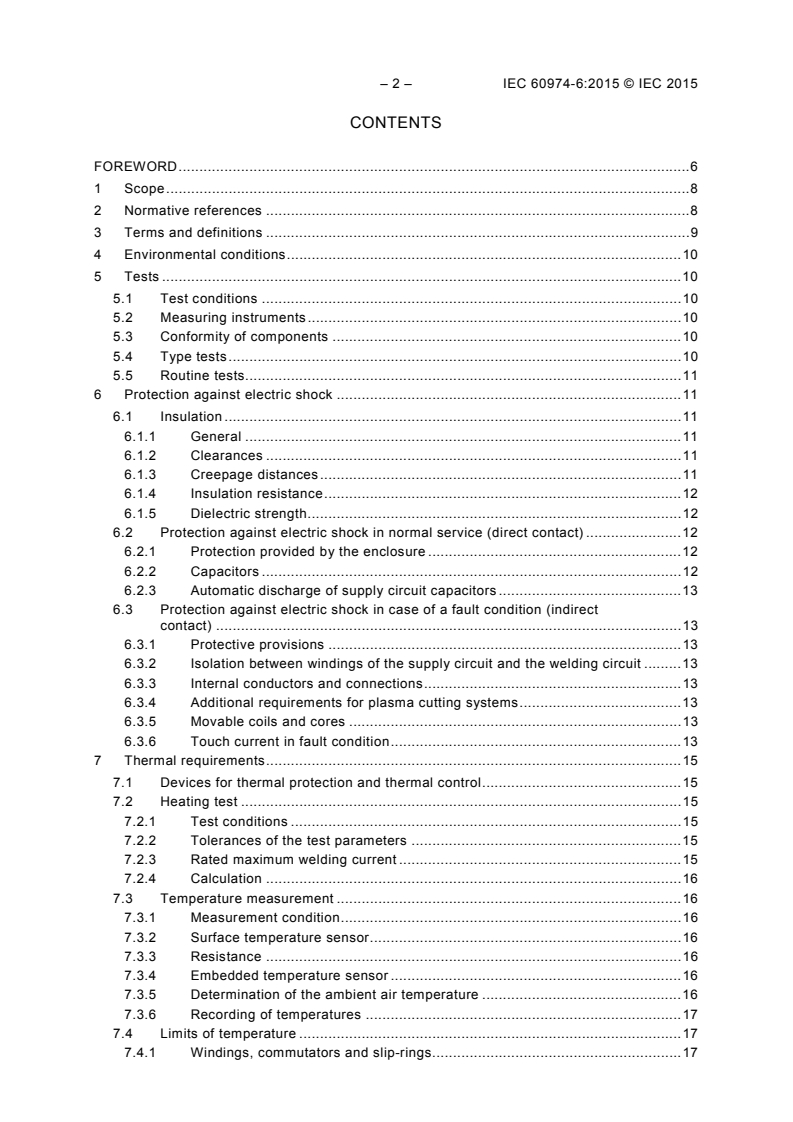
– 2 – IEC 60974-6:2015 © IEC 2015
CONTENTS
FO R EW O RD . 6
1 Sc ope . . 8
2 Normative references . 8
3 Terms and definitions . 9
4 Environmental conditions . 10
5 Tests . 10
5.1 Test conditions . 10
5.2 Measuring instruments . 10
5.3 Conformity of components . 10
5.4 Type tests . 10
5.5 Routine tests. 11
6 Protection against electric shock . 11
6.1 Insulation . 11
6.1.1 General . 11
6.1.2 Clearances . 11
6.1.3 Creepage distances . 11
6.1.4 Insulation resistance . 12
6.1.5 Dielectric strength . 12
6.2 Protection against electric shock in normal service (direct contact) . 12
6.2.1 Protection provided by the enclosure . 12
6.2.2 Capacitors . 12
6.2.3 Automatic discharge of supply circuit capacitors . 13
6.3 Protection against electric shock in case of a fault condition (indirect
contact) . 13
6.3.1 Protective provisions . 13
6.3.2 Isolation between windings of the supply circuit and the welding circuit . 13
6.3.3 Internal conductors and connections . 13
6.3.4 Additional requirements for plasma cutting systems . 13
6.3.5 Movable coils and cores . 13
6.3.6 Touch current in fault condition . 13
7 Thermal requir em en ts . 15
7.1 Devices for thermal protection and thermal control . 15
7.2 Heating test . 15
7.2.1 Test conditions . 15
7.2.2 Tolerances of the test parameters . 15
7.2.3 Rated maximum welding current . 15
7.2.4 Calculation . 16
7.3 Temperature measurement . 16
7.3.1 Measurement condition . 16
7.3.2 Surface temperature sensor . 16
7.3.3 Resistance . 16
7.3.4 Embedded temperature sensor . 16
7.3.5 Determination of the ambient air temperature . 16
7.3.6 Recording of temperatures . 17
7.4 Limits of temperature . 17
7.4.1 Windings, commutators and slip-rings . 17
7.4.2 External surfaces . 17
7.4.3 Other components . 17
7.5 Loading test . 17
7.6 Commutators and slip-rings . 18
8 Thermal control device . 18
8.1 Construction . 18
8.2 Loc a ti o n . 18
8.3 O p er a t io n . 18
8.4 Resetting . 18
8.5 Operating capacity . 19
8.6 Indication . 19
9 Thermal prot ec ti o n . 19
9.1 Construction . 19
9.2 Loc a ti o n . 19
9.3 O p er a t io n . 19
10 Abnormal operation . 20
10.1 General requirements . 20
10.2 Stalled fan test . 20
10.3 Short circuit test . 20
11 Connection to the input supply network . 21
11.1 Input supply . 21
11.1.1 Supply voltage . 21
11.1.2 Supply current . 21
11.1.3 Engine driven welding power source . 21
11.2 Multi supply voltage . 21
11.3 Means of connection to the supply circuit . 21
11.4 Supply circuit terminals . 21
11.5 Cable anchorage . 22
11.6 Inlet openings . 22
11.7 Supply circuit on/off switching device . 22
11.8 Supply cables . 22
11.9 Supply coupling device (attachment plug) . 22
12 Output . 22
12.1 Rated no-load voltage . 22
12.1.1 Rated no-load voltage for arc welding power source . 22
12.1.2 Rated no-load voltage for plasma cutting power source . 23
12.1.3 Additional requirements . 23
12.1.4 Measuring circuit . 24
12.2 Type test values of the conventional load voltage . 25
12.2.1 Manual metal arc welding with covered electrodes . 25
12.2.2 Tungsten inert gas arc welding . 25
12.2.3 Metal inert/active gas and flux cored arc welding . 25
12.2.4 Plasma cutting . 25
12.2.5 Additional requirements . 25
12.3 Mechanical switching devices used to adjust output . 26
12.4 Welding circuit connections . 26
12.4.1 Protection against unintentional contact . 26
12.4.2 Location of coupl in g d e v i c es . 26
– 4 – IEC 60974-6:2015 © IEC 2015
12.4.3 Outlet openings . 26
12.4.4 Marking . 26
12.4.5 Connections for plasma cutting torches . 26
12.5 Power supply to external devices . 26
12.6 Auxiliary power output . 26
12.7 Welding cables . 26
13 Control circuits . 26
14 Hazard reducing device . 26
15 Mechanical provisions . 27
15.1 General requirements . 27
15.2 Enclosure . 27
15.2.1 Enclosure materials . 27
15.2.2 Enclosure strength . 27
15.3 Handling means . 27
15.4 Drop withstand . 27
15.5 Tilting stability . 27
16 Auxiliaries . 27
16.1 General . 27
16.2 Wire feeder . 27
16.2.1 General . 27
16.2.2 Test conditions . 27
16.2.3 Thermal requir em en ts . 28
16.2.4 Protection against unintentional contact . 28
16.3 Torch . 28
16.3.1 General . 28
16.3.2 Test conditions . 28
16.3.3 Thermal requir em en ts . 28
16.4 Electrode holder. 28
16.5 Pressure regulator . 28
17 Rating plate . 28
17.1 General requirements . 28
17.2 Description . 28
17.3 Contents . 29
17.4 T ole r a nc es . 31
18 Adjustment of the output . 32
19 Instructions and markings . 32
19.1 Instructions . 32
19.1.1 General . 32
19.1.2 Instruction manual . 32
19.1.3 Safety instructions . 32
19.2 Mark ings . 33
Annex A (informative) Test probes . 35
Annex B (informative) Examples of rating plates . 36
Annex C (informative) Symbols-only precautionary label . 37
B i b l i o gr a p h y . 38
Figure 1 – Measurement of touch current in fault condition . 14
Figure 2 – Measuring network for weighted touch current . 14
Figure 3 – Measurement of r.m.s values . 24
Figure 4 – Measurement of peak values . 25
Figure 5 – Principle of the rating plate . 29
Figure A.1 – Test probe 12 of IEC 61032 . 35
Figure A.2 – Test probe 13 of IEC 61032 . 35
Figure B.1 – Rating plate . 36
Figure C.1 – Example of precautionary label for engine driven manual metal arc
welding power source . 37
Table 1 – Temperature limits according to the class of insulation . 17
Table 2 – Maximum temperature limits . 20
Table 3 – Summary of rated no-load voltages . 24
Table 4 – Hazard reducing device requirements for plasma cutting power source . 27
– 6 – IEC 60974-6:2015 © IEC 2015
INTERNATIONAL ELECTROTECHNICAL COMMISSION
____________
ARC WELDING EQUIPMENT –
Part 6: Limited duty equipment
FOREWORD
1) The International Electrotechnical Commission (IEC) is a worldwide organization for standardization comprising
all national electrotechnical committees (IEC National Committees). The object of IEC is to promote
international co-operation on all questions concerning standardization in the electrical and electronic fields. To
this end and in addition to other activities, IEC publishes International Standards, Technical Specifications,
Technical Reports, Publicly Available Specifications (PAS) and Guides (hereafter referred to as “IEC
Publication(s)”). Their preparation is entrusted to technical committees; any IEC National Committee interested
in the subject dealt with may participate in this preparatory work. International, governmental and non-
governmental organizations liaising with the IEC also participate in this preparation. IEC collaborates closely
with the International Organization for Standardization (ISO) in accordance with conditions determined by
agreement between the two organizations.
2) The formal decisions or agreements of IEC on technical matters express, as nearly as possible, an international
consensus of opinion on the relevant subjects since each technical committee has representation from all
interested IEC National Committees.
3) IEC Publications have the form of recommendations for international use and are accepted by IEC National
Committees in that sense. While all reasonable efforts are made to ensure that the technical content of IEC
Publications is accurate, IEC cannot be held responsible for the way in which they are used or for any
misinterpretation by any end user.
4) In order to promote international uniformity, IEC National Committees undertake to apply IEC Publications
transparently to the maximum extent possible in their national and regional publications. Any divergence
between any IEC Publication and the corresponding national or regional publication shall be clearly indicated in
the latter.
5) IEC itself does not provide any attestation of conformity. Independent certification bodies provide conformity
assessment services and, in some areas, access to IEC marks of conformity. IEC is not responsible for any
services carried out by independent certification bodies.
6) All users should ensure that they have the latest edition of this publication.
7) No liability shall attach to IEC or its directors, employees, servants or agents including individual experts and
members of its technical committees and IEC National Committees for any personal injury, property damage or
other damage of any nature whatsoever, whether direct or indirect, or for costs (including legal fees) and
expenses arising out of the publication, use of, or reliance upon, this IEC Publication or any other IEC
Publications.
8) Attention is drawn to the Normative references cited in this publication. Use of the referenced publications is
indispensable for the correct application of this publication.
9) Attention is drawn to the possibility that some of the elements of this IEC Publication may be the subject of
patent rights. IEC shall not be held responsible for identifying any or all such patent rights.
International Standard IEC 60974-6 has been prepared by IEC technical committee 26:
Electric welding.
This third edition cancels and replaces the second edition published in 2010. It constitutes a
technical revision.
The main significant technical changes with respect to the previous edition are the following:
– modified measurement conditions (see 7.3.1);
– improved values for temperature limits according to the class of insulation (see Table 1);
– improved maximum temperature limits (see Table 2);
– deleted overload test.
The text of this standard is based on the following documents:
FDIS Report on voting
26/572/FDIS 26/581/RVD
Full information on the voting for the approval of this standard can be found in the report on
voting indicated in the above table.
This publication has been drafted in accordance with the ISO/IEC Directives, Part 2.
This standard is to be used in conjunction with IEC 60974-1:2012.
In this standard, the following print types are used:
– conformity statements: in italic type.
A list of all the parts in the IEC 60974 series, published under the general title Arc welding
equipment, can be found on the IEC website.
The committee has decided that the contents of this publication will remain unchanged until
the stability date indicated on the IEC web site under "http://webstore.iec.ch" in the data
related to the specific publication. At this date, the publication will be
• reconfirmed,
• withdrawn,
• replaced by a revised edition, or
• amended.
IMPORTANT – The “colour inside” logo on the cover page of this publication
indicates that it contains colours which are considered to be useful for the correct
understanding of its contents. Users should therefore print this publication using a
colour printer.
– 8 – IEC 60974-6:2015 © IEC 2015
ARC WELDING EQUIPMENT –
Part 6: Limited duty equipment
1 Scope
This part of IEC 60974 specifies safety and performance requirements applicable to limited
duty arc welding and cutting power sources and auxiliaries designed for use by laymen.
Electrically powered equipment is intended to be connected to the single phase public low-
voltage supply system. Engine driven power sources cannot exceed output power of 7,5 kVA.
NOTE 1 This equipment is typically used by non-professionals in residential areas.
This part of IEC 60974 is not applicable to arc welding and cutting power sources that require
for operation:
• arc striking and stabilizing devices;
• liquid cooling systems;
• gas consoles;
• three-phase input supply;
and which are intended for industrial and professional use only.
This part of IEC 60974 is not applicable to arc welding and cutting power sources and
ancillary equipment used in:
• mechanically guided applications;
• submerged arc welding process;
• plasma gouging process;
• plasma welding process;
that are covered by other parts of IEC 60974.
NOTE 2 Power sources, wire feeders, torches and electrode holders designed for industrial and professional use
are respectively covered by IEC 60974-1, IEC 60974-5, IEC 60974-7 and IEC 60974-11.
NOTE 3 This part of IEC 60974 does not specify electromagnetic compatibility (EMC) requirements that are given
in IEC 60974-10.
2 Normative references
The following documents, in whole or in part, are normatively referenced in this document and
are indispensable for its application. For dated references, only the edition cited applies. For
undated references, the latest edition of the referenced document (including any
amendments) applies.
IEC 60529, Degrees of protection provided by enclosures (IP Code)
IEC 60974-1:2012, Arc welding equipment – Part 1: Welding power sources
IEC 60974-5:2013, Arc welding equipment – Part 5: Wire feeders
IEC 60974-7:2013, Arc welding equipment – Part 7: Torches
IEC 60974-10, Arc welding equipment – Part 10: Electromagnetic compatibility (EMC)
requirements
IEC 60974-11, Arc welding equipment – Part 11: Electrode holders
IEC 61032:1997, Protection of persons and equipment by enclosure – Probes for verification
ISO 2503, Gas welding equipment – Pressure regulators and pressure regulators with flow-
metering devices for gas cylinders used in welding, cutting and allied processes up to 300 bar
(30 MPa)
3 Terms and definitions
For the purposes of this document, the terms and definitions given in IEC 60974-1, as well as
the following apply:
3.1
touch current
electric current passing through a human body or through an animal body when it touches one
or more accessible parts of an installation or equipment
[SOURCE: IEC 60050-195:1990/AMD 1:1999, 195-05-21]
3.2
limited duty welding power source
power source intended for use by a layman
3.3
layman
operator who does not weld in the performance of his profession and has little or no formal
instruction in arc welding
3.4
effective supply current
I
1eff
value of the effective input current, calculated from the rated maximum supply current
(I in A), the supply current at no-load (I in A) and the rated maximum welding time in
1max 0
intermittent mode ( in s) at the rated maximum welding current during an uninterrupted
t
ON
time of one hour by the formula:
t t
ON ON
2 2
I = I × + I × 1−
1eff 1max 0
3 600 3 600
3.5
ON time
t
ON
period of welding operation as allowed by the thermal control device of the welding power
source
3.6
OFF time
t
OFF
period of non-welding operation as imposed by the thermal control device of the welding
power source
– 10 – IEC 60974-6:2015 © IEC 2015
3.7
rated welding time in 1 h
t
ON
summation of the ON times (t ) at the rated maximum welding current in a 60 min period
ON
following the first OFF time (t )
OFF
3.8
rated continuous welding time
t (max)
ON
ON time (t ) at the rated maximum welding current before the first OFF time (t )
ON OFF
4 Environmental conditions
Welding power sources and auxiliaries shall be capable of operating when the following
environmental conditions prevail:
a) range of ambient air temperature:
during operation: –10 °C to +40 °C;
b) relative humidity of the air:
up to 50 % at 40 °C;
up to 90 % at 20 °C;
c) ambient air, free from abnormal amounts of dust, acids, corrosive gases or substances
etc. other than those generated by the welding process;
d) altitude above sea level up to 1 000 m;
e) base of the welding power source inclined up to 10°.
Welding power sources and auxiliaries shall withstand storage and transport at an ambient air
temperature of –20 °C to +55 °C without any damage to function and performance.
Welding power source and auxiliaries shall be capable of delivering the rated continuous
welding time and the rated welding time in 1 h at an ambient temperature of 20 °C.
5 Tests
5.1 Test conditions
The thermal tests shall be carried out at an ambient temperature of 20 °C, see tolerances
in 7.2.2 e).
Other tests shall be carried out at an ambient air temperature between 10 °C and 40 °C.
5.2 Measuring instruments
See 5.2 of IEC 60974-1:2012.
5.3 Conformity of components
See 5.3 of IEC 60974-1:2012.
5.4 Type tests
Unless otherwise specified, the tests in this standard are type tests.
The welding power source shall be tested with any ancillary equipment fitted that could affect
the test results.
All type tests shall be carried out on the same welding power source except where it is
specified that a test may be carried out on another welding power source.
As a condition of conformity the type tests given below shall be carried out in the following
sequence with no drying time between f), g) and h):
a) general visual inspection, see 3.7 of IEC 60974-1:2012;
b) insulation resistance, see 6.1.4 (preliminary check);
c) enclosure, see 15.2;
d) handling means, see 15.3;
e) drop withstand, see 15.4;
f) protection provided by the enclosure, see 6.2.1;
g) insulation resistance, see 6.1.4;
h) dielectric strength, see 6.1.5;
i) visual inspection, see 3.7 of IEC 60974-1:2012.
The other tests included in this standard and not listed in 5.4 shall be carried out in any
convenient sequence.
5.5 Routine tests
All routine tests shall be carried out on each welding power source. The following sequence is
recommended:
a) visual inspection, see 3.7 of IEC 60974-1:2012;
b) continuity of the protective circuit, see 10.5.1 of IEC 60974-1:2012;
c) dielectric strength, see 6.1.5;
d) no-load voltage
1) rated no-load voltage, see 12.1; or
2) for plasma cutting power source, rated reduced no-load voltage, see 13.2.1 of
IEC 60974-1:2012;
e) test to ensure rated minimum and maximum output values in accordance with 15.4 b) and
15.4 c) of IEC 60974-1:2012. The manufacturer may select conventional load, short circuit
load or other test conditions.
NOTE In short circuit and other test condition, the output values can differ from conventional load values.
6 Protection against electric shock
6.1 Insulation
6.1.1 General
See 6.1.1 of IEC 60974-1:2012.
6.1.2 Clearances
See 6.1.2 of IEC 60974-1:2012.
6.1.3 Creepage distances
See 6.1.3 of IEC 60974-1:2012.
– 12 – IEC 60974-6:2015 © IEC 2015
6.1.4 Insulation resistance
See 6.1.4 of IEC 60974-1:2012.
6.1.5 Dielectric strength
See 6.1.5 of IEC 60974-1:2012.
6.2 Protection against electric shock in normal service (direct contact)
6.2.1 Protection provided by the enclosure
6.2.1.1 General
Welding power sources shall have a minimum degree of protection of IP21S using IEC 60529
test procedures and conditions.
Remote controls for welding power sources shall have a minimum degree of protection of
IP2X using IEC 60529 test procedures and conditions.
6.2.1.2 Protection against ingress of water
Adequate drainage shall be provided by the enclosure. Retained water shall not interfere with
the correct operation of the equipment or impair safety.
Conformity shall be checked as follows:
A welding power source shall be subjected to the appropriate water test without being
energized. Immediately after the test, the welding power source shall be moved to a safe
environment and subjected to the insulation resistance and dielectric strength tests.
Adequate drainage of the enclosure shall be checked by visual inspection.
6.2.1.3 Side and top enclosure openings
The enclosure shall be such that a 50 mm long test pin cannot be inserted from all sides
except the underside to touch:
a) live parts of the input circuit or
b) in the case of Class II welding power sources, any metal part which is separated from live
parts of the input circuit by basic insulation.
Conformity shall be checked with test probe 12 of IEC 61032:1997 (see Figure A.1).
6.2.1.4 Bottom enclosure openings
The enclosure shall be such that a 15 mm long test pin cannot be inserted from the underside
to touch:
a) live parts of the input circuit and
b) in the case of Class II welding power sources, any metal part which is separated from live
parts of the input circuit by basic insulation.
Conformity shall be checked with test probe 13 of IEC 61032:1997 (see Figure A.2).
6.2.2 Capacitors
See 6.2.2 of IEC 60974-1:2012.
6.2.3 Automatic discharge of supply circuit capacitors
See 6.2.3 of IEC 60974-1:2012.
6.3 Protection against electric shock in case of a fault condition (indirect contact)
6.3.1 Protective provisions
See 6.3.1 of IEC 60974-1:2012.
6.3.2 Isolation between windings of the supply circuit and the welding circuit
See 6.3.2 of IEC 60974-1:2012.
6.3.3 Internal conductors and connections
See 6.3.3 of IEC 60974-1:2012.
6.3.4 Additional requirements for plasma cutting systems
See 6.3.4 of IEC 60974-1:2012.
6.3.5 Movable coils and cores
See 6.3.5 of IEC 60974-1:2012.
6.3.6 Touch current in fault condition
The weighted touch current shall not exceed 7 mA peak in the case of external protective
conductor failure or disconnection.
Conformity shall be checked using the measuring circuit as shown in Figure 1 and Figure 2
under the following conditions:
a) the welding power source is:
– isolated from the ground plane;
– supplied by the highest rated supply voltage;
– not connected to the protective earth except through measurement components;
b) the output circuit is in the no-load condition;
c) interference suppression capacitors shall not be disconnected.
NOTE Caution! A qualified person performs this test. The protective conductor is disabled for this test.
– 14 – IEC 60974-6:2015 © IEC 2015
PE N/L L
A
3 I
I I
PE
Out In
B
IEC
Key
1 measuring network
2 power source
3 circuit diagram of Figure 2
A, B connection terminals of measuring network
L line
N neutral
PE protective earth
Figure 1 – Measurement of touch current in fault condition
R C
S S
A
R
B
R U C U
B 1 1 2
IEC
Key
A, B test terminals C 0,22 μF
S
R 1 500 Ω R 10 000 Ω
S 1
R C
500 Ω 0,022 μF
B 1
U r.m.s. voltage
U
weighted touch current
= (peak value)
(perception/reaction)
Figure 2 – Measuring network for weighted touch current
7 Thermal requirements
7.1 Devices for thermal protection and thermal control
A welding power source with limited duty shall be fitted with two independent devices, one for
thermal protection and one for thermal control.
The thermal control device limits the temperature of its components by reducing or
disconnecting the welding current, and is reset automatically and is designed in accordance
with Clause 8.
The thermal protection defined in Clause 9 shall be designed to operate if the thermal control
device fails.
7.2 Heating test
7.2.1 Test conditions
The welding power source shall be operated at the rated maximum welding current I and
2max
conventional load voltage given in 12.2, starting from the cold state.
If it is known that I does not give the maximum heating, then a worst case test shall
2max
additionally be made at the setting within the rated range which gives the maximum heating.
When placing the measuring devices, the only access permitted shall be through openings
with cover plates, inspection doors or easily removable panels provided by the manufacturer.
The ventilation in the test area and the measuring devices used shall not interfere with the
normal ventilation of the welding power source or cause abnormal transfer of heat to or from
it.
NOTE 1 The maximum temperature of components can be reached at the no-load condition.
NOTE 2 The rated maximum welding current test and the relevant worst case test can follow each other without
waiting for the welding power source to return to the ambient air temperature.
7.2.2 Tolerances of the test parameters
During the heating test in accordance with 7.2.3 the following tolerances shall be met:
+10
a) load voltage: % of the appropriate conventional load voltage;
− 5
+10
b) welding current: % of the appropriate conventional welding current;
− 5
c) supply voltage: ±5 % of the appropriate rated supply voltage;
+10
d) engine speed: % of the appropriate rated speed;
− 5
+10
e) temperature: K of the ambient temperature.
− 0
7.2.3 Rated maximum welding current
The test sequence for the rated maximum welding current I shall be as follows:
2max
a) ensure that the welding power source is at thermal equilibrium with the ambient
temperature of 20 °C, see tolerances
...