

IEC 60601-2-34:2000
(Main)Medical electrical equipment - Part 2-34: Particular requirements for the safety, including essential performance, of invasive blood pressure monitoring equipment
General Information
- Abstract
Establishes particular requirements for the safety, including the essential performance of invasive blood pressure monitoring and measuring equipment. This particular standard takes into account Collateral Standard 60601-1-2:(1993) Electromagnetic compatibility and Collateral Standard 60601-1-4:(1996) Medical electrical equipment incorporating programmable electrical systems. A section on alarms has been included because alarms are necessary for monitoring equipment.
- Status
- Published
- Publication Date
- 12-Oct-2000
- Technical Committee
- SC 62D - Particular medical equipment, software, and systems
- Current Stage
- DELPUB - Deleted Publication
- Start Date
- 19-May-2011
- Completion Date
- 28-Aug-2026
Buy Documents

IEC 60601-2-34:2000 - Medical electrical equipment - Part 2-34: Particular requirements for the safety, including essential performance, of invasive blood pressure monitoring equipment Released:10/13/2000

IEC 60601-2-34:2000 - Medical electrical equipment - Part 2-34: Particular requirements for the safety, including essential performance, of invasive blood pressure monitoring equipment Released:10/13/2000
Overview
IEC 60601-2-34:2000 is the IEC particular standard that sets safety and essential performance requirements for invasive blood pressure monitoring equipment. Published as the second edition in 2000, it amends and supplements the general medical electrical equipment standard (IEC 60601-1) to address hazards and performance specifics unique to devices used for direct (invasive) circulatory pressure measurement. The standard explicitly covers stand‑alone monitors and systems including associated transducers, catheter tip transducers, hydraulic domes, and fluid‑filled coupling systems. Non‑invasive blood pressure devices and simple consumables (catheter tubing, needles, Luer locks, etc.) are excluded.
Key topics and requirements
- Scope & definitions: clear definitions for applied parts (the transducer and fluid system), invasive blood pressure monitoring equipment, catheter tip transducers, dome, and alarm types (physiological vs technical).
- Electrical safety: requirements for classification, patient leakage currents, dielectric strength and separation to minimise electric shock risk.
- Electromagnetic compatibility (EMC): incorporates collateral IEC 60601‑1‑2 guidance on emissions and immunity testing for reliable operation in clinical environments.
- Programmable systems: takes into account IEC 60601‑1‑4 for medical devices that include programmable electrical systems.
- Alarms: specific clauses and test methods for alarm function, delay testing and alarm diagrams (Annex BB) because alarms are essential for monitoring safety.
- Mechanical & pressure safety: mechanical strength, tests for over‑pressure, diaphragm/leak tests and pressure‑vessel related requirements.
- Environmental & usability concerns: cleaning, sterilization, humidity and ingress of liquids, human error considerations, and constructional requirements for mains parts and components.
- Performance accuracy: tests and criteria for accuracy, repeatability, drift, frequency response and protection against hazardous outputs.
- Guidance annexes: Annex AA provides rationale and guidance for selected clauses; Annex BB contains alarm diagrams and illustrations of test set‑ups.
Applications and users
This standard is essential for:
- Medical device manufacturers designing invasive blood pressure monitors, transducers and catheter‑tip sensors.
- Design and test engineers responsible for electrical, mechanical and EMC compliance.
- Regulatory, quality and risk managers preparing technical documentation, risk assessments and regulatory submissions.
- Test laboratories and certification bodies that perform compliance testing against IEC 60601 family standards.
- Clinical engineers and procurement teams who evaluate device safety and interoperability in hospitals.
Related standards
- IEC 60601‑1 - General requirements for safety of medical electrical equipment
- IEC 60601‑1‑2 (1993) - Electromagnetic compatibility (EMC) collateral standard
- IEC 60601‑1‑4 (1996) - Programmable electrical medical systems collateral standard
Keywords: IEC 60601-2-34, invasive blood pressure monitoring, medical electrical equipment, transducer, catheter tip transducer, patient safety, electromagnetic compatibility, medical device standard.
Relations
- Effective Date
- 05-Sep-2023
Buy Documents
IEC 60601-2-34:2000 - Medical electrical equipment - Part 2-34: Particular requirements for the safety, including essential performance, of invasive blood pressure monitoring equipment Released:10/13/2000
IEC 60601-2-34:2000 - Medical electrical equipment - Part 2-34: Particular requirements for the safety, including essential performance, of invasive blood pressure monitoring equipment Released:10/13/2000
Get Certified
Connect with accredited certification bodies for this standard

BSI Group
BSI (British Standards Institution) is the business standards company that helps organizations make excellence a habit.

TÜV Rheinland
TÜV Rheinland is a leading international provider of technical services.

TÜV SÜD
TÜV SÜD is a trusted partner of choice for safety, security and sustainability solutions.
Sponsored listings
Frequently Asked Questions
IEC 60601-2-34:2000 is a standard published by the International Electrotechnical Commission (IEC). Its full title is "Medical electrical equipment - Part 2-34: Particular requirements for the safety, including essential performance, of invasive blood pressure monitoring equipment". This standard covers: Establishes particular requirements for the safety, including the essential performance of invasive blood pressure monitoring and measuring equipment. This particular standard takes into account Collateral Standard 60601-1-2:(1993) Electromagnetic compatibility and Collateral Standard 60601-1-4:(1996) Medical electrical equipment incorporating programmable electrical systems. A section on alarms has been included because alarms are necessary for monitoring equipment.
Establishes particular requirements for the safety, including the essential performance of invasive blood pressure monitoring and measuring equipment. This particular standard takes into account Collateral Standard 60601-1-2:(1993) Electromagnetic compatibility and Collateral Standard 60601-1-4:(1996) Medical electrical equipment incorporating programmable electrical systems. A section on alarms has been included because alarms are necessary for monitoring equipment.
IEC 60601-2-34:2000 is classified under the following ICS (International Classification for Standards) categories: 11.040.55 - Diagnostic equipment. The ICS classification helps identify the subject area and facilitates finding related standards.
IEC 60601-2-34:2000 has the following relationships with other standards: It is inter standard links to IEC 60601-2-34:2011. Understanding these relationships helps ensure you are using the most current and applicable version of the standard.
IEC 60601-2-34:2000 is available in PDF format for immediate download after purchase. The document can be added to your cart and obtained through the secure checkout process. Digital delivery ensures instant access to the complete standard document.
Standards Content (Sample)
INTERNATIONAL IEC
STANDARD
60601-2-34
Second edition
2000-10
Medical electrical equipment –
Part 2-34:
Particular requirements for the safety, including
essential performance, of invasive blood pressure
monitoring equipment
Appareils électromédicaux –
Partie 2-34:
Règles particulières de sécurité pour les appareils de
surveillance de la pression sanguine prélevée directement
Reference number
Publication numbering
As from 1 January 1997 all IEC publications are issued with a designation in the
60000 series. For example, IEC 34-1 is now referred to as IEC 60034-1.
Consolidated editions
The IEC is now publishing consolidated versions of its publications. For example,
edition numbers 1.0, 1.1 and 1.2 refer, respectively, to the base publication, the
base publication incorporating amendment 1 and the base publication incorporating
amendments 1 and 2.
Further information on IEC publications
The technical content of IEC publications is kept under constant review by the IEC,
thus ensuring that the content reflects current technology. Information relating to
this publication, including its validity, is available in the IEC Catalogue of
publications (see below) in addition to new editions, amendments and corrigenda.
Information on the subjects under consideration and work in progress undertaken
by the technical committee which has prepared this publication, as well as the list
of publications issued, is also available from the following:
• IEC Web Site (www.iec.ch)
• Catalogue of IEC publications
The on-line catalogue on the IEC web site (www.iec.ch/catlg-e.htm) enables
you to search by a v ariety of criteria including text searches, technical
committees and date of publication. On-line information is also available on
recently issued publications, withdrawn and replaced publications, as well as
corrigenda.
• IEC Just Published
This summary of recently issued publications (www.iec.ch/JP.htm) is also
available by email. Please contact the Customer Service Centre (see below) for
further information.
• Customer Service Centre
If you have any questions regarding this publication or need further assistance,
please contact the Customer Service Centre:
Email: custserv@iec.ch
Tel: +41 22 919 02 11
Fax: +41 22 919 03 00
INTERNATIONAL IEC
STANDARD
60601-2-34
Second edition
2000-10
Medical electrical equipment –
Part 2-34:
Particular requirements for the safety, including
essential performance, of invasive blood pressure
monitoring equipment
Appareils électromédicaux –
Partie 2-34:
Règles particulières de sécurité pour les appareils de
surveillance de la pression sanguine prélevée directement
IEC 2000 Copyright - all rights reserved
No part of this publication may be reproduced or utiliz ed in an y form or b y any means, electronic or
mechanical, including photocopying and microfilm, without permission in writing from the publisher.
International Electrotechnical Commission 3, rue de Varembé Geneva, Switzerland
Telefax: +41 22 919 0300 e-mail: inmail@iec.ch IEC web site http://www.iec.ch
Commission Electrotechnique Internationale
PRICE CODE
U
International Electrotechnical Commission
For price, see current catalogue
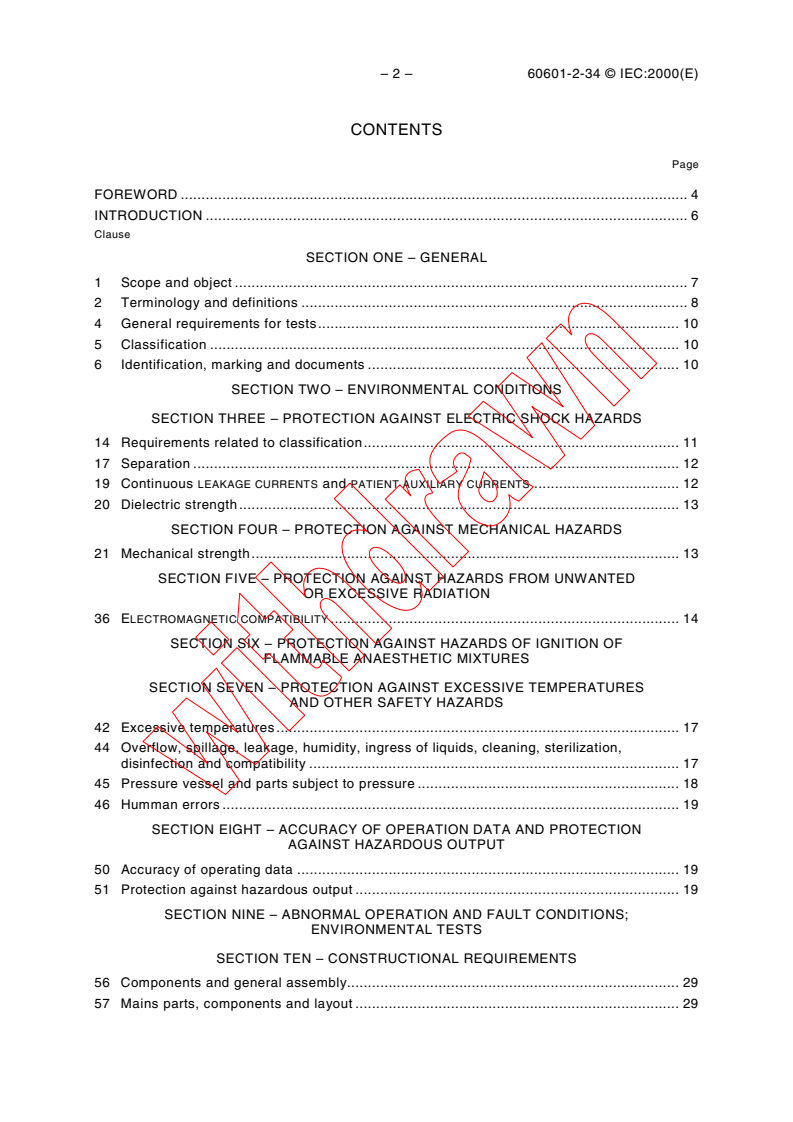
– 2 – 60601-2-34 © IEC:2000(E)
CONTENTS
Page
FOREWORD . 4
INTRODUCTION .6
Clause
SECTION ONE – GENERAL
1 Scope and object . 7
2 Terminology and definitions . 8
4 General requirements for tests. 10
5 Classification .10
6 Identification, marking and documents . 10
SECTION TWO – ENVIRONMENTAL CONDITIONS
SECTION THREE – PROTECTION AGAINST ELECTRIC SHOCK HAZARDS
14 Requirements related to classification. 11
17 Separation . 12
19 Continuous LEAKAGE CURRENTS and PATIENT AUXILIARY CURRENTS . 12
20 Dielectric strength. 13
SECTION FOUR – PROTECTION AGAINST MECHANICAL HAZARDS
21 Mechanical strength. 13
SECTION FIVE – PROTECTION AGAINST HAZARDS FROM UNWANTED
OR EXCESSIVE RADIATION
36 ELECTROMAGNETIC COMPATIBILITY. 14
SECTION SIX – PROTECTION AGAINST HAZARDS OF IGNITION OF
FLAMMABLE ANAESTHETIC MIXTURES
SECTION SEVEN – PROTECTION AGAINST EXCESSIVE TEMPERATURES
AND OTHER SAFETY HAZARDS
42 Excessive temperatures . 17
44 Overflow, spillage, leakage, humidity, ingress of liquids, cleaning, sterilization,
disinfection and compatibility . 17
45 Pressure vessel and parts subject to pressure . 18
46 Humman errors . 19
SECTION EIGHT – ACCURACY OF OPERATION DATA AND PROTECTION
AGAINST HAZARDOUS OUTPUT
50 Accuracy of operating data . 19
51 Protection against hazardous output . 19
SECTION NINE – ABNORMAL OPERATION AND FAULT CONDITIONS;
ENVIRONMENTAL TESTS
SECTION TEN – CONSTRUCTIONAL REQUIREMENTS
56 Components and general assembly. 29
57 Mains parts, components and layout . 29
60601-2-34 © IEC:2000(E) – 3 –
Annex AA (informative) Guidance and rationale for particular clauses and subclauses . 46
Annex BB (informative) ALARM diagrams . 55
INDEX of defined terms. 58
Bibliography . 59
Figure 101 – Measuring circuit for PATIENT LEAKAGE CURRENT via an F-TYPE (FLOATING)
earth caused by an external voltage on the APPLIED PART . 30
Figure 102 – Dynamic test for limitation of energy from different parts – Recovery test . 31
Figure 103 – Measuring circuit for the PATIENT LEAKAGE CURRENT from the APPLIED PART
to earth of CLASS I EQUIPMENT caused by an external voltage on the FUNCTIONAL
EARTH TERMINAL . 32
Figure 104 – Measuring circuit for the PATIENT LEAKAGE CURRENT from the APPLIED PART
to EARTH of INTERNALLY POWERED EQUIPMENT, caused by an external voltage on
a FUNCTIONAL EARTH TERMINAL. 33
Figure 105 – Clarification of leakage current tests . 34
Figure 106 – Diaphragm leak test. 35
Figure 107 – Over-pressure test. 35
Figure 108 – Test layout for conducted and radiated emission and radiated immunity test. 36
Figure 109 – Test circuit for high-frequency surgery interference measurement,
when the PATIENT isolation is in the monitor. 37
Figure 110 – Test circuit for HIGH-FREQUENCY surgery interference measurement, when
the PATIENT isolation is in the TRANSDUCER . 38
Figure 111 – Test set-up for HIGH-FREQUENCY SURGICAL EQUIPMENT
interference measurement. 39
Figure 112 – Test for accuracy of pressure measurements. 40
Figure 113 – Test for sensitivity, repeatability, non-linearity, drift and hysteresis. 41
Figure 114 – Pressure measurement system for accuracy of systolic and diastolic
pressure. 42
Figure 115 – Frequency response of EQUIPMENT and TRANSDUCER . 43
Figure 116 – Test for ALARM DELAY . 44
Figure 117 – Test for ALARM DELAY . 45
Figure AA.1 – Pressure TRANSDUCER error band . 54
– 4 – 60601-2-34 © IEC:2000(E)
INTERNATIONAL ELECTROTECHNICAL COMMISSION
––––––––––––
MEDICAL ELECTRICAL EQUIPMENT –
Part 2-34: Particular requirements for the safety,
including essential performance, of invasive blood
pressure monitoring equipment
FOREWORD
1) The IEC (International Electrotechnical Commission) is a worldwide organization for standardization comprising
all national electrotechnical committees (IEC National Committees). The o bject of the IEC is to promote
international co-operation on all questions concerning standardization in the electrical and electronic fields. To
this end a nd in addition to other activities, the IEC publishes International Standards. Their preparation is
entrusted to technical committees; any I EC National Committee interested in the subject dealt with may
participate in this preparatory work. International, governmental and non-governmental organizations liaising
with the IEC also participate in this preparation. The IEC collaborates closely with the International
Organization for Standardization (ISO) in accordance with conditions determined by agreement between the
two organizations.
2) The formal decisions or agreements of the IEC on t echnical matters express, as nearly as possible, an
international consensus of opinion on the relevant subjects since each technical committee has representation
from all interested National Committees.
3) The documents produced have the form of recommendations for international use and are published in the form
of standards, technical specifications, technical reports or g uides and they are accepted by the National
Committees in that sense.
4) In order to promote international unification, IEC National Committees undertake to apply IEC International
Standards transparently to the maximum extent possible in their national and regional standards. Any
divergence between the IEC Standard and the corresponding national or regional standard shall be clearly
indicated in the latter.
5) The IEC provides no marking procedure to indicate its approval and cannot be rendered responsible for any
equipment declared to be in conformity with one of its standards.
6) Attention is drawn to the possibility that some of the elements of this International Standard may be the subject
of patent rights. The IEC shall not be held responsible for identifying any or all such patent rights.
International Standard IEC 60601-2-34 has been prepared by subcommittee 62D:
Electromedical equipment, of IEC technical committee 62: Electrical equipment in medical
practice.
This second edition of IEC 60601-2-34 cancels and replaces the first edition published in
1994 and constitutes a technical revision.
The text of this standard is based on the following documents:
FDIS Report on voting
62D/367/FDIS 62D/373/RVD
Full information on the voting for the approval of this standard can be found in the report on
voting indicated in the above table.
This publication has been drafted in accordance with the ISO/IEC Directives, Part 3.
Annexes AA and BB are for information only.
60601-2-34 © IEC:2000(E) – 5 –
This Particular Standard amends and supplements IEC 60601-1 (second edition 1988):
Medical Electrical Equipment – Part 1: General Requirements for Safety, modified by
amendment 1 and amendment 2, hereinafter referred to as the General Standard. The
requirements of this Particular Standard take priority over those of the General Standard.
In this Particular Standard the following print types are used:
– requirements, compliance with which can be tested and definitions: in roman type;
– notes, explanations, advice, introductions, general statements, exceptions and references: in smaller type;
– test specifications, headings of subclauses and headings of items: in italic type:
– TERMS DEFINED IN CLAUSE 2 OF THE GENERAL STANDARD OR THIS PARTICULAR STANDARD: SMALL
CAPITALS.
The committee has decided that the contents of this publication will remain unchanged until
2005. At this date, the publication will be
• reconfirmed;
• withdrawn;
• replaced by a revised edition, or
• amended.
A bilingual version of this standard may be issued at a later date.
– 6 – 60601-2-34 © IEC:2000(E)
INTRODUCTION
The General Standard does not include requirements specific to the safety, including
essential performance, of DIRECT BLOOD PRESSURE MONITORING EQUIPMENT. Hence, changes
need to be made to include these unique requirements. This particular standard takes into
account Collateral Standard 60601-1-2:(1993) Electromagnetic compatibility and Collateral
Standard 60601-1-4:(1996) Medical electrical equipment incorporating programmable
electrical systems. A section on ALARMS has been included because ALARMS are necessary for
MONITORING EQUIPMENT.
60601-2-34 © IEC:2000(E) – 7 –
MEDICAL ELECTRICAL EQUIPMENT –
Part 2-34: Particular requirements for the safety,
including essential performance, of invasive blood
pressure monitoring equipment
SECTION ONE – GENERAL
The clauses and subclauses of this section of the General Standard apply except as follows:
1 Scope and object
This clause of the General Standard applies except as follows:
*1.1 Scope
Addition:
This Particular Standard applies to INVASIVE BLOOD PRESSURE MONITORING and m easuring
EQUIPMENT as defined in 2.101, hereinafter referred to as EQUIPMENT.
This Particular Standard does not apply to catheter tubing, catheter needles, Luer locks, taps
and tap tables.
This Particular Standard also does not apply to NON-INVASIVE BLOOD PRESSURE MONITORING
EQUIPMENT.
1.2 Object
Replacement:
The object of this Particular Standard is to establish particular requirements for the safety,
including the essential performance of EQUIPMENT, as defined in 2.101.
1.3 Particular Standards
Addition:
This Particular Standard refers to IEC 60601-1:1988, Medical electrical equipment – Part 1:
General requirements for safety as amended by its amendment 1 (1991) and its amendment 2
(1995).
The General Standard takes into account IEC 60601-1-2:1993, Medical electrical equipment –
Part 1: General requirements for safety – 2. Collateral Standard: Electromagnetic
compatibility – Requirements and tests and IEC 60601-1-4:1996, Medical electrical equipment
– Part 1: Collateral Standard: Programmable electrical medical systems.
For brevity, IEC 60601 is referred to in thi s Particular Standard either as the “General
Standard” or as the “General Requirement(s)”.
– 8 – 60601-2-34 © IEC:2000(E)
The numbering of sections, clauses or subclauses of this Particular Standard corresponds to
that of the General Standard. The changes to the text of the General Standard are specified
by the use of the following words:
“Replacement” means that the clause or subclause of the General Standard is replaced
completely by the text of this Particular Standard.
“Addition” means that the clause or subclause of this Particular Standard is additional to the
requirements of the General Standard.
“Amendment” means that the clause or subclause of the General Standard is amended as
indicated by the text of this Particular Standard.
Subclauses or figures which are additional to those of the General Standard are numbered
starting from 101, additional annexes are lettered AA, BB, etc, and additional items aa), bb),
etc.
The term “this Standard” is used to make reference to the General Standard and thi s
Particular Standard taken together.
An asterisk (*) notes clauses for which there is rationale comment in annex AA or annex BB. It
is considered that a knowledge of the reasons for these requirements will facilitate the proper
application of the standard and be of use in any revision that may be necessitated by changes
in clinical practice or as a result of developments in technology.
Where there is no corresponding section, clause or subclause in this Particular Standard, the
section, clause or subclause of the General Standard, although possibly not relevant, applies
without modification; where it is intended that any part of the General Standard, although
possibly relevant, is not to be applied, a statement to that effect is given in this Particular
Standard.
The requirements of this Particular Standard take priority over those of the General Standard
and of the Collateral Standards mentioned above.
2 Terminology and definitions
This clause of the General Standard applies except as follows:
2.1.5
APPLIED PART
Replacement:
The TRANSDUCER, including any fluid-filled system.
Additional definitions:
2.101
INVASIVE BLOOD PRESSURE MONITORING EQUIPMENT (EQUIPMENT)
stand-alone measuring equipment or part of a physiological monitoring or measuring system,
including associated TRANSDUCERS, that is used for the internal measurement of circulatory
system pressures
60601-2-34 © IEC:2000(E) – 9 –
2.102
TRANSDUCER
device for converting pressure into an electrical signal for monitoring or measuring
2.103
CATHETER TIP TRANSDUCER
TRANSDUCER mounted at, or close to, the tip of a catheter and intended for insertion into the
cardiovascular system
2.104
DOME
means for hydraulically coupling the PATIENT'S blood pressure to the TRANSDUCER, where a
TRANSDUCER external to the PATIENT is used
2.12.101
ALARM
signal which indicates abnormal events occurring to the PATIENT or EQUIPMENT
2.12.102
PHYSIOLOGICAL ALARM
signal which either indicates that a monitored physiological parameter is out of specified limits
or indicates an abnormal PATIENT condition
2.12.103
TECHNICAL ALARM
signal which indicates that the EQUIPMENT or part(s) of the EQUIPMENT are not capable of
accurately monitoring the PATIENT'S condition
2.12.104
SILENCING
stopping an auditory ALARM manifestation by manual action
2.12.105
SILENCING/RESET
stopping a visual and/or auditory ALARM manifestation and reenabling system response to an
abnormal PATIENT condition
2.12.106
INHIBITION
disabling or SILENCING and disabling an ALARM until revoked intentionally
2.12.107
SUSPENSION
disabling or SILENCING and disabling an ALARM temporarily
2.12.108
LATCHED ALARM
ALARM, the visual and auditory manifestation of which does not stop when the parameter
returns to a value which no longer exceeds the alarm limit or if the abnormal PATIENT condition
does not exist any longer
2.12.109
NON-LATCHED ALARM
ALARM, the visual and auditory manifestation of which stops when the parameter (which
caused the alarm) returns to a value which no longer exceeds the alarm limit or if the
abnormal PATIENT condition does not exist any longer
– 10 – 60601-2-34 © IEC:2000(E)
2.12.110
NOMINAL SENSITIVITY
ratio of the change in TRANSDUCER output to a change of the value of the pressure at any
selected pressure range
4 General requirements for tests
This clause of the General Standard applies except as follows:
*4.11 Sequence
Amendment:
Tests called for in 17 h), 17.101.1, 45.101 and 51.101 of this Particular Standard shall be
performed in that order prior to the LEAKAGE CURRENT and dielectric strength tests of C24 and
C25 of Appendix C of the General Standard.
5 Classification
This clause of the General Standard applies except as follows:
5.2 According to the degree of protection against electrical shock
Delete TYPE B and TYPE BF APPLIED PART.
5.6 According to the mode of operation
Amendment:
Delete all but CONTINUOUS OPERATION.
6 Identification, marking and documents
This clause of the General Standard applies except as follows:
6.1 Marking on the outside of EQUIPMENT or EQUIPMENT parts
aa) Addition:
If fulfilment of Type CF isolation depends on the TRANSDUCER then symbol No. 14, table D1,
IEC 60601-1, shall be marked on the EQUIPMENT.
*6.8.2 Instructions for use
Additional items:
aa) Supplementary instructions for use
Advice shall be provided for the following:
1) The connection of the TRANSDUCER and ACCESSORIES, the pressure calibration of the
TRANSDUCER and suggested means for removing entrapped air from the hydraulic
system connected to the TRANSDUCER.
60601-2-34 © IEC:2000(E) – 11 –
2) The safe use of TRANSDUCERS and ACCESSORIES and also on their choice, where the use
of other parts could degrade the safety of the EQUIPMENT. In particular, if fulfilment of
TYPE CF depends on the TRANSDUCER, then the ACCOMPANYING DOCUMENTS must include
the recommended types of TRANSDUCERS.
3) The need for the OPERATOR to avoid conductive connection to the APPLIED PART likely to
degrade safety. (For example, by not contacting metal cocks, if used.)
4) The type of electrical installation to which the EQUIPMENT may be safely connected,
including the connection to any POTENTIAL EQUALIZATION CONDUCTOR terminal on the
EQUIPMENT, if provided.
5) If parts of the TRANSDUCERS or EQUIPMENT are provided with protective means against
hazards to the PATIENT when used with HIGH-FREQUENCY SURGICAL EQUIPMENT, such
means shall be drawn to the attention of the OPERATOR. If such means are absent,
notice shall be given in the ACCOMPANYING DOCUMENTS.
6) The action to be taken following accidental wetting of the EQUIPMENT.
7) Description of those parts of the EQUIPMENT that are protected against the effects of a
discharge of a cardiac defibrillator.
8) Any precautions specific to the EQUIPMENT to be taken when a defibrillator is used on a
PATIENT and on any effects on the EQUIPMENT of the effects of a discharge of a cardiac
defibrillator.
9) A warning that single-use devices are not to be reused.
*10) TRANSDUCER or ACCESSORIES supplied as sterile shall be identified as sterile.
*11) If appropriate, an indi cation of the time limit for safe use of the TRANSDUCER and
ACCESSORIES, expressed as the year and month.
12) If the EQUIPMENT has to be connected to other devices in order to achieve its intended
purpose, sufficient details of its characteristics to identify correctly the devices
necessary for safe operation.
*13) Precautions to be taken in the event of changes in performance of the device as a result
of ageing and environmental conditions.
14) The warm-up time for the TRANSDUCER and EQUIPMENT if greater than 15 s.
*15) The volume displacement in mm /100 mm Hg for any TRANSDUCER and/or DOME that is
supplied with the EQUIPMENT.
SECTION TWO – ENVIRONMENTAL CONDITIONS
The clauses and subclauses of this section of the General Standard apply.
SECTION THREE – PROTECTION AGAINST ELECTRIC SHOCK HAZARDS
The clauses and subclauses of this section of the General Standard apply except as follows:
14 Requirements related to classification
This clause of the General Standard applies except as follows:
14.6 Replacement:
The APPLIED PART shall be TYPE CF.
14.8 The EQUIPMENT shall have DEFIBRILLATOR PROOF APPLIED PARTS.
– 12 – 60601-2-34 © IEC:2000(E)
17 Separation
This clause of the General Standard applies except as follows:
17 h)
Addition:
a) The ENCLOSURE excluding accessible conductive parts in the hydraulic circuit beyond the
DOME.
Addition:
Compliance shall be checked by testing in accordance with figure 102. The requirement is
met when after operation of S1, the peak voltage between the points Y1 and Y2 does not
exceed 1 V.
– The diaphragm of the DOME shall be removed, destructively if necessary.
– Disposable TRANSDUCERS and CATHETER TIP TRANSDUCERS shall be tested intact and
complete.
Repeat the test with the 5 kV supply (V1) reversed.
After this test the EQUIPMENT shall be capable of meeting all requirements and tests of this
Particular Standard and shall function normally (see also 51.101).
17.101.1 Following the test of 17 h), the DOME shall be replaced with one having an intact
diaphragm and the test shall then be repeated. The diaphragm shall not have been punctured
during the test.
Compliance shall be checked by performing the test as described in figure 106 with the air
pressure being applied gradually over about 1/2 s and held for about 10 s, and by noting the
absence of bubbles.
19 Continuous LEAKAGE CURRENTS and PATIENT AUXILIARY CURRENTS
This clause of the General Standard applies except as follows:
*19.3 Allowable values
Addition:
aa) For EQUIPMENT having a FUNCTIONAL EARTH TERMINAL, the PATIENT LEAKAGE CURRENT
flowing from the APPLIED PART to EARTH shall be no greater than 0,05 mA, when a voltage
equal to 110 % of the highest RATED MAINS VOLTAGE is applied between the FUNCTIONAL
EARTH TERMINAL and earth.
The following test shall not be performed when the FUNCTIONAL EARTH TERMINAL is connected
direct to the PROTECTIVE EARTH TERMINAL inside the EQUIPMENT.
Compliance shall be checked by measurement according to figures 103 and 104.
DOME
All tests shall be performed with any reusable and/or disposable removed.
60601-2-34 © IEC:2000(E) – 13 –
Disposable TRANSDUCERS and CATHETER TIP TRANSDUCERS shall be tested intact and complete,
in which case the EQUIPMENT shall be further tested with a reusable TRANSDUCER (where the
F-TYPE APPLIED PART isolation is accomplished in the input circuits of the EQUIPMENT) from
which the reusable or disposable DOME has been removed.
19.4 Tests
a) General
1) Addition:
All tests shall be made with any disposable DOME removed. Disposable and CATHETER TIP
TRANSDUCERS shall be tested complete and intact.
For the MAINS VOLTAGE on the APPLIED PART test, see figure 101. A m ore pictorial
representation providing additional clarification is shown in figure 105.
h) Measurement of the PATIENT LEAKAGE CURRENT
Addition:
All tests are made with any disposable DOME removed. Disposable and CATHETER TIP
TRANSDUCERS are tested complete and intact.
2) Amendment:
ACCESSIBLE CONDUCTIVE PARTS in the hydraulic circuit beyond the DOME and parts within the
cardiovascular system in NORMAL USE are excluded.
20 Dielectric strength
This clause of the General Standard applies except as follows:
20.2 Requirements for EQUIPMENT with an APPLIED PART
*20.3 Values of test voltage
Amendment:
B-d for EQUIPMENT the test voltage shall be 1 500 V (CLASS I, II and INTERNALLY POWERED
EQUIPMENT)
SECTION FOUR – PROTECTION AGAINST MECHANICAL HAZARDS
The clauses and subclauses of this section of the General Standard apply except as follows:
21 Mechanical strength
This clause of the General Standard applies except as follows:
– 14 – 60601-2-34 © IEC:2000(E)
*21.5 Mechanical strength – Free fall
Addition:
The TRANSDUCER, if separable from the EQUIPMENT by the OPERATOR, without its DOME if
removable, shall not present a safety hazard after a free fall from a height of 1 m onto a hard
surface.
Compliance shall be checked by the following test:
The TRANSDUCER sample to be tested is allowed to fall freely once from each of three different
attitudes from a height of 1 m onto a 50 mm thick hardwood board (for example, hardwood
> 600 kg/m ) which lies flat on a rigid base (concrete block).
SECTION FIVE – PROTECTION AGAINST HAZARDS FROM UNWANTED
OR EXCESSIVE RADIATION
The clauses and subclauses of this section of the General Standard apply except as follows:
Addition:
36 ELECTROMAGNETIC COMPATIBILITY
IEC 60601-1-2 applies except as follows:
*36.201 Emission
36.201.1.1
Replacement:
The EQUIPMENT shall comply with the requirements of CISPR 11, Group 1, Class A or Class B,
depending on the environment of intended use.
The INSTRUCTIONS FOR USE shall specify where the EQUIPMENT is to be used.
*36.201.1.7
Replacement:
The EQUIPMENT shall be tested with one of the TRANSDUCER(S) that is specified by the
manufacturer (see 36.202.2.2a and figure 108).
The EQUIPMENT shall comply with the test requirements for any TRANSDUCER specified by the
manufacturer.
NOTE This may be established either by testing or constructional equivalence.
SIGNAL INPUT SIGNAL OUTPUT EQUIPMENT
and cables (if applicable) shall be attached to the
during the test.
60601-2-34 © IEC:2000(E) – 15 –
*36.202 Immunity
Addition to paragraph 4:
Compliance is checked by the following test:
– Setup the EQUIPMENT and TRANSDUCER as outlined in figure 108.
– Balance the TRANSDUCER to obtain zero pressure at zero pressure input.
– Expose the EQUIPMENT and TRANSDUCER sequentially to the specified disturbances
(radiofrequency, transients, magnetic) at any NOMINAL SENSITIVITY.
The EQUIPMENT shall not change the operating state, lose or change any stored data, generate
errors in control software that cause an unintended change in output, or cause errors in blood
pressure readings that are outside of the manufacturer’s specifications. These criteria do not
apply to ESD testing.
36.202.1 Electrostatic discharge
Replacement:
A level of 6 kV shall apply for contact discharge to conductive ACCESSIBLE PARTS and coupling
planes.
A level of 8 kV shall apply for air discharge to non-conductive ACCESSIBLE PARTS.
Addition:
The EQUIPMENT shall return to the previous operating mode within 10 s without loss of any
stored data.
36.202.2 Radiated radiofrequency electromagnetic fields
36.202.2.1 a)
Replacement:
1a) The EQUIPMENT shall comply with IEC 61000-4-3.
36.202.2.1 d)
Replacement:
A level of 3 V/m shall apply.
36.202.2.2 a) Test conditions
Replacement:
The EQUIPMENT shall be exposed to an RF field that is 80 % modulated with a sine wave
between 1 Hz and 5 Hz. The TRANSDUCER cable, if longer than 1 m, shall be shortened to 1 m
as shown in figure 108. The signal cable (if applicable) and mains cable shall be arranged
horizontally and vertically from the EQUIPMENT (figure 108).
The EQUIPMENT shall comply with the test requirements for any TRANSDUCER specified by the
manufacturer.
– 16 – 60601-2-34 © IEC:2000(E)
36.202.3 Transients
Addition:
The EQUIPMENT shall return to the previous operating mode within 10 s without the loss of any
stored data.
36.202.5 Conducted disturbances, induced by radiofrequency fields above 9 kHz
When exposed to conducted electromagnetic fields, via the POWER SUPPLY CORD, the
EQUIPMENT shall operate within normal specifications.
The test methods and instruments shall be as described in IEC 61000-4-6.
The noise voltage that is injected into the MAINS VOLTAGE input shall be 3 V r.m.s. over the
frequency range of 150 kHz to 80 MHz. It shall be modulated at 80 % amplitude modulation at
any single frequency within the range 1 Hz to 5 Hz.
36.202.6 Magnetic fields
Addition:
The EQUIPMENT shall be exposed to an a.c. magnetic field at the power line frequency or
frequencies as specified by the manufacturer according to IEC 61000-4-8.
There is to be no loss of system performance or functionality.
Magnetic field intensity: 3 A/m
The EQUIPMENT shall be exposed on all its faces.
The EQUIPMENT shall operate within the NORMAL limits of this standard when exposed to these
fields.
*36.202.7 Electrosurgery interference
If the EQUIPMENT has been used together with HIGH-FREQUENCY SURGICAL EQUIPMENT it shall
return to the previous operating mode within 10 s after exposure to the field produced by a
HIGH-FREQUENCY SURGICAL EQUIPMENT without loss of any stored data.
Compliance shall be tested according to figures 109, 110 and 111. If the TYPE CF isolation is in
the TRANSDUCER, the compliance test shall be according to figures 110 and 111.
The HIGH-FREQUENCY SURGICAL EQUIPMENT which is used shall comply with IEC 60601-2-2,
shall have 300 W of minimum power cut mode capability, 100 W of minimum power
coagulating mode capability, and a working frequency of 450 kHz ± 100 kHz.
a) Test in cut mode
Set the blood pressure monitor to a range of 120 mm Hg to 150 mm Hg and the output power
of the HIGH-FREQUENCY SURGICAL EQUIPMENT to the 300 W setting. The monitor shall be
calibrated with the zero line visible. Any filter shall be in a wideband position.
Touch the metal contact/block in the test set-up (see figures 109 and 110) with the active
electrode and remove the electrode slowly to get a spark.
60601-2-34 © IEC:2000(E) – 17 –
Repeat the procedure as described five times. Immediately after the operation S1 shall be
opened. The test signal shall be recorded/displayed within 10 s.
b) Test in the coagulation mode
Repeat the test in item a) except with a maximum output power of 100 W.
Test of the spray coagulation mode is excluded.
SECTION SIX – PROTECTION AGAINST HAZARDS OF IGNITION
OF FLAMMABLE ANAESTHETIC MIXTURES
The clauses and subclauses of this section of the General Standard apply.
SECTION SEVEN – PROTECTION AGAINST EXCESSIVE TEMPERATURES
AND OTHER SAFETY HAZARDS
The clauses and subclauses of this section of the General Standard apply except as follows:
42 Excessive temperatures
This clause of the General Standard applies except as follows:
42.5 Guards
Amendment:
This subclause does not apply to any heated stylus or printing element of the EQUIPMENT.
44 Overflow, spillage, leakage, humidity, ingress of liquids,
cleaning, sterilization, disinfection and compatibility
This clause of the General Standard applies except as follows:
*44.3 Spillage
Replacement:
The EQUIPMENT shall be so constructed that, in the event of spillage of liquids (accidental
wetting), no safety hazard shall result.
Compliance shall be checked by the following test:
A test pressure is applied to the TRANSDUCER sufficient to produce 50 % of fu ll-scale
deflection at any NOMINAL SENSITIVITY. The pressure and the resultant deflection (output) are
noted and the EQUIPMENT switched off.
The EQUIPMENT shall then be placed in the least favourable position of NORMAL use and
subjected to 30 s of artificial rainfall of 3 mm/min falling vertically from a height of 0,5 m
above the top of the EQUIPMENT. A test apparatus is shown in figure 3 of IEC 60529.
An intercepting device may be used to determine the duration of the test. Immediately after
the 30 s exposure, visible moisture on the ENCLOSURE shall be removed.
– 18 – 60601-2-34 © IEC:2000(E)
Immediately after the above test, inspection shall show th at any water which may have
entered the equipment cannot adversely affect the safety of the EQUIPMENT. In case of doubt,
the EQUIPMENT shall be capable of meeting the relevant dielectric strength tests specified in
20.1 to 20.4 of the General Standard followed by the functional test described below.
The same test pressure as before is applied again to the TRANSDUCER. The deflection shall be
the same as that noted at the beginning of this test, the tolerance allowed by the specification
in the ACCOMPANYING DOCUMENTS.
If the EQUIPMENT forms part of a medical electrical system, then the system and the
EQUIPMENT shall not be subjected to the above test, unless the EQUIPMENT or part of the
EQUIPMENT is separable from the system while remaining functional, in which case the said
EQUIPMENT or parts of the EQUIPMENT shall be subjected to the above test.
44.6 Ingress of liquids
Replacement:
TRANSDUCERS and EQUIPMENT parts containing insulation, the failure of which could result in a
safety hazard or changes in essential aspects of performance according to this standard, and
which in NORMAL USE are subject to immersion in liquids, shall be watertight according to IPX7
of IEC 60529. Connectors are excluded from this requirement. After the test all requirements
of this Particular Standard shall be satisfied. The test need not be performed if examination of
the construction and circuit arrangement shows that no safety hazard is possible.
45 Pressure vessel and parts subject to pressure
This part of the General Standard applies except as follows:
*45.101 Additional subclause
a) Pressure above atmospheric
The TRANSDUCER with reusable and/or disposable DOME, if a pplicable, shall withstand a
pressure of 500 kPa (4 000 mm Hg) above standard atmospheric pressure applied gradually
over approximately 1/2 s and held for approximately 1 s.
The test shall be as in figure 107 and shall be repeated once within 10 s.
The requirements of this test do not apply to CATHETER TIP TRANSDUCERS.
b) Pressures below atmospheric
TRANSDUCER DOME
The , with reusable and/or disposable , if applicable, shall withstand a
pressure of 50 kPa (400 mm Hg) below standard atmospheric pressure, applied gradually
over approximately 0,5 s and held for approximately 1 s.
The test shall be as in figure 107 and shall be repeated once within 10 s.
After these tests the requirements of this Particular Standard shall be satisfied (see 4.11).
The requirements of this test do not apply to CATHETER TIP TRANSDUCERS.
60601-2-34 © IEC:2000(E) – 19 –
46 Human errors
*46.101 Additional subclause
The DOME shall be transparent.
Compliance shall be checked by ensuring that small air bubbles in water or saline solution are
visible through the DOME.
46.102 Additional subclause
Means shall be provided to reduce the likelihood of unintended operation of the zeroing
control.
Compliance is tested by inspection.
SECTION EIGHT – ACCURACY OF OPERATION DATA AND
PROTECTION AGAINST HAZARDOUS OUTPUT
The clauses and subclauses of this section of the General Standard apply except as follows:
50 Accuracy of operating data
Addition:
50.101 Software
Collateral Standard IEC 60601-1-4 is to be applied.
51 Protection against hazardous output
This clause of the General Standard applies except as follows:
Addition:
*51.101 Recovery time following a defibrillator discharge
After the discharge of a cardiac defibrillator, the EQUIPMENT shall function within 10 s.
Compliance shall be checked by applying a test pressure to the TRANSDUCER sufficient to
produce 30 % to 70 % of full-scale deflection (output) at any NOMINAL SENSITIVITY.
While the pressure is maintained, the EQUIPMENT is subjected to a test discharge. Figure 102
shall be used as the test arrangement under the following conditions:
CLASS I EQUIPMENT
– The PROTECTIVE EARTH TERMINAL and any FUNCTIONAL EARTH TERMINAL shall be connected
to the protective earth terminal of the test circuit.
CLASS II EQUIPMENT and INTERNALLY POWERED EQUIPMENT
ACCESSIBLE CONDUCTIVE PART FUNCTIONAL EARTH TERMINAL
– Foil and any not connected to
and any FUNCTIONAL EARTH TERMINAL shall be connected to the PROTECTIVE EARTH TERMINAL
of the test circuit.
– 20 – 60601-2-34 © IEC:2000(E)
The deflection (output) shall be within 20 % of the preset deflection (output) within 5 s after
the discharge.
The deflection (output) shall be within these limits for at least a further 30 s.
*51.102 Accuracy of pressure measurement
51.102.1 Sensitivity, repeatability, non-linearity, drift and hysteresis
The combined effects of sensitivity, repeatability, non-linearity, drift and hysteresis shall be
within ±4 % of reading or ±0,5 kPa (±4 mm Hg), whichever is greater. Corrections of the
results for changes in barometric pressure during testing are applied to the tests.
Compliance shall be checked as follows (see figure 112 for the test configuration and
figure 113 for the test sequence):
The test shall be repeated for each TRANSDUCER specified by the manufacturer.
For all but CATHETER TIP TRANSDUCERS
Energize the EQUIPMENT.
1) Equilibrate the TRANSDUCER and EQUIPMENT at 25 °C ± 1 °C for 2 h. The TRANSDUCER and
its hydraulic parts are filled with water.
2) Balance the TRANSDUCER to obtain zero pressure output with zero pressure input. Note
the barometric pressure.
3) Using a pr essure source referenced to atmospheric pressure with a combined non-
linearity and hysteresis error of ±0,1 % of full scale, apply pressures as a percentage of
the largest full-scale pressure range of 0, 10, 20, 50, 80, 100, 80, 50, 20, 10, 0, –10, –15,
and 0 %. The output pressure shall be within ±4 % of r eading or ±0,5 kPa (±4 mm Hg),
whichever is greater, compared to the reference measurement.
4) Equilibrate the TRANSDUCER and EQUIPMENT for 2 h at 15 °C ± 1 °C. Apply pressure as
in 3). Note the barometric pressure and apply correction prior to determining compliance.
TRANSDUCER EQUIPMENT
5) Equilibrate the and for 2 h at 25 °C ± 1 °C. Apply pressure as
in 3). Note the barometric pressure and apply correction prior to determining compliance.
6) Equilibrate the TRANSDUCER and EQUIPMENT for 2 h at 35 °C ± 1 °C. Apply pressure as
in 3). Note the barometric pressure and apply correction prior to determining compliance.
7) Equilibrate the TRANSDUCER and EQUIPMENT for 2 h at 25 °C ± 1 °C. Apply pressure as
in 3). Note the barometric pressure and apply correction prior to determining compliance.
For CATHETER TIP TRANSDUCERS (see figure 113 for test sequence)
8) Follow 1).
9) Follow 2).
10) Follow 3).
11) Follow 4) but use a temperature of 35 °C ± 1 °C.
12) Remain at 35 °C ± 1 °C for 4 h. Apply pressure as in 3). Note the barometric pressure
and apply correction prior to determining compliance.
13) Follow 5). Apply pressure as in 3). Note the barometric pressure and apply correction
prior to determining compliance.
60601-2-34 © IEC:2000(E) – 21 –
51.102.2 Accuracy of systolic and diastolic pressure
The accuracy of systolic and diastolic pressures shall be within 0,5 kPa (±4 mm Hg) at a
frequency of 1 Hz.
Refer to figure 114. Although actual pressure sources are shown, any equivalent means of
generating simulated pressures may be used.
Compliance is to be checked as follows:
1) Using static pressure, calibrate the reference pressure measuring system (RPMS) using
an output display device with at least 1 % accuracy and that can display a 1 Hz waveform.
2) Apply static pressure only until the RPMS output display device reads 90 mm Hg peak.
3) With the static pressure applied, apply a 1 Hz sine-wave pressure until the output display
device reads 120 mm Hg for the upper peak pressure and 60 mm Hg for the lower peak
pressure. Peak-to-peak pressure is 60 mm Hg.
The RPMS then has a systolic pressure of 120 mm Hg and a diastolic pressure of 60 mm Hg.
4) After static calibration of the EQUIPMENT under test, it shall have readings of 120 mm Hg ±
4 mm Hg for systolic pressure and 60 mm Hg ± 4 mm Hg for diastolic pressure.
*51.103 Frequency response
The frequency response of the EQUIPMENT and TRANSDUCER shall be at least from d.c. to 10 Hz.
Compliance shall be checked by connection of a sinusoidal pressure source to the EQUIPMENT
as shown in figure 115. The sinuso
...
IEC 60601-2-34
Edition 2.0 2000-10
INTERNATIONAL
STANDARD
NORME
INTERNATIONALE
Medical electrical equipment –
Part 2-34: Particular requirements for the safety, including esssential
performance, of invasive blood pressure monitoring equipment
Appareils électromédicaux –
Partie 2-34: Règles particulières de sécurité et de performances essentielles
pour les appareils de surveillance de la pression sanguine prélevée directement
All rights reserved. Unless otherwise specified, no part of this publication may be reproduced or utilized in any form or by
any means, electronic or mechanical, including photocopying and microfilm, without permission in writing from either IEC or
IEC's member National Committee in the country of the requester.
If you have any questions about IEC copyright or have an enquiry about obtaining additional rights to this publication,
please contact the address below or your local IEC member National Committee for further information.
Droits de reproduction réservés. Sauf indication contraire, aucune partie de cette publication ne peut être reproduite
ni utilisée sous quelque forme que ce soit et par aucun procédé, électronique ou mécanique, y compris la photocopie
et les microfilms, sans l'accord écrit de la CEI ou du Comité national de la CEI du pays du demandeur.
Si vous avez des questions sur le copyright de la CEI ou si vous désirez obtenir des droits supplémentaires sur cette
publication, utilisez les coordonnées ci-après ou contactez le Comité national de la CEI de votre pays de résidence.
IEC Central Office
3, rue de Varembé
CH-1211 Geneva 20
Switzerland
Email: inmail@iec.ch
Web: www.iec.ch
About the IEC
The International Electrotechnical Commission (IEC) is the leading global organization that prepares and publishes
International Standards for all electrical, electronic and related technologies.
About IEC publications
The technical content of IEC publications is kept under constant review by the IEC. Please make sure that you have the
latest edition, a corrigenda or an amendment might have been published.
ƒ Catalogue of IEC publications: www.iec.ch/searchpub
The IEC on-line Catalogue enables you to search by a variety of criteria (reference number, text, technical committee,…).
It also gives information on projects, withdrawn and replaced publications.
ƒ IEC Just Published: www.iec.ch/online_news/justpub
Stay up to date on all new IEC publications. Just Published details twice a month all new publications released. Available
on-line and also by email.
ƒ Electropedia: www.electropedia.org
The world's leading online dictionary of electronic and electrical terms containing more than 20 000 terms and definitions
in English and French, with equivalent terms in additional languages. Also known as the International Electrotechnical
Vocabulary online.
ƒ Customer Service Centre: www.iec.ch/webstore/custserv
If you wish to give us your feedback on this publication or need further assistance, please visit the Customer Service
Centre FAQ or contact us:
Email: csc@iec.ch
Tel.: +41 22 919 02 11
Fax: +41 22 919 03 00
A propos de la CEI
La Commission Electrotechnique Internationale (CEI) est la première organisation mondiale qui élabore et publie des
normes internationales pour tout ce qui a trait à l'électricité, à l'électronique et aux technologies apparentées.
A propos des publications CEI
Le contenu technique des publications de la CEI est constamment revu. Veuillez vous assurer que vous possédez
l’édition la plus récente, un corrigendum ou amendement peut avoir été publié.
ƒ Catalogue des publications de la CEI: www.iec.ch/searchpub/cur_fut-f.htm
Le Catalogue en-ligne de la CEI vous permet d’effectuer des recherches en utilisant différents critères (numéro de référence,
texte, comité d’études,…). Il donne aussi des informations sur les projets et les publications retirées ou remplacées.
ƒ Just Published CEI: www.iec.ch/online_news/justpub
Restez informé sur les nouvelles publications de la CEI. Just Published détaille deux fois par mois les nouvelles
publications parues. Disponible en-ligne et aussi par email.
ƒ Electropedia: www.electropedia.org
Le premier dictionnaire en ligne au monde de termes électroniques et électriques. Il contient plus de 20 000 termes et
définitions en anglais et en français, ainsi que les termes équivalents dans les langues additionnelles. Egalement appelé
Vocabulaire Electrotechnique International en ligne.
ƒ Service Clients: www.iec.ch/webstore/custserv/custserv_entry-f.htm
Si vous désirez nous donner des commentaires sur cette publication ou si vous avez des questions, visitez le FAQ du
Service clients ou contactez-nous:
Email: csc@iec.ch
Tél.: +41 22 919 02 11
Fax: +41 22 919 03 00
IEC 60601-2-34
Edition 2.0 2000-10
INTERNATIONAL
STANDARD
NORME
INTERNATIONALE
Medical electrical equipment –
Part 2-34: Particular requirements for the safety, including esssential
performance, of invasive blood pressure monitoring equipment
Appareils électromédicaux –
Partie 2-34: Règles particulières de sécurité et de performances essentielles
pour les appareils de surveillance de la pression sanguine prélevée directement
INTERNATIONAL
ELECTROTECHNICAL
COMMISSION
COMMISSION
ELECTROTECHNIQUE
PRICE CODE
INTERNATIONALE
XA
CODE PRIX
ICS 11.040.55 ISBN 2-8318-8254-0
– 2 – 60601-2-34 © CEI:2000
SOMMAIRE
AVANT-PROPOS .6
INTRODUCTION.10
SECTION UN – GÉNÉRALITÉS
1 Domaine d'application et objet .12
2 Terminologie et définitions .14
4 Exigences générales relatives aux essais .18
5 Classification .18
6 Identification, marquage et documentation .18
SECTION DEUX – CONDITIONS D'ENVIRONNEMENT
SECTION TROIS – PROTECTION CONTRE LES RISQUES DE CHOCS ÉLECTRIQUES
14 Exigences relatives à la classification .20
17 Séparation.22
19 COURANTS DE FUITE permanents et COURANTS AUXILLIAIRES PATIENT.22
20 Tension de tenue .24
SECTION QUATRE – PROTECTION CONTRE LES RISQUES MÉCANIQUES
21 Résistance mécanique.24
SECTION CINQ – PROTECTION CONTRE LES RISQUES DUS AUX RAYONNEMENTS
NON DÉSIRÉS OU EXCESSIFS
36 Compatibilité électromagnétique .26
SECTION SIX – PROTECTION CONTRE LES RISQUES D'IGNITION
DE MÉLANGES ANESTHÉSIQUES INFLAMMABLES
SECTION SEPT – PROTECTION CONTRE LES TEMPÉRATURES EXCESSIVES
ET AUTRES RISQUES
42 Températures excessives.32
44 Débordements, renversements, fuites, humidité, pénétration de liquides, nettoyage,
stérilisation, désinfection et compatibilité .32
45 Réservoir sous pression et parties sous pression .34
46 Erreurs humaines .34
SECTION HUIT – PRÉCISION DES CARACTÉRISTIQUES DE FONCTIONNEMENT
ET PROTECTION CONTRE LES CARACTÉRISTIQUES DE FONCTIONNEMENT
PRÉSENTANT DES RISQUES
50 Précision des caractéristiques de fonctionnement .36
51 Protection contre les caractéristiques de sortie présentant des risques.36
SECTION NEUF – FONCTIONNEMENT ANORMAL ET CONDITIONS DE DÉFAUT;
ESSAIS D'ENVIRONNEMENT
SECTION DIX – RÈGLES DE CONSTRUCTION
60601-2-34 © IEC:2000 – 3 –
CONTENTS
FOREWORD.7
INTRODUCTION.11
SECTION ONE – GENERAL
1 Scope and object.13
2 Terminology and definitions.15
4 General requirements for tests .19
5 Classification.19
6 Identification, marking and documents.19
SECTION TWO – ENVIRONMENTAL CONDITIONS
SECTION THREE – PROTECTION AGAINST ELECTRIC SHOCK HAZARDS
14 Requirements related to classification .21
17 Separation.23
19 Continuous LEAKAGE CURRENTS and PATIENT AUXILIARY CURRENTS .23
20 Dielectric strength.25
SECTION FOUR – PROTECTION AGAINST MECHANICAL HAZARDS
21 Mechanical strength .25
SECTION FIVE – PROTECTION AGAINST HAZARDS FROM UNWANTED
OR EXCESSIVE RADIATION
36 Electromagnetic compatibility.27
SECTION SIX – PROTECTION AGAINST HAZARDS OF IGNITION OF
FLAMMABLE ANAESTHETIC MIXTURES
SECTION SEVEN – PROTECTION AGAINST EXCESSIVE TEMPERATURES
AND OTHER SAFETY HAZARDS
42 Excessive temperatures.33
44 Overflow, spillage, leakage, humidity, ingress of liquids, cleaning, sterilization,
disinfection and compatibility.33
45 Pressure vessel and parts subject to pressure.35
46 Humman errors.35
SECTION EIGHT – ACCURACY OF OPERATION DATA AND PROTECTION
AGAINST HAZARDOUS OUTPUT
50 Accuracy of operating data .37
51 Protection against hazardous output.37
SECTION NINE – ABNORMAL OPERATION AND FAULT CONDITIONS;
ENVIRONMENTAL TESTS
SECTION TEN – CONSTRUCTIONAL REQUIREMENTS
– 4 – 60601-2-34 © CEI:2000
56 Composants et ensembles.56
57 Parties reliées au réseau, composants et montage.56
Annexe AA (informative) Guide et justifications des articles et paragraphes particuliers .90
Annexe BB (informative) Schémas d'ALARMES. 108
INDEX des termes définis . 114
Bibliographie . 116
FIGURE 101 – Circuit de mesure du COURANT DE FUITE PATIENT via une terre de TYPE-F
(FLOTTANTE) dû à une tension externe sur la PARTIE APPLIQUEE.58
FIGURE 102 – Essai dynamique de limitation de l'énergie issue de différentes parties –
Essai de rétablissement .60
FIGURE 103 – Circuit de mesure du COURANT DE FUITE PATIENT s'écoulant d'une PARTIE
APPLIQUEE vers la terre d'un APPAREIL DE LA CLASSE I dû à une tension externe sur la
BORNE DE TERRE FONCTIONNELLE. .62
FIGURE 104 – Circuit de mesure du COURANT DE FUITE PATIENT s'écoulant de la PARTIE
APPLIQUEE vers la TERRE D'UN APPAREIL A SOURCE ELECTRIQUE INTERNE dû à une tension
externe sur la BORNE DE TERRE FONCTIONNELLE .64
FIGURE 105 – Explication des essais de courant de fuite .66
FIGURE 106 – Essai de fuite de diaphragme .68
FIGURE 107 – Essai de surpression .68
FIGURE 108 – Montage d'essai pour les émissions conduites et rayonnées et essai
d'immunité aux rayonnements .70
FIGURE 109 – Circuit d'essai pour la mesure des interférences des appareils
chirurgicaux à haute fréquence lorsque l'isolation du PATIENT est dans le moniteur .72
FIGURE 110 – Circuit d'essai pour la mesure des interférences chirurgicales à haute
fréquence lorsque l'isolation du PATIENT est dans le TRANSDUCTEUR.74
FIGURE 111 – Montage d'essai pour la mesure des interférences des APPAREILS
CHIRURGICAUX A HAUTE FREQUENCE.76
FIGURE 112 – Essai pour la précision des mesures de pression.78
FIGURE 113 – Essai de la sensibilité, de la répétabilité, de la dérive et de l'hystérésis.80
FIGURE 114 – système de mesure de la pression pour précision de la pression
systolique et diastolique .82
FIGURE 115 – réponse en fréquence des APPAREILS et TRANSDUCTEURS.84
FIGURE 116 – Essai de TEMPORISATION D'ALARME .86
FIGURE 117 – Essai de TEMPORISATION D'ALARME .88
FIGURE AA.1 – Bande d'erreur du TRANSDUCTEUR de pression . 106
60601-2-34 © IEC:2000 – 5 –
56 Components and general assembly .57
57 Mains parts, components and layout.57
Annex AA (informative) Guidance and rationale for particular clauses and subclauses.91
Annex BB (informative) ALARM diagrams.109
INDEX of defined terms .115
Bibliography.117
Figure 101 – Measuring circuit for PATIENT LEAKAGE CURRENT via an F-TYPE (FLOATING)
earth caused by an external voltage on the APPLIED PART .59
Figure 102 – Dynamic test for limitation of energy from different parts – Recovery test.61
Figure 103 – Measuring circuit for the PATIENT LEAKAGE CURRENT from the APPLIED PART
to earth of CLASS I EQUIPMENT caused by an external voltage on the FUNCTIONAL
EARTH TERMINAL.63
Figure 104 – Measuring circuit for the PATIENT LEAKAGE CURRENT from the APPLIED PART
to EARTH of INTERNALLY POWERED EQUIPMENT, caused by an external voltage on
a FUNCTIONAL EARTH TERMINAL .65
Figure 105 – Clarification of leakage current tests .67
Figure 106 – Diaphragm leak test .69
Figure 107 – Over-pressure test .69
Figure 108 – Test layout for conducted and radiated emission and radiated immunity
test .71
Figure 109 – Test circuit for high-frequency surgery interference measurement,
when the PATIENT isolation is in the monitor .73
Figure 110 – Test circuit for HIGH-FREQUENCY surgery interference measurement, when
the PATIENT isolation is in the TRANSDUCER .75
Figure 111 – Test set-up for HIGH-FREQUENCY SURGICAL EQUIPMENT
interference measurement .77
Figure 112 – Test for accuracy of pressure measurements .79
Figure 113 – Test for sensitivity, repeatability, non-linearity, drift and hysteresis .81
Figure 114 – Pressure measurement system for accuracy of systolic and diastolic
pressure .83
Figure 115 – Frequency response of EQUIPMENT and TRANSDUCER .85
Figure 116 – Test for ALARM DELAY .87
Figure 117 – Test for ALARM DELAY .89
Figure AA.1 – Pressure TRANSDUCER error band .107
– 6 – 60601-2-34 © CEI:2000
COMMISSION ÉLECTROTECHNIQUE INTERNATIONALE
____________
APPAREILS ÉLECTROMÉDICAUX –
Partie 2-34: Règles particulières de sécurité
et de performances essentielles pour les appareils de surveillance
de la pression sanguine prélevée directement
AVANT-PROPOS
1) La Commission Electrotechnique Internationale (CEI) est une organisation mondiale de normalisation composée
de l'ensemble des comités électrotechniques nationaux (Comités nationaux de la CEI). La CEI a pour objet de
favoriser la coopération internationale pour toutes les questions de normalisation dans les domaines de
l'électricité et de l'électronique. A cet effet, la CEI – entre autres activités – publie des Normes internationales,
des Spécifications techniques, des Rapports techniques, des Spécifications accessibles au public (PAS) et des
Guides (ci-après dénommés "Publication(s) de la CEI"). Leur élaboration est confiée à des comités d'études,
aux travaux desquels tout Comité national intéressé par le sujet traité peut participer. Les organisations
internationales, gouvernementales et non gouvernementales, en liaison avec la CEI, participent également aux
travaux. La CEI collabore étroitement avec l'Organisation Internationale de Normalisation (ISO), selon des
conditions fixées par accord entre les deux organisations.
2) Les décisions ou accords officiels de la CEI concernant les questions techniques représentent, dans la mesure
du possible, un accord international sur les sujets étudiés, étant donné que les Comités nationaux de la CEI
intéressés sont représentés dans chaque comité d’études.
3) Les Publications de la CEI se présentent sous la forme de recommandations internationales et sont agréées
comme telles par les Comités nationaux de la CEI. Tous les efforts raisonnables sont entrepris afin que la CEI
s'assure de l'exactitude du contenu technique de ses publications; la CEI ne peut pas être tenue responsable de
l'éventuelle mauvaise utilisation ou interprétation qui en est faite par un quelconque utilisateur final.
4) Dans le but d'encourager l'uniformité internationale, les Comités nationaux de la CEI s'engagent, dans toute la
mesure possible, à appliquer de façon transparente les Publications de la CEI dans leurs publications
nationales et régionales. Toutes divergences entre toutes Publications de la CEI et toutes publications
nationales ou régionales correspondantes doivent être indiquées en termes clairs dans ces dernières.
5) La CEI n’a prévu aucune procédure de marquage valant indication d’approbation et n'engage pas sa
responsabilité pour les équipements déclarés conformes à une de ses Publications.
6) Tous les utilisateurs doivent s'assurer qu'ils sont en possession de la dernière édition de cette publication.
7) Aucune responsabilité ne doit être imputée à la CEI, à ses administrateurs, employés, auxiliaires ou
mandataires, y compris ses experts particuliers et les membres de ses comités d'études et des Comités
nationaux de la CEI, pour tout préjudice causé en cas de dommages corporels et matériels, ou de tout autre
dommage de quelque nature que ce soit, directe ou indirecte, ou pour supporter les coûts (y compris les frais
de justice) et les dépenses découlant de la publication ou de l'utilisation de cette Publication de la CEI ou de
toute autre Publication de la CEI, ou au crédit qui lui est accordé.
8) L'attention est attirée sur les références normatives citées dans cette publication. L'utilisation de publications
référencées est obligatoire pour une application correcte de la présente publication.
9) L’attention est attirée sur le fait que certains des éléments de la présente Publication de la CEI peuvent faire
l’objet de droits de propriété intellectuelle ou de droits analogues. La CEI ne saurait être tenue pour
responsable de ne pas avoir identifié de tels droits de propriété et de ne pas avoir signalé leur existence.
La Norme internationale CEI 60601-2-34 a été établie par le sous-comité 62D: Appareils
électromédicaux, du comité d'études 62 de la CEI: Equipements électriques dans la pratique
médicale.
Cette deuxième edition de la CEI 60601-2-34 annule et remplace la première edition publiée en
1994 et constitue une revision technique.
Cette version bilingue, publiée en 2005-10, correspond à la version anglaise.
60601-2-34 © IEC:2000 – 7 –
INTERNATIONAL ELECTROTECHNICAL COMMISSION
___________
MEDICAL ELECTRICAL EQUIPMENT –
Part 2-34: Particular requirements for the safety,
including essential performance, of invasive blood
pressure monitoring equipment
FOREWORD
1) The International Electrotechnical Commission (IEC) is a worldwide organization for standardization comprising
all national electrotechnical committees (IEC National Committees). The object of IEC is to promote
international co-operation on all questions concerning standardization in the electrical and electronic fields. To
this end and in addition to other activities, IEC publishes International Standards, Technical Specifications,
Technical Reports, Publicly Available Specifications (PAS) and Guides (hereafter referred to as “IEC
Publication(s)”). Their preparation is entrusted to technical committees; any IEC National Committee interested
in the subject dealt with may participate in this preparatory work. International, governmental and non-
governmental organizations liaising with the IEC also participate in this preparation. IEC collaborates closely
with the International Organization for Standardization (ISO) in accordance with conditions determined by
agreement between the two organizations.
2) The formal decisions or agreements of IEC on technical matters express, as nearly as possible, an international
consensus of opinion on the relevant subjects since each technical committee has representation from all
interested IEC National Committees.
3) IEC Publications have the form of recommendations for international use and are accepted by IEC National
Committees in that sense. While all reasonable efforts are made to ensure that the technical content of IEC
Publications is accurate, IEC cannot be held responsible for the way in which they are used or for any
misinterpretation by any end user.
4) In order to promote international uniformity, IEC National Committees undertake to apply IEC Publications
transparently to the maximum extent possible in their national and regional publications. Any divergence
between any IEC Publication and the corresponding national or regional publication shall be clearly indicated in
the latter.
5) IEC provides no marking procedure to indicate its approval and cannot be rendered responsible for any
equipment declared to be in conformity with an IEC Publication.
6) All users should ensure that they have the latest edition of this publication.
7) No liability shall attach to IEC or its directors, employees, servants or agents including individual experts and
members of its technical committees and IEC National Committees for any personal injury, property damage or
other damage of any nature whatsoever, whether direct or indirect, or for costs (including legal fees) and
expenses arising out of the publication, use of, or reliance upon, this IEC Publication or any other IEC
Publications.
8) Attention is drawn to the Normative references cited in this publication. Use of the referenced publications is
indispensable for the correct application of this publication.
9) Attention is drawn to the possibility that some of the elements of this IEC Publication may be the subject of
patent rights. IEC shall not be held responsible for identifying any or all such patent rights.
International Standard IEC 60601-2-34 has been prepared by subcommittee 62D:
Electromedical equipment, of IEC technical committee 62: Electrical equipment in medical
practice.
This second edition of IEC 60601-2-34 cancels and replaces the first edition published in
1994 and constitutes a technical revision.
This bilingual version, publilshed in 2005-10, corresponds to the English version.
– 8 – 60601-2-34 © CEI:2000
Le texte anglais de cette norme est basé sur les documents 62D/367/FDIS et 62D/373/RVD.
Le rapport de vote 62D/367/RVD donne toute information sur le vote ayant abouti à
l’approbation de cette norme.
La version française de cette norme n’a pas été soumise au vote.
La présente Norme Particulière modifie et complète la CEI 60601-1:1988, Appareils
électromédicaux – Première partie : Règles générales de sécurité, modifiée par ses
amendements 1 et 2, désignée ci-après comme Norme Générale. Les exigences de cette
Norme Particulière ont priorité sur celles de la Norme Générale.
Dans la présente Norme Particulière, les caractères d'imprimerie suivants sont utilisés:
– exigences, dont la conformité peut être vérifiée par un essai, et définitions: caractères
romains;
notes, explications, conseils, introductions, énoncés de portée générale, exceptions et références: petits
–
caractères;
– modalités d'essais: caractères italiques;
– TERMES DEFINIS A L'ARTICLE 2 DE LA NORME GENERALE CEI 60601-1 OU DANS CETTE NORME
PARTICULIERE: PETITES MAJUSCULES.
Le comité a décidé que le contenu de cette publication ne sera pas modifié avant la date de
maintenance indiquée sur le site web de la CEI sous "http://webstore.iec.ch" dans les données
relatives à la publication recherchée. A cette date, la publication sera
• reconduite,
• supprimée,
• remplacée par une édition révisée, ou
• amendée.
60601-2-34 © IEC:2000 – 9 –
The text of this standard is based on the following documents:
FDIS Report on voting
62D/367/FDIS 62D/373/RVD
Full information on the voting for the approval of this standard can be found in the report on
voting indicated in the above table.
The French version of this standard has not been voted upon.
This Particular Standard amends and supplements IEC 60601-1 (second edition 1988):
Medical Electrical Equipment – Part 1: General Requirements for Safety, modified by
amendment 1 and amendment 2, hereinafter referred to as the General Standard. The
requirements of this Particular Standard take priority over those of the General Standard.
In this Particular Standard the following print types are used:
– requirements, compliance with which can be tested and definitions: in roman type;
– notes, explanations, advice, introductions, general statements, exceptions and references: in smaller type;
– test specifications, headings of subclauses and headings of items: in italic type:
– TERMS DEFINED IN CLAUSE 2 OF THE GENERAL STANDARD OR THIS PARTICULAR STANDARD: SMALL
CAPITALS.
The committee has decided that the contents of this publication will remain unchanged until
the maintenance result date indicated on the IEC web site under "http://webstore.iec.ch" in
the data related to the specific publication. At this date, the publication will be
• reconfirmed;
• withdrawn;
• replaced by a revised edition, or
• amended.
– 10 – 60601-2-34 © CEI:2000
INTRODUCTION
La Norme Générale ne contient pas de règles de sécurité spécifiques, comprenant les
exigences de performances essentielles pour les APPAREILS DE SURVEILLANCE DE LA PRESSION
SANGUINE PRELEVEE DIRECTEMENT. C'est pourquoi des modifications doivent être effectuées
pour inclure ces exigences particulières. La présente norme particulière prend en compte la
Norme Collatérale 60601-1-2: (1993) Compatibilité Électromagnétique et la Norme Collatérale
60601-1-4: (1996) Systèmes électromédicaux programmables. Une section concernant les
ALARMES a été ajoutée car les ALARMES sont nécessaires pour les APPAREILS DE SURVEILLANCE.
60601-2-34 © IEC:2000 – 11 –
INTRODUCTION
The General Standard does not include requirements specific to the safety, including
essential performance, of DIRECT BLOOD PRESSURE MONITORING EQUIPMENT. Hence, changes
need to be made to include these unique requirements. This particular standard takes into
account Collateral Standard 60601-1-2:(1993) Electromagnetic compatibility and Collateral
Standard 60601-1-4:(1996) Medical electrical equipment incorporating programmable
electrical systems. A section on ALARMS has been included because ALARMS are necessary for
MONITORING EQUIPMENT.
– 12 – 60601-2-34 © CEI:2000
APPAREILS ÉLECTROMÉDICAUX –
Partie 2-34: Règles particulières de sécurité
et de performances essentielles pour les appareils de surveillance
de la pression sanguine prélevée directement
SECTION UN – GÉNÉRALITÉS
Les articles et paragraphes de la section correspondante de la Norme Générale s'appliquent
avec les exceptions suivantes:
1 Domaine d'application et objet
L'article correspondant de la Norme Générale s'applique avec les exceptions suivantes:
*1.1 Domaine d'application
Addition:
La présente Norme Particulière s'applique aux APPAREILS DE SURVEILLANCE et de mesure DE LA
PRESSION SANGUINE PRELEVEE DIRECTEMENT définis en 2.101 et appelés APPAREILS dans la
présente norme.
La présente Norme Particulière ne s'applique pas aux tubes et aiguilles de CATHETER, aux
connecteurs Luer, aux prises et panneaux de prises, etc.
La présente Norme Particulière ne s'applique pas non plus aux APPAREILS DE SURVEILLANCE DE
LA PRESSION SANGUINE PRELEVEE INDIRECTEMENT.
1.2 Objet
Remplacement:
L'objet de la présente Norme Particulière est d'établir des règles particulières de sécurité, y
compris des exigences de performances essentielles pour les APPAREILS définis en 2.101.
1.3 Normes particulières
Addition:
La présente Norme Particulière se rapporte à la CEI 60601-1: 1988, Appareils électromédicaux
– Partie 1: Règles générales de sécurité modifiée par son amendement 1 (1991) et son
amendement 2 (1995).
La Norme Générale prend en compte les normes collatérales CEI 60601-1-2:1993, Appareils
électromédicaux – Première partie: Règles générales de sécurité – 2. Norme collatérale:
Compatibilité Electromagnétique – Prescriptions et essais et CEI 60601-1-4: 1996, Appareils
électromédicaux – Première partie – Norme collatérale – Systèmes électromédicaux
programmables.
Pour plus de concision, la CEI 60601-1 est désignée dans la présente Norme Particulière soit
sous le terme «Norme Générale» soit sous le terme «Exigence(s) Générale(s)».
60601-2-34 © IEC:2000 – 13 –
MEDICAL ELECTRICAL EQUIPMENT –
Part 2-34: Particular requirements for the safety,
including essential performance, of invasive blood
pressure monitoring equipment
SECTION ONE – GENERAL
The clauses and subclauses of this section of the General Standard apply except as follows:
1 Scope and object
This clause of the General Standard applies except as follows:
*1.1 Scope
Addition:
This Particular Standard applies to INVASIVE BLOOD PRESSURE MONITORING and measuring
equipment as defined in 2.101, hereinafter referred to as EQUIPMENT.
This Particular Standard does not apply to CATHETER tubing, CATHETER needles, Luer locks,
taps and tap tables.
This Particular Standard also does not apply to NON-INVASIVE BLOOD PRESSURE MONITORING
EQUIPMENT.
1.2 Object
Replacement:
The object of this Particular Standard is to establish particular requirements for the safety,
including the essential performance of EQUIPMENT, as defined in 2.101.
1.3 Particular Standards
Addition:
This Particular Standard refers to IEC 60601-1:1988, Medical electrical equipment – Part 1:
General requirements for safety as amended by its amendment 1 (1991) and its amendment 2
(1995).
The General Standard takes into account IEC 60601-1-2:1993, Medical electrical equipment –
Part 1: General requirements for safety – 2. Collateral Standard: Electromagnetic
compatibility – Requirements and tests and IEC 60601-1-4:1996, Medical electrical equipment
– Part 1: General requirements for safety – 4.Collateral Standard: Programmable electrical
medical systems.
For brevity, IEC 60601 is referred to in this Particular Standard either as the “General
Standard” or as the “General Requirement(s)”.
– 14 – 60601-2-34 © CEI:2000
La numérotation des sections, articles et paragraphes de la présente Norme Particulière
correspond à celle de la Norme Générale. Les modifications au texte de la Norme Générale
sont indiquées par les expressions suivantes:
«Remplacement» signifie que l'article ou le paragraphe correspondant de la Norme Générale
est remplacé complètement par le texte de la présente Norme Particulière.
«Addition» signifie que l’article ou le paragraphe de la présente Norme Particulière doit être
ajouté aux exigences de la Norme Générale.
«Modification» signifie que l'article ou le paragraphe de la Norme Générale est modifié comme
indiqué dans la présente Norme Particulière.
Les paragraphes et figures ajoutés à la Norme Générale sont numérotés à partir de 101, les
annexes complémentaires notées AA, BB, etc. et les compléments aa), bb), etc.
L'expression «cette Norme» est utilisée pour se référer à la Norme Générale et à la présente
Norme Particulière considérées ensembles.
Un astérisque (*) indique les paragraphes pour lesquels il y a une justification dans les
Annexes AA et BB. On considère que la connaissance des raisons qui ont conduit à énoncer
ces exigences facilitera l’application correcte de la norme et sera utile pour toute révision
rendue nécessaire par suite de changements dans la pratique clinique ou d’évolutions
technologiques.
Lorsque la présente Norme Particulière ne comprend pas de section, article ou paragraphe, la
section, l'article ou le paragraphe de la Norme Générale, qui peut être sans objet, s'applique
sans modification; lorsqu'il est demandé qu'une partie quelconque de la Norme Générale, bien
que pertinente, ne s'applique pas, cela est expressément mentionné dans la présente Norme
Particulière.
Les exigences de cette Norme Particulière prévalent sur celles de la Norme Générale et des
Normes Collatérales mentionnées ci-dessus
2 Terminologie et définitions
L'article correspondant de la Norme Générale s'applique avec les exceptions suivantes:
2.1.5
PARTIE APPLIQUEE
Remplacement:
Le TRANSDUCTEUR, y compris tout système rempli de fluide.
Définitions complémentaires:
2.101
APPAREIL DE SURVEILLANCE DE LA PRESSION SANGUINE PRELEVEE DIRECTEMENT (APPAREIL)
appareil de mesure autonome ou élément d'un système de surveillance ou de mesure
physiologique, y compris les TRANSDUCTEURS associés, qui est utilisé pour la mesure interne
des pressions du système circulatoire
2.102
TRANSDUCTEUR
dispositif convertissant la pression en un signal électrique à des fins de surveillance ou de
mesure
60601-2-34 © IEC:2000 – 15 –
The numbering of sections, clauses or subclauses of this Particular Standard corresponds to
that of the General Standard. The changes to the text of the General Standard are specified
by the use of the following words:
“Replacement” means that the clause or subclause of the General Standard is replaced
completely by the text of this Particular Standard.
“Addition” means that the clause or subclause of this Particular Standard is additional to the
requirements of the General Standard.
“Amendment” means that the clause or subclause of the General Standard is amended as
indicated by the text of this Particular Standard.
Subclauses or figures which are additional to those of the General Standard are numbered
starting from 101, additional annexes are lettered AA, BB, etc, and additional items aa), bb),
etc.
The term “this Standard” is used to make reference to the General Standard and this
Particular Standard taken together.
An asterisk (*) notes clauses for which there is rationale comment in Annex AA or Annex BB.
It is considered that a knowledge of the reasons for these requirements will facilitate the
proper application of the standard and be of use in any revision that may be necessitated by
changes in clinical practice or as a result of developments in technology.
Where there is no corresponding section, clause or subclause in this Particular Standard, the
section, clause or subclause of the General Standard, although possibly not relevant, applies
without modification; where it is intended that any part of the General Standard, although
possibly relevant, is not to be applied, a statement to that effect is given in this Particular
Standard.
The requirements of this Particular Standard take priority over those of the General Standard
and of the Collateral Standards mentioned above.
2 Terminology and definitions
This clause of the General Standard applies except as follows:
2.1.5
APPLIED PART
Replacement:
The TRANSDUCER, including any fluid-filled system
Additional definitions:
2.101
INVASIVE BLOOD PRESSURE MONITORING EQUIPMENT (EQUIPMENT)
stand-alone measuring equipment or part of a physiological monitoring or measuring system,
including associated TRANSDUCERS, that is used for the internal measurement of circulatory
system pressures
2.102
TRANSDUCER
device for converting pressure into an electrical signal for monitoring or measuring
– 16 – 60601-2-34 © CEI:2000
2.103
TRANSDUCTEUR EN BOUT DE CATHETER
TRANSDUCTEUR monté à l'extrémité ou près de l'extrémité d'un cathéter et destiné à être
introduit dans le système cardio-vasculaire
2.104
DOME
moyen pour coupler d'un point de vue hydraulique la pression sanguine du PATIENT au
TRANSDUCTEUR, quand on utilise un TRANSDUCTEUR extérieur au PATIENT
2.12.101
ALARME
signal qui indique l'apparition d'événements anormaux au niveau du PATIENT ou de l'APPAREIL
2.12.102
ALARME PHYSIOLOGIQUE
signal qui indique soit qu'un paramètre physiologique surveillé se situe hors des limites
spécifiées soit que le PATIENT se trouve dans une situation anormale
2.12.103
ALARME TECHNIQUE
signal qui indique que l'APPAREIL ou un ( ou plusieurs) élément(s) de l'APPAREIL n'est (ne sont)
pas capable(s) de surveiller avec précision la condition du PATIENT
2.12.104
MISE EN SOURDINE
arrêt de la manifestation d'une ALARME sonore par une action manuelle
2.12.105
MISE EN SOURDINE/REINITIALISATION
arrêt de la manifestation d'une ALARME visuelle et/ou sonore et réinitialisation de la réponse
système à une condition anormale du PATIENT
2.12.106
INHIBITION
désactivation ou MISE EN SOURDINE et désactivation d'une ALARME jusqu'à son annulation
intentionnelle
2.12.107
SUSPENSION
désactivation ou MISE EN SOURDINE et désactivation d'une ALARME de manière temporaire
2.12.108
ALARME VERROUILLEE
ALARME dont la manifestation visuelle et sonore ne cesse pas lorsque le paramètre reprend une
valeur qui ne dépasse plus la limite d'alarme ou si la condition anormale du PATIENT a disparu
2.12.109
ALARME NON VERROUILLEE
ALARME dont la manifestation visuelle et sonore cesse lorsque le paramètre (qui est à l'origine
de l'alarme) reprend une valeur qui ne dépasse plus la limite d'alarme ou si la condition
anormale du PATIENT a disparue
2.12.110
SENSIBILITE NOMINALE
rapport de la variation de la valeur de sortie du TRANSDUCTEUR à la variation de la valeur de la
pression dans toute plage de pressions choisie
60601-2-34 © IEC:2000 – 17 –
2.103
CATHETER TIP TRANSDUCER
TRANSDUCER mounted at, or close to, the tip of a catheter and intended for insertion into the
cardiovascular system
2.104
DOME
means for hydraulically coupling the PATIENT'S blood pressure to the TRANSDUCER, where a
TRANSDUCER external to the PATIENT is used
2.12.101
ALARM
signal which indicates abnormal events occurring to the PATIENT or EQUIPMENT
2.12.102
PHYSIOLOGICAL ALARM
signal which either indicates that a monitored physiological parameter is out of specified limits
or indicates an abnormal PATIENT condition
2.12.103
TECHNICAL ALARM
signal which indicates that the EQUIPMENT or part(s) of the EQUIPMENT are not capable of
accurately monitoring the PATIENT'S condition
2.12.104
SILENCING
stopping an auditory ALARM manifestation by manual action
2.12.105
SILENCING/RESET
stopping a visual and/or auditory ALARM manifestation and reenabling system response to an
abnormal PATIENT condition
2.12.106
INHIBITION
disabling or SILENCING and disabling an ALARM until revoked intentionally
2.12.107
SUSPENSION
disabling or SILENCING and disabling an ALARM temporarily
2.12.108
LATCHED ALARM
ALARM, the visual and audit
...