

IEC 60034-12:2002
(Main)Rotating electrical machines - Part 12: Starting performance of single-speed three-phase cage induction motors
General Information
- Abstract
Specifies four standard designs of starting performance of single speed three-phase cage induction motors for direct on-line or star-delta starting and rated on the basis of duty-type S-1 (maximum continuous rating). Also covers dual voltage motors in so far as the flux saturation level is the same for both voltages.
- Status
- Published
- Publication Date
- 17-Sep-2007
- Technical Committee
- TC 2 - Rotating machinery
- Drafting Committee
- WG 12 - TC 2/WG 12
- Current Stage
- DELPUB - Deleted Publication
- Start Date
- 23-Nov-2016
- Completion Date
- 25-Nov-2016
Buy Documents
IEC 60034-12:2002 - Rotating electrical machines - Part 12: Starting performance of single-speed three-phase cage induction motors Released:4/9/2002


IEC 60034-12:2002+AMD1:2007 CSV - Rotating electrical machines - Part 12: Starting performance of single-speed three-phase cage induction motors Released:9/18/2007
Overview
IEC 60034-12:2002 specifies the requirements for the starting performance of single-speed three-phase cage induction motors. This International Standard, maintained by the International Electrotechnical Commission (IEC), defines four standard designs of starting performance for motors rated up to 1000 V and based on duty-type S1 (continuous duty). It also covers dual voltage motors, provided the level of magnetic flux saturation remains consistent for both voltages. Typical applications include direct-on-line and star-delta starting, as well as motors requiring increased safety features for hazardous environments.
By standardizing essential performance aspects such as starting torque and locked-rotor apparent power, IEC 60034-12 supports the safe, efficient operation of rotating electrical machines in a wide variety of commercial and industrial settings.
Key Topics
Classification of Motor Designs: Four distinct starting performance categories are defined:
- Design N: Normal starting torque motors for direct-on-line starting.
- Design NY: Motors similar to Design N, but for star-delta starting.
- Design H: High starting torque motors for direct-on-line starting.
- Design HY: High starting torque motors for star-delta starting.
Performance Parameters covered include:
- Starting torque (locked-rotor, pull-up, and breakdown torque)
- Locked-rotor apparent power
- External inertia limits for safe starting
- Starting sequence requirements (e.g., minimum allowable number of starts)
Motor Types and Conditions:
- Motors with rated voltage up to 1000 V
- 50 Hz or 60 Hz supply frequencies
- Requirements for duty-type S1 (continuous operation)
- Suitability for use with increased safety protection types in hazardous locations
Reference to Related Standards:
- Compliance with IEC 60034-1 (general requirements for rotating electrical machines)
- References to IEC 60079-0 and IEC 60079-7 for motors used in explosive atmospheres with increased safety requirements
Applications
IEC 60034-12 is widely applied in industries using three-phase cage induction motors, including:
- Manufacturing & Process industries: Standardization helps ensure reliable motor starting and acceleration in conveyor systems, mixers, fans, and pumps.
- HVAC & Building Automation: Setting clear starting performance requirements reduces the risk of motor stalling or excessive current draw upon startup.
- Hazardous Environments: The standard provides additional guidance for motors with 'increased safety' protection, supporting compliance with regulations in oil, gas, and chemical sectors.
- Power and Infrastructure: Facilitates consistent motor selection for direct-on-line or star-delta starting schemes used in utilities, water treatment, and energy management.
Adopting IEC 60034-12 aids end-users, manufacturers, and specifiers in selecting appropriately designed induction motors, reducing downtime and improving operational safety.
Related Standards
IEC 60034-12 aligns with and refers to several key international standards:
- IEC 60034-1: Rating and performance of rotating electrical machines
- IEC 60079-0: General requirements for electrical apparatus in explosive gas atmospheres
- IEC 60079-7: Increased safety requirements for electrical apparatus in hazardous locations
Together, these standards form a comprehensive framework for ensuring safety, reliability, and compatibility of rotating electrical machines worldwide.
Keywords: IEC 60034-12, three-phase cage induction motors, starting performance, motor design standards, rotating electrical machines, direct-on-line starting, star-delta starting, hazardous area motors, electrical standards, motor starting torque.
Relations
- Effective Date
- 25-Aug-2026
- Effective Date
- 25-Aug-2026
- Effective Date
- 25-Aug-2026
- Effective Date
- 05-Sep-2023
- Effective Date
- 05-Sep-2023
Buy Documents
IEC 60034-12:2002 - Rotating electrical machines - Part 12: Starting performance of single-speed three-phase cage induction motors Released:4/9/2002
IEC 60034-12:2002+AMD1:2007 CSV - Rotating electrical machines - Part 12: Starting performance of single-speed three-phase cage induction motors Released:9/18/2007
Get Certified
Connect with accredited certification bodies for this standard

IMQ S.p.A. (Certification)
Italian electrical product certification.

SLG Prüf- und Zertifizierungs GmbH
German testing and certification body.

UL Solutions
Global safety science company with testing, inspection and certification.
Sponsored listings
Frequently Asked Questions
IEC 60034-12:2002 is a standard published by the International Electrotechnical Commission (IEC). Its full title is "Rotating electrical machines - Part 12: Starting performance of single-speed three-phase cage induction motors". This standard covers: Specifies four standard designs of starting performance of single speed three-phase cage induction motors for direct on-line or star-delta starting and rated on the basis of duty-type S-1 (maximum continuous rating). Also covers dual voltage motors in so far as the flux saturation level is the same for both voltages.
Specifies four standard designs of starting performance of single speed three-phase cage induction motors for direct on-line or star-delta starting and rated on the basis of duty-type S-1 (maximum continuous rating). Also covers dual voltage motors in so far as the flux saturation level is the same for both voltages.
IEC 60034-12:2002 is classified under the following ICS (International Classification for Standards) categories: 29.160.30 - Motors. The ICS classification helps identify the subject area and facilitates finding related standards.
IEC 60034-12:2002 has the following relationships with other standards: It is inter standard links to EN ISO 10438-3:2007, EN ISO 13710:2004, EN ISO 13631:2002, IEC 60034-12:2002/AMD1:2007, IEC 60034-12:2016. Understanding these relationships helps ensure you are using the most current and applicable version of the standard.
IEC 60034-12:2002 is available in PDF format for immediate download after purchase. The document can be added to your cart and obtained through the secure checkout process. Digital delivery ensures instant access to the complete standard document.
Standards Content (Sample)
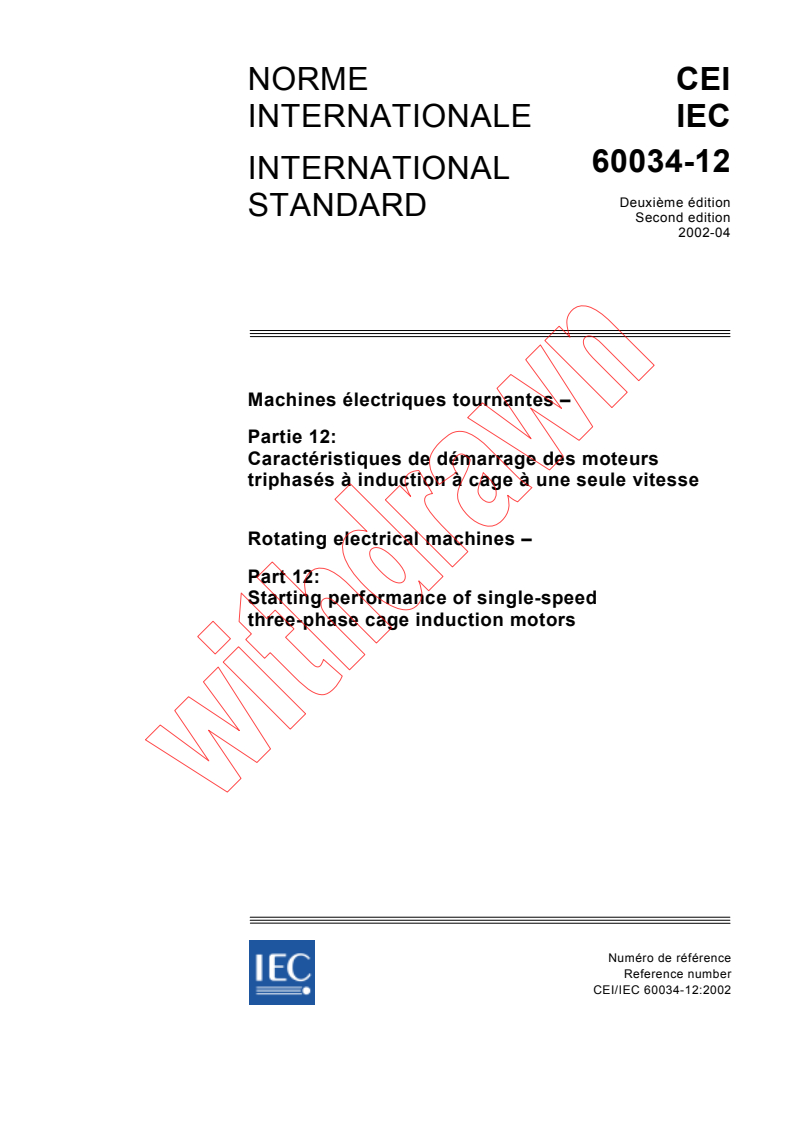
NORME CEI
INTERNATIONALE IEC
60034-12
INTERNATIONAL
Deuxième édition
STANDARD
Second edition
2002-04
Machines électriques tournantes –
Partie 12:
Caractéristiques de démarrage des moteurs
triphasés à induction à cage à une seule vitesse
Rotating electrical machines –
Part 12:
Starting performance of single-speed
three-phase cage induction motors
Numéro de référence
Reference number
CEI/IEC 60034-12:2002
Numérotation des publications Publication numbering
Depuis le 1er janvier 1997, les publications de la CEI As from 1 January 1997 all IEC publications are
sont numérotées à partir de 60000. Ainsi, la CEI 34-1 issued with a designation in the 60000 series. For
devient la CEI 60034-1. example, IEC 34-1 is now referred to as IEC 60034-1.
Editions consolidées Consolidated editions
Les versions consolidées de certaines publications de la The IEC is now publishing consolidated versions of its
CEI incorporant les amendements sont disponibles. Par publications. For example, edition numbers 1.0, 1.1
exemple, les numéros d’édition 1.0, 1.1 et 1.2 indiquent and 1.2 refer, respectively, to the base publication,
respectivement la publication de base, la publication de the base publication incorporating amendment 1 and
base incorporant l’amendement 1, et la publication de the base publication incorporating amendments 1
base incorporant les amendements 1 et 2. and 2.
Informations supplémentaires Further information on IEC publications
sur les publications de la CEI
Le contenu technique des publications de la CEI est The technical content of IEC publications is kept
constamment revu par la CEI afin qu'il reflète l'état under constant review by the IEC, thus ensuring that
actuel de la technique. Des renseignements relatifs à the content reflects current technology. Information
cette publication, y compris sa validité, sont dispo- relating to this publication, including its validity, is
nibles dans le Catalogue des publications de la CEI available in the IEC Catalogue of publications
(voir ci-dessous) en plus des nouvelles éditions, (see below) in addition to new editions, amendments
amendements et corrigenda. Des informations sur les and corrigenda. Information on the subjects under
sujets à l’étude et l’avancement des travaux entrepris consideration and work in progress undertaken by the
par le comité d’études qui a élaboré cette publication, technical committee which has prepared this
ainsi que la liste des publications parues, sont publication, as well as the list of publications issued,
également disponibles par l’intermédiaire de: is also available from the following:
• Site web de la CEI (www.iec.ch) • IEC Web Site (www.iec.ch)
• Catalogue des publications de la CEI • Catalogue of IEC publications
Le catalogue en ligne sur le site web de la CEI The on-line catalogue on the IEC web site
(www.iec.ch/catlg-f.htm) vous permet de faire des (www.iec.ch/catlg-e.htm) enables you to search
recherches en utilisant de nombreux critères, by a variety of criteria including text searches,
comprenant des recherches textuelles, par comité technical committees and date of publication. On-
d’études ou date de publication. Des informations line information is also available on recently
en ligne sont également disponibles sur les issued publications, withdrawn and replaced
nouvelles publications, les publications rempla- publications, as well as corrigenda.
cées ou retirées, ainsi que sur les corrigenda.
• IEC Just Published
• IEC Just Published
Ce résumé des dernières publications parues
This summary of recently issued publications
(www.iec.ch/JP.htm) est aussi disponible par
(www.iec.ch/JP.htm) is also available by email.
courrier électronique. Veuillez prendre contact
Please contact the Customer Service Centre (see
avec le Service client (voir ci-dessous) pour plus
below) for further information.
d’informations.
• Service clients
• Customer Service Centre
Si vous avez des questions au sujet de cette
If you have any questions regarding this
publication ou avez besoin de renseignements
publication or need further assistance, please
supplémentaires, prenez contact avec le Service
contact the Customer Service Centre:
clients:
Email: custserv@iec.ch
Email: custserv@iec.ch
Tél: +41 22 919 02 11
Tel: +41 22 919 02 11
Fax: +41 22 919 03 00
Fax: +41 22 919 03 00
.
NORME CEI
INTERNATIONALE IEC
60034-12
INTERNATIONAL
Deuxième édition
STANDARD
Second edition
2002-04
Machines électriques tournantes –
Partie 12:
Caractéristiques de démarrage des moteurs
triphasés à induction à cage à une seule vitesse
Rotating electrical machines –
Part 12:
Starting performance of single-speed
three-phase cage induction motors
IEC 2002 Droits de reproduction réservés Copyright - all rights reserved
Aucune partie de cette publication ne peut être reproduite ni No part of this publication may be reproduced or utilized in any
utilisée sous quelque forme que ce soit et par aucun procédé, form or by any means, electronic or mechanical, including
électronique ou mécanique, y compris la photocopie et les photocopying and microfilm, without permission in writing from
microfilms, sans l'accord écrit de l'éditeur. the publisher.
International Electrotechnical Commission, 3, rue de Varembé, PO Box 131, CH-1211 Geneva 20, Switzerland
Telephone: +41 22 919 02 11 Telefax: +41 22 919 03 00 E-mail: inmail@iec.ch Web: www.iec.ch
CODE PRIX
L
PRICE CODE
Commission Electrotechnique Internationale
International Electrotechnical Commission
Международная Электротехническая Комиссия
Pour prix, voir catalogue en vigueur
For price, see current catalogue
– 2 – 60034-12 CEI:2002
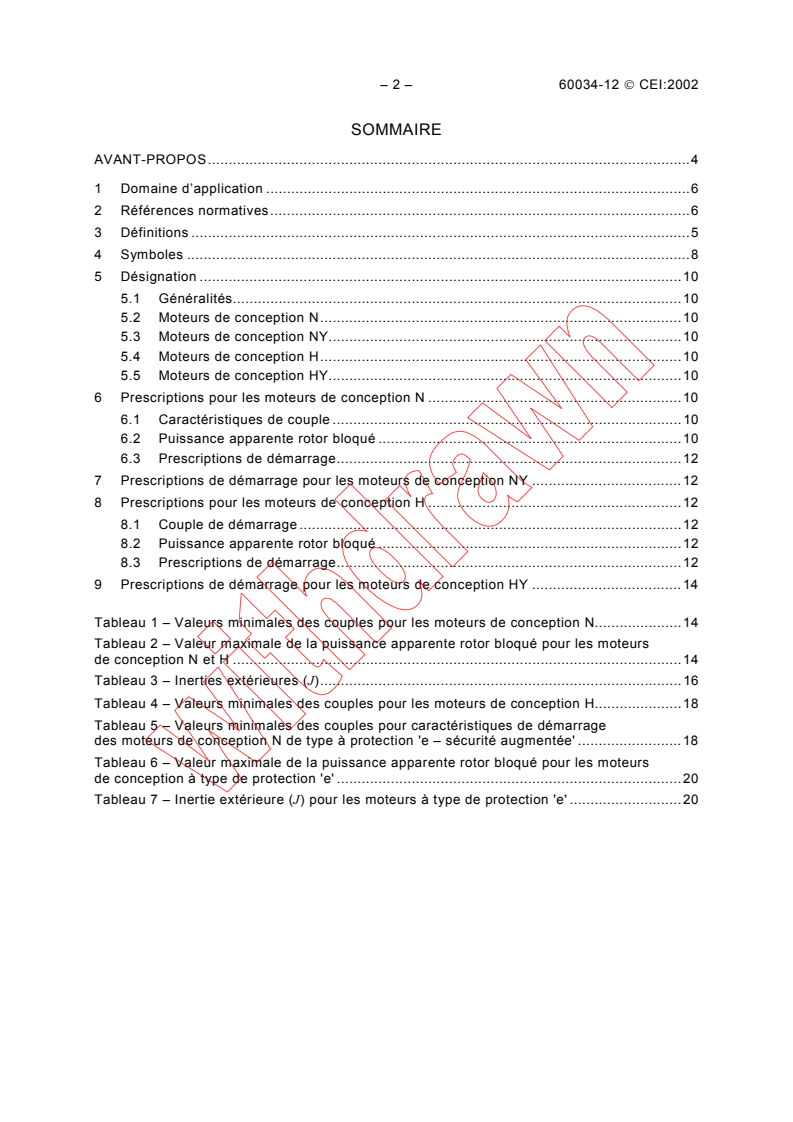
SOMMAIRE
AVANT-PROPOS.4
1 Domaine d’application .6
2 Références normatives.6
3 Définitions .5
4 Symboles .8
5 Désignation .10
5.1 Généralités.10
5.2 Moteurs de conception N.10
5.3 Moteurs de conception NY.10
5.4 Moteurs de conception H.10
5.5 Moteurs de conception HY.10
6 Prescriptions pour les moteurs de conception N .10
6.1 Caractéristiques de couple .10
6.2 Puissance apparente rotor bloqué .10
6.3 Prescriptions de démarrage.12
7 Prescriptions de démarrage pour les moteurs de conception NY .12
8 Prescriptions pour les moteurs de conception H .12
8.1 Couple de démarrage .12
8.2 Puissance apparente rotor bloqué .12
8.3 Prescriptions de démarrage.12
9 Prescriptions de démarrage pour les moteurs de conception HY .14
Tableau 1 – Valeurs minimales des couples pour les moteurs de conception N.14
Tableau 2 – Valeur maximale de la puissance apparente rotor bloqué pour les moteurs
de conception N et H .14
Tableau 3 – Inerties extérieures (J).16
Tableau 4 – Valeurs minimales des couples pour les moteurs de conception H.18
Tableau 5 – Valeurs minimales des couples pour caractéristiques de démarrage
des moteurs de conception N de type à protection 'e – sécurité augmentée' .18
Tableau 6 – Valeur maximale de la puissance apparente rotor bloqué pour les moteurs
de conception à type de protection 'e' .20
Tableau 7 – Inertie extérieure (J) pour les moteurs à type de protection 'e' .20
60034-12 © IEC:2002 – 3 –
CONTENTS
FOREWORD.5
1 Scope.7
2 Normative references .7
3 Definitions .9
4 Symbols .9
5 Designation .11
5.1 General .11
5.2 Design N .11
5.3 Design NY.11
5.4 Design H .11
5.5 Design HY.11
6 Design N requirements .11
6.1 Torque characteristics .11
6.2 Locked rotor apparent power .11
6.3 Starting requirements .13
7 Design NY starting requirements .13
8 Design H requirements .13
8.1 Starting torque .13
8.2 Locked rotor apparent power .13
8.3 Starting requirements .13
9 Design HY requirements starting requirements .15
Table 1 – Minimum value of torques for design N.15
Table 2 – Maximum value of locked rotor apparent power for design N and H.15
Table 3 – External inertia (J) .17
Table 4 – Minimum values of torques for design H .19
Table 5 – Minimum value of torques for design N-e starting performance
for motors with type of protection 'e'.19
Table 6 – Maximum value of locked rotor apparent power
for motors with type of protection 'e'.21
Table 7 – External inertia (J) for motors with type of protection 'e'.21
– 4 – 60034-12 CEI:2002
COMMISSION ÉLECTROTECHNIQUE INTERNATIONALE
____________
MACHINES ÉLECTRIQUES TOURNANTES –
Partie 12: Caractéristiques de démarrage des moteurs triphasés
à induction à cage à une seule vitesse
AVANT-PROPOS
1) La CEI (Commission Electrotechnique Internationale) est une organisation mondiale de normalisation
composée de l'ensemble des comités électrotechniques nationaux (Comités nationaux de la CEI). La CEI a
pour objet de favoriser la coopération internationale pour toutes les questions de normalisation dans les
domaines de l'électricité et de l'électronique. A cet effet, la CEI, entre autres activités, publie des Normes
internationales. Leur élaboration est confiée à des comités d'études, aux travaux desquels tout Comité national
intéressé par le sujet traité peut participer. Les organisations internationales, gouvernementales et non
gouvernementales, en liaison avec la CEI, participent également aux travaux. La CEI collabore étroitement
avec l'Organisation Internationale de Normalisation (ISO), selon des conditions fixées par accord entre les
deux organisations.
2) Les décisions ou accords officiels de la CEI concernant les questions techniques représentent, dans la mesure
du possible, un accord international sur les sujets étudiés, étant donné que les Comités nationaux intéressés
sont représentés dans chaque comité d’études.
3) Les documents produits se présentent sous la forme de recommandations internationales. Ils sont publiés
comme normes, spécifications techniques, rapports techniques ou guides et agréés comme tels par les
Comités nationaux.
4) Dans le but d'encourager l'unification internationale, les Comités nationaux de la CEI s'engagent à appliquer de
façon transparente, dans toute la mesure possible, les Normes internationales de la CEI dans leurs normes
nationales et régionales. Toute divergence entre la norme de la CEI et la norme nationale ou régionale
correspondante doit être indiquée en termes clairs dans cette dernière.
5) La CEI n’a fixé aucune procédure concernant le marquage comme indication d’approbation et sa responsabilité
n’est pas engagée quand un matériel est déclaré conforme à l’une de ses normes.
6) L’attention est attirée sur le fait que certains des éléments de la présente Norme internationale peuvent faire
l’objet de droits de propriété intellectuelle ou de droits analogues. La CEI ne saurait être tenue pour
responsable de ne pas avoir identifié de tels droits de propriété et de ne pas avoir signalé leur existence.
La Norme internationale CEI 60034-12 a été établie par le comité d'études 2 de la CEI:
Machines tournantes.
Cette deuxième édition annule et remplace la première édition parue en 1980, son
amendement 1 (1992) et son amendement 2 (1995). Cette deuxième édition constitue une
révision technique.
Le texte de cette norme est issu des documents suivants:
FDIS Rapport de vote
2/1187/FDIS 2/1199/RVD
Le rapport de vote indiqué dans le tableau ci-dessus donne toute information sur le vote ayant
abouti à l'approbation de cette norme.
Cette publication a été rédigée selon les Directives ISO/CEI, Partie 3.
Le comité a décidé que le contenu de cette publication ne sera pas modifié avant 2005.
A cette date, la publication sera
• reconduite;
• supprimée;
• remplacée par une édition révisée, ou
• amendée.
60034-12 © IEC:2002 – 5 –
INTERNATIONAL ELECTROTECHNICAL COMMISSION
____________
ROTATING ELECTRICAL MACHINES –
Part 12: Starting performance of single-speed
three-phase cage induction motors
FOREWORD
1) The IEC (International Electrotechnical Commission) is a worldwide organization for standardization comprising
all national electrotechnical committees (IEC National Committees). The object of the IEC is to promote
international co-operation on all questions concerning standardization in the electrical and electronic fields. To
this end and in addition to other activities, the IEC publishes International Standards. Their preparation is
entrusted to technical committees; any IEC National Committee interested in the subject dealt with may
participate in this preparatory work. International, governmental and non-governmental organizations liaising
with the IEC also participate in this preparation. The IEC collaborates closely with the International
Organization for Standardization (ISO) in accordance with conditions determined by agreement between the
two organizations.
2) The formal decisions or agreements of the IEC on technical matters express, as nearly as possible, an
international consensus of opinion on the relevant subjects since each technical committee has representation
from all interested National Committees.
3) The documents produced have the form of recommendations for international use and are published in the form
of standards, technical specifications, technical reports or guides and they are accepted by the National
Committees in that sense.
4) In order to promote international unification, IEC National Committees undertake to apply IEC International
Standards transparently to the maximum extent possible in their national and regional standards. Any
divergence between the IEC Standard and the corresponding national or regional standard shall be clearly
indicated in the latter.
5) The IEC provides no marking procedure to indicate its approval and cannot be rendered responsible for any
equipment declared to be in conformity with one of its standards.
6) Attention is drawn to the possibility that some of the elements of this International Standard may be the subject
of patent rights. The IEC shall not be held responsible for identifying any or all such patent rights.
International Standard IEC 60034-12 has been prepared by IEC technical committee 2:
Rotating machinery.
This second edition cancels and replaces the first edition published in 1980, its Amendment 1
(1992) and its Amendment 2 (1995). This second edition constitutes a technical revision.
The text of this standard is based on the following documents:
FDIS Report on voting
2/1187/FDIS 2/1199/RVD
Full information on the voting for the approval of this standard can be found in the report on
voting indicated in the above table.
This publication has been drafted in accordance with the ISO/IEC Directives, Part 3.
The committee has decided that the contents of this publication will remain unchanged until
2005. At this date, the publication will be
• reconfirmed;
• withdrawn;
• replaced by a revised edition, or
• amended.
– 6 – 60034-12 CEI:2002
MACHINES ÉLECTRIQUES TOURNANTES –
Partie 12: Caractéristiques de démarrage des moteurs triphasés
à induction à cage à une seule vitesse
1 Domaine d’application
La présente Norme internationale spécifie les paramètres de quatre conceptions de
caractéristiques de démarrage de moteurs triphasés à induction à cage à une seule vitesse
fonctionnant à 50 Hz ou 60 Hz conformes à la CEI 60034-1 qui:
• ont des tensions assignées jusqu’à 1 000 V;
• sont prévus pour démarrage direct ou étoile-triangle;
• sont dimensionnés pour le service type S1;
• peuvent avoir n’importe quel type d’enveloppe de protection.
Cette norme s’applique également aux moteurs bitension à condition que le niveau de
saturation du flux soit le même aux deux tensions et aux moteurs ayant un type de protection
'e – sécurité augmentée' avec des classes de température allant de T1 à T3 conformes à la
CEI 60079-0 et à la CEI 60079-7.
NOTE 1 Les constructeurs ne sont pas tenus de fabriquer des machines correspondant à ces quatre
conceptions. Le choix d’une conception donnée répondant à la présente norme fera l’objet d’un accord entre
le constructeur et son client.
NOTE 2 Des conceptions autres que les quatre spécifiées peuvent s’avérer nécessaires pour des appli-
cations particulières.
NOTE 3 Les valeurs de couple et de puissance apparente données dans la présente norme sont des valeurs
limites (c’est-à-dire minimales ou maximales sans tolérance), mais il convient de noter que les valeurs données
dans les catalogues des constructeurs peuvent inclure des tolérances conformes à la CEI 60034-1.
NOTE 4 Les valeurs calculées pour la puissance apparente rotor bloqué sont fondées sur les courants rotor
bloqué en régime établi symétriques en valeur efficace; à la mise en marche du moteur, il y aura un courant de
crête instantané asymétrique d’un demi-cycle qui peut fluctuer entre 1,8 et 2,8 fois la valeur continue. La crête de
courant et le temps de descente dépendent de la conception du moteur et de l’angle de commutation.
2 Références normatives
Les documents de référence suivants sont indispensables pour l'application du présent
document. Pour les références datées, seule l'édition citée s'applique. Pour les références
non datées, la dernière édition du document de référence s'applique (y compris les éventuels
amendements).
CEI 60034-1, Machines électriques tournantes – Partie 1: Caractéristiques assignées et
caractéristiques de fonctionnement
CEI 60079-0, Matériels électriques pour atmosphères explosives gazeuses – Partie 0: Règles
générales
CEI 60079-7, Matériels électriques pour atmosphères explosives gazeuses – Partie 7:
Sécurité augmentée 'e'
60034-12 © IEC:2002 – 7 –
ROTATING ELECTRICAL MACHINES –
Part 12: Starting performance of single-speed
three-phase cage induction motors
1 Scope
This International standard specifies the parameters for four designs of starting performance
of single-speed three-phase 50 Hz or 60 Hz cage induction motors in accordance with
IEC 60034-1 that:
• have a rated voltage up to 1 000 V;
• are intended for direct-on-line or star-delta starting;
• are rated on the basis of duty type S1;
• are constructed to any degree of protection.
The standard also applies to dual voltage motors provided that the flux saturation level is the
same for both voltages and to motors having type of protection 'e – increased safety' with
temperature classes T1 to T3 complying with IEC 60079-0 and IEC 60079-7
NOTE 1 It is not expected that all manufacturers will produce machines for all four designs. The selection of any
specific design in accordance with this standard will be a matter of agreement between the manufacturer and the
purchaser.
NOTE 2 Designs other than the four specified may be necessary for particular applications.
NOTE 3 The values of torque and apparent power given in this standard are limiting values (that is, minimum or
maximum without tolerance), but it should be noted that values given in manufacturers' catalogues may include
tolerances in accordance with IEC 60034-1.
NOTE 4 The values tabled for locked rotor apparent power are based on r.m.s. symmetrical steady state locked
rotor currents; at motor switch on there will be a one-half cycle asymmetrical instantaneous peak current which
may range from 1,8 to 2,8 times the steady state value. The current peak and decay time are a function of the
motor design and switching angle.
2 Normative references
The following referenced documents are indispensable for the application of this document.
For dated references, only the edition cited applies. For undated references, the latest edition
of the referenced document (including any amendments) applies.
IEC 60034-1, Rotating electrical machines – Part 1: Rating and performance
IEC 60079-0, Electrical apparatus for explosive gas atmospheres – Part 0: General requirements
IEC 60079-7, Electrical apparatus for explosive gas atmospheres – Part 7: Increased safety 'e'
– 8 – 60034-12 CEI:2002
3 Définitions
Pour les besoins de la présente partie de la CEI 60034, les définitions suivantes s’appliquent.
3.1
couple assigné (T )
N
couple développé par le moteur sur son bout d’arbre d’entraînement aux puissance et vitesse
assignées
[VEI 411-48-05]
3.2
couple à rotor bloqué (T )
l
couple mesuré le plus faible que développe le moteur sur son bout d’arbre d’entraînement,
quand son rotor est maintenu bloqué, quelle que soit sa position angulaire et qu’il est
alimenté à tension et fréquence assignées
[VEI 411-48-06]
3.3
couple minimal pendant le démarrage (T )
u
couple asynchrone le plus faible en régime établi que le moteur développe entre la vitesse
nulle et la vitesse qui correspond au couple de décrochage lorsque le moteur est alimenté à
la tension et à la fréquence assignées.
Cette définition ne s’applique pas aux moteurs dont le couple diminue de manière continue
quand la vitesse augmente.
NOTE En plus des couples asynchrones en régime établi, les couples synchrones harmoniques, qui dépendent de
l’angle de charge du rotor, seront présents à certaines vitesses. A de telles vitesses, le couple d’accélération peut
être négatif pour certains angles de charge de rotor. L’expérience et les calculs montrent qu’il s’agit d’une
condition de fonctionnement instable et c’est pourquoi les couples synchrones harmoniques n’empêchent pas
l’accélération du moteur et qu’ils sont exclus de la présente définition.
3.4
couple de décrochage (T )
b
couple asynchrone le plus fort en régime établi développé par le moteur sans chute brutale de
la vitesse lorsque le moteur est alimenté à la tension et à la fréquence assignées.
Cette définition ne s’applique pas aux moteurs dont le couple diminue de manière continue
quant la vitesse augmente.
3.5
sortie assignée (P )
N
valeur de sortie incluse dans les caractéristiques assignées
3.6
puissance apparente rotor bloqué (S )
l
puissance apparente absorbée, le moteur étant maintenu à l’arrêt à tension et fréquence assignées
4 Symboles
Symbole Grandeur
J Inertie externe
p Nombre de paires de pôles
P Sortie assignée
N
S Puissance apparente rotor bloqué
l
T Couple assigné
N
T Couple rotor bloqué
l
T Couple minimal pendant le démarrage
u
T Couple de décrochage
b
60034-12 © IEC:2002 – 9 –
3 Definitions
For the purposes of this part of IEC 60034, the following definitions apply.
3.1
rated torque (T )
N
the torque the motor develops at its shaft end at rated output and speed
[IEV 411-48-05]
3.2
locked-rotor torque (T )
l
the smallest measured torque the motor develops at its shaft end with the rotor locked, over
all its angular positions, at rated voltage and frequency
[IEV 411-48-06]
3.3
pull-up torque (T )
u
the smallest steady-state asynchronous torque which the motor develops between zero speed
and the speed which corresponds to the breakdown torque, when the motor is supplied at the
rated voltage and frequency.
This definition does not apply to those motors of which the torque continually decreases with
increase in speed.
NOTE In addition to the steady-state asynchronous torques, harmonic synchronous torques, which are a function
of rotor load angle, will be present at specific speeds. At such speeds, the accelerating torque may be negative for
some rotor load angles. Experience and calculation show this to be an unstable operating condition and therefore
harmonic synchronous torques do not prevent motor acceleration and are excluded from this definition.
3.4
breakdown torque (T )
b
the maximum steady-state asynchronous torque which the motor develops without an abrupt
drop in speed, when the motor is supplied at the rated voltage and frequ
...
IEC 60034-12
Edition 2.1 2007-09
INTERNATIONAL
STANDARD
NORME
INTERNATIONALE
Rotating electrical machines –
Part 12: Starting performance of single-speed three-phase cage induction
motors
Machines électriques tournantes –
Partie 12: Caractéristiques de démarrage des moteurs triphasés à induction
à cage à une seule vitesse
All rights reserved. Unless otherwise specified, no part of this publication may be reproduced or utilized in any form or by
any means, electronic or mechanical, including photocopying and microfilm, without permission in writing from either IEC or
IEC's member National Committee in the country of the requester.
If you have any questions about IEC copyright or have an enquiry about obtaining additional rights to this publication,
please contact the address below or your local IEC member National Committee for further information.
Droits de reproduction réservés. Sauf indication contraire, aucune partie de cette publication ne peut être reproduite
ni utilisée sous quelque forme que ce soit et par aucun procédé, électronique ou mécanique, y compris la photocopie
et les microfilms, sans l'accord écrit de la CEI ou du Comité national de la CEI du pays du demandeur.
Si vous avez des questions sur le copyright de la CEI ou si vous désirez obtenir des droits supplémentaires sur cette
publication, utilisez les coordonnées ci-après ou contactez le Comité national de la CEI de votre pays de résidence.
IEC Central Office
3, rue de Varembé
CH-1211 Geneva 20
Switzerland
Email: inmail@iec.ch
Web: www.iec.ch
About the IEC
The International Electrotechnical Commission (IEC) is the leading global organization that prepares and publishes
International Standards for all electrical, electronic and related technologies.
About IEC publications
The technical content of IEC publications is kept under constant review by the IEC. Please make sure that you have the
latest edition, a corrigenda or an amendment might have been published.
ƒ Catalogue of IEC publications: www.iec.ch/searchpub
The IEC on-line Catalogue enables you to search by a variety of criteria (reference number, text, technical committee,…).
It also gives information on projects, withdrawn and replaced publications.
ƒ IEC Just Published: www.iec.ch/online_news/justpub
Stay up to date on all new IEC publications. Just Published details twice a month all new publications released. Available
on-line and also by email.
ƒ Electropedia: www.electropedia.org
The world's leading online dictionary of electronic and electrical terms containing more than 20 000 terms and definitions
in English and French, with equivalent terms in additional languages. Also known as the International Electrotechnical
Vocabulary online.
ƒ Customer Service Centre: www.iec.ch/webstore/custserv
If you wish to give us your feedback on this publication or need further assistance, please visit the Customer Service
Centre FAQ or contact us:
Email: csc@iec.ch
Tel.: +41 22 919 02 11
Fax: +41 22 919 03 00
A propos de la CEI
La Commission Electrotechnique Internationale (CEI) est la première organisation mondiale qui élabore et publie des
normes internationales pour tout ce qui a trait à l'électricité, à l'électronique et aux technologies apparentées.
A propos des publications CEI
Le contenu technique des publications de la CEI est constamment revu. Veuillez vous assurer que vous possédez
l’édition la plus récente, un corrigendum ou amendement peut avoir été publié.
ƒ Catalogue des publications de la CEI: www.iec.ch/searchpub/cur_fut-f.htm
Le Catalogue en-ligne de la CEI vous permet d’effectuer des recherches en utilisant différents critères (numéro de référence,
texte, comité d’études,…). Il donne aussi des informations sur les projets et les publications retirées ou remplacées.
ƒ Just Published CEI: www.iec.ch/online_news/justpub
Restez informé sur les nouvelles publications de la CEI. Just Published détaille deux fois par mois les nouvelles
publications parues. Disponible en-ligne et aussi par email.
ƒ Electropedia: www.electropedia.org
Le premier dictionnaire en ligne au monde de termes électroniques et électriques. Il contient plus de 20 000 termes et
définitions en anglais et en français, ainsi que les termes équivalents dans les langues additionnelles. Egalement appelé
Vocabulaire Electrotechnique International en ligne.
ƒ Service Clients: www.iec.ch/webstore/custserv/custserv_entry-f.htm
Si vous désirez nous donner des commentaires sur cette publication ou si vous avez des questions, visitez le FAQ du
Service clients ou contactez-nous:
Email: csc@iec.ch
Tél.: +41 22 919 02 11
Fax: +41 22 919 03 00
IEC 60034-12
Edition 2.1 2007-09
INTERNATIONAL
STANDARD
NORME
INTERNATIONALE
Rotating electrical machines –
Part 12: Starting performance of single-speed three-phase cage induction
motors
Machines électriques tournantes –
Partie 12: Caractéristiques de démarrage des moteurs triphasés à induction
à cage à une seule vitesse
INTERNATIONAL
ELECTROTECHNICAL
COMMISSION
COMMISSION
ELECTROTECHNIQUE
PRICE CODE
INTERNATIONALE
CC
CODE PRIX
ICS 29.160.30 ISBN 2-8318-9235-X
– 2 – 60034-12 © IEC:2002+A1:2007
CONTENTS
FOREWORD.3
1 Scope.5
2 Normative references.5
3 Definitions.6
4 Symbols.6
5 Designation.7
5.1 General.7
5.2 Design N.7
5.3 Design NY.7
5.4 Design H.7
5.5 Design HY.7
6 Design N requirements .7
6.1 Torque characteristics.7
6.2 Locked rotor apparent power .7
6.3 Starting requirements .8
7 Design NY starting requirements .8
8 Design H requirements .8
8.1 Starting torque.8
8.2 Locked rotor apparent power .8
8.3 Starting requirements .8
9 Design HY requirements starting requirements.9
Table 1 – Minimum values of torques for design N .9
Table 2 – Maximum values of locked rotor apparent power for designs N and H .9
Table 3 – External inertia (J) .10
Table 4 – Minimum values of torques for design H .11
Table 5 – Minimum values of torques for design N-e motors
with type of protection 'e – increased safety' .11
Table 6 – Maximum values of locked rotor apparent power
for motors with type of protection 'e'.12
Table 7 – External inertia (J) for motors with type of protection 'e'.12
60034-12 © IEC:2002+A1:2007 – 3 –
INTERNATIONAL ELECTROTECHNICAL COMMISSION
____________
ROTATING ELECTRICAL MACHINES –
Part 12: Starting performance of single-speed
three-phase cage induction motors
FOREWORD
1) The International Electrotechnical Commission (IEC) is a worldwide organization for standardization comprising
all national electrotechnical committees (IEC National Committees). The object of IEC is to promote
international co-operation on all questions concerning standardization in the electrical and electronic fields. To
this end and in addition to other activities, IEC publishes International Standards, Technical Specifications,
Technical Reports, Publicly Available Specifications (PAS) and Guides (hereafter referred to as “IEC
Publication(s)”). Their preparation is entrusted to technical committees; any IEC National Committee interested
in the subject dealt with may participate in this preparatory work. International, governmental and non-
governmental organizations liaising with the IEC also participate in this preparation. IEC collaborates closely
with the International Organization for Standardization (ISO) in accordance with conditions determined by
agreement between the two organizations.
2) The formal decisions or agreements of IEC on technical matters express, as nearly as possible, an international
consensus of opinion on the relevant subjects since each technical committee has representation from all
interested IEC National Committees.
3) IEC Publications have the form of recommendations for international use and are accepted by IEC National
Committees in that sense. While all reasonable efforts are made to ensure that the technical content of IEC
Publications is accurate, IEC cannot be held responsible for the way in which they are used or for any
misinterpretation by any end user.
4) In order to promote international uniformity, IEC National Committees undertake to apply IEC Publications
transparently to the maximum extent possible in their national and regional publications. Any divergence
between any IEC Publication and the corresponding national or regional publication shall be clearly indicated in
the latter.
5) IEC provides no marking procedure to indicate its approval and cannot be rendered responsible for any
equipment declared to be in conformity with an IEC Publication.
6) All users should ensure that they have the latest edition of this publication.
7) No liability shall attach to IEC or its directors, employees, servants or agents including individual experts and
members of its technical committees and IEC National Committees for any personal injury, property damage or
other damage of any nature whatsoever, whether direct or indirect, or for costs (including legal fees) and
expenses arising out of the publication, use of, or reliance upon, this IEC Publication or any other IEC
Publications.
8) Attention is drawn to the Normative references cited in this publication. Use of the referenced publications is
indispensable for the correct application of this publication.
9) Attention is drawn to the possibility that some of the elements of this IEC Publication may be the subject of
patent rights. IEC shall not be held responsible for identifying any or all such patent rights.
International Standard IEC 60034-12 has been prepared by IEC technical committee 2:
Rotating machinery.
This consolidated version of IEC 60034-12 consists of the second edition (2002) [documents
2/1187/FDIS and 2/1199/RVD] and its amendment 1 (2007) [documents 2/1433/FDIS and
2/1446/RVD].
The technical content is therefore identical to the base edition and its amendment(s) and has
been prepared for user convenience.
It bears the edition number 2.1.
A vertical line in the margin shows where the base publication has been modified by
amendment 1.
– 4 – 60034-12 © IEC:2002+A1:2007
The committee has decided that the contents of the base publication and its amendments will
remain unchanged until the maintenance result date indicated on the IEC web site under
"http://webstore.iec.ch" in the data related to the specific publication. At this date,
the publication will be
• reconfirmed,
• withdrawn,
• replaced by a revised edition, or
• amended.
60034-12 © IEC:2002+A1:2007 – 5 –
ROTATING ELECTRICAL MACHINES –
Part 12: Starting performance of single-speed
three-phase cage induction motors
1 Scope
This International standard specifies the parameters for four designs of starting performance
of single-speed three-phase 50 Hz or 60 Hz cage induction motors in accordance with
IEC 60034-1 that:
• have a rated voltage up to 1 000 V;
• are intended for direct-on-line or star-delta starting;
• are rated on the basis of duty type S1;
• are constructed to any degree of protection.
The standard also applies to dual voltage motors provided that the flux saturation level is the
same for both voltages and to motors having type of protection 'e – increased safety' with
temperature classes T1 to T3 complying with IEC 60079-0 and IEC 60079-7.
NOTE 1 It is not expected that all manufacturers will produce machines for all four designs. The selection of any
specific design in accordance with this standard will be a matter of agreement between the manufacturer and the
purchaser.
NOTE 2 Designs other than the four specified may be necessary for particular applications.
NOTE 3 The values of torque and apparent power given in this standard are limiting values (that is, minimum or
maximum without tolerance), but it should be noted that values given in manufacturers' catalogues may include
tolerances in accordance with IEC 60034-1.
NOTE 4 The values tabled for locked rotor apparent power are based on r.m.s. symmetrical steady state locked
rotor currents; at motor switch on there will be a one-half cycle asymmetrical instantaneous peak current which
may range from 1,8 to 2,8 times the steady state value. The current peak and decay time are a function of the
motor design and switching angle.
2 Normative references
The following referenced documents are indispensable for the application of this document.
For dated references, only the edition cited applies. For undated references, the latest edition
of the referenced document (including any amendments) applies.
IEC 60034-1, Rotating electrical machines – Part 1: Rating and performance
IEC 60079-0, Electrical apparatus for explosive gas atmospheres – Part 0: General requirements
IEC 60079-7, Electrical apparatus for explosive gas atmospheres – Part 7: Increased safety 'e'
– 6 – 60034-12 © IEC:2002+A1:2007
3 Definitions
For the purposes of this part of IEC 60034, the following definitions apply.
3.1
rated torque (T )
N
the torque the motor develops at its shaft end at rated output and speed
[IEV 411-48-05]
3.2
locked-rotor torque (T )
l
the smallest measured torque the motor develops at its shaft end with the rotor locked, over
all its angular positions, at rated voltage and frequency
[IEV 411-48-06]
3.3
pull-up torque (T )
u
the smallest steady-state asynchronous torque which the motor develops between zero speed
and the speed which corresponds to the breakdown torque, when the motor is supplied at the
rated voltage and frequency.
This definition does not apply to those motors of which the torque continually decreases with
increase in speed.
NOTE In addition to the steady-state asynchronous torques, harmonic synchronous torques, which are a function
of rotor load angle, will be present at specific speeds. At such speeds, the accelerating torque may be negative for
some rotor load angles. Experience and calculation show this to be an unstable operating condition and therefore
harmonic synchronous torques do not prevent motor acceleration and are excluded from this definition.
3.4
breakdown torque (T )
b
the maximum steady-state asynchronous torque which the motor develops without an abrupt
drop in speed, when the motor is supplied at the rated voltage and frequency.
This definition does not apply to those motors of which the torque continually decreases with
increase in speed.
3.5
rated output (P )
N
the value of the output included in the rating
3.6
locked rotor apparent power (S )
l
the apparent power input with the motor held at rest at rated voltage and frequency
4 Symbols
Symbol Quantity
J External inertia
p Number of pole pairs
P Rated output
N
S Locked rotor apparent power
l
T Rated torque
N
T Locked rotor torque
l
T Pull-up torque
u
T Breakdown torque
b
60034-12 © IEC:2002+A1:2007 – 7 –
5 Designation
5.1 General
Motors designed according to this standard are classified according to subclauses 5.2 to 5.5.
5.2 Design N
Normal starting torque three-phase cage induction motors intended for direct-on-line starting,
having 2, 4, 6 or 8 poles and rated from 0,4 kW to 1 600 kW.
5.3 Design NY
Motors similar to design N, but intended for star-delta starting. For these motors in star-
connection, minimum values for T and T are 25 % of the values of design N, see table 1.
l u
5.4 Design H
High starting torque three-phase cage induction motors with 4, 6 or 8 poles, intended for
direct-online starting, and rated from 0,4 kW to 160 kW at a frequency of 60 Hz.
5.5 Design HY
Motors similar to design H but intended for star-delta starting. For these motors in star-
connection, minimum values for T and T are 25 % of the values of design H, see table 4.
l u
6 Design N requirements
6.1 Torque characteristics
The starting torque is represented by three characteristic features. These features shall be in
accordance with the appropriate values given in table 1 or table 5. The values in table 1 and
table 5 are minimum values at rated voltage. Higher values are allowed.
The motor torque at any speed between zero and that at which breakdown torque occurs shall
be not less than 1,3 times the torque obtained from a curve varying as the square of the
speed and being equal to rated torque at rated speed. However, for 2-pole motors with type of
protection 'e – increased safety' having a rated output greater than 100 kW, the motor torque
at any speed between zero and that at which breakdown torque occurs shall not be less than
1,3 times the torque obtained from a curve varying as the square of the speed and being
equal to 70 % rated torque at rated speed. For motors with type of protection 'e', the three
characteristic torques shall be in accordance with the appropriate values given in table 5.
NOTE The factor 1,3 has been chosen with regard to an undervoltage of 10 % in relation to the rated voltage at
the motor terminals during the acceleration period.
6.2 Locked rotor apparent power
The locked rotor apparent power shall be not greater than the appropriate value given in
table 2 or table 6. The values given in table 2 and table 6 are independent of the number of
poles and are maximum values at rated voltage. For motors with type of protection 'e', locked
rotor apparent power shall be in accordance with the appropriate values given in table 6.
– 8 – 60034-12 © IEC:2002+A1:2007
6.3 Starting requirements
Motors shall be capable of withstanding two starts in succession (coasting to rest between
starts) from cold conditions and one start from hot after running at rated conditions. The
retarding torque due to the driven load will be in each case proportional to the square of the
speed and equal to the rated torque at rated speed with the external inertia given in table 3 or
table 7.
In each case, a further start is permissible only if the motor temperature before starting does
not exceed the steady temperature at rated load. However, for 2-pole motors with type of
protection 'e – increased safety' having a rated output greater than 100 kW, the retarding
torque due to the driven load is proportional to the square of the speed and equal to 70 %
rated torque at rated speed, with the external inertia given in table 7. After this starting, load
with rated torque is possible.
NOTE It should be recognized that the number of starts should be minimized since these affect the life of the motor.
7 Design NY starting requirements
The starting requirements are as for design N. In addition, however, a reduced retarding
torque is necessary as the starting torque in ‘star connection’ may be insufficient to accelerate
some loads to an acceptable speed.
NOTE It should be recognized that the number of starts should be minimized since these affect the life of the motor.
8 Design H requirements
8.1 Starting torque
The starting torque is represented by three characteristic features. These featurest shall be in
accordance with the appropriate values given in table 4. These values are minimum values at
rated voltage. Higher values are allowed.
8.2 Locked rotor apparent power
The locked rotor apparent power shall be not greater than the appropriate value given in
table 2. The values in table 2 are independent of the number of poles and are maximum
values at rated voltage.
8.3 Starting requirements
Motors shall be capable of withstanding two starts in succession (coasting to rest between
starts) from cold conditions, and one start from hot after running at rated conditions. The
retarding torque due to the driven load is assumed to be constant and equal to rated torque,
independent of speed, with an external inertia of 50 % of the values given in table 3.
In each case, a further start is permissible only if the motor temperature before starting does
not exceed the steady temperature at rated load.
NOTE It should be recognized that the number of starts should be minimized since these affect the life of the motor.
60034-12 © IEC:2002+A1:2007 – 9 –
9 Design HY starting requirements
The starting requirements are as for design H. In addition, however, a reduced retarding
torque is necessary as the starting torque in ‘star connection’ may be insufficient to accelerate
some loads to an acceptable speed.
NOTE It should be recognized that the number of starts should be minimized since these affect the life of the motor.
Table 1 – Minimum values of torques for design N
Number of poles
Range of rated
2 4 6 8
output
kW T T T T T T T T T T T T
l u b l u b l u b l u b
1,9 1,3 2,0 2,0 1,4 2,0 1,7 1,2 1,7 1,5 1,1 1,6
0,4 ≤ P ≤ 0,63
N
0,63 < P ≤ 1,0 1,8 1,2 2,0 1,9 1,3 2,0 1,7 1,2 1,8 1,5 1,1 1,7
N
1,0 < P ≤ 1,6 1,8 1,2 2,0 1,9 1,3 2,0 1,6 1,1 1,9 1,4 1,0 1,8
N
1,7 1,1 2,0 1,8 1,2 2,0 1,6 1,1 1,9 1,4 1,0 1,8
1,6 < P ≤ 2,5
N
1,6 1,1 2,0 1,7 1,2 2,0 1,5 1,1 1,9 1,3 1,0 1,8
2,5 < P ≤ 4,0
N
4,0 < P ≤ 6,3 1,5 1,0 2,0 1,6 1,1 2,0 1,5 1,1 1,9 1,3 1,0 1,8
N
1,5 1,0 2,0 1,6 1,1 2,0 1,5 1,1 1,8 1,3 1,0 1,7
6,3 < P ≤ 10
N
1,4 1,0 2,0 1,5 1,1 2,0 1,4 1,0 1,8 1,2 0,9 1,7
10 < P ≤ 16
N
16 < P ≤ 25 1,3 0,9 1,9 1,4 1,0 1,9 1,4 1,0 1,8 1,2 0,9 1,7
N
25 < P ≤ 40 1,2 0,9 1,9 1,3 1,0 1,9 1,3 1,0 1,8 1,2 0,9 1,7
N
1,1 0,8 1,8 1,2 0,9 1,8 1,2 0,9 1,7 1,1 0,8 1,7
40 < P ≤ 63
N
63 < P ≤ 100 1,0 0,7 1,8 1,1 0,8 1,8 1,1 0,8 1,7 1,0 0,7 1,6
N
100 < P ≤ 160 0,9 0,7 1,7 1,0 0,8 1,7 1,0 0,8 1,7 0,9 0,7 1,6
N
0,8 0,6 1,7 0,9 0,7 1,7 0,9 0,7 1,6 0,9 0,7 1,6
160 < P ≤ 250
N
0,75 0,6 1,6 0,75 0,6 1,6 0,75 0,6 1,6 0,75 0,6 1,6
250 < P ≤ 400
N
400 < P ≤ 630 0,65 0,5 1,6 0,65 0,5 1,6 0,65 0,5 1,6 0,65 0,5 1,6
N
0,5 0,3 1,6 0,5 0,3 1,6 0,5 0,3 1,6 0,5 0,3 1,6
630 < P ≤ 1 600
N
NOTE The values given are per unit T
N.
Table 2 – Maximum values of locked rotor apparent power
for designs N and H
Range of rated output
S /P
N
l
kW
P ≤ 0,4
N
0,4 < P ≤ 0,63 19
N
0,63 < P ≤ 1,0 17
N
1,0 < P ≤ 1,8 15
N
1,8 < P ≤ 4,0
N
4,0 < P ≤ 6,3 13
N
6,3 < P ≤ 25 12
N
25 < P ≤ 63
N
63 < P ≤ 630
N
630 < P ≤ 1 600 9
N
– 10 – 60034-12 © IEC:2002+A1:2007
Table 3 – External inertia (J)
Number of poles 2 4 6 8
Frequency Hz 50 60 50 60 50 60 50 60
Rated output Moment of inertia
kW kg m
0,4 0,018 0,014 0,099 0,074 0,273 0,205 0,561 0,421
0,63 0,026 0,020 0,149 0,112 0,411 0,308 0,845 0,634
1,0 0,040 0,030 0,226 0,170 0,624 0,468 1,28 0,960
1,6 0,061 0,046 0,345 0,259 0,952 0,714 1,95 1,46
2,5 0,091 0,068 0,516 0,387 1,42 1,07 2,92 2,19
4,0 0,139 0,104 0,788 0,591 2,17 1,63 4,46 3,34
6,3 0,210 0,158 1,19 0,889 3,27 2,45 6,71 5,03
10 0,318 0,239 1,80 1,35 4,95 3,71 10,2 7,63
16 0,485 0,364 2,74 2,06 7,56 5,67 15,5 11,6
25 0,725 0,544 4,10 3,07 11,3 8,47 23,2 17,4
40 1,11 0,830 6,26 4,69 17,2 12,9 35,4 26,6
63 1,67 1,25 9,42 7,06 26,0 19,5 53,3 40,0
100 2,52 1,89 14,3 10,7 39,3 29,5 80,8 60,6
160 3,85 2,89 21,8 16,3 60,1 45,1 123 92,5
250 5,76 4,32 32,6 24,4 89,7 67,3 184 138
400 8,79 6,59 49,7 37,3 137 103 281 211
630 13,2 9,90 74,8 56,1 206 155 423 317
1 600 30,6 23 173 130 477 358 979 734
NOTE 1 The values of inertia given are in terms of mr where m is the mass and r is the mean radius
of gyration.
NOTE 2 Moment of inertia is defined in ISO 31/3 1992, Number 3-7.
NOTE 3 For intermediate and higher values, external inertia shall be calculated according to the
following formula from which the values in the table have been calculated:
0,9 2,5
– for 50 Hz motors J = 0,04P p
0,9 2,5
– for 60 Hz motors J = 0,03P p
where: J is the external inertia in kg m ;
P is the output in kW;
p is the number of pairs of poles.
60034-12 © IEC:2002+A1:2007 – 11 –
Table 4 – Minimum values of torques for design H
Number of poles
Range of
rated output 4 6 8
kW
T T T T T T T T T
l u b l u b l u b
0,4 ≤ P ≤ 0,63 3,0 2,1 2,1 2,55 1,8 1,9 2,25 1,65 1,9
N
2,85 1,95 2,0 2,55 1,8 1,9 2,25 1,65 1,9
0,63 < P ≤ 1,0
N
1,0 < P ≤ 1,6 2,85 1,95 2,0 2,4 1,65 1,9 2,1 1,5 1,9
N
1,6 < P ≤ 2,5 2,7 1,8 2,0 2,4 1,65 1,9 2,1 1,5 1,9
N
2,55 1,8 2,0 2,25 1,65 1,9 2,0 1,5 1,9
2,5 < P ≤ 4,0
N
2,4 1,65 2,0 2,25 1,65 1,9 2,0 1,5 1,9
4,0 < P ≤ 6,3
N
6,3 < P ≤ 10 2,4 1,65 2,0 2,25 1,65 1,9 2,0 1,5 1,9
N
2,25 1,65 2,0 2,1 1,5 1,9 2,0 1,4 1,9
10 < P ≤ 16
N
2,1 1,5 1,9 2,1 1,5 1,9 2,0 1,4 1,9
16 < P ≤ 25
N
25 < P ≤ 40 2,0 1,5 1,9 2,0 1,5 1,9 2,0 1,4 1,9
N
40 < P ≤ 160 2,0 1,4 1,9 2,0 1,4 1,9 2,0 1,4 1,9
N
NOTE 1 The values given are per unit T
N.
NOTE 2 The values of T are 1,5 times the corresponding values for design N, but are
l
not less than 2,0.
NOTE 3 The values of T are 1,5 times the corresponding values for design N, but are
u
not less than 1,4.
NOTE 4 The values of T are equal to the corresponding values for design N, but are
b
not less than 1,9 and the values of Tu.
Table 5 – Minimum values of torques for design N-e motors with type of protection 'e –
increased safety'
Number of poles
Range of
rated output 2 4 6 8
kW
T T T T T T T T T T T T
l u b l u b l u b l u b
1,7 1,1 1,8 1,8 1,2 1,8 1,5 1,1 1,6 1,4 1,0 1,6
0,4 ≤ P ≤ 0,63
N
0,63 < P ≤ 1,0 1,6 1,1 1,8 1,7 1,2 1,8 1,5 1,1 1,6 1,4 1,0 1,6
N
1,6 1,1 1,8 1,7 1,2 1,8 1,4 1,0 1,7 1,3 1,0 1,6
1,0 < P ≤ 1,6
N
1,5 1,0 1,8 1,6 1,1 1,8 1,4 1,0 1,7 1,3 1,0 1,6
1,6 < P ≤ 2,5
N
2,5 < P ≤ 4,0 1,4 1,0 1,8 1,5 1,1 1,8 1,4 1,0 1,7 1,2 0,9 1,6
N
1,4 1,0 1,8 1,4 1,0 1,8 1,4 1,0 1,7 1,2 0,9 1,6
4,0 < PN ≤ 6,3
1,4 1,0 1,8 1,4 1,0 1,8 1,4 1,0 1,6 1,2 0,9 1,6
6,3 < P ≤ 10
N
1,3 0,9 1,8 1,4 1,0 1,8 1,3 1,0 1,6 1,1 0,8 1,6
10 < P ≤ 16
N
16 < P ≤ 25 1,2 0,9 1,7 1,3 1,0 1,7 1,3 1,0 1,6 1,1 0,8 1,6
N
1,1 0,8 1,7 1,2 0,9 1,7 1,2 0,9 1,6 1,1 0,8 1,6
25 < P ≤ 40
N
1,0 0,7 1,6 1,1 0,8 1,6 1,1 0,8 1,6 1,0 0,7 1,6
40 < P ≤ 63
N
63 < P ≤ 100 0,9 0,65 1,6 1,0 0,8 1,6 1,0 0,8 1,6 0,9 0,7 1,6
N
0,8 0,6 1,6 0,9 0,7 1,6 0,9 0,7 1,6 0,8 0,6 1,6
100 < P ≤ 160
N
0,75 0,55 1,6 0,8 0,6 1,6 0,8 0,6 1,6 0,8 0,6 1,6
160 < P ≤ 250
N
250 < P ≤ 400 0,7 0,55 1,6 0,7 0,55 1,6 0,7 0,55 1,6 0,7 0,55 1,6
N
400 < P ≤ 630 0,6 0,45 1,6 0,6 0,45 1,6 0,6 0,4 1,6 0,6 0,4 1,6
N
NOTE The values given are per unit T
N.
– 12 – 60034-12 © IEC:2002+A1:2007
Table 6 – Maximum values of locked rotor apparent power
for motors with type of protection 'e'
Range of rated output
S
I
kW
0,4 ≤ P ≤ 6,3
N
6,3 < P ≤ 63
N
63 < P ≤ 630 10
N
NOTE S is expressed as a per unit value
l
of P (kVA/kW).
N
Table 7 – External inertia (J) for motors with type of protection 'e'
Number of poles 2 4 6 8
Frequency (Hz) 50 60 50 60 50 60 50 60
Rated output Moment of inertia
(kW) kg m
0,4 0,017 0,013 0,097 0,073 0,267 0,200 0,548 0,411
0,63 0,025 0,019 0,140 0,105 0,386 0,289 0,792 0,594
1,0 0,036 0,027 0,204 0,153 0,561 0,421 1,15 0,864
1,6 0,053 0,040 0,298 0,223 0,821 0,616 1,69 1,26
2,5 0
...