

IEC 62271-110:2012
(Main)High-voltage switchgear and controlgear - Part 110: Inductive load switching
General Information
- Abstract
IEC 62271-110:2012 is applicable to a.c. circuit-breakers designed for indoor or outdoor installation, for operation at frequencies of 50 Hz and 60 Hz on systems having voltages above 1 000 V and applied for inductive current switching with or without additional short-circuit current breaking duties. The standard is applicable to circuit-breakers in accordance with IEC 62271-100 that are used to switch high-voltage motor currents and shunt reactor currents and also to high-voltage contactors used to switch high-voltage motor currents as covered by IEC 62271-106. For circuit-breakers applied to switch shunt reactor currents at rated voltages according to IEC 62271-1:2007 Tables 2a and 2b, combined voltage tests across the isolating distance are not required (refer to 4.2). This third edition cancels and replaces the second edition published in 2009 and constitutes a technical revision. This edition includes the following significant technical changes with respect to the previous edition:
- former Table 2 has been split into three new tables to conform with IEC 62271-100 and to address actual in service circuit configurations.
- the criteria for successful testing has been revised to a more explicit statement (see 6.114.11a).
- comments received in response to 17A/959/CDV and 17A/981/RVC have been addressed.
The contents of the corrigendum of October 2012 have been included in this copy.
This publication is to be read in conjunction with IEC 62271-1:2007.
- Status
- Published
- Publication Date
- 26-Sep-2012
- Technical Committee
- SC 17A - Switching devices
- Drafting Committee
- MT 32 - TC 17/SC 17A/MT 32
- Current Stage
- DELPUB - Deleted Publication
- Start Date
- 05-Oct-2017
- Completion Date
- 28-Aug-2026
Overview
IEC 62271-110:2012 is an international standard developed by the International Electrotechnical Commission (IEC) focusing on high-voltage switchgear and controlgear, specifically for inductive load switching. It applies to alternating current (a.c.) circuit-breakers designed for indoor or outdoor use operating at frequencies of 50 Hz and 60 Hz on electrical systems with voltages above 1,000 volts. The standard governs circuit-breakers used to switch inductive currents, including high-voltage motor currents and shunt reactor currents, with or without additional short-circuit breaking duties.
This third edition replaces the 2009 version and includes key technical revisions to better align with IEC 62271-100 and address practical in-service circuit configurations. It also provides enhanced clarity on testing criteria and incorporates important technical feedback.
Key Topics
Scope and Applicability:
IEC 62271-110 covers circuit-breakers compliant with IEC 62271-100 and high-voltage contactors under IEC 62271-106, suitable for switching inductive loads such as motors and shunt reactors on high-voltage systems.Ratings and Design:
The standard specifies ratings for different operational conditions and system voltages above 1 kV and outlines design and construction requirements to ensure reliability and safety in inductive load switching scenarios.Type Testing and Performance Verification:
Extensive type tests are described, including dielectric tests, radio interference voltage (RIV) tests, temperature-rise tests, short-time and peak withstand current tests, and electromagnetic compatibility (EMC) assessments. Special attention is given to motor current switching and reactor current switching tests, with detailed test circuits and procedures.Switching Scenarios:
- Motor current switching tests
- Shunt reactor current switching tests with specified in-service circuit configurations and standard transient recovery voltages
- Guidelines for switching inductive loads without the complexities of transformer magnetizing current switching, which is excluded due to non-linear testing difficulties.
Safety and Environmental Considerations:
The standard addresses safety measures during installation, operation, and maintenance, while also considering the environmental impact of switchgear products.
Applications
IEC 62271-110 is essential for manufacturers, designers, and engineers involved in the deployment and maintenance of high-voltage circuit-breakers and contactors used in:
- Electrical utility networks operating above 1,000 V
- Industrial power distribution systems with high-voltage motors and inductive loads
- Power plants and substations requiring reliable switching of shunt reactors to manage reactive power
- Equipment ensuring effective switching operations in both indoor and outdoor high-voltage installations.
Implementing this standard helps ensure robust performance under inductive load switching conditions, reduces equipment failure risks, minimizes downtime, and aligns with international safety and reliability norms.
Related Standards
For comprehensive application, IEC 62271-110:2012 should be used in conjunction with the following IEC standards:
- IEC 62271-1:2007 - General rules for high-voltage switchgear and controlgear, providing foundation requirements and terminology common to the 62271 series.
- IEC 62271-100:2008 - Specific requirements for high-voltage circuit-breakers, detailing design and testing aspects essential for equipment compliance.
- IEC 62271-106 - Requirements for high-voltage contactors used in motor current switching applications.
These related standards collectively cover the broader scope of high-voltage switchgear, control, and protection equipment, enabling standardized design, testing, and performance evaluation.
Keywords: IEC 62271-110, inductive load switching, high-voltage switchgear, a.c. circuit-breakers, shunt reactor switching, motor current switching, electrical standards, high-voltage controlgear, switchgear testing, IEC standards, power distribution equipment.
Relations
- Effective Date
- 05-Sep-2023
- Revised
IEC 62271-110:2017 - High-voltage switchgear and controlgear - Part 110: Inductive load switching - Effective Date
- 05-Sep-2023
- Revises
IEC 62271-110:2009 - High-voltage switchgear and controlgear - Part 110: Inductive load switching - Effective Date
- 05-Sep-2023
Get Certified
Connect with accredited certification bodies for this standard

IMQ S.p.A. (Certification)
Italian electrical product certification.

SLG Prüf- und Zertifizierungs GmbH
German testing and certification body.

UL Solutions
Global safety science company with testing, inspection and certification.
Sponsored listings
Frequently Asked Questions
IEC 62271-110:2012 is a standard published by the International Electrotechnical Commission (IEC). Its full title is "High-voltage switchgear and controlgear - Part 110: Inductive load switching". This standard covers: IEC 62271-110:2012 is applicable to a.c. circuit-breakers designed for indoor or outdoor installation, for operation at frequencies of 50 Hz and 60 Hz on systems having voltages above 1 000 V and applied for inductive current switching with or without additional short-circuit current breaking duties. The standard is applicable to circuit-breakers in accordance with IEC 62271-100 that are used to switch high-voltage motor currents and shunt reactor currents and also to high-voltage contactors used to switch high-voltage motor currents as covered by IEC 62271-106. For circuit-breakers applied to switch shunt reactor currents at rated voltages according to IEC 62271-1:2007 Tables 2a and 2b, combined voltage tests across the isolating distance are not required (refer to 4.2). This third edition cancels and replaces the second edition published in 2009 and constitutes a technical revision. This edition includes the following significant technical changes with respect to the previous edition: - former Table 2 has been split into three new tables to conform with IEC 62271-100 and to address actual in service circuit configurations. - the criteria for successful testing has been revised to a more explicit statement (see 6.114.11a). - comments received in response to 17A/959/CDV and 17A/981/RVC have been addressed. The contents of the corrigendum of October 2012 have been included in this copy. This publication is to be read in conjunction with IEC 62271-1:2007.
IEC 62271-110:2012 is applicable to a.c. circuit-breakers designed for indoor or outdoor installation, for operation at frequencies of 50 Hz and 60 Hz on systems having voltages above 1 000 V and applied for inductive current switching with or without additional short-circuit current breaking duties. The standard is applicable to circuit-breakers in accordance with IEC 62271-100 that are used to switch high-voltage motor currents and shunt reactor currents and also to high-voltage contactors used to switch high-voltage motor currents as covered by IEC 62271-106. For circuit-breakers applied to switch shunt reactor currents at rated voltages according to IEC 62271-1:2007 Tables 2a and 2b, combined voltage tests across the isolating distance are not required (refer to 4.2). This third edition cancels and replaces the second edition published in 2009 and constitutes a technical revision. This edition includes the following significant technical changes with respect to the previous edition: - former Table 2 has been split into three new tables to conform with IEC 62271-100 and to address actual in service circuit configurations. - the criteria for successful testing has been revised to a more explicit statement (see 6.114.11a). - comments received in response to 17A/959/CDV and 17A/981/RVC have been addressed. The contents of the corrigendum of October 2012 have been included in this copy. This publication is to be read in conjunction with IEC 62271-1:2007.
IEC 62271-110:2012 is classified under the following ICS (International Classification for Standards) categories: 29.130.10 - High voltage switchgear and controlgear. The ICS classification helps identify the subject area and facilitates finding related standards.
IEC 62271-110:2012 has the following relationships with other standards: It is inter standard links to IEC 62271-110:2012/COR1:2012, IEC 62271-110:2017, IEC 62271-110:2009. Understanding these relationships helps ensure you are using the most current and applicable version of the standard.
IEC 62271-110:2012 is available in PDF format for immediate download after purchase. The document can be added to your cart and obtained through the secure checkout process. Digital delivery ensures instant access to the complete standard document.
Standards Content (Sample)
IEC 62271-110 ®
Edition 3.0 2012-09
INTERNATIONAL
STANDARD
NORME
INTERNATIONALE
High-voltage switchgear and controlgear –
Part 110: Inductive load switching
Appareillage à haute tension –
Partie 110: Manœuvre de charges inductives
All rights reserved. Unless otherwise specified, no part of this publication may be reproduced or utilized in any form
or by any means, electronic or mechanical, including photocopying and microfilm, without permission in writing from
either IEC or IEC's member National Committee in the country of the requester.
If you have any questions about IEC copyright or have an enquiry about obtaining additional rights to this publication,
please contact the address below or your local IEC member National Committee for further information.
Droits de reproduction réservés. Sauf indication contraire, aucune partie de cette publication ne peut être reproduite ni
utilisée sous quelque forme que ce soit et par aucun procédé, électronique ou mécanique, y compris la photocopie et les
microfilms, sans l'accord écrit de la CEI ou du Comité national de la CEI du pays du demandeur.
Si vous avez des questions sur le copyright de la CEI ou si vous désirez obtenir des droits supplémentaires sur cette
publication, utilisez les coordonnées ci-après ou contactez le Comité national de la CEI de votre pays de résidence.
IEC Central Office Tel.: +41 22 919 02 11
3, rue de Varembé Fax: +41 22 919 03 00
CH-1211 Geneva 20 info@iec.ch
Switzerland www.iec.ch
About the IEC
The International Electrotechnical Commission (IEC) is the leading global organization that prepares and publishes
International Standards for all electrical, electronic and related technologies.
About IEC publications
The technical content of IEC publications is kept under constant review by the IEC. Please make sure that you have the
latest edition, a corrigenda or an amendment might have been published.
Useful links:
IEC publications search - www.iec.ch/searchpub Electropedia - www.electropedia.org
The advanced search enables you to find IEC publications The world's leading online dictionary of electronic and
by a variety of criteria (reference number, text, technical electrical terms containing more than 30 000 terms and
committee,…). definitions in English and French, with equivalent terms in
It also gives information on projects, replaced and additional languages. Also known as the International
withdrawn publications. Electrotechnical Vocabulary (IEV) on-line.
IEC Just Published - webstore.iec.ch/justpublished Customer Service Centre - webstore.iec.ch/csc
Stay up to date on all new IEC publications. Just Published If you wish to give us your feedback on this publication
details all new publications released. Available on-line and or need further assistance, please contact the
also once a month by email. Customer Service Centre: csc@iec.ch.
A propos de la CEI
La Commission Electrotechnique Internationale (CEI) est la première organisation mondiale qui élabore et publie des
Normes internationales pour tout ce qui a trait à l'électricité, à l'électronique et aux technologies apparentées.
A propos des publications CEI
Le contenu technique des publications de la CEI est constamment revu. Veuillez vous assurer que vous possédez
l’édition la plus récente, un corrigendum ou amendement peut avoir été publié.
Liens utiles:
Recherche de publications CEI - www.iec.ch/searchpub Electropedia - www.electropedia.org
La recherche avancée vous permet de trouver des Le premier dictionnaire en ligne au monde de termes
publications CEI en utilisant différents critères (numéro de électroniques et électriques. Il contient plus de 30 000
référence, texte, comité d’études,…). termes et définitions en anglais et en français, ainsi que
Elle donne aussi des informations sur les projets et les les termes équivalents dans les langues additionnelles.
publications remplacées ou retirées. Egalement appelé Vocabulaire Electrotechnique
International (VEI) en ligne.
Just Published CEI - webstore.iec.ch/justpublished
Service Clients - webstore.iec.ch/csc
Restez informé sur les nouvelles publications de la CEI.
Just Published détaille les nouvelles publications parues. Si vous désirez nous donner des commentaires sur
Disponible en ligne et aussi une fois par mois par email. cette publication ou si vous avez des questions
contactez-nous: csc@iec.ch.
IEC 62271-110 ®
Edition 3.0 2012-09
INTERNATIONAL
STANDARD
NORME
INTERNATIONALE
High-voltage switchgear and controlgear –
Part 110: Inductive load switching
Appareillage à haute tension –
Partie 110: Manœuvre de charges inductives
INTERNATIONAL
ELECTROTECHNICAL
COMMISSION
COMMISSION
ELECTROTECHNIQUE
PRICE CODE
INTERNATIONALE
CODE PRIX V
ICS 29.130.10 ISBN 978-2-83220-410-8
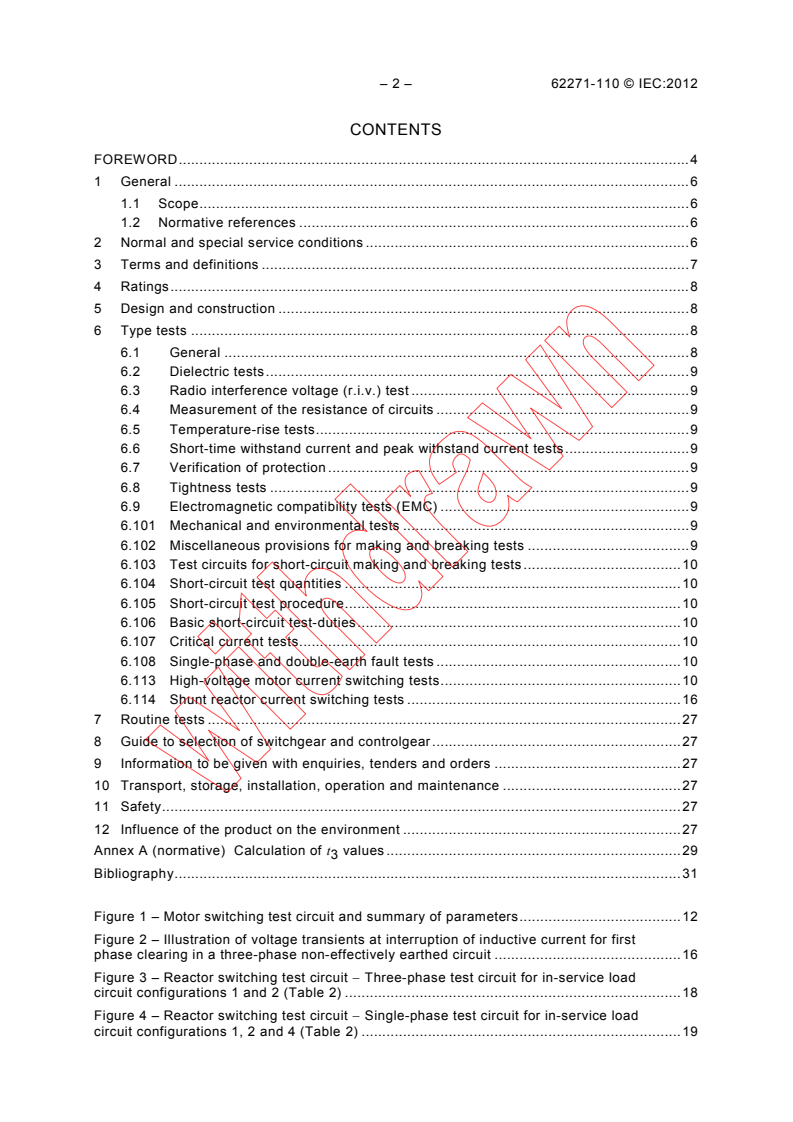
– 2 – 62271-110 © IEC:2012
CONTENTS
FOREWORD . 4
1 General . 6
1.1 Scope . 6
1.2 Normative references . 6
Normal and special service conditions . 6
3 Terms and definitions . 7
4 Ratings . 8
5 Design and construction . 8
6 Type tests . 8
6.1 General . 8
6.2 Dielectric tests . 9
6.3 Radio interference voltage (r.i.v.) test . 9
6.4 Measurement of the resistance of circuits . 9
6.5 Temperature-rise tests . 9
6.6 Short-time withstand current and peak withstand current tests . 9
6.7 Verification of protection . 9
6.8 Tightness tests . 9
6.9 Electromagnetic compatibility tests (EMC) . 9
Mechanical and environmental tests . 9
6.101
6.102 Miscellaneous provisions for making and breaking tests . 9
6.103 Test circuits for short-circuit making and breaking tests . 10
6.104 Short-circuit test quantities . 10
6.105 Short-circuit test procedure . 10
6.106 Basic short-circuit test-duties . 10
6.107 Critical current tests. 10
6.108 Single-phase and double-earth fault tests . 10
6.113 High-voltage motor current switching tests . 10
6.114 Shunt reactor current switching tests . 16
7 Routine tests . 27
8 Guide to selection of switchgear and controlgear . 27
9 Information to be given with enquiries, tenders and orders . 27
10 Transport, storage, installation, operation and maintenance . 27
11 Safety . 27
12 Influence of the product on the environment . 27
Annex A (normative) Calculation of t values . 29
Bibliography . 31
Figure 1 – Motor switching test circuit and summary of parameters . 12
Figure 2 – Illustration of voltage transients at interruption of inductive current for first
phase clearing in a three-phase non-effectively earthed circuit . 16
Figure 3 – Reactor switching test circuit − Three-phase test circuit for in-service load
circuit configurations 1 and 2 (Table 2) . 18
Figure 4 – Reactor switching test circuit − Single-phase test circuit for in-service load
circuit configurations 1, 2 and 4 (Table 2) . 19
62271-110 © IEC:2012 – 3 –
Figure 5 – Reactor switching test circuit − Three-phase test circuit for in-service load
circuit configuration 3 (Table 2) . 20
Figure 6 – Illustration of voltage transients at interruption of inductive current for a
single-phase test . 28
Table 1 – Test duties at motor current switching tests . 14
Table 2 – In-service load circuit configurations . 17
Table 3 – Standard values of prospective transient recovery voltages – Rated voltages
12 kV to 170 kV for effectively and non-effectively earthed systems – Switching shunt
reactors with isolated neutrals (Table 2: In-service load circuit configuration 1) . 21
Table 4 – Standard values of prospective transient recovery voltages – Rated voltages
100 kV to 1 200 kV for effectively earthed systems – Switching shunt reactors with
earthed neutrals (Table 2: In-service load circuit configuration 2). 22
Table 5 – Standard values of prospective transient recovery voltages – Rated voltages
12 kV to 52 kV for effectively and non-effectively earthed systems – Switching shunt
reactors with isolated neutrals (Table 2: In-service load circuit configuration 3) . 23
Table 6 – Standard values of prospective transient recovery voltages – Rated voltages
12 kV to 52 kV for effectively and non-effectively earthed systems – Switching shunt
reactors with earthed neutrals (Table 2: In-service load circuit configuration 4) . 23
Table 7 – Load circuit 1 test currents . 24
Table 8 – Load circuit 2 test currents . 24
Table 9 – Test duties for reactor current switching tests . 25
– 4 – 62271-110 © IEC:2012
INTERNATIONAL ELECTROTECHNICAL COMMISSION
_____________
HIGH-VOLTAGE SWITCHGEAR AND CONTROLGEAR –
Part 110: Inductive load switching
FOREWORD
1) The International Electrotechnical Commission (IEC) is a worldwide organization for standardization comprising
all national electrotechnical committees (IEC National Committees). The object of IEC is to promote
international co-operation on all questions concerning standardization in the electrical and electronic fields. To
this end and in addition to other activities, IEC publishes International Standards, Technical Specifications,
Technical Reports, Publicly Available Specifications (PAS) and Guides (hereafter referred to as “IEC
Publication(s)”). Their preparation is entrusted to technical committees; any IEC National Committee interested
in the subject dealt with may participate in this preparatory work. International, governmental and non-
governmental organizations liaising with the IEC also participate in this preparation. IEC collaborates closely
with the International Organization for Standardization (ISO) in accordance with conditions determined by
agreement between the two organizations.
2) The formal decisions or agreements of IEC on technical matters express, as nearly as possible, an international
consensus of opinion on the relevant subjects since each technical committee has representation from all
interested IEC National Committees.
3) IEC Publications have the form of recommendations for international use and are accepted by IEC National
Committees in that sense. While all reasonable efforts are made to ensure that the technical content of IEC
Publications is accurate, IEC cannot be held responsible for the way in which they are used or for any
misinterpretation by any end user.
4) In order to promote international uniformity, IEC National Committees undertake to apply IEC Publications
transparently to the maximum extent possible in their national and regional publications. Any divergence
between any IEC Publication and the corresponding national or regional publication shall be clearly indicated in
the latter.
5) IEC itself does not provide any attestation of conformity. Independent certification bodies provide conformity
assessment services and, in some areas, access to IEC marks of conformity. IEC is not responsible for any
services carried out by independent certification bodies.
6) All users should ensure that they have the latest edition of this publication.
7) No liability shall attach to IEC or its directors, employees, servants or agents including individual experts and
members of its technical committees and IEC National Committees for any personal injury, property damage or
other damage of any nature whatsoever, whether direct or indirect, or for costs (including legal fees) and
expenses arising out of the publication, use of, or reliance upon, this IEC Publication or any other IEC
Publications.
8) Attention is drawn to the Normative references cited in this publication. Use of the referenced publications is
indispensable for the correct application of this publication.
9) Attention is drawn to the possibility that some of the elements of this IEC Publication may be the subject of
patent rights. IEC shall not be held responsible for identifying any or all such patent rights.
International Standard IEC 62271-110 has been prepared by subcommittee 17A: High-voltage
switchgear and controlgear, of IEC technical committee 17: Switchgear and controlgear.
This third edition cancels and replaces the second edition published in 2009 and constitutes a
technical revision.
This edition includes the following significant technical changes with respect to the previous
edition:
– former Table 2 has been split into three new tables to conform with IEC 62271-100 and to
address actual in-service circuit configurations.
– the criteria for successful testing has been revised to a more explicit statement (see
6.114.11a).
– comments received in response to 17A/959/CDV and 17A/981/RVC have been addressed.
62271-110 © IEC:2012 – 5 –
The text of this standard is based on the following documents:
FDIS Report on voting
17A/1016/FDIS 17A/1025/RVD
Full information on the voting for the approval of this standard can be found in the report on
voting indicated in the above table.
This publication has been drafted in accordance with the ISO/IEC Directives, Part 2.
This standard is to be read in conjunction with IEC 62271-1:2007, and with
IEC 62271-100:2008, to which it refers and which are applicable, unless otherwise specified.
In order to simplify the indication of corresponding requirements, the same numbering of
clauses and subclauses is used as in IEC 62271-1 and IEC 62271-100. Additional subclauses
are numbered from 101.
A list of all the parts in the IEC 62271 series, under the general title High-voltage switchgear
and controlgear, can be found on the IEC website.
The committee has decided that the contents of this publication will remain unchanged until
the stability date indicated on the IEC web site under "http://webstore.iec.ch" in the data
related to the specific publication. At this date, the publication will be
• reconfirmed;
• withdrawn;
• replaced by a revised edition, or
• amended.
The contents of the corrigendum of October 2012 have been included in this copy.
– 6 – 62271-110 © IEC:2012
HIGH-VOLTAGE SWITCHGEAR AND CONTROLGEAR –
Part 110: Inductive load switching
1 General
1.1 Scope
This part of IEC 62271 is applicable to a.c. circuit-breakers designed for indoor or outdoor
installation, for operation at frequencies of 50 Hz and 60 Hz on systems having voltages
above 1 000 V and applied for inductive current switching with or without additional short-
circuit current breaking duties. The standard is applicable to circuit-breakers in accordance
with IEC 62271-100 that are used to switch high-voltage motor currents and shunt reactor
currents and also to high-voltage contactors used to switch high-voltage motor currents as
covered by IEC 62271-106. For circuit-breakers applied to switch shunt reactor currents at
rated voltages according to IEC 62271-1:2007 Tables 2a and 2b, combined voltage tests
across the isolating distance are not required (refer to 4.2).
Switching unloaded transformers, i.e. breaking transformer magnetizing current, is not
considered in this standard. The reasons for this are as follows:
a) due to the non-linearity of the transformer core, it is not possible to correctly model the
switching of transformer magnetizing current using linear components in a test laboratory.
Tests conducted using an available transformer, such as a test transformer, will only be
valid for the transformer tested and cannot be representative for other transformers;
b) as detailed in IEC 62271-306 , the characteristics of this duty are usually less severe than
any other inductive current switching duty. It should be noted that such a duty may
produce severe overvoltages within the transformer winding(s) depending on the circuit-
breaker re-ignition behaviour and transformer winding resonance frequencies.
Short-line faults, out-of-phase current making and breaking and capacitive current switching
are not applicable to circuit-breakers applied to switch shunt reactors or motors. These duties
are therefore not included in this standard.
Subclause 1.1 of IEC 62271-100:2008 is otherwise applicable.
1.2 Normative references
Subclause 1.2 of IEC 62271-100:2008 is applicable with the following addition:
IEC 62271-100:2008, High-voltage switchgear and controlgear – Part 100: Alternating-current
circuit-breakers
2 Normal and special service conditions
Clause 2 of IEC 62271-1:2007 is applicable.
___________
To be published.
62271-110 © IEC:2012 – 7 –
3 Terms and definitions
For the purposes of this document, the definitions of IEC 60050-441 and IEC 62271-1 apply
as well as the following specific to inductive load switching.
3.101
inductive current
power-frequency current through a circuit-breaker drawn by an inductive circuit having a
power factor 0,5 or less
3.102
small inductive current
inductive current having a steady state value considerably less than the rated short-circuit
breaking current
3.103
current chopping
abrupt current interruption in the circuit-breaker at a point-on-wave other than the natural
power-frequency current zero of the circuit connected to the circuit-breaker
3.104
virtual current chopping
current chopping originated by transients in (parts of) the circuit
3.105
chopping current
current interruption prior to the natural power-frequency current zero of the circuit connected
to the switching device
3.106
chopping level
maximum recorded value of the chopping current due to true current chopping in a specific
circuit under rated voltage and normal operating conditions
3.107
load side oscillation
oscillation of the interrupted load side network after current chopping or natural current zero
3.108
suppression peak
first peak of the transient voltage to earth on the load side of the circuit-breaker
3.109
recovery peak
maximum value of the voltage across the circuit-breaker occurring after definite polarity
change of the recovery voltage
Note 1 to entry: Suppression peak and recovery peak are not necessarily the absolute maxima in the transient
recovery voltage. Previous breakdowns may have appeared at higher voltage values.
3.110
voltage escalation
increase in the amplitude of the prospective recovery voltage of the load circuit, produced by
the accumulation of energy due to repeated re-ignitions
– 8 – 62271-110 © IEC:2012
3.111
re-ignition
resumption of current between the contacts of a mechanical switching device during a
breaking operation with an interval of zero current of less than a quarter cycle of power
frequency
[SOURCE: IEC 60050-441:1998, 441-17-45]
Note 1 to entry: In the case of inductive load switching the initiation of the re-ignition is a high frequency event,
which can be of a single or multiple nature and may in some cases be interrupted without power frequency follow
current.
4 Ratings
Clause 4 of IEC 62271-100:2008 is applicable except for the references to short-line faults,
out-of-phase making and breaking, capacitive current switching and as noted in specific
subclauses below. Circuit-breakers do not normally have inductive load switching ratings.
However, circuit-breakers applied for this purpose should meet the requirement of this
standard part.
4.2 Rated insulation level
Subclause 4.2 of IEC 62271-1:2007 is applicable with the following addition:
The rated values stated in Tables 1a and 1b and Tables 2a and 2b of IEC 62271-1:2007 are
applicable with the exception of columns (6) and (8) in Table 2a and column (7) in Table 2b.
NOTE 1 The reason for this exception is the source-less nature of the shunt reactor load circuit.
NOTE 2 In some cases (high chopping overvoltage levels, or where a neutral reactor is present or in cases of
shunt reactors with isolated neutral), it can be necessary to specify an appropriate insulation level which is higher
than the rated values stated above.
5 Design and construction
Clause 5 of IEC 62271-100:2008 is applicable.
6 Type tests
6.1 General
Subclause 6.1 of IEC 62271-100:2008 is applicable with the following addition:
Inductive current switching tests performed for a given current rating and type of application
may be considered valid for another current rating and same type of application as detailed
below:
a) for high-voltage shunt reactor switching at rated voltage 52 kV and above, tests at a
particular current rating are to be considered valid for applications up to 150 % of the
tested current value;
b) for shunt reactor switching at rated voltage below 52 kV, type testing is required but short
circuit test duties T30 and T10 will cover the requirements provided that the TRV values of
T30 and T10 are equal to or higher than the reactor switching TRV values.
c) for high-voltage motor switching, type testing for stalled motor currents at 100 A and 300 A
is considered to cover stalled motor currents in the range 100 A to 300 A and up to the
current associated with the short-circuit current of test duty T10 according to 6.106.1 of
IEC 62271-100:2008.
62271-110 © IEC:2012 – 9 –
With respect to 6.1a) the purpose of type testing is to also determine reignition-free zones for
controlled switching purposes and caution should be exercised when considering applications
at higher currents than the tested values.
Annex B of IEC 62271-100:2008 is applicable with respect to tolerances on test quantities.
6.2 Dielectric tests
Subclause 6.2 of IEC 62271-100:2008 is applicable with the following addition:
Refer to 4.2.
6.3 Radio interference voltage (r.i.v.) test
Subclause 6.3 of IEC 62271-1:2007 is applicable.
6.4 Measurement of the resistance of circuits
Subclause 6.4 of IEC 62271-1:2007 is applicable.
6.5 Temperature-rise tests
Subclause 6.5 of IEC 62271-1:2007 is applicable.
6.6 Short-time withstand current and peak withstand current tests
Subclause 6.6 of IEC 62271-1:2007 is applicable.
6.7 Verification of protection
Subclause 6.7 of IEC 62271-1:2007 is applicable.
6.8 Tightness tests
Subclause 6.8 of IEC 62271-1:2007 is applicable.
6.9 Electromagnetic compatibility tests (EMC)
Subclause 6.9 of IEC 62271-1:2007 is applicable.
6.101 Mechanical and environmental tests
Subclause 6.101 of IEC 62271-100:2008 is applicable.
6.102 Miscellaneous provisions for making and breaking tests
Subclause 6.102 of IEC 62271-100:2008 is applicable with the following addition:
High-voltage motor current and shunt reactor switching tests shall be performed at rated
auxiliary and control voltage or, where necessary, at maximum auxiliary and control voltage to
facilitate consistent control of the opening and closing operation according to 6.102.3.1 of
IEC 62271-100:2008 and at rated functional pressure for interruption and insulation.
For gas circuit-breakers, a shunt reactor switching test shall also be performed at the
minimum functional pressure for interruption and insulation. This requirement applies for test
duty 4 only (see 6.114.9).
– 10 – 62271-110 © IEC:2012
6.103 Test circuits for short-circuit making and breaking tests
Subclause 6.103 of IEC 62271-100:2008 is applicable.
6.104 Short-circuit test quantities
Subclause 6.104 of IEC 62271-100:2008 is applicable.
6.105 Short-circuit test procedure
Subclause 6.105 of IEC 62271-100:2008 is applicable.
6.106 Basic short-circuit test-duties
Subclause 6.106 of IEC 62271-100:2008 is applicable.
6.107 Critical current tests
Subclause 6.107 of IEC 62271-100:2008 is applicable.
6.108 Single-phase and double-earth fault tests
Subclause 6.108 of IEC 62271-100:2008 is applicable.
Subclauses 6.109 to 6.112 of IEC 62271-100:2008 are not applicable to this part of
IEC 62271 series.
6.113 High-voltage motor current switching tests
6.113.1 Applicability
This subclause is applicable to three-phase alternating current circuit-breakers having rated
voltages above 1 kV and up to 17,5 kV, which are used for switching high-voltage motors.
Tests may be carried out at 50 Hz with a relative tolerance of ±10 % or 60 Hz with a relative
tolerance of ±10 %, both frequencies being considered equivalent.
Motor switching tests are applicable to all three-pole circuit-breakers having rated voltages
equal to or less than 17,5 kV, which may be used for the switching of three-phase
asynchronous squirrel-cage or slip-ring motors. The circuit-breaker may be of a higher rated
voltage than the motor when connected to the motor through a stepdown transformer.
However, the more usual application is a direct cable connection between circuit-breaker and
motor. When tests are required, they shall be made in accordance with 6.113.2 to 6.113.9.
When overvoltage limitation devices are mandatory for the tested equipment, the voltage
limiting devices may be included in the test circuit provided that the devices are an intrinsic
part of the equipment under test.
No limits to the overvoltages are given as the overvoltages are only relevant to the specific
application. Overvoltages between phases may be as significant as phase-to-earth
overvoltages.
6.113.2 General
The switching tests can be either field tests or laboratory tests. As regards overvoltages, the
switching of the current of a starting or stalled motor is usually the more severe operation.
Due to the non-linear behaviour of the motor iron core, it is not possible to exactly model the
switching of motor current using linear components in a test station. Tests using linear
62271-110 © IEC:2012 – 11 –
components to simulate the motors can be considered to be more conservative than switching
actual motors.
For laboratory tests a standardized circuit simulating the stalled condition of a motor is
specified (refer to Figure 1). The parameters of this test circuit have been chosen to represent
a relatively severe case with respect to overvoltages and will cover the majority of service
applications.
The laboratory tests are performed to prove the ability of a circuit-breaker to switch motors
and to establish its behaviour with respect to switching overvoltages, re-ignitions and current
chopping. These characteristics may serve as a basis for estimates of the circuit-breaker
performance in other motor circuits. Tests performed with the test currents defined in 6.113.3
and 6.113.4 demonstrate the capability of the switching device to switch high-voltage motors
up to its rated interrupting current.
For field tests, actual circuits are used with a supply system on the source side and a cable
and motor on the load side. There may be a transformer between the circuit-breaker and
motor. However, the results of such field tests are only valid for circuit-breakers working in
circuits similar to those during the tests.
The apparatus under test includes the circuit-breaker with overvoltage protection devices if
they are normally fitted.
NOTE 1 Overvoltages can be produced when switching running motors. This condition is not represented by the
substitute circuit and is generally considered to be less severe than the stalled motor case.
NOTE 2 The starting period switching of a slip-ring motor is generally less severe due to the effect of the starting
resistor.
NOTE 3 The rated voltage of the circuit-breaker can exceed that of the motor.
– 12 – 62271-110 © IEC:2012
Switchgear
Motor substitute
Source U under test
r Bus representation Cable
L L R
s
L
b2
L
R
b1
p
Z
e
C C
p
s
IEC 841/05
Key
U rated voltage
r
Z earthing impedance impedance high enough to limit the phase-to earth
e
fault current to less than the test current (can be
infinite)
L source side inductance ωL ≤ 0,1 ωL, but prospective short-circuit current ≤
s s
the rated short-circuit current of the tested circuit-
breaker
C supply side capacitance
0,03 µF to 0,05 µF for supply circuit A
s
1,5 µF to 2 µF for supply circuit B
L inductance of capacitors and ≤ 2 µH
b1
connections
Bus representation 5 m to 7 m in length spaced appropriate to the rated
voltage
L inductance of connections
≤ 5 µH
b2
Cable
100 m ± 10 m, screened, Z = 30 Ω to 50 Ω
L motor substitute inductance
load circuit 1: 100 A ± 10 A
load circuit 2: 300 A ± 30 A
R motor substitute resistance cosθ ≤ 0,2
C
motor substitute parallel frequency 10 kHz to 15 kHz
p
capacitance
R motor substitute parallel resistance amplitude factor 1,6 to 1,8
p
Figure 1 – Motor switching test circuit and summary of parameters
6.113.3 Characteristics of the supply circuits
6.113.3.1 General
A three-phase supply circuit shall be used. The tests shall be performed using two different
supply circuits A and B as specified in 6.113.3.2 and 6.113.3.3, respectively. Supply circuit A
represents the case of a motor connected directly to a transformer. Supply circuit B
represents the case where parallel cables are applied on the supply side.
6.113.3.2 Supply circuit A
The three-phase supply may be earthed through a high ohmic impedance so that the supply
voltage is defined with respect to earth. The impedance value shall be high enough to limit a
prospective line-to-earth fault current to a value below the test current.
62271-110 © IEC:2012 – 13 –
The source inductance L shall not be lower than that corresponding to the rated short-circuit
s
breaking current of the tested circuit-breaker. Its impedance shall also be not higher than
0,1 times the impedance of the inductance in the load circuit (see 6.113.4).
The supply side capacitance C is represented by three capacitors connected in earthed star.
s
Their value, including the natural capacitance of the circuit shall be 0,04 µF ± 0,01 µF. The
inductance L of the capacitors and connections shall not exceed 2 µH.
b1
The busbar inductance is represented by three bars forming a busbar each 6 m ± 1 m in
length and spaced at a distance appropriate to the rated voltage.
6.113.3.3 Supply circuit B
As supply circuit A with the value of the supply side capacitance increased to
1,75 µF ± 0,25 µF.
6.113.4 Characteristics of the load circuit
6.113.4.1 General
A three-phase load circuit shall be used. The motor substitute circuit is connected to the
circuit-breaker under test by 100 m ± 10 m of screened cable. It is recommended that the
cable be connected directly to the terminals of the motor or substitute circuit.
The inductance of any intermediate connection should not exceed 3 µH. The shield of the
cable shall be earthed at both ends as shown in Figure 1. The tests shall be performed using
two different motor substitute circuits as specified in 6.113.4.2 and 6.113.4.3. The inductance
L of the connections between the circuit-breaker and cable shall not exceed 5 µH.
b2
6.113.4.2 Motor substitute circuit 1
Series-connected resistance and inductance shall be arranged to obtain a current of
100 A ± 10 A at a power factor less than 0,2 lagging. The star point shall not be connected to
earth. Resistance R shall be connected in parallel with each phase impedance and
p
capacitance C between each phase and earth so that the motor substitute circuit has a
p
natural frequency of 12,5 kHz ± 2,5 kHz and an amplitude factor of 1,7 ± 0,1 measured in
each phase with the other two phases connected to earth. The prospective transient recovery
voltages values shall be determined in accordance with Annex F of IEC 62271-100:2008. A
transformer may be introduced at the load end of the cable. This shall be considered as part
of the motor substitute circuit.
6.113.4.3 Motor substitute circuit 2
As motor substitute circuit 1, but with the series resistance and inductance reduced to obtain
a current of 300 A ± 30 A at a power factor less than 0,2 lagging. The prospective transient
recovery voltage shall be as specified for motor substitute circuit 1.
6.113.5 Test voltage
a) The average value of the applied voltages shall be not less than the rated voltage U
r
divided by 3 and shall not exceed this value by more than 10 % without the consent of
the manufacturer.
The differences between the average value and the applied voltages of each pole shall not
exceed 5 %.
The rated voltage U is that of the circuit-breaker when using the substitute circuit, but is
r
that of the motor when an actual motor is used.
b) The power frequency recovery voltage of the test circuit may be stated as a percentage of
the power frequency recovery voltage specified below. It shall not be less than 95 % of the
– 14 – 62271-110 © IEC:2012
specified value and shall be maintained in accordance with 6.104.7 of IEC 62271-
100:2008.
The average value of the power frequency recovery voltages shall not be less than the
rated voltage U of the circuit-breaker divided by 3 .
r
The power frequency recovery voltage of any pole should not deviate by more than 20 %
from the average value at the end of the time for which it is maintained.
The power frequency recovery voltage shall be measured between terminals of a pole in
each phase of the test circuit. Its r.m.s. value shall be determined on the oscillogram
within the time interval of one half cycle and one cycle of test frequency after final arc
extinction, as indicated in Figure 44 of IEC 62271-100:2008. The vertical distance (V , V
1 2
and V respectively) between the peak of the second half-wave and the straight line drawn
between the respective peaks of the preceding and succeeding half-waves shall be
measured, and this, when divided by 2 2 and multiplied by the appropriate calibration
factor, gives the r.m.s. value of the recorded power frequency recovery voltage.
6.113.6 Test duties
The motor current switching tests shall consist of four test duties as specified in Table 1.
Table 1 – Test duties at motor current switching tests
Test duty Supply circuit Motor substitute circuit
1 A 1
2 A 2
3 B 1
4 B 2
The number of tests for each test duty shall be:
– 20 tests with the initiation of the closing and tripping impulses distributed at intervals of
approximately 9 electrical degrees.
The above tests shall be make-breaks or separate makes and breaks except that when using
an actual motor they shall only be make-breaks. When tests are made using the motor
substitute circuit, the contacts of the circuit-breaker shall not be separated until any d.c.
component has become less than 20 %. When switching an actual motor, a make-break time
of 200 ms is recommended.
6.113.7 Test measurements
At least the following quantities shall be recorded by oscillograph or other suitable recording
techniques with bandwidth and time resolution high enough to measure the following:
– power frequency voltage;
– power frequency current;
– phase-to-earth voltage, at the motor or motor substitute circuit terminals, in all three
phases.
6.113.8 Behaviour and condition of circuit-breaker
The criteria for successful testing are as follows:
a) the behaviour of the circuit-breaker during the motor switching tests fulfils the conditions
given in 6.102.8 of IEC 62271-100:2008 as applicable;
b) voltage tests shall be performed in accordance with 6.2.11 of IEC 62271-100:2008;
62271-110 © IEC:2012 – 15 –
c) re-ignitions shall take place between the arcing contacts.
6.113.9 Test report
In addition to the requirements of Annex C of IEC 62271-100:2008, the test report shall
include a thorough description of the circuit, including the following details:
– main dimensions and characteristics of the bus and connections to the circuit-breaker;
– the characteristics of the cable:
• length;
• rated values;
• type;
• main insulation dielectric – XLPE, paper/oil, etc.;
• earthing;
• capacitances;
• surge impedance.
– the parameters of the substitute motor circuit:
• natural frequency;
• amplitude factor;
• current;
• power factor.
– or details of the actual motor:
• type and rating;
• rated voltage;
• winding connection;
• rated motor current;
• starting current and power factor.
– overvoltage characteristics.
The following characteristics of the voltages at the motor or motor substitute circuit terminals
at each test (Figure 2) shall be evaluated:
– u maximum overvoltage;
p
– u suppression peak overvoltage;
ma
– u load side voltage peak to earth;
mr
– u maximum peak-to-peak voltage excursion at re-ignition and/or prestrike.
s
When overvoltages occur which may be hazardous for a specific application, or where circuit-
breaker characteristics are required, a more comprehensive test programme will be required
which is beyond the scope of this standard.
– 16 – 62271-110 © IEC:2012
u
u
a
Supply side voltage
u
p
u
ma
u
o
u
in u
s
Load side voltage
t
u u
k w
u
mr Neutral point
average voltage
IEC 842/05
Key
u power frequency voltage crest value to earth
u neutral voltage shift at first-pole interruption
k
u circuit-breaker arc voltage drop
a
u = u + u initial voltage at the moment of current chopping
in 0 a
u suppression peak voltage to earth
ma
u load side voltage peak to earth
mr
u voltage across the circuit-breaker at re-ignition
w
u maximum overvoltage to earth (could be equal to u or u if no re-ignitions occur)
p ma mr
u maximum peak-to-peak overvoltage excursion at re-ignition
s
Figure 2 – Illustration of voltage transients at interruption of inductive current
for first phase clearing in a three-phase non-effectively earthed circuit
6.114 Shunt reactor current switching tests
6.114.1 Applicability
These tests are applicable to three-phase alternating current circuit-breakers which are used
for steady-state switching of shunt reactors that are directly connected to the circuit-breaker
without interposing transformer. Tests may be carried out at 50 Hz with a relative tolerance of
±10 % or 60 Hz with a relative tolerance of ±10 %. Tests performed at either 50 Hz or 60 Hz
shall be considered as valid for both frequencies.
NOTE 1 The switching of tertiary reactors from the high-voltage side of the transformer is not covered in this
standard.
62271-110 © IEC:2012 – 17 –
NOTE 2 Shunt reactors earthed through neutral reactors are not covered by this standard. However, the
application of test results according to this subclause, on neutral reactor earthed reactors (4-leg reactor scheme),
is discussed in IEC 62271-306.
6.114.2 General
Reactor switching is an operation where small differences in circuit parameters can produce
large differences in the severity of the duty. The results from any one series of tests cannot
simply be applied to a different set of conditions.
NOTE Further guidance is given in IEC 62271-306.
The switching tests can be either field tests or laboratory tests. Results from field tests are
only valid for circuit-breakers applied in circuit similar to those in the tests.
Standard circuits are specified in order to demonstrate the ability of the circuit-breaker to
interrupt reactor currents and to determine chopping characteristics (suppression peak
overvoltages) and re-ignition behaviour. The parameters of these test circuits represent
typical cases of application with relatively severe transient recovery voltage (TRV) and are
regarded as covering the majority of service applications.
Laboratory tests may be made using an actual reactor but the re-ignitions and overvoltage
magnitudes during switching will not necessarily be valid for other cases of installation.
6.114.3 Test circuits
Four in-service load circuit configurations are possible as shown in Table 2.
Table 2 – In-service load circuit configurations
In-service Circuit-breaker Reactor neutral TRV values Test circuit
configuration location earthing
1 Source side of Isolated Table 3 Figure 3 or Figure 4
reactor
2 Earthed Table 4 Figure 3 or Figure 4
3 Neutral
...