


IEC TS 61158-4:1999
(Main)Digital data communications for measurement and control - Fieldbus for use in industrial control systems - Part 4: Data Link protocol specification
General Information
- Abstract
Provides basic time-critical messaging communications between devices in an automation environment. Specifies: a) procedures for a single protocol for the timely transfer of data and control information; b) the structure of the Fieldbus Data Link (DL) Protocol Data Units. Provides communication opportunities to all participating data-link entities in a cyclic asynchronous and in a synchronous manner.
- Status
- Replaced
- Publication Date
- 23-Mar-1999
- Technical Committee
- SC 65C - Industrial networks
- Drafting Committee
- WG 6 - TC 65/SC 65C/WG 6
- Current Stage
- DELPUB - Deleted Publication
- Start Date
- 31-Jan-2000
- Completion Date
- 28-Aug-2026
Buy Documents
IEC TS 61158-4:1999 - Digital data communications for measurement and control - Fieldbus for use in industrial control systems - Part 4: Data Link protocol specification Released:3/24/1999
Relations
- Effective Date
- 05-Sep-2023
Buy Documents
IEC TS 61158-4:1999 - Digital data communications for measurement and control - Fieldbus for use in industrial control systems - Part 4: Data Link protocol specification Released:3/24/1999
Get Certified
Connect with accredited certification bodies for this standard

BSI Group
BSI (British Standards Institution) is the business standards company that helps organizations make excellence a habit.

DVS-ZERT GmbH
German welding certification society.
CARES (UK Certification Authority for Reinforcing Steels)
UK certification for reinforcing steels and construction.
Sponsored listings
Frequently Asked Questions
IEC TS 61158-4:1999 is a technical specification published by the International Electrotechnical Commission (IEC). Its full title is "Digital data communications for measurement and control - Fieldbus for use in industrial control systems - Part 4: Data Link protocol specification". This standard covers: Provides basic time-critical messaging communications between devices in an automation environment. Specifies: a) procedures for a single protocol for the timely transfer of data and control information; b) the structure of the Fieldbus Data Link (DL) Protocol Data Units. Provides communication opportunities to all participating data-link entities in a cyclic asynchronous and in a synchronous manner.
Provides basic time-critical messaging communications between devices in an automation environment. Specifies: a) procedures for a single protocol for the timely transfer of data and control information; b) the structure of the Fieldbus Data Link (DL) Protocol Data Units. Provides communication opportunities to all participating data-link entities in a cyclic asynchronous and in a synchronous manner.
IEC TS 61158-4:1999 is classified under the following ICS (International Classification for Standards) categories: 25.040.40 - Industrial process measurement and control; 35.100.20 - Data link layer. The ICS classification helps identify the subject area and facilitates finding related standards.
IEC TS 61158-4:1999 has the following relationships with other standards: It is inter standard links to IEC 61158-4:2000. Understanding these relationships helps ensure you are using the most current and applicable version of the standard.
IEC TS 61158-4:1999 is available in PDF format for immediate download after purchase. The document can be added to your cart and obtained through the secure checkout process. Digital delivery ensures instant access to the complete standard document.
Standards Content (Sample)
TECHNICAL
IEC
SPECIFICATION
61158-4
First edition
1999-03
Digital data communications for
measurement and control –
Fieldbus for use in industrial control systems –
Part 4:
Data Link protocol specification
Reference number
IEC 61158-4:1999(E)
Numbering
As from 1 January 1997 all IEC publications are issued with a designation in the
60000 series.
Consolidated publications
Consolidated versions of some IEC publications including amendments are
available. For example, edition numbers 1.0, 1.1 and 1.2 refer, respectively, to the
base publication, the base publication incorporating amendment 1 and the base
publication incorporating amendments 1 and 2.
Validity of this publication
The technical content of IEC publications is kept under constant review by the IEC,
thus ensuring that the content reflects current technology.
Information relating to the date of the reconfirmation of the publication is available
in the IEC catalogue.
Information on the subjects under consideration and work in progress undertaken by
the technical committee which has prepared this publication, as well as the list of
publications issued, is to be found at the following IEC sources:
• IEC web site*
• Catalogue of IEC publications
Published yearly with regular updates
(On-line catalogue)*
• IEC Bulletin
Available both at the IEC web site* and as a printed periodical
Terminology, graphical and letter symbols
For general terminology, readers are referred to IEC 60050: International
Electrotechnical Vocabulary (IEV).
For graphical symbols, and letter symbols and signs approved by the IEC for
general use, readers are referred to publications IEC 60027: Letter symbols to be
used in electrical technology, IEC 60417: Graphical symbols for use on equipment.
Index, survey and compilation of the single sheets and IEC 60617: Graphical symbols
for diagrams.
* See web site address on title page.
TECHNICAL IEC
SPECIFICATION 61158-4
First edition
1999-03
Digital data communications for
measurement and control –
Fieldbus for use in industrial control systems –
Part 4:
Data Link protocol specification
© IEC 1999 – Copyright - all rights reserved
No part of this publication may be reproduced or utilized in any form or by any means, electronic or
mechanical, including photocopying and microfilm, without permission in writing from the publisher.
International Electrotechnical Commission 3, rue de Varembé Geneva, Switzerland
Telefax: +41 22 919 0300 e-mail: inmail@iec.ch IEC web site http://www.iec.ch
Commission Electrotechnique Internationale
PRICE CODE
XH
International Electrotechnical Commission
For price, see current catalogue
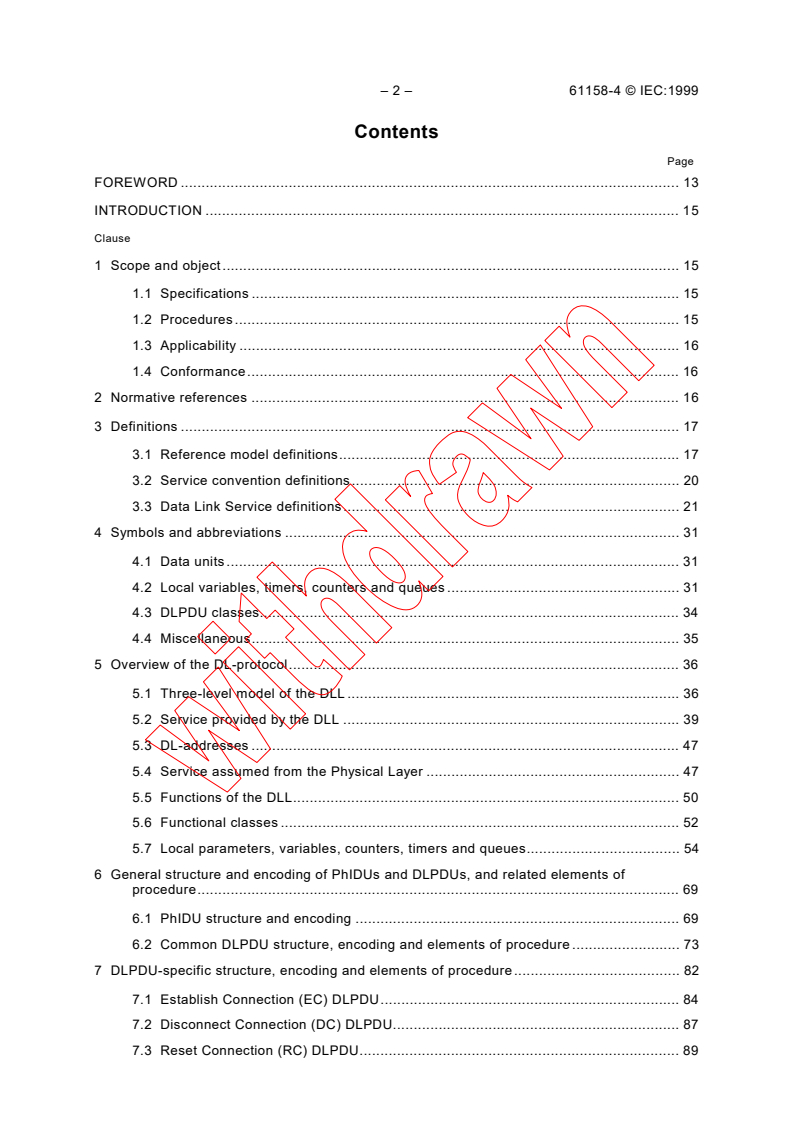
– 2 – 61158-4 © IEC:1999
Contents
Page
FOREWORD .13
INTRODUCTION . 15
Clause
1 Scope and object. 15
1.1 Specifications . 15
1.2 Procedures . 15
1.3 Applicability . 16
1.4 Conformance. 16
2 Normative references . 16
3 Definitions . 17
3.1 Reference model definitions. 17
3.2 Service convention definitions. 20
3.3 Data Link Service definitions. 21
4 Symbols and abbreviations . 31
4.1 Data units . 31
4.2 Local variables, timers, counters and queues . 31
4.3 DLPDU classes. 34
4.4 Miscellaneous. 35
5 Overview of the DL-protocol. 36
5.1 Three-level model of the DLL . 36
5.2 Service provided by the DLL . 39
5.3 DL-addresses . 47
5.4 Service assumed from the Physical Layer . 47
5.5 Functions of the DLL. 50
5.6 Functional classes . 52
5.7 Local parameters, variables, counters, timers and queues. 54
6 General structure and encoding of PhIDUs and DLPDUs, and related elements of
procedure. 69
6.1 PhIDU structure and encoding . 69
6.2 Common DLPDU structure, encoding and elements of procedure . 73
7 DLPDU-specific structure, encoding and elements of procedure . 82
7.1 Establish Connection (EC) DLPDU. 84
7.2 Disconnect Connection (DC) DLPDU. 87
7.3 Reset Connection (RC) DLPDU. 89
61158-4 © IEC:1999 – 3 –
Clause Page
7.4 Compel Acknowledgment (CA) DLPDU . 91
7.5 COMPEL DATA (CD) DLPDU . 99
7.6 EXCHANGE DATA (ED) DLPDU.107
7.7 DATA (DT) DLPDU .117
7.8 STATUS RESPONSE (SR) DLPDU .126
7.9 COMPEL TIME (CT) DLPDU .129
7.10 Time Distribution (TD) DLPDU .131
7.11 Round-Trip-Delay Query (RQ) DLPDU.133
7.12 Round-Trip-Delay Reply (RR) DLPDU .136
7.13 Probe Node DL-address (PN) DLPDU .138
7.14 Probe Response (PR) DLPDU.141
7.15 Pass Token (PT) DLPDU .142
7.16 Execute Sequence (ES) DLPDU.153
7.17 Return Token (RT) DLPDU .160
7.18 Request Interval (RI) DLPDU .161
7.19 CLAIM LAS (CL) DLPDU .163
7.20 Transfer LAS (TL) DLPDU .165
7.21 Wakeup (WK) DLPDU.168
7.22 IDLE (IDLE) DLPDU.170
7.23 Spare DLPDUs .172
7.24 Reserved (not to be used) DLPDUs.173
8 DLPDU-parameter structure and encoding .175
8.1 Structure and encoding of EC-PARAMETERS.175
8.2 Structure and encoding of DC-PARAMETERS.180
8.3 Structure and encoding of RC-PARAMETERS.181
8.4 Structure and encoding of SD-Parameters .183
8.5 Structure and encoding of SR-parameters.192
8.6 Structure and encoding of TD-parameters.193
8.7 Structure and encoding of RQ-parameters .196
8.8 Structure and encoding of RR-parameters.196
8.9 Structure and encoding of PN-parameters.197
8.10 Structure and encoding of DD-parameters.199
9 DL-service elements of procedure.200
9.1 Operation of the DL(SAP)-address, buffer and queue management services .200
9.2 Operation of the connection-mode services.205
– 4 – 61158-4 © IEC:1999
Clause Page
9.3 Operation of the connectionless-mode services.254
9.4 Operation of the scheduling guidance services.268
10 Other DLE elements of procedure .280
10.1 DLE initialization .280
10.2 LAS behavior and operation .284
10.3 DL-support operation .293
11 Implementation profiles.30 0
11.1 DL-address, queue and buffer management services .300
11.2 DL-data delivery services .300
11.3 DL-time and time-based scheduling services.302
Annex A (normative) — Structure and definition of DL-addresses.307
A.1 Form of DL-addresses.307
A.2 Predefined Values and Ranges for DL-Address Components .309
A.3 Predefined DL-Addresses.316
A.4 Representation of DL-Addresses as locally-administered 48-bit MAC-
addresses.318
Annex B (normative) — DL-support sub-protocol.320
B.1 Scope .320
B.2 Overview of LAS operation .320
B.3 DL-support subprotocol definition .321
B.4 Elements of Procedures for receiving SPDUs .359
Annex C (normative) — DL-bridge elements of procedure and bridge sub-protocol .361
C.1 Global changes .361
C.2 Changes to [IL/1]: Introduction.361
C.3 Changes to [IL/2]: Support of the DL-Service .362
C.4 Changes to [IL/3]: Principles of operation .363
C.5 Changes to [IL/ 4]: The spanning tree algorithm and protocol.368
C.6 Changes to [IL/5]: Encoding of bridge protocol data units.369
C.7 Changes to clause 6: Bridge management.369
C.8 Changes to[IL/7]: Management protocol.370
C.9 Changes to [IL/annex A]: PICS proforma .370
C.10 Delete [IL/annex C] and [IL/annex D], both of which relate to source-routing .371
Annex D (normative) — DL-management-information.372
D.1 Scope .372
D.2 DLE configuration parameters .372
61158-4 © IEC:1999 – 5 –
Clause Page
D.3 DLE-collected fault-management data .374
D.4 DLE Variables which can be read and set by DL—management .376
D.5 DLE Actions Requestable by DL-management .377
Annex E (normative) — PICS proforma .378
Introduction .378
E.1 Scope .378
E.2 Normative references .378
E.3 Definitions .379
E.4 Abbreviations .379
E.5 Conformance.379
E.6 Instructions .380
E.7 Identification.381
E.8 Implementation profile .382
E.9 Major low-level capabilities .386
E.10 Major high-level capabilities.401
Annex F (informative )— Formal protocol finite state machines .413
F.1 Basic reception and transmission FSMs.413
F.2 FSMs for DLCs.425
F.3 FSMs for scheduling.431
F.4 FSMs for bridges .431
Annex G (informative) — Exemplary FCS implementation .432
Annex H (informative) — DLPDU and DL-addressing short-form summaries.433
H.1 Fields used in short-form summaries .433
H.2 DLPDU short-form summary grouped by function.435
H.3 DLPDU short-form summary in alphabetic order of DLPDU names.436
H.4 DLPDU short-form summary in alphabetic order of DLPDU acronyms .437
H.5 DLPDU FC code-point assignment matrix — overview and detail .438
H.6 SD-parameters (status and data-description parameters) of CA, CD, ED and
DT DLPDUs .442
H.7 EC parameters of EC DLPDUs .446
H.8 Parameters of DC and RC DLPDUs.447
H.9 Parameters of TD, RQ and RR DLPDUs .449
H.10 Parameters of PN, PT, ES and RI DLPDUs.452
H.11 Addressing summary extracted from annex A figures and tables .453
– 6 – 61158-4 © IEC:1999
Figures
Page
Figure 1 — Relationship of this part of IEC 61158 to other Fieldbus and OSI standards. 14
Figure 2 — Relationships of DLSAPs, DLCEPs, DLSAP-addresses, DLCEP-addresses
and group DL-addresses . 23
Figure 3 — Linear relationships of sending and receiving DLCEP sequence-number
variables . 6 1
Figure 4 — DL-address alternative structures . 75
Figure 5 — SHORT DL-address field — alternative implicit structures . 76
Figure 6 — NODE DL-address field — implicit structure. 76
Figure 7 — State transition diagram for a DLCEP.205
Figure 8 — Projection of the sending and receiving DLCEP sequence-number variables
of Figure 3 onto the cyclic sequence-number parameters of CA, CD, DT, ED and
RC DLPDUs, with consequent determination of required actions .225
Figure 9 — State transitions of a DLE .281
Figure A.1 — Basic Structure of a DL-address .307
Figure A.2 — Basic Structure of a Sub-link Selector.307
Figure A.3 — DL-address Alternative Structures .308
Figure A.4 — Basic Structure of MAC-addresses .319
Figure A.5 — Representation of a DL-address as a MAC-address .319
Figure C.1 — Replacement for [IL] Fig 3-2 Bridge ports .364
Figure C.2 — Replacement for [IL] Fig 3-3 Bridge architecture .364
Figure G.1 — Example of FCS generation.432
Figure G.2 — Example of FCS syndrome checking on reception .432
Figure H.1 — Gross Structure of FC Code Points.439
Figure H.2 [1] Basic Structure of a DL-address .453
Figure H.3 [2] — Basic Structure of a Sub-link Selector.453
Figure H.4 [3] — DL-Address Alternative Structures .453
Figure H.5 [4] — Basic Structure of MAC-addresses .453
Figure H.6 [5] — Representation of a DL-address as a MAC-address .453
61158-4 © IEC:1999 – 7 –
Tables
Page
Table 1 — Correlation of DLPDUs with Functional Classes . 53
Table 2 — Summary structure of DLPDUs . 83
Table 3 — DLPDU restrictions based on dominant token. 84
Table 4 — Structure of EC DLPDUs. 84
Table 5 — Structure of DC DLPDUs. 87
Table 6 — Structure of RC DLPDUs. 89
Table 7 — Structure of CA DLPDUs. 91
Table 8 — Structure of CD DLPDUs. 99
Table 9 — Structure of ED DLPDUs.108
Table 10 — Structure of DT DLPDUs .117
Table 11 — Structure of SR DLPDUs .126
Table 12 — Structure of CT DLPDUs .130
Table 13 — Structure of TD DLPDUs .131
Table 14 — Structure of RQ DLPDUs.133
Table 15 — Structure of RR DLPDUs.136
Table 16 — Structure of PN DLPDUs .138
Table 17 — Structure of PR DLPDUs .141
Table 18 — Structure of PT DLPDUs .143
Table 19 — Structure of ES DLPDUs .153
Table 20 — Structure of RT DLPDUs .160
Table 21 — Structure of RI DLPDUs .162
Table 22 — Structure of CL DLPDUs .163
Table 23 — Structure of TL DLPDUs.165
Table 24 — Structure of WK DLPDUs .169
Table 25 — Structure of IDLE DLPDUs .170
Table 26 — Assumed structure of undefined (spare) DLPDUs.172
Table 27 — Assumed structure of RESERVED (NOT TO BE USED) DLPDUs.173
Table 28 — Structure of an EC DLPDU’s parameters .175
Table 29 — EC-parameters: 1st octet .175
Table 30 — EC-parameters: 2nd octet .176
Table 31 — EC-parameters: 3rd and 4th octets.177
– 8 – 61158-4 © IEC:1999
Page
Table 32 — EC-parameters: 5th and 6th octets .177
Table 33 — EC-parameters: 7th octet .177
Table 34 — EC-parameters: 8th octet .178
Table 35 — EC-parameters: 9th and 10th octets .179
Table 36 — EC-parameters: 11th octet .179
Table 37 — EC-parameters: 12th octet .180
Table 38 — EC-parameters: 13th and 14th octets .180
Table 39 — DC-parameters and RC-parameters: 1st octet .181
Table 40 — DC-parameters and RC-parameters: 2nd octet .181
Table 41 — Disconnect reasons .182
Table 42 — Reset reasons .183
Table 43 — RC-parameters: 3rd octet.183
Table 43b — RC-parameters: 4th octet .183
Table 44 — Structure of connectionless-mode CA, CD, DT and ED DLPDUs.185
Table 45 — Short format SD-parameters for connectionless transaction initiators.185
Table 46 — Short format SD-parameters for connectionless responders .186
Table 47 — Reply status for unitdata-acknowledgment and exchange-unitdata-reply DT
DLPDUs .187
Table 48 — Structure of connection-oriented CA, CD, DT and ED DLPDUs .189
Table 49 — Short format SD-parameters for DLCEP state.190
Table 50 — Long format SD-parameters for DLCEP state: 1st octet .190
Table 51 — Long format SD-parameters for DLCEP state: 2nd octet .190
Table 52 — Long format SD-parameters for DLCEP state: 3rd octet.191
Table 53 — Reply status for SR DLPDUs.192
Table 54 — Short format SR-parameters .193
Table 55 — Structure of TD-parameters.193
Table 56 — Structure and encoding of the DL-time-quality measures .193
Table 57 — Approximate numeric significance of the bits of seven-octet DL-time .195
Table 58 — Approximate numeric significance of the bits of three-octet short time .195
Table 59 — Structure of RQ-parameters .196
Table 60 — Structure of RR-parameters .196
Table 61 — Structure and encoding of the RR-time-quality measures.197
61158-4 © IEC:1999 – 9 –
Page
Table 62 — Structure of PN-parameters .197
Table 63 — PN-parameters: 1st octet .198
Table 64 — PN-parameters: 2nd octet .198
Table 65 — PN-parameters: 3rd and 4th octets.199
Table 66 — PN-parameters: 5th octet .199
Table 67 — PN-parameters: 6th octet .199
Table 68 — Structure of DD-parameters .199
Table 69 — Components of returned DL-time.269
Table 70 — Time Synchronization Computation .272
Table 71 — Maximum permitted phase-tracking error in a DLE’s sense of DL-time at the
minimum requireable Time Distribution period.304
Table A.1 — link || node || selector addressing .310
Table A.2 — link-local node || selector addressing .312
Table A.3 — link-local node designators .314
Table A.4 — node-local selector addressing.316
Table A.5 — predefined flat non-local DL-addresses .317
Table A.6 — predefined flat link-local DL-addresses .318
Table A.7 — predefined node-local DL-addresses.318
Table B.1 — SPDU 1st octet: SPDU class, and protocol version or subclass .322
Table B.2 — Probe-response SPDU.323
Table B.3 — DL-protocol versions supported .323
Table B.4 — PR-SPDU: 3rd and 4th octets .323
Table B.5 — Node-activation SPDU .324
Table B.6 — Node-activation SPDU: 4th octet.325
Table B.7 — LAS-data-base-status SPDU.325
Table B.8 — LAS-data-base-status SPDU: 2nd octet.326
Table B.9 — Live-list- change SPDU.326
Table B.10 — DLE-status structure.327
Table B.11 — Live-list-detail SPDU.328
Table B.12 — DL-conformance-reply SPDU .329
Table B.13 — DL-protocol versions supported.329
Table B.14 — DL-conformance encoding (portion 1) .330
– 10 – 61158-4 © IEC:1999
Page
Table B.15 — DL-conformance encoding (portion 2) .330
Table B.16 — DL-conformance encoding (portion 3) .331
Table B.17 — DL-conformance encoding (portion 4) .331
Table B.18 — Link-basic-parameters-reply SPDU .332
Table B.19 — Link-master-parameters-reply SPDU.333
Table B.20 — Token-hold-time-request SPDU .334
Table B.21 — Token-hold-time-array SPDU .335
Table B.22 — Sequence element header encoding .337
Table B.23 — SHORT DL-address and duration sequence element .337
Table B.24 — LONG DL-address and duration sequence element .338
Table B.25 — Wakeup request sequence element .338
Table B.26 — Schedule-request SPDU .339
Table B.27 — Sequence type, schedule type and priority encoding.340
Table B.28 — Scheduling-completed SPDU .341
Table B.29 — Status and reason codes .342
Table B.30 — Cancel-schedule SPDU.342
Table B.31 — Schedule-cancelled SPDU .343
Table B.32 – Link-schedule.343
Table B.33 – Schedule-summary SPDU .344
Table B.34 – Subschedule-SPDU reference .345
Table B.35 – Subschedule SPDU.346
Table B.36 – Sequence Sub-SPDU .347
Table B.37 – Element-description .348
Table B.38 — Schedule-summary-request SPDU .349
Table B.39 — Subschedule-request SPDU.349
Table B.40 — Parameter-list element-header encoding .350
Table B.41 — Begin/end-of-list element .350
Table B.42 — Continuation-of-list element .351
Table B.43 — SHORT DL-address list element.351
Table B.44 — LONG DL-address element.352
Table B.45 — DLSAP-address-characteristics element .353
61158-4 © IEC:1999 – 11 –
Page
Table B.46 — DLCEP-characteristics element.353
Table B.47 — Address-query SPDU.354
Table B.48 — Address-report SPDU .355
Table B.49 — Address-list-query SPDU .356
Table B.50 — DL-address selection criteria.357
Table B.51 — Address-list-reply SPDU .358
Table H.1 — Generic Assignment of FC Code Points .440
Table H.2 — Individual Assignment of FC Code Points.441
Table H.3 — Reply status for SR DLPDUs .445
Table H.4 — Reply status for unitdata-acknowledgment and exchange-unitdata-reply DT
DLPDUs .445
Table H.5 — Approximate numeric significance of the bits of seven-octet DL-time.450
Table H.6 — Approximate numeric significance of the bits of N(NT), A…A, and three-
octet C(NT) .451
Table H.7 [1] — link || node || selector addressing .454
Table H.8 [2] — link-local node || selector addressing .454
Table H.9 [7] — predefined flat non-local DL-addresses .455
Table H.10 [6] — predefined flat link-local DL-addresses .455
Table H.11 [3] — link-local node designators .456
Table H.12 [4] — node-local selector addressing.456
Table H.13 [7]— predefined node-local DL-addresses .456
– 12 – 61158-4 © IEC:1999
INTERNATIONAL ELECTROTECHNICAL COMMISSION
____________
DIGITAL DATA COMMUNICATIONS FOR MEASUREMENT AND CONTROL –
FIELDBUS FOR USE IN INDUSTRIAL CONTROL SYSTEMS –
Part 4 : Data Link protocol specification
FOREWORD
1) The IEC (International Electrotechnical Commission) is a worldwide organization for standardization comprising
all national electrotechnical committees (IEC National Committees). The object of the IEC is to promote
international co-operation on all questions concerning standardization in the electrical and electronic fields. To
this end and in addition to other activities, the IEC publishes International Standards. Their preparation is
entrusted to technical committees; any IEC National Committee interested in the subject dealt with may
participate in this preparatory work. International, governmental and non-governmental organizations liaising
with the IEC also participate in this preparation. The IEC collaborates closely with the International Organization
for Standardization (ISO) in accordance with conditions determined by agreement between the two organiza-
tions.
2) The formal decisions or agreements of the IEC on technical matters express, as nearly as possible, an
international consensus of opinion on the relevant subjects since each technical committee has representation
from all interested National Committees.
3) The documents produced have the form of recommendations for international use and are published in the form
of standards, technical specifications, technical reports or guides and they are accepted by the National
Committees in that sense.
4) In order to promote international unification, IEC National Committees undertake to apply IEC International
Standards transparently to the maximum extent possible in their national and regional standards. Any diver-
gence between the IEC Standard and the corresponding national or regional standard shall be clearly indicated
in the latter.
5) The IEC provides no marking procedure to indicate its approval and cannot be rendered responsible for any
equipment declared to be in conformity with one of its standards.
6) Attention is drawn to the possibility that some of the elements of this technical specification may be the subject
of patent rights. The IEC shall not be held responsible for identifying any or all such patent rights.
The main task of IEC technical committees is to prepare International Standards. In
exceptional circumstances, a technical committee may propose the publication of a technical
specification when
• the required support cannot be obtained for the publication of an International Standard,
despite repeated efforts, or
• the subject is still under technical development or where, for any other reason, there is the
future but no immediate possibility of an agreement on an International Standard.
Technical specifications are subject to review within three years of publication to decide
whether they can be transformed into International Standards.
IEC 61158-4, which is a technical specification, has been prepared by subcommittee 65C:
Digital communications, of IEC technical committee 65: Industrial-process measurement and
control.
The text of this technical specification is based on the following documents:
Enquiry draft Report on voting
65C/198/FDIS 65C/206+206A/RVD
Full information on the voting for the approval of this technical specification can be found in the
report on voting indicated in the above table.
61158-4 © IEC:1999 – 13 –
This publication has been drafted in accordance with the ISO/IEC Directives, Part 3.
IEC 61158 consists of the following parts, under the general title Digital data communications
for measurement and control — Fieldbus for use in industrial control systems:
Part 1: Introductory guide (under preparation)
Part 2: Physical layer specification and service definition
Part 3: Data Link Service definition
Part 4: Data Link Protocol specification
Part 5: Application layer service definition
Part 6: Application layer protocol specification
Part 7: System management (under consideration)
Part 8: Conformance testing (under consideration)
Annexes A to E form an integral part of this technical specification.
Annexes F to H are for information only.
This publication will be reviewed by the committee responsible for its preparation before 2002.
Information relating to confirmation, amendment or revision of the publication is available from
the IEC web site (http:/www.iec.ch) or from IEC Central Office.
A bilingual version of this standard may be issued at a later date.
– 14 – 61158-4 © IEC:1999
INTRODUCTION
This technical specification is one of a series produced to facilitate the interconnection of
automation system components. It is related to other International Standards and technical
specifications in the series as defined by the Fieldbus Reference Model, which is based in part
on the Reference Model for Open Systems Interconnection. Both Reference Models subdivide
the area of standardization for interconnection into a series of layers of specification, each of
manageable size.
The Data Link Protocol provides the Data
...