

IEC 62501:2009
(Main)Voltage sourced converter (VSC) valves for high-voltage direct current (HVDC) power transmission - Electrical testing
General Information
- Abstract
IEC 62501:2009 applies to self-commutated converter valves, for use in a three-phase bridge voltage sourced converter (VSC) for high voltage d.c. power transmission or as part of a back-to-back link. It is restricted to electrical type and production tests.
- Status
- Published
- Publication Date
- 21-Sep-2017
- Drafting Committee
- WG 15 - TC 22/SC 22F/WG 15
- Current Stage
- DELPUB - Deleted Publication
- Start Date
- 10-Apr-2024
- Completion Date
- 30-Jun-2022
Buy Documents
IEC 62501:2009 - Voltage sourced converter (VSC) valves for high-voltage direct current (HVDC) power transmission - Electrical testing Released:6/25/2009

IEC 62501:2009+AMD1:2014 CSV - Voltage sourced converter (VSC) valves for high-voltage directcurrent (HVDC) power transmission - Electrical testing Released:8/12/2014

IEC 62501:2009+AMD1:2014+AMD2:2017 CSV - Voltage sourced converter (VSC) valves for high-voltage direct current (HVDC) power transmission - Electrical testing Released:9/22/2017
Overview
IEC 62501:2009 is an international standard published by the International Electrotechnical Commission (IEC) focusing on Voltage Sourced Converter (VSC) valves used in high-voltage direct current (HVDC) power transmission systems. Specifically, this standard addresses the electrical testing requirements for self-commutated converter valves in three-phase bridge VSC applications, including back-to-back links. The scope covers both type testing and production testing of VSC valves to ensure performance, reliability, and safety in HVDC power networks.
By standardizing these electrical tests, IEC 62501 aims to support manufacturers, utilities, and system integrators in verifying valve performance and compliance, enhancing HVDC system integrity and facilitating global interoperability.
Key Topics
The IEC 62501 standard details a comprehensive suite of electrical testing procedures, which include:
Type Tests
Designed to validate the design and construction of VSC valves, type tests include:- Maximum continuous operating duty tests
- Temporary overload operating duty tests
- Minimum DC voltage operational tests
- Dielectric tests on valve support structures and multiple valve units
- Impulse voltage testing such as switching and lightning impulse tests
- Overcurrent turn-off and short-circuit current tests
- Electromagnetic disturbance immunity tests
Production Tests
Focused on manufacturing quality assurance, these tests verify:- Visual inspections
- Connection and circuit checks (including voltage grading and control circuits)
- Voltage withstand and partial discharge assessments
- Turn-on and turn-off operations
- Pressure testing of components
Test Conditions and Criteria
The standard specifies ambient testing conditions, test sequencing, correction for atmospheric effects, and defines pass/fail criteria at both valve and valve component levels, ensuring consistency and reliability in the testing process.Terms and Definitions
It includes clear definitions related to insulation coordination, semiconductor operation, valve structure, and converter operating states, facilitating a common language for HVDC technology.
Applications
IEC 62501 plays a crucial role in the development, production, and deployment of VSC valves within HVDC transmission systems:
HVDC Transmission Projects
Ensures that VSC valves meet stringent electrical performance requirements before installation, reducing failure risk in high-voltage DC links.HVDC Back-to-Back Links
Assesses valve operation in complex configurations that connect asynchronous AC grids, where reliable valve performance is critical.Power Electronics Manufacturers
Enables standardized testing protocols for validating VSC valve designs, accelerating product development cycles and enhancing market acceptance.Utilities and Grid Operators
Provides assurance that converter valves used in HVDC systems comply with safety and performance standards for stable and efficient power transmission.
Related Standards
Users of IEC 62501 may also find the following related IEC standards relevant for comprehensive HVDC system design and testing:
- IEC 60947 Series – Low-voltage switchgear and controlgear, relevant for interface and control components in HVDC converter stations.
- IEC 61850 Series – Communication networks and systems in substations, facilitating protection and control of HVDC valve equipment.
- IEC 62271 Series – High-voltage switchgear and controlgear, covering equipment associated with HVDC converter stations.
- IEC 61000 Series – Electromagnetic compatibility (EMC) standards, complementing valve insensitivity testing in IEC 62501.
By adhering to IEC 62501:2009, stakeholders in the HVDC transmission sector benefit from internationally recognized electrical testing methods that improve system reliability, safety, and overall performance of VSC valve technologies in modern HVDC infrastructure.
Relations
- Effective Date
- 05-Sep-2023
- Effective Date
- 05-Sep-2023
- Effective Date
- 05-Sep-2023
Buy Documents
IEC 62501:2009 - Voltage sourced converter (VSC) valves for high-voltage direct current (HVDC) power transmission - Electrical testing Released:6/25/2009
IEC 62501:2009+AMD1:2014 CSV - Voltage sourced converter (VSC) valves for high-voltage directcurrent (HVDC) power transmission - Electrical testing Released:8/12/2014
IEC 62501:2009+AMD1:2014+AMD2:2017 CSV - Voltage sourced converter (VSC) valves for high-voltage direct current (HVDC) power transmission - Electrical testing Released:9/22/2017
Get Certified
Connect with accredited certification bodies for this standard

IMQ S.p.A. (Certification)
Italian electrical product certification.

SLG Prüf- und Zertifizierungs GmbH
German testing and certification body.

UL Solutions
Global safety science company with testing, inspection and certification.
Sponsored listings
Frequently Asked Questions
IEC 62501:2009 is a standard published by the International Electrotechnical Commission (IEC). Its full title is "Voltage sourced converter (VSC) valves for high-voltage direct current (HVDC) power transmission - Electrical testing". This standard covers: IEC 62501:2009 applies to self-commutated converter valves, for use in a three-phase bridge voltage sourced converter (VSC) for high voltage d.c. power transmission or as part of a back-to-back link. It is restricted to electrical type and production tests.
IEC 62501:2009 applies to self-commutated converter valves, for use in a three-phase bridge voltage sourced converter (VSC) for high voltage d.c. power transmission or as part of a back-to-back link. It is restricted to electrical type and production tests.
IEC 62501:2009 is classified under the following ICS (International Classification for Standards) categories: 29.200 - Rectifiers. Convertors. Stabilized power supply; 29.240.99 - Other equipment related to power transmission and distribution networks. The ICS classification helps identify the subject area and facilitates finding related standards.
IEC 62501:2009 has the following relationships with other standards: It is inter standard links to IEC 62501:2009/AMD2:2017, IEC 62501:2009/AMD1:2014, IEC 62501:2024. Understanding these relationships helps ensure you are using the most current and applicable version of the standard.
IEC 62501:2009 is available in PDF format for immediate download after purchase. The document can be added to your cart and obtained through the secure checkout process. Digital delivery ensures instant access to the complete standard document.
Standards Content (Sample)
IEC 62501 ®
Edition 1.0 2009-06
INTERNATIONAL
STANDARD
NORME
INTERNATIONALE
Voltage sourced converter (VSC) valves for high-voltage direct current (HVDC)
power transmission – Electrical testing
Valves à convertisseur de source de tension (VSC) pour le transport d’énergie
en courant continu à haute tension (CCHT) – Essais électriques
All rights reserved. Unless otherwise specified, no part of this publication may be reproduced or utilized in any form or by
any means, electronic or mechanical, including photocopying and microfilm, without permission in writing from either IEC or
IEC's member National Committee in the country of the requester.
If you have any questions about IEC copyright or have an enquiry about obtaining additional rights to this publication,
please contact the address below or your local IEC member National Committee for further information.
Droits de reproduction réservés. Sauf indication contraire, aucune partie de cette publication ne peut être reproduite
ni utilisée sous quelque forme que ce soit et par aucun procédé, électronique ou mécanique, y compris la photocopie
et les microfilms, sans l'accord écrit de la CEI ou du Comité national de la CEI du pays du demandeur.
Si vous avez des questions sur le copyright de la CEI ou si vous désirez obtenir des droits supplémentaires sur cette
publication, utilisez les coordonnées ci-après ou contactez le Comité national de la CEI de votre pays de résidence.
IEC Central Office
3, rue de Varembé
CH-1211 Geneva 20
Switzerland
Email: 0Hinmail@iec.ch
Web: 1Hwww.iec.ch
About the IEC
The International Electrotechnical Commission (IEC) is the leading global organization that prepares and publishes
International Standards for all electrical, electronic and related technologies.
About IEC publications
The technical content of IEC publications is kept under constant review by the IEC. Please make sure that you have the
latest edition, a corrigenda or an amendment might have been published.
ƒ Catalogue of IEC publications: 2Hwww.iec.ch/searchpub
The IEC on-line Catalogue enables you to search by a variety of criteria (reference number, text, technical committee,…).
It also gives information on projects, withdrawn and replaced publications.
ƒ IEC Just Published: 3Hwww.iec.ch/online_news/justpub
Stay up to date on all new IEC publications. Just Published details twice a month all new publications released. Available
on-line and also by email.
ƒ Electropedia: 4Hwww.electropedia.org
The world's leading online dictionary of electronic and electrical terms containing more than 20 000 terms and definitions
in English and French, with equivalent terms in additional languages. Also known as the International Electrotechnical
Vocabulary online.
ƒ Customer Service Centre: 5Hwww.iec.ch/webstore/custserv
If you wish to give us your feedback on this publication or need further assistance, please visit the Customer Service
Centre FAQ or contact us:
Email: 6Hcsc@iec.ch
Tel.: +41 22 919 02 11
Fax: +41 22 919 03 00
A propos de la CEI
La Commission Electrotechnique Internationale (CEI) est la première organisation mondiale qui élabore et publie des
normes internationales pour tout ce qui a trait à l'électricité, à l'électronique et aux technologies apparentées.
A propos des publications CEI
Le contenu technique des publications de la CEI est constamment revu. Veuillez vous assurer que vous possédez
l’édition la plus récente, un corrigendum ou amendement peut avoir été publié.
ƒ Catalogue des publications de la CEI: 7Hwww.iec.ch/searchpub/cur_fut-f.htm
Le Catalogue en-ligne de la CEI vous permet d’effectuer des recherches en utilisant différents critères (numéro de référence,
texte, comité d’études,…). Il donne aussi des informations sur les projets et les publications retirées ou remplacées.
ƒ Just Published CEI: 8Hwww.iec.ch/online_news/justpub
Restez informé sur les nouvelles publications de la CEI. Just Published détaille deux fois par mois les nouvelles
publications parues. Disponible en-ligne et aussi par email.
ƒ Electropedia: 9Hwww.electropedia.org
Le premier dictionnaire en ligne au monde de termes électroniques et électriques. Il contient plus de 20 000 termes et
définitions en anglais et en français, ainsi que les termes équivalents dans les langues additionnelles. Egalement appelé
Vocabulaire Electrotechnique International en ligne.
ƒ Service Clients: 10Hwww.iec.ch/webstore/custserv/custserv_entry-f.htm
Si vous désirez nous donner des commentaires sur cette publication ou si vous avez des questions, visitez le FAQ du
Service clients ou contactez-nous:
Email: 11Hcsc@iec.ch
Tél.: +41 22 919 02 11
Fax: +41 22 919 03 00
IEC 62501 ®
Edition 1.0 2009-06
INTERNATIONAL
STANDARD
NORME
INTERNATIONALE
Voltage sourced converter (VSC) valves for high-voltage direct current (HVDC)
power transmission – Electrical testing
Valves à convertisseur de source de tension (VSC) pour le transport d’énergie
en courant continu à haute tension (CCHT) – Essais électriques
INTERNATIONAL
ELECTROTECHNICAL
COMMISSION
COMMISSION
ELECTROTECHNIQUE
PRICE CODE
INTERNATIONALE
X
CODE PRIX
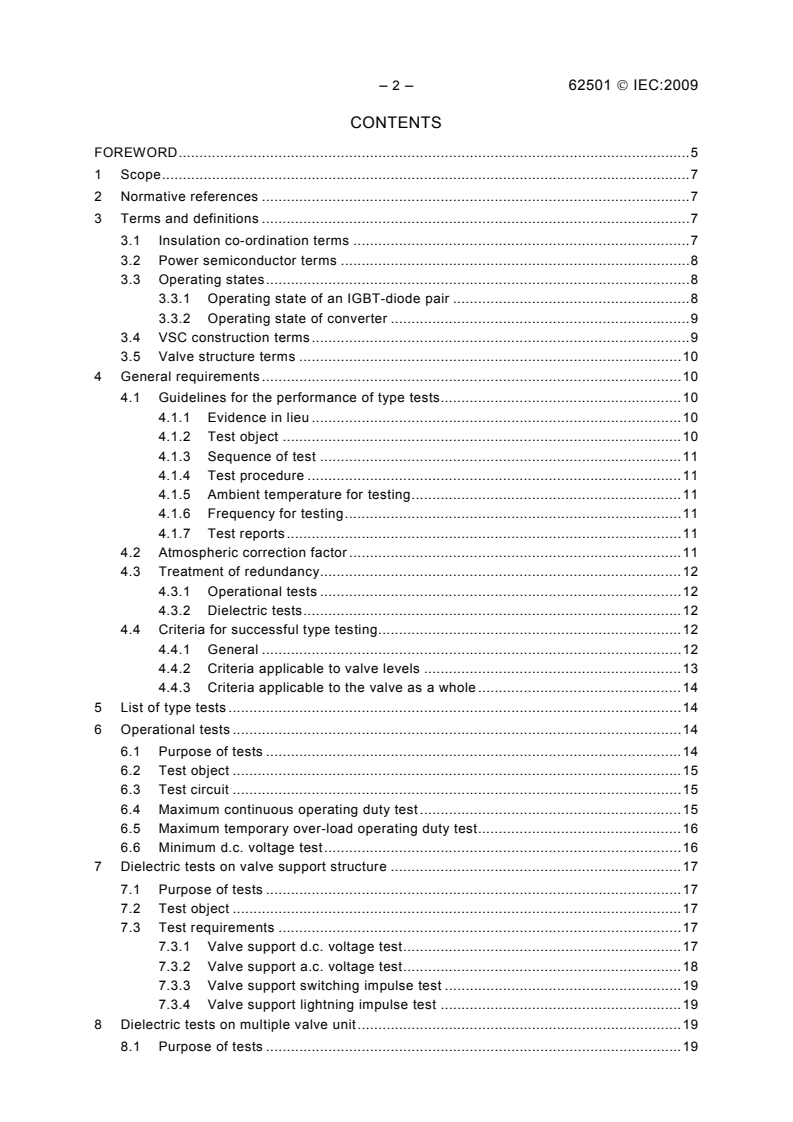
ICS 29.200; 29.240 ISBN 978-2-88910-744-5
– 2 – 62501 © IEC:2009
CONTENTS
FOREWORD.0H0H0H5
1 Scope.1H1H1H7
2 Normative references .2H2H2H7
3 Terms and definitions .3H3H3H7
3.1 Insulation co-ordination terms .4H4H4H7
3.2 Power semiconductor terms .5H5H5H8
3.3 Operating states.6H6H6H8
3.3.1 Operating state of an IGBT-diode pair .7H7H7H8
3.3.2 Operating state of converter .8H8H8H9
3.4 VSC construction terms.9H9H9H9
3.5 Valve structure terms .10H10H10H10
4 General requirements .11H11H11H10
4.1 Guidelines for the performance of type tests.12H12H12H10
4.1.1 Evidence in lieu .13H13H13H10
4.1.2 Test object .14H14H14H10
4.1.3 Sequence of test .15H15H15H11
4.1.4 Test procedure .16H16H16H11
4.1.5 Ambient temperature for testing.17H17H17H11
4.1.6 Frequency for testing.18H18H18H11
4.1.7 Test reports .19H19H19H11
4.2 Atmospheric correction factor .20H20H20H11
4.3 Treatment of redundancy.21H21H21H12
4.3.1 Operational tests .22H22H22H12
4.3.2 Dielectric tests.23H23H23H12
4.4 Criteria for successful type testing.24H24H24H12
4.4.1 General .25H25H25H12
4.4.2 Criteria applicable to valve levels .26H26H26H13
4.4.3 Criteria applicable to the valve as a whole.27H27H27H14
5 List of type tests .28H28H28H14
6 Operational tests .29H29H29H14
6.1 Purpose of tests .30H30H30H14
6.2 Test object .31H31H31H15
6.3 Test circuit .32H32H32H15
6.4 Maximum continuous operating duty test .33H33H33H15
6.5 Maximum temporary over-load operating duty test.34H34H34H16
6.6 Minimum d.c. voltage test.35H35H35H16
7 Dielectric tests on valve support structure .36H36H36H17
7.1 Purpose of tests .37H37H37H17
7.2 Test object .38H38H38H17
7.3 Test requirements .39H39H39H17
7.3.1 Valve support d.c. voltage test.40H40H40H17
7.3.2 Valve support a.c. voltage test.41H41H41H18
7.3.3 Valve support switching impulse test .42H42H42H19
7.3.4 Valve support lightning impulse test .43H43H43H19
8 Dielectric tests on multiple valve unit.44H44H44H19
8.1 Purpose of tests .45H45H45H19
62501 © IEC:2009 – 3 –
8.2 Test object .46H46H46H19
8.3 Test requirements .47H47H47H20
8.3.1 MVU d.c. voltage test to earth .48H48H48H20
8.3.2 MVU a.c. voltage test .49H49H49H20
8.3.3 MVU switching impulse test .50H50H50H21
8.3.4 MVU lightning impulse test .51H51H51H22
9 Dielectric tests between valve terminals .52H52H52H22
9.1 Purpose of the test .53H53H53H22
9.2 Test object .54H54H54H23
9.3 Test requirements .55H55H55H23
9.3.1 Valve a.c. – d.c. voltage test.56H56H56H23
9.3.2 Valve impulse tests (general) .57H57H57H25
9.3.3 Valve switching impulse test.58H58H58H25
9.3.4 Valve lightning impulse test .59H59H59H26
10 IGBT overcurrent turn-off test .60H60H60H26
10.1 Purpose of test.61H61H61H26
10.2 Test object .62H62H62H27
10.3 Test requirements .63H63H63H27
11 Short-circuit current test .64H64H64H27
11.1 Purpose of tests .65H65H65H27
11.2 Test object .66H66H66H27
11.3 Test requirements .67H67H67H27
12 Tests for valve insensitivity to electromagnetic disturbance .68H68H68H28
12.1 Purpose of tests .69H69H69H28
12.2 Test object .70H70H70H28
12.3 Test requirements .71H71H71H28
12.3.1 General .72H72H72H28
12.3.2 Approach one .73H73H73H28
12.3.3 Approach two .74H74H74H29
12.3.4 Acceptance criteria.75H75H75H29
13 Production tests .76H76H76H29
13.1 Purpose of tests .77H77H77H29
13.2 Test object .78H78H78H29
13.3 Test requirements .79H79H79H30
13.4 Production test objectives .80H80H80H30
13.4.1 Visual inspection .81H81H81H30
13.4.2 Connection check .82H82H82H30
13.4.3 Voltage-grading circuit check.83H83H83H30
13.4.4 Control, protection and monitoring circuit checks.84H84H84H30
13.4.5 Voltage withstand check .85H85H85H30
13.4.6 Partial discharge tests .86H86H86H30
13.4.7 Turn-on / turn-off check .87H87H87H30
13.4.8 Pressure test .88H88H88H31
14 Presentation of type test results .89H89H89H31
Annex A (informative) Overview of VSC topology.90H90H90H32
Annex B (informative) Fault tolerance capability .91H91H91H40
Bibliography.92H92H92H41
– 4 – 62501 © IEC:2009
Figure A.1 – A single VSC phase unit and its idealized output voltage .93H93H93H33
Figure A.2 – Output voltage of a VSC phase unit for a 2-level converter .94H94H94H33
Figure A.3 – Output voltage of a VSC phase unit for a 15-level converter, without PWM .95H95H95H34
Figure A.4 – Basic circuit topology of one phase unit of a 2-level converter .96H96H96H35
Figure A.5 – Basic circuit topology of one phase unit of a 3-level diode-clamped
converter .97H97H97H36
Figure A.6 – Basic circuit topology of one phase unit of a 5-level diode-clamped
converter .98H98H98H36
Figure A.7 – Basic circuit topology of one phase unit of a 3-level flying capacitor
converter .99H99H99H37
Figure A.8 – A single VSC phase unit with valves of the “controllable voltage source”
type .100H100H100H38
Figure A.9 – One possible implementation of a multi-level “voltage source” VSC valve .101H101H101H38
Table 1 – Minimum number of valve levels to be tested as a function of the number of
valve levels per valve.102H102H102H11
Table 2 – Valve level faults permitted during type tests.103H103H103H13
Table 3 – List of type tests.104H104H104H14
62501 © IEC:2009 – 5 –
INTERNATIONAL ELECTROTECHNICAL COMMISSION
______________
VOLTAGE SOURCED CONVERTER (VSC)
VALVES FOR HIGH-VOLTAGE DIRECT CURRENT (HVDC)
POWER TRANSMISSION – ELECTRICAL TESTING
FOREWORD
1) The International Electrotechnical Commission (IEC) is a worldwide organization for standardization comprising
all national electrotechnical committees (IEC National Committees). The object of IEC is to promote
international co-operation on all questions concerning standardization in the electrical and electronic fields. To
this end and in addition to other activities, IEC publishes International Standards, Technical Specifications,
Technical Reports, Publicly Available Specifications (PAS) and Guides (hereafter referred to as “IEC
Publication(s)”). Their preparation is entrusted to technical committees; any IEC National Committee interested
in the subject dealt with may participate in this preparatory work. International, governmental and non-
governmental organizations liaising with the IEC also participate in this preparation. IEC collaborates closely
with the International Organization for Standardization (ISO) in accordance with conditions determined by
agreement between the two organizations.
2) The formal decisions or agreements of IEC on technical matters express, as nearly as possible, an international
consensus of opinion on the relevant subjects since each technical committee has representation from all
interested IEC National Committees.
3) IEC Publications have the form of recommendations for international use and are accepted by IEC National
Committees in that sense. While all reasonable efforts are made to ensure that the technical content of IEC
Publications is accurate, IEC cannot be held responsible for the way in which they are used or for any
misinterpretation by any end user.
4) In order to promote international uniformity, IEC National Committees undertake to apply IEC Publications
transparently to the maximum extent possible in their national and regional publications. Any divergence
between any IEC Publication and the corresponding national or regional publication shall be clearly indicated in
the latter.
5) IEC provides no marking procedure to indicate its approval and cannot be rendered responsible for any
equipment declared to be in conformity with an IEC Publication.
6) All users should ensure that they have the latest edition of this publication.
7) No liability shall attach to IEC or its directors, employees, servants or agents including individual experts and
members of its technical committees and IEC National Committees for any personal injury, property damage or
other damage of any nature whatsoever, whether direct or indirect, or for costs (including legal fees) and
expenses arising out of the publication, use of, or reliance upon, this IEC Publication or any other IEC
Publications.
8) Attention is drawn to the Normative references cited in this publication. Use of the referenced publications is
indispensable for the correct application of this publication.
9) Attention is drawn to the possibility that some of the elements of this IEC Publication may be the subject of
patent rights. IEC shall not be held responsible for identifying any or all such patent rights.
IEC 62501 has been prepared by subcommittee 22F: Power electronics for electrical
transmission and distribution systems, of IEC technical committee 22: Power electronic
systems and equipment.
The text of this standard is based on the following documents:
FDIS Report on voting
22F/185/FDIS 22F/193/RVD
Full information on the voting for the approval of this standard can be found in the report on
voting indicated in the above table.
This publication has been drafted in accordance with the ISO/IEC Directives, Part 2.
– 6 – 62501 © IEC:2009
The committee has decided that the contents of this publication will remain unchanged until
the maintenance result date indicated on the IEC web site under "http://webstore.iec.ch" in
the data related to the specific publication. At this date, the publication will be
• reconfirmed,
• withdrawn,
• replaced by a revised edition, or
• amended.
62501 © IEC:2009 – 7 –
VOLTAGE SOURCED CONVERTER (VSC)
VALVES FOR HIGH-VOLTAGE DIRECT CURRENT (HVDC)
POWER TRANSMISSION – ELECTRICAL TESTING
1 Scope
This International Standard applies to self-commutated converter valves, for use in a three-
phase bridge voltage sourced converter (VSC) for high voltage d.c. power transmission or as
part of a back-to-back link. It is restricted to electrical type and production tests.
The tests specified in this standard are based on air insulated valves. For other types of
valves, the test requirements and acceptance criteria must be agreed.
2 Normative references
The following referenced documents are indispensable for the application of this document.
For dated references, only the edition cited applies. For undated references, the latest edition
of the referenced document (including any amendments) applies.
IEC 60060 (all parts), High-voltage test techniques
IEC 60060-1:1989, High-voltage test techniques – Part 1: General definitions and test
requirements
IEC 60071-1:2006, Insulation co-ordination – Part 1: Definitions, principles and rules
IEC 60700-1:1998, Thyristor valves for high voltage direct current (HVDC) power transmission
)
– Part 1: Electrical testing 1F1F0F
Amendment 1(2003)
Amendment (2008)
ISO/IEC 17025, General requirements for the competence of testing and calibration
laboratories
3 Terms and definitions
For the purposes of this document, the following terms and definitions apply.
3.1 Insulation co-ordination terms
3.1.1
test withstand voltage
value of a test voltage of standard waveshape at which a new valve, with unimpaired integrity,
does not show any disruptive discharge and meets all other acceptance criteria specified for
the particular test, when subjected to a specified number of applications or a specified
duration of the test voltage, under specified conditions
___________
)
There exists a consolidated edition 1.2 (2008) that comprises IEC 60700-1, Amendment 1 and Amendment 2.
– 8 – 62501 © IEC:2009
3.1.2
internal insulation
air external to the components and insulating materials of the valve, but contained within the
profile of the valve or multiple valve unit
3.1.3
external insulation
air between the external surface of the valve or multiple valve unit and its surroundings.
3.2 Power semiconductor terms
There are several types of controllable semiconductor switch device which can be used in
VSC converters for HVDC. For convenience, the term IGBT is used throughout this standard
to refer to the main, controllable, semiconductor switch device. However, the standard is
equally applicable to other types of controllable semiconductor switch device.
3.2.1
insulated gate bipolar transistor
IGBT
a controllable switch with the capability to turn-on and turn-off a load current
An IGBT has three terminals: a gate terminal (G) and two load terminals emitter (E) and
collector (C).
By applying appropriate gate to emitter voltages, the load current can be controlled, i.e.
turned on and turned off.
3.2.2
free-wheeling diode
FWD
power semiconductor device with diode characteristic
A FWD has two terminals: an anode (A) and a cathode (K). The current through FWDs is in
the opposite direction to the IGBT current.
FWDs are characterized by the capability to cope with high rates of decrease of current
caused by the switching behaviour of the IGBT.
3.2.3
IGBT-diode pair
arrangement of IGBT and FWD connected in inverse parallel
3.3 Operating states
3.3.1 Operating state of an IGBT-diode pair
3.3.1.1
blocking state
the condition in which an IGBT-diode pair is turned off
In that state, the load current does not flow through the IGBT. However, a load current can
flow through the diode as the diode is not controllable.
3.3.1.2
de-blocked state
the condition when the load current flows either through the IGBT or diode of an IGBT-diode
pair depending on the load current direction
62501 © IEC:2009 – 9 –
3.3.2 Operating state of converter
3.3.2.1
blocking state
a condition of the converter, in which a turn-off signal is applied to all IGBTs of the converter
Typically, the converter is in the blocking state condition after energization.
3.3.2.2
de-blocked state
a condition of the converter, in which turn-on signals are applied to IGBTs of the converter
3.3.2.3
valve protective blocking
means of protecting the valve or converter from excessive electrical stress by the emergency
turn-off of all IGBTs in one or more valves
3.4 VSC construction terms
3.4.1
VSC phase unit
the equipment used to connect the two d.c. busbars to one a.c. terminal
3.4.2
VSC valve
complete controllable device assembly, which represents a functional unit as part of a VSC
phase unit and characterized by switching actions of the power electronic devices upon
control signals of the converter base electronics
NOTE Dependent on the converter topology, a valve can either have the function to act like a controllable switch
or to act like a controllable voltage source.
3.4.3
diode valve
a semiconductor valve containing only diodes as the main semiconductor devices, which
might be used in some VSC topologies
3.4.4
valve
VSC valve or diode valve according to the context
3.4.5
VSC valve level
part of a VSC valve comprising a controllable switch and an associated diode, or controllable
switches and diodes connected in parallel, or controllable switches and diodes connected to a
half bridge arrangement, together with their immediate auxiliaries, storage capacitor, if any
3.4.6
diode valve level
part of a diode valve composed of a diode and associated circuits and components, if any
3.4.7
redundant levels
the maximum number of VSC valve levels or diode valve levels in a valve that may be short-
circuited externally or internally during service without affecting the safe operation of the
valve as demonstrated by type tests, and which if and when exceeded, would require
shutdown of the valve to replace the failed levels or acceptance of increased risk of failures
– 10 – 62501 © IEC:2009
3.5 Valve structure terms
3.5.1
valve structure
physical structure holding the levels of a valve which is insulated to the appropriate voltage
above earth potential
3.5.2
valve support
that part of the valve which mechanically supports and electrically insulates the active part of
the valve from earth
NOTE A part of a valve which is clearly identifiable in a discrete form to be a valve support may not exist in all
designs of valves.
3.5.3
multiple valve unit
MVU
mechanical arrangement of 2 or more valves or 1 or more VSC phase units sharing a common
valve support
NOTE A MVU might not exist in all topologies and physical arrangement of converters.
3.5.4
valve section
electrical assembly defined for test purposes, comprising a number of VSC or diode valve
levels and other components, which exhibits pro-rated electrical properties of a complete
valve
The minimum number of VSC or diode valve levels allowed in a valve section is defined along
with the requirements of each test.
3.5.5
valve base electronics
electronic unit, at earth potential, which is the interface between the converter control system
and the VSC valves
4 General requirements
4.1 Guidelines for the performance of type tests
4.1.1 Evidence in lieu
Each design of valve shall be subjected to the type tests specified in this standard. If the
valve is demonstrably similar to one previously tested, the supplier may, in lieu of performing
a type test, submit a test report of a previous type test for consideration by the purchaser.
This should be accompanied by a separate report detailing the differences in the design and
demonstrating how the referenced type test satisfies the test objectives for the proposed
design.
4.1.2 Test object
This subclause does not apply to tests on the valve supporting structure and multiple valve
unit. The test object for those tests is defined in 7.2 and 8.2.
a) Type tests may be performed either on a complete valve or, in certain circumstances, on
valve sections, as indicated in Table 3.
b) The minimum number of valve levels to be tested, depending on the valve levels in a
single valve, is as shown in Table 1.
62501 © IEC:2009 – 11 –
Table 1 – Minimum number of valve levels to be tested as a function
of the number of valve levels per valve
Number of valve levels per valve Total number of valve levels to be tested
1 – 50 Number of valve levels in one valve
51 – 250 50
20 %
≥ 251
c) Generally, the same valve sections are recommended to be used for all type tests.
However, with the agreement of the purchaser and supplier, different tests may be
performed on different valve sections in parallel, in order to speed up the programme for
executing the tests.
d) Prior to commencement of type tests, the valve, valve sections and/or the components of
them should be demonstrated to have withstood the production tests to ensure proper
manufacture.
4.1.3 Sequence of test
In order to confirm that the valve terminal-terminal insulation has not been degraded by the
fast repetitive switching stresses experienced by the converter in operation, the valve a.c. –
d.c. voltage test between terminals with partial discharge measurement should be performed
after the operational tests. Other type tests specified can be carried out in any order.
NOTE For valves of the “controllable voltage source” type (Clause A.5), the test sequence, where the a.c. – d.c.
voltage test is performed before the operational test, may be acceptable by mutual agreement between the
purchaser and supplier.
4.1.4 Test procedure
The tests shall be performed in accordance with IEC 60060, where applicable.
4.1.5 Ambient temperature for testing
The tests shall be performed in accordance with IEC 60060, where applicable.
4.1.6 Frequency for testing
AC dielectric tests can be performed at either 50 Hz or 60 Hz. For operational tests, specific
requirements regarding the frequency for testing are given in the relevant clauses.
4.1.7 Test reports
At the completion of the type tests, the supplier shall provide type test reports in accordance
with Clause 105H105H105H14.
4.2 Atmospheric correction factor
When specified in the relevant clause, atmospheric correction shall be applied to the test
voltages in accordance with IEC 60060-1. The reference conditions to which correction shall
be made are the following:
– pressure:
• If the insulation coordination of the tested part of the valve is based on standard rated
withstand voltages according to IEC 60071-1, correction factors are only applied for
altitudes exceeding 1 000 m. Hence if the altitude of the site a at which the equipment
s
will be installed is ≤1 000 m, then the standard atmospheric air pressure (b =
101,3 kPa) shall be used with no correction for altitude. If a >1 000 m, then the
s
standard procedure according to IEC 60060-1 is used except that the reference
– 12 – 62501 © IEC:2009
atmospheric pressure b is replaced by the atmospheric pressure corresponding to an
altitude of 1 000 m (b ).
1000m
• If the insulation coordination of the tested part of the valve is not based on standard
rated withstand voltages according to IEC 60071-1, then the standard procedure
according to IEC 60060-1 is used with the reference atmospheric pressure b
(b =101,3 kPa).
– temperature: design maximum valve hall air temperature (°C);
– humidity: design minimum valve hall absolute humidity (g/m ).
The values to be used shall be specified by the supplier.
4.3 Treatment of redundancy
4.3.1 Operational tests
For operational tests, redundant valve levels shall not be short-circuited. The test voltages
used shall be adjusted by means of a scaling factor k :
n
N
tut
k =
n
N − N
t r
where
N is the number of series valve levels in the test object;
tut
N is the total number of series valve levels in the valve;
t
N is the total number of redundant series valve levels in the valve.
r
4.3.2 Dielectric tests
For all dielectric tests between valve terminals, the redundant valve levels shall be short-
circuited. The location of valve levels to be short-circuited shall be agreed by the purchaser
and supplier.
NOTE Depending on the design, limitations may be imposed upon the distribution of short-circuited valve levels.
For example, there may be an upper limit to the number of short-circuited valve levels in one valve section.
For all dielectric tests on valve section, the test voltages used shall be adjusted by means of a
scaling factor k :
o
N
tu
k =
o
N − N
t r
where
N is the number of series valve levels not short circuit connected in the test object;
tu
N is the total number of series valve levels in the valve;
t
N is the total number of redundant series valve levels in the valve.
r
4.4 Criteria for successful type testing
4.4.1 General
Experience in semiconductor application shows that, even with the most careful design of
valves, it is not possible to avoid occasional random failures of valve level components during
service operation. Even though these failures may be stress-related, they are considered
random to the extent that the cause of failure or the relationship between failure rate and
stress cannot be predicted or is not amenable to precise quantitative definition. Type tests
62501 © IEC:2009 – 13 –
subject valves or valve sections, within a short time, to multiple stresses that generally
correspond to the worst stresses that can be experienced by the equipment not more than a
few times during the life of the valve. Considering the above, the criteria for successful type
testing set out below therefore permit a small number of valve levels to fail during type
testing, providing that the failures are rare and do not show any pattern that is indicative of
inadequate design.
4.4.2 Criteria applicable to valve levels
Criteria applicable to valve levels are as follows.
a) If, following a type test as listed in Clause 5, more than one valve level (alternatively more
than 1 % of the tested valve levels, if greater) has become short-circuited, then the valve
shall be deemed to have failed the type tests.
b) If, following a type test, one valve level (or more if still within the 1 % limit) has become
short-circuited, then the failed level(s) shall be restored and this type test repeated.
c) If the cumulative number of short-circuited valve levels during all type tests is more than 3
% of the tested valve levels, then the valve shall be deemed to have failed the type test.
d) The valve or valve sections shall be checked after each type test to determine whether or
not any valve levels have become short-circuited. Failed IGBT/diode or auxiliary
components found during or at the end of a type test may be replaced before further
testing.
e) At the completion of the test programme, the valve or valve sections shall undergo a
series of check tests, which shall include as a minimum:
– check for voltage withstand of valve levels;
– check of the gating circuits;
– check of the monitoring circuits;
– check of any protection circuits forming an integral part of the valve;
– check of the voltage grading circuits.
f) Valve levels short circuits occurring during the check tests shall be counted as part of the
criteria for acceptance defined above. In addition to short-circuited levels, the total number
of valve levels exhibiting faults which do not result in valve level short circuit, which are
discovered during the type test programme and the subsequent check test, shall not
exceed 3 % of the number of tested valve levels in dielectric and operational type tests,
whichever is lower. If the total number of such levels exceeds 3 %, then the nature of the
faults and their cause shall be reviewed and additional action, if any, agreed between
purchaser and supplier.
g) When applying the percentage criteria to determine the permitted maximum number of
short-circuited valve levels and the permitted maximum number of levels with faults which
have not resulted in a valve level becoming short-circuited, it is usual practice to round off
all fractions to the next highest integer, as illustrated in Table 2.
Table 2 – Valve level faults permitted during type tests
Number of valve levels Number of valve levels Total number of valve Additional number of
tested permitted to become levels permitted to valve levels, in all type
short-circuited in any become short-circuited tests, which have
one type test in all type tests experienced a fault but
have not become short-
circuited
Up to 33 1 1 1
34 to 67 1 2 2
68 to 100 1 3 3
etc.
– 14 – 62501 © IEC:2009
The distribution of short-circuited levels and of other valve level faults at the end of all type
tests shall be essentially random and not show any pattern that may be indicative of
inadequate design.
4.4.3 Criteria applicable to the valve as a whole
Breakdown of or external flashover across common electrical equipment associated with more
than one valve level of the valve, or disruptive discharge in dielectric material forming part of
the valve structure, cooling ducts, light guides or other insulating parts of the pulse
transmission and distribution system shall not be permitted.
Component and conductor surface temperatures, together with associated current-carrying
joints and connections, and the temperature of adjacent mounting surfaces shall at all times
remain within limits permitted by the design.
5 List of type tests
Table 3 lists the type tests given in Clauses 6 to 12.
Table 3 – List of type tests
Type test Clause or Test object
subclause
Maximum continuous operating duty test 6.4 Valve or valve section
Maximum temporary over-load operating duty test 6.5 Valve or valve section
Minimum d.c. voltage test 6.6 Valve or valve section
Valve support d.c. voltage test 7.3.1 Valve support
Valve support a.c. voltage test 7.3.2 Valve support
Valve support switching impulse test 7.3.3 Valve support
Valve support lightning impulse test 7.3.4 Valve support
MVU d.c. voltage test to earth 8.3.1 MVU
MVU a.c. voltage test 8.3.2 MVU
MVU switching impulse test 8.3.3 MVU
MVU lightning impulse test 8.3.4 MVU
Valve a.c. – d.c. voltage test 9.3.1
Valve (or valve section if agreed
Valve switching impulse test 9.3.3
between supplier and purchaser)
Valve lightning impulse test 9.3.4
IGBT overcurrent turn-off test 10 Valve or valve section
Short-circuit current test 11 Valve or valve section
Test for valve insensitivity to electromagnetic disturbance 12 Valve (or valve section if agreed
between supplier and purchaser)
6 Operational tests
6.1 Purpose of tests
The principal objectives of the operational tests are:
a) to check the adequacy of the VSC/diode level and associated electrical circuits in a valve
with regard to current, voltage and temperature stresses in the conducting state, at turn-on
and turn-off under the worst repetitive stress conditions;
62501 © IEC:2009 – 15 –
b) to demonstrate correct interaction between valve electronics and power circuits of the
VSC valves.
6.2 Test object
The tests may be performed on either the complete valve or on valve sections. The choice
depends mainly upon the valve design and the test facilities available. The tests specified in
this clause are valid for valve sections containing five or more series-connected VSC/diode
levels. If tests with fewer than five levels are proposed, additional test safety factors shall be
agreed. Under no circumstances shall the number of series-connected levels for tests be less
than three.
The valve or valve sections under test shall be assembled with all auxiliary components.
When required, a proportionally scaled valve arrester shall be included. The arrester shall be
scaled to the number of series-connected levels under test to give a protective level which
corresponds at least to the maximum characteristic of the service arrester.
The coolant shall be in a condition representative of service conditions. Flow and
temperature, in particular, shall be set to the most unfavourable values appropriate to the test
in question, such that the relevant component tempera
...
IEC 62501 ®
Edition 1.1 2014-08
CONSOLIDATED
VERSION
VERSION
CONSOLIDÉE
colour
inside
Voltage sourced converter (VSC) valves for high-voltage direct current (HVDC)
power transmission – Electrical testing
Valves à convertisseur de source de tension (VSC) pour le transport d’énergie
en courant continu à haute tension (CCHT) – Essais électriques
All rights reserved. Unless otherwise specified, no part of this publication may be reproduced or utilized in any form
or by any means, electronic or mechanical, including photocopying and microfilm, without permission in writing from
either IEC or IEC's member National Committee in the country of the requester. If you have any questions about IEC
copyright or have an enquiry about obtaining additional rights to this publication, please contact the address below or
your local IEC member National Committee for further information.
Droits de reproduction réservés. Sauf indication contraire, aucune partie de cette publication ne peut être reproduite
ni utilisée sous quelque forme que ce soit et par aucun procédé, électronique ou mécanique, y compris la photocopie
et les microfilms, sans l'accord écrit de l'IEC ou du Comité national de l'IEC du pays du demandeur. Si vous avez des
questions sur le copyright de l'IEC ou si vous désirez obtenir des droits supplémentaires sur cette publication, utilisez
les coordonnées ci-après ou contactez le Comité national de l'IEC de votre pays de résidence.
IEC Central Office Tel.: +41 22 919 02 11
3, rue de Varembé Fax: +41 22 919 03 00
CH-1211 Geneva 20 info@iec.ch
Switzerland www.iec.ch
About the IEC
The International Electrotechnical Commission (IEC) is the leading global organization that prepares and publishes
International Standards for all electrical, electronic and related technologies.
About IEC publications
The technical content of IEC publications is kept under constant review by the IEC. Please make sure that you have the
latest edition, a corrigenda or an amendment might have been published.
IEC Catalogue - webstore.iec.ch/catalogue Electropedia - www.electropedia.org
The stand-alone application for consulting the entire The world's leading online dictionary of electronic and
bibliographical information on IEC International Standards, electrical terms containing more than 30 000 terms and
Technical Specifications, Technical Reports and other definitions in English and French, with equivalent terms in 14
documents. Available for PC, Mac OS, Android Tablets and additional languages. Also known as the International
iPad. Electrotechnical Vocabulary (IEV) online.
IEC publications search - www.iec.ch/searchpub IEC Glossary - std.iec.ch/glossary
The advanced search enables to find IEC publications by a More than 55 000 electrotechnical terminology entries in
variety of criteria (reference number, text, technical English and French extracted from the Terms and Definitions
committee,…). It also gives information on projects, replaced clause of IEC publications issued since 2002. Some entries
and withdrawn publications. have been collected from earlier publications of IEC TC 37,
77, 86 and CISPR.
IEC Just Published - webstore.iec.ch/justpublished
Stay up to date on all new IEC publications. Just Published IEC Customer Service Centre - webstore.iec.ch/csc
details all new publications released. Available online and If you wish to give us your feedback on this publication or
also once a month by email. need further assistance, please contact the Customer Service
Centre: csc@iec.ch.
A propos de l'IEC
La Commission Electrotechnique Internationale (IEC) est la première organisation mondiale qui élabore et publie des
Normes internationales pour tout ce qui a trait à l'électricité, à l'électronique et aux technologies apparentées.
A propos des publications IEC
Le contenu technique des publications IEC est constamment revu. Veuillez vous assurer que vous possédez l’édition la
plus récente, un corrigendum ou amendement peut avoir été publié.
Catalogue IEC - webstore.iec.ch/catalogue Electropedia - www.electropedia.org
Application autonome pour consulter tous les renseignements
Le premier dictionnaire en ligne de termes électroniques et
bibliographiques sur les Normes internationales,
électriques. Il contient plus de 30 000 termes et définitions en
Spécifications techniques, Rapports techniques et autres
anglais et en français, ainsi que les termes équivalents dans
documents de l'IEC. Disponible pour PC, Mac OS, tablettes
14 langues additionnelles. Egalement appelé Vocabulaire
Android et iPad.
Electrotechnique International (IEV) en ligne.
Recherche de publications IEC - www.iec.ch/searchpub
Glossaire IEC - std.iec.ch/glossary
Plus de 55 000 entrées terminologiques électrotechniques, en
La recherche avancée permet de trouver des publications IEC
en utilisant différents critères (numéro de référence, texte, anglais et en français, extraites des articles Termes et
comité d’études,…). Elle donne aussi des informations sur les Définitions des publications IEC parues depuis 2002. Plus
projets et les publications remplacées ou retirées. certaines entrées antérieures extraites des publications des
CE 37, 77, 86 et CISPR de l'IEC.
IEC Just Published - webstore.iec.ch/justpublished
Service Clients - webstore.iec.ch/csc
Restez informé sur les nouvelles publications IEC. Just
Published détaille les nouvelles publications parues. Si vous désirez nous donner des commentaires sur cette
Disponible en ligne et aussi une fois par mois par email. publication ou si vous avez des questions contactez-nous:
csc@iec.ch.
IEC 62501 ®
Edition 1.1 2014-08
CONSOLIDATED
VERSION
VERSION
CONSOLIDÉE
colour
inside
Voltage sourced converter (VSC) valves for high-voltage direct current (HVDC)
power transmission – Electrical testing
Valves à convertisseur de source de tension (VSC) pour le transport d’énergie
en courant continu à haute tension (CCHT) – Essais électriques
INTERNATIONAL
ELECTROTECHNICAL
COMMISSION
COMMISSION
ELECTROTECHNIQUE
INTERNATIONALE
ICS 29.200; 29.240 ISBN 978-2-8322-1816-7
IEC 62501 ®
Edition 1.1 2014-08
REDLINE VERSION
VERSION REDLINE
colour
inside
Voltage sourced converter (VSC) valves for high-voltage direct current (HVDC)
power transmission – Electrical testing
Valves à convertisseur de source de tension (VSC) pour le transport d’énergie
en courant continu à haute tension (CCHT) – Essais électriques
– 2 – IEC 62501:2009
+AMD1:2014 CSV IEC 2014
CONTENTS
FOREWORD. 0H0H5
1 Scope . 1H1H7
2 Normative references . 2H2H7
3 Terms and definitions . 3H3H7
3.1 Insulation co-ordination terms . 4H4H8
3.2 Power semiconductor terms . 5H5H8
3.3 Operating states of converter . 6H6H9
3.3.1 Operating state of an IGBT-diode pair . 7H7H
3.3.2 Operating state of converter . 8H8H
3.4 VSC construction terms . 9H9H9
3.5 Valve structure terms . 10H10H11
4 General requirements . 11H11H11
4.1 Guidelines for the performance of type tests . 12H12H11
4.1.1 Evidence in lieu . 13H13H11
4.1.2 Test object . 14H14H12
4.1.3 Sequence of test . 15H15H
4.1.4 Test procedure . 16H16H12
4.1.5 Ambient temperature for testing. 17H17H12
4.1.6 Frequency for testing . 18H18H12
4.1.7 Test reports . 19H19H12
4.1.8 Conditions to be considered in determination of type test parameters . 13
4.2 Atmospheric correction factor. 20H20H13
4.3 Treatment of redundancy . 21H21H13
4.3.1 Operational tests . 22H22H13
4.3.2 Dielectric tests . 23H23H13
4.4 Criteria for successful type testing . 24H24H14
4.4.1 General . 25H25H14
4.4.2 Criteria applicable to valve levels . 26H26H14
4.4.3 Criteria applicable to the valve as a whole . 27H27H15
5 List of type tests . 28H28H15
6 Operational tests . 29H29H16
6.1 Purpose of tests . 30H30H16
6.2 Test object . 31H31H16
6.3 Test circuit . 32H32H16
6.4 Maximum continuous operating duty test . 33H33H17
6.5 Maximum temporary over-load operating duty test . 34H34H17
6.6 Minimum d.c. voltage test . 35H35H18
7 Dielectric tests on valve support structure . 36H36H18
7.1 Purpose of tests . 37H37H18
7.2 Test object . 38H38H18
7.3 Test requirements . 39H39H19
7.3.1 Valve support d.c. voltage test . 40H40H19
7.3.2 Valve support a.c. voltage test . 41H41H20
7.3.3 Valve support switching impulse test . 42H42H20
7.3.4 Valve support lightning impulse test . 43H43H21
8 Dielectric tests on multiple valve unit . 44H44H21
+AMD1:2014 CSV IEC 2014
8.1 Purpose of tests . 45H45H21
8.2 Test object . 46H46H21
8.3 Test requirements . 47H47H21
8.3.1 MVU d.c. voltage test to earth . 48H48H21
8.3.2 MVU a.c. voltage test . 49H49H22
8.3.3 MVU switching impulse test . 50H50H23
8.3.4 MVU lightning impulse test . 51H51H24
9 Dielectric tests between valve terminals . 52H52H24
9.1 Purpose of the test . 53H53H24
9.2 Test object . 54H54H25
9.3 Test requirements . 55H55H25
9.3.1 Valve a.c. – d.c. voltage test . 56H56H25
9.3.2 Valve impulse tests (general) . 57H57H27
9.3.3 Valve switching impulse test . 58H58H27
9.3.4 Valve lightning impulse test . 59H59H28
10 IGBT overcurrent turn-off test . 60H60H29
10.1 Purpose of test . 61H61H29
10.2 Test object . 62H62H29
10.3 Test requirements . 63H63H29
11 Short-circuit current test . 64H64H30
11.1 Purpose of tests . 65H65H30
11.2 Test object . 66H66H30
11.3 Test requirements . 67H67H30
12 Tests for valve insensitivity to electromagnetic disturbance . 68H68H30
12.1 Purpose of tests . 69H69H30
12.2 Test object . 70H70H31
12.3 Test requirements . 71H71H31
12.3.1 General . 72H72H31
12.3.2 Approach one . 73H73H31
12.3.3 Approach two . 74H74H31
12.3.4 Acceptance criteria . 75H75H32
13 Production tests . 76H76H32
13.1 Purpose of tests . 77H77H32
13.2 Test object . 78H78H33
13.3 Test requirements . 79H79H33
13.4 Production test objectives . 80H80H33
13.4.1 Visual inspection . 81H81H33
13.4.2 Connection check . 82H82H33
13.4.3 Voltage-grading circuit check . 83H83H33
13.4.4 Control, protection and monitoring circuit checks . 84H84H33
13.4.5 Voltage withstand check . 85H85H33
13.4.6 Partial discharge tests . 86H86H34
13.4.7 Turn-on / turn-off check . 87H87H34
13.4.8 Pressure test . 88H88H34
14 Presentation of type test results . 89H89H34
15 Tests for dynamic braking valves . 329
Annex A (informative) Overview of VSC topology converters in HVDC power
transmission . 90H90H35
– 4 – IEC 62501:2009
+AMD1:2014 CSV IEC 2014
Annex B (informative) Valve component fault tolerance capability . 91H91H48
Bibliography . 92H92H49
Figure A.1 – A single VSC phase unit and its idealized output voltage . 93H93H36
Figure A.2 – Output voltage of a VSC phase unit for a 2-level converter . 94H94H36
Figure A.3 – Output voltage of a VSC phase unit for a 15-level converter, without PWM . 95H95H37
Figure A.4 – Basic circuit topology of one phase unit of a 2-level converter . 96H96H38
Figure A.5 – Basic circuit topology of one phase unit of a 3-level diode-clamped
converter . 97H97H39
Figure A.6 – Basic circuit topology of one phase unit of a 5-level diode-clamped
converter . 98H98H40
Figure A.7 – Basic circuit topology of one phase unit of a 3-level flying capacitor
converter . 99H99H41
Figure A.8 – A single VSC phase unit with valves of the “controllable voltage source”
type . 100H100H42
Figure A.9 – One possible implementation of a multi-level “voltage source” VSC valve
The half-bridge MMC circuit . 43
Figure A.10 – The full-bridge MMC circuit . 430H
Figure A.11 – The half-bridge CTL circuit . 45100H100H45
Figure A.12 – Construction terms in MMC valves . 46
Figure A.13 – Construction terms in CTL valves . 100H100H46
Table 1 – Minimum number of valve levels to be tested as a function of the number of
valve levels per valve . 102H102H12
Table 2 – Valve level faults permitted during type tests . 103H103H15
Table 3 – List of type tests . 104H104H15
+AMD1:2014 CSV IEC 2014
INTERNATIONAL ELECTROTECHNICAL COMMISSION
____________
VOLTAGE SOURCED CONVERTER (VSC)
VALVES FOR HIGH-VOLTAGE DIRECT CURRENT (HVDC)
POWER TRANSMISSION – ELECTRICAL TESTING
FOREWORD
1) The International Electrotechnical Commission (IEC) is a worldwide organization for standardization comprising
all national electrotechnical committees (IEC National Committees). The object of IEC is to promote
international co-operation on all questions concerning standardization in the electrical and electronic fields. To
this end and in addition to other activities, IEC publishes International Standards, Technical Specifications,
Technical Reports, Publicly Available Specifications (PAS) and Guides (hereafter referred to as “IEC
Publication(s)”). Their preparation is entrusted to technical committees; any IEC National Committee interested
in the subject dealt with may participate in this preparatory work. International, governmental and non-
governmental organizations liaising with the IEC also participate in this preparation. IEC collaborates closely
with the International Organization for Standardization (ISO) in accordance with conditions determined by
agreement between the two organizations.
2) The formal decisions or agreements of IEC on technical matters express, as nearly as possible, an international
consensus of opinion on the relevant subjects since each technical committee has representation from all
interested IEC National Committees.
3) IEC Publications have the form of recommendations for international use and are accepted by IEC National
Committees in that sense. While all reasonable efforts are made to ensure that the technical content of IEC
Publications is accurate, IEC cannot be held responsible for the way in which they are used or for any
misinterpretation by any end user.
4) In order to promote international uniformity, IEC National Committees undertake to apply IEC Publications
transparently to the maximum extent possible in their national and regional publications. Any divergence
between any IEC Publication and the corresponding national or regional publication shall be clearly indicated in
the latter.
5) IEC itself does not provide any attestation of conformity. Independent certification bodies provide conformity
assessment services and, in some areas, access to IEC marks of conformity. IEC is not responsible for any
services carried out by independent certification bodies.
6) All users should ensure that they have the latest edition of this publication.
7) No liability shall attach to IEC or its directors, employees, servants or agents including individual experts and
members of its technical committees and IEC National Committees for any personal injury, property damage or
other damage of any nature whatsoever, whether direct or indirect, or for costs (including legal fees) and
expenses arising out of the publication, use of, or reliance upon, this IEC Publication or any other IEC
Publications.
8) Attention is drawn to the Normative references cited in this publication. Use of the referenced publications is
indispensable for the correct application of this publication.
9) Attention is drawn to the possibility that some of the elements of this IEC Publication may be the subject of
patent rights. IEC shall not be held responsible for identifying any or all such patent rights.
This Consolidated version of IEC 62501 bears the edition number 1.1. It consists of the
first edition (2009-06) [documents 22F/185/FDIS and 22F/193/RVD] and its amendment 1
(2014-08) [documents 22F/299/CDV and 22F/316A/RVC]. The technical content is
identical to the base edition and its amendment.
In this Redline version, a vertical line in the margin shows where the technical content
is modified by amendment 1. Additions and deletions are displayed in red, with
deletions being struck through. A separate Final version with all changes accepted is
available in this publication.
This publication has been prepared for user convenience.
– 6 – IEC 62501:2009
+AMD1:2014 CSV IEC 2014
IEC 62501 has been prepared by subcommittee 22F: Power electronics for electrical
transmission and distribution systems, of IEC technical committee 22: Power electronic
systems and equipment.
This publication has been drafted in accordance with the ISO/IEC Directives, Part 2.
The committee has decided that the contents of the base publication and its amendment will
remain unchanged until the stability date indicated on the IEC web site under
"http://webstore.iec.ch" in the data related to the specific publication. At this date, the
publication will be
reconfirmed,
withdrawn,
replaced by a revised edition, or
amended.
IMPORTANT – The “colour inside” logo on the cover page of this publication indicates
that it contains colours which are considered to be useful for the correct understanding
of its contents. Users should therefore print this publication using a colour printer.
+AMD1:2014 CSV IEC 2014
VOLTAGE SOURCED CONVERTER (VSC)
VALVES FOR HIGH-VOLTAGE DIRECT CURRENT (HVDC)
POWER TRANSMISSION – ELECTRICAL TESTING
1 Scope
This International Standard applies to self-commutated converter valves, for use in a three-
phase bridge voltage sourced converter (VSC) for high voltage d.c. power transmission or as
part of a back-to-back link. It is restricted to electrical type and production tests.
The scope of this standard includes the electrical type and production tests of dynamic
braking valves which may be used in some HVDC schemes for d.c. overvoltage limitation.
This standard can be used as a guide for testing of STATCOM valves.
The tests specified in this standard are based on air insulated valves. For other types of
valves, the test requirements and acceptance criteria must should be agreed between the
purchaser and the supplier.
2 Normative references
The following referenced documents are indispensable for the application of this document.
For dated references, only the edition cited applies. For undated references, the latest edition
of the referenced document (including any amendments) applies.
IEC 60060 (all parts), High-voltage test techniques
IEC 60060-1:1989, High-voltage test techniques – Part 1: General definitions and test
requirements
IEC 60071-1:2006, Insulation co-ordination – Part 1: Definitions, principles and rules
IEC 60071 (all parts), Insulation co-ordination
IEC 60270:2000, High-voltage test techniques – Partial discharge measurements
IEC 60700-1:1998, Thyristor valves for high voltage direct current (HVDC) power transmission
)
– Part 1: Electrical testing1F1F
Amendment 1(2003)
Amendment (2008)
ISO/IEC 17025, General requirements for the competence of testing and calibration
laboratories
3 Terms and definitions
For the purposes of this document, the following terms and definitions apply.
___________
)
There exists a consolidated edition 1.2 (2008) that comprises IEC 60700-1, Amendment 1 and Amendment 2.
– 8 – IEC 62501:2009
+AMD1:2014 CSV IEC 2014
3.1 Insulation co-ordination terms
3.1.1
test withstand voltage
value of a test voltage of standard waveshape at which a new valve, with unimpaired integrity,
does not show any disruptive discharge and meets all other acceptance criteria specified for
the particular test, when subjected to a specified number of applications or a specified
duration of the test voltage, under specified conditions
3.1.2
internal insulation
air external to the components and insulating materials of the valve, but contained within the
profile of the valve or multiple valve unit
3.1.3
external insulation
air between the external surface of the valve or multiple valve unit and its surroundings.
3.2 Power semiconductor terms
There are several types of controllable semiconductor switch device which can be used in
VSC converters for HVDC. For convenience, the term IGBT is used throughout this standard
to refer to the main, controllable, semiconductor switch device. However, the standard is
equally applicable to other types of controllable semiconductor switch device.
3.2.1
turn-off semiconductor device
controllable semiconductor device which may be turned on and off by a control signal, for
example an IGBT
NOTE There are several types of turn-off semiconductor devices which can be used in VSC converters for HVDC.
For convenience, the term IGBT is used throughout this standard to refer to the main turn-off semiconductor
device. However, the standard is equally applicable to other types of turn-off semiconductor devices.
3.2.13.2.2
insulated gate bipolar transistor
IGBT
a controllable switch with the capability to turn-on and turn-off a load current
An IGBT has turn-off semiconductor device with three terminals: a gate terminal (G) and two
load terminals emitter (E) and collector (C).
NOTE By applying appropriate gate to emitter voltages, the load current can be controlled, i.e. turned on and
turned off.
3.2.23.2.3
free-wheeling diode
FWD
power semiconductor device with diode characteristic
NOTE 1 A FWD has two terminals: an anode (A) and a cathode (K). The current through FWDs is in the opposite
direction to the IGBT current.
NOTE 2 FWDs are characterized by the capability to cope with high rates of decrease of current caused by the
switching behaviour of the IGBT.
3.2.33.2.4
IGBT-diode pair
arrangement of IGBT and FWD connected in inverse parallel
+AMD1:2014 CSV IEC 2014
3.3 Operating states of converter
3.3.1 Operating state of an IGBT-diode pair
3.3.1.1
blocking state
condition in which an IGBT-diode pair is turned off
In that state, the load current does not flow through the IGBT. However, a load current can
flow through the diode as the diode is not controllable.
3.3.1.2
de-blocked state
the condition when the load current flows either through the IGBT or diode of an IGBT-diode
pair depending on the load current direction
3.3.2 Operating state of converter
3.3.2.13.3.1
blocking state
condition of the converter, in which a turn-off signal is applied continuously to all IGBTs of the
converter
NOTE Typically, the converter is in the blocking state condition after energization.
3.3.2.23.3.2
de-blocked state
condition of the converter, in which turn-on and turn-off signals are applied repetitively to
IGBTs of the converter
3.3.2.33.3.3
valve protective blocking
means of protecting the valve or converter from excessive electrical stress by the emergency
turn-off of all IGBTs in one or more valves
3.3.4
voltage step level
voltage step caused by switching of a valve or part of a valve during the de-blocked state of
the converter
NOTE For valves of the controllable voltage source type, the voltage step level corresponds to the change of
voltage caused by switching one submodule or cell. For valves of the switch type, the voltage step level
corresponds to the change of voltage caused by switching the complete valve.
3.4 VSC construction terms
3.4.1
VSC phase unit
equipment used to connect the two d.c. busbars to one a.c. terminal
3.4.2
switch type VSC valve
complete controllable device assembly, which represents a functional unit as part of a VSC
phase unit and characterized by switching actions of the power electronic devices upon
control signals of the converter base electronics arrangement of IGBT-diode pairs connected
in series and arranged to be switched simultaneously as a single function unit
NOTE Dependent on the converter topology, a valve can either have the function to act like a controllable switch
or to act like a controllable voltage source.
– 10 – IEC 62501:2009
+AMD1:2014 CSV IEC 2014
3.4.3
controllable voltage source type VSC valve
complete controllable voltage source assembly, which is generally connected between one
a.c. terminal and one d.c. terminal
3.4.33.4.4
diode valve
semiconductor valve containing only diodes as the main semiconductor devices, which might
be used in some VSC topologies
3.4.5
dynamic braking valve
complete controllable device assembly, which is used to control energy absorption in braking
resistor
3.4.43.4.6
valve
VSC valve, dynamic braking valve or diode valve according to the context
3.4.7
submodule
part of a VSC valve comprising controllable switches and diodes connected to a half bridge or
full bridge arrangement, together with their immediate auxiliaries, storage capacitor, if any,
where each controllable switch consists of only one switched valve device connected in series
3.4.8
cell
MMC building block where each switch position consists of more than one IGBT-diode pair
connected in series
NOTE See Figure A.13
3.4.53.4.9
VSC valve level
part of a VSC valve comprising a controllable switch and an associated diode, or controllable
switches and diodes connected in parallel, or controllable switches and diodes connected to a
half bridge arrangement, together with their immediate auxiliaries, storage capacitor, if any
smallest indivisible functional unit of VSC valve
NOTE For any VSC valve in which IGBTs are connected in series and operated simultaneously, one VSC valve
level is one IGBT-diode pair including its auxiliaries (see Figure A.13). For MMC type without IGBT-diode pairs
connected in series one valve level is one submodule together with its auxiliaries (see Figure A.12).
3.4.63.4.10
diode valve level
part of a diode valve composed of a diode and associated circuits and components, if any
3.4.73.4.11
redundant levels
maximum number of series connected VSC valve levels or diode valve levels in a valve that
may be short-circuited externally or internally during service without affecting the safe
operation of the valve as demonstrated by type tests, and which if and when exceeded, would
require shutdown of the valve to replace the failed levels or acceptance of increased risk of
failures
NOTE In valve designs such as the cascaded two level converter, which contain two or more conduction paths
within each cell and have series-connected VSC valve levels in each path, redundant levels shall be counted only
in one conduction path in each cell.
+AMD1:2014 CSV IEC 2014
3.4.12
dynamic braking valve level
part of a dynamic braking valve comprising a controllable switch and an associated diode, or
controllable switches and diodes connected in parallel, or controllable switches and diodes
connected to a half bridge arrangement, together with their immediate auxiliaries, storage
capacitor, if any
3.5 Valve structure terms
3.5.1
valve structure
physical structure holding the levels of a valve which is insulated to the appropriate voltage
above earth potential structural components of a valve, required in order to physically support
the valve modules
3.5.2
valve support
that part of the valve which mechanically supports and electrically insulates the active part of
the valve from earth
NOTE A part of a valve which is clearly identifiable in a discrete form to be a valve support may not exist in all
designs of valves.
3.5.3
multiple valve unit
MVU
mechanical arrangement of 2 or more valves or 1 or more VSC phase units sharing a common
valve support
NOTE A MVU might not exist in all topologies and physical arrangement of converters.
3.5.4
valve section
electrical assembly defined for test purposes, comprising a number of VSC or diode valve
levels and other components, which exhibits pro-rated electrical properties of a complete
valve
NOTE 1 For valves of controllable voltage source type the valve section shall include cell or submodule d.c.
capacitor in addition to VSC valve levels.
NOTE 2 The minimum number of VSC or diode valve levels allowed in a valve section is defined along with the
requirements of each test.
3.5.5
valve base electronics
electronic unit, at earth potential, which is the interface providing the electrical to optical
conversion between the converter control system and the VSC valves
4 General requirements
4.1 Guidelines for the performance of type tests
4.1.1 Evidence in lieu
Each design of valve shall be subjected to the type tests specified in this standard. If the
valve is demonstrably similar to one previously tested, the supplier may, in lieu of performing
a type test, submit a test report of a previous type test for consideration by the purchaser.
This should be accompanied by a separate report detailing the differences in the design and
demonstrating how the referenced type test satisfies the test objectives for the proposed
design.
– 12 – IEC 62501:2009
+AMD1:2014 CSV IEC 2014
4.1.2 Test object
This subclause does not apply to tests on the valve supporting structure and multiple valve
unit. The test object for those tests is defined in 7.2 and 8.2.
a) Type tests may be performed either on a complete valve or, in certain circumstances, on
valve sections, as indicated in Table 3.
b) The minimum number of valve levels to be tested, depending on the valve levels in a
single valve, is as shown in Table 1.
Table 1 – Minimum number of valve levels to be tested as a function
of the number of valve levels per valve
Number of valve levels per valve Total number of valve levels to be tested
1 – 50 Number of valve levels in one valve
51 – 250 50
20 %
251
c) Generally, the same valve sections are recommended to be used for all type tests.
However, with the agreement of the purchaser and supplier, different tests may be
performed on different valve sections in parallel, in order to speed up the programme for
executing the tests.
d) Prior to commencement of type tests, the valve, valve sections and/or the components of
them should be demonstrated to have withstood the production tests to ensure proper
manufacture.
4.1.3 Sequence of test
In order to confirm that the valve terminal-terminal insulation has not been degraded by the
fast repetitive switching stresses experienced by the converter in operation, the valve a.c. –
d.c. voltage test between terminals with partial discharge measurement should be performed
after the operational tests. Other type tests specified can be carried out in any order.
NOTE For valves of the “controllable voltage source” type (Clause A.5), the test sequence, where the a.c. – d.c.
voltage test is performed before the operational test, may be acceptable by mutual agreement between the
purchaser and supplier.
4.1.4 Test procedure
The tests shall be performed in accordance with IEC 60060, where applicable with due
account for IEC 60071 (all parts). Partial discharge measurements shall be performed in
accordance with IEC 60270.
4.1.5 Ambient temperature for testing
The tests shall be performed in accordance with IEC 60060, where applicable at the
prevailing ambient temperature of the test facility, unless otherwise specified.
4.1.6 Frequency for testing
AC dielectric tests can be performed at either 50 Hz or 60 Hz. For operational tests, specific
requirements regarding the frequency for testing are given in the relevant clauses.
NOTE Guidance on the worst service conditions can be found in CIGRÉ Technical Brochure No. 447.
4.1.7 Test reports
At the completion of the type tests, the supplier shall provide type test reports in accordance
with Clause 105H105H14.
+AMD1:2014 CSV IEC 2014
4.1.8 Conditions to be considered in determination of type test parameters
Type test parameters should be determined based on the worst operating and fault conditions
to which the valve can be subjected, according to system studies. Guidance on the conditions
can be found in CIGRÉ Technical Brochure No. 447.
4.2 Atmospheric correction factor
When specified in the relevant clause, atmospheric correction shall be applied to the test
voltages in accordance with IEC 60060-1. The reference conditions to which correction shall
be made are the following:
– pressure:
If the insulation coordination of the tested part of the valve is based on standard rated
withstand voltages according to IEC 60071-1, correction factors are only applied for
altitudes exceeding 1 000 m. Hence if the altitude of the site a at which the equipment
s
will be installed is 1 000 m, then the standard atmospheric air pressure (b =
101,3 kPa) shall be used with no correction for altitude. If a 1 000 m, then the
s
standard procedure according to IEC 60060-1 is used except that the reference
atmospheric pressure b is replaced by the atmospheric pressure corresponding to an
altitude of 1 000 m (b ).
1000m
If the insulation coordination of the tested part of the valve is not based on standard
rated withstand voltages according to IEC 60071-1, then the standard procedure
according to IEC 60060-1 is used with the reference atmospheric pressure b
(b =101,3 kPa).
– temperature: design maximum valve hall air temperature (°C);
– humidity: design minimum valve hall absolute humidity (g/m ).
Realistic worst case combinations of temperature and humidity which can occur in practice
shall be used for atmospheric correction.
The values to be used shall be specified by the supplier.
4.3 Treatment of redundancy
4.3.1 Operational tests
For operational tests, redundant valve levels shall not be short-circuited. The test voltages
used shall be adjusted by means of a scaling factor k :
n
N
tut
k
n
N N
t r
where
N is the number of series valve levels in the test object;
tut
N is the total number of series valve levels in the valve;
t
N is the total number of redundant series valve levels in the valve.
r
4.3.2 Dielectric tests
For all dielectric tests between valve terminals
...
IEC 62501 ®
Edition 1.2 2017-09
CONSOLIDATED VERSION
INTERNATIONAL
STANDARD
NORME
INTERNATIONALE
colour
inside
Voltage sourced converter (VSC) valves for high-voltage direct current (HVDC)
power transmission – Electrical testing
Valves à convertisseur de source de tension (VSC) pour le transport d’énergie
en courant continu à haute tension (CCHT) – Essais électriques
All rights reserved. Unless otherwise specified, no part of this publication may be reproduced or utilized in any form
or by any means, electronic or mechanical, including photocopying and microfilm, without permission in writing from
either IEC or IEC's member National Committee in the country of the requester. If you have any questions about IEC
copyright or have an enquiry about obtaining additional rights to this publication, please contact the address below or
your local IEC member National Committee for further information.
Droits de reproduction réservés. Sauf indication contraire, aucune partie de cette publication ne peut être reproduite
ni utilisée sous quelque forme que ce soit et par aucun procédé, électronique ou mécanique, y compris la photocopie
et les microfilms, sans l'accord écrit de l'IEC ou du Comité national de l'IEC du pays du demandeur. Si vous avez des
questions sur le copyright de l'IEC ou si vous désirez obtenir des droits supplémentaires sur cette publication, utilisez
les coordonnées ci-après ou contactez le Comité national de l'IEC de votre pays de résidence.
IEC Central Office Tel.: +41 22 919 02 11
3, rue de Varembé Fax: +41 22 919 03 00
CH-1211 Geneva 20 info@iec.ch
Switzerland www.iec.ch
About the IEC
The International Electrotechnical Commission (IEC) is the leading global organization that prepares and publishes
International Standards for all electrical, electronic and related technologies.
About IEC publications
The technical content of IEC publications is kept under constant review by the IEC. Please make sure that you have the
latest edition, a corrigenda or an amendment might have been published.
IEC Catalogue - webstore.iec.ch/catalogue Electropedia - www.electropedia.org
The stand-alone application for consulting the entire The world's leading online dictionary of electronic and
bibliographical information on IEC International Standards, electrical terms containing 20 000 terms and definitions in
Technical Specifications, Technical Reports and other English and French, with equivalent terms in 16 additional
documents. Available for PC, Mac OS, Android Tablets and languages. Also known as the International Electrotechnical
iPad. Vocabulary (IEV) online.
IEC publications search - www.iec.ch/searchpub IEC Glossary - std.iec.ch/glossary
The advanced search enables to find IEC publications by a 65 000 electrotechnical terminology entries in English and
variety of criteria (reference number, text, technical French extracted from the Terms and Definitions clause of
committee,…). It also gives information on projects, replaced IEC publications issued since 2002. Some entries have been
and withdrawn publications. collected from earlier publications of IEC TC 37, 77, 86 and
CISPR.
IEC Just Published - webstore.iec.ch/justpublished
Stay up to date on all new IEC publications. Just Published IEC Customer Service Centre - webstore.iec.ch/csc
details all new publications released. Available online and If you wish to give us your feedback on this publication or
also once a month by email. need further assistance, please contact the Customer Service
Centre: csc@iec.ch.
A propos de l'IEC
La Commission Electrotechnique Internationale (IEC) est la première organisation mondiale qui élabore et publie des
Normes internationales pour tout ce qui a trait à l'électricité, à l'électronique et aux technologies apparentées.
A propos des publications IEC
Le contenu technique des publications IEC est constamment revu. Veuillez vous assurer que vous possédez l’édition la
plus récente, un corrigendum ou amendement peut avoir été publié.
Catalogue IEC - webstore.iec.ch/catalogue Electropedia - www.electropedia.org
Application autonome pour consulter tous les renseignements
Le premier dictionnaire en ligne de termes électroniques et
bibliographiques sur les Normes internationales,
électriques. Il contient 20 000 termes et définitions en anglais
Spécifications techniques, Rapports techniques et autres
et en français, ainsi que les termes équivalents dans 16
documents de l'IEC. Disponible pour PC, Mac OS, tablettes
langues additionnelles. Egalement appelé Vocabulaire
Android et iPad.
Electrotechnique International (IEV) en ligne.
Recherche de publications IEC - www.iec.ch/searchpub
Glossaire IEC - std.iec.ch/glossary
La recherche avancée permet de trouver des publications IEC
65 000 entrées terminologiques électrotechniques, en anglais
en utilisant différents critères (numéro de référence, texte,
et en français, extraites des articles Termes et Définitions des
comité d’études,…). Elle donne aussi des informations sur les
publications IEC parues depuis 2002. Plus certaines entrées
projets et les publications remplacées ou retirées.
antérieures extraites des publications des CE 37, 77, 86 et
CISPR de l'IEC.
IEC Just Published - webstore.iec.ch/justpublished
Restez informé sur les nouvelles publications IEC. Just Service Clients - webstore.iec.ch/csc
Published détaille les nouvelles publications parues. Si vous désirez nous donner des commentaires sur cette
Disponible en ligne et aussi une fois par mois par email. publication ou si vous avez des questions contactez-nous:
csc@iec.ch.
IEC 62501 ®
Edition 1.2 2017-09
CONSOLIDATED VERSION
INTERNATIONAL
STANDARD
NORME
INTERNATIONALE
colour
inside
Voltage sourced converter (VSC) valves for high-voltage direct current (HVDC)
power transmission – Electrical testing
Valves à convertisseur de source de tension (VSC) pour le transport d’énergie
en courant continu à haute tension (CCHT) – Essais électriques
INTERNATIONAL
ELECTROTECHNICAL
COMMISSION
COMMISSION
ELECTROTECHNIQUE
INTERNATIONALE
ICS 29.200; 29.240.99 ISBN 978-2-8322-4857-7
IEC 62501 ®
Edition 1.2 2017-09
CONSOLIDATED VERSION
REDLINE VERSION
VERSION REDLINE
colour
inside
Voltage sourced converter (VSC) valves for high-voltage direct current (HVDC)
power transmission – Electrical testing
Valves à convertisseur de source de tension (VSC) pour le transport d’énergie
en courant continu à haute tension (CCHT) – Essais électriques
– 2 – IEC 62501:2009+AMD1:2014
+AMD2:2017 CSV IEC 2017
CONTENTS
FOREWORD . 5
1 Scope . 7
2 Normative references . 7
3 Terms and definitions . 8
3.1 Insulation co-ordination terms . 8
3.2 Power semiconductor terms . 8
3.3 Operating states of converter . 9
3.3.1 Operating state of an IGBT-diode pair .
3.3.2 Operating state of converter .
3.4 VSC construction terms . 9
3.5 Valve structure terms . 11
4 General requirements . 11
4.1 Guidelines for the performance of type tests. 11
4.1.1 Evidence in lieu . 11
4.1.2 Selection of test object . 12
4.1.3 Sequence of test .
4.1.43 Test procedure . 12
4.1.54 Ambient temperature for testing . 12
4.1.65 Frequency for testing . 12
4.1.76 Test reports . 13
4.1.7 Conditions to be considered in determination of type test parameters . 13
4.2 Atmospheric correction factor . 13
4.3 Treatment of redundancy . 13
4.3.1 Operational tests . 13
4.3.2 Dielectric tests . 14
4.4 Criteria for successful type testing . 14
4.4.1 General . 14
4.4.2 Criteria applicable to valve levels . 14
4.4.3 Criteria applicable to the valve as a whole . 15
5 List of type tests . 15
6 Operational tests . 16
6.1 Purpose of tests . 16
6.2 Test object . 16
6.3 Test circuit . 17
6.4 Maximum continuous operating duty test . 17
6.5 Maximum temporary over-load operating duty test . 18
6.6 Minimum d.c. voltage test . 18
7 Dielectric tests on valve support structure . 19
7.1 Purpose of tests . 19
7.2 Test object . 19
7.3 Test requirements . 19
7.3.1 Valve support d.c. voltage test . 19
7.3.2 Valve support a.c. voltage test . 20
7.3.3 Valve support switching impulse test . 21
7.3.4 Valve support lightning impulse test . 21
8 Dielectric tests on multiple valve unit . 21
+AMD2:2017 CSV IEC 2017
8.1 Purpose of tests . 22
8.2 Test object . 22
8.3 Test requirements . 22
8.3.1 MVU d.c. voltage test to earth . 22
8.3.2 MVU a.c. voltage test . 23
8.3.3 MVU switching impulse test . 24
8.3.4 MVU lightning impulse test . 25
9 Dielectric tests between valve terminals . 25
9.1 Purpose of the test . 25
9.2 Test object . 26
9.3 Test requirements . 26
9.3.1 Valve a.c. – d.c. voltage test . 26
9.3.2 Valve impulse tests (general) . 28
9.3.3 Valve switching impulse test . 28
9.3.4 Valve lightning impulse test . 29
9.4 Test methods . 30
9.4.1 General . 30
9.4.2 Method one . 30
9.4.3 Method two . 30
10 IGBT overcurrent turn-off test . 30
10.1 Purpose of test . 30
10.2 Test object . 31
10.3 Test requirements . 31
11 Short-circuit current test . 31
11.1 Purpose of tests . 31
11.2 Test object . 31
11.3 Test requirements . 32
12 Tests for valve insensitivity to electromagnetic disturbance . 32
12.1 Purpose of tests . 32
12.2 Test object . 32
12.3 Test requirements . 33
12.3.1 General . 33
12.3.2 Approach one . 33
12.3.3 Approach two . 33
12.3.4 Acceptance criteria . 33
13 Production tests . 34
13.1 Purpose of tests . 34
13.2 Test object . 34
13.3 Test requirements . 34
13.4 Production test objectives . 35
13.4.1 Visual inspection . 35
13.4.2 Connection check . 35
13.4.3 Voltage-grading circuit check . 35
13.4.4 Control, protection and monitoring circuit checks . 35
13.4.5 Voltage withstand check . 35
13.4.6 Partial discharge tests . 35
13.4.7 Turn-on / turn-off check . 35
13.4.8 Pressure test . 35
– 4 – IEC 62501:2009+AMD1:2014
+AMD2:2017 CSV IEC 2017
14 Presentation of type test results . 35
15 Tests for dynamic braking valves . 33
Annex A (informative) Overview of VSC topology converters in HVDC power
transmission . 37
Annex B (informative) Valve component fault tolerance capability . 50
Bibliography . 51
Figure A.1 – A single VSC phase unit and its idealized output voltage . 38
Figure A.2 – Output voltage of a VSC phase unit for a 2-level converter . 38
Figure A.3 – Output voltage of a VSC phase unit for a 15-level converter, without PWM . 39
Figure A.4 – Basic circuit topology of one phase unit of a 2-level converter . 40
Figure A.5 – Basic circuit topology of one phase unit of a 3-level diode-clamped
converter . 41
Figure A.6 – Basic circuit topology of one phase unit of a 5-level diode-clamped
converter . 42
Figure A.7 – Basic circuit topology of one phase unit of a 3-level flying capacitor
converter . 43
Figure A.8 – A single VSC phase unit with controllable voltage source type VSC valves
of the “controllable voltage source” type . 44
Figure A.9 – One possible implementation of a multi-level “voltage source” VSC valve .
Figure A.9 – The half-bridge MMC circuit . 45
Figure A.10 – The full-bridge MMC circuit . 45
Figure A.11 – The half-bridge CTL circuit . 47
Figure A.12 – Construction terms in MMC valves . 48
Figure A.13 – Construction terms in CTL valves. 48
Table 1 – Minimum number of valve levels to be operational type tested as a function
of the number of valve levels per valve . 12
Table 2 – Valve level faults permitted during type tests . 15
Table 3 – List of type tests . 16
+AMD2:2017 CSV IEC 2017
INTERNATIONAL ELECTROTECHNICAL COMMISSION
____________
VOLTAGE SOURCED CONVERTER (VSC)
VALVES FOR HIGH-VOLTAGE DIRECT CURRENT (HVDC)
POWER TRANSMISSION – ELECTRICAL TESTING
FOREWORD
1) The International Electrotechnical Commission (IEC) is a worldwide organization for standardization comprising
all national electrotechnical committees (IEC National Committees). The object of IEC is to promote
international co-operation on all questions concerning standardization in the electrical and electronic fields. To
this end and in addition to other activities, IEC publishes International Standards, Technical Specifications,
Technical Reports, Publicly Available Specifications (PAS) and Guides (hereafter referred to as “IEC
Publication(s)”). Their preparation is entrusted to technical committees; any IEC National Committee interested
in the subject dealt with may participate in this preparatory work. International, governmental and non-
governmental organizations liaising with the IEC also participate in this preparation. IEC collaborates closely
with the International Organization for Standardization (ISO) in accordance with conditions determined by
agreement between the two organizations.
2) The formal decisions or agreements of IEC on technical matters express, as nearly as possible, an international
consensus of opinion on the relevant subjects since each technical committee has representation from all
interested IEC National Committees.
3) IEC Publications have the form of recommendations for international use and are accepted by IEC National
Committees in that sense. While all reasonable efforts are made to ensure that the technical content of IEC
Publications is accurate, IEC cannot be held responsible for the way in which they are used or for any
misinterpretation by any end user.
4) In order to promote international uniformity, IEC National Committees undertake to apply IEC Publications
transparently to the maximum extent possible in their national and regional publications. Any divergence
between any IEC Publication and the corresponding national or regional publication shall be clearly indicated in
the latter.
5) IEC itself does not provide any attestation of conformity. Independent certification bodies provide conformity
assessment services and, in some areas, access to IEC marks of conformity. IEC is not responsible for any
services carried out by independent certification bodies.
6) All users should ensure that they have the latest edition of this publication.
7) No liability shall attach to IEC or its directors, employees, servants or agents including individual experts and
members of its technical committees and IEC National Committees for any personal injury, property damage or
other damage of any nature whatsoever, whether direct or indirect, or for costs (including legal fees) and
expenses arising out of the publication, use of, or reliance upon, this IEC Publication or any other IEC
Publications.
8) Attention is drawn to the Normative references cited in this publication. Use of the referenced publications is
indispensable for the correct application of this publication.
9) Attention is drawn to the possibility that some of the elements of this IEC Publication may be the subject of
patent rights. IEC shall not be held responsible for identifying any or all such patent rights.
This consolidated version of the official IEC Standard and its amendments has been prepared
for user convenience.
IEC 62501 edition 1.2 contains the first edition (2009-06) [documents 22F/185/FDIS and 22F/193/
RVD], its amendment 1 (2014-08) [documents 22F/299/CDV and 22F/316A/RVC] and its
amendment 2 (2017-09) [documents 22F/438/CDV and 22F/457/RVC].
In this Redline version, a vertical line in the margin shows where the technical content is
modified by amendments 1 and 2. Additions are in green text, deletions are in
strikethrough red text. A separate Final version with all changes accepted is available in this
publication.
– 6 – IEC 62501:2009+AMD1:2014
+AMD2:2017 CSV IEC 2017
IEC 62501 has been prepared by subcommittee 22F: Power electronics for electrical
transmission and distribution systems, of IEC technical committee 22: Power electronic
systems and equipment.
This publication has been drafted in accordance with the ISO/IEC Directives, Part 2.
The committee has decided that the contents of the base publication and its amendments will
remain unchanged until the stability date indicated on the IEC web site under
"http://webstore.iec.ch" in the data related to the specific publication. At this date, the
publication will be
• reconfirmed,
• withdrawn,
• replaced by a revised edition, or
• amended.
IMPORTANT – The “colour inside” logo on the cover page of this publication indicates
that it contains colours which are considered to be useful for the correct understanding
of its contents. Users should therefore print this publication using a colour printer.
+AMD2:2017 CSV IEC 2017
VOLTAGE SOURCED CONVERTER (VSC)
VALVES FOR HIGH-VOLTAGE DIRECT CURRENT (HVDC)
POWER TRANSMISSION – ELECTRICAL TESTING
1 Scope
This International Standard applies to self-commutated converter valves, for use in a three-
phase bridge voltage sourced converter (VSC) for high voltage d.c. power transmission or as
part of a back-to-back link. It is restricted to electrical type and production tests.
The scope of this standard includes the electrical type and production tests of dynamic
braking valves which may be used in some HVDC schemes for d.c. overvoltage limitation.
The tests specified in this standard are based on air insulated valves. For other types of
valves, the test requirements and acceptance criteria must should be agreed between the
purchaser and the supplier.
2 Normative references
The following referenced documents are indispensable for the application of this document.
For dated references, only the edition cited applies. For undated references, the latest edition
of the referenced document (including any amendments) applies.
IEC 60060 (all parts), High-voltage test techniques
IEC 60060-1:1989, High-voltage test techniques – Part 1: General definitions and test
requirements
IEC 60071-1:2006, Insulation co-ordination – Part 1: Definitions, principles and rules
IEC 60071 (all parts), Insulation co-ordination
IEC 60270, High-voltage test techniques – Partial discharge measurements
IEC 60700-1:1998 2015, Thyristor valves for high voltage direct current (HVDC) power
)
transmission – Part 1: Electrical testing
Amendment 1(2003)
Amendment (2008)
IEC 62747, Terminology for voltage-sourced converters (VSC) for high-voltage direct current
(HVDC) systems
ISO/IEC 17025, General requirements for the competence of testing and calibration
laboratories
3 Terms and definitions
For the purposes of this document, the following terms and definitions given in IEC 62747 and
the following apply.
___________
)
There exists a consolidated edition 1.2 (2008) that comprises IEC 60700-1, Amendment 1 and Amendment 2.
– 8 – IEC 62501:2009+AMD1:2014
+AMD2:2017 CSV IEC 2017
3.1 Insulation co-ordination terms
3.1.1
test withstand voltage
value of a test voltage of standard waveshape at which a new valve, with unimpaired integrity,
does not show any disruptive discharge and meets all other acceptance criteria specified for
the particular test, when subjected to a specified number of applications or a specified
duration of the test voltage, under specified conditions
3.1.2
internal insulation
air external to the components and insulating materials of the valve, but contained within the
profile of the valve or multiple valve unit
3.1.3
external insulation
air between the external surface of the valve or multiple valve unit and its surroundings.
3.2 Power semiconductor terms
There are several types of controllable semiconductor switch device which can be used in
VSC converters for HVDC. For convenience, the term IGBT is used throughout this standard
to refer to the main, controllable, semiconductor switch device. However, the standard is
equally applicable to other types of controllable semiconductor switch device.
3.2.1
turn-off semiconductor device
controllable semiconductor device which may be turned on and off by a control signal, for
example an IGBT
NOTE There are several types of turn-off semiconductor devices which can be used in VSC converters for HVDC.
For convenience, the term IGBT is used throughout this standard to refer to the main turn-off semiconductor
device. However, the standard is equally applicable to other types of turn-off semiconductor devices.
3.2.13.2.2
insulated gate bipolar transistor
IGBT
a controllable switch with the capability to turn-on and turn-off a load current
An IGBT has turn-off semiconductor device with three terminals: a gate terminal (G) and two
load terminals emitter (E) and collector (C).
NOTE By applying appropriate gate to emitter voltages, the load current can be controlled, i.e. turned on and
turned off.
3.2.23.2.3
free-wheeling diode
FWD
power semiconductor device with diode characteristic
NOTE 1 A FWD has two terminals: an anode (A) and a cathode (K). The current through FWDs is in the opposite
direction to the IGBT current.
NOTE 2 FWDs are characterized by the capability to cope with high rates of decrease of current caused by the
switching behaviour of the IGBT.
3.2.33.2.4
IGBT-diode pair
arrangement of IGBT and FWD connected in inverse parallel
+AMD2:2017 CSV IEC 2017
3.3 Operating states of converter
3.3.1 Operating state of an IGBT-diode pair
3.3.1.1
blocking state
condition in which an IGBT-diode pair is turned off
In that state, the load current does not flow through the IGBT. However, a load current can
flow through the diode as the diode is not controllable.
3.3.1.2
de-blocked state
the condition when the load current flows either through the IGBT or diode of an IGBT-diode
pair depending on the load current direction
3.3.2 Operating state of converter
3.3.2.13.3.1
blocking state
condition of the converter, in which a turn-off signal is applied continuously to all IGBTs of the
converter
NOTE Typically, the converter is in the blocking state condition after energization.
3.3.2.23.3.2
de-blocked state
condition of the converter, in which turn-on and turn-off signals are applied repetitively to
IGBTs of the converter
3.3.2.33.3.3
valve protective blocking
means of protecting the valve or converter from excessive electrical stress by the emergency
turn-off of all IGBTs in one or more valves
3.3.4
voltage step level
voltage step caused by switching of a valve or part of a valve during the de-blocked state of
the converter
NOTE For valves of the controllable voltage source type, the voltage step level corresponds to the change of
voltage caused by switching one submodule or cell. For valves of the switch type, the voltage step level
corresponds to the change of voltage caused by switching the complete valve.
3.4 VSC construction terms
3.4.1
VSC phase unit
equipment used to connect the two d.c. busbars to one a.c. terminal
3.4.2
switch type VSC valve
complete controllable device assembly, which represents a functional unit as part of a VSC
phase unit and characterized by switching actions of the power electronic devices upon
control signals of the converter base electronics
arrangement of IGBT-diode pairs connected in series and arranged to be switched
simultaneously as a single function unit
NOTE Dependent on the converter topology, a valve can either have the function to act like a controllable switch
or to act like a controllable voltage source.
– 10 – IEC 62501:2009+AMD1:2014
+AMD2:2017 CSV IEC 2017
3.4.3
controllable voltage source type VSC valve
complete controllable voltage source assembly, which is generally connected between one
a.c. terminal and one d.c. terminal
3.4.33.4.4
diode valve
semiconductor valve containing only diodes as the main semiconductor devices, which might
be used in some VSC topologies
3.4.5
dynamic braking valve
complete controllable device assembly, which is used to control energy absorption in braking
resistor
3.4.43.4.6
valve
VSC valve, dynamic braking valve or diode valve according to the context
3.4.7
submodule
part of a VSC valve comprising controllable switches and diodes connected to a half bridge or
full bridge arrangement, together with their immediate auxiliaries, storage capacitor, if any,
where each controllable switch consists of only one switched valve device connected in series
3.4.8
cell
MMC building block where each switch position consists of more than one IGBT-diode pair
connected in series
NOTE See Figure A.13
3.4.53.4.9
VSC valve level
part of a VSC valve comprising a controllable switch and an associated diode, or controllable
switches and diodes connected in parallel, or controllable switches and diodes connected to a
half bridge arrangement, together with their immediate auxiliaries, storage capacitor, if any
smallest indivisible functional unit of VSC valve
NOTE For any VSC valve in which IGBTs are connected in series and operated simultaneously, one VSC valve
level is one IGBT-diode pair including its auxiliaries (see Figure A.13). For MMC type without IGBT-diode pairs
connected in series one valve level is one submodule together with its auxiliaries (see Figure A.12).
3.4.63.4.10
diode valve level
part of a diode valve composed of a diode and associated circuits and components, if any
3.4.73.4.11
redundant levels
maximum number of series connected VSC valve levels or diode valve levels in a valve that
may be short-circuited externally or internally during service without affecting the safe
operation of the valve as demonstrated by type tests, and which if and when exceeded, would
require shutdown of the valve to replace the failed levels or acceptance of increased risk of
failures
NOTE In valve designs such as the cascaded two level converter, which contain two or more conduction paths
within each cell and have series-connected VSC valve levels in each path, redundant levels shall be counted only
in one conduction path in each cell.
+AMD2:2017 CSV IEC 2017
3.4.12
dynamic braking valve level
part of a dynamic braking valve comprising a controllable switch and an associated diode, or
controllable switches and diodes connected in parallel, or controllable switches and diodes
connected to a half bridge arrangement, together with their immediate auxiliaries, storage
capacitor, if any
3.5 Valve structure terms
3.5.1
valve structure
physical structure holding the levels of a valve which is insulated to the appropriate voltage
above earth potential
structural components of a valve, required in order to physically support the valve modules
3.5.2
valve support
that part of the valve which mechanically supports and electrically insulates the active part of
the valve from earth
NOTE A part of a valve which is clearly identifiable in a discrete form to be a valve support may not exist in all
designs of valves.
3.5.3
multiple valve unit
MVU
mechanical arrangement of 2 or more valves or 1 or more VSC phase units sharing a common
valve support
NOTE A MVU might not exist in all topologies and physical arrangement of converters.
3.5.4
valve section
electrical assembly defined for test purposes, comprising a number of VSC or diode valve
levels and other components, which exhibits pro-rated electrical properties of a complete
valve
NOTE 1 For valves of controllable voltage source type the valve section shall include cell or submodule d.c.
capacitor in addition to VSC valve levels.
NOTE 2 The minimum number of VSC or diode valve levels allowed in a valve section is defined along with the
requirements of each test.
3.5.5
valve base electronics
electronic unit, at earth potential, which is the interface between the converter control system
and the VSC valves
4 General requirements
4.1 Guidelines for the performance of type tests
4.1.1 Evidence in lieu
Each design of valve shall be subjected to the type tests specified in this standard. If the
valve is demonstrably similar to one previously tested, the supplier may, in lieu of performing
a type test, submit a test report of a previous type test for consideration by the purchaser.
This should be accompanied by a separate report detailing the differences in the design and
demonstrating how the referenced type test satisfies the test objectives for the proposed
design.
– 12 – IEC 62501:2009+AMD1:2014
+AMD2:2017 CSV IEC 2017
4.1.2 Selection of test object
This subclause does not apply to tests on the valve supporting structure and multiple valve
unit. The test object for those tests is defined in 7.2 and 8.2.
a) Type tests may be performed either on a complete valve or, in certain circumstances, on
valve sections, as indicated in Table 3.
b) The minimum number of valve levels to be operational type tested, depending on the valve
levels in a single valve, is as shown in Table 1.
Table 1 – Minimum number of valve levels to be operational type tested as a function
of the number of valve levels per valve
Number of valve levels per valve Total number of valve levels to be tested
1 – 50 Number of valve levels in one valve
51 – 250 50
20 %
≥ 251
The minimum number of valve levels to be dielectric type tested can be equal to or lower than
the number specified for the operational type test.
The minimum number of valve levels, however, shall be representative to the valve dielectric
design. Details can be found in 9.2.
c) Generally, the same valve sections are recommended to be used for all type tests.
However, with the agreement of the purchaser and supplier, different tests may be
performed on different valve sections in parallel, in order to speed up the programme for
executing the tests.
d) Prior to commencement of type tests, the valve, valve sections and/or the components of
them should be demonstrated to have withstood the production tests to ensure proper
manufacture.
4.1.3 Sequence of test
In order to confirm that the valve terminal-terminal insulation has not been degraded by the
fast repetitive switching stresses experienced by the converter in operation, the valve a.c. –
d.c. voltage test between terminals with partial discharge measurement should be performed
after the operational tests. Other type tests specified can be carried out in any order.
NOTE For valves of the “controllable voltage source” type (Clause A.5), the test sequence, where the a.c. – d.c.
voltage test is performed before the operational test, may be acceptable by mutual agreement between the
purchaser and supplier.
4.1.44.1.3 Test procedure
The tests shall be performed in accordance with IEC 60060, where applicable with due
account for IEC 60071 (all parts). Partial discharge measurements shall be performed in
accordance with IEC 60270.
4.1.54.1.4 Ambient temperature for testing
The tests shall be performed in accordance with IEC 60060, where applicable at the
prevailing ambient temperature of the test facility, unless otherwise specified.
4.1.64.1.5 Frequency for testing
AC dielectric tests can be performed at either 50 Hz or 60 Hz. For operational tests, specific
requirements regarding the frequency for testing are given in the relevant clauses.
+AMD2:2017 CSV IEC 2017
4.1.74.1.6 Test reports
At the completion of the type tests, the supplier shall provide type test reports in accordance
with Clause 14.
4.1.7 Conditions to be considered in determination of type test parameters
Type test parameters should be determined based on the worst operating and fault conditions
to which the valve can be subjected, according to system studies. Guidance on the conditions
can be found in CIGRÉ Technical Brochure No. 447.
4.2 Atmospheric correction factor
When specified in the relevant clause, atmospheric correction shall be applied to the test
voltages in accordance with IEC 60060-1. The reference conditions to which correction shall
be made are the following:
– pressure:
• If the insulation coordination of the tested part of the valve is based on standard rated
withstand voltages according to IEC 60071-1, correction factors are only applied for
altitudes exceeding 1 000 m. Hence if the altitude of the site a at which the equipment
s
will be installed is ≤1 000 m, then the standard atmospheric air pressure (b =
101,3 kPa) shall be used with no correction for altitude. If a >1 000 m, then the
s
standard procedure according to IEC 60060-1 is used except that the reference
atmospheric pressure b is replaced by the atmospheric pressure corresponding to an
altitude of 1 000 m (b ).
1000m
• If the insulation coordination of the tested part of the valve is not based on standard
rated withstand voltages according to IEC 60071-1, then the standard procedure
according to IEC 60060-1 is used with the reference atmospheric pressure b
(b =101,3 kPa).
– temperature: design maximum valve hall air temperature (°C);
– humidity: design minimum valve hall absolute humidity (g/m ).
Realistic worst case combinations of temperature and humidity which can occur in practice
shall be used for atmospheric correction.
The values to be used shall be specified by the supplier.
4.3 Treatment of redundancy
4.3.1 Operational tests
For operational tests, redundant valve l
...