


IEC PAS 62246-2-1:2008
(Main)Reed contact units - Part 2-1: Heavy-duty reed switches - Quality assessment specification
Reed contact units - Part 2-1: Heavy-duty reed switches - Quality assessment specification
IEC/PAS 62246-2-1:2008(E) defines requirements and tests for heavy-duty reed switches intended to be incorporated into devices that can be used in various industrial applications. Is to be used in conjunction with IEC 62246-2 and selects from IEC 62246-2 and from other sources the appropriate test procedures to be used in detail specifications derived from this PAS.
General Information
- Status
- Replaced
- Publication Date
- 08-Apr-2008
- Technical Committee
- TC 94 - Electrical relays
- Current Stage
- DELPUB - Deleted Publication
- Start Date
- 24-May-2013
- Completion Date
- 13-Feb-2026
Relations
- Replaced By
IEC 62246-1-1:2013 - Reed switches - Part 1-1: Generic specification - Quality assessment - Effective Date
- 05-Sep-2023
Get Certified
Connect with accredited certification bodies for this standard

Intertek Testing Services NA Inc.
Intertek certification services in North America.

UL Solutions
Global safety science company with testing, inspection and certification.

ANCE
Mexican certification and testing association.
Sponsored listings
Frequently Asked Questions
IEC PAS 62246-2-1:2008 is a technical specification published by the International Electrotechnical Commission (IEC). Its full title is "Reed contact units - Part 2-1: Heavy-duty reed switches - Quality assessment specification". This standard covers: IEC/PAS 62246-2-1:2008(E) defines requirements and tests for heavy-duty reed switches intended to be incorporated into devices that can be used in various industrial applications. Is to be used in conjunction with IEC 62246-2 and selects from IEC 62246-2 and from other sources the appropriate test procedures to be used in detail specifications derived from this PAS.
IEC/PAS 62246-2-1:2008(E) defines requirements and tests for heavy-duty reed switches intended to be incorporated into devices that can be used in various industrial applications. Is to be used in conjunction with IEC 62246-2 and selects from IEC 62246-2 and from other sources the appropriate test procedures to be used in detail specifications derived from this PAS.
IEC PAS 62246-2-1:2008 is classified under the following ICS (International Classification for Standards) categories: 29.120.70 - Relays. The ICS classification helps identify the subject area and facilitates finding related standards.
IEC PAS 62246-2-1:2008 has the following relationships with other standards: It is inter standard links to IEC 62246-1-1:2013. Understanding these relationships helps ensure you are using the most current and applicable version of the standard.
IEC PAS 62246-2-1:2008 is available in PDF format for immediate download after purchase. The document can be added to your cart and obtained through the secure checkout process. Digital delivery ensures instant access to the complete standard document.
Standards Content (Sample)
IEC/PAS 62246-2-1
Edition 1.0 2008-04
PUBLICLY AVAILABLE
SPECIFICATION
PRE-STANDARD
Reed contact units –
Part 2-1: Heavy-duty reed switches – Quality assessment specification
IEC/PAS 62246-2-1:2008(E)
All rights reserved. Unless otherwise specified, no part of this publication may be reproduced or utilized in any form
or by any means, electronic or mechanical, including photocopying and microfilm, without permission in writing from
either IEC or IEC's member National Committee in the country of the requester.
If you have any questions about IEC copyright or have an enquiry about obtaining additional rights to this publication,
please contact the address below or your local IEC member National Committee for further information.
IEC Central Office
3, rue de Varembé
CH-1211 Geneva 20
Switzerland
Email: inmail@iec.ch
Web: www.iec.ch
About the IEC
The International Electrotechnical Commission (IEC) is the leading global organization that prepares and publishes
International Standards for all electrical, electronic and related technologies.
About IEC publications
The technical content of IEC publications is kept under constant review by the IEC. Please make sure that you have the
latest edition, a corrigenda or an amendment might have been published.
ƒ Catalogue of IEC publications: www.iec.ch/searchpub
The IEC on-line Catalogue enables you to search by a variety of criteria (reference number, text, technical committee,…).
It also gives information on projects, withdrawn and replaced publications.
ƒ IEC Just Published: www.iec.ch/online_news/justpub
Stay up to date on all new IEC publications. Just Published details twice a month all new publications released. Available
on-line and also by email.
ƒ Electropedia: www.electropedia.org
The world's leading online dictionary of electronic and electrical terms containing more than 20 000 terms and definitions
in English and French, with equivalent terms in additional languages. Also known as the International Electrotechnical
Vocabulary online.
ƒ Customer Service Centre: www.iec.ch/webstore/custserv
If you wish to give us your feedback on this publication or need further assistance, please visit the Customer Service
Centre FAQ or contact us:
Email: csc@iec.ch
Tel.: +41 22 919 02 11
Fax: +41 22 919 03 00
IEC/PAS 62246-2-1
Edition 1.0 2008-04
PUBLICLY AVAILABLE
SPECIFICATION
PRE-STANDARD
Reed contact units –
Part 2-1: Heavy-duty reed switches – Quality assessment specification
INTERNATIONAL
ELECTROTECHNICAL
COMMISSION
PRICE CODE
W
ICS 29.120.70 ISBN 2-8318-9669-X
– 2 – PAS 62246-2-1 © IEC:2008(E)
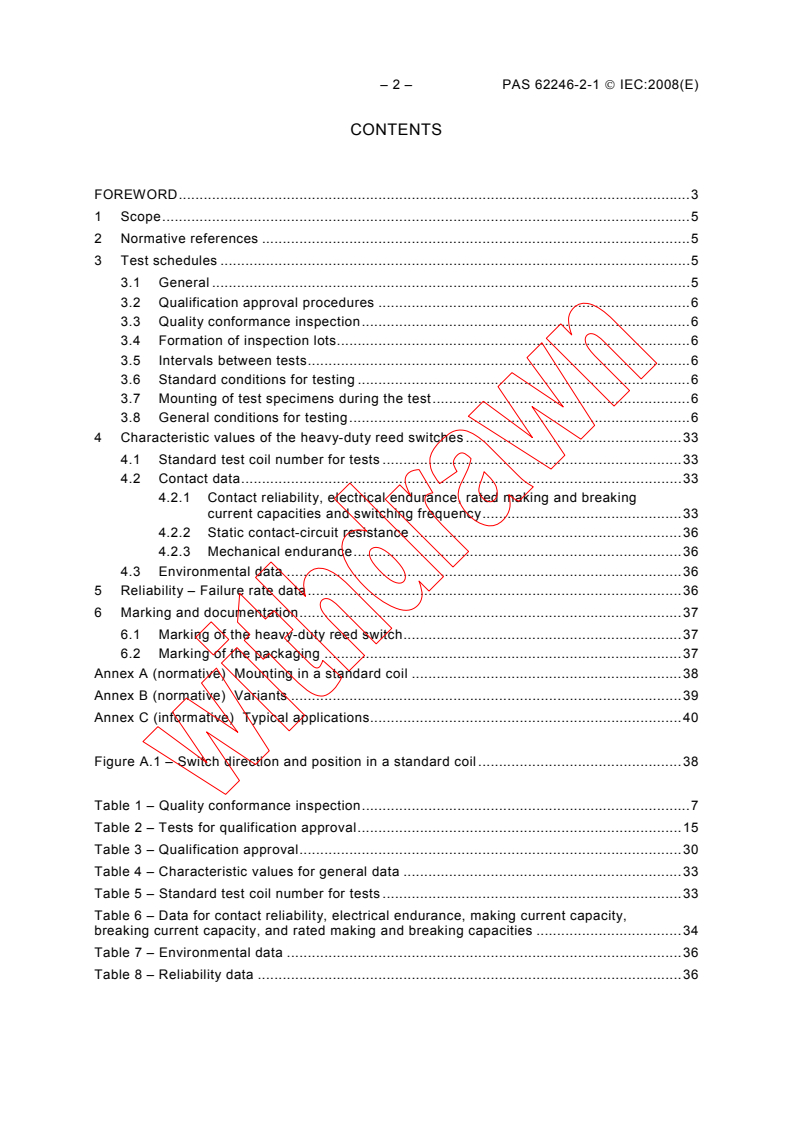
CONTENTS
FOREWORD.3
1 Scope.5
2 Normative references .5
3 Test schedules .5
3.1 General .5
3.2 Qualification approval procedures .6
3.3 Quality conformance inspection.6
3.4 Formation of inspection lots.6
3.5 Intervals between tests.6
3.6 Standard conditions for testing .6
3.7 Mounting of test specimens during the test.6
3.8 General conditions for testing.6
4 Characteristic values of the heavy-duty reed switches .33
4.1 Standard test coil number for tests .33
4.2 Contact data.33
4.2.1 Contact reliability, electrical endurance, rated making and breaking
current capacities and switching frequency.33
4.2.2 Static contact-circuit resistance .36
4.2.3 Mechanical endurance.36
4.3 Environmental data .36
5 Reliability – Failure rate data.36
6 Marking and documentation.37
6.1 Marking of the heavy-duty reed switch.37
6.2 Marking of the packaging .37
Annex A (normative) Mounting in a standard coil .38
Annex B (normative) Variants .39
Annex C (informative) Typical applications.40
Figure A.1 – Switch direction and position in a standard coil.38
Table 1 – Quality conformance inspection.7
Table 2 – Tests for qualification approval.15
Table 3 – Qualification approval.30
Table 4 – Characteristic values for general data .33
Table 5 – Standard test coil number for tests .33
Table 6 – Data for contact reliability, electrical endurance, making current capacity,
breaking current capacity, and rated making and breaking capacities .34
Table 7 – Environmental data .36
Table 8 – Reliability data .36
PAS 62246-2-1 © IEC:2008(E) – 3 –
INTERNATIONAL ELECTROTECHNICAL COMMISSION
____________
REED CONTACT UNITS –
Part 2-1: Heavy-duty reed switches –
Quality assessment specification
FOREWORD
1) The International Electrotechnical Commission (IEC) is a worldwide organization for standardization comprising
all national electrotechnical committees (IEC National Committees). The object of IEC is to promote
international co-operation on all questions concerning standardization in the electrical and electronic fields. To
this end and in addition to other activities, IEC publishes International Standards, Technical Specifications,
Technical Reports, Publicly Available Specifications (PAS) and Guides (hereafter referred to as “IEC
Publication(s)”). Their preparation is entrusted to technical committees; any IEC National Committee interested
in the subject dealt with may participate in this preparatory work. International, governmental and non-
governmental organizations liaising with the IEC also participate in this preparation. IEC collaborates closely
with the International Organization for Standardization (ISO) in accordance with conditions determined by
agreement between the two organizations.
2) The formal decisions or agreements of IEC on technical matters express, as nearly as possible, an international
consensus of opinion on the relevant subjects since each technical committee has representation from all
interested IEC National Committees.
3) IEC Publications have the form of recommendations for international use and are accepted by IEC National
Committees in that sense. While all reasonable efforts are made to ensure that the technical content of IEC
Publications is accurate, IEC cannot be held responsible for the way in which they are used or for any
misinterpretation by any end user.
4) In order to promote international uniformity, IEC National Committees undertake to apply IEC Publications
transparently to the maximum extent possible in their national and regional publications. Any divergence
between any IEC Publication and the corresponding national or regional publication shall be clearly indicated in
the latter.
5) IEC provides no marking procedure to indicate its approval and cannot be rendered responsible for any
equipment declared to be in conformity with an IEC Publication.
6) All users should ensure that they have the latest edition of this publication.
7) No liability shall attach to IEC or its directors, employees, servants or agents including individual experts and
members of its technical committees and IEC National Committees for any personal injury, property damage or
other damage of any nature whatsoever, whether direct or indirect, or for costs (including legal fees) and
expenses arising out of the publication, use of, or reliance upon, this IEC Publication or any other IEC
Publications.
8) Attention is drawn to the Normative references cited in this publication. Use of the referenced publications is
indispensable for the correct application of this publication.
9) Attention is drawn to the possibility that some of the elements of this IEC Publication may be the subject of
patent rights. IEC shall not be held responsible for identifying any or all such patent rights.
A PAS is a technical specification not fulfilling the requirements for a standard, but made
available to the public.
IEC/PAS 62246-2-1 has been processed by IEC Technical Committee 94: All-or-nothing
electrical relays.
The text of this PAS is based on the This PAS was approved for
following document: publication by the P-members of the
committee concerned as indicated in
the following document
Draft PAS Report on voting
94/264/NP 94/271/RVN
Following the publication of this PAS, which is a pre-standard publication, the technical
committee or subcommittee concerned will transform it into an International Standard. It is
intended to incorporate its contents into the next edition of IEC 62246-2 during the upcoming
maintenance cycle for that standard.
– 4 – PAS 62246-2-1 © IEC:2008(E)
This PAS shall remain valid for an initial maximum period of 3 years starting from the
publication date. The validity may be extended for a single 3-year period, following which it
shall be revised to become another type of normative document, or shall be withdrawn.
PAS 62246-2-1 © IEC:2008(E) – 5 –
REED CONTACT UNITS –
Part 2-1: Heavy-duty reed switches –
Quality assessment specification
1 Scope
This PAS defines requirements and tests for heavy-duty reed switches intended to be
incorporated into devices that can be used in various industrial applications.
This PAS is to be used in conjunction with IEC 62246-2.
This PAS selects from IEC 62246-2 and from other sources the appropriate test procedures to
be used in detail specifications derived from this PAS.
Two different product variants (variant A and variant B) are specified depending on
characteristic values and tests (see Annex B).
2 Normative references
The following referenced documents are indispensable for the application of this document.
For dated references, only the edition cited applies. For undated references, the latest edition
of the referenced document (including any amendments) applies.
IEC 60068-2-11 (1981): Environmental testing – Part 2: Tests. Test Ka: Salt mist
IEC 60068-2-14 (1984): Environmental testing – Part 2: Tests. Test N: Change of temperature
IEC 60068-2-20 (1979): Environmental testing. Part 2: Tests. Test T: Soldering
Amendment 2 (1987)
IEC 60068-2-21 (2006): Environmental testing – Part 2-21: Tests – Test U: Robustness of
terminations and integral mounting devices
IEC 60068-2-29 (1987): Environmental testing. Part 2: Tests. Test Eb and guidance: Bump
IEC 60068-2-78 (2001): Environmental testing – Part 2-78: Tests – Test Cab: Damp heat,
steady state
IEC 60127-2 (2003): Miniature fuses – Part 2: Cartridge fuse-links
IEC 61373 (1999): Railway applications – Rolling stock equipment – Shock and vibration tests
IEC 62246-1 (2002): Reed contact units – Part 1: Generic specification
IEC 62246-2 (2007): Reed contact units – Part 2: Heavy-duty reed switches
3 Test schedules
3.1 General
Test procedures are referenced in the corresponding subclauses of IEC 62246-2.
– 6 – PAS 62246-2-1 © IEC:2008(E)
3.2 Qualification approval procedures
Qualification approval procedures are indicated in Table 2 and Table 3:
– sampling and test schedule are specified in Table 2 and Table 3;
– the tests specified and their order is mandatory;
– tests stated in Table 2 are mandatory for the variants except when otherwise specified;
– tests stated in Table 3 are mandatory only for the variants indicated.
3.3 Quality conformance inspection
Quality conformance inspection contains the tests stated in Table 1:
– Group A: routine tests;
– Groups A and B: lot-by-lot tests;
– Group C: periodic tests.
Unless otherwise stated in this PAS, all tests of Table 1 are mandatory.
Where a subgroup contains cumulative tests, the order of the tests is mandatory. Specimens
that have been subjected to tests denoted as destructive (D) shall not be released for delivery.
Specimens that have been subjected to tests denoted as non-destructive (ND) are permitted
to be released for delivery.
3.4 Formation of inspection lots
The basis for determination of sample size for the quality conformance inspection is the
heavy-duty reed switch quantity produced during one month.
3.5 Intervals between tests
The following are the intervals necessary between tests:
– Subgroup A0: at shipment;
– Subgroups A4 and B1: at least once a month;
– Subgroup C1: at least once a year;
– Subgroup C4: at least once every two years.
3.6 Standard conditions for testing
If not otherwise stated, all tests shall be performed under standard conditions for testing
according to 3.3 of IEC 62246-1.
3.7 Mounting of test specimens during the test
The following requirement shall apply for shock and vibration tests:
The heavy-duty reed switch shall be mounted by its normal mounting method to the test
fixture, where inherent resonances have been minimized so as not to invalidate the test.
3.8 General conditions for testing
Unless otherwise stated, the test coil number and when applicable its polarity specified in
Table 5 shall be used for all tests. Unless otherwise stated in this PAS, the polarity shall be
as specified by the manufacturer.
PAS 62246-2-1 © IEC:2008(E) – 7 –
Table 1 – Quality conformance inspection
Group A
Subgroup A0
For all tests in this subgroup: 100 % test.
Test Test conditions according to Performance
Test
No. IEC 62246-2 requirements
A0 – 1
Visual inspection and Subclause 3.4 According to Table 4
check of dimensions
(ND) Marking as specified in 6.1
A0 – 2 Functional tests (ND) Subclause 3.5, Procedure 1
Application points and standard test coil number: According to Table 5
Must-operate value: According to Table 4
Saturate value: 150 % of must-operate
Must-release value:
Contact failure-to-make and failure-to-break by
monitoring a current, typically 10 mA at 24 V d.c.
A0 – 3 Contact-circuit Subclause 3.7 Initial value according to Table 4
resistance (ND)
Application points: terminals of closed
contacts
Standard test coil number: According to Table 5
Test coil voltage: 150 % of must-operate
Test voltage max.: 6 V d.c.
Test current max.: 1 A
A0 – 4 Dielectric test (ND) Subclause 3.8
Application points and test voltage: According to Table 4
Duration of test: 1 min Maximum leakage current:
0,5 mA
A shorter test with a higher voltage may be stated in
the detail specification
A0 – 5 Operate, release, Subclause 3.10
transfer or bridging
and bounce times (ND) Application points and standard test coil number: According to Table 5
Test coil voltage: 150 % of must-operate
1) operate time According to Table 4
2) release time
3) operate bounce time
Contact failure-to-make and failure-to-break by
monitoring a current, typically 10 mA at 24 V d.c.
A0 – 6 Sealing (ND) Subclause 3.22
Application points and standard test coil number: According to Table 5
Arc time during test: According to Table 7
Test coil voltage: 150 % of must-operate
Test voltage: 100 V – 110 V d.c.
Test current: 0,5 A – 0,55 A
Total number of operations required: 3
– 8 – PAS 62246-2-1 © IEC:2008(E)
Table 1 – Quality conformance inspection (continued)
Subgroup A4 (period: inspection lot refers to the production volume in one month)
Test Test conditions according to Performance
Test IL AQL
No. IEC 62246-2 requirements
1 Visual inspection and Subclause 3.4 According to Table 4
check of dimensions
Marking as specified in 6.1
(ND)
2 Functional tests (ND) Subclause 3.5, Procedure 1
Application points and standard test coil According to Table 5
number:
Must-operate value: According to Table 4
Saturate value: 150 % of must-operate
Must-release value:
Contact failure-to-make and failure-to-
break by monitoring a current, typically
10 mA at 24 V d.c.
Contact-circuit Subclause 3.7 Initial value according to Table 4
resistance (ND)
Application points: terminals of
closed contacts
Standard test coil number: According to Table 5
Test coil voltage: 150 % of must-operate
Test voltage max.: 6 V d.c.
Test current max.: 1 A
4 Dielectric test (ND) Subclause 3.8 S4 1,0
Application points and test voltage: According to Table 4
Duration of test: 1 min Maximum leakage current:
0,5 mA
A shorter test with a higher voltage may be
stated in the detail specification
5 Operate, release, Subclause 3.10
transfer or bridging
and bounce times (ND) Application points and standard test coil According to Table 5
number:
Test coil voltage: 150 % of must-operate
1) operate time: According to Table 4
2) release time:
3) operate bounce time:
Contact failure-to-make and failure-to-
break by monitoring a current, typically
10 mA at 24 V d.c.
6 Sealing (ND) Subclause 3.22
Application points and standard test coil According to Table 5
number:
Arc time during test: According to Table 7
Test coil voltage: 150 % of must-operate
Test voltage: 100 V – 110 V d.c.
Test current: 0,5 A – 0,55 A
Total number of operations required: 3
PAS 62246-2-1 © IEC:2008(E) – 9 –
Table 1 – Quality conformance inspection (continued)
Subgroup B1 (period: inspection lot refers to the production volume of one month)
Test Test conditions according to Performance
Test IL AQL
No. IEC 62246-2 requirements
7 Contact reliability test Subclause 3.32 S3 2,5
(D)
Test switch type and standard test coil According to Table 5
number:
Test coil voltage: 150 % of must-operate
Coil suppression: N/A
Duty cycle: 50 %
Switching load conditions: According to Table 6
Monitoring conditions: According to Table 6
At each cycle during the test
Final measurements:
Test 3 – contact-circuit resistance According to Table 4
Test 2 – functional tests According to Table 4
– 10 – PAS 62246-2-1 © IEC:2008(E)
Table 1 – Quality conformance inspection (continued)
Subgroup C1 (period: one year)
Test
Test Test conditions according to Sample Acceptable Performance
No. IEC 62246-2 size number of requirements
failures
8 Robustness of Subclause 3.12 (in accordance with 6 0 According to Table 4
terminals (D) IEC 60068-2-21) No breaking or loosening of
terminals
Procedure: test Ua1 – tensile
Final measurements:
Test 1 – visual inspection No cracks or other
deterioration
Test 2 – functional tests According to Table 4
Test 6 – sealing According to Table 7
9 Soldering (D) Subclause 3.13 (in accordance with 5 0 The dipped surface shall be
IEC 60068-2-20, test Ta, method 1) 95 % covered with new
solder coating, the
remaining 5 % may contain
only small pinholes
Temperature: (235 ± 5) °C
Duration: (2 ± 0,5) s
Application point: 5 mm from the glass-
to-metal seals
Subclause 3.13 (in accordance with
IEC 60068-2-20, test Ta, method 2)
Temperature: (350 ± 5) °C
Duration: (3 ± 0,5) s
Application point: 5 mm from the glass-
to-metal seals
Final measurements:
No cracks or other
Test 1 – visual test
deterioration
According to Table 4
Test 2 – functional tests
According to Table 7
Test 6 – sealing
PAS 62246-2-1 © IEC:2008(E) – 11 –
Table 1 – Quality conformance inspection (continued)
Subgroup C1 (period: one year)
Acceptable
Test Test conditions according to Sample Performance
Test number of
No. IEC 62246-2 size requirements
failures
10 Rapid change of Subclause 3.16 (in accordance with 6 0
temperature (D) IEC 60068-2-14)
Low temperature: – 50 °C
High temperature: 100 °C
Exposure time: 20 min
Transition time: 1 min
Number of cycles: 10
Final measurements:
Test 4 – dielectric test According to Table 4
Test 2 – functional tests According to Table 4
Test 3 – contact-circuit resistance According to Table 4
Test 1 – visual inspection No cracks or other
deterioration
Test 6 – sealing test According to Table 7
11 Vibration (D) Subclause 3.19 6 0 No opening of closed
Functional contact circuit with
Test switch type and standard test coil energization condition or
number: according to Table 5 closing of opened contact
Test coil voltage: 150 % of must-operate circuit shall exceed 10 µs
Axis of mounting: The movable contact shall
be located in the transverse
direction
Vibration conditions:
Application: three directions
According to Table 7
Number of sweeps per direction: 3
Sweep rate: 1 octave/min ± 10 %
Total duration: approx. 3×10 min
Test contact voltage and current:
24 V d.c. max., 10 mA max.
Final measurements:
Test 1 – visual inspection
No cracks or other
deterioration
Test 2 – functional tests
According to Table 4
Test 6 – sealing
According to Table 7
– 12 – PAS 62246-2-1 © IEC:2008(E)
Table 1 – Quality conformance inspection (continued)
Subgroup C1 (period: one year)
Acceptable
Test Test conditions according to Sample Performance
Test number of
No. IEC 62246-2 size requirements
failures
12 Electrical Subclause 3.23 6 0
endurance (D)
Test switch type and standard test coil According to Table 5
number:
Test coil voltage: 150 % of must-operate
Coil suppression: N/A
Duty cycle: 50 %
Switching load conditions: According to Table 6
Monitoring conditions: According to Table 6
At each cycle during the
test
Final measurements:
Test 3 – contact-circuit resistance According to Table 4
If applicable:
Test 2 – functional tests According to Table 4
Test 4 – dielectric test According to Table 4
PAS 62246-2-1 © IEC:2008(E) – 13 –
Table 1 – Quality conformance inspection (continued)
Subgroup C4 (period: at least once every two years)
Acceptable
Test Test conditions according to Sample Performance
Test number of
No. IEC 62246-2 size requirements
failures
13 Shock (D) Subclause 3.20 6 0 No opening of closed
Functional contact circuit with
Test switch type and standard test coil energization condition, or
number: According to Table 5 closing of opened contact
Test coil voltage: 150 % of must-operate circuit shall exceed 10 µs
Axis of mounting: The movable contact shall
be located in the transverse
Shock conditions: direction
Application: three directions
Number of shocks: 18 (three positive and According to Table 7
three negative in each of the three
orthogonal planes)
Duration: 30 ms
Test contact voltage and current:
24 V d.c. max., 10 mA max.
Final measurements:
Test 1 – visual inspection No cracks or other
deterioration
Test 2 – functional tests According to Table 4
Test 6 – sealing According to Table 7
14 Mechanical Subclause 3.24 20 1
endurance (D) There shall be no broken
Test switch type and standard test coil parts
number:
Test coil voltage: 150 % of must-operate
According to Table 5
Coil suppression: N/A
Duty cycle: 50 %
Number of cycles per second: 50 to 60
Periodic measurements:
6 6 6 6
1×10 ; 3×10 ; 5×10 ; 7×10 ;
7 7 7 7 8
1×10 ; 3×10 ; 5×10 ; 7×10 ;and 10
±20 % change of must-
Limits for failure to make:
operate value
50 % change of must-
Limits for failure to break:
release value
According to Table 4
Test 3 – contact-circuit resistance
According to Table 4
Test 2 – functional tests
– 14 – PAS 62246-2-1 © IEC:2008(E)
Table 1 – Quality conformance inspection (continued)
Subgroup C4 (period: at least once every two years)
Acceptable
Test Test conditions according to Sample Performance
Test number of
No. IEC 62246-2 size requirements
failures
15 Making current Subclause 3.34 6 0
capacity (D)
Test switch type and standard test coil According to Table 5
number:
Test coil voltage: 150 % of must-operate
Coil suppression: N/A
Making load conditions: According to Table 6
Monitoring conditions: At each cycle during the
test
monitoring times: t = 400 ms, τ = 50 ms
1 1
According to Table 4
Test 3 – contact-circuit resistance
If applicable:
According to Table 4
Test 2 – functional tests
According to Table 4
Test 4 – dielectric test
16 Breaking current Subclause 3.35 6 0
capacity (D)
Test switch type and standard test coil According to Table 5
number:
Test coil voltage: 150 % of must-operate
Coil suppression: N/A
Breaking load conditions: According to Table 6
Monitoring conditions: At each cycle during the
test
monitoring times: t = 100 ms, τ = 50 ms
2 2
According to Table 4
Test 3 – contact-circuit resistance
If applicable:
According to Table 4
Test 2 – functional tests
According to Table 4
Test 4 – dielectric test
17 Rated impulse Subclause 3.29 3 0
voltage (D)
Test voltage: 3 000 V d.c. According to Table 6
Test voltage wave form: 1,2 / 50 µs
Variant B only
Number of pulses: 6 pulses (three
positive and three negative)
Final measurements:
No cracks or other
Test 1 – visual test
deterioration
Test 2 – functional tests According to Table 4
Test 4 – dielectric test According to Table 4
PAS 62246-2-1 © IEC:2008(E) – 15 –
Table 2 – Tests for qualification approval
Acceptable
Test Test conditions according to Sample Performance
Test number of
No. IEC 62246-2 size requirements
failures
1 Visual inspection Subclause 3.4 According to Table 4
and check of
dimensions (ND) Marking as specified in 6.1
2 Functional tests Subclause 3.5, Procedure 1
(ND)
Application points and standard test coil According to Table 5
number:
Must-operate value: According to Table 4
Saturate value: 150 % of must-operate
Must-release value:
Contact failure-to-make and failure-to-
break by monitoring a current, typically
10 mA at 24 V d.c.
3 Contact circuit Subclause 3.7 Initial value according to
resistance (ND) Table 4
Application points: terminals of
closed contacts
Standard test coil number: According to Table 5
Test coil voltage: 150 % of must-operate
Test voltage max.: 6 V d.c.
Test current max.: 1 A
Dielectric test Subclause 3.8
(ND)
Application points and test voltage: According to Table 4
Duration of test: 1 min Maximum leakage current:
0,5 mA
170 0
A shorter test with a higher voltage may
be stated in the detail specification
Operate, release, Subclause 3.10
transfer or
bridging, and Application points and standard test coil According to Table 5
bounce times number:
(ND)
Test coil voltage: 150 % of must-operate
1) operate time: According to Table 4
2) release time:
3) operate bounce time:
Contact failure-to-make and failure-to-
break by monitoring a current, typically
10 mA at 24 V d.c.
6 Sealing (ND) Subclause 3.22
Application points and standard test coil According to Table 5
number:
Arc time during test According to Table 7
Test coil voltage: 150 % of must-operate
Test voltage: 100 V – 110 V d.c.
Test current: 0,5 A – 0,55 A
Total number of operations required: 3
– 16 – PAS 62246-2-1 © IEC:2008(E)
Table 2 – Tests for qualification approval (continued)
Acceptable
Test Test conditions according to Sample Performance
Test number of
No. IEC 62246-2 size requirements
failures
7 Remanence test Subclause 3.6 6 0
(ND)
Application points and standard test coil According to Table 5
number:
Saturate value: 150 % of must-operate Remanence value:
Just-operate value 1 Maximum 10 %
Saturate value (reverse polarity): 150 %
of must-operate
Just-operate value 2
8 Insulation test Subclause 3.9 6 0
(ND)
Application points and test voltage: According to Table 4
9 Contact sticking Subclause 3.11, Procedure 1 6 0
(ND) Application points and standard test coil According to Table 5
Thermal sticking number:
Upper category temperature: 150 °C
Saturate value: 150 % of must-operate
Test period: minimum 24 h
Maximum permitted value: Permitted value: max.10 %
Magnetostrictive Subclause 3.11.2
According to Table 5
sticking Application points and standard test coil
number:
Pulsing rate: 10 cycles per second
Limits for the peak-to-peak value of the Zero failure-to-break
pulse: 200 % and 100 % of must-operate
Number of test cycles: 5
Minimum contact circuit resistance According to Table 4
defining failure-to-break:
10 Robustness of Subclause 3.12 (in accordance with 6 0 According to Table 4
terminals (D) IEC 60068-2-21) No breaking or loosening of
terminals
Procedure: test Ua1 – tensile
Final measurements:
Test 1 – visual inspection No cracks or other
deterioration
Test 2 – functional tests According to Table 4
Test 6 – sealing According to Table 7
PAS 62246-2-1 © IEC:2008(E) – 17 –
Table 2 – Tests for qualification approval (continued)
Acceptable
Test Test conditions according to Sample Performance
Test number of
No. IEC 62246-2 size requirements
failures
6 0
11 Soldering (D) Subclause 3.13 (in accordance with When inspected with a
IEC 60068-2-20, test Ta, method 1) magnifying lens the dipped
surface shall be 95 %
covered with new solder
coating, the remaining 5 %
Temperature: (235 ± 5) °C
may contain only small
Duration: (2 ± 0,5) s
pinholes
Application point: 5 mm from the
glass-to-metal seals
Subclause 3.13 (in accordance with
IEC 60068-2-20), test Ta, method 2)
Temperature: (350 ± 5) °C
Duration: (3 ± 0,5) s
Application point: 5 mm
from the glass-to-metal seals
Final measurements:
No cracks or other
Test 1 – visual test
deterioration
According to Table 4
Test 2 – functional tests
According to Table 7
Test 6 – sealing
12 Climatic Subclause 3.14 6 0
sequence (D)
Dry heat, 3.14.1 of IEC 62246-1
Application points and standard test coil According to Table 5
number:
Temperature: 200 °C
Duration: 16 h
Recovery: 4 h
During the last 2 h of dry heat exposure: Value according to Table 4
monitoring of contact-circuit resistance
Number of cycles per second: 2
Duty factor: 1:1
Test contact voltage: max. 6 V d.c. or a.c.
Test contact current: max. 1 A
Before the end of dry heat exposure:
Test 2 – functional tests According to Table 4
Damp heat cyclic, 3.14.1, one cycle
Temperature 55 °C
Recovery: 4 h
Cold, 3.14.1
Temperature: – 50 °C
Duration: 2 h
Before the end of cold exposure:
Test 2 – functional tests
According to Table 4
Damp heat cyclic, 3.14.1, one cycle
Temperature: 55 °C
Recovery: 4 h
– 18 – PAS 62246-2-1 © IEC:2008(E)
Table 2 – Tests for qualification approval (continued)
Acceptable
Test Test conditions according to Sample Performance
Test number of
No. IEC 62246-2 size requirements
failures
12 Final measurements:
Climatic
sequence
(continued) Test 4 – dielectric test According to Table 4
Test 2 – functional tests According to Table 4
Test 3 – contact-circuit resistance According to Table 4
Test 1 – visual inspection No cracks or other
deterioration
Test 6 – sealing test According to Table 7
13 6 0
Damp heat, Subclause 3.15 (in accordance with
steady state IEC 60068-2-78)
(D)
Temperature: 200 °C
Conditioning time: 10 days
Final measurements:
Test 4 – dielectric test According to Table 4
Test 2 – functional tests According to Table 4
Test 3 – contact-circuit resistance According to Table 4
Test 1 – visual inspection No cracks or other
deterioration
Test 6 – sealing test According to Table 7
Test 11 – solderability
14 Rapid change Subclause 3.16 (in accordance with 6 0
of IEC 60068-2-14)
temperature
(D) Low temperature: – 50 °C
High temperature: 100 °C
Exposure time: 20 min
Transition time: 1 min
Number of cycles: 10
Final measurements:
Test 4 – dielectric test According to Table 4
Test 2 – functional tests According to Table 4
Test 3 – contact-circuit resistance According to Table 4
Test 1 – visual inspection No cracks or other
deterioration
Test 6 – sealing test According to Table 7
PAS 62246-2-1 © IEC:2008(E) – 19 –
Table 2 – Tests for qualification approval (continued)
Acceptable
Test Test conditions according to Sample Performance
Test number of
no. IEC 62246-2 size requirements
failures
6 0
15 Salt mist (D) Subclause 3.17 (in accordance with
IEC 60068-2-11)
Concentration: 5 ± 1 % by weight
PH value: 6,5 to 7,2
Temperature: 35 °C
Durations: 168 h
Final measurements:
Test 4 – dielectric test According to Table 4
Test 2 – functional tests According to Table 4
Test 3 – contact-circuit resistance According to Table 4
Test 1 – visual inspection No breaking or loosening of
terminals
Test 6 – sealing test According to Table 7
16 Bump (D) Subclause 3.18 (in accordance with 6 0 No opening of closed contact
IEC 60068-2-29, test Eb) circuit with energization
condition or closing of opened
contact circuit shall exceed
Standard test coil according to Table 5 10 µs
Test coil voltage: 150 % of must-operate
Peak acceleration: 150 m/s
Duration: 6 ms
Number of bumps: 100 + 5
Final measurements:
Test 2 – functional tests According to Table 4
Test 1 – visual inspection No breaking or loosening of
terminals
Test 6 – sealing test According to Table 7
– 20 – PAS 62246-2-1 © IEC:2008(E)
Table 2 – Tests for qualification approval (continued)
Acceptable
Test Test conditions according to Sample Performance
Test number of
No. IEC 62246-2 size requirements
failures
6 0
17 Vibration (D) Subclause 3.19 No opening of closed contact
Functional circuit with energization
Test switch type and standard test coil condition or closing of opened
number: according to Table 5 contact circuit shall exceed
Test coil voltage: 150 % of must-operate 10 µs
Axis of mounting: The movable contact shall be
located in the transverse
direction
Vibration conditions:
Application: three directions
According to Table 7
Number of sweeps per direction: 3
Sweep rate: 1 octave/min ± 10 %
Total duration: approx. 3×10 min
Test contact voltage and current:
24 V d.c. max., 10 mA max.
Final measurements:
Test 1 – visual inspection
No cracks or other
deterioration
Test 2 – functional tests
According to Table 4
Test 6 – sealing
According to Table 7
Clause 9 of IEC 61373 applies 6 0
Vibration (D)
Survival
Test switch type and standard test coil
The movable contact shall be
number: according to Table 5
located in the transverse
Test coil voltage: 150 % of must-operate
direction
Axis of mounting:
Vibration conditions:
Application: three directions
Frequency: 5 Hz to 150 Hz
Number of sweeps per direction: 3
Sweep rate: 1 octave/min ± 10 %
Test duration: min. 5 h each
Peak to peak values:
Vertical direction: 7,90 m/s
Transverse direction: 3,5 m/s
Longitudinal direction: 5,50 m/s
Test contact voltage and current:
24 V d.c. max., 10 mA max.
Final measurements:
Test 1 – visual inspection
No cracks or other
deterioration
Test 2 – functional tests
According to Table 4
Test 6 – sealing
According to Table 7
PAS 62246-2-1 © IEC:2008(E) – 21 –
Table 2 – Tests for qualification approval (continued)
Acceptable
Test Test conditions according to Sample Performance
Test number of
No. IEC 62246-2 size requirements
failures
6 0
18 Shock (D) Subclause 3.20 No opening of closed contact
Functional circuit with energization
Test switch type and standard test coil condition, or closing of opened
number: According to Table 5 contact circuit shall exceed
Test coil voltage: 150 % of must-operate 10 µs
Axis of mounting: The movable contact shall be
located in the transverse
Shock conditions: direction
Application: three directions
Number of shocks: 18 (three positive and According to Table 7
three negative in each of the three
orthogonal planes)
Duration: 30 ms
Test contact voltage and current:
24 V d.c. max., 10 mA max.
Final measurements:
Test 1 – visual inspection No cracks or other
deterioration
Test 2 – functional tests According to Table 4
According to Table 7
Test 6 – sealing
6 0
Shock (D) Subclause 3.20 No cracks or other
Survival deterioration
Test switch type and standard test coil
number: according to Table 5
Test coil voltage: 150 % of must-operate
Axis of mounting: The movable contact shall be
located in the transverse
direction
Shock conditions:
According to Table 7
Application: three directions
Number of shocks: 18 (three positive and
three negative in each of the three
orthogonal planes)
Duration: 30 ms
Final measurements:
Test 1 – visual inspection According to Table 4
According to Table 4
Test 2 – functional tests
Test 6 – sealing According to Table 7
– 22 – PAS 62246-2-1 © IEC:2008(E)
Table 2 – Tests for qualification approval (continued)
Acceptable
Test Test conditions according to Sample Performance
Test number of
No. IEC 62246-2 size requirements
failures
6 0
19 Electrical Subclause 3.23
endurance (D)
Test switch type and standard test coil According to Table 5
number:
Test coil voltage: 150 % of must-operate
Coil suppression: N/A
Duty cycle: 50 %
Switching load conditions: According to Table 6
Monitoring conditions: According to Table 6
At each cycle during the test
Final measurements:
Test 3 – contact-circuit resistance According to Table 4
If applicable:
Test 2 – functional tests According to Table 4
Test 4 – dielectric test According to Table 4
20 Mechanical Subclause 3.24 20 1
endurance (D) There shall be no broken parts
Test switch type and standard test coil
number:
According to Table 5
Test coil voltage: 150 % of must-operate
Coil suppression: N/A
Duty cycle: 50 %
Number of cycles per second: 50 to 60
Periodic measurements:
6 6 6 6
1×10 ; 3×10 ; 5×10 ; 7×10 ;
7 7 7 7 8
1×10 ; 3×10 ; 5×10 ; 7×10 ;and 10
±20 % change of must-operate
Limits for failure to make:
value
50 % change of must-release
Limits for failure to break:
value
According to Table 4
Test 3 – contact-circuit resistance
According to Table 4
Test 2 – functional tests
PAS 62246-2-1 © IEC:2008(E) – 23 –
Table 2 – Tests for qualification approval (continued)
Acceptable
Test Test conditions according to Sample Performance
Test number of
No. IEC 62246-2 size requirements
failures
21 Maximum Subclause 3.25, Procedure 1 6 0
cycling
frequency Test switch type and standard test coil According to Table 5
number:
Test coil voltage: 150 % of must-operate
Maximum bounce time: 3 ms
Coil suppression: N/A According to Table 4
Duty cycle: 50 %
Maximum cycling frequency per second: 60
22 Rated Subclause 3.31 3 0
conditional
short-circuit Test switch type and standard test coil According to Table 5
current (D) number:
Test coil voltage: 150 % of must-operate
Not required Coil suppression: N/A
for Variant B
Type of SCPD: quick acting fuse type
FH in accordance with IEC 60127-2,
standard sheet 1. According to Table 7
Ratings of SCPD: 5 A 250 V
Test voltage: 264 V a.c. or 115 V d.c.
r.m.s. test current: 20 A a.c. and d.c.
Minimum time interval between tests: 3 min
Number of tests: 3
Final measurements:
Test 1 – visual test No cracks or other
deterioration
Test 2 – functional tests According to Table 4
Test 4 – dielectric test According to Table 4
23 Contact Subclause 3.32 20 0
reliability test
(D) Test switch type and standard test coil According to Table 5
number:
Test coil voltage: 150 % of must-operate
Coil suppression: N/A
Duty cycle: 50 %
Switching load conditions: According to Table 6
Monitoring conditions: According to Table 6
At each operating cycle
Final measurements:
Test 3 – contact-circuit resistance According to Table 4
Test 2 – functional tests According to Table 4
– 24 – PAS 62246-2-1 © IEC:2008(E)
Table 2 – Tests for qualification approval (continued)
Acceptable
Test Test conditions according to Sample Performance
Test number of
No. IEC 62246-2 size requirements
defectives
3 0
24 Temperature Subclause 3.33
rise (ND)
Test switch type and standard test coil According to Table 5
number:
Test coil voltage: 150 % of must-operate
Coil suppression: N/A
Testing current: According to Table 4
Measurement positions: terminals
Measurement duration: 1,5 h
Final measurements:
Test 1 – visual test No damage or other
deterioration
Test 3 – contact-circuit resistance According to Table 4
Test 2 – functional test According to Table 4
25 6 0
Making Subclause 3.34
current
capacity (D) Test switch type and standard test coil According to Table 5
number:
Test coil voltage: 150 % of must-operate
Coil suppression: N/A
Making load conditions: According t
...
Questions, Comments and Discussion
Ask us and Technical Secretary will try to provide an answer. You can facilitate discussion about the standard in here.
Loading comments...