

IEC 60143-1:2015
(Main)Series capacitors for power systems - Part 1: General
General Information
- Abstract
IEC 60143-1:2015 applies both to capacitor units and capacitor banks intended to be used connected in series with an a.c. transmission or distribution line or circuit forming part of an a.c. power system having a frequency of 15 Hz to 60 Hz. The primary focus of this standard is on transmission application. The series capacitor units and banks are usually intended for high-voltage power systems. This standard is applicable to the complete voltage range. This standard does not apply to capacitors of the self-healing metallized dielectric type. The following capacitors, even if connected in series with a circuit, are excluded from this standard:
- capacitors for inductive heat-generating plants (IEC 60110-1);
- capacitors for motor applications and the like (IEC 60252 (all parts));
- capacitors to be used in power electronics circuits (IEC 61071);
- capacitors for discharge lamps (IEC 61048 and IEC 61049). For standard types of accessories such as insulators, switches, instrument transformers, external fuses, etc. see the pertinent IEC standard. The object of this standard is:
- to formulate uniform rules regarding performance, testing and rating;
- to formulate specific safety rules;
- to serve as a guide for installation and operation. This fifth edition cancels and replaces the fourth edition, published in 2004. This edition constitutes a technical revision. The main change with respect to the previous edition is that the endurance test has been replaced by an ageing test because voltage cycling is already performed in the cold duty test. The guide section has been expanded regarding long line correction and altitude correction. In addition the insulation tables and references to other standards have been updated.
Keywords: a.c. transmission or distribution line, capacitor units and banks for high-voltage power systems
The contents of the corrigendum of April 2017 have been included in this copy.
- Status
- Published
- Publication Date
- 02-Nov-2023
- Technical Committee
- TC 33 - Power capacitors and their applications
- Drafting Committee
- MT 13 - TC 33/MT 13
- Current Stage
- PPUB - Publication issued
- Start Date
- 25-Jun-2015
- Completion Date
- 31-Jul-2015
Buy Documents

IEC 60143-1:2015+AMD1:2023 CSV - Series capacitors for power systems - Part 1: General Released:11/3/2023
IEC 60143-1:2015 - Series capacitors for power systems - Part 1: General Released:6/25/2015
Overview
IEC 60143-1:2015 (Edition 5.1, including amendment 1:2023) defines the general requirements for series capacitor units and capacitor banks intended for connection in series with an alternating current (a.c.) transmission or distribution line within power systems. Applicable for systems operating from 15 Hz to 60 Hz, this standard primarily addresses high-voltage transmission applications and covers the full voltage range for series capacitor devices.
This standard lays out uniform rules for performance, testing, ratings, and safety of series capacitors. It provides installation and operation guidance, enhancing reliability and system safety for high-voltage power network operators. However, it does not apply to self-healing metallized dielectric capacitors or capacitors used for heating, motor circuits, power electronics, or discharge lamp applications. For those applications, other IEC standards apply.
Keywords: a.c. transmission, high-voltage power systems, series capacitors, capacitor banks, IEC 60143-1:2015
Key Topics
Scope and Exclusions
- Covers series capacitor units and banks for a.c. transmission and distribution systems (15 Hz - 60 Hz), focusing on high-voltage applications.
- Excludes capacitors for heating, motors, power electronics, and lighting circuits, referenced in other IEC standards.
Performance, Testing, and Rating
- Establishes comprehensive procedures for assessing performance, routine, type, and special tests (including updated ageing tests).
- Specifies test environments, capacitance, losses, insulation integrity, thermal stability, and discharge characteristics.
Safety Requirements
- Outlines mandatory safety features for series capacitors, including discharge devices and protective coordination.
- Addresses environmental protection, especially for substances such as polychlorinated biphenyls.
Guidance for Application
- Provides recommendations for the selection of ratings, bank configuration, insulation levels, overload and overvoltage handling, and long line/altitude corrections.
- Considers operational scenarios such as system faults, network protection, harmonics, and relay coordination.
Markings and Documentation
- Specifies essential labeling and documentation for capacitor units and banks, including instruction books and safety warnings.
Applications
IEC 60143-1:2015 is significant for organizations involved in power transmission and grid stability. Key applications include:
Transmission Line Series Compensation
- Enhances power transfer capacity and stability of high-voltage a.c. transmission networks by mitigating reactance and controlling voltage profiles.
System Reliability and Efficiency
- Supports the optimal deployment and maintenance of series capacitor banks, ensuring consistent network performance within designed operational limits.
Standardized Testing and Safety Protocols
- Enables manufacturers and utilities to specify, test, and maintain series capacitors to common international standards, reducing risk and complying with regulatory requirements.
Grid Modernization Projects
- Essential reference for engineers and project managers involved in high-voltage grid upgrades, interconnections, or new substation commissioning.
Related Standards
For a holistic approach to series capacitors and related equipment, consider the following related IEC standards:
- IEC 60143-2: Protective equipment for series capacitor banks
- IEC 60143-3: Internal fuses for series capacitors
- IEC 60143-4: Thyristor-controlled series capacitors
- IEC 60060-1: High-voltage test techniques - General definitions and requirements
- IEC 60071 series: Insulation coordination
- IEC 60549: High-voltage fuses for protection of shunt capacitors
- IEC 60871-1: Shunt capacitors for a.c. power systems above 1,000V
By adhering to IEC 60143-1:2015, power utilities, equipment manufacturers, and system integrators benefit from increased safety, reliability, and international compatibility in the deployment of series capacitors for transmission lines and distribution networks.
Relations
- Amended By
IEC 60143-1:2015/AMD1:2023 - Amendment 1 - Series capacitors for power systems - Part 1: General - Effective Date
- 05-Sep-2023
- Corrected By
IEC 60143-1:2015/COR1:2017 - Corrigendum 1 - Series capacitors for power systems - Part 1: General - Effective Date
- 05-Sep-2023
- Effective Date
- 05-Sep-2023
Buy Documents
IEC 60143-1:2015+AMD1:2023 CSV - Series capacitors for power systems - Part 1: General Released:11/3/2023
IEC 60143-1:2015 - Series capacitors for power systems - Part 1: General Released:6/25/2015
Frequently Asked Questions
IEC 60143-1:2015 is a standard published by the International Electrotechnical Commission (IEC). Its full title is "Series capacitors for power systems - Part 1: General". This standard covers: IEC 60143-1:2015 applies both to capacitor units and capacitor banks intended to be used connected in series with an a.c. transmission or distribution line or circuit forming part of an a.c. power system having a frequency of 15 Hz to 60 Hz. The primary focus of this standard is on transmission application. The series capacitor units and banks are usually intended for high-voltage power systems. This standard is applicable to the complete voltage range. This standard does not apply to capacitors of the self-healing metallized dielectric type. The following capacitors, even if connected in series with a circuit, are excluded from this standard: - capacitors for inductive heat-generating plants (IEC 60110-1); - capacitors for motor applications and the like (IEC 60252 (all parts)); - capacitors to be used in power electronics circuits (IEC 61071); - capacitors for discharge lamps (IEC 61048 and IEC 61049). For standard types of accessories such as insulators, switches, instrument transformers, external fuses, etc. see the pertinent IEC standard. The object of this standard is: - to formulate uniform rules regarding performance, testing and rating; - to formulate specific safety rules; - to serve as a guide for installation and operation. This fifth edition cancels and replaces the fourth edition, published in 2004. This edition constitutes a technical revision. The main change with respect to the previous edition is that the endurance test has been replaced by an ageing test because voltage cycling is already performed in the cold duty test. The guide section has been expanded regarding long line correction and altitude correction. In addition the insulation tables and references to other standards have been updated. Keywords: a.c. transmission or distribution line, capacitor units and banks for high-voltage power systems The contents of the corrigendum of April 2017 have been included in this copy.
IEC 60143-1:2015 applies both to capacitor units and capacitor banks intended to be used connected in series with an a.c. transmission or distribution line or circuit forming part of an a.c. power system having a frequency of 15 Hz to 60 Hz. The primary focus of this standard is on transmission application. The series capacitor units and banks are usually intended for high-voltage power systems. This standard is applicable to the complete voltage range. This standard does not apply to capacitors of the self-healing metallized dielectric type. The following capacitors, even if connected in series with a circuit, are excluded from this standard: - capacitors for inductive heat-generating plants (IEC 60110-1); - capacitors for motor applications and the like (IEC 60252 (all parts)); - capacitors to be used in power electronics circuits (IEC 61071); - capacitors for discharge lamps (IEC 61048 and IEC 61049). For standard types of accessories such as insulators, switches, instrument transformers, external fuses, etc. see the pertinent IEC standard. The object of this standard is: - to formulate uniform rules regarding performance, testing and rating; - to formulate specific safety rules; - to serve as a guide for installation and operation. This fifth edition cancels and replaces the fourth edition, published in 2004. This edition constitutes a technical revision. The main change with respect to the previous edition is that the endurance test has been replaced by an ageing test because voltage cycling is already performed in the cold duty test. The guide section has been expanded regarding long line correction and altitude correction. In addition the insulation tables and references to other standards have been updated. Keywords: a.c. transmission or distribution line, capacitor units and banks for high-voltage power systems The contents of the corrigendum of April 2017 have been included in this copy.
IEC 60143-1:2015 is classified under the following ICS (International Classification for Standards) categories: 31.060.70 - Power capacitors. The ICS classification helps identify the subject area and facilitates finding related standards.
IEC 60143-1:2015 has the following relationships with other standards: It is inter standard links to IEC 60143-1:2015/AMD1:2023, IEC 60143-1:2015/COR1:2017, IEC 60143-1:2004. Understanding these relationships helps ensure you are using the most current and applicable version of the standard.
IEC 60143-1:2015 is available in PDF format for immediate download after purchase. The document can be added to your cart and obtained through the secure checkout process. Digital delivery ensures instant access to the complete standard document.
Standards Content (Sample)
IEC 60143-1 ®
Edition 5.1 2023-11
CONSOLIDATED VERSION
INTERNATIONAL
STANDARD
NORME
INTERNATIONALE
colour
inside
Series capacitors for power systems –
Part 1: General
Condensateurs série destinés à être installés sur des réseaux –
Partie 1: Généralités
All rights reserved. Unless otherwise specified, no part of this publication may be reproduced or utilized in any form
or by any means, electronic or mechanical, including photocopying and microfilm, without permission in writing from
either IEC or IEC's member National Committee in the country of the requester. If you have any questions about IEC
copyright or have an enquiry about obtaining additional rights to this publication, please contact the address below or
your local IEC member National Committee for further information.
Droits de reproduction réservés. Sauf indication contraire, aucune partie de cette publication ne peut être reproduite ni
utilisée sous quelque forme que ce soit et par aucun procédé, électronique ou mécanique, y compris la photocopie et
les microfilms, sans l'accord écrit de l'IEC ou du Comité national de l'IEC du pays du demandeur. Si vous avez des
questions sur le copyright de l'IEC ou si vous désirez obtenir des droits supplémentaires sur cette publication, utilisez
les coordonnées ci-après ou contactez le Comité national de l'IEC de votre pays de résidence.
IEC Secretariat Tel.: +41 22 919 02 11
3, rue de Varembé info@iec.ch
CH-1211 Geneva 20 www.iec.ch
Switzerland
About the IEC
The International Electrotechnical Commission (IEC) is the leading global organization that prepares and publishes
International Standards for all electrical, electronic and related technologies.
About IEC publications
The technical content of IEC publications is kept under constant review by the IEC. Please make sure that you have the
latest edition, a corrigendum or an amendment might have been published.
IEC publications search - webstore.iec.ch/advsearchform IEC Products & Services Portal - products.iec.ch
The advanced search enables to find IEC publications by a Discover our powerful search engine and read freely all the
variety of criteria (reference number, text, technical publications previews. With a subscription you will always have
committee, …). It also gives information on projects, replaced access to up to date content tailored to your needs.
and withdrawn publications.
Electropedia - www.electropedia.org
IEC Just Published - webstore.iec.ch/justpublished
The world's leading online dictionary on electrotechnology,
Stay up to date on all new IEC publications. Just Published
containing more than 22 300 terminological entries in English
details all new publications released. Available online and once
and French, with equivalent terms in 19 additional languages.
a month by email.
Also known as the International Electrotechnical Vocabulary
(IEV) online.
IEC Customer Service Centre - webstore.iec.ch/csc
If you wish to give us your feedback on this publication or need
further assistance, please contact the Customer Service
Centre: sales@iec.ch.
A propos de l'IEC
La Commission Electrotechnique Internationale (IEC) est la première organisation mondiale qui élabore et publie des
Normes internationales pour tout ce qui a trait à l'électricité, à l'électronique et aux technologies apparentées.
A propos des publications IEC
Le contenu technique des publications IEC est constamment revu. Veuillez vous assurer que vous possédez l’édition la
plus récente, un corrigendum ou amendement peut avoir été publié.
Recherche de publications IEC - Découvrez notre puissant moteur de recherche et consultez
webstore.iec.ch/advsearchform gratuitement tous les aperçus des publications. Avec un
La recherche avancée permet de trouver des publications IEC abonnement, vous aurez toujours accès à un contenu à jour
en utilisant différents critères (numéro de référence, texte, adapté à vos besoins.
comité d’études, …). Elle donne aussi des informations sur les
projets et les publications remplacées ou retirées. Electropedia - www.electropedia.org
Le premier dictionnaire d'électrotechnologie en ligne au monde,
IEC Just Published - webstore.iec.ch/justpublished
avec plus de 22 300 articles terminologiques en anglais et en
Restez informé sur les nouvelles publications IEC. Just
français, ainsi que les termes équivalents dans 19 langues
Published détaille les nouvelles publications parues.
additionnelles. Egalement appelé Vocabulaire
Disponible en ligne et une fois par mois par email.
Electrotechnique International (IEV) en ligne.
Service Clients - webstore.iec.ch/csc
Si vous désirez nous donner des commentaires sur cette
publication ou si vous avez des questions contactez-nous:
sales@iec.ch.
IEC Products & Services Portal - products.iec.ch
IEC 60143-1 ®
Edition 5.1 2023-11
CONSOLIDATED VERSION
INTERNATIONAL
STANDARD
NORME
INTERNATIONALE
colour
inside
Series capacitors for power systems –
Part 1: General
Condensateurs série destinés à être installés sur des réseaux –
Partie 1: Généralités
INTERNATIONAL
ELECTROTECHNICAL
COMMISSION
COMMISSION
ELECTROTECHNIQUE
INTERNATIONALE
ICS 31.060.70 ISBN 978-2-8322-7807-9
IEC 60143-1 ®
Edition 5.1 2023-11
CONSOLIDATED VERSION
REDLINE VERSION
VERSION REDLINE
colour
inside
Series capacitors for power systems –
Part 1: General
Condensateurs série destinés à être installés sur des réseaux –
Partie 1: Généralités
– 2 – IEC 60143-1:2015+AMD1:2023 CSV
© IEC 2023
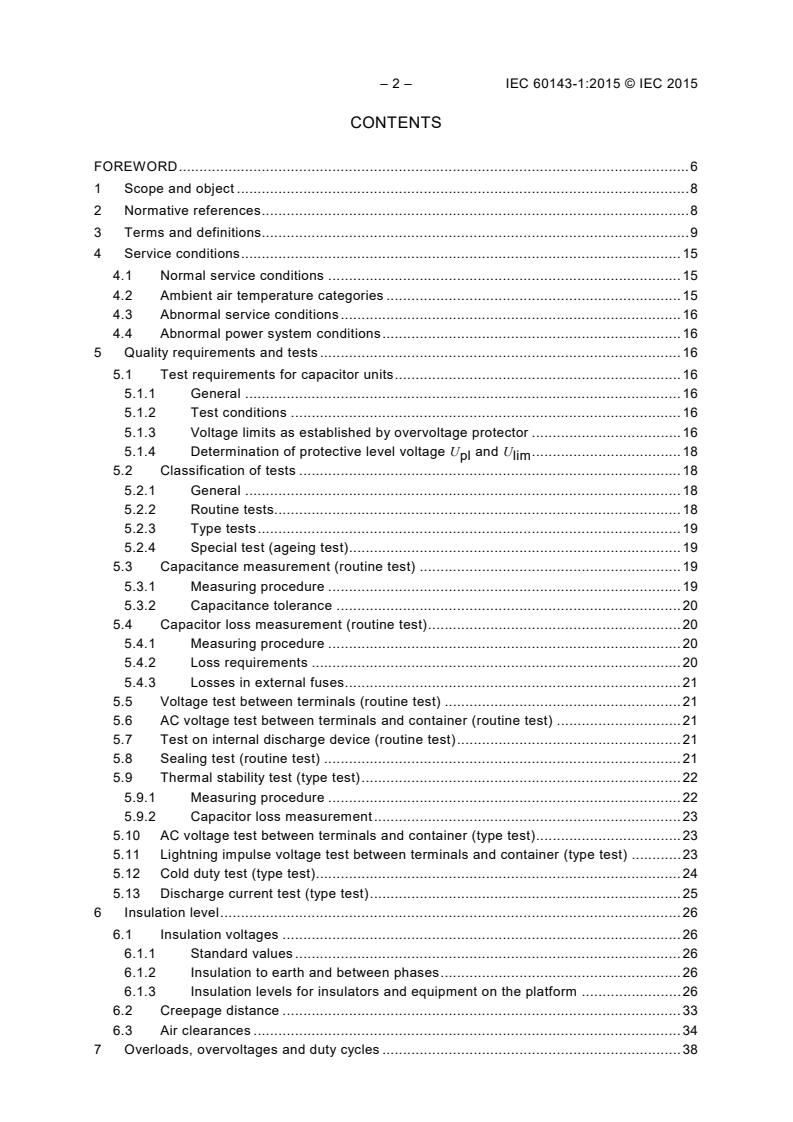
CONTENTS
FOREWORD . 6
1 Scope and object . 8
2 Normative references . 8
3 Terms and definitions . 9
4 Service conditions . 14
4.1 Normal service conditions . 14
4.2 Ambient air temperature categories . 15
4.3 Abnormal service conditions . 15
4.4 Abnormal power system conditions . 16
5 Quality requirements and tests . 16
5.1 Test requirements for capacitor units . 16
5.1.1 General . 16
5.1.2 Test conditions . 16
5.1.3 Voltage limits as established by overvoltage protector . 16
5.1.4 Determination of protective level voltage U and U . 18
pl lim
5.2 Classification of tests . 18
5.2.1 General . 18
5.2.2 Routine tests . 18
5.2.3 Type tests . 18
5.2.4 Special test (ageing test) . 19
5.3 Capacitance measurement (routine test) . 19
5.3.1 Measuring procedure . 19
5.3.2 Capacitance tolerance . 20
5.4 Capacitor loss measurement (routine test) . 20
5.4.1 Measuring procedure . 20
5.4.2 Loss requirements . 20
5.4.3 Losses in external fuses . 21
5.5 Voltage test between terminals (routine test) . 21
5.6 AC voltage test between terminals and container (routine test) . 21
5.7 Test on internal discharge device (routine test) . 21
5.8 Sealing test (routine test) . 21
5.9 Thermal stability test (type test) . 21
5.9.1 Measuring procedure . 21
5.9.2 Capacitor loss measurement . 23
5.10 AC voltage test between terminals and container (type test) . 23
5.11 Lightning impulse voltage test between terminals and container (type test) . 23
5.12 Cold duty test (type test) . 24
5.13 Discharge current test (type test) . 25
6 Insulation level . 26
6.1 Insulation voltages . 26
6.1.1 Standard values . 26
6.1.2 Insulation to earth and between phases . 26
6.1.3 Insulation levels for insulators and equipment on the platform . 26
6.2 Creepage distance . 33
6.3 Air clearances . 34
7 Overloads, overvoltages and duty cycles . 38
© IEC 2023
7.1 Currents . 38
7.2 Transient overvoltages . 38
7.3 Duty cycles . 39
8 Safety requirements . 39
8.1 Discharge device . 39
8.2 Container connection . 39
8.3 Protection of the environment . 40
8.4 Other safety requirements . 40
9 Markings and instruction books. 40
9.1 Markings of the unit . 40
9.1.1 Rating plate . 40
9.1.2 Warning plate . 41
9.2 Markings of the bank . 41
9.2.1 Instruction sheet or rating plate . 41
9.2.2 Warning plate . 41
9.3 Instruction book . 41
10 Guide for selection of ratings, installation and operation . 42
10.1 General . 42
10.2 Reactance per line, rated reactance per bank and number of modules per
bank . 42
10.2.1 Capacitive reactance per line . 42
10.2.2 Number of series capacitor banks in a transmission line . 43
10.2.3 Number of modules in a capacitor bank . 43
10.2.4 Future requirements for series capacitors . 44
10.3 Current ratings for the bank . 44
10.3.1 General . 44
10.3.2 Typical bank overload and swing current capabilities . 45
10.3.3 Analysis to determine the continuous and emergency overload current
rating . 46
10.3.4 Analysis to determine the swing current rating . 46
10.4 Overvoltage protection requirements . 46
10.5 Voltage limitations during power system faults . 47
10.5.1 General . 47
10.5.2 Voltage limitation when the inductance between the primary overvoltage
protector and the capacitors is not significant . 47
10.5.3 Voltage limitation when the inductance between the primary overvoltage
protector and the capacitors is significant . 48
10.6 Protective and switching devices . 48
10.6.1 Capacitor fusing . 48
10.6.2 Other devices . 48
10.6.3 Connection diagrams . 49
10.7 Choice of insulation level . 49
10.7.1 Normal cases. 49
10.7.2 Altitude exceeding 1 000 m . 49
10.8 Long line correction . 50
10.9 Other application considerations . 51
10.9.1 General . 51
10.9.2 Ferro-resonance . 51
10.9.3 Sub-synchronous resonance . 51
– 4 – IEC 60143-1:2015+AMD1:2023 CSV
© IEC 2023
10.9.4 Relay protection of the power system . 51
10.9.5 Attenuation of carrier-frequency transmission . 52
10.9.6 Non-transposed transmission lines . 52
10.9.7 Power system harmonic currents . 52
10.9.8 TRV across line circuit-breakers . 52
10.9.9 Delayed line current zero crossing . 53
10.9.10 Prolonged secondary arc current . 53
Annex A (normative) Test requirements and application guide for external fuses and
units to be externally fused . 54
A.1 Overview. 54
A.2 Purpose . 54
A.3 Terms employed in Annex A . 54
A.4 Performance requirements . 54
A.5 Tests . 55
A.5.1 Tests on fuses . 55
A.5.2 Type tests on capacitor container . 55
A.6 Guide for coordination of fuse protection . 55
A.6.1 General . 55
A.6.2 Protection sequence . 55
A.7 Choice of fuses . 56
A.7.1 General . 56
A.7.2 Non current-limiting fuses . 56
A.7.3 Current-limiting fuses. 56
A.8 Information needed by the user of the fuses . 56
Annex B (informative) Economic evaluation of series capacitor bank losses . 57
Annex C (informative) Capacitor bank fusing and unit arrangement . 58
C.1 General . 58
C.2 Internally fused capacitor bank . 58
C.3 Externally fused capacitor bank . 58
C.4 Fuseless capacitor bank . 59
Annex D (informative) Examples of typical connection diagrams for large series
capacitor installations for transmission lines . 61
Annex E (informative) Precautions to be taken to avoid pollution of the environment by
polychlorinated biphenyls . 62
Bibliography . 63
Figure 1 – Typical nomenclature of a series capacitor installation . 12
Figure 2 – Classification of overvoltage protection . 17
Figure 3 – Time and amplitude limits for an overvoltage period waveform . 25
Figure 4 – Air clearance versus a.c. power frequency withstand voltage . 38
Figure 5 – Typical current-time profile of an inserted capacitor bank following the fault
and clearing of parallel line . 45
Figure C.1 – Typical connections between capacitor units in a segment or phase . 59
Figure C.2 – Typical connections between elements within a capacitor unit . 60
Figure D.1 – Diagrams for smaller banks . 61
Table 1 – Letter symbols for upper limit of temperature range . 15
© IEC 2023
Table 2 – Ambient air temperature in thermal stability test . 22
Table 3 – Standard insulation levels for range I (1 kV < U ≤ 245 kV) . 29
m
Table 4 – Standard insulation levels for range II (U > 245 kV) (1 of 2) . 30
m
Table 5 – Typical insulation levels for platform-to-ground insulators (1 of 2) . 32
Table 6 – Specific creepage distances . 34
Table 7 – Correlation between standard lightning impulse withstand voltages and
minimum air clearances . 36
Table 8 – Correlation between standard switching impulse withstand voltages and
minimum phase-to-earth air clearances. 37
Table 9 – Correlation between standard switching impulse withstand voltages and
minimum phase-to-phase air clearances . 37
Table 10 – Typical bank overload and swing current capabilities . 45
– 6 – IEC 60143-1:2015+AMD1:2023 CSV
© IEC 2023
INTERNATIONAL ÉLECTROTECHNICAL COMMISSION
____________
SERIES CAPACITORS FOR POWER SYSTEMS –
Part 1: General
FOREWORD
1) The International Electrotechnical Commission (IEC) is a worldwide organization for standardization comprising
all national electrotechnical committees (IEC National Committees). The object of IEC is to promote
international co-operation on all questions concerning standardization in the electrical and electronic fields. To
this end and in addition to other activities, IEC publishes International Standards, Technical Specifications,
Technical Reports, Publicly Available Specifications (PAS) and Guides (hereafter referred to as “IEC
Publication(s)”). Their preparation is entrusted to technical committees; any IEC National Committee interested
in the subject dealt with may participate in this preparatory work. International, governmental and non-
governmental organizations liaising with the IEC also participate in this preparation. IEC collaborates closely
with the International Organization for Standardization (ISO) in accordance with conditions determined by
agreement between the two organizations.
2) The formal decisions or agreements of IEC on technical matters express, as nearly as possible, an international
consensus of opinion on the relevant subjects since each technical committee has representation from all
interested IEC National Committees.
3) IEC Publications have the form of recommendations for international use and are accepted by IEC National
Committees in that sense. While all reasonable efforts are made to ensure that the technical content of IEC
Publications is accurate, IEC cannot be held responsible for the way in which they are used or for any
misinterpretation by any end user.
4) In order to promote international uniformity, IEC National Committees undertake to apply IEC Publications
transparently to the maximum extent possible in their national and regional publications. Any divergence
between any IEC Publication and the corresponding national or regional publication shall be clearly indicated in
the latter.
5) IEC itself does not provide any attestation of conformity. Independent certification bodies provide conformity
assessment services and, in some areas, access to IEC marks of conformity. IEC is not responsible for any
services carried out by independent certification bodies.
6) All users should ensure that they have the latest edition of this publication.
7) No liability shall attach to IEC or its directors, employees, servants or agents including individual experts and
members of its technical committees and IEC National Committees for any personal injury, property damage or
other damage of any nature whatsoever, whether direct or indirect, or for costs (including legal fees) and
expenses arising out of the publication, use of, or reliance upon, this IEC Publication or any other IEC
Publications.
8) Attention is drawn to the Normative references cited in this publication. Use of the referenced publications is
indispensable for the correct application of this publication.
9) Attention is drawn to the possibility that some of the elements of this IEC Publication may be the subject of
patent rights. IEC shall not be held responsible for identifying any or all such patent rights.
This consolidated version of the official IEC Standard and its amendment has been
prepared for user convenience.
IEC 60143-1 edition 5.1 contains the fifth edition (2015-06) [documents 33/578/FDIS and
33/580/RVD], its corrigendum (2017-04), and its amendment 1 (2023-11) [documents
33/690/CDV and 33/693/RVC].
In this Redline version, a vertical line in the margin shows where the technical content
is modified by amendment 1. Additions are in green text, deletions are in strikethrough
red text. A separate Final version with all changes accepted is available in this
publication.
© IEC 2023
International Standard IEC 60143-1 has been prepared by IEC technical committee 33: Power
capacitors and their applications.
This fifth edition constitutes a technical revision.
The main change with respect to the previous edition is that the endurance test has been
replaced by an ageing test because voltage cycling is already performed in the cold duty test.
The guide section has been expanded regarding long line correction and altitude correction.
In addition the insulation tables and references to other standards have been updated.
This publication has been drafted in accordance with the ISO/IEC Directives, Part 2.
A list of all parts in the IEC 60143 series, published under the general title Series capacitors
for power systems, can be found on the IEC website.
The committee has decided that the contents of this document and its amendment will remain
unchanged until the stability date indicated on the IEC website under webstore.iec.ch in the
data related to the specific document. At this date, the document will be
• reconfirmed,
• withdrawn,
• replaced by a revised edition, or
• amended.
IMPORTANT – The 'colour inside' logo on the cover page of this publication indicates
that it contains colours which are considered to be useful for the correct
understanding of its contents. Users should therefore print this document using a
colour printer.
– 8 – IEC 60143-1:2015+AMD1:2023 CSV
© IEC 2023
SERIES CAPACITORS FOR POWER SYSTEMS –
Part 1: General
1 Scope and object
This part of IEC 60143 applies both to capacitor units and capacitor banks intended to be
used connected in series with an a.c. transmission or distribution line or circuit forming part of
an a.c. power system having a frequency of 15 Hz to 60 Hz.
The primary focus of this standard is on transmission application.
The series capacitor units and banks are usually intended for high-voltage power systems.
This standard is applicable to the complete voltage range.
This standard does not apply to capacitors of the self-healing metallized dielectric type.
The following capacitors, even if connected in series with a circuit, are excluded from this
standard:
– capacitors for inductive heat-generating plants (IEC 60110-1);
– capacitors for motor applications and the like (IEC 60252 (all parts));
– capacitors to be used in power electronics circuits (IEC 61071);
– capacitors for discharge lamps (IEC 61048 and IEC 61049).
For standard types of accessories such as insulators, switches, instrument transformers,
external fuses, etc. see the pertinent IEC standard.
NOTE 1 Additional requirements for capacitors to be protected by internal fuses, as well as the requirements for
internal fuses, are found in IEC 60143-3. See also Annex C.
NOTE 2 Additional requirements for capacitors to be protected by external fuses, as well as the requirements for
external fuses, are found in Annex A and Annex C.
NOTE 3 A separate standard for series capacitor accessories (spark-gaps, varistors, discharge reactors, current-
limiting damping reactors, damping resistors, circuit-breakers, etc.), IEC 60143-2, has been revised and was
completed in 2012. A separate standard for internal fuses for series capacitors, IEC 60143-3 has been revised and
was completed in 2013.
NOTE 4 Some information regarding fuseless capacitor units and fuseless capacitor banks is found in Annex C.
The object of this standard is:
– to formulate uniform rules regarding performance, testing and rating;
– to formulate specific safety rules;
– to serve as a guide for installation and operation.
2 Normative references
The following documents, in whole or in part, are normatively referenced in this document and
are indispensable for its application. For dated references, only the edition cited applies. For
undated references, the latest edition of the referenced document (including any
amendments) applies.
NOTE If there is a conflict between this standard and a standard listed below, the text of IEC 60143-1 prevails.
© IEC 2023
IEC 60050 (all parts), International Electrotechnical Vocabulary (available at
www.electropedia.org)
IEC 60060-1:2010, High-voltage test techniques – Part 1: General definitions and test
requirements
IEC 60071-1:2006, Insulation co-ordination – Part 1: Definitions, principles and rules
IEC 60071-2:1996, Insulation co-ordination – Part 2: Application guide
IEC 60143-2:2012, Series capacitors for power systems – Part 2: Protective equipment for
series capacitor banks
IEC 60143-3:1998, Series capacitors for power systems – Part 3: Internal fuses
IEC 60143-4: 2010 Series capacitors for power systems – Part 4: Thyristor controlled series
capacitors
IEC 60549:2013, High-voltage fuses for the external protection of shunt capacitors
IEC 60871-1: 2014 Shunt capacitors for a.c power systems having a rated voltage above
1000V – Part 1: General
IEC 62271-1:2007, High-voltage switchgear and controlgear – Part 1: Common specifications
IEEE Std. 693:1997, IEEE Recommended Practice for Seismic Design of Substations
3 Terms and definitions
For the purposes of this document, the following terms and definitions apply.
3.1
ambient air temperature (for capacitors)
temperature of air at the proposed location of the capacitor installation
3.2
bypass switch
device such as a switch or circuit-breaker used in parallel with a series capacitor and its
overvoltage protector to shunt line current for some specified time or continuously
Note 1 to entry: This device shall also have the capability of bypassing the capacitor during specified power
system fault conditions. The operation of the device is initiated by the capacitor bank control, remote control or by
an operator. The device may be mounted on the platform or on the ground near the platform. Besides bypassing
the capacitor, this device shall also have the capability of inserting the capacitor into a circuit carrying a specified
level of current.
3.3
capacitor
word used when it is not necessary to distinguish between the different meanings of the words
capacitor unit and the assembly of capacitors associated with a segment
3.4
capacitor unit
unit
assembly of one or more capacitor elements in the same container with terminals brought out
– 10 – IEC 60143-1:2015+AMD1:2023 CSV
© IEC 2023
[SOURCE: IEC 60050-436:1990, 436-01-04]
3.5
(capacitor) element
device consisting essentially of two electrodes separated by a dielectric
[SOURCE: IEC 60050-436:1990, 436-01-03]
3.6
capacitor losses
active power dissipated in the capacitor
Note 1 to entry: All loss-producing components should be included. For a unit, this includes losses from the
dielectric, discharge device, internal fuses (if applicable) and internal connections. For the bank, this includes
losses from the units, external fuses (if applicable) and busbars. See Annex B for additional discussion.
[SOURCE: IEC 60050-436:1990, 436-04-10]
3.7
cooling air temperature
temperature of cooling air measured at the hottest position in the capacitor assembly of a
segment, under rated current and steady-state conditions, midway between two units
Note 1 to entry: If only one unit is involved, it is the temperature measured at a point approximately 0,1 m away
from the capacitor container and at two-thirds of the height from its base.
3.8
degree of compensation
k
degree of series compensation, k (of a line section) is
k = 100 (X / X ) %
c L
where
is the capacitive reactance of the series capacitor;
X
c
X is the total positive sequence inductive reactance of the transmission line section on which
L
the series capacitor is applied.
3.9
discharge device (of a capacitor)
device connected across the terminals of the capacitor or built into the capacitor unit, capable
of reducing the residual voltage across the capacitor effectively to zero after the capacitor has
been disconnected from the supply
Note 1 to entry: Further requirements on the size of the discharge device are found in 8.1.
[SOURCE: IEC 60050-436:1990, 436-03-15, modified (modified definition, addition of Note 1
to entry)]
3.10
external fuse (of a capacitor)
fuse connected in series with a capacitor unit or with a group of parallel units
3.11
fuseless capacitor bank
capacitor bank without any fuses, internal or external, constructed of parallel strings of
capacitor units. Each string consists of capacitor units connected in series
Note 1 to entry: See Annex C for an explanation of “string”.
© IEC 2023
3.12
highest voltage of a three-phase system
highest r.m.s. phase-to-phase voltage which occurs under normal operating conditions at any
time and at any point of the system
Note 1 to entry: It excludes voltage transients (such as those due to system switching) and temporary voltage
variations due to abnormal system conditions (such as due to faults or sudden disconnection of large loads).
3.13
highest voltage for equipment
U
m
highest r.m.s. value of phase-to-phase voltage for which the equipment is designed in respect
of its insulation as well as other characteristics which relate to this voltage in the relevant
equipment standards
Note 1 to entry: This voltage is the maximum value of the highest voltage of the system for which the equipment
may be used.
[SOURCE: IEC 60050-604:1987, 604-03-01]
3.14
insulation level
U
i
non-simultaneous combination of test voltages (power-frequency (U ) or switching impulse,
ipf
and lightning impulse) which characterizes the insulation of the capacitor with regard to its
capability of withstanding the electric stresses between terminals and earth, between phases
and between terminals and metalwork (e.g. platform) not at earth potential
3.15
internal fuse of a capacitor
fuse connected inside a capacitor unit, in series with an element or group of elements
[SOURCE: IEC 60050-436:1990, 436-03-16]
3.16
limiting voltage
U
lim
maximum peak of the power frequency voltage occurring between capacitor unit terminals
immediately before or during operation of the overvoltage protector, divided by 2
SEE: 5.1.4
Note 1 to entry: This voltage appears either during conduction of the varistor or immediately before ignition of the
spark gap.
3.17
line terminal
terminal to be connected to the power system
[SOURCE: IEC 60050-436:1990, 436-03-01, modified (modified definition)]
3.18
module (of a series capacitor)
switchable step of a series capacitor consisting of identical segments in each phase (see
Figure 1), which furthermore are also equipped with provisions for a common operation of the
bypass switch of each of these segments
Note 1 to entry: The bypass switch of a module is normally operated on a three-phase basis. However, in some
applications for protection purposes, the bypass switch may be required to temporarily operate on an individual
phase basis.
– 12 – IEC 60143-1:2015+AMD1:2023 CSV
© IEC 2023
Note 2 to entry: Figure 1 shows a typical nomenclature of a series capacitor installation.
SC installation
SC
Module 1 Module N
bank
9 9
Phase A
2-7
11 11
Segment A1 Segment AN
9 9
Phase B
Segment B1
Segment BN
9 9
Phase C
11 11
Segment C1
Segment CN
IEC
Key
1 assembly of capacitor units
2-7 main protective equipment (Figure 2c) and Annex D)
9 isolating disconnector
10 bypass disconnector
11 earth switch
NOTE 1 A SC Installation includes a SC Bank plus 9, 10 and 11.
NOTE 2 Most series capacitors are configured with a single module, unless the reactance and current
requirements result in a voltage across the bank that is impractical for the supplier to achieve with one module.
Normally each module has its own bypass switch, but a common bypass switch may be used for more than one
module. See clause 10.2.3 for additional details.
Figure 1 – Typical nomenclature of a series capacitor installation
3.19
overvoltage protector (of a series capacitor)
quick-acting device (usually MOV or a self triggered spark gap) which limits the voltage
across the capacitor to a permissible value when that value would otherwise be exceeded as
a result of a circuit fault or other abnormal power system conditions
3.20
power frequency withstand voltage
U
ipf
wet power frequency withstand voltage of bushings and insulators
3.21
protective level
U
pl
magnitude of the maximum peak of the power frequency voltage appearing across the
overvoltage protector during a power system fault
© IEC 2023
Note 1 to entry: The protective level may be expressed in terms of the actual peak voltage across a segment or in
terms of the per unit of the peak of the rated voltage across the capacitor (see 5.1.4, 10.4 and 10.5). This voltage
appears either during conduction of the varistor or immediately before ignition of the spark gap.
3.22
rated capacitance (of a capacitor)
C
N
capacitance value for which the capacitor has been designed
3.23
rated current of a capacitor
I
N
r.m.s. value of the alternating current for which the capacitor has been designed
[SOURCE: IEC 60050-436:1990, 436-01-13]
3.24
rated frequency (of a capacitor)
f
N
frequency of the system in which the capacitor is intended to be used
[SOURCE: IEC 60050-436:1990, 436-01-14, modified (modified definition)]
3.25
rated output (of a capacitor)
Q
N
reactive power derived from rated reactance and rated current
Note 1 to entry: For the bank, the rated three-phase reactive power rating in Mvar (Q ) is defined by the equation:
N
× X
Q = 3 × I
N N N
where
I is the rated current, in kA;
N
X is the rated reactance, in Ω.
N
3.26
rated reactance (of capacitor)
X
N
reactance of each phase of the series capacitor at rated frequency and 20 °C dielectric
temperature
3.27
rated voltage (of the bank)
power system phase-to-phase voltage for which the phase-to-ground insulation system is
designed
3.28
rated voltage (of a capacitor)
U
N
r.m.s. value of the voltage between the terminals, derived from rated reactance and rated
current U = X × I
N N N
3.29
residual voltage (of a capacitor)
voltage remaining between terminals of a capacitor at a given time following disconnection of
the supply
– 14 – IEC 60143-1:2015+AMD1:2023 CSV
© IEC 2023
3.30
segment (of a series capacitor)
single-phase assembly of groups of capacitors which has its own voltage-limiting devices and
relays to protect the capacitors from overvoltages and overloads
SEE: Figure 1
Note 1 to entry: Segments are not normally separated by isolating disconnectors. More than one segment can be
on the same insulated platform.
3.31
series capacitor bank (or bank)
three-phase assembly of capacitors with the associated protection and insulated support
structure
Note 1 to entry: The bank may include one or more modules (see Figure 1).
3.32
series capacitor installation
series capacitor bank and its accessories including the bypass and isolating disconnectors
[SOURCE: IEC 60050-436:1990, 436-01-07, modified (addition of "including the bypass and
isolating connectors")]
3.33
steady-state condition
thermal equilibrium attained by the capacitor at constant output and at constant ambient air
temperature
3.34
sub-segment
portion of a segment that includes a single-phase assembly of capacitor units an an
associated protective device, discharge current limiting an damping equipment, and selected
protection and control functions, but does not have a dedicated by-pass switch
3.35
tangent of loss angle (of a capacitor)
tan δ
ratio between the equivalent series resistance and the capacitive reactance of a capacitor at
specified sinusoidal alternating voltage and frequency
Note 1 to entry: Tangent of loss angle can also be expressed as the capacitor losses divided by the reactive
power of the capacitor.
3.36
varistor coordinating current
magnitude of the maximum peak of power frequency varistor current associated with the
protective level
Note 1 to entry: The varistor coordinating current waveform is considered to
...
IEC 60143-1 ®
Edition 5.0 2015-06
INTERNATIONAL
STANDARD
NORME
INTERNATIONALE
colour
inside
Series capacitors for power systems –
Part 1: General
Condensateurs série destinés à être installés sur des réseaux –
Partie 1: Généralités
All rights reserved. Unless otherwise specified, no part of this publication may be reproduced or utilized in any form
or by any means, electronic or mechanical, including photocopying and microfilm, without permission in writing from
either IEC or IEC's member National Committee in the country of the requester. If you have any questions about IEC
copyright or have an enquiry about obtaining additional rights to this publication, please contact the address below or
your local IEC member National Committee for further information.
Droits de reproduction réservés. Sauf indication contraire, aucune partie de cette publication ne peut être reproduite
ni utilisée sous quelque forme que ce soit et par aucun procédé, électronique ou mécanique, y compris la photocopie
et les microfilms, sans l'accord écrit de l'IEC ou du Comité national de l'IEC du pays du demandeur. Si vous avez des
questions sur le copyright de l'IEC ou si vous désirez obtenir des droits supplémentaires sur cette publication, utilisez
les coordonnées ci-après ou contactez le Comité national de l'IEC de votre pays de résidence.
IEC Central Office Tel.: +41 22 919 02 11
3, rue de Varembé Fax: +41 22 919 03 00
CH-1211 Geneva 20 info@iec.ch
Switzerland www.iec.ch
About the IEC
The International Electrotechnical Commission (IEC) is the leading global organization that prepares and publishes
International Standards for all electrical, electronic and related technologies.
About IEC publications
The technical content of IEC publications is kept under constant review by the IEC. Please make sure that you have the
latest edition, a corrigenda or an amendment might have been published.
IEC Catalogue - webstore.iec.ch/catalogue Electropedia - www.electropedia.org
The stand-alone application for consulting the entire The world's leading online dictionary of electronic and
bibliographical information on IEC International Standards, electrical terms containing more than 30 000 terms and
Technical Specifications, Technical Reports and other definitions in English and French, with equivalent terms in 15
documents. Available for PC, Mac OS, Android Tablets and additional languages. Also known as the International
iPad. Electrotechnical Vocabulary (IEV) online.
IEC publications search - www.iec.ch/searchpub IEC Glossary - std.iec.ch/glossary
The advanced search enables to find IEC publications by a More than 60 000 electrotechnical terminology entries in
variety of criteria (reference number, text, technical English and French extracted from the Terms and Definitions
committee,…). It also gives information on projects, replaced clause of IEC publications issued since 2002. Some entries
and withdrawn publications. have been collected from earlier publications of IEC TC 37,
77, 86 and CISPR.
IEC Just Published - webstore.iec.ch/justpublished
Stay up to date on all new IEC publications. Just Published IEC Customer Service Centre - webstore.iec.ch/csc
details all new publications released. Available online and If you wish to give us your feedback on this publication or
also once a month by email. need further assistance, please contact the Customer Service
Centre: csc@iec.ch.
A propos de l'IEC
La Commission Electrotechnique Internationale (IEC) est la première organisation mondiale qui élabore et publie des
Normes internationales pour tout ce qui a trait à l'électricité, à l'électronique et aux technologies apparentées.
A propos des publications IEC
Le contenu technique des publications IEC est constamment revu. Veuillez vous assurer que vous possédez l’édition la
plus récente, un corrigendum ou amendement peut avoir été publié.
Catalogue IEC - webstore.iec.ch/catalogue Electropedia - www.electropedia.org
Application autonome pour consulter tous les renseignements
Le premier dictionnaire en ligne de termes électroniques et
bibliographiques sur les Normes internationales,
électriques. Il contient plus de 30 000 termes et définitions en
Spécifications techniques, Rapports techniques et autres
anglais et en français, ainsi que les termes équivalents dans
documents de l'IEC. Disponible pour PC, Mac OS, tablettes
15 langues additionnelles. Egalement appelé Vocabulaire
Android et iPad.
Electrotechnique International (IEV) en ligne.
Recherche de publications IEC - www.iec.ch/searchpub
Glossaire IEC - std.iec.ch/glossary
La recherche avancée permet de trouver des publications IEC Plus de 60 000 entrées terminologiques électrotechniques, en
en utilisant différents critères (numéro de référence, texte, anglais et en français, extraites des articles Termes et
comité d’études,…). Elle donne aussi des informations sur les Définitions des publications IEC parues depuis 2002. Plus
projets et les publications remplacées ou retirées. certaines entrées antérieures extraites des publications des
CE 37, 77, 86 et CISPR de l'IEC.
IEC Just Published - webstore.iec.ch/justpublished
Service Clients - webstore.iec.ch/csc
Restez informé sur les nouvelles publications IEC. Just
Published détaille les nouvelles publications parues. Si vous désirez nous donner des commentaires sur cette
Disponible en ligne et aussi une fois par mois par email. publication ou si vous avez des questions contactez-nous:
csc@iec.ch.
IEC 60143-1 ®
Edition 5.0 2015-06
INTERNATIONAL
STANDARD
NORME
INTERNATIONALE
colour
inside
Series capacitors for power systems –
Part 1: General
Condensateurs série destinés à être installés sur des réseaux –
Partie 1: Généralités
INTERNATIONAL
ELECTROTECHNICAL
COMMISSION
COMMISSION
ELECTROTECHNIQUE
INTERNATIONALE
ICS 31.060.70 ISBN 978-2-8322-2752-7
– 2 – IEC 60143-1:2015 © IEC 2015
CONTENTS
FOREWORD . 6
1 Scope and object . 8
2 Normative references . 8
3 Terms and definitions. 9
4 Service conditions . 15
4.1 Normal service conditions . 15
4.2 Ambient air temperature categories . 15
4.3 Abnormal service conditions . 16
4.4 Abnormal power system conditions . 16
5 Quality requirements and tests . 16
5.1 Test requirements for capacitor units . 16
5.1.1 General . 16
5.1.2 Test conditions . 16
5.1.3 Voltage limits as established by overvoltage protector . 16
5.1.4 Determination of protective level voltage U and U . 18
pl lim
5.2 Classification of tests . 18
5.2.1 General . 18
5.2.2 Routine tests. 18
5.2.3 Type tests . 19
5.2.4 Special test (ageing test) . 19
5.3 Capacitance measurement (routine test) . 19
5.3.1 Measuring procedure . 19
5.3.2 Capacitance tolerance . 20
5.4 Capacitor loss measurement (routine test) . 20
5.4.1 Measuring procedure . 20
5.4.2 Loss requirements . 20
5.4.3 Losses in external fuses . 21
5.5 Voltage test between terminals (routine test) . 21
5.6 AC voltage test between terminals and container (routine test) . 21
5.7 Test on internal discharge device (routine test) . 21
5.8 Sealing test (routine test) . 21
5.9 Thermal stability test (type test) . 22
5.9.1 Measuring procedure . 22
5.9.2 Capacitor loss measurement . 23
5.10 AC voltage test between terminals and container (type test) . 23
5.11 Lightning impulse voltage test between terminals and container (type test) . 23
5.12 Cold duty test (type test). 24
5.13 Discharge current test (type test) . 25
6 Insulation level . 26
6.1 Insulation voltages . 26
6.1.1 Standard values . 26
6.1.2 Insulation to earth and between phases . 26
6.1.3 Insulation levels for insulators and equipment on the platform . 26
6.2 Creepage distance . 33
6.3 Air clearances . 34
7 Overloads, overvoltages and duty cycles . 38
7.1 Currents . 38
7.2 Transient overvoltages . 38
7.3 Duty cycles . 39
8 Safety requirements . 39
8.1 Discharge device . 39
8.2 Container connection . 39
8.3 Protection of the environment . 40
8.4 Other safety requirements . 40
9 Markings and instruction books . 40
9.1 Markings of the unit . 40
9.1.1 Rating plate . 40
9.1.2 Warning plate . 41
9.2 Markings of the bank . 41
9.2.1 Instruction sheet or rating plate . 41
9.2.2 Warning plate . 41
9.3 Instruction book . 41
10 Guide for selection of ratings, installation and operation . 42
10.1 General . 42
10.2 Reactance per line, rated reactance per bank and number of modules per
bank . 42
10.2.1 Capacitive reactance per line . 42
10.2.2 Number of series capacitor banks in a transmission line . 43
10.2.3 Number of modules in a capacitor bank . 44
10.2.4 Future requirements for series capacitors . 44
10.3 Current ratings for the bank . 44
10.3.1 General . 44
10.3.2 Typical bank overload and swing current capabilities . 45
10.3.3 Analysis to determine the continuous and emergency overload current
rating . 46
10.3.4 Analysis to determine the swing current rating . 46
10.4 Overvoltage protection requirements . 46
10.5 Voltage limitations during power system faults . 47
10.5.1 General . 47
10.5.2 Voltage limitation when the inductance between the primary overvoltage
protector and the capacitors is not significant . 47
10.5.3 Voltage limitation when the inductance between the primary overvoltage
protector and the capacitors is significant . 48
10.6 Protective and switching devices . 48
10.6.1 Capacitor fusing . 48
10.6.2 Other devices . 48
10.6.3 Connection diagrams . 48
10.7 Choice of insulation level . 49
10.7.1 Normal cases . 49
10.7.2 Altitude exceeding 1 000 m . 49
10.8 Long line correction . 50
10.9 Other application considerations . 51
10.9.1 General . 51
10.9.2 Ferro-resonance . 51
10.9.3 Sub-synchronous resonance . 51
– 4 – IEC 60143-1:2015 © IEC 2015
10.9.4 Relay protection of the power system . 51
10.9.5 Attenuation of carrier-frequency transmission . 52
10.9.6 Non-transposed transmission lines . 52
10.9.7 Power system harmonic currents . 52
10.9.8 TRV across line circuit-breakers . 52
10.9.9 Delayed line current zero crossing . 53
10.9.10 Prolonged secondary arc current . 53
Annex A (normative) Test requirements and application guide for external fuses and
units to be externally fused . 54
A.1 Overview . 54
A.2 Purpose . 54
A.3 Terms employed in Annex A . 54
A.4 Performance requirements . 54
A.5 Tests . 55
A.5.1 Tests on fuses . 55
A.5.2 Type tests on capacitor container . 55
A.6 Guide for coordination of fuse protection . 55
A.6.1 General . 55
A.6.2 Protection sequence . 55
A.7 Choice of fuses . 56
A.7.1 General . 56
A.7.2 Non current-limiting fuses . 56
A.7.3 Current-limiting fuses . 56
A.8 Information needed by the user of the fuses . 56
Annex B (informative) Economic evaluation of series capacitor bank losses . 57
Annex C (informative) Capacitor bank fusing and unit arrangement . 58
C.1 General . 58
C.2 Internally fused capacitor bank . 58
C.3 Externally fused capacitor bank . 58
C.4 Fuseless capacitor bank . 59
Annex D (informative) Examples of typical connection diagrams for large series
capacitor installations for transmission lines . 61
Annex E (informative) Precautions to be taken to avoid pollution of the environment by
polychlorinated biphenyls . 62
Bibliography . 63
Figure 1 – Typical nomenclature of a series capacitor installation . 12
Figure 2 – Classification of overvoltage protection . 17
Figure 3 – Time and amplitude limits for an overvoltage period waveform . 25
Figure 4 – Air clearance versus a.c. power frequency withstand voltage . 38
Figure 5 – Typical current-time profile of an inserted capacitor bank following the fault
and clearing of parallel line . 45
Figure C.1 – Typical connections between capacitor units in a segment or phase . 59
Figure C.2 – Typical connections between elements within a capacitor unit . 60
Figure D.1 – Diagrams for smaller banks . 61
Table 1 – Letter symbols for upper limit of temperature range . 15
Table 2 – Ambient air temperature in thermal stability test . 22
Table 3 – Standard insulation levels for range I (1 kV < U ≤ 245 kV) . 29
m
Table 4 – Standard insulation levels for range II (U > 245 kV) (1 of 2) . 30
m
Table 5 – Typical insulation levels for platform-to-ground insulators (1 of 2) . 32
Table 6 – Specific creepage distances . 34
Table 7 – Correlation between standard lightning impulse withstand voltages and
minimum air clearances . 36
Table 8 – Correlation between standard switching impulse withstand voltages and
minimum phase-to-earth air clearances . 37
Table 9 – Correlation between standard switching impulse withstand voltages and
minimum phase-to-phase air clearances . 37
Table 10 – Typical bank overload and swing current capabilities . 45
– 6 – IEC 60143-1:2015 © IEC 2015
INTERNATIONAL ÉLECTROTECHNICAL COMMISSION
____________
SERIES CAPACITORS FOR POWER SYSTEMS –
Part 1: General
FOREWORD
1) The International Electrotechnical Commission (IEC) is a worldwide organization for standardization comprising
all national electrotechnical committees (IEC National Committees). The object of IEC is to promote
international co-operation on all questions concerning standardization in the electrical and electronic fields. To
this end and in addition to other activities, IEC publishes International Standards, Technical Specifications,
Technical Reports, Publicly Available Specifications (PAS) and Guides (hereafter referred to as “IEC
Publication(s)”). Their preparation is entrusted to technical committees; any IEC National Committee interested
in the subject dealt with may participate in this preparatory work. International, governmental and non-
governmental organizations liaising with the IEC also participate in this preparation. IEC collaborates closely
with the International Organization for Standardization (ISO) in accordance with conditions determined by
agreement between the two organizations.
2) The formal decisions or agreements of IEC on technical matters express, as nearly as possible, an international
consensus of opinion on the relevant subjects since each technical committee has representation from all
interested IEC National Committees.
3) IEC Publications have the form of recommendations for international use and are accepted by IEC National
Committees in that sense. While all reasonable efforts are made to ensure that the technical content of IEC
Publications is accurate, IEC cannot be held responsible for the way in which they are used or for any
misinterpretation by any end user.
4) In order to promote international uniformity, IEC National Committees undertake to apply IEC Publications
transparently to the maximum extent possible in their national and regional publications. Any divergence
between any IEC Publication and the corresponding national or regional publication shall be clearly indicated in
the latter.
5) IEC itself does not provide any attestation of conformity. Independent certification bodies provide conformity
assessment services and, in some areas, access to IEC marks of conformity. IEC is not responsible for any
services carried out by independent certification bodies.
6) All users should ensure that they have the latest edition of this publication.
7) No liability shall attach to IEC or its directors, employees, servants or agents including individual experts and
members of its technical committees and IEC National Committees for any personal injury, property damage or
other damage of any nature whatsoever, whether direct or indirect, or for costs (including legal fees) and
expenses arising out of the publication, use of, or reliance upon, this IEC Publication or any other IEC
Publications.
8) Attention is drawn to the Normative references cited in this publication. Use of the referenced publications is
indispensable for the correct application of this publication.
9) Attention is drawn to the possibility that some of the elements of this IEC Publication may be the subject of
patent rights. IEC shall not be held responsible for identifying any or all such patent rights.
International Standard IEC 60143-1 has been prepared by IEC technical committee 33: Power
capacitors and their applications.
This fifth edition cancels and replaces the fourth edition, published in 2004. This edition
constitutes a technical revision.
The main change with respect to the previous edition is that the endurance test has been
replaced by an ageing test because voltage cycling is already performed in the cold duty test.
The guide section has been expanded regarding long line correction and altitude correction. In
addition the insulation tables and references to other standards have been updated.
The text of this standard is based on the following documents:
FDIS Report on voting
33/578/FDIS 33/580/RVD
Full information on the voting for the approval of this standard can be found in the report on
voting indicated in the above table.
This publication has been drafted in accordance with the ISO/IEC Directives, Part 2.
A list of all parts in the IEC 60143 series, published under the general title Series capacitors for
power systems, can be found on the IEC website.
The committee has decided that the contents of this publication will remain unchanged until the
stability date indicated on the IEC website under "http://webstore.iec.ch" in the data related to
the specific publication. At this date, the publication will be
• reconfirmed,
• withdrawn,
• replaced by a revised edition, or
• amended.
The contents of the corrigendum of April 2017 have been included in this copy.
IMPORTANT – The 'colour inside' logo on the cover page of this publication indicates
that it contains colours which are considered to be useful for the correct understanding
of its contents. Users should therefore print this document using a colour printer.
– 8 – IEC 60143-1:2015 © IEC 2015
SERIES CAPACITORS FOR POWER SYSTEMS –
Part 1: General
1 Scope and object
This part of IEC 60143 applies both to capacitor units and capacitor banks intended to be used
connected in series with an a.c. transmission or distribution line or circuit forming part of an
a.c. power system having a frequency of 15 Hz to 60 Hz.
The primary focus of this standard is on transmission application.
The series capacitor units and banks are usually intended for high-voltage power systems. This
standard is applicable to the complete voltage range.
This standard does not apply to capacitors of the self-healing metallized dielectric type.
The following capacitors, even if connected in series with a circuit, are excluded from this
standard:
– capacitors for inductive heat-generating plants (IEC 60110-1);
– capacitors for motor applications and the like (IEC 60252 (all parts));
– capacitors to be used in power electronics circuits (IEC 61071);
– capacitors for discharge lamps (IEC 61048 and IEC 61049).
For standard types of accessories such as insulators, switches, instrument transformers,
external fuses, etc. see the pertinent IEC standard.
NOTE 1 Additional requirements for capacitors to be protected by internal fuses, as well as the requirements for
internal fuses, are found in IEC 60143-3. See also Annex C.
NOTE 2 Additional requirements for capacitors to be protected by external fuses, as well as the requirements for
external fuses, are found in Annex A and Annex C.
NOTE 3 A separate standard for series capacitor accessories (spark-gaps, varistors, discharge reactors, current-
limiting damping reactors, damping resistors, circuit-breakers, etc.), IEC 60143-2, has been revised and was
completed in 2012. A separate standard for internal fuses for series capacitors, IEC 60143-3 has been revised and
was completed in 2013.
NOTE 4 Some information regarding fuseless capacitor units and fuseless capacitor banks is found in Annex C.
The object of this standard is:
– to formulate uniform rules regarding performance, testing and rating;
– to formulate specific safety rules;
– to serve as a guide for installation and operation.
2 Normative references
The following documents, in whole or in part, are normatively referenced in this document and
are indispensable for its application. For dated references, only the edition cited applies. For
undated references, the latest edition of the referenced document (including any amendments)
applies.
NOTE If there is a conflict between this standard and a standard listed below, the text of IEC 60143-1 prevails.
IEC 60050 (all parts), International Electrotechnical Vocabulary (available at
www.electropedia.org)
IEC 60060-1:2010, High-voltage test techniques – Part 1: General definitions and test
requirements
IEC 60071-1:2006, Insulation co-ordination – Part 1: Definitions, principles and rules
IEC 60071-2:1996, Insulation co-ordination – Part 2: Application guide
IEC 60143-2:2012, Series capacitors for power systems – Part 2: Protective equipment for
series capacitor banks
IEC 60143-3:1998, Series capacitors for power systems – Part 3: Internal fuses
IEC 60143-4: 2010 Series capacitors for power systems – Part 4: Thyristor controlled series
capacitors
IEC 60549:2013, High-voltage fuses for the external protection of shunt capacitors
IEC 60871-1: 2014 Shunt capacitors for a.c power systems having a rated voltage above
1000V – Part 1: General
IEC 62271-1:2007, High-voltage switchgear and controlgear – Part 1: Common specifications
IEEE Std. 693:1997, IEEE Recommended Practice for Seismic Design of Substations
3 Terms and definitions
For the purposes of this document, the following terms and definitions apply.
3.1
ambient air temperature (for capacitors)
temperature of air at the proposed location of the capacitor installation
3.2
bypass switch
device such as a switch or circuit-breaker used in parallel with a series capacitor and its
overvoltage protector to shunt line current for some specified time or continuously
Note 1 to entry: This device shall also have the capability of bypassing the capacitor during specified power
system fault conditions. The operation of the device is initiated by the capacitor bank control, remote control or by
an operator. The device may be mounted on the platform or on the ground near the platform. Besides bypassing the
capacitor, this device shall also have the capability of inserting the capacitor into a circuit carrying a specified level
of current.
3.3
capacitor
word used when it is not necessary to distinguish between the different meanings of the words
capacitor unit and the assembly of capacitors associated with a segment
3.4
capacitor unit
unit
assembly of one or more capacitor elements in the same container with terminals brought out
– 10 – IEC 60143-1:2015 © IEC 2015
[SOURCE: IEC 60050-436:1990, 436-01-04]
3.5
(capacitor) element
device consisting essentially of two electrodes separated by a dielectric
[SOURCE: IEC 60050-436:1990, 436-01-03]
3.6
capacitor losses
active power dissipated in the capacitor
Note 1 to entry: All loss-producing components should be included. For a unit, this includes losses from the
dielectric, discharge device, internal fuses (if applicable) and internal connections. For the bank, this includes
losses from the units, external fuses (if applicable) and busbars. See Annex B for additional discussion.
[SOURCE: IEC 60050-436:1990, 436-04-10]
3.7
cooling air temperature
temperature of cooling air measured at the hottest position in the capacitor assembly of a
segment, under rated current and steady-state conditions, midway between two units
Note 1 to entry: If only one unit is involved, it is the temperature measured at a point approximately 0,1 m away
from the capacitor container and at two-thirds of the height from its base.
3.8
degree of compensation
k
degree of series compensation, k (of a line section) is
k = 100 (X / X ) %
c L
where
X is the capacitive reactance of the series capacitor;
c
X is the total positive sequence inductive reactance of the transmission line section on which
L
the series capacitor is applied.
3.9
discharge device (of a capacitor)
device connected across the terminals of the capacitor or built into the capacitor unit, capable
of reducing the residual voltage across the capacitor effectively to zero after the capacitor has
been disconnected from the supply
Note 1 to entry: Further requirements on the size of the discharge device are found in 8.1.
[SOURCE: IEC 60050-436:1990, 436-03-15, modified (modified definition, addition of Note 1 to
entry)]
3.10
external fuse (of a capacitor)
fuse connected in series with a capacitor unit or with a group of parallel units
3.11
fuseless capacitor bank
capacitor bank without any fuses, internal or external, constructed of parallel strings of
capacitor units. Each string consists of capacitor units connected in series
Note 1 to entry: See Annex C for an explanation of “string”.
3.12
highest voltage of a three-phase system
highest r.m.s. phase-to-phase voltage which occurs under normal operating conditions at any
time and at any point of the system
Note 1 to entry: It excludes voltage transients (such as those due to system switching) and temporary voltage
variations due to abnormal system conditions (such as due to faults or sudden disconnection of large loads).
3.13
highest voltage for equipment
U
m
highest r.m.s. value of phase-to-phase voltage for which the equipment is designed in respect
of its insulation as well as other characteristics which relate to this voltage in the relevant
equipment standards
Note 1 to entry: This voltage is the maximum value of the highest voltage of the system for which the equipment
may be used.
[SOURCE: IEC 60050-604:1987, 604-03-01]
3.14
insulation level
U
i
non-simultaneous combination of test voltages (power-frequency (U ) or switching impulse,
ipf
and lightning impulse) which characterizes the insulation of the capacitor with regard to its
capability of withstanding the electric stresses between terminals and earth, between phases
and between terminals and metalwork (e.g. platform) not at earth potential
3.15
internal fuse of a capacitor
fuse connected inside a capacitor unit, in series with an element or group of elements
[SOURCE: IEC 60050-436:1990, 436-03-16]
3.16
limiting voltage
U
lim
maximum peak of the power frequency voltage occurring between capacitor unit terminals
immediately before or during operation of the overvoltage protector, divided by 2
SEE: 5.1.4
Note 1 to entry: This voltage appears either during conduction of the varistor or immediately before ignition of the
spark gap.
3.17
line terminal
terminal to be connected to the power system
[SOURCE: IEC 60050-436:1990, 436-03-01, modified (modified definition)]
3.18
module (of a series capacitor)
switchable step of a series capacitor consisting of identical segments in each phase (see
Figure 1), which furthermore are also equipped with provisions for a common operation of the
bypass switch of each of these segments
– 12 – IEC 60143-1:2015 © IEC 2015
Note 1 to entry: The bypass switch of a module is normally operated on a three-phase basis. However, in some
applications for protection purposes, the bypass switch may be required to temporarily operate on an individual
phase basis.
Note 2 to entry: Figure 1 shows a typical nomenclature of a series capacitor installation.
SC installation
SC
Module 1
Module N
bank
9 9
Phase A
2-7
11 11
Segment A1
Segment AN
9 9
Phase B
Segment B1 Segment BN
9 9
Phase C
11 11
Segment C1
Segment CN
IEC
Key
1 assembly of capacitor units
2-7 main protective equipment (Figure 2c) and Annex D)
9 isolating disconnector
10 bypass disconnector
11 earth switch
NOTE 1 A SC Installation includes a SC Bank plus 9, 10 and 11.
NOTE 2 Most series capacitors are configured with a single module, unless the reactance and current
requirements result in a voltage across the bank that is impractical for the supplier to achieve with one module.
Normally each module has its own bypass switch, but a common bypass switch may be used for more than one
module. See clause 10.2.3 for additional details.
Figure 1 – Typical nomenclature of a series capacitor installation
3.19
overvoltage protector (of a series capacitor)
quick-acting device (usually MOV or a self triggered spark gap) which limits the voltage across
the capacitor to a permissible value when that value would otherwise be exceeded as a result
of a circuit fault or other abnormal power system conditions
3.20
power frequency withstand voltage
U
ipf
wet power frequency withstand voltage of bushings and insulators
3.21
protective level
U
pl
magnitude of the maximum peak of the power frequency voltage appearing across the
overvoltage protector during a power system fault
Note 1 to entry: The protective level may be expressed in terms of the actual peak voltage across a segment or in
terms of the per unit of the peak of the rated voltage across the capacitor (see 5.1.4, 10.4 and 10.5). This voltage
appears either during conduction of the varistor or immediately before ignition of the spark gap.
3.22
rated capacitance (of a capacitor)
C
N
capacitance value for which the capacitor has been designed
3.23
rated current of a capacitor
I
N
r.m.s. value of the alternating current for which the capacitor has been designed
[SOURCE: IEC 60050-436:1990, 436-01-13]
3.24
rated frequency (of a capacitor)
f
N
frequency of the system in which the capacitor is intended to be used
[SOURCE: IEC 60050-436:1990, 436-01-14, modified (modified definition)]
3.25
rated output (of a capacitor)
Q
N
reactive power derived from rated reactance and rated current
Note 1 to entry: For the bank, the rated three-phase reactive power rating in Mvar (Q ) is defined by the equation:
N
Q = 3 × I × X
N N N
where
I is the rated current, in kA;
N
X is the rated reactance, in Ω.
N
3.26
rated reactance (of capacitor)
X
N
reactance of each phase of the series capacitor at rated frequency and 20 °C dielectric
temperature
3.27
rated voltage (of the bank)
power system phase-to-phase voltage for which the phase-to-ground insulation system is
designed
3.28
rated voltage (of a capacitor)
U
N
r.m.s. value of the voltage between the terminals, derived from rated reactance and rated
current U = X × I
N N N
– 14 – IEC 60143-1:2015 © IEC 2015
3.29
residual voltage (of a capacitor)
voltage remaining between terminals of a capacitor at a given time following disconnection of
the supply
3.30
segment (of a series capacitor)
single-phase assembly of groups of capacitors which has its own voltage-limiting devices and
relays to protect the capacitors from overvoltages and overloads
SEE: Figure 1
Note 1 to entry: Segments are not normally separated by isolating disconnectors. More than one segment can be
on the same insulated platform.
3.31
series capacitor bank (or bank)
three-phase assembly of capacitors with the associated protection and insulated support
structure
Note 1 to entry: The bank may include one or more modules (see Figure 1).
3.32
series capacitor installation
series capacitor bank and its accessories including the bypass and isolating disconnectors
[SOURCE: IEC 60050-436:1990, 436-01-07, modified (addition of "including the bypass and
isolating connectors")]
3.33
steady-state condition
thermal equilibrium attained by the capacitor at constant output and at constant ambient air
temperature
3.34
sub-segment
portion of a segment that includes a single-phase assembly of capacitor units an an associated
protective device, discharge current limiting an damping equipment, and selected protection
and control functions, but does not have a dedicated by-pass switch
3.35
tangent of loss angle (of a capacitor)
tan δ
ratio between the equivalent series resistance and the capacitive reactance of a capacitor at
specified sinusoidal alternating voltage and frequency
Note 1 to entry: Tangent of loss angle can also be expressed as the capacitor losses divided by the reactive
power of the capacitor.
3.36
varistor coordinating current
magnitude of the maximum peak of power frequency varistor cu
...