

IEC 61290-4-1:2011
(Main)Optical amplifiers - Test methods - Part 4-1: Gain transient parameters - Two-wavelength method
General Information
- Abstract
IEC 61290-4-1:2011 applies to erbium-doped fibre amplifiers (EDFAs) and optically amplified elementary sub-systems. It applies to OAs using active fibres (optical fibre amplifiers, OFAs), containing rare-earth dopants. These amplifiers are commercially available and widely deployed in service provider networks.
- Status
- Published
- Publication Date
- 09-Aug-2011
- Technical Committee
- SC 86C - Fibre optic systems, sensing and active devices
- Drafting Committee
- WG 3 - TC 86/SC 86C/WG 3
- Current Stage
- DELPUB - Deleted Publication
- Start Date
- 26-Sep-2016
- Completion Date
- 28-Aug-2026
IEC 61290-4-1:2011 Standard – Optical Amplifiers Gain Transient Parameters Testing
Overview
IEC 61290-4-1:2011 is an international standard developed by the International Electrotechnical Commission (IEC) that specifies test methods for measuring gain transient parameters in optical amplifiers using the two-wavelength method. It primarily applies to erbium-doped fibre amplifiers (EDFAs) and other optical fibre amplifiers (OFAs) employing active fibres doped with rare-earth elements. These amplifiers are vital components in modern service provider networks, especially in Dense Wavelength Division Multiplexing (DWDM) systems.
Gain transients occur when optical signals are dynamically added or removed in the network, causing temporary fluctuations in amplifier gain. This standard provides a systematic approach to accurately quantify these transient gain behaviors, which are critical for ensuring network stability and performance.
Key Topics
Scope and Application
This standard covers the measurement of transient gain overshoot, undershoot, gain offset, and response time constants during channel add/drop events in optical amplifiers and subsystems. It addresses commercially deployed amplifiers to support network equipment manufacturers and service providers in designing and testing stable optical communication systems.Transient Gain Phenomenon
Gain transients arise when input power to the amplifier changes suddenly, usually due to adding or dropping DWDM channels. The amplifier gain exhibits dynamic responses such as overshoot (spikes above steady state), undershoot (drops below steady state), and eventual settling to a stable gain value. Understanding and controlling these parameters is essential to prevent signal distortion and degradation over cascaded amplifier systems.Two-Wavelength Measurement Method
The standard details a two-wavelength test setup where transient gain is measured on surviving (pre-existing) optical signals while others are added or removed, enabling precise characterization of gain overshoot and undershoot using controlled test equipment.Transient Parameters Defined
- Gain Overshoot/Undershoot: Peak deviations in gain following channel changes.
- Gain Offset: Residual gain difference after transient settles.
- Transient Gain Response Time Constant (Settling Time): Time taken for gain to return to stable value.
- Add and Drop Rise/Fall Times: Duration metrics for channel transition events.
Test Apparatus and Procedure
IEC 61290-4-1 describes the test equipment configuration, including signal sources, control mechanisms, and measurement instruments, along with detailed step-by-step procedures to obtain repeatable and reliable results.Background and Additional Information
Informative annexes discuss transient phenomena in EDFAs, spectral hole effects, and how slew rate impacts transient gain response, aiding deeper understanding of physical amplifier behavior.
Applications
IEC 61290-4-1:2011 serves critical practical functions within the telecommunications and optical networking industries:
Service Provider Networks
Ensures EDFAs deployed in DWDM networks meet stringent transient gain stability requirements, reducing signal impairments during channel reconfiguration.Network Equipment Manufacturers (NEMs)
Provides standard methods to verify amplifier dynamic performance, facilitating product development and compliance with industry expectations.Optical System Design and Testing
Supports design validation for amplifiers and subsystems, enabling optimized gain control algorithms and improving overall system resilience.Quality Assurance and Certification
Enables standardized testing for amplifier suppliers and laboratories to demonstrate performance consistency critical for interoperability in multi-vendor environments.
Related Standards
IEC 61291-1: Optical amplifiers – Part 1: Generic specification
Covers generic technical specifications and is referenced normatively for terminology and performance criteria.Other parts of the IEC 61290 series, which include various test methods for optical amplifiers, provide a comprehensive framework for amplifier evaluation.
International Electrotechnical Vocabulary (Electropedia)
Provides official definitions for electrical and optical terminology used in this and related standards.
Conclusion
IEC 61290-4-1:2011 is a foundational international standard that defines precise, reliable test methods to characterize gain transient parameters of erbium-doped fibre amplifiers and optical fibre amplifiers. By adhering to this standard, network operators and equipment manufacturers can ensure robustness and stability in optical amplification, particularly important in the dynamic environment of modern DWDM telecommunications networks.
Keywords: IEC 61290-4-1, optical amplifier testing, erbium-doped fibre amplifier, EDFA transient gain, gain overshoot, gain undershoot, two-wavelength method, optical fibre amplifier, DWDM network testing, transient gain response, optical amplifiers standard.
Relations
- Effective Date
- 05-Sep-2023
Get Certified
Connect with accredited certification bodies for this standard

ANCE
Mexican certification and testing association.

Intertek Slovenia
Intertek testing, inspection, and certification services in Slovenia.

LNE (Laboratoire National de Métrologie et d'Essais)
French national laboratory for metrology and testing.
Sponsored listings
Frequently Asked Questions
IEC 61290-4-1:2011 is a standard published by the International Electrotechnical Commission (IEC). Its full title is "Optical amplifiers - Test methods - Part 4-1: Gain transient parameters - Two-wavelength method". This standard covers: IEC 61290-4-1:2011 applies to erbium-doped fibre amplifiers (EDFAs) and optically amplified elementary sub-systems. It applies to OAs using active fibres (optical fibre amplifiers, OFAs), containing rare-earth dopants. These amplifiers are commercially available and widely deployed in service provider networks.
IEC 61290-4-1:2011 applies to erbium-doped fibre amplifiers (EDFAs) and optically amplified elementary sub-systems. It applies to OAs using active fibres (optical fibre amplifiers, OFAs), containing rare-earth dopants. These amplifiers are commercially available and widely deployed in service provider networks.
IEC 61290-4-1:2011 is classified under the following ICS (International Classification for Standards) categories: 33.180.30 - Optic amplifiers. The ICS classification helps identify the subject area and facilitates finding related standards.
IEC 61290-4-1:2011 has the following relationships with other standards: It is inter standard links to IEC 61290-4-1:2016. Understanding these relationships helps ensure you are using the most current and applicable version of the standard.
IEC 61290-4-1:2011 is available in PDF format for immediate download after purchase. The document can be added to your cart and obtained through the secure checkout process. Digital delivery ensures instant access to the complete standard document.
Standards Content (Sample)
IEC 61290-4-1 ®
Edition 1.0 2011-08
INTERNATIONAL
STANDARD
NORME
INTERNATIONALE
colour
inside
Optical amplifiers – Test methods –
Part 4-1: Gain transient parameters – Two-wavelength method
Amplificateurs optiques – Méthodes d’essai –
Partie 4-1: Paramètres de gain transitoire – Méthode à deux longueurs d'onde
All rights reserved. Unless otherwise specified, no part of this publication may be reproduced or utilized in any form or by
any means, electronic or mechanical, including photocopying and microfilm, without permission in writing from either IEC or
IEC's member National Committee in the country of the requester.
If you have any questions about IEC copyright or have an enquiry about obtaining additional rights to this publication,
please contact the address below or your local IEC member National Committee for further information.
Droits de reproduction réservés. Sauf indication contraire, aucune partie de cette publication ne peut être reproduite
ni utilisée sous quelque forme que ce soit et par aucun procédé, électronique ou mécanique, y compris la photocopie
et les microfilms, sans l'accord écrit de la CEI ou du Comité national de la CEI du pays du demandeur.
Si vous avez des questions sur le copyright de la CEI ou si vous désirez obtenir des droits supplémentaires sur cette
publication, utilisez les coordonnées ci-après ou contactez le Comité national de la CEI de votre pays de résidence.
IEC Central Office
3, rue de Varembé
CH-1211 Geneva 20
Switzerland
Email: inmail@iec.ch
Web: www.iec.ch
About the IEC
The International Electrotechnical Commission (IEC) is the leading global organization that prepares and publishes
International Standards for all electrical, electronic and related technologies.
About IEC publications
The technical content of IEC publications is kept under constant review by the IEC. Please make sure that you have the
latest edition, a corrigenda or an amendment might have been published.
Catalogue of IEC publications: www.iec.ch/searchpub
The IEC on-line Catalogue enables you to search by a variety of criteria (reference number, text, technical committee,…).
It also gives information on projects, withdrawn and replaced publications.
IEC Just Published: www.iec.ch/online_news/justpub
Stay up to date on all new IEC publications. Just Published details twice a month all new publications released. Available
on-line and also by email.
Electropedia: www.electropedia.org
The world's leading online dictionary of electronic and electrical terms containing more than 20 000 terms and definitions
in English and French, with equivalent terms in additional languages. Also known as the International Electrotechnical
Vocabulary online.
Customer Service Centre: www.iec.ch/webstore/custserv
If you wish to give us your feedback on this publication or need further assistance, please visit the Customer Service
Centre FAQ or contact us:
Email: csc@iec.ch
Tel.: +41 22 919 02 11
Fax: +41 22 919 03 00
A propos de la CEI
La Commission Electrotechnique Internationale (CEI) est la première organisation mondiale qui élabore et publie des
normes internationales pour tout ce qui a trait à l'électricité, à l'électronique et aux technologies apparentées.
A propos des publications CEI
Le contenu technique des publications de la CEI est constamment revu. Veuillez vous assurer que vous possédez
l’édition la plus récente, un corrigendum ou amendement peut avoir été publié.
Catalogue des publications de la CEI: www.iec.ch/searchpub/cur_fut-f.htm
Le Catalogue en-ligne de la CEI vous permet d’effectuer des recherches en utilisant différents critères (numéro de référence,
texte, comité d’études,…). Il donne aussi des informations sur les projets et les publications retirées ou remplacées.
Just Published CEI: www.iec.ch/online_news/justpub
Restez informé sur les nouvelles publications de la CEI. Just Published détaille deux fois par mois les nouvelles
publications parues. Disponible en-ligne et aussi par email.
Electropedia: www.electropedia.org
Le premier dictionnaire en ligne au monde de termes électroniques et électriques. Il contient plus de 20 000 termes et
définitions en anglais et en français, ainsi que les termes équivalents dans les langues additionnelles. Egalement appelé
Vocabulaire Electrotechnique International en ligne.
Service Clients: www.iec.ch/webstore/custserv/custserv_entry-f.htm
Si vous désirez nous donner des commentaires sur cette publication ou si vous avez des questions, visitez le FAQ du
Service clients ou contactez-nous:
Email: csc@iec.ch
Tél.: +41 22 919 02 11
Fax: +41 22 919 03 00
IEC 61290-4-1 ®
Edition 1.0 2011-08
INTERNATIONAL
STANDARD
NORME
INTERNATIONALE
colour
inside
Optical amplifiers – Test methods –
Part 4-1: Gain transient parameters – Two-wavelength method
Amplificateurs optiques – Méthodes d’essai –
Partie 4-1: Paramètres de gain transitoire – Méthode à deux longueurs d'onde
INTERNATIONAL
ELECTROTECHNICAL
COMMISSION
COMMISSION
ELECTROTECHNIQUE
PRICE CODE
INTERNATIONALE
CODE PRIX R
ICS 33.180.30 ISBN 978-2-88912-614-9
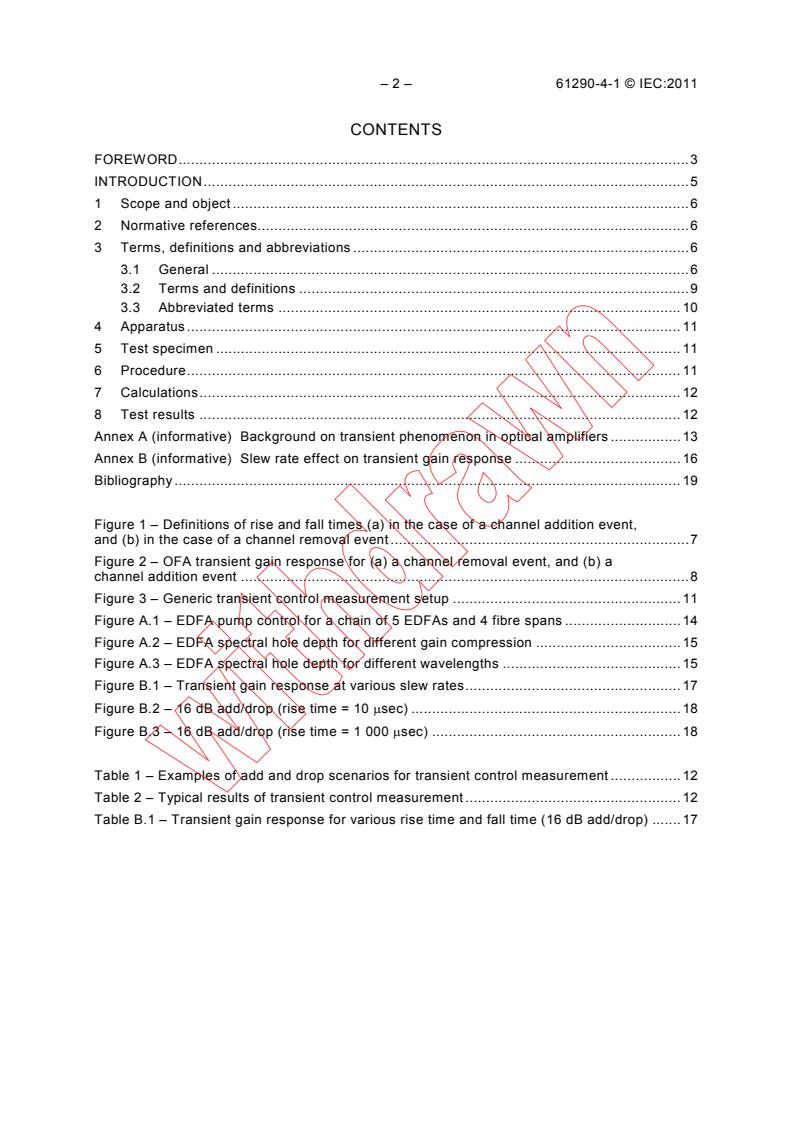
– 2 – 61290-4-1 © IEC:2011
CONTENTS
FOREWORD . 3
INTRODUCTION . 5
1 Scope and object . 6
2 Normative references. 6
3 Terms, definitions and abbreviations . 6
3.1 General . 6
3.2 Terms and definitions . 9
3.3 Abbreviated terms . 10
4 Apparatus . 11
5 Test specimen . 11
6 Procedure . 11
7 Calculations . 12
8 Test results . 12
Annex A (informative) Background on transient phenomenon in optical amplifiers . 13
Annex B (informative) Slew rate effect on transient gain response . 16
Bibliography . 19
Figure 1 – Definitions of rise and fall times (a) in the case of a channel addition event,
and (b) in the case of a channel removal event . 7
Figure 2 – OFA transient gain response for (a) a channel removal event, and (b) a
channel addition event . 8
Figure 3 – Generic transient control measurement setup . 11
Figure A.1 – EDFA pump control for a chain of 5 EDFAs and 4 fibre spans . 14
Figure A.2 – EDFA spectral hole depth for different gain compression . 15
Figure A.3 – EDFA spectral hole depth for different wavelengths . 15
Figure B.1 – Transient gain response at various slew rates . 17
Figure B.2 – 16 dB add/drop (rise time = 10 µsec) . 18
Figure B.3 – 16 dB add/drop (rise time = 1 000 µsec) . 18
Table 1 – Examples of add and drop scenarios for transient control measurement . 12
Table 2 – Typical results of transient control measurement . 12
Table B.1 – Transient gain response for various rise time and fall time (16 dB add/drop) . 17
61290-4-1 © IEC:2011 – 3 –
INTERNATIONAL ELECTROTECHNICAL COMMISSION
____________
OPTICAL AMPLIFIERS –
TEST METHODS –
Part 4-1: Gain transient parameters –
Two-wavelength method
FOREWORD
1) The International Electrotechnical Commission (IEC) is a worldwide organization for standardization comprising
all national electrotechnical committees (IEC National Committees). The object of IEC is to promote
international co-operation on all questions concerning standardization in the electrical and electronic fields. To
this end and in addition to other activities, IEC publishes International Standards, Technical Specifications,
Technical Reports, Publicly Available Specifications (PAS) and Guides (hereafter referred to as “IEC
Publication(s)”). Their preparation is entrusted to technical committees; any IEC National Committee interested
in the subject dealt with may participate in this preparatory work. International, governmental and non-
governmental organizations liaising with the IEC also participate in this preparation. IEC collaborates closely
with the International Organization for Standardization (ISO) in accordance with conditions determined by
agreement between the two organizations.
2) The formal decisions or agreements of IEC on technical matters express, as nearly as possible, an international
consensus of opinion on the relevant subjects since each technical committee has representation from all
interested IEC National Committees.
3) IEC Publications have the form of recommendations for international use and are accepted by IEC National
Committees in that sense. While all reasonable efforts are made to ensure that the technical content of IEC
Publications is accurate, IEC cannot be held responsible for the way in which they are used or for any
misinterpretation by any end user.
4) In order to promote international uniformity, IEC National Committees undertake to apply IEC Publications
transparently to the maximum extent possible in their national and regional publications. Any divergence
between any IEC Publication and the corresponding national or regional publication shall be clearly indicated in
the latter.
5) IEC itself does not provide any attestation of conformity. Independent certification bodies provide conformity
assessment services and, in some areas, access to IEC marks of conformity. IEC is not responsible for any
services carried out by independent certification bodies.
6) All users should ensure that they have the latest edition of this publication.
7) No liability shall attach to IEC or its directors, employees, servants or agents including individual experts and
members of its technical committees and IEC National Committees for any personal injury, property damage or
other damage of any nature whatsoever, whether direct or indirect, or for costs (including legal fees) and
expenses arising out of the publication, use of, or reliance upon, this IEC Publication or any other IEC
Publications.
8) Attention is drawn to the Normative references cited in this publication. Use of the referenced publications is
indispensable for the correct application of this publication.
9) Attention is drawn to the possibility that some of the elements of this IEC Publication may be the subject of
patent rights. IEC shall not be held responsible for identifying any or all such patent rights.
International Standard IEC 61290-4-1 has been prepared by subcommittee 86C: Fibre optic
systems and active devices, of IEC technical committee 86: Fibre Optics.
The text of this standard is based on the following documents:
CDV Report on voting
86C/956/CDV 86C/1011/RVC
Full information on the voting for the approval of this standard can be found in the report on
voting indicated in the above table.
This publication has been drafted in accordance with the ISO/IEC Directives, Part 2.
– 4 – 61290-4-1 © IEC:2011
A list of all parts of the IEC 61290 series, published under the general title Optical amplifiers –
Test methods can be found on the IEC website.
Future standards in this series will carry the new general title as cited above. Titles of existing
standards in this series will be updated at the time of the next edition.
The committee has decided that the contents of this publication will remain unchanged until the
stability date indicated on the IEC web site under "http://webstore.iec.ch" in the data related to
the specific publication. At this date, the publication will be
• reconfirmed,
• withdrawn,
• replaced by a revised edition, or
• amended.
IMPORTANT – The 'colour inside' logo on the cover page of this publication indicates
that it contains colours which are considered to be useful for the correct understanding
of its contents. Users should therefore print this document using a colour printer.
61290-4-1 © IEC:2011 – 5 –
INTRODUCTION
This part of IEC 61290-4 is devoted to the subject of Optical Amplifiers (OAs). The technology
of optical amplifiers is quite new and still emerging; hence amendments and new editions to
this standard can be expected.
Each abbreviation introduced in this standard is explained in the text at least the first time it
appears. However, for an easier understanding of the whole text, a list of all abbreviations used
in this standard is given in 3.3.
Background information on the transient phenomenon in erbium-doped fibre amplifiers and the
consequences on fibre optic systems is provided in Annex A and on slew rate effects in
Annex B.
– 6 – 61290-4-1 © IEC:2011
OPTICAL AMPLIFIERS –
TEST METHODS –
Part 4-1: Gain transient parameters –
Two-wavelength method
1 Scope and object
This part of IEC 61290-4 applies to erbium-doped fibre amplifiers (EDFAs) and optically
amplified elementary sub-systems. It applies to OAs using active fibres (optical fibre amplifiers,
OFAs), containing rare-earth dopants. These amplifiers are commercially available and widely
deployed in service provider networks.
The object of this part of IEC 61290-4 is to provide the general background for EDFA transients
and related parameters, and to describe a standard test method for accurate and reliable
measurement of the following transient parameters:
• Channel addition/removal transient gain overshoot and transient net gain overshoot
• Channel addition/removal transient gain undershoot and transient net gain undershoot
• Channel addition/removal gain offset
• Channel addition/removal transient gain response time constant (settling time)
2 Normative references
The following referenced documents are indispensable for the application of this document. For
dated references, only the edition cited applies. For undated references, the latest edition of
the referenced document (including any amendments) applies.
IEC 61291-1, Optical amplifiers – Part 1: Generic specification
NOTE A list of informative references is given in the Bibliography.
3 Terms, definitions and abbreviations
3.1 General
When the input power to an OFA operating in saturation changes sharply, the gain of the
amplifier will typically exhibit a transient response before settling back into the required gain.
This response is dictated both by the optical characteristics of the active fibre within the OFA
as well as the performance of the automatic gain control (AGC) mechanism.
Since a change in input power typically occurs when part of the DWDM channels within the
specified transmission band are dropped or added, definitions are provided that describe a
dynamic event leading to transient response. Rise and fall time definitions are shown in
Figure 1.
61290-4-1 © IEC:2011 – 7 –
100 %
of change
90 %
of change
10 %
of change
Rise
time
Time
Channel
Channel
addition start
addition end
(a) IEC 1582/11
10 %
of change
90 %
of change
100 %
of change
Fall
time
Time
Channel
Channel
removal start
removal end
(b)
IEC 1583/11
Figure 1 – Definitions of rise and fall times (a) in the case of a channel addition event,
and (b) in the case of a channel removal event
The parameters generally used to characterize the transient gain behaviour of a gain controlled
EDFA for the case of channel removal are defined in Figure 2(a). The figure specifically
represents the time dependence of the gain of one of the surviving channels when channels
Input power to EDFA
Input power to EDFA
(linear a.u.)
(linear a.u.)
Transient gain response time
constant (settling time)
– 8 – 61290-4-1 © IEC:2011
are removed. Likewise, the transient gain behaviour for the case when channels are added is
shown in Figure 2(b). The main transient parameters are: transient gain response time
constant (setting time), gain offset, transient net gain overshoot, and transient gain net
undershoot. The transient gain overshoot and undershoot are particularly critical to carriers and
network equipment manufacturers (NEMs) given that the speed and amplitude of gain
fluctuations compound through the network as the optical signal passes through an increasing
number of cascaded amplifiers. Properly designed optical amplifiers have very small values for
these transient parameters.
Net gain
overshoot
Gain
Gain
overshoot
stability
Final
gain
Gain offset
Initial
Gain
Net gain
gain
undershoot
undershoot
Time
(a)
IEC 1584/11
Net gain
Gain
Overshoot
overshoot
Initial
Gain offset
gain
Final
gain
Gain
stability
Gain
Net gain
undershoot
undershoot
Transient gain response time
constant (settling time)
Time
(b)
IEC 1585/11
Figure 2 – OFA transient gain response for (a) a channel removal event,
and (b) a channel addition event
Gain (dB)
Gain (dB)
61290-4-1 © IEC:2011 – 9 –
3.2 Terms and definitions
For the purposes of this document, the terms and definitions given in IEC 61291-1 and the
following apply.
3.2.1
surviving (pre-existing) signal
optical signal that remains (exists) after (before) drop (add) event
3.2.2
saturating signal
optical signal that is switched off (on) by the drop (add) event
3.2.3
drop (add) level
amount in dB by which the input power decreases (increases) due to dropping (adding) of
channels
3.2.4
add rise time
time it takes for the input optical signal to rise from 10 % to 90 % of the total difference
between the initial and final signal levels during an add event (see Figure 1(a))
3.2.5
drop fall time
time it takes for the input optical signal to fall from 10 % to 90 % of the total difference between
the initial and final signal levels during a drop event (see Figure 1 (b))
3.2.6
initial gain
gain of the surviving (pre-existing) channel before a drop (add) event
3.2.7
final gain
steady state gain of the surviving (pre-existing) channel a very long time (i.e. once the gain has
stabilized) after a drop (add) event
3.2.8
gain offset
Change in dB of the gain between initial and final state, defined as final gain – initial gain
NOTE Gain offset may be positive or negative for both channel addition and removal events
3.2.9
gain stability
specified peak-to-peak gain fluctuations of the OFA under steady state conditions (i.e. not in
response to a transient event)
3.2.10
transient gain response time constant (settling time)
amount of time required to bring the gain of the surviving (pre-existing) channel to the final gain
NOTE 1 This parameter is the measured time from the beginning of the drop (add) event that created the transient
gain response, to the time at which the surviving (pre-existing) channel gain first enters within the gain stability
band centred on the final gain.
NOTE 2 Hereon this will also be referred to as settling time
– 10 – 61290-4-1 © IEC:2011
3.2.11
transient gain overshoot
difference in dB between the maximum surviving (pre-existing) channel gain reached during the
OFA transient response to a drop (add) event, and the lowest of either the initial gain and final
gain
NOTE Hereon this will also be referred to as gain overshoot
3.2.12
transient net gain overshoot
difference in dB between the maximum surviving (pre-existing) channel gain reached during the
OFA transient response to a drop (add) event, and the highest of either the initial gain and final
gain. The transient net gain overshoot is just the transient gain overshoot minus the gain offset,
and represents the actual transient response not related to the shift of the amplifier from the
initial steady state condition to the final steady state condition
NOTE Hereon this will also be referred to as net gain overshoot
3.2.13
transient gain undershoot
difference in dB between the minimum surviving (pre-existing) channel gain reached during the
OFA transient response to a drop (add) event, and the highest of either the initial gain and final
gain
NOTE Hereon this will also be referred to as gain undershoot
3.2.14
transient net gain undershoot
difference in dB between the minimum surviving (pre-existing) channel gain reached during the
OFA transient response to a drop (add) event and the lowest of either the initial gain and final
gain.
NOTE 1 The transient net gain undershoot is just the transient gain undershoot minus the gain offset and
represents the actual transient response not related to the shift of the amplifier from the initial steady state
condition to the final steady state condition.
NOTE 2 Hereon this will also be referred to as net gain undershoot
3.3 Abbreviated terms
AGC automatic gain control
AOM acousto-optic modulator
BER bit error ratio
DFB distributed feedback
DWDM dense wavelength division multiplexing
EDFA erbium-doped fibre amplifier
FWHM full width half maximum
NEM network equipment manufacturer
NSP network service provider
O/E optical-to-electronic
OA optical amplifier
OFA optical fibre amplifier
OSNR optical signal-to-noise ratio
SHB spectral-hole-burning
VOA variable optical attenuator
WDM wavelength division multiplexing
61290-4-1 © IEC:2011 – 11 –
4 Apparatus
Figure 3 shows a generic setup to characterize the transient response properties of OAs.
DDFFBB Las Laserer
1 VOVOA1A1
λ1
OOptptiiccalal OOOFFFAAA PaPassss
ccouplouplerer underunderunder fifillteterr
tetetesssttt
OOptptiiccalal
PoPoll. .
DDFFBB Las Laserer
VOVOA2A2
mmodulodulatatoror
SSccrramamblblerer
λ2
DetDecettecor tor
TTrriiggergger
PPululsse genere generatatoror OOsciscillllooscoscoppee
IEC 1693/11
Figure 3 – Generic transient control measurement setup
5 Test specimen
The OA shall operate at nominal operating conditions. If the OA is likely to cause laser
oscillations due to unwanted reflections, optical isolators should be used to bracket the OA
under test. This will minimize signal instability and measurement inaccuracy.
6 Procedure
In the setup shown, the input signal power into the amplifier being tested is the combination of
two distributed feedback (DFB) lasers with wavelengths approximately 1 nm apart. Each
channel is subsequently adjusted with a variable optical attenuator (VOA) to the desired optical
input power levels. One optical modulator driven by a function generator acts as an on/off
switch, to simulate add and drop events. The two optical channels are subsequently combined
onto the same fibre before the signal is directed to the amplifier being tested. A tuneable filter,
an optical-to-electronic (O/E) converter and an oscilloscope are placed in tandem at the output
of the amplifier. The surviving channel is selected with the tuneable filter and its transient
response is monitored with the O/E converter and oscilloscope. A waveform similar to the one
shown in Figure 2 is displayed on the oscilloscope’s screen.
To simulate a drop event at the input of the amplifier being tested, the two lasers are set so
that their total input power is equal to the amplifier’s typical input power (e.g. 1 dBm).
Therefore, the two lasers at –2 dBm each represent 20 optical channels having –15 dBm power
per channel. When the function generator turns the modulator into the “off” position, the
second laser is completely suppressed, changing the system’s channel loading. For instance,
when one laser is switched off it simulates a 3 dB “drop” or a change in the system’s channel
loading from 40 channels to 20 channels. Similarly, when the modulator is changed into an “on”
state, the addition of a second laser simulates a 3 dB add in optical power, or a change in the
system’s channel loading from 20 channels to 40 channels. For other transient control
measurements, the VOAs can be adjusted accordingly so that the input power levels will differ
by an appropriate value.
Several transient control measurements can be performed, according to the operating
conditions and specifications that are provided. Measurements may also be taken for various
add and drop scenarios as shown in Table 1. These measurements are typically performed
over a broad range of input power levels.
– 12 – 61290-4-1 © IEC:2011
Table 1 – Examples of add and drop scenarios for transient control measurement
Channels
Scenario Total channels Surviving channels
added/dropped
20 dB add/drop 100 1 99
16 dB add/drop 40 1 39
13 dB add/drop 40 2 38
10 dB add/drop 40 4 36
6 dB add/drop 40 10 30
3 dB add/drop 40 20 20
7 Calculations
The results of the transient measurement are the following parameters:
• Channel addition/removal transient gain overshoot and transient net gain overshoot
• Channel addition/removal transient gain undershoot and transient net gain undershoot
• Channel addition/removal gain offset
• Channel addition/removal transient gain response time constant (settling time)
These parameters can be extracted from the oscilloscope display, as described in Figure 2.
8 Test results
Table 2 shows typical measurement conditions and transient control measurement results of C-
band EDFAs. The measurement conditions include gain, surviving channel wavelength, input
power, transient type (e.g., 3 dB drop, 1 dB add), and different transient parameters. In order to
characterize the EDFA transient, the user should choose the measurement conditions to
adequately characterize the dynamic range of the OA.
Typical values of transient parameters are listed in the last row of the table.
Table 2 – Typical results of transient control measurement
Amplifier gain (dB) Surviving channel wavelength (nm)
Transient gain
Input Transient net Transient net gain
Transient event response time Gain offset
power gain overshoot undershoot
description constant (dB)
(dBm) (dB) (dB)
(µsec)
3 dB add or drop -4 0,5 0,2 10 -0,2
x dB add or drop
y dB
Typical values <1 <0,5 <100 <0,5
61290-4-1 © IEC:2011 – 13 –
Annex A
(informative)
Background on transient phenomenon in optical amplifiers
Optical power transients are sub-millisecond fluctuations in network power levels that are
caused by events such as channel loading changes, passive loss variations, and network
protection switching. In a dynamic networking environment, optical amplifiers need to be able
to compensate for such power variations in order to avoid potential degradation of quality of
service. For instance, in a network reconfiguration scenario, the number of DWDM channels at
the input of an EDFA may suddenly decrease, increasing the amplifier’s inversion and therefore
its gain, in a matter of microseconds. This gain change is detrimental to network service
providers (NSPs) given that their networks will no longer operate in the gain level for which
they were optimized, potentially impacting service quality. An increase in bit error ratio (BER) is
a typical manifestation of quality of service degradation. A reduction in channel power can
decrease the optical signal-to-noise ratio (OSNR), while an increase in the power can enhance
degradation due to non-linear effects in transmission fibre and increased signal shot noise
, from shot noise from amplified input signal.
factor, F
shot,sig
Three factors determine the gain in EDFAs: input optical power, optical pump power, and the
inversion level of the optical amplifier. The inversion level of an EDFA characterizes the
fraction of erbium atoms that are available to provide energy to the input optical signal,
resulting in optical gain. Typically, the inversion level increases with the increase in optical
pump power and decreases with the increase in input optical power. For that reason, if
wavelengths are added to an EDFA input, increasing its optical input power, the optical power
of the pumps will also need to be increased in order to maintain the inversion level and
therefore, a constant gain per channel. Constant gain per channel is important to optimize the
performance of optical networks. Similarly, if wavelengths are dropped from an EDFA input, the
pumps will need to be rapidly decreased in order to maintain a constant gain per channel.
The gain of an EDFA can be controlled by adjusting its pump current. The basic scheme for the
pump control is shown in Figure A.1 and involves making measurement of input and output
power of the EDFA through signal taps and monitor photodiodes. Early reported work
addressed pump control on time scales of the spontaneous lifetime in EDFAs. One of the
studies demonstrated low frequency feed forward compensation with a low frequency control
loop. The results of pump power control on time scales much shorter than the erbium
spontaneous lifetime were demonstrated to arrest the power excursion in the surviving
channels are shown in Figure A.1. The necessary response time was characterized by
monitoring the power of the surviving channel as a function of the delay after the cutoff of the
dropped channels. The second stage pump power of the amplifier is then decreased by an
amount suitable to restore the gain of the surviving channels. This experiment demonstrates
that the dynamic timescales for changes in signal power and pump power are comparable and
the power excursion of the surviving channels can be arbitrarily limited if the pump power is
decreased with sufficiently short delay. For example, in the last trace, negligible power
excursion occurs when a correction is applied after a delay of a few microseconds. This shows
that with standard pumps, if the decision to take the corrective action can be reached in time,
the pump power can be turned down quickly enough to control the excursions of surviving
channels. These measurements demonstrate that, for the pump control to minimize the
variations in the power of the surviving channels in case of channel loss, the response of the
control scheme must be at the most a few tens of microseconds.
– 14 – 61290-4-1 © IEC:2011
Gain control off
Gain Control Off
1 2 4 5 14
1 span, control off
2 spans, control off
P
P
in
in
3 spans, control off
4 spans, control off
EDF
EDF
0 0,5 1,0 1,5 2,0
PP
p PP Time (ms)
p out
out
Surviving Channel Power After 4 Spans, 320km
Surviving channel power after 4 spans, 320 km
G
G
Gain control on
Gain Control On
Gain control 1818
Gain
circuit
Control
Circuit
0 0.5 1 1.5 2
0 0,5 1,0 1,5 2,0
TimeTi (mems, ms)
IEC 1694/11
NOTE Half of the channels are added and dropped periodically. Surviving channel relative power is shown on the
right hand side for both the cases with and without pump control on all the EDFAs.
Figure A.1 – EDFA pump control for a chain of 5 EDFAs and 4 fibre spans
In lightwave transmission applications EDFAs are operated in saturation mode. The gain
saturation in EDFAs is predominantly homogeneous, which means that in a multi-channel WDM
system, once the gain of one of the channels is known, the gain of other channels can be
calculated directly. This result comes from the homogeneous property of the EDFA model.
While the gain spectrum of EDFAs is predominantly homogeneous, however, a small amount of
inhomogeneity has been observed. The inhomogeneous broadening gives rise to Spectral-
Hole-Burning (SHB) in the gain spectra of optical amplifiers. Using an accurate difference
measurement technique, the SHB in EDFAs has been measured at room temperature. The
result of SHB measurement for different saturation levels is shown in Figure A.2. The figure
shows the existence of a spectral hole having FWHM of 8 nm. The depth of the hole increases
linearly at a rate of 0,027 dB per 1 dB increase in gain compression relative to small signal gain.
For 10 dB gain compression, a dip of 0,28 dB in the gain spectra due to SHB is observed. The
SHB is strongly dependent upon the wavelength and has been shown to be four times larger at
1 532 nm than at 1 551 nm. The dependence of the spectral hole width on the saturating
wavelength is shown in Figure A.3. The FWHM of the hole increases as the saturating
wavelength is increased.
Surviving channel relative power (dB)
Surviving channel relative power (dB)
Surviving Channel Rel. Power (dB)
Surviving Channel Rel. Power (dB)
61290-4-1 © IEC:2011 – 15 –
0,5
Compression
–0,5
1,00 dB
2,00 dB
3,54 dB
5,25 dB
–1,0 7,32 dB
10,91 dB
13,41 dB
–1,5
1 520 1 530 1 540 1 550 1 560
Wavelength (nm)
IEC 1695/11
Figure A.2 – EDFA spectral hole depth for different gain compression
λ = 1 545 nm
sat
4 nm
λ = 1 551 nm
sat
8 nm
λ = 1 562 nm
sat
10 nm
1 535 1 540 1 545 1 550 1 555 1 560 1 565 1 570 1 575
Wavelength (nm)
IEC 1696/11
Figure A.3 – EDFA spectral hole depth for different wavelengths
The SHB effect impacts the gain shape of the long-haul optical transmission systems. The
effect manifests itself such that each WDM channel in the system reduces the gain of the
neighbouring channels within the spectral hole-width but does not significantly affect channels
far removed in wavelength. While characterizing the gain spectra of the amplifiers it is
therefore important that multi-wavelength input signal with channel separation less than the
SHB width be employed. The SHB effect observed in an individual amplifier is small (0,2dB to
0,3 dB) but in long chain of amplifiers such as in a long haul or submarine system it can add up
to produce a significant and observable change in the overall spectrum. The importance of
SHB was noted in long-haul transmission over 9 300 km. The SHB impacts a WDM system in a
positive way since it helps in the mitigation of channel power divergence and should be
included in the system design.
Gain difference (0,1 dB/div.)
Hole depth (dB)
– 16 – 61290-4-1 © IEC:2011
Annex B
(informative)
Slew rate effect on transient gain response
B.1 The importance of rise time and fall time of input power
When channels are either added at add event or removed at drop event, it must be considered
how fast the input power will be changed while measuring transient gain. Gain control of the
EDFA is generally realized by power monitors of input and output levels and by way of power
adjustment method through driving pump laser current. Optical design and control algorithms
effect the transient response of gain at add or drop events as explained in Annex A.
Additionally the input power slew rate of changing conditions also affects transient gain
response.
If the input power to the EDFA changes slowly, then the gain control mechanism may be able
to compensate transient gain phenomena with the fast gain control mechanism of EDFA. In
addition, the pump power adjustment process can minimize transient gain under the gradual
sloped input power variation. Thus the transient response of the EDFA will be suppressed with
small transient gain.
If input power to the EDFA changes rapidly such as in the case of a step input, then the gain
control mechanism may not be able to suppress transient gain since the gain control
mechanism of the EDFA is not fast enough to compensate transient gain under the steep input
power variation. In addition, the transient response of the EDFA will be increased as a result.
B.2 Measured data and explanation
Measured data for various rise time and fall time conditions are provided with typical
experimental data. Transient gain responses at 16 dB add/drop conditions are evaluated for
the case of a single stage EDFA. Rise times and fall times are varied from 10 µsec to
1 000 µsec to observe effect of various rise time and fall time conditions on transient gain
response.
A schematic diagram of the experimental setup is described in Figure 3. In this experiment, the
surviving channel wavelength and the add/drop channel wavelength are 1 561 nm and
1 545 nm, respectively. An Acoustic Optical Modulator (AOM) is used as a modulator. Rise
time and fall time is adjusted using an arbitrary function generator so that the slew rate will
provide rise time and fall time from 10 µsec to 1000 µsec. The output of the function generator
is connected to the electrical input to the AOM. Transient gain responses are recorded by an
oscilloscope to quantify the transient gain response and steady state gain response. Table B.1
summarizes transient gain response for various rise time and fall time conditions. A positive
value means an overshoot of the transient gain response at the drop event, and a negative
value means an undershoot of the transient gain response at the add event. The overshoot
level and undershoot level of transient gain responses are plotted in Figure B.1.
Transient gain response is mitigated at larger rise and fall times as presumed in Figure B.1.
Figure B.2 and Figure B.3 display transient gain responses at 10 µsec rise/fall time and
1 000-µsec rise/fall time.
61290-4-1 © IEC:2011 – 17 –
Table B.1 – Transient gain response for various rise time and fall time (16 dB add/drop)
Surviving channel Add/drop channel Rise time
Transient gain response
Steady state gain
wavelength wavelength Fall time
response
λ1 λ2 16dB add event 16dB drop event
(nm) (nm) (µsec) (dB) (dB) (dB)
1 561 1 545 10 -0,76 0,74
50 -0,76 0,58
0,29
100 -0,63 0,52
1 000 -0,56 0,29
1,0
0,8
0,6
0,4
0,2
0,0
-0,2
-0,4
-0,6
-0,8
-1,0
0 100 200 300 400 500 600 700 800 900 1000 1100
Rise time at add event, fall time at drop event (µs)
Under shoot at add condition
Overshoot at drop condition
IEC 1697/11
Figure B.1 – Transient gain response at various slew rates
Transient gain response
(dB)
(overshoot, undershoot)
– 18 – 61290-4-1 © IEC:2011
Surviving channel output
Surviving channel output
Transient gain response
Transient gain response
Total input power Total input power
16 dB add case (rise time = 10 µs) 16 dB drop case (rise time = 10 µs)
IEC 1698/11
Figure B.2 – 16 dB add/drop (rise time = 10 µs)
Surviving channel output
Surviving channel output
Transient gain response
Transient gain response
Total input power Total input power
16 dB add case (rise time = 1 000 µs) 16 dB drop case (rise time = 1 000 µs)
IEC 1699/11
Figure B.3 – 16 dB add/drop (rise time = 1 000 µs)
61290-4-1 © IEC:2011 – 19 –
Bibliography
IEC 61290-1-1, Optical amplifiers – Test methods – Part 1-1: Power and gain parameters –
Optical spectrum analyzer method
IEC 61290-1-2, Optical amplifiers – Test methods – Part 1-1: Power and gain parameters –
Electrical spectrum analyzer method
IEC 61290-1-3, Optical amplifiers – Test methods – Part 1-1: Power and gain parameters –
Optical power meter method
IEC 61290-3-1, Optical amplifiers – Test methods – Part 3-1: Noise figure parameters – Optical
spectrum analyzer
IEC 61290-3-2, Optical amplifiers – Test methods – Part 3-2: Noise figure parameters –
Electrical spectrum analyzer method.
IEC 61290-4-2, Optical amplifiers – Test methods – Part 4-2: Gain transient parameters –
Broadband source method
Emmanuel Desurvire, Erbium-Doped Fiber Amplifiers, John Wiley & Sons, (1994)
P.C. Becker, N.A. Olsson and J.R. Simpson, Erbium-Doped Fiber Amplifiers: Fundamentals
and Technology, Academic Press (1999)
Emmanuel Desurvire, Dominique Bayart, Bertrand Desthieux and Sebastien Bigo, Erbium-
Doped Fiber Amplifiers, Device and System Developments, John Wiley & Sons (2002)
J.L. Zyskind, Jonathan A. Nagel and Howard D. Kidorf, “Erbium-Doped Fiber Amplifiers for
Optical Communications”, pp. 13-68 in Optical Fiber Telecommunications IIIB, edited by Ivan
Kaminow and Thomas Koch, Academic Press (1997)
Douglas M. Baney, “Characterization of Erbium-Doped Fiber Amplifiers”, Chapter 13, pp. 519-
595 in Fiber Optic Test and Measurement edited by Dennis Derickson, Prentice Hall, New
Jersey (1998)
Atul Srivastava and Yan Sun, “Advances in Erbium-Doped Fiber Amplifiers”, Chapter 4,
pp. 174-212 in Optical Fiber Telecommunications IVA edited by Ivan Kaminow and Tingye Li,
Academic Press, San Diego (2002)
Atul Srivastava and Yan Sun, “Erbium Doped Fiber Amplifiers for Dynamic Optical Networks”,
Chapter 12, pp.181-203 in Guided Wave Optical Components and Devices edited by Bishnu P.
Pal, Elsevier Academic Press, San Diego (2006)
___________
– 20 – 61290-4-1 © CEI:2011
SOMMAIRE
AVANT-PROPOS . 21
INTRODUCTION . 23
1 Domaine d'application et objet . 24
2 Références normatives . 24
3 Termes, définitions, et abréviations . 24
3.1 Généralités . 24
3.2 Termes et définitions . 27
3.3 Abréviations . 29
4 Matériel . 29
5 Spécimen d’essai . 30
6 Mode opératoire.
...