


IEC 60851-3:2009
(Main)Winding wires - Test methods - Part 3: Mechanical properties
Winding wires - Test methods - Part 3: Mechanical properties
IEC 60851-3:2009 specifies the following methods of test for winding wires:
- Test 6: Elongation;
- Test 7: Springiness;
- Test 8: Flexibility and adherence;
- Test 11: Resistance to abrasion;
- Test 18: Heat bonding.
With respect to the previous edition, significant technical changes appear in Subclause 5.3, Jerk test.
Fils de bobinage - Méthodes d'essai - Partie 3: Propriétés mécaniques
La CEI 60851-3:2009 spécifie les méthodes d'essai suivantes des fils de bobinage:
- Essai 6: Allongement;
- Essai 7: Effet de ressort;
- Essai 8: Souplesse et adhérence;
- Essai 11: Résistance à l'abrasion;
- Essai 18: Thermo-adhérence.
Par rapport à l'édition précédente, des modifications techniques majeures sont introduites au Paragraphe 5.3, Essai de traction brusque.
General Information
- Status
- Published
- Publication Date
- 27-Jan-2009
- Technical Committee
- TC 55 - Winding wires
- Drafting Committee
- WG 1 - TC 55/WG 1
- Current Stage
- DELPUB - Deleted Publication
- Start Date
- 22-Aug-2023
- Completion Date
- 13-May-2022
Relations
- Effective Date
- 05-Sep-2023
- Effective Date
- 05-Sep-2023
- Effective Date
- 05-Sep-2023
- Effective Date
- 05-Sep-2023
- Effective Date
- 05-Sep-2023
- Effective Date
- 05-Sep-2023
Overview
IEC 60851-3:2009 is an international standard published by the International Electrotechnical Commission (IEC) that specifies test methods for assessing the mechanical properties of winding wires. This standard is critical for manufacturers, engineers, and quality controllers involved in the production and evaluation of winding wires used in electrical and electronic devices. It ensures consistent and reliable mechanical performance by defining specific testing techniques, including elongation, springiness, flexibility, resistance to abrasion, and heat bonding.
The standard consolidates multiple amendments up to 2019, reflecting the latest technical enhancements, notably in the jerk test method. By adhering to IEC 60851-3, stakeholders ensure their winding wires meet international quality benchmarks for mechanical durability and performance.
Key Topics
IEC 60851-3:2009 covers the following key mechanical property tests for winding wires:
Test 6: Elongation
Measures the elongation at fracture and tensile strength to evaluate the wire's ability to withstand mechanical strain without failure.Test 7: Springiness
Assesses the wire's ability to recover its shape after deformation, crucial for maintaining coil integrity in applications.Test 8: Flexibility and Adherence
Includes mandrel winding, stretching, jerk, peel, and adherence tests. These assess the wire’s resistance to cracking, delamination, and deformation when bent or twisted, essential for reliable winding and insulation adherence.Test 11: Resistance to Abrasion
Evaluates the enamel coating’s durability against wear and friction, helping to prevent insulation damage during winding or handling.Test 18: Heat Bonding
Tests the heat bonding characteristics of enamelled wires, including bond retention and strength of helical and twisted coils.
Significant Technical Updates
The latest amendments include major refinements in the jerk test (Subclause 5.3), improving test accuracy for enamelled round wires. These updates enhance the measurement of the wire's mechanical endurance under rapid stress changes.
Applications
IEC 60851-3 is essential for industries and applications where winding wires are subjected to mechanical stress and must maintain electrical insulation and durability:
- Electric motor manufacturing: Ensures winding wires used in stators and rotors maintain mechanical integrity during coil winding and operation.
- Transformers and inductors: Validates wire properties for reliable performance in electromagnetic coils.
- Electromechanical devices: Supports the production of components requiring precise mechanical specifications for wire flexibility and bonding.
- Quality control laboratories: Provides standardized methods for routine testing and certification of mechanical properties of winding wires.
- Research and development: Assists engineers in designing new high-performance wire coatings and constructions by offering a benchmark for mechanical testing.
Related Standards
To complement IEC 60851-3, users often reference related IEC standards that cover other aspects of winding wires and insulation:
- IEC 60851-1 – General requirements and definitions for winding wires.
- IEC 60851-2 – Tests for electrical properties of winding wires.
- IEC 60851-4 – Dimensional, mechanical, and visual measurement methods.
- IEC 60317 series – Specifications for particular types of winding wires.
- IEC 60034 series – Standards related to rotating electrical machines that utilize winding wires.
Practical Value
Following IEC 60851-3 ensures the production of winding wires with:
- Consistent mechanical strength and flexibility, reducing failures during coil winding.
- Reliable abrasion resistance and coating adherence, preserving insulation quality.
- Accurate heat bonding properties, optimizing coil assembly processes.
- Standardized test procedures for international compliance and easy interoperability across global markets.
By integrating these mechanical test methods, manufacturers and quality assurance teams can improve product durability and performance, reduce material defects, and increase customer confidence in electrotechnical applications.
IEC 60851-3:2009 - Winding wires - Test methods - Part 3: Mechanical properties

IEC 60851-3:2009+AMD1:2013+AMD2:2019 CSV - Winding wires - Test methods - Part 3: Mechanical properties Released:8/23/2019 Isbn:9782832273487

IEC 60851-3:2009+AMD1:2013 CSV - Winding wires - Test methods - Part 3: Mechanical properties Released:7/31/2013 Isbn:9782832209394
Get Certified
Connect with accredited certification bodies for this standard

Intertek Testing Services NA Inc.
Intertek certification services in North America.

UL Solutions
Global safety science company with testing, inspection and certification.

ANCE
Mexican certification and testing association.
Sponsored listings
Frequently Asked Questions
IEC 60851-3:2009 is a standard published by the International Electrotechnical Commission (IEC). Its full title is "Winding wires - Test methods - Part 3: Mechanical properties". This standard covers: IEC 60851-3:2009 specifies the following methods of test for winding wires: - Test 6: Elongation; - Test 7: Springiness; - Test 8: Flexibility and adherence; - Test 11: Resistance to abrasion; - Test 18: Heat bonding. With respect to the previous edition, significant technical changes appear in Subclause 5.3, Jerk test.
IEC 60851-3:2009 specifies the following methods of test for winding wires: - Test 6: Elongation; - Test 7: Springiness; - Test 8: Flexibility and adherence; - Test 11: Resistance to abrasion; - Test 18: Heat bonding. With respect to the previous edition, significant technical changes appear in Subclause 5.3, Jerk test.
IEC 60851-3:2009 is classified under the following ICS (International Classification for Standards) categories: 29.060.10 - Wires. The ICS classification helps identify the subject area and facilitates finding related standards.
IEC 60851-3:2009 has the following relationships with other standards: It is inter standard links to IEC 60851-3:2009/AMD1:2013, IEC 60851-3:2009/AMD2:2019, IEC 60851-3:1996/AMD2:2003, IEC 60851-3:1996/AMD1:1997, IEC 60851-3:2023, IEC 60851-3:1996. Understanding these relationships helps ensure you are using the most current and applicable version of the standard.
IEC 60851-3:2009 is available in PDF format for immediate download after purchase. The document can be added to your cart and obtained through the secure checkout process. Digital delivery ensures instant access to the complete standard document.
Standards Content (Sample)
IEC 60851-3 ®
Edition 3.0 2009-01
INTERNATIONAL
STANDARD
NORME
INTERNATIONALE
Winding wires – Test methods –
Part 3: Mechanical properties
Fils de bobinage – Méthodes d'essai –
Partie 3: Propriétés mécaniques
All rights reserved. Unless otherwise specified, no part of this publication may be reproduced or utilized in any form or by
any means, electronic or mechanical, including photocopying and microfilm, without permission in writing from either IEC or
IEC's member National Committee in the country of the requester.
If you have any questions about IEC copyright or have an enquiry about obtaining additional rights to this publication,
please contact the address below or your local IEC member National Committee for further information.
Droits de reproduction réservés. Sauf indication contraire, aucune partie de cette publication ne peut être reproduite
ni utilisée sous quelque forme que ce soit et par aucun procédé, électronique ou mécanique, y compris la photocopie
et les microfilms, sans l'accord écrit de la CEI ou du Comité national de la CEI du pays du demandeur.
Si vous avez des questions sur le copyright de la CEI ou si vous désirez obtenir des droits supplémentaires sur cette
publication, utilisez les coordonnées ci-après ou contactez le Comité national de la CEI de votre pays de résidence.
IEC Central Office
3, rue de Varembé
CH-1211 Geneva 20
Switzerland
Email: inmail@iec.ch
Web: www.iec.ch
About the IEC
The International Electrotechnical Commission (IEC) is the leading global organization that prepares and publishes
International Standards for all electrical, electronic and related technologies.
About IEC publications
The technical content of IEC publications is kept under constant review by the IEC. Please make sure that you have the
latest edition, a corrigenda or an amendment might have been published.
ƒ Catalogue of IEC publications: www.iec.ch/searchpub
The IEC on-line Catalogue enables you to search by a variety of criteria (reference number, text, technical committee,…).
It also gives information on projects, withdrawn and replaced publications.
ƒ IEC Just Published: www.iec.ch/online_news/justpub
Stay up to date on all new IEC publications. Just Published details twice a month all new publications released. Available
on-line and also by email.
ƒ Electropedia: www.electropedia.org
The world's leading online dictionary of electronic and electrical terms containing more than 20 000 terms and definitions
in English and French, with equivalent terms in additional languages. Also known as the International Electrotechnical
Vocabulary online.
ƒ Customer Service Centre: www.iec.ch/webstore/custserv
If you wish to give us your feedback on this publication or need further assistance, please visit the Customer Service
Centre FAQ or contact us:
Email: csc@iec.ch
Tel.: +41 22 919 02 11
Fax: +41 22 919 03 00
A propos de la CEI
La Commission Electrotechnique Internationale (CEI) est la première organisation mondiale qui élabore et publie des
normes internationales pour tout ce qui a trait à l'électricité, à l'électronique et aux technologies apparentées.
A propos des publications CEI
Le contenu technique des publications de la CEI est constamment revu. Veuillez vous assurer que vous possédez
l’édition la plus récente, un corrigendum ou amendement peut avoir été publié.
ƒ Catalogue des publications de la CEI: www.iec.ch/searchpub/cur_fut-f.htm
Le Catalogue en-ligne de la CEI vous permet d’effectuer des recherches en utilisant différents critères (numéro de référence,
texte, comité d’études,…). Il donne aussi des informations sur les projets et les publications retirées ou remplacées.
ƒ Just Published CEI: www.iec.ch/online_news/justpub
Restez informé sur les nouvelles publications de la CEI. Just Published détaille deux fois par mois les nouvelles
publications parues. Disponible en-ligne et aussi par email.
ƒ Electropedia: www.electropedia.org
Le premier dictionnaire en ligne au monde de termes électroniques et électriques. Il contient plus de 20 000 termes et
définitions en anglais et en français, ainsi que les termes équivalents dans les langues additionnelles. Egalement appelé
Vocabulaire Electrotechnique International en ligne.
ƒ Service Clients: www.iec.ch/webstore/custserv/custserv_entry-f.htm
Si vous désirez nous donner des commentaires sur cette publication ou si vous avez des questions, visitez le FAQ du
Service clients ou contactez-nous:
Email: csc@iec.ch
Tél.: +41 22 919 02 11
Fax: +41 22 919 03 00
IEC 60851-3 ®
Edition 3.0 2009-01
INTERNATIONAL
STANDARD
NORME
INTERNATIONALE
Winding wires – Test methods –
Part 3: Mechanical properties
Fils de bobinage – Méthodes d'essai –
Partie 3: Propriétés mécaniques
INTERNATIONAL
ELECTROTECHNICAL
COMMISSION
COMMISSION
ELECTROTECHNIQUE
PRICE CODE
INTERNATIONALE
X
CODE PRIX
ICS 29.060.10 ISBN 978-2-88910-311-9
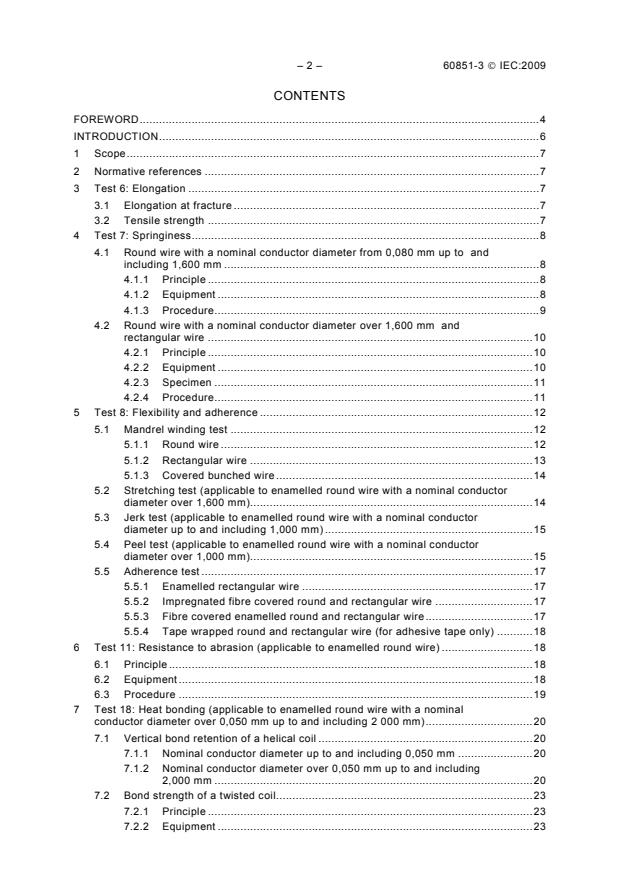
– 2 – 60851-3 © IEC:2009
CONTENTS
FOREWORD.4
INTRODUCTION.6
1 Scope.7
2 Normative references .7
3 Test 6: Elongation .7
3.1 Elongation at fracture .7
3.2 Tensile strength .7
4 Test 7: Springiness.8
4.1 Round wire with a nominal conductor diameter from 0,080 mm up to and
including 1,600 mm .8
4.1.1 Principle .8
4.1.2 Equipment .8
4.1.3 Procedure.9
4.2 Round wire with a nominal conductor diameter over 1,600 mm and
rectangular wire .10
4.2.1 Principle .10
4.2.2 Equipment .10
4.2.3 Specimen .11
4.2.4 Procedure.11
5 Test 8: Flexibility and adherence .12
5.1 Mandrel winding test .12
5.1.1 Round wire .12
5.1.2 Rectangular wire .13
5.1.3 Covered bunched wire.14
5.2 Stretching test (applicable to enamelled round wire with a nominal conductor
diameter over 1,600 mm).14
5.3 Jerk test (applicable to enamelled round wire with a nominal conductor
diameter up to and including 1,000 mm) .15
5.4 Peel test (applicable to enamelled round wire with a nominal conductor
diameter over 1,000 mm).15
5.5 Adherence test .17
5.5.1 Enamelled rectangular wire .17
5.5.2 Impregnated fibre covered round and rectangular wire .17
5.5.3 Fibre covered enamelled round and rectangular wire.17
5.5.4 Tape wrapped round and rectangular wire (for adhesive tape only) .18
6 Test 11: Resistance to abrasion (applicable to enamelled round wire) .18
6.1 Principle.18
6.2 Equipment.18
6.3 Procedure .19
7 Test 18: Heat bonding (applicable to enamelled round wire with a nominal
conductor diameter over 0,050 mm up to and including 2 000 mm).
7.1 Vertical bond retention of a helical coil .20
7.1.1 Nominal conductor diameter up to and including 0,050 mm .20
7.1.2 Nominal conductor diameter over 0,050 mm up to and including
2,000 mm .
7.2 Bond strength of a twisted coil.23
7.2.1 Principle .23
7.2.2 Equipment .23
60851-3 © IEC:2009 – 3 –
7.2.3 Specimen .23
7.2.4 Procedure.25
7.2.5 Result.25
Annex A (informative) Bond strength of heat bonding wires .27
Annex B (informative) Friction test methods.33
Bibliography.43
Figure 1 – Test equipment to determine springiness .8
Figure 2 – Construction and details of the mandrel (see Table 1).9
Figure 3 – Test equipment to determine springiness .11
Figure 4 – Test equipment for mandrel winding test .14
Figure 5 – Test equipment for jerk test.15
Figure 6 – Test equipment for peel test.16
Figure 7 – Scraper .17
Figure 8 – Cross-section of the wire after removal of the coating .17
Figure 9 – Test equipment for unidirectional scrape test .19
Figure 10 – Test equipment for bond retention of a helical coil.22
Figure 11 – Coil winder .24
Figure 12 – Oval shape coil .25
Figure 13 – Twisting device with a load applied to the twisted coil specimen .25
Figure 14 – Arrangement of supports .26
Figure A.1 – Example of voltage-time graphs of twisted coil specimens with a nominal
conductor diameter of 0,300 mm with isothermic graphs .29
Figure A.2 – Example of voltage-time graphs of twisted coil specimens with a nominal
conductor diameter of 0,315 mm with isothermic graphs .30
Figure A.3 – Example of voltage-time graphs of twisted coil specimens with a nominal
conductor diameter of 0,355 mm with isothermic graphs .31
Figure A.4 – Example of voltage-time graphs of twisted coil specimens with a nominal
conductor diameter of 0,500 mm with isothermic graphs .32
Figure B.1 – Static coefficient of friction test apparatus.38
Figure B.2 – Dynamic coefficient of friction test apparatus .39
Figure B.3 – Dynamic coefficient of friction test apparatus .40
Figure B.4 – Detail drawing of friction head assembly with mechanical dynamometer .41
Figure B.5 – Load block with sapphires.42
Figure B.6 – Twisted specimen .42
Table 1 – Mandrels for springiness .9
Table 2 – Magnification to detect cracks .12
Table 3 – Load for peel test .16
Table 4 – Preparation of helical coils .21
Table 5 – Bond retention at elevated temperature.22
Table B.1 – Twisted pair method.37
– 4 – 60851-3 © IEC:2009
INTERNATIONAL ELECTROTECHNICAL COMMISSION
____________
WINDING WIRES –
TEST METHODS –
Part 3: Mechanical properties
FOREWORD
1) The International Electrotechnical Commission (IEC) is a worldwide organization for standardization comprising
all national electrotechnical committees (IEC National Committees). The object of IEC is to promote
international co-operation on all questions concerning standardization in the electrical and electronic fields. To
this end and in addition to other activities, IEC publishes International Standards, Technical Specifications,
Technical Reports, Publicly Available Specifications (PAS) and Guides (hereafter referred to as “IEC
Publication(s)”). Their preparation is entrusted to technical committees; any IEC National Committee interested
in the subject dealt with may participate in this preparatory work. International, governmental and non-
governmental organizations liaising with the IEC also participate in this preparation. IEC collaborates closely
with the International Organization for Standardization (ISO) in accordance with conditions determined by
agreement between the two organizations.
2) The formal decisions or agreements of IEC on technical matters express, as nearly as possible, an international
consensus of opinion on the relevant subjects since each technical committee has representation from all
interested IEC National Committees.
3) IEC Publications have the form of recommendations for international use and are accepted by IEC National
Committees in that sense. While all reasonable efforts are made to ensure that the technical content of IEC
Publications is accurate, IEC cannot be held responsible for the way in which they are used or for any
misinterpretation by any end user.
4) In order to promote international uniformity, IEC National Committees undertake to apply IEC Publications
transparently to the maximum extent possible in their national and regional publications. Any divergence
between any IEC Publication and the corresponding national or regional publication shall be clearly indicated in
the latter.
5) IEC provides no marking procedure to indicate its approval and cannot be rendered responsible for any
equipment declared to be in conformity with an IEC Publication.
6) All users should ensure that they have the latest edition of this publication.
7) No liability shall attach to IEC or its directors, employees, servants or agents including individual experts and
members of its technical committees and IEC National Committees for any personal injury, property damage or
other damage of any nature whatsoever, whether direct or indirect, or for costs (including legal fees) and
expenses arising out of the publication, use of, or reliance upon, this IEC Publication or any other IEC
Publications.
8) Attention is drawn to the Normative references cited in this publication. Use of the referenced publications is
indispensable for the correct application of this publication.
9) Attention is drawn to the possibility that some of the elements of this IEC Publication may be the subject of
patent rights. IEC shall not be held responsible for identifying any or all such patent rights.
International Standard IEC 60851-3 has been prepared by IEC technical committee 55:
Winding wires.
This third edition cancels and replaces the second edition, published in 1996, its
amendment 1 (1997) and its amendment 2 (2003), and constitutes a technical revision.
With respect to the previous edition, significant technical changes appear in Subclause 5.3,
Jerk test.
60851-3 © IEC:2009 – 5 –
The text of this standard is based on the following documents:
CDV Report on voting
55/1043/CDV 55/1059/RVC
Full information on the voting for the approval of this standard can be found in the report on
voting indicated in the above table.
This publication has been drafted in accordance with the ISO/IEC Directives, Part 2.
A list of all the parts in the IEC 60851 series, under the general title Winding wires – Test
methods, can be found on the IEC website.
The committee has decided that the contents of this publication will remain unchanged until
the maintenance result date indicated on the IEC web site under "http://webstore.iec.ch" in
the data related to the specific publication. At this date, the publication will be
• reconfirmed,
• withdrawn,
• replaced by a revised edition, or
• amended.
– 6 – 60851-3 © IEC:2009
INTRODUCTION
This part of IEC 60851 forms an element of a series of standards, which deals with insulated
wires used for windings in electrical equipment. The series has three groups describing
a) winding wires − Test methods (IEC 60851);
b) specifications for particular types of winding wires (IEC 60317);
c) packaging of winding wires (IEC 60264).
60851-3 © IEC:2009 – 7 –
WINDING WIRES –
TEST METHODS –
Part 3: Mechanical properties
1 Scope
This part of IEC 60851 specifies the following methods of test for winding wires:
– Test 6: Elongation;
– Test 7: Springiness;
– Test 8: Flexibility and adherence;
– Test 11: Resistance to abrasion;
– Test 18: Heat bonding.
For definitions, general notes on methods of test and the complete series of methods of test
for winding wires, see IEC 60851-1.
2 Normative references
The following referenced documents are indispensable for the application of this document.
For dated references, only the edition cited applies. For undated references, the latest edition
of the referenced document (including any amendments) applies.
IEC 60851-1, Winding wires – Test methods – Part 1: General
IEC 60851-2:1996, Winding wires – Test methods – Part 2: Determination of dimensions
ISO 178:2001, Plastics – Determination of flexural properties
Amendment 1:2004
3 Test 6: Elongation
3.1 Elongation at fracture
Elongation is the increase in length expressed as a percentage of the original length.
A straight piece of wire shall be elongated to the point of fracture of the conductor at a rate of
(5 ± 1) mm/s with an elongation tester or with tensile testing equipment with a free measuring
length of between 200 mm and 250 mm. The linear increase at fracture shall be calculated as
a percentage of the free measuring length.
Three specimens shall be tested. The three single values shall be reported. The mean value
represents elongation at fracture.
3.2 Tensile strength
Tensile strength is the ratio of the force at fracture to initial cross-section.
– 8 – 60851-3 © IEC:2009
A straight piece of wire shall be elongated to the point of fracture of the conductor at a rate of
(5 ± 1) mm/s with tensile testing equipment with a free measuring length of between 200 mm
and 250 mm and which records the force at fracture.
Three specimens shall be tested. The initial cross-section and the three single values of the
force at fracture shall be reported. The mean value of the ratio of the force at fracture and the
initial cross-section represents the tensile strength.
4 Test 7: Springiness
Springiness is the recoil measured in degrees after the wire is wound in the form of a helical
coil or bent through an angle.
4.1 Round wire with a nominal conductor diameter from 0,080 mm up to
and including 1,600 mm
4.1.1 Principle
A straight piece of wire is wound five times around a mandrel with a diameter and under a
tension applied to the wire as specified in the relevant standard. The reading of the angle by
which the end of the five turns recoils is the measure of springiness.
4.1.2 Equipment
Figure 1 shows an example of the test equipment with details of the mandrel given in Figure 2
and Table 1. Figure 2 indicates a helical groove, which may be used to facilitate winding. The
provision of this groove, however, is not mandatory. The dial is marked with 72 equally
spaced divisions so that with five turns of the wire the reading corresponds to the number of
degrees that each turn springs back.
40 32
4a
44 28
52 20
4b
56 16
60 12
64 8
IEC 019/09
Key
1 mandrel
2 dial
3 locking device
4 locking device
5 base-plate
6 mandrel-fixing screw
Figure 1 – Test equipment to determine springiness
60851-3 © IEC:2009 – 9 –
X
f
a b
c
IEC 020/09
Key
1 7 threads
2 part X enlarged
Figure 2 – Construction and details of the mandrel (see Table 1)
Table 1 – Mandrels for springiness
a b
Mandrel diameter Dimensions
mm mm
a b c d e f
5 6,0 7,5 32 0,30 0,05 0,13
7 6,0 9,0 34 0,40 0,07 0,18
10 6,0 9,0 34 0,60 0,10 0,25
12,5
6,0 9,0 40 0,80 0,14 0,35
19 10,0 11,0 45 1,20 0,20 0,50
25 12,5 12,5 45 2,00 0,28 0,70
37,5 12,5 14,5 47 2,40 0,40 1,00
50 12,5 17,5 50 3,00
0,80 2,00
a
At the bottom of the groove, if provided.
b
See Figure 2.
4.1.3 Procedure
The specified mandrel shall be mounted and locked in position with its axis horizontal and
with the slot or hole for fastening the wire corresponding with the zero of the dial. The
mandrel shall be dusted with powdered talc (French chalk) to prevent the wire clinging to the
mandrel.
A tension shall be applied to a straight piece of wire of about 1 m in length by attaching the
specified load to one end of the wire. The handle to rotate the mandrel shall be unlatched.
The other end of the wire shall be inserted into the slot or hole so that sufficient wire projects
on the other side of the mandrel and the wire is in firm contact with the mandrel. The weight
shall be slowly lowered with the wire suspended vertically below the mandrel and with the dial
zero and the slot or hole pointing downwards.
With the free end of the wire being held securely, the mandrel shall be rotated for five
complete turns counter clockwise (looking at the face of the dial) and further until the zero on
the dial is vertically upwards. The handle shall then be latched in this position. The load shall
be removed while the wire is held in position, and the wire shall then be cut about 25 mm
beyond the end of the fifth turn. This end of the wire shall be bent into a vertical position in
line with the dial zero to act as a pointer.
d
e
– 10 – 60851-3 © IEC:2009
A pencil or similar tool shall be placed to the left of this end of the wire to prevent any sudden
springback. The coil shall then be allowed to unwind slowly and without jerking.
NOTE If the wire springs back suddenly, erroneous results may be obtained.
The mandrel and the dial shall then be unlatched and rotated clockwise to bring the pointer
back into a vertical position. The springback angle is equal to the reading on the dial in line
with the pointer. With very springy wires, the pointer may recoil more than one complete
revolution. If this is the case, 72 has to be added to the dial reading for each complete
revolution of recoil.
Three specimens shall be tested. The three single values shall be reported. The mean value
represents springiness.
4.2 Round wire with a nominal conductor diameter over 1,600 mm
and rectangular wire
4.2.1 Principle
A straight piece of wire shall be bent through an angle of 30°. After removing the force, the
reading of the angle by which the wire springs back is the measure of springiness.
4.2.2 Equipment
Figure 3 shows an example of the test equipment basically consisting of two jaws, one of
which is fixed (2) and one is movable (1), and a sector graduated in degrees (5) with the 0° to
10° sector of the scale graduated in 0,5° increments. The graduated sector is an arc placed in
a plane at 90° to the clamp faces. Its centre is located at the outer edge of the fixed jaw (3).
The lever arm with its fulcrum placed at the centre of the arc can move over the graduated
sector in the vertical plane.
The lever arm shall have a pointer or marker to provide a proper reading of the springback
angle. On the lever arm with approximately 305 mm length scaled off in millimetres with the
origin at the centre of the arc, is a slider (4) with a knife edge.
60851-3 © IEC:2009 – 11 –
4 Position 2
0°
10°
20°
30°
Position 1
IEC 021/09
R 0,5 mm
Position 3
0°
1 20°
30°
IEC 022/09
Key
1 moveable jaw
2 fixed jaw
3 centre of graduated sector
4 slider
5 graduated sector
6 wire specimen
7 sprinback
Figure 3 – Test equipment to determine springiness
4.2.3 Specimen
A wire sample of at least 1 200 mm in length shall be removed from the spool with as little
bending of the wire as possible. It shall be straightened by hand and cut into three pieces
each of 400 mm length. Elongation by tools shall not be used. Unnecessary bending shall be
avoided to minimize work hardening.
4.2.4 Procedure
The conductor diameter or thickness, multiplied by 40, determines the position of the slider on
the lever arm. The specimen shall be tightened between the jaws with a force just sufficient to
– 12 – 60851-3 © IEC:2009
prevent slipping. The specimen shall be tightened in such a position as to allow bending the
wire in the same direction as it was wound on the spool. The free end of the specimen shall
exceed the slider knife edge by (12 ± 2) mm.
By means of the lever arm, starting at the initial position (the 30° scale mark, position 1), the
wire shall be bent for 30° (the 0° scale mark, position 2). The total bending shall take between
2 s and 5 s. The specimen shall be held in this position for not more than 2 s and then
returned in the reverse direction at the same angular rate at which it was bent, until the slider
knife edge moves away from the wire specimen. The lever arm shall be raised again until the
slider knife edge just contacts the wire specimen without bending it. In this position, the
springback angle equals the reading on the scale of the graduated sector in line with the
pointer on the lever arm (position 3).
Three specimens shall be tested. The single values shall be reported. The mean value
represents springiness.
5 Test 8: Flexibility and adherence
Flexibility and adherence reflect the potential of the wire to withstand stretching, winding,
bending or twisting without showing cracks or loss of adhesion of the insulation.
5.1 Mandrel winding test
5.1.1 Round wire
A straight piece of wire shall be wound for 10 continuous and adjacent turns around a
polished mandrel of the diameter given in the relevant standard. The mandrel shall be rotated
with a rate of 1 r/s to 3 r/s with a tension applied to the wire that is just sufficient to keep it in
contact with the mandrel. Elongating or twisting the wire shall be avoided. Any suitable
equipment shall be used.
5.1.1.1 Enamelled round wire with a nominal conductor diameter up to
and including 1,600 mm
If the relevant standard calls for pre-stretching before winding, the wire shall be elongated
according to Clause 3 to the specified percentage. After winding, the specimen shall be
examined for cracks with the magnification as given in Table 2.
Table 2 – Magnification to detect cracks
Nominal conductor diameter
a
mm
Magnification
Over Up to and including
– 0,040 10 to 15 times
0,040 0,500 6 to 10 times
0,500 1,600 1 to 6 times
a
One time expresses normal vision.
Three specimens shall be tested. Any cracks detected shall be reported.
5.1.1.2 Fibre covered round wire
After winding, the specimen shall be examined for exposure of the bare conductor with normal
vision or with a magnification of up to six times.
60851-3 © IEC:2009 – 13 –
Three specimens shall be tested. Exposure of the bare conductor shall be reported.
5.1.1.3 Fibre covered enamelled round wire
After winding, the specimen shall be examined for exposure of the bare conductor or
underlying coating with normal vision or with a magnification of up to six times.
Three specimens shall be tested. Exposure of the bare conductor or the underlying coating
shall be reported.
5.1.1.4 Tape wrapped round wire
After winding, the specimen shall be examined for exposure of the bare conductor or
delamination with normal vision or with a magnification of up to six times.
Three specimens shall be tested. Exposure of the bare conductor or any delamination shall be
reported.
5.1.2 Rectangular wire
A straight piece of wire approximately 400 mm in length shall be bent through 180° round a
polished mandrel of the diameter given in the relevant standard in two directions to form an
elongated S-shape. The straight part between the U-shape bends shall be at least 150 mm.
Care should be taken to ensure that the specimen does not buckle or depart from a uniform
bend. A suitable apparatus is shown in Figure 4.
After bending, the insulation shall be examined for cracks in case of enamelled wire, for
exposure of the bare conductor or underlying coating in case of fibre covered wire and
for exposure of the bare conductor and delamination in case of tape wrapped wire under a
magnification of six to ten times.
Six specimens shall be bent, three flatwise (on the thickness) and three edgewise (on the
width). It shall be reported, if the wire shows cracks or delamination, exposure of the bare
conductor or underlying coating, whichever is applicable.
– 14 – 60851-3 © IEC:2009
IEC 023/09
Key
1 mandrel
2 mandrel clamping collar
3 winding nut
4 lever
5 lever
6 ball bearing
7 specimen
8 support
Figure 4 – Test equipment for mandrel winding test
5.1.3 Covered bunched wire
A straight piece of wire shall be wound for ten continuous turns around a polished mandrel of the
diameter given in the relevant standard and under a tension given in 3.2.5.3 of IEC 60851-2. Care
should be taken not to twist the specimen for each revolution.
After winding, the specimen shall be examined by normal vision for openings in the covering.
One specimen shall be tested. It shall be reported, if the wire does not show the required
degree of closeness of the covering.
5.2 Stretching test (applicable to enamelled round wire with a nominal conductor
diameter over 1,600 mm)
A straight piece of wire shall be elongated according to Clause 3 to the percentage specified
in the relevant standard. After elongation, the specimen shall be examined for cracks or loss
of adhesion with normal vision or with a magnification of up to six times.
Three specimens shall be tested. It shall be reported, if the wire shows cracks and/or loss of
adhesion.
60851-3 © IEC:2009 – 15 –
5.3 Jerk test (applicable to enamelled round wire with a nominal conductor diameter
up to and including 1,000 mm)
A straight piece of wire shall be rapidly stretched to the breaking point with test equipment as
shown in Figure 5. A free measuring length of between 200 mm and 250 mm shall be
provided. After stretching, the specimen shall be examined for cracks or loss of adhesion
under a magnification as given in Table 2. A distance of 2 mm from the broken ends shall be
disregarded.
Three specimens shall be tested. It shall be reported, if the wire shows cracks and/or loss of
adhesion.
IEC 024/09
Key
1 wedge grips (clamps)
2 fixed jaw set
3 lever arm
4 adjustable stop
5 specimen
6 specified elongation
Figure 5 – Test equipment for jerk test
5.4 Peel test (applicable to enamelled round wire with a nominal conductor diameter
over 1,000 mm)
A straight piece of wire shall be placed in the test equipment shown in Figure 6 consisting of
two fixing devices 500 mm apart on the same axis. One of these is free to rotate. The other is
not but can be displaced axially and is loaded according to Table 3 to apply a tension to the
rotating wire.
– 16 – 60851-3 © IEC:2009
IEC 025/09
Key
1 specimen
2 rotary clamp
3 fixed clamp
4 load
Figure 6 – Test equipment for peel test
Table 3 – Load for peel test
Nominal conductor diameter
mm Load
Over Up to and included N
1,000 1,400 25
1,400 1,800 40
1,800 2,240 60
2,240 2,800 100
2,800 3,550 160
3,550 4,500 250
4,500 5,000 400
By means of a scraper as shown in Figure 7, the coating shall be removed on opposite sides
of the wire and along the wire axis down to the bare conductor as shown in Figure 8. The
pressure on the scraper shall be sufficient to remove the coating and leave a clean smooth
surface at the coating/conductor interface without scraping off a significant quantity of
conductor material. The removal of the coating shall commence about 10 mm from the fixing
devices. The rotating device shall be driven at a speed of between 60 r/min and 100 r/min
until the number of revolutions R as specified in the relevant standard has been reached.
After peeling and rotating, the specimen shall be examined for loss of adhesion. If the coating
can be removed from the wire without difficulty (for example with the thumbnail), it shall be
considered to have lost its adhesion even if it has not become completely detached from the
wire.
One specimen shall be tested. It shall be reported, if loss of adhesion is observed.
60851-3 © IEC:2009 – 17 –
IEC 026/09
Figure 7 – Scraper
IEC 027/09
Figure 8 – Cross-section of the wire after removal of the coating
5.5 Adherence test
A straight piece of wire of about 300 mm length shall be elongated in accordance with Clause
3 to the percentage specified in the relevant standard.
5.5.1 Enamelled rectangular wire
Before elongation, the coating shall be cut circumferentially through to the conductor at a
point approximately in the centre of the measured length. After elongation, the specimen shall
be examined for loss of adhesion.
One specimen shall be tested. It shall be reported, if loss of adhesion is observed, measured
longitudinally from the cut. If so, the length of loss of adhesion shall be measured in one
direction from the cut. The maximum value observed shall be reported after examining all
sides of the specimen.
5.5.2 Impregnated fibre covered round and rectangular wire
Before elongation, the insulation shall be removed from all but the central 100 mm of the wire
piece. After elongation, the specimen shall be examined for loss of adhesion.
One specimen shall be tested. It shall be reported, if loss of adhesion is observed with the
insulation sliding along the conductor in case of round wire or being detached in case of
rectangular wire.
5.5.3 Fibre covered enamelled round and rectangular wire
Before elongation, the insulation shall be cut circumferentially at two places 100 mm apart in
the centre of the wire piece through to the conductor. After elongation, the specimen shall be
examined for loss of adhesion.
One specimen shall be tested. It shall be reported, if loss of adhesion is observed.
– 18 – 60851-3 © IEC:2009
5.5.4 Tape wrapped round and rectangular wire (for adhesive tape only)
Before elongation, the insulation shall be cut circumferentially through to the conductor at a
point approximately in the centre of the measured length. After elongation, the specimen shall
be examined for loss of adhesion.
6 Test 11: Resistance to abrasion (applicable to enamelled round wire)
Resistance to abrasion is determined as the maximum force, which can be sustained when a
needle scrapes along the wire under a progressively increasing force.
6.1 Principle
A straight piece of wire is subjected to a unidirectional scrape test, by a needle to which a
progressively increasing load is applied and which scrapes along the wire surface. The load
that causes an electrical contact of the needle with the conductor is called the load-to-failure.
6.2 Equipment
Test equipment as shown in Figure 9 shall be used. It shall be provided with a mechanism to
produce scraping action in one direction at a rate of (400 ± 40) mm/min. The scraping device
shall contain a polished piano wire or a needle of (0,23 ± 0,01) mm diameter, located between
two jaws which hold the piano wire or needle rigidly, without sagging or curvature and at right
angles to the direction of stroke which shall be in the direction of the axis of the wire under
test. For placing the specimen, the test equipment shall be provided with two clamping jaws
over a supporting anvil, which can be lowered while a wire is inserted into the jaws and
straightened.
The test equipment shall provide a d.c. voltage of (6,5 ± 0,5) V to be applied between the
conductor and the piano wire or the needle scraper. The short-circuit current shall be limited
to 20 mA, for example by means of a series resistor or a relay. The circuit shall be designed
to detect a short circuit and stop the equipment after the scraper is in contact with the
conductor of the wire for about 3 mm.
The test equipment shall be provided with a graduated scale over the lower edge of the lever,
which indicates the factor by which the initial load applied to the piano wire or to the needle
has to be multiplied to determine the force-to-failure.
60851-3 © IEC:2009 – 19 –
1 7
5 6
IEC 028/09
Weighted scraping device moves from right to left with increasing load on wire
Key
1 capstan for straightening specimen
2 fixed pivot point
3 weighted scraping device
4 indexer
5 specimen
6 anvil with adjustable height for wires with different diameters
7 piano wire
8 scale, indicating multiplying factor
9 reset/operate
10 reset lever
11 chucks index at 120° increments
Figure 9 – Test equipment for unidirectional scrape test
6.3 Procedure
A straight piece of wire shall be wiped clean, placed in the apparatus and straightened by a
maximum of 1 % elongation. The specimen shall then be secured in the clamping jaws and
the supporting anvil adjusted to contact the specimen. The initial force applied to the scraping
device shall not exceed 90 % of the minimum force to failure specified in the relevant
standard and shall lead to short circuit between scraper and conductor at a point between
200 mm and 150 mm from the fixed pivot point. The weighted scraping device shall be
lowered slowly to the surface of the wire and the scraping action started.
The value at which the scraper stops shall be read on the graduated scale on the lower edge
of the lever. The product of this value and the initial load applied shall be recorded.
The procedure shall be repeated twice on the same specimen, indexing around the periphery
of the wire, once at 120° and once at 240° from the original position and the same information
recorded.
– 20 – 60851-3 © IEC:2009
One specimen shall be tested. The three single values shall be reported. The mean value
represents the average force-to-failure.
7 Test 18: Heat bonding (applicable to enamelled round wire with a nominal conductor
diameter over 0,050 mm up to and including 2 000 mm)
Heat bonding is the potential of the windings of a coil to bond together under the influence of
heat.
7.1 Vertical bond retention of a helical coil
Vertical bond retention of a helical coil is the potential of the bonded coil to maintain its
coherence when a load is applied to its lower end.
7.1.1 Nominal conductor diameter up to and including 0,050 mm
The method of test is to be agreed upon between purchaser and supplier.
7.1.2 Nominal conductor diameter over 0,050 mm up to and including 2,000 mm
7.1.2.1 Principle
The turns of a helical coil of the wire wound on a mandrel are pressed together by applying a
load and then bonded by means of heat or solvent. After bonding, the specimen is removed
from the mandrel and suspended in a vertical position with a load applied at the lower end to
determine whether the specimen withstands a specified load or not. This procedure is
repeated at an elevated temperature.
7.1.2.2 Specimen
A straight piece of wire shall be wound on a polished mandrel of a diameter according to
Table 4. The coil shall have a minimum length of 20 mm. The winding rate shall be between
1 r/s and 3 r/s with an applied winding force not exceeding the values in Table 4. In order to
allow the coil to relax freely, the ends of the wire shall not be fastened. The coil on the
mandrel shall be positioned vertically as shown in Figure 10a with a load applied as specified
in Table 4. The weight shall not stick to the mandrel, and there shall be a clearance between
the weight and the mandrel. This arrangement shall then be placed in an oven with forced air
circulation at a temperature specified in the relevant standard for a period of
– 3
...
IEC 60851-3 ®
Edition 3.2 2019-08
CONSOLIDATED VERSION
INTERNATIONAL
STANDARD
NORME
INTERNATIONALE
colour
inside
Winding wires – Test methods –
Part 3: Mechanical properties
Fils de bobinage – Méthodes d'essai –
Partie 3: Propriétés mécaniques
All rights reserved. Unless otherwise specified, no part of this publication may be reproduced or utilized in any form
or by any means, electronic or mechanical, including photocopying and microfilm, without permission in writing from
either IEC or IEC's member National Committee in the country of the requester. If you have any questions about IEC
copyright or have an enquiry about obtaining additional rights to this publication, please contact the address below or
your local IEC member National Committee for further information.
Droits de reproduction réservés. Sauf indication contraire, aucune partie de cette publication ne peut être reproduite
ni utilisée sous quelque forme que ce soit et par aucun procédé, électronique ou mécanique, y compris la photocopie
et les microfilms, sans l'accord écrit de l'IEC ou du Comité national de l'IEC du pays du demandeur. Si vous avez des
questions sur le copyright de l'IEC ou si vous désirez obtenir des droits supplémentaires sur cette publication, utilisez
les coordonnées ci-après ou contactez le Comité national de l'IEC de votre pays de résidence.
IEC Central Office Tel.: +41 22 919 02 11
3, rue de Varembé info@iec.ch
CH-1211 Geneva 20 www.iec.ch
Switzerland
About the IEC
The International Electrotechnical Commission (IEC) is the leading global organization that prepares and publishes
International Standards for all electrical, electronic and related technologies.
About IEC publications
The technical content of IEC publications is kept under constant review by the IEC. Please make sure that you have the
latest edition, a corrigendum or an amendment might have been published.
IEC publications search - webstore.iec.ch/advsearchform Electropedia - www.electropedia.org
The advanced search enables to find IEC publications by a The world's leading online dictionary on electrotechnology,
variety of criteria (reference number, text, technical containing more than 22 000 terminological entries in English
committee,…). It also gives information on projects, replaced and French, with equivalent terms in 16 additional languages.
and withdrawn publications. Also known as the International Electrotechnical Vocabulary
(IEV) online.
IEC Just Published - webstore.iec.ch/justpublished
Stay up to date on all new IEC publications. Just Published IEC Glossary - std.iec.ch/glossary
details all new publications released. Available online and 67 000 electrotechnical terminology entries in English and
once a month by email. French extracted from the Terms and Definitions clause of
IEC publications issued since 2002. Some entries have been
IEC Customer Service Centre - webstore.iec.ch/csc collected from earlier publications of IEC TC 37, 77, 86 and
If you wish to give us your feedback on this publication or CISPR.
need further assistance, please contact the Customer Service
Centre: sales@iec.ch.
A propos de l'IEC
La Commission Electrotechnique Internationale (IEC) est la première organisation mondiale qui élabore et publie des
Normes internationales pour tout ce qui a trait à l'électricité, à l'électronique et aux technologies apparentées.
A propos des publications IEC
Le contenu technique des publications IEC est constamment revu. Veuillez vous assurer que vous possédez l’édition la
plus récente, un corrigendum ou amendement peut avoir été publié.
Recherche de publications IEC - Electropedia - www.electropedia.org
webstore.iec.ch/advsearchform Le premier dictionnaire d'électrotechnologie en ligne au
La recherche avancée permet de trouver des publications IEC monde, avec plus de 22 000 articles terminologiques en
en utilisant différents critères (numéro de référence, texte, anglais et en français, ainsi que les termes équivalents dans
comité d’études,…). Elle donne aussi des informations sur les 16 langues additionnelles. Egalement appelé Vocabulaire
projets et les publications remplacées ou retirées. Electrotechnique International (IEV) en ligne.
IEC Just Published - webstore.iec.ch/justpublished Glossaire IEC - std.iec.ch/glossary
Restez informé sur les nouvelles publications IEC. Just 67 000 entrées terminologiques électrotechniques, en anglais
Published détaille les nouvelles publications parues. et en français, extraites des articles Termes et Définitions des
Disponible en ligne et une fois par mois par email. publications IEC parues depuis 2002. Plus certaines entrées
antérieures extraites des publications des CE 37, 77, 86 et
Service Clients - webstore.iec.ch/csc CISPR de l'IEC.
Si vous désirez nous donner des commentaires sur cette
publication ou si vous avez des questions contactez-nous:
sales@iec.ch.
IEC 60851-3 ®
Edition 3.2 2019-08
CONSOLIDATED VERSION
INTERNATIONAL
STANDARD
NORME
INTERNATIONALE
colour
inside
Winding wires – Test methods –
Part 3: Mechanical properties
Fils de bobinage – Méthodes d'essai –
Partie 3: Propriétés mécaniques
INTERNATIONAL
ELECTROTECHNICAL
COMMISSION
COMMISSION
ELECTROTECHNIQUE
INTERNATIONALE
ICS 29.060.10 ISBN 978-2-8322-7348-7
IEC 60851-3 ®
Edition 3.2 2019-08
CONSOLIDATED VERSION
REDLINE VERSION
VERSION REDLINE
colour
inside
Winding wires – Test methods –
Part 3: Mechanical properties
Fils de bobinage – Méthodes d'essai –
Partie 3: Propriétés mécaniques
– 2 – IEC 60851-3:2009+AMD1:2013
+AMD2:2019 CSV IEC 2019
CONTENTS
1 Scope . 8
2 Normative references . 8
3 Test 6: Elongation . 8
3.1 Elongation at fracture . 8
3.2 Tensile strength . 8
4 Test 7: Springiness . 9
4.1 Round wire with a nominal conductor diameter from 0,080 mm up to and
including 1,600 mm . 9
4.1.1 Principle . 9
4.1.2 Equipment . 9
4.1.3 Procedure . 10
4.2 Round wire with a nominal conductor diameter over 1,600 mm and
rectangular wire . 11
4.2.1 Principle . 11
4.2.2 Equipment . 11
4.2.3 Specimen . 12
4.2.4 Procedure . 12
5 Test 8: Flexibility and adherence . 13
5.1 Mandrel winding test . 13
5.1.1 Round wire . 13
5.1.2 Rectangular wire . 14
5.1.3 Covered bunched wire . 15
5.2 Stretching test (applicable to enamelled round wire with a nominal conductor
diameter over 1,600 mm) . 15
5.3 Jerk test (applicable to enamelled round wire with a nominal conductor
diameter up to and including 1,000 mm) . 16
5.4 Peel test (applicable to enamelled round wire with a nominal conductor
diameter over 1,000 mm) . 16
5.5 Adherence test . 18
5.5.1 Enamelled rectangular wire . 18
5.5.2 Impregnated fibre covered round and rectangular wire . 18
5.5.3 Fibre covered enamelled round and rectangular wire . 18
5.5.4 Tape wrapped round and rectangular wire (for adhesive tape only) . 19
6 Test 11: Resistance to abrasion (applicable to enamelled round wire) . 19
6.1 Principle . 19
6.2 Equipment . 19
6.3 Procedure . 20
7 Test 18: Heat bonding (applicable to enamelled round wire with a nominal
conductor diameter over 0,050 mm up to and including 2 000 mm and to
enamelled rectangular wire) . 21
7.1 Vertical bond retention of a helical coil . 21
7.1.1 Nominal conductor diameter up to and including 0,050 mm . 21
7.1.2 Nominal conductor diameter over 0,050 mm up to and including
2,000 mm . 21
7.2 Bond strength of a twisted coil . 24
7.2.1 Principle . 24
7.2.2 Equipment . 24
7.2.3 Specimen . 24
+AMD2:2019 CSV IEC 2019
7.2.4 Procedure . 26
7.2.5 Result . 26
7.3 Enamelled rectangular wire heat bonding . 27
Annex A (informative) Bond strength of heat bonding wires . 29
Annex B (informative) Friction test methods . 35
Figure 1 – Test equipment to determine springiness . 9
Figure 2 – Construction and details of the mandrel (see Table 1) . 10
Figure 3 – Test equipment to determine springiness . 12
Figure 4 – Test equipment for mandrel winding test . 15
Figure 5 – Test equipment for jerk test . 16
Figure 6 – Test equipment for peel test . 17
Figure 7 – Scraper . 18
Figure 8 – Cross-section of the wire after removal of the coating . 18
Figure 9 – Test equipment for unidirectional scrape test . 20
Figure 10 – Test equipment for bond retention of a helical coil . 23
Figure 11 – Coil winder . 25
Figure 12 – Oval shape coil . 26
Figure 13 – Twisting device with a load applied to the twisted coil specimen . 26
Figure 14 – Arrangement of supports . 27
Figure 15 – Samples for heat bonding. 28
Figure A.1 – Example of voltage-time graphs of twisted coil specimens with a nominal
conductor diameter of 0,300 mm with isothermic graphs . 31
Figure A.2 – Example of voltage-time graphs of twisted coil specimens with a nominal
conductor diameter of 0,315 mm with isothermic graphs . 32
Figure A.3 – Example of voltage-time graphs of twisted coil specimens with a nominal
conductor diameter of 0,355 mm with isothermic graphs . 33
Figure A.4 – Example of voltage-time graphs of twisted coil specimens with a nominal
conductor diameter of 0,500 mm with isothermic graphs . 34
Figure B.1 – Static coefficient of friction test apparatus . 42
Figure B.2 – Dynamic coefficient of friction test apparatus . 43
Figure B.3 – Dynamic coefficient of friction test apparatus .
Figure B.3 – Diagram of a typical dynamic coefficient of friction tester . 45
Figure B.4 – Detail drawing of friction head assembly with mechanical dynamometer .
Figure B.4 – Material – sapphire (synthetic) . 47
Figure B.5 – Load block with sapphires .
Figure B.5 – Synthetic sapphires mounted on load block . 48
Figure B.6 – Load applied perpendicular to wire path . 49
Figure B.67 – Twisted specimen . 49
Table 1 – Mandrels for springiness . 10
Table 2 – Magnification to detect cracks . 13
Table 3 – Load for peel test . 17
Table 4 – Preparation of helical coils . 22
Table 5 – Bond retention at elevated temperature . 23
– 4 – IEC 60851-3:2009+AMD1:2013
+AMD2:2019 CSV IEC 2019
Table B.1 – Load block weights for dynamic coefficient of friction testing . 40
Table B.12 – Twisted pair method . 41
+AMD2:2019 CSV IEC 2019
INTERNATIONAL ELECTROTECHNICAL COMMISSION
____________
WINDING WIRES –
TEST METHODS –
Part 3: Mechanical properties
FOREWORD
1) The International Electrotechnical Commission (IEC) is a worldwide organization for standardization comprising
all national electrotechnical committees (IEC National Committees). The object of IEC is to promote
international co-operation on all questions concerning standardization in the electrical and electronic fields. To
this end and in addition to other activities, IEC publishes International Standards, Technical Specifications,
Technical Reports, Publicly Available Specifications (PAS) and Guides (hereafter referred to as “IEC
Publication(s)”). Their preparation is entrusted to technical committees; any IEC National Committee interested
in the subject dealt with may participate in this preparatory work. International, governmental and non-
governmental organizations liaising with the IEC also participate in this preparation. IEC collaborates closely
with the International Organization for Standardization (ISO) in accordance with conditions determined by
agreement between the two organizations.
2) The formal decisions or agreements of IEC on technical matters express, as nearly as possible, an international
consensus of opinion on the relevant subjects since each technical committee has representation from all
interested IEC National Committees.
3) IEC Publications have the form of recommendations for international use and are accepted by IEC National
Committees in that sense. While all reasonable efforts are made to ensure that the technical content of IEC
Publications is accurate, IEC cannot be held responsible for the way in which they are used or for any
misinterpretation by any end user.
4) In order to promote international uniformity, IEC National Committees undertake to apply IEC Publications
transparently to the maximum extent possible in their national and regional publications. Any divergence
between any IEC Publication and the corresponding national or regional publication shall be clearly indicated in
the latter.
5) IEC provides no marking procedure to indicate its approval and cannot be rendered responsible for any
equipment declared to be in conformity with an IEC Publication.
6) All users should ensure that they have the latest edition of this publication.
7) No liability shall attach to IEC or its directors, employees, servants or agents including individual experts and
members of its technical committees and IEC National Committees for any personal injury, property damage or
other damage of any nature whatsoever, whether direct or indirect, or for costs (including legal fees) and
expenses arising out of the publication, use of, or reliance upon, this IEC Publication or any other IEC
Publications.
8) Attention is drawn to the Normative references cited in this publication. Use of the referenced publications is
indispensable for the correct application of this publication.
9) Attention is drawn to the possibility that some of the elements of this IEC Publication may be the subject of
patent rights. IEC shall not be held responsible for identifying any or all such patent rights.
This consolidated version of the official IEC Standard and its amendments has been
prepared for user convenience.
IEC 60851-3 edition 3.2 contains the third edition (2009-01) [documents 55/1043/CDV and
55/1059/RVC], its amendment 1 (2013-07) [documents 55/1392/FDIS and 55/1407/RVD]
and its amendment 2 (2019-08) [documents 55/1781/FDIS and 55/1798/RVD].
In this Redline version, a vertical line in the margin shows where the technical content
is modified by amendments 1 and 2. Additions are in green text, deletions are in
strikethrough red text. A separate Final version with all changes accepted is available
in this publication.
– 6 – IEC 60851-3:2009+AMD1:2013
+AMD2:2019 CSV IEC 2019
International Standard IEC 60851-3 has been prepared by IEC technical committee 55:
Winding wires.
With respect to the previous edition, significant technical changes appear in Subclause 5.3,
Jerk test.
This publication has been drafted in accordance with the ISO/IEC Directives, Part 2.
A list of all the parts in the IEC 60851 series, under the general title Winding wires – Test
methods, can be found on the IEC website.
The committee has decided that the contents of the base publication and its amendments will
remain unchanged until the stability date indicated on the IEC web site under
"http://webstore.iec.ch" in the data related to the specific publication. At this date, the
publication will be
• reconfirmed,
• withdrawn,
• replaced by a revised edition, or
• amended.
IMPORTANT – The 'colour inside' logo on the cover page of this publication indicates
that it contains colours which are considered to be useful for the correct
understanding of its contents. Users should therefore print this document using a
colour printer.
+AMD2:2019 CSV IEC 2019
INTRODUCTION
This part of IEC 60851 forms an element of a series of standards, which deals with insulated
wires used for windings in electrical equipment. The series has three groups describing
a) winding wires − Test methods (IEC 60851);
b) specifications for particular types of winding wires (IEC 60317);
c) packaging of winding wires (IEC 60264).
– 8 – IEC 60851-3:2009+AMD1:2013
+AMD2:2019 CSV IEC 2019
WINDING WIRES –
TEST METHODS –
Part 3: Mechanical properties
1 Scope
This part of IEC 60851 specifies the following methods of test for winding wires:
– Test 6: Elongation;
– Test 7: Springiness;
– Test 8: Flexibility and adherence;
– Test 11: Resistance to abrasion;
– Test 18: Heat bonding.
For definitions, general notes on methods of test and the complete series of methods of test
for winding wires, see IEC 60851-1.
2 Normative references
The following referenced documents are indispensable for the application of this document.
For dated references, only the edition cited applies. For undated references, the latest edition
of the referenced document (including any amendments) applies.
IEC 60851-1, Winding wires – Test methods – Part 1: General
IEC 60851-2:1996, Winding wires – Test methods – Part 2: Determination of dimensions
ISO 178:2001, Plastics – Determination of flexural properties
Amendment 1:2004
3 Test 6: Elongation
3.1 Elongation at fracture
Elongation is the increase in length expressed as a percentage of the original length.
A straight piece of wire shall be elongated to the point of fracture of the conductor at a rate of
(5 ± 1) mm/s with an elongation tester or with tensile testing equipment with a free measuring
length of between 200 mm and 250 mm. The linear increase at fracture shall be calculated as
a percentage of the free measuring length.
Three specimens shall be tested. The three single values shall be reported. The mean value
represents elongation at fracture.
3.2 Tensile strength
Tensile strength is the ratio of the force at fracture to initial cross-section.
+AMD2:2019 CSV IEC 2019
A straight piece of wire shall be elongated to the point of fracture of the conductor at a rate of
(5 ± 1) mm/s with tensile testing equipment with a free measuring length of between 200 mm
and 250 mm and which records the force at fracture.
Three specimens shall be tested. The initial cross-section and the three single values of the
force at fracture shall be reported. The mean value of the ratio of the force at fracture and the
initial cross-section represents the tensile strength.
4 Test 7: Springiness
Springiness is the recoil measured in degrees after the wire is wound in the form of a helical
coil or bent through an angle.
4.1 Round wire with a nominal conductor diameter from 0,080 mm up to
and including 1,600 mm
4.1.1 Principle
A straight piece of wire is wound five times around a mandrel with a diameter and under a
tension applied to the wire as specified in the relevant standard. The reading of the angle by
which the end of the five turns recoils is the measure of springiness.
4.1.2 Equipment
Figure 1 shows an example of the test equipment with details of the mandrel given in Figure 2
and Table 1. Figure 2 indicates a helical groove, which may be used to facilitate winding. The
provision of this groove, however, is not mandatory. The dial is marked with 72 equally
spaced divisions so that with five turns of the wire the reading corresponds to the number of
degrees that each turn springs back.
3 32
4a
44 28
4b
60 12
64 8
68 4
IEC 019/09
Key
1 mandrel
2 dial
3 locking device
4 locking device
5 base-plate
6 mandrel-fixing screw
Figure 1 – Test equipment to determine springiness
– 10 – IEC 60851-3:2009+AMD1:2013
+AMD2:2019 CSV IEC 2019
X
f
a b
c
IEC 020/09
Key
1 7 threads
2 part X enlarged
Figure 2 – Construction and details of the mandrel (see Table 1)
Table 1 – Mandrels for springiness
a b
Mandrel diameter Dimensions
mm mm
a b c d e f
5 6,0 7,5 32 0,30 0,05 0,13
7 6,0 9,0 34 0,40
0,07 0,18
10 6,0 9,0 34 0,60 0,10 0,25
12,5 6,0 9,0 40 0,80 0,14 0,35
19 10,0 11,0 45 1,20 0,20 0,50
25 12,5
12,5 45 2,00 0,28 0,70
37,5 12,5 14,5 47 2,40 0,40 1,00
50 12,5 17,5 50 3,00 0,80 2,00
a
At the bottom of the groove, if provided.
b
See Figure 2.
4.1.3 Procedure
The specified mandrel shall be mounted and locked in position with its axis horizontal and
with the slot or hole for fastening the wire corresponding with the zero of the dial. The
mandrel shall be dusted with powdered talc (French chalk) to prevent the wire clinging to the
mandrel.
A tension shall be applied to a straight piece of wire of about 1 m in length by attaching the
specified load to one end of the wire. The handle to rotate the mandrel shall be unlatched.
The other end of the wire shall be inserted into the slot or hole so that sufficient wire projects
on the other side of the mandrel and the wire is in firm contact with the mandrel. The weight
shall be slowly lowered with the wire suspended vertically below the mandrel and with the dial
zero and the slot or hole pointing downwards.
With the free end of the wire being held securely, the mandrel shall be rotated for five
complete turns counter clockwise (looking at the face of the dial) and further until the zero on
the dial is vertically upwards. The handle shall then be latched in this position. The load shall
be removed while the wire is held in position, and the wire shall then be cut about 25 mm
beyond the end of the fifth turn. This end of the wire shall be bent into a vertical position in
line with the dial zero to act as a pointer.
d
e
+AMD2:2019 CSV IEC 2019
A pencil or similar tool shall be placed to the left of this end of the wire to prevent any sudden
springback. The coil shall then be allowed to unwind slowly and without jerking.
NOTE If the wire springs back suddenly, erroneous results may be obtained.
The mandrel and the dial shall then be unlatched and rotated clockwise to bring the pointer
back into a vertical position. The springback angle is equal to the reading on the dial in line
with the pointer. With very springy wires, the pointer may recoil more than one complete
revolution. If this is the case, 72 has to be added to the dial reading for each complete
revolution of recoil.
Three specimens shall be tested. The three single values shall be reported. The mean value
represents springiness.
4.2 Round wire with a nominal conductor diameter over 1,600 mm
and rectangular wire
4.2.1 Principle
A straight piece of wire shall be bent through an angle of 30°. After removing the force, the
reading of the angle by which the wire springs back is the measure of springiness.
4.2.2 Equipment
Figure 3 shows an example of the test equipment basically consisting of two jaws, one of
which is fixed (2) and one is movable (1), and a sector graduated in degrees (5) with the 0° to
10° sector of the scale graduated in 0,5° increments. The graduated sector is an arc placed in
a plane at 90° to the clamp faces. Its centre is located at the outer edge of the fixed jaw (3).
The lever arm with its fulcrum placed at the centre of the arc can move over the graduated
sector in the vertical plane.
The lever arm shall have a pointer or marker to provide a proper reading of the springback
angle. On the lever arm with approximately 305 mm length scaled off in millimetres with the
origin at the centre of the arc, is a slider (4) with a knife edge.
– 12 – IEC 60851-3:2009+AMD1:2013
+AMD2:2019 CSV IEC 2019
4 Position 2
0°
10°
20°
30°
Position 1
3 IEC 021/09
R 0,5 mm
Position 3
0°
1 20°
30°
IEC 022/09
Key
1 moveable jaw
2 fixed jaw
3 centre of graduated sector
4 slider
5 graduated sector
6 wire specimen
7 sprinback
Figure 3 – Test equipment to determine springiness
4.2.3 Specimen
A wire sample of at least 1 200 mm in length shall be removed from the spool with as little
bending of the wire as possible. It shall be straightened by hand and cut into three pieces
each of 400 mm length. Elongation by tools shall not be used. Unnecessary bending shall be
avoided to minimize work hardening.
4.2.4 Procedure
The conductor diameter or thickness, multiplied by 40, determines the position of the slider on
the lever arm. The specimen shall be tightened between the jaws with a force just sufficient to
+AMD2:2019 CSV IEC 2019
prevent slipping. The specimen shall be tightened in such a position as to allow bending the
wire in the same direction as it was wound on the spool. The free end of the specimen shall
exceed the slider knife edge by (12 ± 2) mm.
By means of the lever arm, starting at the initial position (the 30° scale mark, position 1), the
wire shall be bent for 30° (the 0° scale mark, position 2). The total bending shall take between
2 s and 5 s. The specimen shall be held in this position for not more than 2 s and then
returned in the reverse direction at the same angular rate at which it was bent, until the slider
knife edge moves away from the wire specimen. The lever arm shall be raised again until the
slider knife edge just contacts the wire specimen without bending it. In this position, the
springback angle equals the reading on the scale of the graduated sector in line with the
pointer on the lever arm (position 3).
Three specimens shall be tested. The single values shall be reported. The mean value
represents springiness.
5 Test 8: Flexibility and adherence
Flexibility and adherence reflect the potential of the wire to withstand stretching, winding,
bending or twisting without showing cracks or loss of adhesion of the insulation.
5.1 Mandrel winding test
5.1.1 Round wire
A straight piece of wire shall be wound for 10 continuous and adjacent turns around a
polished mandrel of the diameter given in the relevant standard. The mandrel shall be rotated
with a rate of 1 r/s to 3 r/s with a tension applied to the wire that is just sufficient to keep it in
contact with the mandrel. Elongating or twisting the wire shall be avoided. Any suitable
equipment shall be used.
5.1.1.1 Enamelled round wire with a nominal conductor diameter up to
and including 1,600 mm
If the relevant standard calls for pre-stretching before winding, the wire shall be elongated
according to Clause 3 to the specified percentage. After winding, the specimen shall be
examined for cracks with the magnification as given in Table 2.
Table 2 – Magnification to detect cracks
Nominal conductor diameter
a
mm
Magnification
Over Up to and including
– 0,040 10 to 15 times
0,040 0,500 6 to 10 times
0,500 1,600 1 to 6 times
a
One time expresses normal vision.
Three specimens shall be tested. Any cracks detected shall be reported.
5.1.1.2 Fibre covered round wire
After winding, the specimen shall be examined for exposure of the bare conductor with normal
vision or with a magnification of up to six times.
– 14 – IEC 60851-3:2009+AMD1:2013
+AMD2:2019 CSV IEC 2019
Three specimens shall be tested. Exposure of the bare conductor shall be reported.
5.1.1.3 Fibre covered enamelled round wire
After winding, the specimen shall be examined for exposure of the bare conductor or
underlying coating with normal vision or with a magnification of up to six times.
Three specimens shall be tested. Exposure of the bare conductor or the underlying coating
shall be reported.
5.1.1.4 Tape wrapped round wire
After winding, the specimen shall be examined for exposure of the bare conductor or
delamination with normal vision or with a magnification of up to six times.
Three specimens shall be tested. Exposure of the bare conductor or any delamination shall be
reported.
5.1.2 Rectangular wire
A straight piece of wire approximately 400 mm in length shall be bent through 180° round a
polished mandrel of the diameter given in the relevant standard in two directions to form an
elongated S-shape. The straight part between the U-shape bends shall be at least 150 mm.
Care should be taken to ensure that the specimen does not buckle or depart from a uniform
bend. A suitable apparatus is shown in Figure 4.
After bending, the insulation shall be examined for cracks in case of enamelled wire, for
exposure of the bare conductor or underlying coating in case of fibre covered wire and
for exposure of the bare conductor and delamination in case of tape wrapped wire under a
magnification of six to ten times.
Six specimens shall be bent, three flatwise (on the thickness) and three edgewise (on the
width). It shall be reported, if the wire shows cracks or delamination, exposure of the bare
conductor or underlying coating, whichever is applicable.
+AMD2:2019 CSV IEC 2019
IEC 023/09
Key
1 mandrel
2 mandrel clamping collar
3 winding nut
4 lever
5 lever
6 ball bearing
7 specimen
8 support
Figure 4 – Test equipment for mandrel winding test
5.1.3 Covered bunched wire
A straight piece of wire shall be wound for ten continuous turns around a polished mandrel of the
diameter given in the relevant standard and under a tension given in 3.2.5.3 of IEC 60851-2. Care
should be taken not to twist the specimen for each revolution.
After winding, the specimen shall be examined by normal vision for openings in the covering.
One specimen shall be tested. It shall be reported, if the wire does not show the required
degree of closeness of the covering.
5.2 Stretching test (applicable to enamelled round wire with a nominal conductor
diameter over 1,600 mm)
A straight piece of wire shall be elongated according to Clause 3 to the percentage specified
in the relevant standard. After elongation, the specimen shall be examined for cracks or loss
of adhesion with normal vision or with a magnification of up to six times.
Three specimens shall be tested. It shall be reported, if the wire shows cracks and/or loss of
adhesion.
– 16 – IEC 60851-3:2009+AMD1:2013
+AMD2:2019 CSV IEC 2019
5.3 Jerk test (applicable to enamelled round wire with a nominal conductor diameter
up to and including 1,000 mm)
A straight piece of wire shall be rapidly stretched to the breaking point with test equipment as
shown in Figure 5. A free measuring length of between 200 mm and 250 mm shall be
provided. After stretching, the specimen shall be examined for cracks or loss of adhesion
under a magnification as given in Table 2. A distance of 2 mm from the broken ends shall be
disregarded.
Three specimens shall be tested. It shall be reported, if the wire shows cracks and/or loss of
adhesion.
IEC 024/09
Key
1 wedge grips (clamps)
2 fixed jaw set
3 lever arm
4 adjustable stop
5 specimen
6 specified elongation
Figure 5 – Test equipment for jerk test
5.4 Peel test (applicable to enamelled round wire with a nominal conductor diameter
over 1,000 mm)
A straight piece of wire shall be placed in the test equipment shown in Figure 6 consisting of
two fixing devices 500 mm apart on the same axis. One of these is free to rotate. The other is
not but can be displaced axially and is loaded according to Table 3 to apply a tension to the
rotating wire.
+AMD2:2019 CSV IEC 2019
2 3
IEC 025/09
Key
1 specimen
2 rotary clamp
3 fixed clamp
4 load
Figure 6 – Test equipment for peel test
Table 3 – Load for peel test
Nominal conductor diameter
mm Load
Over Up to and included N
1,000 1,400 25
1,400 1,800 40
1,800 2,240 60
2,240 2,800 100
2,800 3,550 160
3,550 4,500 250
4,500 5,000 400
By means of a scraper as shown in Figure 7, the coating shall be removed on opposite sides
of the wire and along the wire axis down to the bare conductor as shown in Figure 8. The
pressure on the scraper shall be sufficient to remove the coating and leave a clean smooth
surface at the coating/conductor interface without scraping off a significant quantity of
conductor material. The removal of the coating shall commence about 10 mm from the fixing
devices. The rotating device shall be driven at a speed of between 60 r/min and 100 r/min
until the number of revolutions R as specified in the relevant standard has been reached.
After peeling and rotating, the specimen shall be examined for loss of adhesion. If the coating
can be removed from the wire without difficulty (for example with the thumbnail), it shall be
considered to have lost its adhesion even if it has not become completely detached from the
wire.
One specimen shall be tested. It shall be reported, if loss of adhesion is observed.
– 18 – IEC 60851-3:2009+AMD1:2013
+AMD2:2019 CSV IEC 2019
IEC 026/09
Figure 7 – Scraper
IEC 027/09
Figure 8 – Cross-section of the wire after removal of the coating
5.5 Adherence test
A straight piece of wire of about 300 mm length shall be elongated in accordance with Clause
3 to the percentage specified in the relevant standard.
5.5.1 Enamelled rectangular wire
Before elongation, the coating shall be cut circumferentially through to the conductor at a
point approximately in the centre of the measured length. After elongation, the specimen shall
be examined for loss of adhesion.
One specimen shall be tested. It shall be reported, If loss of adhesion is observed, measured
longitudinally as determined by longitudinal measurement from the cut, it shall be reported. If
so, the length of loss of adhesion shall be measured in one direction from the cut. The
maximum value observed shall be reported after examining all sides of the specimen, under a
magnification of six to ten times.
5.5.2 Impregnated fibre covered round and rectangular wire
Before elongation, the insulation shall be removed from all but the central cut circumferentially
at two places 100 mm apart in the centre of the wire piece specimen through to the conductor.
After elongation, the specimen shall be examined for loss of adhesion under a magnification
of six to ten times.
One specimen shall be tested. It shall be reported, If loss of adhesion is observed with the
insulation sliding along the conductor in case of round wire or being detached in case of
rectangular wire according to the relevant specification, it shall be reported.
5.5.3 Fibre covered enamelled round and rectangular wire
Before elongation, the insulation shall be cut circumferentially at two places 100 mm apart in
the centre of the wire piece specimen through to the conductor. After elongation, the
specimen shall be examined for loss of adhesion under a magnification of six to ten times.
+AMD2:2019 CSV IEC 2019
One specimen shall be tested. It shall be reported, If loss of adhesion is observed according
to the relevant specification, it shall be reported.
5.5.4 Tape wrapped round and rectangular wire (for adhesive tape only)
Before elongation, the insulation shall be cut circumferentially through to the conductor at a
point approximately in the centre of the measured length. After elongation, the specimen shall
be examined for loss of adhesion under a magnification of six to ten times.
6 Test 11: Resistance to abrasion (applicable to enamelled round wire)
Resistance to abrasion is determined as the maximum force, which can be sustained when a
needle scrapes along the wire under a progressively increasing force.
6.1 Principle
A straight piece of wire is subjected to a unidirectional scrape test, by a needle to which a
progressively increasing load is applied and which scrapes along the wire surface. The load
that causes an electrical contact of the needle with the conductor is called the load-to-failure.
6.2 Equipment
Test equipment as shown in Figure 9 shall be used. It shall be provided with a mechanism to
produce scraping action in one direction at a rate of (400 ± 40) mm/min. The scraping device
shall contain a polished piano wire or a needle of (0,23 ± 0,01) mm diameter, located between
two jaws which hold the piano wire or needle rigidly, without sagging or curvature and at right
angles to the direction of stroke which shall be in the direction of the axis of the wire under
test. For placing the specimen, the test equipment shall be provided with two clamping jaws
over a supporting anvil, which can be lowered while a wire is inserted into the jaws and
straightened.
The test equipment shall provide a d.c. voltage of (6,5 ± 0,5) V to be applied between the
conductor and the piano wire or the needle scraper. The short-circuit current shall be limited
to 20 mA, for example by means of a series resistor or a relay. The circuit shall be designed
to detect a short circuit and stop the equipment after the scraper is in
...
IEC 60851-3 ®
Edition 3.1 2013-07
CONSOLIDATED
VERSION
VERSION
CONSOLIDÉE
colour
inside
Winding wires – Test methods –
Part 3: Mechanical properties
Fils de bobinage – Méthodes d'essai –
Partie 3: Propriétés mécaniques
All rights reserved. Unless otherwise specified, no part of this publication may be reproduced or utilized in any form
or by any means, electronic or mechanical, including photocopying and microfilm, without permission in writing from
either IEC or IEC's member National Committee in the country of the requester.
If you have any questions about IEC copyright or have an enquiry about obtaining additional rights to this publication,
please contact the address below or your local IEC member National Committee for further information.
Droits de reproduction réservés. Sauf indication contraire, aucune partie de cette publication ne peut être reproduite ni
utilisée sous quelque forme que ce soit et par aucun procédé, électronique ou mécanique, y compris la photocopie et les
microfilms, sans l'accord écrit de la CEI ou du Comité national de la CEI du pays du demandeur.
Si vous avez des questions sur le copyright de la CEI ou si vous désirez obtenir des droits supplémentaires sur cette
publication, utilisez les coordonnées ci-après ou contactez le Comité national de la CEI de votre pays de résidence.
IEC Central Office Tel.: +41 22 919 02 11
3, rue de Varembé Fax: +41 22 919 03 00
CH-1211 Geneva 20 info@iec.ch
Switzerland www.iec.ch
About the IEC
The International Electrotechnical Commission (IEC) is the leading global organization that prepares and publishes
International Standards for all electrical, electronic and related technologies.
About IEC publications
The technical content of IEC publications is kept under constant review by the IEC. Please make sure that you have the
latest edition, a corrigenda or an amendment might have been published.
Useful links:
IEC publications search - www.iec.ch/searchpub Electropedia - www.electropedia.org
The advanced search enables you to find IEC publications The world's leading online dictionary of electronic and
by a variety of criteria (reference number, text, technical electrical terms containing more than 30 000 terms and
committee,…). definitions in English and French, with equivalent terms in
It also gives information on projects, replaced and additional languages. Also known as the International
withdrawn publications. Electrotechnical Vocabulary (IEV) on-line.
IEC Just Published - webstore.iec.ch/justpublished Customer Service Centre - webstore.iec.ch/csc
Stay up to date on all new IEC publications. Just Published If you wish to give us your feedback on this publication
details all new publications released. Available on-line and or need further assistance, please contact the
also once a month by email. Customer Service Centre: csc@iec.ch.
A propos de la CEI
La Commission Electrotechnique Internationale (CEI) est la première organisation mondiale qui élabore et publie des
Normes internationales pour tout ce qui a trait à l'électricité, à l'électronique et aux technologies apparentées.
A propos des publications CEI
Le contenu technique des publications de la CEI est constamment revu. Veuillez vous assurer que vous possédez
l’édition la plus récente, un corrigendum ou amendement peut avoir été publié.
Liens utiles:
Recherche de publications CEI - www.iec.ch/searchpub Electropedia - www.electropedia.org
La recherche avancée vous permet de trouver des Le premier dictionnaire en ligne au monde de termes
publications CEI en utilisant différents critères (numéro de électroniques et électriques. Il contient plus de 30 000
référence, texte, comité d’études,…). termes et définitions en anglais et en français, ainsi que
Elle donne aussi des informations sur les projets et les les termes équivalents dans les langues additionnelles.
publications remplacées ou retirées. Egalement appelé Vocabulaire Electrotechnique
International (VEI) en ligne.
Just Published CEI - webstore.iec.ch/justpublished
Service Clients - webstore.iec.ch/csc
Restez informé sur les nouvelles publications de la CEI.
Just Published détaille les nouvelles publications parues. Si vous désirez nous donner des commentaires sur
Disponible en ligne et aussi une fois par mois par email. cette publication ou si vous avez des questions
contactez-nous: csc@iec.ch.
IEC 60851-3 ®
Edition 3.1 2013-07
CONSOLIDATED
VERSION
VERSION
CONSOLIDÉE
colour
inside
Winding wires – Test methods –
Part 3: Mechanical properties
Fils de bobinage – Méthodes d'essai –
Partie 3: Propriétés mécaniques
INTERNATIONAL
ELECTROTECHNICAL
COMMISSION
COMMISSION
ELECTROTECHNIQUE
INTERNATIONALE
ICS 29.060.10 ISBN 978-2-8322-0939-4
IEC 60851-3 ®
Edition 3.1 2013-07
REDLINE VERSION
VERSION REDLINE
colour
inside
Winding wires – Test methods –
Part 3: Mechanical properties
Fils de bobinage – Méthodes d'essai –
Partie 3: Propriétés mécaniques
– 2 – 60851-3 IEC:2009+A1:2013
CONTENTS
FOREWORD . 4
INTRODUCTION . 6
1 Scope . 7
2 Normative references . 7
3 Test 6: Elongation . 7
3.1 Elongation at fracture . 7
3.2 Tensile strength . 7
4 Test 7: Springiness . 8
4.1 Round wire with a nominal conductor diameter from 0,080 mm up to and
including 1,600 mm . 8
4.1.1 Principle . 8
4.1.2 Equipment . 8
4.1.3 Procedure . 9
4.2 Round wire with a nominal conductor diameter over 1,600 mm and
rectangular wire . 10
4.2.1 Principle . 10
4.2.2 Equipment . 10
4.2.3 Specimen . 11
4.2.4 Procedure . 11
5 Test 8: Flexibility and adherence . 12
5.1 Mandrel winding test . 12
5.1.1 Round wire . 12
5.1.2 Rectangular wire . 13
5.1.3 Covered bunched wire . 14
5.2 Stretching test (applicable to enamelled round wire with a nominal conductor
diameter over 1,600 mm) . 14
5.3 Jerk test (applicable to enamelled round wire with a nominal conductor
diameter up to and including 1,000 mm) . 15
5.4 Peel test (applicable to enamelled round wire with a nominal conductor
diameter over 1,000 mm) . 15
5.5 Adherence test . 17
5.5.1 Enamelled rectangular wire . 17
5.5.2 Impregnated fibre covered round and rectangular wire . 17
5.5.3 Fibre covered enamelled round and rectangular wire . 17
5.5.4 Tape wrapped round and rectangular wire (for adhesive tape only) . 18
6 Test 11: Resistance to abrasion (applicable to enamelled round wire) . 18
6.1 Principle . 18
6.2 Equipment . 18
6.3 Procedure . 19
7 Test 18: Heat bonding (applicable to enamelled round wire with a nominal
conductor diameter over 0,050 mm up to and including 2 000 mm) . 20
7.1 Vertical bond retention of a helical coil . 20
7.1.1 Nominal conductor diameter up to and including 0,050 mm . 20
7.1.2 Nominal conductor diameter over 0,050 mm up to and including
2,000 mm . 20
7.2 Bond strength of a twisted coil . 23
7.2.1 Principle . 23
7.2.2 Equipment . 23
60851-3 IEC:2009+A1:2013 – 3 –
7.2.3 Specimen . 23
7.2.4 Procedure . 25
7.2.5 Result . 25
Annex A (informative) Bond strength of heat bonding wires . 27
Annex B (informative) Friction test methods . 33
Bibliography . 48
Figure 1 – Test equipment to determine springiness . 8
Figure 2 – Construction and details of the mandrel (see Table 1) . 9
Figure 3 – Test equipment to determine springiness . 11
Figure 4 – Test equipment for mandrel winding test . 14
Figure 5 – Test equipment for jerk test . 15
Figure 6 – Test equipment for peel test . 16
Figure 7 – Scraper . 17
Figure 8 – Cross-section of the wire after removal of the coating . 17
Figure 9 – Test equipment for unidirectional scrape test . 19
Figure 10 – Test equipment for bond retention of a helical coil . 22
Figure 11 – Coil winder . 24
Figure 12 – Oval shape coil . 25
Figure 13 – Twisting device with a load applied to the twisted coil specimen . 25
Figure 14 – Arrangement of supports . 26
Figure A.1 – Example of voltage-time graphs of twisted coil specimens with a nominal
conductor diameter of 0,300 mm with isothermic graphs . 29
Figure A.2 – Example of voltage-time graphs of twisted coil specimens with a nominal
conductor diameter of 0,315 mm with isothermic graphs . 30
Figure A.3 – Example of voltage-time graphs of twisted coil specimens with a nominal
conductor diameter of 0,355 mm with isothermic graphs . 31
Figure A.4 – Example of voltage-time graphs of twisted coil specimens with a nominal
conductor diameter of 0,500 mm with isothermic graphs . 32
Figure B.1 – Static coefficient of friction test apparatus . 40
Figure B.2 – Dynamic coefficient of friction test apparatus . 41
Figure B.3 – Diagram of a typical dynamic coefficient of friction tester apparatus. 43
Figure B.4 – Detail drawing of friction head assembly with mechanical
dynamometerMaterial – sapphire (synthetic) . 45
Figure B.5 – Load block withSynthetic sapphires mounted on load block . 46
Figure B.6 – Load applied perpendicular to wire path . 47
Figure B.67 – Twisted specimen . 47
Table 1 – Mandrels for springiness . 9
Table 2 – Magnification to detect cracks . 12
Table 3 – Load for peel test . 16
Table 4 – Preparation of helical coils . 21
Table 5 – Bond retention at elevated temperature . 22
Table B.1 – Load block weights for dynamic coefficient of friction testing . 38
Table B.12 – Twisted pair method . 39
– 4 – 60851-3 IEC:2009+A1:2013
INTERNATIONAL ELECTROTECHNICAL COMMISSION
____________
WINDING WIRES –
TEST METHODS –
Part 3: Mechanical properties
FOREWORD
1) The International Electrotechnical Commission (IEC) is a worldwide organization for standardization comprising
all national electrotechnical committees (IEC National Committees). The object of IEC is to promote
international co-operation on all questions concerning standardization in the electrical and electronic fields. To
this end and in addition to other activities, IEC publishes International Standards, Technical Specifications,
Technical Reports, Publicly Available Specifications (PAS) and Guides (hereafter referred to as “IEC
Publication(s)”). Their preparation is entrusted to technical committees; any IEC National Committee interested
in the subject dealt with may participate in this preparatory work. International, governmental and non-
governmental organizations liaising with the IEC also participate in this preparation. IEC collaborates closely
with the International Organization for Standardization (ISO) in accordance with conditions determined by
agreement between the two organizations.
2) The formal decisions or agreements of IEC on technical matters express, as nearly as possible, an international
consensus of opinion on the relevant subjects since each technical committee has representation from all
interested IEC National Committees.
3) IEC Publications have the form of recommendations for international use and are accepted by IEC National
Committees in that sense. While all reasonable efforts are made to ensure that the technical content of IEC
Publications is accurate, IEC cannot be held responsible for the way in which they are used or for any
misinterpretation by any end user.
4) In order to promote international uniformity, IEC National Committees undertake to apply IEC Publications
transparently to the maximum extent possible in their national and regional publications. Any divergence
between any IEC Publication and the corresponding national or regional publication shall be clearly indicated in
the latter.
5) IEC provides no marking procedure to indicate its approval and cannot be rendered responsible for any
equipment declared to be in conformity with an IEC Publication.
6) All users should ensure that they have the latest edition of this publication.
7) No liability shall attach to IEC or its directors, employees, servants or agents including individual experts and
members of its technical committees and IEC National Committees for any personal injury, property damage or
other damage of any nature whatsoever, whether direct or indirect, or for costs (including legal fees) and
expenses arising out of the publication, use of, or reliance upon, this IEC Publication or any other IEC
Publications.
8) Attention is drawn to the Normative references cited in this publication. Use of the referenced publications is
indispensable for the correct application of this publication.
9) Attention is drawn to the possibility that some of the elements of this IEC Publication may be the subject of
patent rights. IEC shall not be held responsible for identifying any or all such patent rights.
This Consolidated version of IEC 60851-3 bears the edition number 3.1. It consists of
the third edition (2009) [documents 55/1043/CDV and 55/1059/RVC] and its amendment 1
(2013) [documents 55/1392/FDIS and 55/1407/RVD]. The technical content is identical to
the base edition and its amendment.
In this Redline version, a vertical line in the margin shows where the technical content
is modified by amendment 1. Additions and deletions are displayed in red, with
deletions being struck through. A separate Final version with all changes accepted is
available in this publication.
This publication has been prepared for user convenience.
60851-3 IEC:2009+A1:2013 – 5 –
International Standard IEC 60851-3 has been prepared by IEC technical committee 55:
Winding wires.
With respect to the previous edition, significant technical changes appear in Subclause 5.3,
Jerk test.
This publication has been drafted in accordance with the ISO/IEC Directives, Part 2.
A list of all the parts in the IEC 60851 series, under the general title Winding wires – Test
methods, can be found on the IEC website.
The committee has decided that the contents of the base publication and its amendment will
remain unchanged until the stability date indicated on the IEC web site under
"http://webstore.iec.ch" in the data related to the specific publication. At this date, the
publication will be
• reconfirmed,
• withdrawn,
• replaced by a revised edition, or
• amended.
IMPORTANT – The “colour inside” logo on the cover page of this publication indicates
that it contains colours which are considered to be useful for the correct understanding
of its contents. Users should therefore print this publication using a colour printer.
– 6 – 60851-3 IEC:2009+A1:2013
INTRODUCTION
This part of IEC 60851 forms an element of a series of standards, which deals with insulated
wires used for windings in electrical equipment. The series has three groups describing
a) winding wires − Test methods (IEC 60851);
b) specifications for particular types of winding wires (IEC 60317);
c) packaging of winding wires (IEC 60264).
60851-3 IEC:2009+A1:2013 – 7 –
WINDING WIRES –
TEST METHODS –
Part 3: Mechanical properties
1 Scope
This part of IEC 60851 specifies the following methods of test for winding wires:
– Test 6: Elongation;
– Test 7: Springiness;
– Test 8: Flexibility and adherence;
– Test 11: Resistance to abrasion;
– Test 18: Heat bonding.
For definitions, general notes on methods of test and the complete series of methods of test
for winding wires, see IEC 60851-1.
2 Normative references
The following referenced documents are indispensable for the application of this document.
For dated references, only the edition cited applies. For undated references, the latest edition
of the referenced document (including any amendments) applies.
IEC 60851-1, Winding wires – Test methods – Part 1: General
IEC 60851-2:1996, Winding wires – Test methods – Part 2: Determination of dimensions
ISO 178:2001, Plastics – Determination of flexural properties
Amendment 1:2004
3 Test 6: Elongation
3.1 Elongation at fracture
Elongation is the increase in length expressed as a percentage of the original length.
A straight piece of wire shall be elongated to the point of fracture of the conductor at a rate of
(5 ± 1) mm/s with an elongation tester or with tensile testing equipment with a free measuring
length of between 200 mm and 250 mm. The linear increase at fracture shall be calculated as
a percentage of the free measuring length.
Three specimens shall be tested. The three single values shall be reported. The mean value
represents elongation at fracture.
3.2 Tensile strength
Tensile strength is the ratio of the force at fracture to initial cross-section.
– 8 – 60851-3 IEC:2009+A1:2013
A straight piece of wire shall be elongated to the point of fracture of the conductor at a rate of
(5 ± 1) mm/s with tensile testing equipment with a free measuring length of between 200 mm
and 250 mm and which records the force at fracture.
Three specimens shall be tested. The initial cross-section and the three single values of the
force at fracture shall be reported. The mean value of the ratio of the force at fracture and the
initial cross-section represents the tensile strength.
4 Test 7: Springiness
Springiness is the recoil measured in degrees after the wire is wound in the form of a helical
coil or bent through an angle.
4.1 Round wire with a nominal conductor diameter from 0,080 mm up to
and including 1,600 mm
4.1.1 Principle
A straight piece of wire is wound five times around a mandrel with a diameter and under a
tension applied to the wire as specified in the relevant standard. The reading of the angle by
which the end of the five turns recoils is the measure of springiness.
4.1.2 Equipment
Figure 1 shows an example of the test equipment with details of the mandrel given in Figure 2
and Table 1. Figure 2 indicates a helical groove, which may be used to facilitate winding. The
provision of this groove, however, is not mandatory. The dial is marked with 72 equally
spaced divisions so that with five turns of the wire the reading corresponds to the number of
degrees that each turn springs back.
3 32
4a
44 28
4b
60 12
64 8
IEC 019/09
Key
1 mandrel
2 dial
3 locking device
4 locking device
5 base-plate
6 mandrel-fixing screw
Figure 1 – Test equipment to determine springiness
60851-3 IEC:2009+A1:2013 – 9 –
X
f
a b
c
IEC 020/09
Key
1 7 threads
2 part X enlarged
Figure 2 – Construction and details of the mandrel (see Table 1)
Table 1 – Mandrels for springiness
a b
Mandrel diameter Dimensions
mm mm
a b c d e f
5 6,0 7,5 32 0,30 0,05 0,13
7 6,0 9,0 34 0,40 0,07 0,18
10 6,0 9,0 34 0,60
0,10 0,25
12,5 6,0 9,0 40 0,80 0,14 0,35
19 10,0 11,0 45 1,20 0,20 0,50
25 12,5 12,5 45 2,00 0,28 0,70
37,5 12,5 14,5 47 2,40 0,40
1,00
50 12,5 17,5 50 3,00 0,80 2,00
a
At the bottom of the groove, if provided.
b
See Figure 2.
4.1.3 Procedure
The specified mandrel shall be mounted and locked in position with its axis horizontal and
with the slot or hole for fastening the wire corresponding with the zero of the dial. The
mandrel shall be dusted with powdered talc (French chalk) to prevent the wire clinging to the
mandrel.
A tension shall be applied to a straight piece of wire of about 1 m in length by attaching the
specified load to one end of the wire. The handle to rotate the mandrel shall be unlatched.
The other end of the wire shall be inserted into the slot or hole so that sufficient wire projects
on the other side of the mandrel and the wire is in firm contact with the mandrel. The weight
shall be slowly lowered with the wire suspended vertically below the mandrel and with the dial
zero and the slot or hole pointing downwards.
With the free end of the wire being held securely, the mandrel shall be rotated for five
complete turns counter clockwise (looking at the face of the dial) and further until the zero on
the dial is vertically upwards. The handle shall then be latched in this position. The load shall
be removed while the wire is held in position, and the wire shall then be cut about 25 mm
beyond the end of the fifth turn. This end of the wire shall be bent into a vertical position in
line with the dial zero to act as a pointer.
d
e
– 10 – 60851-3 IEC:2009+A1:2013
A pencil or similar tool shall be placed to the left of this end of the wire to prevent any sudden
springback. The coil shall then be allowed to unwind slowly and without jerking.
NOTE If the wire springs back suddenly, erroneous results may be obtained.
The mandrel and the dial shall then be unlatched and rotated clockwise to bring the pointer
back into a vertical position. The springback angle is equal to the reading on the dial in line
with the pointer. With very springy wires, the pointer may recoil more than one complete
revolution. If this is the case, 72 has to be added to the dial reading for each complete
revolution of recoil.
Three specimens shall be tested. The three single values shall be reported. The mean value
represents springiness.
4.2 Round wire with a nominal conductor diameter over 1,600 mm
and rectangular wire
4.2.1 Principle
A straight piece of wire shall be bent through an angle of 30°. After removing the force, the
reading of the angle by which the wire springs back is the measure of springiness.
4.2.2 Equipment
Figure 3 shows an example of the test equipment basically consisting of two jaws, one of
which is fixed (2) and one is movable (1), and a sector graduated in degrees (5) with the 0° to
10° sector of the scale graduated in 0,5° increments. The graduated sector is an arc placed in
a plane at 90° to the clamp faces. Its centre is located at the outer edge of the fixed jaw (3).
The lever arm with its fulcrum placed at the centre of the arc can move over the graduated
sector in the vertical plane.
The lever arm shall have a pointer or marker to provide a proper reading of the springback
angle. On the lever arm with approximately 305 mm length scaled off in millimetres with the
origin at the centre of the arc, is a slider (4) with a knife edge.
60851-3 IEC:2009+A1:2013 – 11 –
4 Position 2
0°
10°
20°
30°
Position 1
3 IEC 021/09
R 0,5 mm
Position 3
0°
1 20°
30°
IEC 022/09
Key
1 moveable jaw
2 fixed jaw
3 centre of graduated sector
4 slider
5 graduated sector
6 wire specimen
7 sprinback
Figure 3 – Test equipment to determine springiness
4.2.3 Specimen
A wire sample of at least 1 200 mm in length shall be removed from the spool with as little
bending of the wire as possible. It shall be straightened by hand and cut into three pieces
each of 400 mm length. Elongation by tools shall not be used. Unnecessary bending shall be
avoided to minimize work hardening.
4.2.4 Procedure
The conductor diameter or thickness, multiplied by 40, determines the position of the slider on
the lever arm. The specimen shall be tightened between the jaws with a force just sufficient to
– 12 – 60851-3 IEC:2009+A1:2013
prevent slipping. The specimen shall be tightened in such a position as to allow bending the
wire in the same direction as it was wound on the spool. The free end of the specimen shall
exceed the slider knife edge by (12 ± 2) mm.
By means of the lever arm, starting at the initial position (the 30° scale mark, position 1), the
wire shall be bent for 30° (the 0° scale mark, position 2). The total bending shall take between
2 s and 5 s. The specimen shall be held in this position for not more than 2 s and then
returned in the reverse direction at the same angular rate at which it was bent, until the slider
knife edge moves away from the wire specimen. The lever arm shall be raised again until the
slider knife edge just contacts the wire specimen without bending it. In this position, the
springback angle equals the reading on the scale of the graduated sector in line with the
pointer on the lever arm (position 3).
Three specimens shall be tested. The single values shall be reported. The mean value
represents springiness.
5 Test 8: Flexibility and adherence
Flexibility and adherence reflect the potential of the wire to withstand stretching, winding,
bending or twisting without showing cracks or loss of adhesion of the insulation.
5.1 Mandrel winding test
5.1.1 Round wire
A straight piece of wire shall be wound for 10 continuous and adjacent turns around a
polished mandrel of the diameter given in the relevant standard. The mandrel shall be rotated
with a rate of 1 r/s to 3 r/s with a tension applied to the wire that is just sufficient to keep it in
contact with the mandrel. Elongating or twisting the wire shall be avoided. Any suitable
equipment shall be used.
5.1.1.1 Enamelled round wire with a nominal conductor diameter up to
and including 1,600 mm
If the relevant standard calls for pre-stretching before winding, the wire shall be elongated
according to Clause 3 to the specified percentage. After winding, the specimen shall be
examined for cracks with the magnification as given in Table 2.
Table 2 – Magnification to detect cracks
Nominal conductor diameter
a
mm
Magnification
Over Up to and including
– 0,040 10 to 15 times
0,040 0,500 6 to 10 times
0,500 1,600 1 to 6 times
a
One time expresses normal vision.
Three specimens shall be tested. Any cracks detected shall be reported.
5.1.1.2 Fibre covered round wire
After winding, the specimen shall be examined for exposure of the bare conductor with normal
vision or with a magnification of up to six times.
60851-3 IEC:2009+A1:2013 – 13 –
Three specimens shall be tested. Exposure of the bare conductor shall be reported.
5.1.1.3 Fibre covered enamelled round wire
After winding, the specimen shall be examined for exposure of the bare conductor or
underlying coating with normal vision or with a magnification of up to six times.
Three specimens shall be tested. Exposure of the bare conductor or the underlying coating
shall be reported.
5.1.1.4 Tape wrapped round wire
After winding, the specimen shall be examined for exposure of the bare conductor or
delamination with normal vision or with a magnification of up to six times.
Three specimens shall be tested. Exposure of the bare conductor or any delamination shall be
reported.
5.1.2 Rectangular wire
A straight piece of wire approximately 400 mm in length shall be bent through 180° round a
polished mandrel of the diameter given in the relevant standard in two directions to form an
elongated S-shape. The straight part between the U-shape bends shall be at least 150 mm.
Care should be taken to ensure that the specimen does not buckle or depart from a uniform
bend. A suitable apparatus is shown in Figure 4.
After bending, the insulation shall be examined for cracks in case of enamelled wire, for
exposure of the bare conductor or underlying coating in case of fibre covered wire and
for exposure of the bare conductor and delamination in case of tape wrapped wire under a
magnification of six to ten times.
Six specimens shall be bent, three flatwise (on the thickness) and three edgewise (on the
width). It shall be reported, if the wire shows cracks or delamination, exposure of the bare
conductor or underlying coating, whichever is applicable.
– 14 – 60851-3 IEC:2009+A1:2013
IEC 023/09
Key
1 mandrel
2 mandrel clamping collar
3 winding nut
4 lever
5 lever
6 ball bearing
7 specimen
8 support
Figure 4 – Test equipment for mandrel winding test
5.1.3 Covered bunched wire
A straight piece of wire shall be wound for ten continuous turns around a polished mandrel of the
diameter given in the relevant standard and under a tension given in 3.2.5.3 of IEC 60851-2. Care
should be taken not to twist the specimen for each revolution.
After winding, the specimen shall be examined by normal vision for openings in the covering.
One specimen shall be tested. It shall be reported, if the wire does not show the required
degree of closeness of the covering.
5.2 Stretching test (applicable to enamelled round wire with a nominal conductor
diameter over 1,600 mm)
A straight piece of wire shall be elongated according to Clause 3 to the percentage specified
in the relevant standard. After elongation, the specimen shall be examined for cracks or loss
of adhesion with normal vision or with a magnification of up to six times.
Three specimens shall be tested. It shall be reported, if the wire shows cracks and/or loss of
adhesion.
60851-3 IEC:2009+A1:2013 – 15 –
5.3 Jerk test (applicable to enamelled round wire with a nominal conductor diameter
up to and including 1,000 mm)
A straight piece of wire shall be rapidly stretched to the breaking point with test equipment as
shown in Figure 5. A free measuring length of between 200 mm and 250 mm shall be
provided. After stretching, the specimen shall be examined for cracks or loss of adhesion
under a magnification as given in Table 2. A distance of 2 mm from the broken ends shall be
disregarded.
Three specimens shall be tested. It shall be reported, if the wire shows cracks and/or loss of
adhesion.
IEC 024/09
Key
1 wedge grips (clamps)
2 fixed jaw set
3 lever arm
4 adjustable stop
5 specimen
6 specified elongation
Figure 5 – Test equipment for jerk test
5.4 Peel test (applicable to enamelled round wire with a nominal conductor diameter
over 1,000 mm)
A straight piece of wire shall be placed in the test equipment shown in Figure 6 consisting of
two fixing devices 500 mm apart on the same axis. One of these is free to rotate. The other is
not but can be displaced axially and is loaded according to Table 3 to apply a tension to the
rotating wire.
– 16 – 60851-3 IEC:2009+A1:2013
2 3
IEC 025/09
Key
1 specimen
2 rotary clamp
3 fixed clamp
4 load
Figure 6 – Test equipment for peel test
Table 3 – Load for peel test
Nominal conductor diameter
mm Load
Over Up to and included N
1,000 1,400 25
1,400 1,800 40
1,800 2,240 60
2,240 2,800 100
2,800 3,550 160
3,550 4,500 250
4,500 5,000 400
By means of a scraper as shown in Figure 7, the coating shall be removed on opposite sides
of the wire and along the wire axis down to the bare conductor as shown in Figure 8. The
pressure on the scraper shall be sufficient to remove the coating and leave a clean smooth
surface at the coating/conductor interface without scraping off a significant quantity of
conductor material. The removal of the coating shall commence about 10 mm from the fixing
devices. The rotating device shall be driven at a speed of between 60 r/min and 100 r/min
until the number of revolutions R as specified in the relevant standard has been reached.
After peeling and rotating, the specimen shall be examined for loss of adhesion. If the coating
can be removed from the wire without difficulty (for example with the thumbnail), it shall be
considered to have lost its adhesion even if it has not become completely detached from the
wire.
One specimen shall be tested. It shall be reported, if loss of adhesion is observed.
60851-3 IEC:2009+A1:2013 – 17 –
IEC 026/09
Figure 7 – Scraper
IEC 027/09
Figure 8 – Cross-section of the wire after removal of the coating
5.5 Adherence test
A straight piece of wire of about 300 mm length shall be elongated in accordance with Clause
3 to the percentage specified in the relevant standard.
5.5.1 Enamelled rectangular wire
Before elongation, the coating shall be cut circumferentially through to the conductor at a
point approximately in the centre of the measured length. After elongation, the specimen shall
be examined for loss of adhesion.
One specimen shall be tested. It shall be reported, if loss of adhesion is observed, measured
longitudinally from the cut. If so, the length of loss of adhesion shall be measured in one
direction from the cut. The maximum value observed shall be reported after examining all
sides of the specimen.
5.5.2 Impregnated fibre covered round and rectangular wire
Before elongation, the insulation shall be removed from all but the central 100 mm of the wire
piece. After elongation, the specimen shall be examined for loss of adhesion.
One specimen shall be tested. It shall be reported, if loss of adhesion is observed with the
insulation sliding along the conductor in case of round wire or being detached in case of
rectangular wire.
5.5.3 Fibre covered enamelled round and rectangular wire
Before elongation, the insulation shall be cut circumferentially at two places 100 mm apart in
the centre of the wire piece through to the conductor. After elongation, the specimen shall be
examined for loss of adhesion.
One specimen shall be tested. It shall be reported, if loss of adhesion is observed.
– 18 – 60851-3 IEC:2009+A1:2013
5.5.4 Tape wrapped round and rectangular wire (for adhesive tape only)
Before elongation, the insulation shall be cut circumferentially through to the conductor at a
point approximately in the centre of the measured length. After elongation, the specimen shall
be examined for loss of adhesion.
6 Test 11: Resistance to abrasion (applicable to enamelled round wire)
Resistance to abrasion is determined as the maximum force, which can be sustained when a
needle scrapes along the wire under a progressively increasing force.
6.1 Principle
A straight piece of wire is subjected to a unidirectional scrape test, by a needle to which a
progressively increasing load is applied and which scrapes along the wire surface. The load
that causes an electrical contact of the needle with the conductor is called the load-to-failure.
6.2 Equipment
Test equipment as shown in Figure 9 shall be used. It shall be provided with a mechanism to
produce scraping action in one direction at a rate of (400 ± 40) mm/min. The scraping device
shall contain a polished piano wire or a needle of (0,23 ± 0,01) mm diameter, located between
two jaws which hold the piano wire or needle rigidly, without sagging or curvature and at right
angles to the direction of stroke which shall be in the direction of the axis of the wire under
test. For placing the specimen, the test equipment shall be provided with two clamping jaws
over a supporting anvil, which can be lowered while a wire is inserted into the jaws and
straightened.
The test equipment shall provide a d.c. voltage of (6,5 ± 0,5) V to be applied between the
conductor and the piano wire or the needle scraper. The short-circuit current shall be limited
to 20 mA, for example by means of a series resistor or a relay. The circuit shall be designed
to detect a short circuit and stop the equipment after the scraper is in contact with the
conductor of the wire for about 3 mm.
The test equipment shall be provided with a graduated scale over the lower edge of the lever,
which indicates the factor by which the initial load applied to the piano wire or to the needle
has to be multiplied to determine the force-to-failure.
60851-3 IEC:2009+A1:2013 – 19 –
5 6
IEC 028/09
Weighted scraping device moves from right to left with increasing load on wire
Key
1 capstan for straightening specimen
2 fixed pivot point
3 weighted scraping device
4 indexer
5 specimen
6 anvil with adjustable height for wires with different diameters
7 piano wire
8 scale, indicating multiplying factor
9 reset/operate
10 reset lever
11 chucks index at 120° increments
Figure 9 – Test equipment for unidirectional scrape test
6.3 Procedure
A straight piece of wire shall be wiped clean, placed in the apparatus and straightened by a
maximum of 1 % elongation. The specimen shall then be secured in the clamping jaws and
the supporting anvil adjusted to contact the specimen. The initial force applied to the scraping
device shall not exceed 90 % of the minimum force to failure specified in the relevant
standard and shall lead to short circuit between scraper and conductor at a point between
200 mm and 150 mm from the fixed pivot point. The weighted scraping device shall be
lowered slowly to the surface of the wire and the scraping action started.
The value at which the scraper stops shall be read on the graduated scale on the lower edge
of the lever. The product of this value and the initial load applied shall be recorded.
The procedure shall be repeated twice on the same specimen, indexing around the periphery
of the wire, once at 120° and once at 2
...
Questions, Comments and Discussion
Ask us and Technical Secretary will try to provide an answer. You can facilitate discussion about the standard in here.
Loading comments...