

IEC 61784-3-14:2010
(Main)Industrial communication networks - Profiles - Part 3-14: Functional safety fieldbuses - Additional specifications for CPF 14
General Information
- Abstract
IEC 61784-3-14:2010 specifies a safety communication layer (services and protocol) based on CPF 14 of IEC 61784-2 and IEC 61158 Type 14. It identifies the principles for functional safety communications defined in IEC 61784-3 that are relevant for this safety communication layer. This bilingual version (2012-02) corresponds to the monolingual English version, published in 2010-06.
- Status
- Published
- Publication Date
- 28-Jun-2010
- Technical Committee
- SC 65C - Industrial networks
- Drafting Committee
- WG 12 - TC 65/SC 65C/WG 12
- Current Stage
- PPUB - Publication issued
- Start Date
- 29-Jun-2010
- Completion Date
- 15-Jun-2010
Buy Documents
IEC 61784-3-14:2010 - Industrial communication networks - Profiles - Part 3-14: Functional safety fieldbuses - Additional specifications for CPF 14 Released:6/29/2010
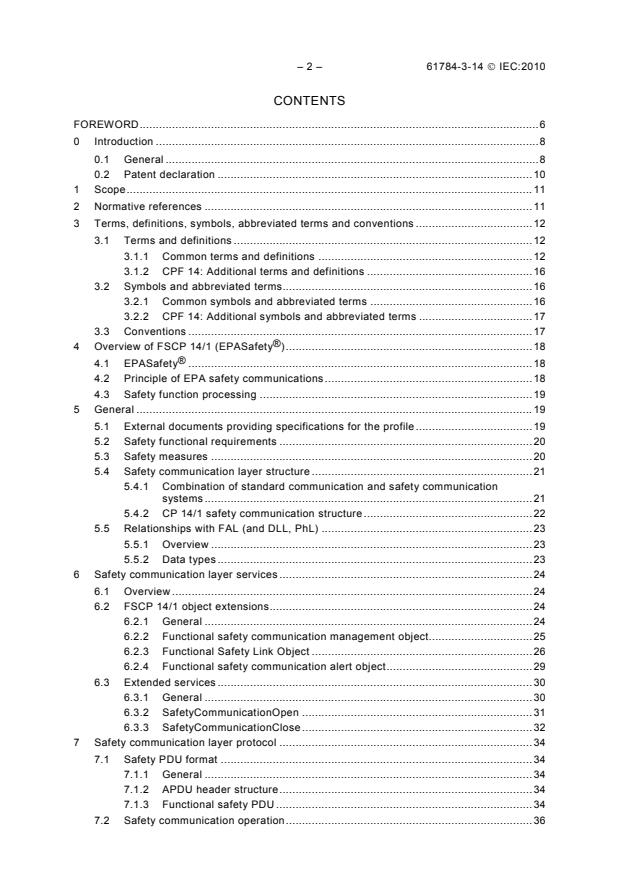
IEC 61784-3-14:2010 - Industrial communication networks - Profiles - Part 3-14: Functional safety fieldbuses - Additional specifications for CPF 14 Released:6/29/2010
Overview
IEC 61784-3-14:2010 defines a safety communication layer for functional safety fieldbuses based on CPF 14 (as specified in IEC 61784‑2) and IEC 61158 Type 14. Published by IEC, this profile (often referenced as FSCP 14/1 or EPASafety) specifies services, protocol structures and management objects required to implement a safety-aware communication layer for safety-critical industrial control systems. The bilingual 2012-02 edition corresponds to the original English edition of June 2010.
Key topics and technical requirements
The standard concentrates on the safety communication layer (SCL) and covers:
- Safety PDU and APDU formats: encoding and structure for Functional Safety PDUs (FSPDU) and headers.
- Service and protocol definitions: extended services (e.g., SafetyCommunicationOpen / SafetyCommunicationClose) and state-machine behaviour for periodic and non‑periodic data exchange.
- Integrity and cross-checks: sequence numbers, CRC and CRC‑cross‑check algorithms, feedback messages and hash/check functions to detect communication faults.
- Timing and synchronization: scheduling numbers, time stamps, time expectation margins, time synchronization monitoring and diagnostics.
- Management objects and diagnostics: Functional Safety Communication Management Object, Functional Safety Link Object, safety communication alert object and CSME (communication safety management entity) diagnostics.
- Communication fault handling: alert reporting, configuration management and communication fault report processes.
- System and safety requirements: safety functional requirements, safety measures, installation guidelines, reaction time calculation and maintenance considerations.
- Assessment guidance and annexes: information for assessment, hash function calculation and other informative material for implementers and certifiers.
Applications and who uses it
IEC 61784-3-14 is targeted at systems requiring certified, safety‑rated communication between controllers, safety PLCs, sensors and actuators in industrial environments:
- Control and safety engineers implementing SIL-rated or similar safety functions
- Device manufacturers building CPF 14 / IEC 61158 Type 14 fieldbus interfaces
- System integrators designing safety architectures for machinery and process plants
- Protocol developers and firmware teams implementing SCL services and PDUs
- Certification and assessment bodies evaluating conformance to functional safety communication profiles
Typical applications include safety-related automation in manufacturing, process control, machine safety systems and any environment where deterministic, verified safety communications are required.
Related standards
- IEC 61784 series (communication profiles)
- IEC 61784‑2 (CPF definitions; CPF 14)
- IEC 61158 (fieldbus types - Type 14)
- IEC 61784‑3 (principles for functional safety communications)
Keywords: IEC 61784-3-14, CPF 14, FSCP 14/1, industrial communication networks, functional safety fieldbuses, safety communication layer, IEC 61158 Type 14, EPASafety, safety PDU, CRC, time synchronization.
Buy Documents
IEC 61784-3-14:2010 - Industrial communication networks - Profiles - Part 3-14: Functional safety fieldbuses - Additional specifications for CPF 14 Released:6/29/2010
IEC 61784-3-14:2010 - Industrial communication networks - Profiles - Part 3-14: Functional safety fieldbuses - Additional specifications for CPF 14 Released:6/29/2010
Get Certified
Connect with accredited certification bodies for this standard

BSI Group
BSI (British Standards Institution) is the business standards company that helps organizations make excellence a habit.

DVS-ZERT GmbH
German welding certification society.
CARES (UK Certification Authority for Reinforcing Steels)
UK certification for reinforcing steels and construction.
Sponsored listings
Frequently Asked Questions
IEC 61784-3-14:2010 is a standard published by the International Electrotechnical Commission (IEC). Its full title is "Industrial communication networks - Profiles - Part 3-14: Functional safety fieldbuses - Additional specifications for CPF 14". This standard covers: IEC 61784-3-14:2010 specifies a safety communication layer (services and protocol) based on CPF 14 of IEC 61784-2 and IEC 61158 Type 14. It identifies the principles for functional safety communications defined in IEC 61784-3 that are relevant for this safety communication layer. This bilingual version (2012-02) corresponds to the monolingual English version, published in 2010-06.
IEC 61784-3-14:2010 specifies a safety communication layer (services and protocol) based on CPF 14 of IEC 61784-2 and IEC 61158 Type 14. It identifies the principles for functional safety communications defined in IEC 61784-3 that are relevant for this safety communication layer. This bilingual version (2012-02) corresponds to the monolingual English version, published in 2010-06.
IEC 61784-3-14:2010 is classified under the following ICS (International Classification for Standards) categories: 25.040.40 - Industrial process measurement and control; 35.100.05 - Multilayer applications. The ICS classification helps identify the subject area and facilitates finding related standards.
IEC 61784-3-14:2010 is available in PDF format for immediate download after purchase. The document can be added to your cart and obtained through the secure checkout process. Digital delivery ensures instant access to the complete standard document.
Standards Content (Sample)
IEC 61784-3-14 ®
Edition 1.0 2010-06
INTERNATIONAL
STANDARD
colour
inside
Industrial communication networks – Profiles –
Part 3-14: Functional safety fieldbuses – Additional specifications for CPF 14
All rights reserved. Unless otherwise specified, no part of this publication may be reproduced or utilized in any form
or by any means, electronic or mechanical, including photocopying and microfilm, without permission in writing from
either IEC or IEC's member National Committee in the country of the requester.
If you have any questions about IEC copyright or have an enquiry about obtaining additional rights to this publication,
please contact the address below or your local IEC member National Committee for further information.
IEC Central Office
3, rue de Varembé
CH-1211 Geneva 20
Switzerland
Email: inmail@iec.ch
Web: www.iec.ch
About the IEC
The International Electrotechnical Commission (IEC) is the leading global organization that prepares and publishes
International Standards for all electrical, electronic and related technologies.
About IEC publications
The technical content of IEC publications is kept under constant review by the IEC. Please make sure that you have the
latest edition, a corrigenda or an amendment might have been published.
ƒ Catalogue of IEC publications: www.iec.ch/searchpub
The IEC on-line Catalogue enables you to search by a variety of criteria (reference number, text, technical committee,…).
It also gives information on projects, withdrawn and replaced publications.
ƒ IEC Just Published: www.iec.ch/online_news/justpub
Stay up to date on all new IEC publications. Just Published details twice a month all new publications released. Available
on-line and also by email.
ƒ Electropedia: www.electropedia.org
The world's leading online dictionary of electronic and electrical terms containing more than 20 000 terms and definitions
in English and French, with equivalent terms in additional languages. Also known as the International Electrotechnical
Vocabulary online.
ƒ Customer Service Centre: www.iec.ch/webstore/custserv
If you wish to give us your feedback on this publication or need further assistance, please visit the Customer Service
Centre FAQ or contact us:
Email: csc@iec.ch
Tel.: +41 22 919 02 11
Fax: +41 22 919 03 00
IEC 61784-3-14 ®
Edition 1.0 2010-06
INTERNATIONAL
STANDARD
colour
inside
Industrial communication networks – Profiles –
Part 3-14: Functional safety fieldbuses – Additional specifications for CPF 14
INTERNATIONAL
ELECTROTECHNICAL
COMMISSION
PRICE CODE
XB
ICS 25.040.40; 35.100.05 ISBN 978-2-88910-983-8
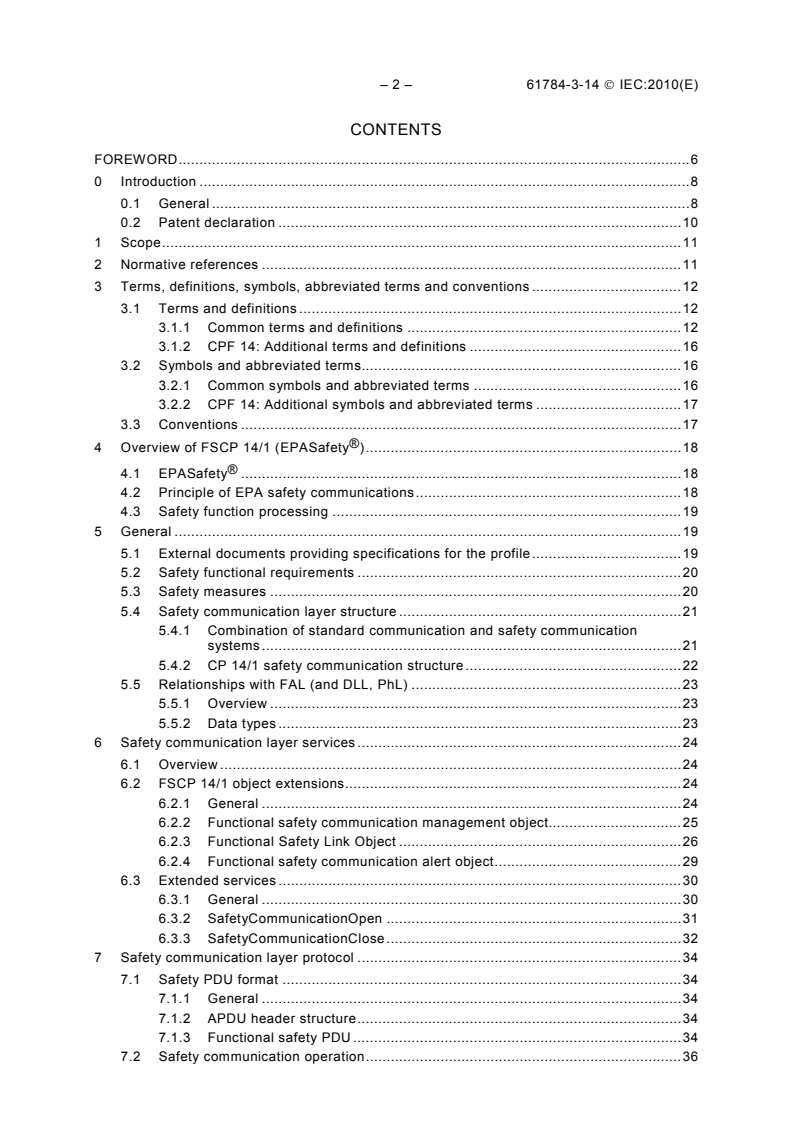
– 2 – 61784-3-14 © IEC:2010(E)
CONTENTS
FOREWORD.6
0 Introduction .8
0.1 General .8
0.2 Patent declaration .10
1 Scope.11
2 Normative references .11
3 Terms, definitions, symbols, abbreviated terms and conventions .12
3.1 Terms and definitions .12
3.1.1 Common terms and definitions .12
3.1.2 CPF 14: Additional terms and definitions .16
3.2 Symbols and abbreviated terms.16
3.2.1 Common symbols and abbreviated terms .16
3.2.2 CPF 14: Additional symbols and abbreviated terms .17
3.3 Conventions .17 ®
4 Overview of FSCP 14/1 (EPASafety ).18 ®
4.1 EPASafety .18
4.2 Principle of EPA safety communications.18
4.3 Safety function processing .19
5 General .19
5.1 External documents providing specifications for the profile.19
5.2 Safety functional requirements .20
5.3 Safety measures .20
5.4 Safety communication layer structure .21
5.4.1 Combination of standard communication and safety communication
systems.21
5.4.2 CP 14/1 safety communication structure.22
5.5 Relationships with FAL (and DLL, PhL) .23
5.5.1 Overview .23
5.5.2 Data types .23
6 Safety communication layer services .24
6.1 Overview .24
6.2 FSCP 14/1 object extensions.24
6.2.1 General .24
6.2.2 Functional safety communication management object.25
6.2.3 Functional Safety Link Object .26
6.2.4 Functional safety communication alert object.29
6.3 Extended services .30
6.3.1 General .30
6.3.2 SafetyCommunicationOpen .31
6.3.3 SafetyCommunicationClose.32
7 Safety communication layer protocol .34
7.1 Safety PDU format .34
7.1.1 General .34
7.1.2 APDU header structure.34
7.1.3 Functional safety PDU .34
7.2 Safety communication operation.36
61784-3-14 © IEC:2010(E) – 3 –
7.2.1 Sequence number .36
7.2.2 RelationKey.36
7.2.3 Feedback message .37
7.2.4 CRC-cross-check .37
7.2.5 Scheduling number.38
7.2.6 Time stamp .39
7.2.7 Time expectation .39
7.2.8 Time synchronization monitoring .39
7.2.9 Communication scheduling precision monitoring.39
7.3 Safety communication behaviour .39
7.3.1 Protocol state description of periodic data transmission.39
7.3.2 Protocol state description of non-periodic data transmission.41
7.3.3 Protocol state description of alert report for communication fault .46
7.3.4 Function description .49
7.4 Code .51
7.4.1 Object code .51
7.4.2 Service code .53
8 Safety communication layer management.59
8.1 Time synchronization diagnostics .59
8.1.1 Time synchronization process.59
8.1.2 Time synchronization management.60
8.2 CSME diagnostics .60
8.2.1 General .60
8.2.2 CSME diagnostics management .60
8.3 Communication fault management.61
8.3.1 Configuration management.61
8.3.2 Communication fault report process.61
9 System requirements.64
9.1 Indicators and switches .64
9.2 Installation guidelines.64
9.3 Safety function response time .64
9.3.1 General .64
9.3.2 Calculation of the network reaction time .65
9.4 Duration of demands .66
9.5 Constraints for calculation of system characteristics.66
9.6 Maintenance.67
9.7 Safety manual .67
10 Assessment.67
Annex A (informative) Additional information for functional safety communication
profiles of CPF 14.68
A.1 Hash function calculation.68
A.2 … .69
Annex B (informative) Information for assessment of the functional safety
communication profiles of CPF 14.70
Bibliography.71
Table 1 – Relationships between errors and safety measures .21
Table 2 – Data types used within FSCP 14/1 .24
– 4 – 61784-3-14 © IEC:2010(E)
Table 3 – FSCP 14/1 object extensions .24
Table 4 – Functional safety service extension.31
Table 5 – SafetyCommunicationOpen Service Parameters.31
Table 6 – SafetyCommunicationClose Service Parameters .33
Table 7 – Encoding of APDU Header .34
Table 8 – Structure of Functional Safety PDU (FSPDU) Header.35
Table 9 – CRC calculation polynomials .37
Table 10 – Functional safety communication state description .40
Table 11 – States and transitions of periodic data transmission .40
Table 12 – Functional safety communication states description .42
Table 13 – States and transitions of non-periodic data transmission .42
Table 14 – Communication alert state description .47
Table 15 – Communication alert states and transitions .47
Table 16 – LinkObjectType function description .49
Table 17 – CRCCheck function description .49
Table 18 – CrossCheck function description .50
Table 19 – TimeDelayCheck function description .50
Table 20 – PeriodUncomfrimedSNCheck function description .50
Table 21 – Non-periodicSNCheck function description .50
Table 22 – Functional safety communication management object encoding .51
Table 23 – Functional safety link object encoding .51
Table 24 – Functional safety communication alert object encoding .53
Table 25 – Encoding of SafetyCommunicationOpen request parameters.56
Table 26 – SafetyCommunicationOpen positive response parameters.56
Table 27 – SafetyCommunicationOpen negative response parameters .57
Table 28 – SafeCommunicationClose request parameters .57
Table 29 – SafeCommunicationClose positive response parameters.57
Table 30 – SafeCommunicationClose negative response parameters.57
Table 31 – Error class and code .58
Table 32 – Communication process of confirmed service between two devices.61
Table 33 – Settings for time expectation margin.65
-2
Table 34 – Constraints for system characteristics at ε = 10 .67
Figure 1 – Relationships of IEC 61784-3 with other standards (machinery) .8
Figure 2 – Relationships of IEC 61784-3 with other standards (process).9
Figure 3 – Safety communication architecture.19
Figure 4 – Safety function processing .19
Figure 5 – Standard communication and safety communication .22
Figure 6 – CP 14/1 protocol hierarchy.23
Figure 7 – Relationship between the SCL and the other layers of CP 14/1 .23
Figure 8 – Functional safety communication message structure.34
Figure 9 – Structure of Functional Safety PDU (FSPDU) .35
Figure 10 – Structure of Virtual Safety Check Message (VSCM) .35
61784-3-14 © IEC:2010(E) – 5 –
Figure 11 – FSPDU mapping .36
Figure 12 – Time-sharing communication scheduling .38
Figure 13 – Format of EndofNonPeriodicDataSending PDU .39
Figure 14 – State transfer figure of periodic data transmission.40
Figure 15 – Functional safety communication state transfer .41
Figure 16 – Communication alert report state transfer figure.46
Figure 17 – CRC check for time synchronization process.59
Figure 18 – The process of communication fault report .63
Figure 19 – Example application for FSCP 14/1 communication.64
Figure 20 – Calculation of the network reaction time.65
– 6 – 61784-3-14 © IEC:2010(E)
INTERNATIONAL ELECTROTECHNICAL COMMISSION
____________
INDUSTRIAL COMMUNICATION NETWORKS –
PROFILES –
Part 3-14: Functional safety fieldbuses –
Additional specifications for CPF 14
FOREWORD
1) The International Electrotechnical Commission (IEC) is a worldwide organization for standardization comprising
all national electrotechnical committees (IEC National Committees). The object of IEC is to promote
international co-operation on all questions concerning standardization in the electrical and electronic fields. To
this end and in addition to other activities, IEC publishes International Standards, Technical Specifications,
Technical Reports, Publicly Available Specifications (PAS) and Guides (hereafter referred to as “IEC
Publication(s)”). Their preparation is entrusted to technical committees; any IEC National Committee interested
in the subject dealt with may participate in this preparatory work. International, governmental and non-
governmental organizations liaising with the IEC also participate in this preparation. IEC collaborates closely
with the International Organization for Standardization (ISO) in accordance with conditions determined by
agreement between the two organizations.
2) The formal decisions or agreements of IEC on technical matters express, as nearly as possible, an international
consensus of opinion on the relevant subjects since each technical committee has representation from all
interested IEC National Committees.
3) IEC Publications have the form of recommendations for international use and are accepted by IEC National
Committees in that sense. While all reasonable efforts are made to ensure that the technical content of IEC
Publications is accurate, IEC cannot be held responsible for the way in which they are used or for any
misinterpretation by any end user.
4) In order to promote international uniformity, IEC National Committees undertake to apply IEC Publications
transparently to the maximum extent possible in their national and regional publications. Any divergence
between any IEC Publication and the corresponding national or regional publication shall be clearly indicated in
the latter.
5) IEC itself does not provide any attestation of conformity. Independent certification bodies provide conformity
assessment services and, in some areas, access to IEC marks of conformity. IEC is not responsible for any
services carried out by independent certification bodies.
6) All users should ensure that they have the latest edition of this publication.
7) No liability shall attach to IEC or its directors, employees, servants or agents including individual experts and
members of its technical committees and IEC National Committees for any personal injury, property damage or
other damage of any nature whatsoever, whether direct or indirect, or for costs (including legal fees) and
expenses arising out of the publication, use of, or reliance upon, this IEC Publication or any other IEC
Publications.
8) Attention is drawn to the Normative references cited in this publication. Use of the referenced publications is
indispensable for the correct application of this publication.
International Standard IEC 61784-3-14 has been prepared by subcommittee 65C: Industrial
networks, of IEC technical committee 65: Industrial process measurement, control and
automation.
The text of this standard is based on the following documents:
FDIS Report on voting
65C/591A/FDIS 65C/603/RVD
Full information on the voting for the approval of this standard can be found in the report on
voting indicated in the above table.
This publication has been drafted in accordance with the ISO/IEC Directives, Part 2.
61784-3-14 © IEC:2010(E) – 7 –
A list of all parts of the IEC 61784-3 series, published under the general title Industrial
communication networks – Profiles – Functional safety fieldbuses, can be found on the IEC
website.
The committee has decided that the contents of this publication will remain unchanged until
the stability date indicated on the IEC web site under "http://webstore.iec.ch" in the data
related to the specific publication. At this date, the publication will be
• reconfirmed,
• withdrawn,
• replaced by a revised edition, or
• amended.
IMPORTANT – The 'colour inside' logo on the cover page of this publication indicates
that it contains colours which are considered to be useful for the correct
understanding of its contents. Users should therefore print this document using a
colour printer.
– 8 – 61784-3-14 © IEC:2010(E)
0 Introduction
0.1 General
The IEC 61158 fieldbus standard together with its companion standards IEC 61784-1 and
IEC 61784-2 defines a set of communication protocols that enable distributed control of
automation applications. Fieldbus technology is now considered well accepted and well
proven. Thus many fieldbus enhancements are emerging, addressing not yet standardized
areas such as real time, safety-related and security-related applications.
This standard explains the relevant principles for functional safety communications with
reference to IEC 61508 series and specifies several safety communication layers (profiles and
corresponding protocols) based on the communication profiles and protocol layers of
IEC 61784-1, IEC 61784-2 and the IEC 61158 series. It does not cover electrical safety and
intrinsic safety aspects.
Figure 1 shows the relationships between this standard and relevant safety and fieldbus
standards in a machinery environment.
Product standards
ISO 12100-1 and ISO 14121
ISO 12100-1 and ISO 14121
IEC 61496 IEC 61800-5-2 ISO 10218-1 Safety of machinery – Principles for
IEC 61131-6
IEC 61496 IEC 61131-6 IEC 61800-5-2 ISO 10218-1 Safety of machinery – Principles for
Safety f. e.g. Safety functions Safety requirements design and risk assessment
Safety for PLC design and risk assessment
Safety f. e.g. Safety for PLC Safety functions Safety requirements
light curtains (under consideration) for drives for robots
(under consideration)
light curtains for drives for robots
Design of safety-related electrical, electronic and program-
IEC 61784-4 IEC 62443
IEC 61784-4 IEC 62443
Security Security mable electronic control systems (SRECS) for machinery
Security Security
(profile-specific) (common part)
(profile-specific) (common part)
SIL based PL based
IEC 61784-5 IEC 61918
IEC 61784-5 IEC 61918
Installation guide Installation guide
Installation guide Installation guide Design objective
(profile-specific) (common part)
(profile-specific) (common part)
Applicable standards
ISO 13849-1, -2
ISO 13849-1, -2
IEC 60204-1
IEC 60204-1
Safety-related parts
Safety-related parts
Safety of electrical
Safety of electrical
IEC 61000-1-2
IEC 61000-1-2 of machinery
of machinery
equipment
equipment
Methodology EMC & FS
Methodology EMC & FS (SRPCS)
(SRPCS)
IEC 61326-3-1
IEC 61784-3
IEC 61784-3 IEC 61326-3-1
Non-electrical
Non-electrical
Functional safety Test EMC & FS
Functional safety Test EMC & FS
communication
communication
Electrical
Electrical
US: NFPA 79
US: NFPA 79
profiles
profiles
(2006)
(2006)
IEC 62061
IEC 62061
Functional safety
Functional safety
IEC 61158 series /
IEC 61158 series /
for machinery
for machinery
IEC 61784-1, -2 IEC 61508 series
IEC 61784-1, -2 IEC 61508 series (SRECS)
(SRECS)
Functional safety (FS)
Fieldbus for use in Functional safety (FS) (including EMC for
Fieldbus for use in (including EMC for
(basic standard)
(basic standard) industrial environment)
industrial control systems industrial environment)
industrial control systems
Key
(yellow) safety-related standards
(blue) fieldbus-related standards
(dashed yellow) this standard
NOTE Subclauses 6.7.6.4 (high complexity) and 6.7.8.1.6 (low complexity) of IEC 62061 specify the relationship
between PL (Category) and SIL.
Figure 1 – Relationships of IEC 61784-3 with other standards (machinery)
61784-3-14 © IEC:2010(E) – 9 –
Figure 2 shows the relationships between this standard and relevant safety and fieldbus
standards in a process environment.
Product standards
IEC 61496 IEC 61800-5-2 ISO 10218-1
IEC 61131-6
IEC 61496 IEC 61131-6 IEC 61800-5-2 ISO 10218-1
Safety f. e.g. Safety functions Safety requirements
Safety for PLC
Safety f. e.g. Safety for PLC Safety functions Safety requirements
light curtains (under consideration) for drives for robots
(under consideration)
light curtains for drives for robots
IEC 61784-4 IEC 62443
IEC 61784-4 IEC 62443
Security Security
Security Security
(profile-specific) (common part)
(profile-specific) (common part)
See safety standards for machinery
(Figure 1)
IEC 61784-5 IEC 61918
IEC 61784-5 IEC 61918
Installation guide Installation guide
Installation guide Installation guide
(profile-specific) (common part)
(profile-specific) (common part)
Valid also in process industries,
whenever applicable
a)
a)
IEC 61326-3-2
IEC 61326-3-2
EMC and
EMC and
functional safety
functional safety
IEC 61784-3
IEC 61784-3
Functional safety
Functional safety
communication
communication
profiles
profiles
US:
US:
ISA-84.00.01
ISA-84.00.01
b)
b)
(3 parts = modified
IEC 61511 series
IEC 61511 series (3 parts = modified
IEC 61511)
Functional safety –
IEC 61158 series / Functional safety – IEC 61511)
IEC 61158 series /
Safety instrumented
Safety instrumented
IEC 61784-1, -2 IEC 61508 series
IEC 61784-1, -2 IEC 61508 series
systems for the
systems for the
Fieldbus for use in Functional safety (FS)
Functional safety (FS)
Fieldbus for use in DE: VDI 2180
process industry sector DE: VDI 2180
process industry sector
(basic standard)
(basic standard)
industrial control systems Part 1-4
industrial control systems
Part 1-4
Key
(yellow) safety-related standards
(blue) fieldbus-related standards
(dashed yellow) this standard
a
For specified electromagnetic environments; otherwise IEC 61326-3-1.
b
EN ratified.
Figure 2 – Relationships of IEC 61784-3 with other standards (process)
Safety communication layers which are implemented as parts of safety-related systems
according to IEC 61508 series provide the necessary confidence in the transportation of
messages (information) between two or more participants on a fieldbus in a safety-related
system, or sufficient confidence of safe behaviour in the event of fieldbus errors or failures.
Safety communication layers specified in this standard do this in such a way that a fieldbus
can be used for applications requiring functional safety up to the Safety Integrity Level (SIL)
specified by its corresponding functional safety communication profile.
The resulting SIL claim of a system depends on the implementation of the selected functional
safety communication profile within this system – implementation of a functional safety
communication profile in a standard device is not sufficient to qualify it as a safety device.
– 10 – 61784-3-14 © IEC:2010(E)
This standard describes:
⎯ basic principles for implementing the requirements of IEC 61508 series for safety-
related data communications, including possible transmission faults, remedial
measures and considerations affecting data integrity;
⎯ individual description of functional safety profiles for several communication profile
families in IEC 61784-1 and IEC 61784-2;
⎯ safety layer extensions to the communication service and protocols sections of the
IEC 61158 series.
0.2 Patent declaration
The International Electrotechnical Commission (IEC) draws attention to the fact that it is
claimed that compliance with this document may involve the use of patents concerning the
functional safety communication profiles for family 14 as follows, where the [xx] notation
indicates the holder of the patent right:
CN1960247 [SxZ] Method of Safety communication for industrial network
CN1929373 [SxZ] The safety communication for the safety instrument
system applied in industrial process.
[SxZ] The diagnosis method and the equipment for monitoring
CN101035030
the industrial Ethernet message.
IEC takes no position concerning the evidence, validity and scope of these patent rights.
The holders of these patents rights have assured the IEC that they are willing to negotiate
licences under reasonable and non-discriminatory terms and conditions with applicants
throughout the world. In this respect, the statement of the holders of these patent rights are
registered with IEC.
Information may be obtained from:
[SxZ] SUPCON and Zhejiang university
Dongqin FENG
(1) Zhejiang SUPCON Technology Co., Ltd.
Liuhe Road 309, Bingjiang District,
Hangzhou, CHINA 310053
(2) Zhejiang University
Zheda Road 38,
Hangzhou CHINA 310027
Attention is drawn to the possibility that some of the elements of this document may be the
subject of patent rights other than those identified above. IEC shall not be held responsible for
identifying any or all such patent rights.
61784-3-14 © IEC:2010(E) – 11 –
INDUSTRIAL COMMUNICATION NETWORKS –
PROFILES –
Part 3-14: Functional safety fieldbuses –
Additional specifications for CPF 14
1 Scope
This part of the IEC 61784-3 series specifies a safety communication layer (services and
protocol) based on CPF 14 of IEC 61784-2 and IEC 61158 Type 14. It identifies the principles
for functional safety communications defined in IEC 61784-3 that are relevant for this safety
communication layer.
NOTE 1 It does not cover electrical safety and intrinsic safety aspects. Electrical safety relates to hazards such
as electrical shock. Intrinsic safety relates to hazards associated with potentially explosive atmospheres.
This part defines mechanisms for the transmission of safety-relevant messages among
participants within a distributed network using fieldbus technology in accordance with the
requirements of IEC 61508 series for functional safety. These mechanisms may be used in
various industrial applications such as process control, manufacturing automation and
machinery.
This part provides guidelines for both developers and assessors of compliant devices and
systems.
NOTE 2 The resulting SIL claim of a system depends on the implementation of the selected functional safety
communication profile within this system – implementation of a functional safety communication profile according to
this part in a standard device is not sufficient to qualify it as a safety device.
2 Normative references
The following referenced documents are indispensable for the application of this document.
For dated references, only the edition cited applies. For undated references, the latest edition
of the referenced document (including any amendments) applies.
IEC 61158 (all parts), Industrial communication networks – Fieldbus specifications
IEC 61158-3-14, Industrial communication networks – Fieldbus specifications – Part 3-14:
Data-link layer service definition – Type 14 elements
IEC 61158-4-14, Industrial communication networks – Fieldbus specifications – Part 4-14:
Data-link layer protocol specification – Type 14 elements
IEC 61158-5-14, Industrial communication networks – Fieldbus specifications – Part 5-14:
Application layer service definition – Type 14 elements
IEC 61158-6-14, Industrial communication networks – Fieldbus specifications – Part 6-14:
Application layer protocol specification – Type 14 elements
—————————
In the following pages of this standard, “this part” will be used for “this part of the IEC 61784-3 series”.
In the following pages of this standard, “IEC 61508” will be used for “IEC 61508 series”.
– 12 – 61784-3-14 © IEC:2010(E)
IEC 61508 (all parts), Functional safety of electrical/electronic/programmable electronic
safety-related systems
IEC 61511 (all parts), Functional safety – Safety instrumented systems for the process
industry sector
IEC 61588, Precision clock synchronization protocol for networked measurement and control
systems
IEC 61784-2, Industrial communication networks – Profiles – Part 2: Additional fieldbus
profiles for real-time networks based on ISO/IEC 8802-3
IEC 61784-3:2010 , Industrial communication networks – Profiles – Part 3: Functional safety
fieldbuses – General rules and profile definitions
ISO/IEC 8802-3, Information technology – Telecommunications and information exchange
between systems – Local and metropolitan area networks – Specific requirements – Part 3:
Carrier sense multiple access with collision detection (CSMA/CD) access method and
physical layer specifications
3 Terms, definitions, symbols, abbreviated terms and conventions
3.1 Terms and definitions
For the purposes of this document, the following terms and definitions apply.
3.1.1 Common terms and definitions
3.1.1.1
availability
probability for an automated system that for a given period of time there are no unsatisfactory
system conditions such as loss of production
3.1.1.2
black channel
communication channel without available evidence of design or validation according to
IEC 61508
3.1.1.3
bridge
abstract device that connects multiple network segments along the data link layer
3.1.1.4
communication channel
logical connection between two end-points within a communication system
3.1.1.5
communication system
arrangement of hardware, software and propagation media to allow the transfer of messages
(ISO/IEC 7498 application layer) from one application to another
3.1.1.6
connection
logical binding between two application objects within the same or different devices
—————————
In preparation.
61784-3-14 © IEC:2010(E) – 13 –
3.1.1.7
Cyclic Redundancy Check (CRC)
redundant data derived from, and stored or transmitted together with, a block of data
in order to detect data corruption
procedure used to calculate the redundant data
NOTE 1 Terms “CRC code” and "CRC signature", and labels such as CRC1, CRC2, may also be used in this
standard to refer to the redundant data.
NOTE 2 See also [40], [41] .
3.1.1.8
error
discrepancy between a computed, observed or measured value or condition and the true,
specified or theoretically correct value or condition
[IEC 61508-4:2010 ], [IEC 61158]
NOTE 1 Errors may be due to design mistakes within hardware/software and/or corrupted information due to
electromagnetic interference and/or other effects.
NOTE 2 Errors do not necessarily result in a failure or a fault.
3.1.1.9
failure
termination of the ability of a functional unit to perform a required function or operation of a
functional unit in any way other than as required
NOTE 1 The definition in IEC 61508-4 is the same, with additional notes.
[IEC 61508-4:2010, modified], [ISO/IEC 2382-14.01.11, modified]
NOTE 2 Failure may be due to an error (for example, problem with hardware/software design or message
disruption)
3.1.1.10
fault
abnormal condition that may cause a reduction in, or loss of, the capability of a functional unit
to perform a required function
NOTE IEV 191-05-01 defines “fault” as a state characterized by the inability to perform a required function,
excluding the inability during preventive maintenance or other planned actions, or due to lack of external resources.
[IEC 61508-4:2010, modified], [ISO/IEC 2382-14.01.10, modified]
3.1.1.11
fieldbus
communication system based on serial data transfer and used in industrial automation or
process control applications
3.1.1.12
frame
denigrated synonym for DLPDU
3.1.1.13
hash function
(mathematical) function that maps values from a (possibly very) large set of values into a
(usually) smaller range of values
—————————
Figures in square brackets refer to the bibliography.
To be published.
– 14 – 61784-3-14 © IEC:2010(E)
NOTE 1 Hash functions can be used to detect data corruption.
NOTE 2 Common hash functions include parity, checksum or CRC.
[IEC/TR 62210, modified]
3.1.1.14
hazard
state or set of conditions of a system that, together with other related conditions will inevitably
lead to harm to persons, property or environment
3.1.1.15
message
ordered series of octets intended to convey information
[ISO/IEC 2382-16.02.01, modified]
3.1.1.16
message sink
part of a communication system in which messages are considered to be received
[ISO/IEC 2382-16.02.03]
3.1.1.17
message source
part of a communication system from which messages are considered to originate
[ISO/IEC 2382-16.02.02]
3.1.1.18
performance level (PL)
discrete level used to specify the ability of safety-related parts of control systems to perform a
safety function under foreseeable conditions
[ISO 13849-1]
3.1.1.19
redundancy
existence of means, in addition to the means which would be sufficient for a functional unit to
perform a required function or for data to represent information
NOTE The definition in IEC 61508-4 is the same, with additional example and notes.
[IEC 61508-4:2010, modified], [ISO/IEC 2382-14.01.12, modified]
3.1.1.20
reliability
probability that an automated system can perform a required function under given conditions
for a given time interval (t1,t2)
NOTE 1 It is generally assumed that the automated system is in a state to perform this required function at the
beginning of the time interval.
NOTE 2 The term "reliability" is also used to denote the reliability performance quantified by this probability.
NOTE 3 Within the MTBF or MTTF period of time, the probability that an automated system will perform a
required function under given conditions is decreasing.
NOTE 4 Reliability differs from availability.
[IEC 62059-11, modified]
3.1.1.21
risk
combination of the probability of occurrence of harm and the severity of that harm
61784-3-14 © IEC:2010(E) – 15 –
NOTE For more discussion on this concept see Annex A of IEC 61508-5:2010 .
[IEC 61508-4:2010], [ISO/IEC Guide 51:1999, definition 3.2]
3.1.1.22
safety communication layer (SCL)
communication layer that includes all the necessary measures to ensure safe transmission of
data in accordance with the requirements of IEC 61508
3.1.1.23
safety data
data transmitted across a safety network using a safety protocol
NOTE The Safety Communication Layer does not ensure safety of the data itself, only that the data is transmitted
safely.
3.1.1.24
safety device
device designed in accordance with IEC 61508 and which implements the functional safety
communication profile
3.1.1.25
safety function
function to be implemented by an E/E/PE safety-related system or other risk reduction
measures, that is intended to achieve or maintain a safe state for the EUC, in respect of a
specific hazardous event
NOTE The definition in IEC 61508-4 is the same, with an additional example and reference.
[IEC 61508-4:2010, modified]
3.1.1.26
safety function response time
worst case elapsed time following an actuation of a safety sensor connected to a fieldbus,
before the corresponding safe state of its safety actuator(s) is achieved in the presence of
errors or failures in the safety function channel
NOTE This concept is introduced in IEC 61784-3:2010, 5.2.4 and addressed by the functional safety
communication profiles defined in this part.
3.1.1.27
safety integrity level (SIL)
discrete level (one out of a possible four), corresponding to a range of safety integrity values,
where safety integrity level 4 has the highest level of safety integrity and safety integrity level
1 has the lowest
NOTE 1 The target failure measures (see IEC 61508-4:2010, 3.5.17) for the four safety integrity levels are
specified in Tables 2 and 3 of IEC 61508-1:2010 .
NOTE 2 Safety integrity levels are used for specifying the safety integrity requirements of the safety functions to
be allocated to the E/E/PE safety-related systems.
NOTE 3 A safety integrity level (SIL) is not a property of a system, subsystem, element or component. The correct
interpretation of the phrase “SILn safety-related system” (where n is 1, 2, 3 or 4) is that the system is potentially
capable of supporting safety functions with a safety integrity level up to n.
[IEC 61508-4:2010]
—————————
To be published.
To be published.
– 16 – 61784-3-14 © IEC:2010(E)
3.1.1.28
safety measure
measure to control possible communication errors that is designed and
implemented in compliance with the requirements of IEC 61508
NOTE 1 In practice, several safety measures are combined to achieve the required safety integrity level.
NOTE 2 Communication errors and related sa
...
IEC 61784-3-14 ®
Edition 1.0 2010-06
INTERNATIONAL
STANDARD
NORME
INTERNATIONALE
colour
inside
Industrial communication networks – Profiles –
Part 3-14: Functional safety fieldbuses – Additional specifications for CPF 14
Réseaux de communication industriels – Profils –
Partie 3-14: Bus de terrain de sécurité fonctionnelle – Spécifications
supplémentaires pour CPF 14
All rights reserved. Unless otherwise specified, no part of this publication may be reproduced or utilized in any form
or by any means, electronic or mechanical, including photocopying and microfilm, without permission in writing from
either IEC or IEC's member National Committee in the country of the requester.
If you have any questions about IEC copyright or have an enquiry about obtaining additional rights to this publication,
please contact the address below or your local IEC member National Committee for further information.
Droits de reproduction réservés. Sauf indication contraire, aucune partie de cette publication ne peut être reproduite ni
utilisée sous quelque forme que ce soit et par aucun procédé, électronique ou mécanique, y compris la photocopie et les
microfilms, sans l'accord écrit de la CEI ou du Comité national de la CEI du pays du demandeur.
Si vous avez des questions sur le copyright de la CEI ou si vous désirez obtenir des droits supplémentaires sur cette
publication, utilisez les coordonnées ci-après ou contactez le Comité national de la CEI de votre pays de résidence.
IEC Central Office Tel.: +41 22 919 02 11
3, rue de Varembé Fax: +41 22 919 03 00
CH-1211 Geneva 20 info@iec.ch
Switzerland www.iec.ch
About the IEC
The International Electrotechnical Commission (IEC) is the leading global organization that prepares and publishes
International Standards for all electrical, electronic and related technologies.
About IEC publications
The technical content of IEC publications is kept under constant review by the IEC. Please make sure that you have the
latest edition, a corrigenda or an amendment might have been published.
Useful links:
IEC publications search - www.iec.ch/searchpub Electropedia - www.electropedia.org
The advanced search enables you to find IEC publications The world's leading online dictionary of electronic and
by a variety of criteria (reference number, text, technical electrical terms containing more than 30 000 terms and
committee,…). definitions in English and French, with equivalent terms in
It also gives information on projects, replaced and additional languages. Also known as the International
withdrawn publications. Electrotechnical Vocabulary (IEV) on-line.
IEC Just Published - webstore.iec.ch/justpublished Customer Service Centre - webstore.iec.ch/csc
Stay up to date on all new IEC publications. Just Published If you wish to give us your feedback on this publication
details all new publications released. Available on-line and or need further assistance, please contact the
also once a month by email. Customer Service Centre: csc@iec.ch.
A propos de la CEI
La Commission Electrotechnique Internationale (CEI) est la première organisation mondiale qui élabore et publie des
Normes internationales pour tout ce qui a trait à l'électricité, à l'électronique et aux technologies apparentées.
A propos des publications CEI
Le contenu technique des publications de la CEI est constamment revu. Veuillez vous assurer que vous possédez
l’édition la plus récente, un corrigendum ou amendement peut avoir été publié.
Liens utiles:
Recherche de publications CEI - www.iec.ch/searchpub Electropedia - www.electropedia.org
La recherche avancée vous permet de trouver des Le premier dictionnaire en ligne au monde de termes
publications CEI en utilisant différents critères (numéro de électroniques et électriques. Il contient plus de 30 000
référence, texte, comité d’études,…). termes et définitions en anglais et en français, ainsi que
Elle donne aussi des informations sur les projets et les les termes équivalents dans les langues additionnelles.
publications remplacées ou retirées. Egalement appelé Vocabulaire Electrotechnique
International (VEI) en ligne.
Just Published CEI - webstore.iec.ch/justpublished
Service Clients - webstore.iec.ch/csc
Restez informé sur les nouvelles publications de la CEI.
Just Published détaille les nouvelles publications parues. Si vous désirez nous donner des commentaires sur
Disponible en ligne et aussi une fois par mois par email. cette publication ou si vous avez des questions
contactez-nous: csc@iec.ch.
IEC 61784-3-14 ®
Edition 1.0 2010-06
INTERNATIONAL
STANDARD
NORME
INTERNATIONALE
colour
inside
Industrial communication networks – Profiles –
Part 3-14: Functional safety fieldbuses – Additional specifications for CPF 14
Réseaux de communication industriels – Profils –
Partie 3-14: Bus de terrain de sécurité fonctionnelle – Spécifications
supplémentaires pour CPF 14
INTERNATIONAL
ELECTROTECHNICAL
COMMISSION
COMMISSION
ELECTROTECHNIQUE
PRICE CODE
INTERNATIONALE
XB
CODE PRIX
ICS 25.040.40, 35.100.05 ISBN 978-2-88912-946-1
– 2 – 61784-3-14 IEC:2010
CONTENTS
FOREWORD . 6
0 Introduction . 8
0.1 General . 8
0.2 Patent declaration . 10
1 Scope . 11
2 Normative references . 11
3 Terms, definitions, symbols, abbreviated terms and conventions . 12
3.1 Terms and definitions . 12
3.1.1 Common terms and definitions . 12
3.1.2 CPF 14: Additional terms and definitions . 16
3.2 Symbols and abbreviated terms. 16
3.2.1 Common symbols and abbreviated terms . 16
3.2.2 CPF 14: Additional symbols and abbreviated terms . 17
3.3 Conventions . 17 ®
4 Overview of FSCP 14/1 (EPASafety ) . 18 ®
4.1 EPASafety . 18
4.2 Principle of EPA safety communications . 18
4.3 Safety function processing . 19
5 General . 19
5.1 External documents providing specifications for the profile . 19
5.2 Safety functional requirements . 20
5.3 Safety measures . 20
5.4 Safety communication layer structure . 21
5.4.1 Combination of standard communication and safety communication
systems . 21
5.4.2 CP 14/1 safety communication structure . 22
5.5 Relationships with FAL (and DLL, PhL) . 23
5.5.1 Overview . 23
5.5.2 Data types . 23
6 Safety communication layer services . 24
6.1 Overview . 24
6.2 FSCP 14/1 object extensions . 24
6.2.1 General . 24
6.2.2 Functional safety communication management object. 25
6.2.3 Functional Safety Link Object . 26
6.2.4 Functional safety communication alert object . 29
6.3 Extended services . 30
6.3.1 General . 30
6.3.2 SafetyCommunicationOpen . 31
6.3.3 SafetyCommunicationClose . 32
7 Safety communication layer protocol . 34
7.1 Safety PDU format . 34
7.1.1 General . 34
7.1.2 APDU header structure . 34
7.1.3 Functional safety PDU . 34
7.2 Safety communication operation . 36
61784-3-14 IEC:2010 – 3 –
7.2.1 Sequence number . 36
7.2.2 RelationKey . 36
7.2.3 Feedback message . 37
7.2.4 CRC-cross-check . 37
7.2.5 Scheduling number . 37
7.2.6 Time stamp . 39
7.2.7 Time expectation . 39
7.2.8 Time synchronization monitoring . 39
7.2.9 Communication scheduling precision monitoring . 39
7.3 Safety communication behaviour . 39
7.3.1 Protocol state description of periodic data transmission . 39
7.3.2 Protocol state description of non-periodic data transmission . 41
7.3.3 Protocol state description of alert report for communication fault . 46
7.3.4 Function description . 49
7.4 Code . 51
7.4.1 Object code . 51
7.4.2 Service code . 53
8 Safety communication layer management . 59
8.1 Time synchronization diagnostics . 59
8.1.1 Time synchronization process. 59
8.1.2 Time synchronization management . 60
8.2 CSME diagnostics . 60
8.2.1 General . 60
8.2.2 CSME diagnostics management . 60
8.3 Communication fault management . 61
8.3.1 Configuration management . 61
8.3.2 Communication fault report process . 61
9 System requirements . 64
9.1 Indicators and switches . 64
9.2 Installation guidelines . 64
9.3 Safety function response time . 64
9.3.1 General . 64
9.3.2 Calculation of the network reaction time . 65
9.4 Duration of demands . 66
9.5 Constraints for calculation of system characteristics . 66
9.6 Maintenance . 67
9.7 Safety manual . 67
10 Assessment . 67
Annex A (informative) Additional information for functional safety communication
profiles of CPF 14 . 68
A.1 Hash function calculation . 68
A.2 … . 69
Annex B (informative) Information for assessment of the functional safety
communication profiles of CPF 14 . 70
Bibliography . 71
Table 1 – Relationships between errors and safety measures . 21
Table 2 – Data types used within FSCP 14/1 . 24
– 4 – 61784-3-14 IEC:2010
Table 3 – FSCP 14/1 object extensions . 24
Table 4 – Functional safety service extension . 31
Table 5 – SafetyCommunicationOpen Service Parameters . 31
Table 6 – SafetyCommunicationClose Service Parameters . 33
Table 7 – Encoding of APDU Header . 34
Table 8 – Structure of Functional Safety PDU (FSPDU) Header . 35
Table 9 – CRC calculation polynomials . 37
Table 10 – Functional safety communication state description . 40
Table 11 – States and transitions of periodic data transmission . 40
Table 12 – Functional safety communication states description . 42
Table 13 – States and transitions of non-periodic data transmission . 42
Table 14 – Communication alert state description . 47
Table 15 – Communication alert states and transitions . 47
Table 16 – LinkObjectType function description . 49
Table 17 – CRCCheck function description . 49
Table 18 – CrossCheck function description . 50
Table 19 – TimeDelayCheck function description . 50
Table 20 – PeriodUncomfrimedSNCheck function description . 50
Table 21 – Non-periodicSNCheck function description . 50
Table 22 – Functional safety communication management object encoding . 51
Table 23 – Functional safety link object encoding . 51
Table 24 – Functional safety communication alert object encoding . 53
Table 25 – Encoding of SafetyCommunicationOpen request parameters . 56
Table 26 – SafetyCommunicationOpen positive response parameters . 56
Table 27 – SafetyCommunicationOpen negative response parameters . 57
Table 28 – SafeCommunicationClose request parameters . 57
Table 29 – SafeCommunicationClose positive response parameters . 57
Table 30 – SafeCommunicationClose negative response parameters . 57
Table 31 – Error class and code . 58
Table 32 – Communication process of confirmed service between two devices . 61
Table 33 – Settings for time expectation margin . 65
-2
Table 34 – Constraints for system characteristics at ε = 10 . 67
Figure 1 – Relationships of IEC 61784-3 with other standards (machinery) . 8
Figure 2 – Relationships of IEC 61784-3 with other standards (process) . 9
Figure 3 – Safety communication architecture . 19
Figure 4 – Safety function processing . 19
Figure 5 – Standard communication and safety communication . 22
Figure 6 – CP 14/1 protocol hierarchy . 23
Figure 7 – Relationship between the SCL and the other layers of CP 14/1 . 23
Figure 8 – Functional safety communication message structure . 34
Figure 9 – Structure of Functional Safety PDU (FSPDU) . 35
Figure 10 – Structure of Virtual Safety Check Message (VSCM) . 35
61784-3-14 IEC:2010 – 5 –
Figure 11 – FSPDU mapping . 36
Figure 12 – Time-sharing communication scheduling . 38
Figure 13 – Format of EndofNonPeriodicDataSending PDU . 38
Figure 14 – State transfer figure of periodic data transmission . 40
Figure 15 – Functional safety communication state transfer . 41
Figure 16 – Communication alert report state transfer figure . 46
Figure 17 – CRC check for time synchronization process . 59
Figure 18 – The process of communication fault report . 63
Figure 19 – Example application for FSCP 14/1 communication . 64
Figure 20 – Calculation of the network reaction time . 65
– 6 – 61784-3-14 IEC:2010
INTERNATIONAL ELECTROTECHNICAL COMMISSION
____________
INDUSTRIAL COMMUNICATION NETWORKS –
PROFILES –
Part 3-14: Functional safety fieldbuses –
Additional specifications for CPF 14
FOREWORD
1) The International Electrotechnical Commission (IEC) is a worldwide organization for standardization comprising
all national electrotechnical committees (IEC National Committees). The object of IEC is to promote
international co-operation on all questions concerning standardization in the electrical and electronic fields. To
this end and in addition to other activities, IEC publishes International Standards, Technical Specifications,
Technical Reports, Publicly Available Specifications (PAS) and Guides (hereafter referred to as “IEC
Publication(s)”). Their preparation is entrusted to technical committees; any IEC National Committee interested
in the subject dealt with may participate in this preparatory work. International, governmental and non-
governmental organizations liaising with the IEC also participate in this preparation. IEC collaborates closely
with the International Organization for Standardization (ISO) in accordance with conditions determined by
agreement between the two organizations.
2) The formal decisions or agreements of IEC on technical matters express, as nearly as possible, an international
consensus of opinion on the relevant subjects since each technical committee has representation from all
interested IEC National Committees.
3) IEC Publications have the form of recommendations for international use and are accepted by IEC National
Committees in that sense. While all reasonable efforts are made to ensure that the technical content of IEC
Publications is accurate, IEC cannot be held responsible for the way in which they are used or for any
misinterpretation by any end user.
4) In order to promote international uniformity, IEC National Committees undertake to apply IEC Publications
transparently to the maximum extent possible in their national and regional publications. Any divergence
between any IEC Publication and the corresponding national or regional publication shall be clearly indicated in
the latter.
5) IEC itself does not provide any attestation of conformity. Independent certification bodies provide conformity
assessment services and, in some areas, access to IEC marks of conformity. IEC is not responsible for any
services carried out by independent certification bodies.
6) All users should ensure that they have the latest edition of this publication.
7) No liability shall attach to IEC or its directors, employees, servants or agents including individual experts and
members of its technical committees and IEC National Committees for any personal injury, property damage or
other damage of any nature whatsoever, whether direct or indirect, or for costs (including legal fees) and
expenses arising out of the publication, use of, or reliance upon, this IEC Publication or any other IEC
Publications.
8) Attention is drawn to the Normative references cited in this publication. Use of the referenced publications is
indispensable for the correct application of this publication.
International Standard IEC 61784-3-14 has been prepared by subcommittee 65C: Industrial
networks, of IEC technical committee 65: Industrial process measurement, control and
automation.
This bilingual version (2012-02) corresponds to the monolingual English version, published in
2010-06.
The text of this standard is based on the following documents:
FDIS Report on voting
65C/591A/FDIS 65C/603/RVD
Full information on the voting for the approval of this standard can be found in the report on
voting indicated in the above table.
The French version of this standard has not been voted upon.
61784-3-14 IEC:2010 – 7 –
This publication has been drafted in accordance with the ISO/IEC Directives, Part 2.
A list of all parts of the IEC 61784-3 series, published under the general title Industrial
communication networks – Profiles – Functional safety fieldbuses, can be found on the IEC
website.
The committee has decided that the contents of this publication will remain unchanged until
the stability date indicated on the IEC web site under "http://webstore.iec.ch" in the data
related to the specific publication. At this date, the publication will be
• reconfirmed,
• withdrawn,
• replaced by a revised edition, or
• amended.
IMPORTANT – The 'colour inside' logo on the cover page of this publication indicates
that it contains colours which are considered to be useful for the correct
understanding of its contents. Users should therefore print this document using a
colour printer.
– 8 – 61784-3-14 IEC:2010
0 Introduction
0.1 General
The IEC 61158 fieldbus standard together with its companion standards IEC 61784-1 and
IEC 61784-2 defines a set of communication protocols that enable distributed control of
automation applications. Fieldbus technology is now considered well accepted and well
proven. Thus many fieldbus enhancements are emerging, addressing not yet standardized
areas such as real time, safety-related and security-related applications.
This standard explains the relevant principles for functional safety communications with
reference to IEC 61508 series and specifies several safety communication layers (profiles and
corresponding protocols) based on the communication profiles and protocol layers of
IEC 61784-1, IEC 61784-2 and the IEC 61158 series. It does not cover electrical safety and
intrinsic safety aspects.
Figure 1 shows the relationships between this standard and relevant safety and fieldbus
standards in a machinery environment.
Product standards
ISO 12100-1 and ISO 14121
ISO 12100-1 and ISO 14121
IEC 61496 IEC 61800-5-2 ISO 10218-1 Safety of machinery – Principles for
IEC 61131-6
IEC 61496 IEC 61131-6 IEC 61800-5-2 ISO 10218-1 Safety of machinery – Principles for
Safety f. e.g. Safety functions Safety requirements design and risk assessment
Safety for PLC design and risk assessment
Safety f. e.g. Safety for PLC Safety functions Safety requirements
light curtains (under consideration) for drives for robots
(under consideration)
light curtains for drives for robots
Design of safety-related electrical, electronic and program-
IEC 61784-4 IEC 62443
IEC 61784-4 IEC 62443
mable electronic control systems (SRECS) for machinery
Security Security
Security Security
(profile-specific) (common part)
(profile-specific) (common part)
SIL based PL based
IEC 61784-5 IEC 61918
IEC 61784-5 IEC 61918
Installation guide Installation guide
Installation guide Installation guide Design objective
(profile-specific) (common part)
(profile-specific) (common part)
Applicable standards
ISO 13849-1, -2
ISO 13849-1, -2
IEC 60204-1
IEC 60204-1
Safety-related parts
Safety-related parts
Safety of electrical
Safety of electrical
IEC 61000-1-2
IEC 61000-1-2 of machinery
of machinery
equipment
equipment
Methodology EMC & FS
(SRPCS)
Methodology EMC & FS
(SRPCS)
IEC 61784-3 IEC 61326-3-1
IEC 61784-3 IEC 61326-3-1
Non-electrical
Non-electrical
Functional safety Test EMC & FS
Test EMC & FS
Functional safety
communication
communication
Electrical
Electrical
US: NFPA 79
US: NFPA 79
profiles
profiles
(2006)
(2006)
IEC 62061
IEC 62061
Functional safety
Functional safety
IEC 61158 series /
IEC 61158 series /
for machinery
for machinery
IEC 61784-1, -2 IEC 61508 series
IEC 61784-1, -2 IEC 61508 series (SRECS)
(SRECS)
Functional safety (FS)
Fieldbus for use in Functional safety (FS) (including EMC for
Fieldbus for use in (including EMC for
(basic standard)
(basic standard) industrial environment)
industrial control systems industrial environment)
industrial control systems
Key
(yellow) safety-related standards
(blue) fieldbus-related standards
(dashed yellow) this standard
NOTE Subclauses 6.7.6.4 (high complexity) and 6.7.8.1.6 (low complexity) of IEC 62061 specify the relationship
between PL (Category) and SIL.
Figure 1 – Relationships of IEC 61784-3 with other standards (machinery)
61784-3-14 IEC:2010 – 9 –
Figure 2 shows the relationships between this standard and relevant safety and fieldbus
standards in a process environment.
Product standards
IEC 61496 IEC 61800-5-2 ISO 10218-1
IEC 61131-6
IEC 61496 IEC 61131-6 IEC 61800-5-2 ISO 10218-1
Safety f. e.g. Safety functions Safety requirements
Safety for PLC
Safety f. e.g. Safety for PLC Safety functions Safety requirements
light curtains (under consideration) for drives for robots
(under consideration)
light curtains for drives for robots
IEC 61784-4 IEC 62443
IEC 61784-4 IEC 62443
Security Security
Security Security
(profile-specific) (common part)
(profile-specific) (common part)
See safety standards for machinery
(Figure 1)
IEC 61784-5 IEC 61918
IEC 61784-5 IEC 61918
Installation guide Installation guide
Installation guide Installation guide
(profile-specific) (common part)
(profile-specific) (common part)
Valid also in process industries,
whenever applicable
a)
a)
IEC 61326-3-2
IEC 61326-3-2
EMC and
EMC and
functional safety
functional safety
IEC 61784-3
IEC 61784-3
Functional safety
Functional safety
communication
communication
profiles
profiles
US:
US:
ISA-84.00.01
ISA-84.00.01
b)
b)
(3 parts = modified
IEC 61511 series
IEC 61511 series (3 parts = modified
IEC 61511)
Functional safety –
IEC 61158 series / Functional safety – IEC 61511)
IEC 61158 series /
Safety instrumented
Safety instrumented
IEC 61784-1, -2 IEC 61508 series
IEC 61784-1, -2 IEC 61508 series
systems for the
systems for the
Fieldbus for use in Functional safety (FS)
Functional safety (FS)
Fieldbus for use in DE: VDI 2180
process industry sector DE: VDI 2180
process industry sector
(basic standard)
(basic standard)
industrial control systems Part 1-4
industrial control systems
Part 1-4
Key
(yellow) safety-related standards
(blue) fieldbus-related standards
(dashed yellow) this standard
a
For specified electromagnetic environments; otherwise IEC 61326-3-1.
b
EN ratified.
Figure 2 – Relationships of IEC 61784-3 with other standards (process)
Safety communication layers which are implemented as parts of safety-related systems
according to IEC 61508 series provide the necessary confidence in the transportation of
messages (information) between two or more participants on a fieldbus in a safety-related
system, or sufficient confidence of safe behaviour in the event of fieldbus errors or failures.
Safety communication layers specified in this standard do this in such a way that a fieldbus
can be used for applications requiring functional safety up to the Safety Integrity Level (SIL)
specified by its corresponding functional safety communication profile.
The resulting SIL claim of a system depends on the implementation of the selected functional
safety communication profile within this system – implementation of a functional safety
communication profile in a standard device is not sufficient to qualify it as a safety device.
– 10 – 61784-3-14 IEC:2010
This standard describes:
basic principles for implementing the requirements of IEC 61508 series for safety-
related data communications, including possible transmission faults, remedial
measures and considerations affecting data integrity;
individual description of functional safety profiles for several communication profile
families in IEC 61784-1 and IEC 61784-2;
safety layer extensions to the communication service and protocols sections of the
IEC 61158 series.
0.2 Patent declaration
The International Electrotechnical Commission (IEC) draws attention to the fact that it is
claimed that compliance with this document may involve the use of patents concerning the
functional safety communication profiles for family 14 as follows, where the [xx] notation
indicates the holder of the patent right:
CN1960247 [SxZ] Method of Safety communication for industrial network
The safety communication for the safety instrument
CN1929373 [SxZ]
system applied in industrial process.
[SxZ] The diagnosis method and the equipment for monitoring
CN101035030
the industrial Ethernet message.
IEC takes no position concerning the evidence, validity and scope of these patent rights.
The holders of these patents rights have assured the IEC that they are willing to negotiate
licences under reasonable and non-discriminatory terms and conditions with applicants
throughout the world. In this respect, the statement of the holders of these patent rights are
registered with IEC.
Information may be obtained from:
[SxZ] SUPCON and Zhejiang university
Dongqin FENG
(1) Zhejiang SUPCON Technology Co., Ltd.
Liuhe Road 309, Bingjiang District,
Hangzhou, CHINA 310053
(2) Zhejiang University
Zheda Road 38,
Hangzhou CHINA 310027
Attention is drawn to the possibility that some of the elements of this document may be the
subject of patent rights other than those identified above. IEC shall not be held responsible for
identifying any or all such patent rights.
61784-3-14 IEC:2010 – 11 –
INDUSTRIAL COMMUNICATION NETWORKS –
PROFILES –
Part 3-14: Functional safety fieldbuses –
Additional specifications for CPF 14
1 Scope
This part of the IEC 61784-3 series specifies a safety communication layer (services and
protocol) based on CPF 14 of IEC 61784-2 and IEC 61158 Type 14. It identifies the principles
for functional safety communications defined in IEC 61784-3 that are relevant for this safety
communication layer.
NOTE 1 It does not cover electrical safety and intrinsic safety aspects. Electrical safety relates to hazards such
as electrical shock. Intrinsic safety relates to hazards associated with potentially explosive atmospheres.
This part defines mechanisms for the transmission of safety-relevant messages among
participants within a distributed network using fieldbus technology in accordance with the
requirements of IEC 61508 series for functional safety. These mechanisms may be used in
various industrial applications such as process control, manufacturing automation and
machinery.
This part provides guidelines for both developers and assessors of compliant devices and
systems.
NOTE 2 The resulting SIL claim of a system depends on the implementation of the selected functional safety
communication profile within this system – implementation of a functional safety communication profile according to
this part in a standard device is not sufficient to qualify it as a safety device.
2 Normative references
The following referenced documents are indispensable for the application of this document.
For dated references, only the edition cited applies. For undated references, the latest edition
of the referenced document (including any amendments) applies.
IEC 61158 (all parts), Industrial communication networks – Fieldbus specifications
IEC 61158-3-14, Industrial communication networks – Fieldbus specifications – Part 3-14:
Data-link layer service definition – Type 14 elements
IEC 61158-4-14, Industrial communication networks – Fieldbus specifications – Part 4-14:
Data-link layer protocol specification – Type 14 elements
IEC 61158-5-14, Industrial communication networks – Fieldbus specifications – Part 5-14:
Application layer service definition – Type 14 elements
IEC 61158-6-14, Industrial communication networks – Fieldbus specifications – Part 6-14:
Application layer protocol specification – Type 14 elements
—————————
In the following pages of this standard, “this part” will be used for “this part of the IEC 61784-3 series”.
In the following pages of this standard, “IEC 61508” will be used for “IEC 61508 series”.
– 12 – 61784-3-14 IEC:2010
IEC 61508 (all parts), Functional safety of electrical/electronic/programmable electronic
safety-related systems
IEC 61511 (all parts), Functional safety – Safety instrumented systems for the process
industry sector
IEC 61588, Precision clock synchronization protocol for networked measurement and control
systems
IEC 61784-2, Industrial communication networks – Profiles – Part 2: Additional fieldbus
profiles for real-time networks based on ISO/IEC 8802-3
IEC 61784-3:2010 , Industrial communication networks – Profiles – Part 3: Functional safety
fieldbuses – General rules and profile definitions
ISO/IEC 8802-3, Information technology – Telecommunications and information exchange
between systems – Local and metropolitan area networks – Specific requirements – Part 3:
Carrier sense multiple access with collision detection (CSMA/CD) access method and
physical layer specifications
3 Terms, definitions, symbols, abbreviated terms and conventions
3.1 Terms and definitions
For the purposes of this document, the following terms and definitions apply.
3.1.1 Common terms and definitions
3.1.1.1
availability
probability for an automated system that for a given period of time there are no unsatisfactory
system conditions such as loss of production
3.1.1.2
black channel
communication channel without available evidence of design or validation according to
IEC 61508
3.1.1.3
bridge
abstract device that connects multiple network segments along the data link layer
3.1.1.4
communication channel
logical connection between two end-points within a communication system
3.1.1.5
communication system
arrangement of hardware, software and propagation media to allow the transfer of messages
(ISO/IEC 7498 application layer) from one application to another
3.1.1.6
connection
logical binding between two application objects within the same or different devices
—————————
In preparation.
61784-3-14 IEC:2010 – 13 –
3.1.1.7
Cyclic Redundancy Check (CRC)
redundant data derived from, and stored or transmitted together with, a block of data
in order to detect data corruption
procedure used to calculate the redundant data
NOTE 1 Terms “CRC code” and "CRC signature", and labels such as CRC1, CRC2, may also be used in this
standard to refer to the redundant data.
NOTE 2 See also [40], [41] .
3.1.1.8
error
discrepancy between a computed, observed or measured value or condition and the true,
specified or theoretically correct value or condition
[IEC 61508-4:2010 ], [IEC 61158]
NOTE 1 Errors may be due to design mistakes within hardware/software and/or corrupted information due to
electromagnetic interference and/or other effects.
NOTE 2 Errors do not necessarily result in a failure or a fault.
3.1.1.9
failure
termination of the ability of a functional unit to perform a required function or operation of a
functional unit in any way other than as required
NOTE 1 The definition in IEC 61508-4 is the same, with additional notes.
[IEC 61508-4:2010, modified], [ISO/IEC 2382-14.01.11, modified]
NOTE 2 Failure may be due to an error (for example, problem with hardware/software design or message
disruption)
3.1.1.10
fault
abnormal condition that may cause a reduction in, or loss of, the capability of a functional unit
to perform a required function
NOTE IEV 191-05-01 defines “fault” as a state characterized by the inability to perform a required function,
excluding the inability during preventive maintenance or other planned actions, or due to lack of external resources.
[IEC 61508-4:2010, modified], [ISO/IEC 2382-14.01.10, modified]
3.1.1.11
fieldbus
communication system based on serial data transfer and used in industrial automation or
process control applications
3.1.1.12
frame
denigrated synonym for DLPDU
3.1.1.13
hash function
(mathematical) function that maps values from a (possibly very) large set of values into a
(usually) smaller range of values
—————————
Figures in square brackets refer to the bibliography.
To be published.
– 14 – 61784-3-14 IEC:2010
NOTE 1 Hash functions can be used to detect data corruption.
NOTE 2 Common hash functions include parity, checksum or CRC.
[IEC/TR 62210, modified]
3.1.1.14
hazard
state or set of conditions of a system that, together with other related conditions will inevitably
lead to harm to persons, property or environment
3.1.1.15
message
ordered series of octets intended to convey information
[ISO/IEC 2382-16.02.01, modified]
3.1.1.16
message sink
part of a communication system in which messages are considered to be received
[ISO/IEC 2382-16.02.03]
3.1.1.17
message source
part of a communication system from which messages are considered to originate
[ISO/IEC 2382-16.02.02]
3.1.1.18
performance level (PL)
discrete level used to specify the ability of safety-related parts of control systems to perform a
safety function under foreseeable conditions
[ISO 13849-1]
3.1.1.19
redundancy
existence of means, in addition to the means which would be sufficient for a functional unit to
perform a required function or for data to represent information
NOTE The definition in IEC 61508-4 is the same, with additional example and notes.
[IEC 61508-4:2010, modified], [ISO/IEC 2382-14.01.12, modified]
3.1.1.20
reliability
probability that an automated system can perform a required function under given conditions
for a given time interval (t1,t2)
NOTE 1 It is generally assumed that the automated system is in a state to perform this required function at the
beginning of the time interval.
NOTE 2 The term "reliability" is also used to denote the reliability performance quantified by this probability.
NOTE 3 Within the MTBF or MTTF period of time, the probability that an automated system will
...