


ETSI TS 103 927 V1.1.1 (2024-01)
CYBER; Cyber Security for Consumer Internet of Things; Requirements for Smart Voice-Controlled Devices
CYBER; Cyber Security for Consumer Internet of Things; Requirements for Smart Voice-Controlled Devices
DTS/CYBER-0095
General Information
Standards Content (Sample)
TECHNICAL SPECIFICATION
CYBER;
Cyber Security for Consumer Internet of Things;
Requirements for Smart Voice-controlled Device
2 ETSI TS 103 927 V1.1.1 (2024-01)
Reference
DTS/CYBER-0095
Keywords
cyber security, IoT, privacy, smart voice-controlled
device
ETSI
650 Route des Lucioles
F-06921 Sophia Antipolis Cedex - FRANCE
Tel.: +33 4 92 94 42 00 Fax: +33 4 93 65 47 16
Siret N° 348 623 562 00017 - APE 7112B
Association à but non lucratif enregistrée à la
Sous-Préfecture de Grasse (06) N° w061004871
Important notice
The present document can be downloaded from:
https://www.etsi.org/standards-search
The present document may be made available in electronic versions and/or in print. The content of any electronic and/or
print versions of the present document shall not be modified without the prior written authorization of ETSI. In case of any
existing or perceived difference in contents between such versions and/or in print, the prevailing version of an ETSI
deliverable is the one made publicly available in PDF format at www.etsi.org/deliver.
Users of the present document should be aware that the document may be subject to revision or change of status.
Information on the current status of this and other ETSI documents is available at
https://portal.etsi.org/TB/ETSIDeliverableStatus.aspx
If you find errors in the present document, please send your comment to one of the following services:
https://portal.etsi.org/People/CommiteeSupportStaff.aspx
If you find a security vulnerability in the present document, please report it through our
Coordinated Vulnerability Disclosure Program:
https://www.etsi.org/standards/coordinated-vulnerability-disclosure
Notice of disclaimer & limitation of liability
The information provided in the present deliverable is directed solely to professionals who have the appropriate degree of
experience to understand and interpret its content in accordance with generally accepted engineering or
other professional standard and applicable regulations.
No recommendation as to products and services or vendors is made or should be implied.
No representation or warranty is made that this deliverable is technically accurate or sufficient or conforms to any law
n or warranty is made of merchantability or fitness
and/or governmental rule and/or regulation and further, no representatio
for any particular purpose or against infringement of intellectual property rights.
In no event shall ETSI be held liable for loss of profits or any other incidental or consequential damages.
Any software contained in this deliverable is provided "AS IS" with no warranties, express or implied, including but not
limited to, the warranties of merchantability, fitness for a particular purpose and non-infringement of intellectual property
rights and ETSI shall not be held liable in any event for any damages whatsoever (including, without limitation, damages
for loss of profits, business interruption, loss of information, or any other pecuniary loss) arising out of or related to the use
of or inability to use the software.
Copyright Notification
No part may be reproduced or utilized in any form or by any means, electronic or mechanical, including photocopying and
microfilm except as authorized by written permission of ETSI.
The content of the PDF version shall not be modified without the written authorization of ETSI.
The copyright and the foregoing restriction extend to reproduction in all media.
© ETSI 2024.
All rights reserved.
ETSI
3 ETSI TS 103 927 V1.1.1 (2024-01)
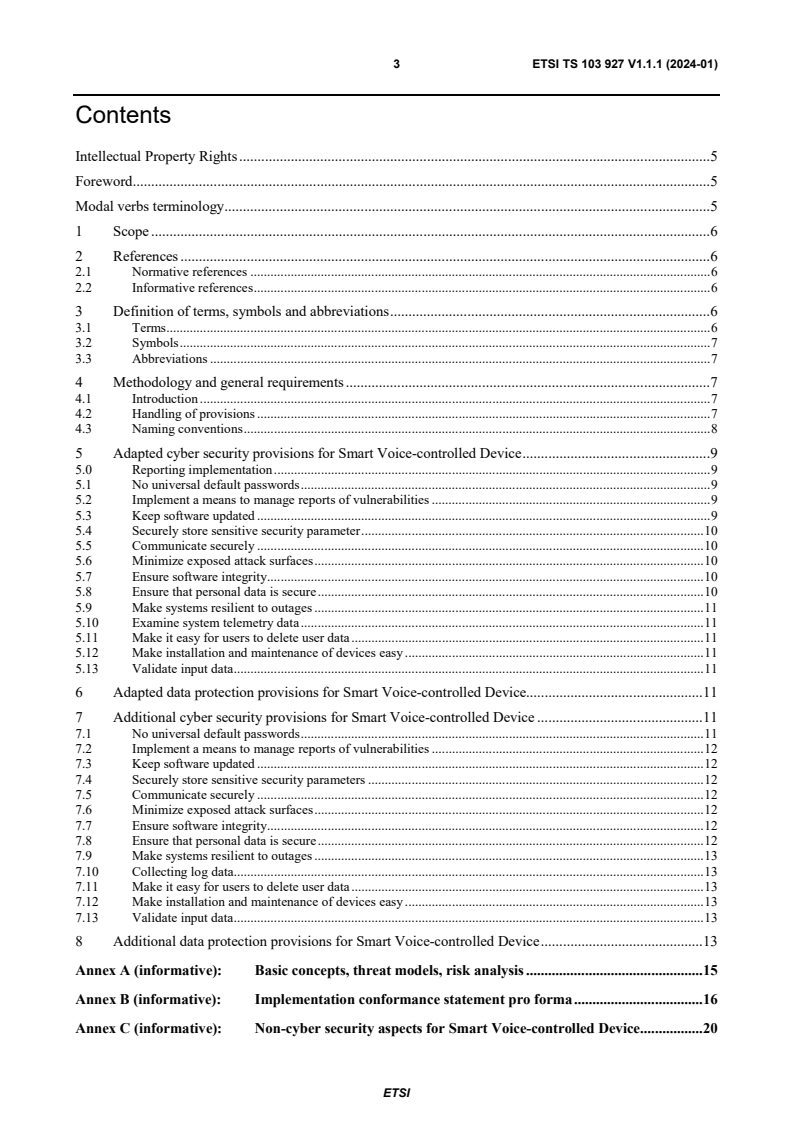
Contents
Intellectual Property Rights . 5
Foreword . 5
Modal verbs terminology . 5
1 Scope . 6
2 References . 6
2.1 Normative references . 6
2.2 Informative references . 6
3 Definition of terms, symbols and abbreviations . 6
3.1 Terms . 6
3.2 Symbols . 7
3.3 Abbreviations . 7
4 Methodology and general requirements . 7
4.1 Introduction . 7
4.2 Handling of provisions . 7
4.3 Naming conventions . 8
5 Adapted cyber security provisions for Smart Voice-controlled Device . 9
5.0 Reporting implementation . 9
5.1 No universal default passwords . 9
5.2 Implement a means to manage reports of vulnerabilities . 9
5.3 Keep software updated . 9
5.4 Securely store sensitive security parameter . 10
5.5 Communicate securely . 10
5.6 Minimize exposed attack surfaces . 10
5.7 Ensure software integrity . 10
5.8 Ensure that personal data is secure . 10
5.9 Make systems resilient to outages . 11
5.10 Examine system telemetry data . 11
5.11 Make it easy for users to delete user data . 11
5.12 Make installation and maintenance of devices easy . 11
5.13 Validate input data. 11
6 Adapted data protection provisions for Smart Voice-controlled Device. 11
7 Additional cyber security provisions for Smart Voice-controlled Device . 11
7.1 No universal default passwords . 11
7.2 Implement a means to manage reports of vulnerabilities . 12
7.3 Keep software updated . 12
7.4 Securely store sensitive security parameters . 12
7.5 Communicate securely . 12
7.6 Minimize exposed attack surfaces . 12
7.7 Ensure software integrity . 12
7.8 Ensure that personal data is secure . 12
7.9 Make systems resilient to outages . 13
7.10 Collecting log data. 13
7.11 Make it easy for users to delete user data . 13
7.12 Make installation and maintenance of devices easy . 13
7.13 Validate input data. 13
8 Additional data protection provisions for Smart Voice-controlled Device . 13
Annex A (informative): Basic concepts, threat models, risk analysis . 15
Annex B (informative): Implementation conformance statement pro forma . 16
Annex C (informative): Non-cyber security aspects for Smart Voice-controlled Device . 20
ETSI
4 ETSI TS 103 927 V1.1.1 (2024-01)
Annex D (informative): A typical architecture of a smart home system with SVD . 21
History . 22
ETSI
5 ETSI TS 103 927 V1.1.1 (2024-01)
Intellectual Property Rights
Essential patents
IPRs essential or potentially essential to normative deliverables may have been declared to ETSI. The declarations
pertaining to these essential IPRs, if any, are publicly available for ETSI members and non-members, and can be
found in ETSI SR 000 314: "Intellectual Property Rights (IPRs); Essential, or potentially Essential, IPRs notified to
ETSI in respect of ETSI standards", which is available from the ETSI Secretariat. Latest updates are available on the
ETSI Web server (https://ipr.etsi.org/).
Pursuant to the ETSI Directives including the ETSI IPR Policy, no investigation regarding the essentiality of IPRs,
including IPR searches, has been carried out by ETSI. No guarantee can be given as to the existence of other IPRs not
referenced in ETSI SR 000 314 (or the updates on the ETSI Web server) which are, or may be, or may become,
essential to the present document.
Trademarks
The present document may include trademarks and/or tradenames which are asserted and/or registered by their owners.
ETSI claims no ownership of these except for any which are indicated as being the property of ETSI, and conveys no
right to use or reproduce any trademark and/or tradename. Mention of those trademarks in the present document does
not constitute an endorsement by ETSI of products, services or organizations associated with those trademarks.
DECT™, PLUGTESTS™, UMTS™ and the ETSI logo are trademarks of ETSI registered for the benefit of its
Members. 3GPP™ and LTE™ are trademarks of ETSI registered for the benefit of its Members and of the 3GPP
Organizational Partners. oneM2M™ logo is a trademark of ETSI registered for the benefit of its Members and of the ®
oneM2M Partners. GSM and the GSM logo are trademarks registered and owned by the GSM Association.
Foreword
This Technical Specification (TS) has been produced by ETSI Technical Committee Cyber Security (CYBER).
Modal verbs terminology
In the present document "shall", "shall not", "should", "should not", "may", "need not", "will", "will not", "can" and
"cannot" are to be interpreted as described in clause 3.2 of the ETSI Drafting Rules (Verbal forms for the expression of
provisions).
"must" and "must not" are NOT allowed in ETSI deliverables except when used in direct citation.
ETSI
6 ETSI TS 103 927 V1.1.1 (2024-01)
1 Scope
The present document defines security provisions for Smart Voice-controlled Device extending from the provisions for
consumer IoT devices defined in ETSI TS 103 645 [1].
In terms of security concerns, SVD has a different focus than other generic IoT devices (e.g. distributed sensors, smart
appliances, etc.). For example, SVD mainly interacts with users through voice assistants that can understand
users' voice commands and assist users to control other devices in the IoT network. This feature actually expands the
attack surface of SVD. In addition, SVD usually collects the user's voice and trains a model uniquely suitable for the
current user to provide personalized service. Therefore, SVD-related privacy protection issues are particularly
prominent. This vertical will focus on addressing the unique security issues of SVD.
Annex D gives an architectural diagram of a typical smart home system containing SVD to allow readers of the present
document to better understand the position and purpose of SVD in a home network environment.
2 References
2.1 Normative references
References are either specific (identified by date of publication and/or edition number or version number) or
non-specific. For specific references, only the cited version applies. For non-specific references, the latest version of the
referenced document (including any amendments) applies.
Referenced documents which are not found to be publicly available in the expected location might be found at
https://docbox.etsi.org/Reference/.
NOTE: While any hyperlinks included in this clause were valid at the time of publication, ETSI cannot guarantee
their long term validity.
The following referenced documents are necessary for the application of the present document.
[1] ETSI TS 103 645 (V3.1.1): "CYBER; Cyber Security for Consumer Internet of Things: Baseline
Requirements".
2.2 Informative references
References are either specific (identified by date of publication and/or edition number or version number) or
non-specific. For specific references, only the cited version applies. For non-specific references, the latest version of the
referenced document (including any amendments) applies.
NOTE: While any hyperlinks included in this clause were valid at the time of publication, ETSI cannot guarantee
their long term validity.
The following referenced documents are not necessary for the application of the present document but they assist the
user with regard to a particular subject area.
Not applicable.
3 Definition of terms, symbols and abbreviations
3.1 Terms
For the purposes of the present document, the terms given in ETSI TS 103 645 [1] and the following apply:
pairing: act of authentication, authorization and exchange of specific information between devices/machines and/or
applications running on a device/machine resulting in a long-term trust relationship
ETSI
7 ETSI TS 103 927 V1.1.1 (2024-01)
NOTE: Pairing often involves the association of this relationship with the user's account.
Smart Voice-controlled Device (SVD): consumer IoT device with integrated voice-controlled virtual assistant logic
that responds to prompts and commands from users
NOTE 1: SVD in the present document do not include SVD for industrial purposes and in-vehicle system integrated
voice-controlled assistants.
NOTE 2: These devices in some cases can play music, answer questions, control smart home devices, make phone
calls, and perform other tasks based on voice commands.
NOTE 3: Integrated voice-controlled virtual assistant logic can make use of associated services to interpret voice
records.
3.2 Symbols
Void.
3.3 Abbreviations
For the purposes of the present document, the abbreviations given in ETSI TS 103 645 [1] and the following apply:
NVD National Vulnerability Database
OTA Over-The-Air
SVD Smart Voice-controlled Device
SSL Secure Sockets Layer
TLS Transport Layer Security
4 Methodology and general requirements
4.1 Introduction
Like many Internet of Things (IoT) devices, Smart Voice-controlled Device rely on internet connectivity and may be
connected to other devices within a Local Area Network (LAN), which makes them susceptible to various security risks
and attacks. The voice commands processed by SVD often entail the use of personal data, such as the user's location
and contacts, which further reinforces the importance of securing such devices. Additionally, the voice processing
capability of SVD makes them vulnerable to eavesdropping and unauthorized access. Thus, ETSI TS 103 645 [1] serves
as the security baseline, on which security requirements are promoted, refined, extended, and added to ensure the
security of SVD and prevent potential security threats.
4.2 Handling of provisions
The present document adopts the provisions of ETSI TS 103 645 [1] as a baseline for the Smart Voice-controlled
Device. The methodology used for the adoption is described in the present clause, which includes different operations to
modify provisions from ETSI TS 103 645 [1] and add new provisions specific to Smart Voice-controlled Device.
All provisions from ETSI TS 103 645 [1] shall apply in the present document, unchanged, to the Smart
Voice-controlled Device, unless otherwise noted in the present document.
Consumer IoT devices in the vertical domain of a SVD are not constrained devices. Consequently, all provisions from
ETSI TS 103 645 [1] regarding constrained devices are adjusted accordingly.
There are different types of modifications indicated by a naming convention as described in clause 4.3. Within clauses 5
and 6 of the present document, the following modifications can be applied to the set of provisions defined in ETSI
TS 103 645 [1]:
• Information: Providing additional information (in the form of informative text) to an unmodified provision.
The original provision in ETSI TS 103 645 [1] is still valid.
ETSI
8 ETSI TS 103 927 V1.1.1 (2024-01)
• Promotion: Promoting a recommendation to a mandatory provision. The wording of the provision remains as
in the original provision, but the promoted modal verb is replaced by the new modal verb (e.g. "should" is
replaced by "shall"). The original provision in ETSI TS 103 645 [1] is replaced by the promotion and is not
valid anymore.
• Refinement: Refining a provision with additions or modifications to its normative definition text, including
stronger scoping of conditionality. The original scope and spirit remain in force. The original provision in
ETSI TS 103 645 [1] is replaced by the refinement and is not valid anymore.
NOTE: A refinement can be used to scope the conditionality of a provision, i.e. to remove one or more conditions
from the provision, as part of the clarification on the provision's constraints.
• Extension: Extending an existing provision with one or more new sub-provisions. The original provision in
ETSI TS 103 645 [1] is still valid.
• Substitution: Replacing a recommendation that is not applicable for the Smart Voice-controlled Device with
another recommendation of equivalent effect (that provides, possibly in combination with other
recommendations or provisions, the same security outcome as the replaced recommendation). The original
provision in ETSI TS 103 645 [1] is replaced by the substitution and is not valid anymore.
• Exclusion (only possible for recommendations and conditional provisions): Declaring a recommendation
or conditional provision as "not applicable" for the Smart Voice-controlled Device. The original provision in
ETSI TS 103 645 [1] is excluded and is not valid anymore.
The present document allows to define new provisions within the clauses 7 and 8 that are not covered in ETSI
TS 103 645 [1]. There is one type of new provisions, that is also covered by the naming convention in clause 4.3:
• Addition: Defining a new provision specific to the Smart Voice-controlled Device that cannot be linked to any
provision in ETSI TS 103 645 [1].
4.3 Naming conventions
The provisions in the present document are named following the naming conventions described in the present clause.
Each provision contains an acronym representing the Smart Voice-controlled Device. The acronym for the Smart
Voice-controlled Device is set to SVD.
Names for provisions that are specific to the present document are constructed as follows:
• The name starts with the string "Provision" to which the acronym "SVD" is appended.
• A provision identifier (id) is appended. An example id is 5.1-1.
• One or more suffixes are appended (according to the types of provisions as described in clause 4.2).
NOTE: A provision can be at the same time promoted and refined, in which case the two suffixes are appended to
its name.
• For provisions that are extensions, an alphabetical index is appended, that is unique to the provision, for
example, "-a". The alphabetical index is appended only in cases where there is more than one extension to a
given provision.
The following list describes the suffixes depending on the type of the provision as described in clause 4.2:
• Information: The id is the id of the original provision in ETSI TS 103 645 [1] additional informative
information is provided for. The suffix is "(information)".
• Promotion: The id is the id of the original provision in ETSI TS 103 645 [1] that is promoted. The suffix is
"(promoted)".
• Refinement: The id is the id of the original provision in ETSI TS 103 645 [1] that is refined. The suffix is
"(refined)".
ETSI
9 ETSI TS 103 927 V1.1.1 (2024-01)
• Extension: The id is the id of the original provision in ETSI TS 103 645 [1] that is extended. The suffix is
"(extended)".
• Substitution: The id is the id of the original provision in ETSI TS 103 645 [1] that is substituted. The suffix is
"(substituted)".
• Exclusion: The id is the id of the original provision in ETSI TS 103 645 [1] that is excluded. The suffix is
"(excluded)".
• Addition: The id is a new and unique id added in clause 7 or 8 that reflects the clause in which it is defined.
The suffix is "(added)".
5 Adapted cyber security provisions for Smart
Voice-controlled Device
5.0 Reporting implementation
Provision SVD 5.0-1 (extended): A justification shall be recorded for each recommendation in the present document
that is considered to be not applicable for or not fulfilled by the device.
5.1 No universal default passwords
Existing provisions from ETSI TS 103 645 [1], clause 5.1 are modified as follows.
Provision SVD 5.1-1, Provision SVD 5.1-2 (information):
NOTE: Credentials that are commonly used by SVD for initial pairing, such as pairing codes and QR codes, are
also be considered as "passwords" in these provisions. Best practice is to ensure that credentials for
pairing are either unique per device or dynamically generated, to reduce the probability of random
guessing.
Provision SVD 5.1-5 (refined): The SVD shall have a mechanism available which makes brute-force attacks on
authentication mechanisms via network interfaces impracticable.
5.2 Implement a means to manage reports of vulnerabilities
No modifications to the provisions from ETSI TS 103 645 [1], clause 5.2 are defined in the present document.
5.3 Keep software updated
Existing provisions from ETSI TS 103 645 [1], clause 5.3 are modified as follows:
Provision SVD 5.3-2 (refined): The SVD shall have an update mechanism for the secure installation of updates.
Provision SVD 5.3-4A (promoted): One secure update mechanism shall be configurable to be automated.
Provision SVD 5.3-7 (extended): If the SVD is updated OTA, a secure channel where the communication partner is
authenticated via a trusted certificate should be used to transmit the update.
EXAMPLE 1:
...
Questions, Comments and Discussion
Ask us and Technical Secretary will try to provide an answer. You can facilitate discussion about the standard in here.
Loading comments...