


ETSI TS 183 043 V1.2.1 (2009-02)
Telecommunications and Internet converged Services and Protocols for Advanced Networking (TISPAN); IMS-based PSTN/ISDN Emulation; Stage 3 specification
Telecommunications and Internet converged Services and Protocols for Advanced Networking (TISPAN); IMS-based PSTN/ISDN Emulation; Stage 3 specification
RTS/TISPAN-03190-NGN-R1
General Information
Standards Content (Sample)
Technical Specification
Telecommunications and Internet converged Services and
Protocols for Advanced Networking (TISPAN);
IMS-based PSTN/ISDN Emulation;
Stage 3 specification
2 ETSI TS 183 043 V1.2.1 (2009-02)
Reference
RTS/TISPAN-03190-NGN-R1
Keywords
IMS, ISDN, PSTN, stage 3
ETSI
650 Route des Lucioles
F-06921 Sophia Antipolis Cedex - FRANCE
Tel.: +33 4 92 94 42 00 Fax: +33 4 93 65 47 16
Siret N° 348 623 562 00017 - NAF 742 C
Association à but non lucratif enregistrée à la
Sous-Préfecture de Grasse (06) N° 7803/88
Important notice
Individual copies of the present document can be downloaded from:
http://www.etsi.org
The present document may be made available in more than one electronic version or in print. In any case of existing or
perceived difference in contents between such versions, the reference version is the Portable Document Format (PDF).
In case of dispute, the reference shall be the printing on ETSI printers of the PDF version kept on a specific network drive
within ETSI Secretariat.
Users of the present document should be aware that the document may be subject to revision or change of status.
Information on the current status of this and other ETSI documents is available at
http://portal.etsi.org/tb/status/status.asp
If you find errors in the present document, please send your comment to one of the following services:
http://portal.etsi.org/chaircor/ETSI_support.asp
Copyright Notification
No part may be reproduced except as authorized by written permission.
The copyright and the foregoing restriction extend to reproduction in all media.
© European Telecommunications Standards Institute 2009.
All rights reserved.
TM TM TM TM
DECT , PLUGTESTS , UMTS , TIPHON , the TIPHON logo and the ETSI logo are Trade Marks of ETSI registered
for the benefit of its Members.
TM
3GPP is a Trade Mark of ETSI registered for the benefit of its Members and of the 3GPP Organizational Partners.
LTE™ is a Trade Mark of ETSI currently being registered
for the benefit of its Members and of the 3GPP Organizational Partners.
GSM® and the GSM logo are Trade Marks registered and owned by the GSM Association.
ETSI
3 ETSI TS 183 043 V1.2.1 (2009-02)
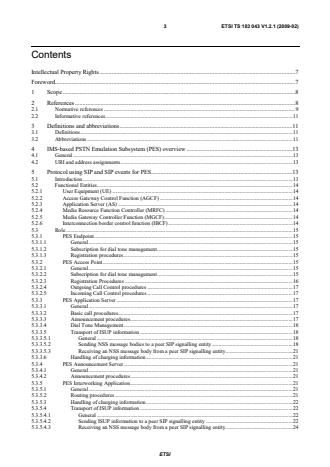
Contents
Intellectual Property Rights.7
Foreword.7
1 Scope.8
2 References.8
2.1 Normative references.9
2.2 Informative references.11
3 Definitions and abbreviations.11
3.1 Definitions.11
3.2 Abbreviations.11
4 IMS-based PSTN Emulation Subsystem (PES) overview .13
4.1 General.13
4.2 URI and address assignments.13
5 Protocol using SIP and SIP events for PES.13
5.1 Introduction.13
5.2 Functional Entities.14
5.2.1 User Equipment (UE) .14
5.2.2 Access Gateway Control Function (AGCF) .14
5.2.3 Application Server (AS).14
5.2.4 Media Resource Function Controller (MRFC) .14
5.2.5 Media Gateway Controller Function (MGCF).14
5.2.6 Interconnection border control function (IBCF).14
5.3 Role.15
5.3.1 PES Endpoint.15
5.3.1.1 General.15
5.3.1.2 Subscription for dial tone management.15
5.3.1.3 Registration procedures.15
5.3.2 PES Access Point.15
5.3.2.1 General.15
5.3.2.2 Subscription for dial tone management.15
5.3.2.3 Registration Procedures.16
5.3.2.4 Outgoing Call Control procedures .17
5.3.2.5 Incoming Call Control procedures .17
5.3.3 PES Application Server .17
5.3.3.1 General.17
5.3.3.2 Basic call procedures.17
5.3.3.3 Announcement procedures.17
5.3.3.4 Dial Tone Management.18
5.3.3.5 Transport of ISUP information .18
5.3.3.5.1 General.18
5.3.3.5.2 Sending NSS message bodies to a peer SIP signalling entity.18
5.3.3.5.3 Receiving an NSS message body from a peer SIP signalling entity.21
5.3.3.6 Handling of charging information.21
5.3.4 PES Announcement Server.21
5.3.4.1 General.21
5.3.4.2 Announcement procedures.21
5.3.5 PES Interworking Application.21
5.3.5.1 General.21
5.3.5.2 Routing procedures .21
5.3.5.3 Handling of charging information.22
5.3.5.4 Transport of ISUP information .22
5.3.5.4.1 General.22
5.3.5.4.2 Sending ISUP information to a peer SIP signalling entity .22
5.3.5.4.3 Receiving an NSS message body from a peer SIP signalling entity.24
ETSI
4 ETSI TS 183 043 V1.2.1 (2009-02)
5.3.5.4.4 ISUP messages for special consideration .25
5.3.5.5 Optional SIP/ISUP interworking procedures for PSTN Bridging.27
5.3.6 PES interconnection application.27
5.3.6.1 General.27
5.3.6.2 Procedures related to NSS message bodies.27
6 Protocol using SIP/SDP for PES.28
6.1 Introduction.28
6.2 Functional Entities.28
6.2.1 User Equipment (UE) .28
6.2.2 Access Gateway Control Function (AGCF) .28
6.2.3 Application Server (AS).28
6.2.4 Media Resource Function Controller (MRFC) .28
6.3 Roles.28
6.3.1 PES Endpoint.28
6.3.2 PES Access Point.28
6.3.2.1 General.28
6.3.2.2 Originating calls.28
6.3.2.3 Terminating calls.29
6.3.2.4 Modifying SDP within existing dialogues .29
6.3.3 PES Application Server .29
6.3.3.1 General.29
6.3.4 PES Announcement Server.30
6.3.4.1 General.30
7 Protocol using H.248 for PES .30
7.1 Introduction.30
7.2 Functional Entities.30
7.2.1 Access Gateway Control Function (AGCF) .30
7.2.2 Media Gateway Function (MGF).30
7.3 Roles.30
7.3.1 PES Access Point.30
7.3.1.1 General.30
7.3.1.2 Registration.30
7.3.1.3 Basic Session control procedures for analog lines .31
7.3.1.3.1 Originating side procedures.31
7.3.1.3.2 Terminating side procedures .34
7.3.1.4 Procedures for fax/modems calls over analog access.36
7.3.1.5 Message Waiting Indication.36
7.3.2 PES Media Gateway .36
Annex A (normative): XML document structure for Dial Tone Management .37
Annex B (normative): AGCF internal communication .38
B.1 General.38
B.2 Internal communication principles.38
B.3 Internal primitives .39
B.4 Feature manager behaviour .40
B.4.1 Registration procedures.40
B.4.1.1 Global registration procedures.40
B.4.1.2 Per line registration procedures .40
B.4.1.2.1 User-initiated registration.40
B.4.1.2.2 User-initiated deregistration.40
B.4.1.2.3 Exception procedures.41
B.4.2 Call Processing.41
B.4.2.1 General procedures.41
B.4.2.2 Flash-Hook Management.41
B.4.2.2.1 General rules.41
B.4.2.2.2 Loose coupling procedures .42
B.4.2.2.3 Tight coupling procedures.43
ETSI
5 ETSI TS 183 043 V1.2.1 (2009-02)
Annex C (informative): Implementation of Supplementary Services.45
C.1 General principles .45
C.1.1 Introduction.45
C.1.2 Supplementary service control.45
C.1.2.1 Service code commands.45
C.1.2.1.1 Command syntax.45
C.1.2.1.2 Generic procedure at the AGCF side .46
C.1.2.1.3 Generic procedure at the AS side.46
C.1.2.2 Switching order commands .46
C.1.3 Setting of initial filter criteria.47
C.1.4 Supplementary services using ISUP information.48
C.2 Advice of Charge .49
C.2.1 Actions at the Originating AGCF.49
C.2.2 Actions at the Originating AS .49
C.2.3 Actions at the Terminating AGCF .49
C.2.4 Actions at the Terminating AS .49
C.3 Anonymous Call Rejection .49
C.3.1 Actions at the Originating AGCF.49
C.3.2 Actions at the Originating AS .49
C.3.3 Actions at the Terminating AS .49
C.3.4 Actions at the Terminating AGCF .50
C.4 Automatic Call Return.50
C.4.1 Actions at the AGCF at the invoker side.50
C.4.2 Actions at the AS at the invoker side .50
C.5 Calling Line Identity Presentation / Restriction .50
C.5.1 Actions at the Originating AGCF.50
C.5.2 Actions at the Originating AS .50
C.5.3 Actions at the Terminating AS .51
C.5.4 Actions at the Terminating AGCF .51
C.6 Calling Name Delivery.51
C.6.1 Actions at the Originating AGCF.51
C.6.2 Actions at the Originating Application Server .51
C.6.3 Actions at the Terminating Application Server .51
C.6.4 Actions at the Terminating AGCF .51
C.7 Call Forwarding.52
C.7.1 Activation/Deactivation/Interrogation.52
C.7.1.1 Actions at the AGCF.52
C.7.1.2 Actions at the AS .52
C.7.2 Invocation.52
C.7.2.1 Actions at the Originating AGCF .52
C.7.2.2 Actions at the Originating AS.52
C.7.2.3 Actions at the Forwarding AS.52
C.7.2.4 Actions at the Forwarding AGCF .52
C.7.2.5 Actions at the Terminating AS .52
C.7.2.6 Actions at the Terminating AGCF.52
C.8 Distinctive Ringing .53
C.8.1 Actions at the Originating AGCF.53
C.8.2 Actions at the Originating Application Server .53
C.8.3 Actions at the Terminating Application Server .53
C.8.4 Actions at the Terminating AGCF .53
C.9 Call Waiting .53
C.9.1 General.53
C.9.1.1 Actions at the AGCF at the terminating side .53
C.9.1.2 Actions at the AS at the terminating side.54
C.9.2 Option 1 (Loose coupling) .54
C.9.2.1 Actions at the AGCF at the terminating side .54
ETSI
6 ETSI TS 183 043 V1.2.1 (2009-02)
C.9.2.2 Actions at the AS at the terminating side.55
C.9.3 Option 2 (Tight coupling).56
C.9.3.1 Actions at the AGCF at the terminating side .56
C.9.3.2 Actions at the AS at the terminating side.57
C.10 Incoming Call Barring.59
C.10.1 Activation/Deactivation/Interrogation.59
C.10.1.1 Actions at the AGCF.59
C.10.1.2 Actions at the AS .59
C.10.2 Invocation.59
C.10.2.1 Actions at the Originating AGCF .59
C.10.2.2 Actions at the Originating AS.59
C.10.2.3 Actions at the Terminating AS .59
C.10.2.4 Actions at the Terminating AGCF.59
C.11 Malicious Call Identification.59
C.11.1 Actions at the Originating AGCF.59
C.11.2 Actions at the Originating AS .59
C.11.3 Actions at the Terminating AS .60
C.11.4 Actions at the Terminating AGCF .60
C.12 Message Waiting Indicator.60
C.12.1 Actions at the AGCF .60
C.12.2 Actions at the AS.60
C.13 Outgoing Call Barring.60
C.13.1 Activation/Deactivation/Interrogation.60
C.13.1.1 Actions at the AGCF.60
C.13.1.2 Actions at the AS .60
C.13.2 Invocation.60
C.13.2.1 Actions at the Originating AGCF .60
C.13.2.2 Actions at the Originating AS.61
C.13.2.3 Actions at the Terminating AS .61
C.13.2.4 Actions at the Terminating AGCF.61
C.14 Three party service.61
C.14.1 General.61
C.14.1.1 Actions at the AGCF at the service invocation side .61
C.14.1.2 Actions at the AS at the service invocation side.62
C.14.2 Option 1 (Loose coupling) .63
C.14.2.1 Actions at the AGCF at the invoking side .63
C.14.2.2 Actions at the Originating AS at the invoking side.63
C.14.3 Option 2 (Tight coupling).64
C.14.3.1 Actions at the AGCF at the originating side .64
C.14.3.2 Actions at the Originating AS at the originating side .64
C.15 Repeat Last Call .64
C.15.1 AGCF at the served user side .64
C.15.2 AS at the served user side.64
Annex D (normative): Mapping between SIP and the subscriber line protocol.65
D.1 Introduction.65
D.2 Call Setup message.65
D.3 Message Waiting Indicator message .66
D.4 Advice of Charge message.67
Annex E (informative): Bibliography.68
Annex F (informative): Change history .69
History .70
ETSI
7 ETSI TS 183 043 V1.2.1 (2009-02)
Intellectual Property Rights
IPRs essential or potentially essential to the present document may have been declared to ETSI. The information
pertaining to these essential IPRs, if any, is publicly available for ETSI members and non-members, and can be found
in ETSI SR 000 314: "Intellectual Property Rights (IPRs); Essential, or potentially Essential, IPRs notified to ETSI in
respect of ETSI standards", which is available from the ETSI Secretariat. Latest updates are available on the ETSI Web
server (http://webapp.etsi.org/IPR/home.asp).
Pursuant to the ETSI IPR Policy, no investigation, including IPR searches, has been carried out by ETSI. No guarantee
can be given as to the existence of other IPRs not referenced in ETSI SR 000 314 (or the updates on the ETSI Web
server) which are, or may be, or may become, essential to the present document.
Foreword
This Technical Specification (TS) has been produced by ETSI Technical Committee Telecommunications and Internet
converged Services and Protocols for Advanced Networking (TISPAN).
ETSI
8 ETSI TS 183 043 V1.2.1 (2009-02)
1 Scope
The present document defines call control protocols and procedures for use in the IMS-based PSTN/ISDN Emulation
subsystem based on the Media Gateway Control Protocol (MEGACO), the Session Initiation Protocol (SIP), and the
associated Session Description Protocol (SDP).
NOTE: The present document relies on the architectural framework defined in TS 182 012 [3] for IMS-based
PES Emulation and may need to be updated once the open issues identified in the present document are
resolved.
The present document is applicable to:
• the interface between the User Equipment (UE) and the Call Session Control Function (CSCF);
• the interface between the Access Gateway Control Function (AGCF) and the Media Gateway Function
(MGF);
• the interface between the Access Gateway Control Function (AGCF) and the Call Session Control Function
(CSCF);
• the interface between the CSCF and any other CSCF;
• the interface between the CSCF and an Application Server (AS);
• the interface between the CSCF and the Media Gateway Control Function (MGCF);
• the interface between the S-CSCF and the Multimedia Resource Function Controller (MRFC);
• the interface between the CSCF and the Breakout Gateway Control Function (BGCF);
• the interface between the BGCF and the MGCF;
• the interface between the BGCF and any other BGCF;
• the interface between the CSCF and an external Multimedia IP network;
• the interface between the CSCF and the IBCF;
• the interface between the CSCF and the IBCF.
2 References
References are either specific (identified by date of publication and/or edition number or version number) or
non-specific.
• For a specific reference, subsequent revisions do not apply.
• Non-specific reference may be made only to a complete document or a part thereof and only in the following
cases:
- if it is accepted that it will be possible to use all future changes of the referenced document for the
purposes of the referring document;
- for informative references.
Referenced documents which are not found to be publicly available in the expected location might be found at
http://docbox.etsi.org/Reference.
NOTE: While any hyperlinks included in this clause were valid at the time of publication ETSI cannot guarantee
their long term validity.
ETSI
9 ETSI TS 183 043 V1.2.1 (2009-02)
2.1 Normative references
The following referenced documents are indispensable for the application of the present document. For dated
references, only the edition cited applies. For non-specific references, the latest edition of the referenced document
(including any amendments) applies.
[1] ETSI ES 282 001: "Telecommunications and Internet converged Services and Protocols for
Advanced Networking (TISPAN); NGN Functional Architecture Release 1".
[2] ETSI TS 182 006: "Telecommunications and Internet converged Services and Protocols for
Advanced Networking (TISPAN); IP Multimedia Subsystem (IMS); Stage 2 description
(3GPP TS 23.228 v7.2.0, modified)".
[3] ETSI TS 182 012: "Telecommunications and Internet converged Services and Protocols for
Advanced Networking (TISPAN); IMS-based PSTN/ISDN Emulation Subsystem; Functional
architecture".
[4] ETSI ES 283 003: "Telecommunications and Internet converged Services and Protocols for
Advanced Networking (TISPAN); IP Multimedia Call Control Protocol based on Session
Initiation Protocol (SIP) and Session Description Protocol (SDP) Stage 3
[3GPP TS 24.229 (Release 7), modified]".
[5] ETSI ES 283 002: "Telecommunications and Internet converged Services and Protocols for
Advanced Networking (TISPAN); NGN Release 1 H.248 Profile for controlling Access and
Residential Gateways".
[6] ETSI TS 183 028: "Telecommunications and Internet converged Services and Protocols for
Advanced Networking (TISPAN); Common Basic Communication procedures; Protocol
specification".
[7] ETSI TS 183 047: "Telecommunications and Internet converged Services and Protocols for
Advanced Networking (TISPAN); NGN IMS Supplementary Services; Advice of Charge (AoC)".
[8] ETSI TS 183 010: "Telecommunications and Internet converged Services and Protocols for
Advanced Networking (TISPAN); NGN Signalling Control Protocol; Communication HOLD
(HOLD) PSTN/ISDN simulation services; Protocol specification".
[9] ETSI TS 183 004: "Telecommunications and Internet converged Services and Protocols for
Advanced Networking (TISPAN); PSTN/ISDN simulation services: Communication Diversion
(CDIV); Protocol specification".
[10] ETSI ES 200 659-3: "Access and Terminals (AT); Analogue access to the Public Switched
Telephone Network (PSTN); Subscriber line protocol over the local loop for display (and related)
services; Part 3: Data link message and parameter codings".
[11] ETSI EG 201 973-2: "Access and Terminals (AT); Public Switched Telephone Network; Support
of legacy terminals by Broadband IP networks and equipment; Part 2: Analogue PSTN terminals".
[12] ETSI ETS 300 738: "Human Factors (HF); Minimum Man-Machine Interface (MMI) to public
network based supplementary services".
[13] ITU-T Recommendation H.248.23: "Gateway control protocol: Enhanced Alerting packages".
[14] ITU-T Recommendation H.248.26: "Gateway control protocol: Enhanced analog lines packages".
[15] IETF draft-ietf-sipping-config-framework-08: "A Framework for Session Initiation Protocol User
Agent Profile Delivery".
[16] IETF RFC 4240: "Basic Network Media Services with SIP".
[17] IETF RFC 2833: "RTP Payload for DTMF Digits, Telephony Tones and Telephony Signals".
[18] IETF RFC 3842: "A Message Summary and Message Waiting Indication Event Package for the
Session Initiation Protocol (SIP)".
ETSI
10 ETSI TS 183 043 V1.2.1 (2009-02)
[19] IETF RFC 3966: "The tel URI for Telephone Numbers".
[20] ETSI EN 383 001: "Telecommunications and Internet converged Services and Protocols for
Advanced Networking (TISPAN); Interworking between Session Initiation Protocol (SIP) and
Bearer Independent Call Control (BICC) Protocol or ISDN User Part (ISUP) [ITU-T
Recommendation Q.1912.5, modified]".
[21] IETF RFC 2805: "Media Gateway Control Protocol Architecture and Requirements".
[22] ITU-T Recommendation H.248.1: "Gateway control protocol".
[23] ITU-T Recommendation G.711: "Pulse code modulation (PCM) of voice frequencies".
[24] IETF RFC 3323: "A Privacy Mechanism for the Session Initiation Protocol (SIP)".
[25] IETF RFC 3325: "Private Extensions to the Session Initiation Protocol (SIP) for Asserted Identity
within Trusted Networks".
[26] ETSI TS 183 006: "Telecommunications and Internet converged Services and Protocols for
Advanced Networking (TISPAN); PSTN/ISDN simulation services; Message Waiting Indication
(MWI): Protocol specification".
[27] ETSI TS 183 011: "Telecommunications and Internet converged Services and Protocols for
Advanced Networking (TISPAN); PSTN/ISDN simulation services: Anonymous Communication
Rejection (ACR) and Communication Barring (CB); Protocol specification".
[28] ETSI ES 282 010: "Telecommunications and Internet converged Services and Protocols for
Advanced Networking (TISPAN); Charging [Endorsement of 3GPP TS 32.240 v6.3.0,
3GPP TS 32.260 v6.3.0, 3GPP TS 32.297 v6.1.0, 3GPP TS 32.298 v6.1.0 and 3GPP TS 32.299
v6.4.0 modified]".
[29] IETF RFC 3311: "The Session Ini
...
Questions, Comments and Discussion
Ask us and Technical Secretary will try to provide an answer. You can facilitate discussion about the standard in here.
Loading comments...