

ETSI EN 303 105-1 V1.1.1 (2022-03)
Digital Video Broadcasting (DVB); Next Generation broadcasting system to Handheld, physical layer specification (DVB-NGH); Part 1: Base Profile
General Information
- Abstract
DEN/JTC-DVB-373-1
- Status
- Not Published
- Technical Committee
- BROADCAS - EBU/CENELEC/ETSI on Broadcasting
- Current Stage
- 12 - Completion
- Due Date
- 07-Apr-2022
- Completion Date
- 29-Mar-2022
Buy Documents
ETSI EN 303 105-1 V1.0.3 (2021-12) - Digital Video Broadcasting (DVB); Next Generation broadcasting system to Handheld, physical layer specification (DVB-NGH); Part 1: Base Profile
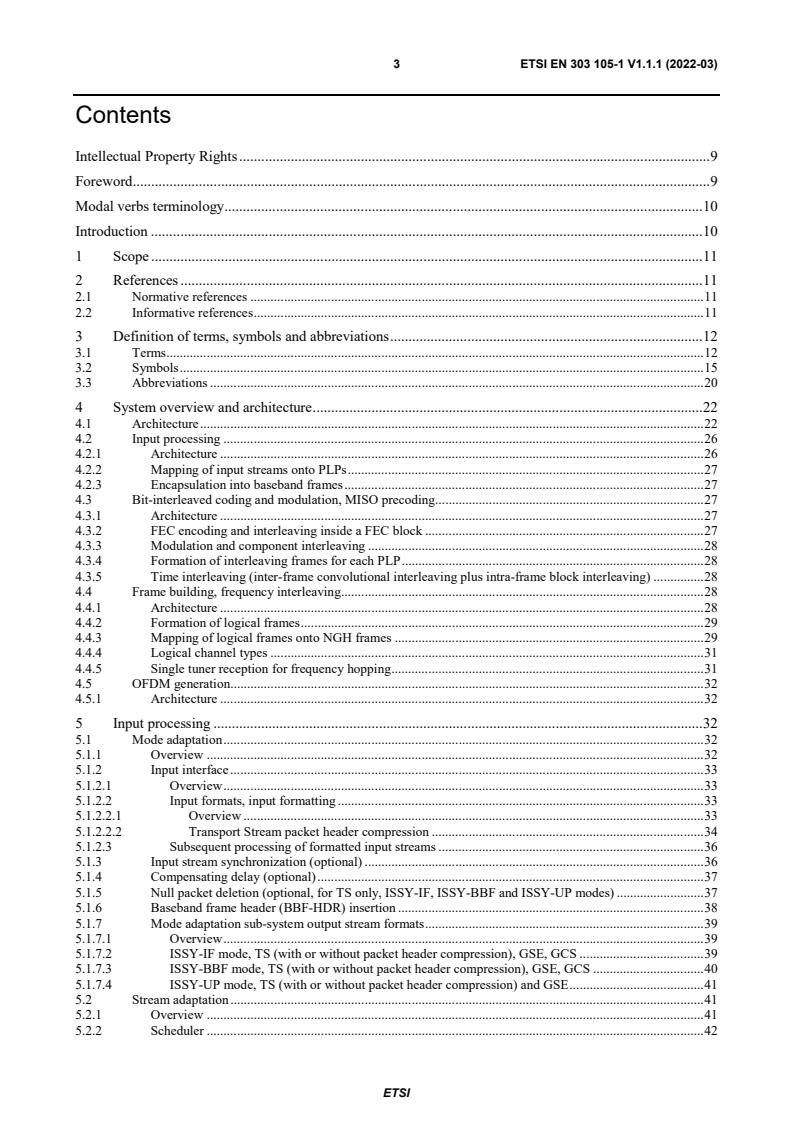
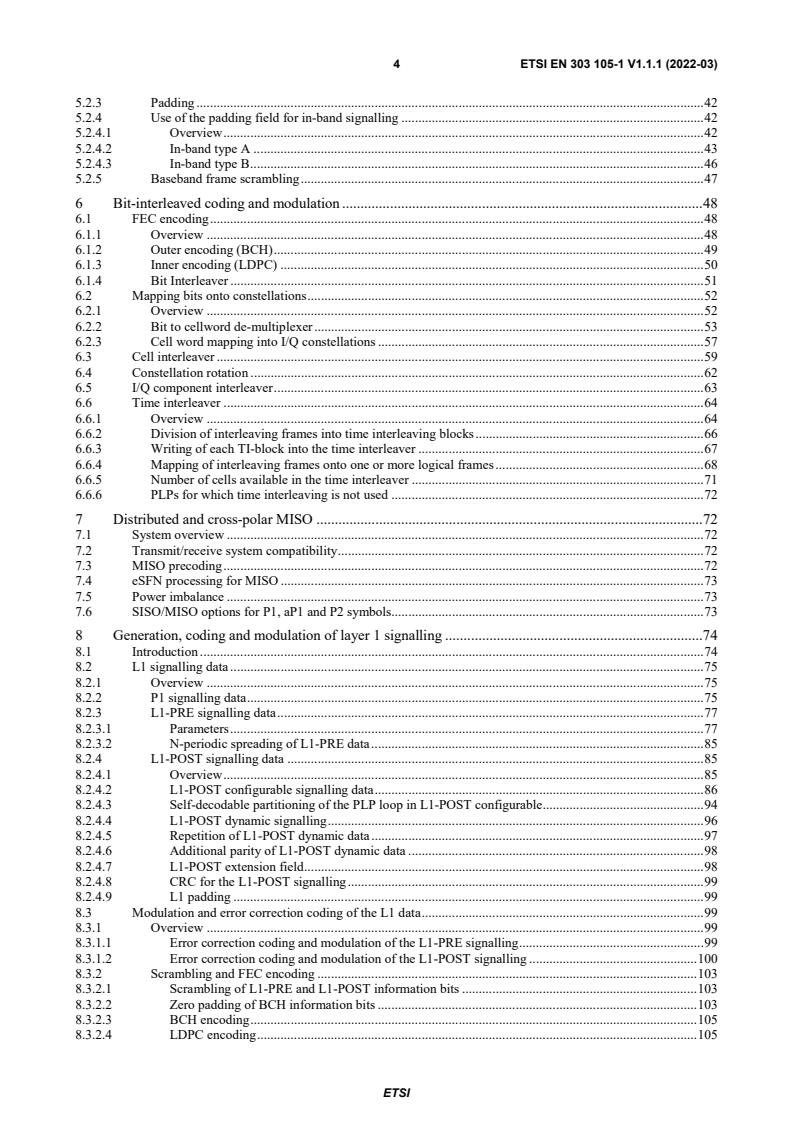
ETSI EN 303 105-1 V1.1.1 (2022-03) - Digital Video Broadcasting (DVB); Next Generation broadcasting system to Handheld, physical layer specification (DVB-NGH); Part 1: Base Profile

ETSI EN 303 105-1 V1.1.1 (2022-03) - Overview (DVB-NGH Base Profile)
Standard reference: ETSI EN 303 105-1 V1.1.1 (2022-03) (identical to ETSI EN 303 105-1 V1.1.1 (2022-03))
Title: Digital Video Broadcasting (DVB) - Next Generation broadcasting system to Handheld, physical layer specification (DVB‑NGH) - Part 1: Base Profile
Organization: SIST / ETSI
This standard specifies the complete physical layer for the DVB‑NGH next‑generation system for broadcasting to handheld terminals over terrestrial and hybrid (terrestrial + satellite) networks. It covers the processing chain from input streams (Transport Streams or generic data) through modulation and signalling to the transmitted RF waveform. DVB‑NGH is intended for linear and non‑linear services (TV, radio, data) and includes compatibility considerations with DVB‑T2‑lite receivers.
Key technical topics and requirements
- Input processing and mode adaptation: Mapping of input streams to Physical Layer Pipes (PLPs), baseband frame construction, optional TS packet header compression and null packet deletion.
- Bit‑interleaved coding and modulation (BICM): Outer and inner FEC structure including BCH outer codes and LDPC inner codes; bit interleaving and mapping to constellation symbols.
- Constellation and cell mapping: Bit-to-cellword mapping, I/Q constellation mapping, constellation rotation and component interleaving.
- Time and frequency interleaving: Multi‑stage interleaving (intra‑frame and inter‑frame) to improve robustness for mobile/handheld reception.
- OFDM generation and frame building: Logical frame formation, NGH frame mapping and OFDM symbol generation for terrestrial/hybrid transmissions.
- Distributed and cross‑polar MISO/MIMO: MISO precoding, eSFN considerations and SISO/MISO options for signaling symbols to support multi‑antenna and cross‑polar deployments.
- Layer‑1 signalling (L1): P1, L1‑PRE and L1‑POST signalling structures to convey system configuration and PLP metadata to receivers.
- Practical features: Support for single‑tuner reception with frequency hopping, in‑band signalling, baseband frame scrambling and padding mechanisms.
Practical applications and users
Who uses this standard:
- Broadcasters and network operators deploying next‑generation terrestrial or hybrid services to handheld devices.
- Chipset and receiver manufacturers designing DVB‑NGH compliant demodulators and front‑end hardware.
- System integrators and test laboratories validating physical‑layer interoperability and performance.
- Regulators and spectrum planners assessing next‑generation mobile broadcast deployments.
Practical applications:
- Delivery of robust TV, radio and data services to mobile and handheld receivers.
- Hybrid terrestrial + satellite broadcast networks providing wider coverage and service continuity.
- Low‑power, mobile‑optimized broadcast profiles compatible with legacy DVB‑T2‑lite devices.
Related standards
- ETSI EN 303 105‑1 (DVB‑NGH Part 1) - identical reference
- DVB‑T2 and DVB‑T2‑lite (related DVB physical‑layer specifications) - for compatibility context
Keywords: DVB‑NGH, DVB, digital broadcasting, physical layer, handheld, terrestrial broadcasting, hybrid satellite, OFDM, LDPC, BCH, MISO, PLP, transport stream.
Buy Documents
ETSI EN 303 105-1 V1.0.3 (2021-12) - Digital Video Broadcasting (DVB); Next Generation broadcasting system to Handheld, physical layer specification (DVB-NGH); Part 1: Base Profile
ETSI EN 303 105-1 V1.1.1 (2022-03) - Digital Video Broadcasting (DVB); Next Generation broadcasting system to Handheld, physical layer specification (DVB-NGH); Part 1: Base Profile
Frequently Asked Questions
ETSI EN 303 105-1 V1.1.1 (2022-03) is a standard published by the European Telecommunications Standards Institute (ETSI). Its full title is "Digital Video Broadcasting (DVB); Next Generation broadcasting system to Handheld, physical layer specification (DVB-NGH); Part 1: Base Profile". This standard covers: DEN/JTC-DVB-373-1
DEN/JTC-DVB-373-1
ETSI EN 303 105-1 V1.1.1 (2022-03) is available in PDF format for immediate download after purchase. The document can be added to your cart and obtained through the secure checkout process. Digital delivery ensures instant access to the complete standard document.
Standards Content (Sample)
Draft ETSI EN 303 105-1 V1.0.3 (2021-12)
EUROPEAN STANDARD
Digital Video Broadcasting (DVB);
Next Generation broadcasting system to Handheld,
physical layer specification (DVB-NGH);
Part 1: Base Profile
2 Draft ETSI EN 303 105-1 V1.0.3 (2021-12)
Reference
DEN/JTC-DVB-373-1
Keywords
audio, broadcasting, data, digital, DVB, hybrid,
MIMO, MPEG, radio, satellite, terrestrial, TV, video
ETSI
650 Route des Lucioles
F-06921 Sophia Antipolis Cedex - FRANCE
Tel.: +33 4 92 94 42 00 Fax: +33 4 93 65 47 16
Siret N° 348 623 562 00017 - APE 7112B
Association à but non lucratif enregistrée à la
Sous-Préfecture de Grasse (06) N° w061004871
Important notice
The present document can be downloaded from:
http://www.etsi.org/standards-search
The present document may be made available in electronic versions and/or in print. The content of any electronic and/or
print versions of the present document shall not be modified without the prior written authorization of ETSI. In case of any
existing or perceived difference in contents between such versions and/or in print, the prevailing version of an ETSI
deliverable is the one made publicly available in PDF format at www.etsi.org/deliver.
Users of the present document should be aware that the document may be subject to revision or change of status.
Information on the current status of this and other ETSI documents is available at
https://portal.etsi.org/TB/ETSIDeliverableStatus.aspx
If you find errors in the present document, please send your comment to one of the following services:
https://portal.etsi.org/People/CommiteeSupportStaff.aspx
Notice of disclaimer & limitation of liability
The information provided in the present deliverable is directed solely to professionals who have the appropriate degree of
experience to understand and interpret its content in accordance with generally accepted engineering or
other professional standard and applicable regulations.
No recommendation as to products and services or vendors is made or should be implied.
In no event shall ETSI be held liable for loss of profits or any other incidental or consequential damages.
Any software contained in this deliverable is provided "AS IS" with no warranties, express or implied, including but not
limited to, the warranties of merchantability, fitness for a particular purpose and non-infringement of intellectual property
rights and ETSI shall not be held liable in any event for any damages whatsoever (including, without limitation, damages
for loss of profits, business interruption, loss of information, or any other pecuniary loss) arising out of or related to the use
of or inability to use the software.
Copyright Notification
No part may be reproduced or utilized in any form or by any means, electronic or mechanical, including photocopying and
microfilm except as authorized by written permission of ETSI.
The content of the PDF version shall not be modified without the written authorization of ETSI.
The copyright and the foregoing restriction extend to reproduction in all media.
© ETSI 2021.
© European Broadcasting Union 2021.
All rights reserved.
ETSI
3 Draft ETSI EN 303 105-1 V1.0.3 (2021-12)
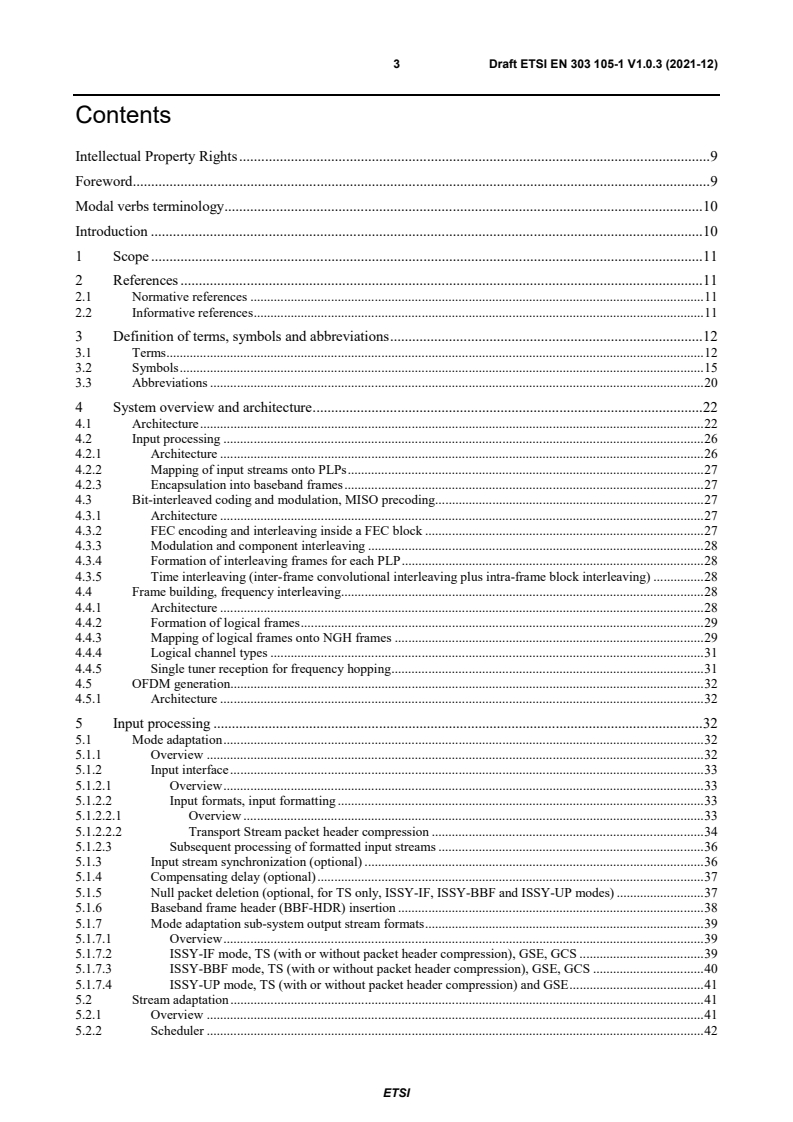
Contents
Intellectual Property Rights . 9
Foreword . 9
Modal verbs terminology . 10
Introduction . 10
1 Scope . 11
2 References . 11
2.1 Normative references . 11
2.2 Informative references . 11
3 Definition of terms, symbols and abbreviations . 12
3.1 Terms . 12
3.2 Symbols . 15
3.3 Abbreviations . 20
4 System overview and architecture . 22
4.1 Architecture . 22
4.2 Input processing . 26
4.2.1 Architecture . 26
4.2.2 Mapping of input streams onto PLPs . 27
4.2.3 Encapsulation into baseband frames . 27
4.3 Bit-interleaved coding and modulation, MISO precoding . 27
4.3.1 Architecture . 27
4.3.2 FEC encoding and interleaving inside a FEC block . 27
4.3.3 Modulation and component interleaving . 28
4.3.4 Formation of interleaving frames for each PLP . 28
4.3.5 Time interleaving (inter-frame convolutional interleaving plus intra-frame block interleaving) . 28
4.4 Frame building, frequency interleaving . 28
4.4.1 Architecture . 28
4.4.2 Formation of logical frames . 29
4.4.3 Mapping of logical frames onto NGH frames . 29
4.4.4 Logical channel types . 31
4.4.5 Single tuner reception for frequency hopping . 31
4.5 OFDM generation. 32
4.5.1 Architecture . 32
5 Input processing . 32
5.1 Mode adaptation . 32
5.1.1 Overview . 32
5.1.2 Input interface . 33
5.1.2.1 Overview . 33
5.1.2.2 Input formats, input formatting . 33
5.1.2.2.1 Overview . 33
5.1.2.2.2 Transport Stream packet header compression . 34
5.1.2.3 Subsequent processing of formatted input streams . 36
5.1.3 Input stream synchronization (optional) . 36
5.1.4 Compensating delay (optional) . 37
5.1.5 Null packet deletion (optional, for TS only, ISSY-IF, ISSY-BBF and ISSY-UP modes) . 37
5.1.6 Baseband frame header (BBF-HDR) insertion . 38
5.1.7 Mode adaptation sub-system output stream formats . 39
5.1.7.1 Overview . 39
5.1.7.2 ISSY-IF mode, TS (with or without packet header compression), GSE, GCS . 39
5.1.7.3 ISSY-BBF mode, TS (with or without packet header compression), GSE, GCS . 40
5.1.7.4 ISSY-UP mode, TS (with or without packet header compression) and GSE . 41
5.2 Stream adaptation . 41
5.2.1 Overview . 41
5.2.2 Scheduler . 42
ETSI
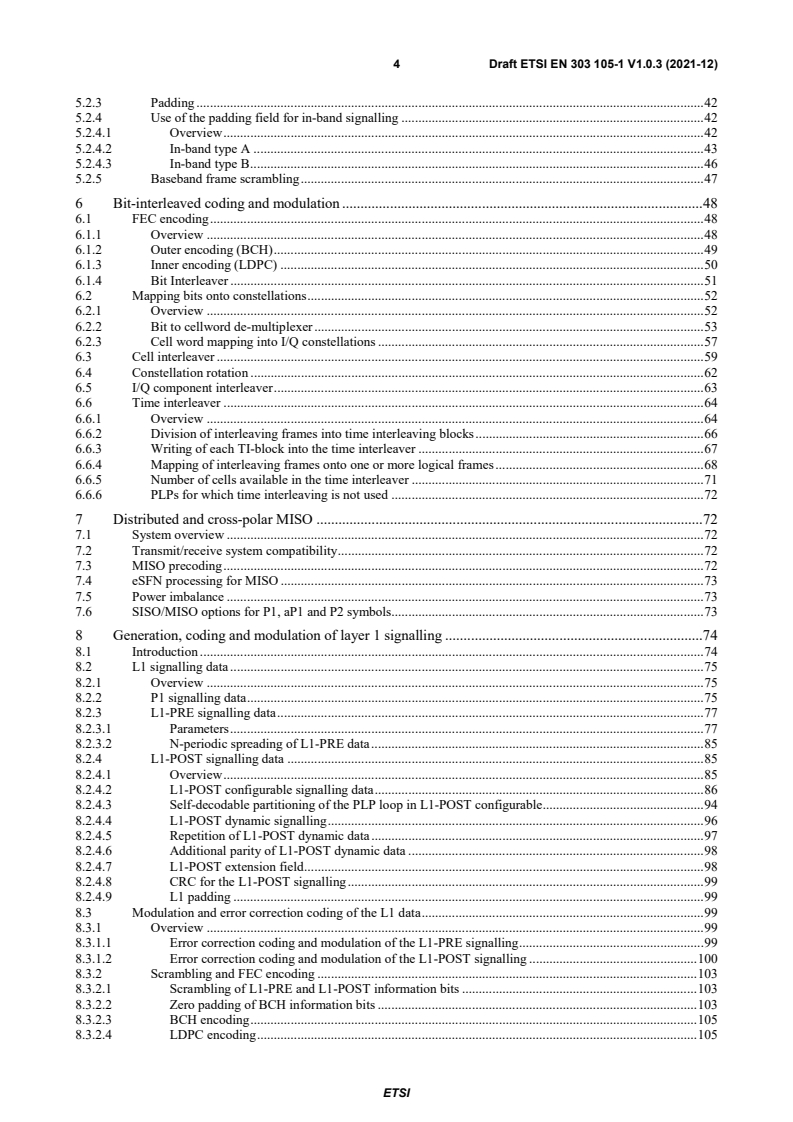
4 Draft ETSI EN 303 105-1 V1.0.3 (2021-12)
5.2.3 Padding . 42
5.2.4 Use of the padding field for in-band signalling . 42
5.2.4.1 Overview . 42
5.2.4.2 In-band type A . 43
5.2.4.3 In-band type B . 46
5.2.5 Baseband frame scrambling . 47
6 Bit-interleaved coding and modulation . 48
6.1 FEC encoding . 48
6.1.1 Overview . 48
6.1.2 Outer encoding (BCH) . 49
6.1.3 Inner encoding (LDPC) . 50
6.1.4 Bit Interleaver . 51
6.2 Mapping bits onto constellations . 52
6.2.1 Overview . 52
6.2.2 Bit to cellword de-multiplexer . 53
6.2.3 Cell word mapping into I/Q constellations . 57
6.3 Cell interleaver . 59
6.4 Constellation rotation . 62
6.5 I/Q component interleaver . 63
6.6 Time interleaver . 64
6.6.1 Overview . 64
6.6.2 Division of interleaving frames into time interleaving blocks . 66
6.6.3 Writing of each TI-block into the time interleaver . 67
6.6.4 Mapping of interleaving frames onto one or more logical frames . 68
6.6.5 Number of cells available in the time interleaver . 71
6.6.6 PLPs for which time interleaving is not used . 72
7 Distributed and cross-polar MISO . 72
7.1 System overview . 72
7.2 Transmit/receive system compatibility . 72
7.3 MISO precoding . 72
7.4 eSFN processing for MISO . 73
7.5 Power imbalance . 73
7.6 SISO/MISO options for P1, aP1 and P2 symbols. 73
8 Generation, coding and modulation of layer 1 signalling . 74
8.1 Introduction . 74
8.2 L1 signalling data . 75
8.2.1 Overview . 75
8.2.2 P1 signalling data . 75
8.2.3 L1-PRE signalling data . 77
8.2.3.1 Parameters . 77
8.2.3.2 N-periodic spreading of L1-PRE data . 85
8.2.4 L1-POST signalling data . 85
8.2.4.1 Overview . 85
8.2.4.2 L1-POST configurable signalling data . 86
8.2.4.3 Self-decodable partitioning of the PLP loop in L1-POST configurable . 94
8.2.4.4 L1-POST dynamic signalling . 96
8.2.4.5 Repetition of L1-POST dynamic data . 97
8.2.4.6 Additional parity of L1-POST dynamic data . 98
8.2.4.7 L1-POST extension field . 98
8.2.4.8 CRC for the L1-POST signalling . 99
8.2.4.9 L1 padding . 99
8.3 Modulation and error correction coding of the L1 data . 99
8.3.1 Overview . 99
8.3.1.1 Error correction coding and modulation of the L1-PRE signalling . 99
8.3.1.2 Error correction coding and modulation of the L1-POST signalling . 100
8.3.2 Scrambling and FEC encoding . 103
8.3.2.1 Scrambling of L1-PRE and L1-POST information bits . 103
8.3.2.2 Zero padding of BCH information bits . 103
8.3.2.3 BCH encoding . 105
8.3.2.4 LDPC encoding . 105
ETSI
5 Draft ETSI EN 303 105-1 V1.0.3 (2021-12)
8.3.2.4.1 Introduction . 105
8.3.2.4.2 LDPC encoding for L1-PRE . 106
8.3.2.4.3 LDPC encoding for L1-POST . 106
8.3.2.5 Puncturing of LDPC parity bits . 108
8.3.2.5.1 Puncturing of LDPC parity bits for L1-PRE . 108
8.3.2.5.2 Puncturing of LDPC parity bits for L1-POST . 110
8.3.2.6 Generation of additional parity for L1-POST signalling . 111
8.3.2.7 Removal of zero padding bits. 112
8.3.2.8 Bit interleaving for L1-POST signalling . 112
8.3.3 Mapping bits onto constellations . 113
8.3.3.1 Overview . 113
8.3.3.2 Mapping of L1-PRE signalling . 113
8.3.3.3 Demultiplexing of L1-POST signalling . 114
8.3.3.4 Mapping into I/Q constellations . 115
9 Frames . 115
9.1 Frame builder . 115
9.2 Logical frame structure . 116
9.2.1 Overview . 116
9.2.2 Signalling of the logical frame . 117
9.2.3 Mapping the PLPs onto logical frames . 117
9.2.3.1 Overview . 117
9.2.3.2 Allocating the cells at the output of the time interleaver for a given PLP . 117
9.2.3.3 Allocating the cells of the PLPs . 118
9.2.3.3.1 Overview . 118
9.2.3.3.2 Allocating the cells of the common and type 1 PLPs . 118
9.2.3.3.3 Allocating the cells of type 2 PLPs. 119
9.2.3.3.4 Allocation of cells positions in the logical frame for each of the type 2 PLPs . 119
9.2.3.3.5 Mapping of the time interleaver output cells for each type 2 PLP, together with any padding,
to the allocated cell positions in the logical frame . 122
9.2.3.3.6 Allocating the cells of type 3 PLPs. 123
9.2.3.3.7 Allocating the cells of type 4 PLPs. 123
9.2.4 Auxiliary stream insertion . 124
9.2.5 Dummy cell insertion. 124
9.3 Logical super-frame structure . 124
9.4 Logical channel structure . 125
9.4.1 Overview . 125
9.4.2 Logical channel type A . 125
9.4.3 Logical channel type B . 126
9.4.4 Logical channel type C . 126
9.4.5 Logical channel type D . 126
9.4.6 Logical channel group . 127
9.5 Mapping of logical channels to NGH frames . 127
9.5.1 Overview . 127
9.5.2 Mapping for logical channels type A . 127
9.5.3 Mapping for logical channels type B . 128
9.5.4 Mapping for logical channels type C . 128
9.5.5 Mapping for logical channels type D . 128
9.5.6 Restrictions on frame structure to allow tuner switching time for logical channels of types C and D . 128
9.6 NGH frame structure . 129
9.7 Super-frame . 130
9.8 NGH frame . 131
9.8.1 Overview . 131
9.8.2 Duration of the NGH frame . 131
9.8.3 Capacity and structure of the NGH frame . 132
9.8.4 Mapping of L1-PRE signalling information to P2 symbol(s) . 134
9.8.4.1 Introduction . 134
9.8.4.2 Addressing of OFDM cells . 135
9.8.5 Dummy cell insertion. 136
9.8.6 Insertion of unmodulated cells in the frame closing symbol . 137
9.9 Future Extension Frames (FEFs) . 137
9.10 Frequency interleaver . 137
ETSI
6 Draft ETSI EN 303 105-1 V1.0.3 (2021-12)
10 Local service insertion. 144
10.1 Orthogonal-Local Service Insertion (O-LSI). 144
10.1.1 Overview . 144
10.1.2 O-LSI symbols and data cells . 144
10.1.2.1 Overview . 144
10.1.2.2 Power level of the O-LSI data cells . 144
10.1.2.3 Filling of O-LSI symbols with LF data cells . 145
10.1.3 O-LSI scattered pilot patterns . 145
10.1.3.1 Location of O-LSI scattered pilot patterns . 145
10.1.3.2 Power level of scattered pilot cells . 145
10.1.3.3 Modulation of scattered pilot cells . 145
10.1.4 O-LSI continual pilots . 146
10.1.4.1 Overview . 146
10.1.4.2 Location of O-LSI CPs . 146
10.1.4.3 Power level of CP cells . 146
10.1.4.4 Modulation of continual pilot cells . 146
10.1.5 Normalization factor K . 146
10.2 Hierarchical local service insertion (H-LSI). 147
10.2.1 Introduction. 147
10.2.2 Overview . 147
10.2.3 L1 signalling for hierarchical local service . 148
10.2.4 LS burst header encoding . 148
10.2.4.1 Basic signalling . 148
10.2.4.2 LS burst header coding . 149
10.2.4.3 Cyclic delay. 150
10.2.4.4 Scrambling of the lower branch . 150
10.2.5 Frequency interleaving of local service cells . 150
10.2.6 Insertion of local service pilots . 151
10.2.6.1 Overview . 151
10.2.6.2 Location of local service pilot cells . 151
10.2.6.3 Amplitude of local service pilot . 151
10.2.7 Hierarchical modulator . 151
11 OFDM generation . 153
11.1 Overview . 153
11.2 Pilot insertion . 154
11.2.1 Introduction. 154
11.2.2 Definition of the reference sequence . 154
11.2.2.1 Introduction . 154
11.2.2.2 Symbol level . 155
11.2.2.3 Frame level . 155
11.2.3 Scattered pilot insertion . 156
11.2.3.1 Overview . 156
11.2.3.2 Locations of the scattered pilots . 156
11.2.3.3 Amplitudes of the scattered pilots . 157
11.2.3.4 Modulation of the scattered pilots . 157
11.2.4 Continual pilot insertion . 158
11.2.4.1 Overview . 158
11.2.4.2 Locations of the continual pilots . 158
11.2.4.3 Locations of additional continual pilots in extended carrier mode . 158
11.2.4.4 Amplitudes of the continual pilots . 158
11.2.4.5 Modulation of the continual pilots . 158
11.2.5 Edge pilot insertion . 159
11.2.6 P2 pilot insertion . 159
11.2.6.1 Locations of the P2 pilots . 159
11.2.6.2 Amplitudes of the P2 pilots . 159
11.2.6.3 Modulation of the P2 pilots . 159
11.2.7 Insertion of frame closing pilots . 159
11.2.7.1 Introduction . 159
11.2.7.2 Locations of the frame closing pilots . 160
11.2.7.3 Amplitudes of the frame closing pilots . 160
11.2.7.4 Modulation of the frame closing pilots . 160
ETSI
7 Draft ETSI EN 303 105-1 V1.0.3 (2021-12)
11.2.8 Amplitudes of pilots in the presence of intentional power imbalance (SISO) . 160
11.2.9 Modification of the pilots for MIXO . 161
11.2.10 Amplitudes of pilots in the presence of intentional power imbalance (MIXO) . 162
11.3 Tone reservation . 162
11.4 Mapping of data cells to OFDM carriers . 163
11.5 IFFT - OFDM Modulation . 163
11.5.1 Introduction. 163
11.5.2 eSFN processing . 165
11.6 PAPR reduction . 166
11.6.1 Overview . 166
11.6.2 Active Constellation Extension (ACE) . 166
11.6.3 PAPR reduction using tone reservation . 168
11.6.3.1 Introduction . 168
11.6.3.2 Algorithm of PAPR reduction using tone reservation . 168
11.7 Guard interval insertion . 169
11.8 P1 symbol insertion . 170
11.8.1 P1 symbol overview. 170
11.8.2 P1 symbol description . 170
11.8.2.1 Introduction . 170
11.8.2.2 Carrier distribution in P1 symbol . 171
11.8.2.3 Modulation of the active carriers in P1 . 172
11.8.2.4 Boosting of the active Carriers . 174
11.8.2.5 Generation of the time domain P1 signal . 174
11.8.2.5.1 Generation of the main part of the P1 signal . 174
11.8.2.5.2 Frequency-shifted repetition in guard intervals . 175
11.8.3 Additional P1 (aP1) symbol . 175
11.8.3.1 aP1 symbol overview . 175
11.8.3.2 aP1 symbol description . 175
11.8.3.2.1 Overview . 175
11.8.3.2.2 aP1 scrambling sequence . 176
11.8.3.2.3 Frequen
...
EUROPEAN STANDARD
Digital Video Broadcasting (DVB);
Next Generation broadcasting system to Handheld,
physical layer specification (DVB-NGH);
Part 1: Base Profile
2 ETSI EN 303 105-1 V1.1.1 (2022-03)
Reference
DEN/JTC-DVB-373-1
Keywords
audio, broadcasting, data, digital, DVB, hybrid,
MIMO, MPEG, radio, satellite, terrestrial, TV, video
ETSI
650 Route des Lucioles
F-06921 Sophia Antipolis Cedex - FRANCE
Tel.: +33 4 92 94 42 00 Fax: +33 4 93 65 47 16
Siret N° 348 623 562 00017 - APE 7112B
Association à but non lucratif enregistrée à la
Sous-Préfecture de Grasse (06) N° w061004871
Important notice
The present document can be downloaded from:
http://www.etsi.org/standards-search
The present document may be made available in electronic versions and/or in print. The content of any electronic and/or
print versions of the present document shall not be modified without the prior written authorization of ETSI. In case of any
existing or perceived difference in contents between such versions and/or in print, the prevailing version of an ETSI
deliverable is the one made publicly available in PDF format at www.etsi.org/deliver.
Users of the present document should be aware that the document may be subject to revision or change of status.
Information on the current status of this and other ETSI documents is available at
https://portal.etsi.org/TB/ETSIDeliverableStatus.aspx
If you find errors in the present document, please send your comment to one of the following services:
https://portal.etsi.org/People/CommiteeSupportStaff.aspx
If you find a security vulnerability in the present document, please report it through our
Coordinated Vulnerability Disclosure Program:
https://www.etsi.org/standards/coordinated-vulnerability-disclosure
Notice of disclaimer & limitation of liability
The information provided in the present deliverable is directed solely to professionals who have the appropriate degree of
experience to understand and interpret its content in accordance with generally accepted engineering or
other professional standard and applicable regulations.
No recommendation as to products and services or vendors is made or should be implied.
In no event shall ETSI be held liable for loss of profits or any other incidental or consequential damages.
Any software contained in this deliverable is provided "AS IS" with no warranties, express or implied, including but not
limited to, the warranties of merchantability, fitness for a particular purpose and non-infringement of intellectual property
rights and ETSI shall not be held liable in any event for any damages whatsoever (including, without limitation, damages
for loss of profits, business interruption, loss of information, or any other pecuniary loss) arising out of or related to the use
of or inability to use the software.
Copyright Notification
No part may be reproduced or utilized in any form or by any means, electronic or mechanical, including photocopying and
microfilm except as authorized by written permission of ETSI.
The content of the PDF version shall not be modified without the written authorization of ETSI.
The copyright and the foregoing restriction extend to reproduction in all media.
© ETSI 2022.
© European Broadcasting Union 2022.
All rights reserved.
ETSI
3 ETSI EN 303 105-1 V1.1.1 (2022-03)
Contents
Intellectual Property Rights . 9
Foreword . 9
Modal verbs terminology . 10
Introduction . 10
1 Scope . 11
2 References . 11
2.1 Normative references . 11
2.2 Informative references . 11
3 Definition of terms, symbols and abbreviations . 12
3.1 Terms . 12
3.2 Symbols . 15
3.3 Abbreviations . 20
4 System overview and architecture . 22
4.1 Architecture . 22
4.2 Input processing . 26
4.2.1 Architecture . 26
4.2.2 Mapping of input streams onto PLPs . 27
4.2.3 Encapsulation into baseband frames . 27
4.3 Bit-interleaved coding and modulation, MISO precoding . 27
4.3.1 Architecture . 27
4.3.2 FEC encoding and interleaving inside a FEC block . 27
4.3.3 Modulation and component interleaving . 28
4.3.4 Formation of interleaving frames for each PLP . 28
4.3.5 Time interleaving (inter-frame convolutional interleaving plus intra-frame block interleaving) . 28
4.4 Frame building, frequency interleaving . 28
4.4.1 Architecture . 28
4.4.2 Formation of logical frames . 29
4.4.3 Mapping of logical frames onto NGH frames . 29
4.4.4 Logical channel types . 31
4.4.5 Single tuner reception for frequency hopping . 31
4.5 OFDM generation. 32
4.5.1 Architecture . 32
5 Input processing . 32
5.1 Mode adaptation . 32
5.1.1 Overview . 32
5.1.2 Input interface . 33
5.1.2.1 Overview . 33
5.1.2.2 Input formats, input formatting . 33
5.1.2.2.1 Overview . 33
5.1.2.2.2 Transport Stream packet header compression . 34
5.1.2.3 Subsequent processing of formatted input streams . 36
5.1.3 Input stream synchronization (optional) . 36
5.1.4 Compensating delay (optional) . 37
5.1.5 Null packet deletion (optional, for TS only, ISSY-IF, ISSY-BBF and ISSY-UP modes) . 37
5.1.6 Baseband frame header (BBF-HDR) insertion . 38
5.1.7 Mode adaptation sub-system output stream formats . 39
5.1.7.1 Overview . 39
5.1.7.2 ISSY-IF mode, TS (with or without packet header compression), GSE, GCS . 39
5.1.7.3 ISSY-BBF mode, TS (with or without packet header compression), GSE, GCS . 40
5.1.7.4 ISSY-UP mode, TS (with or without packet header compression) and GSE . 41
5.2 Stream adaptation . 41
5.2.1 Overview . 41
5.2.2 Scheduler . 42
ETSI
4 ETSI EN 303 105-1 V1.1.1 (2022-03)
5.2.3 Padding . 42
5.2.4 Use of the padding field for in-band signalling . 42
5.2.4.1 Overview . 42
5.2.4.2 In-band type A . 43
5.2.4.3 In-band type B . 46
5.2.5 Baseband frame scrambling . 47
6 Bit-interleaved coding and modulation . 48
6.1 FEC encoding . 48
6.1.1 Overview . 48
6.1.2 Outer encoding (BCH) . 49
6.1.3 Inner encoding (LDPC) . 50
6.1.4 Bit Interleaver . 51
6.2 Mapping bits onto constellations . 52
6.2.1 Overview . 52
6.2.2 Bit to cellword de-multiplexer . 53
6.2.3 Cell word mapping into I/Q constellations . 57
6.3 Cell interleaver . 59
6.4 Constellation rotation . 62
6.5 I/Q component interleaver . 63
6.6 Time interleaver . 64
6.6.1 Overview . 64
6.6.2 Division of interleaving frames into time interleaving blocks . 66
6.6.3 Writing of each TI-block into the time interleaver . 67
6.6.4 Mapping of interleaving frames onto one or more logical frames . 68
6.6.5 Number of cells available in the time interleaver . 71
6.6.6 PLPs for which time interleaving is not used . 72
7 Distributed and cross-polar MISO . 72
7.1 System overview . 72
7.2 Transmit/receive system compatibility . 72
7.3 MISO precoding . 72
7.4 eSFN processing for MISO . 73
7.5 Power imbalance . 73
7.6 SISO/MISO options for P1, aP1 and P2 symbols. 73
8 Generation, coding and modulation of layer 1 signalling . 74
8.1 Introduction . 74
8.2 L1 signalling data . 75
8.2.1 Overview . 75
8.2.2 P1 signalling data . 75
8.2.3 L1-PRE signalling data . 77
8.2.3.1 Parameters . 77
8.2.3.2 N-periodic spreading of L1-PRE data . 85
8.2.4 L1-POST signalling data . 85
8.2.4.1 Overview . 85
8.2.4.2 L1-POST configurable signalling data . 86
8.2.4.3 Self-decodable partitioning of the PLP loop in L1-POST configurable . 94
8.2.4.4 L1-POST dynamic signalling . 96
8.2.4.5 Repetition of L1-POST dynamic data . 97
8.2.4.6 Additional parity of L1-POST dynamic data . 98
8.2.4.7 L1-POST extension field . 98
8.2.4.8 CRC for the L1-POST signalling . 99
8.2.4.9 L1 padding . 99
8.3 Modulation and error correction coding of the L1 data . 99
8.3.1 Overview . 99
8.3.1.1 Error correction coding and modulation of the L1-PRE signalling . 99
8.3.1.2 Error correction coding and modulation of the L1-POST signalling . 100
8.3.2 Scrambling and FEC encoding . 103
8.3.2.1 Scrambling of L1-PRE and L1-POST information bits . 103
8.3.2.2 Zero padding of BCH information bits . 103
8.3.2.3 BCH encoding . 105
8.3.2.4 LDPC encoding . 105
ETSI
5 ETSI EN 303 105-1 V1.1.1 (2022-03)
8.3.2.4.1 Introduction . 105
8.3.2.4.2 LDPC encoding for L1-PRE . 106
8.3.2.4.3 LDPC encoding for L1-POST . 106
8.3.2.5 Puncturing of LDPC parity bits . 108
8.3.2.5.1 Puncturing of LDPC parity bits for L1-PRE . 108
8.3.2.5.2 Puncturing of LDPC parity bits for L1-POST . 110
8.3.2.6 Generation of additional parity for L1-POST signalling . 111
8.3.2.7 Removal of zero padding bits. 112
8.3.2.8 Bit interleaving for L1-POST signalling . 112
8.3.3 Mapping bits onto constellations . 113
8.3.3.1 Overview . 113
8.3.3.2 Mapping of L1-PRE signalling . 113
8.3.3.3 Demultiplexing of L1-POST signalling . 114
8.3.3.4 Mapping into I/Q constellations . 115
9 Frames . 115
9.1 Frame builder . 115
9.2 Logical frame structure . 116
9.2.1 Overview . 116
9.2.2 Signalling of the logical frame . 117
9.2.3 Mapping the PLPs onto logical frames . 117
9.2.3.1 Overview . 117
9.2.3.2 Allocating the cells at the output of the time interleaver for a given PLP . 117
9.2.3.3 Allocating the cells of the PLPs . 118
9.2.3.3.1 Overview . 118
9.2.3.3.2 Allocating the cells of the common and type 1 PLPs . 118
9.2.3.3.3 Allocating the cells of type 2 PLPs. 119
9.2.3.3.4 Allocation of cells positions in the logical frame for each of the type 2 PLPs . 119
9.2.3.3.5 Mapping of the time interleaver output cells for each type 2 PLP, together with any padding,
to the allocated cell positions in the logical frame . 122
9.2.3.3.6 Allocating the cells of type 3 PLPs. 123
9.2.3.3.7 Allocating the cells of type 4 PLPs. 123
9.2.4 Auxiliary stream insertion . 124
9.2.5 Dummy cell insertion. 124
9.3 Logical super-frame structure . 124
9.4 Logical channel structure . 125
9.4.1 Overview . 125
9.4.2 Logical channel type A . 125
9.4.3 Logical channel type B . 126
9.4.4 Logical channel type C . 126
9.4.5 Logical channel type D . 126
9.4.6 Logical channel group . 127
9.5 Mapping of logical channels to NGH frames . 127
9.5.1 Overview . 127
9.5.2 Mapping for logical channels type A . 127
9.5.3 Mapping for logical channels type B . 128
9.5.4 Mapping for logical channels type C . 128
9.5.5 Mapping for logical channels type D . 128
9.5.6 Restrictions on frame structure to allow tuner switching time for logical channels of types C and D . 128
9.6 NGH frame structure . 129
9.7 Super-frame . 130
9.8 NGH frame . 131
9.8.1 Overview . 131
9.8.2 Duration of the NGH frame . 131
9.8.3 Capacity and structure of the NGH frame . 132
9.8.4 Mapping of L1-PRE signalling information to P2 symbol(s) . 134
9.8.4.1 Introduction . 134
9.8.4.2 Addressing of OFDM cells . 135
9.8.5 Dummy cell insertion. 136
9.8.6 Insertion of unmodulated cells in the frame closing symbol . 137
9.9 Future Extension Frames (FEFs) . 137
9.10 Frequency interleaver . 137
ETSI
6 ETSI EN 303 105-1 V1.1.1 (2022-03)
10 Local service insertion. 144
10.1 Orthogonal-Local Service Insertion (O-LSI). 144
10.1.1 Overview . 144
10.1.2 O-LSI symbols and data cells . 144
10.1.2.1 Overview . 144
10.1.2.2 Power level of the O-LSI data cells . 144
10.1.2.3 Filling of O-LSI symbols with LF data cells . 145
10.1.3 O-LSI scattered pilot patterns . 145
10.1.3.1 Location of O-LSI scattered pilot patterns . 145
10.1.3.2 Power level of scattered pilot cells . 145
10.1.3.3 Modulation of scattered pilot cells . 145
10.1.4 O-LSI continual pilots . 146
10.1.4.1 Overview . 146
10.1.4.2 Location of O-LSI CPs . 146
10.1.4.3 Power level of CP cells . 146
10.1.4.4 Modulation of continual pilot cells . 146
10.1.5 Normalization factor K . 146
10.2 Hierarchical Local Service Insertion (H-LSI) . 147
10.2.1 Introduction. 147
10.2.2 Overview . 147
10.2.3 L1 signalling for hierarchical local service . 148
10.2.4 LS burst header encoding . 148
10.2.4.1 Basic signalling . 148
10.2.4.2 LS burst header coding . 149
10.2.4.3 Cyclic delay. 150
10.2.4.4 Scrambling of the lower branch . 150
10.2.5 Frequency interleaving of local service cells . 150
10.2.6 Insertion of local service pilots . 151
10.2.6.1 Overview . 151
10.2.6.2 Location of local service pilot cells . 151
10.2.6.3 Amplitude of local service pilot . 151
10.2.7 Hierarchical modulator . 151
11 OFDM generation . 153
11.1 Overview . 153
11.2 Pilot insertion . 154
11.2.1 Introduction. 154
11.2.2 Definition of the reference sequence . 154
11.2.2.1 Introduction . 154
11.2.2.2 Symbol level . 155
11.2.2.3 Frame level . 155
11.2.3 Scattered pilot insertion . 156
11.2.3.1 Overview . 156
11.2.3.2 Locations of the scattered pilots . 156
11.2.3.3 Amplitudes of the scattered pilots . 157
11.2.3.4 Modulation of the scattered pilots . 157
11.2.4 Continual pilot insertion . 158
11.2.4.1 Overview . 158
11.2.4.2 Locations of the continual pilots . 158
11.2.4.3 Locations of additional continual pilots in extended carrier mode . 158
11.2.4.4 Amplitudes of the continual pilots . 158
11.2.4.5 Modulation of the continual pilots . 158
11.2.5 Edge pilot insertion . 159
11.2.6 P2 pilot insertion . 159
11.2.6.1 Locations of the P2 pilots . 159
11.2.6.2 Amplitudes of the P2 pilots . 159
11.2.6.3 Modulation of the P2 pilots . 159
11.2.7 Insertion of frame closing pilots . 159
11.2.7.1 Introduction . 159
11.2.7.2 Locations of the frame closing pilots . 160
11.2.7.3 Amplitudes of the frame closing pilots . 160
11.2.7.4 Modulation of the frame closing pilots . 160
ETSI
7 ETSI EN 303 105-1 V1.1.1 (2022-03)
11.2.8 Amplitudes of pilots in the presence of intentional power imbalance (SISO) . 160
11.2.9 Modification of the pilots for MIXO . 161
11.2.10 Amplitudes of pilots in the presence of intentional power imbalance (MIXO) . 162
11.3 Tone reservation . 162
11.4 Mapping of data cells to OFDM carriers . 163
11.5 IFFT - OFDM Modulation . 163
11.5.1 Introduction. 163
11.5.2 eSFN processing . 165
11.6 PAPR reduction . 166
11.6.1 Overview . 166
11.6.2 Active Constellation Extension (ACE) . 166
11.6.3 PAPR reduction using tone reservation . 168
11.6.3.1 Introduction . 168
11.6.3.2 Algorithm of PAPR reduction using tone reservation . 168
11.7 Guard interval insertion . 169
11.8 P1 symbol insertion . 170
11.8.1 P1 symbol overview. 170
11.8.2 P1 symbol description . 170
11.8.2.1 Introduction . 170
11.8.2.2 Carrier distribution in P1 symbol . 171
11.8.2.3 Modulation of the active carriers in P1 . 172
11.8.2.4 Boosting of the active Carriers . 174
11.8.2.5 Generation of the time domain P1 signal . 174
11.8.2.5.1 Generation of the main part of the P1 signal . 174
11.8.2.5.2 Frequency-shifted repetition in guard intervals . 175
11.8.3 Additional P1 (aP1) symbol . 175
11.8.3.1 aP1 symbol overview . 175
11.8.3.2 aP1 symbol description . 175
11.8.3.2.1 Overview . 175
...
SLOVENSKI STANDARD
01-maj-2022
Digitalna videoradiodifuzija (DVB) - Radiodifuzijski sistem naslednje generacije za
dlančnike, specifikacija fizične plasti (DVB-NGH) - 1. del: Osnovni profil
Digital Video Broadcasting (DVB) - Next Generation broadcasting system to Handheld,
physical layer specification (DVB-NGH) - Part 1: Base Profile
Ta slovenski standard je istoveten z: ETSI EN 303 105-1 V1.1.1 (2022-03)
ICS:
33.170 Televizijska in radijska Television and radio
difuzija broadcasting
35.100.10 Fizični sloj Physical layer
2003-01.Slovenski inštitut za standardizacijo. Razmnoževanje celote ali delov tega standarda ni dovoljeno.
EUROPEAN STANDARD
Digital Video Broadcasting (DVB);
Next Generation broadcasting system to Handheld,
physical layer specification (DVB-NGH);
Part 1: Base Profile
2 ETSI EN 303 105-1 V1.1.1 (2022-03)
Reference
DEN/JTC-DVB-373-1
Keywords
audio, broadcasting, data, digital, DVB, hybrid,
MIMO, MPEG, radio, satellite, terrestrial, TV, video
ETSI
650 Route des Lucioles
F-06921 Sophia Antipolis Cedex - FRANCE
Tel.: +33 4 92 94 42 00 Fax: +33 4 93 65 47 16
Siret N° 348 623 562 00017 - APE 7112B
Association à but non lucratif enregistrée à la
Sous-Préfecture de Grasse (06) N° w061004871
Important notice
The present document can be downloaded from:
http://www.etsi.org/standards-search
The present document may be made available in electronic versions and/or in print. The content of any electronic and/or
print versions of the present document shall not be modified without the prior written authorization of ETSI. In case of any
existing or perceived difference in contents between such versions and/or in print, the prevailing version of an ETSI
deliverable is the one made publicly available in PDF format at www.etsi.org/deliver.
Users of the present document should be aware that the document may be subject to revision or change of status.
Information on the current status of this and other ETSI documents is available at
https://portal.etsi.org/TB/ETSIDeliverableStatus.aspx
If you find errors in the present document, please send your comment to one of the following services:
https://portal.etsi.org/People/CommiteeSupportStaff.aspx
If you find a security vulnerability in the present document, please report it through our
Coordinated Vulnerability Disclosure Program:
https://www.etsi.org/standards/coordinated-vulnerability-disclosure
Notice of disclaimer & limitation of liability
The information provided in the present deliverable is directed solely to professionals who have the appropriate degree of
experience to understand and interpret its content in accordance with generally accepted engineering or
other professional standard and applicable regulations.
No recommendation as to products and services or vendors is made or should be implied.
In no event shall ETSI be held liable for loss of profits or any other incidental or consequential damages.
Any software contained in this deliverable is provided "AS IS" with no warranties, express or implied, including but not
limited to, the warranties of merchantability, fitness for a particular purpose and non-infringement of intellectual property
rights and ETSI shall not be held liable in any event for any damages whatsoever (including, without limitation, damages
for loss of profits, business interruption, loss of information, or any other pecuniary loss) arising out of or related to the use
of or inability to use the software.
Copyright Notification
No part may be reproduced or utilized in any form or by any means, electronic or mechanical, including photocopying and
microfilm except as authorized by written permission of ETSI.
The content of the PDF version shall not be modified without the written authorization of ETSI.
The copyright and the foregoing restriction extend to reproduction in all media.
© ETSI 2022.
© European Broadcasting Union 2022.
All rights reserved.
ETSI
3 ETSI EN 303 105-1 V1.1.1 (2022-03)
Contents
Intellectual Property Rights . 9
Foreword . 9
Modal verbs terminology . 10
Introduction . 10
1 Scope . 11
2 References . 11
2.1 Normative references . 11
2.2 Informative references . 11
3 Definition of terms, symbols and abbreviations . 12
3.1 Terms . 12
3.2 Symbols . 15
3.3 Abbreviations . 20
4 System overview and architecture . 22
4.1 Architecture . 22
4.2 Input processing . 26
4.2.1 Architecture . 26
4.2.2 Mapping of input streams onto PLPs . 27
4.2.3 Encapsulation into baseband frames . 27
4.3 Bit-interleaved coding and modulation, MISO precoding . 27
4.3.1 Architecture . 27
4.3.2 FEC encoding and interleaving inside a FEC block . 27
4.3.3 Modulation and component interleaving . 28
4.3.4 Formation of interleaving frames for each PLP . 28
4.3.5 Time interleaving (inter-frame convolutional interleaving plus intra-frame block interleaving) . 28
4.4 Frame building, frequency interleaving . 28
4.4.1 Architecture . 28
4.4.2 Formation of logical frames . 29
4.4.3 Mapping of logical frames onto NGH frames . 29
4.4.4 Logical channel types . 31
4.4.5 Single tuner reception for frequency hopping . 31
4.5 OFDM generation. 32
4.5.1 Architecture . 32
5 Input processing . 32
5.1 Mode adaptation . 32
5.1.1 Overview . 32
5.1.2 Input interface . 33
5.1.2.1 Overview . 33
5.1.2.2 Input formats, input formatting . 33
5.1.2.2.1 Overview . 33
5.1.2.2.2 Transport Stream packet header compression . 34
5.1.2.3 Subsequent processing of formatted input streams . 36
5.1.3 Input stream synchronization (optional) . 36
5.1.4 Compensating delay (optional) . 37
5.1.5 Null packet deletion (optional, for TS only, ISSY-IF, ISSY-BBF and ISSY-UP modes) . 37
5.1.6 Baseband frame header (BBF-HDR) insertion . 38
5.1.7 Mode adaptation sub-system output stream formats . 39
5.1.7.1 Overview . 39
5.1.7.2 ISSY-IF mode, TS (with or without packet header compression), GSE, GCS . 39
5.1.7.3 ISSY-BBF mode, TS (with or without packet header compression), GSE, GCS . 40
5.1.7.4 ISSY-UP mode, TS (with or without packet header compression) and GSE . 41
5.2 Stream adaptation . 41
5.2.1 Overview . 41
5.2.2 Scheduler . 42
ETSI
4 ETSI EN 303 105-1 V1.1.1 (2022-03)
5.2.3 Padding . 42
5.2.4 Use of the padding field for in-band signalling . 42
5.2.4.1 Overview . 42
5.2.4.2 In-band type A . 43
5.2.4.3 In-band type B . 46
5.2.5 Baseband frame scrambling . 47
6 Bit-interleaved coding and modulation . 48
6.1 FEC encoding . 48
6.1.1 Overview . 48
6.1.2 Outer encoding (BCH) . 49
6.1.3 Inner encoding (LDPC) . 50
6.1.4 Bit Interleaver . 51
6.2 Mapping bits onto constellations . 52
6.2.1 Overview . 52
6.2.2 Bit to cellword de-multiplexer . 53
6.2.3 Cell word mapping into I/Q constellations . 57
6.3 Cell interleaver . 59
6.4 Constellation rotation . 62
6.5 I/Q component interleaver . 63
6.6 Time interleaver . 64
6.6.1 Overview . 64
6.6.2 Division of interleaving frames into time interleaving blocks . 66
6.6.3 Writing of each TI-block into the time interleaver . 67
6.6.4 Mapping of interleaving frames onto one or more logical frames . 68
6.6.5 Number of cells available in the time interleaver . 71
6.6.6 PLPs for which time interleaving is not used . 72
7 Distributed and cross-polar MISO . 72
7.1 System overview . 72
7.2 Transmit/receive system compatibility . 72
7.3 MISO precoding . 72
7.4 eSFN processing for MISO . 73
7.5 Power imbalance . 73
7.6 SISO/MISO options for P1, aP1 and P2 symbols. 73
8 Generation, coding and modulation of layer 1 signalling . 74
8.1 Introduction . 74
8.2 L1 signalling data . 75
8.2.1 Overview . 75
8.2.2 P1 signalling data . 75
8.2.3 L1-PRE signalling data . 77
8.2.3.1 Parameters . 77
8.2.3.2 N-periodic spreading of L1-PRE data . 85
8.2.4 L1-POST signalling data . 85
8.2.4.1 Overview . 85
8.2.4.2 L1-POST configurable signalling data . 86
8.2.4.3 Self-decodable partitioning of the PLP loop in L1-POST configurable . 94
8.2.4.4 L1-POST dynamic signalling . 96
8.2.4.5 Repetition of L1-POST dynamic data . 97
8.2.4.6 Additional parity of L1-POST dynamic data . 98
8.2.4.7 L1-POST extension field . 98
8.2.4.8 CRC for the L1-POST signalling . 99
8.2.4.9 L1 padding . 99
8.3 Modulation and error correction coding of the L1 data . 99
8.3.1 Overview . 99
8.3.1.1 Error correction coding and modulation of the L1-PRE signalling . 99
8.3.1.2 Error correction coding and modulation of the L1-POST signalling . 100
8.3.2 Scrambling and FEC encoding . 103
8.3.2.1 Scrambling of L1-PRE and L1-POST information bits . 103
8.3.2.2 Zero padding of BCH information bits . 103
8.3.2.3 BCH encoding . 105
8.3.2.4 LDPC encoding . 105
ETSI
5 ETSI EN 303 105-1 V1.1.1 (2022-03)
8.3.2.4.1 Introduction . 105
8.3.2.4.2 LDPC encoding for L1-PRE . 106
8.3.2.4.3 LDPC encoding for L1-POST . 106
8.3.2.5 Puncturing of LDPC parity bits . 108
8.3.2.5.1 Puncturing of LDPC parity bits for L1-PRE . 108
8.3.2.5.2 Puncturing of LDPC parity bits for L1-POST . 110
8.3.2.6 Generation of additional parity for L1-POST signalling . 111
8.3.2.7 Removal of zero padding bits. 112
8.3.2.8 Bit interleaving for L1-POST signalling . 112
8.3.3 Mapping bits onto constellations . 113
8.3.3.1 Overview . 113
8.3.3.2 Mapping of L1-PRE signalling . 113
8.3.3.3 Demultiplexing of L1-POST signalling . 114
8.3.3.4 Mapping into I/Q constellations . 115
9 Frames . 115
9.1 Frame builder . 115
9.2 Logical frame structure . 116
9.2.1 Overview . 116
9.2.2 Signalling of the logical frame . 117
9.2.3 Mapping the PLPs onto logical frames . 117
9.2.3.1 Overview . 117
9.2.3.2 Allocating the cells at the output of the time interleaver for a given PLP . 117
9.2.3.3 Allocating the cells of the PLPs . 118
9.2.3.3.1 Overview . 118
9.2.3.3.2 Allocating the cells of the common and type 1 PLPs . 118
9.2.3.3.3 Allocating the cells of type 2 PLPs. 119
9.2.3.3.4 Allocation of cells positions in the logical frame for each of the type 2 PLPs . 119
9.2.3.3.5 Mapping of the time interleaver output cells for each type 2 PLP, together with any padding,
to the allocated cell positions in the logical frame . 122
9.2.3.3.6 Allocating the cells of type 3 PLPs. 123
9.2.3.3.7 Allocating the cells of type 4 PLPs. 123
9.2.4 Auxiliary stream insertion . 124
9.2.5 Dummy cell insertion. 124
9.3 Logical super-frame structure . 124
9.4 Logical channel structure . 125
9.4.1 Overview . 125
9.4.2 Logical channel type A . 125
9.4.3 Logical channel type B . 126
9.4.4 Logical channel type C . 126
9.4.5 Logical channel type D . 126
9.4.6 Logical channel group . 127
9.5 Mapping of logical channels to NGH frames . 127
9.5.1 Overview . 127
9.5.2 Mapping for logical channels type A . 127
9.5.3 Mapping for logical channels type B . 128
9.5.4 Mapping for logical channels type C . 128
9.5.5 Mapping for logical channels type D . 128
9.5.6 Restrictions on frame structure to allow tuner switching time for logical channels of types C and D . 128
9.6 NGH frame structure . 129
9.7 Super-frame . 130
9.8 NGH frame . 131
9.8.1 Overview . 131
9.8.2 Duration of the NGH frame . 131
9.8.3 Capacity and structure of the NGH frame . 132
9.8.4 Mapping of L1-PRE signalling information to P2 symbol(s) . 134
9.8.4.1 Introduction . 134
9.8.4.2 Addressing of OFDM cells . 135
9.8.5 Dummy cell insertion. 136
9.8.6 Insertion of unmodulated cells in the frame closing symbol . 137
9.9 Future Extension Frames (FEFs) . 137
9.10 Frequency interleaver . 137
ETSI
6 ETSI EN 303 105-1 V1.1.1 (2022-03)
10 Local service insertion. 144
10.1 Orthogonal-Local Service Insertion (O-LSI). 144
10.1.1 Overview . 144
10.1.2 O-LSI symbols and data cells . 144
10.1.2.1 Overview . 144
10.1.2.2 Power level of the O-LSI data cells . 144
10.1.2.3 Filling of O-LSI symbols with LF data cells . 145
10.1.3 O-LSI scattered pilot patterns . 145
10.1.3.1 Location of O-LSI scattered pilot patterns . 145
10.1.3.2 Power level of scattered pilot cells . 145
10.1.3.3 Modulation of scattered pilot cells . 145
10.1.4 O-LSI continual pilots . 146
10.1.4.1 Overview . 146
10.1.4.2 Location of O-LSI CPs . 146
10.1.4.3 Power level of CP cells . 146
10.1.4.4 Modulation of continual pilot cells . 146
10.1.5 Normalization factor K . 146
10.2 Hierarchical Local Service Insertion (H-LSI) . 147
10.2.1 Introduction. 147
10.2.2 Overview . 147
10.2.3 L1 signalling for hierarchical local service . 148
10.2.4 LS burst header encoding . 148
10.2.4.1 Basic signalling . 148
10.2.4.2 LS burst header coding . 149
10.2.4.3 Cyclic delay. 150
10.2.4.4 Scrambling of the lower branch . 150
10.2.5 Frequency interleaving of local service cells . 150
10.2.6 Insertion of local service pilots . 151
10.2.6.1 Overview . 151
10.2.6.2 Location of local service pilot cells . 151
10.2.6.3 Amplitude of local service pilot . 151
10.2.7 Hierarchical modulator . 151
11 OFDM generation . 153
11.1 Overview . 153
11.2 Pilot insertion . 154
11.2.1 Introduction. 154
11.2.2 Definition of the reference sequence . 154
11.2.2.1 Introduction . 154
11.2.2.2 Symbol level . 155
11.2.2.3 Frame level . 155
11.2.3 Scattered pilot insertion . 156
11.2.3.1 Overview . 156
11.2.3.2 Locations of the scattered pilots . 156
11.2.3.3 Amplitudes of the scattered pilots . 157
11.2.3.4 Modulation of the scattered pilots . 157
11.2.4 Continual pilot insertion . 158
11.2.4.1 Overview . 158
11.2.4.2 Locations of the continual pilots . 158
11.2.4.3 Locations of additional continual pilots in extended carrier mode . 158
11.2.4.4 Amplitudes of the continual pilots . 158
11.2.4.5 Modulation of the continual pilots . 158
11.2.5 Edge pilot insertion . 159
11.2.6 P2 pilot insertion . 159
11.2.6.1 Locations of the P2 pilots . 159
11.2.6.2 Amplitudes of the P2 pilots . 159
11.2.6.3 Modulation of the P2 pilots . 159
11.2.7 Insertion of frame closing pilots . 159
11.2.7.1 Introduction . 159
11.2.7.2 Locations of the frame closing pilots . 160
11.2.7.3 Amplitudes of the frame closing pilots . 160
11.2.7.4 Modulation of the frame closing pilots . 160
ETSI
7 ETSI EN 303 105-1 V1.1.1 (2022-03)
11.2.8 Amplitudes of pilots in the presence of intentional power imbalance (SISO) . 160
11.2.9 Modification of the pilots for MIXO . 161
11.2.10 Amplitudes of pilots in the presence of intentional power imbalance (MIXO) . 162
11.3 Tone reservation . 162
11.4 Mapping of data cells to OFDM carriers . 163
11.5 IFFT - OFDM Modulation . 163
11.5.1 Introduction. 163
11.5.2 eSFN processing . 165
11.6 PAPR reduction . 166
11.6.1 Overview . 166
11.6.2 Active Constellation Extension (ACE) . 166
11.6.3 PAPR reduction using tone reservation . 168
11.6.3.1 Introduction . 168
11.6.3.2 Algorithm of PAPR reduction using tone reservation . 168
11.7 Guard interval insertion . 169
11.8 P1 symbol insertion . 170
11.8.1 P1 symbol overview. 170
11.8.2 P1 symbol description . 170
11.8.2.1 Introduction . 170
11.8.2.2 Carrier distribution in P1 symbol . 171
11.8.2.3 Modulation of the active carriers in P1 . 172
11.8.2.4 Boosting of the active Carriers .
...