


ETSI TS 100 396-6 V2.1.1 (2022-10)
Terrestrial Trunked Radio (TETRA); Direct Mode Operation (DMO); Part 6: Security
Terrestrial Trunked Radio (TETRA); Direct Mode Operation (DMO); Part 6: Security
RTS/TCCE-06209
General Information
Standards Content (Sample)
TECHNICAL SPECIFICATION
Terrestrial Trunked Radio (TETRA);
Direct Mode Operation (DMO);
Part 6: Security
2 ETSI TS 100 396-6 V2.1.1 (2022-10)
Reference
RTS/TCCE-06209
Keywords
air interface, data, DMO, security, security mode,
speech, TETRA
ETSI
650 Route des Lucioles
F-06921 Sophia Antipolis Cedex - FRANCE
Tel.: +33 4 92 94 42 00 Fax: +33 4 93 65 47 16
Siret N° 348 623 562 00017 - APE 7112B
Association à but non lucratif enregistrée à la
Sous-Préfecture de Grasse (06) N° w061004871
Important notice
The present document can be downloaded from:
http://www.etsi.org/standards-search
The present document may be made available in electronic versions and/or in print. The content of any electronic and/or
print versions of the present document shall not be modified without the prior written authorization of ETSI. In case of any
existing or perceived difference in contents between such versions and/or in print, the prevailing version of an ETSI
deliverable is the one made publicly available in PDF format at www.etsi.org/deliver.
Users of the present document should be aware that the document may be subject to revision or change of status.
Information on the current status of this and other ETSI documents is available at
https://portal.etsi.org/TB/ETSIDeliverableStatus.aspx
If you find errors in the present document, please send your comment to one of the following services:
https://portal.etsi.org/People/CommiteeSupportStaff.aspx
If you find a security vulnerability in the present document, please report it through our
Coordinated Vulnerability Disclosure Program:
https://www.etsi.org/standards/coordinated-vulnerability-disclosure
Notice of disclaimer & limitation of liability
The information provided in the present deliverable is directed solely to professionals who have the appropriate degree of
experience to understand and interpret its content in accordance with generally accepted engineering or
other professional standard and applicable regulations.
No recommendation as to products and services or vendors is made or should be implied.
No representation or warranty is made that this deliverable is technically accurate or sufficient or conforms to any law
rule and/or regulation and further, no representation or warranty is made of merchantability or fitness
and/or governmental
for any particular purpose or against infringement of intellectual property rights.
In no event shall ETSI be held liable for loss of profits or any other incidental or consequential damages.
Any software contained in this deliverable is provided "AS IS" with no warranties, express or implied, including but not
limited to, the warranties of merchantability, fitness for a particular purpose and non-infringement of intellectual property
rights and ETSI shall not be held liable in any event for any damages whatsoever (including, without limitation, damages
for loss of profits, business interruption, loss of information, or any other pecuniary loss) arising out of or related to the use
of or inability to use the software.
Copyright Notification
No part may be reproduced or utilized in any form or by any means, electronic or mechanical, including photocopying and
microfilm except as authorized by written permission of ETSI.
The content of the PDF version shall not be modified without the written authorization of ETSI.
The copyright and the foregoing restriction extend to reproduction in all media.
© ETSI 2022.
All rights reserved.
ETSI
3 ETSI TS 100 396-6 V2.1.1 (2022-10)
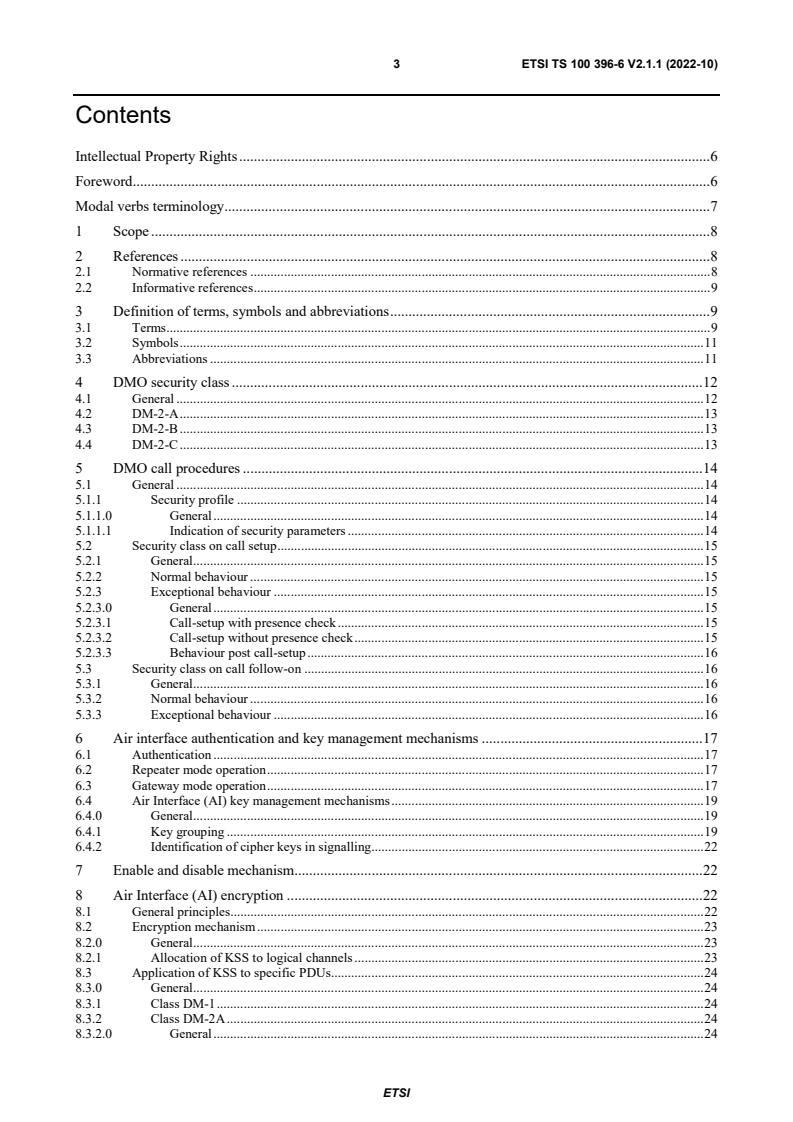
Contents
Intellectual Property Rights . 6
Foreword . 6
Modal verbs terminology . 7
1 Scope . 8
2 References . 8
2.1 Normative references . 8
2.2 Informative references . 9
3 Definition of terms, symbols and abbreviations . 9
3.1 Terms . 9
3.2 Symbols . 11
3.3 Abbreviations . 11
4 DMO security class . 12
4.1 General . 12
4.2 DM-2-A . 13
4.3 DM-2-B . 13
4.4 DM-2-C . 13
5 DMO call procedures . 14
5.1 General . 14
5.1.1 Security profile . 14
5.1.1.0 General . 14
5.1.1.1 Indication of security parameters . 14
5.2 Security class on call setup . 15
5.2.1 General . 15
5.2.2 Normal behaviour . 15
5.2.3 Exceptional behaviour . 15
5.2.3.0 General . 15
5.2.3.1 Call-setup with presence check . 15
5.2.3.2 Call-setup without presence check . 15
5.2.3.3 Behaviour post call-setup . 16
5.3 Security class on call follow-on . 16
5.3.1 General . 16
5.3.2 Normal behaviour . 16
5.3.3 Exceptional behaviour . 16
6 Air interface authentication and key management mechanisms . 17
6.1 Authentication . 17
6.2 Repeater mode operation . 17
6.3 Gateway mode operation . 17
6.4 Air Interface (AI) key management mechanisms . 19
6.4.0 General . 19
6.4.1 Key grouping . 19
6.4.2 Identification of cipher keys in signalling . 22
7 Enable and disable mechanism . 22
8 Air Interface (AI) encryption . 22
8.1 General principles. 22
8.2 Encryption mechanism . 23
8.2.0 General . 23
8.2.1 Allocation of KSS to logical channels . 23
8.3 Application of KSS to specific PDUs. 24
8.3.0 General . 24
8.3.1 Class DM-1 . 24
8.3.2 Class DM-2A . 24
8.3.2.0 General . 24
ETSI
4 ETSI TS 100 396-6 V2.1.1 (2022-10)
8.3.2.1 DMAC-SYNC PDU encryption . 25
8.3.2.2 DMAC-DATA PDU encryption . 25
8.3.2.3 DMAC-FRAG PDU encryption . 26
8.3.2.4 DMAC-END PDU encryption . 26
8.3.2.5 DMAC-U-SIGNAL PDU encryption . 26
8.3.2.6 Traffic channel encryption . 27
8.3.3 Class DM-2B . 27
8.3.3.0 General . 27
8.3.3.1 DMAC-SYNC PDU encryption . 28
8.3.3.2 DMAC-DATA PDU encryption . 28
8.3.3.3 DMAC-FRAG PDU encryption . 28
8.3.3.4 DMAC-END PDU encryption . 29
8.3.3.5 DMAC-U-SIGNAL PDU encryption . 29
8.3.3.6 Traffic channel encryption . 29
8.3.4 Class DM-2C . 29
8.3.4.0 General . 29
8.3.4.1 DMAC-SYNC PDU encryption . 31
8.3.4.2 DMAC-DATA PDU encryption . 32
8.3.4.3 DMAC-FRAG PDU encryption . 32
8.3.4.4 DMAC-END PDU encryption . 32
8.3.4.5 DMAC-U-SIGNAL PDU encryption . 33
8.3.4.6 Traffic channel encryption . 33
8.4 Encryption of identities in repeater and gateway presence signal . 33
9 Encryption synchronization . 37
9.1 General . 37
9.1.0 Introduction. 37
9.1.1 Algorithm to establish frame number to increment TVP . 38
9.1.1.1 Master DM-MS operation . 38
9.1.1.2 Slave DM-MS operation . 38
9.2 TVP used for reception of normal bursts . 39
9.3 Synchronization of calls through a repeater . 39
9.3.0 General . 39
9.3.1 Algorithm to establish frame number to increment TVP . 40
9.3.1.1 Master DM-MS operation . 40
9.3.1.2 Slave DM-MS operation . 40
9.4 Synchronization of calls through a gateway . 40
9.5 Synchronization of data calls where data is multi-slot interleaved . 41
9.5.0 General . 41
9.5.1 Recovery of stolen frames from interleaved data . 42
Annex A (normative): Key Stream Generator (KSG) boundary conditions . 43
A.0 General . 43
A.1 Overview . 43
A.2 Use . 44
A.3 Interfaces to the algorithm . 44
A.3.0 General . 44
A.3.1 Use of ECK (TEA set A) . 45
A.3.1.0 General . 45
A.3.1.1 Use of ECK in class DM-2-A and DM-2-B . 45
A.3.1.2 Use of ECK in class DM-2-C . 45
A.3.2 Keystream. 46
A.3.3 Time Variant Parameter (TVP) . 46
A.3.4 Use of xSI (TEA set B) . 46
A.3.4.1 General . 46
A.3.4.2 Use of SSI in class DM-2-A and DM-2-B . 46
A.3.4.3 Use of SSI in class DM-2-C . 46
A.3.5 Composition of IV (TEA set B) . 47
Annex B (normative): Boundary conditions for cryptographic algorithm TB6 . 48
ETSI
5 ETSI TS 100 396-6 V2.1.1 (2022-10)
Annex C (informative): Encryption control in DM-MS . 49
C.0 Introduction . 49
C.1 General . 49
C.2 Service description and primitives . 49
C.2.0 General . 49
C.2.1 DMCC-ENCRYPT primitive . 50
C.2.2 DMC-ENCRYPTION primitive . 52
C.3 Protocol functions . 53
Annex D (informative): Void . 54
Annex E (informative): Change request history . 55
History . 56
ETSI
6 ETSI TS 100 396-6 V2.1.1 (2022-10)
Intellectual Property Rights
Essential patents
IPRs essential or potentially essential to normative deliverables may have been declared to ETSI. The declarations
pertaining to these essential IPRs, if any, are publicly available for ETSI members and non-members, and can be
found in ETSI SR 000 314: "Intellectual Property Rights (IPRs); Essential, or potentially Essential, IPRs notified to
ETSI in respect of ETSI standards", which is available from the ETSI Secretariat. Latest updates are available on the
ETSI Web server (https://ipr.etsi.org/).
Pursuant to the ETSI Directives including the ETSI IPR Policy, no investigation regarding the essentiality of IPRs,
including IPR searches, has been carried out by ETSI. No guarantee can be given as to the existence of other IPRs not
referenced in ETSI SR 000 314 (or the updates on the ETSI Web server) which are, or may be, or may become,
essential to the present document.
Trademarks
The present document may include trademarks and/or tradenames which are asserted and/or registered by their owners.
ETSI claims no ownership of these except for any which are indicated as being the property of ETSI, and conveys no
right to use or reproduce any trademark and/or tradename. Mention of those trademarks in the present document does
not constitute an endorsement by ETSI of products, services or organizations associated with those trademarks.
DECT™, PLUGTESTS™, UMTS™ and the ETSI logo are trademarks of ETSI registered for the benefit of its
Members. 3GPP™ and LTE™ are trademarks of ETSI registered for the benefit of its Members and of the 3GPP
Organizational Partners. oneM2M™ logo is a trademark of ETSI registered for the benefit of its Members and of the ®
oneM2M Partners. GSM and the GSM logo are trademarks registered and owned by the GSM Association.
Foreword
This Technical Specification (TS) has been produced by ETSI Technical Committee TETRA and Critical
Communications Evolution (TCCE).
The present document is part 6 of a multi-part deliverable covering Direct Mode Operation, as identified below:
Part 1: "General network design";
Part 2: "Radio aspects";
Part 3: "Mobile Station to Mobile Station (MS-MS) Air Interface (AI) protocol";
Part 4: "Type 1 repeater air interface";
Part 5: "Gateway air interface";
Part 6: "Security";
Part 7: "Type 2 repeater air interface";
Part 8: "Protocol Implementation Conformance Statement (PICS) proforma specification";
Part 10: "Managed Direct Mode Operation (M-DMO)".
NOTE 1: Parts 7, 8 and 10 of this multi-part deliverable are of "historical" status and will not be updated according
to this version of the standard.
NOTE 2: Some parts are also published as Technical Specifications such as ETSI TS 100 396-6 (the present
document) and those may be the latest version of the document.
ETSI
7 ETSI TS 100 396-6 V2.1.1 (2022-10)
Modal verbs terminology
In the present document "shall", "shall not", "should", "should not", "may", "need not", "will", "will not", "can" and
"cannot" are to be interpreted as described in clause 3.2 of the ETSI Drafting Rules (Verbal forms for the expression of
provisions).
"must" and "must not" are NOT allowed in ETSI deliverables except when used in direct citation.
ETSI
8 ETSI TS 100 396-6 V2.1.1 (2022-10)
1 Scope
The present document defines the Terrestrial Trunked Radio system (TETRA) Direct Mode of operation. It specifies the
basic Air Interface (AI), the interworking between Direct Mode Groups via Repeaters and interworking with the
TETRA Trunked system via Gateways. It also specifies the security aspects in TETRA Direct Mode and the intrinsic
services that are supported in addition to the basic bearer and teleservices.
The present document describes the security mechanisms in TETRA Direct Mode. It provides mechanisms for
confidentiality of control signalling, user speech and data at the AI, using encryption algorithms from two different air
interface encryption algorithm sets. It also provided some implicit authentication as a member of a group by knowledge
of a shared secret encryption key.
The use of AI encryption gives both confidentiality protection against eavesdropping, and some implicit authentication.
2 References
2.1 Normative references
References are either specific (identified by date of publication and/or edition number or version number) or
non-specific. For specific references, only the cited version applies. For non-specific references, the latest version of the
referenced document (including any amendments) applies.
NOTE 1: Some referenced ENs are also published as Technical Specifications. In all cases, the latest version of
such a document, either EN or TS, should be taken as the referenced document.
Referenced documents which are not found to be publicly available in the expected location might be found at
https://docbox.etsi.org/Reference/.
NOTE 2: While any hyperlinks included in this clause were valid at the time of publication, ETSI cannot guarantee
their long term validity.
The following referenced documents are necessary for the application of the present document.
[1] ETSI EN 300 392-2: "Terrestrial Trunked Radio (TETRA); Voice plus Data (V+D); Part 2: Air
Interface (AI)".
[2] ISO 7498-2: "Information processing systems -- Open Systems Interconnection -- Basic Reference
Model -- Part 2: Security Architecture".
[3] ETSI EN 300 396-2: "Terrestrial Trunked Radio (TETRA); Technical requirements for Direct
Mode Operation (DMO); Part 2: Radio aspects".
[4] ETSI EN 300 392-7: "Terrestrial Trunked Radio (TETRA); Voice plus Data (V+D); Part 7:
Security".
[5] ETSI EN 300 396-3: "Terrestrial Trunked Radio (TETRA); Technical requirements for Direct
Mode Operation (DMO); Part 3: Mobile Station to Mobile Station (MS-MS) Air Interface (AI)
protocol".
[6] ETSI TS 100 392-15: "Terrestrial Trunked Radio (TETRA); Voice plus Data (V+D); Part 15:
TETRA frequency bands, duplex spacings and channel numbering".
[7] ETSI EN 302 109: "Terrestrial Trunked Radio (TETRA); Security; Synchronization mechanism
for end-to-end encryption".
[8] ETSI EN 300 396-5: "Terrestrial Trunked Radio (TETRA); Technical requirements for Direct
Mode Operation (DMO); Part 5: Gateway air interface".
[9] ETSI EN 300 396-4: "Terrestrial Trunked Radio (TETRA); Technical requirements for Direct
Mode Operation (DMO); Part 4: Type 1 repeater air interface".
ETSI
9 ETSI TS 100 396-6 V2.1.1 (2022-10)
2.2 Informative references
References are either specific (identified by date of publication and/or edition number or version number) or
non-specific. For specific references, only the cited version applies. For non-specific references, the latest version of the
referenced document (including any amendments) applies.
NOTE: While any hyperlinks included in this clause were valid at the time of publication, ETSI cannot guarantee
their long term validity.
The following referenced documents are not necessary for the application of the present document but they assist the
user with regard to a particular subject area.
[i.1] ETSI TS 101 053-1: "Rules for the management of the TETRA standard encryption algorithms;
Part 1: TEA1".
[i.2] ETSI TS 101 053-2: "Rules for the management of the TETRA standard encryption algorithms;
Part 2: TEA2".
[i.3] ETSI TS 101 053-3: "Rules for the management of the TETRA standard encryption algorithms;
Part 3: TEA3".
[i.4] ETSI TS 101 053-4: "Rules for the management of the TETRA standard encryption algorithms;
Part 4: TEA4".
[i.5] ETSI TS 101 052-1: "Rules for the management of the TETRA standard authentication and key
management algorithm set TAA1".
[i.6] ETSI TS 101 053-5: "TCCE Security (TCCE); Rules for the management of the TETRA standard
encryption algorithms; Part 5: TEA5".
[i.7] ETSI TS 101 053-6: "TCCE Security (TCCE); Rules for the management of the TETRA standard
encryption algorithms; Part 6: TEA6".
[i.8] ETSI TS 101 053-7: "TCCE Security (TCCE); Rules for the management of the TETRA standard
encryption algorithms; Part 7: TEA7".
[i.9] ETSI EN 300 396-1: "Terrestrial Trunked Radio (TETRA); Technical requirements for Direct
Mode Operation (DMO); Part 1: General network design".
3 Definition of terms, symbols and abbreviations
3.1 Terms
For the purposes of the present document, the following terms apply:
air interface encryption state: status of encryption in a call (on or off)
call transaction: all of the functions associated with a complete unidirectional transmission of information during a call
NOTE: A call is made up of one or more call transactions. In a simplex call these call transactions are sequential.
See ETSI EN 300 396-3 [5].
Carrier Number (CN): integer, N, used in TETRA to represent the frequency of the RF carrier
NOTE: See ETSI TS 100 392-15 [6].
Cipher Key (CK): value that is used to determine the transformation of plain text to cipher text in a cryptographic
algorithm
ETSI
10 ETSI TS 100 396-6 V2.1.1 (2022-10)
cipher text: data produced through the use of encipherment
NOTE: The semantic content of the resulting data is not available (ISO 7498-2 [2]).
crypto period: the length of time during which a specific key is in use
decipherment: reversal of a corresponding reversible encipherment
NOTE: See ISO 7498-2 [2].
Direct Mode Operation (DMO): mode of simplex operation where mobile subscriber radio units may communicate
using radio frequencies which may be monitored by, but which are outside the control of, the TETRA TMO network
NOTE: DM operation is performed without intervention of any base station. See ETSI EN 300 396-3 [5].
DMO-net: number of DMO MSs communicating together and using common cryptographic parameters
encipherment: cryptographic transformation of data to produce cipher text
NOTE: See ISO 7498-2 [2].
Encryption Cipher Key (ECK): cipher key used as input to the KSG, derived from an address specific cipher key and
randomly varied per channel using algorithm TB6 where a KSG from TEA set A is in use
end-to-end encryption: encryption within or at the source end system, with the corresponding decryption occurring
only within or at the destination end system
explicit authentication: transaction initiated and completed specifically to demonstrate knowledge of a shared secret
where the secret is not revealed
Extended Cipher Key (CKX): value that is used to determine the transformation of plain text to cipher text in a
cryptographic algorithm where an air interface encryption algorithm from TEA set B is in use
Extended Static Cipher Key (SCKX): predetermined cipher key that may be used to provide confidentiality in class
DM-2-A, DM-2-B and DM-2-C systems where an air interface encryption algorithm from TEA set B is in use
implicit authentication: authenticity demonstrated by proof of knowledge of a shared secret where that demonstration
is a by-product of another function
Initial Value (IV): sequence of symbols that randomize the KSG inside the encryption unit
Key Association Group (KAG): set of keys associated with one or more GSSIs at different periods of time
key stream: pseudo random stream of symbols that is generated by a KSG for encipherment and decipherment
Key Stream Generator (KSG): cryptographic algorithm which produces a stream of binary digits which can be used
for encipherment and decipherment
NOTE: The initial state of the KSG is determined by the initialization value.
Key Stream Segment (KSS): key stream of arbitrary length
Open MNI: network address used in conjunction with an open group address, which allows communication with any
users who have selected the same DMO frequency
NOTE 1: The open MNI is encoded as all binary ones (11…11 ).
NOTE 2: The open MNI is described in ETSI EN 300 396-1 [i.9].
plain text: unencrypted source data
NOTE: The semantic content is available.
proprietary algorithm: algorithm which is the intellectual property of a legal entity
rep-gate: MS acting as a repeater and gateway
NOTE: For further descriptions of repeaters and gateways, refer to ETSI EN 300 396-1 [i.9].
ETSI
11 ETSI TS 100 396-6 V2.1.1 (2022-10)
SCK set: collective term for the group of 32 SCKs and/or SCKXs
NOTE: An SCK set may contain SCKs or SCKXs or both SCKs and SCKXs.
SCK-subset: collection of SCKs and/or SCKXs from an SCK set, with SCKNs in numerical sequence, where every
SCK or SCKX in the subset is associated with one or more different GSSIs
NOTE: Multiple SCK subsets have corresponding SCKs or SCKXs associated with the same GSSIs.
Static Cipher Key (SCK): predetermined cipher key that may be used to provide confidentiality in class DM-2-A,
DM-2-B and DM-2-C systems with a corresponding algorithm from TEA set A
synchronous stream cipher: encryption method in which a cipher text symbol completely represents the
corresponding plain text symbol
NOTE: The encryption is based on a key stream that is independent of the cipher text. In order to synchronize the
KSGs in the transmitting and the receiving terminal synchronization data is transmitted separately.
TEA set A: set of air interface encryption algorithms comprising TEA1, TEA2, TEA3 and TEA4
TEA set B: set of air interface encryption algorithms comprising TEA5, TEA6 and TEA7
TETRA algorithm: mathematical description of a cryptographic process used for either of the security processes
authentication or encryption
Trunked Mode Operation (TMO): operations of TETRA specified in ETSI EN 300 392-2 [1]
3.2 Symbols
Void.
3.3 Abbreviations
For the purposes of the present document, the following abbreviations apply:
ACK ACKnowledgement
AI Air Interface
CK Cipher Key
CKX Extended Cipher Key
CN Carrier Number
DM Direct Mode
DMAC Direct Mode Medium Access Control
DMC A layer 2 Service Access Point (DMC-SAP)
DMCC Direct Mode Call Control
DMO Direct Mode Operation
DPRES DMO PREScence
DSB Direct mode Synchronisation Burst
ECK Encryption Cipher Key
EDSI Encrypted Direct-mode Short Identity
EDSI-URTC Encrypted DMO Short Identity-Usage Restriction Type Confidentiality
EUIV EDSI-URTC Initialisation Vector
FN Frame Number
FRAG FRAGmented
GATE GATEway
GSSI Group Short Subscriber Identity
GTSI Group TETRA Subscriber Identity
GTX Gateway Transmit
IV Initial Value
KAG Key Association Group
KSG Key Stream Generator
KSS Key Stream Segment
MAC Medium Access Control
ETSI
12 ETSI TS 100 396-6 V2.1.1 (2022-10)
MDE Message Dependent Elements
M-DMO Managed DMO
MNC Mobile Network Code
MNI Mobile Network Identity
MS Mobile Station
OTAR Over The Air Rekeying
PDU Protocol Data Unit
PICS Protocol Implementation Conformance Statement
REP REPeater
RF Radio Frequency
RG_Add Repeater or Gateway Address
RX Receive
SAP Service Access Point
SCH Signalling CHannel
SCH/F Full SCH
SCH/H Half SCH
SCH/S Synchronization SCH
SCK Static Cipher Key
SCKN Static Cipher Key Number
SCK-VN SCK-Version Number
SCKX Extended Static Cipher Key
SDS Short Data Service
SDU Service Data Unit
SSI Short Subscriber Identity
STCH STolen CHannel
SwMI Switching and Management Infrastructure
SYNC SYNChronization
TCH Traffic CHannel
TCH/S Speech Traffic CHannel
TDMA Time Division Multiple Access
TEA TETRA Encryption Algorithm
TMO Trunked Mode Operation
TN Timeslot Number
TSI TETRA Subscriber Entity
TVP Time Variant Parameter
TX Transmit
U-PLANE User-PLANE
URT Usage Restriction Type
URTC Usage Restriction Type Confidentiality
V+D Voice + Data
VN Version Number
XOR eXclusive OR
xSI Short Identity (of various types)
4 DMO security class
4.1 General
TETRA security is defined in terms of class. DMO security offers 4 classes defined in table 4.1.
NOTE: DMO offers equivalence to TMO security class 1 (no encryption enabled) and to TMO security class 2
(SCK and SCKX encryption supported).
ETSI
13 ETSI TS 100 396-6 V2.1.1 (2022-10)
Table 4.1: Direct Mode security class
DMO security class Remark
DM-1 No encryption applied.
DM-2-A The DM-SDU and any related traffic is AI encrypted. Addresses are not encrypted.
DM-2-B The destination address (SSI), DM-SDU and any related traffic are AI encrypted.
DM-2-C In the DMAC-SYNC PDU, the PDU is encrypted from destination address element and
onwards except for source address type element, and any related traffic is AI encrypted. In
the DMAC-DATA PDU, the PDU is encrypted from the destination address type element and
onwards.
NOTE 1: Except in DMAC-DATA PDUs for class DM-2-C the destination and source address type elements are never
encrypted.
NOTE 2: DM-1 is considered the lowest level of security.
NOTE 3: DM-2-A through DM-2-B to DM-2-C provide progressively increased levels of security by encrypting more of
the signalling content.
The security class is identified in DMAC-SYNC PDUs by the AI encryption state element (see table 4.2).
Table 4.2: AI encryption state element encoding
Information element Length Value Class
Air Interface encryption state 2 00 DM-1
10 DM-2-A
11 DM-2-B
01 DM-2-C
On establishing a call the first master shall establish the security class of the call. The security class should be
maintained for the duration of the call.
4.2 DM-2-A
The purpose of security class DM-2-A is to provide confidentiality of user traffic and signalling in applications where it
is not necessary to hide the addressing information.
In addition security class DM-2-A allows calls to be made through a repeater where the repeater is not provided with
the capability to encrypt or decrypt messages by maintaining the layer 2 (MAC) elements of any signalling in clear.
Addresses identified by the Usage Restriction Type (URT) field in repeaters, gateways and combined
repeater-gateways, shall be in clear (i.e. the Encrypted DMO Short Identity-Usage Restriction Type Confidentiality
(EDSI-URTC) shall not apply).
4.3 DM-2-B
The purpose of security class DM-2-B is to provide confidentiality of user traffic and signalling.
Security class DM-2-B extends the confidentiality applied to signalling over that provided in class DM-2-A to encrypt
parts of the MAC header. The encryption allows repeater operation to be made without requiring the repeater to be able
to encrypt and decrypt transmissions unless it wishes to check the validity of the destination address. In class DM-2-B
because the source address is in clear, a pre-emptor can identify the pre-emption slots and hence the call can be
pre-empted even if the pre-emptor does not have the encryption key being used by the call master.
Addresses identified by the URT field in repeaters, gateways and combined repeater-gateways, should be encrypted
(i.e. EDSI-URTC should apply).
4.4 DM-2-C
The purpose of security class DM-2-C is to provide confidentiality of user traffic and signalling including all identities
other than those of repeaters and gateways.
ETSI
14 ETSI TS 100 396-6 V2.1.1 (2022-10)
In addition in class DM-2-C the bulk of the MAC header elements are encrypted. Where repeaters are used, the repeater
requires the ability to encrypt and decrypt all transmissions. In class DM-2-C calls can only be pre-empted by an MS
which has the SCK or SCKX in use by the call master.
Addresses identified by the URT field in repeaters, gateways and combined repeater-gateways, should be encrypted
(i.e. EDSI-URTC should apply).
5 DMO call procedures
5.1 General
5.1.1 Security profile
5.1.1.0 General
An MS should maintain a security profile for each destination address. The security profile should contain at least the
following for each destination address:
• KSG, as identified by its KSG-identifier;
• current SCK or SCKX, as identified by SCKN, for transmission;
• valid SCKs or SCKXs, as identified by SCKN, for reception;
• the preferred, and minimum, security class to be applied to calls for transmission;
• the minimum security class to be applied to calls for reception; and
• the minimum security class that a master will accept in a pre-emption request.
The preferred security class is the security class to be used for transmission when the MS is acting as a call master. The
minimum security class for transmission is the lowest security class that the MS shall use to transmit responses to other
signalling.
NOTE 1: Minimum may be the same as preferred.
NOTE 2: A default profile may be maintained in addition to a profile for specific addresses.
NOTE 3: A profile should exist for received individual calls (i.e. for calls where destination address is that of the
receiving MS).
NOTE 4: If the preferred security class to be applied to calls for transmission is DM-2-C the minimum security
class that a master will accept in a pre-emption request should be set to class DM-2-C MS.
5.1.1.1 Indication of security parameters
In call setup procedures the DMAC-SYNC PDU found in logical channel SCH/S shall contain the parameters required
to identify the security class of the call, the encryption algorithm and the identity of the key in use, in addition to the
current value of the Time Variant Parameter used to synchronize the encryption devices (see also annex A).
The DMAC-SYNC PDU is defined in clause 9 of ETSI EN 300 396-3 [5] and contains the security elements identified
in table 5.1.
ETSI
15 ETSI TS 100 396-6 V2.1.1 (2022-10)
Table 5.1: Security elements of DMAC-SYNC PDU contents in SCH/S
Information element Length Value Remark
Air interface encryption state 2 Security class (see note 1)
Time Variant Parameter 29 Any
Reser
...
Questions, Comments and Discussion
Ask us and Technical Secretary will try to provide an answer. You can facilitate discussion about the standard in here.
Loading comments...