


ETSI TR 104 066 V1.1.1 (2024-07)
Securing Artificial Intelligence (SAI); Security Testing of AI
Securing Artificial Intelligence (SAI); Security Testing of AI
DTR/SAI-0015
General Information

Standards Content (Sample)
TECHNICAL REPORT
Securing Artificial Intelligence;
Security Testing of AI
2 ETSI TR 104 066 V1.1.1 (2024-07)
Reference
DTR/SAI-0015
Keywords
artificial intelligence, security
ETSI
650 Route des Lucioles
F-06921 Sophia Antipolis Cedex - FRANCE
Tel.: +33 4 92 94 42 00 Fax: +33 4 93 65 47 16
Siret N° 348 623 562 00017 - APE 7112B
Association à but non lucratif enregistrée à la
Sous-Préfecture de Grasse (06) N° w061004871
Important notice
The present document can be downloaded from:
https://www.etsi.org/standards-search
The present document may be made available in electronic versions and/or in print. The content of any electronic and/or
print versions of the present document shall not be modified without the prior written authorization of ETSI. In case of any
existing or perceived difference in contents between such versions and/or in print, the prevailing version of an ETSI
deliverable is the one made publicly available in PDF format at www.etsi.org/deliver.
Users of the present document should be aware that the document may be subject to revision or change of status.
Information on the current status of this and other ETSI documents is available at
https://portal.etsi.org/TB/ETSIDeliverableStatus.aspx
If you find errors in the present document, please send your comment to one of the following services:
https://portal.etsi.org/People/CommiteeSupportStaff.aspx
If you find a security vulnerability in the present document, please report it through our
Coordinated Vulnerability Disclosure Program:
https://www.etsi.org/standards/coordinated-vulnerability-disclosure
Notice of disclaimer & limitation of liability
The information provided in the present deliverable is directed solely to professionals who have the appropriate degree of
experience to understand and interpret its content in accordance with generally accepted engineering or
other professional standard and applicable regulations.
No recommendation as to products and services or vendors is made or should be implied.
No representation or warranty is made that this deliverable is technically accurate or sufficient or conforms to any law
and/or governmental rule and/or regulation and further, no representation or warranty is made of merchantability or fitness
for any particular purpose or against infringement of intellectual property rights.
In no event shall ETSI be held liable for loss of profits or any other incidental or consequential damages.
Any software contained in this deliverable is provided "AS IS" with no warranties, express or implied, including but not
limited to, the warranties of merchantability, fitness for a particular purpose and non-infringement of intellectual property
rights and ETSI shall not be held liable in any event for any damages whatsoever (including, without limitation, damages
for loss of profits, business interruption, loss of information, or any other pecuniary loss) arising out of or related to the use
of or inability to use the software.
Copyright Notification
No part may be reproduced or utilized in any form or by any means, electronic or mechanical, including photocopying and
microfilm except as authorized by written permission of ETSI.
The content of the PDF version shall not be modified without the written authorization of ETSI.
The copyright and the foregoing restriction extend to reproduction in all media.
© ETSI 2024.
All rights reserved.
ETSI
3 ETSI TR 104 066 V1.1.1 (2024-07)
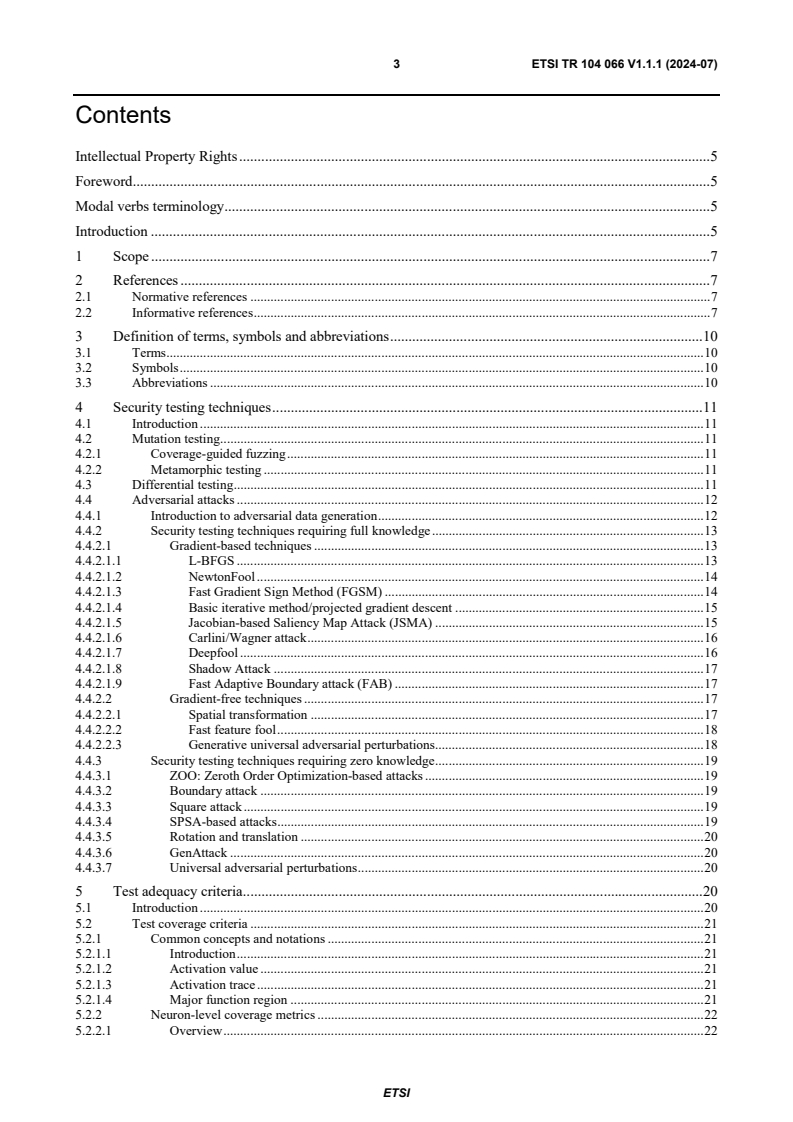
Contents
Intellectual Property Rights . 5
Foreword . 5
Modal verbs terminology . 5
Introduction . 5
1 Scope . 7
2 References . 7
2.1 Normative references . 7
2.2 Informative references . 7
3 Definition of terms, symbols and abbreviations . 10
3.1 Terms . 10
3.2 Symbols . 10
3.3 Abbreviations . 10
4 Security testing techniques . 11
4.1 Introduction . 11
4.2 Mutation testing . 11
4.2.1 Coverage-guided fuzzing . 11
4.2.2 Metamorphic testing . 11
4.3 Differential testing . 11
4.4 Adversarial attacks . 12
4.4.1 Introduction to adversarial data generation . 12
4.4.2 Security testing techniques requiring full knowledge . 13
4.4.2.1 Gradient-based techniques . 13
4.4.2.1.1 L-BFGS . 13
4.4.2.1.2 NewtonFool . 14
4.4.2.1.3 Fast Gradient Sign Method (FGSM) . 14
4.4.2.1.4 Basic iterative method/projected gradient descent . 15
4.4.2.1.5 Jacobian-based Saliency Map Attack (JSMA) . 15
4.4.2.1.6 Carlini/Wagner attack . 16
4.4.2.1.7 Deepfool . 16
4.4.2.1.8 Shadow Attack . 17
4.4.2.1.9 Fast Adaptive Boundary attack (FAB) . 17
4.4.2.2 Gradient-free techniques . 17
4.4.2.2.1 Spatial transformation . 17
4.4.2.2.2 Fast feature fool . 18
4.4.2.2.3 Generative universal adversarial perturbations . 18
4.4.3 Security testing techniques requiring zero knowledge . 19
4.4.3.1 ZOO: Zeroth Order Optimization-based attacks . 19
4.4.3.2 Boundary attack . 19
4.4.3.3 Square attack . 19
4.4.3.4 SPSA-based attacks . 19
4.4.3.5 Rotation and translation . 20
4.4.3.6 GenAttack . 20
4.4.3.7 Universal adversarial perturbations . 20
5 Test adequacy criteria . 20
5.1 Introduction . 20
5.2 Test coverage criteria . 21
5.2.1 Common concepts and notations . 21
5.2.1.1 Introduction . 21
5.2.1.2 Activation value . 21
5.2.1.3 Activation trace . 21
5.2.1.4 Major function region . 21
5.2.2 Neuron-level coverage metrics . 22
5.2.2.1 Overview . 22
ETSI
4 ETSI TR 104 066 V1.1.1 (2024-07)
5.2.2.2 Neuron coverage . 22
5.2.2.3 k-multisection neuron coverage . 23
5.2.2.4 Neuron boundary coverage . 24
5.2.2.5 Strong neuron activation coverage . 24
5.2.3 Layer coverage metrics . 25
5.2.3.1 Top-k neuron coverage . 25
5.2.3.2 Top-k neuron patterns . 25
5.2.4 Surprise Adequacy . 25
5.2.4.1 Basic idea . 25
5.2.4.2 Likelihood-based Surprise Adequacy . 26
5.2.4.3 Distance-based Surprise Adequacy . 26
5.3 Stop criteria . 27
5.3.1 Relationship of stop criteria to metrics for neural networks . 27
5.3.2 Adversarial robustness . 27
5.3.2.1 Global Lipschitz constant . 27
5.3.2.1.1 Introduction . 27
5.3.2.1.2 Global Lipschitz constant calculation for neural network architectures . 27
5.3.2.1.3 Global Lipschitz constant calculation using Extreme Value Theory . 28
5.3.2.2 Local adversarial robustness . 28
5.3.2.3 Global adversarial robustness. 28
6 Security test oracles . 29
6.1 Introduction . 29
6.2 Statistical and probabilistic test oracles . 29
6.3 Pseudo test oracles. 29
6.3.1 Not a Number . 29
6.3.2 Differential testing . 29
6.3.3 Metamorphic relations . 30
Annex A: Bibliography . 31
History . 32
ETSI
5 ETSI TR 104 066 V1.1.1 (2024-07)
Intellectual Property Rights
Essential patents
IPRs essential or potentially essential to normative deliverables may have been declared to ETSI. The declarations
pertaining to these essential IPRs, if any, are publicly available for ETSI members and non-members, and can be
found in ETSI SR 000 314: "Intellectual Property Rights (IPRs); Essential, or potentially Essential, IPRs notified to
ETSI in respect of ETSI standards", which is available from the ETSI Secretariat. Latest updates are available on the
ETSI Web server (https://ipr.etsi.org/).
Pursuant to the ETSI Directives including the ETSI IPR Policy, no investigation regarding the essentiality of IPRs,
including IPR searches, has been carried out by ETSI. No guarantee can be given as to the existence of other IPRs not
referenced in ETSI SR 000 314 (or the updates on the ETSI Web server) which are, or may be, or may become,
essential to the present document.
Trademarks
The present document may include trademarks and/or tradenames which are asserted and/or registered by their owners.
ETSI claims no ownership of these except for any which are indicated as being the property of ETSI, and conveys no
right to use or reproduce any trademark and/or tradename. Mention of those trademarks in the present document does
not constitute an endorsement by ETSI of products, services or organizations associated with those trademarks.
DECT™, PLUGTESTS™, UMTS™ and the ETSI logo are trademarks of ETSI registered for the benefit of its
Members. 3GPP™ and LTE™ are trademarks of ETSI registered for the benefit of its Members and of the 3GPP
Organizational Partners. oneM2M™ logo is a trademark of ETSI registered for the benefit of its Members and of the ®
oneM2M Partners. GSM and the GSM logo are trademarks registered and owned by the GSM Association.
Foreword
This Technical Report (TR) has been produced by ETSI Technical Committee Securing Artificial Intelligence (SAI).
Modal verbs terminology
In the present document "should", "should not", "may", "need not", "will", "will not", "can" and "cannot" are to be
interpreted as described in clause 3.2 of the ETSI Drafting Rules (Verbal forms for the expression of provisions).
"must" and "must not" are NOT allowed in ETSI deliverables except when used in direct citation.
Introduction
Security testing of AI aims at identifying vulnerabilities in AI models. On the one hand, security testing of AI has some
commonalities with security testing of traditional software systems. On the other hand, the functioning of AI and in
particular ML poses new challenges and requires different approaches for several reasons:
• There are significant differences between symbolic AI, sub symbolic AI, i.e. ML, versus traditional software
systems that have strong implications on AI and ML security and on how to test their security properties.
• Non-determinism: AI-based systems can evolve at runtime (self-learning systems), and thus, security
properties can degrade at runtime, too. If faced with the same input at different times, self-learning AI-based
systems can provide different predictions.
• Test oracle problem: assigning a test verdict is different and more difficult for AI-based systems since not all
expected results are known a priori.
ETSI
6 ETSI TR 104 066 V1.1.1 (2024-07)
• Data-driven algorithms: in contrast to traditional systems, (training) data forms the behaviour of sub symbolic
AI, meaning security testing should be extended from the AI component to the data used for training or
continuous learning of a system.
Testing consists of several activities that include test planning and control, test design, test implementation, test
execution and test evaluation. The present document covers the testing activities test design, test execution and test
evaluation. For that purpose, the present document introduces methods and metrics to design test cases (see clause 4), to
measure the progress (see clause 5) and to evaluate test cases (see clause 6).
The present document addresses security testing approaches for AI, security test oracles for AI, and definition of test
adequacy criteria for security testing of AI. Techniques of each of these topics are applied together to security test a
ML component. Security testing approaches are used to generate test cases that are executed against the ML component.
Security test oracles enable to calculate a test verdict to determine if a test case has passed, that is, no vulnerability has
been detected, or failed, that is a vulnerability has been identified. Test adequacy criteria are used to determine the
entire progress and can be employed to specify a stop condition for security testing.
The security testing approaches addressed by the present document are not solely related to security but to robustness as
well. Issues with the robustness of ML components can result in both security and safety issues. Security issues of a ML
component can enable an adversary to achieve a violation of one of the security properties, i.e. confidentiality, integrity,
and availability. Safety issues of a ML component might endanger the environment in which the ML component and the
system it is part of is operating. Security issues might also lead to safety issues when, for instance, the availability or
integrity of safety measures is affected. Testing of robustness of ML components related to safety-issues in the
Automotive domain has been discussed, for instance, in [i.1].
ETSI
7 ETSI TR 104 066 V1.1.1 (2024-07)
1 Scope
The present document identifies methods and techniques that are appropriate for security testing of ML-based
components. Security testing of AI does not end at the component level. As for testing of traditional software, the
integration with other components of a system needs to be tested as well. However, integration testing is not the subject
of the present document.
The present document addresses:
• security testing approaches for AI;
• security test oracles for AI;
• definition of test adequacy criteria for security testing of AI.
Techniques of each of these topics should be applied together to security test of a ML component. Security testing
approaches are used to generate test cases that are executed against the ML component. Security test oracles enable to
calculate a test verdict to determine if a test case has passed, that is, no vulnerability has been detected, or failed, that is
a vulnerability has been identified. Test adequacy criteria are used to determine the entire progress and can be employed
to specify a stop condition for security testing.
2 References
2.1 Normative references
Normative references are not applicable in the present document.
2.2 Informative references
References are either specific (identified by date of publication and/or edition number or version number) or
non-specific. For specific references, only the cited version applies. For non-specific references, the latest version of the
referenced document (including any amendments) applies.
NOTE: While any hyperlinks included in this clause were valid at the time of publication, ETSI cannot guarantee
their long-term validity.
The following referenced documents are not necessary for the application of the present document but they assist the
user with regard to a particular subject area.
[i.1] Berghoff, C., Bielik, P., Neu, M., Tsankov, P., & von Twickel, A. (2021, June). Robustness
Testing of AI Systems: A Case Study for Traffic Sign Recognition. In IFIP International
Conference on Artificial Intelligence Applications and Innovations (pp. 256-267). Springer, Cham.
[i.2] American fuzzy lop.
[i.3] LLVM compiler infrastructure: "libFUZZER".
[i.4] Odena, A., & Goodfellow, I. (2018). Tensorfuzz: Debugging neural networks with
coverage-guided fuzzing. arXiv preprint arXiv:1807.10875.
[i.5] Chen, T. Y., Cheung, S. C., & Yiu, S. M. (2020). Metamorphic testing: a new approach for
generating next test cases. arXiv preprint arXiv:2002.12543.
[i.6] McKeeman, W. M. (1998). Differential testing for software. Digital Technical Journal, 10(1),
100-107.
[i.7] Pei, K., Cao, Y., Yang, J., & Jana, S. (2017, October). Deepxplore: Automated whitebox testing of
deep learning systems. In proceedings of the 26th Symposium on Operating Systems Principles
(pp. 1-18).
ETSI
8 ETSI TR 104 066 V1.1.1 (2024-07)
[i.8] Ilyas, A., Santurkar, S., Tsipras, D., Engstrom, L., Tran, B., & Madry, A. (2019). Adversarial
examples are not bugs, they are features. Advances in neural information processing systems.
[i.9] Tramèr, F., Papernot, N., Goodfellow, I., Boneh, D., & McDaniel, P. (2017). The space of
transferable adversarial examples. arXiv preprint arXiv:1704.03453.
[i.10] Demontis, A., Melis, M., Pintor, M., Jagielski, M., Biggio, B., Oprea, A., & Roli, F. (2019). Why
do adversarial attacks transfer? explaining transferability of evasion and poisoning attacks. In 28th
USENIX security symposium (USENIX security 19) (pp. 321-338).
[i.11] Szegedy, C., Zaremba, W., Sutskever, I., Bruna, J., Erhan, D., Goodfellow, I., &
Fergus, R. (2013). Intriguing properties of neural networks. arXiv preprint arXiv:1312.6199.
[i.12] Jang, U., Wu, X., & Jha, S. (2017, December). Objective metrics and gradient descent algorithms
for adversarial examples in machine learning. In Proceedings of the 33rd Annual Computer
Security Applications Conference (pp. 262-277).
[i.13] Goodfellow, I. J., Shlens, J., & Szegedy, C. (2014). Explaining and harnessing adversarial
examples. arXiv preprint arXiv:1412.6572.
[i.14] Kurakin, A., Goodfellow, I., & Bengio, S. (2016). Adversarial examples in the physical world.
arXiv preprint arXiv:1607.02533.
[i.15] Madry, A., Makelov, A., Schmidt, L., Tsipras, D., & Vladu, A. (2017). Towards deep learning
models resistant to adversarial attacks. arXiv preprint arXiv:1706.06083.
[i.16] Dong, Y., Liao, F., Pang, T., Su, H., Zhu, J., Hu, X., & Li, J. (2018). Boosting adversarial attacks
TM
with momentum. In Proceedings of the IEEE conference on computer vision and pattern
recogntion (pp. 9185-9193).
[i.17] Xie, C., Zhang, Z., Zhou, Y., Bai, S., Wang, J., Ren, Z., & Yuille, A. L. (2019). Improving
TM
transferability of adversarial examples with input diversity. In Proceedings of the IEEE /CVF
Conference on Computer Vision and Pattern Recognition (pp. 2730-2739).
[i.18] Croce, F., & Hein, M. (2020, November). Reliable evaluation of adversarial robustness with an
ensemble of diverse parameter-free attacks. In International conference on machine learning
(pp. 2206-2216). PMLR.
[i.19] Papernot, N., McDaniel, P., Jha, S., Fredrikson, M., Celik, Z. B., & Swami, A. (2016, March). The
TM
limitations of deep learning in adversarial settings. In 2016 IEEE European symposium on
TM
security and privacy (EuroS&P) (pp. 372-387). IEEE .
[i.20] Loison, A., Combey, T., & Hajri, H. (2020). Probabilistic Jacobian-based Saliency Maps Attacks.
arXiv preprint arXiv:2007.06032.
[i.21] Carlini, N., & Wagner, D. (2017, May). Towards evaluating the robustness of neural networks. In
TM TM
2017 IEEE symposium on security and privacy (sp) (pp. 39-57). IEEE .
[i.22] Moosavi-Dezfooli, S. M., Fawzi, A., & Frossard, P. (2016). Deepfool: a simple and accurate
TM
method to fool deep neural networks. In Proceedings of the IEEE conference on computer
vision and pattern recognition (pp. 25).
[i.23] Ghiasi, A., Shafahi, A., & Goldstein, T. (2020). Breaking certified defenses: Semantic adversarial
examples with spoofed robustness certificates. arXiv preprint arXiv:2003.08937.
[i.24] Croce, F., & Hein, M. (2020, November). Minimally distorted adversarial examples with a fast
adaptive boundary attack. In International Conference on Machine Learning (pp. 2196-2205).
PMLR.
[i.25] Xiao, C., Zhu, J. Y., Li, B., He, W., Liu, M., & Song, D. (2018). Spatially transformed adversarial
examples. arXiv preprint arXiv:1801.02612.
[i.26] Mopuri, K. R., Garg, U., & Babu, R. V. (2017). Fast feature fool: A data independent approach to
universal adversarial perturbations. arXiv preprint arXiv:1707.05572.
ETSI
9 ETSI TR 104 066 V1.1.1 (2024-07)
[i.27] Hayes, J., & Danezis, G. (2018, May). Learning universal adversarial perturbations with
TM TM
generative models. In 2018 IEEE Security and Privacy Workshops (SPW) (pp. 43-49). IEEE .
[i.28] Chen, P. Y., Zhang, H., Sharma, Y., Yi, J., & Hsieh, C. J. (2017, November). Zoo: Zeroth order
optimization based black-box attacks to deep neural networks without training substitute models.
In Proceedings of the 10th ACM Workshop on Artificial Intelligence and Security (pp. 15-26).
[i.29] Brendel, W., Rauber, J., & Bethge, M. (2017). Decision-based adversarial attacks: Reliable attacks
against black-box machine learning models. arXiv preprint arXiv:1712.04248.
[i.30] Andriushchenko, M., Croce, F., Flammarion, N. & Hein, M. (2020, August). Square attack: a
query-efficient black-box adversarial attack via random search. In European Conference on
Computer Vision (pp. 484-501). Springer, Cham.
[i.31] Uesato, J., O'donoghue, B., Kohli, P., & Oord, A. (2018, July). Adversarial risk and the dangers of
evaluating against weak attacks. In International Conference on Machine Learning
(pp. 5025-5034). PMLR.
[i.32] Carlini, N., Athalye, A., Papernot, N., Brendel, W., Rauber, J., Tsipras, D. & Kurakin, A. (2019).
On evaluating adversarial robustness. arXiv preprint arXiv:1902.06705.
[i.33] Engstrom, L., Tran, B., Tsipras, D., Schmidt, L., & Madry, A. (2018). A rotation and a translation
suffice: Fooling CNNs with simple transformations.
[i.34] Alzantot, M., Sharma, Y., Chakraborty, S., Zhang, H., Hsieh, C. J., & Srivastava, M. B.
(2019, July). Genattack: Practical black-box attacks with gradient-free optimization. In
Proceedings of the Genetic and Evolutionary Computation Conference (pp. 1111-1119).
[i.35] Moosavi-Dezfooli, S. M., Fawzi, A., Fawzi, O., & Frossard, P. (2017). Universal adversarial
TM
perturbations. In Proceedings of the IEEE conference on computer vision and pattern
recognition (pp. 1765-1773).
[i.36] Dong, Y., Zhang, P., Wang, J., Liu, S., Sun, J., Hao, J. & Ting, D. (2019). There is Limited
Correlation between Coverage and Robustness for Deep Neural Networks. arXiv preprint
arXiv:1911.05904.
[i.37] Zhu, H., Hall, P. A., & May, J. H. (1997). Software unit test coverage and adequacy. Acm
computing surveys (csur), 29(4), 366-427.
[i.38] Kim, J., Feldt, R., & Yoo, S. (2019, May). Guiding deep learning system testing using surprise
TM
adequacy. In 2019 IEEE /ACM 41st International Conference on Software Engineering (ICSE)
TM
(pp. 1039-1049). IEEE .
[i.39] Ma, L., Juefei-Xu, F., Zhang, F., Sun, J., Xue, M., Li, B. & Zhao, J. (2018, September).
rd
Deepgauge: Multi-granularity testing criteria for deep learning systems. In Proceedings of the 33
TM
ACM/IEEE International Conference on Automated Software Engineering (pp. 120-131).
[i.40] Weng, T. W., Zhang, H., Chen, P. Y., Yi, J., Su, D., Gao, Y. & Daniel, L. (2018). Evaluating the
robustness of neural networks: An extreme value theory approach. arXiv preprint
arXiv:1801.10578.
[i.41] Cisse, M., Bojanowski, P., Grave, E., Dauphin, Y., & Usunier, N. (2017). Parseval networks:
Improving robustness to adversarial examples. arXiv preprint arXiv:1704.08847.
[i.42] Katz, G., Barrett, C., Dill, D. L., Julian, K., & Kochenderfer, M. J. (2017, July). Reluplex: An
efficient SMT solver for verifying deep neural networks. In International Conference on Computer
Aided Verification (pp. 97-117). Springer, Cham.
[i.43] Mayer, J., & Guderlei, R. (2004). Test oracles using statistical methods. Testing of
component-based systems and software quality.
ETSI
10 ETSI TR 104 066 V1.1.1 (2024-07)
3 Definition of terms, symbols and abbreviations
3.1 Terms
For the purposes of the present document, the following terms apply:
adversarial example: carefully crafted input which mislead a model to give an incorrect prediction
perturbation: semantically meaningless modification of an input
EXAMPLE: Perturbation can have the form of noise added to an image.
substitute model: model created by an adversary to craft transferable adversarial examples
NOTE 1: The substitute model performs the same task as the target model but may use a different ML technique or
a different dataset.
NOTE 2: The terms surrogate model and substitute model are used synonymously.
surrogate model: See substitute model.
target label: label that an adversary wants the target model to output if fed with an adversarial example
target model: model an adversary wants to make wrong predictions
transferable adversarial example: adversarial example which is crafted for one model but can also fool a different
model with a high probability
true label: correct label for an input from the ground truth
3.2 Symbols
For the purposes of the present document, the following symbols apply:
� Pseudo distance (number of non-zero elements)
�
� Euclidean distance
�
� Chebyshev distance
�
� Flow field function
����
� Distance that needs to be specified by the parameter � with � ∈ �0,2, ∞�
�
3.3 Abbreviations
For the purposes of the present document, the following abbreviations apply:
AI Artificial Intelligence
CLEVER Cross Lipschitz Extreme Value for nEtwork Robustness
DSA Distance-based Surprise Adequacy
FAB Fast Adaptive Boundary attack
FGSM Fast Gradient Sign Method
JSMA Jacobian-based Saliency Map Attack
L-BFGS computer-memory-Limited approximation of the Broyden-Fletcher-Goldfarb-Shanno algorithm
LSA Likelihood-based Surprise Adequacy
ML Machine Learning
NaN Not a Number
PGD Projected Gradient Descent
ReLU Rectified Linear Unit
SAI Securing Artificial Intelligence
SPSA Simultaneous Perturbation Stochastic Approximation
TJSMA Taylor JSMA
WJSMA Weighted JSMA
ETSI
11 ETSI TR 104 066 V1.1.1 (2024-07)
ZOO Zeroth Order Optimization-based attacks
4 Security testing techniques
4.1 Introduction
Security testing techniques are used for designing test cases that are later on executed against an ML component. Such
test cases consist of the input data that is fed to the ML component to identify a vulnerability, e.g. a susceptibility to a
specific adversarial example. Clause 4 presents different approaches that can be employed for crafting such inputs. The
presented testing approaches can be divided into those that have been developed for traditional software and can be
employed for security testing of ML components as well, and those that are specific to ML. Furthermore, not all of them
are security-specific but can be more versatile with respect to the quality characteristics in question.
NOTE: It is necessary to ensure that the system is not designed to recognise the adversarial examples used in a
test environment and to run in such a way that the test is passed by bypassing normal operation.
4.2 Mutation testing
4.2.1 Coverage-guided fuzzing
Coverage-guided fuzzing is a technique that has been established for traditional software systems. For such systems,
code coverage has been extensively used as coverage metrics together with genetic algorithms, mostly using binary
mutation without protocol models, as in American Fuzzy Lop [i.2] and libFuzzer [i.3]. Odena et al. [i.4] transferred this
approach to neural networks of different architectures. Instead of random binary mutation, they use specific mutators
for images and text. For images, their approach mutates existing pictures by adding white noise either to the extent of a
user-configurable variance or by a user-configurable � norm. As distance metric the approximate nearest neighbour
�
that is greater than a given threshold is used and assume a higher coverage is the distance to the nearest neighbour is
above this threshold.
NOTE: � norm or Chebyshev distance simply takes the (mathematically absolutely) largest component of a
�
vector.
4.2.2 Metamorphic testing
Metamorphic testing [i.5] is a testing approach that relies on metamorphic relations to identify test inputs for which the
relationships between their outputs are known or could be identified, for instance using statistical methods. Based on
existing, passing test cases, new test cases can be derived using the metamorphic relations. Hence, metamorphic testing
requires the identification of metamorphic relations as a first step. This can be a challenging task for complex scenarios
where relationships between different inputs and output are not obvious. The simplest example of a metamorphic
relation is for the sine function where two metamorphic relations can be derived from the periodicity of the sine
function:
sin� =sin�� +2�� (1)
and
| | | � �|
sin� = sin � + � (2)
Metamorphic relations can be more complex than simple equality and the absolute value and can involve any
mathematical function. They are usually specific to the problem domain.
4.3 Differential testing
Differential testing [i.6] is a testing technique developed for traditional software that uses another system as a reference
system to identify deviations of the system under test when different behaviours of both systems can be observed. Test
cases are generated randomly, and test cases that result in different behaviours between the system under test and the
reference system are considered to have revealed a bug and are retained as regression test and for debugging purposes.
ETSI
12 ETSI TR 104 066 V1.1.1 (2024-07)
The approach has been adapted for deep learning systems by Pei et al. [i.7] using neuron coverage metric (see
clause 5.2.2) to identify faults in neural networks by using an objective function that considers both systems and tries to
find inputs that lead to different classification results using their gradients.
4.4 Adversarial attacks
4.4.1 Introduction to adversarial data generation
Adversarial data generation is a discipline of adversarial machine learning that encompasses techniques for generating
such inputs for which an ML model generates incorrect outputs. Such inputs are close to known inputs with corrects
outputs but despite that similarity have a different output. Such inputs are called adversarial samples or adversarial
examples and they have first been developed for computer vision. The general approach adds some noise, e.g. to an
image, to achieve a different output even though both inputs are so similar that there is no deviation that would justify a
different output. Even though adversarial examples have been widely generated for images, they are possible to be
generated for any kind of data.
The distance between an uncorrupted input with uncorrupted output and corrupted input with a corrupted output is
measured using some norm. Most used norms are the � norm, the � norm and the � norm. They differ in how the
� � �
approximate the distance and their computational complexity. � norm measures just the number of non-zero elements
�
of a vector after subtracting the vectors from input and corrupted input, � measures the Euclidean distance between
�
two vectors and is the computationally most complex norm, and � measures the largest difference of the elements of
�
the difference vector. The lower the measured distance, the closer the corrupted inputs are to uncorrupted inputs. The
closer corrupted inputs are to uncorrupted inputs, the more likely it is they remain undetected, e.g. by a human, or they
are not successful due to a mitigation measure. Hence, the distance of the corrupted data to uncorrupted data generated
by a generation technique including the used norm to measure the distance constitute one aspect of the power of attacks,
referred to as quality of examples in Table 1. In general, many approaches are guided by the gradient of the cost
function and work iteratively. Thus, there are lots of full-knowledge approaches that require access to the internals of
the models. However, zero-knowledge approaches can estimate the gradient or employ a local search or use substitute
models constructed from queries to the model under attack. Another way to measure the power of an attack generated
through adversarial data generation is whether the technique can perform a specific corrupted output, i.e. if it is
targeted, or whether it can just be able to generate any corrupted output.
An important aspect relevant for adversarial attacks is their property of transferability. Adversarial attacks transfer
between models of different architecture and models trained with different training sets. Transferability of adversarial
attacks has been investigated quite much. Several aspects have been investigated why adversarial attacks are
transferable. For instance, transferability can result from non-robust features in the used dataset [i.8], but also from
common adversarial subspaces shared between two ML models [i.9]. Model properties, e.g. properties of the input
gradients, e.g. their size and the alignment between two models, have been also identified to facilitate the transferability
of adversarial examples [i.10]. This property reduces the effort for the attacker as well as for testing. Thus, it makes the
approach of building a database of adversarial samples justifiable.
Table 1 presents an overview of the characteristics and properties of adversarial data generation techniques that are
presented in more detail in the remainder of clause 4.4.
ETSI
13 ETSI TR 104 066 V1.1.1 (2024-07)
Table 1: Overview of techniques for adversarial sample generation
Knowledge Optimization Technique Computational Query Quality of Supported Targeted/
Efficiency Efficiency examples norms untargeted
Full Gradient-L-BFGS low low medium � targeted
�
knowledge based
NewtonFool high medium low � untargeted
�
FGSM high high low � targeted
�
Basic Iterative low high medium � targeted
�
Method/Projected
Gradient Descent
JSMA low medium high � targeted
�
Carlini/Wagner low low very high � , � , � targeted
� � �
DeepFool high low high � untargeted
�
adaptable
any �
�
norm
Shadow Attack low low very high adaptable untargeted
any �
�
norm
Fast Adaptive high medium very high adaptable untargeted
Boundary Attack any �
�
norm
Gradient-free Spatial low low high specific targeted
Transformation (�
����
based on
� )
�
Fast Feature high medium high � untargeted
�
Fool
Generative low low high � , � targeted
� �
Universal
Adversarial
Perturbations
Zero training a Surrogate low low any full any full targeted
knowledge surrogate models knowledge knowledge
model
gradient ZOO low medium high � targeted
�
estimation
SPSA low low high adaptable untargeted
any �
�
norm
search- Rotation and high low high n/a untargeted
based Translation
Boundary Attack low low medium adaptable untargeted
any �
�
norm
Square Attack medium low medium � ,� untargeted
� �
GenAttack medium low medium � targeted
�
Universal low low high � , � untargeted
� �
Adversarial
Perturbations
4.4.2 Security testing techniques requiring full knowledge
4.4.2.1 Gradient-based techniques
4.4.2.1.1 L-BFGS
L-BFGS is an optimization algorithm (belonging to the class of quasi-Newton methods) that Szegedy et al. [i.11] used
to approximate the minimal distance (using the � norm) between two images with different classification results by a
�
deep neural network. The perturbed image using a minimizer � is approximated since the original box-constrained
optimization problem is a hard problem.
ETSI
14 ETSI TR 104 066 V1.1.1 (2024-07)
L-BFGS is a computer-me
...
Questions, Comments and Discussion
Ask us and Technical Secretary will try to provide an answer. You can facilitate discussion about the standard in here.
Loading comments...