

ETSI EN 302 065 V1.2.1 (2010-10)
Electromagnetic compatibility and Radio spectrum Matters (ERM); Short Range Devices (SRD) using Ultra Wide Band technology (UWB) for communications purposes; Harmonized EN covering the essential requirements of article 3.2 of the R&TTE Directive
General Information
- Abstract
REN/ERM-TGUWB-0118-1
- Status
- Published
- Publication Date
- 28-Dec-2010
- Technical Committee
- ERM TGUWB - Ultra Wide Band
- Current Stage
- 12 - Completion
- Due Date
- 04-Nov-2010
- Completion Date
- 28-Oct-2010
- Mandate
- M/284
Buy Documents
en_302065v010201p - Electromagnetic compatibility and Radio spectrum Matters (ERM); Short Range Devices (SRD) using Ultra Wide Band technology (UWB) for communications purposes; Harmonized EN covering the essential requirements of article 3.2 of the R&TTE Directive
ETSI EN 302 065 V1.2.1 (2009-12) - Electromagnetic compatibility and Radio spectrum Matters (ERM); Short Range Devices (SRD) using Ultra Wide Band technology (UWB) for communications purposes; Harmonized EN covering essential requirements of article 3.2 of the R&TTE Directive
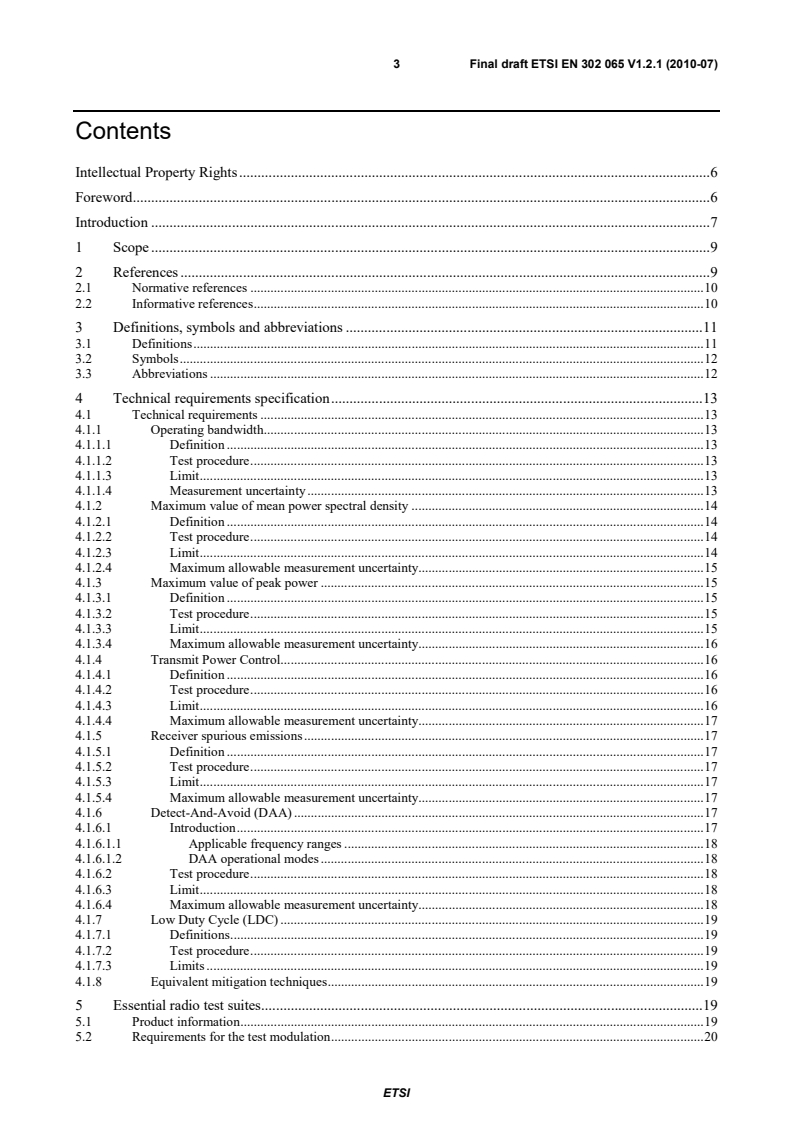
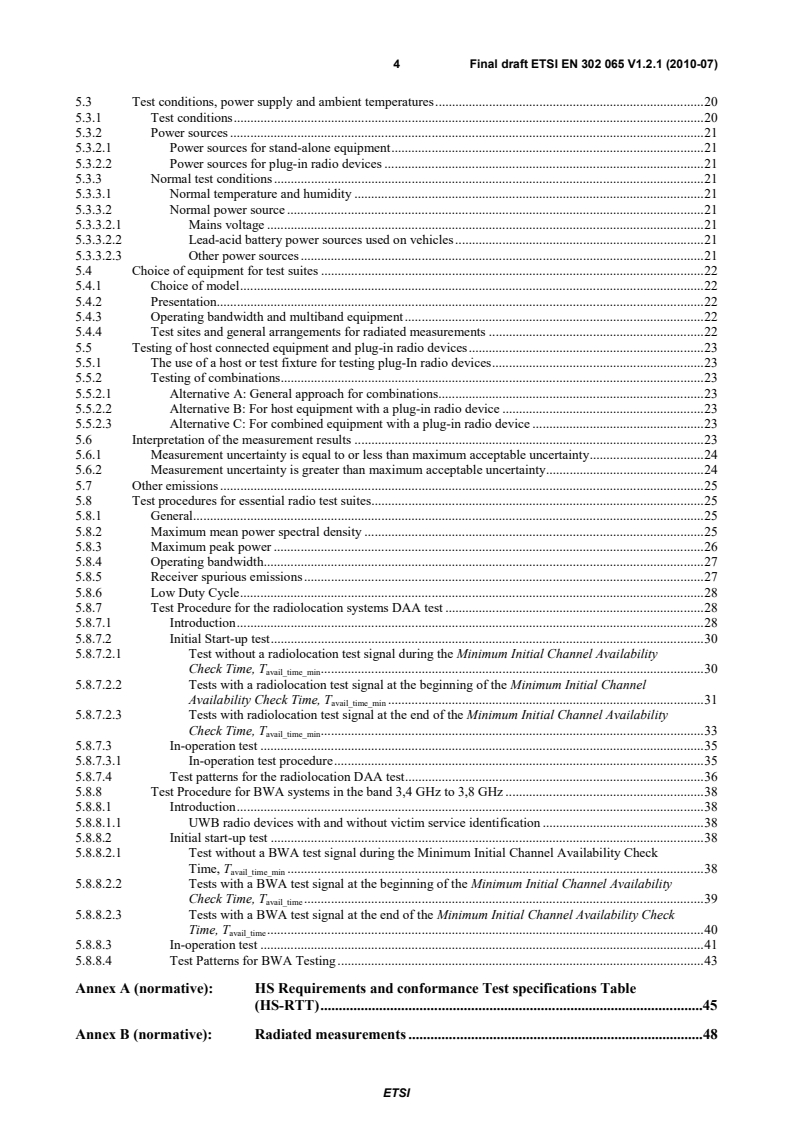
ETSI EN 302 065 V1.2.1 (2010-07) - Electromagnetic compatibility and Radio spectrum Matters (ERM); Short Range Devices (SRD) using Ultra Wide Band technology (UWB) for communications purposes; Harmonized EN covering the essential requirements of article 3.2 of the R&TTE Directive
Overview
ETSI EN 302 065 V1.2.1 (2010-10) is a harmonized European standard for Ultra Wide Band (UWB) Short Range Devices (SRD) used for communications. It defines electromagnetic compatibility (EMC) and radio spectrum requirements addressing the essential requirements of Article 3.2 of the R&TTE Directive. The standard covers transceivers, transmitters and receivers using impulse, modified-impulse and RF-carrier based UWB technologies for fixed (indoor only), mobile and portable applications.
Key topics and technical requirements
The standard specifies testable technical requirements and radio test suites, including:
- Operating bandwidth - definitions, test procedures and measurement uncertainty.
- Maximum mean power spectral density (PSD) - methods to measure and limits to protect spectrum usage.
- Peak power limits - definitions, test procedures and acceptable uncertainty.
- Transmit Power Control (TPC) - requirements and conformity testing.
- Receiver spurious emissions - requirements for in-band and out-of-band emissions.
- Detect-And-Avoid (DAA) mechanisms - operational modes, test procedures and radiolocation DAA test patterns.
- Low Duty Cycle (LDC) provisions - definitions, test methods and limits for pulse-based UWB.
- Equivalent mitigation techniques and measurement interpretation when uncertainty exceeds limits.
- Special test suites - host-connected/plug-in device testing, combinations, radiated measurements, product information and environmental/test conditions.
- Band-specific testing - e.g., BWA-related tests in the 3.4–3.8 GHz range (test patterns and DAA considerations).
The document includes normative and informative references, definitions, symbols and annexes listing conformance test specifications.
Practical applications and who uses this standard
SIST EN 302 065 is essential for organizations designing, manufacturing or testing UWB communication devices, including:
- Device manufacturers (consumer electronics, IoT, industrial wireless).
- Automotive and rail equipment suppliers using UWB for short-range communications and positioning.
- Test laboratories and conformity assessment bodies conducting EMC and spectrum compliance testing.
- Product compliance and regulatory teams preparing technical documentation for market access under the R&TTE framework.
- System integrators adding plug-in or combined UWB radio modules to host equipment (PCs, set-top boxes, access points).
Note: the standard prohibits installation of UWB transmitters conforming to this document at fixed outdoor locations and for use in flying models, aircraft and other aviation applications (per relevant ECC and EU decisions).
Related standards and context
- Harmonized EN (ETSI) document forming the European compliance basis for Article 3.2 of the R&TTE Directive.
- Useful alongside other ETSI EMC and radio spectrum standards and national implementation guidance for SRD and UWB deployments.
Keywords: Ultra Wide Band, UWB, Short Range Devices, SRD, EMC, R&TTE Directive, Detect-And-Avoid, power spectral density, peak power, transmit power control, conformity testing.
Buy Documents
en_302065v010201p - Electromagnetic compatibility and Radio spectrum Matters (ERM); Short Range Devices (SRD) using Ultra Wide Band technology (UWB) for communications purposes; Harmonized EN covering the essential requirements of article 3.2 of the R&TTE Directive
ETSI EN 302 065 V1.2.1 (2009-12) - Electromagnetic compatibility and Radio spectrum Matters (ERM); Short Range Devices (SRD) using Ultra Wide Band technology (UWB) for communications purposes; Harmonized EN covering essential requirements of article 3.2 of the R&TTE Directive
ETSI EN 302 065 V1.2.1 (2010-07) - Electromagnetic compatibility and Radio spectrum Matters (ERM); Short Range Devices (SRD) using Ultra Wide Band technology (UWB) for communications purposes; Harmonized EN covering the essential requirements of article 3.2 of the R&TTE Directive
Frequently Asked Questions
ETSI EN 302 065 V1.2.1 (2010-10) is a standard published by the European Telecommunications Standards Institute (ETSI). Its full title is "Electromagnetic compatibility and Radio spectrum Matters (ERM); Short Range Devices (SRD) using Ultra Wide Band technology (UWB) for communications purposes; Harmonized EN covering the essential requirements of article 3.2 of the R&TTE Directive". This standard covers: REN/ERM-TGUWB-0118-1
REN/ERM-TGUWB-0118-1
ETSI EN 302 065 V1.2.1 (2010-10) is associated with the following European legislation: Standardization Mandates: M/284. When a standard is cited in the Official Journal of the European Union, products manufactured in conformity with it benefit from a presumption of conformity with the essential requirements of the corresponding EU directive or regulation.
ETSI EN 302 065 V1.2.1 (2010-10) is available in PDF format for immediate download after purchase. The document can be added to your cart and obtained through the secure checkout process. Digital delivery ensures instant access to the complete standard document.
Standards Content (Sample)
Harmonized European Standard (Telecommunications series)
Electromagnetic compatibility and
Radio spectrum Matters (ERM);
Short Range Devices (SRD) using
Ultra Wide Band technology (UWB)
for communications purposes;
Harmonized EN covering the essential requirements
of article 3.2 of the R&TTE Directive
2 ETSI EN 302 065 V1.2.1 (2010-10)
Reference
REN/ERM-TGUWB-0118-1
Keywords
radio, SRD, testing, UWB
ETSI
650 Route des Lucioles
F-06921 Sophia Antipolis Cedex - FRANCE
Tel.: +33 4 92 94 42 00 Fax: +33 4 93 65 47 16
Siret N° 348 623 562 00017 - NAF 742 C
Association à but non lucratif enregistrée à la
Sous-Préfecture de Grasse (06) N° 7803/88
Important notice
Individual copies of the present document can be downloaded from:
http://www.etsi.org
The present document may be made available in more than one electronic version or in print. In any case of existing or
perceived difference in contents between such versions, the reference version is the Portable Document Format (PDF).
In case of dispute, the reference shall be the printing on ETSI printers of the PDF version kept on a specific network drive
within ETSI Secretariat.
Users of the present document should be aware that the document may be subject to revision or change of status.
Information on the current status of this and other ETSI documents is available at
http://portal.etsi.org/tb/status/status.asp
If you find errors in the present document, please send your comment to one of the following services:
http://portal.etsi.org/chaircor/ETSI_support.asp
Copyright Notification
No part may be reproduced except as authorized by written permission.
The copyright and the foregoing restriction extend to reproduction in all media.
© European Telecommunications Standards Institute 2010.
All rights reserved.
TM TM TM TM
DECT , PLUGTESTS , UMTS , TIPHON , the TIPHON logo and the ETSI logo are Trade Marks of ETSI registered
for the benefit of its Members.
TM
3GPP is a Trade Mark of ETSI registered for the benefit of its Members and of the 3GPP Organizational Partners.
LTE™ is a Trade Mark of ETSI currently being registered
for the benefit of its Members and of the 3GPP Organizational Partners.
GSM® and the GSM logo are Trade Marks registered and owned by the GSM Association.
ETSI
3 ETSI EN 302 065 V1.2.1 (2010-10)
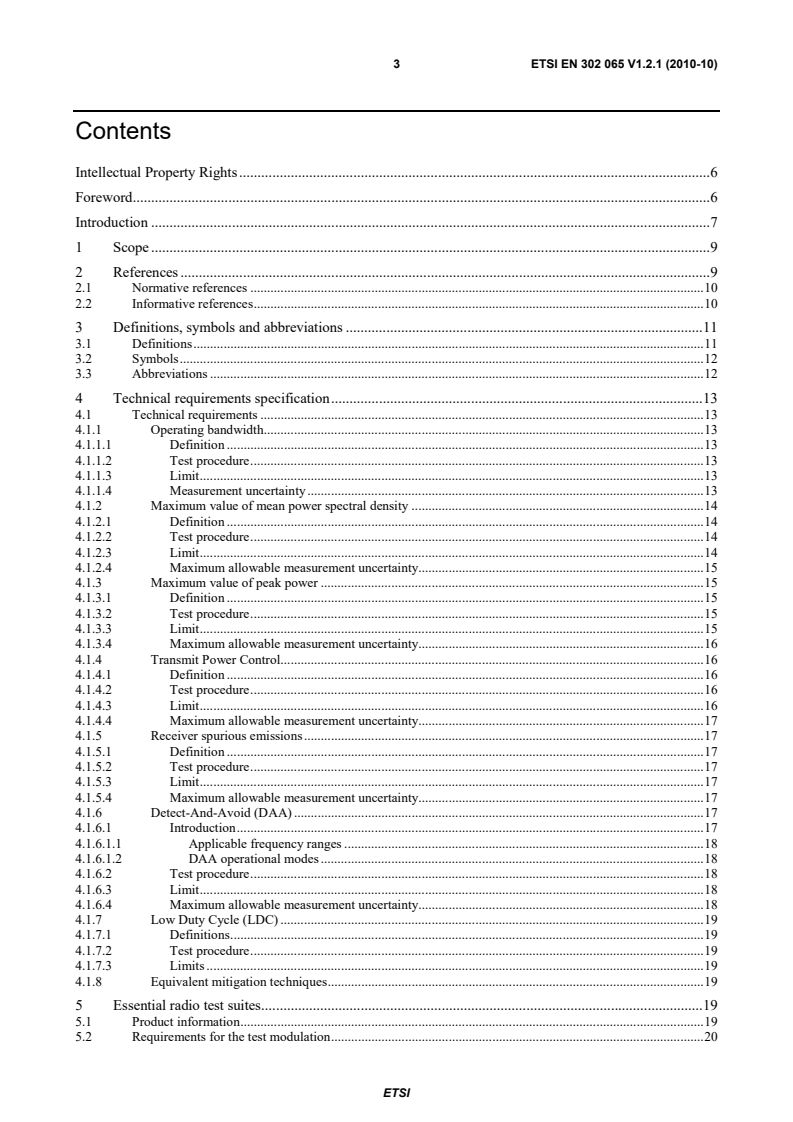
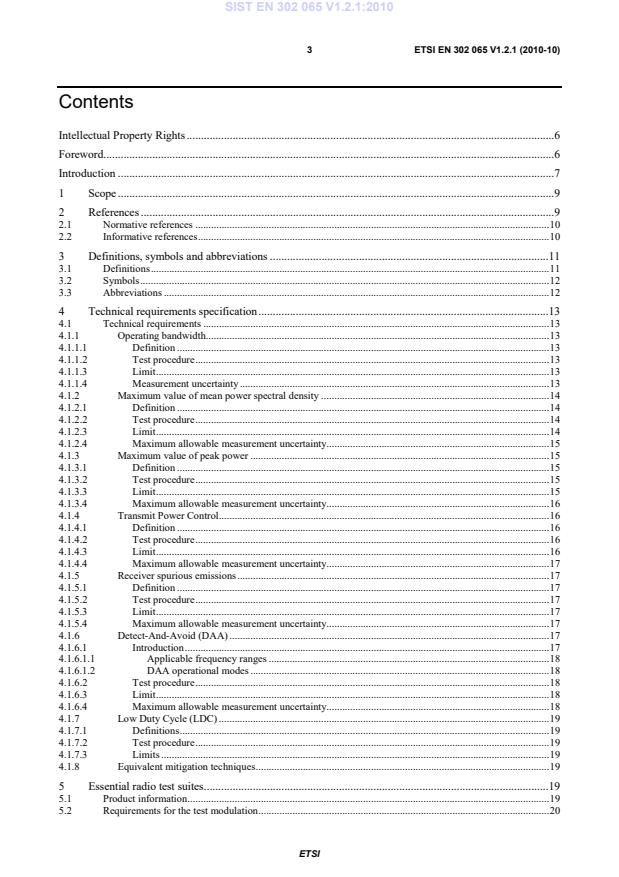
Contents
Intellectual Property Rights . 6
Foreword . 6
Introduction . 7
1 Scope . 9
2 References . 9
2.1 Normative references . 10
2.2 Informative references . 10
3 Definitions, symbols and abbreviations . 11
3.1 Definitions . 11
3.2 Symbols . 12
3.3 Abbreviations . 12
4 Technical requirements specification . 13
4.1 Technical requirements . 13
4.1.1 Operating bandwidth. 13
4.1.1.1 Definition . 13
4.1.1.2 Test procedure . 13
4.1.1.3 Limit . 13
4.1.1.4 Measurement uncertainty . 13
4.1.2 Maximum value of mean power spectral density . 14
4.1.2.1 Definition . 14
4.1.2.2 Test procedure . 14
4.1.2.3 Limit . 14
4.1.2.4 Maximum allowable measurement uncertainty. 15
4.1.3 Maximum value of peak power . 15
4.1.3.1 Definition . 15
4.1.3.2 Test procedure . 15
4.1.3.3 Limit . 15
4.1.3.4 Maximum allowable measurement uncertainty. 16
4.1.4 Transmit Power Control . 16
4.1.4.1 Definition . 16
4.1.4.2 Test procedure . 16
4.1.4.3 Limit . 16
4.1.4.4 Maximum allowable measurement uncertainty. 17
4.1.5 Receiver spurious emissions . 17
4.1.5.1 Definition . 17
4.1.5.2 Test procedure . 17
4.1.5.3 Limit . 17
4.1.5.4 Maximum allowable measurement uncertainty. 17
4.1.6 Detect-And-Avoid (DAA) . 17
4.1.6.1 Introduction . 17
4.1.6.1.1 Applicable frequency ranges . 18
4.1.6.1.2 DAA operational modes . 18
4.1.6.2 Test procedure . 18
4.1.6.3 Limit . 18
4.1.6.4 Maximum allowable measurement uncertainty. 18
4.1.7 Low Duty Cycle (LDC) . 19
4.1.7.1 Definitions . 19
4.1.7.2 Test procedure . 19
4.1.7.3 Limits . 19
4.1.8 Equivalent mitigation techniques . 19
5 Essential radio test suites . 19
5.1 Product information . 19
5.2 Requirements for the test modulation . 20
ETSI
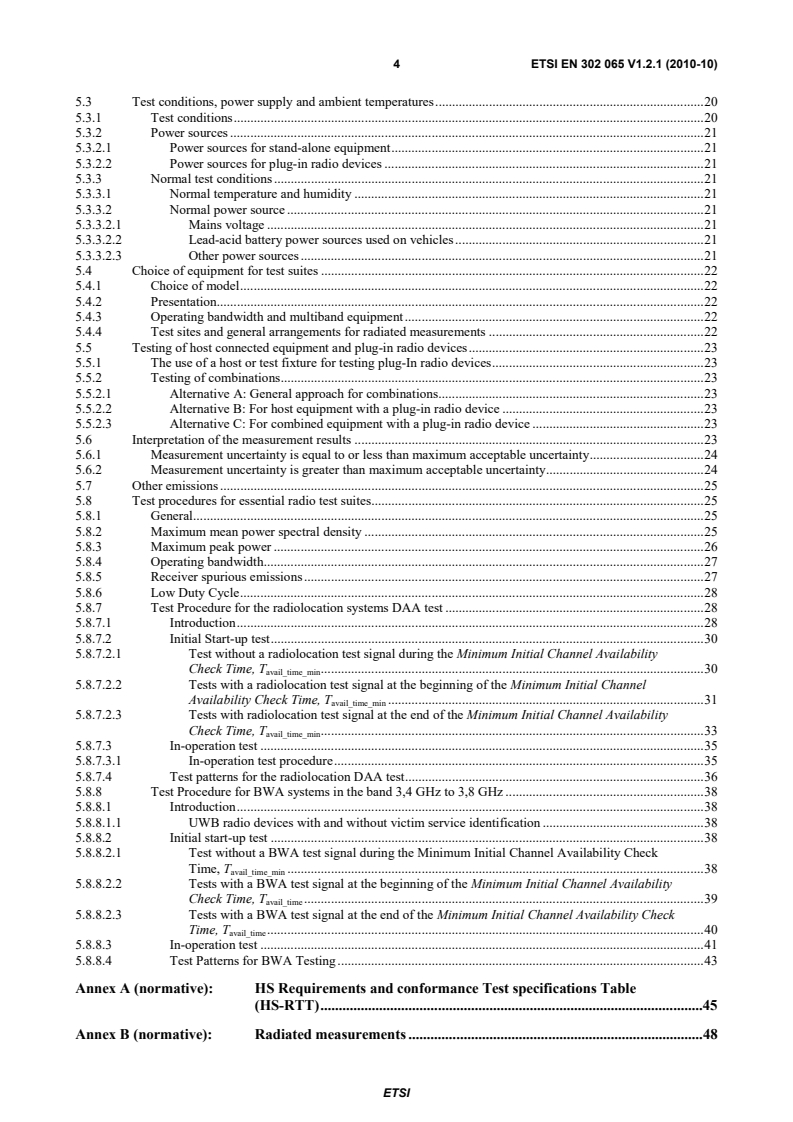
4 ETSI EN 302 065 V1.2.1 (2010-10)
5.3 Test conditions, power supply and ambient temperatures . 20
5.3.1 Test conditions . 20
5.3.2 Power sources . 21
5.3.2.1 Power sources for stand-alone equipment . 21
5.3.2.2 Power sources for plug-in radio devices . 21
5.3.3 Normal test conditions . 21
5.3.3.1 Normal temperature and humidity . 21
5.3.3.2 Normal power source . 21
5.3.3.2.1 Mains voltage . 21
5.3.3.2.2 Lead-acid battery power sources used on vehicles . 21
5.3.3.2.3 Other power sources . 21
5.4 Choice of equipment for test suites . 22
5.4.1 Choice of model . 22
5.4.2 Presentation. 22
5.4.3 Operating bandwidth and multiband equipment . 22
5.4.4 Test sites and general arrangements for radiated measurements . 22
5.5 Testing of host connected equipment and plug-in radio devices . 23
5.5.1 The use of a host or test fixture for testing plug-In radio devices . 23
5.5.2 Testing of combinations . 23
5.5.2.1 Alternative A: General approach for combinations . 23
5.5.2.2 Alternative B: For host equipment with a plug-in radio device . 23
5.5.2.3 Alternative C: For combined equipment with a plug-in radio device . 23
5.6 Interpretation of the measurement results . 23
5.6.1 Measurement uncertainty is equal to or less than maximum acceptable uncertainty . 24
5.6.2 Measurement uncertainty is greater than maximum acceptable uncertainty . 24
5.7 Other emissions . 25
5.8 Test procedures for essential radio test suites. 25
5.8.1 General . 25
5.8.2 Maximum mean power spectral density . 25
5.8.3 Maximum peak power . 26
5.8.4 Operating bandwidth. 27
5.8.5 Receiver spurious emissions . 27
5.8.6 Low Duty Cycle . 28
5.8.7 Test Procedure for the radiolocation systems DAA test . 28
5.8.7.1 Introduction . 28
5.8.7.2 Initial Start-up test . 30
5.8.7.2.1 Test without a radiolocation test signal during the Minimum Initial Channel Availability
Check Time, T . 30
avail_time_min
5.8.7.2.2 Tests with a radiolocation test signal at the beginning of the Minimum Initial Channel
Availability Check Time, T . 31
avail_time_min
5.8.7.2.3 Tests with radiolocation test signal at the end of the Minimum Initial Channel Availability
Check Time, T . 33
avail_time_min
5.8.7.3 In-operation test . 35
5.8.7.3.1 In-operation test procedure . 35
5.8.7.4 Test patterns for the radiolocation DAA test . 36
5.8.8 Test Procedure for BWA systems in the band 3,4 GHz to 3,8 GHz . 38
5.8.8.1 Introduction . 38
5.8.8.1.1 UWB radio devices with and without victim service identification . 38
5.8.8.2 Initial start-up test . 38
5.8.8.2.1 Test without a BWA test signal during the Minimum Initial Channel Availability Check
Time, T . 38
avail_time_min
5.8.8.2.2 Tests with a BWA test signal at the beginning of the Minimum Initial Channel Availability
Check Time, T . 39
avail_time
5.8.8.2.3 Tests with a BWA test signal at the end of the Minimum Initial Channel Availability Check
Time, T . 40
avail_time
5.8.8.3 In-operation test . 41
5.8.8.4 Test Patterns for BWA Testing . 43
Annex A (normative): HS Requirements and conformance Test specifications Table
(HS-RTT) . 45
Annex B (normative): Radiated measurements . 48
ETSI
5 ETSI EN 302 065 V1.2.1 (2010-10)
B.1 Test sites and general arrangements for measurements involving the use of radiated fields . 48
B.1.1 Anechoic chamber . 48
B.1.2 Anechoic chamber with a conductive ground plane . 49
B.1.3 Test antenna . 51
B.1.4 Substitution antenna . 51
B.1.5 Measuring antenna . 51
B.2 Guidance on the use of a radiation test site . 51
B.2.1 Verification of the test site . 51
B.2.2 Preparation of the EUT . 52
B.2.3 Power supplies to the EUT . 52
B.2.4 Range length . 52
B.2.5 Site preparation . 53
B.3 Coupling of signals . 53
B.3.1 General . 53
B.3.2 Data Signals. 53
B.4 Standard test methods . 53
B.4.1 Calibrated setup . 53
B.4.2 Substitution method . 54
B.5 Standard calibration method . 55
Annex C (normative): Conducted measurements for DAA testing . 57
Annex D (informative): Measurement antenna and preamplifier specifications . 58
Annex E (normative): Radiolocation services in the band 3,1 GHz to 3,4 GHz . 59
Annex F (normative): Broadband wireless access services in the band 3,4 GHz to 3,8 GHz . 60
Annex G (normative): Radiolocation services in the band 8,5 GHz to 9,0 GHz . 61
Annex H (informative): Calculation of peak limit for 3 MHz measurement bandwidth . 62
Annex I (normative): ICS Proforma for DAA radio device . 64
I.1 Identification of the protocol . 64
I.2 ICS proforma tables. 64
I.2.1 Avoidance Modes . 64
Annex J (informative): Bibliography . 65
Annex K (informative): The EN title in the official languages . 66
History . 67
ETSI
6 ETSI EN 302 065 V1.2.1 (2010-10)
Intellectual Property Rights
IPRs essential or potentially essential to the present document may have been declared to ETSI. The information
pertaining to these essential IPRs, if any, is publicly available for ETSI members and non-members, and can be found
in ETSI SR 000 314: "Intellectual Property Rights (IPRs); Essential, or potentially Essential, IPRs notified to ETSI in
respect of ETSI standards", which is available from the ETSI Secretariat. Latest updates are available on the ETSI Web
server (http://webapp.etsi.org/IPR/home.asp).
Pursuant to the ETSI IPR Policy, no investigation, including IPR searches, has been carried out by ETSI. No guarantee
can be given as to the existence of other IPRs not referenced in ETSI SR 000 314 (or the updates on the ETSI Web
server) which are, or may be, or may become, essential to the present document.
Foreword
This Harmonized European Standard (Telecommunications series) has been produced by ETSI Technical Committee
Electromagnetic compatibility and Radio spectrum Matters (ERM).
The present document has been produced by ETSI in response to a mandate from the European Commission issued
under Council Directive 98/34/EC [i.2] (as amended) laying down a procedure for the provision of information in the
field of technical standards and regulations.
The present document is intended to become a Harmonized Standard, the reference of which will be published in the
Official Journal of the European Communities referencing the Directive 1999/5/EC [i.3] of the European Parliament
and of the Council of 9 March 1999 on radio equipment and telecommunications terminal equipment and the mutual
recognition of their conformity ("the R&TTE Directive").
The present document is intended to cover the provisions of article 3.2 of Directive 1999/5/EC
(R&TTE Directive) [i.3].
The present document does not apply to radio equipment for which a specific Harmonized EN applies as such
Harmonized EN may specify additional EN requirements relevant to the presumption of conformity under article 3.2 of
the R&TTE Directive.
Technical specifications relevant to Directive 1999/5/EC [i.3] are summarised in annex A.
National transposition dates
Date of adoption of this EN: 20 September 2010
Date of latest announcement of this EN (doa): 31 December 2010
Date of latest publication of new National Standard
or endorsement of this EN (dop/e): 30 June 2011
Date of withdrawal of any conflicting National Standard (dow): 30 June 2012
ETSI
7 ETSI EN 302 065 V1.2.1 (2010-10)
Introduction
The present document is part of a set of standards developed by ETSI and is designed to fit in a modular structure to
cover all radio and telecommunications terminal equipment within the scope of the R&TTE Directive. The modular
structure is shown in EG 201 399 [i.1].
UWB Technologies
The present document provides a generic set of technical requirements covering many different types of UWB
technologies used for short range communications. These technologies can be broken down into two groups:
1) Impulse based technologies; and
2) RF carrier based technologies.
The following clauses give a brief overview of these UWB technologies and their associated modulation techniques.
Impulse technology
Impulse derived UWB technology consists of a series of impulses created from a dc voltage step whose rise time can be
modified to provide the maximum useful number of spectral emission frequencies. This derived impulse can then be
suitably modified by the use of filters to locate the resulting waveform within a specific frequency spectrum range. This
filter can be a standalone filter or incorporated into an antenna design to reduce emissions outside the designated
frequency spectrum.
Modulation techniques include pulse positioning in time, pulse suppression and other techniques to convey information.
The transmitted energy is summed at the receiver to reproduce the transmitted pulse.
This technology is suitable for direct and non-direct line of sight communications, any reflected or time delayed
emissions being suppressed by the receiver input circuits.
RF carrier based technology
RF carrier based UWB technology is based upon classical radio carrier technology suitably modulated by a baseband
modulating process. The modulating process must produce a bandwidth in excess of 50 MHz to be defined as UWB.
Different modulating processes are used to transmit the data information to the receiver and can consist of a series of
single hopping frequencies or multi-tone carriers.
This technology can be used for both direct and non-direct line of sight communications, any reflected or time delayed
emissions being suppressed by the receiver input circuits.
Test and measurement limitations
The ERA report 2006-0713 [i.9] has shown that there are practical limitations on measurements of RF radiated
emissions. The minimum radiated levels that can be practically measured in the lower GHz frequency range by using a
radiated measurement setup with a horn antenna and pre-amplifier are typically in the range of about -70 dBm/MHz to
-75 dBm/MHz (e.i.r.p) to have sufficient confidence in the measured result (i.e. UWB signal should be at least 6 dB
above the noise floor of the spectrum analyser and the measurement is performed under far-field conditions at a one
meter distance).
For equipment that have dedicated detachable antennas and provide a 50 ohm antenna port for testing, conducted
measurements can be made provided that suitable antenna calibrations can be provided. In the present document, test
suites for conducted measurements are only provided for DAA conformance measurements. Transmitter emissions of
the radio device are expected to be measured using the radiated measurement setup with the exception of UWB devices
which are intended to operate at a mean power spectral density of -70 dBm/MHz or less, then a conducted test
procedure can be used.
ETSI
8 ETSI EN 302 065 V1.2.1 (2010-10)
For integrated antenna equipment, previous ETSI testing standards have allowed equipment modification to provide a
50 ohm test adaptor to be added to provide the necessary test port. However, UWB integral equipment and particularly
impulse based technology does not use classical radio techniques and as such is unlikely to have matched 50 ohm
antenna port impedances.
The present document therefore recognizes these difficulties and provides a series of test methods suitable for the
different UWB technologies.
ETSI
9 ETSI EN 302 065 V1.2.1 (2010-10)
1 Scope
The present document applies to transceivers, transmitters and receivers utilizing Ultra WideBand (UWB) technologies
and used for short range communication purposes.
The present document applies to impulse, modified impulse and RF carrier based UWB communication technologies.
The present document applies to fixed (indoor only), mobile or portable applications, e.g.:
• stand-alone radio equipment with or without its own control provisions;
• plug-in radio devices intended for use with, or within, a variety of host systems, e.g. personal computers,
hand-held terminals, etc.;
• plug-in radio devices intended for use within combined equipment, e.g. cable modems, set-top boxes, access
points, etc.;
• combined equipment or a combination of a plug-in radio device and a specific type of host equipment;
• equipment for use in road and rail vehicles.
NOTE 1: As per the ECC/DEC/(06)04 [i.4] and Decision 2007/131/EC [i.5] and its amendment the UWB
transmitter equipment conforming to the present document is not to be installed at a fixed outdoor
location, for use in flying models, aircraft and other forms of aviation.
The present document applies to UWB equipment with an output connection used with a dedicated antenna or UWB
equipment with an integral antenna.
These radio equipment types are capable of operating in all or part of the frequency bands given in Table 1.
Table 1: Radiocommunications frequency bands
Radiocommunications frequency bands
Transmit 3,1 GHz to 4,8 GHz
Receive 3,1 GHz to 4,8 GHz
Transmit 6,0 GHz to 9 GHz
Receive 6,0 GHz to 9 GHz
NOTE: The UWB radio device can also operate outside of the radiocommunications frequency bands shown in the
present table provided that the limits in clause 4.1.2.3, Table 2 are met.
NOTE 2: A list of such ENs is included on the web site http://www.newapproach.org.
2 References
References are either specific (identified by date of publication and/or edition number or version number) or
non-specific. For specific references, only the cited version applies. For non-specific references, the latest version of the
referenced document (including any amendments) applies.
Referenced documents which are not found to be publicly available in the expected location might be found at
http://docbox.etsi.org/Reference.
NOTE: While any hyperlinks included in this clause were valid at the time of publication ETSI cannot guarantee
their long term validity.
ETSI
10 ETSI EN 302 065 V1.2.1 (2010-10)
2.1 Normative references
The following referenced documents are necessary for the application of the present document.
[1] ETSI TR 100 028 (V1.4.1) (all parts): "Electromagnetic compatibility and Radio spectrum Matters
(ERM); Uncertainties in the measurement of mobile radio equipment characteristics".
[2] ANSI C63.5 (2006): "American National Standard for Calibration of Antennas Used for Radiated
Emission Measurements in Electro Magnetic Interference".
[3] ITU-R Recommendation SM 329-10 (2003): "Unwanted emissions in the spurious domain".
[4] ETSI TS 102 321 (V1.1.1): "Electromagnetic compatibility and Radio spectrum Matters (ERM);
Normalized Site Attenuation (NSA) and validation of a fully lined anechoic chamber up to
40 GHz".
[5] ETSI TS 102 754 (V1.2.1): "Electromagnetic compatibility and Radio spectrum Matters (ERM);
Short Range Devices (SRD); Technical characteristics of Detect-And-Avoid (DAA) mitigation
techniques for SRD equipment using Ultra Wideband (UWB) technology".
2.2 Informative references
The following referenced documents are not necessary for the application of the present document but they assist the
user with regard to a particular subject area.
[i.1] ETSI EG 201 399 (V2.1.1): "Electromagnetic compatibility and Radio spectrum Matters (ERM);
A guide to the production of candidate Harmonized Standards for application under the R&TTE
Directive".
[i.2] Directive 1998/34/EC as amended by 1998/48/EC the European Parliament and of the Council of
22 June 1998 laying down a procedure for the provision of information in the field of technical
standards and regulations.
[i.3] Directive 1999/5/EC of the European Parliament and of the Council of 9 March 1999 on radio
equipment and telecommunications terminal equipment and the mutual recognition of their
conformity (R&TTE Directive).
[i.4] CEPT ECC/DEC/(06)04 of 24 March 2006 amended 6 July 2007 at Constanza on the harmonized
conditions for devices using Ultra-Wideband (UWB) technology in bands below 10.6 GHz.
[i.5] Commission Decision 2007/131/EC of 21 February 2007 on allowing the use of the radio
spectrum for equipment using ultra-wideband technology in a harmonised manner in the
Community (notified under document number C(2007) 522).
[i.6] ITU-R Recommendation SM.1754 (2006): "Measurement techniques of ultra-wideband
transmissions".
[i.7] ETSI TR 102 273 (V1.2.1) (all parts): "Electromagnetic compatibility and Radio spectrum Matters
(ERM); Improvement on Radiated Methods of Measurement (using test site) and evaluation of the
corresponding measurement uncertainties".
[i.8] ETSI TR 102 070-2 (V1.1.1): "Electromagnetic compatibility and Radio spectrum Matters (ERM);
Guide to the application of harmonized standards to multi-radio and combined radio and non-radio
equipment; Part 2: Effective use of the radio frequency spectrum".
[i.9] ERA Report 2006-0713: "Conducted and radiated measurements for low level UWB emissions".
[i.10] ECC Report 120 (March 2008): "ECC Report on Technical requirements for UWB DAA (Detect
and avoid) devices to ensure the protection of radiolocation in the bands 3.1-3.4 GHz and
8.5-9 GHz and BWA terminals in the band 3.4 - 4.2 GHz".
[i.11] Decision 2009/343/EC amending decision 2007/131/EC on allowing the use of radio spectrum for
equipment using ultra-wideband technology in a harmonised manner in the Community.
ETSI
11 ETSI EN 302 065 V1.2.1 (2010-10)
3 Definitions, symbols and abbreviations
3.1 Definitions
For the purposes of the present document, the following terms and definitions apply:
avoidance level: maximum amplitude to which the UWB transmit power is set for the relevant protection zone
combined equipment: any combination of non-radio equipment and a plug-in radio device that would not offer full
functionality without the radio device
default avoidance bandwidth: portion of the victim service bandwidth to be protected if no enhanced service
bandwidth identification mechanisms are implemented in the DAA enabled devices
detect and avoid time: time duration between a change of the external RF environmental conditions and adaptation of
the corresponding UWB operational parameters
detection probability: probability that the DAA enabled UWB radio device reacts appropriately to a signal detection
threshold crossing within the detect and avoid time
dedicated antenna: removable antenna supplied and tested with the radio equipment, designed as an indispensable part
of the equipment
effective radiated power (e.r.p.): product of the power supplied to the antenna and its gain relative to a half-wave
dipole in a given direction (RR 1.162)
equivalent isotropically radiated power (e.i.r.p.): product of the power supplied to the antenna and the antenna gain
in a given direction relative to an isotropic antenna (absolute or isotropic gain) (RR 1.161)
gating: transmission that is intermittent or of a low duty cycle referring to the use of burst transmissions where a
transmitter is switched on and off for selected time intervals
hopping: spread spectrum technique whereby individual radio links are continually switched from one subchannel to
another
host: host equipment is any equipment which has complete user functionality when not connected to the radio
equipment part and to which the radio equipment part provides additional functionality and to which connection is
necessary for the radio equipment part to offer functionality
impulse: pulse whose width is determined by its dc step risetime and whose maximum amplitude is determined by its
dc step value
integral antenna: permanent fixed antenna, which may be built-in, designed as an indispensable part of the equipment
maximum avoidance power level: UWB transmit power assuring the equivalent protection of the victim service
minimum avoidance bandwidth: portion of the victim service bandwidth requiring protection
minimum initial channel availability check time: minimum time the UWB radio device spends searching for victim
signals after power on, Parameter: T
avail, Time
narrowband: See test in clause 5.8.5.
Non-Interference mode operation (NIM): operational mode that allows the use of the radio spectrum on a
non-interference basis without active mitigation techniques
plug-in radio device: radio equipment module intended to be used with or within host, combined or multi-radio
equipment, using their control functions and power supply
pulse: short transient signal whose time duration is nominally the reciprocal of its -10 dB bandwidth
rf carrier: fixed radio frequency prior to modulation
ETSI
12 ETSI EN 302 065 V1.2.1 (2010-10)
signal detection threshold: amplitude of the victim signal which defines the transition between adjacent protection
zones, Parameter: D
thresh
NOTE: The threshold level is defined to be the signal level at the receiver front end of the UWB DAA radio
device and assuming a 0 dBi receive antenna.
signal detection threshold set: set of amplitudes of the victim signal which defines the transition between adjacent
protection zones
stand-alone radio equipment: equipment that is intended primarily as communications equipment and that is normally
used on a stand-alone basis
victim signal: signal(s) of the service to be detected and protected by the DAA mitigation technique
wideband: emission whose occupied bandwidth is greater than the test equipment measurement bandwidth
zone model: flexible DAA concept based on the definition of different zones as defined in TS 102 754 [5]
3.2 Symbols
For the purposes of the present document, the following symbols apply:
Ω ohm
λ wavelength
D detection threshold
dB decibel
dBi gain in decibels relative to an isotropic antenna
dBm gain in decibels relative to one milliwatt
f frequency
f highest frequency of the power envelope
H
f lowest frequency of the power envelope
L
I Isolation in dB
P Power in dBm
R Distance
T Minimum initial channel availability check time
avail_time_min
T Detect and avoid time
avoid
NOTE: Actual Detect and Avoid time of a DUT, can be negative.
T Maximum allowed Detect and avoid time
avoid_max
T time
3.3 Abbreviations
For the purposes of the present document, the following abbreviations apply:
AC Alternating Current
ATT ATTenuator/ATTenuation
BPSK Binary Phase Shift Keying
BWA Broadband Wireless Access
CEPT European Conference of Postal and Telecommunications Administrations
CON Conformance test results
DAA Detect And Avoid
dc direct current
e.i.r.p. equivalent isotropically radiated power
e.r.p. effective radiated power
ECC Electronic Communications Committee
EIRP Equivalent Isotropically Radiated Power
EUT Equipment Unter Test
FDD Frequency Division Duplex
FH Frequency Hopping
ETSI
13 ETSI EN 302 065 V1.2.1 (2010-10)
FMCW Frequency Modulated Continuous Wave
FSK Frequency Shift Keying
HS Harmonized Standard
ICS Implementation Conformance Statement
LDC Low Duty Cycle
LFM Linear Frequency Modulation
LNA Low Noise Amplifier
NIM Non Interference Mode
OFDM Orthogonal Frequency Division Multiplexing
OFDMA Orthogonal Frequency Division Multiple Access
PPB Pulse Per Burst
PRF Pulse Repetition Frequency
R&TTE Radio and Telecommunications Terminal Equipment
RBW Resolution BandWidth
RF Radio Frequency
RMS Root Mean Square
RR Radio Regulations
Rx Receiver
SNR Signal to Noise Ratio
SRD Short Range Device
TDD Time Division Duplex
TPC Transmit Power Control
Tx Transmitter
UWB Ultra WideBand
VBW Video BandWidth
VSWR Voltage Standing Wave Ratio
4 Technical requirements specification
4.1 Technical requirements
4.1.1 Operating bandwidth
4.1.1.1 Definition
The width of a frequency band such that, below the lower and above the upper frequency limits, the mean powers
emitted are each equal to a percentage of 5 % of the total mean power of a given emission.
For the purposes of the present document the measurements are made at the -13 dB points.
4.1.1.2 Test procedure
This test shall be performed using a radiated test procedure (see clause 5.4.4 and annex B).
For UWB devices which are intended to operate at a mean power spectral density of -70 dBm/MHz or less, the test can
be performed using a conducted test procedure.
4.1.1.3 Limit
The operating bandwidth shall be greater than 50 MHz (at -13 dB relative to the maximum spectral power density).
4.1.1.4 Measurement uncertainty
See Table 10.
ETSI
14 ETSI EN 302 065 V1.2.1 (2010-10)
4.1.2 Maximum value of mean power spectral density
4.1.2.1 Definition
The maximum mean power spectral density (specified as e.i.r.p.) of the radio device under test, at a particular
frequency, is the average power per unit bandwidth (centred on that frequency)
...
Draft ETSI EN 302 065 V1.2.1 (2009-12)
Harmonized European Standard (Telecommunications series)
Electromagnetic compatibility and
Radio spectrum Matters (ERM);
Short Range Devices (SRD) using
Ultra Wide Band technology (UWB)
for communications purposes;
Harmonized EN covering essential requirements
of article 3.2 of the R&TTE Directive
2 Draft ETSI EN 302 065 V1.2.1 (2009-12)
Reference
REN/ERM-TGUWB-0118-1
Keywords
radio, SRD, testing, UWB
ETSI
650 Route des Lucioles
F-06921 Sophia Antipolis Cedex - FRANCE
Tel.: +33 4 92 94 42 00 Fax: +33 4 93 65 47 16
Siret N° 348 623 562 00017 - NAF 742 C
Association à but non lucratif enregistrée à la
Sous-Préfecture de Grasse (06) N° 7803/88
Important notice
Individual copies of the present document can be downloaded from:
http://www.etsi.org
The present document may be made available in more than one electronic version or in print. In any case of existing or
perceived difference in contents between such versions, the reference version is the Portable Document Format (PDF).
In case of dispute, the reference shall be the printing on ETSI printers of the PDF version kept on a specific network drive
within ETSI Secretariat.
Users of the present document should be aware that the document may be subject to revision or change of status.
Information on the current status of this and other ETSI documents is available at
http://portal.etsi.org/tb/status/status.asp
If you find errors in the present document, please send your comment to one of the following services:
http://portal.etsi.org/chaircor/ETSI_support.asp
Copyright Notification
No part may be reproduced except as authorized by written permission.
The copyright and the foregoing restriction extend to reproduction in all media.
© European Telecommunications Standards Institute 2009.
All rights reserved.
TM TM TM TM
DECT , PLUGTESTS , UMTS , TIPHON , the TIPHON logo and the ETSI logo are Trade Marks of ETSI registered
for the benefit of its Members.
TM
3GPP is a Trade Mark of ETSI registered for the benefit of its Members and of the 3GPP Organizational Partners.
LTE™ is a Trade Mark of ETSI currently being registered
for the benefit of its Members and of the 3GPP Organizational Partners.
GSM® and the GSM logo are Trade Marks registered and owned by the GSM Association.
ETSI
3 Draft ETSI EN 302 065 V1.2.1 (2009-12)
Contents
Intellectual Property Rights . 6
Foreword . 6
Introduction . 7
1 Scope . 9
2 References . 9
2.1 Normative references . 10
2.2 Informative references . 10
3 Definitions, symbols and abbreviations . 11
3.1 Definitions . 11
3.2 Symbols . 12
3.3 Abbreviations . 12
4 Technical requirements specification . 13
4.1 Technical requirements . 13
4.1.1 Operating bandwidth. 13
4.1.1.1 Definition . 13
4.1.1.2 Test procedure . 13
4.1.1.3 Limit . 13
4.1.1.4 Measurement uncertainty . 14
4.1.2 Maximum value of mean power spectral density . 14
4.1.2.1 Definition . 14
4.1.2.2 Test procedure . 14
4.1.2.3 Limit . 14
4.1.2.4 Maximum allowable measurement uncertainty. 15
4.1.3 Maximum value of peak power . 15
4.1.3.1 Definition . 15
4.1.3.2 Test procedure . 15
4.1.3.3 Limit . 15
4.1.3.4 Maximum allowable measurement uncertainty. 16
4.1.4 Transmit Power Control . 16
4.1.4.1 Definition . 16
4.1.4.2 Test procedure . 16
4.1.4.3 Limit . 17
4.1.4.4 Maximum allowable measurement uncertainty. 17
4.1.5 Receiver spurious emissions . 17
4.1.5.1 Definition . 17
4.1.5.2 Test procedure . 17
4.1.5.3 Limit . 17
4.1.5.4 Maximum allowable measurement uncertainty. 18
4.1.6 Detect-And-Avoid (DAA) . 18
4.1.6.1 Introduction . 18
4.1.6.1.1 Applicable frequency ranges . 18
4.1.6.1.2 DAA operational modes . 18
4.1.6.2 Test procedure . 19
4.1.6.3 Limit . 19
4.1.6.4 Maximum allowable measurement uncertainty. 19
4.1.7 Low Duty Cycle (LDC) . 19
4.1.7.1 Definitions . 19
4.1.7.2 Test procedure . 19
4.1.7.3 Limits . 19
4.1.8 Equivalent mitigation techniques . 20
5 Essential radio test suites . 20
5.1 Product information . 20
5.2 Requirements for the test modulation . 21
ETSI
4 Draft ETSI EN 302 065 V1.2.1 (2009-12)
5.3 Test conditions, power supply and ambient temperatures . 21
5.3.1 Test conditions . 21
5.3.2 Power sources . 21
5.3.2.1 Power sources for stand-alone equipment . 21
5.3.2.2 Power sources for plug-in radio devices . 21
5.3.3 Normal test conditions . 22
5.3.3.1 Normal temperature and humidity . 22
5.3.3.2 Normal power source . 22
5.3.3.2.1 Mains voltage . 22
5.3.3.2.2 Lead-acid battery power sources used on vehicles . 22
5.3.3.2.3 Other power sources . 22
5.4 Choice of equipment for test suites . 22
5.4.1 Choice of model . 22
5.4.2 Presentation. 22
5.4.3 Operating bandwidth. 22
5.4.4 Test sites and general arrangements for radiated measurements . 23
5.5 Testing of host connected equipment and plug-in radio devices . 23
5.5.1 The use of a host or test fixture for testing plug-In radio devices . 23
5.5.2 Testing of combinations . 23
5.5.2.1 Alternative A: General approach for combinations . 23
5.5.2.2 Alternative B: For host equipment with a plug-in radio device . 23
5.5.2.3 Alternative C: For combined equipment with a plug-in radio device . 24
5.6 Interpretation of the measurement results . 24
5.6.1 Measurement uncertainty is equal to or less than maximum acceptable uncertainty . 24
5.6.2 Measurement uncertainty is greater than maximum acceptable uncertainty . 25
5.7 Other emissions . 25
5.8 Test procedures for essential radio test suites. 25
5.8.1 General . 25
5.8.2 Maximum mean power spectral density . 25
5.8.3 Maximum peak power . 27
5.8.4 Operating bandwidth. 27
5.8.5 Receiver spurious emissions . 28
5.8.6 Low Duty Cycle . 28
5.8.7 Test Procedure for the radiolocation systems DAA test . 28
5.8.7.1 Introduction . 28
5.8.7.2 Start-up test . 30
5.8.7.2.1 Test without a radiolocation test signal during the Minimum Initial Channel Availability
Check Time, T . 30
avail_time_min
5.8.7.2.2 Tests with a radiolocation test signal at the beginning of the Minimum Initial Channel
Availability Check Time, T . 31
avail_time_min
5.8.7.2.3 Tests with radiolocation test signal at the end of the Minimum Initial Channel Availability
Check Time, T . 33
avail_time_min
5.8.7.3 In-operation test . 35
5.8.7.3.1 In-operation test procedure . 35
5.8.7.4 Test patterns for the radiolocation DAA test . 36
5.8.8 Test Procedure for BWA systems in the band 3,4 GHz to 3,8 GHz . 37
5.8.8.1 Introduction . 37
5.8.8.1.1 UWB radio devices with and without victim service identification . 37
5.8.8.2 Initial start-up test . 37
5.8.8.2.1 Test without a BWA test signal during the Minimum Initial Channel Availability Check
Time, T . 38
avail_time_min
5.8.8.2.2 Tests with a BWA test signal at the beginning of the Minimum Initial Channel Availability
Check Time, T . 38
avail_time
5.8.8.2.3 Tests with a BWA test signal at the end of the Minimum Initial Channel Availability Check
Time, T . 40
avail_time
5.8.8.3 In-operation test . 41
5.8.8.4 Test Patterns for BWA Testing . 42
Annex A (normative): HS Requirements and conformance Test specifications Table (HS-
RTT) . 44
Annex B (normative): Radiated measurements . 47
ETSI
5 Draft ETSI EN 302 065 V1.2.1 (2009-12)
B.1 Test sites and general arrangements for measurements involving the use of radiated fields . 47
B.1.1 Anechoic chamber . 47
B.1.2 Anechoic chamber with a conductive ground plane . 48
B.1.3 Test antenna . 50
B.1.4 Substitution antenna . 50
B.1.5 Measuring antenna . 50
B.2 Guidance on the use of a radiation test site . 50
B.2.1 Verification of the test site . 50
B.2.2 Preparation of the EUT . 51
B.2.3 Power supplies to the EUT . 51
B.2.4 Range length . 51
B.2.5 Site preparation . 52
B.3 Coupling of signals . 52
B.3.1 General . 52
B.3.2 Data Signals. 52
B.4 Standard test methods . 52
B.4.1 Calibrated setup . 52
B.4.2 Substitution method . 53
B.5 Standard calibration method . 54
Annex C (normative): Conducted measurements for DAA testing . 56
Annex D (informative): Measurement antenna and preamplifier specifications . 57
Annex E (normative): Radiolocation services in the band 3,1 GHz to 3,4 GHz . 58
Annex F (normative): Broadband wireless access services in the band 3,4 GHz to 3,8 GHz . 59
Annex G (normative): Radiolocation services in the band 8,5 GHz to 9,0 GHz . 60
Annex H (informative): Calculation of peak limit for 3 MHz measurement bandwidth . 61
Annex I (normative): ICS Proforma for DAA radio device . 63
I.1 Identification of the protocol . 63
I.2 ICS proforma tables. 63
I.2.1 Avoidance Modes . 63
Annex J (informative): Bibliography . 64
Annex K (informative): The EN title in the official languages . 65
History . 66
ETSI
6 Draft ETSI EN 302 065 V1.2.1 (2009-12)
Intellectual Property Rights
IPRs essential or potentially essential to the present document may have been declared to ETSI. The information
pertaining to these essential IPRs, if any, is publicly available for ETSI members and non-members, and can be found
in ETSI SR 000 314: "Intellectual Property Rights (IPRs); Essential, or potentially Essential, IPRs notified to ETSI in
respect of ETSI standards", which is available from the ETSI Secretariat. Latest updates are available on the ETSI Web
server (http://webapp.etsi.org/IPR/home.asp).
Pursuant to the ETSI IPR Policy, no investigation, including IPR searches, has been carried out by ETSI. No guarantee
can be given as to the existence of other IPRs not referenced in ETSI SR 000 314 (or the updates on the ETSI Web
server) which are, or may be, or may become, essential to the present document.
Foreword
This Harmonized European Standard (Telecommunications series) has been produced by ETSI Technical Committee
Electromagnetic compatibility and Radio spectrum Matters (ERM), and is now submitted for the Public Enquiry phase
of the ETSI standards Two-step Approval Procedure.
The present document has been produced by ETSI in response to a mandate from the European Commission issued
under Council Directive 98/34/EC [i.2] (as amended) laying down a procedure for the provision of information in the
field of technical standards and regulations.
The present document is intended to become a Harmonized Standard, the reference of which will be published in the
Official Journal of the European Communities referencing the Directive 1999/5/EC [i.3] of the European Parliament
and of the Council of 9 March 1999 on radio equipment and telecommunications terminal equipment and the mutual
recognition of their conformity ("the R&TTE Directive").
The present document is intended to cover the provisions of article 3.2 of Directive 1999/5/EC
(R&TTE Directive) [i.3].
The present document does not apply to radio equipment for which a specific Harmonized EN applies as such
Harmonized EN may specify additional EN requirements relevant to the presumption of conformity under article 3.2 of
the R&TTE Directive.
Technical specifications relevant to Directive 1999/5/EC [i.3] are given in annex A.
Proposed national transposition dates
Date of latest announcement of this EN (doa): 3 months after ETSI publication
Date of latest publication of new National Standard
or endorsement of this EN (dop/e): 6 months after doa
Date of withdrawal of any conflicting National Standard (dow): 18 months after doa
ETSI
7 Draft ETSI EN 302 065 V1.2.1 (2009-12)
Introduction
The present document is part of a set of standards developed by ETSI and is designed to fit in a modular structure to
cover all radio and telecommunications terminal equipment within the scope of the R&TTE Directive. The modular
structure is shown in EG 201 399 [i.1].
UWB Technologies
The present document provides a generic set of technical requirements covering many different types of UWB
technologies used for short range communications. These technologies can be broken down into two groups:
1) Impulse based technologies; and
2) RF carrier based technologies.
The following clauses give a brief overview of these UWB technologies and their associated modulation techniques.
Impulse technology
Impulse derived UWB technology consists of a series of impulses created from a dc voltage step whose rise time can be
modified to provide the maximum useful number of spectral emission frequencies. This derived impulse can then be
suitably modified by the use of filters to locate the resulting waveform within a specific frequency spectrum range. This
filter can be a stand alone filter or incorporated into an antenna design to reduce emissions outside the designated
frequency spectrum.
Modulation techniques include pulse positioning in time, pulse suppression and other techniques to convey information.
The transmitted energy is summed at the receiver to reproduce the transmitted pulse.
This technology is suitable for direct and non-direct line of sight communications, any reflected or time delayed
emissions being suppressed by the receiver input circuits.
RF carrier based technology
RF carrier based UWB technology is based upon classical radio carrier technology suitably modulated by a baseband
modulating process. The modulating process must produce a bandwidth in excess of 50 MHz to be defined as UWB.
Different modulating processes are used to transmit the data information to the receiver and can consist of a series of
single hopping frequencies or multi-tone carriers.
This technology can be used for both direct and non-direct line of sight communications, any reflected or time delayed
emissions being suppressed by the receiver input circuits.
Test and measurement limitations
The ERA report 2006-0713 [i.9] has shown that there are practical limitations on measurements of RF radiated
emissions. The minimum radiated levels that can be practically measured in the lower GHz frequency range by using a
radiated measurement setup with a horn antenna and pre-amplifier are typically in the range of about -70 dBm/MHz to
-75 dBm/MHz (e.i.r.p) to have sufficient confidence in the measured result (i.e. UWB signal should be at least 6 dB
above the noise floor of the spectrum analyser and the measurement is performed under far-field conditions at a one
meter distance).
For equipment that have detachable antennas and provide a 50 ohm antenna port, conducted measurements can be made
providing suitable antenna calibrations can be provided. In the present document, test suites for conducted
measurements are only provided for DAA conformance measurements. All transmitter emissions of the radio device are
expected to be measured using the radiated measurement setup.
For integrated antenna equipment, previous ETSI testing standards have allowed equipment modification to provide a
50 ohm test adaptor to be added to provide the necessary test port. However, UWB integral equipment and particularly
impulse based technology does not use classical radio techniques and as such is unlikely to have matched 50 ohm
antenna port impedances.
ETSI
8 Draft ETSI EN 302 065 V1.2.1 (2009-12)
The present document therefore recognizes these difficulties and provides a series of test methods suitable for the
different UWB technologies.
ETSI
9 Draft ETSI EN 302 065 V1.2.1 (2009-12)
1 Scope
The present document applies to transceivers, transmitters and receivers utilizing Ultra WideBand (UWB) technologies
and used for short range communication purposes.
The present document applies to impulse, modified impulse and RF carrier based UWB communication technologies.
The present document applies to fixed (indoor only), mobile or portable applications, e.g.:
• stand-alone radio equipment with or without its own control provisions;
• plug-in radio devices intended for use with, or within, a variety of host systems, e.g. personal computers,
hand-held terminals, etc.;
• plug-in radio devices intended for use within combined equipment, e.g. cable modems, set-top boxes, access
points, etc.;
• combined equipment or a combination of a plug-in radio device and a specific type of host equipment;
• equipment for use in road and rail vehicles.
NOTE 1: As per the ECC/DEC/(06)04 [i.4] and Decision 2007/131/EC [i.5] and its amendment the UWB
transmitter equipment conforming to this standard is not to be installed at a fixed outdoor location, for use
in flying models, aircraft and other forms of aviation.
The present document applies to UWB equipment with an output connection used with a dedicated antenna or UWB
equipment with an integral antenna.
These radio equipment types are capable of operating in all or part of the frequency bands given in Table 1.
Table 1: Radiocommunications frequency bands
Radiocommunications frequency bands
Transmit 3,1 GHz to 4,8 GHz
Receive 3,1 GHz to 4,8 GHz
Transmit 6,0 GHz to 9 GHz
Receive 6,0 GHz to 9 GHz
NOTE: The UWB radio device can also operate outside of the radiocommunications frequency bands shown in the
present table provided that the limits in clause 4.1.2.3, Table 3 are met.
NOTE 2: A list of such ENs is included on the web site http://www.newapproach.org.
2 References
References are either specific (identified by date of publication and/or edition number or version number) or
non-specific.
• For a specific reference, subsequent revisions do not apply.
• Non-specific reference may be made only to a complete document or a part thereof and only in the following
cases:
- if it is accepted that it will be possible to use all future changes of the referenced document for the
purposes of the referring document;
- for informative references.
Referenced documents which are not found to be publicly available in the expected location might be found at
http://docbox.etsi.org/Reference.
ETSI
10 Draft ETSI EN 302 065 V1.2.1 (2009-12)
NOTE: While any hyperlinks included in this clause were valid at the time of publication ETSI cannot guarantee
their long term validity.
2.1 Normative references
The following referenced documents are indispensable for the application of the present document. For dated
references, only the edition cited applies. For non-specific references, the latest edition of the referenced document
(including any amendments) applies.
[1] ETSI TR 100 028 (V1.4.1) (all parts): "Electromagnetic compatibility and Radio spectrum Matters
(ERM); Uncertainties in the measurement of mobile radio equipment characteristics".
[2] ANSI C63.5 (2004): "American National Standard for Electromagnetic Compatibility-Radiated
Emission Measurements in Electromagnetic Interference (EMI) Control-Calibration of Antennas
(9 kHz to 40 GHz)".
[3] ITU-R Recommendation SM 329-10 (2003): "Unwanted emissions in the spurious domain".
[4] ETSI TS 102 321 (V1.1.1): "Electromagnetic compatibility and Radio spectrum Matters (ERM);
Normalized Site Attenuation (NSA) and validation of a fully lined anechoic chamber up to
40 GHz".
[5] ETSI TS 102 754 (V1.2.1): "Electromagnetic compatibility and Radio spectrum Matters (ERM);
Short Range Devices (SRD); Technical characteristics of Detect-And-Avoid (DAA) mitigation
techniques for SRD equipment using Ultra Wideband (UWB) technology".
2.2 Informative references
The following referenced documents are not essential to the use of the present document but they assist the user with
regard to a particular subject area. For non-specific references, the latest version of the referenced document (including
any amendments) applies.
[i.1] ETSI EG 201 399 (V2.1.1): "Electromagnetic compatibility and Radio spectrum Matters (ERM);
A guide to the production of candidate Harmonized Standards for application under the R&TTE
Directive".
[i.2] Directive 1998/34/EC as amended by 1998/48/EC the European Parliament and of the Council of
22 June 1998 laying down a procedure for the provision of information in the field of technical
standards and regulations.
[i.3] Directive 1999/5/EC of the European Parliament and of the Council of 9 March 1999 on radio
equipment and telecommunications terminal equipment and the mutual recognition of their
conformity (R&TTE Directive).
[i.4] CEPT ECC/DEC/(06)04 of 24 March 2006 amended 6 July 2007 at Constanza on the harmonized
conditions for devices using Ultra-Wideband (UWB) technology in bands below 10.6 GHz.
[i.5] Decision 2007/131/EC: commission decision of 21 February 2007 on allowing the use of the radio
spectrum for equipment using ultra-wideband technology in a harmonised manner in the
Community (notified under document number C(2007) 522).
[i.6] ITU-R Recommendation SM.1754 (2006): "Measurement techniques of ultra-wideband
transmissions".
[i.7] ETSI TR 102 273 (V1.2.1) (all parts): "Electromagnetic compatibility and Radio spectrum Matters
(ERM): Improvement of radiated methods of measurement (using test sites) and evaluation of the
corresponding measurement uncertainties".
[i.8] ETSI TR 102 070-2 (V1.1.1): "Electromagnetic compatibility and Radio spectrum Matters (ERM);
Guide to the application of harmonized standards to multi-radio and combined radio and non-radio
equipment; Part 2: Effective use of the radio frequency spectrum".
[i.9] ERA Report 2006-0713: "Conducted and radiated measurements for low level UWB emissions".
ETSI
11 Draft ETSI EN 302 065 V1.2.1 (2009-12)
[i.10] ECC Report 120 (March 2008): "ECC Report on Technical requirements for UWB DAA (Detect
and avoid) devices to ensure the protection of radiolocation in the bands 3.1-3.4 GHz and
8.5-9 GHz and BWA terminals in the band 3.4 - 4.2 GHz".
3 Definitions, symbols and abbreviations
3.1 Definitions
For the purposes of the present document, the following terms and definitions apply:
avoidance level: maximum amplitude to which the UWB transmit power is set for the relevant protection zone
combined equipment: any combination of non-radio equipment and a plug-in radio device that would not offer full
functionality without the radio device
default avoidance bandwidth: portion of the victim service bandwidth to be protected if no enhanced service
bandwidth identification mechanisms are implemented in the DAA enabled devices
detect and avoid time: time duration between a change of the external RF environmental conditions and adaptation of
the corresponding UWB operational parameters
detection probability: probability that the DAA enabled UWB radio device reacts appropriately to a signal detection
threshold crossing within the detect and avoid time
dedicated antenna: removable antenna supplied and tested with the radio equipment, designed as an indispensable part
of the equipment
effective radiated power (e.r.p): product of the power supplied to the antenna and its gain relative to a half-wave
dipole in a given direction (RR 1.162)
equivalent isotropically radiated power (e.i.r.p): product of the power supplied to the antenna and the antenna gain in
a given direction relative to an isotropic antenna (absolute or isotropic gain) (RR 1.161)
gating: transmission that is intermittent or of a low duty cycle referring to the use of burst transmissions where a
transmitter is switched on and off for selected time intervals
hopping: spread spectrum technique whereby individual radio links are continually switched from one subchannel to
another
host: host equipment is any equipment which has complete user functionality when not connected to the radio
equipment part and to which the radio equipment part provides additional functionality and to which connection is
necessary for the radio equipment part to offer functionality
impulse: pulse whose width is determined by its dc step risetime and whose maximum amplitude is determined by its
dc step value
in operation channel availability check time: minimum time the UWB radio device spends searching for victim
signals during normal operation, Parameter: T
in op avail
integral antenna: permanent fixed antenna, which may be built-in, designed as an indispensable part of the equipment
maximum avoidance power level: UWB transmit power assuring the equivalent protection of the victim service
minimum avoidance bandwidth: portion of the victim service bandwidth requiring protection
minimum initial channel availability check time: minimum time the UWB radio device spends searching for victim
signals after power on, Parameter: T
avail, Time
narrowband: See test in clause 5.8.5.
ETSI
12 Draft ETSI EN 302 065 V1.2.1 (2009-12)
Non-Interference mode operation (NIM): operational mode that allows the use of the radio spectrum on a
non-interference basis without active mitigation techniques
plug-in radio device: radio equipment module intended to be used with or within host, combined or multi-radio
equipment, using their control functions and power supply
pulse: short transient signal whose time duration is nominally the reciprocal of its -10 dB bandwidth
rf carrier: fixed radio frequency prior to modulation
signal detection threshold: amplitude of the victim signal which defines the transition between adjacent protection
zones, Parameter: D
thresh
NOTE: The threshold level is defined to be the signal level at the receiver front end of the UWB DAA radio
device and assuming a 0 dBi receive antenna.
signal detection threshold set: set of amplitudes of the victim signal which defines the transition between adjacent
protection zones
stand-alone radio equipment: equipment that is intended primarily as communications equipment and that is normally
used on a stand-alone basis
victim signal: signal(s) of the service to be detected and protected by the DAA mitigation technique
wideband: emission whose occupied bandwidth is greater than the test equipment measurement bandwidth
3.2 Symbols
For the purposes of the present document, the following symbols apply:
Ω ohm
λ wavelength
D detection threshold
dB decibel
dBi gain in decibels relative to an isotropic antenna
dBm gain in decibels relative to one milliwatt
f frequency
f highest frequency of the power envelope
H
f lowest frequency of the power envelope
L
I Isolation in dB
P Power in dBm
R Distance
T Minimum initial channel availability check time
avail_time_min
T Detect and avoid time
avoid
NOTE: Actual Detect and Avoid time of a DUT, can be negative.
T Maximum allowed Detect and avoid time
avoid_max
T time
3.3 Abbreviations
For the purposes of the present document, the following abbreviations apply:
AC Alternating Current
ATT ATTenuator/ATTenuation
BPSK Binary Phase Shift Keying
BWA Broadband Wireless Access
CEPT European Conference of Postal and Telecommunications Administrations
CON Conformance test results
CPC Cognitive Pilot Channels
DAA Detect And Avoid
ETSI
13 Draft ETSI EN 302 065 V1.2.1 (2009-12)
dc direct current
e.i.r.p. equivalent isotropically radiated power
e.r.p. effective radiated power
ECC Electronic Communications Committee
EIRP Equivalent Isotropically Radiated Power
EUT Equipment Unter Test
FDD Frequency Division Duplex
FH Frequency Hopping
FMCW Frequency Modulated Continuous Wave
FSK Frequency Shift Keying
HS Harmonized Standard
ICS Implementation Conformance Statement
LDC Low Duty Cycle
LFM Linear Frequency Modulation
LNA Low Noise Amplifier
NIM Non Interference Mode
OFDM Orthogonal Frequency Division Multiplexing
OFDMA Orthogonal Frequency Division Multiple Access
PRF Pulse Repetition Frequency
R&TTE Radio and Telecommunications Terminal Equipment
RBW Resolution BandWidth
RF Radio Frequency
RMS Root Mean Square
RR Radio Regulations
Rx Receiver
SNR Signal to Noise Ratio
SRD Short Range Device
TDD Time Division Duplex
TPC Transmit Power Control
Tx Transmitter
UWB Ultra WideBand
VBW Video BandWidth
VSWR Voltage Standing Wave Ratio
4 Technical requirements specification
4.1 Technical requirements
4.1.1 Operating bandwidth
4.1.1.1 Definition
The width of a frequency band such that, below the lower and above the upper frequency limits, the mean powers
emitted are each equal to a percentage of 5 % of the total mean power of a given emission.
For the purposes of the present document the measurements are made at the -13 dB points.
4.1.1.2 Test procedure
This test shall be performed using a radiated test procedure (see clause 5.4.4 and annex B).
4.1.1.3 Limit
The operating bandwidth shall be greater than 50 MHz (at -10 dB relative to the maximum spectral power density).
ETSI
14 Draft ETSI EN 302 065 V1.2.1 (2009-12)
4.1.1.4 Measurement uncertainty
See Table 11.
4.1.2 Maximum value
...
Final draft ETSI EN 302 065 V1.2.1 (2010-07)
Harmonized European Standard (Telecommunications series)
Electromagnetic compatibility and
Radio spectrum Matters (ERM);
Short Range Devices (SRD) using
Ultra Wide Band technology (UWB)
for communications purposes;
Harmonized EN covering the essential requirements
of article 3.2 of the R&TTE Directive
2 Final draft ETSI EN 302 065 V1.2.1 (2010-07)
Reference
REN/ERM-TGUWB-0118-1
Keywords
radio, SRD, testing, UWB
ETSI
650 Route des Lucioles
F-06921 Sophia Antipolis Cedex - FRANCE
Tel.: +33 4 92 94 42 00 Fax: +33 4 93 65 47 16
Siret N° 348 623 562 00017 - NAF 742 C
Association à but non lucratif enregistrée à la
Sous-Préfecture de Grasse (06) N° 7803/88
Important notice
Individual copies of the present document can be downloaded from:
http://www.etsi.org
The present document may be made available in more than one electronic version or in print. In any case of existing or
perceived difference in contents between such versions, the reference version is the Portable Document Format (PDF).
In case of dispute, the reference shall be the printing on ETSI printers of the PDF version kept on a specific network drive
within ETSI Secretariat.
Users of the present document should be aware that the document may be subject to revision or change of status.
Information on the current status of this and other ETSI documents is available at
http://portal.etsi.org/tb/status/status.asp
If you find errors in the present document, please send your comment to one of the following services:
http://portal.etsi.org/chaircor/ETSI_support.asp
Copyright Notification
No part may be reproduced except as authorized by written permission.
The copyright and the foregoing restriction extend to reproduction in all media.
© European Telecommunications Standards Institute 2010.
All rights reserved.
TM TM TM TM
DECT , PLUGTESTS , UMTS , TIPHON , the TIPHON logo and the ETSI logo are Trade Marks of ETSI registered
for the benefit of its Members.
TM
3GPP is a Trade Mark of ETSI registered for the benefit of its Members and of the 3GPP Organizational Partners.
LTE™ is a Trade Mark of ETSI currently being registered
for the benefit of its Members and of the 3GPP Organizational Partners.
GSM® and the GSM logo are Trade Marks registered and owned by the GSM Association.
ETSI
3 Final draft ETSI EN 302 065 V1.2.1 (2010-07)
Contents
Intellectual Property Rights . 6
Foreword . 6
Introduction . 7
1 Scope . 9
2 References . 9
2.1 Normative references . 10
2.2 Informative references . 10
3 Definitions, symbols and abbreviations . 11
3.1 Definitions . 11
3.2 Symbols . 12
3.3 Abbreviations . 12
4 Technical requirements specification . 13
4.1 Technical requirements . 13
4.1.1 Operating bandwidth. 13
4.1.1.1 Definition . 13
4.1.1.2 Test procedure . 13
4.1.1.3 Limit . 13
4.1.1.4 Measurement uncertainty . 13
4.1.2 Maximum value of mean power spectral density . 14
4.1.2.1 Definition . 14
4.1.2.2 Test procedure . 14
4.1.2.3 Limit . 14
4.1.2.4 Maximum allowable measurement uncertainty. 15
4.1.3 Maximum value of peak power . 15
4.1.3.1 Definition . 15
4.1.3.2 Test procedure . 15
4.1.3.3 Limit . 15
4.1.3.4 Maximum allowable measurement uncertainty. 16
4.1.4 Transmit Power Control . 16
4.1.4.1 Definition . 16
4.1.4.2 Test procedure . 16
4.1.4.3 Limit . 16
4.1.4.4 Maximum allowable measurement uncertainty. 17
4.1.5 Receiver spurious emissions . 17
4.1.5.1 Definition . 17
4.1.5.2 Test procedure . 17
4.1.5.3 Limit . 17
4.1.5.4 Maximum allowable measurement uncertainty. 17
4.1.6 Detect-And-Avoid (DAA) . 17
4.1.6.1 Introduction . 17
4.1.6.1.1 Applicable frequency ranges . 18
4.1.6.1.2 DAA operational modes . 18
4.1.6.2 Test procedure . 18
4.1.6.3 Limit . 18
4.1.6.4 Maximum allowable measurement uncertainty. 18
4.1.7 Low Duty Cycle (LDC) . 19
4.1.7.1 Definitions . 19
4.1.7.2 Test procedure . 19
4.1.7.3 Limits . 19
4.1.8 Equivalent mitigation techniques . 19
5 Essential radio test suites . 19
5.1 Product information . 19
5.2 Requirements for the test modulation . 20
ETSI
4 Final draft ETSI EN 302 065 V1.2.1 (2010-07)
5.3 Test conditions, power supply and ambient temperatures . 20
5.3.1 Test conditions . 20
5.3.2 Power sources . 21
5.3.2.1 Power sources for stand-alone equipment . 21
5.3.2.2 Power sources for plug-in radio devices . 21
5.3.3 Normal test conditions . 21
5.3.3.1 Normal temperature and humidity . 21
5.3.3.2 Normal power source . 21
5.3.3.2.1 Mains voltage . 21
5.3.3.2.2 Lead-acid battery power sources used on vehicles . 21
5.3.3.2.3 Other power sources . 21
5.4 Choice of equipment for test suites . 22
5.4.1 Choice of model . 22
5.4.2 Presentation. 22
5.4.3 Operating bandwidth and multiband equipment . 22
5.4.4 Test sites and general arrangements for radiated measurements . 22
5.5 Testing of host connected equipment and plug-in radio devices . 23
5.5.1 The use of a host or test fixture for testing plug-In radio devices . 23
5.5.2 Testing of combinations . 23
5.5.2.1 Alternative A: General approach for combinations . 23
5.5.2.2 Alternative B: For host equipment with a plug-in radio device . 23
5.5.2.3 Alternative C: For combined equipment with a plug-in radio device . 23
5.6 Interpretation of the measurement results . 23
5.6.1 Measurement uncertainty is equal to or less than maximum acceptable uncertainty . 24
5.6.2 Measurement uncertainty is greater than maximum acceptable uncertainty . 24
5.7 Other emissions . 25
5.8 Test procedures for essential radio test suites. 25
5.8.1 General . 25
5.8.2 Maximum mean power spectral density . 25
5.8.3 Maximum peak power . 26
5.8.4 Operating bandwidth. 27
5.8.5 Receiver spurious emissions . 27
5.8.6 Low Duty Cycle . 28
5.8.7 Test Procedure for the radiolocation systems DAA test . 28
5.8.7.1 Introduction . 28
5.8.7.2 Initial Start-up test . 30
5.8.7.2.1 Test without a radiolocation test signal during the Minimum Initial Channel Availability
Check Time, T . 30
avail_time_min
5.8.7.2.2 Tests with a radiolocation test signal at the beginning of the Minimum Initial Channel
Availability Check Time, T . 31
avail_time_min
5.8.7.2.3 Tests with radiolocation test signal at the end of the Minimum Initial Channel Availability
Check Time, T . 33
avail_time_min
5.8.7.3 In-operation test . 35
5.8.7.3.1 In-operation test procedure . 35
5.8.7.4 Test patterns for the radiolocation DAA test . 36
5.8.8 Test Procedure for BWA systems in the band 3,4 GHz to 3,8 GHz . 38
5.8.8.1 Introduction . 38
5.8.8.1.1 UWB radio devices with and without victim service identification . 38
5.8.8.2 Initial start-up test . 38
5.8.8.2.1 Test without a BWA test signal during the Minimum Initial Channel Availability Check
Time, T . 38
avail_time_min
5.8.8.2.2 Tests with a BWA test signal at the beginning of the Minimum Initial Channel Availability
Check Time, T . 39
avail_time
5.8.8.2.3 Tests with a BWA test signal at the end of the Minimum Initial Channel Availability Check
Time, T . 40
avail_time
5.8.8.3 In-operation test . 41
5.8.8.4 Test Patterns for BWA Testing . 43
Annex A (normative): HS Requirements and conformance Test specifications Table
(HS-RTT) . 45
Annex B (normative): Radiated measurements . 48
ETSI
5 Final draft ETSI EN 302 065 V1.2.1 (2010-07)
B.1 Test sites and general arrangements for measurements involving the use of radiated fields . 48
B.1.1 Anechoic chamber . 48
B.1.2 Anechoic chamber with a conductive ground plane . 49
B.1.3 Test antenna . 51
B.1.4 Substitution antenna . 51
B.1.5 Measuring antenna . 51
B.2 Guidance on the use of a radiation test site . 51
B.2.1 Verification of the test site . 51
B.2.2 Preparation of the EUT . 52
B.2.3 Power supplies to the EUT . 52
B.2.4 Range length . 52
B.2.5 Site preparation . 53
B.3 Coupling of signals . 53
B.3.1 General . 53
B.3.2 Data Signals. 53
B.4 Standard test methods . 53
B.4.1 Calibrated setup . 53
B.4.2 Substitution method . 54
B.5 Standard calibration method . 55
Annex C (normative): Conducted measurements for DAA testing . 57
Annex D (informative): Measurement antenna and preamplifier specifications . 58
Annex E (normative): Radiolocation services in the band 3,1 GHz to 3,4 GHz . 59
Annex F (normative): Broadband wireless access services in the band 3,4 GHz to 3,8 GHz . 60
Annex G (normative): Radiolocation services in the band 8,5 GHz to 9,0 GHz . 61
Annex H (informative): Calculation of peak limit for 3 MHz measurement bandwidth . 62
Annex I (normative): ICS Proforma for DAA radio device . 64
I.1 Identification of the protocol . 64
I.2 ICS proforma tables. 64
I.2.1 Avoidance Modes . 64
Annex J (informative): Bibliography . 65
Annex K (informative): The EN title in the official languages . 66
History . 67
ETSI
6 Final draft ETSI EN 302 065 V1.2.1 (2010-07)
Intellectual Property Rights
IPRs essential or potentially essential to the present document may have been declared to ETSI. The information
pertaining to these essential IPRs, if any, is publicly available for ETSI members and non-members, and can be found
in ETSI SR 000 314: "Intellectual Property Rights (IPRs); Essential, or potentially Essential, IPRs notified to ETSI in
respect of ETSI standards", which is available from the ETSI Secretariat. Latest updates are available on the ETSI Web
server (http://webapp.etsi.org/IPR/home.asp).
Pursuant to the ETSI IPR Policy, no investigation, including IPR searches, has been carried out by ETSI. No guarantee
can be given as to the existence of other IPRs not referenced in ETSI SR 000 314 (or the updates on the ETSI Web
server) which are, or may be, or may become, essential to the present document.
Foreword
This Harmonized European Standard (Telecommunications series) has been produced by ETSI Technical Committee
Electromagnetic compatibility and Radio spectrum Matters (ERM), and is now submitted for the Vote phase of the
ETSI standards Two-step Approval Procedure.
The present document has been produced by ETSI in response to a mandate from the European Commission issued
under Council Directive 98/34/EC [i.2] (as amended) laying down a procedure for the provision of information in the
field of technical standards and regulations.
The present document is intended to become a Harmonized Standard, the reference of which will be published in the
Official Journal of the European Communities referencing the Directive 1999/5/EC [i.3] of the European Parliament
and of the Council of 9 March 1999 on radio equipment and telecommunications terminal equipment and the mutual
recognition of their conformity ("the R&TTE Directive").
The present document is intended to cover the provisions of article 3.2 of Directive 1999/5/EC
(R&TTE Directive) [i.3].
The present document does not apply to radio equipment for which a specific Harmonized EN applies as such
Harmonized EN may specify additional EN requirements relevant to the presumption of conformity under article 3.2 of
the R&TTE Directive.
Technical specifications relevant to Directive 1999/5/EC [i.3] are summarised in annex A.
Proposed national transposition dates
Date of latest announcement of this EN (doa): 3 months after ETSI publication
Date of latest publication of new National Standard
or endorsement of this EN (dop/e): 6 months after doa
Date of withdrawal of any conflicting National Standard (dow): 18 months after doa
ETSI
7 Final draft ETSI EN 302 065 V1.2.1 (2010-07)
Introduction
The present document is part of a set of standards developed by ETSI and is designed to fit in a modular structure to
cover all radio and telecommunications terminal equipment within the scope of the R&TTE Directive. The modular
structure is shown in EG 201 399 [i.1].
UWB Technologies
The present document provides a generic set of technical requirements covering many different types of UWB
technologies used for short range communications. These technologies can be broken down into two groups:
1) Impulse based technologies; and
2) RF carrier based technologies.
The following clauses give a brief overview of these UWB technologies and their associated modulation techniques.
Impulse technology
Impulse derived UWB technology consists of a series of impulses created from a dc voltage step whose rise time can be
modified to provide the maximum useful number of spectral emission frequencies. This derived impulse can then be
suitably modified by the use of filters to locate the resulting waveform within a specific frequency spectrum range. This
filter can be a standalone filter or incorporated into an antenna design to reduce emissions outside the designated
frequency spectrum.
Modulation techniques include pulse positioning in time, pulse suppression and other techniques to convey information.
The transmitted energy is summed at the receiver to reproduce the transmitted pulse.
This technology is suitable for direct and non-direct line of sight communications, any reflected or time delayed
emissions being suppressed by the receiver input circuits.
RF carrier based technology
RF carrier based UWB technology is based upon classical radio carrier technology suitably modulated by a baseband
modulating process. The modulating process must produce a bandwidth in excess of 50 MHz to be defined as UWB.
Different modulating processes are used to transmit the data information to the receiver and can consist of a series of
single hopping frequencies or multi-tone carriers.
This technology can be used for both direct and non-direct line of sight communications, any reflected or time delayed
emissions being suppressed by the receiver input circuits.
Test and measurement limitations
The ERA report 2006-0713 [i.9] has shown that there are practical limitations on measurements of RF radiated
emissions. The minimum radiated levels that can be practically measured in the lower GHz frequency range by using a
radiated measurement setup with a horn antenna and pre-amplifier are typically in the range of about -70 dBm/MHz to
-75 dBm/MHz (e.i.r.p) to have sufficient confidence in the measured result (i.e. UWB signal should be at least 6 dB
above the noise floor of the spectrum analyser and the measurement is performed under far-field conditions at a one
meter distance).
For equipment that have dedicated detachable antennas and provide a 50 ohm antenna port for testing, conducted
measurements can be made provided that suitable antenna calibrations can be provided. In the present document, test
suites for conducted measurements are only provided for DAA conformance measurements. All transmitter emissions
of the radio device are expected to be measured using the radiated measurement setup.
For integrated antenna equipment, previous ETSI testing standards have allowed equipment modification to provide a
50 ohm test adaptor to be added to provide the necessary test port. However, UWB integral equipment and particularly
impulse based technology does not use classical radio techniques and as such is unlikely to have matched 50 ohm
antenna port impedances.
ETSI
8 Final draft ETSI EN 302 065 V1.2.1 (2010-07)
The present document therefore recognizes these difficulties and provides a series of test methods suitable for the
different UWB technologies.
ETSI
9 Final draft ETSI EN 302 065 V1.2.1 (2010-07)
1 Scope
The present document applies to transceivers, transmitters and receivers utilizing Ultra WideBand (UWB) technologies
and used for short range communication purposes.
The present document applies to impulse, modified impulse and RF carrier based UWB communication technologies.
The present document applies to fixed (indoor only), mobile or portable applications, e.g.:
• stand-alone radio equipment with or without its own control provisions;
• plug-in radio devices intended for use with, or within, a variety of host systems, e.g. personal computers,
hand-held terminals, etc.;
• plug-in radio devices intended for use within combined equipment, e.g. cable modems, set-top boxes, access
points, etc.;
• combined equipment or a combination of a plug-in radio device and a specific type of host equipment;
• equipment for use in road and rail vehicles.
NOTE 1: As per the ECC/DEC/(06)04 [i.4] and Decision 2007/131/EC [i.5] and its amendment the UWB
transmitter equipment conforming to the present document is not to be installed at a fixed outdoor
location, for use in flying models, aircraft and other forms of aviation.
The present document applies to UWB equipment with an output connection used with a dedicated antenna or UWB
equipment with an integral antenna.
These radio equipment types are capable of operating in all or part of the frequency bands given in Table 1.
Table 1: Radiocommunications frequency bands
Radiocommunications frequency bands
Transmit 3,1 GHz to 4,8 GHz
Receive 3,1 GHz to 4,8 GHz
Transmit 6,0 GHz to 9 GHz
Receive 6,0 GHz to 9 GHz
NOTE: The UWB radio device can also operate outside of the radiocommunications frequency bands shown in the
present table provided that the limits in clause 4.1.2.3, Table 2 are met.
NOTE 2: A list of such ENs is included on the web site http://www.newapproach.org.
2 References
References are either specific (identified by date of publication and/or edition number or version number) or
non-specific. For specific references, only the cited version applies. For non-specific references, the latest version of the
referenced document (including any amendments) applies.
Referenced documents which are not found to be publicly available in the expected location might be found at
http://docbox.etsi.org/Reference.
NOTE: While any hyperlinks included in this clause were valid at the time of publication ETSI cannot guarantee
their long term validity.
ETSI
10 Final draft ETSI EN 302 065 V1.2.1 (2010-07)
2.1 Normative references
The following referenced documents are necessary for the application of the present document.
[1] ETSI TR 100 028 (V1.4.1) (all parts): "Electromagnetic compatibility and Radio spectrum Matters
(ERM); Uncertainties in the measurement of mobile radio equipment characteristics".
[2] ANSI C63.5 (2006): "American National Standard for Calibration of Antennas Used for Radiated
Emission Measurements in Electro Magnetic Interference".
[3] ITU-R Recommendation SM 329-10 (2003): "Unwanted emissions in the spurious domain".
[4] ETSI TS 102 321 (V1.1.1): "Electromagnetic compatibility and Radio spectrum Matters (ERM);
Normalized Site Attenuation (NSA) and validation of a fully lined anechoic chamber up to
40 GHz".
[5] ETSI TS 102 754 (V1.2.1): "Electromagnetic compatibility and Radio spectrum Matters (ERM);
Short Range Devices (SRD); Technical characteristics of Detect-And-Avoid (DAA) mitigation
techniques for SRD equipment using Ultra Wideband (UWB) technology".
2.2 Informative references
The following referenced documents are not necessary for the application of the present document but they assist the
user with regard to a particular subject area.
[i.1] ETSI EG 201 399 (V2.1.1): "Electromagnetic compatibility and Radio spectrum Matters (ERM);
A guide to the production of candidate Harmonized Standards for application under the R&TTE
Directive".
[i.2] Directive 1998/34/EC as amended by 1998/48/EC the European Parliament and of the Council of
22 June 1998 laying down a procedure for the provision of information in the field of technical
standards and regulations.
[i.3] Directive 1999/5/EC of the European Parliament and of the Council of 9 March 1999 on radio
equipment and telecommunications terminal equipment and the mutual recognition of their
conformity (R&TTE Directive).
[i.4] CEPT ECC/DEC/(06)04 of 24 March 2006 amended 6 July 2007 at Constanza on the harmonized
conditions for devices using Ultra-Wideband (UWB) technology in bands below 10.6 GHz.
[i.5] Commission Decision 2007/131/EC of 21 February 2007 on allowing the use of the radio
spectrum for equipment using ultra-wideband technology in a harmonised manner in the
Community (notified under document number C(2007) 522).
[i.6] ITU-R Recommendation SM.1754 (2006): "Measurement techniques of ultra-wideband
transmissions".
[i.7] ETSI TR 102 273 (V1.2.1) (all parts): "Electromagnetic compatibility and Radio spectrum Matters
(ERM); Improvement on Radiated Methods of Measurement (using test site) and evaluation of the
corresponding measurement uncertainties".
[i.8] ETSI TR 102 070-2 (V1.1.1): "Electromagnetic compatibility and Radio spectrum Matters (ERM);
Guide to the application of harmonized standards to multi-radio and combined radio and non-radio
equipment; Part 2: Effective use of the radio frequency spectrum".
[i.9] ERA Report 2006-0713: "Conducted and radiated measurements for low level UWB emissions".
[i.10] ECC Report 120 (March 2008): "ECC Report on Technical requirements for UWB DAA (Detect
and avoid) devices to ensure the protection of radiolocation in the bands 3.1-3.4 GHz and
8.5-9 GHz and BWA terminals in the band 3.4 - 4.2 GHz".
[i.11] Decision 2009/343/EC amending decision 2007/131/EC on allowing the use of radio spectrum for
equipment using ultra-wideband technology in a harmonised manner in the Community.
ETSI
11 Final draft ETSI EN 302 065 V1.2.1 (2010-07)
3 Definitions, symbols and abbreviations
3.1 Definitions
For the purposes of the present document, the following terms and definitions apply:
avoidance level: maximum amplitude to which the UWB transmit power is set for the relevant protection zone
combined equipment: any combination of non-radio equipment and a plug-in radio device that would not offer full
functionality without the radio device
default avoidance bandwidth: portion of the victim service bandwidth to be protected if no enhanced service
bandwidth identification mechanisms are implemented in the DAA enabled devices
detect and avoid time: time duration between a change of the external RF environmental conditions and adaptation of
the corresponding UWB operational parameters
detection probability: probability that the DAA enabled UWB radio device reacts appropriately to a signal detection
threshold crossing within the detect and avoid time
dedicated antenna: removable antenna supplied and tested with the radio equipment, designed as an indispensable part
of the equipment
effective radiated power (e.r.p.): product of the power supplied to the antenna and its gain relative to a half-wave
dipole in a given direction (RR 1.162)
equivalent isotropically radiated power (e.i.r.p.): product of the power supplied to the antenna and the antenna gain
in a given direction relative to an isotropic antenna (absolute or isotropic gain) (RR 1.161)
gating: transmission that is intermittent or of a low duty cycle referring to the use of burst transmissions where a
transmitter is switched on and off for selected time intervals
hopping: spread spectrum technique whereby individual radio links are continually switched from one subchannel to
another
host: host equipment is any equipment which has complete user functionality when not connected to the radio
equipment part and to which the radio equipment part provides additional functionality and to which connection is
necessary for the radio equipment part to offer functionality
impulse: pulse whose width is determined by its dc step risetime and whose maximum amplitude is determined by its
dc step value
integral antenna: permanent fixed antenna, which may be built-in, designed as an indispensable part of the equipment
maximum avoidance power level: UWB transmit power assuring the equivalent protection of the victim service
minimum avoidance bandwidth: portion of the victim service bandwidth requiring protection
minimum initial channel availability check time: minimum time the UWB radio device spends searching for victim
signals after power on, Parameter: T
avail, Time
narrowband: See test in clause 5.8.5.
Non-Interference mode operation (NIM): operational mode that allows the use of the radio spectrum on a
non-interference basis without active mitigation techniques
plug-in radio device: radio equipment module intended to be used with or within host, combined or multi-radio
equipment, using their control functions and power supply
pulse: short transient signal whose time duration is nominally the reciprocal of its -10 dB bandwidth
rf carrier: fixed radio frequency prior to modulation
ETSI
12 Final draft ETSI EN 302 065 V1.2.1 (2010-07)
signal detection threshold: amplitude of the victim signal which defines the transition between adjacent protection
zones, Parameter: D
thresh
NOTE: The threshold level is defined to be the signal level at the receiver front end of the UWB DAA radio
device and assuming a 0 dBi receive antenna.
signal detection threshold set: set of amplitudes of the victim signal which defines the transition between adjacent
protection zones
stand-alone radio equipment: equipment that is intended primarily as communications equipment and that is normally
used on a stand-alone basis
victim signal: signal(s) of the service to be detected and protected by the DAA mitigation technique
wideband: emission whose occupied bandwidth is greater than the test equipment measurement bandwidth
zone model: flexible DAA concept based on the definition of different zones as defined in TS 102 754 [5]
3.2 Symbols
For the purposes of the present document, the following symbols apply:
Ω ohm
λ wavelength
D detection threshold
dB decibel
dBi gain in decibels relative to an isotropic antenna
dBm gain in decibels relative to one milliwatt
f frequency
f highest frequency of the power envelope
H
f lowest frequency of the power envelope
L
I Isolation in dB
P Power in dBm
R Distance
T Minimum initial channel availability check time
avail_time_min
T Detect and avoid time
avoid
NOTE: Actual Detect and Avoid time of a DUT, can be negative.
T Maximum allowed Detect and avoid time
avoid_max
T time
3.3 Abbreviations
For the purposes of the present document, the following abbreviations apply:
AC Alternating Current
ATT ATTenuator/ATTenuation
BPSK Binary Phase Shift Keying
BWA Broadband Wireless Access
CEPT European Conference of Postal and Telecommunications Administrations
CON Conformance test results
DAA Detect And Avoid
dc direct current
e.i.r.p. equivalent isotropically radiated power
e.r.p. effective radiated power
ECC Electronic Communications Committee
EIRP Equivalent Isotropically Radiated Power
EUT Equipment Unter Test
FDD Frequency Division Duplex
FH Frequency Hopping
ETSI
13 Final draft ETSI EN 302 065 V1.2.1 (2010-07)
FMCW Frequency Modulated Continuous Wave
FSK Frequency Shift Keying
HS Harmonized Standard
ICS Implementation Conformance Statement
LDC Low Duty Cycle
LFM Linear Frequency Modulation
LNA Low Noise Amplifier
NIM Non Interference Mode
OFDM Orthogonal Frequency Division Multiplexing
OFDMA Orthogonal Frequency Division Multiple Access
PPB Pulse Per Burst
PRF Pulse Repetition Frequency
R&TTE Radio and Telecommunications Terminal Equipment
RBW Resolution BandWidth
RF Radio Frequency
RMS Root Mean Square
RR Radio Regulations
Rx Receiver
SNR Signal to Noise Ratio
SRD Short Range Device
TDD Time Division Duplex
TPC Transmit Power Control
Tx Transmitter
UWB Ultra WideBand
VBW Video BandWidth
VSWR Voltage Standing Wave Ratio
4 Technical requirements specification
4.1 Technical requirements
4.1.1 Operating bandwidth
4.1.1.1 Definition
The width of a frequency band such that, below the lower and above the upper frequency limits, the mean powers
emitted are each equal to a percentage of 5 % of the total mean power of a given emission.
For the purposes of the present document the measurements are made at the -13 dB points.
4.1.1.2 Test procedure
This test shall be performed using a radiated test procedure (see clause 5.4.4 and annex B).
4.1.1.3 Limit
The operating bandwidth shall be greater than 50 MHz (at -13 dB relative to the maximum spectral power density).
4.1.1.4 Measurement uncertainty
See Table 10.
ETSI
14 Final draft ETSI EN 302 065 V1.2.1 (2010-07)
4.1.2 Maximum value of mean power spectral density
4.1.2.1 Definition
The maximum mean power spectral density (specified as e.i.r.p.) of the radio device under test, at a particular
frequency, is the average power per unit bandwidth (centred on that frequency) radiated in the direction of the
maximum level under the specified conditions of measurement
...
2003-01.Slovenski inštitut za standardizacijo. Razmnoževanje celote ali delov tega standarda ni dovoljeno.Electromagnetic compatibility and Radio spectrum Matters (ERM) - Short Range Devices (SRD) using Ultra Wide Band technology (UWB) for communications purposes - Harmonized EN covering essential requirements of article 3.2 of the R&TTE Directive33.100.01Elektromagnetna združljivost na splošnoElectromagnetic compatibility in general33.060.99Druga oprema za radijske komunikacijeOther equipment for radiocommunicationsICS:Ta slovenski standard je istoveten z:EN 302 065 Version 1.2.1SIST EN 302 065 V1.2.1:2010en01-december-2010SIST EN 302 065 V1.2.1:2010SLOVENSKI
STANDARD
ETSI ETSI EN 302 065 V1.2.1 (2010-10) 2
Reference REN/ERM-TGUWB-0118-1 Keywords radio, SRD, testing, UWB ETSI 650 Route des Lucioles F-06921 Sophia Antipolis Cedex - FRANCE
Tel.: +33 4 92 94 42 00
Fax: +33 4 93 65 47 16
Siret N° 348 623 562 00017 - NAF 742 C Association à but non lucratif enregistrée à la Sous-Préfecture de Grasse (06) N° 7803/88
Important notice Individual copies of the present document can be downloaded from: http://www.etsi.org The present document may be made available in more than one electronic version or in print. In any case of existing or perceived difference in contents between such versions, the reference version is the Portable Document Format (PDF). In case of dispute, the reference shall be the printing on ETSI printers of the PDF version kept on a specific network drive within ETSI Secretariat. Users of the present document should be aware that the document may be subject to revision or change of status. Information on the current status of this and other ETSI documents is available at http://portal.etsi.org/tb/status/status.asp If you find errors in the present document, please send your comment to one of the following services: http://portal.etsi.org/chaircor/ETSI_support.asp Copyright Notification No part may be reproduced except as authorized by written permission. The copyright and the foregoing restriction extend to reproduction in all media.
© European Telecommunications Standards Institute 2010. All rights reserved.
DECTTM, PLUGTESTSTM, UMTSTM, TIPHONTM, the TIPHON logo and the ETSI logo are Trade Marks of ETSI registered for the benefit of its Members. 3GPPTM is a Trade Mark of ETSI registered for the benefit of its Members and of the 3GPP Organizational Partners. LTE™ is a Trade Mark of ETSI currently being registered for the benefit of its Members and of the 3GPP Organizational Partners. GSM® and the GSM logo are Trade Marks registered and owned by the GSM Association. SIST EN 302 065 V1.2.1:2010
ETSI ETSI EN 302 065 V1.2.1 (2010-10) 3 Contents Intellectual Property Rights . 6 Foreword . 6 Introduction . 7 1 Scope . 9 2 References . 9 2.1 Normative references . 10 2.2 Informative references . 10 3 Definitions, symbols and abbreviations . 11 3.1 Definitions . 11 3.2 Symbols . 12 3.3 Abbreviations . 12 4 Technical requirements specification . 13 4.1 Technical requirements . 13 4.1.1 Operating bandwidth. 13 4.1.1.1 Definition . 13 4.1.1.2 Test procedure . 13 4.1.1.3 Limit . 13 4.1.1.4 Measurement uncertainty . 13 4.1.2 Maximum value of mean power spectral density . 14 4.1.2.1 Definition . 14 4.1.2.2 Test procedure . 14 4.1.2.3 Limit . 14 4.1.2.4 Maximum allowable measurement uncertainty. 15 4.1.3 Maximum value of peak power . 15 4.1.3.1 Definition . 15 4.1.3.2 Test procedure . 15 4.1.3.3 Limit . 15 4.1.3.4 Maximum allowable measurement uncertainty. 16 4.1.4 Transmit Power Control . 16 4.1.4.1 Definition . 16 4.1.4.2 Test procedure . 16 4.1.4.3 Limit . 16 4.1.4.4 Maximum allowable measurement uncertainty. 17 4.1.5 Receiver spurious emissions . 17 4.1.5.1 Definition . 17 4.1.5.2 Test procedure . 17 4.1.5.3 Limit . 17 4.1.5.4 Maximum allowable measurement uncertainty. 17 4.1.6 Detect-And-Avoid (DAA) . 17 4.1.6.1 Introduction . 17 4.1.6.1.1 Applicable frequency ranges . 18 4.1.6.1.2 DAA operational modes . 18 4.1.6.2 Test procedure . 18 4.1.6.3 Limit . 18 4.1.6.4 Maximum allowable measurement uncertainty. 18 4.1.7 Low Duty Cycle (LDC) . 19 4.1.7.1 Definitions . 19 4.1.7.2 Test procedure . 19 4.1.7.3 Limits . 19 4.1.8 Equivalent mitigation techniques . 19 5 Essential radio test suites . 19 5.1 Product information . 19 5.2 Requirements for the test modulation . 20 SIST EN 302 065 V1.2.1:2010
ETSI ETSI EN 302 065 V1.2.1 (2010-10) 4 5.3 Test conditions, power supply and ambient temperatures . 20 5.3.1 Test conditions . 20 5.3.2 Power sources . 21 5.3.2.1 Power sources for stand-alone equipment . 21 5.3.2.2 Power sources for plug-in radio devices . 21 5.3.3 Normal test conditions . 21 5.3.3.1 Normal temperature and humidity . 21 5.3.3.2 Normal power source . 21 5.3.3.2.1 Mains voltage . 21 5.3.3.2.2 Lead-acid battery power sources used on vehicles . 21 5.3.3.2.3 Other power sources . 21 5.4 Choice of equipment for test suites . 22 5.4.1 Choice of model . 22 5.4.2 Presentation. 22 5.4.3 Operating bandwidth and multiband equipment . 22 5.4.4 Test sites and general arrangements for radiated measurements . 22 5.5 Testing of host connected equipment and plug-in radio devices . 23 5.5.1 The use of a host or test fixture for testing plug-In radio devices . 23 5.5.2 Testing of combinations . 23 5.5.2.1 Alternative A: General approach for combinations . 23 5.5.2.2 Alternative B: For host equipment with a plug-in radio device . 23 5.5.2.3 Alternative C: For combined equipment with a plug-in radio device . 23 5.6 Interpretation of the measurement results . 23 5.6.1 Measurement uncertainty is equal to or less than maximum acceptable uncertainty . 24 5.6.2 Measurement uncertainty is greater than maximum acceptable uncertainty . 24 5.7 Other emissions . 25 5.8 Test procedures for essential radio test suites. 25 5.8.1 General . 25 5.8.2 Maximum mean power spectral density . 25 5.8.3 Maximum peak power . 26 5.8.4 Operating bandwidth. 27 5.8.5 Receiver spurious emissions . 27 5.8.6 Low Duty Cycle . 28 5.8.7 Test Procedure for the radiolocation systems DAA test . 28 5.8.7.1 Introduction . 28 5.8.7.2 Initial Start-up test . 30 5.8.7.2.1 Test without a radiolocation test signal during the Minimum Initial Channel Availability Check Time, Tavail_time_min . 30 5.8.7.2.2 Tests with a radiolocation test signal at the beginning of the Minimum Initial Channel Availability Check Time, Tavail_time_min . 31 5.8.7.2.3 Tests with radiolocation test signal at the end of the Minimum Initial Channel Availability Check Time, Tavail_time_min . 33 5.8.7.3 In-operation test . 35 5.8.7.3.1 In-operation test procedure . 35 5.8.7.4 Test patterns for the radiolocation DAA test . 36 5.8.8 Test Procedure for BWA systems in the band 3,4 GHz to 3,8 GHz . 38 5.8.8.1 Introduction . 38 5.8.8.1.1 UWB radio devices with and without victim service identification . 38 5.8.8.2 Initial start-up test . 38 5.8.8.2.1 Test without a BWA test signal during the Minimum Initial Channel Availability Check Time, Tavail_time_min . 38 5.8.8.2.2 Tests with a BWA test signal at the beginning of the Minimum Initial Channel Availability Check Time, Tavail_time . 39 5.8.8.2.3 Tests with a BWA test signal at the end of the Minimum Initial Channel Availability Check Time, Tavail_time . 40 5.8.8.3 In-operation test . 41 5.8.8.4 Test Patterns for BWA Testing . 43 Annex A (normative): HS Requirements and conformance Test specifications Table (HS-RTT) . 45 Annex B (normative): Radiated measurements . 48 SIST EN 302 065 V1.2.1:2010
ETSI ETSI EN 302 065 V1.2.1 (2010-10) 5 B.1 Test sites and general arrangements for measurements involving the use of radiated fields . 48 B.1.1 Anechoic chamber . 48 B.1.2 Anechoic chamber with a conductive ground plane . 49 B.1.3 Test antenna . 51 B.1.4 Substitution antenna . 51 B.1.5 Measuring antenna . 51 B.2 Guidance on the use of a radiation test site . 51 B.2.1 Verification of the test site . 51 B.2.2 Preparation of the EUT . 52 B.2.3 Power supplies to the EUT . 52 B.2.4 Range length . 52 B.2.5 Site preparation . 53 B.3 Coupling of signals . 53 B.3.1 General . 53 B.3.2 Data Signals. 53 B.4 Standard test methods . 53 B.4.1 Calibrated setup . 53 B.4.2 Substitution method . 54 B.5 Standard calibration method . 55 Annex C (normative): Conducted measurements for DAA testing . 57 Annex D (informative): Measurement antenna and preamplifier specifications . 58 Annex E (normative): Radiolocation services in the band 3,1 GHz to 3,4 GHz . 59 Annex F (normative): Broadband wireless access services in the band 3,4 GHz to 3,8 GHz . 60 Annex G (normative): Radiolocation services in the band 8,5 GHz to 9,0 GHz . 61 Annex H (informative): Calculation of peak limit for 3 MHz measurement bandwidth . 62 Annex I (normative): ICS Proforma for DAA radio device . 64 I.1 Identification of the protocol . 64 I.2 ICS proforma tables. 64 I.2.1 Avoidance Modes . 64 Annex J (informative): Bibliography . 65 Annex K (informative): The EN title in the official languages . 66 History . 67
ETSI ETSI EN 302 065 V1.2.1 (2010-10) 6 Intellectual Property Rights IPRs essential or potentially essential to the present document may have been declared to ETSI. The information pertaining to these essential IPRs, if any, is publicly available for ETSI members and non-members, and can be found in ETSI SR 000 314: "Intellectual Property Rights (IPRs); Essential, or potentially Essential, IPRs notified to ETSI in respect of ETSI standards", which is available from the ETSI Secretariat. Latest updates are available on the ETSI Web server (http://webapp.etsi.org/IPR/home.asp). Pursuant to the ETSI IPR Policy, no investigation, including IPR searches, has been carried out by ETSI. No guarantee can be given as to the existence of other IPRs not referenced in ETSI SR 000 314 (or the updates on the ETSI Web server) which are, or may be, or may become, essential to the present document. Foreword This Harmonized European Standard (Telecommunications series) has been produced by ETSI Technical Committee Electromagnetic compatibility and Radio spectrum Matters (ERM). The present document has been produced by ETSI in response to a mandate from the European Commission issued under Council Directive 98/34/EC [i.2] (as amended) laying down a procedure for the provision of information in the field of technical standards and regulations. The present document is intended to become a Harmonized Standard, the reference of which will be published in the Official Journal of the European Communities referencing the Directive 1999/5/EC [i.3] of the European Parliament and of the Council of 9 March 1999 on radio equipment and telecommunications terminal equipment and the mutual recognition of their conformity ("the R&TTE Directive"). The present document is intended to cover the provisions of article 3.2 of Directive 1999/5/EC (R&TTE Directive) [i.3]. The present document does not apply to radio equipment for which a specific Harmonized EN applies as such Harmonized EN may specify additional EN requirements relevant to the presumption of conformity under article 3.2 of the R&TTE Directive. Technical specifications relevant to Directive 1999/5/EC [i.3] are summarised in annex A.
National transposition dates Date of adoption of this EN: 20 September 2010 Date of latest announcement of this EN (doa): 31 December 2010 Date of latest publication of new National Standard or endorsement of this EN (dop/e):
30 June 2011 Date of withdrawal of any conflicting National Standard (dow): 30 June 2012
ETSI ETSI EN 302 065 V1.2.1 (2010-10) 7 Introduction The present document is part of a set of standards developed by ETSI and is designed to fit in a modular structure to cover all radio and telecommunications terminal equipment within the scope of the R&TTE Directive. The modular structure is shown in EG 201 399 [i.1]. UWB Technologies The present document provides a generic set of technical requirements covering many different types of UWB technologies used for short range communications. These technologies can be broken down into two groups: 1) Impulse based technologies; and 2) RF carrier based technologies. The following clauses give a brief overview of these UWB technologies and their associated modulation techniques. Impulse technology Impulse derived UWB technology consists of a series of impulses created from a dc voltage step whose rise time can be modified to provide the maximum useful number of spectral emission frequencies. This derived impulse can then be suitably modified by the use of filters to locate the resulting waveform within a specific frequency spectrum range. This filter can be a standalone filter or incorporated into an antenna design to reduce emissions outside the designated frequency spectrum. Modulation techniques include pulse positioning in time, pulse suppression and other techniques to convey information. The transmitted energy is summed at the receiver to reproduce the transmitted pulse. This technology is suitable for direct and non-direct line of sight communications, any reflected or time delayed emissions being suppressed by the receiver input circuits. RF carrier based technology RF carrier based UWB technology is based upon classical radio carrier technology suitably modulated by a baseband modulating process. The modulating process must produce a bandwidth in excess of 50 MHz to be defined as UWB. Different modulating processes are used to transmit the data information to the receiver and can consist of a series of single hopping frequencies or multi-tone carriers. This technology can be used for both direct and non-direct line of sight communications, any reflected or time delayed emissions being suppressed by the receiver input circuits. Test and measurement limitations The ERA report 2006-0713 [i.9] has shown that there are practical limitations on measurements of RF radiated emissions. The minimum radiated levels that can be practically measured in the lower GHz frequency range by using a radiated measurement setup with a horn antenna and pre-amplifier are typically in the range of about -70 dBm/MHz to -75 dBm/MHz (e.i.r.p) to have sufficient confidence in the measured result (i.e. UWB signal should be at least 6 dB above the noise floor of the spectrum analyser and the measurement is performed under far-field conditions at a one meter distance).
For equipment that have dedicated detachable antennas and provide a 50 ohm antenna port for testing, conducted measurements can be made provided that suitable antenna calibrations can be provided. In the present document, test suites for conducted measurements are only provided for DAA conformance measurements. Transmitter emissions of the radio device are expected to be measured using the radiated measurement setup with the exception of UWB devices which are intended to operate at a mean power spectral density of -70 dBm/MHz or less, then a conducted test procedure can be used. SIST EN 302 065 V1.2.1:2010
ETSI ETSI EN 302 065 V1.2.1 (2010-10) 8 For integrated antenna equipment, previous ETSI testing standards have allowed equipment modification to provide a 50 ohm test adaptor to be added to provide the necessary test port. However, UWB integral equipment and particularly impulse based technology does not use classical radio techniques and as such is unlikely to have matched 50 ohm antenna port impedances. The present document therefore recognizes these difficulties and provides a series of test methods suitable for the different UWB technologies. SIST EN 302 065 V1.2.1:2010
ETSI ETSI EN 302 065 V1.2.1 (2010-10) 9 1 Scope The present document applies to transceivers, transmitters and receivers utilizing Ultra WideBand (UWB) technologies and used for short range communication purposes. The present document applies to impulse, modified impulse and RF carrier based UWB communication technologies. The present document applies to fixed (indoor only), mobile or portable applications, e.g.: • stand-alone radio equipment with or without its own control provisions; • plug-in radio devices intended for use with, or within, a variety of host systems, e.g. personal computers, hand-held terminals, etc.; • plug-in radio devices intended for use within combined equipment, e.g. cable modems, set-top boxes, access points, etc.; • combined equipment or a combination of a plug-in radio device and a specific type of host equipment; • equipment for use in road and rail vehicles. NOTE 1: As per the ECC/DEC/(06)04 [i.4] and Decision 2007/131/EC [i.5] and its amendment the UWB transmitter equipment conforming to the present document is not to be installed at a fixed outdoor location, for use in flying models, aircraft and other forms of aviation. The present document applies to UWB equipment with an output connection used with a dedicated antenna or UWB equipment with an integral antenna. These radio equipment types are capable of operating in all or part of the frequency bands given in Table 1. Table 1: Radiocommunications frequency bands Radiocommunications frequency bands Transmit 3,1 GHz to 4,8 GHz Receive 3,1 GHz to 4,8 GHz Transmit 6,0 GHz to 9 GHz Receive 6,0 GHz to 9 GHz NOTE: The UWB radio device can also operate outside of the radiocommunications frequency bands shown in the present table provided that the limits in clause 4.1.2.3, Table 2 are met.
NOTE 2: A list of such ENs is included on the web site http://www.newapproach.org. 2 References References are either specific (identified by date of publication and/or edition number or version number) or non-specific. For specific references, only the cited version applies. For non-specific references, the latest version of the referenced document (including any amendments) applies. Referenced documents which are not found to be publicly available in the expected location might be found at http://docbox.etsi.org/Reference. NOTE: While any hyperlinks included in this clause were valid at the time of publication ETSI cannot guarantee their long term validity. SIST EN 302 065 V1.2.1:2010
ETSI ETSI EN 302 065 V1.2.1 (2010-10) 10 2.1 Normative references The following referenced documents are necessary for the application of the present document. [1] ETSI TR 100 028 (V1.4.1) (all parts): "Electromagnetic compatibility and Radio spectrum Matters (ERM); Uncertainties in the measurement of mobile radio equipment characteristics". [2] ANSI C63.5 (2006): "American National Standard for Calibration of Antennas Used for Radiated Emission Measurements in Electro Magnetic Interference". [3] ITU-R Recommendation SM 329-10 (2003): "Unwanted emissions in the spurious domain". [4] ETSI TS 102 321 (V1.1.1): "Electromagnetic compatibility and Radio spectrum Matters (ERM); Normalized Site Attenuation (NSA) and validation of a fully lined anechoic chamber up to 40 GHz". [5] ETSI TS 102 754 (V1.2.1): "Electromagnetic compatibility and Radio spectrum Matters (ERM); Short Range Devices (SRD); Technical characteristics of Detect-And-Avoid (DAA) mitigation techniques for SRD equipment using Ultra Wideband (UWB) technology". 2.2 Informative references The following referenced documents are not necessary for the application of the present document but they assist the user with regard to a particular subject area. [i.1] ETSI EG 201 399 (V2.1.1): "Electromagnetic compatibility and Radio spectrum Matters (ERM); A guide to the production of candidate Harmonized Standards for application under the R&TTE Directive". [i.2] Directive 1998/34/EC as amended by 1998/48/EC the European Parliament and of the Council of 22 June 1998 laying down a procedure for the provision of information in the field of technical standards and regulations. [i.3] Directive 1999/5/EC of the European Parliament and of the Council of 9 March 1999 on radio equipment and telecommunications terminal equipment and the mutual recognition of their conformity (R&TTE Directive). [i.4] CEPT ECC/DEC/(06)04 of 24 March 2006 amended 6 July 2007 at Constanza on the harmonized conditions for devices using Ultra-Wideband (UWB) technology in bands below 10.6 GHz. [i.5] Commission Decision 2007/131/EC of 21 February 2007 on allowing the use of the radio spectrum for equipment using ultra-wideband technology in a harmonised manner in the Community (notified under document number C(2007) 522). [i.6] ITU-R Recommendation SM.1754 (2006): "Measurement techniques of ultra-wideband transmissions". [i.7] ETSI TR 102 273 (V1.2.1) (all parts): "Electromagnetic compatibility and Radio spectrum Matters (ERM); Improvement on Radiated Methods of Measurement (using test site) and evaluation of the corresponding measurement uncertainties". [i.8] ETSI TR 102 070-2 (V1.1.1): "Electromagnetic compatibility and Radio spectrum Matters (ERM); Guide to the application of harmonized standards to multi-radio and combined radio and non-radio equipment; Part 2: Effective use of the radio frequency spectrum". [i.9] ERA Report 2006-0713: "Conducted and radiated measurements for low level UWB emissions". [i.10] ECC Report 120 (March 2008): "ECC Report on Technical requirements for UWB DAA (Detect and avoid) devices to ensure the protection of radiolocation in the bands 3.1-3.4 GHz and 8.5-9 GHz and BWA terminals in the band 3.4 - 4.2 GHz". [i.11] Decision 2009/343/EC amending decision 2007/131/EC on allowing the use of radio spectrum for equipment using ultra-wideband technology in a harmonised manner in the Community. SIST EN 302 065 V1.2.1:2010
ETSI ETSI EN 302 065 V1.2.1 (2010-10) 11 3 Definitions, symbols and abbreviations 3.1 Definitions For the purposes of the present document, the following terms and definitions apply: avoidance level: maximum amplitude to which the UWB transmit power is set for the relevant protection zone combined equipment: any combination of non-radio equipment and a plug-in radio device that would not offer full functionality without the radio device default avoidance bandwidth: portion of the victim service bandwidth to be protected if no enhanced service bandwidth identification mechanisms are implemented in the DAA enabled devices
detect and avoid time: time duration between a change of the external RF environmental conditions and adaptation of the corresponding UWB operational parameters detection probability: probability that the DAA enabled UWB radio device reacts appropriately to a signal detection threshold crossing within the detect and avoid time dedicated antenna: removable antenna supplied and tested with the radio equipment, designed as an indispensable part of the equipment effective radiated power (e.r.p.): product of the power supplied to the antenna and its gain relative to a half-wave dipole in a given direction (RR 1.162) equivalent isotropically radiated power (e.i.r.p.): product of the power supplied to the antenna and the antenna gain in a given direction relative to an isotropic antenna (absolute or isotropic gain) (RR 1.161) gating: transmission that is intermittent or of a low duty cycle referring to the use of burst transmissions where a transmitter is switched on and off for selected time intervals hopping: spread spectrum technique whereby individual radio links are continually switched from one subchannel to another host: host equipment is any equipment which has complete user functionality when not connected to the radio equipment part and to which the radio equipment part provides additional functionality and to which connection is necessary for the radio equipment part to offer functionality impulse: pulse whose width is determined by its dc step risetime and whose maximum amplitude is determined by its dc step value integral antenna: permanent fixed antenna, which may be built-in, designed as an indispensable part of the equipment maximum avoidance power level: UWB transmit power assuring the equivalent protection of the victim service minimum avoidance bandwidth: portion of the victim service bandwidth requiring protection minimum initial channel availability check time: minimum time the UWB radio device spends searching for victim signals after power on, Parameter: Tavail, Time narrowband: See test in clause 5.8.5. Non-Interference mode operation (NIM): operational mode that allows the use of the radio spectrum on a non-interference basis without active mitigation techniques plug-in radio device: radio equipment module intended to be used with or within host, combined or multi-radio equipment, using their control functions and power supply pulse: short transient signal whose time duration is nominally the reciprocal of its -10 dB bandwidth rf carrier: fixed radio frequency prior to modulation SIST EN 302 065 V1.2.1:2010
ETSI ETSI EN 302 065 V1.2.1 (2010-10) 12 signal detection threshold: amplitude of the victim signal which defines the transition between adjacent protection zones, Parameter: Dthresh NOTE: The threshold level is defined to be the signal level at the receiver front end of the UWB DAA radio device and assuming a 0 dBi receive antenna. signal detection threshold set: set of amplitudes of the victim signal which defines the transition between adjacent protection zones stand-alone radio equipment: equipment that is intended primarily as communications equipment and that is normally used on a stand-alone basis victim signal: signal(s) of the service to be detected and protected by the DAA mitigation technique wideband: emission whose occupied bandwidth is greater than the test equipment measurement bandwidth zone model: flexible DAA concept based on the definition of different zones as defined in TS 102 754 [5] 3.2 Symbols For the purposes of the present document, the following symbols apply: Ω ohm λ wavelength D detection threshold dB decibel dBi gain in decibels relative to an isotropic antenna dBm gain in decibels relative to one milliwatt f frequency fH highest frequency of the power envelope fL lowest frequency of the power envelope I Isolation in dB P Power in dBm R Distance Tavail_time_min Minimum initial channel availability check time Tavoid Detect and avoid time NOTE: Actual Detect and Avoid time of a DUT, can be negative. Tavoid_max Maximum allowed Detect and avoid time T time 3.3 Abbreviations For the purposes of the present document, the following abbreviations apply: AC Alternating Current ATT ATTenuator/ATTenuation BPSK Binary Phase Shift Keying BWA Broadband Wireless Access CEPT European Conference of Postal and Telecommunications Administrations CON Conformance test results DAA Detect And Avoid dc direct current e.i.r.p. equivalent isotropically radiated power e.r.p. effective radiated power ECC Electronic Communications Committee EIRP Equivalent Isotropically Radiated Power EUT Equipment Unter Test FDD Frequency Division Duplex FH Frequency Hopping SIST EN 302 065 V1.2.1:2010
ETSI ETSI EN 302 065 V1.2.1 (2010-10) 13 FMCW Frequency Modulated Continuous Wave
FSK Frequency Shift Keying HS Harmonized Standard ICS Implementation Conformance Statement LDC Low Duty Cycle LFM Linear Frequency Modulation LNA Low Noise Amplifier NIM Non Interference Mode OFDM Orthogonal Frequency Division Multiplexing OFDMA Orthogonal Frequency Division Multiple Access PPB Pulse Per Burst PRF Pulse Repetition Frequency R&TTE Radio and Telecommunications Terminal Equipment RBW Resolution BandWidth RF Radio Frequency RMS Root Mean Square RR Radio Regulations Rx Receiver SNR Signal to Noise Ratio SRD Short Range Device TDD Time Division Duplex TPC Transmit Power Control Tx Transmitter UWB Ultra WideBand VBW Video BandWidth VSWR Voltage Standing Wave Ratio 4 Technical requirements specification 4.1 Technical requirements 4.1.1 Operating bandwidth 4.1.1.1 Definition The width of a frequency band such that, below the lower and above the upper frequency limits, the mean powers emitted are each equal to a percentage of 5 % of the total mean power of a given emission. For the purposes of the present document the measurements are made at the -13 dB points. 4.1.1.2 Test procedure This test shall be performed using a radiated test procedure (see clause 5.4.4 and annex B).
For UWB devices which are intended to operate at a mean power spectral density of -70 dBm/MHz or less, the test can be performed using a conducted test procedure. 4.1.1.3 Limit The operating bandwidth shall be greater than 50 MHz (at -13 dB relative to the maximum spectral power density).
4.1.1.4 Measurement uncertainty See Table 10. SIST EN 302 065 V1.2.1:2010
ETSI ETSI EN 302 065 V1.2.1 (2010-10) 14 4.1.2 Maximum value of mean power spectral density 4.1.2.1 Definition The maximum mean power spectral density (specified as e.i.r.p.) of the radio device under test, at a particular frequency, is the average power per unit bandwidth (centred on that frequency) radiated in the direction of the maximum level under the specified conditions of measurement. 4.1.2.2 Test procedure This test shall be performed using a radiated test procedure (see clause 5.8.2) for the frequencie
...