


ETSI EN 304 113 V1.1.1 (2026-07)
Maritime satellite Emergency Position Indicating Radio Beacons (EPIRBs) for non-SOLAS vessels; Technical characteristics and methods of measurement
General Information
- Abstract
DEN/ERM-TGMAR-636
- Status
- Not Published
- Technical Committee
- ERM TGMARINE - ERM Maritime and radio amateur activities
- Current Stage
- 12 - Citation in the OJ (auto-insert)
- Due Date
- 10-Jul-2026
- Completion Date
- 02-Jul-2026
Buy Documents
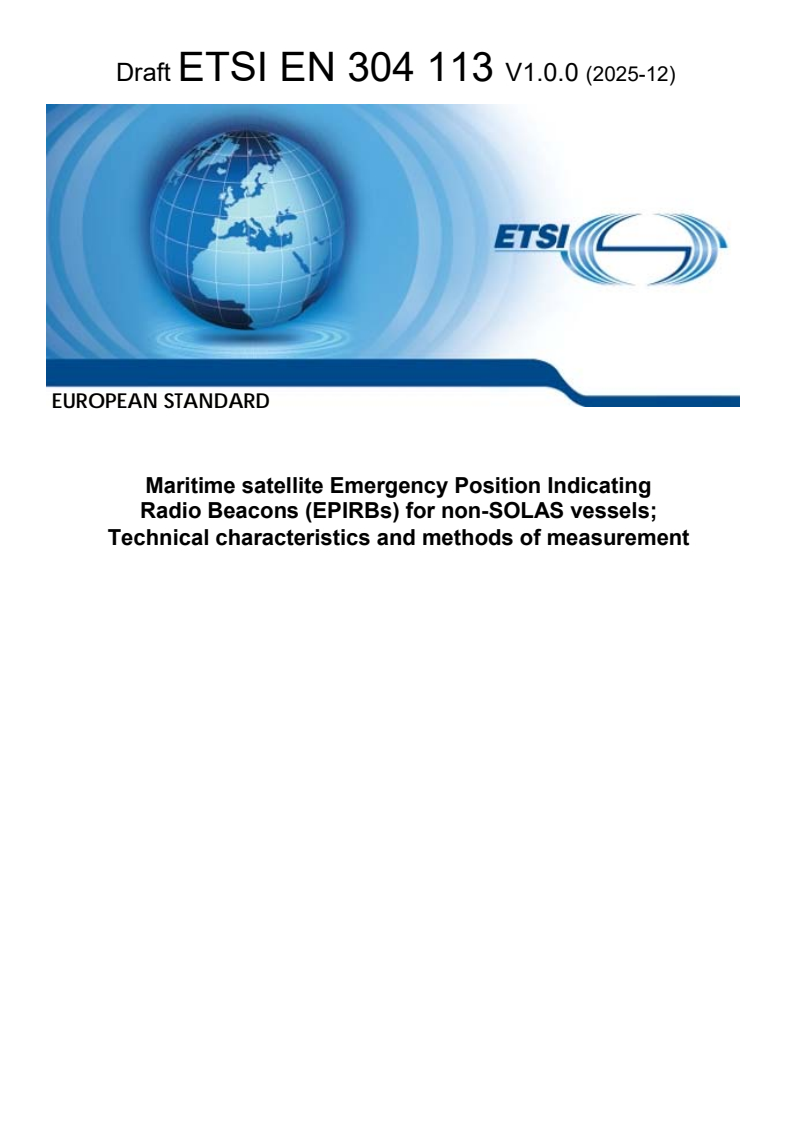
ETSI EN 304 113 V1.0.0 (2025-12) - Maritime satellite Emergency Position Indicating Radio Beacons (EPIRBs) for non-SOLAS vessels; Technical characteristics and methods of measurement
ETSI EN 304 113 V1.1.0 (2026-04) - Maritime satellite Emergency Position Indicating Radio Beacons (EPIRBs) for non-SOLAS vessels; Technical characteristics and methods of measurement
ETSI EN 304 113 V1.1.1 (2026-07) - Maritime satellite Emergency Position Indicating Radio Beacons (EPIRBs) for non-SOLAS vessels; Technical characteristics and methods of measurement

Buy Documents
ETSI EN 304 113 V1.0.0 (2025-12) - Maritime satellite Emergency Position Indicating Radio Beacons (EPIRBs) for non-SOLAS vessels; Technical characteristics and methods of measurement
ETSI EN 304 113 V1.1.0 (2026-04) - Maritime satellite Emergency Position Indicating Radio Beacons (EPIRBs) for non-SOLAS vessels; Technical characteristics and methods of measurement
ETSI EN 304 113 V1.1.1 (2026-07) - Maritime satellite Emergency Position Indicating Radio Beacons (EPIRBs) for non-SOLAS vessels; Technical characteristics and methods of measurement
Frequently Asked Questions
ETSI EN 304 113 V1.1.1 (2026-07) is a standard published by the European Telecommunications Standards Institute (ETSI). Its full title is "Maritime satellite Emergency Position Indicating Radio Beacons (EPIRBs) for non-SOLAS vessels; Technical characteristics and methods of measurement". This standard covers: DEN/ERM-TGMAR-636
DEN/ERM-TGMAR-636
ETSI EN 304 113 V1.1.1 (2026-07) is available in PDF format for immediate download after purchase. The document can be added to your cart and obtained through the secure checkout process. Digital delivery ensures instant access to the complete standard document.
Standards Content (Sample)
Draft ETSI EN 304 113 V1.0.0 (2025-12)
EUROPEAN STANDARD
Maritime satellite Emergency Position Indicating
Radio Beacons (EPIRBs) for non-SOLAS vessels;
Technical characteristics and methods of measurement
2 Draft ETSI EN 304 113 V1.0.0 (2025-12)
Reference
DEN/ERM-TGMAR-636
Keywords
EPIRB, maritime, radio, SAR, testing
ETSI
650 Route des Lucioles
F-06921 Sophia Antipolis Cedex - FRANCE
Tel.: +33 4 92 94 42 00 Fax: +33 4 93 65 47 16
Siret N° 348 623 562 00017 - APE 7112B
Association à but non lucratif enregistrée à la
Sous-Préfecture de Grasse (06) N° w061004871
Important notice
The present document can be downloaded from the
ETSI Search & Browse Standards application.
The present document may be made available in electronic versions and/or in print. The content of any electronic and/or print
versions of the present document shall not be modified without the prior written authorization of ETSI. In case of any existing or
perceived difference in contents between such versions and/or in print, the prevailing version of an ETSI deliverable is the one
made publicly available in PDF format on ETSI deliver repository.
Users should be aware that the present document may be revised or have its status changed,
this information is available in the Milestones listing.
If you find errors in the present document, please send your comments to
the relevant service listed under Committee Support Staff.
If you find a security vulnerability in the present document, please report it through our
Coordinated Vulnerability Disclosure (CVD) program.
Notice of disclaimer & limitation of liability
The information provided in the present deliverable is directed solely to professionals who have the appropriate degree of
experience to understand and interpret its content in accordance with generally accepted engineering or
other professional standard and applicable regulations.
No recommendation as to products and services or vendors is made or should be implied.
In no event shall ETSI be held liable for loss of profits or any other incidental or consequential damages.
Any software contained in this deliverable is provided "AS IS" with no warranties, express or implied, including but not limited to,
the warranties of merchantability, fitness for a particular purpose and non-infringement of intellectual property rights and ETSI
shall not be held liable in any event for any damages whatsoever (including, without limitation, damages for loss of profits,
business interruption, loss of information, or any other pecuniary loss) arising out of or related to the use of or inability to use the
software.
Copyright Notification
No part may be reproduced or utilized in any form or by any means, electronic or mechanical, including photocopying and
microfilm except as authorized by written permission of ETSI.
The content of the PDF version shall not be modified without the written authorization of ETSI.
The copyright and the foregoing restriction extend to reproduction in all media.
© ETSI 2025.
All rights reserved.
ETSI
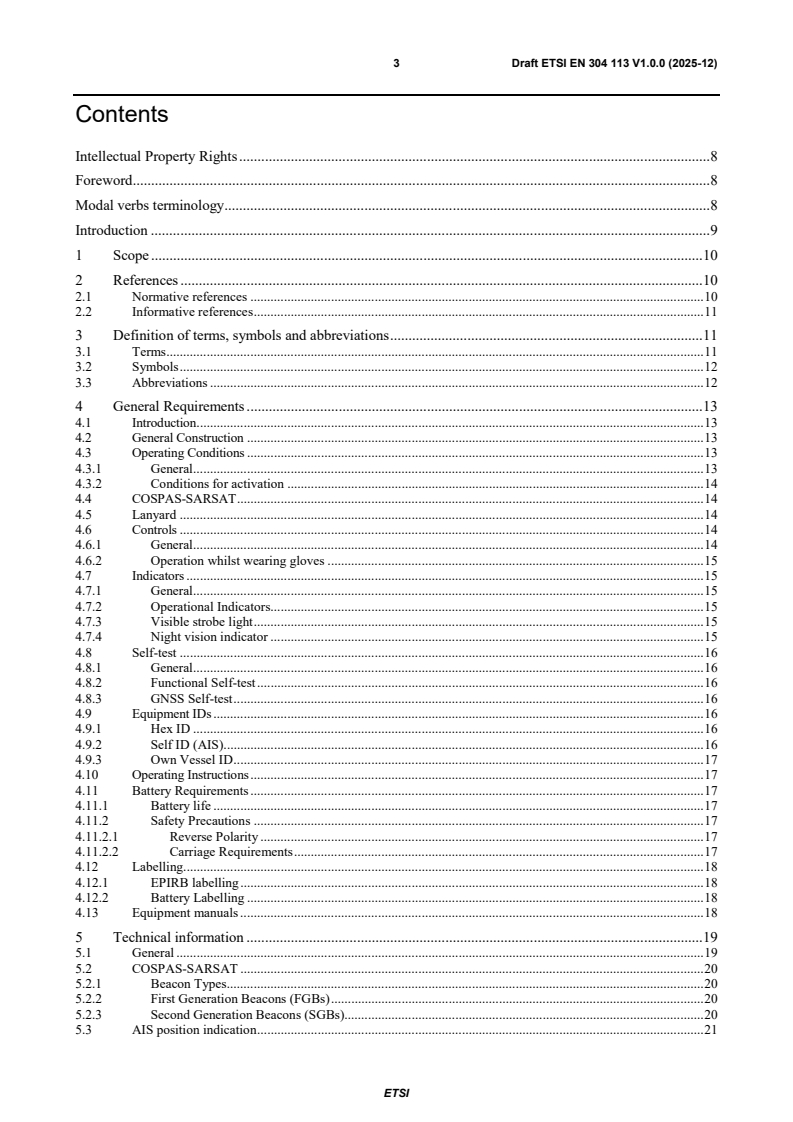
3 Draft ETSI EN 304 113 V1.0.0 (2025-12)
Contents
Intellectual Property Rights . 8
Foreword . 8
Modal verbs terminology . 8
Introduction . 9
1 Scope . 10
2 References . 10
2.1 Normative references . 10
2.2 Informative references . 11
3 Definition of terms, symbols and abbreviations . 11
3.1 Terms . 11
3.2 Symbols . 12
3.3 Abbreviations . 12
4 General Requirements . 13
4.1 Introduction . 13
4.2 General Construction . 13
4.3 Operating Conditions . 13
4.3.1 General . 13
4.3.2 Conditions for activation . 14
4.4 COSPAS-SARSAT . 14
4.5 Lanyard . 14
4.6 Controls . 14
4.6.1 General . 14
4.6.2 Operation whilst wearing gloves . 15
4.7 Indicators . 15
4.7.1 General . 15
4.7.2 Operational Indicators . 15
4.7.3 Visible strobe light . 15
4.7.4 Night vision indicator . 15
4.8 Self-test . 16
4.8.1 General . 16
4.8.2 Functional Self-test . 16
4.8.3 GNSS Self-test . 16
4.9 Equipment IDs . 16
4.9.1 Hex ID . 16
4.9.2 Self ID (AIS). 16
4.9.3 Own Vessel ID . 17
4.10 Operating Instructions . 17
4.11 Battery Requirements . 17
4.11.1 Battery life . 17
4.11.2 Safety Precautions . 17
4.11.2.1 Reverse Polarity . 17
4.11.2.2 Carriage Requirements . 17
4.12 Labelling. 18
4.12.1 EPIRB labelling . 18
4.12.2 Battery Labelling . 18
4.13 Equipment manuals . 18
5 Technical information . 19
5.1 General . 19
5.2 COSPAS-SARSAT . 20
5.2.1 Beacon Types . 20
5.2.2 First Generation Beacons (FGBs) . 20
5.2.3 Second Generation Beacons (SGBs). 20
5.3 AIS position indication . 21
ETSI
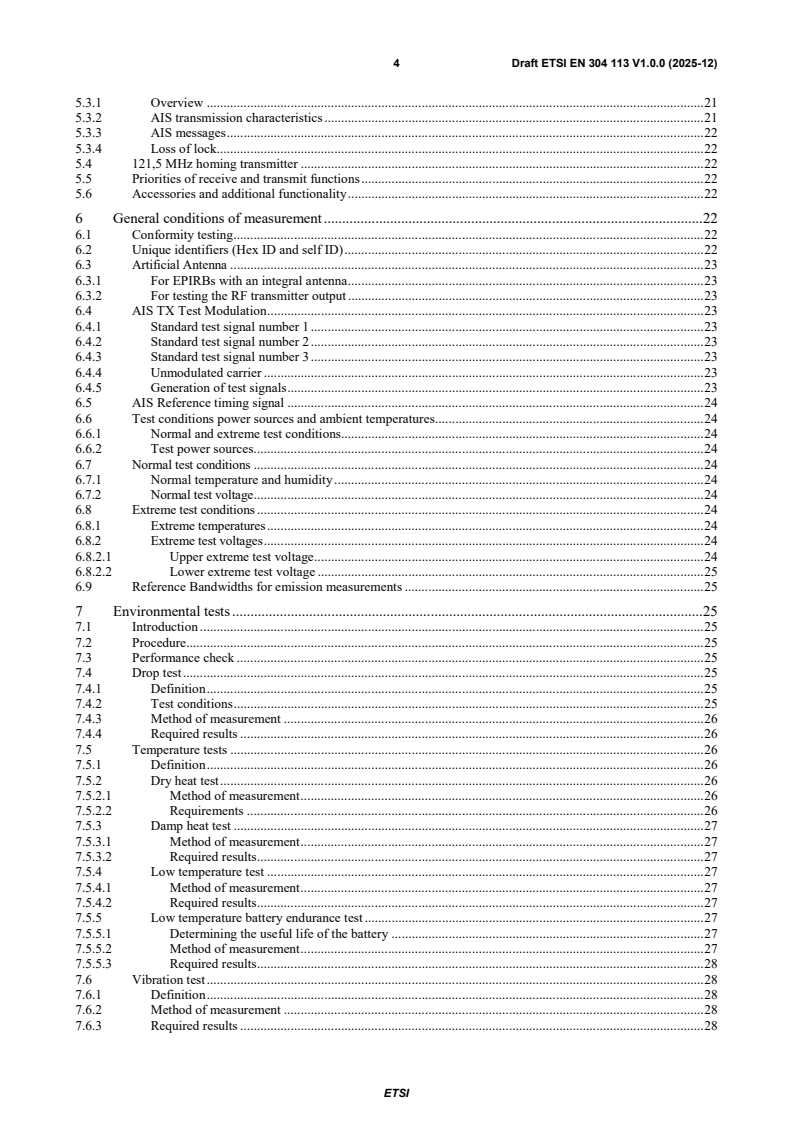
4 Draft ETSI EN 304 113 V1.0.0 (2025-12)
5.3.1 Overview . 21
5.3.2 AIS transmission characteristics . 21
5.3.3 AIS messages . 22
5.3.4 Loss of lock. 22
5.4 121,5 MHz homing transmitter . 22
5.5 Priorities of receive and transmit functions . 22
5.6 Accessories and additional functionality . 22
6 General conditions of measurement . 22
6.1 Conformity testing . 22
6.2 Unique identifiers (Hex ID and self ID) . 22
6.3 Artificial Antenna . 23
6.3.1 For EPIRBs with an integral antenna . 23
6.3.2 For testing the RF transmitter output . 23
6.4 AIS TX Test Modulation . 23
6.4.1 Standard test signal number 1 . 23
6.4.2 Standard test signal number 2 . 23
6.4.3 Standard test signal number 3 . 23
6.4.4 Unmodulated carrier . 23
6.4.5 Generation of test signals . 23
6.5 AIS Reference timing signal . 24
6.6 Test conditions power sources and ambient te mperature s . 24
6.6.1 Normal and extreme test conditions. 24
6.6.2 Test power sources. 24
6.7 Normal test conditions . 24
6.7.1 Normal temperature and humidity . 24
6.7.2 Normal test voltage . 24
6.8 Extreme test conditions . 24
6.8.1 Extreme temperatures . 24
6.8.2 Extreme test voltages . 24
6.8.2.1 Upper extreme test voltage . 24
6.8.2.2 Lower extreme test voltage . 25
6.9 Reference Bandwidths for emission measurements . 25
7 Environmental tests . 25
7.1 Introduction . 25
7.2 Procedure . 25
7.3 Performance check . 25
7.4 Drop test . 25
7.4.1 Definition . 25
7.4.2 Test conditions . 25
7.4.3 Method of measurement . 26
7.4.4 Required results . 26
7.5 Temperature tests . 26
7.5.1 Definition . 26
7.5.2 Dry heat test . 26
7.5.2.1 Method of measurement . 26
7.5.2.2 Requirements . 26
7.5.3 Damp heat test . 27
7.5.3.1 Method of measurement . 27
7.5.3.2 Required results . 27
7.5.4 Low temperature test . 27
7.5.4.1 Method of measurement . 27
7.5.4.2 Required results . 27
7.5.5 Low temperature battery endurance test . 27
7.5.5.1 Determining the useful life of the battery . 27
7.5.5.2 Method of measurement . 27
7.5.5.3 Required results . 28
7.6 Vibration test . 28
7.6.1 Definition . 28
7.6.2 Method of measurement . 28
7.6.3 Required results . 28
ETSI
5 Draft ETSI EN 304 113 V1.0.0 (2025-12)
7.7 Saltwater spray test . 29
7.7.1 Definition . 29
7.7.2 Method of measurement . 29
7.7.2.1 The spraying apparatus . 29
7.7.2.2 Preparation of EUT . 29
7.7.2.3 Test cycles . 29
7.7.2.4 Conclusion of testing. 30
7.7.3 Required results . 30
7.8 Thermal shock test. 30
7.8.1 Definition . 30
7.8.2 Method of measurement . 30
7.8.3 Required results . 30
7.9 Bump test. 30
7.9.1 Definition . 30
7.9.2 Method of measurement . 30
7.9.3 Required results . 31
7.10 Compass safe distance test . 31
7.10.1 Definition . 31
7.10.2 Method of measurement . 31
7.10.3 Requirements . 32
7.11 Solar radiation test . 32
7.11.0 Applicability . 32
7.11.1 Definition . 32
7.11.2 Method of measurement . 32
7.11.3 Requirements . 32
7.12 Oil resistance test. 32
7.12.0 Applicability . 32
7.12.1 Definition . 33
7.12.2 Method of measurement . 33
7.12.3 Requirements . 33
7.13 Automatic activation and float upright test . 33
7.13.1 Definition . 33
7.13.2 Method of measurement . 33
7.13.3 Requirements . 33
7.14 Watertightness test . 34
7.14.1 Definition . 34
7.14.2 Method of measurement . 34
7.14.3 Required results . 34
8 Tests on the 121,5 MHz homing transmitter . 34
8.1 Frequency error . 34
8.1.1 Definition . 34
8.1.2 Method of measurement . 34
8.1.3 Limit . 34
8.2 Audio modulation characteristics . 35
8.2.1 Definition . 35
8.2.2 Method of measurement . 36
8.2.3 Limits . 36
8.3 DST sweep rate and duty cycle . 36
8.3.1 Definition . 36
8.3.2 Method of measurement . 37
8.3.3 Limits . 37
8.4 Spectral carrier power ratio . 37
8.4.1 Definition . 37
8.4.2 Method of measurement . 37
8.4.3 Limit . 38
8.5 Maximum Effective Isotropic Radiated Peak Envelope Power (EIRPEP) . 38
8.5.1 Definition . 38
8.5.2 Method of measurement under normal test conditions . 38
8.5.3 Limit . 39
8.6 Transmitter spectrum mask . 39
8.6.1 Definition . 39
ETSI
6 Draft ETSI EN 304 113 V1.0.0 (2025-12)
8.6.2 Method of measurement . 39
8.6.3 Limit . 40
8.7 Radiation produced by operation of the test function . 40
8.7.1 Definition . 40
8.7.2 Method of measurement . 40
8.7.2.0 General . 40
8.7.2.1 Mandatory full-power test transmission . 41
8.7.2.2 Optional low-power test transmission . 41
8.7.3 Limits . 41
9 Tests on the AIS transmitter . 41
9.1 AIS Frequency error . 41
9.1.1 Definition . 41
9.1.2 Method of measurement . 41
9.1.3 Limit . 41
9.2 AIS Conducted power variation . 41
9.2.1 Purpose . 41
9.2.2 Definition . 42
9.2.3 Method of measurement . 42
9.2.4 Limit . 42
9.3 AIS Transmitter spectrum mask . 42
9.3.1 Definition . 42
9.3.2 Method of measurement . 42
9.3.3 Limit . 43
9.4 AIS Transmitter transient behaviour (output power) . 43
9.4.1 Definition . 43
9.4.2 Method of measurement . 44
9.4.3 Limit . 45
9.5 AIS Transmitter Transient Behaviour (frequency deviation) . 45
9.5.1 Definition . 45
9.5.2 Method of measurement . 45
9.5.3 Limit . 46
9.6 AIS Synchronization accuracy . 46
9.6.1 Definition . 46
9.6.2 Method of measurement . 46
9.6.3 Limit . 47
9.7 AIS Effective Isotropic Radiated Power (EIRP) . 47
9.7.1 Definition . 47
9.7.2 Method of measurement . 48
9.7.3 Limits . 48
10 Spurious emissions . 49
10.1 Definition . 49
10.2 Method of measurement . 49
10.2.1 Modes of operation . 49
10.2.2 Test method . 49
10.2.3 Exclusion bands . 49
10.2.3.1 Active mode . 49
10.2.3.2 Standby or off . 50
10.3 Limit . 50
10.3.1 Activated mode . 50
10.3.2 Standby or off . 50
11 AIS VDL Link layer tests . 50
11.1 Active mode tests . 50
11.1.1 Method of measurement . 50
11.1.2 Initialization period - Required results. 50
11.1.3 Message content of Message 1 - Required results . 50
11.1.4 Message content of first Message 14 - Required results . 51
11.1.5 Message content of second Message 14 - Required results . 51
11.1.6 Transmission schedule for Message 1 - Required results . 51
11.1.7 Communication state of Message 1 - Required results . 52
11.1.8 Transmission schedule of Message 14 - Required results. 52
ETSI
7 Draft ETSI EN 304 113 V1.0.0 (2025-12)
11.1.9 Transmission with lost GNSS - Required results . 52
11.2 GNSS self-test . 52
11.2.0 General . 52
11.2.1 Method of measurement . 53
11.2.2 Required results . 53
11.3 Functional self-test . 53
11.3.0 General . 53
11.3.1 Method of measurement . 53
11.3.2 Required results . 53
12 GNSS receiver . 54
12.1 General . 54
12.2 Protection from specific interfering signals . 54
12.3 Protection from internally generated interfering signals . 54
12.3.1 Definition . 54
12.3.2 Method of measurement . 54
12.3.2.1 Test setup . 54
12.3.2.2 Calibration of the test setup . 55
12.3.2.3 Making the measurement . 57
12.3.3 Required results . 58
13 Lanyard Strength test.
...
Final draft ETSI EN 304 113 V1.1.0 (2026-04)
EUROPEAN STANDARD
Maritime satellite Emergency Position Indicating
Radio Beacons (EPIRBs) for non-SOLAS vessels;
Technical characteristics and methods of measurement
2 Final draft ETSI EN 304 113 V1.1.0 (2026-04)
Reference
DEN/ERM-TGMAR-636
Keywords
EPIRB, maritime, radio, SAR, testing
ETSI
650 Route des Lucioles
F-06921 Sophia Antipolis Cedex - FRANCE
Tel.: +33 4 92 94 42 00 Fax: +33 4 93 65 47 16
Siret N° 348 623 562 00017 - APE 7112B
Association à but non lucratif enregistrée à la
Sous-Préfecture de Grasse (06) N° w061004871
Important notice
The present document can be downloaded from the
ETSI Search & Browse Standards application.
The present document may be made available in electronic versions and/or in print. The content of any electronic and/or
print versions of the present document shall not be modified without the prior written authorization of ETSI. In case of any
existing or perceived difference in contents between such versions and/or in print, the prevailing version of an ETSI
deliverable is the one made publicly available in PDF format on ETSI deliver repository.
Users should be aware that the present document may be revised or have its status changed,
this information is available in the Milestones listing.
If you find errors in the present document, please send your comments to
the relevant service listed under Committee Support Staff.
If you find a security vulnerability in the present document, please report it through our
Coordinated Vulnerability Disclosure (CVD) program.
Notice of disclaimer & limitation of liability
The information provided in the present deliverable is directed solely to professionals who have the appropriate degree of
experience to understand and interpret its content in accordance with generally accepted engineering or
other professional standard and applicable regulations.
No recommendation as to products and services or vendors is made or should be implied.
In no event shall ETSI be held liable for loss of profits or any other incidental or consequential damages.
Any software contained in this deliverable is provided "AS IS" with no warranties, express or implied, including but not
limited to, the warranties of merchantability, fitness for a particular purpose and non-infringement of intellectual property
rights and ETSI shall not be held liable in any event for any damages whatsoever (including, without limitation, damages
for loss of profits, business interruption, loss of information, or any other pecuniary loss) arising out of or related to the use
of or inability to use the software.
Copyright Notification
No part may be reproduced or utilized in any form or by any means, electronic or mechanical, including photocopying and
microfilm except as authorized by written permission of ETSI.
The content of the PDF version shall not be modified without the written authorization of ETSI.
The copyright and the foregoing restriction extend to reproduction in all media.
© ETSI 2026.
All rights reserved.
ETSI
3 Final draft ETSI EN 304 113 V1.1.0 (2026-04)
Contents
Intellectual Property Rights . 8
Foreword . 8
Modal verbs terminology . 8
Introduction . 9
1 Scope . 10
2 References . 10
2.1 Normative references . 10
2.2 Informative references . 11
3 Definition of terms, symbols and abbreviations . 11
3.1 Terms . 11
3.2 Symbols . 12
3.3 Abbreviations . 12
4 General Requirements . 13
4.1 Introduction . 13
4.2 General Construction . 13
4.3 Operating Conditions . 13
4.3.1 General . 13
4.3.2 Conditions for activation . 14
4.4 COSPAS-SARSAT . 14
4.5 Lanyard . 14
4.6 Controls . 15
4.6.1 General . 15
4.6.2 Operation whilst wearing gloves . 15
4.7 Indicators . 15
4.7.1 General . 15
4.7.2 Operational Indicators . 15
4.7.3 Visible strobe light . 16
4.7.4 Night vision indicator . 16
4.8 Self-test . 16
4.8.1 General . 16
4.8.2 Functional Self-test . 16
4.8.3 GNSS Self-test . 16
4.9 Equipment IDs . 17
4.9.1 Hex ID . 17
4.9.2 Self ID (AIS). 17
4.9.3 Own Vessel ID . 17
4.10 Operating Instructions . 17
4.11 Battery Requirements . 17
4.11.1 Battery life . 17
4.11.2 Safety Precautions . 18
4.11.2.1 Reverse Polarity . 18
4.11.2.2 Carriage Requirements . 18
4.12 Labelling. 18
4.12.1 EPIRB labelling . 18
4.12.2 Battery Labelling . 19
4.13 Equipment manuals . 19
5 Technical information . 20
5.1 General . 20
5.2 COSPAS-SARSAT . 20
5.2.1 Beacon Types . 20
5.2.2 First Generation Beacons (FGBs) . 20
5.2.3 Second Generation Beacons (SGBs). 21
ETSI
4 Final draft ETSI EN 304 113 V1.1.0 (2026-04)
5.3 AIS position indication . 22
5.3.1 Overview . 22
5.3.2 AIS transmission characteristics . 22
5.3.3 AIS messages . 22
5.3.4 Loss of lock. 22
5.4 121,5 MHz homing transmitter . 22
5.5 Priorities of receive and transmit functions . 22
5.6 Accessories and additional functionality . 23
6 General conditions of measurement . 23
6.1 Conformity testing . 23
6.2 Unique identifiers (Hex ID and self ID) . 23
6.3 Artificial Antenna . 23
6.3.1 For EPIRBs with an integral antenna . 23
6.3.2 For testing the RF transmitter output . 23
6.4 AIS TX Test Modulation . 24
6.4.1 Standard test signal number 1 . 24
6.4.2 Standard test signal number 2 . 24
6.4.3 Standard test signal number 3 . 24
6.4.4 Unmodulated carrier . 24
6.4.5 Generation of test signals . 24
6.5 AIS Reference timing signal . 24
6.6 Test conditions power sources and ambient te mperature s . 24
6.6.1 Normal and extreme test conditions. 24
6.6.2 Test power sources. 24
6.7 Normal test conditions . 25
6.7.1 Normal temperature and humidity . 25
6.7.2 Normal test voltage . 25
6.8 Extreme test conditions . 25
6.8.1 Extreme temperatures . 25
6.8.2 Extreme test voltages . 25
6.8.2.1 Upper extreme test voltage . 25
6.8.2.2 Lower extreme test voltage . 25
6.9 Reference Bandwidths for emission measurements . 25
7 Environmental tests . 26
7.1 Introduction . 26
7.2 Procedure . 26
7.3 Performance check . 26
7.4 Drop test . 26
7.4.1 Definition . 26
7.4.2 Test conditions . 26
7.4.3 Method of measurement . 26
7.4.4 Required results . 27
7.5 Temperature tests . 27
7.5.1 Definition . 27
7.5.2 Dry heat test . 27
7.5.2.1 Method of measurement . 27
7.5.2.2 Requirements . 27
7.5.3 Damp heat test . 27
7.5.3.1 Method of measurement . 27
7.5.3.2 Required results . 28
7.5.4 Low temperature test . 28
7.5.4.1 Method of measurement . 28
7.5.4.2 Required results . 28
7.5.5 Low temperature battery endurance test . 28
7.5.5.1 Determining the useful life of the battery . 28
7.5.5.2 Method of measurement . 28
7.5.5.3 Required results . 28
7.6 Vibration test . 29
7.6.1 Definition . 29
7.6.2 Method of measurement . 29
ETSI
5 Final draft ETSI EN 304 113 V1.1.0 (2026-04)
7.6.3 Required results . 29
7.7 Saltwater spray test . 29
7.7.1 Definition . 29
7.7.2 Method of measurement . 30
7.7.2.1 The spraying apparatus . 30
7.7.2.2 Preparation of EUT . 30
7.7.2.3 Test cycles . 30
7.7.2.4 Conclusion of testing. 30
7.7.3 Required results . 30
7.8 Thermal shock test. 31
7.8.1 Definition . 31
7.8.2 Method of measurement . 31
7.8.3 Required results . 31
7.9 Bump test. 31
7.9.1 Definition . 31
7.9.2 Method of measurement . 31
7.9.3 Required results . 32
7.10 Compass safe distance test . 32
7.10.1 Definition . 32
7.10.2 Method of measurement . 32
7.10.3 Requirements . 33
7.11 Solar radiation test . 33
7.11.0 Applicability . 33
7.11.1 Definition . 33
7.11.2 Method of measurement . 33
7.11.3 Requirements . 33
7.12 Oil resistance test. 33
7.12.0 Applicability . 33
7.12.1 Definition . 34
7.12.2 Method of measurement . 34
7.12.3 Requirements . 34
7.13 Automatic activation and float upright test . 34
7.13.1 Definition . 34
7.13.2 Method of measurement . 34
7.13.3 Requirements . 34
7.14 Watertightness test . 35
7.14.1 Definition . 35
7.14.2 Method of measurement . 35
7.14.3 Required results . 35
8 Tests on the 121,5 MHz homing transmitter . 35
8.1 Frequency error . 35
8.1.1 Definition . 35
8.1.2 Method of measurement . 35
8.1.3 Limit . 35
8.2 Audio modulation characteristics . 36
8.2.1 Definition . 36
8.2.2 Method of measurement . 37
8.2.3 Limits . 37
8.3 DST sweep rate and duty cycle . 37
8.3.1 Definition . 37
8.3.2 Method of measurement . 38
8.3.3 Limits . 38
8.4 Spectral carrier power ratio . 38
8.4.1 Definition . 38
8.4.2 Method of measurement . 38
8.4.3 Limit . 39
8.5 Maximum Effective Isotropic Radiated Peak Envelope Power (EIRPEP) . 39
8.5.1 Definition . 39
8.5.2 Method of measurement under normal test conditions . 39
8.5.3 Limit . 40
8.6 Transmitter spectrum mask . 40
ETSI
6 Final draft ETSI EN 304 113 V1.1.0 (2026-04)
8.6.1 Definition . 40
8.6.2 Method of measurement . 40
8.6.3 Limit . 41
8.7 Radiation produced by operation of the test function . 41
8.7.1 Definition . 41
8.7.2 Method of measurement . 41
8.7.2.0 General . 41
8.7.2.1 Mandatory full-power test transmission . 42
8.7.2.2 Optional low-power test transmission . 42
8.7.3 Limits . 42
9 Tests on the AIS transmitter . 42
9.1 AIS Frequency error . 42
9.1.1 Definition . 42
9.1.2 Method of measurement . 42
9.1.3 Limit . 42
9.2 AIS Conducted power variation . 43
9.2.1 Purpose . 43
9.2.2 Definition . 43
9.2.3 Method of measurement . 43
9.2.4 Limit . 43
9.3 AIS Transmitter spectrum mask . 43
9.3.1 Definition . 43
9.3.2 Method of measurement . 43
9.3.3 Limit . 44
9.4 AIS Transmitter transient behaviour (output power) . 44
9.4.1 Definition . 44
9.4.2 Method of measurement . 45
9.4.3 Limit . 46
9.5 AIS Transmitter Transient Behaviour (frequency deviation) . 46
9.5.1 Definition . 46
9.5.2 Method of measurement . 46
9.5.3 Limit . 47
9.6 AIS Synchronization accuracy . 47
9.6.1 Definition . 47
9.6.2 Method of measurement . 47
9.6.3 Limit . 48
9.7 AIS Effective Isotropic Radiated Power (EIRP) . 48
9.7.1 Definition . 48
9.7.2 Method of measurement . 48
9.7.3 Limits . 49
10 Spurious emissions . 50
10.1 Definition . 50
10.2 Method of measurement . 50
10.2.1 Modes of operation . 50
10.2.2 Test method . 50
10.2.3 Exclusion bands . 50
10.2.3.1 Active mode . 50
10.2.3.2 Standby or off . 51
10.3 Limit . 51
10.3.1 Activated mode . 51
10.3.2 Standby or off . 51
11 AIS VDL Link layer tests . 51
11.1 Active mode tests . 51
11.1.1 Method of measurement . 51
11.1.2 Initialization period - Required results. 51
11.1.3 Message content of Message 1 - Required results . 51
11.1.4 Message content of first Message 14 - Required results . 52
11.1.5 Message content of second Message 14 - Required results . 52
11.1.6 Transmission schedule for Message 1 - Required results . 52
11.1.7 Communication state of Message 1 - Required results . 53
ETSI
7 Final draft ETSI EN 304 113 V1.1.0 (2026-04)
11.1.8 Transmission schedule of Message 14 - Required results. 53
11.1.9 Transmission with lost GNSS - Required results . 53
11.2 GNSS self-test . 53
11.2.0 General . 53
11.2.1 Method of measurement . 54
11.2.2 Required results . 54
11.3 Functional self-test . 54
11.3.0 General . 54
11.3.1 Method of measurement . 54
11.3.2 Required results . 54
12 GNSS receiver . 55
12.1 General . 55
12.2 Protection from specific interfering signals . 55
12.3 Protection from internally generated interfering signals . 55
12.3.1 Definition . 55
12.3.2 Method of measurement . 55
12.3.2.1 Test setup . 55
12.3.2.2 Calibration of the test setup . 56
12.3.2.3 Making the measurement . 58
12.3.3 Required results . 59
13 Lanyard Strength test.
...
EUROPEAN STANDARD
Maritime satellite Emergency Position Indicating
Radio Beacons (EPIRBs) for non-SOLAS vessels;
Technical characteristics and methods of measurement
2 ETSI EN 304 113 V1.1.1 (2026-07)
Reference
DEN/ERM-TGMAR-636
Keywords
EPIRB, maritime, radio, SAR, testing
ETSI
650 Route des Lucioles
F-06921 Sophia Antipolis Cedex - FRANCE
Tel.: +33 4 92 94 42 00 Fax: +33 4 93 65 47 16
Siret N° 348 623 562 00017 - APE 7112B
Association à but non lucratif enregistrée à la
Sous-Préfecture de Grasse (06) N° w061004871
Important notice
The present document can be downloaded from the
ETSI Search & Browse Standards application.
The present document may be made available in electronic versions and/or in print. The content of any electronic and/or
print versions of the present document shall not be modified without the prior written authorization of ETSI. In case of any
existing or perceived difference in contents between such versions and/or in print, the prevailing version of an ETSI
deliverable is the one made publicly available in PDF format on ETSI deliver repository.
Users should be aware that the present document may be revised or have its status changed,
this information is available in the Milestones listing.
If you find errors in the present document, please send your comments to
the relevant service listed under Committee Support Staff.
If you find a security vulnerability in the present document, please report it through our
Coordinated Vulnerability Disclosure (CVD) program.
Notice of disclaimer & limitation of liability
The information provided in the present deliverable is directed solely to professionals who have the appropriate degree of
experience to understand and interpret its content in accordance with generally accepted engineering or
other professional standard and applicable regulations.
No recommendation as to products and services or vendors is made or should be implied.
In no event shall ETSI be held liable for loss of profits or any other incidental or consequential damages.
Any software contained in this deliverable is provided "AS IS" with no warranties, express or implied, including but not
limited to, the warranties of merchantability, fitness for a particular purpose and non-infringement of intellectual property
rights and ETSI shall not be held liable in any event for any damages whatsoever (including, without limitation, damages
for loss of profits, business interruption, loss of information, or any other pecuniary loss) arising out of or related to the use
of or inability to use the software.
Copyright Notification
No part of this document may be reproduced in any form, by any means and in any media, without the prior written
authorization of ETSI and except as expressly permitted below.
By way of exception and when the document is a normative deliverable (European Standard (EN),
Technical Specification (TS), Group Specification (GS) or ETSI Standard (ES)), ETSI authorizes to reproduce
and incorporate into products, services and technical documentation only those extracts (e.g. templates) that are strictly
necessary for the technical implementation of the normative deliverable, to ensure compliance with the latter.
Nothing in this notice shall be construed as limiting any mandatory exceptions to copyright provided by applicable law.
© ETSI 2026.
All rights reserved.
ETSI
3 ETSI EN 304 113 V1.1.1 (2026-07)
Contents
Intellectual Property Rights . 8
Foreword . 8
Modal verbs terminology . 9
Introduction . 9
1 Scope . 10
2 References . 10
2.1 Normative references . 10
2.2 Informative references . 11
3 Definition of terms, symbols and abbreviations . 11
3.1 Terms . 11
3.2 Symbols . 12
3.3 Abbreviations . 12
4 General Requirements . 13
4.1 Introduction . 13
4.2 General Construction . 13
4.3 Operating Conditions . 13
4.3.1 General . 13
4.3.2 Conditions for activation . 14
4.4 COSPAS-SARSAT . 14
4.5 Lanyard . 14
4.6 Controls . 15
4.6.1 General . 15
4.6.2 Operation whilst wearing gloves . 15
4.7 Indicators . 15
4.7.1 General . 15
4.7.2 Operational Indicators . 15
4.7.3 Visible strobe light . 16
4.7.4 Night vision indicator . 16
4.8 Self-test . 16
4.8.1 General . 16
4.8.2 Functional Self-test . 16
4.8.3 GNSS Self-test . 16
4.9 Equipment IDs . 17
4.9.1 Hex ID . 17
4.9.2 Self ID (AIS). 17
4.9.3 Own Vessel ID . 17
4.10 Operating Instructions . 17
4.11 Battery Requirements . 17
4.11.1 Battery life . 17
4.11.2 Safety Precautions . 18
4.11.2.1 Reverse Polarity . 18
4.11.2.2 Carriage Requirements . 18
4.12 Labelling. 18
4.12.1 EPIRB labelling . 18
4.12.2 Battery Labelling . 19
4.13 Equipment manuals . 19
5 Technical information . 20
5.1 General . 20
5.2 COSPAS-SARSAT . 20
5.2.1 Beacon Types . 20
5.2.2 First Generation Beacons (FGBs) . 20
5.2.3 Second Generation Beacons (SGBs). 21
5.3 AIS position indication . 22
ETSI
4 ETSI EN 304 113 V1.1.1 (2026-07)
5.3.1 Overview . 22
5.3.2 AIS transmission characteristics . 22
5.3.3 AIS messages . 22
5.3.4 Loss of lock. 22
5.4 121,5 MHz homing transmitter . 22
5.5 Priorities of receive and transmit functions . 22
5.6 Accessories and additional functionality . 23
6 General conditions of measurement . 23
6.1 Conformity testing . 23
6.2 Unique identifiers (Hex ID and self ID) . 23
6.3 Artificial Antenna . 23
6.3.1 For EPIRBs with an integral antenna . 23
6.3.2 For testing the RF transmitter output . 23
6.4 AIS TX Test Modulation . 24
6.4.1 Standard test signal number 1 . 24
6.4.2 Standard test signal number 2 . 24
6.4.3 Standard test signal number 3 . 24
6.4.4 Unmodulated carrier . 24
6.4.5 Generation of test signals . 24
6.5 AIS Reference timing signal . 24
6.6 Test conditions power sources and ambient te mperature s . 24
6.6.1 Normal and extreme test conditions. 24
6.6.2 Test power sources. 24
6.7 Normal test conditions . 25
6.7.1 Normal temperature and humidity . 25
6.7.2 Normal test voltage . 25
6.8 Extreme test conditions . 25
6.8.1 Extreme temperatures . 25
6.8.2 Extreme test voltages . 25
6.8.2.1 Upper extreme test voltage . 25
6.8.2.2 Lower extreme test voltage . 25
6.9 Reference Bandwidths for emission measurements . 25
7 Environmental tests . 26
7.1 Introduction . 26
7.2 Procedure . 26
7.3 Performance check . 26
7.4 Drop test . 26
7.4.1 Definition . 26
7.4.2 Test conditions . 26
7.4.3 Method of measurement . 26
7.4.4 Required results . 27
7.5 Temperature tests . 27
7.5.1 Definition . 27
7.5.2 Dry heat test . 27
7.5.2.1 Method of measurement . 27
7.5.2.2 Requirements . 27
7.5.3 Damp heat test . 27
7.5.3.1 Method of measurement . 27
7.5.3.2 Required results . 28
7.5.4 Low temperature test . 28
7.5.4.1 Method of measurement . 28
7.5.4.2 Required results . 28
7.5.5 Low temperature battery endurance test . 28
7.5.5.1 Determining the useful life of the battery . 28
7.5.5.2 Method of measurement . 28
7.5.5.3 Required results . 28
7.6 Vibration test . 29
7.6.1 Definition . 29
7.6.2 Method of measurement . 29
7.6.3 Required results . 29
ETSI
5 ETSI EN 304 113 V1.1.1 (2026-07)
7.7 Saltwater spray test . 29
7.7.1 Definition . 29
7.7.2 Method of measurement . 30
7.7.2.1 The spraying apparatus . 30
7.7.2.2 Preparation of EUT . 30
7.7.2.3 Test cycles . 30
7.7.2.4 Conclusion of testing. 30
7.7.3 Required results . 30
7.8 Thermal shock test. 31
7.8.1 Definition . 31
7.8.2 Method of measurement . 31
7.8.3 Required results . 31
7.9 Bump test. 31
7.9.1 Definition . 31
7.9.2 Method of measurement . 31
7.9.3 Required results . 32
7.10 Compass safe distance test . 32
7.10.1 Definition . 32
7.10.2 Method of measurement . 32
7.10.3 Requirements . 33
7.11 Solar radiation test . 33
7.11.0 Applicability . 33
7.11.1 Definition . 33
7.11.2 Method of measurement . 33
7.11.3 Requirements . 33
7.12 Oil resistance test. 33
7.12.0 Applicability . 33
7.12.1 Definition . 34
7.12.2 Method of measurement . 34
7.12.3 Requirements . 34
7.13 Automatic activation and float upright test . 34
7.13.1 Definition . 34
7.13.2 Method of measurement . 34
7.13.3 Requirements . 34
7.14 Watertightness test . 35
7.14.1 Definition . 35
7.14.2 Method of measurement . 35
7.14.3 Required results . 35
8 Tests on the 121,5 MHz homing transmitter . 35
8.1 Frequency error . 35
8.1.1 Definition . 35
8.1.2 Method of measurement . 35
8.1.3 Limit . 35
8.2 Audio modulation characteristics . 36
8.2.1 Definition . 36
8.2.2 Method of measurement . 37
8.2.3 Limits . 37
8.3 DST sweep rate and duty cycle . 37
8.3.1 Definition . 37
8.3.2 Method of measurement . 38
8.3.3 Limits . 38
8.4 Spectral carrier power ratio . 38
8.4.1 Definition . 38
8.4.2 Method of measurement . 38
8.4.3 Limit . 39
8.5 Maximum Effective Isotropic Radiated Peak Envelope Power (EIRPEP) . 39
8.5.1 Definition . 39
8.5.2 Method of measurement under normal test conditions . 39
8.5.3 Limit . 40
8.6 Transmitter spectrum mask . 40
8.6.1 Definition . 40
ETSI
6 ETSI EN 304 113 V1.1.1 (2026-07)
8.6.2 Method of measurement . 40
8.6.3 Limit . 41
8.7 Radiation produced by operation of the test function . 41
8.7.1 Definition . 41
8.7.2 Method of measurement . 41
8.7.2.0 General . 41
8.7.2.1 Mandatory full-power test transmission . 42
8.7.2.2 Optional low-power test transmission . 42
8.7.3 Limits . 42
9 Tests on the AIS transmitter . 42
9.1 AIS Frequency error . 42
9.1.1 Definition . 42
9.1.2 Method of measurement . 42
9.1.3 Limit . 42
9.2 AIS Conducted power variation . 43
9.2.1 Purpose . 43
9.2.2 Definition . 43
9.2.3 Method of measurement . 43
9.2.4 Limit . 43
9.3 AIS Transmitter spectrum mask . 43
9.3.1 Definition . 43
9.3.2 Method of measurement . 43
9.3.3 Limit . 44
9.4 AIS Transmitter transient behaviour (output power) . 44
9.4.1 Definition . 44
9.4.2 Method of measurement . 45
9.4.3 Limit . 46
9.5 AIS Transmitter Transient Behaviour (frequency deviation) . 46
9.5.1 Definition . 46
9.5.2 Method of measurement . 46
9.5.3 Limit . 47
9.6 AIS Synchronization accuracy . 47
9.6.1 Definition . 47
9.6.2 Method of measurement . 47
9.6.3 Limit . 48
9.7 AIS Effective Isotropic Radiated Power (EIRP) . 48
9.7.1 Definition . 48
9.7.2 Method of measurement . 48
9.7.3 Limits . 49
10 Spurious emissions . 50
10.1 Definition . 50
10.2 Method of measurement . 50
10.2.1 Modes of operation . 50
10.2.2 Test method . 50
10.2.3 Exclusion bands . 50
10.2.3.1 Active mode . 50
10.2.3.2 Standby or off . 51
10.3 Limit . 51
10.3.1 Activated mode . 51
10.3.2 Standby or off . 51
11 AIS VDL Link layer tests . 51
11.1 Active mode tests . 51
11.1.1 Method of measurement . 51
11.1.2 Initialization period - Required results. 51
11.1.3 Message content of Message 1 - Required results . 51
11.1.4 Message content of first Message 14 - Required results . 52
11.1.5 Message content of second Message 14 - Required results . 52
11.1.6 Transmission schedule for Message 1 - Required results . 52
11.1.7 Communication state of Message 1 - Required results . 53
11.1.8 Transmission schedule of Message 14 - Required results. 53
ETSI
7 ETSI EN 304 113 V1.1.1 (2026-07)
11.1.9 Transmission with lost GNSS - Required results . 53
11.2 GNSS self-test . 53
11.2.0 General . 53
11.2.1 Method of measurement . 54
11.2.2 Required results . 54
11.3 Functional self-test . 54
11.3.0 General . 54
11.3.1 Method of measurement . 54
11.3.2 Required results . 54
12 GNSS receiver . 55
12.1 General . 55
12.2 Protection from specific interfering signals . 55
12.3 Protection from internally generated interfering signals . 55
12.3.1 Definition . 55
12.3.2 Method of measurement . 55
12.3.2.1 Test setup . 55
12.3.2.2 Calibration of the test setup . 56
12.3.2.3 Making the measurement .
...
SLOVENSKI STANDARD
01-september-2026
Pomorski satelitski radijski javljalniki kraja nuje (EPIRB) na plovilih brez opreme
SOLAS - Tehnične karakteristike in merilne metode
Maritime satellite Emergency Position Indicating Radio Beacons (EPIRBs) for non-
SOLAS vessels - Technical characteristics and methods of measurement
Ta slovenski standard je istoveten z: ETSI EN 304 113 V1.1.1 (2026-07)
ICS:
33.060.20 Sprejemna in oddajna Receiving and transmitting
oprema equipment
47.020.70 Navigacijska in krmilna Navigation and control
oprema equipment
2003-01.Slovenski inštitut za standardizacijo. Razmnoževanje celote ali delov tega standarda ni dovoljeno.
EUROPEAN STANDARD
Maritime satellite Emergency Position Indicating
Radio Beacons (EPIRBs) for non-SOLAS vessels;
Technical characteristics and methods of measurement
2 ETSI EN 304 113 V1.1.1 (2026-07)
Reference
DEN/ERM-TGMAR-636
Keywords
EPIRB, maritime, radio, SAR, testing
ETSI
650 Route des Lucioles
F-06921 Sophia Antipolis Cedex - FRANCE
Tel.: +33 4 92 94 42 00 Fax: +33 4 93 65 47 16
Siret N° 348 623 562 00017 - APE 7112B
Association à but non lucratif enregistrée à la
Sous-Préfecture de Grasse (06) N° w061004871
Important notice
The present document can be downloaded from the
ETSI Search & Browse Standards application.
The present document may be made available in electronic versions and/or in print. The content of any electronic and/or
print versions of the present document shall not be modified without the prior written authorization of ETSI. In case of any
existing or perceived difference in contents between such versions and/or in print, the prevailing version of an ETSI
deliverable is the one made publicly available in PDF format on ETSI deliver repository.
Users should be aware that the present document may be revised or have its status changed,
this information is available in the Milestones listing.
If you find errors in the present document, please send your comments to
the relevant service listed under Committee Support Staff.
If you find a security vulnerability in the present document, please report it through our
Coordinated Vulnerability Disclosure (CVD) program.
Notice of disclaimer & limitation of liability
The information provided in the present deliverable is directed solely to professionals who have the appropriate degree of
experience to understand and interpret its content in accordance with generally accepted engineering or
other professional standard and applicable regulations.
No recommendation as to products and services or vendors is made or should be implied.
In no event shall ETSI be held liable for loss of profits or any other incidental or consequential damages.
Any software contained in this deliverable is provided "AS IS" with no warranties, express or implied, including but not
limited to, the warranties of merchantability, fitness for a particular purpose and non-infringement of intellectual property
rights and ETSI shall not be held liable in any event for any damages whatsoever (including, without limitation, damages
for loss of profits, business interruption, loss of information, or any other pecuniary loss) arising out of or related to the use
of or inability to use the software.
Copyright Notification
No part of this document may be reproduced in any form, by any means and in any media, without the prior written
authorization of ETSI and except as expressly permitted below.
By way of exception and when the document is a normative deliverable (European Standard (EN),
Technical Specification (TS), Group Specification (GS) or ETSI Standard (ES)), ETSI authorizes to reproduce
and incorporate into products, services and technical documentation only those extracts (e.g. templates) that are strictly
necessary for the technical implementation of the normative deliverable, to ensure compliance with the latter.
Nothing in this notice shall be construed as limiting any mandatory exceptions to copyright provided by applicable law.
© ETSI 2026.
All rights reserved.
ETSI
3 ETSI EN 304 113 V1.1.1 (2026-07)
Contents
Intellectual Property Rights . 8
Foreword . 8
Modal verbs terminology . 9
Introduction . 9
1 Scope . 10
2 References . 10
2.1 Normative references . 10
2.2 Informative references . 11
3 Definition of terms, symbols and abbreviations . 11
3.1 Terms . 11
3.2 Symbols . 12
3.3 Abbreviations . 12
4 General Requirements . 13
4.1 Introduction . 13
4.2 General Construction . 13
4.3 Operating Conditions . 13
4.3.1 General . 13
4.3.2 Conditions for activation . 14
4.4 COSPAS-SARSAT . 14
4.5 Lanyard . 14
4.6 Controls . 15
4.6.1 General . 15
4.6.2 Operation whilst wearing gloves . 15
4.7 Indicators . 15
4.7.1 General . 15
4.7.2 Operational Indicators . 15
4.7.3 Visible strobe light . 16
4.7.4 Night vision indicator . 16
4.8 Self-test . 16
4.8.1 General . 16
4.8.2 Functional Self-test . 16
4.8.3 GNSS Self-test . 16
4.9 Equipment IDs . 17
4.9.1 Hex ID . 17
4.9.2 Self ID (AIS). 17
4.9.3 Own Vessel ID . 17
4.10 Operating Instructions . 17
4.11 Battery Requirements . 17
4.11.1 Battery life . 17
4.11.2 Safety Precautions . 18
4.11.2.1 Reverse Polarity . 18
4.11.2.2 Carriage Requirements . 18
4.12 Labelling. 18
4.12.1 EPIRB labelling . 18
4.12.2 Battery Labelling . 19
4.13 Equipment manuals . 19
5 Technical information . 20
5.1 General . 20
5.2 COSPAS-SARSAT . 20
5.2.1 Beacon Types . 20
5.2.2 First Generation Beacons (FGBs) . 20
5.2.3 Second Generation Beacons (SGBs). 21
5.3 AIS position indication . 22
ETSI
4 ETSI EN 304 113 V1.1.1 (2026-07)
5.3.1 Overview . 22
5.3.2 AIS transmission characteristics . 22
5.3.3 AIS messages . 22
5.3.4 Loss of lock. 22
5.4 121,5 MHz homing transmitter . 22
5.5 Priorities of receive and transmit functions . 22
5.6 Accessories and additional functionality . 23
6 General conditions of measurement . 23
6.1 Conformity testing . 23
6.2 Unique identifiers (Hex ID and self ID) . 23
6.3 Artificial Antenna . 23
6.3.1 For EPIRBs with an integral antenna . 23
6.3.2 For testing the RF transmitter output . 23
6.4 AIS TX Test Modulation . 24
6.4.1 Standard test signal number 1 . 24
6.4.2 Standard test signal number 2 . 24
6.4.3 Standard test signal number 3 . 24
6.4.4 Unmodulated carrier . 24
6.4.5 Generation of test signals . 24
6.5 AIS Reference timing signal . 24
6.6 Test conditions power sources and ambient te mperature s . 24
6.6.1 Normal and extreme test conditions. 24
6.6.2 Test power sources. 24
6.7 Normal test conditions . 25
6.7.1 Normal temperature and humidity . 25
6.7.2 Normal test voltage . 25
6.8 Extreme test conditions . 25
6.8.1 Extreme temperatures . 25
6.8.2 Extreme test voltages . 25
6.8.2.1 Upper extreme test voltage . 25
6.8.2.2 Lower extreme test voltage . 25
6.9 Reference Bandwidths for emission measurements . 25
7 Environmental tests . 26
7.1 Introduction . 26
7.2 Procedure . 26
7.3 Performance check . 26
7.4 Drop test . 26
7.4.1 Definition . 26
7.4.2 Test conditions . 26
7.4.3 Method of measurement . 26
7.4.4 Required results . 27
7.5 Temperature tests . 27
7.5.1 Definition . 27
7.5.2 Dry heat test . 27
7.5.2.1 Method of measurement . 27
7.5.2.2 Requirements . 27
7.5.3 Damp heat test . 27
7.5.3.1 Method of measurement . 27
7.5.3.2 Required results . 28
7.5.4 Low temperature test . 28
7.5.4.1 Method of measurement . 28
7.5.4.2 Required results . 28
7.5.5 Low temperature battery endurance test . 28
7.5.5.1 Determining the useful life of the battery . 28
7.5.5.2 Method of measurement . 28
7.5.5.3 Required results . 28
7.6 Vibration test . 29
7.6.1 Definition . 29
7.6.2 Method of measurement . 29
7.6.3 Required results . 29
ETSI
5 ETSI EN 304 113 V1.1.1 (2026-07)
7.7 Saltwater spray test . 29
7.7.1 Definition . 29
7.7.2 Method of measurement . 30
7.7.2.1 The spraying apparatus . 30
7.7.2.2 Preparation of EUT . 30
7.7.2.3 Test cycles . 30
7.7.2.4 Conclusion of testing. 30
7.7.3 Required results . 30
7.8 Thermal shock test. 31
7.8.1 Definition . 31
7.8.2 Method of measurement . 31
7.8.3 Required results . 31
7.9 Bump test. 31
7.9.1 Definition . 31
7.9.2 Method of measurement . 31
7.9.3 Required results . 32
7.10 Compass safe distance test . 32
7.10.1 Definition . 32
7.10.2 Method of measurement . 32
7.10.3 Requirements . 33
7.11 Solar radiation test . 33
7.11.0 Applicability . 33
7.11.1 Definition . 33
7.11.2 Method of measurement . 33
7.11.3 Requirements . 33
7.12 Oil resistance test. 33
7.12.0 Applicability . 33
7.12.1 Definition . 34
7.12.2 Method of measurement . 34
7.12.3 Requirements . 34
7.13 Automatic activation and float upright test . 34
7.13.1 Definition . 34
7.13.2 Method of measurement . 34
7.13.3 Requirements . 34
7.14 Watertightness test . 35
7.14.1 Definition . 35
7.14.2 Method of measurement . 35
7.14.3 Required results . 35
8 Tests on the 121,5 MHz homing transmitter . 35
8.1 Frequency error . 35
8.1.1 Definition . 35
8.1.2 Method of measurement . 35
8.1.3 Limit . 35
8.2 Audio modulation characteristics . 36
8.2.1 Definition . 36
8.2.2 Method of measurement . 37
8.2.3 Limits . 37
8.3 DST sweep rate and duty cycle . 37
8.3.1 Definition . 37
8.3.2 Method of measurement . 38
8.3.3 Limits . 38
8.4 Spectral carrier power ratio . 38
8.4.1 Definition . 38
8.4.2 Method of measurement . 38
8.4.3 Limit . 39
8.5 Maximum Effective Isotropic Radiated Peak Envelope Power (EIRPEP) . 39
8.5.1 Definition . 39
8.5.2 Method of measurement under normal test conditions . 39
8.5.3 Limit . 40
8.6 Transmitter spectrum mask . 40
8.6.1 Definition . 40
ETSI
6 ETSI EN 304 113 V1.1.1 (2026-07)
8.6.2 Method of measurement . 40
8.6.3 Limit . 41
8.7 Radiation produced by operation of the test function . 41
8.7.1 Definition . 41
8.7.2 Method of measurement . 41
8.7.2.0 General . 41
8.7.2.1 Mandatory full-power test transmission . 42
8.7.2.2 Optional low-power test transmission . 42
8.7.3 Limits . 42
9 Tests on the AIS transmitter . 42
9.1 AIS Frequency error . 42
9.1.1 Definition . 42
9.1.2 Method of measurement . 42
9.1.3 Limit . 42
9.2 AIS Conducted power variation . 43
9.2.1 Purpose . 43
9.2.2 Definition . 43
9.2.3 Method of measurement . 43
9.2.4 Limit . 43
9.3 AIS Transmitter spectrum mask . 43
9.3.1 Definition . 43
9.3.2 Method of measurement . 43
9.3.3 Limit . 44
9.4 AIS Transmitter transient behaviour (output power) . 44
9.4.1 Definition . 44
9.4.2 Method of measurement . 45
9.4.3 Limit . 46
9.5 AIS Transmitter Transient Behaviour (frequency deviation) . 46
9.5.1 Definition . 46
9.5.2 Method of measurement . 46
9.5.3 Limit . 47
9.6 AIS Synchronization accuracy . 47
9.6.1 Definition . 47
9.6.2 Method of measurement . 47
9.6.3 Limit . 48
9.7 AIS Effective Isotropic Radiated Power (EIRP) . 48
9.7.1 Definition . 48
9.7.2 Method of measurement . 48
9.7.3 Limits . 49
10 Spurious emissions . 50
10.1 Definition . 50
10.2 Method of measurement . 50
10.2.1 Modes of operation . 50
10.2.2 Test method . 50
10.2.3 Exclusion bands . 50
10.2.3.1 Active mode . 50
10.2.3.2 Standby or off . 51
10.3 Limit . 51
10.3.1 Activated mode . 51
10.3.2 Standby or off . 51
11 AIS VDL Link layer tests . 51
11.1 Active mode tests . 51
11.1.1 Method of measurement . 51
11.1.2 Initialization period - Required results. 51
11.1.3 Message content of Message 1 - Required results . 51
11.1.4 Message content of first Message 14 - Required results . 52
11.1.5 Message content of second Message 14 - Required results . 52
11.1.6 Transmission schedule for Message 1 - Required results . 52
11.1.7 Communication state of Message 1 - Required results . 53
11.1.8 Transmission schedule of Message 14 - Required results. 53
ETSI
7 ETSI EN 304 113 V1.1.1 (2026-07)
11.1.9 Transmission with lost GNSS - Required results . 53
11.2 GNSS self-test . 53
11.2.0 General . 53
11.2.1 Method of measurement . 54
11.2.2 Required results . 54
11.3 Functional self-test . 54
11.3.0 General . 54
11.3.1 Method of measurement . 54
11.3.2 Required results . 54
12 GNSS receiver . 55
12.1 General .
...