


ETSI TS 102 385-2 V2.5.1 (2008-12)
Broadband Radio Access Networks (BRAN); HiperMAN; Conformance Testing for WiMAX/HiperMAN 1.2.1; Part 2: Test Suite Structure and Test Purposes (TSS&TP)
Broadband Radio Access Networks (BRAN); HiperMAN; Conformance Testing for WiMAX/HiperMAN 1.2.1; Part 2: Test Suite Structure and Test Purposes (TSS&TP)
RTS/BRAN-004T002-2R5
General Information
Standards Content (Sample)
Technical Specification
Broadband Radio Access Networks (BRAN);
HiperMAN;
Conformance Testing for WiMAX/HiperMAN 1.2.1;
Part 2: Test Suite Structure and
Test Purposes (TSS&TP)
2 ETSI TS 102 385-2 V2.5.1 (2008-12)
Reference
RTS/BRAN-004T002-2R5
Keywords
broadband, FWA, DLC, MAC, HiperMAN, radio,
testing, TSS&TP
ETSI
650 Route des Lucioles
F-06921 Sophia Antipolis Cedex - FRANCE
Tel.: +33 4 92 94 42 00 Fax: +33 4 93 65 47 16
Siret N° 348 623 562 00017 - NAF 742 C
Association à but non lucratif enregistrée à la
Sous-Préfecture de Grasse (06) N° 7803/88
Important notice
Individual copies of the present document can be downloaded from:
http://www.etsi.org
The present document may be made available in more than one electronic version or in print. In any case of existing or
perceived difference in contents between such versions, the reference version is the Portable Document Format (PDF).
In case of dispute, the reference shall be the printing on ETSI printers of the PDF version kept on a specific network drive
within ETSI Secretariat.
Users of the present document should be aware that the document may be subject to revision or change of status.
Information on the current status of this and other ETSI documents is available at
http://portal.etsi.org/tb/status/status.asp
If you find errors in the present document, please send your comment to one of the following services:
http://portal.etsi.org/chaircor/ETSI_support.asp
Copyright Notification
No part may be reproduced except as authorized by written permission.
The copyright and the foregoing restriction extend to reproduction in all media.
© European Telecommunications Standards Institute 2008.
© WIMAX Forum 2008.
All rights reserved.
TM TM TM TM
DECT , PLUGTESTS , UMTS , TIPHON , the TIPHON logo and the ETSI logo are Trade Marks of ETSI registered
for the benefit of its Members.
TM
3GPP is a Trade Mark of ETSI registered for the benefit of its Members and of the 3GPP Organizational Partners.
ETSI
3 ETSI TS 102 385-2 V2.5.1 (2008-12)
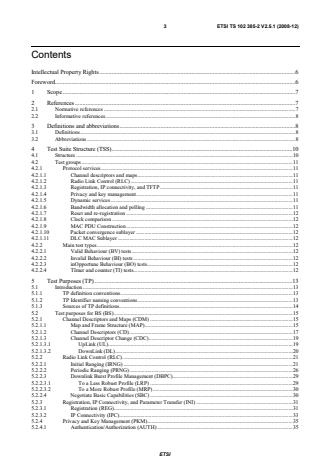
Contents
Intellectual Property Rights.6
Foreword.6
1 Scope.7
2 References.7
2.1 Normative references.7
2.2 Informative references.8
3 Definitions and abbreviations.8
3.1 Definitions.8
3.2 Abbreviations.8
4 Test Suite Structure (TSS).10
4.1 Structure.10
4.2 Test groups.11
4.2.1 Protocol services.11
4.2.1.1 Channel descriptors and maps.11
4.2.1.2 Radio Link Control (RLC) .11
4.2.1.3 Registration, IP connectivity, and TFTP.11
4.2.1.4 Privacy and key management.11
4.2.1.5 Dynamic services.11
4.2.1.6 Bandwidth allocation and polling .11
4.2.1.7 Reset and re-registration .12
4.2.1.8 Clock comparison.12
4.2.1.9 MAC PDU Construction .12
4.2.1.10 Packet convergence sublayer .12
4.2.1.11 DLC MAC Sublayer.12
4.2.2 Main test types.12
4.2.2.1 Valid Behaviour (BV) tests.12
4.2.2.2 Invalid Behaviour (BI) tests .12
4.2.2.3 inOpportune Behaviour (BO) tests.12
4.2.2.4 TImer and counter (TI) tests.12
5 Test Purposes (TP).13
5.1 Introduction.13
5.1.1 TP definition conventions.13
5.1.2 TP Identifier naming conventions.13
5.1.3 Sources of TP definitions.14
5.2 Test purposes for BS (BS).15
5.2.1 Channel Descriptors and Maps (CDM) .15
5.2.1.1 Map and Frame Structure (MAP).15
5.2.1.2 Channel Descriptors (CD).17
5.2.1.3 Channel Descriptor Change (CDC).19
5.2.1.3.1 UpLink (UL).19
5.2.1.3.2 DownLink (DL).20
5.2.2 Radio Link Control (RLC).21
5.2.2.1 Initial Ranging (IRNG) .21
5.2.2.2 Periodic Ranging (PRNG).26
5.2.2.3 Downlink Burst Profile Management (DBPC).29
5.2.2.3.1 To a Less Robust Profile (LRP) .29
5.2.2.3.2 To a More Robust Profile (MRP) .30
5.2.2.4 Negotiate Basic Capabilities (SBC) .30
5.2.3 Registration, IP Connectivity, and Parameter Transfer (INI) .31
5.2.3.1 Registration (REG).31
5.2.3.2 IP Connectivity (IPC).33
5.2.4 Privacy and Key Management (PKM).35
5.2.4.1 Authentication/Authorization (AUTH).35
ETSI
4 ETSI TS 102 385-2 V2.5.1 (2008-12)
5.2.4.1.1 Initialization (INIT).35
5.2.4.1.2 OPeratioNal (OPN).40
5.2.4.2 Encryption Key Transfer (TEK) .42
5.2.4.2.1 Initialization (INIT).42
5.2.4.2.2 Operational (OPN).44
5.2.4.3 Security Association Management (SAM).46
5.2.4.4 Encryption and Key Scheduling (EKS).47
5.2.4.4.1 Key Usage (KU).49
5.2.4.4.2 Encryption (ENC).50
5.2.4.4.3 Decryption (DEC).52
5.2.4.5 Certificates (CERT).54
5.2.5 Dynamic Services (DS).54
5.2.5.1 Dynamic Services Addition (DSA).54
5.2.5.2 Dynamic Services Change (DSC) .67
5.2.5.3 Dynamic Services Deletion (DSD) .83
5.2.5.4 QoS Parameter Sets (QPS).88
5.2.6 Bandwidth Allocation and Polling (BWA).94
5.2.6.1 Request/Grant (REQ).96
5.2.6.2 MultiCast Polling (MCP) .102
5.2.7 Reset and Re-Registration (RER) .105
5.2.8 CloCk Comparison (CCC).106
5.2.9 MAC PDU Construction (MAC).107
5.2.9.1 PACKing (PACK).109
5.2.9.2 Fragmentation (FRAG).111
5.2.9.3 PDU Concatenation (CAT) .113
5.2.9.4 Cyclic Redundancy Check (CRC).114
5.2.9.5 ARQ (ARQ).115
5.2.9.5.1 Setup (SET).115
5.2.9.5.2 Reset (RE).117
5.2.9.5.3 Receive Data (RXD).120
5.2.9.5.4 Transmit Data (TXD) .124
5.2.10 Packet Convergence Sublayer (PCS).129
5.2.10.1 Packet CS Usage (PCU).129
5.2.10.2 Classifier DSx Signaling (CDS).130
5.2.10.3 Classification (CLS).131
5.2.10.3.1 IPv4 and IPv6 (IP).133
5.2.10.3.2 Ethernet (ENET).135
5.2.10.3.3 VLAN (VLAN).136
5.2.10.3.4 IP over Ethernet (IPoE) .137
5.2.10.3.5 IP over VLAN (IPoV) .140
5.2.10.4 Payload Header Suppression (PHS).142
5.2.11 Service Flow Control (SF).145
5.2.12 Adaptive Antenna Support (AAS) .149
5.3 Test purposes for SS (SS).151
5.3.1 Channel Descriptors and Maps (CDM) .151
5.3.1.1 Map and Frame Structure (MAP).151
5.3.1.1.1 Initialization (INIT).151
5.3.1.1.2 Operational (OPN).153
5.3.1.1.3 Relevance (RLV).154
5.3.1.2 Channel Descriptors (CD).155
5.3.1.3 Channel Descriptor Change (CDC).156
5.3.1.3.1 Uplink (UL).156
5.3.1.3.2 Downlink (DL).158
5.3.2 Radio Link Control (RLC).159
5.3.2.1 Initial Ranging (IRNG) .159
5.3.2.2 Periodic Ranging (PRNG).163
5.3.2.3 Downlink Burst Profile Management (DBPC).174
5.3.2.3.1 To a Less Robust Profile (LRP) .174
5.3.2.3.2 To a More Robust Profile (MRP) .176
5.3.2.4 Negotiate Basic Capabilities (SBC) .180
5.3.3 Registration, IP Connectivity, and Parameter Transfer (INI) .181
5.3.3.1 Registration (REG).181
ETSI
5 ETSI TS 102 385-2 V2.5.1 (2008-12)
5.3.3.2 IP Connectivity (IPC).184
5.3.4 Privacy and Key Management (PKM).186
5.3.4.1 Authentication/Authorization (AUTH).186
5.3.4.1.1 Initialization (INIT).186
5.3.4.1.2 Operational (OPN).191
5.3.4.2 Encryption Key Transfer (TEK) .195
5.3.4.2.1 Initialization (INIT).195
5.3.4.2.2 Operational (OPN).198
5.3.4.3 Security Association Management (SAM).206
5.3.4.4 Encryption and Key Scheduling (EKS).206
5.3.4.4.1 Key Usage (KU).207
5.3.4.4.2 Encryption (ENC).208
5.3.4.4.3 Decryption (DEC).212
5.3.4.5 Certificates (CERT).215
5.3.5 Dynamic Services (DS).220
5.3.5.1 Dynamic Services Addition (DSA).220
5.3.5.2 Dynamic Services Change (DSC) .232
5.3.5.3 Dynamic Services Deletion (DSD) .246
5.3.5.4 Qos Parameter Sets (QPS) .249
5.3.6 Bandwidth Allocation and Polling (BWA).251
5.3.6.1 Request/Grant (REQ).251
5.3.6.2 Multicast Polling (MCP).256
5.3.7 Reset and Re-registration (RER) .258
5.3.8 Clock Comparison (CCC).260
5.3.9 MAC PDU Construction (MAC).260
5.3.9.1 Packing (PACK).263
5.3.9.2 Fragmentation (FRAG).264
5.3.9.3 PDU Concatenation (CAT) .266
5.3.9.4 Cyclic Redundancy Check (CRC).266
5.3.9.5 ARQ (ARQ).267
5.3.9.5.1 Setup (SET).267
5.3.9.5.2 Reset (RE).270
5.3.9.5.3 Receive Data (RXD).273
5.3.9.5.4 Transmit Data (TXD) .275
5.3.10 Packet Convergence Sublayer (PCS).280
5.3.10.1 Packet CS Usage (PCU).280
5.3.10.2 Classifier DSx Signaling (CDS).281
5.3.10.3 Classification (CLS).282
5.3.10.3.1 IPv4 and IPv6 (IP).282
5.3.10.3.2 Ethernet (ENET).284
5.3.10.3.3 VLAN (VLAN).285
5.3.10.3.4 IP over Ethernet (IPoE) .286
5.3.10.3.5 IP over VLAN (IPoV) .289
5.3.10.4 Payload Header Suppression (PHS).291
5.3.11 Service Flow Control (SF).293
5.3.12 Adaptive Antenna Support (AAS) .297
Annex A (informative): Bibliography.299
History .300
ETSI
6 ETSI TS 102 385-2 V2.5.1 (2008-12)
Intellectual Property Rights
IPRs essential or potentially essential to the present document may have been declared to ETSI. The information
pertaining to these essential IPRs, if any, is publicly available for ETSI members and non-members, and can be found
in ETSI SR 000 314: "Intellectual Property Rights (IPRs); Essential, or potentially Essential, IPRs notified to ETSI in
respect of ETSI standards", which is available from the ETSI Secretariat. Latest updates are available on the ETSI Web
server (http://webapp.etsi.org/IPR/home.asp).
Pursuant to the ETSI IPR Policy, no investigation, including IPR searches, has been carried out by ETSI. No guarantee
can be given as to the existence of other IPRs not referenced in ETSI SR 000 314 (or the updates on the ETSI Web
server) which are, or may be, or may become, essential to the present document.
Foreword
This Technical Specification (TS) has been produced by ETSI Technical Committee Broadband Radio Access
Networks (BRAN).
The present document is part 2 of a multi-part deliverable covering Broadband Radio Access Networks (BRAN);
HiperMAN; Conformance Testing for WiMAX/HiperMAN 1.2.1, as identified below:
Part 1: "Protocol Implementation Conformance Statement (PICS) proforma";
Part 2: "Test Suite Structure and Test Purposes (TSS&TP)";
Part 3: "Abstract Test Suite (ATS)".
ETSI
7 ETSI TS 102 385-2 V2.5.1 (2008-12)
1 Scope
The present document contains the Test Suite Structure (TSS) and Test Purposes (TP) to test the BRAN
HiperMAN 1.2.1 Data Link Control (DLC) layer.
The objective of this test specification is to provide a basis for conformance tests for HiperMAN equipment giving a
high probability of air interface inter-operability between different manufacturers' HiperMAN equipment.
The ISO standard for the methodology of conformance testing (ISO/IEC 9646-1 [5] and ISO/IEC 9646-2 [6]) as well as
the ETSI rules for conformance testing (ETS 300 406 [4]) are used as a basis for the test methodology.
2 References
References are either specific (identified by date of publication and/or edition number or version number) or
non-specific.
• For a specific reference, subsequent revisions do not apply.
• Non-specific reference may be made only to a complete document or a part thereof and only in the following
cases:
- if it is accepted that it will be possible to use all future changes of the referenced document for the purposes
of the referring document;
- for informative references.
Referenced documents which are not found to be publicly available in the expected location might be found at
http://docbox.etsi.org/Reference.
For online referenced documents, information sufficient to identify and locate the source shall be provided. Preferably,
the primary source of the referenced document should be cited, in order to ensure traceability. Furthermore, the
reference should, as far as possible, remain valid for the expected life of the document. The reference shall include the
method of access to the referenced document and the full network address, with the same punctuation and use of upper
case and lower case letters.
NOTE: While any hyperlinks included in this clause were valid at the time of publication ETSI cannot guarantee
their long term validity.
2.1 Normative references
The following referenced documents are indispensable for the application of the present document. For dated
references, only the edition cited applies. For non-specific references, the latest edition of the referenced document
(including any amendments) applies.
[1] ETSI TS 102 178 (V1.2.1): "Broadband Radio Access Networks (BRAN); HiperMAN; Data Link
Control (DLC) Layer".
[2] IEEE 802.16-2004: " IEEE Standard for Local and Metropolitan Area Networks - Part 16: Air
Interface for Fixed Broadband Wireless Access Systems".
[3] IEEE 802.16e-2005: "IEEE Standard for Local and Metropolitan Area Networks - Part 16: Air
Interface for Fixed and Mobile Broadband Wireless Access Systems - Amendment for Physical
and Medium Access Control Layers for Combined Fixed and Mobile Operation in Licensed
Bands".
[4] ETSI ETS 300 406: "Methods for Testing and Specification (MTS); Protocol and profile
conformance testing specifications; Standardization methodology".
ETSI
8 ETSI TS 102 385-2 V2.5.1 (2008-12)
[5] ISO/IEC 9646-1/ITU-T Recommendation X.290: "Information technology - Open Systems
Interconnection - Conformance testing methodology and framework - Part 1: General concepts".
NOTE: See also ITU-T Recommendation X.290 (1991).
[6] ISO/IEC 9646-2/ITU-T Recommendation X.291: "Information technology - Open Systems
Interconnection - Conformance testing methodology and framework - Part 2: Abstract Test Suite
specification".
[7] ISO/IEC 9646-6/ITU-T Recommendation X.295: "Information technology - Open Systems
Interconnection - Conformance testing methodology and framework - Part 6: Protocol profile test
specification".
[8] ISO/IEC 9646-7/ITU-T Recommendation X.296: "Information technology - Open Systems
Interconnection - Conformance testing methodology and framework - Part 7: Implementation
Conformance Statement".
[9] IEEE 802.3: "IEEE Standard for Information Technology - Telecommunications and Information
Exchange between Systems - Local and Metropolitan Area Networks - Specific requirements -
Part 3: Carrier Sense Multiple Access with Collision Detection (CSMA/CD) Access Method and
Physical Layer Specifications".
2.2 Informative references
The following referenced documents are not essential to the use of the present document but they assist the user with
regard to a particular subject area. For non-specific references, the latest version of the referenced document (including
any amendments) applies.
[i.1] ISO 3166 (all parts): "Codes for the representation of names of countries and their subdivisions".
3 Definitions and abbreviations
3.1 Definitions
For the purposes of the present document, the terms and definitions given in ISO/IEC 9646-7 [8], TS 102 178 [1],
IEEE 802.16-2004 [2] and IEEE 802.16e-2005 [3] apply.
3.2 Abbreviations
For the purposes of the present document, the abbreviations given in ISO/IEC 9646-1 [5], ISO/IEC 9646-6 [7],
ISO/IEC 9646-7 [8], TS 102 178 [1], IEEE 802.16-2004 [2], IEEE 802.16e-2005 [3] and the following apply:
ACK ACKnowledgment
AES Advanced Encryption Standard
AK Authorization Key
ATM Asynchronous Transfer Mode
BE Best Effort
BPSK Binary Phase Shift Keying
BSN Block Sequence Number
BW BandWidth
BWA BandWidth Allocation and polling
CA Certification Authority
CBC Cipher Block Chaining
CDC Channel Descriptor Change
CDM Channel Descriptors and Maps
CDS Classifier DSx Signaling
CID Connection IDentifier
CINR Carrier to noise and INterference Ratio
ETSI
9 ETSI TS 102 385-2 V2.5.1 (2008-12)
CLS CLaSsification
CRC Cyclic Redundancy Check
CS Convergence Sublayer
DCD Downlink Channel Descriptor
DES Data Encryption Standard
DIUC Downlink Interval Usage Code
DLC Data Link Control layer
DSA Dynamic Service Addition
DSC Dynamic Service Change
DSD Dynamic Service Deletion
DSx Dynamic Service addition, change or deletion
ECB Electronic Control Block
EKS Encryption and Key Scheduling
FC Frame Count
FDD Frequency Division Duplexing
FPC Fast Power Control
FSM Finite State Machine
FWA Fixed Wireless Access
HMAC Hashed Message Authentication Code
HT Header Type
IE Information Element
IPC IP Connectivity
IUT Implentation Under Test
KEK Key Encryption Key
KU Key Usage
MAC Medium Access Control
MIB Management Information Base
NACK Negative ACKnowledgment
OFDM Orthogonal Frequency Division Multiplexing
OFDMA Orthogonal Frequency Division Multiple Access
PCU Packet CS Usage
PDU Protocol Data Unit
PHS Payload Header Suppression
PHSI Payload Header Suppression Index
PHSV Payload Header Suppression Verify
PHY PHYsical layer
PMP Point-to-MultiPoint
PRNG Periodic Ranging
QoS Quality of Service
RER REset and Re-registration
RNG RaNGing
RSP ReSPonse
RXD Receive Data
SA Security Association
SAID Security Association IDentity
SAM Security Association Management
SAP Service Access Point
SDU Service Data Unit
SNMP Simple Network Management Protocol
TDD Time Division Duplexing
TFTP Trivial File Transfer Protocol
TLV Type, Length, Value
TP Test Purposes
TSS Test Suite Structure
Tx Transmit
TXD Transmit Data
UCD Uplink Channel Descriptor
UGS Unsolicited Grant Service
ETSI
10 ETSI TS 102 385-2 V2.5.1 (2008-12)
4 Test Suite Structure (TSS)
4.1 Structure
Figure 1 shows the DLC Test Suite Structure (TSS) including its subgroups defined for conformance testing.
Group Function Sub-function
Map and frame Structure
Initialization
Operational
Relevance
Channel Descriptors
Channel Descriptor Change
Uplink
Downlink
Radio Link Control
Initial Ranging
Periodic Ranging
Downlink Burst Profile Management
To a Less Robust Profile
To a More Robust Profile
Negotiate Basic Capabilities
Registration, IP connectivity and TFTP
Registration
IP Connectivity
Privacy and Key Management
Authentication/ Authorization
Initialization
Operational
TEK
Initialization
Operational
Security Association Management
Encryption and Key Scheduling
Key Usage
Encryption
Decryption
Certificates
Dynamic Services
Dynamic Service Addition
Dynamic Service Change
Dynamic Service Deletion
QoS Parameter Sets
Bandwidth Allocation and Polling
Request/Grant
Multicast Polling
Reset and Re-registration
Clock Comparison
MAC PDU
Packing
Fragmentation
PDU concatenation
CRC
ARQ
Setup
Reset
Receive Data
Transmit Data
Packet CS
Packet CS Usage
Classifier DSx Signaling
Classification
ETSI
11 ETSI TS 102 385-2 V2.5.1 (2008-12)
Group Function Sub-function
IPv4 and IPv6
Ethernet
VLAN
IP over Ethernet
IP over VLAN
Payload Header Suppression
Service Flow Control
Adaptive Antenna Support
Figure 1: TSS for HiperMAN DLC
The test suite is structured as a tree with the root defined as DLC-BS or DLC-SS representing the protocol groups "DLC
for BS" or "DLC for SS". The tree is of rank 3 with the first rank a Group, the second a Function, and the third a
sub-function. The third rank is broken down into the standard ISO conformance test categories CA, BV, BI, BO and TI
as defined in clause 4.2.2.
4.2 Test groups
Each test group has a total of three levels. The first level is the protocol services. The second level separates the
protocol services into the various functional areas. The third level are the sub-functional areas. The fourth level, if
required, is used to indicate the initiator (BS or SS) or the direction of communication (DL or UL). This fourth level is
not shown in figure 1.
4.2.1 Protocol services
The protocol groups identify the DLC protocol services given in TS 102 178 [1] and IEEE 802.16-2004 [2].
4.2.1.1 Channel descriptors and maps
This protocol group contains the test purposes for the DCD, UCD, DL-MAP, and UL-MAP messages that provide
channel parameters and burst mapping. Such functions as Scanning for the Downlink Channel and Obtaining Uplink
Parameter are included.
4.2.1.2 Radio Link Control (RLC)
This protocol group contains the test purposes for Initial Ranging/Automatic Adjustments, Negotiating Basic
Capabilities, Periodic Ranging, and Downlink Profile management.
4.2.1.3 Registration, IP connectivity, and TFTP
This protocol group includes the test purposes for Registration during Initialization, IP Connectivity during
Initializations, Time of Day Establishment, and the Transfer of Operational Parameters.
4.2.1.4 Privacy and key management
The functions included in this protocol group are Authentication/Authorization, Certification, Reauthorization, TEK
Exchange, TEK Update, TEK Scheduling, Security Association Management, Encryption, and Decryption.
4.2.1.5 Dynamic services
Dynamic service addition, change, and deletion for both BS-Initiated and DS-Initiated behaviour are in this protocol
group.
4.2.1.6 Bandwidth allocation and polling
This protocol group includes the bandwidth request/grant functions for stand-alone, piggyback and focused contention.
ETSI
12 ETSI TS 102 385-2 V2.5.1 (2008-12)
4.2.1.7 Reset and re-registration
Reset and re-registration functions are included in this protocol group.
4.2.1.8 Clock comparison
The clock comparison function in this group is used in network systems with service flows carrying information that
requires the SSs to reconstruct their network clock signals, e.g. DS1 and DS3.
4.2.1.9 MAC PDU Construction
The functions included in this protocol group are PDU Packing, Fragmentation, Concatenation, CRC Use, ARQ Reset,
ARQ Receive, and ARQ Transmit.
4.2.1.10 Packet convergence sublayer
The service specific packet Convergence Sublayer (CS) resides on top of the MAC sublayer and utilizes, via the MAC
SAP, the services provided by the MAC sublayer. The CS performs the following functions:
• Accepting higher-layer PDUs.
• Classifying higher-layer PDUs.
• Processing (if necessary) classified higher-layer PDUs.
• Delivering PDUs to the appropriate MAC SAP.
4.2.1.11 DLC MAC Sublayer
The MAC sublayer provides the core MAC functionality of system access, bandwidth allocation, connection
establishment, and connection maintenance. It receives data from the various convergence sublayers classified to
particular MAC connections. QoS is applied to the transmission and scheduling of data over the PHY. The MAC
sublayer also performs authentication, secure key exchange, and encryption management.
4.2.2 Main test types
The main test types are the valid behaviour group, the invalid behaviour group and the inopportune behaviour group.
4.2.2.1 Valid Behaviour (BV) tests
This test group shall verify that the IUT reacts in conformity with the base specifications after receipt or exchange of
valid Protocol Data Units (PDUs). Valid PDUs means that the exchange of messages and the content of the exchanged
messages are considered as valid.
4.2.2.2 Invalid Behaviour (BI) tests
This test sub group shall verify that the IUT reacts in conformity with the base specifications after receipt of a
syntactically invalid PDU.
4.2.2.3 inOpportune Behaviour (BO) tests
This test sub group shall verify that the IUT reacts in conformity with the base specifications after receipt of a
syntactically correct PDU not expected in the actual message exchange.
4.2.2.4 TImer and counter (TI) tests
This test group shall verify that the IUT reacts in conformity with the base specifications after expiry of a defined timer
or counter.
ETSI
13 ETSI TS 102 385-2 V2.5.1 (2008-12)
5 Test Purposes (TP)
5.1 Introduction
5.1.1 TP definition conventions
The TPs are defined by the rules shown in table 1.
Table 1: TP definition rules
TP Definition Item Item Description
TP Id The TP Id is a unique identifier formed according to the TP naming conventions
defined in the clause below.
IEEE 802.16 [2] A pointer to the base specification requirement from which the TP is derived
Reference (specification reference, clause, and paragraph).
PICS Item The PICS item(s) associated with this TP.
Initial Condition The IUT's state to which the TP is applied.
Expected behaviour Definition of the events that are expected from the IUT pursuant to the base
specification given a certain stimulus.
Notes Additional optional information provided to the TP reader.
5.1.2 TP Identifier naming conventions
The identifier of the TP is built according to table 2.
Table 2: TP naming convention
Identifier: TP//////-H
= side type BS Base Station
SS Subscriber Station
= protocol group CDM Channel Descriptors and Maps
RLC Radio Link Control
INI Registration, IP Connectivity, and Parameter
Transfer
PKM Privacy and Key Management
DS Dynamic Services
BWA BandWidth Allocation and Polling
RER REset and Re-registration
CCC CloCk Comparison
MAC MAC PDU Construction
PCS Packet CS
SF Service Flow control
AAS Adaptive Antenna Support
= function group MAP MAp and frame structure
CD Channel Descriptors
CDC Channel Descriptor Change
IRNG Initial RangiNG
PRNG Periodic RangiNG
DBPC Downlink Burst Profile Management
SBC Negotiate Basic Capabilities
REG REGistration
IPC IP Connectivity
AUTH AUTHentication/AUTHorization
TEK Encryption Key Transfer
SAM Security Association Management
EKS Encryption and Key Scheduling
CERT CERTificates
DSA Dynamic Service Addition
DSC Dynamic Service Change
DSD Dynamic Service Deletion
ETSI
14 ETSI TS 102 385-2 V2.5.1 (2008-12)
Identifier: TP//////-H
QPS QoS Parameter Sets
REQ REQuest/Grant
MCP MultiCast Polling
PACK PACKing
FRAG FRAGmentation
CAT PDU ConcATenation
CRC Cyclic Redundancy Check (CRC)
ARQ ARQ
PCU Packet CS Usage
CDS Classifier DSx Signaling
CLS CLaSsificat
...
Questions, Comments and Discussion
Ask us and Technical Secretary will try to provide an answer. You can facilitate discussion about the standard in here.
Loading comments...