

ETSI EN 302 878-2 V1.1.1 (2011-11)
Access, Terminals, Transmission and Multiplexing (ATTM); Third Generation Transmission Systems for Interactive Cable Television Services - IP Cable Modems; Part 2: Physical Layer; DOCSIS 3.0
General Information
- Abstract
DEN/ATTM-003006-2
- Status
- Published
- Publication Date
- 22-Nov-2011
- Technical Committee
- ATTM AT3 - Integrated broadband cable and television networks
- Current Stage
- 12 - Completion
- Due Date
- 15-Nov-2011
- Completion Date
- 23-Nov-2011
Buy Documents
en_30287802v010100c - Access, Terminals, Transmission and Multiplexing (ATTM); Third Generation Transmission Systems for Interactive Cable Television Services - IP Cable Modems; Part 2: Physical Layer; DOCSIS 3.0
en_30287802v010100v - Access, Terminals, Transmission and Multiplexing (ATTM); Third Generation Transmission Systems for Interactive Cable Television Services - IP Cable Modems; Part 2: Physical Layer; DOCSIS 3.0
en_30287802v010101p - Access, Terminals, Transmission and Multiplexing (ATTM); Third Generation Transmission Systems for Interactive Cable Television Services - IP Cable Modems; Part 2: Physical Layer; DOCSIS 3.0
Overview
ETSI EN 302 878-2 V1.1.1 (2011-11) specifies the physical layer requirements for IP cable modems implementing DOCSIS 3.0 within the Third Generation Transmission Systems for Interactive Cable Television Services (ATTM). This Slovenian adoption of ETSI EN 302 878-2 (identical to the ETSI text) incorporates engineering changes and updates to TS 102 639‑2 and defines radio‑frequency (RF) and modulation, framing, and transmit/receive characteristics needed for interoperable cable modem and CMTS equipment.
Key topics and technical requirements
The standard focuses on practical physical‑layer elements required for DOCSIS 3.0 on cable networks. Important technical topics include:
- Frequency plans and RF channel assumptions for upstream and downstream operation.
- Modulation formats and rates (DOCSIS 3.0 and backward‑compatibility modes), covering TDMA and S‑CDMA modes.
- Forward error correction (R-S / Reed‑Solomon) framing and byte ordering for DOCSIS 3.0 multiple transmit channel modes.
- Interleavers, scramblers and TCM encoders used in upstream symbol processing.
- S‑CDMA framing, spreader, code‑hopping and mini‑slot handling for synchronous upstream channels.
- Transmit power requirements and burst profiles, including power calculations for TDMA and S‑CDMA and requirements for multiple transmit channel operation.
- Fidelity and emission limits: spurious emissions, adjacent‑channel behavior, modulation error ratio (MER), filter distortion, carrier phase noise and timing/jitter considerations.
- Upstream demodulator input characteristics and CM electrical output/transmitter capability requirements.
- Definitions, normative references and functional assumptions that ensure compatibility with other services and fault isolation.
Practical applications and who uses it
This standard is essential for:
- Cable modem and CMTS manufacturers - to design physical‑layer implementations that conform to DOCSIS 3.0 and ensure interoperability.
- Network operators / cable MSOs - to specify equipment, plan upstream/downstream frequency usage, and maintain RF and emission compliance.
- Test laboratories and certification bodies - to validate compliance with DOCSIS 3.0 physical‑layer requirements (MER, spurious emissions, power, timing).
- Regulators and standards engineers - when defining national or regional deployment rules that reference ETSI/SIST physical‑layer norms.
Related standards and keywords
- Related ETSI/EN document: EN 302 878-2 V1.1.1 (2011-11) (identical text).
- Update to: TS 102 639-2 (Third Generation Transmission Systems - IP Cable Modems, Part 2).
- SEO keywords: DOCSIS 3.0, IP cable modems, physical layer, cable modem standards, CMTS, upstream TDMA, S‑CDMA, modulation, Reed‑Solomon, transmit power, MER, spurious emissions, ETSI, SIST.
Buy Documents
en_30287802v010100c - Access, Terminals, Transmission and Multiplexing (ATTM); Third Generation Transmission Systems for Interactive Cable Television Services - IP Cable Modems; Part 2: Physical Layer; DOCSIS 3.0
en_30287802v010100v - Access, Terminals, Transmission and Multiplexing (ATTM); Third Generation Transmission Systems for Interactive Cable Television Services - IP Cable Modems; Part 2: Physical Layer; DOCSIS 3.0
en_30287802v010101p - Access, Terminals, Transmission and Multiplexing (ATTM); Third Generation Transmission Systems for Interactive Cable Television Services - IP Cable Modems; Part 2: Physical Layer; DOCSIS 3.0
Frequently Asked Questions
ETSI EN 302 878-2 V1.1.1 (2011-11) is a standard published by the European Telecommunications Standards Institute (ETSI). Its full title is "Access, Terminals, Transmission and Multiplexing (ATTM); Third Generation Transmission Systems for Interactive Cable Television Services - IP Cable Modems; Part 2: Physical Layer; DOCSIS 3.0". This standard covers: DEN/ATTM-003006-2
DEN/ATTM-003006-2
ETSI EN 302 878-2 V1.1.1 (2011-11) is available in PDF format for immediate download after purchase. The document can be added to your cart and obtained through the secure checkout process. Digital delivery ensures instant access to the complete standard document.
Standards Content (Sample)
Draft ETSI EN 302 878-2 V1.1.0 (2011-04)
European Standard
Access, Terminals, Transmission and Multiplexing (ATTM);
Third Generation Transmission Systems for
Interactive Cable Television Services - IP Cable Modems;
Part 2: Physical Layer;
DOCSIS 3.0
2 Draft ETSI EN 302 878-2 V1.1.0 (2011-04)
Reference
DEN/ATTM-003006-2
Keywords
access, broadband, cable, data, IP, IPCable,
modem
ETSI
650 Route des Lucioles
F-06921 Sophia Antipolis Cedex - FRANCE
Tel.: +33 4 92 94 42 00 Fax: +33 4 93 65 47 16
Siret N° 348 623 562 00017 - NAF 742 C
Association à but non lucratif enregistrée à la
Sous-Préfecture de Grasse (06) N° 7803/88
Important notice
Individual copies of the present document can be downloaded from:
http://www.etsi.org
The present document may be made available in more than one electronic version or in print. In any case of existing or
perceived difference in contents between such versions, the reference version is the Portable Document Format (PDF).
In case of dispute, the reference shall be the printing on ETSI printers of the PDF version kept on a specific network drive
within ETSI Secretariat.
Users of the present document should be aware that the document may be subject to revision or change of status.
Information on the current status of this and other ETSI documents is available at
http://portal.etsi.org/tb/status/status.asp
If you find errors in the present document, please send your comment to one of the following services:
http://portal.etsi.org/chaircor/ETSI_support.asp
Copyright Notification
No part may be reproduced except as authorized by written permission.
The copyright and the foregoing restriction extend to reproduction in all media.
© European Telecommunications Standards Institute 2011.
All rights reserved.
TM TM TM TM
DECT , PLUGTESTS , UMTS , TIPHON , the TIPHON logo and the ETSI logo are Trade Marks of ETSI registered
for the benefit of its Members.
TM
3GPP is a Trade Mark of ETSI registered for the benefit of its Members and of the 3GPP Organizational Partners.
LTE™ is a Trade Mark of ETSI currently being registered
for the benefit of its Members and of the 3GPP Organizational Partners.
GSM® and the GSM logo are Trade Marks registered and owned by the GSM Association.
ETSI
3 Draft ETSI EN 302 878-2 V1.1.0 (2011-04)
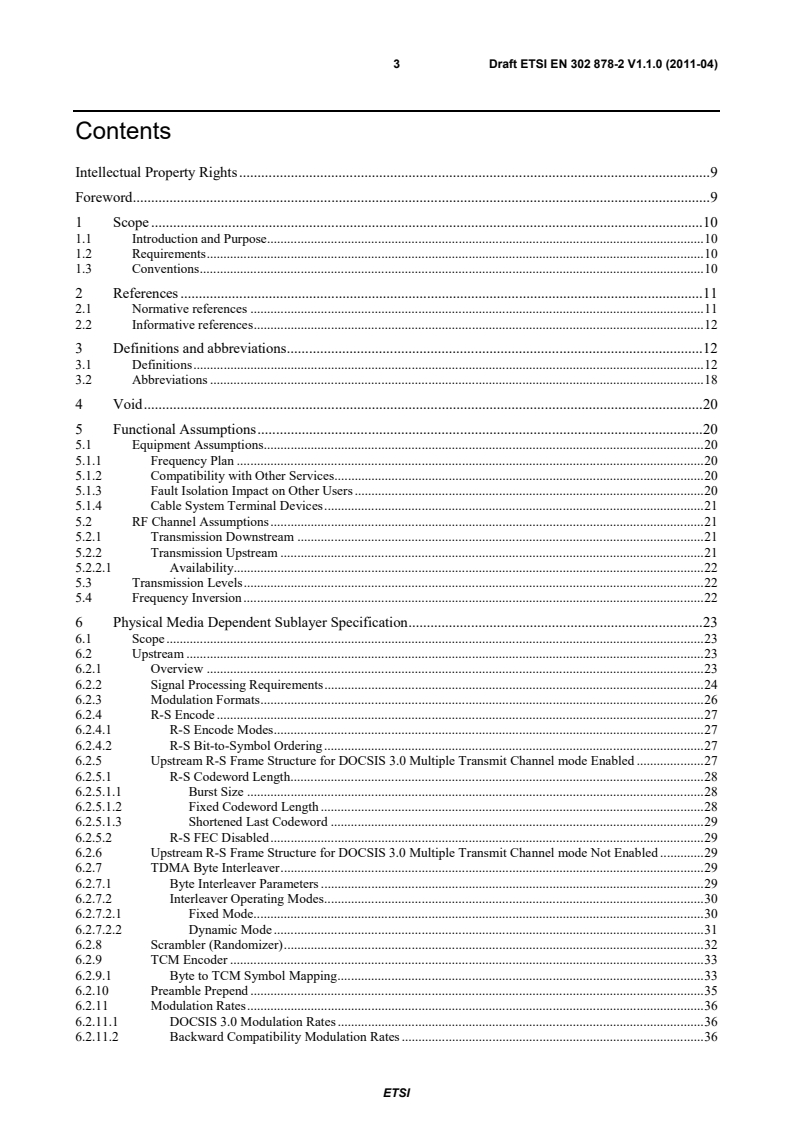
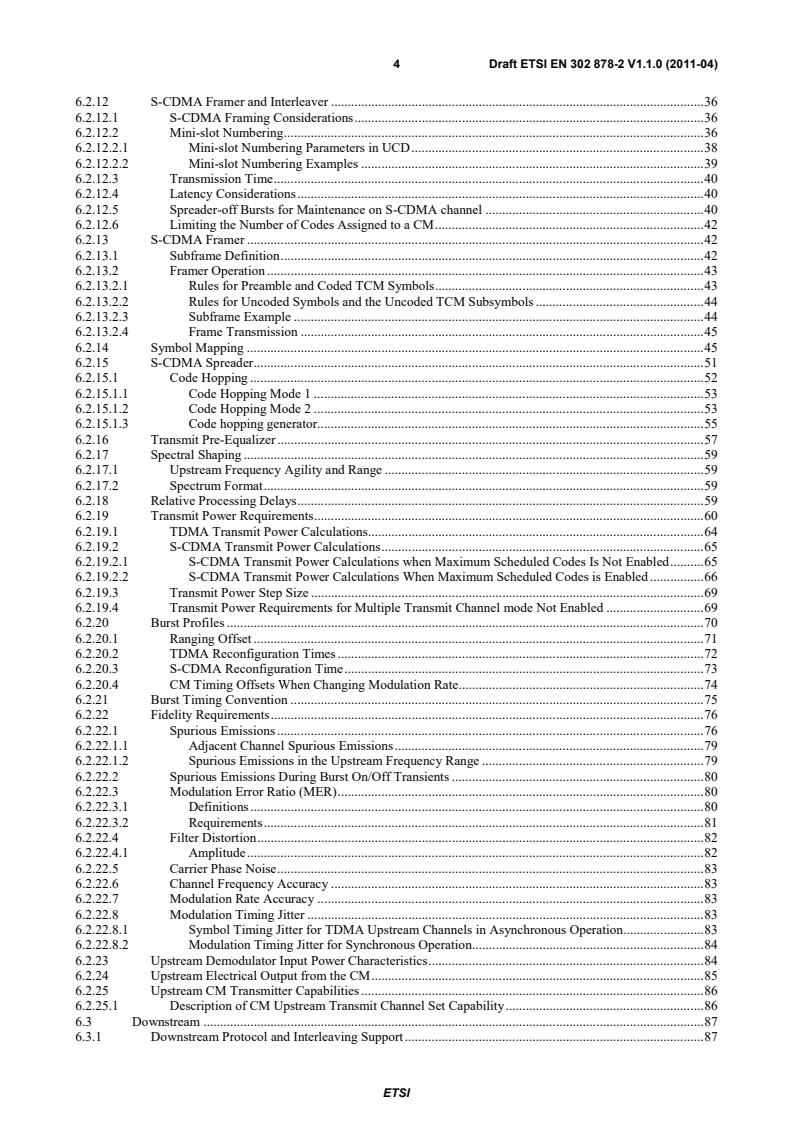
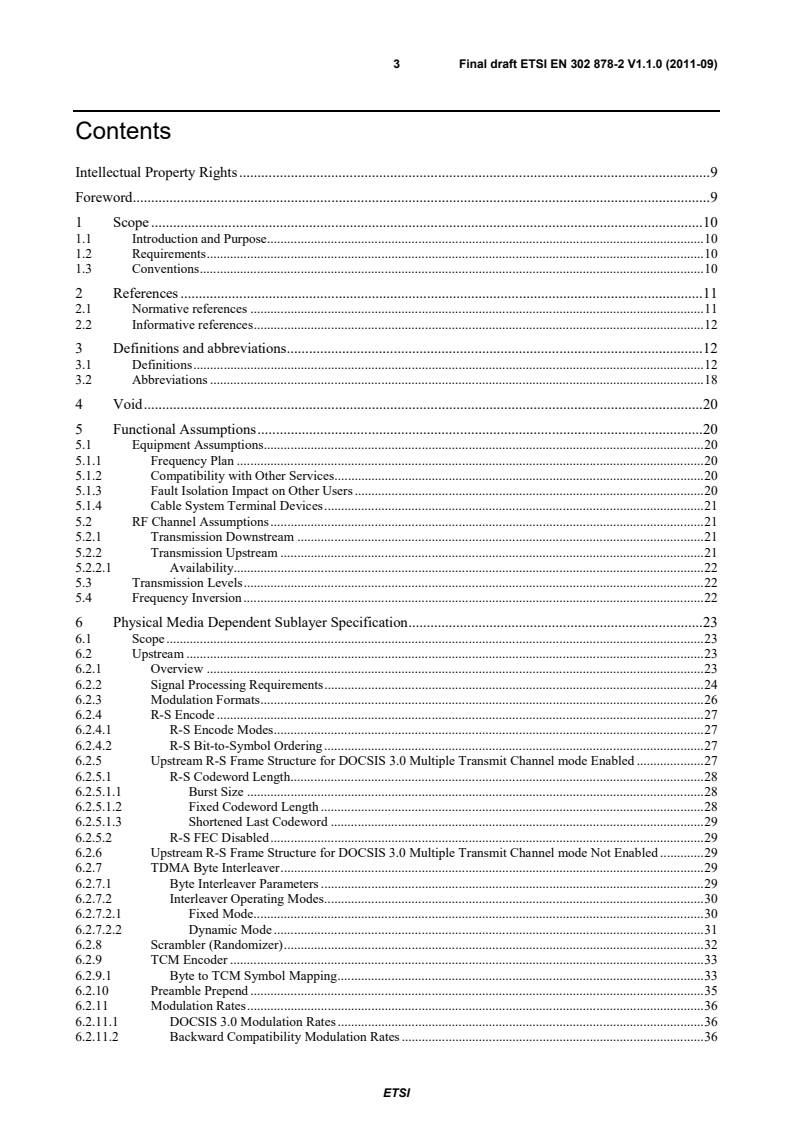
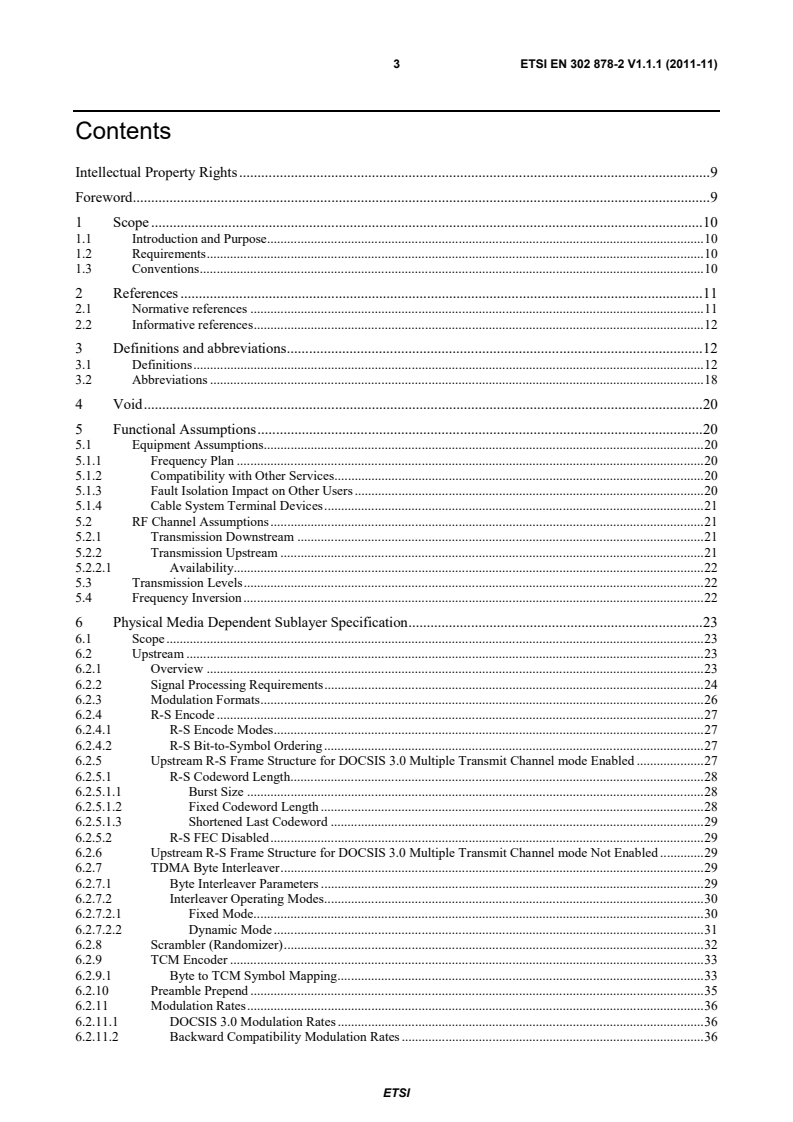
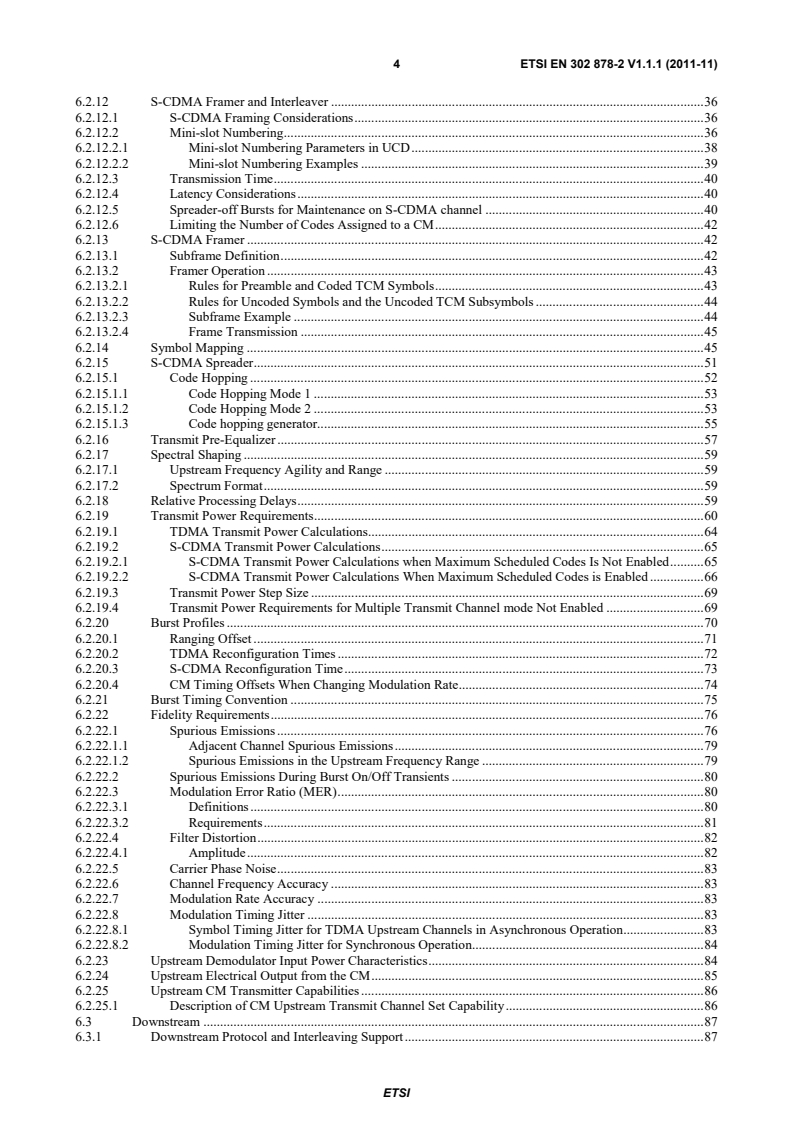
Contents
Intellectual Property Rights . 9
Foreword . 9
1 Scope . 10
1.1 Introduction and Purpose . 10
1.2 Requirements . 10
1.3 Conventions . 10
2 References . 11
2.1 Normative references . 11
2.2 Informative references . 12
3 Definitions and abbreviations . 12
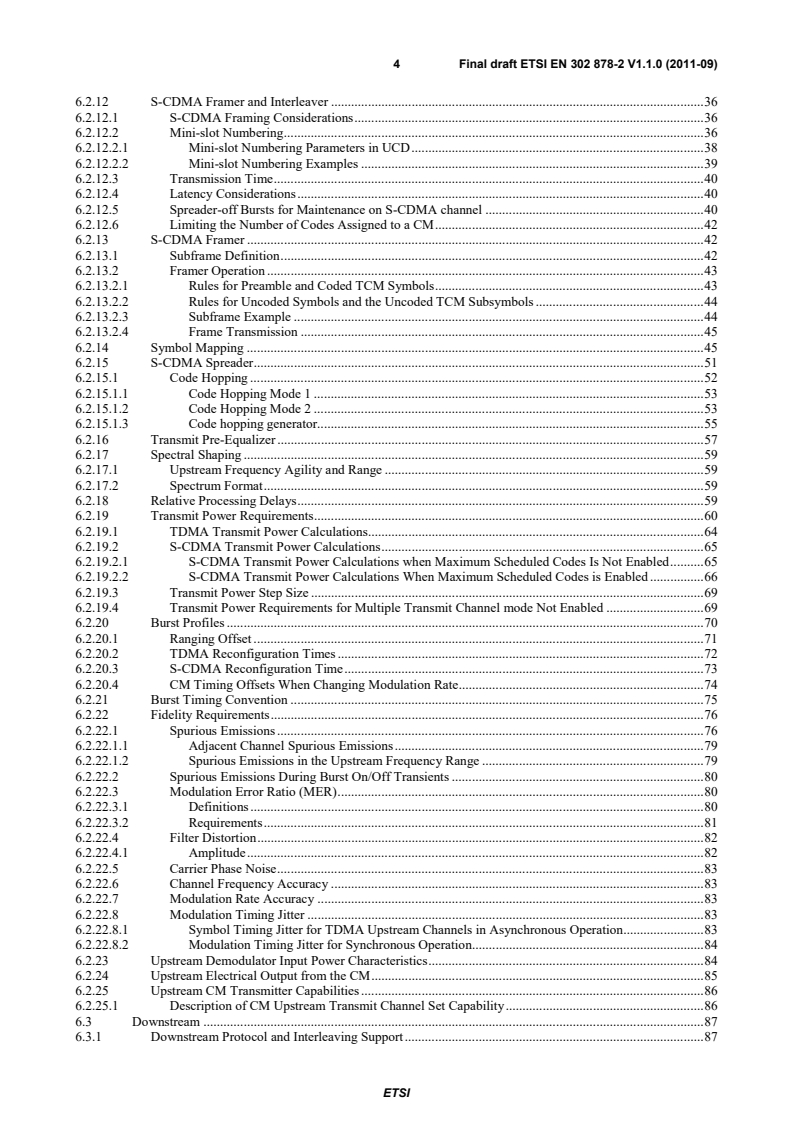
3.1 Definitions . 12
3.2 Abbreviations . 18
4 Void . 20
5 Functional Assumptions . 20
5.1 Equipment Assumptions . 20
5.1.1 Frequency Plan . 20
5.1.2 Compatibility with Other Services . 20
5.1.3 Fault Isolation Impact on Other Users . 20
5.1.4 Cable System Terminal Devices . 21
5.2 RF Channel Assumptions . 21
5.2.1 Transmission Downstream . 21
5.2.2 Transmission Upstream . 21
5.2.2.1 Availability. 22
5.3 Transmission Levels . 22
5.4 Frequency Inversion . 22
6 Physical Media Dependent Sublayer Specification . 23
6.1 Scope . 23
6.2 Upstream . 23
6.2.1 Overview . 23
6.2.2 Signal Processing Requirements . 24
6.2.3 Modulation Formats . 26
6.2.4 R-S Encode . 27
6.2.4.1 R-S Encode Modes . 27
6.2.4.2 R-S Bit-to-Symbol Ordering . 27
6.2.5 Upstream R-S Frame Structure for DOCSIS 3.0 Multiple Transmit Channel mode Enabled . 27
6.2.5.1 R-S Codeword Length. 28
6.2.5.1.1 Burst Size . 28
6.2.5.1.2 Fixed Codeword Length . 28
6.2.5.1.3 Shortened Last Codeword . 29
6.2.5.2 R-S FEC Disabled . 29
6.2.6 Upstream R-S Frame Structure for DOCSIS 3.0 Multiple Transmit Channel mode Not Enabled . 29
6.2.7 TDMA Byte Interleaver . 29
6.2.7.1 Byte Interleaver Parameters . 29
6.2.7.2 Interleaver Operating Modes . 30
6.2.7.2.1 Fixed Mode . 30
6.2.7.2.2 Dynamic Mode . 31
6.2.8 Scrambler (Randomizer) . 32
6.2.9 TCM Encoder . 33
6.2.9.1 Byte to TCM Symbol Mapping . 33
6.2.10 Preamble Prepend . 35
6.2.11 Modulation Rates . 36
6.2.11.1 DOCSIS 3.0 Modulation Rates . 36
6.2.11.2 Backward Compatibility Modulation Rates . 36
ETSI
4 Draft ETSI EN 302 878-2 V1.1.0 (2011-04)
6.2.12 S-CDMA Framer and Interleaver . 36
6.2.12.1 S-CDMA Framing Considerations . 36
6.2.12.2 Mini-slot Numbering . 36
6.2.12.2.1 Mini-slot Numbering Parameters in UCD . 38
6.2.12.2.2 Mini-slot Numbering Examples . 39
6.2.12.3 Transmission Time . 40
6.2.12.4 Latency Considerations . 40
6.2.12.5 Spreader-off Bursts for Maintenance on S-CDMA channel . 40
6.2.12.6 Limiting the Number of Codes Assigned to a CM . 42
6.2.13 S-CDMA Framer . 42
6.2.13.1 Subframe Definition . 42
6.2.13.2 Framer Operation . 43
6.2.13.2.1 Rules for Preamble and Coded TCM Symbols . 43
6.2.13.2.2 Rules for Uncoded Symbols and the Uncoded TCM Subsymbols . 44
6.2.13.2.3 Subframe Example . 44
6.2.13.2.4 Frame Transmission . 45
6.2.14 Symbol Mapping . 45
6.2.15 S-CDMA Spreader . 51
6.2.15.1 Code Hopping . 52
6.2.15.1.1 Code Hopping Mode 1 . 53
6.2.15.1.2 Code Hopping Mode 2 . 53
6.2.15.1.3 Code hopping generator. 55
6.2.16 Transmit Pre-Equalizer . 57
6.2.17 Spectral Shaping . 59
6.2.17.1 Upstream Frequency Agility and Range . 59
6.2.17.2 Spectrum Format . 59
6.2.18 Relative Processing Delays . 59
6.2.19 Transmit Power Requirements . 60
6.2.19.1 TDMA Transmit Power Calculations. 64
6.2.19.2 S-CDMA Transmit Power Calculations . 65
6.2.19.2.1 S-CDMA Transmit Power Calculations when Maximum Scheduled Codes Is Not Enabled . 65
6.2.19.2.2 S-CDMA Transmit Power Calculations When Maximum Scheduled Codes is Enabled . 66
6.2.19.3 Transmit Power Step Size . 69
6.2.19.4 Transmit Power Requirements for Multiple Transmit Channel mode Not Enabled . 69
6.2.20 Burst Profiles . 70
6.2.20.1 Ranging Offset . 71
6.2.20.2 TDMA Reconfiguration Times . 72
6.2.20.3 S-CDMA Reconfiguration Time . 73
6.2.20.4 CM Timing Offsets When Changing Modulation Rate. 74
6.2.21 Burst Timing Convention . 75
6.2.22 Fidelity Requirements . 76
6.2.22.1 Spurious Emissions . 76
6.2.22.1.1 Adjacent Channel Spurious Emissions . 79
6.2.22.1.2 Spurious Emissions in the Upstream Frequency Range . 79
6.2.22.2 Spurious Emissions During Burst On/Off Transients . 80
6.2.22.3 Modulation Error Ratio (MER) . 80
6.2.22.3.1 Definitions . 80
6.2.22.3.2 Requirements . 81
6.2.22.4 Filter Distortion . 82
6.2.22.4.1 Amplitude . 82
6.2.22.5 Carrier Phase Noise . 83
6.2.22.6 Channel Frequency Accuracy . 83
6.2.22.7 Modulation Rate Accuracy . 83
6.2.22.8 Modulation Timing Jitter . 83
6.2.22.8.1 Symbol Timing Jitter for TDMA Upstream Channels in Asynchronous Operation . 83
6.2.22.8.2 Modulation Timing Jitter for Synchronous Operation . 84
6.2.23 Upstream Demodulator Input Power Characteristics . 84
6.2.24 Upstream Electrical Output from the CM . 85
6.2.25 Upstream CM Transmitter Capabilities . 86
6.2.25.1 Description of CM Upstream Transmit Channel Set Capability . 86
6.3 Downstream . 87
6.3.1 Downstream Protocol and Interleaving Support . 87
ETSI
5 Draft ETSI EN 302 878-2 V1.1.0 (2011-04)
6.3.2 Downstream Electrical Input to CM . 87
6.3.3 CM BER Performance . 87
6.3.3.1 64-QAM . 88
6.3.3.1.1 64-QAM CM BER Performance . 88
6.3.3.1.2 Image Rejection Performance . 88
6.3.3.1.3 64-QAM Adjacent Channel Performance. 88
6.3.3.2 256-QAM . 88
6.3.3.2.1 256-QAM CM BER Performance . 88
6.3.3.2.2 256-QAM Image Rejection Performance . 88
6.3.3.2.3 256-QAM Adjacent Channel Performance. 89
6.3.4 Downstream Multiple Receiver Capabilities . 89
6.3.4.1 Receive Module Parameters . 89
6.3.4.2 Receive Channel Parameters . 90
6.3.4.3 Standard Receive Channel Profile . 90
6.3.4.4 Example Manufacturer Receive Channel Profile . 91
6.3.4.5 Reconfiguration of CM Receive Channels . 92
6.3.5 Non-Synchronous DS Channel Support . 92
Annex A (normative): Timing Requirements for Supporting Business Services over DOCSIS . 93
A.1 CMTS . . 93
A.2 CM . . 93
Annex B (normative): Additions and Modifications for European Specification . 94
B.1 Scope . 94
B.1.1 Introduction and Purpose . 94
B.1.2 Background . 94
B.1.2.1 Broadband Access Network . 94
B.1.2.2 Network and System Architecture . 94
B.1.2.2.1 The DOCSIS Network . 94
B.1.2.3 Service Goals . 95
B.1.2.4 Statement of Compatibility . 95
B.1.2.5 Reference Architecture . 95
B.1.2.6 Void . 95
B.1.3 Requirements . 95
B.1.4 Conventions . 95
B.1.5 Organization of Document . 95
B.2 References . 95
B.2.1 Normative References . 95
B.2.2 Informative References . 95
B.2.3 Reference Acquisition . 95
B.3 Terms and Definitions . 95
B.4 Abbreviations and Acronyms . 96
B.5 Functional Assumptions . 96
B.5.1 Equipment Assumptions . 96
B.5.1.1 Frequency Plan . 96
B.5.1.2 Compatibility with Other Services . 96
B.5.1.3 Fault Isolation Impact on Other Users . 96
B.5.1.4 Cable System Terminal Devices . 96
B.5.2 RF Channel Assumptions . 96
B.5.2.1 Transmission Downstream . 97
B.5.2.2 Transmission Upstream . 98
B.5.2.2.1 Availability. 98
B.5.3 Transmission Levels . 98
B.5.4 Frequency Inversion . 98
B.6 Physical Media Dependent Sublayer Specification . 98
B.6.1 Scope . 98
B.6.2 Upstream . 99
ETSI
6 Draft ETSI EN 302 878-2 V1.1.0 (2011-04)
B.6.2.1 Overview . 99
B.6.2.2 Signal Processing Requirements . 100
B.6.2.3 Modulation Formats . 100
B.6.2.4 R-S Encode . 100
B.6.2.4.1 R-S Encode Modes . 100
B.6.2.4.2 R-S Bit-to-Symbol Ordering . 100
B.6.2.5 Upstream R-S Frame Structure for DOCSIS 3.0 Multiple Transmit Channel mode Enabled . 100
B.6.2.5.1 R-S Codeword Length. 100
B.6.2.5.1.1 Burst Size . 100
B.6.2.5.1.2 Fixed Codeword Length . 101
B.6.2.5.1.3 Shortened Last Codeword . 101
B.6.2.5.2 R-S FEC Disabled . 101
B.6.2.6 Upstream R-S Frame Structure for DOCSIS 3.0 Multiple Transmit Channel mode Not Enabled . 101
B.6.2.7 TDMA Byte Interleaver . 101
B.6.2.7.1 Byte Interleaver Parameters . 101
B.6.2.7.2 Interleaver Operating Modes . 101
B.6.2.7.2.1 Fixed Mode . 101
B.6.2.7.2.2 Dynamic Mode . 101
B.6.2.8 Scrambler (Randomizer) . 101
B.6.2.9 TCM Encoder . 101
B.6.2.9.1 Byte to TCM Symbol Mapping . 101
B.6.2.10 Preamble Prepend . 101
B.6.2.11 Modulation Rates . 101
B.6.2.11.1 DOCSIS 3.0 Modulation Rates . 102
B.6.2.11.2 Backward Compatibility Modulation Rates . 102
B.6.2.12 S-CDMA Framer and Interleaver . 102
B.6.2.12.1 S-CDMA Framing Considerations . 102
B.6.2.12.2 Mini-slot Numbering . 102
B.6.2.12.2.1 Mini-slot Numbering Parameters in UCD . 102
B.6.2.12.2.2 Mini-slot Numbering Examples . 102
B.6.2.12.3 Transmission Time . 102
B.6.2.12.4 Latency Considerations . 102
B.6.2.12.5 Spreader-off Bursts for Maintenance on S-CDMA channel . 102
B.6.2.12.6 Limiting the Number of Codes Assigned to a CM . 102
B.6.2.13 S-CDMA Framer . 102
B.6.2.13.1 Subframe Definition . 102
B.6.2.13.2 Framer Operation . 102
B.6.2.13.2.1 Rules for Preamble and Coded TCM Symbols . 102
B.6.2.13.2.2 Rules for Uncoded Symbols and the Uncoded TCM Subsymbols . 103
B.6.2.13.2.3 Subframe Example . 103
B.6.2.13.2.4 Frame Transmission . 103
B.6.2.14 Symbol Mapping . 103
B.6.2.15 S-CDMA Spreader . 103
B.6.2.15.1 Code Hopping . 103
B.6.2.15.1.1 Code Hopping Mode 1 . 103
B.6.2.15.1.2 Code Hopping Mode 2 . 103
B.6.2.15.1.3 Code Hopping Generator . 103
B.6.2.16 Transmit Pre-Equalizer . 103
B.6.2.17 Spectral Shaping . 105
B.6.2.17.1 Upstream Frequency Agility and Range . 105
B.6.2.17.2 Spectrum Format . 105
B.6.2.18 Relative Processing Delays . 105
B.6.2.19 Transmit Power Requirements . 106
B.6.2.19.1 TDMA Transmit Power Calculations. 109
B.6.2.19.2 S-CDMA Transmit Power Calculations . 110
B.6.2.19.2.1 S-CDMA Transmit power Calculations with Maximum Scheduled Codes Not Enabled . 110
B.6.2.19.2.2 S-CDMA Transmit Power Calculations With Maximum Scheduled Codes Enabled . 112
B.6.2.19.3 Transmit Power Step Size . 114
B.6.2.19.4 Transmit Power Requirements for Multiple Transmit Channel mode Not Enabled . 114
B.6.2.20 Burst Profiles . 115
B.6.2.20.1 Ranging Offset . 116
B.6.2.20.2 TDMA Reconfiguration Times . 116
ETSI
7 Draft ETSI EN 302 878-2 V1.1.0 (2011-04)
B.6.2.20.3 S-CDMA Reconfiguration Times . 118
B.6.2.20.4 CM Timing Offsets When Changing Modulation Rate. 118
B.6.2.21 Burst Timing Convention . 118
B.6.2.22 Fidelity Requirements . 118
B.6.2.22.1 Spurious Emissions . 118
B.6.2.22.1.1 Adjacent Channel Spurious Emissions . 120
B.6.2.22.1.2 Spurious Emissions in the Upstream Frequency Range . 121
B.6.2.22.2 Spurious Emissions During Burst On/Off Transients . 121
B.6.2.22.3 Modulation Error Ratio (MER) . 121
B.6.2.22.3.1 Definitions . 122
B.6.2.22.3.2 Requirements . 122
B.6.2.22.4 Filter Distortion . 122
B.6.2.22.4.1 Amplitude . 123
B.6.2.22.5 Carrier Phase Noise . 123
B.6.2.22.6 Channel Frequency Accuracy . 123
B.6.2.22.7 Modulation Rate Accuracy . 123
B.6.2.22.8 Modulation Timing Jitter . 123
B.6.2.22.8.1 Symbol Timing Jitter for TDMA Upstream Channels in Asynchronous Operation . 123
B.6.2.22.8.2 Modulation Timing Jitter for Synchronous Operation . 123
B.6.2.23 Upstream Demodulator Input Power Characteristics . 123
B.6.2.24 Upstream Electrical Output from the CM . 123
B.6.2.25 Upstream CM Transmitter Capabilities . 124
B.6.2.25.1 Description of CM Upstream Transmit Channel Set Capabilities. 124
B.6.3 Downstream . 124
B.6.3.1 Downstream Protocol and Interleaving Support . 124
B.6.3.2 Downstream Electrical Input to CM . 125
B.6.3.3 CM BER Performance . 125
B.6.3.3.1 64-QAM . 125
B.6.3.3.1.1 64-QAM CM BER Performance . 125
B.6.3.3.1.2 64-QAM Image Rejection Performance . 126
B.6.3.3.1.3 64-QAM Adjacent Channel Performance. 126
B.6.3.3.2 256-QAM . 126
B.6.3.3.2.1 256-QAM CM BER Performance . 126
B.6.3.3.2.2 256-QAM Image Rejection Performance . 126
B.6.3.3.2.3 256-QAM Adjacent Channel Performance. 126
B.6.3.4 Downstream Multiple Receiver Capabilities . 126
B.6.3.4.1 Receive Module Parameters . 126
B.6.3.4.2 Receive Channel Parameters . 127
B.6.3.4.3 Standard Receive Channel Profile . 127
B.6.3.4.4 Example Manufacturer Receive Channel Profile . 127
B.6.3.4.5 Reconfiguration of CM Receive Channels . 128
B.6.3.5 Non-Synchronous DS Channel Support . 128
Annex C (normative): MPEG Header Synchronization and Recovery .
...
Final draft ETSI EN 302 878-2 V1.1.0 (2011-09)
European Standard
Access, Terminals, Transmission and Multiplexing (ATTM);
Third Generation Transmission Systems for
Interactive Cable Television Services - IP Cable Modems;
Part 2: Physical Layer;
DOCSIS 3.0
2 Final draft ETSI EN 302 878-2 V1.1.0 (2011-09)
Reference
DEN/ATTM-003006-2
Keywords
access, broadband, cable, data, IP, IPCable,
modem
ETSI
650 Route des Lucioles
F-06921 Sophia Antipolis Cedex - FRANCE
Tel.: +33 4 92 94 42 00 Fax: +33 4 93 65 47 16
Siret N° 348 623 562 00017 - NAF 742 C
Association à but non lucratif enregistrée à la
Sous-Préfecture de Grasse (06) N° 7803/88
Important notice
Individual copies of the present document can be downloaded from:
http://www.etsi.org
The present document may be made available in more than one electronic version or in print. In any case of existing or
perceived difference in contents between such versions, the reference version is the Portable Document Format (PDF).
In case of dispute, the reference shall be the printing on ETSI printers of the PDF version kept on a specific network drive
within ETSI Secretariat.
Users of the present document should be aware that the document may be subject to revision or change of status.
Information on the current status of this and other ETSI documents is available at
http://portal.etsi.org/tb/status/status.asp
If you find errors in the present document, please send your comment to one of the following services:
http://portal.etsi.org/chaircor/ETSI_support.asp
Copyright Notification
No part may be reproduced except as authorized by written permission.
The copyright and the foregoing restriction extend to reproduction in all media.
© European Telecommunications Standards Institute 2011.
All rights reserved.
TM TM TM
DECT , PLUGTESTS , UMTS and the ETSI logo are Trade Marks of ETSI registered for the benefit of its Members.
TM
3GPP and LTE™ are Trade Marks of ETSI registered for the benefit of its Members and
of the 3GPP Organizational Partners.
GSM® and the GSM logo are Trade Marks registered and owned by the GSM Association.
ETSI
3 Final draft ETSI EN 302 878-2 V1.1.0 (2011-09)
Contents
Intellectual Property Rights . 9
Foreword . 9
1 Scope . 10
1.1 Introduction and Purpose . 10
1.2 Requirements . 10
1.3 Conventions . 10
2 References . 11
2.1 Normative references . 11
2.2 Informative references . 12
3 Definitions and abbreviations . 12
3.1 Definitions . 12
3.2 Abbreviations . 18
4 Void . 20
5 Functional Assumptions . 20
5.1 Equipment Assumptions . 20
5.1.1 Frequency Plan . 20
5.1.2 Compatibility with Other Services . 20
5.1.3 Fault Isolation Impact on Other Users . 20
5.1.4 Cable System Terminal Devices . 21
5.2 RF Channel Assumptions . 21
5.2.1 Transmission Downstream . 21
5.2.2 Transmission Upstream . 21
5.2.2.1 Availability. 22
5.3 Transmission Levels . 22
5.4 Frequency Inversion . 22
6 Physical Media Dependent Sublayer Specification . 23
6.1 Scope . 23
6.2 Upstream . 23
6.2.1 Overview . 23
6.2.2 Signal Processing Requirements . 24
6.2.3 Modulation Formats . 26
6.2.4 R-S Encode . 27
6.2.4.1 R-S Encode Modes . 27
6.2.4.2 R-S Bit-to-Symbol Ordering . 27
6.2.5 Upstream R-S Frame Structure for DOCSIS 3.0 Multiple Transmit Channel mode Enabled . 27
6.2.5.1 R-S Codeword Length. 28
6.2.5.1.1 Burst Size . 28
6.2.5.1.2 Fixed Codeword Length . 28
6.2.5.1.3 Shortened Last Codeword . 29
6.2.5.2 R-S FEC Disabled . 29
6.2.6 Upstream R-S Frame Structure for DOCSIS 3.0 Multiple Transmit Channel mode Not Enabled . 29
6.2.7 TDMA Byte Interleaver . 29
6.2.7.1 Byte Interleaver Parameters . 29
6.2.7.2 Interleaver Operating Modes . 30
6.2.7.2.1 Fixed Mode . 30
6.2.7.2.2 Dynamic Mode . 31
6.2.8 Scrambler (Randomizer) . 32
6.2.9 TCM Encoder . 33
6.2.9.1 Byte to TCM Symbol Mapping . 33
6.2.10 Preamble Prepend . 35
6.2.11 Modulation Rates . 36
6.2.11.1 DOCSIS 3.0 Modulation Rates . 36
6.2.11.2 Backward Compatibility Modulation Rates . 36
ETSI
4 Final draft ETSI EN 302 878-2 V1.1.0 (2011-09)
6.2.12 S-CDMA Framer and Interleaver . 36
6.2.12.1 S-CDMA Framing Considerations . 36
6.2.12.2 Mini-slot Numbering . 36
6.2.12.2.1 Mini-slot Numbering Parameters in UCD . 38
6.2.12.2.2 Mini-slot Numbering Examples . 39
6.2.12.3 Transmission Time . 40
6.2.12.4 Latency Considerations . 40
6.2.12.5 Spreader-off Bursts for Maintenance on S-CDMA channel . 40
6.2.12.6 Limiting the Number of Codes Assigned to a CM . 42
6.2.13 S-CDMA Framer . 42
6.2.13.1 Subframe Definition . 42
6.2.13.2 Framer Operation . 43
6.2.13.2.1 Rules for Preamble and Coded TCM Symbols . 43
6.2.13.2.2 Rules for Uncoded Symbols and the Uncoded TCM Subsymbols . 44
6.2.13.2.3 Subframe Example . 44
6.2.13.2.4 Frame Transmission . 45
6.2.14 Symbol Mapping . 45
6.2.15 S-CDMA Spreader . 51
6.2.15.1 Code Hopping . 52
6.2.15.1.1 Code Hopping Mode 1 . 53
6.2.15.1.2 Code Hopping Mode 2 . 53
6.2.15.1.3 Code hopping generator. 55
6.2.16 Transmit Pre-Equalizer . 57
6.2.17 Spectral Shaping . 59
6.2.17.1 Upstream Frequency Agility and Range . 59
6.2.17.2 Spectrum Format . 59
6.2.18 Relative Processing Delays . 59
6.2.19 Transmit Power Requirements . 60
6.2.19.1 TDMA Transmit Power Calculations. 64
6.2.19.2 S-CDMA Transmit Power Calculations . 65
6.2.19.2.1 S-CDMA Transmit Power Calculations when Maximum Scheduled Codes Is Not Enabled . 65
6.2.19.2.2 S-CDMA Transmit Power Calculations When Maximum Scheduled Codes is Enabled . 66
6.2.19.3 Transmit Power Step Size . 69
6.2.19.4 Transmit Power Requirements for Multiple Transmit Channel mode Not Enabled . 69
6.2.20 Burst Profiles . 70
6.2.20.1 Ranging Offset . 71
6.2.20.2 TDMA Reconfiguration Times . 72
6.2.20.3 S-CDMA Reconfiguration Time . 73
6.2.20.4 CM Timing Offsets When Changing Modulation Rate. 74
6.2.21 Burst Timing Convention . 75
6.2.22 Fidelity Requirements . 76
6.2.22.1 Spurious Emissions . 76
6.2.22.1.1 Adjacent Channel Spurious Emissions . 79
6.2.22.1.2 Spurious Emissions in the Upstream Frequency Range . 79
6.2.22.2 Spurious Emissions During Burst On/Off Transients . 80
6.2.22.3 Modulation Error Ratio (MER) . 80
6.2.22.3.1 Definitions . 80
6.2.22.3.2 Requirements . 81
6.2.22.4 Filter Distortion . 82
6.2.22.4.1 Amplitude . 82
6.2.22.5 Carrier Phase Noise . 83
6.2.22.6 Channel Frequency Accuracy . 83
6.2.22.7 Modulation Rate Accuracy . 83
6.2.22.8 Modulation Timing Jitter . 83
6.2.22.8.1 Symbol Timing Jitter for TDMA Upstream Channels in Asynchronous Operation . 83
6.2.22.8.2 Modulation Timing Jitter for Synchronous Operation . 84
6.2.23 Upstream Demodulator Input Power Characteristics . 84
6.2.24 Upstream Electrical Output from the CM . 85
6.2.25 Upstream CM Transmitter Capabilities . 86
6.2.25.1 Description of CM Upstream Transmit Channel Set Capability . 86
6.3 Downstream . 87
6.3.1 Downstream Protocol and Interleaving Support . 87
ETSI
5 Final draft ETSI EN 302 878-2 V1.1.0 (2011-09)
6.3.2 Downstream Electrical Input to CM . 87
6.3.3 CM BER Performance . 87
6.3.3.1 64-QAM . 88
6.3.3.1.1 64-QAM CM BER Performance . 88
6.3.3.1.2 Image Rejection Performance . 88
6.3.3.1.3 64-QAM Adjacent Channel Performance. 88
6.3.3.2 256-QAM . 88
6.3.3.2.1 256-QAM CM BER Performance . 88
6.3.3.2.2 256-QAM Image Rejection Performance . 88
6.3.3.2.3 256-QAM Adjacent Channel Performance. 89
6.3.4 Downstream Multiple Receiver Capabilities . 89
6.3.4.1 Receive Module Parameters . 89
6.3.4.2 Receive Channel Parameters . 90
6.3.4.3 Standard Receive Channel Profile . 90
6.3.4.4 Example Manufacturer Receive Channel Profile . 91
6.3.4.5 Reconfiguration of CM Receive Channels . 92
6.3.5 Non-Synchronous DS Channel Support . 92
Annex A (normative): Timing Requirements for Supporting Business Services over
DOCSIS . 93
A.1 CMTS . . 93
A.2 CM . . 93
Annex B (normative): Additions and Modifications for European Specification . 94
B.1 Scope . 94
B.1.1 Introduction and Purpose . 94
B.1.2 Background . 94
B.1.2.1 Broadband Access Network . 94
B.1.2.2 Network and System Architecture . 94
B.1.2.2.1 The DOCSIS Network . 94
B.1.2.3 Service Goals . 95
B.1.2.4 Statement of Compatibility . 95
B.1.2.5 Reference Architecture . 95
B.1.2.6 Void . 95
B.1.3 Requirements . 95
B.1.4 Conventions . 95
B.1.5 Organization of Document . 95
B.2 References . 95
B.2.1 Normative References . 95
B.2.2 Informative References . 95
B.2.3 Reference Acquisition . 95
B.3 Terms and Definitions . 95
B.4 Abbreviations and Acronyms . 96
B.5 Functional Assumptions . 96
B.5.1 Equipment Assumptions . 96
B.5.1.1 Frequency Plan . 96
B.5.1.2 Compatibility with Other Services . 96
B.5.1.3 Fault Isolation Impact on Other Users . 96
B.5.1.4 Cable System Terminal Devices . 96
B.5.2 RF Channel Assumptions . 96
B.5.2.1 Transmission Downstream . 97
B.5.2.2 Transmission Upstream . 98
B.5.2.2.1 Availability. 98
B.5.3 Transmission Levels . 98
B.5.4 Frequency Inversion . 98
B.6 Physical Media Dependent Sublayer Specification . 98
B.6.1 Scope . 98
ETSI
6 Final draft ETSI EN 302 878-2 V1.1.0 (2011-09)
B.6.2 Upstream . 99
B.6.2.1 Overview . 99
B.6.2.2 Signal Processing Requirements . 100
B.6.2.3 Modulation Formats . 100
B.6.2.4 R-S Encode . 100
B.6.2.4.1 R-S Encode Modes . 100
B.6.2.4.2 R-S Bit-to-Symbol Ordering . 100
B.6.2.5 Upstream R-S Frame Structure for DOCSIS 3.0 Multiple Transmit Channel mode Enabled . 100
B.6.2.5.1 R-S Codeword Length. 100
B.6.2.5.1.1 Burst Size . 100
B.6.2.5.1.2 Fixed Codeword Length . 101
B.6.2.5.1.3 Shortened Last Codeword . 101
B.6.2.5.2 R-S FEC Disabled . 101
B.6.2.6 Upstream R-S Frame Structure for DOCSIS 3.0 Multiple Transmit Channel mode Not Enabled . 101
B.6.2.7 TDMA Byte Interleaver . 101
B.6.2.7.1 Byte Interleaver Parameters . 101
B.6.2.7.2 Interleaver Operating Modes . 101
B.6.2.7.2.1 Fixed Mode . 101
B.6.2.7.2.2 Dynamic Mode . 101
B.6.2.8 Scrambler (Randomizer) . 101
B.6.2.9 TCM Encoder . 101
B.6.2.9.1 Byte to TCM Symbol Mapping . 101
B.6.2.10 Preamble Prepend . 101
B.6.2.11 Modulation Rates . 101
B.6.2.11.1 DOCSIS 3.0 Modulation Rates . 102
B.6.2.11.2 Backward Compatibility Modulation Rates . 102
B.6.2.12 S-CDMA Framer and Interleaver . 102
B.6.2.12.1 S-CDMA Framing Considerations . 102
B.6.2.12.2 Mini-slot Numbering . 102
B.6.2.12.2.1 Mini-slot Numbering Parameters in UCD . 102
B.6.2.12.2.2 Mini-slot Numbering Examples . 102
B.6.2.12.3 Transmission Time . 102
B.6.2.12.4 Latency Considerations . 102
B.6.2.12.5 Spreader-off Bursts for Maintenance on S-CDMA channel . 102
B.6.2.12.6 Limiting the Number of Codes Assigned to a CM . 102
B.6.2.13 S-CDMA Framer . 102
B.6.2.13.1 Subframe Definition . 102
B.6.2.13.2 Framer Operation . 102
B.6.2.13.2.1 Rules for Preamble and Coded TCM Symbols . 102
B.6.2.13.2.2 Rules for Uncoded Symbols and the Uncoded TCM Subsymbols . 103
B.6.2.13.2.3 Subframe Example . 103
B.6.2.13.2.4 Frame Transmission . 103
B.6.2.14 Symbol Mapping . 103
B.6.2.15 S-CDMA Spreader . 103
B.6.2.15.1 Code Hopping . 103
B.6.2.15.1.1 Code Hopping Mode 1 . 103
B.6.2.15.1.2 Code Hopping Mode 2 . 103
B.6.2.15.1.3 Code Hopping Generator . 103
B.6.2.16 Transmit Pre-Equalizer . 103
B.6.2.17 Spectral Shaping . 105
B.6.2.17.1 Upstream Frequency Agility and Range . 105
B.6.2.17.2 Spectrum Format . 105
B.6.2.18 Relative Processing Delays . 105
B.6.2.19 Transmit Power Requirements . 106
B.6.2.19.1 TDMA Transmit Power Calculations. 109
B.6.2.19.2 S-CDMA Transmit Power Calculations . 110
B.6.2.19.2.1 S-CDMA Transmit power Calculations with Maximum Scheduled Codes Not Enabled . 110
B.6.2.19.2.2 S-CDMA Transmit Power Calculations With Maximum Scheduled Codes Enabled . 112
B.6.2.19.3 Transmit Power Step Size . 114
B.6.2.19.4 Transmit Power Requirements for Multiple Transmit Channel mode Not Enabled . 114
B.6.2.20 Burst Profiles . 115
B.6.2.20.1 Ranging Offset . 116
ETSI
7 Final draft ETSI EN 302 878-2 V1.1.0 (2011-09)
B.6.2.20.2 TDMA Reconfiguration Times . 116
B.6.2.20.3 S-CDMA Reconfiguration Times . 118
B.6.2.20.4 CM Timing Offsets When Changing Modulation Rate. 118
B.6.2.21 Burst Timing Convention . 118
B.6.2.22 Fidelity Requirements . 118
B.6.2.22.1 Spurious Emissions . 118
B.6.2.22.1.1 Adjacent Channel Spurious Emissions . 120
B.6.2.22.1.2 Spurious Emissions in the Upstream Frequency Range . 121
B.6.2.22.2 Spurious Emissions During Burst On/Off Transients . 121
B.6.2.22.3 Modulation Error Ratio (MER) . 121
B.6.2.22.3.1 Definitions . 122
B.6.2.22.3.2 Requirements . 122
B.6.2.22.4 Filter Distortion . 122
B.6.2.22.4.1 Amplitude . 123
B.6.2.22.5 Carrier Phase Noise . 123
B.6.2.22.6 Channel Frequency Accuracy . 123
B.6.2.22.7 Modulation Rate Accuracy . 123
B.6.2.22.8 Modulation Timing Jitter . 123
B.6.2.22.8.1 Symbol Timing Jitter for TDMA Upstream Channels in Asynchronous Operation . 123
B.6.2.22.8.2 Modulation Timing Jitter for Synchronous Operation . 123
B.6.2.23 Upstream Demodulator Input Power Characteristics . 123
B.6.2.24 Upstream Electrical Output from the CM . 123
B.6.2.25 Upstream CM Transmitter Capabilities . 124
B.6.2.25.1 Description of CM Upstream Transmit Channel Set Capabilities. 124
B.6.3 Downstream . 124
B.6.3.1 Downstream Protocol and Interleaving Support . 124
B.6.3.2 Downstream Electrical Input to CM . 125
B.6.3.3 CM BER Performance . 125
B.6.3.3.1 64-QAM . 125
B.6.3.3.1.1 64-QAM CM BER Performance . 125
B.6.3.3.1.2 64-QAM Image Rejection Performance . 126
B.6.3.3.1.3 64-QAM Adjacent Channel Performance. 126
B.6.3.3.2 256-QAM . 126
B.6.3.3.2.1 256-QAM CM BER Performance . 126
B.6.3.3.2.2 256-QAM Image Rejection Performance . 126
B.6.3.3.2.3 256-QAM Adjacent Channel Performance. 126
B.6.3.4 Downstream Multiple Receiver Capabilities . 126
B.6.3.4.1 Receive Module Parameters . 126
B.6.3.4.2 Receive Channel Parameters . 127
B.6.3.4.3 Standard Receive Channel Profile . 127
B.6.3.4.4 Example Manufacturer Receive Channel Profile . 127
B.6.3.4.5 Reconfiguration of CM Receive Channels . 128
B.6.3.5 Non-Synchronous DS Channel Support . 128
Annex C (normative): MPEG Header Synchronization and Recovery.
...
European Standard
Access, Terminals, Transmission and Multiplexing (ATTM);
Third Generation Transmission Systems for
Interactive Cable Television Services - IP Cable Modems;
Part 2: Physical Layer;
DOCSIS 3.0
2 ETSI EN 302 878-2 V1.1.1 (2011-11)
Reference
DEN/ATTM-003006-2
Keywords
access, broadband, cable, data, IP, IPCable,
modem
ETSI
650 Route des Lucioles
F-06921 Sophia Antipolis Cedex - FRANCE
Tel.: +33 4 92 94 42 00 Fax: +33 4 93 65 47 16
Siret N° 348 623 562 00017 - NAF 742 C
Association à but non lucratif enregistrée à la
Sous-Préfecture de Grasse (06) N° 7803/88
Important notice
Individual copies of the present document can be downloaded from:
http://www.etsi.org
The present document may be made available in more than one electronic version or in print. In any case of existing or
perceived difference in contents between such versions, the reference version is the Portable Document Format (PDF).
In case of dispute, the reference shall be the printing on ETSI printers of the PDF version kept on a specific network drive
within ETSI Secretariat.
Users of the present document should be aware that the document may be subject to revision or change of status.
Information on the current status of this and other ETSI documents is available at
http://portal.etsi.org/tb/status/status.asp
If you find errors in the present document, please send your comment to one of the following services:
http://portal.etsi.org/chaircor/ETSI_support.asp
Copyright Notification
No part may be reproduced except as authorized by written permission.
The copyright and the foregoing restriction extend to reproduction in all media.
© European Telecommunications Standards Institute 2011.
All rights reserved.
TM TM TM
DECT , PLUGTESTS , UMTS and the ETSI logo are Trade Marks of ETSI registered for the benefit of its Members.
TM
3GPP and LTE™ are Trade Marks of ETSI registered for the benefit of its Members and
of the 3GPP Organizational Partners.
GSM® and the GSM logo are Trade Marks registered and owned by the GSM Association.
ETSI
3 ETSI EN 302 878-2 V1.1.1 (2011-11)
Contents
Intellectual Property Rights . 9
Foreword . 9
1 Scope . 10
1.1 Introduction and Purpose . 10
1.2 Requirements . 10
1.3 Conventions . 10
2 References . 11
2.1 Normative references . 11
2.2 Informative references . 12
3 Definitions and abbreviations . 12
3.1 Definitions . 12
3.2 Abbreviations . 18
4 Void . 20
5 Functional Assumptions . 20
5.1 Equipment Assumptions . 20
5.1.1 Frequency Plan . 20
5.1.2 Compatibility with Other Services . 20
5.1.3 Fault Isolation Impact on Other Users . 20
5.1.4 Cable System Terminal Devices . 21
5.2 RF Channel Assumptions . 21
5.2.1 Transmission Downstream . 21
5.2.2 Transmission Upstream . 21
5.2.2.1 Availability. 22
5.3 Transmission Levels . 22
5.4 Frequency Inversion . 22
6 Physical Media Dependent Sublayer Specification . 23
6.1 Scope . 23
6.2 Upstream . 23
6.2.1 Overview . 23
6.2.2 Signal Processing Requirements . 24
6.2.3 Modulation Formats . 26
6.2.4 R-S Encode . 27
6.2.4.1 R-S Encode Modes . 27
6.2.4.2 R-S Bit-to-Symbol Ordering . 27
6.2.5 Upstream R-S Frame Structure for DOCSIS 3.0 Multiple Transmit Channel mode Enabled . 27
6.2.5.1 R-S Codeword Length. 28
6.2.5.1.1 Burst Size . 28
6.2.5.1.2 Fixed Codeword Length . 28
6.2.5.1.3 Shortened Last Codeword . 29
6.2.5.2 R-S FEC Disabled . 29
6.2.6 Upstream R-S Frame Structure for DOCSIS 3.0 Multiple Transmit Channel mode Not Enabled . 29
6.2.7 TDMA Byte Interleaver . 29
6.2.7.1 Byte Interleaver Parameters . 29
6.2.7.2 Interleaver Operating Modes . 30
6.2.7.2.1 Fixed Mode . 30
6.2.7.2.2 Dynamic Mode . 31
6.2.8 Scrambler (Randomizer) . 32
6.2.9 TCM Encoder . 33
6.2.9.1 Byte to TCM Symbol Mapping . 33
6.2.10 Preamble Prepend . 35
6.2.11 Modulation Rates . 36
6.2.11.1 DOCSIS 3.0 Modulation Rates . 36
6.2.11.2 Backward Compatibility Modulation Rates . 36
ETSI
4 ETSI EN 302 878-2 V1.1.1 (2011-11)
6.2.12 S-CDMA Framer and Interleaver . 36
6.2.12.1 S-CDMA Framing Considerations . 36
6.2.12.2 Mini-slot Numbering . 36
6.2.12.2.1 Mini-slot Numbering Parameters in UCD . 38
6.2.12.2.2 Mini-slot Numbering Examples . 39
6.2.12.3 Transmission Time . 40
6.2.12.4 Latency Considerations . 40
6.2.12.5 Spreader-off Bursts for Maintenance on S-CDMA channel . 40
6.2.12.6 Limiting the Number of Codes Assigned to a CM . 42
6.2.13 S-CDMA Framer . 42
6.2.13.1 Subframe Definition . 42
6.2.13.2 Framer Operation . 43
6.2.13.2.1 Rules for Preamble and Coded TCM Symbols . 43
6.2.13.2.2 Rules for Uncoded Symbols and the Uncoded TCM Subsymbols . 44
6.2.13.2.3 Subframe Example . 44
6.2.13.2.4 Frame Transmission . 45
6.2.14 Symbol Mapping . 45
6.2.15 S-CDMA Spreader . 51
6.2.15.1 Code Hopping . 52
6.2.15.1.1 Code Hopping Mode 1 . 53
6.2.15.1.2 Code Hopping Mode 2 . 53
6.2.15.1.3 Code hopping generator. 55
6.2.16 Transmit Pre-Equalizer . 57
6.2.17 Spectral Shaping . 59
6.2.17.1 Upstream Frequency Agility and Range . 59
6.2.17.2 Spectrum Format . 59
6.2.18 Relative Processing Delays . 59
6.2.19 Transmit Power Requirements . 60
6.2.19.1 TDMA Transmit Power Calculations. 64
6.2.19.2 S-CDMA Transmit Power Calculations . 65
6.2.19.2.1 S-CDMA Transmit Power Calculations when Maximum Scheduled Codes Is Not Enabled . 65
6.2.19.2.2 S-CDMA Transmit Power Calculations When Maximum Scheduled Codes is Enabled . 66
6.2.19.3 Transmit Power Step Size . 69
6.2.19.4 Transmit Power Requirements for Multiple Transmit Channel mode Not Enabled . 69
6.2.20 Burst Profiles . 70
6.2.20.1 Ranging Offset . 71
6.2.20.2 TDMA Reconfiguration Times . 72
6.2.20.3 S-CDMA Reconfiguration Time . 73
6.2.20.4 CM Timing Offsets When Changing Modulation Rate. 74
6.2.21 Burst Timing Convention . 75
6.2.22 Fidelity Requirements . 76
6.2.22.1 Spurious Emissions . 76
6.2.22.1.1 Adjacent Channel Spurious Emissions . 79
6.2.22.1.2 Spurious Emissions in the Upstream Frequency Range . 79
6.2.22.2 Spurious Emissions During Burst On/Off Transients . 80
6.2.22.3 Modulation Error Ratio (MER) . 80
6.2.22.3.1 Definitions . 80
6.2.22.3.2 Requirements . 81
6.2.22.4 Filter Distortion . 82
6.2.22.4.1 Amplitude . 82
6.2.22.5 Carrier Phase Noise . 83
6.2.22.6 Channel Frequency Accuracy . 83
6.2.22.7 Modulation Rate Accuracy . 83
6.2.22.8 Modulation Timing Jitter . 83
6.2.22.8.1 Symbol Timing Jitter for TDMA Upstream Channels in Asynchronous Operation . 83
6.2.22.8.2 Modulation Timing Jitter for Synchronous Operation . 84
6.2.23 Upstream Demodulator Input Power Characteristics . 84
6.2.24 Upstream Electrical Output from the CM . 85
6.2.25 Upstream CM Transmitter Capabilities . 86
6.2.25.1 Description of CM Upstream Transmit Channel Set Capability . 86
6.3 Downstream . 87
6.3.1 Downstream Protocol and Interleaving Support . 87
ETSI
5 ETSI EN 302 878-2 V1.1.1 (2011-11)
6.3.2 Downstream Electrical Input to CM . 87
6.3.3 CM BER Performance . 87
6.3.3.1 64-QAM . 88
6.3.3.1.1 64-QAM CM BER Performance . 88
6.3.3.1.2 Image Rejection Performance . 88
6.3.3.1.3 64-QAM Adjacent Channel Performance. 88
6.3.3.2 256-QAM . 88
6.3.3.2.1 256-QAM CM BER Performance . 88
6.3.3.2.2 256-QAM Image Rejection Performance . 88
6.3.3.2.3 256-QAM Adjacent Channel Performance. 89
6.3.4 Downstream Multiple Receiver Capabilities . 89
6.3.4.1 Receive Module Parameters . 89
6.3.4.2 Receive Channel Parameters . 90
6.3.4.3 Standard Receive Channel Profile . 90
6.3.4.4 Example Manufacturer Receive Channel Profile . 91
6.3.4.5 Reconfiguration of CM Receive Channels . 92
6.3.5 Non-Synchronous DS Channel Support . 92
Annex A (normative): Timing Requirements for Supporting Business Services over
DOCSIS . 93
A.1 CMTS . . 93
A.2 CM . . 93
Annex B (normative): Additions and Modifications for European Specification . 94
B.1 Scope . 94
B.1.1 Introduction and Purpose . 94
B.1.2 Background . 94
B.1.2.1 Broadband Access Network . 94
B.1.2.2 Network and System Architecture . 94
B.1.2.2.1 The DOCSIS Network . 94
B.1.2.3 Service Goals . 95
B.1.2.4 Statement of Compatibility . 95
B.1.2.5 Reference Architecture . 95
B.1.2.6 Void . 95
B.1.3 Requirements . 95
B.1.4 Conventions . 95
B.1.5 Void . 95
B.2 References . 95
B.2.1 Normative References . 95
B.2.2 Informative References . 95
B.2.3 Reference Acquisition . 95
B.3 Terms and Definitions . 95
B.4 Abbreviations and Acronyms . 96
B.5 Functional Assumptions . 96
B.5.1 Equipment Assumptions . 96
B.5.1.1 Frequency Plan . 96
B.5.1.2 Compatibility with Other Services . 96
B.5.1.3 Fault Isolation Impact on Other Users . 96
B.5.1.4 Cable System Terminal Devices . 96
B.5.2 RF Channel Assumptions . 96
B.5.2.1 Transmission Downstream . 97
B.5.2.2 Transmission Upstream . 98
B.5.2.2.1 Availability. 98
B.5.3 Transmission Levels . 98
B.5.4 Frequency Inversion . 98
B.6 Physical Media Dependent Sublayer Specification . 98
B.6.1 Scope . 98
ETSI
6 ETSI EN 302 878-2 V1.1.1 (2011-11)
B.6.2 Upstream . 99
B.6.2.1 Overview . 99
B.6.2.2 Signal Processing Requirements . 100
B.6.2.3 Modulation Formats . 100
B.6.2.4 R-S Encode . 100
B.6.2.4.1 R-S Encode Modes . 100
B.6.2.4.2 R-S Bit-to-Symbol Ordering . 100
B.6.2.5 Upstream R-S Frame Structure for DOCSIS 3.0 Multiple Transmit Channel mode Enabled . 100
B.6.2.5.1 R-S Codeword Length. 100
B.6.2.5.1.1 Burst Size . 100
B.6.2.5.1.2 Fixed Codeword Length . 101
B.6.2.5.1.3 Shortened Last Codeword . 101
B.6.2.5.2 R-S FEC Disabled . 101
B.6.2.6 Upstream R-S Frame Structure for DOCSIS 3.0 Multiple Transmit Channel mode Not Enabled . 101
B.6.2.7 TDMA Byte Interleaver . 101
B.6.2.7.1 Byte Interleaver Parameters . 101
B.6.2.7.2 Interleaver Operating Modes . 101
B.6.2.7.2.1 Fixed Mode . 101
B.6.2.7.2.2 Dynamic Mode . 101
B.6.2.8 Scrambler (Randomizer) . 101
B.6.2.9 TCM Encoder . 101
B.6.2.9.1 Byte to TCM Symbol Mapping . 101
B.6.2.10 Preamble Prepend . 101
B.6.2.11 Modulation Rates . 101
B.6.2.11.1 DOCSIS 3.0 Modulation Rates . 102
B.6.2.11.2 Backward Compatibility Modulation Rates . 102
B.6.2.12 S-CDMA Framer and Interleaver . 102
B.6.2.12.1 S-CDMA Framing Considerations . 102
B.6.2.12.2 Mini-slot Numbering . 102
B.6.2.12.2.1 Mini-slot Numbering Parameters in UCD . 102
B.6.2.12.2.2 Mini-slot Numbering Examples . 102
B.6.2.12.3 Transmission Time . 102
B.6.2.12.4 Latency Considerations . 102
B.6.2.12.5 Spreader-off Bursts for Maintenance on S-CDMA channel . 102
B.6.2.12.6 Limiting the Number of Codes Assigned to a CM . 102
B.6.2.13 S-CDMA Framer . 102
B.6.2.13.1 Subframe Definition . 102
B.6.2.13.2 Framer Operation . 102
B.6.2.13.2.1 Rules for Preamble and Coded TCM Symbols . 102
B.6.2.13.2.2 Rules for Uncoded Symbols and the Uncoded TCM Subsymbols . 103
B.6.2.13.2.3 Subframe Example . 103
B.6.2.13.2.4 Frame Transmission . 103
B.6.2.14 Symbol Mapping . 103
B.6.2.15 S-CDMA Spreader . 103
B.6.2.15.1 Code Hopping . 103
B.6.2.15.1.1 Code Hopping Mode 1 . 103
B.6.2.15.1.2 Code Hopping Mode 2 . 103
B.6.2.15.1.3 Code Hopping Generator . 103
B.6.2.16 Transmit Pre-Equalizer . 103
B.6.2.17 Spectral Shaping . 105
B.6.2.17.1 Upstream Frequency Agility and Range . 105
B.6.2.17.2 Spectrum Format . 105
B.6.2.18 Relative Processing Delays . 105
B.6.2.19 Transmit Power Requirements . 106
B.6.2.19.1 TDMA Transmit Power Calculations. 109
B.6.2.19.2 S-CDMA Transmit Power Calculations . 110
B.6.2.19.2.1 S-CDMA Transmit power Calculations with Maximum Scheduled Codes Not Enabled . 110
B.6.2.19.2.2 S-CDMA Transmit Power Calculations With Maximum Scheduled Codes Enabled . 112
B.6.2.19.3 Transmit Power Step Size . 114
B.6.2.19.4 Transmit Power Requirements for Multiple Transmit Channel mode Not Enabled . 114
B.6.2.20 Burst Profiles . 115
B.6.2.20.1 Ranging Offset . 116
ETSI
7 ETSI EN 302 878-2 V1.1.1 (2011-11)
B.6.2.20.2 TDMA Reconfiguration Times . 116
B.6.2.20.3 S-CDMA Reconfiguration Times . 118
B.6.2.20.4 CM Timing Offsets When Changing Modulation Rate. 118
B.6.2.21 Burst Timing Convention . 118
B.6.2.22 Fidelity Requirements . 118
B.6.2.22.1 Spurious Emissions . 118
B.6.2.22.1.1 Adjacent Channel Spurious Emissions . 120
B.6.2.22.1.2 Spurious Emissions in the Upstream Frequency Range . 121
B.6.2.22.2 Spurious Emissions During Burst On/Off Transients . 121
B.6.2.22.3 Modulation Error Ratio (MER) . 121
B.6.2.22.3.1 Definitions . 122
B.6.2.22.3.2 Requirements . 122
B.6.2.22.4 Filter Distortion . 122
B.6.2.22.4.1 Amplitude . 123
B.6.2.22.5 Carrier Phase Noise . 123
B.6.2.22.6 Channel Frequency Accuracy . 123
B.6.2.22.7 Modulation Rate Accuracy . 123
B.6.2.22.8 Modulation Timing Jitter . 123
B.6.2.22.8.1 Symbol Timing Jitter for TDMA Upstream Channels in Asynchronous Operation . 123
B.6.2.22.8.2 Modulation Timing Jitter for Synchronous Operation . 123
B.6.2.23 Upstream Demodulator Input Power Characteristics . 123
B.6.2.24 Upstream Electrical Output from the CM . 123
B.6.2.25 Upstream CM Transmitter Capabilities . 124
B.6.2.25.1 Description of CM Upstream Transmit Channel Set Capabilities. 124
B.6.3 Downstream . 124
B.6.3.1 Downstream Protocol and Interleaving Support . 124
B.6.3.2 Downstream Electrical Input to CM . 125
B.6.3.3 CM BER Performance . 125
B.6.3.3.1 64-QAM . 125
B.6.3.3.1.1 64-QAM CM BER Performance . 125
B.6.3.3.1.2 64-QAM Image Rejection Performance . 126
B.6.3.3.1.3 64-QAM Adjacent Channel Performance. 126
B.6.3.3.2 256-QAM . 126
B.6.3.3.2.1 256-QAM CM BER Performance . 126
B.6.3.3.2.2 256-QAM Image Rejection Performance . 126
B.6.3.3.2.3 256-QAM Adjacent Channel Performance. 126
B.6.3.4 Downstream Multiple Receiver Capabilities . 126
B.6.3.4.1 Receive Module Parameters . 126
B.6.3.4.2 Receive Channel Parameters . 127
B.6.3.4.3 Standard Receive Channel Profile . 127
B.6.3.4.4 Example Manufacturer Receive Channel Profile . 127
B.6.3.4.5 Reconfiguration of CM Receive Channels . 128
B.6.3.5 Non-Synchronous DS Channel Support . 128
Annex C (normative): MPEG Header Synchronization and Recovery. 129
C.1 MPEG Header Synchronization and Rec
...
2003-01.Slovenski inštitut za standardizacijo. Razmnoževanje celote ali delov tega standarda ni dovoljeno.Access, Terminals, Transmission and Multiplexing (ATTM) - Third Generation Transmission Systems for Interactive Cable Television Services - IP Cable Modems - Part 2: Physical Layer - DOCSIS 3.035.180Terminalska in druga periferna oprema ITIT Terminal and other peripheral equipment35.100.10Physical layerICS:Ta slovenski standard je istoveten z:EN 302 878-2 Version 1.1.1SIST EN 302 878-2 V1.1.1:2012en01-februar-2012SIST EN 302 878-2 V1.1.1:2012SLOVENSKI
STANDARD
European Standard SIST EN 302 878-2 V1.1.1:2012
ETSI ETSI EN 302 878-2 V1.1.1 (2011-11) 2
Reference DEN/ATTM-003006-2 Keywords access, broadband, cable, data, IP, IPCable, modem ETSI 650 Route des Lucioles F-06921 Sophia Antipolis Cedex - FRANCE
Tel.: +33 4 92 94 42 00
Fax: +33 4 93 65 47 16
Siret N° 348 623 562 00017 - NAF 742 C Association à but non lucratif enregistrée à la Sous-Préfecture de Grasse (06) N° 7803/88
Important notice Individual copies of the present document can be downloaded from: http://www.etsi.org The present document may be made available in more than one electronic version or in print. In any case of existing or perceived difference in contents between such versions, the reference version is the Portable Document Format (PDF). In case of dispute, the reference shall be the printing on ETSI printers of the PDF version kept on a specific network drive within ETSI Secretariat. Users of the present document should be aware that the document may be subject to revision or change of status. Information on the current status of this and other ETSI documents is available at http://portal.etsi.org/tb/status/status.asp If you find errors in the present document, please send your comment to one of the following services: http://portal.etsi.org/chaircor/ETSI_support.asp Copyright Notification No part may be reproduced except as authorized by written permission. The copyright and the foregoing restriction extend to reproduction in all media.
© European Telecommunications Standards Institute 2011. All rights reserved.
DECTTM, PLUGTESTSTM, UMTSTM and the ETSI logo are Trade Marks of ETSI registered for the benefit of its Members. 3GPPTM and LTE™ are Trade Marks of ETSI registered for the benefit of its Members and of the 3GPP Organizational Partners. GSM® and the GSM logo are Trade Marks registered and owned by the GSM Association. SIST EN 302 878-2 V1.1.1:2012
ETSI ETSI EN 302 878-2 V1.1.1 (2011-11) 3 Contents Intellectual Property Rights . 9 Foreword . 9 1 Scope . 10 1.1 Introduction and Purpose . 10 1.2 Requirements . 10 1.3 Conventions . 10 2 References . 11 2.1 Normative references . 11 2.2 Informative references . 12 3 Definitions and abbreviations . 12 3.1 Definitions . 12 3.2 Abbreviations . 18 4 Void . 20 5 Functional Assumptions . 20 5.1 Equipment Assumptions . 20 5.1.1 Frequency Plan . 20 5.1.2 Compatibility with Other Services . 20 5.1.3 Fault Isolation Impact on Other Users . 20 5.1.4 Cable System Terminal Devices . 21 5.2 RF Channel Assumptions . 21 5.2.1 Transmission Downstream . 21 5.2.2 Transmission Upstream . 21 5.2.2.1 Availability. 22 5.3 Transmission Levels . 22 5.4 Frequency Inversion . 22 6 Physical Media Dependent Sublayer Specification . 23 6.1 Scope . 23 6.2 Upstream . 23 6.2.1 Overview . 23 6.2.2 Signal Processing Requirements . 24 6.2.3 Modulation Formats . 26 6.2.4 R-S Encode . 27 6.2.4.1 R-S Encode Modes . 27 6.2.4.2 R-S Bit-to-Symbol Ordering . 27 6.2.5 Upstream R-S Frame Structure for DOCSIS 3.0 Multiple Transmit Channel mode Enabled . 27 6.2.5.1 R-S Codeword Length. 28 6.2.5.1.1 Burst Size . 28 6.2.5.1.2 Fixed Codeword Length . 28 6.2.5.1.3 Shortened Last Codeword . 29 6.2.5.2 R-S FEC Disabled . 29 6.2.6 Upstream R-S Frame Structure for DOCSIS 3.0 Multiple Transmit Channel mode Not Enabled . 29 6.2.7 TDMA Byte Interleaver . 29 6.2.7.1 Byte Interleaver Parameters . 29 6.2.7.2 Interleaver Operating Modes . 30 6.2.7.2.1 Fixed Mode . 30 6.2.7.2.2 Dynamic Mode . 31 6.2.8 Scrambler (Randomizer) . 32 6.2.9 TCM Encoder . 33 6.2.9.1 Byte to TCM Symbol Mapping . 33 6.2.10 Preamble Prepend . 35 6.2.11 Modulation Rates . 36 6.2.11.1 DOCSIS 3.0 Modulation Rates . 36 6.2.11.2 Backward Compatibility Modulation Rates . 36 SIST EN 302 878-2 V1.1.1:2012
ETSI ETSI EN 302 878-2 V1.1.1 (2011-11) 4 6.2.12 S-CDMA Framer and Interleaver . 36 6.2.12.1 S-CDMA Framing Considerations . 36 6.2.12.2 Mini-slot Numbering . 36 6.2.12.2.1 Mini-slot Numbering Parameters in UCD . 38 6.2.12.2.2 Mini-slot Numbering Examples . 39 6.2.12.3 Transmission Time . 40 6.2.12.4 Latency Considerations . 40 6.2.12.5 Spreader-off Bursts for Maintenance on S-CDMA channel . 40 6.2.12.6 Limiting the Number of Codes Assigned to a CM . 42 6.2.13 S-CDMA Framer . 42 6.2.13.1 Subframe Definition . 42 6.2.13.2 Framer Operation . 43 6.2.13.2.1 Rules for Preamble and Coded TCM Symbols . 43 6.2.13.2.2 Rules for Uncoded Symbols and the Uncoded TCM Subsymbols . 44 6.2.13.2.3 Subframe Example . 44 6.2.13.2.4 Frame Transmission . 45 6.2.14 Symbol Mapping . 45 6.2.15 S-CDMA Spreader . 51 6.2.15.1 Code Hopping . 52 6.2.15.1.1 Code Hopping Mode 1 . 53 6.2.15.1.2 Code Hopping Mode 2 . 53 6.2.15.1.3 Code hopping generator. 55 6.2.16 Transmit Pre-Equalizer . 57 6.2.17 Spectral Shaping . 59 6.2.17.1 Upstream Frequency Agility and Range . 59 6.2.17.2 Spectrum Format . 59 6.2.18 Relative Processing Delays . 59 6.2.19 Transmit Power Requirements . 60 6.2.19.1 TDMA Transmit Power Calculations. 64 6.2.19.2 S-CDMA Transmit Power Calculations . 65 6.2.19.2.1 S-CDMA Transmit Power Calculations when Maximum Scheduled Codes Is Not Enabled . 65 6.2.19.2.2 S-CDMA Transmit Power Calculations When Maximum Scheduled Codes is Enabled . 66 6.2.19.3 Transmit Power Step Size . 69 6.2.19.4 Transmit Power Requirements for Multiple Transmit Channel mode Not Enabled . 69 6.2.20 Burst Profiles . 70 6.2.20.1 Ranging Offset . 71 6.2.20.2 TDMA Reconfiguration Times . 72 6.2.20.3 S-CDMA Reconfiguration Time . 73 6.2.20.4 CM Timing Offsets When Changing Modulation Rate. 74 6.2.21 Burst Timing Convention . 75 6.2.22 Fidelity Requirements . 76 6.2.22.1 Spurious Emissions . 76 6.2.22.1.1 Adjacent Channel Spurious Emissions . 79 6.2.22.1.2 Spurious Emissions in the Upstream Frequency Range . 79 6.2.22.2 Spurious Emissions During Burst On/Off Transients . 80 6.2.22.3 Modulation Error Ratio (MER) . 80 6.2.22.3.1 Definitions . 80 6.2.22.3.2 Requirements . 81 6.2.22.4 Filter Distortion . 82 6.2.22.4.1 Amplitude . 82 6.2.22.5 Carrier Phase Noise . 83 6.2.22.6 Channel Frequency Accuracy . 83 6.2.22.7 Modulation Rate Accuracy . 83 6.2.22.8 Modulation Timing Jitter . 83 6.2.22.8.1 Symbol Timing Jitter for TDMA Upstream Channels in Asynchronous Operation . 83 6.2.22.8.2 Modulation Timing Jitter for Synchronous Operation . 84 6.2.23 Upstream Demodulator Input Power Characteristics . 84 6.2.24 Upstream Electrical Output from the CM . 85 6.2.25 Upstream CM Transmitter Capabilities . 86 6.2.25.1 Description of CM Upstream Transmit Channel Set Capability . 86 6.3 Downstream . 87 6.3.1 Downstream Protocol and Interleaving Support . 87 SIST EN 302 878-2 V1.1.1:2012
ETSI ETSI EN 302 878-2 V1.1.1 (2011-11) 5 6.3.2 Downstream Electrical Input to CM . 87 6.3.3 CM BER Performance . 87 6.3.3.1 64-QAM . 88 6.3.3.1.1 64-QAM CM BER Performance . 88 6.3.3.1.2 Image Rejection Performance . 88 6.3.3.1.3 64-QAM Adjacent Channel Performance. 88 6.3.3.2 256-QAM . 88 6.3.3.2.1 256-QAM CM BER Performance . 88 6.3.3.2.2 256-QAM Image Rejection Performance . 88 6.3.3.2.3 256-QAM Adjacent Channel Performance. 89 6.3.4 Downstream Multiple Receiver Capabilities . 89 6.3.4.1 Receive Module Parameters . 89 6.3.4.2 Receive Channel Parameters . 90 6.3.4.3 Standard Receive Channel Profile . 90 6.3.4.4 Example Manufacturer Receive Channel Profile . 91 6.3.4.5 Reconfiguration of CM Receive Channels . 92 6.3.5 Non-Synchronous DS Channel Support . 92 Annex A (normative): Timing Requirements for Supporting Business Services over DOCSIS . 93 A.1 CMTS . 93 A.2 CM . 93 Annex B (normative): Additions and Modifications for European Specification . 94 B.1 Scope . 94 B.1.1 Introduction and Purpose . 94 B.1.2 Background . 94 B.1.2.1 Broadband Access Network . 94 B.1.2.2 Network and System Architecture . 94 B.1.2.2.1 The DOCSIS Network . 94 B.1.2.3 Service Goals . 95 B.1.2.4 Statement of Compatibility . 95 B.1.2.5 Reference Architecture . 95 B.1.2.6 Void . 95 B.1.3 Requirements . 95 B.1.4 Conventions . 95 B.1.5 Void . 95 B.2 References . 95 B.2.1 Normative References . 95 B.2.2 Informative References . 95 B.2.3 Reference Acquisition . 95 B.3 Terms and Definitions . 95 B.4 Abbreviations and Acronyms . 96 B.5 Functional Assumptions . 96 B.5.1 Equipment Assumptions . 96 B.5.1.1 Frequency Plan . 96 B.5.1.2 Compatibility with Other Services . 96 B.5.1.3 Fault Isolation Impact on Other Users . 96 B.5.1.4 Cable System Terminal Devices . 96 B.5.2 RF Channel Assumptions . 96 B.5.2.1 Transmission Downstream . 97 B.5.2.2 Transmission Upstream . 98 B.5.2.2.1 Availability. 98 B.5.3 Transmission Levels . 98 B.5.4 Frequency Inversion . 98 B.6 Physical Media Dependent Sublayer Specification . 98 B.6.1 Scope . 98 SIST EN 302 878-2 V1.1.1:2012
ETSI ETSI EN 302 878-2 V1.1.1 (2011-11) 6 B.6.2 Upstream . 99 B.6.2.1 Overview . 99 B.6.2.2 Signal Processing Requirements . 100 B.6.2.3 Modulation Formats . 100 B.6.2.4 R-S Encode . 100 B.6.2.4.1 R-S Encode Modes . 100 B.6.2.4.2 R-S Bit-to-Symbol Ordering . 100 B.6.2.5 Upstream R-S Frame Structure for DOCSIS 3.0 Multiple Transmit Channel mode Enabled . 100 B.6.2.5.1 R-S Codeword Length. 100 B.6.2.5.1.1 Burst Size . 100 B.6.2.5.1.2 Fixed Codeword Length . 101 B.6.2.5.1.3 Shortened Last Codeword . 101 B.6.2.5.2 R-S FEC Disabled . 101 B.6.2.6 Upstream R-S Frame Structure for DOCSIS 3.0 Multiple Transmit Channel mode Not Enabled . 101 B.6.2.7 TDMA Byte Interleaver . 101 B.6.2.7.1 Byte Interleaver Parameters . 101 B.6.2.7.2 Interleaver Operating Modes . 101 B.6.2.7.2.1 Fixed Mode . 101 B.6.2.7.2.2 Dynamic Mode . 101 B.6.2.8 Scrambler (Randomizer) . 101 B.6.2.9 TCM Encoder . 101 B.6.2.9.1 Byte to TCM Symbol Mapping . 101 B.6.2.10 Preamble Prepend . 101 B.6.2.11 Modulation Rates . 101 B.6.2.11.1 DOCSIS 3.0 Modulation Rates . 102 B.6.2.11.2 Backward Compatibility Modulation Rates . 102 B.6.2.12 S-CDMA Framer and Interleaver . 102 B.6.2.12.1 S-CDMA Framing Considerations . 102 B.6.2.12.2 Mini-slot Numbering . 102 B.6.2.12.2.1 Mini-slot Numbering Parameters in UCD . 102 B.6.2.12.2.2 Mini-slot Numbering Examples . 102 B.6.2.12.3 Transmission Time . 102 B.6.2.12.4 Latency Considerations . 102 B.6.2.12.5 Spreader-off Bursts for Maintenance on S-CDMA channel . 102 B.6.2.12.6 Limiting the Number of Codes Assigned to a CM . 102 B.6.2.13 S-CDMA Framer . 102 B.6.2.13.1 Subframe Definition . 102 B.6.2.13.2 Framer Operation . 102 B.6.2.13.2.1 Rules for Preamble and Coded TCM Symbols . 102 B.6.2.13.2.2 Rules for Uncoded Symbols and the Uncoded TCM Subsymbols . 103 B.6.2.13.2.3 Subframe Example . 103 B.6.2.13.2.4 Frame Transmission . 103 B.6.2.14 Symbol Mapping . 103 B.6.2.15 S-CDMA Spreader . 103 B.6.2.15.1 Code Hopping . 103 B.6.2.15.1.1 Code Hopping Mode 1 . 103 B.6.2.15.1.2 Code Hopping Mode 2 . 103 B.6.2.15.1.3 Code Hopping Generator . 103 B.6.2.16 Transmit Pre-Equalizer . 103 B.6.2.17 Spectral Shaping . 105 B.6.2.17.1 Upstream Frequency Agility and Range . 105 B.6.2.17.2 Spectrum Format . 105 B.6.2.18 Relative Processing Delays . 105 B.6.2.19 Transmit Power Requirements . 106 B.6.2.19.1 TDMA Transmit Power Calculations. 109 B.6.2.19.2 S-CDMA Transmit Power Calculations . 110 B.6.2.19.2.1 S-CDMA Transmit power Calculations with Maximum Scheduled Codes Not Enabled . 110 B.6.2.19.2.2 S-CDMA Transmit Power Calculations With Maximum Scheduled Codes Enabled . 112 B.6.2.19.3 Transmit Power Step Size . 114 B.6.2.19.4 Transmit Power Requirements for Multiple Transmit Channel mode Not Enabled . 114 B.6.2.20 Burst Profiles . 115 B.6.2.20.1 Ranging Offset . 116 SIST EN 302 878-2 V1.1.1:2012
ETSI ETSI EN 302 878-2 V1.1.1 (2011-11) 7 B.6.2.20.2 TDMA Reconfiguration Times . 116 B.6.2.20.3 S-CDMA Reconfiguration Times . 118 B.6.2.20.4 CM Timing Offsets When Changing Modulation Rate. 118 B.6.2.21 Burst Timing Convention . 118 B.6.2.22 Fidelity Requirements . 118 B.6.2.22.1 Spurious Emissions . 118 B.6.2.22.1.1 Adjacent Channel Spurious Emissions . 120 B.6.2.22.1.2 Spurious Emissions in the Upstream Frequency Range . 121 B.6.2.22.2 Spurious Emissions During Burst On/Off Transients . 121 B.6.2.22.3 Modulation Error Ratio (MER) . 121 B.6.2.22.3.1 Definitions . 122 B.6.2.22.3.2 Requirements . 122 B.6.2.22.4 Filter Distortion . 122 B.6.2.22.4.1 Amplitude . 123 B.6.2.22.5 Carrier Phase Noise . 123 B.6.2.22.6 Channel Frequency Accuracy . 123 B.6.2.22.7 Modulation Rate Accuracy . 123 B.6.2.22.8 Modulation Timing Jitter . 123 B.6.2.22.8.1 Symbol Timing Jitter for TDMA Upstream Channels in Asynchronous Operation . 123 B.6.2.22.8.2 Modulation Timing Jitter for Synchronous Operation . 123 B.6.2.23 Upstream Demodulator Input Power Characteristics . 123 B.6.2.24 Upstream Electrical Output from the CM . 123 B.6.2.25 Upstream CM Transmitter Capabilities . 124 B.6.2.25.1 Description of CM Upstream Transmit Channel Set Capabilities. 124 B.6.3 Downstream . 124 B.6.3.1 Downstream Protocol and Interleaving Support . 124 B.6.3.2 Downstream Electrical Input to CM . 125 B.6.3.3 CM BER Performance . 125 B.6.3.3.1 64-QAM . 125 B.6.3.3.1.1 64-QAM CM BER Performance . 125 B.6.3.3.1.2 64-QAM Image Rejection Performance . 126 B.6.3.3.1.3 64-QAM Adjacent Channel Performance. 126 B.6.3.3.2 256-QAM . 126 B.6.3.3.2.1 256-QAM CM BER Performance . 126 B.6.3.3.2.2 256-QAM Image Rejection Performance . 126 B.6.3.3.2.3 256-QAM Adjacent Channel Performance. 126 B.6.3.4 Downstream Multiple Receiver Capabilities . 126 B.6.3.4.1 Receive Module Parameters . 126 B.6.3.4.2 Receive Channel Parameters . 127 B.6.3.4.3 Standard Receive Channel Profile . 127 B.6.3.4.4 Example Manufacturer Receive Channel Profile . 127 B.6.3.4.5 Reconfiguration of CM Receive Channels . 128 B.6.3.5 Non-Synchronous DS Channel Support . 128 Annex C (normative): MPEG Header Synchronizati
...