


ETSI TS 103 945 V1.1.1 (2023-11)
Emergency Communications (EMTEL); PEMEA Audio Video Extension
Emergency Communications (EMTEL); PEMEA Audio Video Extension
DTS/EMTEL-00070
General Information
Standards Content (Sample)
TECHNICAL SPECIFICATION
Emergency Communications (EMTEL);
PEMEA Audio Video Extension
2 ETSI TS 103 945 V1.1.1 (2023-11)
Reference
DTS/EMTEL-00070
Keywords
application, emergency
ETSI
650 Route des Lucioles
F-06921 Sophia Antipolis Cedex - FRANCE
Tel.: +33 4 92 94 42 00 Fax: +33 4 93 65 47 16
Siret N° 348 623 562 00017 - APE 7112B
Association à but non lucratif enregistrée à la
Sous-Préfecture de Grasse (06) N° w061004871
Important notice
The present document can be downloaded from:
https://www.etsi.org/standards-search
The present document may be made available in electronic versions and/or in print. The content of any electronic and/or
print versions of the present document shall not be modified without the prior written authorization of ETSI. In case of any
existing or perceived difference in contents between such versions and/or in print, the prevailing version of an ETSI
deliverable is the one made publicly available in PDF format at www.etsi.org/deliver.
Users of the present document should be aware that the document may be subject to revision or change of status.
Information on the current status of this and other ETSI documents is available at
https://portal.etsi.org/TB/ETSIDeliverableStatus.aspx
If you find errors in the present document, please send your comment to one of the following services:
https://portal.etsi.org/People/CommiteeSupportStaff.aspx
If you find a security vulnerability in the present document, please report it through our
Coordinated Vulnerability Disclosure Program:
https://www.etsi.org/standards/coordinated-vulnerability-disclosure
Notice of disclaimer & limitation of liability
The information provided in the present deliverable is directed solely to professionals who have the appropriate degree of
experience to understand and interpret its content in accordance with generally accepted engineering or
other professional standard and applicable regulations.
No recommendation as to products and services or vendors is made or should be implied.
No representation or warranty is made that this deliverable is technically accurate or sufficient or conforms to any law
and/or governmental rule and/or regulation and further, no representation or warranty is made of merchantability or fitness
for any particular purpose or against infringement of intellectual property rights.
In no event shall ETSI be held liable for loss of profits or any other incidental or consequential damages.
Any software contained in this deliverable is provided "AS IS" with no warranties, express or implied, including but not
limited to, the warranties of merchantability, fitness for a particular purpose and non-infringement of intellectual property
rights and ETSI shall not be held liable in any event for any damages whatsoever (including, without limitation, damages
for loss of profits, business interruption, loss of information, or any other pecuniary loss) arising out of or related to the use
of or inability to use the software.
Copyright Notification
No part may be reproduced or utilized in any form or by any means, electronic or mechanical, including photocopying and
microfilm except as authorized by written permission of ETSI.
The content of the PDF version shall not be modified without the written authorization of ETSI.
The copyright and the foregoing restriction extend to reproduction in all media.
© ETSI 2023.
All rights reserved.
ETSI
3 ETSI TS 103 945 V1.1.1 (2023-11)
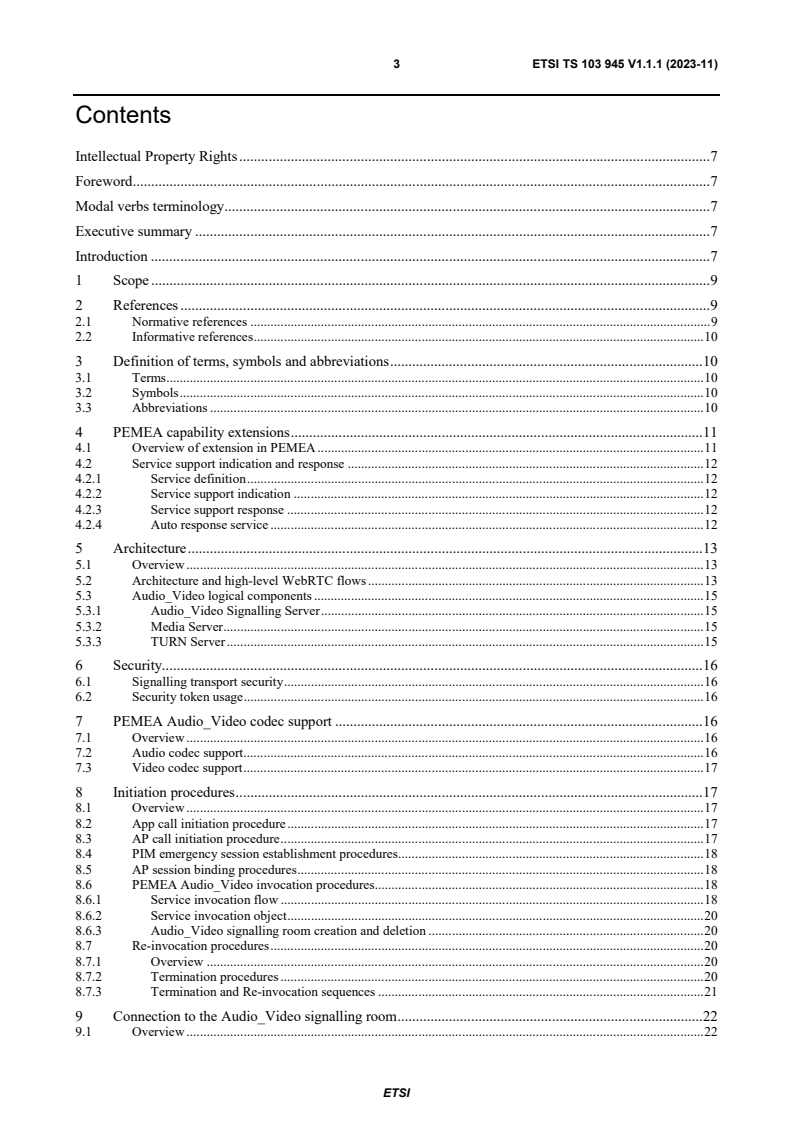
Contents
Intellectual Property Rights . 7
Foreword . 7
Modal verbs terminology . 7
Executive summary . 7
Introduction . 7
1 Scope . 9
2 References . 9
2.1 Normative references . 9
2.2 Informative references . 10
3 Definition of terms, symbols and abbreviations . 10
3.1 Terms . 10
3.2 Symbols . 10
3.3 Abbreviations . 10
4 PEMEA capability extensions . 11
4.1 Overview of extension in PEMEA . 11
4.2 Service support indication and response . 12
4.2.1 Service definition . 12
4.2.2 Service support indication . 12
4.2.3 Service support response . 12
4.2.4 Auto response service . 12
5 Architecture . 13
5.1 Overview . 13
5.2 Architecture and high-level WebRTC flows . 13
5.3 Audio_Video logical components . 15
5.3.1 Audio_Video Signalling Server . 15
5.3.2 Media Server . 15
5.3.3 TURN Server . 15
6 Security. 16
6.1 Signalling transport security . 16
6.2 Security token usage . 16
7 PEMEA Audio_Video codec support . 16
7.1 Overview . 16
7.2 Audio codec support . 16
7.3 Video codec support . 17
8 Initiation procedures . 17
8.1 Overview . 17
8.2 App call initiation procedure . 17
8.3 AP call initiation procedure . 17
8.4 PIM emergency session establishment procedures . 18
8.5 AP session binding procedures . 18
8.6 PEMEA Audio_Video invocation procedures. 18
8.6.1 Service invocation flow . 18
8.6.2 Service invocation object . 20
8.6.3 Audio_Video signalling room creation and deletion . 20
8.7 Re-invocation procedures . 20
8.7.1 Overview . 20
8.7.2 Termination procedures . 20
8.7.3 Termination and Re-invocation sequences . 21
9 Connection to the Audio_Video signalling room . 22
9.1 Overview . 22
ETSI
4 ETSI TS 103 945 V1.1.1 (2023-11)
9.2 Audio_Video signalling room joining procedure . 22
9.3 PSAP Call-Taker joining procedure . 22
9.4 AP joining procedure. 23
9.5 JOIN sequence flow . 24
10 List of users . 25
10.1 Overview . 25
10.2 Connection and disconnection of participants . 25
10.3 USER_LIST sequence flow . 26
11 RTC session negotiation . . 26
11.1 Overview . 26
11.2 RTC_SESSION_NEGOTIATION message for Send-Only streams . 27
11.3 RTC_SESSION_NEGOTIATION message for Receive-Only streams . 27
11.4 RTC_SESSION_NEGOTIATION message flow . 27
12 SDP negotiation . 30
12.1 Overview . 30
12.2 SDP structure considerations . 31
12.3 Negotiation of Send-Only stream . 31
12.4 Negotiation of Receive-Only stream . 32
12.5 Re-Negotiation of Send-Only stream . 33
12.6 Re-Negotiation of Receive-Only stream . 34
12.7 Notify the Audio_Video Service when a local peer-connection is closed . 34
12.8 RTC_SESSION_DESCRIPTION message flow . 35
13 ICE candidate exchange . 37
13.1 Overview . 37
13.2 ICE candidate structure considerations . 38
13.3 Exchange of ICE candidates . 38
13.4 End-of-Candidates indication . 39
13.5 RTC_ICE_CANDIDATE message flow . 39
14 User media . 42
14.1 Overview . 42
14.2 User media properties . 42
14.3 USER_MEDIA message flow . 43
15 Media control . 43
15.1 Overview . 43
15.2 Permissions. 44
15.3 Mute a participant . 44
15.4 Isolate a participant . 44
15.5 MEDIA_CONTROL message flow . 45
16 Change permissions . 45
16.1 Overview . 45
16.2 Permissions. 45
16.3 Give moderator permissions to a participant . 46
16.4 Remove moderator permissions from a participant . 46
16.5 CHANGE_PERMISSIONS message flow . 46
17 Add participants to the call . 47
18 Audio_Video signalling room closure . 47
19 Leaving the Audio_Video session . 47
20 Abnormal behaviour procedures . 48
20.1 Overview . 48
20.2 Failure of Audio_Video Signalling Server . 48
20.2.1 Audio_Video Signalling Server failure scenarios . 48
20.2.2 Audio_Video Signalling Server goes down . 48
20.2.3 Audio_Video Signalling Server loses connectivity . 48
20.3 Failure of Media Server . 49
20.3.1 Media Server failure scenarios . 49
ETSI
5 ETSI TS 103 945 V1.1.1 (2023-11)
20.3.2 Media Server failure . 49
20.3.3 Media Server loses connectivity . 49
20.4 Failure of TURN Server . 50
20.4.1 TURN Server failure scenarios . 50
20.4.2 TURN Server failure . 50
20.4.3 TURN Server loses connectivity . 50
20.5 Failure of PAV client . 51
20.5.1 PAV client failures. 51
20.5.2 PAV client goes down . 51
20.5.3 PAV client loses connectivity . 52
21 PEMEA Audio_Video message and type definitions . 52
21.1 Overview . 52
21.2 Data types . 52
21.2.1 MessageType . 52
21.2.2 User . 53
21.2.3 UserId . 53
21.2.4 PartialUserId . 54
21.2.5 RtcConfiguration . 54
21.2.6 RtcIceServer . 54
21.2.7 RtcSessionDescription . 54
21.2.8 RtcIceCandidate . 55
21.2.9 Media . 55
21.2.10 Action . 55
21.2.11 ReasonCode . 56
21.3 JOIN message . 56
21.3.1 Message overview . 56
21.3.2 Examples . 56
21.4 USER_LIST message . 57
21.4.1 Message overview . 57
21.4.2 Examples . 57
21.5 RTC_SESSION_NEGOTIATION message . 57
21.5.1 Message overview . 57
21.5.2 Examples . 58
21.6 RTC_SESSION_DESCRIPTION message . 58
21.6.1 Message overview . 58
21.6.2 Examples . 59
21.7 RTC_ICE_CANDIDATE message . 61
21.7.1 Message overview . 61
21.7.2 Examples . 61
21.8 USER_MEDIA message . 62
21.8.1 Message overview . 62
21.8.2 Examples . 63
21.9 MEDIA_CONTROL message. 63
21.9.1 Message overview . 63
21.9.2 Examples . 64
21.10 CHANGE_PERMISSIONS message . 65
21.10.1 Message overview . 65
21.10.2 Examples . 65
21.11 ERROR message . 66
21.11.1 Message overview . 66
21.11.2 Error message example . 66
Annex A (normative): PEMEA Audio_Video JSON schema . 67
A.1 General . 67
A.2 Audio_Video invocation schema . 67
A.3 JOIN schema . 67
A.4 USER_LIST schema . 68
A.5 RTC_SESSION_NEGOTIATION schema . 69
ETSI
6 ETSI TS 103 945 V1.1.1 (2023-11)
A.6 RTC_SESSION_DESCRIPTION from participants schema . 70
A.7 RTC_SESSION_DESCRIPTION from Audio_Video signalling room schema . 71
A.8 RTC_ICE_CANDIDATE from participants schema . 71
A.9 RTC_ICE_CANDIDATE from Audio_Video signalling room schema . 72
A.10 USER_MEDIA from participants schema . 73
A.11 USER_MEDIA from Audio_Video signalling room schema . 74
A.12 MEDIA_CONTROL from participants schema . 74
A.13 MEDIA_CONTROL from Audio_Video signalling room schema . 75
A.14 CHANGE_PERMISSIONS from participants schema . 76
A.15 CHANGE_PERMISSIONS from Audio_Video signalling room schema . 76
A.16 ERROR schema . 77
Annex B (informative): Recommended TLS cipler suits . 78
History . 79
ETSI
7 ETSI TS 103 945 V1.1.1 (2023-11)
Intellectual Property Rights
Essential patents
IPRs essential or potentially essential to normative deliverables may have been declared to ETSI. The declarations
pertaining to these essential IPRs, if any, are publicly available for ETSI members and non-members, and can be
found in ETSI SR 000 314: "Intellectual Property Rights (IPRs); Essential, or potentially Essential, IPRs notified to
ETSI in respect of ETSI standards", which is available from the ETSI Secretariat. Latest updates are available on the
ETSI Web server (https://ipr.etsi.org/).
Pursuant to the ETSI Directives including the ETSI IPR Policy, no investigation regarding the essentiality of IPRs,
including IPR searches, has been carried out by ETSI. No guarantee can be given as to the existence of other IPRs not
referenced in ETSI SR 000 314 (or the updates on the ETSI Web server) which are, or may be, or may become,
essential to the present document.
Trademarks
The present document may include trademarks and/or tradenames which are asserted and/or registered by their owners.
ETSI claims no ownership of these except for any which are indicated as being the property of ETSI, and conveys no
right to use or reproduce any trademark and/or tradename. Mention of those trademarks in the present document does
not constitute an endorsement by ETSI of products, services or organizations associated with those trademarks.
DECT™, PLUGTESTS™, UMTS™ and the ETSI logo are trademarks of ETSI registered for the benefit of its
Members. 3GPP™ and LTE™ are trademarks of ETSI registered for the benefit of its Members and of the 3GPP
Organizational Partners. oneM2M™ logo is a trademark of ETSI registered for the benefit of its Members and of the ®
oneM2M Partners. GSM and the GSM logo are trademarks registered and owned by the GSM Association.
Foreword
This Technical Specification (TS) has been produced by ETSI Special Committee Emergency Communications
(EMTEL).
Modal verbs terminology
In the present document "shall", "shall not", "should", "should not", "may", "need not", "will", "will not", "can" and
"cannot" are to be interpreted as described in clause 3.2 of the ETSI Drafting Rules (Verbal forms for the expression of
provisions).
"must" and "must not" are NOT allowed in ETSI deliverables except when used in direct citation.
Executive summary
The Pan-European Mobile Emergency Application (PEMEA) architecture provides a framework to enable applications
supporting emergency calling functionality to contact emergency services while roaming. PEMEA caters for a range of
extension capabilities, including Audio_Video which provides an audio and/or video real-time communication
capability between the App user and the PSAP. The present document provides a specification for an Audio_Video
capability for PEMEA.
Introduction
Audio-video communications are a common communications capability in all modern communication Apps. These
Apps support dedicated and multi-party video communications on a range of platforms including mobile phones,
tablets, laptops and browsers. While some applications use SIP to establish communications sessions, the vast majority
use WebRTC media streams, generally with proprietary signalling.
ETSI
8 ETSI TS 103 945 V1.1.1 (2023-11)
Using simple WebRTC Audio_Video communications enables equal access to emergency services for both abled and
disabled citizens from almost any device, safely and easily while keeping with the modern trend towards all Web-based
communications.
The specification in the present document does not preclude PEMEA from being used to support and initiate other
protocols or implementations.
The present document assumes a working knowledge of PEMEA and familiarity with the PEMEA specification ETSI
TS 103 478 [1]. Terms common to the PEMEA specification are not redefined or explained in detail in the present
document.
ETSI
9 ETSI TS 103 945 V1.1.1 (2023-11)
1 Scope
The present document describes the PEMEA Audio_Video (PAV) capability, and the need for this functionality. The
required entities and actors are identified along with the protocol, specifying message exchanges between entities. The
message formats are specified and procedural descriptions of expected behaviours under different conditions are
detailed.
2 References
2.1 Normative references
References are either specific (identified by date of publication and/or edition number or version number) or
non-specific. For specific references, only the cited version applies. For non-specific references, the latest version of the
referenced document (including any amendments) applies.
Referenced documents which are not found to be publicly available in the expected location might be found at
https://docbox.etsi.org/Reference/.
NOTE: While any hyperlinks included in this clause were valid at the time of publication, ETSI cannot guarantee
their long term validity.
The following referenced documents are necessary for the application of the present document.
[1] ETSI TS 103 478 (V1.1.1): "Emergency Communications (EMTEL); Pan-European Mobile
Emergency Application".
[2] IETF RFC 2617 (June 1999): "HTTP Authentication: Basic and Digest Access Authentication".
[3] IETF RFC 6750 (October 2012): "The OAuth 2.0 Authorization Framework: Bearer Token
Usage".
[4] IETF RFC 6455 (December 2011): "The WebSocket Protocol".
[5] IETF RFC 8445 (July 2018): "Interactive Connectivity Establishment (ICE): A Protocol for
Network Address Translator (NAT) Traversal".
[6] IETF RFC 8839 (January 2021): "Session Description Protocol (SDP) Offer/Answer Procedures
for Interactive Connectivity Establishment (ICE)".
[7] IETF RFC 7742 (March 2016): "WebRTC Video Processing and Codec Requirements".
[8] IETF RFC 7874 (May 2016): "WebRTC Audio Codec and Processing Requirements".
[9] IETF RFC 6716 (September 2012): "Definition of the Opus Audio Codec".
[10] IETF RFC 8251 (October 2017): "Updates to the Opus Audio Codec".
[11] IETF RFC 7587 (June 2015): "RTP Payload Format for the Opus Speech and Audio Codec".
[12] IETF RFC 8838 (January 2021): "Trickle ICE: Incremental Provisioning of Candidates for the
Interactive Connectivity Establishment (ICE) Protocol".
[13] IETF RFC 4566 (July 2006): "SDP: Session Description Protocol".
[14] IETF RFC 8840 (January 2021): "A Session Initiation Protocol (SIP) Usage for Incremental
Provisioning of Candidates for the Interactive Connectivity Establishment (Trickle ICE)".
[15] IETF RFC 8863 (January 2021): "Interactive Connectivity Establishment Patiently Awaiting
Connectivity (ICE PAC)".
[16] IETF RFC 5766 (April 2020): "Traversal Using Relays around NAT (TURN): Relay Extensions to
Session Traversal Utilities for NAT (STUN)".
ETSI
10 ETSI TS 103 945 V1.1.1 (2023-11)
2.2 Informative references
References are either specific (identified by date of publication and/or edition number or version number) or
non-specific. For specific references, only the cited version applies. For non-specific references, the latest version of the
referenced document (including any amendments) applies.
NOTE: While any hyperlinks included in this clause were valid at the time of publication, ETSI cannot guarantee
their long term validity.
The following referenced documents are not necessary for the application of the present document but they assist the
user with regard to a particular subject area.
[i.1] ETSI TS 103 756 (V1.1.1): "Emergency Communications (EMTEL); PEMEA Instant Message
Extension".
[i.2] ETSI TS 103 871 (V1.1.1): "Emergency Communications (EMTEL); PEMEA Real-Time Text
Extension".
[i.3] IETF RFC 7519 (May 2015): "JSON Web Token (JWT)".
[i.4] IETF RFC 8656 (February 2020): "Traversal Using Relays around NAT (TURN): Relay
Extensions to Session Traversal Utilities for NAT (STUN)".
[i.5] IETF RFC 3551 (July 2003): "RTP Profile for Audio and Video Conferences with Minimal
Control".
[i.6] IETF RFC 3389 (September 2002): "Real-time Transport Protocol (RTP) Payload for Comfort
Noise (CN)".
3 Definition of terms, symbols and abbreviations
3.1 Terms
For the purposes of the present document, the following terms apply:
security: techniques and methods used to ensure:
• authentication of entities accessing resources or data.
• authorization of authenticated entities prior to accessing or obtaining resources and/or data.
• privacy of user data ensuring access only to authenticated and authorized entities.
• secrecy of information transferred between two authenticated and authorized entities.
• trusted: is used as defined in ETSI TS 103 478 [1].
3.2 Symbols
Void.
3.3 Abbreviations
For the purposes of the present document, the following abbreviations apply:
AEAD Authenticated Encryption with Associated Data
AES Advanced Encryption Standard
AESGCM Advanced Encryption Standard key used with GCM
AP Application Provider
ETSI
11 ETSI TS 103 945 V1.1.1 (2023-11)
App Application
CN Comfort Noise
CPE Customer Premises Equipment
DHE Diffie-Hellman key Exchange
ECDHE Elliptic-Curve Diffie-Hellman key Exchange
ECDSA Elliptic Curve Digital Signature Algorithm
EDS Emergency Data Send (message)
ETSI European Telecommunications Standards Institute
FID Flow Identification
GCM Galois/Counter Mode
HTTP Hyper-Text Transfer Protocol
HTTPS Secure HTTP
ICE Interactive Connectivity Establishment
IETF Internet Engineering Task Force
IM Instant Messenger
IP Internet Protocol
JSON JavaScript Object Notation
JWT JSON Web Token
MAC Message Authentication Code
NAT Network Address Translation
Pa PEMEA Application to AP interface
PAV PEMEA Audio_Video
PCMA Pulse Code Modulation A-Law
PCMU Pulse Code Modulation µ-Law
PEMEA Pan-European Mobile Emergency Application
PIM PSAP Interface Module
PSAP Public Safety Answering Point
PSP PSAP Service Provider
RFC Request For Comments
RSA Rivest Shamir Adleman public key encryption algorithm
RTC Real-Time Communications
RTP Real-Time Protocol
RTT Real-Time Text
SDP Session Description Protocol
SFU Selective Forwarding Units
SIP Session Initiation Protocol
STUN Session Traversal Utilities for NAT
TLS Transport Layer Security
tPSP terminating PSP
TS Technical Specification
TURN Traversal Using Relay around NAT
UCS Universal multiple-octet Coded Character Set
UDP User Datagram Protocol
URI Uniform Resource Identifier
UTC Coordinated Universal Timer
UTF-8 UCS Transformation Format (8-bit words)
WMS WebRTC MediaStream
4 PEMEA capability extensions
4.1 Overview of extension in PEMEA
PEMEA extension capabilities are defined in ETSI TS 103 478 [1] and are implemented through the use of
"reach-back" URIs. The Application Provider (AP) node advertises capabilities as part of the initial forward message
through the network, the Emergency Data Send (EDS) message, and the terminating PSAP Service Provider (PSP) or
PSAP responds with the subset of capabilities that it supports, thus binding the emergency session between the AP and
the terminating emergency node.
ETSI
12 ETSI TS 103 945 V1.1.1 (2023-11)
Specifically, the capabilities are sent as information elements in the apMoreInformation element of the EDS message.
The information element and apMoreInformation structures are defined in clauses 10.3.11 and 10.3.12 of ETSI
TS 103 478 [1]. An information element in a PEMEA EDS message identifies a capability and each capability is made
up of three distinct parts:
• typeOfInfo: what function does the information element serve;
• protocol: the specific semantics for using the function;
• value: the URI through which the service is invoked.
Table 10 in ETSI TS 103 478 [1] identifies an initial set of "typeOfInfo" values used to specify a range of capability
extensions for PEMEA. However, beyond the Location_Update and SIP_Request values described in Table 11 of ETSI
TS 103 478 [1], protocols are left for further study and definition in subsequent specifications such as the present
document. ETSI TS 103 756 [i.1] describes the concrete specification for PEMEA Instant Message protocol and ETSI
TS 103 871 [i.2] describes the concrete specification for PEMEA Real-Time Text.
4.2 Service support indication and response
4.2.1 Service definition
ETSI TS 103 478 [1] defines the "Audio_Video" typeOfInfo in Table 10, but does not elaborate further on protocols in
Table 11. The present document provides a concrete definition of the "Audio_Video" typeOfInfo in PEMEA through
the specification of a protocol value. The definition in Table 1 shall be considered as an extension to Table 11 in ETSI
TS 103 478 [1].
Table 1: Extended AP Information Type Protocol Registry
Info type Value Protocol Token Description
Audio_Video PEMEA Audio_Video functionality is supported using the PEMEA WebRTC message
exchange protocol
4.2.2 Service support indication
An AP needing to indicate that the Application it is serving can support real-time text using the PEMEA protocol would
include the following information element in the apMoreInformation element of the EDS associated with the emergency
s
...
Questions, Comments and Discussion
Ask us and Technical Secretary will try to provide an answer. You can facilitate discussion about the standard in here.
Loading comments...