


ETSI EN 303 722 V1.2.1 (2022-03)
Wideband Data Transmission Systems (WDTS) for Fixed Network Radio Equipment operating in the 57 GHz to 71 GHz band; Harmonised Standard for access to radio spectrum
Wideband Data Transmission Systems (WDTS) for Fixed Network Radio Equipment operating in the 57 GHz to 71 GHz band; Harmonised Standard for access to radio spectrum
DEN/BRAN-230025
Širokopasovni sistemi za prenos podatkov (WDTS) za radijsko opremo fiksnega omrežja, ki delujejo v pasu od 57 GHz do 71 GHz - Harmonizirani standard za dostop do radijskega spektra
Ta dokument določa tehnične značilnosti in metode merjenja za širokopasovne sisteme za prenos podatkov (WDTS) za radijsko opremo fiksnega omrežja, ki delujejo v pasu od 57 GHz do 71 GHz, ob upoštevanju priporočila ERC 70-03 [i.3], dodatek 3 (frekvenčna pasova c2 in c3), in sklepa Komisije 2006/771/ES [i.4] (pasova 75a in 75b).
Ta radijska oprema lahko deluje v vseh delih frekvenčnih pasov iz preglednice 1.
OPOMBA 1: Tehnične lastnosti aplikacij, ki uporabljajo to radijsko opremo, so podrobneje opisane v standardu ETSI TR 103 583 [i.1].
OPOMBA 2: Razmerje med tem dokumentom in bistvenimi zahtevami člena 3.2 Direktive 2014/53/EU [i.5] je podano v dodatku A.
General Information
Standards Content (Sample)
Draft ETSI EN 303 722 V1.1.0 (2021-07)
HARMONISED EUROPEAN STANDARD
Wideband Data Transmission Systems (WDTS)
for Fixed Network Radio Equipment operating
in the 57 GHz to 71 GHz band;
Harmonised Standard for access to radio spectrum
2 Draft ETSI EN 303 722 V1.1.0 (2021-07)
Reference
DEN/BRAN-230025
Keywords
60 GHz, access, broadband, fixed networks, radio,
SRD
ETSI
650 Route des Lucioles
F-06921 Sophia Antipolis Cedex - FRANCE
Tel.: +33 4 92 94 42 00 Fax: +33 4 93 65 47 16
Siret N° 348 623 562 00017 - APE 7112B
Association à but non lucratif enregistrée à la
Sous-Préfecture de Grasse (06) N° w061004871
Important notice
The present document can be downloaded from:
http://www.etsi.org/standards-search
The present document may be made available in electronic versions and/or in print. The content of any electronic and/or
print versions of the present document shall not be modified without the prior written authorization of ETSI. In case of any
existing or perceived difference in contents between such versions and/or in print, the prevailing version of an ETSI
deliverable is the one made publicly available in PDF format at www.etsi.org/deliver.
Users of the present document should be aware that the document may be subject to revision or change of status.
Information on the current status of this and other ETSI documents is available at
https://portal.etsi.org/TB/ETSIDeliverableStatus.aspx
If you find errors in the present document, please send your comment to one of the following services:
https://portal.etsi.org/People/CommiteeSupportStaff.aspx
Notice of disclaimer & limitation of liability
The information provided in the present deliverable is directed solely to professionals who have the appropriate degree of
experience to understand and interpret its content in accordance with generally accepted engineering or
other professional standard and applicable regulations.
No recommendation as to products and services or vendors is made or should be implied.
In no event shall ETSI be held liable for loss of profits or any other incidental or consequential damages.
Any software contained in this deliverable is provided "AS IS" with no warranties, express or implied, including but not
limited to, the warranties of merchantability, fitness for a particular purpose and non-infringement of intellectual property
rights and ETSI shall not be held liable in any event for any damages whatsoever (including, without limitation, damages
for loss of profits, business interruption, loss of information, or any other pecuniary loss) arising out of or related to the use
of or inability to use the software.
Copyright Notification
No part may be reproduced or utilized in any form or by any means, electronic or mechanical, including photocopying and
microfilm except as authorized by written permission of ETSI.
The content of the PDF version shall not be modified without the written authorization of ETSI.
The copyright and the foregoing restriction extend to reproduction in all media.
© ETSI 2021.
All rights reserved.
ETSI
3 Draft ETSI EN 303 722 V1.1.0 (2021-07)
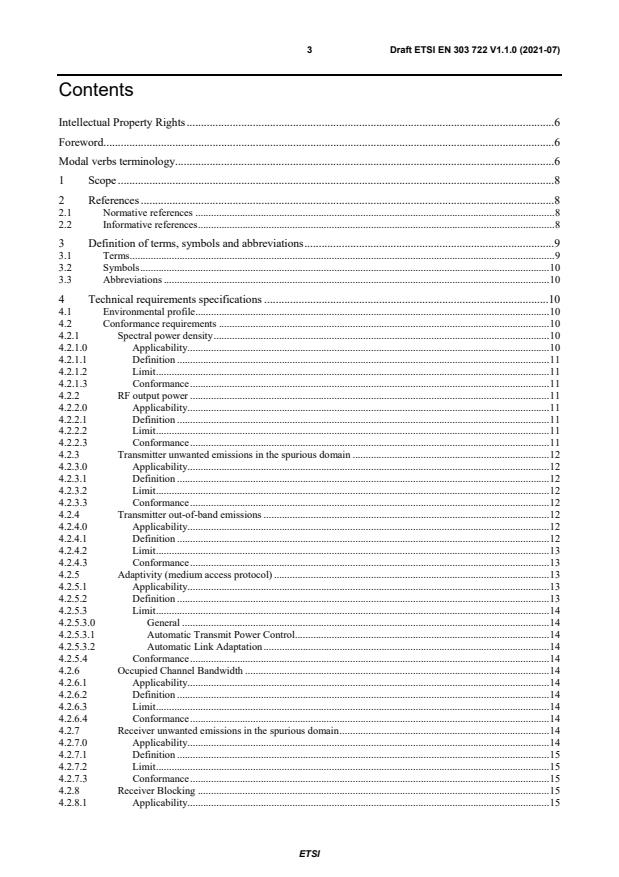
Contents
Intellectual Property Rights . 6
Foreword . 6
Modal verbs terminology . 6
1 Scope . 8
2 References . 8
2.1 Normative references . 8
2.2 Informative references . 8
3 Definition of terms, symbols and abbreviations . 9
3.1 Terms . 9
3.2 Symbols . 10
3.3 Abbreviations . 10
4 Technical requirements specifications . 10
4.1 Environmental profile . 10
4.2 Conformance requirements . 10
4.2.1 Spectral power density . 10
4.2.1.0 Applicability. 10
4.2.1.1 Definition . 11
4.2.1.2 Limit . 11
4.2.1.3 Conformance . 11
4.2.2 RF output power . 11
4.2.2.0 Applicability. 11
4.2.2.1 Definition . 11
4.2.2.2 Limit . 11
4.2.2.3 Conformance . 11
4.2.3 Transmitter unwanted emissions in the spurious domain . 12
4.2.3.0 Applicability. 12
4.2.3.1 Definition . 12
4.2.3.2 Limit . 12
4.2.3.3 Conformance . 12
4.2.4 Transmitter out-of-band emissions . 12
4.2.4.0 Applicability. 12
4.2.4.1 Definition . 12
4.2.4.2 Limit . 13
4.2.4.3 Conformance . 13
4.2.5 Adaptivity (medium access protocol) . 13
4.2.5.1 Applicability. 13
4.2.5.2 Definition . 13
4.2.5.3 Limit . 14
4.2.5.3.0 General . 14
4.2.5.3.1 Automatic Transmit Power Control. 14
4.2.5.3.2 Automatic Link Adaptation . 14
4.2.5.4 Conformance . 14
4.2.6 Occupied Channel Bandwidth . 14
4.2.6.1 Applicability. 14
4.2.6.2 Definition . 14
4.2.6.3 Limit . 14
4.2.6.4 Conformance . 14
4.2.7 Receiver unwanted emissions in the spurious domain . 14
4.2.7.0 Applicability. 14
4.2.7.1 Definition . 15
4.2.7.2 Limit . 15
4.2.7.3 Conformance . 15
4.2.8 Receiver Blocking . 15
4.2.8.1 Applicability. 15
ETSI
4 Draft ETSI EN 303 722 V1.1.0 (2021-07)
4.2.8.2 Definition . 15
4.2.8.3 Performance Criteria . 15
4.2.8.4 Limit . 15
4.2.8.5 Conformance . 16
4.2.9 Receiver Sensitivity level . 16
4.2.9.1 Applicability. 16
4.2.9.2 Definition . 16
4.2.9.3 Limit . 16
4.2.9.4 Conformance . 16
5 Testing for compliance with technical requirements . 16
5.1 Environmental conditions for testing . 16
5.1.1 General . 16
5.1.2 Normal test conditions . 17
5.1.2.1 Normal temperature and humidity . 17
5.1.2.2 Normal power source . 17
5.1.3 Extreme test conditions . 17
5.2 Test procedure for the essential radio test suites . 17
5.2.0 General . 17
5.2.1 Product Information . 17
5.2.2 Test modulation, frequency and configuration . 17
5.2.3 Spectral power density . 18
5.2.3.1 Test conditions . 18
5.2.3.2 Test method . 18
5.2.4 RF output power . 19
5.2.4.1 Test conditions . 19
5.2.4.2 Test method . 19
5.2.5 Transmitter unwanted emissions in the spurious domain . 20
5.2.5.0 Test conditions . 20
5.2.5.1 Pre-scan . 20
5.2.5.2 Identified emissions . 21
5.2.6 Transmitter out-of-band emissions . 22
5.2.6.1 Test conditions . 22
5.2.6.2 Test method . 22
5.2.7 Adaptivity (medium access protocol) . 23
5.2.7.1 Test conditions . 23
5.2.7.2 Test method (ATPC) . 23
5.2.7.3 Test method (ALA) . 24
5.2.8 Occupied Channel Bandwidth . 25
5.2.8.1 Test conditions . 25
5.2.8.2 Test method . 25
5.2.9 Receiver unwanted emissions in the spurious domain . 25
5.2.9.0 Test conditions . 25
5.2.9.1 Pre-scan . 26
5.2.9.2 Identified emissions . 26
5.2.10 Receiver Blocking . 27
5.2.10.1 Test conditions . 27
5.2.10.2 Test Method . 27
5.2.11 Receiver sensitivity level . 28
5.2.11.1 Test conditions . 28
5.2.11.2 Test method . 28
Annex A (informative): Relationship between the present document and the essential
requirements of Directive 2014/53/EU . 29
Annex B (informative): Maximum Measurement Uncertainty . 31
Annex C (normative): Test sites and arrangements for radiated measurements . 32
C.1 Test sites . 32
C.1.1 Open air test sites . 32
C.1.2 Anechoic chamber . 33
C.1.2.1 General . 33
ETSI
5 Draft ETSI EN 303 722 V1.1.0 (2021-07)
C.1.2.2 Description . 33
C.1.2.3 Influence of parasitic reflections . 33
C.1.2.4 Calibration and mode of use . 33
C.2 Test antenna . 35
C.3 Substitution antenna . 35
Annex D (normative): General description of measurement . 36
D.1 Radiated measurements . 36
D.2 Substitution measurement . 37
Annex E (informative): Bibliography . 38
Annex F (informative): Change History . 39
History . 40
ETSI
6 Draft ETSI EN 303 722 V1.1.0 (2021-07)
Intellectual Property Rights
Essential patents
IPRs essential or potentially essential to normative deliverables may have been declared to ETSI. The declarations
pertaining to these essential IPRs, if any, are publicly available for ETSI members and non-members, and can be
found in ETSI SR 000 314: "Intellectual Property Rights (IPRs); Essential, or potentially Essential, IPRs notified to
ETSI in respect of ETSI standards", which is available from the ETSI Secretariat. Latest updates are available on the
ETSI Web server (https://ipr.etsi.org/).
Pursuant to the ETSI Directives including the ETSI IPR Policy, no investigation regarding the essentiality of IPRs,
including IPR searches, has been carried out by ETSI. No guarantee can be given as to the existence of other IPRs not
referenced in ETSI SR 000 314 (or the updates on the ETSI Web server) which are, or may be, or may become,
essential to the present document.
Trademarks
The present document may include trademarks and/or tradenames which are asserted and/or registered by their owners.
ETSI claims no ownership of these except for any which are indicated as being the property of ETSI, and conveys no
right to use or reproduce any trademark and/or tradename. Mention of those trademarks in the present document does
not constitute an endorsement by ETSI of products, services or organizations associated with those trademarks.
DECT™, PLUGTESTS™, UMTS™ and the ETSI logo are trademarks of ETSI registered for the benefit of its
Members. 3GPP™ and LTE™ are trademarks of ETSI registered for the benefit of its Members and of the 3GPP
Organizational Partners. oneM2M™ logo is a trademark of ETSI registered for the benefit of its Members and of the ®
oneM2M Partners. GSM and the GSM logo are trademarks registered and owned by the GSM Association.
Foreword
This draft Harmonised European Standard (EN) has been produced by ETSI Technical Committee Broadband Radio
Access Networks (BRAN), and is now submitted for the combined Public Enquiry and Vote phase of the ETSI
standards EN Approval Procedure.
The present document has been prepared under the Commission's standardisation request C(2015) 5376 final [i.2] to
provide one voluntary means of conforming to the essential requirements of Directive 2014/53/EU on the harmonisation
of the laws of the Member States relating to the making available on the market of radio equipment and repealing
Directive 1999/5/EC [i.5].
Once the present document is cited in the Official Journal of the European Union under that Directive, compliance with
the normative clauses of the present document given in table A.1 confers, within the limits of the scope of the present
document, a presumption of conformity with the corresponding essential requirements of that Directive and associated
EFTA regulations.
Proposed national transposition dates
Date of latest announcement of this EN (doa): 3 months after ETSI publication
Date of latest publication of new National Standard
or endorsement of this EN (dop/e): 6 months after doa
Date of withdrawal of any conflicting National Standard (dow): 18 months after doa
ETSI
7 Draft ETSI EN 303 722 V1.1.0 (2021-07)
Modal verbs terminology
In the present document "shall", "shall not", "should", "should not", "may", "need not", "will", "will not", "can" and
"cannot" are to be interpreted as described in clause 3.2 of the ETSI Drafting Rules (Verbal forms for the expression of
provisions).
"must" and "must not" are NOT allowed in ETSI deliverables except when used in direct citation.
ETSI
8 Draft ETSI EN 303 722 V1.1.0 (2021-07)
1 Scope
The present document specifies technical characteristics and methods of measurements for Wideband Data
Transmission Systems (WDTS) fixed network radio equipment operating in the 57 GHz to 71 GHz band taking into
consideration ERC/REC 70-03 [i.3] annex 3 (frequency bands c2 and c3) and Commission Decision 2006/771/EC [i.4]
bands 75a and 75b.
This radio equipment is capable of operating in all or any part of the frequency bands given in table 1.
Table 1: Radiocommunications service frequency band
Transmit/Receive Radiocommunications service frequency band
Transmit 57 GHz to 71 GHz
Receive 57 GHz to 71 GHz
NOTE 1: The technical characteristics of applications using these radio equipment are further described in ETSI
TR 103 583 [i.1].
NOTE 2: The relationship between the present document and essential requirements of article 3.2 of Directive
2014/53/EU [i.5] is given in annex A.
2 References
2.1 Normative references
References are either specific (identified by date of publication and/or edition number or version number) or
non-specific. For specific reference, only the cited version applies. For non-specific reference, the latest version of the
referenced document (including any amendments) applies.
Referenced documents which are not found to be publicly available in the expected location might be found at
https://docbox.etsi.org/Reference/.
NOTE: While any hyperlinks included in this clause were valid at the time of publication, ETSI cannot guarantee
their long term validity.
The following referenced documents are necessary for the application of the present document.
Not applicable.
2.2 Informative references
References are either specific (identified by date of publication and/or edition number or version number) or
non-specific. For specific references, only the cited version applies. For non-specific references, the latest version of the
referenced document (including any amendments) applies.
NOTE: While any hyperlinks included in this clause were valid at the time of publication, ETSI cannot guarantee
their long term validity.
The following referenced documents are not necessary for the application of the present document but they assist the
user with regard to a particular subject area.
[i.1] ETSI TR 103 583 (V1.1.1): "System Reference document (SRdoc); Technical characteristics of
Multiple Gigabit Wireless Systems (MGWS) in radio spectrum between 57 GHz and 71 GHz".
[i.2] Commission Implementing Decision C(2015) 5376 final of 4.8.2015 on a standardisation request
to the European Committee for Electrotechnical Standardisation and to the European
Telecommunications Standards Institute as regards radio equipment in support of Directive
2014/53/EU of the European Parliament and of the Council.
ETSI
9 Draft ETSI EN 303 722 V1.1.0 (2021-07)
[i.3] ERC Recommendation 70-03 (Tromsø 1997 and subsequent amendments): "Related to the Use of
Short Range Devices (SRD)".
[i.4] Commission Decision of 9 November 2006 on harmonisation of the radio spectrum for use by
short-range devices (notified under document number C(2006) 5304) (Text with EEA relevance)
(2006/771/EC). .
NOTE: Available at http://data.europa.eu/eli/dec/2006/771(2)/2019-08-13.
[i.5] Directive 2014/53/EU of the European Parliament and of the Council of 16 April 2014 on the
harmonisation of the laws of the Member States relating to the making available on the market of
radio equipment and repealing Directive 1999/5/EC.
[i.6] Commission Implementing Decision (EU) 2019/1345 of 2 August 2019 amending Decision
2006/771/EC updating harmonised technical conditions in the area of radio spectrum use for short-
range devices (notified under document C(2019) 5660) Text with EEA relevance.
[i.7] ERC Recommendation 74-01 (Approved 1998 and subsequent amendments): "Unwanted
emissions in the spurious domain".
3 Definition of terms, symbols and abbreviations
3.1 Terms
For the purposes of the present document, the terms given in Directive 2014/53/EU [i.5] and the following apply:
60 GHz range or 60 GHz band: one of the variously permitted frequencies of operation, between 57 GHz to 71 GHz
activity factor: percentage over any one-minute time period when equipment is operating under a given set of
conditions
adjacent channel: channels on either side of the nominal channel separated by the nominal channel bandwidth
automatic transmit power control: mechanism that automatically reduces the transmit power based on the power at
the receiver
channel separation: minimum separation (in MHz) between the centre frequencies of two adjacent channels in the
channel plan of the radio equipment
integral antenna: antenna which is declared to be part of the radio equipment by the manufacturer
NOTE 1: In some cases, it may not be possible to remove an integral antenna or expose an antenna connector
without changing the output characteristics of the radio equipment.
NOTE 2: Even with an integral antenna, it might still be possible to separate the antenna from the equipment using
a special tool.
mean power: average power (transmitted or received) during the On Time of the signal
nominal channel bandwidth: bandwidth assigned to a single channel
NOTE: The nominal channel bandwidth is part of the product information as outlined in clause 5.2.1.
occupied bandwidth: bandwidth of the signal containing 99 % of the transmitted mean power
NOTE: Both below the lower and above the upper frequency limits, the mean power emitted is equal to 0,5 % of
the total mean power of the emission.
smart antenna system: equipment that combines multiple transmit and/or receive antenna elements with a signal
processing function to increase its radiation and/or reception capabilities
NOTE: This includes techniques such as spatial multiplexing, beam forming, cyclic delay diversity, etc.
ETSI
10 Draft ETSI EN 303 722 V1.1.0 (2021-07)
3.2 Symbols
For the purposes of the present document, the following symbols apply:
dBc decibel relative to the maximum spectral power density of the transmitted signal
dBi decibel relative to the gain of an isotropic antenna
dBm decibel relative to one milliwatt
dBr decibel relative to a given maximum power level
GHz thousand millions of cycles per second
kHz thousands of cycles per second
μs millionths of seconds
3.3 Abbreviations
For the purposes of the present document, the following abbreviations apply:
ACM Adaptive Code and Modulation
ALA Adaptive Level Adjust
ATPC Automatic Transmit Power Control
BW BandWidth
CW Continuous Wave
DC Duty Cycle
EFTA European Free Trade Association
EIRP Equivalent Isotropically Radiated Power
EIRP Equivalent Isotropically Radiated Power spectral density
ERP Effective Radiated Power
FER Frame Error Rate
MCS Modulation and Coding Scheme
PD Power Density
PDL spectral Power Density Limit
PSD Power Spectral Density
RBW Resolution BandWidth
RF Radio Frequency
RMS Root Mean Square
UUT Unit Under Test
4 Technical requirements specifications
4.1 Environmental profile
The technical requirements of the present document apply under the environmental profile for operation of the
equipment, which shall be in accordance with its intended use. The equipment shall comply with all the technical
requirements of the present document at all times when operating within the boundary limits of the operational
environmental profile defined by its intended use.
4.2 Conformance requirements
4.2.1 Spectral power density
4.2.1.0 Applicability
The present requirement applies to all equipment within the scope of the present document.
ETSI
11 Draft ETSI EN 303 722 V1.1.0 (2021-07)
4.2.1.1 Definition
The spectral power density is the mean Equivalent Isotropically Radiated Power (EIRP) density (EIRP ) during a
transmission burst.
4.2.1.2 Limit
The maximum spectral power density is applicable to the system as a whole when operated at the highest power spectral
density level (EIRP ). The maximum spectral power density shall be as indicated in table 2.
Table 2: Power Spectral Density (PSD) limit
Condition Maximum EIRP
38 dBm/MHz
Fixed outdoor installations with ≥ 30 dBi
transmit antenna gain
Otherwise 23 dBm/MHz
NOTE: Information on PSD limit is aligned with the Commission Implementing Decision (EU) 2019/1345 [i.6]
(see Annex, Table 2, Bands 75a and 75b).
4.2.1.3 Conformance
Conformance tests as defined in clause 5.2.3 shall be carried out and result compared to the limit.
4.2.2 RF output power
4.2.2.0 Applicability
The present requirement applies to all equipment within the scope of the present document.
4.2.2.1 Definition
The RF output power is the mean Equivalent Isotropically Radiated Power (EIRP) for the equipment during a
transmission burst.
4.2.2.2 Limit
The maximum RF output power is applicable to the system as a whole when operated at the highest stated power level.
For a smart antenna system, the limit applies to the configuration that results in the highest EIRP. In case of multiple
(adjacent or non-adjacent) channels the total RF output power of all channels shall be less than or equal to the limits in
table 3.
The maximum RF output power shall be as indicated in table 3.
Table 3: RF output power limit
Antenna Gain (GA) Additional Conditions Maximum power level (EIRP)
G < 13 dBi 27 dBm + G
A A
13 dBi ≤ GA < 30 dBi 40 dBm
40 dBm
30 dBi ≤ G
A
Fixed outdoor installations 55 dBm
NOTE: Information on RF output power limit is aligned with the Commission Implementing Decision
(EU) 2019/1345 [i.6] (see Annex, Table 2, Bands 75a and 75b).
4.2.2.3 Conformance
Conformance tests as defined in clause 5.2.4 shall be carried out and result compared to the limit.
ETSI
12 Draft ETSI EN 303 722 V1.1.0 (2021-07)
4.2.3 Transmitter unwanted emissions in the spurious domain
4.2.3.0 Applicability
The present requirement applies to all equipment within the scope of the present document.
4.2.3.1 Definition
Transmitter unwanted emissions are unwanted emissions in the spurious domain while the equipment is transmitting.
4.2.3.2 Limit
The level of unwanted emissions in the spurious domain shall be less than or equal to the limits given in table 4,where
:
the lower boundary between the spurious domain and the out-of-band domain shall be at a frequency FL
• F = min (57 GHz; f - min(2,5 × nominal channel BW, 1,5 × nominal channel BW + 500 MHz))
L C
where f is the nominal centre frequency of the transmission.
C
The upper boundary between the spurious domain and the out-of-band domain shall be at a frequency F :
H
• F = max (71 GHz; f + min(2,5 × nominal channel BW, 1,5 × nominal channel BW + 500 MHz))
H C
Table 4: Transmitter unwanted emissions in the spurious domain
Frequency range Emission Limit Measurement Bandwidth
ERP (≤ 1 GHz)
EIRP (> 1 GHz)
30 MHz to 47 MHz -36 dBm 100 kHz
47 MHz to 74 MHz -54 dBm 100 kHz
74 MHz to 87,5 MHz -36 dBm 100 kHz
87,5 MHz to 118 MHz -54 dBm 100 kHz
118 MHz to 174 MHz -36 dBm 100 kHz
174 MHz to 230 MHz -54 dBm 100 kHz
230 MHz to 470 MHz -36 dBm 100 kHz
470 MHz to 694 MHz -54 dBm 100 kHz
694 MHz to 1 GHz -36 dBm 100 kHz
1 GHz to FL GHz -30 dBm 1 MHz
FH GHz to 142 GHz -30 dBm 1 MHz
NOTE: Information on limits for transmitter unwanted emissions in the spurious domain is based on ERC
Recommendation 74-01 [i.7].
4.2.3.3 Conformance
Conformance tests as defined in clause 5.2.5 shall be carried out and result compared to the limit.
4.2.4 Transmitter out-of-band emissions
4.2.4.0 Applicability
The present requirement applies to all equipment within the scope of the present document.
4.2.4.1 Definition
Transmitter unwanted emissions in the out-of-band domain are emissions when the equipment is in transmit mode, on
frequencies immediately outside the necessary bandwidth which results from the modulation process but excluding
spurious emissions.
ETSI
13 Draft ETSI EN 303 722 V1.1.0 (2021-07)
4.2.4.2 Limit
The transmitter unwanted emissions in the out-of-band domain shall be less than or equal to the relative limits provided
in figure 1, where the x-axis is the ratio of frequency (F) to declared nominal channel BandWidth (BW), or an absolute
level of -30 dBm within a 1 MHz bandwidth, whichever is greater. Non-adjacent channels shall be tested separately.
Within the 57 to 71 GHz band and outside -2,5 to +2,5 ratio of frequency to declared nominal bandwidth range
the -30 dBr or -30 dBm in 1 MHz whichever is the greater shall apply.
Figure 1: Transmit Mask
4.2.4.3 Conformance
Conformance tests as defined in clause 5.2.6 shall be carried out and result compared to the limit.
4.2.5 Adaptivity (medium access protocol)
4.2.5.1 Applicability
The present requirement applies to all equipment within the scope of the present document.
4.2.5.2 Definition
Automatic Transmit Power Control (ATPC) and Automatic Link Adaptation (ALA), also known as Automatic Adaptive
Coding and Modulation (ACM), are adaptivity (medium access protocol) mechanisms designed to facilitate spectrum
sharing with other devices. ATPC automatically reduces transmit power when there is excess link margin such that link
performance (throughput and FER) are not impacted. ALA automatically adapts the coding and modulation to
maximize spectral efficiency, thus reducing the transmission time of a given amount of payload. Both ATPC and ALA
reduce the interference caused to other links in the band and facilitates spectrum sharing. Equipment may support either,
or both, types of adaptivity mechanisms.
ETSI
14 Draft ETSI EN 303 722 V1.1.0 (2021-07)
4.2.5.3 Limit
4.2.5.3.0 General
ATPC and/or ALA shall be implemented by the equipment and shall be active under all circumstances, except that the
transmission of control, management, and synchronization frames are permitted without the use of ATPC or ALA.
4.2.5.3.1 Automatic Transmit Power Control
For devices equipped with transmitter power control, the difference in the average output power between the highest
power setting and lowest power setting shall be greater than or equal to 3 dB for a given constant data rate and nominal
channel bandwidth.
4.2.5.3.2 Automatic Link Adaptation
For devices equipped with automatic link adaptation, the difference in the average output power between that measured
for highest data rate and that measured for the lowest data rate should be greater than or equal to 3 dB for a given
constant path loss and nominal channel bandwidth. Alternatively, the duty cycle of the transmissions measured for
highest data rate shall be reduced by 10 % compared to that measured for the lowest data rate.
4.2.5.4 Conformance
The conformance tests as defined in clause 5.2.7 shall be carried out.
4.2.6 Occupied Channel Bandwidth
4.2.6.1 Applicability
This requirement applies to all equipment within the scope of the present document.
4.2.6.2 Definition
The Occupied Channel Bandwidth is the bandwidth containing 99 % of the power of the signal.
4.2.6.3 Limit
The Occupied Channel Bandwidth shall be less than the declared nominal Channel Bandwidth for all transmissions. The
device shall support a mode of transmission with a necessary bandwidth at least 70 % of the declared nominal channel
bandwidth. In case of smart antenna systems (devices with multiple transmit chains) each of the transmit chains shall
meet this requirement.
When equipment has simultaneous transmissions in adjacent channels, these transmissions may be considered as one
signal with an actual nominal channel bandwidth of "n" times the individual nominal channel bandwidth where "n" is
the number of adjacent channels. When equipment has simultaneous transmissions in non-adjacent channels, each
power envelope shall be considered separately.
4.2.6.4 Conformance
Conformance tests as defined in clause 5.2.8 shall be carried out and result compared to the limit.
4.2.7 Receiver unwanted emissions in the spurious domain
4.2.7.0 Applicability
The present requirement applies to all equipment within the scope of the present document.
ETSI
15 Draft ETSI EN 303 722 V1.1.0 (2021-07)
4.2.7.1 Definition
These are unwanted emissions in the spurious domain while the equipment is receiving a transmission.
4.2.7.2 Limit
The level of unwanted emissions in the spurious domain shall be less than or equal to the limits given in table 5.
Table 5: Receiver spurious emissions
Frequency band Emission Limit Measurement Bandwidth
ERP (≤ 1 GHz)
EIRP (> 1 GHz)
30 MHz to 1 GHz -57 dBm 100 kHz
1 GHz to 142 GHz -47 dBm 1 MHz
NOTE: Information on limits for transmitter unwanted emissions in the spurious domain is based on
ERC Recommendation 74-01 [i.7].
4.2.7.3 Conformance
Conformance tests as defined in clause 5.2.9 shall be carried out and result compared to the limit.
4.2.8 Receiver Blocking
4.2.8.1 Applicability
The present requirement applies to all equipment within the scope of the present document.
4.2.8.2 Definition
The receiver adjacent channel rejection is a measure of the receiver's ability to receive a wanted signal at its assigned
channel frequency in the presence of an unwanted signal at a given frequency offset from the centre frequency of the
assigned channel, without this unwanted signal causing a degradation of the performance of the receiver beyond
minimum performance criteria as specified in clause 4.2.6.3.
4.2.8.3 Performance Criteria
The minimum performance criterion shall be a FER of less than or equal to 10 %.
4.2.8.4 Limit
The minimum performance criteria as defined in clause 4.2.8.3 shall be met. The levels of the unwanted signal power
shall be
...
Draft ETSI EN 303 722 V1.2.0 (2021-12)
HARMONISED EUROPEAN STANDARD
Wideband Data Transmission Systems (WDTS)
for Fixed Network Radio Equipment operating
in the 57 GHz to 71 GHz band;
Harmonised Standard for access to radio spectrum
2 Draft ETSI EN 303 722 V1.2.0 (2021-12)
Reference
DEN/BRAN-230025
Keywords
60 GHz, access, broadband, fixed networks, radio,
SRD
ETSI
650 Route des Lucioles
F-06921 Sophia Antipolis Cedex - FRANCE
Tel.: +33 4 92 94 42 00 Fax: +33 4 93 65 47 16
Siret N° 348 623 562 00017 - APE 7112B
Association à but non lucratif enregistrée à la
Sous-Préfecture de Grasse (06) N° w061004871
Important notice
The present document can be downloaded from:
http://www.etsi.org/standards-search
The present document may be made available in electronic versions and/or in print. The content of any electronic and/or
print versions of the present document shall not be modified without the prior written authorization of ETSI. In case of any
existing or perceived difference in contents between such versions and/or in print, the prevailing version of an ETSI
deliverable is the one made publicly available in PDF format at www.etsi.org/deliver.
Users of the present document should be aware that the document may be subject to revision or change of status.
Information on the current status of this and other ETSI documents is available at
https://portal.etsi.org/TB/ETSIDeliverableStatus.aspx
If you find errors in the present document, please send your comment to one of the following services:
https://portal.etsi.org/People/CommiteeSupportStaff.aspx
Notice of disclaimer & limitation of liability
The information provided in the present deliverable is directed solely to professionals who have the appropriate degree of
experience to understand and interpret its content in accordance with generally accepted engineering or
other professional standard and applicable regulations.
No recommendation as to products and services or vendors is made or should be implied.
In no event shall ETSI be held liable for loss of profits or any other incidental or consequential damages.
Any software contained in this deliverable is provided "AS IS" with no warranties, express or implied, including but not
limited to, the warranties of merchantability, fitness for a particular purpose and non-infringement of intellectual property
rights and ETSI shall not be held liable in any event for any damages whatsoever (including, without limitation, damages
for loss of profits, business interruption, loss of information, or any other pecuniary loss) arising out of or related to the use
of or inability to use the software.
Copyright Notification
No part may be reproduced or utilized in any form or by any means, electronic or mechanical, including photocopying and
microfilm except as authorized by written permission of ETSI.
The content of the PDF version shall not be modified without the written authorization of ETSI.
The copyright and the foregoing restriction extend to reproduction in all media.
© ETSI 2021.
All rights reserved.
ETSI
3 Draft ETSI EN 303 722 V1.2.0 (2021-12)
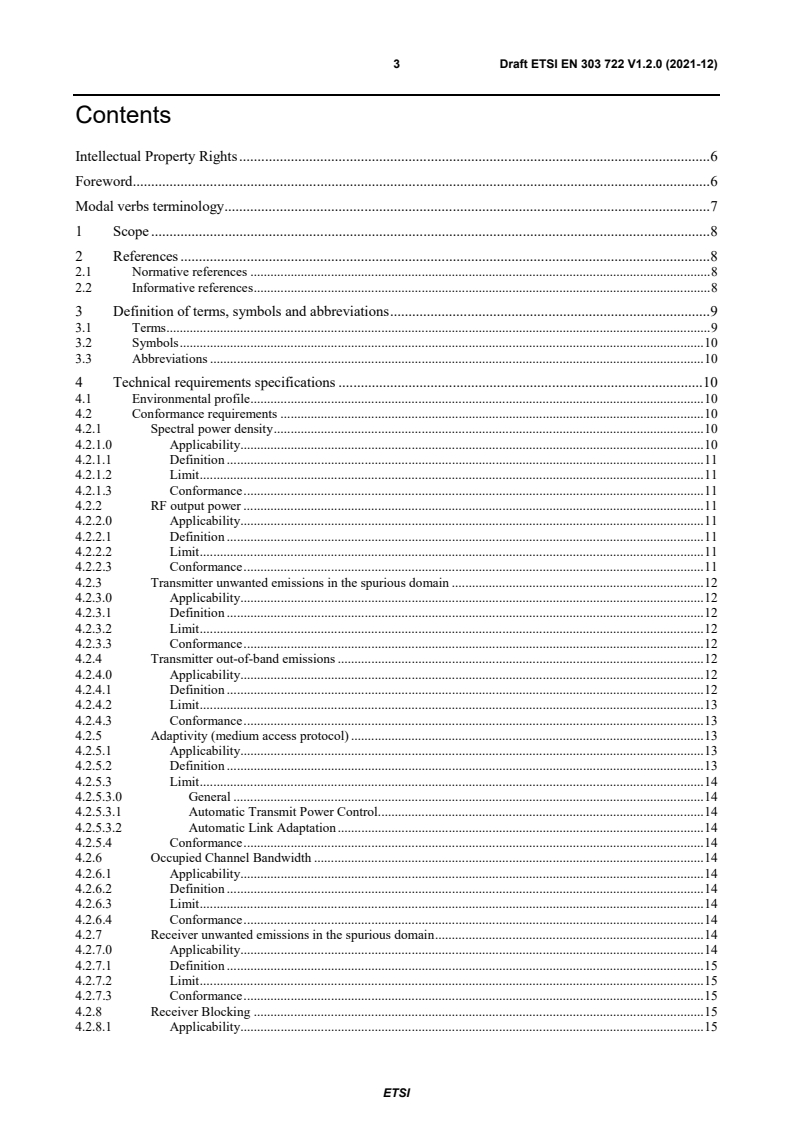
Contents
Intellectual Property Rights . 6
Foreword . 6
Modal verbs terminology . 7
1 Scope . 8
2 References . 8
2.1 Normative references . 8
2.2 Informative references . 8
3 Definition of terms, symbols and abbreviations . 9
3.1 Terms . 9
3.2 Symbols . 10
3.3 Abbreviations . 10
4 Technical requirements specifications . 10
4.1 Environmental profile . 10
4.2 Conformance requirements . 10
4.2.1 Spectral power density . 10
4.2.1.0 Applicability. 10
4.2.1.1 Definition . 11
4.2.1.2 Limit . 11
4.2.1.3 Conformance . 11
4.2.2 RF output power . 11
4.2.2.0 Applicability. 11
4.2.2.1 Definition . 11
4.2.2.2 Limit . 11
4.2.2.3 Conformance . 11
4.2.3 Transmitter unwanted emissions in the spurious domain . 12
4.2.3.0 Applicability. 12
4.2.3.1 Definition . 12
4.2.3.2 Limit . 12
4.2.3.3 Conformance . 12
4.2.4 Transmitter out-of-band emissions . 12
4.2.4.0 Applicability. 12
4.2.4.1 Definition . 12
4.2.4.2 Limit . 13
4.2.4.3 Conformance . 13
4.2.5 Adaptivity (medium access protocol) . 13
4.2.5.1 Applicability. 13
4.2.5.2 Definition . 13
4.2.5.3 Limit . 14
4.2.5.3.0 General . 14
4.2.5.3.1 Automatic Transmit Power Control. 14
4.2.5.3.2 Automatic Link Adaptation . 14
4.2.5.4 Conformance . 14
4.2.6 Occupied Channel Bandwidth . 14
4.2.6.1 Applicability. 14
4.2.6.2 Definition . 14
4.2.6.3 Limit . 14
4.2.6.4 Conformance . 14
4.2.7 Receiver unwanted emissions in the spurious domain . 14
4.2.7.0 Applicability. 14
4.2.7.1 Definition . 15
4.2.7.2 Limit . 15
4.2.7.3 Conformance . 15
4.2.8 Receiver Blocking . 15
4.2.8.1 Applicability. 15
ETSI
4 Draft ETSI EN 303 722 V1.2.0 (2021-12)
4.2.8.2 Definition . 15
4.2.8.3 Performance Criteria . 15
4.2.8.4 Limit . 15
4.2.8.5 Conformance . 16
4.2.9 Receiver Sensitivity level . 16
4.2.9.1 Applicability. 16
4.2.9.2 Definition . 16
4.2.9.3 Limit . 16
4.2.9.4 Conformance . 16
5 Testing for compliance with technical requirements . 16
5.1 Environmental conditions for testing . 16
5.1.1 General . 16
5.1.2 Normal test conditions . 16
5.1.2.1 Normal temperature and humidity . 16
5.1.2.2 Normal power source . 17
5.1.3 Extreme test conditions . 17
5.2 Test procedure for the essential radio test suites . 17
5.2.0 General . 17
5.2.1 Product Information . 17
5.2.2 Test modulation, frequency and configuration . 17
5.2.3 Spectral power density . 18
5.2.3.1 Test conditions . 18
5.2.3.2 Test method . 18
5.2.4 RF output power . 19
5.2.4.1 Test conditions . 19
5.2.4.2 Test method . 19
5.2.5 Transmitter unwanted emissions in the spurious domain . 20
5.2.5.0 Test conditions . 20
5.2.5.1 Pre-scan . 20
5.2.5.2 Identified emissions . 21
5.2.6 Transmitter out-of-band emissions . 22
5.2.6.1 Test conditions . 22
5.2.6.2 Test method . 22
5.2.7 Adaptivity (medium access protocol) . 22
5.2.7.1 Test conditions . 22
5.2.7.2 Test method (ATPC) . 22
5.2.7.3 Test method (ALA) . 24
5.2.8 Occupied Channel Bandwidth . 24
5.2.8.1 Test conditions . 24
5.2.8.2 Test method . 25
5.2.9 Receiver unwanted emissions in the spurious domain . 25
5.2.9.0 Test conditions . 25
5.2.9.1 Pre-scan . 26
5.2.9.2 Identified emissions . 26
5.2.10 Receiver Blocking . 26
5.2.10.1 Test conditions . 26
5.2.10.2 Test Method . 27
5.2.11 Receiver sensitivity level . 28
5.2.11.1 Test conditions . 28
5.2.11.2 Test method . 28
Annex A (informative): Relationship between the present document and the essential
requirements of Directive 2014/53/EU . 29
Annex B (informative): Maximum Measurement Uncertainty . 31
Annex C (normative): Test sites and arrangements for radiated measurements . 32
C.1 Test sites . 32
C.1.1 Open air test sites . 32
C.1.2 Anechoic chamber . 33
C.1.2.1 General . 33
ETSI
5 Draft ETSI EN 303 722 V1.2.0 (2021-12)
C.1.2.2 Description . 33
C.1.2.3 Influence of parasitic reflections . 33
C.1.2.4 Calibration and mode of use . 33
C.2 Test antenna . 35
C.3 Substitution antenna . 35
Annex D (normative): General description of measurement . 36
D.1 Radiated measurements . 36
D.2 Substitution measurement . 37
Annex E (informative): Bibliography . 38
Annex F (informative): Change History . 39
History . 40
ETSI
6 Draft ETSI EN 303 722 V1.2.0 (2021-12)
Intellectual Property Rights
Essential patents
IPRs essential or potentially essential to normative deliverables may have been declared to ETSI. The declarations
pertaining to these essential IPRs, if any, are publicly available for ETSI members and non-members, and can be
found in ETSI SR 000 314: "Intellectual Property Rights (IPRs); Essential, or potentially Essential, IPRs notified to
ETSI in respect of ETSI standards", which is available from the ETSI Secretariat. Latest updates are available on the
ETSI Web server (https://ipr.etsi.org/).
Pursuant to the ETSI Directives including the ETSI IPR Policy, no investigation regarding the essentiality of IPRs,
including IPR searches, has been carried out by ETSI. No guarantee can be given as to the existence of other IPRs not
referenced in ETSI SR 000 314 (or the updates on the ETSI Web server) which are, or may be, or may become,
essential to the present document.
Trademarks
The present document may include trademarks and/or tradenames which are asserted and/or registered by their owners.
ETSI claims no ownership of these except for any which are indicated as being the property of ETSI, and conveys no
right to use or reproduce any trademark and/or tradename. Mention of those trademarks in the present document does
not constitute an endorsement by ETSI of products, services or organizations associated with those trademarks.
DECT™, PLUGTESTS™, UMTS™ and the ETSI logo are trademarks of ETSI registered for the benefit of its
Members. 3GPP™ and LTE™ are trademarks of ETSI registered for the benefit of its Members and of the 3GPP
Organizational Partners. oneM2M™ logo is a trademark of ETSI registered for the benefit of its Members and of the ®
oneM2M Partners. GSM and the GSM logo are trademarks registered and owned by the GSM Association.
Foreword
This draft Harmonised European Standard (EN) has been produced by ETSI Technical Committee Broadband Radio
Access Networks (BRAN), and is now submitted for the combined Public Enquiry and Vote phase of the ETSI
standards EN Approval Procedure.
The present document has been prepared under the Commission's standardisation request C(2015) 5376 final [i.2] to
provide one voluntary means of conforming to the essential requirements of Directive 2014/53/EU on the harmonisation
of the laws of the Member States relating to the making available on the market of radio equipment and repealing
Directive 1999/5/EC [i.5].
Once the present document is cited in the Official Journal of the European Union under that Directive, compliance with
the normative clauses of the present document given in table A.1 confers, within the limits of the scope of the present
document, a presumption of conformity with the corresponding essential requirements of that Directive and associated
EFTA regulations.
Proposed national transposition dates
Date of latest announcement of this EN (doa): 3 months after ETSI publication
Date of latest publication of new National Standard
or endorsement of this EN (dop/e): 6 months after doa
Date of withdrawal of any conflicting National Standard (dow): 18 months after doa
ETSI
7 Draft ETSI EN 303 722 V1.2.0 (2021-12)
Modal verbs terminology
In the present document "shall", "shall not", "should", "should not", "may", "need not", "will", "will not", "can" and
"cannot" are to be interpreted as described in clause 3.2 of the ETSI Drafting Rules (Verbal forms for the expression of
provisions).
"must" and "must not" are NOT allowed in ETSI deliverables except when used in direct citation.
ETSI
8 Draft ETSI EN 303 722 V1.2.0 (2021-12)
1 Scope
The present document specifies technical characteristics and methods of measurements for Wideband Data
Transmission Systems (WDTS) fixed network radio equipment operating in the 57 GHz to 71 GHz band taking into
consideration ERC Recommendation 70-03 [i.3], annex 3 (frequency bands c2 and c3) and Commission Decision
2006/771/EC [i.4] bands 75a and 75b.
This radio equipment is capable of operating in all or any part of the frequency bands given in table 1.
Table 1: Radiocommunications service frequency band
Transmit/Receive Radiocommunications service frequency band
Transmit 57 GHz to 71 GHz
Receive 57 GHz to 71 GHz
NOTE 1: The technical characteristics of applications using these radio equipment are further described in ETSI
TR 103 583 [i.1].
NOTE 2: The relationship between the present document and essential requirements of article 3.2 of Directive
2014/53/EU [i.5] is given in annex A.
2 References
2.1 Normative references
References are either specific (identified by date of publication and/or edition number or version number) or
non-specific. For specific references, only the cited version applies. For non-specific references, the latest version of the
referenced document (including any amendments) applies.
Referenced documents which are not found to be publicly available in the expected location might be found at
https://docbox.etsi.org/Reference/.
NOTE: While any hyperlinks included in this clause were valid at the time of publication, ETSI cannot guarantee
their long term validity.
The following referenced documents are necessary for the application of the present document.
Not applicable.
2.2 Informative references
References are either specific (identified by date of publication and/or edition number or version number) or
non-specific. For specific references, only the cited version applies. For non-specific references, the latest version of the
referenced document (including any amendments) applies.
NOTE: While any hyperlinks included in this clause were valid at the time of publication, ETSI cannot guarantee
their long term validity.
The following referenced documents are not necessary for the application of the present document but they assist the
user with regard to a particular subject area.
[i.1] ETSI TR 103 583 (V1.1.1): "System Reference document (SRdoc); Technical characteristics of
Multiple Gigabit Wireless Systems (MGWS) in radio spectrum between 57 GHz and 71 GHz".
[i.2] Commission Implementing Decision C(2015) 5376 final of 4.8.2015 on a standardisation request
to the European Committee for Electrotechnical Standardisation and to the European
Telecommunications Standards Institute as regards radio equipment in support of Directive
2014/53/EU of the European Parliament and of the Council.
ETSI
9 Draft ETSI EN 303 722 V1.2.0 (2021-12)
[i.3] ERC Recommendation 70-03 (Tromsø 1997 and subsequent amendments): "Related to the Use of
Short Range Devices (SRD)".
[i.4] Commission Decision 2006/771/EC of 9 November 2006 on harmonisation of the radio spectrum
for use by short-range devices (notified under document number C(2006) 5304) (Text with EEA
relevance).
NOTE: Available at http://data.europa.eu/eli/dec/2006/771(2)/2019-08-13.
[i.5] Directive 2014/53/EU of the European Parliament and of the Council of 16 April 2014 on the
harmonisation of the laws of the Member States relating to the making available on the market of
radio equipment and repealing Directive 1999/5/EC.
[i.6] Commission Implementing Decision (EU) 2019/1345 of 2 August 2019 amending Decision
2006/771/EC updating harmonised technical conditions in the area of radio spectrum use for short-
range devices (notified under document C(2019) 5660) Text with EEA relevance.
[i.7] ERC Recommendation 74-01 (approved 1998 and subsequent amendments): "Unwanted emissions
in the spurious domain".
3 Definition of terms, symbols and abbreviations
3.1 Terms
For the purposes of the present document, the terms given in Directive 2014/53/EU [i.2] and the following apply:
60 GHz range or 60 GHz band: one of the variously permitted frequencies of operation, between 57 GHz to 71 GHz
activity factor: percentage over any one-minute time period when equipment is operating under a given set of
conditions
adjacent channel: channels on either side of the nominal channel separated by the nominal channel bandwidth
automatic transmit power control: mechanism that automatically reduces the transmit power based on the power at
the receiver
channel separation: minimum separation (in MHz) between the centre frequencies of two adjacent channels in the
channel plan of the radio equipment
integral antenna: antenna which is declared to be part of the radio equipment by the manufacturer
NOTE 1: In some cases, it may not be possible to remove an integral antenna or expose an antenna connector
without changing the output characteristics of the radio equipment.
NOTE 2: Even with an integral antenna, it might still be possible to separate the antenna from the equipment using
a special tool.
mean power: average power (transmitted or received) during the On Time of the signal
nominal channel bandwidth: bandwidth assigned to a single channel
NOTE: The nominal channel bandwidth is part of the product information as outlined in clause 5.2.1.
occupied bandwidth: bandwidth of the signal containing 99 % of the transmitted mean power
NOTE: Both below the lower and above the upper frequency limits, the mean power emitted is equal to 0,5 % of
the total mean power of the emission.
smart antenna system: equipment that combines multiple transmit and/or receive antenna elements with a signal
processing function to increase its radiation and/or reception capabilities
NOTE: This includes techniques such as spatial multiplexing, beam forming, cyclic delay diversity, etc.
ETSI
10 Draft ETSI EN 303 722 V1.2.0 (2021-12)
3.2 Symbols
For the purposes of the present document, the following symbols apply:
dBc decibel relative to the maximum spectral power density of the transmitted signal
dBi decibel relative to the gain of an isotropic antenna
dBm decibel relative to one milliwatt
dBr decibel relative to a given maximum power level
GHz thousand millions of cycles per second
kHz thousands of cycles per second
μs millionths of seconds
3.3 Abbreviations
For the purposes of the present document, the following abbreviations apply:
ACM Adaptive Code and Modulation
ALA Automatic Link Adaptation
ATPC Automatic Transmit Power Control
BW BandWidth
ChS Channel Separation
CW Continuous Wave
DC Duty Cycle
EFTA European Free Trade Association
EIRP Equivalent Isotropically Radiated Power
EIRP Equivalent Isotropically Radiated Power spectral density
ERP Effective Radiated Power
FER Frame Error Rate
MCS Modulation and Coding Scheme
mW milliWatt
PD Power Density
PDL spectral Power Density Limit
PSD Power Spectral Density
RBW Resolution BandWidth
RF Radio Frequency
RMS Root Mean Square
UUT Unit Under Test
WDTS Wideband Data Transmission Systems
4 Technical requirements specifications
4.1 Environmental profile
The technical requirements of the present document apply under the environmental profile for operation of the
equipment, which shall be in accordance with its intended use. The equipment shall comply with all the technical
requirements of the present document at all times when operating within the boundary limits of the operational
environmental profile defined by its intended use.
4.2 Conformance requirements
4.2.1 Spectral power density
4.2.1.0 Applicability
The present requirement applies to all equipment within the scope of the present document.
ETSI
11 Draft ETSI EN 303 722 V1.2.0 (2021-12)
4.2.1.1 Definition
The spectral power density is the mean Equivalent Isotropically Radiated Power (EIRP) density (EIRP ) during a
transmission burst.
4.2.1.2 Limit
The maximum spectral power density is applicable to the system as a whole when operated at the highest power spectral
density level (EIRP ). The maximum spectral power density shall be as indicated in table 2.
Table 2: Power Spectral Density (PSD) limit
Condition Maximum EIRP
38 dBm/MHz
Fixed outdoor installations with ≥ 30 dBi
transmit antenna gain
Otherwise 23 dBm/MHz
NOTE: Information on PSD limit is aligned with the Commission Implementing Decision (EU) 2019/1345 [i.6]
(see Annex, Table 2, Bands 75a and 75b).
4.2.1.3 Conformance
Conformance tests as defined in clause 5.2.3 shall be carried out and result compared to the limit.
4.2.2 RF output power
4.2.2.0 Applicability
The present requirement applies to all equipment within the scope of the present document.
4.2.2.1 Definition
The RF output power is the mean Equivalent Isotropically Radiated Power (EIRP) for the equipment during a
transmission burst.
4.2.2.2 Limit
The maximum RF output power is applicable to the system as a whole when operated at the highest stated power level.
For a smart antenna system, the limit applies to the configuration that results in the highest EIRP. In case of multiple
(adjacent or non-adjacent) channels the total RF output power of all channels shall be less than or equal to the limits in
table 3.
The maximum RF output power shall be as indicated in table 3.
Table 3: RF output power limit
Antenna Gain (GA) Additional Conditions Maximum power level (EIRP)
G < 13 dBi 27 dBm + G
A A
13 dBi ≤ GA < 30 dBi 40 dBm
40 dBm
30 dBi ≤ G
A
Fixed outdoor installations 55 dBm
NOTE: Information on RF output power limit is aligned with the Commission Implementing Decision
(EU) 2019/1345 [i.6] (see Annex, Table 2, Bands 75a and 75b).
4.2.2.3 Conformance
Conformance tests as defined in clause 5.2.4 shall be carried out and result compared to the limit.
ETSI
12 Draft ETSI EN 303 722 V1.2.0 (2021-12)
4.2.3 Transmitter unwanted emissions in the spurious domain
4.2.3.0 Applicability
The present requirement applies to all equipment within the scope of the present document.
4.2.3.1 Definition
Transmitter unwanted emissions are unwanted emissions in the spurious domain while the equipment is transmitting.
4.2.3.2 Limit
The level of unwanted emissions in the spurious domain shall be less than or equal to the limits given in table 4,where
:
the lower boundary between the spurious domain and the out-of-band domain shall be at a frequency FL
• F = min (57 GHz; f - min(2,5 × nominal channel BW, 1,5 × nominal channel BW + 500 MHz))
L C
where f is the nominal centre frequency of the transmission.
C
The upper boundary between the spurious domain and the out-of-band domain shall be at a frequency F :
H
• F = max (71 GHz; f + min(2,5 × nominal channel BW, 1,5 × nominal channel BW + 500 MHz))
H C
Table 4: Transmitter unwanted emissions in the spurious domain
Frequency range Emission Limit Measurement Bandwidth
ERP (≤ 1 GHz)
EIRP (> 1 GHz)
30 MHz to 47 MHz -36 dBm 100 kHz
47 MHz to 74 MHz -54 dBm 100 kHz
74 MHz to 87,5 MHz -36 dBm 100 kHz
87,5 MHz to 118 MHz -54 dBm 100 kHz
118 MHz to 174 MHz -36 dBm 100 kHz
174 MHz to 230 MHz -54 dBm 100 kHz
230 MHz to 470 MHz -36 dBm 100 kHz
470 MHz to 694 MHz -54 dBm 100 kHz
694 MHz to 1 GHz -36 dBm 100 kHz
1 GHz to FL GHz -30 dBm 1 MHz
FH GHz to 142 GHz -30 dBm 1 MHz
NOTE: Information on limits for transmitter unwanted emissions in the spurious domain is based on ERC
Recommendation 74-01 [i.7].
4.2.3.3 Conformance
Conformance tests as defined in clause 5.2.5 shall be carried out and result compared to the limit.
4.2.4 Transmitter out-of-band emissions
4.2.4.0 Applicability
The present requirement applies to all equipment within the scope of the present document.
4.2.4.1 Definition
Transmitter unwanted emissions in the out-of-band domain are emissions when the equipment is in transmit mode, on
frequencies immediately outside the necessary bandwidth which results from the modulation process but excluding
spurious emissions.
ETSI
13 Draft ETSI EN 303 722 V1.2.0 (2021-12)
4.2.4.2 Limit
The transmitter unwanted emissions in the out-of-band domain shall be less than or equal to the relative limits provided
in figure 1, where the x-axis is the ratio of frequency offset from centre frequency (f - f ) to declared nominal channel
C
BandWidth (BW), or an absolute level of -30 dBm within a 1 MHz bandwidth, whichever is greater. Non-adjacent
channels shall be tested separately. Within the 57 to 71 GHz band and outside --Rd to +Rd ratio of frequency offset
from centre frequency to declared nominal bandwidth range the -30 dBr or -30 dBm in 1 MHz whichever is the greater
shall apply, where Rd = min(2,5, 1,5 + 500 MHz/BW).
Figure 1: Transmit Mask
4.2.4.3 Conformance
Conformance tests as defined in clause 5.2.6 shall be carried out and result compared to the limit.
4.2.5 Adaptivity (medium access protocol)
4.2.5.1 Applicability
The present requirement applies to all equipment within the scope of the present document.
4.2.5.2 Definition
Automatic Transmit Power Control (ATPC) and Automatic Link Adaptation (ALA), also known as Automatic Adaptive
Coding and Modulation (ACM), are adaptivity (medium access protocol) mechanisms designed to facilitate spectrum
sharing with other devices. ATPC automatically reduces transmit power when there is excess link margin such that link
performance (throughput and FER) are not impacted. ALA automatically adapts the coding and modulation to
maximize spectral efficiency, thus reducing the transmission time of a given amount of payload. Both ATPC and ALA
reduce the interference caused to other links in the band and facilitates spectrum sharing. Equipment may support either,
or both, types of adaptivity mechanisms.
ETSI
14 Draft ETSI EN 303 722 V1.2.0 (2021-12)
4.2.5.3 Limit
4.2.5.3.0 General
ATPC and/or ALA shall be implemented by the equipment and shall be active under all circumstances, except that the
transmission of control, management, and synchronization frames are permitted without the use of ATPC or ALA.
4.2.5.3.1 Automatic Transmit Power Control
For devices equipped with transmitter power control, the difference in the average output power between the highest
power setting and lowest power setting shall be greater than or equal to 3 dB for a given constant data rate and nominal
channel bandwidth.
4.2.5.3.2 Automatic Link Adaptation
For devices equipped with automatic link adaptation, the difference in the average output power between that measured
for highest data rate and that measured for the lowest data rate should be greater than or equal to 3 dB for a given
constant path loss and nominal channel bandwidth. Alternatively, the duty cycle of the transmissions measured for
highest data rate shall be reduced by 10 % compared to that measured for the lowest data rate.
4.2.5.4 Conformance
The conformance tests as defined in clause 5.2.7 shall be carried out.
4.2.6 Occupied Channel Bandwidth
4.2.6.1 Applicability
This requirement applies to all equipment within the scope of the present document.
4.2.6.2 Definition
The Occupied Channel Bandwidth is the bandwidth containing 99 % of the power of the signal.
4.2.6.3 Limit
The Occupied Channel Bandwidth shall be less than the declared nominal Channel Bandwidth for all transmissions. The
device shall support a mode of transmission with a necessary bandwidth at least 70 % of the declared nominal channel
bandwidth. In case of smart antenna systems (devices with multiple transmit chains) each of the transmit chains shall
meet this requirement.
When equipment has simultaneous transmissions in adjacent channels, these transmissions may be considered as one
signal with an actual nominal channel bandwidth of "n" times the individual nominal channel bandwidth where "n" is
the number of adjacent channels. When equipment has simultaneous transmissions in non-adjacent channels, each
power envelope shall be considered separately.
4.2.6.4 Conformance
Conformance tests as defined in clause 5.2.8 shall be carried out and result compared to the limit.
4.2.7 Receiver unwanted emissions in the spurious domain
4.2.7.0 Applicability
The present requirement applies to all equipment within the scope of the present document.
ETSI
15 Draft ETSI EN 303 722 V1.2.0 (2021-12)
4.2.7.1 Definition
These are unwanted emissions in the spurious domain while the equipment is receiving a transmission.
4.2.7.2 Limit
The level of unwanted emissions in the spurious domain shall be less than or equal to the limits given in table 5.
Table 5: Receiver spurious emissions
Frequency band Emission Limit Measurement Bandwidth
ERP (≤ 1 GHz)
EIRP (> 1 GHz)
30 MHz to 1 GHz -57 dBm 100 kHz
1 GHz to 142 GHz -47 dBm 1 MHz
NOTE: Information on limits for transmitter unwanted emissions in the spurious domain is based on
ERC Recommendation 74-01 [i.7].
4.2.7.3 Conformance
Conformance tests as defined in clause 5.2.9 shall be carried out and result compared to the limit.
4.2.8 Receiver Blocking
4.2.8.1 Applicability
The present requirement applies to all equipment within the scope of the present document.
4.2.8.2 Definition
The receiver adjacent channel rejection is a measure of the receiver's ability to receive a wanted signal at its assigned
channel frequency in the presence of an unwanted signal at a given frequency offset from the centre frequency of the
assigned channel, without this unwanted signal causing a degradation of the performance of the receiver beyond
minimum performance criteria as specified in clause 4.2.6.3.
4.2.8.3 Performance Criteria
The minimum performance cr
...
HARMONISED EUROPEAN STANDARD
Wideband Data Transmission Systems (WDTS)
for Fixed Network Radio Equipment operating
in the 57 GHz to 71 GHz band;
Harmonised Standard for access to radio spectrum
2 ETSI EN 303 722 V1.2.1 (2022-03)
Reference
DEN/BRAN-230025
Keywords
60 GHz, access, broadband, fixed networks, radio,
SRD
ETSI
650 Route des Lucioles
F-06921 Sophia Antipolis Cedex - FRANCE
Tel.: +33 4 92 94 42 00 Fax: +33 4 93 65 47 16
Siret N° 348 623 562 00017 - APE 7112B
Association à but non lucratif enregistrée à la
Sous-Préfecture de Grasse (06) N° w061004871
Important notice
The present document can be downloaded from:
http://www.etsi.org/standards-search
The present document may be made available in electronic versions and/or in print. The content of any electronic and/or
print versions of the present document shall not be modified without the prior written authorization of ETSI. In case of any
existing or perceived difference in contents between such versions and/or in print, the prevailing version of an ETSI
deliverable is the one made publicly available in PDF format at www.etsi.org/deliver.
Users of the present document should be aware that the document may be subject to revision or change of status.
Information on the current status of this and other ETSI documents is available at
https://portal.etsi.org/TB/ETSIDeliverableStatus.aspx
If you find errors in the present document, please send your comment to one of the following services:
https://portal.etsi.org/People/CommiteeSupportStaff.aspx
Notice of disclaimer & limitation of liability
The information provided in the present deliverable is directed solely to professionals who have the appropriate degree of
experience to understand and interpret its content in accordance with generally accepted engineering or
other professional standard and applicable regulations.
No recommendation as to products and services or vendors is made or should be implied.
In no event shall ETSI be held liable for loss of profits or any other incidental or consequential damages.
Any software contained in this deliverable is provided "AS IS" with no warranties, express or implied, including but not
limited to, the warranties of merchantability, fitness for a particular purpose and non-infringement of intellectual property
rights and ETSI shall not be held liable in any event for any damages whatsoever (including, without limitation, damages
for loss of profits, business interruption, loss of information, or any other pecuniary loss) arising out of or related to the use
of or inability to use the software.
Copyright Notification
No part may be reproduced or utilized in any form or by any means, electronic or mechanical, including photocopying and
microfilm except as authorized by written permission of ETSI.
The content of the PDF version shall not be modified without the written authorization of ETSI.
The copyright and the foregoing restriction extend to reproduction in all media.
© ETSI 2022.
All rights reserved.
ETSI
3 ETSI EN 303 722 V1.2.1 (2022-03)
Contents
Intellectual Property Rights . 6
Foreword . 6
Modal verbs terminology . 7
1 Scope . 8
2 References . 8
2.1 Normative references . 8
2.2 Informative references . 8
3 Definition of terms, symbols and abbreviations . 9
3.1 Terms . 9
3.2 Symbols . 10
3.3 Abbreviations . 10
4 Technical requirements specifications . 10
4.1 Environmental profile . 10
4.2 Conformance requirements . 10
4.2.1 Spectral power density . 10
4.2.1.0 Applicability. 10
4.2.1.1 Definition . 11
4.2.1.2 Limit . 11
4.2.1.3 Conformance . 11
4.2.2 RF output power . 11
4.2.2.0 Applicability. 11
4.2.2.1 Definition . 11
4.2.2.2 Limit . 11
4.2.2.3 Conformance . 11
4.2.3 Transmitter unwanted emissions in the spurious domain . 12
4.2.3.0 Applicability. 12
4.2.3.1 Definition . 12
4.2.3.2 Limit . 12
4.2.3.3 Conformance . 12
4.2.4 Transmitter out-of-band emissions . 12
4.2.4.0 Applicability. 12
4.2.4.1 Definition . 12
4.2.4.2 Limit . 13
4.2.4.3 Conformance . 13
4.2.5 Adaptivity (medium access protocol) . 13
4.2.5.1 Applicability. 13
4.2.5.2 Definition . 13
4.2.5.3 Limit . 14
4.2.5.3.0 General . 14
4.2.5.3.1 Automatic Transmit Power Control. 14
4.2.5.3.2 Automatic Link Adaptation . 14
4.2.5.4 Conformance . 14
4.2.6 Occupied Channel Bandwidth . 14
4.2.6.1 Applicability. 14
4.2.6.2 Definition . 14
4.2.6.3 Limit . 14
4.2.6.4 Conformance . 14
4.2.7 Receiver unwanted emissions in the spurious domain . 14
4.2.7.0 Applicability. 14
4.2.7.1 Definition . 15
4.2.7.2 Limit . 15
4.2.7.3 Conformance . 15
4.2.8 Receiver Blocking . 15
4.2.8.1 Applicability. 15
ETSI
4 ETSI EN 303 722 V1.2.1 (2022-03)
4.2.8.2 Definition . 15
4.2.8.3 Performance Criteria . 15
4.2.8.4 Limit . 15
4.2.8.5 Conformance . 16
4.2.9 Receiver Sensitivity level . 16
4.2.9.1 Applicability. 16
4.2.9.2 Definition . 16
4.2.9.3 Limit . 16
4.2.9.4 Conformance . 16
5 Testing for compliance with technical requirements . 16
5.1 Environmental conditions for testing . 16
5.1.1 General . 16
5.1.2 Normal test conditions . 16
5.1.2.1 Normal temperature and humidity . 16
5.1.2.2 Normal power source . 17
5.1.3 Extreme test conditions . 17
5.2 Test procedure for the essential radio test suites . 17
5.2.0 General . 17
5.2.1 Product Information . 17
5.2.2 Test modulation, frequency and configuration . 17
5.2.3 Spectral power density . 18
5.2.3.1 Test conditions . 18
5.2.3.2 Test method . 18
5.2.4 RF output power . 19
5.2.4.1 Test conditions . 19
5.2.4.2 Test method . 19
5.2.5 Transmitter unwanted emissions in the spurious domain . 20
5.2.5.0 Test conditions . 20
5.2.5.1 Pre-scan . 20
5.2.5.2 Identified emissions . 21
5.2.6 Transmitter out-of-band emissions . 22
5.2.6.1 Test conditions . 22
5.2.6.2 Test method . 22
5.2.7 Adaptivity (medium access protocol) . 22
5.2.7.1 Test conditions . 22
5.2.7.2 Test method (ATPC) . 22
5.2.7.3 Test method (ALA) . 24
5.2.8 Occupied Channel Bandwidth . 24
5.2.8.1 Test conditions . 24
5.2.8.2 Test method . 25
5.2.9 Receiver unwanted emissions in the spurious domain . 25
5.2.9.0 Test conditions . 25
5.2.9.1 Pre-scan . 26
5.2.9.2 Identified emissions . 26
5.2.10 Receiver Blocking . 26
5.2.10.1 Test conditions . 26
5.2.10.2 Test Method . 27
5.2.11 Receiver sensitivity level . 28
5.2.11.1 Test conditions . 28
5.2.11.2 Test method . 28
Annex A (informative): Relationship between the present document and the essential
requirements of Directive 2014/53/EU . 29
Annex B (informative): Maximum Measurement Uncertainty . 31
Annex C (normative): Test sites and arrangements for radiated measurements . 32
C.1 Test sites . 32
C.1.1 Open air test sites . 32
C.1.2 Anechoic chamber . 33
C.1.2.1 General . 33
ETSI
5 ETSI EN 303 722 V1.2.1 (2022-03)
C.1.2.2 Description . 33
C.1.2.3 Influence of parasitic reflections . 33
C.1.2.4 Calibration and mode of use . 33
C.2 Test antenna . 35
C.3 Substitution antenna . 35
Annex D (normative): General description of measurement . 36
D.1 Radiated measurements . 36
D.2 Substitution measurement . 37
Annex E (informative): Bibliography . 38
Annex F (informative): Change History . 39
History . 40
ETSI
6 ETSI EN 303 722 V1.2.1 (2022-03)
Intellectual Property Rights
Essential patents
IPRs essential or potentially essential to normative deliverables may have been declared to ETSI. The declarations
pertaining to these essential IPRs, if any, are publicly available for ETSI members and non-members, and can be
found in ETSI SR 000 314: "Intellectual Property Rights (IPRs); Essential, or potentially Essential, IPRs notified to
ETSI in respect of ETSI standards", which is available from the ETSI Secretariat. Latest updates are available on the
ETSI Web server (https://ipr.etsi.org/).
Pursuant to the ETSI Directives including the ETSI IPR Policy, no investigation regarding the essentiality of IPRs,
including IPR searches, has been carried out by ETSI. No guarantee can be given as to the existence of other IPRs not
referenced in ETSI SR 000 314 (or the updates on the ETSI Web server) which are, or may be, or may become,
essential to the present document.
Trademarks
The present document may include trademarks and/or tradenames which are asserted and/or registered by their owners.
ETSI claims no ownership of these except for any which are indicated as being the property of ETSI, and conveys no
right to use or reproduce any trademark and/or tradename. Mention of those trademarks in the present document does
not constitute an endorsement by ETSI of products, services or organizations associated with those trademarks.
DECT™, PLUGTESTS™, UMTS™ and the ETSI logo are trademarks of ETSI registered for the benefit of its
Members. 3GPP™ and LTE™ are trademarks of ETSI registered for the benefit of its Members and of the 3GPP
Organizational Partners. oneM2M™ logo is a trademark of ETSI registered for the benefit of its Members and of the ®
oneM2M Partners. GSM and the GSM logo are trademarks registered and owned by the GSM Association.
Foreword
This Harmonised European Standard (EN) has been produced by ETSI Technical Committee Broadband Radio Access
Networks (BRAN).
The present document has been prepared under the Commission's standardisation request C(2015) 5376 final [i.2] to
provide one voluntary means of conforming to the essential requirements of Directive 2014/53/EU on the harmonisation
of the laws of the Member States relating to the making available on the market of radio equipment and repealing
Directive 1999/5/EC [i.5].
Once the present document is cited in the Official Journal of the European Union under that Directive, compliance with
the normative clauses of the present document given in table A.1 confers, within the limits of the scope of the present
document, a presumption of conformity with the corresponding essential requirements of that Directive and associated
EFTA regulations.
National transposition dates
Date of adoption of this EN: 10 March 2022
Date of latest announcement of this EN (doa): 30 June 2022
Date of latest publication of new National Standard
or endorsement of this EN (dop/e): 31 December 2022
Date of withdrawal of any conflicting National Standard (dow): 31 December 2023
ETSI
7 ETSI EN 303 722 V1.2.1 (2022-03)
Modal verbs terminology
In the present document "shall", "shall not", "should", "should not", "may", "need not", "will", "will not", "can" and
"cannot" are to be interpreted as described in clause 3.2 of the ETSI Drafting Rules (Verbal forms for the expression of
provisions).
"must" and "must not" are NOT allowed in ETSI deliverables except when used in direct citation.
ETSI
8 ETSI EN 303 722 V1.2.1 (2022-03)
1 Scope
The present document specifies technical characteristics and methods of measurements for Wideband Data
Transmission Systems (WDTS) fixed network radio equipment operating in the 57 GHz to 71 GHz band taking into
consideration ERC Recommendation 70-03 [i.3], annex 3 (frequency bands c2 and c3) and Commission Decision
2006/771/EC [i.4] bands 75a and 75b.
This radio equipment is capable of operating in all or any part of the frequency bands given in table 1.
Table 1: Radiocommunications service frequency band
Transmit/Receive Radiocommunications service frequency band
Transmit 57 GHz to 71 GHz
Receive 57 GHz to 71 GHz
NOTE 1: The technical characteristics of applications using these radio equipment are further described in ETSI
TR 103 583 [i.1].
NOTE 2: The relationship between the present document and essential requirements of article 3.2 of Directive
2014/53/EU [i.5] is given in annex A.
2 References
2.1 Normative references
References are either specific (identified by date of publication and/or edition number or version number) or
non-specific. For specific references, only the cited version applies. For non-specific references, the latest version of the
referenced document (including any amendments) applies.
Referenced documents which are not found to be publicly available in the expected location might be found at
https://docbox.etsi.org/Reference/.
NOTE: While any hyperlinks included in this clause were valid at the time of publication, ETSI cannot guarantee
their long term validity.
The following referenced documents are necessary for the application of the present document.
Not applicable.
2.2 Informative references
References are either specific (identified by date of publication and/or edition number or version number) or
non-specific. For specific references, only the cited version applies. For non-specific references, the latest version of the
referenced document (including any amendments) applies.
NOTE: While any hyperlinks included in this clause were valid at the time of publication, ETSI cannot guarantee
their long term validity.
The following referenced documents are not necessary for the application of the present document but they assist the
user with regard to a particular subject area.
[i.1] ETSI TR 103 583 (V1.1.1): "System Reference document (SRdoc); Technical characteristics of
Multiple Gigabit Wireless Systems (MGWS) in radio spectrum between 57 GHz and 71 GHz".
[i.2] Commission Implementing Decision C(2015) 5376 final of 4.8.2015 on a standardisation request
to the European Committee for Electrotechnical Standardisation and to the European
Telecommunications Standards Institute as regards radio equipment in support of Directive
2014/53/EU of the European Parliament and of the Council.
ETSI
9 ETSI EN 303 722 V1.2.1 (2022-03)
[i.3] ERC Recommendation 70-03 (Tromsø 1997 and subsequent amendments): "Related to the Use of
Short Range Devices (SRD)".
[i.4] Commission Decision 2006/771/EC of 9 November 2006 on harmonisation of the radio spectrum
for use by short-range devices (notified under document number C(2006) 5304) (Text with EEA
relevance).
NOTE: Available at http://data.europa.eu/eli/dec/2006/771(2)/2019-08-13.
[i.5] Directive 2014/53/EU of the European Parliament and of the Council of 16 April 2014 on the
harmonisation of the laws of the Member States relating to the making available on the market of
radio equipment and repealing Directive 1999/5/EC.
[i.6] Commission Implementing Decision (EU) 2019/1345 of 2 August 2019 amending Decision
2006/771/EC updating harmonised technical conditions in the area of radio spectrum use for short-
range devices (notified under document C(2019) 5660) Text with EEA relevance.
[i.7] ERC Recommendation 74-01 (approved 1998 and subsequent amendments): "Unwanted emissions
in the spurious domain".
3 Definition of terms, symbols and abbreviations
3.1 Terms
For the purposes of the present document, the terms given in Directive 2014/53/EU [i.2] and the following apply:
60 GHz range or 60 GHz band: one of the variously permitted frequencies of operation, between 57 GHz to 71 GHz
activity factor: percentage over any one-minute time period when equipment is operating under a given set of
conditions
adjacent channel: channels on either side of the nominal channel separated by the nominal channel bandwidth
automatic transmit power control: mechanism that automatically reduces the transmit power based on the power at
the receiver
channel separation: minimum separation (in MHz) between the centre frequencies of two adjacent channels in the
channel plan of the radio equipment
integral antenna: antenna which is declared to be part of the radio equipment by the manufacturer
NOTE 1: In some cases, it may not be possible to remove an integral antenna or expose an antenna connector
without changing the output characteristics of the radio equipment.
NOTE 2: Even with an integral antenna, it might still be possible to separate the antenna from the equipment using
a special tool.
mean power: average power (transmitted or received) during the On Time of the signal
nominal channel bandwidth: bandwidth assigned to a single channel
NOTE: The nominal channel bandwidth is part of the product information as outlined in clause 5.2.1.
occupied bandwidth: bandwidth of the signal containing 99 % of the transmitted mean power
NOTE: Both below the lower and above the upper frequency limits, the mean power emitted is equal to 0,5 % of
the total mean power of the emission.
smart antenna system: equipment that combines multiple transmit and/or receive antenna elements with a signal
processing function to increase its radiation and/or reception capabilities
NOTE: This includes techniques such as spatial multiplexing, beam forming, cyclic delay diversity, etc.
ETSI
10 ETSI EN 303 722 V1.2.1 (2022-03)
3.2 Symbols
For the purposes of the present document, the following symbols apply:
dBc decibel relative to the maximum spectral power density of the transmitted signal
dBi decibel relative to the gain of an isotropic antenna
dBm decibel relative to one milliwatt
dBr decibel relative to a given maximum power level
GHz thousand millions of cycles per second
kHz thousands of cycles per second
μs millionths of seconds
3.3 Abbreviations
For the purposes of the present document, the following abbreviations apply:
ACM Adaptive Code and Modulation
ALA Automatic Link Adaptation
ATPC Automatic Transmit Power Control
BW BandWidth
ChS Channel Separation
CW Continuous Wave
DC Duty Cycle
EFTA European Free Trade Association
EIRP Equivalent Isotropically Radiated Power
EIRP0 Equivalent Isotropically Radiated Power spectral density
ERP Effective Radiated Power
FER Frame Error Rate
MCS Modulation and Coding Scheme
mW milliWatt
PD Power Density
PDL spectral Power Density Limit
PSD Power Spectral Density
RBW Resolution BandWidth
RF Radio Frequency
RMS Root Mean Square
UUT Unit Under Test
WDTS Wideband Data Transmission Systems
4 Technical requirements specifications
4.1 Environmental profile
The technical requirements of the present document apply under the environmental profile for operation of the
equipment, which shall be in accordance with its intended use. The equipment shall comply with all the technical
requirements of the present document at all times when operating within the boundary limits of the operational
environmental profile defined by its intended use.
4.2 Conformance requirements
4.2.1 Spectral power density
4.2.1.0 Applicability
The present requirement applies to all equipment within the scope of the present document.
ETSI
11 ETSI EN 303 722 V1.2.1 (2022-03)
4.2.1.1 Definition
The spectral power density is the mean Equivalent Isotropically Radiated Power (EIRP) density (EIRP ) during a
transmission burst.
4.2.1.2 Limit
The maximum spectral power density is applicable to the system as a whole when operated at the highest power spectral
density level (EIRP ). The maximum spectral power density shall be as indicated in table 2.
Table 2: Power Spectral Density (PSD) limit
Condition Maximum EIRP
38 dBm/MHz
Fixed outdoor installations with ≥ 30 dBi
transmit antenna gain
Otherwise 23 dBm/MHz
NOTE: Information on PSD limit is aligned with the Commission Implementing Decision (EU) 2019/1345 [i.6]
(see Annex, Table 2, Bands 75a and 75b).
4.2.1.3 Conformance
Conformance tests as defined in clause 5.2.3 shall be carried out and result compared to the limit.
4.2.2 RF output power
4.2.2.0 Applicability
The present requirement applies to all equipment within the scope of the present document.
4.2.2.1 Definition
The RF output power is the mean Equivalent Isotropically Radiated Power (EIRP) for the equipment during a
transmission burst.
4.2.2.2 Limit
The maximum RF output power is applicable to the system as a whole when operated at the highest stated power level.
For a smart antenna system, the limit applies to the configuration that results in the highest EIRP. In case of multiple
(adjacent or non-adjacent) channels the total RF output power of all channels shall be less than or equal to the limits in
table 3.
The maximum RF output power shall be as indicated in table 3.
Table 3: RF output power limit
Antenna Gain (G ) Additional Conditions Maximum power level (EIRP)
A
G < 13 dBi 27 dBm + G
A A
13 dBi ≤ GA < 30 dBi 40 dBm
40 dBm
30 dBi ≤ G
A
Fixed outdoor installations 55 dBm
NOTE: Information on RF output power limit is aligned with the Commission Implementing Decision
(EU) 2019/1345 [i.6] (see Annex, Table 2, Bands 75a and 75b).
4.2.2.3 Conformance
Conformance tests as defined in clause 5.2.4 shall be carried out and result compared to the limit.
ETSI
12 ETSI EN 303 722 V1.2.1 (2022-03)
4.2.3 Transmitter unwanted emissions in the spurious domain
4.2.3.0 Applicability
The present requirement applies to all equipment within the scope of the present document.
4.2.3.1 Definition
Transmitter unwanted emissions are unwanted emissions in the spurious domain while the equipment is transmitting.
4.2.3.2 Limit
The level of unwanted emissions in the spurious domain shall be less than or equal to the limits given in table 4,where
the lower boundary between the spurious domain and the out-of-band domain shall be at a frequency F :
L
• F = min (57 GHz; f - min(2,5 × nominal channel BW, 1,5 × nominal channel BW + 500 MHz))
L C
where f is the nominal centre frequency of the transmission.
C
The upper boundary between the spurious domain and the out-of-band domain shall be at a frequency F :
H
• F = max (71 GHz; f + min(2,5 × nominal channel BW, 1,5 × nominal channel BW + 500 MHz))
H C
Table 4: Transmitter unwanted emissions in the spurious domain
Frequency range Emission Limit Measurement Bandwidth
ERP (≤ 1 GHz)
EIRP (> 1 GHz)
30 MHz to 47 MHz -36 dBm 100 kHz
47 MHz to 74 MHz -54 dBm 100 kHz
74 MHz to 87,5 MHz -36 dBm 100 kHz
87,5 MHz to 118 MHz -54 dBm 100 kHz
118 MHz to 174 MHz -36 dBm 100 kHz
174 MHz to 230 MHz -54 dBm 100 kHz
230 MHz to 470 MHz -36 dBm 100 kHz
470 MHz to 694 MHz -54 dBm 100 kHz
694 MHz to 1 GHz -36 dBm 100 kHz
1 GHz to FL GHz -30 dBm 1 MHz
FH GHz to 142 GHz -30 dBm 1 MHz
NOTE: Information on limits for transmitter unwanted emissions in the spurious domain is based on ERC
Recommendation 74-01 [i.7].
4.2.3.3 Conformance
Conformance tests as defined in clause 5.2.5 shall be carried out and result compared to the limit.
4.2.4 Transmitter out-of-band emissions
4.2.4.0 Applicability
The present requirement applies to all equipment within the scope of the present document.
4.2.4.1 Definition
Transmitter unwanted emissions in the out-of-band domain are emissions when the equipment is in transmit mode, on
frequencies immediately outside the necessary bandwidth which results from the modulation process but excluding
spurious emissions.
ETSI
13 ETSI EN 303 722 V1.2.1 (2022-03)
4.2.4.2 Limit
The transmitter unwanted emissions in the out-of-band domain shall be less than or equal to the relative limits provided
in figure 1, where the x-axis is the ratio of frequency offset from centre frequency (f - f ) to declared nominal channel
C
BandWidth (BW), or an absolute level of -30 dBm within a 1 MHz bandwidth, whichever is greater. Non-adjacent
channels shall be tested separately. Within the 57 to 71 GHz band and outside -Rd to +Rd ratio of frequency offset from
centre frequency to declared nominal bandwidth range the -30 dBr or -30 dBm in 1 MHz whichever is the greater shall
apply, where Rd = min(2,5, 1,5 + 500 MHz/BW).
Figure 1: Transmit Mask
4.2.4.3 Conformance
Conformance tests as defined in clause 5.2.6 shall be carried out and result compared to the limit.
4.2.5 Adaptivity (medium access protocol)
4.2.5.1 Applicability
The present requirement applies to all equipment within the scope of the present document.
4.2.5.2 Definition
Automatic Transmit Power Control (ATPC) and Automatic Link Adaptation (ALA), also known as Automatic Adaptive
Coding and Modulation (ACM), are adaptivity (medium access protocol) mechanisms designed to facilitate spectrum
sharing with other devices. ATPC automatically reduces transmit power when there is excess link margin such that link
performance (throughput and FER) are not impacted. ALA automatically adapts the coding and modulation to
maximize spectral efficiency, thus reducing the transmission time of a given amount of payload. Both ATPC and ALA
reduce the interference caused to other links in the band and facilitates spectrum sharing. Equipment may support either,
or both, types of adaptivity mechanisms.
ETSI
14 ETSI EN 303 722 V1.2.1 (2022-03)
4.2.5.3 Limit
4.2.5.3.0 General
ATPC and/or ALA shall be implemented by the equipment and shall be active under all circumstances, except that the
transmission of control, management, and synchronization frames are permitted without the use of ATPC or ALA.
4.2.5.3.1 Automatic Transmit Power Control
For devices equipped with transmitter power control, the difference in the average output power between the highest
power setting and lowest power setting shall be greater than or equal to 3 dB for a given constant data rate and nominal
channel bandwidth.
4.2.5.3.2 Automatic Link Adaptation
For devices equipped with automatic link adaptation, the difference in the average output power between that measured
for highest data rate and that measured for the lowest data rate should be greater than or equal to 3 dB for a given
constant path loss and nominal channel bandwidth. Alternatively, the duty cycle of the transmissions measured for
highest data rate shall be reduced by 10 % compared to that measured for the lowest data rate.
4.2.5.4 Conformance
The conformance tests as defined in clause 5.2.7 shall be carried out.
4.2.6 Occupied Channel Bandwidth
4.2.6.1 Applicability
This requirement applies to all equipment within the scope of the present document.
4.2.6.2 Definition
The Occupied Channel Bandwidth is the bandwidth containing 99 % of the power of the signal.
4.2.6.3 Limit
The Occupied Channel Bandwidth shall be less than the declared nominal Channel Bandwidth for all transmissions. The
device shall support a mode of transmission with a necessary bandwidth at least 70 % of the declared nominal channel
bandwidth. In case of smart antenna systems (devices with multiple transmit chains) each of the transmit chains shall
meet this requirement.
When equipment has simultaneous transmissions in adjacent channels, these transmissions may be considered as one
signal with an actual nominal channel bandwidth of "n" times the individual nominal channel bandwidth where "n" is
the number of adjacent channels. When equipment has simultaneous transmissions in non-adjacent channels, each
power envelope shall be considered separately.
4.2.6.4 Conformance
Conformance tests as defined in clause 5.2.8 shall be carried out and result compared to the limit.
4.2.7 Receiver unwanted emissions in the spurious domain
4.2.7.0 Applicability
The present requirement applies to all equipment within the scope of the present document.
ETSI
15 ETSI EN 303 722 V1.2.1 (2022-03)
4.2.7.1 Definition
These are unwanted emissions in the spurious domain while the equipment is receiving a transmission.
4.2.7.2 Limit
The level of unwanted emissions in the spurious domain shall be less than or equal to the limits given in table 5.
Table 5: Receiver spurious emissions
Frequency band Emission Limit Measurement Bandwidth
ERP (≤ 1 GHz)
EIRP (> 1 GHz)
30 MHz to 1 GHz -57 dBm 100 kHz
1 GHz to 142 GHz -47 dBm 1 MHz
NOTE: Information on limits for transmitter unwanted emissions in the spurious domain is based on ERC
Recommendation 74-01 [i.7].
4.2.7.3 Conformance
Conformance tests as defined in clause 5.2.9 shall be carried out and result compared to the limit.
4.2.8 Receiver Blocking
4.2.8.1 Applicability
The present requirement applies to all equipment within the scope of the present document.
4.2.8.2 Definition
The receiver adjacent channel rejection is a measure of the receiver's ability to receive a wanted signal at its assigned
channel frequency in the presence of an unwanted signal at a given frequency offset from the centre frequency of the
assigned channel, without this unwanted signal causing a degradation of the performance of the receiver beyond
minimum performance criteria as specified in clause 4.2.6.3.
4.2.8.3 Performance Criteria
The minimum performance criterion shall be a FER of less than or equal to 10 %.
4.2.8.4 Limit
The minimum performance criteria as defined in clause 4.2.8.3 shall be met. The levels of the unwanted signal power
shall be equal to o
...
SLOVENSKI STANDARD
01-maj-2022
Širokopasovni sistemi za prenos podatkov (WDTS) za radijsko opremo fiksnega
omrežja, ki delujejo v pasu od 57 GHz do 71 GHz - Harmonizirani standard za
dostop do radijskega spektra
Wideband Data Transmission Systems (WDTS) for Fixed Network Radio Equipment
operating in the 57 GHz to 71 GHz band - Harmonised Standard for access to radio
spectrum
Ta slovenski standard je istoveten z: ETSI EN 303 722 V1.2.1 (2022-03)
ICS:
33.060.01 Radijske komunikacije na Radiocommunications in
splošno general
2003-01.Slovenski inštitut za standardizacijo. Razmnoževanje celote ali delov tega standarda ni dovoljeno.
HARMONISED EUROPEAN STANDARD
Wideband Data Transmission Systems (WDTS)
for Fixed Network Radio Equipment operating
in the 57 GHz to 71 GHz band;
Harmonised Standard for access to radio spectrum
2 ETSI EN 303 722 V1.2.1 (2022-03)
Reference
DEN/BRAN-230025
Keywords
60 GHz, access, broadband, fixed networks, radio,
SRD
ETSI
650 Route des Lucioles
F-06921 Sophia Antipolis Cedex - FRANCE
Tel.: +33 4 92 94 42 00 Fax: +33 4 93 65 47 16
Siret N° 348 623 562 00017 - APE 7112B
Association à but non lucratif enregistrée à la
Sous-Préfecture de Grasse (06) N° w061004871
Important notice
The present document can be downloaded from:
http://www.etsi.org/standards-search
The present document may be made available in electronic versions and/or in print. The content of any electronic and/or
print versions of the present document shall not be modified without the prior written authorization of ETSI. In case of any
existing or perceived difference in contents between such versions and/or in print, the prevailing version of an ETSI
deliverable is the one made publicly available in PDF format at www.etsi.org/deliver.
Users of the present document should be aware that the document may be subject to revision or change of status.
Information on the current status of this and other ETSI documents is available at
https://portal.etsi.org/TB/ETSIDeliverableStatus.aspx
If you find errors in the present document, please send your comment to one of the following services:
https://portal.etsi.org/People/CommiteeSupportStaff.aspx
Notice of disclaimer & limitation of liability
The information provided in the present deliverable is directed solely to professionals who have the appropriate degree of
experience to understand and interpret its content in accordance with generally accepted engineering or
other professional standard and applicable regulations.
No recommendation as to products and services or vendors is made or should be implied.
In no event shall ETSI be held liable for loss of profits or any other incidental or consequential damages.
Any software contained in this deliverable is provided "AS IS" with no warranties, express or implied, including but not
limited to, the warranties of merchantability, fitness for a particular purpose and non-infringement of intellectual property
rights and ETSI shall not be held liable in any event for any damages whatsoever (including, without limitation, damages
for loss of profits, business interruption, loss of information, or any other pecuniary loss) arising out of or related to the use
of or inability to use the software.
Copyright Notification
No part may be reproduced or utilized in any form or by any means, electronic or mechanical, including photocopying and
microfilm except as authorized by written permission of ETSI.
The content of the PDF version shall not be modified without the written authorization of ETSI.
The copyright and the foregoing restriction extend to reproduction in all media.
© ETSI 2022.
All rights reserved.
ETSI
3 ETSI EN 303 722 V1.2.1 (2022-03)
Contents
Intellectual Property Rights . 6
Foreword . 6
Modal verbs terminology . 7
1 Scope . 8
2 References . 8
2.1 Normative references . 8
2.2 Informative references . 8
3 Definition of terms, symbols and abbreviations . 9
3.1 Terms . 9
3.2 Symbols . 10
3.3 Abbreviations . 10
4 Technical requirements specifications . 10
4.1 Environmental profile . 10
4.2 Conformance requirements . 10
4.2.1 Spectral power density . 10
4.2.1.0 Applicability. 10
4.2.1.1 Definition . 11
4.2.1.2 Limit . 11
4.2.1.3 Conformance . 11
4.2.2 RF output power . 11
4.2.2.0 Applicability. 11
4.2.2.1 Definition . 11
4.2.2.2 Limit . 11
4.2.2.3 Conformance . 11
4.2.3 Transmitter unwanted emissions in the spurious domain . 12
4.2.3.0 Applicability. 12
4.2.3.1 Definition . 12
4.2.3.2 Limit . 12
4.2.3.3 Conformance . 12
4.2.4 Transmitter out-of-band emissions . 12
4.2.4.0 Applicability. 12
4.2.4.1 Definition . 12
4.2.4.2 Limit . 13
4.2.4.3 Conformance . 13
4.2.5 Adaptivity (medium access protocol) . 13
4.2.5.1 Applicability. 13
4.2.5.2 Definition . 13
4.2.5.3 Limit . 14
4.2.5.3.0 General . 14
4.2.5.3.1 Automatic Transmit Power Control. 14
4.2.5.3.2 Automatic Link Adaptation . 14
4.2.5.4 Conformance . 14
4.2.6 Occupied Channel Bandwidth . 14
4.2.6.1 Applicability. 14
4.2.6.2 Definition . 14
4.2.6.3 Limit . 14
4.2.6.4 Conformance . 14
4.2.7 Receiver unwanted emissions in the spurious domain . 14
4.2.7.0 Applicability. 14
4.2.7.1 Definition . 15
4.2.7.2 Limit . 15
4.2.7.3 Conformance . 15
4.2.8 Receiver Blocking . 15
4.2.8.1 Applicability. 15
ETSI
4 ETSI EN 303 722 V1.2.1 (2022-03)
4.2.8.2 Definition . 15
4.2.8.3 Performance Criteria . 15
4.2.8.4 Limit . 15
4.2.8.5 Conformance . 16
4.2.9 Receiver Sensitivity level . 16
4.2.9.1 Applicability. 16
4.2.9.2 Definition . 16
4.2.9.3 Limit . 16
4.2.9.4 Conformance . 16
5 Testing for compliance with technical requirements . 16
5.1 Environmental conditions for testing . 16
5.1.1 General . 16
5.1.2 Normal test conditions . 16
5.1.2.1 Normal temperature and humidity . 16
5.1.2.2 Normal power source . 17
5.1.3 Extreme test conditions . 17
5.2 Test procedure for the essential radio test suites . 17
5.2.0 General . 17
5.2.1 Product Information . 17
5.2.2 Test modulation, frequency and configuration . 17
5.2.3 Spectral power density . 18
5.2.3.1 Test conditions . 18
5.2.3.2 Test method . 18
5.2.4 RF output power . 19
5.2.4.1 Test conditions . 19
5.2.4.2 Test method . 19
5.2.5 Transmitter unwanted emissions in the spurious domain . 20
5.2.5.0 Test conditions . 20
5.2.5.1 Pre-scan . 20
5.2.5.2 Identified emissions . 21
5.2.6 Transmitter out-of-band emissions . 22
5.2.6.1 Test conditions . 22
5.2.6.2 Test method . 22
5.2.7 Adaptivity (medium access protocol) . 22
5.2.7.1 Test conditions . 22
5.2.7.2 Test method (ATPC) . 22
5.2.7.3 Test method (ALA) . 24
5.2.8 Occupied Channel Bandwidth . 24
5.2.8.1 Test conditions . 24
5.2.8.2 Test method . 25
5.2.9 Receiver unwanted emissions in the spurious domain . 25
5.2.9.0 Test conditions . 25
5.2.9.1 Pre-scan . 26
5.2.9.2 Identified emissions . 26
5.2.10 Receiver Blocking . 26
5.2.10.1 Test conditions . 26
5.2.10.2 Test Method . 27
5.2.11 Receiver sensitivity level . 28
5.2.11.1 Test conditions . 28
5.2.11.2 Test method . 28
Annex A (informative): Relationship between the present document and the essential
requirements of Directive 2014/53/EU . 29
Annex B (informative): Maximum Measurement Uncertainty . 31
Annex C (normative): Test sites and arrangements for radiated measurements . 32
C.1 Test sites . 32
C.1.1 Open air test sites . 32
C.1.2 Anechoic chamber . 33
C.1.2.1 General . 33
ETSI
5 ETSI EN 303 722 V1.2.1 (2022-03)
C.1.2.2 Description . 33
C.1.2.3 Influence of parasitic reflections . 33
C.1.2.4 Calibration and mode of use . 33
C.2 Test antenna . 35
C.3 Substitution antenna . 35
Annex D (normative): General description of measurement . 36
D.1 Radiated measurements . 36
D.2 Substitution measurement . 37
Annex E (informative): Bibliography . 38
Annex F (informative): Change History . 39
History . 40
ETSI
6 ETSI EN 303 722 V1.2.1 (2022-03)
Intellectual Property Rights
Essential patents
IPRs essential or potentially essential to normative deliverables may have been declared to ETSI. The declarations
pertaining to these essential IPRs, if any, are publicly available for ETSI members and non-members, and can be
found in ETSI SR 000 314: "Intellectual Property Rights (IPRs); Essential, or potentially Essential, IPRs notified to
ETSI in respect of ETSI standards", which is available from the ETSI Secretariat. Latest updates are available on the
ETSI Web server (https://ipr.etsi.org/).
Pursuant to the ETSI Directives including the ETSI IPR Policy, no investigation regarding the essentiality of IPRs,
including IPR searches, has been carried out by ETSI. No guarantee can be given as to the existence of other IPRs not
referenced in ETSI SR 000 314 (or the updates on the ETSI Web server) which are, or may be, or may become,
essential to the present document.
Trademarks
The present document may include trademarks and/or tradenames which are asserted and/or registered by their owners.
ETSI claims no ownership of these except for any which are indicated as being the property of ETSI, and conveys no
right to use or reproduce any trademark and/or tradename. Mention of those trademarks in the present document does
not constitute an endorsement by ETSI of products, services or organizations associated with those trademarks.
DECT™, PLUGTESTS™, UMTS™ and the ETSI logo are trademarks of ETSI registered for the benefit of its
Members. 3GPP™ and LTE™ are trademarks of ETSI registered for the benefit of its Members and of the 3GPP
Organizational Partners. oneM2M™ logo is a trademark of ETSI registered for the benefit of its Members and of the ®
oneM2M Partners. GSM and the GSM logo are trademarks registered and owned by the GSM Association.
Foreword
This Harmonised European Standard (EN) has been produced by ETSI Technical Committee Broadband Radio Access
Networks (BRAN).
The present document has been prepared under the Commission's standardisation request C(2015) 5376 final [i.2] to
provide one voluntary means of conforming to the essential requirements of Directive 2014/53/EU on the harmonisation
of the laws of the Member States relating to the making available on the market of radio equipment and repealing
Directive 1999/5/EC [i.5].
Once the present document is cited in the Official Journal of the European Union under that Directive, compliance with
the normative clauses of the present document given in table A.1 confers, within the limits of the scope of the present
document, a presumption of conformity with the corresponding essential requirements of that Directive and associated
EFTA regulations.
National transposition dates
Date of adoption of this EN: 10 March 2022
Date of latest announcement of this EN (doa): 30 June 2022
Date of latest publication of new National Standard
or endorsement of this EN (dop/e): 31 December 2022
Date of withdrawal of any conflicting National Standard (dow): 31 December 2023
ETSI
7 ETSI EN 303 722 V1.2.1 (2022-03)
Modal verbs terminology
In the present document "shall", "shall not", "should", "should not", "may", "need not", "will", "will not", "can" and
"cannot" are to be interpreted as described in clause 3.2 of the ETSI Drafting Rules (Verbal forms for the expression of
provisions).
"must" and "must not" are NOT allowed in ETSI deliverables except when used in direct citation.
ETSI
8 ETSI EN 303 722 V1.2.1 (2022-03)
1 Scope
The present document specifies technical characteristics and methods of measurements for Wideband Data
Transmission Systems (WDTS) fixed network radio equipment operating in the 57 GHz to 71 GHz band taking into
consideration ERC Recommendation 70-03 [i.3], annex 3 (frequency bands c2 and c3) and Commission Decision
2006/771/EC [i.4] bands 75a and 75b.
This radio equipment is capable of operating in all or any part of the frequency bands given in table 1.
Table 1: Radiocommunications service frequency band
Transmit/Receive Radiocommunications service frequency band
Transmit 57 GHz to 71 GHz
Receive 57 GHz to 71 GHz
NOTE 1: The technical characteristics of applications using these radio equipment are further described in ETSI
TR 103 583 [i.1].
NOTE 2: The relationship between the present document and essential requirements of article 3.2 of Directive
2014/53/EU [i.5] is given in annex A.
2 References
2.1 Normative references
References are either specific (identified by date of publication and/or edition number or version number) or
non-specific. For specific references, only the cited version applies. For non-specific references, the latest version of the
referenced document (including any amendments) applies.
Referenced documents which are not found to be publicly available in the expected location might be found at
https://docbox.etsi.org/Reference/.
NOTE: While any hyperlinks included in this clause were valid at the time of publication, ETSI cannot guarantee
their long term validity.
The following referenced documents are necessary for the application of the present document.
Not applicable.
2.2 Informative references
References are either specific (identified by date of publication and/or edition number or version number) or
non-specific. For specific references, only the cited version applies. For non-specific references, the latest version of the
referenced document (including any amendments) applies.
NOTE: While any hyperlinks included in this clause were valid at the time of publication, ETSI cannot guarantee
their long term validity.
The following referenced documents are not necessary for the application of the present document but they assist the
user with regard to a particular subject area.
[i.1] ETSI TR 103 583 (V1.1.1): "System Reference document (SRdoc); Technical characteristics of
Multiple Gigabit Wireless Systems (MGWS) in radio spectrum between 57 GHz and 71 GHz".
[i.2] Commission Implementing Decision C(2015) 5376 final of 4.8.2015 on a standardisation request
to the European Committee for Electrotechnical Standardisation and to the European
Telecommunications Standards Institute as regards radio equipment in support of Directive
2014/53/EU of the European Parliament and of the Council.
ETSI
9 ETSI EN 303 722 V1.2.1 (2022-03)
[i.3] ERC Recommendation 70-03 (Tromsø 1997 and subsequent amendments): "Related to the Use of
Short Range Devices (SRD)".
[i.4] Commission Decision 2006/771/EC of 9 November 2006 on harmonisation of the radio spectrum
for use by short-range devices (notified under document number C(2006) 5304) (Text with EEA
relevance).
NOTE: Available at http://data.europa.eu/eli/dec/2006/771(2)/2019-08-13.
[i.5] Directive 2014/53/EU of the European Parliament and of the Council of 16 April 2014 on the
harmonisation of the laws of the Member States relating to the making available on the market of
radio equipment and repealing Directive 1999/5/EC.
[i.6] Commission Implementing Decision (EU) 2019/1345 of 2 August 2019 amending Decision
2006/771/EC updating harmonised technical conditions in the area of radio spectrum use for short-
range devices (notified under document C(2019) 5660) Text with EEA relevance.
[i.7] ERC Recommendation 74-01 (approved 1998 and subsequent amendments): "Unwanted emissions
in the spurious domain".
3 Definition of terms, symbols and abbreviations
3.1 Terms
For the purposes of the present document, the terms given in Directive 2014/53/EU [i.2] and the following apply:
60 GHz range or 60 GHz band: one of the variously permitted frequencies of operation, between 57 GHz to 71 GHz
activity factor: percentage over any one-minute time period when equipment is operating under a given set of
conditions
adjacent channel: channels on either side of the nominal channel separated by the nominal channel bandwidth
automatic transmit power control: mechanism that automatically reduces the transmit power based on the power at
the receiver
channel separation: minimum separation (in MHz) between the centre frequencies of two adjacent channels in the
channel plan of the radio equipment
integral antenna: antenna which is declared to be part of the radio equipment by the manufacturer
NOTE 1: In some cases, it may not be possible to remove an integral antenna or expose an antenna connector
without changing the output characteristics of the radio equipment.
NOTE 2: Even with an integral antenna, it might still be possible to separate the antenna from the equipment using
a special tool.
mean power: average power (transmitted or received) during the On Time of the signal
nominal channel bandwidth: bandwidth assigned to a single channel
NOTE: The nominal channel bandwidth is part of the product information as outlined in clause 5.2.1.
occupied bandwidth: bandwidth of the signal containing 99 % of the transmitted mean power
NOTE: Both below the lower and above the upper frequency limits, the mean power emitted is equal to 0,5 % of
the total mean power of the emission.
smart antenna system: equipment that combines multiple transmit and/or receive antenna elements with a signal
processing function to increase its radiation and/or reception capabilities
NOTE: This includes techniques such as spatial multiplexing, beam forming, cyclic delay diversity, etc.
ETSI
10 ETSI EN 303 722 V1.2.1 (2022-03)
3.2 Symbols
For the purposes of the present document, the following symbols apply:
dBc decibel relative to the maximum spectral power density of the transmitted signal
dBi decibel relative to the gain of an isotropic antenna
dBm decibel relative to one milliwatt
dBr decibel relative to a given maximum power level
GHz thousand millions of cycles per second
kHz thousands of cycles per second
μs millionths of seconds
3.3 Abbreviations
For the purposes of the present document, the following abbreviations apply:
ACM Adaptive Code and Modulation
ALA Automatic Link Adaptation
ATPC Automatic Transmit Power Control
BW BandWidth
ChS Channel Separation
CW Continuous Wave
DC Duty Cycle
EFTA European Free Trade Association
EIRP Equivalent Isotropically Radiated Power
EIRP0 Equivalent Isotropically Radiated Power spectral density
ERP Effective Radiated Power
FER Frame Error Rate
MCS Modulation and Coding Scheme
mW milliWatt
PD Power Density
PDL spectral Power Density Limit
PSD Power Spectral Density
RBW Resolution BandWidth
RF Radio Frequency
RMS Root Mean Square
UUT Unit Under Test
WDTS Wideband Data Transmission Systems
4 Technical requirements specifications
4.1 Environmental profile
The technical requirements of the present document apply under the environmental profile for operation of the
equipment, which shall be in accordance with its intended use. The equipment shall comply with all the technical
requirements of the present document at all times when operating within the boundary limits of the operational
environmental profile defined by its intended use.
4.2 Conformance requirements
4.2.1 Spectral power density
4.2.1.0 Applicability
The present requirement applies to all equipment within the scope of the present document.
ETSI
11 ETSI EN 303 722 V1.2.1 (2022-03)
4.2.1.1 Definition
The spectral power density is the mean Equivalent Isotropically Radiated Power (EIRP) density (EIRP ) during a
transmission burst.
4.2.1.2 Limit
The maximum spectral power density is applicable to the system as a whole when operated at the highest power spectral
density level (EIRP ). The maximum spectral power density shall be as indicated in table 2.
Table 2: Power Spectral Density (PSD) limit
Condition Maximum EIRP
38 dBm/MHz
Fixed outdoor installations with ≥ 30 dBi
transmit antenna gain
Otherwise 23 dBm/MHz
NOTE: Information on PSD limit is aligned with the Commission Implementing Decision (EU) 2019/1345 [i.6]
(see Annex, Table 2, Bands 75a and 75b).
4.2.1.3 Conformance
Conformance tests as defined in clause 5.2.3 shall be carried out and result compared to the limit.
4.2.2 RF output power
4.2.2.0 Applicability
The present requirement applies to all equipment within the scope of the present document.
4.2.2.1 Definition
The RF output power is the mean Equivalent Isotropically Radiated Power (EIRP) for the equipment during a
transmission burst.
4.2.2.2 Limit
The maximum RF output power is applicable to the system as a whole when operated at the highest stated power level.
For a smart antenna system, the limit applies to the configuration that results in the highest EIRP. In case of multiple
(adjacent or non-adjacent) channels the total RF output power of all channels shall be less than or equal to the limits in
table 3.
The maximum RF output power shall be as indicated in table 3.
Table 3: RF output power limit
Antenna Gain (G ) Additional Conditions Maximum power level (EIRP)
A
G < 13 dBi 27 dBm + G
A A
13 dBi ≤ GA < 30 dBi 40 dBm
40 dBm
30 dBi ≤ G
A
Fixed outdoor installations 55 dBm
NOTE: Information on RF output power limit is aligned with the Commission Implementing Decision
(EU) 2019/1345 [i.6] (see Annex, Table 2, Bands 75a and 75b).
4.2.2.3 Conformance
Conformance tests as defined in clause 5.2.4 shall be carried out and result compared to the limit.
ETSI
12 ETSI EN 303 722 V1.2.1 (2022-03)
4.2.3 Transmitter unwanted emissions in the spurious domain
4.2.3.0 Applicability
The present requirement applies to all equipment within the scope of the present document.
4.2.3.1 Definition
Transmitter unwanted emissions are unwanted emissions in the spurious domain while the equipment is transmitting.
4.2.3.2 Limit
The level of unwanted emissions in the spurious domain shall be less than or equal to the limits given in table 4,where
the lower boundary between the spurious domain and the out-of-band domain shall be at a frequency F :
L
• F = min (57 GHz; f - min(2,5 × nominal channel BW, 1,5 × nominal channel BW + 500 MHz))
L C
where f is the nominal centre frequency of the transmission.
C
The upper boundary between the spurious domain and the out-of-band domain shall be at a frequency F :
H
• F = max (71 GHz; f + min(2,5 × nominal channel BW, 1,5 × nominal channel BW + 500 MHz))
H C
Table 4: Transmitter unwanted emissions in the spurious domain
Frequency range Emission Limit Measurement Bandwidth
ERP (≤ 1 GHz)
EIRP (> 1 GHz)
30 MHz to 47 MHz -36 dBm 100 kHz
47 MHz to 74 MHz -54 dBm 100 kHz
74 MHz to 87,5 MHz -36 dBm 100 kHz
87,5 MHz to 118 MHz -54 dBm 100 kHz
118 MHz to 174 MHz -36 dBm 100 kHz
174 MHz to 230 MHz -54 dBm 100 kHz
230 MHz to 470 MHz -36 dBm 100 kHz
470 MHz to 694 MHz -54 dBm 100 kHz
694 MHz to 1 GHz -36 dBm 100 kHz
1 GHz to FL GHz -30 dBm 1 MHz
FH GHz to 142 GHz -30 dBm 1 MHz
NOTE: Information on limits for transmitter unwanted emissions in the spurious domain is based on ERC
Recommendation 74-01 [i.7].
4.2.3.3 Conformance
Conformance tests as defined in clause 5.2.5 shall be carried out and result compared to the limit.
4.2.4 Transmitter out-of-band emissions
4.2.4.0 Applicability
The present requirement applies to all equipment within the scope of the present document.
4.2.4.1 Definition
Transmitter unwanted emissions in the out-of-band domain are emissions when the equipment is in transmit mode, on
frequencies immediately outside the necessary bandwidth which results from the modulation process but excluding
spurious emissions.
ETSI
13 ETSI EN 303 722 V1.2.1 (2022-03)
4.2.4.2 Limit
The transmitter unwanted emissions in the out-of-band domain shall be less than or equal to the relative limits provided
in figure 1, where the x-axis is the ratio of frequency offset from centre frequency (f - f ) to declared nominal channel
C
BandWidth (BW), or an absolute level of -30 dBm within a 1 MHz bandwidth, whichever is greater. Non-adjacent
channels shall be tested separately. Within the 57 to 71 GHz band and outside -Rd to +Rd ratio of frequency offset from
centre frequency to declared nominal bandwidth range the -30 dBr or -30 dBm in 1 MHz whichever is the greater shall
apply, where Rd = min(2,5, 1,5 + 500 MHz/BW).
Figure 1: Transmit Mask
4.2.4.3 Conformance
Conformance tests as defined in clause 5.2.6 shall be carried out and result compared to the limit.
4.2.5 Adaptivity (medium access protocol)
4.2.5.1 Applicability
The present requirement applies to all equipment within the scope of the present document.
4.2.5.2 Definition
Automatic Transmit Power Control (ATPC) and Automatic Link Adaptation (ALA), also known as Automatic Adaptive
Coding and Modulation (ACM), are adaptivity (medium access protocol) mechanisms designed to facilitate spectrum
sharing with other devices. ATPC automatically reduces transmit power when there is excess link margin such that link
performance (throughput and FER) are not impacted. ALA automatically adapts the coding and modulation to
maximize spectral efficiency, thus reducing the transmission time of a given amount of payload. Both ATPC and ALA
reduce the interference caused to other links in the band and facilitates spectrum sharing. Equipment may support either,
or both, types of adaptivity mechanisms.
ETSI
14 ETSI EN 303 722 V1.2.1 (2022-03)
4.2.5.3 Limit
4.2.5.3.0 General
ATPC and/or ALA shall be implemented by the equipment and shall be active under all circumstances, except that the
transmission of control, management, and synchronization frames are permitted without the use of ATPC or ALA.
4.2.5.3.1 Automatic Transmit Power Control
For devices equipped with transmitter power control, the difference in the average output power between the highest
power setting and lowest power setting shall be greater than or equal to 3 dB for a given constant data rate and nominal
channel bandwidth.
4.2.5.3.2 Automatic Link Adaptation
For devices equipped with automatic link adaptation, the difference in the average output power between that measured
for highest data rate and that measured for the lowest data rate should be greater than or equal to 3 dB for a given
constant path loss and nominal channel bandwidth. Alternatively, the duty cycle of the transmissions measured for
highest data rate shall be reduced by 10 % compared to that measured for the lowest data rate.
4.2.5.4 Conformance
The conformance tests as defined in clause 5.2.7 shall be carried out.
4.2.6 Occupied Channel Bandwidth
4.2.6.1 Applicability
This requirement applies to all equipment within the scope of the present document.
4.2.6.2 Definition
The Occupied Channel Bandwidth is the bandwidth containing 99 % of the power of the signal.
4.2.6.3 Limit
The Occupied Channel Bandwidth shall be less than the declared nominal Channel Bandwidth for all transmissions. The
device shall support a mode of transmission with a necessary bandwidth at least 70 % of the declared nominal channel
bandwidth. In case of smart antenna systems (devices with multiple transmit chains) each of the transmit chains shall
meet this requirement.
When equipment has simultaneous transmissions in adjacent channels, these transmissions may be considered as one
signal with an actual nominal channel bandwidth of "n" times the individual nominal channel bandwidth where "n" is
the number of adjacent channels. When equipment has simultaneous transmissions in non-adjacent channels, each
power envelope shall be considered separately.
4.2.6.4 Conformance
Conformance tests as defined in clause 5.2.8 shall be carried out and result compared to the limit.
4.2.7 Receiver unwanted emissions in the spurious domain
4.2.7.0 Applicability
The present requirement applies to all equipment within the scope of the present document.
ETSI
15 ETSI EN 303 722 V1.2.1 (2022-03)
4.2.7.1 Definition
These are unwanted emissions in the spurious domain while the equipment is receiving a transmission.
4.2.7.2 Limit
The level of unwanted emissions in the spurious domain shall be less than or equal to t
...
Questions, Comments and Discussion
Ask us and Technical Secretary will try to provide an answer. You can facilitate discussion about the standard in here.
Loading comments...