


ETSI TS 118 114 V2.0.0 (2016-09)
oneM2M; LWM2M Interworking (oneM2M TS-0014 version 2.0.0 Release 2)
oneM2M; LWM2M Interworking (oneM2M TS-0014 version 2.0.0 Release 2)
DTS/oneM2M-000014
General Information
Standards Content (Sample)
TECHNICAL SPECIFICATION
oneM2M;
LWM2M Interworking
(oneM2M TS-0014 version 2.0.0 Release 2)
oneM2M TS-0014 version 2.0.0 Release 2 2 ETSI TS 118 114 V2.0.0 (2016-09)
Reference
DTS/oneM2M-000014
Keywords
interworking, IoT, M2M
ETSI
650 Route des Lucioles
F-06921 Sophia Antipolis Cedex - FRANCE
Tel.: +33 4 92 94 42 00 Fax: +33 4 93 65 47 16
Siret N° 348 623 562 00017 - NAF 742 C
Association à but non lucratif enregistrée à la
Sous-Préfecture de Grasse (06) N° 7803/88
Important notice
The present document can be downloaded from:
http://www.etsi.org/standards-search
The present document may be made available in electronic versions and/or in print. The content of any electronic and/or
print versions of the present document shall not be modified without the prior written authorization of ETSI. In case of any
existing or perceived difference in contents between such versions and/or in print, the only prevailing document is the
print of the Portable Document Format (PDF) version kept on a specific network drive within ETSI Secretariat.
Users of the present document should be aware that the document may be subject to revision or change of status.
Information on the current status of this and other ETSI documents is available at
https://portal.etsi.org/TB/ETSIDeliverableStatus.aspx
If you find errors in the present document, please send your comment to one of the following services:
https://portal.etsi.org/People/CommiteeSupportStaff.aspx
Copyright Notification
No part may be reproduced or utilized in any form or by any means, electronic or mechanical, including photocopying
and microfilm except as authorized by written permission of ETSI.
The content of the PDF version shall not be modified without the written authorization of ETSI.
The copyright and the foregoing restriction extend to reproduction in all media.
© European Telecommunications Standards Institute 2016.
All rights reserved.
TM TM TM
DECT , PLUGTESTS , UMTS and the ETSI logo are Trade Marks of ETSI registered for the benefit of its Members.
TM
3GPP and LTE™ are Trade Marks of ETSI registered for the benefit of its Members and
of the 3GPP Organizational Partners.
GSM® and the GSM logo are Trade Marks registered and owned by the GSM Association.
ETSI
oneM2M TS-0014 version 2.0.0 Release 2 3 ETSI TS 118 114 V2.0.0 (2016-09)
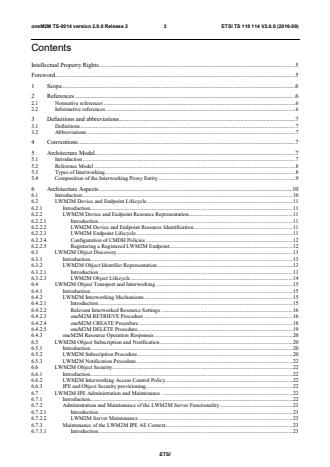
Contents
Intellectual Property Rights . 5
Foreword . 5
1 Scope . 6
2 References . 6
2.1 Normative references . 6
2.2 Informative references . 6
3 Definitions and abbreviations . 7
3.1 Definitions . 7
3.2 Abbreviations . 7
4 Conventions . 7
5 Architecture Model. 7
5.1 Introduction . 7
5.2 Reference Model . 8
5.3 Types of Interworking . 8
5.4 Composition of the Interworking Proxy Entity . 9
6 Architecture Aspects . 10
6.1 Introduction . 10
6.2 LWM2M Device and Endpoint Lifecycle . 11
6.2.1 Introduction. 11
6.2.2 LWM2M Device and Endpoint Resource Representation . 11
6.2.2.1 Introduction . 11
6.2.2.2 LWM2M Device and Endpoint Resource Identification . 11
6.2.2.3 LWM2M Endpoint Lifecycle . 11
6.2.2.4 Configuration of CMDH Policies . 12
6.2.2.5 Registering a Registered LWM2M Endpoint . 12
6.3 LWM2M Object Discovery . 13
6.3.1 Introduction. 13
6.3.2 LWM2M Object Identifier Representation . 13
6.3.2.1 Introduction . 13
6.3.2.3 LWM2M Object Lifecycle . 14
6.4 LWM2M Object Transport and Interworking . 15
6.4.1 Introduction. 15
6.4.2 LWM2M Interworking Mechanisms . 15
6.4.2.1 Introduction . 15
6.4.2.2 Relevant Interworked Resource Settings . 16
6.4.2.3 oneM2M RETRIEVE Procedure . 16
6.4.2.4 oneM2M CREATE Procedure . 18
6.4.2.5 oneM2M DELETE Procedure . 19
6.4.3 oneM2M Resource Operation Responses . 20
6.5 LWM2M Object Subscription and Notification . 20
6.5.1 Introduction. 20
6.5.2 LWM2M Subscription Procedure . 20
6.5.3 LWM2M Notification Procedure . 22
6.6 LWM2M Object Security . 22
6.6.1 Introduction. 22
6.6.2 LWM2M Interworking Access Control Policy . 22
6.6.3 IPE and Object Security provisioning . 22
6.7 LWM2M IPE Administration and Maintenance . 22
6.7.1 Introduction. 22
6.7.2 Administration and Maintenance of the LWM2M Server Functionality . 23
6.7.2.1 Introduction . 23
6.7.2.2 LWM2M Server Maintenance . 23
6.7.3 Maintenance of the LWM2M IPE AE Context. 23
6.7.3.1 Introduction . 23
ETSI
oneM2M TS-0014 version 2.0.0 Release 2 4 ETSI TS 118 114 V2.0.0 (2016-09)
6.7.3.2 LWM2M Endpoint List . 23
6.7.3.3 Configuration of Interworking Functions. 24
6.8 LWM2M Client Provisioning (Bootstrap) . 24
7 Transparent Interworking Function . 24
7.1 Introduction . 24
7.2 Attribute Mapping for the Resources . 24
8 Semantically Enabled Interworking Function (Informative). 25
8.1 Introduction . 25
8.2 Organization of Semantically Enabled Content Sharing Resources . 25
8.2.1 Introduction. 25
8.2.2 Lifecycle of Semantically Enabled Content Sharing Resources . 26
8.2.3 Mapping for the Encoding of the Resource . 26
8.3 Guidelines for Mapping to the Base Ontology . 27
8.3.1 Introduction. 27
8.3.2 Mapping of the LWM2M Client . 27
8.3.4 Mapping of the LWM2M Object, Object Instance. Resource and Resource Instance . 27
8.3.4.1 Introduction . 27
Annex A (Informative): Introduction to OMA LightweightM2M (LWM2M) . 29
A.1 Introduction . 29
A.2 Architecture . 30
A.3 Terminology . 31
A.4 Reference Points . 31
A.4.1 Introduction . 31
A.4.2 Functional Components . 31
A.4.2.1 LWM2M Server . 31
A.4.2.2 LWM2M Client . 31
A.4.3 Interfaces . 31
A.5 Protocols . 32
A.5.1 Protocol Stack . 32
A.5.2 Data Model . 32
A.5.3 Interface Descriptions . 33
A.5.3.1 Bootstrap . 33
A.5.3.2 Client Registration . 34
A.5.3.3 Device Management and Service Enablement . 34
A.5.3.4 Information Reporting . 35
A.6 Functions . 36
History . 37
ETSI
oneM2M TS-0014 version 2.0.0 Release 2 5 ETSI TS 118 114 V2.0.0 (2016-09)
Intellectual Property Rights
IPRs essential or potentially essential to the present document may have been declared to ETSI. The information
pertaining to these essential IPRs, if any, is publicly available for ETSI members and non-members, and can be found
in ETSI SR 000 314: "Intellectual Property Rights (IPRs); Essential, or potentially Essential, IPRs notified to ETSI in
respect of ETSI standards", which is available from the ETSI Secretariat. Latest updates are available on the ETSI Web
server (https://ipr.etsi.org/).
Pursuant to the ETSI IPR Policy, no investigation, including IPR searches, has been carried out by ETSI. No guarantee
can be given as to the existence of other IPRs not referenced in ETSI SR 000 314 (or the updates on the ETSI Web
server) which are, or may be, or may become, essential to the present document.
Foreword
This Technical Specification (TS) has been produced by ETSI Partnership Project oneM2M (oneM2M).
ETSI
oneM2M TS-0014 version 2.0.0 Release 2 6 ETSI TS 118 114 V2.0.0 (2016-09)
1 Scope
The present document specifies the interworking capabilities of the M2M Service Layer between ASN/IN/MN CSEs
and LWM2M Endpoints using the architecture identified in Annex F of ETSI TS 118 101 [2] for the following
interworking scenarios:
• Interworking for transparent transport of encoded LWM2M Objects and commands in Content Sharing
Resources between LWM2M Endpoints and M2M Applications.
• Interworking with full mapping of LWM2M Objects in LWM2M Endpoints to semantically enabled Content
Sharing Resources that are utilized by M2M Applications.
NOTE: The present document limits Content Sharing Resources to and resources.
2 References
2.1 Normative references
References are either specific (identified by date of publication and/or edition number or version number) or
non-specific. For specific references, only the cited version applies. For non-specific references, the latest version of the
referenced document (including any amendments) applies.
Referenced documents which are not found to be publicly available in the expected location might be found at
https://docbox.etsi.org/Reference/.
NOTE: While any hyperlinks included in this clause were valid at the time of publication, ETSI cannot guarantee
their long term validity.
The following referenced documents are necessary for the application of the present document.
[1] ETSI TS 118 111: "oneM2M; Common Terminology (oneM2M TS-0011)".
[2] ETSI TS 118 101: "oneM2M Functional Architecture (oneM2M TS-0001)".
[3] OMA-TS-LightweightM2M-V1-0-20150318-D: "Lightweight Machine to Machine Technical
Specification".
[4] ETSI TS 118 103: "oneM2M; Security solutions (oneM2M TS-0003)".
2.2 Informative references
References are either specific (identified by date of publication and/or edition number or version number) or
non-specific. For specific references, only the cited version applies. For non-specific references, the latest version of the
referenced document (including any amendments) applies.
NOTE: While any hyperlinks included in this clause were valid at the time of publication, ETSI cannot guarantee
their long term validity.
The following referenced documents are not necessary for the application of the present document but they assist the
user with regard to a particular subject area.
[i.1] oneM2M Drafting Rules.
NOTE: Available at http://www.onem2m.org/images/files/oneM2M-Drafting-Rules.pdf
[i.2] IETF RFC 7252: "Constrained Application Protocol (CoAP)".
[i.3] IETF RFC 6347: "Datagram Transport Layer Security Version 1.2".
[i.4] OMA OMA-RD-LightweightM2M-V1-0: "OMA Lightweight Machine to Machine Requirement".
ETSI
oneM2M TS-0014 version 2.0.0 Release 2 7 ETSI TS 118 114 V2.0.0 (2016-09)
[i.5] ETSI TS 118 112: "oneM2M; Base Ontology (oneM2M TS-0012)".
3 Definitions and abbreviations
3.1 Definitions
For the purposes of the present document, the terms and definitions given in ETSI TS 118 111 [1] apply. A term defined
in the present document takes precedence over the definition of the same term, if any, in ETSI TS 118 111 [1] and ETSI
TS 118 101 [2].
3.2 Abbreviations
For the purposes of the present document, the terms and definitions given in ETSI TS 118 111 [1] and the following
apply:
LWM2M Lightweight M2M
OMA Open Mobile Alliance
4 Conventions
The key words "Shall", "Shall not", "May", "Need not", "Should", "Should not" in this document are to be interpreted as
described in the oneM2M Drafting Rules [i.1].
5 Architecture Model
5.1 Introduction
The architecture model followed in the present document is based on the architecture model in Annex F of ETSI TS 118
101 [2] that describes how interworking between CSEs and non-oneM2M solutions and protocol using specialized
Interworking Proxy application Entities (IPE). The present document describes the LWM2M IPE that supports the
following scenarios.
Hybrid Application LWM2M Application
LWM2M
LWM2M
Interface
Interface
LWM2M
LWM2M
Mca IPE
IPE
Mca
Mca
()
CSE(s)
Figure 5.1-1: LWM2M Interworking Scenarios
In the scenarios depicted in Figure 5.1-1, the Hybrid and LWM2M Applications represent applications that implement
the LWM2M Client role defined in the LWM2M Protocol [3].
ETSI
oneM2M TS-0014 version 2.0.0 Release 2 8 ETSI TS 118 114 V2.0.0 (2016-09)
5.2 Reference Model
The LWM2M Interworking reference model utilizes the Functional Architecture's reference model in ETSI TS 118
101 [2]; augmenting the ETSI TS 118 101 [2] reference model with capabilities provided by the LWM2M IPE.
LWM2M AE
Application
LWM2M Protocol
LWM2M
Mca
IPE
Mca
Mcc/Mcc’
CSE CSE
ASN/MN/IN MN/IN
NOTE: The AE in the reference model could be registered with the same CSE as the LWM2M IPE.
Figure 5.2-1: LWM2M Reference Model
5.3 Types of Interworking
LWM2M IPEs provide the following types of interworking:
1) Interworking using the Content Sharing Resource for transparent transport of encoded LWM2M Objects that
are available to AEs as depicted in Figure 5.3-1.
2) Interworking with full mapping of the semantics of LWM2M Objects to semantically enabled resources that
are available to AEs as depicted in Figure 5.3-2.
3) While depicted outside the hosting CSE, the Content Sharing Resources are hosted in a CSE (e.g. CSE1).
LWM2M
provides
AE
Application
LWM2M
Obje cts
uses
LWM2M Protocol
uses
Content Sharing Resource
LWM2 M
LWM2M
Objects
encapsulates
Mca
(Ser iali zed )
IPE
Mca
Mcc/Mcc’
CSE1 CSE2
Figure 5.3-1: LWM2M Transparent Interworking Function
ETSI
oneM2M TS-0014 version 2.0.0 Release 2 9 ETSI TS 118 114 V2.0.0 (2016-09)
In Figure 5.3-1, the LWM2M Objects are provided by the LWM2M Application to the LWM2M IPE using the
LWM2M Protocol. The LWM2M IPE then encapsulates the LWM2M Objects in Content Sharing Resources and then
hosts the Content Sharing Resources in a CSE using the Mca reference points for use by AEs. The AE accesses the
Content Sharing Resource from the CSE that hosts the resource using the Mca reference point. Once the AE receives
the Content Sharing Resource, the AE extracts the LWM2M Object from the Content Sharing Resource for the AE's
purpose. Clause 7 describes this type of interworking in greater detail.
LWM2M
provides
AE
Application
LWM2M
Obje cts
uses
LWM2M Protocol
uses
Semantically
Enabled
LWM2M
Content
encapsulates
Mca
Sharing
IPE
Resource
Mca
Mcc/Mcc’
CSE1 CSE2
Figure 5.3-2: LWM2M Semantically Enabled Interworking Function
In Figure 5.3-2, the LWM2M Objects are provided by the LWM2M Application to the LWM2M IPE using the
LWM2M Protocol. The LWM2M IPE then interworks the LWM2M Objects into Content Sharing Resources. The
Content Sharing Resources are based on the oneM2M defined Semantic Ontology. The LWM2M IPE hosts the Content
Sharing Resource in a CSE across the Mca reference for use by other AEs. The AE accesses the Content Sharing
Resource from the CSE that hosts the resource using the Mca reference point. Once the AE receives the Content
Sharing Resource, the AE encodes the information using the Semantic Ontology for the AE's purpose. Clause 8
describes this type of interworking in greater detail.
An instance of a LWM2M IPE shall provide the capability for transparent transport of encapsulated LWM2M Objects
as Content Sharing Resources and/or translation of LWM2M Objects as oneM2M semantically enabled Content
Sharing Resources.
5.4 Composition of the Interworking Proxy Entity
The LWM2M IPE participation in the LWM2M Protocol as described in clause 5 does so in the role of a LWM2M
Server to which LWM2M Applications (LWM2M Clients) interact. For each LWM2M Client (Endpoint) that is
maintained by the LWM2M Server in the LWM2M IPE, the LWM2M IPE shall instantiate and maintains an instance of
a Resource of type .
ETSI
oneM2M TS-0014 version 2.0.0 Release 2 10 ETSI TS 118 114 V2.0.0 (2016-09)
Figure 5.4-1: LWM2M IPE Architecture
6 Architecture Aspects
6.1 Introduction
The LWM2M IPE participation in the LWM2M Protocol as described in clause 5 does so in the role of a LWM2M
Server to which LWM2M Applications (LWM2M Clients) interact. As a LWM2M Server, the IPE provides the
following Architecture Aspects based on the LWM2M Protocol Aspects described in clause A.2:
• LWM2M Device and Endpoint Lifecycle (Client Registration).
• LWM2M Object Discovery (Client Registration, Device Management and Service Enablement).
• LWM2M Object Transport and Interworking (Device Management and Service Enablement).
• LWM2M Object Subscription and Notification (Information Reporting).
• LWM2M Interworking Proxy Entity Administration.
• LWM2M Client Provisioning (Bootstrap).
ETSI
oneM2M TS-0014 version 2.0.0 Release 2 11 ETSI TS 118 114 V2.0.0 (2016-09)
• LWM2M Object Security (Device Management and Service Enablement).
6.2 LWM2M Device and Endpoint Lifecycle
6.2.1 Introduction
As the LWM2M IPE discovers LWM2M Endpoints when the LWM2M IPE interacts with the LWM2M Client over the
LWM2M protocol's Bootstrap and Client Registration interfaces, the LWM2M IPE shall maintain the associated
resources in the CSE that represents the LWM2M Device and Endpoint.
6.2.2 LWM2M Device and Endpoint Resource Representation
6.2.2.1 Introduction
LWM2M Endpoint provides the management and control functions for an M2M Application on a device. As such, the
CSE that hosts the M2M Application shall represent the LWM2M Endpoint as a resource (LWM2M Endpoint
resource). The LWM2M Device that hosts the LWM2M Endpoint shall be represented as a resource.
6.2.2.2 LWM2M Device and Endpoint Resource Identification
LWM2M Endpoints are identified by their Endpoint Client Name described in clause 6.2.1 of the LWM2M Technical
Specification [3]. The Endpoint Client Name URN without the "urn:" sequence is used as the AE-ID of the associated
resource that represents the LWM2M Client.
In most deployment scenarios, LWM2M Devices host one (1) LWM2M Endpoint. In this scenario the LWM2M
Device's resource's M2M-Node-ID should be the same as the LWM2M Endpoint Client Name URN without
the "urn:" sequence. When a LWM2M Device host's more than one (>1) LWM2M Endpoint, the determination of the
resource's M2M-Node-ID is implementation specific. In all deployment scenarios, the resource is linked
with the resource as described in ETSI TS 118 101 [2].
As the LWM2M Endpoint is represented as an resource and a LWM2M Object is represented as a Content
Sharing Resource in the M2M Service Layer, a reference shall be made between the resource that represents the
LWM2M Endpoint and the Content Sharing Resources which represents the list of LWM2M Objects and Object
Instances available in that LWM2M Client.
In order to identify interworked entities hosted in a CSE for the LWM2M technology described in this present
document, the resource that represents the LWM2M Endpoint and the Content Sharing Resources which
represent the list of LWM2M Objects and Object Instances available in that LWM2M Client, shall have a
Iwked_Technology labels attribute set to LWM2M.
In addition the resource uses the Hierarchical and Non-Hierarchical mechanisms for Resource Addressing as
defined in clause 9.3.1 of ETSI TS 118 101 [2] where the resourceName attribute of the resource shall be a
Endpoint Client Name URN without the "urn:" sequence.
6.2.2.3 LWM2M Endpoint Lifecycle
LWM2M Endpoint's are discovered when the LWM2M Client is successfully registers with the LWM2M Server using
the LWM2M Register operation. In addition to the LWM2M Register operation, the LWM2M Client can periodically
refresh the LWM2M Client's registration with the LWM2M IPE using the LWM2M Update operation. Finally a
LWM2M Client can deregister when the LWM2M Client issues a De-register operation to the LWM2M IPE or the
LWM2M Client's registration lifetime expires.
The LWM2M Client Registration interface's operations and the registration lifetime expiration event maps to the
following operations on the and resources.
ETSI
oneM2M TS-0014 version 2.0.0 Release 2 12 ETSI TS 118 114 V2.0.0 (2016-09)
Table 6.2.2.3-1: LWM2M Endpoint Lifecycle Translation – Client Registration Interface
LWM2M Operation
oneM2M Resource and Operation
Client Registration Interface
Register create , create
Update update , update
De-register delete , delete
Table 6.2.2.3-2: LWM2M Endpoint Lifecycle Translation – LWM2M Server Events
LWM2M Server Events oneM2M Resource and Operation
client lifetime expiration delete , delete , delete resources
associated with the resource.
Table 6.2.2.3-3: LWM2M Endpoint Lifecycle Attribute Translation
LWM2M Attributes
oneM2M Resource Attribute
Client Registration Interface
Endpoint Client Name : AE-ID, resourceName
: M2M-Node-ID when the Device only supports one
Endpoint; resourceName
Lifetime , : expirationTime
LWM2M Version , : labels. Value is "Iwked-Entity-
Version:"appended with the value of the LWM2M Version.
Binding Mode Not Applicable
SMS Number Not Applicable
Table 6.2.2.3-4: LWM2M Endpoint Lifecycle Response Code Translation
LWM2M Errors
oneM2M Resource Operation Response
Client Registration Interface
Register create , create
2.01 Created: 2001 Created
4.00 Bad Request All other codes
4.03 Forbidden 4105 Conflict
Update update , update
2.04 Changed 2004 Changed
4.00 Bad Request All other codes
4.04 Not Found 4000 Not Found
De-register delete , delete
2.02 Deleted 2002 Deleted
4.04 Not Found 4004 Not Found
6.2.2.4 Configuration of CMDH Policies
In the present document, the CMDH Policies associated with the resource for the AE is implementation
specific.
6.2.2.5 Registering a Registered LWM2M Endpoint
In the scenario where a LWM2M Client issues a Register operation for an AE that is already created, the LWM2M IPE
shall treat the operation as if the LWM2M Client requested a De-Register (Delete resource) prior this Register
operation (Create resource) as described in Table 6.2.2.3-1. The procedure for the LWM2M Server is defined in
clause 5.3.1 of the LWM2M Technical Specification [3].
ETSI
oneM2M TS-0014 version 2.0.0 Release 2 13 ETSI TS 118 114 V2.0.0 (2016-09)
6.3 LWM2M Object Discovery
6.3.1 Introduction
The LWM2M Client uses the Registration Interface to provide the properties required by the LWM2M Server of the
IPE to contact the LWM2M Client (e.g. Endpoint Name) and to maintain the session between these two LWM2M
entities (e.g. Lifetime, Queue Mode).In addition, the LWM2M Client also provides the knowledge of the supported
Objects and existing Object Instances across the Registration Interface.
The LWM2M IPE uses the information exchange across this interface to synchronize which LWM2M Objects
supported by the LWM2M Endpoint and what is defined in the hosting CSE for the M2M Application representing the
LWM2M Endpoint. This clause specifies how discovered LWM2M Objects identifiers are translated to discoverable
Content Sharing Resources along with the associated linkages to other resources.
6.3.2 LWM2M Object Identifier Representation
6.3.2.1 Introduction
Through the Registration Interface, the LWM2M Client provides the list of supported LWM2M Objects and existing
LWM2M Object Instances. Each element of the list is described by its path, which can be the path of an Object or an
Object Instance.
For example the LWM2M Client could provide the following list of paths: , , , , ,
, . This list of paths is a valid list of LWM2M Objects and LWM2M Object Instances in the CoRE Link
Format [RFC6690], specifying that LWM2M Objects with OMNA Identifiers 1, 2, 3,4, and 5 are supported. The
respective OMNA references are : urn:oma:lwm2m:oma:1, urn:oma:lwm2m:oma:2, urn:oma:lwm2m:oma:3,
urn:oma:lwm2m:oma:4, urn:oma:lwm2m:oma:5.
Additionally, information is provided that LWM2M Object 1 (Server Object) and LWM2M Object 2 (Access Control
Object) have 2 instances (Instance Identifiers 0 and 1); LWM2M Object 3 (Device Object) and LWM2M Object 4
(Connectivity Monitoring Object) have 1 instance each (0); LWM2M Object 5 is supported but no instance has been
created yet for that LWM2M Object.
Optionally other information can be carried by that list as the capability for all the Objects in the LWM2M Client to
support:
• an alternate root path (default root path is '/');
• a specific Content-Format (e.g. LWM2M JSON Content-Format).
For discovery of LWM2M Objects by M2M Applications, the properties carried by LWM2M Objects list (i.e.
technology, Objects and LWM2M Object Instances Identifiers, optional alternate rootpath, supported Content-Format)
shall be translated into the labels attribute of the Content Sharing Resource as separate entries with the following
format:
• Iwked-Technology:LWM2M
• Iwked-Entity-Type:Resource Type.
• LWM2M-PATH:Resource Root Path (for LWM2M default rootpath is "/").
• Iwked-Entity-ID:Resource Path Object Identifier and Instance Identifier.
• Iwked-Content-Type: Supported Content Format (LWM2M default Supported ContentFormat is LWM2M
TLV other can be LWM2M JSON).
For example if the LWM2M Endpoint provided the following LWM2M Objects as part of the Client Registration
Interface: ;rt="oma.lwm2m";ct=LWM2M+JSON, would translate into a resource with
the following entries in the labels attribute: Iwked-Technology:LWM2M Iwked-Entity-Type:"urn:oma:lwm2m:oma:1"
LWM2MPTH:"/lwm2m" Iwked-Entity-ID: "/1/0" Iwked-Content-Type:LWM2M+JSON (see note).
ETSI
oneM2M TS-0014 version 2.0.0 Release 2 14 ETSI TS 118 114 V2.0.0 (2016-09)
NOTE: LWM2M+JSON is an entry (numerical ID) in the CoAP Content-Format Registry representing the
media-type "application/vnd.oma.lwm2m+json" used in LWM2M TS 1.0 enabler and currently engaged
in the IANA registration process.
The CoAP Resource Type may also be used as the semantic ontology of the resource by inserting this
value in the ontologyRef attribute of the resource.
LWM2M Object Resources are identified by their URI within the context of the LWM2M Endpoint described in
clause 6.2.1 of the LWM2M Technical Specification [3].
As the LWM2M Endpoint is represented as an resource and a LWM2M Object is represented as a Content
Sharing Resource in the M2M Service Layer, a reference shall be made between the resource that represents the
LWM2M Endpoint and the Content Sharing Resources which represent the list of LWM2M Objects and Object
Instances available in the LWM2M Client.
In addition, Content Sharing Resources that represents the LWM2M Object or LWM2M Object Instance uses the
Hierarchical and Non-Hierarchical mechanisms for Resource Addressing as defined in clause 9.3.1 of ETSI
TS 118 101 [2] where the resourceName attribute of the Content Sharing Resource shall be the value of the
LWM2MURI.
For example if the LWM2MURI is "/1/0 and the LWM2MPTH is "/" then the resourceName attribute of the Content
Sharing Resource could be "/1/0".
6.3.2.3 LWM2M Object Lifecycle
LWM2M Endpoint's are discovered when the LWM2M Client is successfully registers with the LWM2M Server using
the LWM2M Register operation. In addition to the LWM2M Register operation, the LWM2M Client can periodically
refresh the LWM2M Client's registration with the LWM2M IPE using the LWM2M Update operation. Finally a
LWM2M Client can deregister when the LWM2M Client issues a De-register operation to the LWM2M IPE or the
LWM2M Client's registration lifetime expires.
The LWM2M Client Registration interface's operations and the registration lifetime expiration event maps to the
following operations on the Content Sharing Resource.
Table 6.3.2.3-1: LWM2M Object Lifecycle Translation – Client Registration Interface
LWM2M Operation
oneM2M Resource and Operation
Client Registration Interface
Register create
Update update , delete
De-register delete
Table 6.3.2.3-2: LWM2M Object Lifecycle Translation – LWM2M Server Events
LWM2M Server Events oneM2M Resource and Operation
Client lifetime expiration delete
Table 6.3.2.3-3: LWM2M Object Lifecycle Attribute Translation
LWM2M Attributes
oneM2M Resource Attribute
Client Registration Interface
Endpoint Client Name Not Applicable
Resource Links resourceName
Lifetime expirationTime
LWM2M Version Not Applicable
Binding Mode Not Applicable
SMS Number Not Applicable
ETSI
oneM2M TS-0014 version 2.0.0 Release 2 15 ETSI TS 118 114 V2.0.0 (2016-09)
Table 6.2.2.3-4: LWM2M Object Lifecycle Response Code Translation
LWM2M Errors
oneM2M Resource Operation Response
Client Registration Interface
Register create
2.01 Created: 2001 Created
4.00 Bad Request All other codes
4.03 Forbidden 4105 Conflict
Update update
2.04 Changed 2004 Changed
4.00 Bad Request All other codes
4.04 Not Found 4000 Not Found
De-register delete
2.02 Deleted 2002 Deleted
4.04 Not Found 4004 Not Found
6.4 LWM2M Object Transport and Interworking
6.4.1 Introduction
When an oneM2M request is addressed from a CSE/AE to a hosting CSE containing the representation of a LWM2M
Client, the oneM2M response to the Originator of the request is returned through the cooperation of the hosting CSE
and the IPE.
The LWM2M Client uses the Device Management & Service Enablement interface to provide the capabilities for the
LWM2M Server of the IPE to access LWM2M Objects, Objects Instances and Resources available from the LWM2M
Client.
A hosting CSE maintains a representation of the LWM2M Data Model of LWM2M Object, Object Instance or
Resources as instances of oneM2M resource types. These oneM2M resources are instantiated and registered as
described in clause 6.3 allowing oneM2M AEs and CSEs to exchange data with LWM2M Clients.
In reference to clause 6.3, at the end of the registration phase all declared LWM2M Object Instances and LWM2M
Objects are associated to a Content Sharing Resource created with the resourceName attribute set accordingly to the
proper LWM2M Object Instance path (e.g. /9/1) or to the LWM2M Object path (e.g. /9).
6.4.2 LWM2M Interworking Mechanisms
6.4.2.1 Introduction
Cooperation between IPE and the oneM2M hosting CSE requires efficient mechanisms to maintain the latest state of the
targeted LWM2M Objects, Object Instances and Resources. These mechanisms include data synchronization between
the IPE and hosting CSE.
Data synchronization relies on the oneM2M Subscription/Notification and LWM2M Observation/Notification
mechanisms. For automated data synchronization between the IPE and hosting CSE to be achieved, the solution shall be
granular enough to allow data synchronization for each LWM2M Object Instance.
Access Control mechanisms relies on an interworking between oneM2M and LWM2M Access Control Policies.
LWM2M and oneM2M mechanisms used to achieve Data Synchronization and Access Control is specified in more
details in clauses 6.5 and 6.6.
These following sub-clauses specify the sequences of operations involved for each type of supported oneM2M requests
following the general procedures specified in clause 10 (CREATE,RETRIEVE, DELETE) as used within the context of
the interworking for the present document
ETSI
oneM2M TS-0014 version 2.0.0 Release 2 16 ETSI TS 118 114 V2.0.0 (2016-09)
6.4.2.2 Relevant Interworked Resource Settings
A LWM2M Object Instance is represented in oneM2M as a Content Sharing Resource with 2 direct children resource
types: a resource and a resource when used with a resource.
For supporting the LWM2M interworking process, a few attributes for the Content Sharing Resource and the
resource shall have a specified set of parameters.
a) Attributes of Content Sharing Resource.
Table 6.4.2.2-1: resource – Relevant Interworked Attributes
Attributes of resource Value
accessControlPolicyIDs ACP set (see Clause 6.6)
maxNrOfInstances 1
b) Child resource types of resource.
Table 6.4.2.2-2: resource – Relevant Child resource types
Child resources of resource
resource
resource
c) Attributes of resource.
Table 6.4.2.2-3: resource – Relevant Interworked Attributes
Attributes of Description / Value
notificationURI IPE URI
eventType B. Deletion of the subscribed-to resource;
C. Creation of a direct child of the subscribed-to resource;
E. An attempt to retrieve a direct-child-resource of a
subscribed-to resource is performed while this child is an
obsolete resource or the reference used for retrieving this resource is
not assigned.This retrieval is performed by a RETRIEVE request
targeting the subscribed-to resource with the Result Content parameter
set to either "child-resources" or "attributes+child-resources".
6.4.2.3 oneM2M RETRIEVE Procedure
This procedure describes the retrieval of a resource using the oneM2M RETRIEVE request. The information contained
within the resource is related to the LWM2M Objects Instances that are interworked through the IPE. This clause shall
be treated in conformance with the RETRIEVE Procedure specified in ETSI TS 118 101 [2], clauses 10.1.2 and
10.2.4.2.
The Receiver performs local processing to verify the existence of requested Resource and checks privileges for
retrieving the information related to the resource. After successful verification, the Receiver shall return the requested
information according to the procedures for the type of interworking (e.g. Transparent, Semantically Enabled) as
described in clause 7 and 8, otherwise an error response shall be returned to the Originator.
ETSI
oneM2M TS-0014 version 2.0.0 Release 2 17 ETSI TS 118 114 V2.0.0 (2016-09)
Figure 6.4.2.3-1: Procedure f
...
Questions, Comments and Discussion
Ask us and Technical Secretary will try to provide an answer. You can facilitate discussion about the standard in here.
Loading comments...