


ETSI TS 103 606 V1.1.1 (2018-05)
Hybrid Broadcast Broadband Television; Operator Applications
Hybrid Broadcast Broadband Television; Operator Applications
DTS/JTC-048
General Information
Standards Content (Sample)
TECHNICAL SPECIFICATION
Hybrid Broadcast Broadband Television;
Operator Applications
2 ETSI TS 103 606 V1.1.1 (2018-05)
Reference
DTS/JTC-048
Keywords
broadcasting, DVB, HTML, internet
ETSI
650 Route des Lucioles
F-06921 Sophia Antipolis Cedex - FRANCE
Tel.: +33 4 92 94 42 00 Fax: +33 4 93 65 47 16
Siret N° 348 623 562 00017 - NAF 742 C
Association à but non lucratif enregistrée à la
Sous-Préfecture de Grasse (06) N° 7803/88
Important notice
The present document can be downloaded from:
http://www.etsi.org/standards-search
The present document may be made available in electronic versions and/or in print. The content of any electronic and/or
print versions of the present document shall not be modified without the prior written authorization of ETSI. In case of any
existing or perceived difference in contents between such versions and/or in print, the only prevailing document is the
print of the Portable Document Format (PDF) version kept on a specific network drive within ETSI Secretariat.
Users of the present document should be aware that the document may be subject to revision or change of status.
Information on the current status of this and other ETSI documents is available at
https://portal.etsi.org/TB/ETSIDeliverableStatus.aspx
If you find errors in the present document, please send your comment to one of the following services:
https://portal.etsi.org/People/CommiteeSupportStaff.aspx
Copyright Notification
No part may be reproduced or utilized in any form or by any means, electronic or mechanical, including photocopying
and microfilm except as authorized by written permission of ETSI.
The content of the PDF version shall not be modified without the written authorization of ETSI.
The copyright and the foregoing restriction extend to reproduction in all media.
© ETSI 2018.
© European Broadcasting Union 2018.
All rights reserved.
TM TM TM
DECT , PLUGTESTS , UMTS and the ETSI logo are trademarks of ETSI registered for the benefit of its Members.
TM TM
3GPP and LTE are trademarks of ETSI registered for the benefit of its Members and
of the 3GPP Organizational Partners.
oneM2M logo is protected for the benefit of its Members. ®
GSM and the GSM logo are trademarks registered and owned by the GSM Association.
ETSI
3 ETSI TS 103 606 V1.1.1 (2018-05)
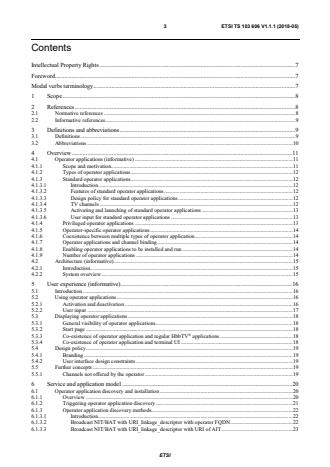
Contents
Intellectual Property Rights . 7
Foreword . 7
Modal verbs terminology . 7
1 Scope . 8
2 References . 8
2.1 Normative references . 8
2.2 Informative references . 9
3 Definitions and abbreviations . 9
3.1 Definitions . 9
3.2 Abbreviations . 10
4 Overview . 11
4.1 Operator applications (informative) . 11
4.1.1 Scope and motivation. 11
4.1.2 Types of operator applications . 12
4.1.3 Standard operator applications . 12
4.1.3.1 Introduction . 12
4.1.3.2 Features of standard operator applications . 12
4.1.3.3 Design policy for standard operator applications . 12
4.1.3.4 TV channels . 12
4.1.3.5 Activating and launching of standard operator applications . 13
4.1.3.6 User input for standard operator applications . 13
4.1.4 Privileged operator applications . 13
4.1.5 Operator-specific operator applications . 14
4.1.6 Coexistence between multiple types of operator application . 14
4.1.7 Operator applications and channel binding . 14
4.1.8 Enabling operator applications to be installed and run . 14
4.1.9 Number of operator applications . 14
4.2 Architecture (informative) . 15
4.2.1 Introduction. 15
4.2.2 System overview . 15
5 User experience (informative) . 16
5.1 Introduction . 16
5.2 Using operator applications . 16
5.2.1 Activation and deactivation . 16
5.2.2 User input . 17
5.3 Displaying operator applications . 18
5.3.1 General visibility of operator applications . 18
5.3.2 Start page . 18 ®
5.3.3 Co-existence of operator application and regular HbbTV applications . 18
5.3.4 Co-existence of operator application and terminal UI . 18
5.4 Design policy . 19
5.4.1 Branding . 19
5.4.2 User interface design constraints . 19
5.5 Further concepts . 19
5.5.1 Channels not offered by the operator . 19
6 Service and application model . 20
6.1 Operator application discovery and installation . 20
6.1.1 Overview . 20
6.1.2 Triggering operator application discovery . 21
6.1.3 Operator application discovery methods . 22
6.1.3.1 Introduction . 22
6.1.3.2 Broadcast NIT/BAT with URI_linkage_descriptor with operator FQDN. 22
6.1.3.3 Broadcast NIT/BAT with URI_linkage_descriptor with URI of AIT . 23
ETSI
4 ETSI TS 103 606 V1.1.1 (2018-05)
6.1.3.4 NIT from CICAM with uri_linkage_descriptor with URI of XML AIT . 23
6.1.3.5 Hardwired in terminal with operator FQDN . 23
6.1.3.6 Hardwired in terminal with URI of XML AIT . 23
6.1.3.7 DNS SRV lookup to a standardized address . 23
6.1.4 DNS SRV lookup process . 23
6.1.5 (XML) AIT acquisition and download . 24
6.1.5.1 XML AIT acquisition . 24
6.1.5.2 AIT Acquisition . 25
6.1.6 Deciding which operator applications to install . 26
6.1.7 Encrypted application package download . 26
6.1.7.1 Introduction (informative) . 26
6.1.7.2 Encrypted application package download via IP . 26
6.1.7.3 Encrypted application package download via DSM-CC object carousel . 26
6.1.8 Decrypt, verify, unpack and installation of the application package . 27
6.1.9 Installation failures . 27
6.1.9.1 Installation failure overview. 27
6.1.9.2 Failure handling on first-time installation . 27
6.1.9.3 Failure handling when updating an operator application . 28
6.2 Updating operator applications . 28
6.3 Operator application lifecycle . 28
6.3.1 Introduction. 28
6.3.2 Starting and stopping operator applications . 29
6.3.2.1 Summary (Informative) . 29
6.3.2.2 Starting operator applications. 29
6.3.2.3 Stopping operator applications . 29
6.3.2.4 Co-existence of multiple operator applications . 29
6.3.3 Operator application states . 30
6.3.3.1 Introduction . 30
6.3.3.2 Foreground state . 30
6.3.3.3 Background state . 31
6.3.3.4 Transient state . 32
6.3.3.5 Overlaid foreground state . 33
6.3.3.6 Overlaid transient state . 33
6.4 UI elements provided by an operator application . 34 ®
6.5 Regular HbbTV application signalling and lifecycle . 35
6.5.1 Application signalling . 35 ®
6.5.2 Starting and stopping regular HbbTV applications . 35 ®
6.5.3 Running regular HbbTV applications with an operator application in the foreground . 35
6.6 Multiple operator applications . 36
6.6.1 Supported operators . 36
6.6.2 Adding operators and operator applications to terminals. 37
6.6.3 Installed operator applications . 37
6.7 Removal of operator applications . 37
7 Formats and protocols . 38
7.1 Operator application signalling . 38
7.1.1 Launch and startup context signalling . 38
7.1.2 Status launch parameter . 39
7.2 Extensions to broadcast signalling . 40
7.2.1 Application overlay descriptor . 40
7.2.2 Application version descriptor . 40
7.3 Extensions to broadcast-independent application signalling . 41
7.3.1 Minimum application version . 41
7.4 Operator application ZIP File . 42
7.4.1 Operator application ZIP File Format . 42
7.4.2 Interoperability Considerations . 42
7.4.3 Operator application ZIP File failure conditions . 43
7.4.4 Application ZIP file contents . 44
8 Browser application environment . 44
8.1 Execution model . 44
8.2 DAE specification usage . 44
ETSI
5 ETSI TS 103 606 V1.1.1 (2018-05)
8.3 New JavaScript APIs . 44
8.3.1 APIs for access to proprietary functions . 44
8.4 Web APIs . 46
8.4.1 Web Notifications . 46
8.4.1.1 Requirements . 46
8.4.1.2 Usage guidelines . 46
8.5 APIs defined in ETSI TS 102 796 . 47
8.5.1 Modification to terminalChannel . 47
9 System integration . 47
9.1 Media decoder and tuner resource conflict resolution . 47
9.1.1 Overview (informative) . 47
9.1.2 Sharing resources for a video/broadcast object . 47
9.1.3 Sharing resources for other media decoders . 48
9.1.4 Broadcast video presentation and privileged operator applications . 48
9.2 Channel lists (informative) . 49
9.2.1 Background . 49
9.2.2 Operator applications and channel lists . 49
9.3 Display model . 50
9.4 URLs . 50
9.4.1 Origin for an installed operator application . 50
9.4.2 Referencing installed operator applications and resources . 50
9.5 Access to broadcast carousels . 51
10 Capabilities . 51
10.1 Terminal capabilities and functions . 51
10.1.1 Component selection. 51
10.1.1.1 Introduction . 51
10.1.1.2 Component selection via user preferences . 52
10.1.1.3 Direct component selection via BroadcastSupervisor class . 52
10.1.1.4 Standard direct component selection . 53 ®
10.1.1.5 Clarification of component selection by regular HbbTV applications . 53
10.1.2 Minimum terminal capabilities . 53
10.1.3 User Input . 53 ®
10.1.4 HbbTV reported capabilities and option strings . 55
11 Security. 55
11.1 Overview . 55
11.2 Device and Server Authentication . 56
11.2.1 Mutual TLS Authentication . 56
11.2.1.1 Overview . 56
11.2.1.2 Client certificate . 56
11.2.1.2.1 Client certificate overview. 56
11.2.1.2.2 Operational considerations . 57
11.2.1.2.3 Client Root and Intermediate Certificate Authority Certificate Profiles . 57
11.2.1.2.4 Client certificate profile . 58
11.2.2 Device authentication in broadcast (informative) . 59
11.3 Operator application authentication . 59
11.3.1 Encrypted application package overview . 59
11.3.2 Operator Signing Certificate . 59
11.3.3 Terminal Packaging Certificate . 61
11.3.4 Encrypted application packaging process . 62
11.3.4.1 Encrypted application packaging process overview . 62
11.3.4.2 Operator application signing process . 62
11.3.4.3 Process for encrypting an application package . 63
11.3.4.4 Process for decrypting an application package . 64
11.3.4.5 Application ZIP package signature verification process . 64
11.4 CI Plus . 65
11.4.1 CI Plus communication . 65
12 Privacy . 65
13 Media synchronization . 66
ETSI
6 ETSI TS 103 606 V1.1.1 (2018-05)
14 Companion screens. 66
Annex A (normative): OIPF specification profile . 67
A.1 Detailed section-by-section definition for volume 5 . 67
A.2 Modifications, extensions and clarifications to OIPF volume 5 . 73
A.2.1 Configuration class . 73
A.2.1.1 Constants . 73
A.2.1.2 Properties . 75
A.2.1.3 Methods . 75
A.2.1.4 Replacing UI relating to scheduled recordings . 75
A.2.1.4.1 Messages . 75
A.2.1.4.2 Conflict resolution (informative) . 76
A.2.1.5 Replacing reminders (informative) . 77
A.2.2 Application class . 77
A.2.2.1 Properties . 77
A.2.2.2 Methods . 78
A.2.2.3 Events . 80
A.2.3 ChannelConfig class . 80
A.2.4 Operator applications and the video/broadcast object . 81
A.2.4.1 Modifications to the state machine . 81
A.2.4.2 Modification to onChannelChangeSucceeded . 81
A.2.5 The BroadcastSupervisor class . 82
A.2.6 oipfDrmAgent . 85
A.2.6.1 Shared use of DRM and Conditional Access messaging in the terminal . 85
A.2.7 oipfRecordingScheduler . 85
A.2.8 Extensions to the application/oipfParentalControlManager object . 86
A.2.8.1 Properties . 86
A.2.9 Extensions to the Channel class . 86
A.2.9.1 Properties . 86 ®
Annex B (normative): HbbTV use of the DVB URI_linkage_descriptor . 87
B.1 Introduction . 87
B.2 URI_linkage_descriptor profile . 87
Annex C (informative): Sequence diagrams . 88
C.1 Channel Change . 88
C.2 Broadband-based operator application discovery . 89
C.3 Broadcast-based operator application discovery and installation . 89
Annex D (informative): Bilateral agreement . 91
History . 93
ETSI
7 ETSI TS 103 606 V1.1.1 (2018-05)
Intellectual Property Rights
Essential patents
IPRs essential or potentially essential to normative deliverables may have been declared to ETSI. The information
pertaining to these essential IPRs, if any, is publicly available for ETSI members and non-members, and can be found
in ETSI SR 000 314: "Intellectual Property Rights (IPRs); Essential, or potentially Essential, IPRs notified to ETSI in
respect of ETSI standards", which is available from the ETSI Secretariat. Latest updates are available on the ETSI Web
server (https://ipr.etsi.org/).
Pursuant to the ETSI IPR Policy, no investigation, including IPR searches, has been carried out by ETSI. No guarantee
can be given as to the existence of other IPRs not referenced in ETSI SR 000 314 (or the updates on the ETSI Web
server) which are, or may be, or may become, essential to the present document.
Trademarks
The present document may include trademarks and/or tradenames which are asserted and/or registered by their owners.
ETSI claims no ownership of these except for any which are indicated as being the property of ETSI, and conveys no
right to use or reproduce any trademark and/or tradename. Mention of those trademarks in the present document does
not constitute an endorsement by ETSI of products, services or organizations associated with those trademarks.
Foreword
This Technical Specification (TS) has been produced by Joint Technical Committee (JTC) Broadcast of the European
Broadcasting Union (EBU), Comité Européen de Normalisation ELECtrotechnique (CENELEC) and the European
Telecommunications Standards Institute (ETSI).
NOTE: The EBU/ETSI JTC Broadcast was established in 1990 to co-ordinate the drafting of standards in the
specific field of broadcasting and related fields. Since 1995 the JTC Broadcast became a tripartite body
by including in the Memorandum of Understanding also CENELEC, which is responsible for the
standardization of radio and television receivers. The EBU is a professional association of broadcasting
organizations whose work includes the co-ordination of its members' activities in the technical, legal,
programme-making and programme-exchange domains. The EBU has active members in about
60 countries in the European broadcasting area; its headquarters is in Geneva.
European Broadcasting Union
CH-1218 GRAND SACONNEX (Geneva)
Switzerland
Tel: +41 22 717 21 11
Fax: +41 22 717 24 81
Modal verbs terminology
In the present document "shall", "shall not", "should", "should not", "may", "need not", "will", "will not", "can" and
"cannot" are to be interpreted as described in clause 3.2 of the ETSI Drafting Rules (Verbal forms for the expression of
provisions).
"must" and "must not" are NOT allowed in ETSI deliverables except when used in direct citation.
ETSI
8 ETSI TS 103 606 V1.1.1 (2018-05)
1 Scope ®
The present document specifies a platform, based on the existing HbbTV specification ETSI TS 102 796 [1], that
supports the signalling, transport and presentation of an operator application. The operator application is able to replace
some of the terminal's user interface. The extent to which the terminal user interface is replaced by an operator
application depends on the type of the operator application and the business models of the operator and manufacturer.
The present document assumes the presence of an agreement between an operator and the device manufacturer.
Operator applications will not run in the absence of such an agreement. Topics that could or need to be covered by such
a bilateral agreement are listed in annex D.
The present document makes use of functionalities described in ETSI TS 102 796 [1] which is describing a platform for
signalling, transport, and presentation of enhanced and interactive applications intended for running on hybrid terminals
that include both a DVB compliant broadcast connection and a broadband connection to the Internet. The usage of a
hybrid terminal for IPTV delivered audio-visual content is described in "IP-delivered Broadcast Channels and Related
Signalling of HbbTV Applications" [i.4].
2 References
2.1 Normative references
References are either specific (identified by date of publication and/or edition number or version number) or
non-specific. For specific references, only the cited version applies. For non-specific references, the latest version of the
referenced document (including any amendments) applies.
Referenced documents which are not found to be publicly available in the expected location might be found at
https://docbox.etsi.org/Reference.
NOTE: While any hyperlinks included in this clause were valid at the time of publication, ETSI cannot guarantee
their long term validity.
The following referenced documents are necessary for the application of the present document.
[1] ETSI TS 102 796: "Hybrid Broadcast Broadband TV".
NOTE: The present document is not suitable to be used with versions before 1.4.1.
[2] Open IPTV Forum Release 2 specification, volume 5 (V2.3): "Declarative Application
Environment".
NOTE: Available at http://www.oipf.tv/specifications.
[3] ETSI TS 102 809: "Digital Video Broadcasting (DVB); Signalling and carriage of interactive
applications and services in Hybrid broadcast/broadband environments".
[4] ETSI TS 102 851: "Digital Video Broadcasting (DVB); Uniform Resource Identifiers (URI) for
DVB Systems".
[5] CI Plus™ specification (V1.3.2) (2015-03): "Content Security Extensions to the Common
Interface".
NOTE: Available from: http://www.ci-plus.com/data/ci-plus_specification_v1.3.2.pdf.
[6] IETF RFC 2782: "A DNS RR for specifying the location of services (DNS SRV)".
[7] ETSI TS 103 205: "Digital Video Broadcasting (DVB); Extensions to the CI Plus™
Specification".
[8] W3C Recommendation "Web Notifications", 22 October 2015.
NOTE: Available at https://www.w3.org/TR/notifications/.
ETSI
9 ETSI TS 103 606 V1.1.1 (2018-05)
[9] ISO/IEC 21320-1 (2015-10-15): "Information Technology - Document Container File".
NOTE: Available at: http://standards.iso.org/ittf/PubliclyAvailableStandards/c060101_ISO_IEC_21320-
1_2015.zip.
[10] IETF RFC 5246: "The Transport Layer Security (TLS) Protocol Version 1.2".
[11] IETF RFC 5280: "Internet X.509 Public Key Infrastructure Certificate and Certificate Revocation
List (CRL) Profile".
[12] IETF RFC 5652: "Cryptographic Message Syntax (CMS)".
[13] IETF RFC 4055: "Additional Algorithms and Identifiers for RSA Cryptography for use in the
Internet X.509 Public Key Infrastructure Certificate and Certificate Revocation List (CRL)
Profile".
[14] ETSI EN 300 468: "Digital Video Broadcasting (DVB); Specification for Service Information (SI)
in DVB systems".
[15] Open IPTV Forum Release 2 specification, volume 7 (V2.3): "Authentication, Content Protection
and Service Protection".
NOTE: Available at http://www.oipf.tv/specifications.
[16] IETF RFC 3986: "Uniform Resource Identifier (URI): Generic Syntax".
[17] IETF RFC 4501: "Domain Name System Uniform Resource Identifiers".
[18] IETF RFC 3447: "Public-Key Cryptography Standards (PKCS) #1: RSA Cryptography
Specifications Version 2.1".
2.2 Informative references
References are either specific (identified by date of publication and/or edition number or version number) or
non-specific. For specific references, only the cited version applies. For non-specific references, the latest version of the
referenced document (including any amendments) applies.
NOTE: While any hyperlinks included in this clause were valid at the time of publication, ETSI cannot guarantee
their long term validity.
The following referenced documents are not necessary for the application of the present document but they assist the
user with regard to a particular subject area.
[i.1] ETSI TS 103 464: "Hybrid Broadcast Broadband TV Application Discovery over Broadband".
[i.2] Open IPTV Forum Release 2.3 specification volume 5a (V2.3): "Web Standards TV Profile".
[i.3] W3C Candidate Recommendation: "Secure Contexts". ®
[i.4] HbbTV : "IP-delivered Broadcast Channels and Related Signalling of HbbTV Applications".
3 Definitions and abbreviations
3.1 Definitions
For the purposes of the present document, the following terms and definitions apply:
bilateral agreement: agreement between a terminal manufacturer and an operator defining commercial, operational,
technical and user interface arrangements for the use of an operator application
broadband: bi-directional IP connection with sufficient bandwidth for streaming or downloading A/V content
ETSI
10 ETSI TS 103 606 V1.1.1 (2018-05)
broadcast: uni-directional MPEG-2 transport stream based broadcast using DVB technologies ®
companion screen device: device (not another HbbTV terminal) that can run applications that in turn link to or work
® ®
with an HbbTV terminal or HbbTV application
NOTE: Such a device can be for example a mobile phone or a tablet.
hybrid terminal: terminal supporting delivery of A/V content both via broadband and broadcast
operator: entity that aggregates a set of channels and offers them to the user
operator application: application from an operator that takes over some of the user interface of the terminal
operator-specific operator application: operator application that is installed on a terminal and that, when it is active,
provides most of the terminal's user interfaces
NOTE: This type of operator applications is intended for set-top-boxes where the manufacturer provides little or
no user interface except perhaps for the basic device setup and installation.
privileged operator applica
...
Questions, Comments and Discussion
Ask us and Technical Secretary will try to provide an answer. You can facilitate discussion about the standard in here.
Loading comments...