


ETSI ES 204 079 V1.1.1 (2024-09)
Environmental Engineering (EE); Method for environmental performance scoring of smartphones
Environmental Engineering (EE); Method for environmental performance scoring of smartphones
DES/EE-MICT4
Okoljski inženiring (EE) - Metoda za ocenjevanje okoljskih lastnosti pametnih telefonov
Cilj tega dokumenta je zagotoviti standardizirano metodo za ocenjevanje okoljskih lastnosti pametnih telefonov. Opredeljena je metoda za pridobitev skupne ocene, ki odraža splošne okoljske lastnosti, pri čemer se upoštevajo vidiki učinkovitosti materiala in ocene življenjskega cikla (LCA). Ocenjujejo se naslednje lastnosti pametnega telefona:
• trajnost;
• zmožnost popravila, ponovne uporabe in nadgradnje;
• zmožnost recikliranja in predelave;
• uporaba nevarnih ali omejenih snovi;
• uporaba recikliranih materialov;
• embalaža in dodatna oprema;
• vplivi na okolje.
General Information
Standards Content (Sample)
Final draft ETSI ES 204 079 V1.1.0 (2024-07)
ETSI STANDARD
Environmental Engineering (EE);
Method for environmental performance scoring of
smartphones
2 Final draft ETSI ES 204 079 V1.1.0 (2024-07)
Reference
DES/EE-MICT4
Keywords
energy consumption, environmental impact,
greenhouse gas emission, ICT, LCA, smartphone
ETSI
650 Route des Lucioles
F-06921 Sophia Antipolis Cedex - FRANCE
Tel.: +33 4 92 94 42 00 Fax: +33 4 93 65 47 16
Siret N° 348 623 562 00017 - APE 7112B
Association à but non lucratif enregistrée à la
Sous-Préfecture de Grasse (06) N° w061004871
Important notice
The present document can be downloaded from:
https://www.etsi.org/standards-search
The present document may be made available in electronic versions and/or in print. The content of any electronic and/or
print versions of the present document shall not be modified without the prior written authorization of ETSI. In case of any
existing or perceived difference in contents between such versions and/or in print, the prevailing version of an ETSI
deliverable is the one made publicly available in PDF format at www.etsi.org/deliver.
Users of the present document should be aware that the document may be subject to revision or change of status.
Information on the current status of this and other ETSI documents is available at
https://portal.etsi.org/TB/ETSIDeliverableStatus.aspx
If you find errors in the present document, please send your comment to one of the following services:
https://portal.etsi.org/People/CommiteeSupportStaff.aspx
If you find a security vulnerability in the present document, please report it through our
Coordinated Vulnerability Disclosure Program:
https://www.etsi.org/standards/coordinated-vulnerability-disclosure
Notice of disclaimer & limitation of liability
The information provided in the present deliverable is directed solely to professionals who have the appropriate degree of
experience to understand and interpret its content in accordance with generally accepted engineering or
other professional standard and applicable regulations.
No recommendation as to products and services or vendors is made or should be implied.
No representation or warranty is made that this deliverable is technically accurate or sufficient or conforms to any law
anty is made of merchantability or fitness
and/or governmental rule and/or regulation and further, no representation or warr
for any particular purpose or against infringement of intellectual property rights.
In no event shall ETSI be held liable for loss of profits or any other incidental or consequential damages.
Any software contained in this deliverable is provided "AS IS" with no warranties, express or implied, including but not
limited to, the warranties of merchantability, fitness for a particular purpose and non-infringement of intellectual property
rights and ETSI shall not be held liable in any event for any damages whatsoever (including, without limitation, damages
for loss of profits, business interruption, loss of information, or any other pecuniary loss) arising out of or related to the use
of or inability to use the software.
Copyright Notification
No part may be reproduced or utilized in any form or by any means, electronic or mechanical, including photocopying and
microfilm except as authorized by written permission of ETSI.
The content of the PDF version shall not be modified without the written authorization of ETSI.
The copyright and the foregoing restriction extend to reproduction in all media.
© ETSI 2024.
All rights reserved.
ETSI
3 Final draft ETSI ES 204 079 V1.1.0 (2024-07)
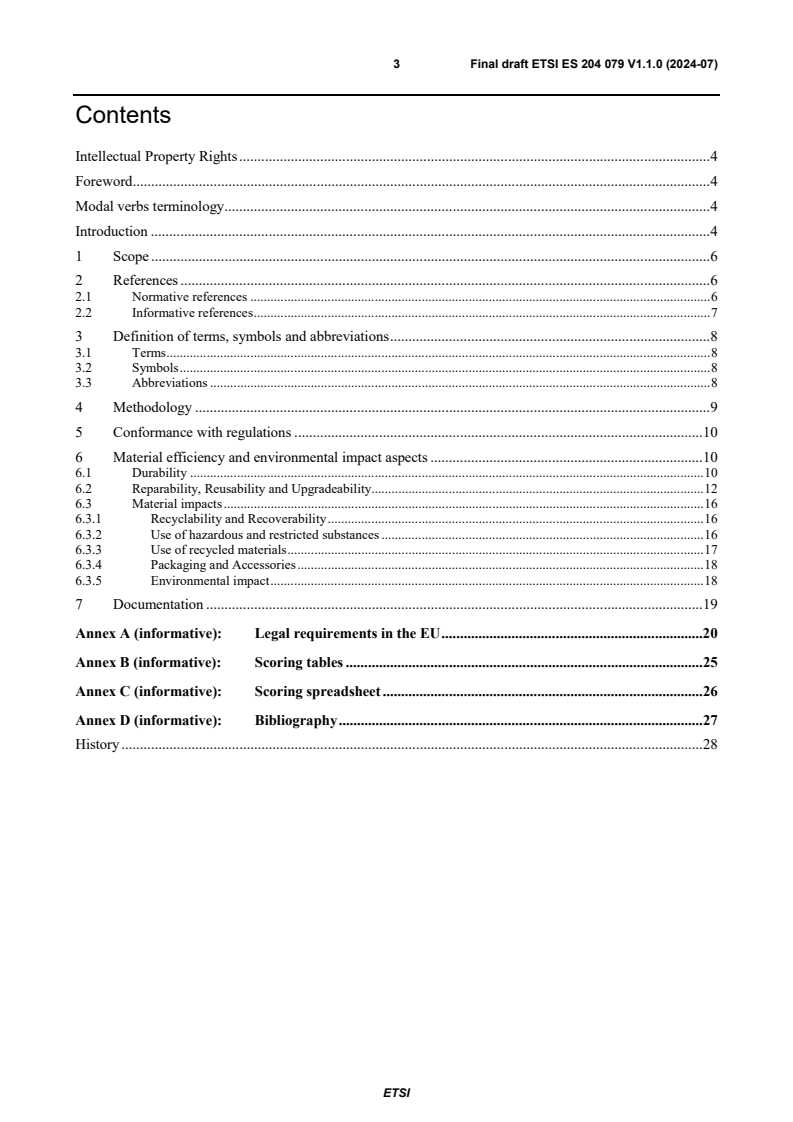
Contents
Intellectual Property Rights . 4
Foreword . 4
Modal verbs terminology . 4
Introduction . 4
1 Scope . 6
2 References . 6
2.1 Normative references . 6
2.2 Informative references . 7
3 Definition of terms, symbols and abbreviations . 8
3.1 Terms . 8
3.2 Symbols . 8
3.3 Abbreviations . 8
4 Methodology . 9
5 Conformance with regulations . 10
6 Material efficiency and environmental impact aspects . 10
6.1 Durability . 10
6.2 Reparability, Reusability and Upgradeability. 12
6.3 Material impacts . 16
6.3.1 Recyclability and Recoverability . 16
6.3.2 Use of hazardous and restricted substances . 16
6.3.3 Use of recycled materials . 17
6.3.4 Packaging and Accessories . 18
6.3.5 Environmental impact . 18
7 Documentation . 19
Annex A (informative): Legal requirements in the EU . 20
Annex B (informative): Scoring tables . 25
Annex C (informative): Scoring spreadsheet . 26
Annex D (informative): Bibliography . 27
History . 28
ETSI
4 Final draft ETSI ES 204 079 V1.1.0 (2024-07)
Intellectual Property Rights
Essential patents
IPRs essential or potentially essential to normative deliverables may have been declared to ETSI. The declarations
pertaining to these essential IPRs, if any, are publicly available for ETSI members and non-members, and can be
found in ETSI SR 000 314: "Intellectual Property Rights (IPRs); Essential, or potentially Essential, IPRs notified to
ETSI in respect of ETSI standards", which is available from the ETSI Secretariat. Latest updates are available on the
ETSI Web server (https://ipr.etsi.org/).
Pursuant to the ETSI Directives including the ETSI IPR Policy, no investigation regarding the essentiality of IPRs,
including IPR searches, has been carried out by ETSI. No guarantee can be given as to the existence of other IPRs not
referenced in ETSI SR 000 314 (or the updates on the ETSI Web server) which are, or may be, or may become,
essential to the present document.
Trademarks
The present document may include trademarks and/or tradenames which are asserted and/or registered by their owners.
ETSI claims no ownership of these except for any which are indicated as being the property of ETSI, and conveys no
right to use or reproduce any trademark and/or tradename. Mention of those trademarks in the present document does
not constitute an endorsement by ETSI of products, services or organizations associated with those trademarks.
DECT™, PLUGTESTS™, UMTS™ and the ETSI logo are trademarks of ETSI registered for the benefit of its
Members. 3GPP™ and LTE™ are trademarks of ETSI registered for the benefit of its Members and of the 3GPP
Organizational Partners. oneM2M™ logo is a trademark of ETSI registered for the benefit of its Members and of the ®
oneM2M Partners. GSM and the GSM logo are trademarks registered and owned by the GSM Association.
Foreword
This final draft ETSI Standard (ES) has been produced by ETSI Technical Committee Environmental Engineering (EE),
and is now submitted for the ETSI Membership Approval Procedure.
Modal verbs terminology
In the present document "shall", "shall not", "should", "should not", "may", "need not", "will", "will not", "can" and
"cannot" are to be interpreted as described in clause 3.2 of the ETSI Drafting Rules (Verbal forms for the expression of
provisions).
"must" and "must not" are NOT allowed in ETSI deliverables except when used in direct citation.
Introduction
In 2019, ITU-T Study Group 5 Question 7 (Q7) published Recommendation ITU-T L.1015 [i.1] "Criteria for evaluation
of the environmental impact of mobile phones". Recommendation ITU-T L.1015 contains many relevant indicators
related to the environmental impacts of mobile phones, but no standardised scoring methodology. Additional documents
of relevance produced by Q7 include scoring methods for environmental health and safety performance of true wireless
stereo headphones (Recommendation ITU-T L.1016 [i.3]) and circularity performance scoring for ICT goods
(Recommendation ITU-T L.1023 [i.2] in 2020 and just recently an update in 2023).
ETSI TC EE Working Group M-ICT "Environmental matters associated with Mobile ICT Devices" is dedicated exactly
to the intended scope and purpose of these kinds of scoring methods.
ETSI
5 Final draft ETSI ES 204 079 V1.1.0 (2024-07)
European and international markets are in need of a standardized scoring method for the environmental performance of
smartphones which goes beyond just reparability criteria and can provide a more robust foundation for non-LCA based
Green Claims. Features of such a method include:
• Additional indicators to differentiate best performing products that reach beyond regulatory requirements.
• Definition of weightings to combine all indicators into a single score.
Environmental impact calculations for smartphones - e.g. using Life Cycle Assessment (LCA) - are made in different
ways and therefore absolute numbers (e.g. kg CO2e) calculated in different ways cannot currently be compared. Still,
the ability to use LCA is very important in order to identify and reduce the environmental impact footprint of individual
products.
The present document was developed jointly by the European Telecommunications Standards Institute Technical
Committee Environmental Engineering (ETSI TC EE) and ITU-T Study Group 5. It is published as Recommendation
ITU-T L.1017 [i.15] and ETSI ES 204 079 (the present document), which are technically equivalent, by ITU and ETSI,
respectively.
ETSI
6 Final draft ETSI ES 204 079 V1.1.0 (2024-07)
1 Scope
The objective of the present document is to provide a standardized method to assess the environmental performance of
smartphones. A method to arrive at an aggregate score reflecting the overall environmental performance is defined
which takes into account material efficiency and Life Cycle Assessment (LCA) aspects. The following attributes of a
smartphone are evaluated:
• Durability.
• Reparability, reusability and upgradeability.
• Recyclability and recoverability.
• Use of hazardous or restricted substances.
• Use of recycled materials.
• Packaging and Accessories.
• Environmental impacts.
2 References
2.1 Normative references
References are either specific (identified by date of publication and/or edition number or version number) or
non-specific. For specific references, only the cited version applies. For non-specific references, the latest version of the
referenced document (including any amendments) applies.
Referenced documents which are not found to be publicly available in the expected location might be found at
https://docbox.etsi.org/Reference/.
NOTE: While any hyperlinks included in this clause were valid at the time of publication, ETSI cannot guarantee
their long term validity.
The following referenced documents are necessary for the application of the present document.
[1] IEC 60529 :1989+AMD1:1999+AMD2:2013 CSV Consolidated version: "Degrees of protection
provided by enclosures (IP Code)".
[2] IEC 60068-2-31:2008: "Environmental testing - Part 2-31: Tests - Test Ec: Rough handling
shocks, primarily for equipment-type specimens".
[3] IEC 61960-3:2017: "Secondary cells and batteries containing alkaline or other non-acid
electrolytes - Secondary lithium cells and batteries for portable applications - Part 3: Prismatic and
cylindrical lithium secondary cells and batteries made from them".
[4] EN ISO 6769:2022: "Metallic and other inorganic coatings, including for corrosion protection and
corrosion testing of metals and alloys" (produced by CEN).
[5] EN 45554:2020: "Material efficiency aspects for products in scope of Ecodesign legislation"
(produced by CEN).
[6] EN 45557:2020: "General method for assessing the proportion of recycled material content in
energy-related products" (produced by CEN).
[7] ISO 14040: "Environmental management -- Life cycle assessment -- Principles and framework".
[8] ETSI ES 203 199 (02-2015): "Environmental Engineering (EE); Methodology for environmental
Life Cycle Assessment (LCA) of Information and Communication Technology (ICT) goods,
networks and services".
ETSI
7 Final draft ETSI ES 204 079 V1.1.0 (2024-07)
2.2 Informative references
References are either specific (identified by date of publication and/or edition number or version number) or
non-specific. For specific references,only the cited version applies. For non-specific references, the latest version of the
referenced document (including any amendments) applies.
NOTE: While any hyperlinks included in this clause were valid at the time of publication, ETSI cannot guarantee
their long term validity.
The following referenced documents are not necessary for the application of the present document but they assist the
user with regard to a particular subject area.
[i.1] Recommendation ITU-T L.1015 (2019): "Criteria for evaluation of the environmental impact of
mobile phones".
[i.2] Recommendation ITU-T L.1023 (2023): "Assessment method for circularity performance
scoring".
[i.3] Recommendation ITU-T L.1016 (2022): "Method for evaluation of the environmental health and
safety performance of true wireless stereo headphones".
[i.4] Commission Regulation (EU) 2023/1670 of 16 June 2023 laying down ecodesign requirements for
smartphones, mobile phones other than smartphones, cordless phones and slate tablets pursuant to
Directive 2009/125/EC of the European Parliament and of the Council and amending Commission
Regulation (EU) 2023/826.
[i.5] Directive 2012/19/EU of the European Parliament and of the Council of 4 July 2012 on waste
electrical and electronic equipment (WEEE).
[i.6] Directive 2011/65/EU of the European Parliament and of the Council of 8 June 2011 on the
restriction of the use of certain hazardous substances in electrical and electronic equipment.
[i.7] Regulation (EC) No 1907/2006 of the European Parliament and of the Council of 18 December
2006 concerning the Registration, Evaluation, Authorisation and Restriction of Chemicals
(REACH), establishing a European Chemicals Agency, amending Directive 1999/45/EC and
repealing Council Regulation (EEC) No 793/93 and Commission Regulation (EC) No 1488/94 as
well as Council Directive 76/769/EEC and Commission Directives 91/155/EEC, 93/67/EEC,
93/105/EC and 2000/21/EC.
[i.8] Regulation (EU) 2023/1542 of the European Parliament and of the Council of 12 July 2023
concerning batteries and waste batteries, amending Directive 2008/98/EC and Regulation (EU)
2019/1020 and repealing Directive 2006/66/EC.
[i.9] Directive 2006/66/EC of the European Parliament and of the Council of 6 September 2006 on
batteries and accumulators and waste batteries and accumulators and repealing Directive
91/157/EEC.
[i.10] Globally harmonized system of classification and labelling of chemicals (GHS) - United Nations.
[i.11] IEC 61249-2-21:2003: "Materials for printed boards and other interconnecting structures -
Part 2-21: Reinforced base materials, clad and unclad - Non-halogenated epoxide woven E-glass
reinforced laminated sheets of defined flammability (vertical burning test), copper-clad".
[i.12] Compatibility of polymers for recycling are described in Pahl, G., Beitz, W., Engineering design:
A systematic Approach. Great Britain: Springer-Verlag London Limited, 1996.
[i.13] 2019/771/EU: "Directive (EU) 2019/771 of the European Parliament and of the Council of 20 May
2019 on certain aspects concerning contracts for the sale of goods, amending Regulation (EU)
2017/2394 and Directive 2009/22/EC, and repealing Directive 1999/44/EC".
[i.14] NIST Special Publication 800-88: " Guidelines for Media Sanitization".
[i.15] Recommendation ITU-T L.1017: "Method for environmental performance scoring of
smartphones".
ETSI
8 Final draft ETSI ES 204 079 V1.1.0 (2024-07)
3 Definition of terms, symbols and abbreviations
3.1 Terms
For the purposes of the present document, the following terms apply:
environmental aspect: element of an organization's activities or solutions that determines the environmental impact
NOTE: The Durability, 3RU and Use of hazardous and restricted substances outlined in this Recommendation are
examples of environmental aspects.
environmental assessment: evaluation and interpretation of results and impacts from an environmental measurement
environmental indicator: metric used to measure one or more environmental aspects
NOTE: The D , 3RU and HR outlined in this Recommendation (e.g. D1) are examples of environmental
n n n
indicators.
environmental measurement: process to help determine the environmental performance through collection,
calculation or compilation of data or information
environmental performance: degree to which a set of environmental aspects align with the principles for a circular
economy and low environmental impact
NOTE: The Environmental Performance Scores obtained by the framework outlined in this Recommendation are
examples of environmental performance.
3.2 Symbols
Void.
3.3 Abbreviations
For the purposes of the present document, the following abbreviations apply:
BAT Battery
BC Back Cover
BUT mechanical Button
DA Display Assembly
EC External Charging port
EIE Environment Impact Evaluation
FFC Front Facing Camera
FM Folding Mechanism ®
FSC Forest Stewardship Council
IPxx Ingress Protection
LCA Life Cycle Assessment
MIC Microphone
PA Packaging and Accessories
PEFC Programme for the Endorsement of Forest Certification schemes
RCM Recycled Materials
RFC Rear Facing Camera
RoHs Restriction of Hazardous substances
RR Recyclability and Recoverability
RRU Repairability, Reusability, Upgradeability
SPK Speaker
TS Total environment performance Score
ETSI
9 Final draft ETSI ES 204 079 V1.1.0 (2024-07)
4 Methodology
The environmental performance of smartphones can be evaluated by addressing material efficiency and through
consideration of life cycle assessment of environmental impacts.
The environmental performance of smartphones in terms of material efficiency can be evaluated by analysing three
impact groups: durability (clause 6.1), repairability, reusability, upgradeability (clause 6.2) and material impacts
(clause 6.3). The material impacts impact group consists of five aspects:
i) recyclability and recoverability;
ii) use of hazardous or restricted substances;
iii) use of recycled materials;
iv) packaging and accessories; and
v) environmental impact.
The total environmental performance score is calculated as follows:
D+RRU+M
�� = (1)
�
where:
• TS = Total Environmental Performance Score
• x = Smartphone model
• D = Aggregated score for the aspect Durability (see clause 6.1)
• RRU = Aggregated Score for the aspect Repairability, Reusability, Upgradeability (see clause 6.2)
• M = Aggregated Score for the aspect Material impacts (see clause 6.3)
The aggregated score for Durability is calculated as an average of the maximum possible durability indicators as
follows:
∑ �
� �
�= (2)
��
where:
• D = Aggregated score for the aspect Durability (see clause 6.1)
• Di = Score for Durability indicator i
• i = number of included Durability indicators
The aggregated score for Repairability, Reusability, Upgradeability is calculated an average of the maximum possible
indicators as follows:
∑
���
� �
���= (3)
��
where:
• RRU = Aggregated score for the aspect Repairability, Reusability, Upgradeability (see clause 6.2)
• RRU = Score for Repairability, Reusability, Upgradeability indicator i
i
• i = number of included Repairability, Reusability, Upgradeability indicators
The aggregated score for Material impacts is calculated as an average of the maximum possible indicators as follows:
∑ ���∑ �� �∑ ����∑ ���∑ ����
� � � � � � � � � �
�= (4)
��
ETSI
10 Final draft ETSI ES 204 079 V1.1.0 (2024-07)
where:
• M = Aggregated score for the aspect Material impact (see clause 6.3)
• RR = Score for Recyclability and Recoverability indicator i (see clause 6.3.1)
i
• HR = Score for Hazardous and Restricted substances indicator i (see clause 6.3.2)
i
• RCM = Score for Recycled Materials indicator i (see clause 6.3.3)
i
• PAi = Score for Packaging and Accessories indicator i (see clause 6.3.4)
• EIE = Score for Environmental Impact indicator i (see clause 6.3.5)
i
• i = number of included Material impacts indicators
5 Conformance with regulations
To help users of the present document with designing new smartphones, indicators based on legal requirements in the
EU are listed in Table A.1 in Annex A.
NOTE: At the time of writing, the Level 1 of the respective indicators in the following clauses match the EU
minimum regulatory requirements as displayed in Annex A.
6 Material efficiency and environmental impact aspects
6.1 Durability
Table 1 lists the requirements for the evaluation of the Durability aspect (D) of smartphones.
ETSI
11 Final draft ETSI ES 204 079 V1.1.0 (2024-07)
Table 1: Durability indicators
No. Indicator Score
1 2 3 4 5
D1 Warranty for the 2 years 3 years ˃ 3 years
smartphone and its
components
D2 Dust protection IP4x IP5x IP6x
D3 Water Protection IPx4 IPx5 IPx6 IPx7 IPx8
D4 Drop resistance for 45 ˂ x ≤ 90 90 ˂ x ≤ 180 180 ˂ x ≤ 270 270 ˂ x ≤ 300 x ˃ 300
non-foldable phones
[number of drops]
Drop resistance for 35 ≤ x in 70 ≤ x in 140 ≤ x in 210 ≤ x in 245 ≤ x in
foldable phones unextended unextended unextended unextended unextended
[number of drops] state state state state state
15 ≤ x in fully
extended 25 ≤ x in fully 35 ≤ x in fully 45 ≤ x in fully 55 ≤ x in fully
state extended extended extended extended state
state state state
D5 Battery life (full 800 = x cycles 800 ≤ x ˂ 1 000 ≤ x ˂ x ≥ 1 200
charge cycles) with 1 000 cycles 1 200 cycles cycles with
remaining with with remaining
capacity ≥ remaining remaining capacity ≥
80 % capacity ≥ 80 capacity ≥ 80 %
% 80 %
D6 Scratch resistance Mohs level 4 Mohs level 5 Mohs level 6 Mohs level 7
(non-foldable
displays)
D7 Number of full X < 200 000 x 200 000 ≤ x ˂ 265 000 ≤ x ˂ 330 000 ≤ x ˂ x ≥ 400 000
extension – fold 265 000 330 000 400 000
cycles for foldable
displays
D8 Period of availability 5 years 6 years 7 years
of OS support
(Provision of security
updates, corrective
updates or
functionality updates
to OS, at no cost from
the date of end of
placement on the
market)
Additional explanation on indicators:
D1. Warranty includes the battery. It does not need to include other accessories such as headsets, battery chargers,
etc. If the warranty differs between the smartphone and battery, the shorter is used for the assessment.
D2. IEC 60529 [1] is used for the assessment.
D3. IEC 60529 [1] is used for the assessment.
D4. IEC 60068-2-31 [2], Free fall repeated - Procedure 2.
D5. IEC 61960-3:2017 [3], Endurance in cycles, at a rate of 0,2 l A is used for the assessment.
t
D6. EN ISO 6769:2022 [4].
D7. There is no current standard testing methodology for this indicator. Manufacturers shall adopt a testing
approach that is reproducible, providing consistent results under the same conditions, and repeatable, ensuring
consistent outcomes across multiple trials. It shall be objective, minimizing human bias and error through
standardized procedures.
ETSI
12 Final draft ETSI ES 204 079 V1.1.0 (2024-07)
6.2 Reparability, Reusability and Upgradeability
Table 2 lists the requirements for the evaluation of the Reparability, Reusability and Upgradeability (RRU) aspect of
smartphones.
Table 2: Reparability, reusability and upgradability
No. Indicators Score
1 2 3 4 5
RRU1 Duration of front-facing back cover or front-facing back cover or front-facing
availability of camera back cover camera back cover camera
spare parts from assembly, rear- assembly, assembly, rear- assembly, assembly, rear-
the date of end of facing camera display facing camera display facing camera
placement on the assembly, assembly, assembly,
assembly, assembly,
market external audio protective foil for external audio protective foil external audio
(Spare parts may connector(s), foldable connector(s), for foldable connector(s),
be equivalent, external displays,
external displays, external
manufacturer- charging port(s), charger, SIM charging port(s), charger, SIM charging port(s),
approved parts) mechanical tray and mechanical tray and mechanical
button(s), main
memory card button(s), main memory card button(s), main
microphone(s), tray and battery microphone(s), tray and battery microphone(s),
speaker(s), = 8 years. front- speaker(s), = 9 years, front- speaker(s),
hinge assembly, facing camera
hinge assembly, facing camera hinge assembly,
mechanical assembly, rear- mechanical assembly, rear- mechanical
display folding facing camera display folding facing camera display folding
mechanism, assembly, mechanism, assembly, mechanism,
back cover or external audio back cover or external audio back cover or
back cover connector(s), back cover connector(s),
back cover
assembly, external assembly, external assembly,
display charging port(s), display charging port(s), display
assembly, mechanical assembly, mechanical
assembly,
protective foil for button(s), main protective foil for button(s), main protective foil for
foldable microphone(s), foldable microphone(s), foldable
displays, speaker(s), displays,
speaker(s), displays,
charger, SIM hinge assembly, charger, SIM hinge assembly, charger, SIM
tray and mechanical tray and mechanical tray and
memory card display folding
memory card display folding memory card
tray and battery mechanism and tray and battery mechanism and tray and battery
available for 7 battery = 7 available for 8 battery = 8 available for 9
years years
years years years
ETSI
13 Final draft ETSI ES 204 079 V1.1.0 (2024-07)
No. Indicators Score
1 2 3 4 5
RRU2 Target group the back cover the back cover front-facing
availability of or back cover or back cover camera
spare parts assembly, assembly, assembly, rear-
display display facing camera
See note 1 assembly, assembly, assembly,
protective foil for protective foil for external audio
foldable foldable connector(s),
displays, displays,
external
charger, SIM charger, SIM charging port(s),
tray and tray and mechanical
memory card memory card button(s), main
tray and battery tray, battery, microphone(s),
and display display speaker(s),
assembly to end assembly, and hinge assembly,
users, all other charging port to mechanical
to professional end users, all display folding
repairers other to mechanism,
professional parts list 2 and
repairers battery are
available to end
users
RRU3 Availability of Available
...
ETSI STANDARD
Environmental Engineering (EE);
Method for environmental performance scoring of
smartphones
2 ETSI ES 204 079 V1.1.1 (2024-09)
Reference
DES/EE-MICT4
Keywords
energy consumption, environmental impact,
greenhouse gas emission, ICT, LCA, smartphone
ETSI
650 Route des Lucioles
F-06921 Sophia Antipolis Cedex - FRANCE
Tel.: +33 4 92 94 42 00 Fax: +33 4 93 65 47 16
Siret N° 348 623 562 00017 - APE 7112B
Association à but non lucratif enregistrée à la
Sous-Préfecture de Grasse (06) N° w061004871
Important notice
The present document can be downloaded from the
ETSI Search & Browse Standards application.
The present document may be made available in electronic versions and/or in print. The content of any electronic and/or
print versions of the present document shall not be modified without the prior written authorization of ETSI. In case of any
existing or perceived difference in contents between such versions and/or in print, the prevailing version of an ETSI
deliverable is the one made publicly available in PDF format on ETSI deliver.
Users should be aware that the present document may be revised or have its status changed,
this information is available in the Milestones listing.
If you find errors in the present document, please send your comments to
the relevant service listed under Committee Support Staff.
If you find a security vulnerability in the present document, please report it through our
Coordinated Vulnerability Disclosure (CVD) program.
Notice of disclaimer & limitation of liability
The information provided in the present deliverable is directed solely to professionals who have the appropriate degree of
experience to understand and interpret its content in accordance with generally accepted engineering or
other professional standard and applicable regulations.
No recommendation as to products and services or vendors is made or should be implied.
No representation or warranty is made that this deliverable is technically accurate or sufficient or conforms to any law
and/or governmental rule and/or regulation and further, no representation or warranty is made of merchantability or fitness
for any particular purpose or against infringement of intellectual property rights.
In no event shall ETSI be held liable for loss of profits or any other incidental or consequential damages.
Any software contained in this deliverable is provided "AS IS" with no warranties, express or implied, including but not
limited to, the warranties of merchantability, fitness for a particular purpose and non-infringement of intellectual property
rights and ETSI shall not be held liable in any event for any damages whatsoever (including, without limitation, damages
for loss of profits, business interruption, loss of information, or any other pecuniary loss) arising out of or related to the use
of or inability to use the software.
Copyright Notification
No part may be reproduced or utilized in any form or by any means, electronic or mechanical, including photocopying and
microfilm except as authorized by written permission of ETSI.
The content of the PDF version shall not be modified without the written authorization of ETSI.
The copyright and the foregoing restriction extend to reproduction in all media.
© ETSI 2024.
All rights reserved.
ETSI
3 ETSI ES 204 079 V1.1.1 (2024-09)
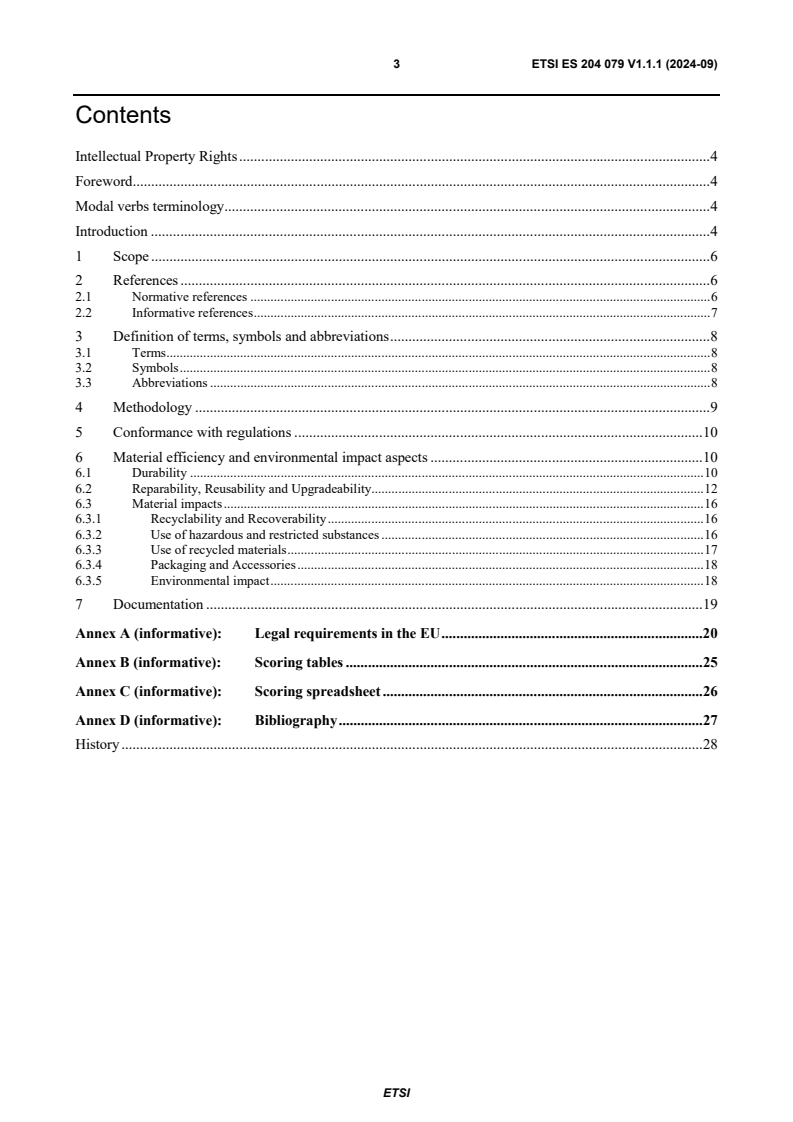
Contents
Intellectual Property Rights . 4
Foreword . 4
Modal verbs terminology . 4
Introduction . 4
1 Scope . 6
2 References . 6
2.1 Normative references . 6
2.2 Informative references . 7
3 Definition of terms, symbols and abbreviations . 8
3.1 Terms . 8
3.2 Symbols . 8
3.3 Abbreviations . 8
4 Methodology . 9
5 Conformance with regulations . 10
6 Material efficiency and environmental impact aspects . 10
6.1 Durability . 10
6.2 Reparability, Reusability and Upgradeability. 12
6.3 Material impacts . 16
6.3.1 Recyclability and Recoverability . 16
6.3.2 Use of hazardous and restricted substances . 16
6.3.3 Use of recycled materials . 17
6.3.4 Packaging and Accessories . 18
6.3.5 Environmental impact . 18
7 Documentation . 19
Annex A (informative): Legal requirements in the EU . 20
Annex B (informative): Scoring tables . 25
Annex C (informative): Scoring spreadsheet . 26
Annex D (informative): Bibliography . 27
History . 28
ETSI
4 ETSI ES 204 079 V1.1.1 (2024-09)
Intellectual Property Rights
Essential patents
IPRs essential or potentially essential to normative deliverables may have been declared to ETSI. The declarations
pertaining to these essential IPRs, if any, are publicly available for ETSI members and non-members, and can be
found in ETSI SR 000 314: "Intellectual Property Rights (IPRs); Essential, or potentially Essential, IPRs notified to
ETSI in respect of ETSI standards", which is available from the ETSI Secretariat. Latest updates are available on the
ETSI Web server (https://ipr.etsi.org/).
Pursuant to the ETSI Directives including the ETSI IPR Policy, no investigation regarding the essentiality of IPRs,
including IPR searches, has been carried out by ETSI. No guarantee can be given as to the existence of other IPRs not
referenced in ETSI SR 000 314 (or the updates on the ETSI Web server) which are, or may be, or may become,
essential to the present document.
Trademarks
The present document may include trademarks and/or tradenames which are asserted and/or registered by their owners.
ETSI claims no ownership of these except for any which are indicated as being the property of ETSI, and conveys no
right to use or reproduce any trademark and/or tradename. Mention of those trademarks in the present document does
not constitute an endorsement by ETSI of products, services or organizations associated with those trademarks.
DECT™, PLUGTESTS™, UMTS™ and the ETSI logo are trademarks of ETSI registered for the benefit of its
Members. 3GPP™ and LTE™ are trademarks of ETSI registered for the benefit of its Members and of the 3GPP
Organizational Partners. oneM2M™ logo is a trademark of ETSI registered for the benefit of its Members and of the ®
oneM2M Partners. GSM and the GSM logo are trademarks registered and owned by the GSM Association.
Foreword
This ETSI Standard (ES) has been produced by ETSI Technical Committee Environmental Engineering (EE).
Modal verbs terminology
In the present document "shall", "shall not", "should", "should not", "may", "need not", "will", "will not", "can" and
"cannot" are to be interpreted as described in clause 3.2 of the ETSI Drafting Rules (Verbal forms for the expression of
provisions).
"must" and "must not" are NOT allowed in ETSI deliverables except when used in direct citation.
Introduction
In 2019, ITU-T Study Group 5 Question 7 (Q7) published Recommendation ITU-T L.1015 [i.1] "Criteria for evaluation
of the environmental impact of mobile phones". Recommendation ITU-T L.1015 contains many relevant indicators
related to the environmental impacts of mobile phones, but no standardised scoring methodology. Additional documents
of relevance produced by Q7 include scoring methods for environmental health and safety performance of true wireless
stereo headphones (Recommendation ITU-T L.1016 [i.3]) and circularity performance scoring for ICT goods
(Recommendation ITU-T L.1023 [i.2] in 2020 and just recently an update in 2023).
ETSI TC EE Working Group M-ICT "Environmental matters associated with Mobile ICT Devices" is dedicated exactly
to the intended scope and purpose of these kinds of scoring methods.
European and international markets are in need of a standardized scoring method for the environmental performance of
smartphones which goes beyond just reparability criteria and can provide a more robust foundation for non-LCA based
Green Claims. Features of such a method include:
• Additional indicators to differentiate best performing products that reach beyond regulatory requirements.
ETSI
5 ETSI ES 204 079 V1.1.1 (2024-09)
• Definition of weightings to combine all indicators into a single score.
Environmental impact calculations for smartphones - e.g. using Life Cycle Assessment (LCA) - are made in different
ways and therefore absolute numbers (e.g. kg CO2e) calculated in different ways cannot currently be compared. Still,
the ability to use LCA is very important in order to identify and reduce the environmental impact footprint of individual
products.
The present document was developed jointly by the European Telecommunications Standards Institute Technical
Committee Environmental Engineering (ETSI TC EE) and ITU-T Study Group 5. It is published as Recommendation
ITU-T L.1017 [i.15] and ETSI ES 204 079 (the present document), which are technically equivalent, by ITU and ETSI,
respectively.
ETSI
6 ETSI ES 204 079 V1.1.1 (2024-09)
1 Scope
The objective of the present document is to provide a standardized method to assess the environmental performance of
smartphones. A method to arrive at an aggregate score reflecting the overall environmental performance is defined
which takes into account material efficiency and Life Cycle Assessment (LCA) aspects. The following attributes of a
smartphone are evaluated:
• Durability.
• Reparability, reusability and upgradeability.
• Recyclability and recoverability.
• Use of hazardous or restricted substances.
• Use of recycled materials.
• Packaging and Accessories.
• Environmental impacts.
2 References
2.1 Normative references
References are either specific (identified by date of publication and/or edition number or version number) or
non-specific. For specific references, only the cited version applies. For non-specific references, the latest version of the
referenced document (including any amendments) applies.
Referenced documents which are not found to be publicly available in the expected location might be found at
https://docbox.etsi.org/Reference/.
NOTE: While any hyperlinks included in this clause were valid at the time of publication, ETSI cannot guarantee
their long term validity.
The following referenced documents are necessary for the application of the present document.
[1] IEC 60529 :1989+AMD1:1999+AMD2:2013 CSV Consolidated version: "Degrees of protection
provided by enclosures (IP Code)".
[2] IEC 60068-2-31:2008: "Environmental testing - Part 2-31: Tests - Test Ec: Rough handling
shocks, primarily for equipment-type specimens".
[3] IEC 61960-3:2017: "Secondary cells and batteries containing alkaline or other non-acid
electrolytes - Secondary lithium cells and batteries for portable applications - Part 3: Prismatic and
cylindrical lithium secondary cells and batteries made from them".
[4] EN ISO 6769:2022: "Metallic and other inorganic coatings, including for corrosion protection and
corrosion testing of metals and alloys" (produced by CEN).
[5] EN 45554:2020: "Material efficiency aspects for products in scope of Ecodesign legislation"
(produced by CEN).
[6] EN 45557:2020: "General method for assessing the proportion of recycled material content in
energy-related products" (produced by CEN).
[7] ISO 14040: "Environmental management -- Life cycle assessment -- Principles and framework".
[8] ETSI ES 203 199 (V1.3.1) (02-2015): "Environmental Engineering (EE); Methodology for
environmental Life Cycle Assessment (LCA) of Information and Communication Technology
(ICT) goods, networks and services".
ETSI
7 ETSI ES 204 079 V1.1.1 (2024-09)
2.2 Informative references
References are either specific (identified by date of publication and/or edition number or version number) or
non-specific. For specific references,only the cited version applies. For non-specific references, the latest version of the
referenced document (including any amendments) applies.
NOTE: While any hyperlinks included in this clause were valid at the time of publication, ETSI cannot guarantee
their long term validity.
The following referenced documents are not necessary for the application of the present document but they assist the
user with regard to a particular subject area.
[i.1] Recommendation ITU-T L.1015 (2019): "Criteria for evaluation of the environmental impact of
mobile phones".
[i.2] Recommendation ITU-T L.1023 (2023): "Assessment method for circularity performance
scoring".
[i.3] Recommendation ITU-T L.1016 (2022): "Method for evaluation of the environmental health and
safety performance of true wireless stereo headphones".
[i.4] Commission Regulation (EU) 2023/1670 of 16 June 2023 laying down ecodesign requirements for
smartphones, mobile phones other than smartphones, cordless phones and slate tablets pursuant to
Directive 2009/125/EC of the European Parliament and of the Council and amending Commission
Regulation (EU) 2023/826.
[i.5] Directive 2012/19/EU of the European Parliament and of the Council of 4 July 2012 on waste
electrical and electronic equipment (WEEE).
[i.6] Directive 2011/65/EU of the European Parliament and of the Council of 8 June 2011 on the
restriction of the use of certain hazardous substances in electrical and electronic equipment.
[i.7] Regulation (EC) No 1907/2006 of the European Parliament and of the Council of 18 December
2006 concerning the Registration, Evaluation, Authorisation and Restriction of Chemicals
(REACH), establishing a European Chemicals Agency, amending Directive 1999/45/EC and
repealing Council Regulation (EEC) No 793/93 and Commission Regulation (EC) No 1488/94 as
well as Council Directive 76/769/EEC and Commission Directives 91/155/EEC, 93/67/EEC,
93/105/EC and 2000/21/EC.
[i.8] Regulation (EU) 2023/1542 of the European Parliament and of the Council of 12 July 2023
concerning batteries and waste batteries, amending Directive 2008/98/EC and Regulation (EU)
2019/1020 and repealing Directive 2006/66/EC.
[i.9] Directive 2006/66/EC of the European Parliament and of the Council of 6 September 2006 on
batteries and accumulators and waste batteries and accumulators and repealing Directive
91/157/EEC.
[i.10] Globally harmonized system of classification and labelling of chemicals (GHS) - United Nations.
[i.11] IEC 61249-2-21:2003: "Materials for printed boards and other interconnecting structures -
Part 2-21: Reinforced base materials, clad and unclad - Non-halogenated epoxide woven E-glass
reinforced laminated sheets of defined flammability (vertical burning test), copper-clad".
[i.12] Compatibility of polymers for recycling are described in Pahl, G., Beitz, W., Engineering design:
A systematic Approach. Great Britain: Springer-Verlag London Limited, 1996.
[i.13] 2019/771/EU: "Directive (EU) 2019/771 of the European Parliament and of the Council of 20 May
2019 on certain aspects concerning contracts for the sale of goods, amending Regulation (EU)
2017/2394 and Directive 2009/22/EC, and repealing Directive 1999/44/EC".
[i.14] NIST Special Publication 800-88: " Guidelines for Media Sanitization".
[i.15] Recommendation ITU-T L.1017: "Method for environmental performance scoring of
smartphones".
ETSI
8 ETSI ES 204 079 V1.1.1 (2024-09)
3 Definition of terms, symbols and abbreviations
3.1 Terms
For the purposes of the present document, the following terms apply:
environmental aspect: element of an organization's activities or solutions that determines the environmental impact
NOTE: The Durability, 3RU and Use of hazardous and restricted substances outlined in this Recommendation are
examples of environmental aspects.
environmental assessment: evaluation and interpretation of results and impacts from an environmental measurement
environmental indicator: metric used to measure one or more environmental aspects
NOTE: The D , 3RU and HR outlined in this Recommendation (e.g. D1) are examples of environmental
n n n
indicators.
environmental measurement: process to help determine the environmental performance through collection,
calculation or compilation of data or information
environmental performance: degree to which a set of environmental aspects align with the principles for a circular
economy and low environmental impact
NOTE: The Environmental Performance Scores obtained by the framework outlined in this Recommendation are
examples of environmental performance.
3.2 Symbols
Void.
3.3 Abbreviations
For the purposes of the present document, the following abbreviations apply:
BAT Battery
BC Back Cover
BUT mechanical Button
DA Display Assembly
EC External Charging port
EIE Environment Impact Evaluation
FFC Front Facing Camera
FM Folding Mechanism ®
FSC Forest Stewardship Council
IPxx Ingress Protection
LCA Life Cycle Assessment
MIC Microphone
PA Packaging and Accessories
PEFC Programme for the Endorsement of Forest Certification schemes
RCM Recycled Materials
RFC Rear Facing Camera
RoHs Restriction of Hazardous substances
RR Recyclability and Recoverability
RRU Repairability, Reusability, Upgradeability
SPK Speaker
TS Total environment performance Score
ETSI
9 ETSI ES 204 079 V1.1.1 (2024-09)
4 Methodology
The environmental performance of smartphones can be evaluated by addressing material efficiency and through
consideration of life cycle assessment of environmental impacts.
The environmental performance of smartphones in terms of material efficiency can be evaluated by analysing three
impact groups: durability (clause 6.1), repairability, reusability, upgradeability (clause 6.2) and material impacts
(clause 6.3). The material impacts impact group consists of five aspects:
i) recyclability and recoverability;
ii) use of hazardous or restricted substances;
iii) use of recycled materials;
iv) packaging and accessories; and
v) environmental impact.
The total environmental performance score is calculated as follows:
D+RRU+M
�� = (1)
�
where:
• TS = Total Environmental Performance Score
• x = Smartphone model
• D = Aggregated score for the aspect Durability (see clause 6.1)
• RRU = Aggregated Score for the aspect Repairability, Reusability, Upgradeability (see clause 6.2)
• M = Aggregated Score for the aspect Material impacts (see clause 6.3)
The aggregated score for Durability is calculated as an average of the maximum possible durability indicators as
follows:
∑ �
� �
�= (2)
��
where:
• D = Aggregated score for the aspect Durability (see clause 6.1)
• Di = Score for Durability indicator i
• i = number of included Durability indicators
The aggregated score for Repairability, Reusability, Upgradeability is calculated an average of the maximum possible
indicators as follows:
∑
���
� �
���= (3)
��
where:
• RRU = Aggregated score for the aspect Repairability, Reusability, Upgradeability (see clause 6.2)
• RRU = Score for Repairability, Reusability, Upgradeability indicator i
i
• i = number of included Repairability, Reusability, Upgradeability indicators
The aggregated score for Material impacts is calculated as an average of the maximum possible indicators as follows:
∑ ���∑ �� �∑ ����∑ ���∑ ���
� � � � � � � � � �
�= (4)
��
ETSI
10 ETSI ES 204 079 V1.1.1 (2024-09)
where:
• M = Aggregated score for the aspect Material impact (see clause 6.3)
• RR = Score for Recyclability and Recoverability indicator i (see clause 6.3.1)
i
• HR = Score for Hazardous and Restricted substances indicator i (see clause 6.3.2)
i
• RCM = Score for Recycled Materials indicator i (see clause 6.3.3)
i
• PAi = Score for Packaging and Accessories indicator i (see clause 6.3.4)
• EIE = Score for Environmental Impact indicator i (see clause 6.3.5)
i
• i = number of included Material impacts indicators
5 Conformance with regulations
To help users of the present document with designing new smartphones, indicators based on legal requirements in the
EU are listed in Table A.1 in Annex A.
NOTE: At the time of writing, the Level 1 of the respective indicators in the following clauses match the EU
minimum regulatory requirements as displayed in Annex A.
6 Material efficiency and environmental impact aspects
6.1 Durability
Table 1 lists the requirements for the evaluation of the Durability aspect (D) of smartphones.
ETSI
11 ETSI ES 204 079 V1.1.1 (2024-09)
Table 1: Durability indicators
No. Indicator Score
1 2 3 4 5
D1 Warranty for the 2 years 3 years ˃ 3 years
smartphone and its
components
D2 Dust protection IP4x IP5x IP6x
D3 Water Protection IPx4 IPx5 IPx6 IPx7 IPx8
D4 Drop resistance for 45 ˂ x ≤ 90 90 ˂ x ≤ 180 180 ˂ x ≤ 270 270 ˂ x ≤ 300 x ˃ 300
non-foldable phones
[number of drops]
Drop resistance for 35 ≤ x in 70 ≤ x in 140 ≤ x in 210 ≤ x in 245 ≤ x in
foldable phones unextended unextended unextended unextended unextended
[number of drops] state state state state state
15 ≤ x in fully
extended 25 ≤ x in fully 35 ≤ x in fully 45 ≤ x in fully 55 ≤ x in fully
state extended extended extended extended state
state state state
D5 Battery life (full 800 = x cycles 800 ≤ x ˂ 1 000 ≤ x ˂ x ≥ 1 200
charge cycles) with 1 000 cycles 1 200 cycles cycles with
remaining with with remaining
capacity ≥ remaining remaining capacity ≥
80 % capacity ≥ 80 capacity ≥ 80 %
% 80 %
D6 Scratch resistance Mohs level 4 Mohs level 5 Mohs level 6 Mohs level 7
(non-foldable
displays)
D7 Number of full X < 200 000 x 200 000 ≤ x ˂ 265 000 ≤ x ˂ 330 000 ≤ x ˂ x ≥ 400 000
extension – fold 265 000 330 000 400 000
cycles for foldable
displays
D8 Period of availability 5 years 6 years 7 years
of OS support
(Provision of security
updates, corrective
updates or
functionality updates
to OS, at no cost from
the date of end of
placement on the
market)
Additional explanation on indicators:
D1. Warranty includes the battery. It does not need to include other accessories such as headsets, battery chargers,
etc. If the warranty differs between the smartphone and battery, the shorter is used for the assessment.
D2. IEC 60529 [1] is used for the assessment.
D3. IEC 60529 [1] is used for the assessment.
D4. IEC 60068-2-31 [2], Free fall repeated - Procedure 2.
D5. IEC 61960-3:2017 [3], Endurance in cycles, at a rate of 0,2 l A is used for the assessment.
t
D6. EN ISO 6769:2022 [4].
D7. There is no current standard testing methodology for this indicator. Manufacturers shall adopt a testing
approach that is reproducible, providing consistent results under the same conditions, and repeatable, ensuring
consistent outcomes across multiple trials. It shall be objective, minimizing human bias and error through
standardized procedures.
ETSI
12 ETSI ES 204 079 V1.1.1 (2024-09)
6.2 Reparability, Reusability and Upgradeability
Table 2 lists the requirements for the evaluation of the Reparability, Reusability and Upgradeability (RRU) aspect of
smartphones.
Table 2: Reparability, reusability and upgradability
No. Indicators Score
1 2 3 4 5
RRU1 Duration of front-facing back cover or front-facing back cover or front-facing
availability of camera back cover camera back cover camera
spare parts from assembly, rear- assembly, assembly, rear- assembly, assembly, rear-
the date of end of facing camera display facing camera display facing camera
placement on the assembly, assembly, assembly,
assembly, assembly,
market external audio protective foil for external audio protective foil external audio
(Spare parts may connector(s), foldable connector(s), for foldable connector(s),
be equivalent, external displays,
external displays, external
manufacturer- charging port(s), charger, SIM charging port(s), charger, SIM charging port(s),
approved parts) mechanical tray and mechanical tray and mechanical
button(s), main
memory card button(s), main memory card button(s), main
microphone(s), tray and battery microphone(s), tray and battery microphone(s),
speaker(s), = 8 years. front- speaker(s), = 9 years, front- speaker(s),
hinge assembly, facing camera
hinge assembly, facing camera hinge assembly,
mechanical assembly, rear- mechanical assembly, rear- mechanical
display folding facing camera display folding facing camera display folding
mechanism, assembly, mechanism, assembly, mechanism,
back cover or external audio back cover or external audio back cover or
back cover connector(s), back cover connector(s),
back cover
assembly, external assembly, external assembly,
display charging port(s), display charging port(s), display
assembly, mechanical assembly, mechanical
assembly,
protective foil for button(s), main protective foil for button(s), main protective foil for
foldable microphone(s), foldable microphone(s), foldable
displays, speaker(s), displays,
speaker(s), displays,
charger, SIM hinge assembly, charger, SIM hinge assembly, charger, SIM
tray and mechanical tray and mechanical tray and
memory card display folding
memory card display folding memory card
tray and battery mechanism and tray and battery mechanism and tray and battery
available for 7 battery = 7 available for 8 battery = 8 available for 9
years years
years years years
ETSI
13 ETSI ES 204 079 V1.1.1 (2024-09)
No. Indicators Score
1 2 3 4 5
RRU2 Target group the back cover the back cover front-facing
availability of or back cover or back cover camera
spare parts assembly, assembly, assembly, rear-
display display facing camera
See note 1 assembly, assembly, assembly,
protective foil for protective foil for external audio
foldable foldable connector(s),
displays, displays,
external
charger, SIM charger, SIM charging port(s),
tray and tray and mechanical
memory card memory card button(s), main
tray and battery tray, battery, microphone(s),
and display display speaker(s),
assembly to end assembly, and hinge assembly,
users, all other charging port to mechanical
to professional end users, all display folding
repairers other to mechanism,
professional parts list 2 and
repairers battery are
available to end
users
RRU3 Availability of Available only to Available to Available to Available to Available to
repair, reuse and independent independent independent independent independe
...
SLOVENSKI STANDARD
01-december-2024
Okoljski inženiring (EE) - Metoda za ocenjevanje okoljskih lastnosti pametnih
telefonov
Environmental Engineering (EE) - Method for environmental performance scoring of
smartphones
Ta slovenski standard je istoveten z: ETSI ES 204 079 V1.1.1 (2024-09)
ICS:
19.040 Preskušanje v zvezi z Environmental testing
okoljem
33.050.10 Telefonska oprema Telephone equipment
2003-01.Slovenski inštitut za standardizacijo. Razmnoževanje celote ali delov tega standarda ni dovoljeno.
ETSI STANDARD
Environmental Engineering (EE);
Method for environmental performance scoring of
smartphones
2 ETSI ES 204 079 V1.1.1 (2024-09)
Reference
DES/EE-MICT4
Keywords
energy consumption, environmental impact,
greenhouse gas emission, ICT, LCA, smartphone
ETSI
650 Route des Lucioles
F-06921 Sophia Antipolis Cedex - FRANCE
Tel.: +33 4 92 94 42 00 Fax: +33 4 93 65 47 16
Siret N° 348 623 562 00017 - APE 7112B
Association à but non lucratif enregistrée à la
Sous-Préfecture de Grasse (06) N° w061004871
Important notice
The present document can be downloaded from the
ETSI Search & Browse Standards application.
The present document may be made available in electronic versions and/or in print. The content of any electronic and/or
print versions of the present document shall not be modified without the prior written authorization of ETSI. In case of any
existing or perceived difference in contents between such versions and/or in print, the prevailing version of an ETSI
deliverable is the one made publicly available in PDF format on ETSI deliver.
Users should be aware that the present document may be revised or have its status changed,
this information is available in the Milestones listing.
If you find errors in the present document, please send your comments to
the relevant service listed under Committee Support Staff.
If you find a security vulnerability in the present document, please report it through our
Coordinated Vulnerability Disclosure (CVD) program.
Notice of disclaimer & limitation of liability
The information provided in the present deliverable is directed solely to professionals who have the appropriate degree of
experience to understand and interpret its content in accordance with generally accepted engineering or
other professional standard and applicable regulations.
No recommendation as to products and services or vendors is made or should be implied.
No representation or warranty is made that this deliverable is technically accurate or sufficient or conforms to any law
and/or governmental rule and/or regulation and further, no representation or warranty is made of merchantability or fitness
for any particular purpose or against infringement of intellectual property rights.
In no event shall ETSI be held liable for loss of profits or any other incidental or consequential damages.
Any software contained in this deliverable is provided "AS IS" with no warranties, express or implied, including but not
limited to, the warranties of merchantability, fitness for a particular purpose and non-infringement of intellectual property
rights and ETSI shall not be held liable in any event for any damages whatsoever (including, without limitation, damages
for loss of profits, business interruption, loss of information, or any other pecuniary loss) arising out of or related to the use
of or inability to use the software.
Copyright Notification
No part may be reproduced or utilized in any form or by any means, electronic or mechanical, including photocopying and
microfilm except as authorized by written permission of ETSI.
The content of the PDF version shall not be modified without the written authorization of ETSI.
The copyright and the foregoing restriction extend to reproduction in all media.
© ETSI 2024.
All rights reserved.
ETSI
3 ETSI ES 204 079 V1.1.1 (2024-09)
Contents
Intellectual Property Rights . 4
Foreword . 4
Modal verbs terminology . 4
Introduction . 4
1 Scope . 6
2 References . 6
2.1 Normative references . 6
2.2 Informative references . 7
3 Definition of terms, symbols and abbreviations . 8
3.1 Terms . 8
3.2 Symbols . 8
3.3 Abbreviations . 8
4 Methodology . 9
5 Conformance with regulations . 10
6 Material efficiency and environmental impact aspects . 10
6.1 Durability . 10
6.2 Reparability, Reusability and Upgradeability. 12
6.3 Material impacts . 16
6.3.1 Recyclability and Recoverability . 16
6.3.2 Use of hazardous and restricted substances . 16
6.3.3 Use of recycled materials . 17
6.3.4 Packaging and Accessories . 18
6.3.5 Environmental impact . 18
7 Documentation . 19
Annex A (informative): Legal requirements in the EU . 20
Annex B (informative): Scoring tables . 25
Annex C (informative): Scoring spreadsheet . 26
Annex D (informative): Bibliography . 27
History . 28
ETSI
4 ETSI ES 204 079 V1.1.1 (2024-09)
Intellectual Property Rights
Essential patents
IPRs essential or potentially essential to normative deliverables may have been declared to ETSI. The declarations
pertaining to these essential IPRs, if any, are publicly available for ETSI members and non-members, and can be
found in ETSI SR 000 314: "Intellectual Property Rights (IPRs); Essential, or potentially Essential, IPRs notified to
ETSI in respect of ETSI standards", which is available from the ETSI Secretariat. Latest updates are available on the
ETSI Web server (https://ipr.etsi.org/).
Pursuant to the ETSI Directives including the ETSI IPR Policy, no investigation regarding the essentiality of IPRs,
including IPR searches, has been carried out by ETSI. No guarantee can be given as to the existence of other IPRs not
referenced in ETSI SR 000 314 (or the updates on the ETSI Web server) which are, or may be, or may become,
essential to the present document.
Trademarks
The present document may include trademarks and/or tradenames which are asserted and/or registered by their owners.
ETSI claims no ownership of these except for any which are indicated as being the property of ETSI, and conveys no
right to use or reproduce any trademark and/or tradename. Mention of those trademarks in the present document does
not constitute an endorsement by ETSI of products, services or organizations associated with those trademarks.
DECT™, PLUGTESTS™, UMTS™ and the ETSI logo are trademarks of ETSI registered for the benefit of its
Members. 3GPP™ and LTE™ are trademarks of ETSI registered for the benefit of its Members and of the 3GPP
Organizational Partners. oneM2M™ logo is a trademark of ETSI registered for the benefit of its Members and of the ®
oneM2M Partners. GSM and the GSM logo are trademarks registered and owned by the GSM Association.
Foreword
This ETSI Standard (ES) has been produced by ETSI Technical Committee Environmental Engineering (EE).
Modal verbs terminology
In the present document "shall", "shall not", "should", "should not", "may", "need not", "will", "will not", "can" and
"cannot" are to be interpreted as described in clause 3.2 of the ETSI Drafting Rules (Verbal forms for the expression of
provisions).
"must" and "must not" are NOT allowed in ETSI deliverables except when used in direct citation.
Introduction
In 2019, ITU-T Study Group 5 Question 7 (Q7) published Recommendation ITU-T L.1015 [i.1] "Criteria for evaluation
of the environmental impact of mobile phones". Recommendation ITU-T L.1015 contains many relevant indicators
related to the environmental impacts of mobile phones, but no standardised scoring methodology. Additional documents
of relevance produced by Q7 include scoring methods for environmental health and safety performance of true wireless
stereo headphones (Recommendation ITU-T L.1016 [i.3]) and circularity performance scoring for ICT goods
(Recommendation ITU-T L.1023 [i.2] in 2020 and just recently an update in 2023).
ETSI TC EE Working Group M-ICT "Environmental matters associated with Mobile ICT Devices" is dedicated exactly
to the intended scope and purpose of these kinds of scoring methods.
European and international markets are in need of a standardized scoring method for the environmental performance of
smartphones which goes beyond just reparability criteria and can provide a more robust foundation for non-LCA based
Green Claims. Features of such a method include:
• Additional indicators to differentiate best performing products that reach beyond regulatory requirements.
ETSI
5 ETSI ES 204 079 V1.1.1 (2024-09)
• Definition of weightings to combine all indicators into a single score.
Environmental impact calculations for smartphones - e.g. using Life Cycle Assessment (LCA) - are made in different
ways and therefore absolute numbers (e.g. kg CO2e) calculated in different ways cannot currently be compared. Still,
the ability to use LCA is very important in order to identify and reduce the environmental impact footprint of individual
products.
The present document was developed jointly by the European Telecommunications Standards Institute Technical
Committee Environmental Engineering (ETSI TC EE) and ITU-T Study Group 5. It is published as Recommendation
ITU-T L.1017 [i.15] and ETSI ES 204 079 (the present document), which are technically equivalent, by ITU and ETSI,
respectively.
ETSI
6 ETSI ES 204 079 V1.1.1 (2024-09)
1 Scope
The objective of the present document is to provide a standardized method to assess the environmental performance of
smartphones. A method to arrive at an aggregate score reflecting the overall environmental performance is defined
which takes into account material efficiency and Life Cycle Assessment (LCA) aspects. The following attributes of a
smartphone are evaluated:
• Durability.
• Reparability, reusability and upgradeability.
• Recyclability and recoverability.
• Use of hazardous or restricted substances.
• Use of recycled materials.
• Packaging and Accessories.
• Environmental impacts.
2 References
2.1 Normative references
References are either specific (identified by date of publication and/or edition number or version number) or
non-specific. For specific references, only the cited version applies. For non-specific references, the latest version of the
referenced document (including any amendments) applies.
Referenced documents which are not found to be publicly available in the expected location might be found at
https://docbox.etsi.org/Reference/.
NOTE: While any hyperlinks included in this clause were valid at the time of publication, ETSI cannot guarantee
their long term validity.
The following referenced documents are necessary for the application of the present document.
[1] IEC 60529 :1989+AMD1:1999+AMD2:2013 CSV Consolidated version: "Degrees of protection
provided by enclosures (IP Code)".
[2] IEC 60068-2-31:2008: "Environmental testing - Part 2-31: Tests - Test Ec: Rough handling
shocks, primarily for equipment-type specimens".
[3] IEC 61960-3:2017: "Secondary cells and batteries containing alkaline or other non-acid
electrolytes - Secondary lithium cells and batteries for portable applications - Part 3: Prismatic and
cylindrical lithium secondary cells and batteries made from them".
[4] EN ISO 6769:2022: "Metallic and other inorganic coatings, including for corrosion protection and
corrosion testing of metals and alloys" (produced by CEN).
[5] EN 45554:2020: "Material efficiency aspects for products in scope of Ecodesign legislation"
(produced by CEN).
[6] EN 45557:2020: "General method for assessing the proportion of recycled material content in
energy-related products" (produced by CEN).
[7] ISO 14040: "Environmental management -- Life cycle assessment -- Principles and framework".
[8] ETSI ES 203 199 (V1.3.1) (02-2015): "Environmental Engineering (EE); Methodology for
environmental Life Cycle Assessment (LCA) of Information and Communication Technology
(ICT) goods, networks and services".
ETSI
7 ETSI ES 204 079 V1.1.1 (2024-09)
2.2 Informative references
References are either specific (identified by date of publication and/or edition number or version number) or
non-specific. For specific references,only the cited version applies. For non-specific references, the latest version of the
referenced document (including any amendments) applies.
NOTE: While any hyperlinks included in this clause were valid at the time of publication, ETSI cannot guarantee
their long term validity.
The following referenced documents are not necessary for the application of the present document but they assist the
user with regard to a particular subject area.
[i.1] Recommendation ITU-T L.1015 (2019): "Criteria for evaluation of the environmental impact of
mobile phones".
[i.2] Recommendation ITU-T L.1023 (2023): "Assessment method for circularity performance
scoring".
[i.3] Recommendation ITU-T L.1016 (2022): "Method for evaluation of the environmental health and
safety performance of true wireless stereo headphones".
[i.4] Commission Regulation (EU) 2023/1670 of 16 June 2023 laying down ecodesign requirements for
smartphones, mobile phones other than smartphones, cordless phones and slate tablets pursuant to
Directive 2009/125/EC of the European Parliament and of the Council and amending Commission
Regulation (EU) 2023/826.
[i.5] Directive 2012/19/EU of the European Parliament and of the Council of 4 July 2012 on waste
electrical and electronic equipment (WEEE).
[i.6] Directive 2011/65/EU of the European Parliament and of the Council of 8 June 2011 on the
restriction of the use of certain hazardous substances in electrical and electronic equipment.
[i.7] Regulation (EC) No 1907/2006 of the European Parliament and of the Council of 18 December
2006 concerning the Registration, Evaluation, Authorisation and Restriction of Chemicals
(REACH), establishing a European Chemicals Agency, amending Directive 1999/45/EC and
repealing Council Regulation (EEC) No 793/93 and Commission Regulation (EC) No 1488/94 as
well as Council Directive 76/769/EEC and Commission Directives 91/155/EEC, 93/67/EEC,
93/105/EC and 2000/21/EC.
[i.8] Regulation (EU) 2023/1542 of the European Parliament and of the Council of 12 July 2023
concerning batteries and waste batteries, amending Directive 2008/98/EC and Regulation (EU)
2019/1020 and repealing Directive 2006/66/EC.
[i.9] Directive 2006/66/EC of the European Parliament and of the Council of 6 September 2006 on
batteries and accumulators and waste batteries and accumulators and repealing Directive
91/157/EEC.
[i.10] Globally harmonized system of classification and labelling of chemicals (GHS) - United Nations.
[i.11] IEC 61249-2-21:2003: "Materials for printed boards and other interconnecting structures -
Part 2-21: Reinforced base materials, clad and unclad - Non-halogenated epoxide woven E-glass
reinforced laminated sheets of defined flammability (vertical burning test), copper-clad".
[i.12] Compatibility of polymers for recycling are described in Pahl, G., Beitz, W., Engineering design:
A systematic Approach. Great Britain: Springer-Verlag London Limited, 1996.
[i.13] 2019/771/EU: "Directive (EU) 2019/771 of the European Parliament and of the Council of 20 May
2019 on certain aspects concerning contracts for the sale of goods, amending Regulation (EU)
2017/2394 and Directive 2009/22/EC, and repealing Directive 1999/44/EC".
[i.14] NIST Special Publication 800-88: " Guidelines for Media Sanitization".
[i.15] Recommendation ITU-T L.1017: "Method for environmental performance scoring of
smartphones".
ETSI
8 ETSI ES 204 079 V1.1.1 (2024-09)
3 Definition of terms, symbols and abbreviations
3.1 Terms
For the purposes of the present document, the following terms apply:
environmental aspect: element of an organization's activities or solutions that determines the environmental impact
NOTE: The Durability, 3RU and Use of hazardous and restricted substances outlined in this Recommendation are
examples of environmental aspects.
environmental assessment: evaluation and interpretation of results and impacts from an environmental measurement
environmental indicator: metric used to measure one or more environmental aspects
NOTE: The D , 3RU and HR outlined in this Recommendation (e.g. D1) are examples of environmental
n n n
indicators.
environmental measurement: process to help determine the environmental performance through collection,
calculation or compilation of data or information
environmental performance: degree to which a set of environmental aspects align with the principles for a circular
economy and low environmental impact
NOTE: The Environmental Performance Scores obtained by the framework outlined in this Recommendation are
examples of environmental performance.
3.2 Symbols
Void.
3.3 Abbreviations
For the purposes of the present document, the following abbreviations apply:
BAT Battery
BC Back Cover
BUT mechanical Button
DA Display Assembly
EC External Charging port
EIE Environment Impact Evaluation
FFC Front Facing Camera
FM Folding Mechanism ®
FSC Forest Stewardship Council
IPxx Ingress Protection
LCA Life Cycle Assessment
MIC Microphone
PA Packaging and Accessories
PEFC Programme for the Endorsement of Forest Certification schemes
RCM Recycled Materials
RFC Rear Facing Camera
RoHs Restriction of Hazardous substances
RR Recyclability and Recoverability
RRU Repairability, Reusability, Upgradeability
SPK Speaker
TS Total environment performance Score
ETSI
9 ETSI ES 204 079 V1.1.1 (2024-09)
4 Methodology
The environmental performance of smartphones can be evaluated by addressing material efficiency and through
consideration of life cycle assessment of environmental impacts.
The environmental performance of smartphones in terms of material efficiency can be evaluated by analysing three
impact groups: durability (clause 6.1), repairability, reusability, upgradeability (clause 6.2) and material impacts
(clause 6.3). The material impacts impact group consists of five aspects:
i) recyclability and recoverability;
ii) use of hazardous or restricted substances;
iii) use of recycled materials;
iv) packaging and accessories; and
v) environmental impact.
The total environmental performance score is calculated as follows:
D+RRU+M
�� = (1)
�
where:
• TS = Total Environmental Performance Score
• x = Smartphone model
• D = Aggregated score for the aspect Durability (see clause 6.1)
• RRU = Aggregated Score for the aspect Repairability, Reusability, Upgradeability (see clause 6.2)
• M = Aggregated Score for the aspect Material impacts (see clause 6.3)
The aggregated score for Durability is calculated as an average of the maximum possible durability indicators as
follows:
∑ �
� �
�= (2)
��
where:
• D = Aggregated score for the aspect Durability (see clause 6.1)
• Di = Score for Durability indicator i
• i = number of included Durability indicators
The aggregated score for Repairability, Reusability, Upgradeability is calculated an average of the maximum possible
indicators as follows:
∑
���
� �
���= (3)
��
where:
• RRU = Aggregated score for the aspect Repairability, Reusability, Upgradeability (see clause 6.2)
• RRU = Score for Repairability, Reusability, Upgradeability indicator i
i
• i = number of included Repairability, Reusability, Upgradeability indicators
The aggregated score for Material impacts is calculated as an average of the maximum possible indicators as follows:
∑ ���∑ �� �∑ ����∑ ���∑ ���
� � � � � � � � � �
�= (4)
��
ETSI
10 ETSI ES 204 079 V1.1.1 (2024-09)
where:
• M = Aggregated score for the aspect Material impact (see clause 6.3)
• RR = Score for Recyclability and Recoverability indicator i (see clause 6.3.1)
i
• HR = Score for Hazardous and Restricted substances indicator i (see clause 6.3.2)
i
• RCM = Score for Recycled Materials indicator i (see clause 6.3.3)
i
• PAi = Score for Packaging and Accessories indicator i (see clause 6.3.4)
• EIE = Score for Environmental Impact indicator i (see clause 6.3.5)
i
• i = number of included Material impacts indicators
5 Conformance with regulations
To help users of the present document with designing new smartphones, indicators based on legal requirements in the
EU are listed in Table A.1 in Annex A.
NOTE: At the time of writing, the Level 1 of the respective indicators in the following clauses match the EU
minimum regulatory requirements as displayed in Annex A.
6 Material efficiency and environmental impact aspects
6.1 Durability
Table 1 lists the requirements for the evaluation of the Durability aspect (D) of smartphones.
ETSI
11 ETSI ES 204 079 V1.1.1 (2024-09)
Table 1: Durability indicators
No. Indicator Score
1 2 3 4 5
D1 Warranty for the 2 years 3 years ˃ 3 years
smartphone and its
components
D2 Dust protection IP4x IP5x IP6x
D3 Water Protection IPx4 IPx5 IPx6 IPx7 IPx8
D4 Drop resistance for 45 ˂ x ≤ 90 90 ˂ x ≤ 180 180 ˂ x ≤ 270 270 ˂ x ≤ 300 x ˃ 300
non-foldable phones
[number of drops]
Drop resistance for 35 ≤ x in 70 ≤ x in 140 ≤ x in 210 ≤ x in 245 ≤ x in
foldable phones unextended unextended unextended unextended unextended
[number of drops] state state state state state
15 ≤ x in fully
extended 25 ≤ x in fully 35 ≤ x in fully 45 ≤ x in fully 55 ≤ x in fully
state extended extended extended extended state
state state state
D5 Battery life (full 800 = x cycles 800 ≤ x ˂ 1 000 ≤ x ˂ x ≥ 1 200
charge cycles) with 1 000 cycles 1 200 cycles cycles with
remaining with with remaining
capacity ≥ remaining remaining capacity ≥
80 % capacity ≥ 80 capacity ≥ 80 %
% 80 %
D6 Scratch resistance Mohs level 4 Mohs level 5 Mohs level 6 Mohs level 7
(non-foldable
displays)
D7 Number of full X < 200 000 x 200 000 ≤ x ˂ 265 000 ≤ x ˂ 330 000 ≤ x ˂ x ≥ 400 000
extension – fold 265 000 330 000 400 000
cycles for foldable
displays
D8 Period of availability 5 years 6 years 7 years
of OS support
(Provision of security
updates, corrective
updates or
functionality updates
to OS, at no cost from
the date of end of
placement on the
market)
Additional explanation on indicators:
D1. Warranty includes the battery. It does not need to include other accessories such as headsets, battery chargers,
etc. If the warranty differs between the smartphone and battery, the shorter is used for the assessment.
D2. IEC 60529 [1] is used for the assessment.
D3. IEC 60529 [1] is used for the assessment.
D4. IEC 60068-2-31 [2], Free fall repeated - Procedure 2.
D5. IEC 61960-3:2017 [3], Endurance in cycles, at a rate of 0,2 l A is used for the assessment.
t
D6. EN ISO 6769:2022 [4].
D7. There is no current standard testing methodology for this indicator. Manufacturers shall adopt a testing
approach that is reproducible, providing consistent results under the same conditions, and repeatable, ensuring
consistent outcomes across multiple trials. It shall be objective, minimizing human bias and error through
standardized procedures.
ETSI
12 ETSI ES 204 079 V1.1.1 (2024-09)
6.2 Reparability, Reusability and Upgradeability
Table 2 lists the requirements for the evaluation of the Reparability, Reusability and Upgradeability (RRU) aspect of
smartphones.
Table 2: Reparability, reusability and upgradability
No. Indicators Score
1 2 3 4 5
RRU1 Duration of front-facing back cover or front-facing back cover or front-facing
availability of camera back cover camera back cover camera
spare parts from assembly, rear- assembly, assembly, rear- assembly, assembly, rear-
the date of end of facing camera display facing camera display facing camera
placement on the assembly, assembly, assembly,
assembly, assembly,
market external audio protective foil for external audio protective foil external audio
(Spare parts may connector(s), foldable connector(s), for foldable connector(s),
be equivalent, external displays,
external displays, external
manufacturer- charging port(s), charger, SIM charging port(s), charger, SIM charging port(s),
approved parts) mechanical tray and mechanical tray and mechanical
button(s), main
memory card button(s), main memory card button(s), main
microphone(s), tray and battery microphone(s), tray and battery microphone(s),
speaker(s), = 8 years. front- speaker(s), = 9 years, front- speaker(s),
hinge assembly, facing camera
hinge assembly, facing camera hinge assembly,
mechanical assembly, rear- mechanical assembly, rear- mechanical
display folding facing camera display folding facing camera display folding
mechanism, assembly, mechanism, assembly, mechanism,
back cover or external audio back cover or external audio back cover or
back cover connector(s), back cover connector(s),
back cover
assembly, external assembly, external assembly,
display charging port(s), display charging port(s), display
assembly, mechanical assembly, mechanical
assembly,
protective foil for button(s), main protective foil for button(s), main protective foil for
foldable microphone(s), foldable microphone(s), foldable
displays, speaker(s), displays,
speaker(s), displays,
charger, SIM hinge assembly, charger, SIM hinge assembly, charger, SIM
tray and mechanical tray and mechanical tray and
memory card display folding
memory card display folding memory card
tray and battery mechanism and tray and battery mechanism and tray and battery
available for 7 battery = 7 available for 8 battery = 8 available for 9
years years
years years years
ETSI
13 ETSI ES 204 079 V1.1.1 (2024-09)
No. Indicators Score
1 2 3 4 5
RRU2 Target group the back cover the back cover front-facing
availability of or back cover or back cover camera
spare parts assembly, assembly, assembly, rear-
display display facing camera
See note 1 assembly, assembly, assembly,
protective foil for protective foil for external audio
foldable foldable connector(s),
displays, displays,
external
charger, SIM charger, SIM charging port(s),
tray and tray and mechanical
memory card memory card button(s), main
tray and battery tray, battery, microphone(s),
and display display speaker(s),
assembly to end assembly, and hinge assembly,
users, all other charging port to mechanical
...
Questions, Comments and Discussion
Ask us and Technical Secretary will try to provide an answer. You can facilitate discussion about the standard in here.
Loading comments...