


ETSI TS 104 224 V1.1.1 (2025-03)
Securing Artificial Intelligence (SAI); Explicability and transparency of AI processing
Securing Artificial Intelligence (SAI); Explicability and transparency of AI processing
RTS/SAI-0016
General Information

Standards Content (Sample)
TECHNICAL SPECIFICATION
Securing Artificial Intelligence (SAI);
Explicability and transparency of AI processing
2 ETSI TS 104 224 V1.1.1 (2025-03)
Reference
RTS/SAI-0016
Keywords
artificial intelligence
ETSI
650 Route des Lucioles
F-06921 Sophia Antipolis Cedex - FRANCE
Tel.: +33 4 92 94 42 00 Fax: +33 4 93 65 47 16
Siret N° 348 623 562 00017 - APE 7112B
Association à but non lucratif enregistrée à la
Sous-Préfecture de Grasse (06) N° w061004871
Important notice
The present document can be downloaded from the
ETSI Search & Browse Standards application.
The present document may be made available in electronic versions and/or in print. The content of any electronic and/or
print versions of the present document shall not be modified without the prior written authorization of ETSI. In case of any
existing or perceived difference in contents between such versions and/or in print, the prevailing version of an ETSI
deliverable is the one made publicly available in PDF format on ETSI deliver repository.
Users should be aware that the present document may be revised or have its status changed,
this information is available in the Milestones listing.
If you find errors in the present document, please send your comments to
the relevant service listed under Committee Support Staff.
If you find a security vulnerability in the present document, please report it through our
Coordinated Vulnerability Disclosure (CVD) program.
Notice of disclaimer & limitation of liability
The information provided in the present deliverable is directed solely to professionals who have the appropriate degree of
experience to understand and interpret its content in accordance with generally accepted engineering or
other professional standard and applicable regulations.
No recommendation as to products and services or vendors is made or should be implied.
No representation or warranty is made that this deliverable is technically accurate or sufficient or conforms to any law
and/or governmental rule and/or regulation and further, no representation or warranty is made of merchantability or fitness
for any particular purpose or against infringement of intellectual property rights.
In no event shall ETSI be held liable for loss of profits or any other incidental or consequential damages.
Any software contained in this deliverable is provided "AS IS" with no warranties, express or implied, including but not
limited to, the warranties of merchantability, fitness for a particular purpose and non-infringement of intellectual property
rights and ETSI shall not be held liable in any event for any damages whatsoever (including, without limitation, damages
for loss of profits, business interruption, loss of information, or any other pecuniary loss) arising out of or related to the use
of or inability to use the software.
Copyright Notification
No part may be reproduced or utilized in any form or by any means, electronic or mechanical, including photocopying and
microfilm except as authorized by written permission of ETSI.
The content of the PDF version shall not be modified without the written authorization of ETSI.
The copyright and the foregoing restriction extend to reproduction in all media.
© ETSI 2025.
All rights reserved.
ETSI
3 ETSI TS 104 224 V1.1.1 (2025-03)
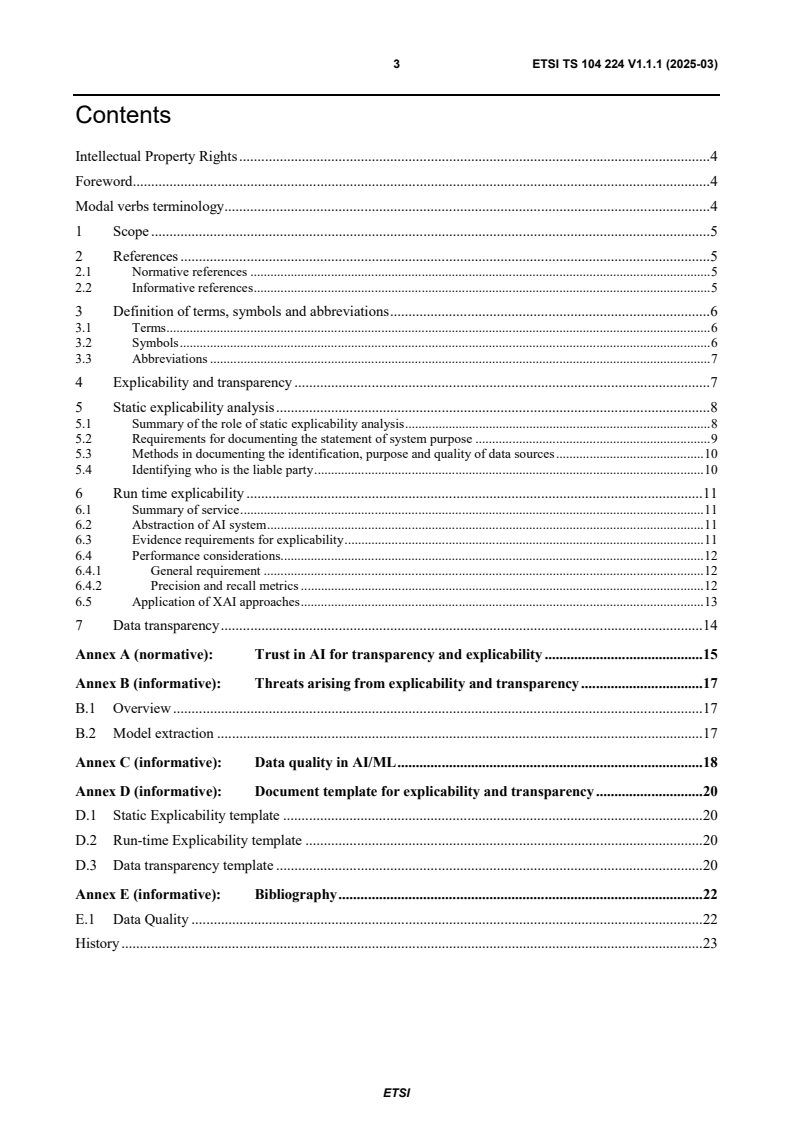
Contents
Intellectual Property Rights . 4
Foreword . 4
Modal verbs terminology . 4
1 Scope . 5
2 References . 5
2.1 Normative references . 5
2.2 Informative references . 5
3 Definition of terms, symbols and abbreviations . 6
3.1 Terms . 6
3.2 Symbols . 6
3.3 Abbreviations . 7
4 Explicability and transparency . 7
5 Static explicability analysis . 8
5.1 Summary of the role of static explicability analysis . 8
5.2 Requirements for documenting the statement of system purpose . 9
5.3 Methods in documenting the identification, purpose and quality of data sources . 10
5.4 Identifying who is the liable party . 10
6 Run time explicability . 11
6.1 Summary of service . 11
6.2 Abstraction of AI system . 11
6.3 Evidence requirements for explicability . 11
6.4 Performance considerations. 12
6.4.1 General requirement . 12
6.4.2 Precision and recall metrics . 12
6.5 Application of XAI approaches . 13
7 Data transparency . 14
Annex A (normative): Trust in AI for transparency and explicability . 15
Annex B (informative): Threats arising from explicability and transparency . 17
B.1 Overview . 17
B.2 Model extraction . 17
Annex C (informative): Data quality in AI/ML . 18
Annex D (informative): Document template for explicability and transparency . 20
D.1 Static Explicability template . 20
D.2 Run-time Explicability template . 20
D.3 Data transparency template . 20
Annex E (informative): Bibliography . 22
E.1 Data Quality . 22
History . 23
ETSI
4 ETSI TS 104 224 V1.1.1 (2025-03)
Intellectual Property Rights
Essential patents
IPRs essential or potentially essential to normative deliverables may have been declared to ETSI. The declarations
pertaining to these essential IPRs, if any, are publicly available for ETSI members and non-members, and can be
found in ETSI SR 000 314: "Intellectual Property Rights (IPRs); Essential, or potentially Essential, IPRs notified to
ETSI in respect of ETSI standards", which is available from the ETSI Secretariat. Latest updates are available on the
ETSI IPR online database.
Pursuant to the ETSI Directives including the ETSI IPR Policy, no investigation regarding the essentiality of IPRs,
including IPR searches, has been carried out by ETSI. No guarantee can be given as to the existence of other IPRs not
referenced in ETSI SR 000 314 (or the updates on the ETSI Web server) which are, or may be, or may become,
essential to the present document.
Trademarks
The present document may include trademarks and/or tradenames which are asserted and/or registered by their owners.
ETSI claims no ownership of these except for any which are indicated as being the property of ETSI, and conveys no
right to use or reproduce any trademark and/or tradename. Mention of those trademarks in the present document does
not constitute an endorsement by ETSI of products, services or organizations associated with those trademarks.
DECT™, PLUGTESTS™, UMTS™ and the ETSI logo are trademarks of ETSI registered for the benefit of its
Members. 3GPP™, LTE™ and 5G™ logo are trademarks of ETSI registered for the benefit of its Members and of the
3GPP Organizational Partners. oneM2M™ logo is a trademark of ETSI registered for the benefit of its Members and of ®
the oneM2M Partners. GSM and the GSM logo are trademarks registered and owned by the GSM Association.
Foreword
This Technical Specification (TS) has been produced by ETSI Technical Committee Securing Artificial Intelligence
(SAI).
NOTE: The present document updates and extends ETSI GR SAI 007 prepared by ISG SAI.
Modal verbs terminology
In the present document "shall", "shall not", "should", "should not", "may", "need not", "will", "will not", "can" and
"cannot" are to be interpreted as described in clause 3.2 of the ETSI Drafting Rules (Verbal forms for the expression of
provisions).
"must" and "must not" are NOT allowed in ETSI deliverables except when used in direct citation.
ETSI
5 ETSI TS 104 224 V1.1.1 (2025-03)
1 Scope
The present document identifies steps to be taken by designers and implementers of AI platforms in order to give
assurance of the explicability and transparency of AI processing. AI processing includes AI decision making and AI
data processing.
NOTE: The present document uses the term explicability but recognizes that many other publications use the term
explainability as a synonym. The terms are interchangeable with the proviso that the latter term is not a
commonly accepted UK English word but that it has been used in the specific context of AI (see also
clause 3.1 of the present document).
2 References
2.1 Normative references
References are either specific (identified by date of publication and/or edition number or version number) or
non-specific. For specific references, only the cited version applies. For non-specific references, the latest version of the
referenced document (including any amendments) applies.
Referenced documents which are not found to be publicly available in the expected location might be found in the ETSI
docbox.
NOTE: While any hyperlinks included in this clause were valid at the time of publication, ETSI cannot guarantee
their long term validity.
The following referenced documents are necessary for the application of the present document.
[1] ETSI TS 104 050: "Securing Artificial Intelligence (SAI); AI Threat Ontology and definitions".
[2] ISO/IEC 22989: "Information technology - Artificial intelligence - Artificial intelligence concepts
and terminology".
2.2 Informative references
References are either specific (identified by date of publication and/or edition number or version number) or
non-specific. For specific references, only the cited version applies. For non-specific references, the latest version of the
referenced document (including any amendments) applies.
NOTE: While any hyperlinks included in this clause were valid at the time of publication, ETSI cannot guarantee
their long term validity.
The following referenced documents are not necessary for the application of the present document but they assist the
user with regard to a particular subject area.
[i.1] ETSI TR 104 221: "Securing Artificial Intelligence (SAI); Problem Statement".
NOTE: An earlier version of the above document is available as ETSI GR SAI 004.
[i.2] ETSI TR 104 048: "Securing Artificial Intelligence (SAI); Data Supply Chain Security".
NOTE: An earlier version of the above document is available as ETSI GR SAI 002.
[i.3] ETSI GR NFV-SEC 003: "Network Functions Virtualisation (NFV); NFV Security; Security and
Trust Guidance".
[i.4] Auguste Kerckhoffs: "La cryptographie militaire" Journal des sciences militaires, vol. IX,
pp. 5-83, January 1883, pp. 161-191, February 1883.
ETSI
6 ETSI TS 104 224 V1.1.1 (2025-03)
[i.5] Regulation (EU) 2024/1689 of the European Parliament and of the Council of 13 June 2024 laying
down harmonised rules on artificial intelligence and amending Regulations (EC) No 300/2008,
(EU) No 167/2013, (EU) No 168/2013, (EU) 2018/858, (EU) 2018/1139 and (EU) 2019/2144 and
Directives 2014/90/EU, (EU) 2016/797 and (EU) 2020/1828 (Artificial Intelligence Act).
[i.6] DARPA: "XAI: Explainable Artificial Intelligence".
[i.7] Margaret Mitchell, Simone Wu, Andrew Zaldivar, Parker Barnes, Lucy Vasserman, Ben
Hutchinson, Elena Spitzer, Inioluwa Deborah Raji, Timnit Gebru. Conference on Fairness,
Accountability, and Transparency: "Model Cards for Model Reporting", 29 January 2019, Atlanta,
GA, USA. ACM, New York, NY, USA.
[i.8] Samek W., Montavon G., Vedaldi A., Hansen L. K. and Müller K. R. (eds.) (2019): "Explainable
AI: Interpreting, Explaining and Visualizing Deep Learning". Cham, Springer.
[i.9] Timnit Gebru, Jamie Morgenstern, Briana Vecchione, Jennifer Wortman Vaughan,
Hanna Wallach, Hal Daumé III and Kate Crawford: "Datasheets for Datasets", Communications of
the ACM, Volume 64, Issue 12, pp. 89-92, November 2021.
[i.10] Lapuschkin S., Wäldchen S., Binder A., Montavon G., Samek W. and Müller K. R. (2019):
"Unmasking Clever Hans predictors and assessing what machines really learn". Nat. Commun. 10,
doi: 10.1038/s41467-019-08987-4.
[i.11] Molnar C.: "Interpretable Machine Learning-A Guide for Making Black Box Models
Explainable".
[i.12] Samek W., Montavon G., Binder A., Lapuschkin S. and Müller K. R. (2016): "Interpreting the
predictions of complex ML models by layer-wise relevance propagation", arXiv abs/1611.08191.
[i.13] ETSI TR 104 102: "Cyber Security (CYBER); Encrypted Traffic Integration (ETI); ZT-Kipling
methodology".
3 Definition of terms, symbols and abbreviations
3.1 Terms
For the purposes of the present document, the terms given in ETSI TS 104 050 [1] and ISO/IEC 22989 [2] and the
following apply:
AI system: engineered system that generates outputs such as content, forecasts, recommendations or decisions for a
given set of human-defined objectives
NOTE: Definition from ISO/IEC 22989 [2].
explainability: property of an AI system to express important factors influencing the AI system results in a way that
humans can understand
NOTE: Definition from ISO/IEC 22989 [2].
explicability: property of an action to be able to be accounted for or understood
transparency: property of an action to be open to inspection with no hidden properties
3.2 Symbols
Void.
ETSI
7 ETSI TS 104 224 V1.1.1 (2025-03)
3.3 Abbreviations
For the purposes of the present document, the following abbreviations apply:
AI Artificial Intelligence
BTT Build-Train-Test
DARPA Defence Advanced Research Projects Agency
LRP Layer-wise Relevance Propagation
ML Machine Learning
OECD Organization for Economic Cooperation and Development
RTE Run Time Explicability
TA Trust Association
XAI eXplainable AI
4 Explicability and transparency
The SAI problem statement, ETSI TR 104 221 [i.1], identifies explicability as being a contributor in establishing trust in
AI systems as one element of achieving transparency. However, in computer science the concept of transparency is
somewhat at odds with explicability and can be interpreted as "functioning without the user being aware of its
presence" when referring to a process. The term transparent (and its associated noun form, transparency) when applied
to AI is, for the purposes of the present document, the core concept of being open to examination, or having no part
hidden.
The term explicability is, in very crude terms, being able to show how any result was achieved ("show your working"),
which when combined with transparency gives assurance that nothing is hidden.
NOTE 1: In ETSI TR 104 221 [i.1] and in ISO/IEC 22989 [2] the term explainability is used whereas in the present
document the more common term in UK English, explicability, is used.
NOTE 2: It is recognized that many processes are protected from disclosure by mechanisms that protect the
intellectual property that the processes contain and such protections are not intended to be impacted by
the requirement to maintain attributes of transparency and explicability.
The outcome of applying constraints of explicability and transparency to systems is that trust can be conferred as a
system attribute that is open to examination and verification by third parties.
It is recognized that in many systems, such as in telecommunications, the role of AI is often at a component level. The
role of most applications is not to explicitly design or develop intelligence as a primary goal. Trust should not be
attributed where purpose is not clear.
One purpose of transparency and, particularly, explicability is to prevent the AI components of a system from denying
that they took part in an action, and to prevent the AI component denying they were the recipient of the output of an
action from any other part of the system.
NOTE 3: The description above is very close to the common definition of non-repudiation but there is a subtly
different intent in the scope of explicability and transparency, hence for the present document this is not
referred to as non-repudiation.
In ETSI TS 104 050 [1], it is stated that there are a number of characteristics associated to intelligence the key elements
of which are given below, and in the context of transparency and explicability it is expected that each of these
characteristics, if they are present in the AI component or system, is described:
• reasoning: the application of learned strategies in order to solve puzzles, and make judgments where there is
uncertainty in either the input or the expected outcome;
• learning: the means by which reasoning and other behaviour evolves over time to address new input;
• communicating: in natural language (to human third parties), in particular when within the bounds of the
system it is unable to process data to a known state.
ETSI
8 ETSI TS 104 224 V1.1.1 (2025-03)
In terms of explicability it should be clear where reasoning takes place, and on what data and algorithm, such reasoning
is based. Similarly the scope of explicability and transparency addresses the means by which the system learns. Finally,
in the context of the key characteristics above, the means by which the system's purpose is communicated should be in
natural language where the intended recipient should be considered as a lay person (i.e. having no knowledge of any
specialized language of AI/ML or of the programming techniques of AI/ML).
Many concerns raised regarding AI/ML (see ETSI TR 104 221 [i.1]) and addressed as "Design challenges and
unintentional factors" can be made visible through the application of specific explicability techniques. An example is
the concern of bias (confirmation bias and selection bias in particular) where, by the application of simple checklists
(see clauses 5 and 6) the system deployment should be able to answer questions of the form "why was this data source
selected?".
EXAMPLE: An AI can be biased by design if the purpose of the AI is to filter candidates for a job based on
some personal characteristic (i.e. as opposed to a meritocratic selection engine, the AI acts as a
characteristic selection engine). In such a case the explicability and transparency requirements will
be able to identify that negative, or trait-based, filtering is at the root of the reasoning engine of the
AI.
It is reasonable to suggest that bias in inputs will be reinforced in the output, hence in clause 5 it is stressed that
explicability addresses the purpose of data. If data is preselected to achieve a particular result that could be seen to be
consistent with selection bias and that would need to be explained as part of the system purpose (as in the example) or
removed by design.
5 Static explicability analysis
5.1 Summary of the role of static explicability analysis
The role of static explicability is closely related to giving detailed system documentation. The purpose of explicability
is to allow a lay person (i.e. not a professional programmer or system analyst) to gain a reasonable understanding of the
main data flows and processing steps in the program.
EXAMPLE: A data set of images is used as training data and routinely classified as images of, say, "Cat",
"Dog", "Fox", "Badger" where the purpose is to enable a camera observing a suburban garden to
record movements of particular animals at night, thus being able to say that a badger crossed the
garden lawn at a particular time of the night.
In a simple scenario such as in the example above the purpose is clear (identify which animal is in the capture range of
the camera), it is clear where the training data comes from (the set of images), and it is reasonable to expect a layperson
to understand the purpose, the role of data and components in the system, and to make reasonable attempts to verify the
veracity of the system (e.g. by getting a dog to pass in front of the camera and be recognized as a dog, or for a deer to
pass in front of the camera and not to be recognized as one of the animals it has been trained to recognize).
As more components are added to the system to improve the system's ability in recognition, say by adding gait analysis
(dogs and cats move quite differently) static explicability shall be maintained (i.e. at all times static explicability shall
be a characteristic of the current system).
The components identified in table 1 shall be clearly identifiable in the system documentation.
ETSI
9 ETSI TS 104 224 V1.1.1 (2025-03)
Table 1: System documentation elements in static explicability analysis
Documentation Element Mandatory Short description
Element
1 Statement of system Yes This element of the system documentation is intended to
purpose allow a layperson to clearly understand the purpose of the
system and to explicitly identify the role of AI in achieving
that purpose.
2a Identification of data Yes Where the data comes from and how the authenticity of
source(s) the data source is verified.
2b Purpose of data Yes The role of the particular data source in the system (e.g.
source(s) (in support training data containing images of dogs to train the system
of system purpose) in recognizing a dog from an image).
2c Method(s) used to Strongly Methods and processes used in determining if the input
determine data recommended data is a fair and accurate representation of the desired
quality input. This should address how bias or preference is
identified and corrected in the data input.
3 Identity of liable Yes For each processing or data element a means to identify
party liability for correction of errors or for maintenance of the
element.
5.2 Requirements for documenting the statement of system
purpose
The statement of system purpose is critical in allowing a layperson to clearly understand the intent of the system and the
role of AI in achieving that purpose or intent.
EXAMPLE 1: AI used in a voice-recognition personal assistant. The purpose of the system is to allow the user to
issue spoken commands in natural language and to translate those into machine commands for
purposes including machine control, and internet-based information search and retrieval. The AI in
the system provides a number of functions in order to achieve its purpose including: AI to enable
speech recognition; AI to assist in parsing of recognized speech to commands; AI to drive voice
responses to spoken commands; AI to parse and relay the results of search commands into natural
language.
NOTE 1: In the above example multiple AI capabilities are identified even if the perception of the user is of a
single AI being applied.
EXAMPLE 2: AI used in adaptive cruise control in road vehicles. The primary purpose is to ensure that whilst
the driver can set a target speed to be maintained it is recognized that strict adherence to the target
speed can be unsafe. The role of the AI in this system is to maintain a safe distance between
vehicles whilst maximizing the time spent at the target speed. The system therefore adaptively
modifies the vehicle speed (not exceeding the target speed) by maintaining a "safe" distance from
other vehicles through selective braking and acceleration where data on the presence and actions
of other vehicles are obtained from system sensors and driver input.
The statement of system purpose should be written in natural language and be concise as well as precise (i.e. not open to
variations in interpretation).
The following characteristics shall be identifiable in the statement of system purpose:
• Unambiguous: it should be impossible to interpret the system purpose in more than one way.
• Complete: the system purpose should contain all the information necessary to understand it without requiring
reference to other documents.
NOTE 2: The above requirement may be seen to contradict best practice in standards development where
referencing is used to ensure succinctness, whereas in the statement of system purpose a little more
verbosity may be beneficial.
• Precise: the system purpose should be worded clearly and exactly, without unnecessary detail that might
confuse the reader.
ETSI
10 ETSI TS 104 224 V1.1.1 (2025-03)
• Well-structured: any individual elements of the system purpose should be included in an appropriate and
easy-to-read manner.
The present document provides a template for the documenting of the system purpose in Annex D.
5.3 Methods in documenting the identification, purpose and
quality of data sources
As outlined in table 1 where data is used in AI the liable party should ensure that answers are documented for the
following questions (this is also addressed in the ZT-Kipling method defined in ETSI TR 104 102 [i.13] and in
Annex A):
• Where does the data come from?
- As the purpose of data has been indicated earlier this clarifies explicitly the source of the data. This can
include statements such as the following for the example of adaptive cruise control: "the range-data
indicating the distance to surrounding vehicles and environmental objects is sourced from a radar array
positioned at the front left, centre and right of the vehicle".
• How is the authenticity of the data source verified?
- The aim here is to ensure that only trusted data (data sources) are used in the system.
• What is the role of the particular data source in the system? (e.g. training data containing images of dogs to
train the system in recognizing a dog from an image).
• What methods and processes are used in determining if the input data is a fair and accurate representation of
the desired input?
• What steps have been taken to determine if the input data has bias?
- It can be argued that all data is biased and that all designers will have some degree of selection bias in the
data chosen
...
Questions, Comments and Discussion
Ask us and Technical Secretary will try to provide an answer. You can facilitate discussion about the standard in here.
Loading comments...