


ETSI TS 102 941 V2.2.1 (2022-11)
Intelligent Transport Systems (ITS); Security; Trust and Privacy Management; Release 2
Intelligent Transport Systems (ITS); Security; Trust and Privacy Management; Release 2
RTS/ITS-005102
General Information
Standards Content (Sample)
TECHNICAL SPECIFICATION
Intelligent Transport Systems (ITS);
Security;
Trust and Privacy Management;
Release 2
2 ETSI TS 102 941 V2.2.1 (2022-11)
Reference
RTS/ITS-005102
Keywords
interoperability, ITS, management, security
ETSI
650 Route des Lucioles
F-06921 Sophia Antipolis Cedex - FRANCE
Tel.: +33 4 92 94 42 00 Fax: +33 4 93 65 47 16
Siret N° 348 623 562 00017 - APE 7112B
Association à but non lucratif enregistrée à la
Sous-Préfecture de Grasse (06) N° w061004871
Important notice
The present document can be downloaded from:
http://www.etsi.org/standards-search
The present document may be made available in electronic versions and/or in print. The content of any electronic and/or
print versions of the present document shall not be modified without the prior written authorization of ETSI. In case of any
existing or perceived difference in contents between such versions and/or in print, the prevailing version of an ETSI
deliverable is the one made publicly available in PDF format at www.etsi.org/deliver.
Users of the present document should be aware that the document may be subject to revision or change of status.
Information on the current status of this and other ETSI documents is available at
https://portal.etsi.org/TB/ETSIDeliverableStatus.aspx
If you find errors in the present document, please send your comment to one of the following services:
https://portal.etsi.org/People/CommiteeSupportStaff.aspx
If you find a security vulnerability in the present document, please report it through our
Coordinated Vulnerability Disclosure Program:
https://www.etsi.org/standards/coordinated-vulnerability-disclosure
Notice of disclaimer & limitation of liability
The information provided in the present deliverable is directed solely to professionals who have the appropriate degree of
experience to understand and interpret its content in accordance with generally accepted engineering or
other professional standard and applicable regulations.
No recommendation as to products and services or vendors is made or should be implied.
No representation or warranty is made that this deliverable is technically accurate or sufficient or conforms to any law
rule and/or regulation and further, no representation or warranty is made of merchantability or fitness
and/or governmental
for any particular purpose or against infringement of intellectual property rights.
In no event shall ETSI be held liable for loss of profits or any other incidental or consequential damages.
Any software contained in this deliverable is provided "AS IS" with no warranties, express or implied, including but not
limited to, the warranties of merchantability, fitness for a particular purpose and non-infringement of intellectual property
rights and ETSI shall not be held liable in any event for any damages whatsoever (including, without limitation, damages
for loss of profits, business interruption, loss of information, or any other pecuniary loss) arising out of or related to the use
of or inability to use the software.
Copyright Notification
No part may be reproduced or utilized in any form or by any means, electronic or mechanical, including photocopying and
microfilm except as authorized by written permission of ETSI.
The content of the PDF version shall not be modified without the written authorization of ETSI.
The copyright and the foregoing restriction extend to reproduction in all media.
© ETSI 2022.
All rights reserved.
ETSI
3 ETSI TS 102 941 V2.2.1 (2022-11)
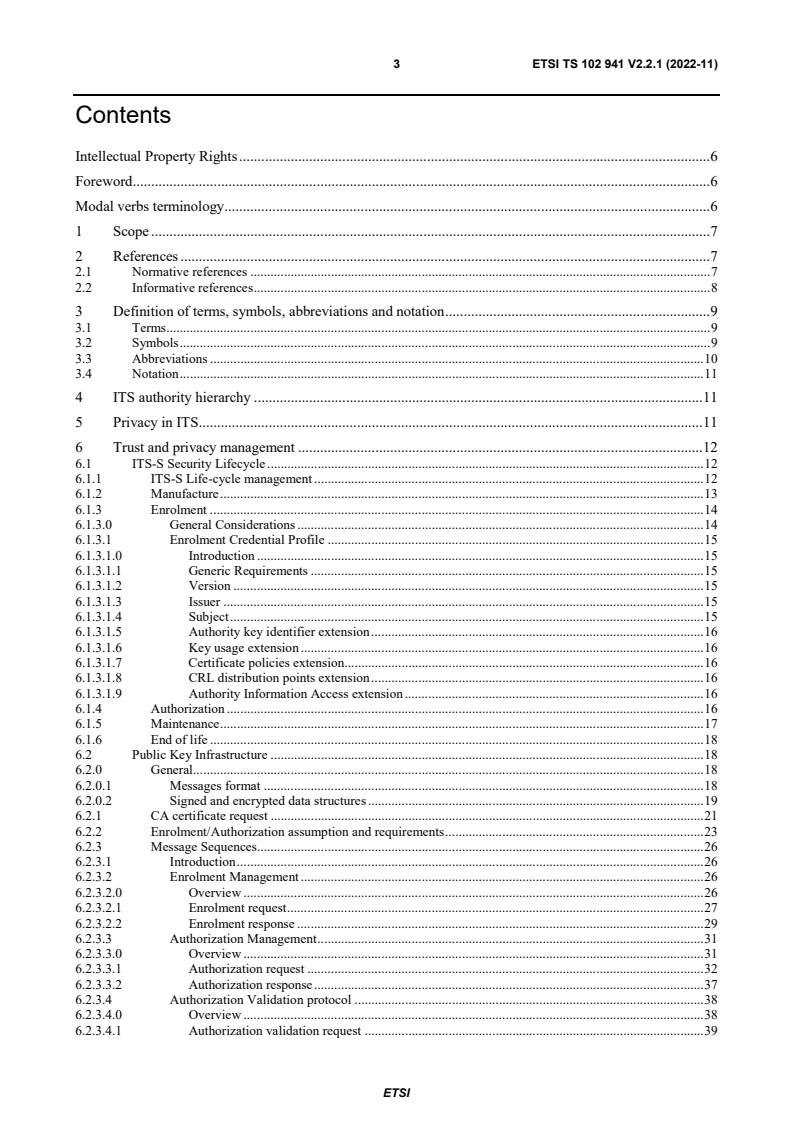
Contents
Intellectual Property Rights . 6
Foreword . 6
Modal verbs terminology . 6
1 Scope . 7
2 References . 7
2.1 Normative references . 7
2.2 Informative references . 8
3 Definition of terms, symbols, abbreviations and notation . 9
3.1 Terms . 9
3.2 Symbols . 9
3.3 Abbreviations . 10
3.4 Notation . 11
4 ITS authority hierarchy . 11
5 Privacy in ITS . 11
6 Trust and privacy management . 12
6.1 ITS-S Security Lifecycle . 12
6.1.1 ITS-S Life-cycle management . 12
6.1.2 Manufacture . 13
6.1.3 Enrolment . 14
6.1.3.0 General Considerations . 14
6.1.3.1 Enrolment Credential Profile . 15
6.1.3.1.0 Introduction . 15
6.1.3.1.1 Generic Requirements . 15
6.1.3.1.2 Version . 15
6.1.3.1.3 Issuer . 15
6.1.3.1.4 Subject . 15
6.1.3.1.5 Authority key identifier extension . 16
6.1.3.1.6 Key usage extension . 16
6.1.3.1.7 Certificate policies extension . 16
6.1.3.1.8 CRL distribution points extension . 16
6.1.3.1.9 Authority Information Access extension . 16
6.1.4 Authorization . 16
6.1.5 Maintenance . 17
6.1.6 End of life . 18
6.2 Public Key Infrastructure . 18
6.2.0 General . 18
6.2.0.1 Messages format . 18
6.2.0.2 Signed and encrypted data structures . 19
6.2.1 CA certificate request . 21
6.2.2 Enrolment/Authorization assumption and requirements . 23
6.2.3 Message Sequences. 26
6.2.3.1 Introduction . 26
6.2.3.2 Enrolment Management . 26
6.2.3.2.0 Overview . 26
6.2.3.2.1 Enrolment request . 27
6.2.3.2.2 Enrolment response . 29
6.2.3.3 Authorization Management . 31
6.2.3.3.0 Overview . 31
6.2.3.3.1 Authorization request . 32
6.2.3.3.2 Authorization response . 37
6.2.3.4 Authorization Validation protocol . 38
6.2.3.4.0 Overview . 38
6.2.3.4.1 Authorization validation request . 39
ETSI
4 ETSI TS 102 941 V2.2.1 (2022-11)
6.2.3.4.2 Authorization validation response . 40
6.2.3.5 Authorization Management with Butterfly Keys . 42
6.2.3.5.0 Introduction . 42
6.2.3.5.1 Overview . 42
6.2.3.5.2 Butterfly Authorization request . 43
6.2.3.5.3 Butterfly authorization response . 47
6.2.3.5.4 Butterfly certificate request . 48
6.2.3.5.5 Butterfly certificate response . 50
6.2.3.5.6 Butterfly AT download request . 52
6.2.3.5.7 Butterfly AT download response . 53
6.3 Generation, distribution and use of Trust information lists . 54
6.3.1 Generation and distribution of CTL by TLM . 54
6.3.2 Generation and distribution of CTL by RCA . 54
6.3.3 Generation and distribution of CRL by RCA . 55
6.3.4 Specification of Full CTL and Delta CTL . 55
6.3.5 Transmission of CTL and CRL. 57
6.3.6 CTL and CRL use by ITS-Ss . 57
6.4 Generation and distribution of TLM / RCA Link Certificates . 57
6.4.1 General . 57
6.4.2 Generation of Link Certificate Messages . 58
6.4.2.1 Generation of Link Certificate Message by the TLM . 58
6.4.2.2 Generation of Link Certificate Message by a Root CA. 59
7 Security association and key management between ITS Stations . 63
7.0 Introduction . 63
7.1 Broadcast SAs . 63
7.2 Multicast SAs . 63
7.3 Unicast SAs . 64
Annex A (normative): ITS security management messages specified in ASN.1 . 66
A.1 ITS trust and privacy messages specified in ASN.1 . 66
A.2 Security management messages structures . 66
A.2.1 Security data structures . 66
A.2.2 Security Management messages for CA . 66
A.2.3 Security Management messages for ITS-S_WithPrivacy . 67
A.2.4 Security Management messages for ITSS_NoPrivacy . 67
A.2.5 Enrolment and authorization data types . 67
A.2.5.1 Enrolment . 67
A.2.5.2 Authorization . 68
A.2.5.3 AuthorizationValidation . 68
A.2.6 Offline message structures . 68
A.2.7 Trust lists data types . 69
A.2.8 Link certificate message data types . 69
A.3 Imported messages structures . 69
Annex B (normative): Service Specific Permissions (SSP) definition . 74
B.1 Overview . 74
B.2 CTL SSP definition . 74
B.3 CRL SSP definition . 75
B.4 Certificate request messages SSP definition . 75
B.5 Security Management certificate permissions . 76
Annex C (informative): Communication profiles for security credential provisioning services
(EC request, AT request) . 77
C.0 General . 77
C.1 Communication profiles description . 78
ETSI
5 ETSI TS 102 941 V2.2.1 (2022-11)
Annex D (normative): Communication profiles for CTL and CRL . 83
D.1 CTL request and response protocol . . 83
D.2 CRL request and response protocol . 83
D.3 Broadcast communication of CTL/CRL . 84
Annex E (normative): Communication profiles for TLM Certificates, TLM Link Certificate
Messages, ECTLs and delta ECTLs access . 86
E.1 CPOC HOST URL Definition . 86
E.2 Request of TLM certificate . 86
E.3 Request of TLM link certificate message . 87
E.4 Request of full ECTL . 87
E.5 Request of delta ECTL . 88
Annex F (informative): Encryption of a message from a sender to a receiver . 89
Annex G (informative): Bibliography . 91
Annex H (informative): Change request history . 92
History . 94
ETSI
6 ETSI TS 102 941 V2.2.1 (2022-11)
Intellectual Property Rights
Essential patents
IPRs essential or potentially essential to normative deliverables may have been declared to ETSI. The declarations
pertaining to these essential IPRs, if any, are publicly available for ETSI members and non-members, and can be
found in ETSI SR 000 314: "Intellectual Property Rights (IPRs); Essential, or potentially Essential, IPRs notified to
ETSI in respect of ETSI standards", which is available from the ETSI Secretariat. Latest updates are available on the
ETSI Web server (https://ipr.etsi.org/).
Pursuant to the ETSI Directives including the ETSI IPR Policy, no investigation regarding the essentiality of IPRs,
including IPR searches, has been carried out by ETSI. No guarantee can be given as to the existence of other IPRs not
referenced in ETSI SR 000 314 (or the updates on the ETSI Web server) which are, or may be, or may become,
essential to the present document.
Trademarks
The present document may include trademarks and/or tradenames which are asserted and/or registered by their owners.
ETSI claims no ownership of these except for any which are indicated as being the property of ETSI, and conveys no
right to use or reproduce any trademark and/or tradename. Mention of those trademarks in the present document does
not constitute an endorsement by ETSI of products, services or organizations associated with those trademarks.
DECT™, PLUGTESTS™, UMTS™ and the ETSI logo are trademarks of ETSI registered for the benefit of its
Members. 3GPP™ and LTE™ are trademarks of ETSI registered for the benefit of its Members and of the 3GPP
Organizational Partners. oneM2M™ logo is a trademark of ETSI registered for the benefit of its Members and of the ®
oneM2M Partners. GSM and the GSM logo are trademarks registered and owned by the GSM Association.
Foreword
This Technical Specification (TS) has been produced by ETSI Technical Committee Intelligent Transport Systems
(ITS).
Modal verbs terminology
In the present document "shall", "shall not", "should", "should not", "may", "need not", "will", "will not", "can" and
"cannot" are to be interpreted as described in clause 3.2 of the ETSI Drafting Rules (Verbal forms for the expression of
provisions).
"must" and "must not" are NOT allowed in ETSI deliverables except when used in direct citation.
ETSI
7 ETSI TS 102 941 V2.2.1 (2022-11)
1 Scope
The present document specifies the trust and privacy management for Intelligent Transport Systems (ITS)
communications. Based upon the security services defined in ETSI TS 102 731 [i.23] and the security architecture
defined in ETSI TS 102 940 [5], it identifies the trust establishment and privacy management required to support
security in an ITS environment and the relationships that exist between the entities themselves and the elements of the
ITS reference architecture defined in ETSI EN 302 665 [i.25].
The present document identifies and specifies security services for the establishment and maintenance of identities and
cryptographic keys in an Intelligent Transport Systems (ITS). Its purpose is to provide the functions upon which
systems of trust and privacy can be built within an ITS.
2 References
2.1 Normative references
References are either specific (identified by date of publication and/or edition number or version number) or
non-specific. For specific references, only the cited version applies. For non-specific references, the latest version of the
referenced document (including any amendments) applies.
Referenced documents which are not found to be publicly available in the expected location might be found at
https://docbox.etsi.org/Reference.
NOTE: While any hyperlinks included in this clause were valid at the time of publication, ETSI cannot guarantee
their long term validity.
The following referenced documents are necessary for the application of the present document.
[1] Void.
[2] Void.
[3] ETSI TS 103 097: "Intelligent Transport Systems (ITS); Security; Security header and certificate
formats; Release 2".
[4] Void.
[5] ETSI TS 102 940: "Intelligent Transport Systems (ITS); Security; ITS communications security
architecture and security management; Release 2".
[6] ISO/IEC 8824-1:2021: "Information technology -- Abstract Syntax Notation One (ASN.1):
Specification of basic notation -- Part 1 Specification of basic notation".
[7] Recommendation ITU-T X.696 (02/2021): "Information technology - ASN.1 encoding rules:
Specification of Octet Encoding Rules (OER)".
[8] Void.
[9] Void.
[10] Void.
[11] Void.
[12] Void.
[13] NIST FIPS PUB 198-1: "The Keyed-Hash Message Authentication Code (HMAC)".
[14] Void.
[15] IETF RFC 4862: "IPv6 Stateless Address Autoconfiguration".
ETSI
8 ETSI TS 102 941 V2.2.1 (2022-11)
[16] ETSI TS 103 836-6-1: "Intelligent Transport Systems (ITS); Vehicular Communications;
GeoNetworking; Part 6: Internet Integration; Sub-part 1: Transmission of IPv6 Packets over
GeoNetworking Protocols; Release 2".
[17] Void.
[18] ETSI TS 103 836-4-1: "Intelligent Transportation Systems (ITS); Vehicular Communications;
GeoNetworking; Part 4: Geographical addressing and forwarding for point-to-point and point-to-
multipoint communications; Sub-part 1: Media-Independent Functionality; Release 2".
[19] ETSI TS 102 965: "Intelligent Transport Systems (ITS); Application Object Identifier (ITS-AID);
Registration; Release 2".
[20] Void.
[21] IETF RFC 5280: "Internet X.509 Public Key Infrastructure Certificate and Certificate Revocation
List (CRL) Profile".
NOTE: Available from https://datatracker.ietf.org/doc/html/rfc5280.
[22] IETF RFC 5480: "Elliptic Curve Cryptography Subject Public Key Information".
NOTE: Available from https://www.rfc-editor.org/rfc/rfc5480.
[23] Void.
[24] IEEE 1609.2.1™-2022: "IEEE Standard for Wireless Access in Vehicular Environments (WAVE)
- Certificate Management Interfaces for End Entities".
2.2 Informative references
References are either specific (identified by date of publication and/or edition number or version number) or
non-specific. For specific references, only the cited version applies. For non-specific references, the latest version of the
referenced document (including any amendments) applies.
NOTE: While any hyperlinks included in this clause were valid at the time of publication, ETSI cannot guarantee
their long term validity.
The following referenced documents are not necessary for the application of the present document but they assist the
user with regard to a particular subject area.
[i.1] ISO/IEC 15408-2: "Information technology -- Security techniques -- Evaluation criteria for IT
security; Part 2: Security functional components".
[i.2] ETSI TR 102 638: "Intelligent Transport Systems (ITS); Vehicular communication; Basic Set of
Applications; Release 2".
[i.3] IETF RFC 4046: "Multicast Security (MSEC) Group Key Management Architecture".
[i.4] IETF RFC 4301: "Security Architecture for the Internet Protocol".
[i.5] IETF RFC 4302: "IP Authentication Header".
[i.6] IETF RFC 4303: "IP Encapsulating Security Payload (ESP)".
[i.7] IETF RFC 5246: "The Transport Layer Security (TLS) Protocol Version 1.2".
[i.8] IETF RFC 3547: "The Group Domain of Interpretation".
[i.9] IETF RFC 3830: "MIKEY: Multimedia Internet KEYing".
[i.10] IETF RFC 4535: "GSAKMP: Group Secure Association Key Management Protocol".
[i.11] IETF RFC 4306: "Internet Key Exchange (IKEv2) Protocol", December 2005.
[i.12] IETF RFC 4877: "Mobile IPv6 Operation with IKEv2 and the Revised IPsec Architecture".
ETSI
9 ETSI TS 102 941 V2.2.1 (2022-11)
[i.13] ETSI TS 102 723-8: "Intelligent Transport Systems (ITS); OSI cross-layer topics; Part 8: Interface
between security entity and network and transport layer".
[i.14] CVRIA: "Connected Vehicle Reference Implementation Architecture".
NOTE: Available at http://www.iteris.com/cvria/.
[i.15] ISO 21210-2010: "Intelligent Transport Systems (ITS) -- Communications access for land mobiles
(CALM) -- Ipv6 networking".
[i.16] IETF RFC 8446: "The Transport Layer Security (TLS) Protocol Version 1.3".
[i.17] ETSI TS 102 942: "Intelligent Transport Systems (ITS); Security; Access control; Release 2".
[i.18] ETSI TS 102 943: "Intelligent Transport Systems (ITS); Security; Confidentiality services;
Release 2".
[i.19] ETSI TS 103 900: "Intelligent Transport Systems (ITS); Vehicular Communications; Basic Set of
Applications; Specification of Cooperative Awareness Basic Service; Release 2".
[i.20] ETSI TS 103 831: "Intelligent Transport Systems (ITS); Vehicular Communications; Basic Set of
Applications; Decentralized Environmental Notification Service; Release 2".
[i.21] ETSI TS 103 301: "Intelligent Transport Systems (ITS); Vehicular Communications; Basic Set of
Applications; Facilities layer protocols and communication requirements for infrastructure
services; Release 2".
[i.22] IEEE 802.11™: "IEEE Standard for Information technology -- Telecommunications and
information exchange between systems -- Local and metropolitan area networks-Specific
requirements -- Part 11: Wireless LAN Medium Access Control (MAC) and Physical Layer (PHY)
Specifications".
[i.23] ETSI TS 102 731: "Intelligent Transport Systems (ITS); Security; Security Services and
Architecture; Release 2".
[i.24] Void.
[i.25] ETSI EN 302 665: "Intelligent Transport Systems (ITS); Communications Architecture".
[i.26] EU C-ITS Security Credential Management System (EU CCMS).
3 Definition of terms, symbols, abbreviations and
notation
3.1 Terms
For the purposes of the present document, the terms given in ETSI TS 102 731 [i.23], ETSI TS 102 940 [5],
ISO/IEC 15408-2 [i.1] and the following apply:
delta CTL: partial CTL that only contains CTL entries that have been updated since the issuance of the prior, base CTL
3.2 Symbols
Void.
ETSI
10 ETSI TS 102 941 V2.2.1 (2022-11)
3.3 Abbreviations
For the purposes of the present document, the abbreviations given in ETSI TS 103 097 [3], ETSI TS 102 940 [5], ETSI
TS 103 836-4-1 [18] and the following apply:
AA Authorization Authority
AES Advanced Encryption Standard
ASN Abstract Syntax Notation
AT Authorization Ticket
CA Certification Authority
CCH Control CHannel
CCM Counter with CBC-MAC
CCMS Cooperative-ITS Certificate Management System
COER Canonical Octet Encoding Rules
CPOC C-ITS Point Of Contact
CRL Certificate Revocation List
CTL Certificate Trust List
CVRIA Connected Vehicle Reference Implementation Architecture
DC Distribution Centre
DEN Decentralized Environmental Notification
DENM Decentralized Environmental Notification Message
EA Enrolment Authority
EC Enrolment Credential
ECC Elliptic Curve Cryptography
ECTL European Certificate Trust List
EV Electric Vehicle
FIPS Federal Information Processing Standard
GET command HTTP GET
GN/BTP GeoNetworking/Basic Transport Protocol
GN6 GeoNetworking-IPv6
HMAC keyed-Hash Message Authentication Code
HTTP Hyper Text Transfer Protocol
IETF Internet Engineering Task Force
IP Internet Protocol
ITS-AID ITS Application ID
ITU-T International Telecommunication Union - Telecommunication standardization sector
KDF Key Derivation Function
LTE Long Term Evolution (4G)
MSB Most Significant Bit
MSEC Multicast SECurity
OBD On-Board Diagnosis
PA Policy Authority
PDU Protocol Data Unit
PII Personally Identifiable Information
POP Proof Of Possession
PSID Provider Service Identifier
RCA Root Certification Authority
RFC Request For Comment
SA Security Association
SCH Service CHannel
SLAAC StateLess Address Auto Configuration
SM Security Management
SSP Service Specific Permissions
TCP Transmission Control Protocol
TLM Trust List Manager
TLS Transport Layer Security
URL Uniform Resource Locator
V2I Vehicle-to-Infrastructure
WLAN Wireless Local Area Network
XOR eXclusive OR function
ETSI
11 ETSI TS 102 941 V2.2.1 (2022-11)
3.4 Notation
The requirements identified in the present document include:
a) mandatory requirements strictly to be followed in order to conform to the present document. Such
requirements are indicated by clauses without any additional marking;
b) requirements strictly to be followed if applicable to the type of ITS Station concerned.
Such requirements are indicated by clauses marked by "[CONDITIONAL]"; and where relevant is marked by an
identifier of the type of ITS-S for which the clauses are applicable as follows:
• [Itss_WithPrivacy] is used to denote requirements applicable to ITS-S for which pseudonymity has to be
assured and re-identification by the AA is not allowed. This includes for instance personal user vehicle ITS-S
or personal ITS-S Portable.
• [Itss_NoPrivacy] is used to denote requirements applicable to ITS-S for which pseudonymity does not have to
be assured and are allowed to be re-identified by the AA. This may be for instance fixed or mobile RSUs or
special vehicles.
4 ITS authority hierarchy
Trust and privacy management requires secure distribution and maintenance (including revocation when applicable) of
trust relationships, which may be enabled by specific security parameters that include enrolment credentials that provide
rd
party certificates of proof of identity or other attributes such as pseudonym certificates. Public key certificates and
Public Key Infrastructure (PKI) are used to establish and maintain trust between the ITS-S and other ITS-S and
authorities.
ETSI TS 102 731 [i.23] specifies requirements on security management services and security management roles such as
EAs and AAs. The ITS security architecture is defined in ETSI TS 102 940 [5] and covers both the secured
Communication Architecture, the architecture of the ITS-S Communication security system and the Security
Management System architecture.
The present document assumes the definition of the security management entities specified in ETSI TS 102 940 [5] and
the top-level entities for the management of multiple Root CAs collaborating within a single Trust Model.
5 Privacy in ITS
ISO/IEC 15408-2 [i.1] identifies 4 key attributes that relate to privacy:
• anonymity;
• pseudonymity;
• unlinkability; and
• unobservability.
ETSI
12 ETSI TS 102 941 V2.2.1 (2022-11)
Anonymity alone is insufficient for protection of an ITS user's privacy and unsuitable as a solution for ITS, as one of
the main requirements of ITS is that the ITS-S should be observable in order to provide improved safety. Consequently,
pseudonymity and unlinkability offer the appropriate protection of the privacy of a sender of basic ITS safety messages
(CAM and DENM). Pseudonymity ensures that an ITS-S may use a resource or service without disclosing its identity
but can still be accountable for that use [i.1]. Unlinkability ensures that an ITS-S may make multiple uses of resources
or services without others being able to link them together [i.1].
Pseudonymity shall be provided by using temporary identifiers in ITS safety messages, and never transmitting the
station's canonical identifier in communications between ITS stations. Unlinkability can be achieved by limiting the
amount of detailed immutable (or slowly changing) information carried in the ITS safety message, thus preventing the
possible association of transmissions from the same vehicle over a long time period (such as two similar transmissions
broadcast on different days).
ITS Privacy is provided in two dimensions:
i) privacy of ITS registration and authorization tickets provisioning:
- ensured by permitting knowledge of the canonical identifier of an ITS-S to only a limited number of
authorities (EAs);
- provided by the separation of the duties and roles of PKI authorities into an entity verifying the canonical
identifier known as the Enrolment Authority (EA) and an entity responsible for authorizing and
managing services known as the Authorization Authority (AA);
ii) privacy of communications between ITS-Ss.
Separation of duties for enrolment (identification and authentication) and for authorization has been shown in ETSI
TS 102 731 [i.23] as an essential component of privacy management and provides protection against attacks on a user's
privacy. However, it is possible for the EA role to be delegated to the manufacturer and for the EA and AA roles to be
assumed by a single authority.
When the same operational authority manages both the EA and AA, it shall guarantee privacy of requesting ITS-S i.e.
providing all the technical and organizational measures to ensure that ITS identity information held by the EA is kept
separately to avoid re-identification of pseudonym certificates (ATs).
When dedicated authorities are used only for certificates provisioning to ITS-S which do not have privacy requirements
such as Road-Side Units, the EA and AA may not provide technical and operational separation.
6 Trust and privacy management
6.1 ITS-S Security Lifecycle
6.1.1 ITS-S Life-cycle management
The ITS-S Security Lifecycle includes the following stages (see Figure 1):
• initial ITS-S configuration during manufacture;
• enrolment;
• authorization;
• operation and maintenance;
• end of life.
ETSI
13 ETSI TS 102 941 V2.2.1 (2022-11)
Figure 1: ITS Station Security Life Cycle
6.1.2 Manufacture
As part of the ITS-S manufacturing process, the following information elements associated with the identity of the
station shall be established within the ITS-S itself and within the Enrolment Authority (EA):
• In the ITS-S, the following information elements shall be established using a physically secure process. The
specification of this physically secure process is out of scope for the present document:
- a canonical identifier which is globally unique (see note 1);
- contact information for the EA and AA which will issue certificates for the ITS-S:
network address;
public key certificate;
- the set of current known trusted AA certificates which the ITS-S may use to trust communications from
other ITS-S;
- when using the process specified in clause 6.2.3.2 for the initial enrolment: a public/private key pair for
cryptographic purposes (canonical key pair); and
- the trust anchor (Root CA) public key certificate and the DC network address;
- in case of a multiple root CAs architecture as specified in ETSI TS 102 940 [5], the TLM public key
certificate and the CPOC network address.
NOTE 1: The management of the canonical identifier and the means to guarantee uniqueness are not addressed in
the present document.
• In the EA, the following three items of information shall be established, all associated with each other (see
note 2):
- the permanent canonical identifier of the ITS-S;
- the profile information for the ITS-S that may contain an initial list of maximum appPermissions
(ITS-AIDs with SSP), region restrictions and assurance level which may be modified over time;
- when using the process specified in clause 6.2.3.2 for the initial enrolment: the public key from the key
pair belonging to the ITS-S (canonical public key).
NOTE 2: The process for establishing this information within the ITS-S and the EA is beyond the scope of the
present document.
NOTE 3: The EA certificate may contain certIssuePermissions with type enrol limiting the maximum
permissions (ITS-AIDs with SSP) assigned to the ITS-S in the profile information. In this case, the Root
CA (issuer of the EA certificate) contains at least these certIssuePermissions with type enrol
in its certIssuePermissions.
ETSI
14 ETSI TS 102 941 V2.2.1 (2022-11)
6.1.3 Enrolment
6.1.3.0 General Considerations
There are two types of enrolment certificate that can be used to authenticate requests for authorization tickets:
• ETSI TS 102 941 enrolment credentials following the specification in the present document. The provisioning
of this type is described in the present document.
• X.509 enrolment credentials following the X.509 format which is specified in IETF RFC 5280 [21] and IETF
RFC 5480 [22]. The provisioning of this type is out-of-scope of the present document since mechanisms
already exist. The present document will explicitly refer to X.509 enrolment credentials when this type is
meant.
The following process applies to the provisioning of ETSI TS 102 941 enrolment credentials.
The ITS-S requests its enrolment certificate from the EA (see clause 6.2.3.2).
When an end entity applies for an enrolment certificate, it may indicate that it is entitled to the certificate directly or
indirectly. Compare with section 4.1.4.2 of IEEE 1609.2.1 [24].
In the indirect initial enrolment case, the Enrolment Authority (EA) is given assurance that the end entity is entitled to
the enrolment certificate by means outside the scope of the enrolment certificate request. For example, the enrolment
request could happen in an environment that is trusted by the EA and the request could be transmitted over a secure
connection.
In the direct initial enrolment case, before enrolment happens, the end entity generates a keypair known as the canonical
keypair and is assigned (or generates) a globally unique identifier known as the canonical identity (see clause 6.1.2).
The state transitions for enrolment are shown in Figure 2.
Figure 2: Simplified state machine for the enrolment process
After a successful enrolment process, the ITS-S shall possess an enrolment credential that shall be used in subsequent
authorization requests.
ETSI
15 ETSI TS 102 941 V2.2.1 (2022-11)
For renewing the Enrolment Certificate at the EA, the ITS-S shall send an EnrolmentRequest signed by the previous
valid enrolment credential issued by this EA.
6.1.3.1 Enrolment Credential Profile
6.1.3.1.0 Introduction
The profile for the ETSI enrolment credential is defined in ETSI TS 103 097 [3] along with the ETSI ITS security
header and certificate format.
Since the format of the X.509 enrolment credential is not defined in ETSI TS 103 097 [3] but used for trust and privacy
management in the present document, the profile for X.509 enrolment credentials is specified in the present document.
The X.509 enrolment credential shall apply the followi
...
Questions, Comments and Discussion
Ask us and Technical Secretary will try to provide an answer. You can facilitate discussion about the standard in here.
Loading comments...