


ETSI TS 103 436 V1.2.1 (2018-02)
Reconfigurable Radio Systems (RRS); Security requirements for reconfigurable radios
Reconfigurable Radio Systems (RRS); Security requirements for reconfigurable radios
RTS/RRS-0315
General Information
Standards Content (Sample)
TECHNICAL SPECIFICATION
Reconfigurable Radio Systems (RRS);
Security requirements for reconfigurable radios
2 ETSI TS 103 436 V1.2.1 (2018-02)
Reference
RTS/RRS-0315
Keywords
security, software
ETSI
650 Route des Lucioles
F-06921 Sophia Antipolis Cedex - FRANCE
Tel.: +33 4 92 94 42 00 Fax: +33 4 93 65 47 16
Siret N° 348 623 562 00017 - NAF 742 C
Association à but non lucratif enregistrée à la
Sous-Préfecture de Grasse (06) N° 7803/88
Important notice
The present document can be downloaded from:
http://www.etsi.org/standards-search
The present document may be made available in electronic versions and/or in print. The content of any electronic and/or
print versions of the present document shall not be modified without the prior written authorization of ETSI. In case of any
existing or perceived difference in contents between such versions and/or in print, the only prevailing document is the
print of the Portable Document Format (PDF) version kept on a specific network drive within ETSI Secretariat.
Users of the present document should be aware that the document may be subject to revision or change of status.
Information on the current status of this and other ETSI documents is available at
https://portal.etsi.org/TB/ETSIDeliverableStatus.aspx
If you find errors in the present document, please send your comment to one of the following services:
https://portal.etsi.org/People/CommiteeSupportStaff.aspx
Copyright Notification
No part may be reproduced or utilized in any form or by any means, electronic or mechanical, including photocopying
and microfilm except as authorized by written permission of ETSI.
The content of the PDF version shall not be modified without the written authorization of ETSI.
The copyright and the foregoing restriction extend to reproduction in all media.
© ETSI 2018.
All rights reserved.
TM TM TM
DECT , PLUGTESTS , UMTS and the ETSI logo are trademarks of ETSI registered for the benefit of its Members.
TM
3GPP and LTE™ are trademarks of ETSI registered for the benefit of its Members and
of the 3GPP Organizational Partners.
oneM2M logo is protected for the benefit of its Members.
GSM® and the GSM logo are trademarks registered and owned by the GSM Association.
ETSI
3 ETSI TS 103 436 V1.2.1 (2018-02)
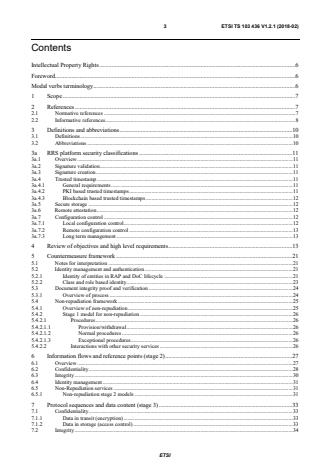
Contents
Intellectual Property Rights . 6
Foreword . 6
Modal verbs terminology . 6
1 Scope . 7
2 References . 7
2.1 Normative references . 7
2.2 Informative references . 8
3 Definitions and abbreviations . 10
3.1 Definitions . 10
3.2 Abbreviations . 10
3a RRS platform security classifications . 11
3a.1 Overview . 11
3a.2 Signature validation . 11
3a.3 Signature creation . 11
3a.4 Trusted timestamp . 11
3a.4.1 General requirements . 11
3a.4.2 PKI based trusted timestamps . 11
3a.4.3 Blockchain based trusted timestamps . 12
3a.5 Secure storage . 12
3a.6 Remote attestation . 12
3a.7 Configuration control . 12
3a.7.1 Local configuration control. 12
3a.7.2 Remote configuration control . 13
3a.7.3 Long term management . 13
4 Review of objectives and high level requirements . 13
5 Countermeasure framework . 21
5.1 Notes for interpretation . 21
5.2 Identity management and authentication . 21
5.2.1 Identity of entities in RAP and DoC lifecycle . 21
5.2.2 Class and role based identity. 23
5.3 Document integrity proof and verification . 24
5.3.1 Overview of process . 24
5.4 Non-repudiation framework . 25
5.4.1 Overview of non-repudiation . 25
5.4.2 Stage 1 model for non-repudiation . 26
5.4.2.1 Procedures . 26
5.4.2.1.1 Provision/withdrawal . 26
5.4.2.1.2 Normal procedures . 26
5.4.2.1.3 Exceptional procedures. 26
5.4.2.2 Interactions with other security services . 26
6 Information flows and reference points (stage 2) . 27
6.1 Overview . 27
6.2 Confidentiality . 28
6.3 Integrity . 30
6.4 Identity management . 31
6.5 Non-Repudiation services . 31
6.5.1 Non-repudiation stage 2 models . 31
7 Protocol sequences and data content (stage 3) . 33
7.1 Confidentiality . 33
7.1.1 Data in transit (encryption) . 33
7.1.2 Data in storage (access control) . 33
7.2 Integrity . 34
ETSI
4 ETSI TS 103 436 V1.2.1 (2018-02)
7.2.1 Data in transit . 34
7.2.2 Data in storage . 34
7.2.2.1 Single storage point . 34
7.2.2.2 Distributed storage points . 34
7.3 Combined authentication and integrity using digital signature . 35
7.4 Non-repudiation service . 35
8 Cryptographic algorithm and key considerations . 36
8.1 Symmetric cryptography . 36
8.2 Asymmetric cryptography . 36
9 Provision of root of trust . 36
10 Remote attestation service . 37
10.1 Applicability . 37
10.2 Scope of remote attestation service . 37
10.3 Dependencies of remote attestation service . 38
11 Configuration control service . 38
11.1 Overview . 38
11.2 RE Configuration record format . 38
11.3 Policy enforcement . 38
11.3.1 XACML Model . 38
11.3.2 TCG TPM Model . 40
11.4 Remote configuration control service. 40
11.5 Long-term management service . 41
Annex A (informative): Cost benefit analysis for countermeasure application . 43
A.1 Sample calculation . 43
A.2 Standards design . 45
A.3 Implementation . 45
A.4 Operation . 46
A.5 Regulatory impact . 46
A.6 Market acceptance . 46
Annex B (informative): Password policy guide . 48
Annex C (informative): Key lifetime and verification guidelines . 50
C.1 General . 50
C.2 Symmetric cryptography . 50
C.3 Asymmetric cryptography . 50
C.4 Export control . 50
Annex D (informative): PKI considerations for RRS . 52
D.1 What is a Public Key Infrastructure? . 52
D.2 Authorities in RRS and their PKI role . 53
D.3 Assignments of RRS roles to PKI . 55
D.3.1 Model 1: New Root Authority for RRS in the EU . 55
D.3.2 Model 2: Existing authorities assigning one entity as root . 55
D.4 Alternative models to PKI for key management . 55
D.4.1 General considerations . 55
D.4.2 Self signed certificates . 55
Annex E (informative): The electronic signature regulation (eIDAS) . 56
ETSI
5 ETSI TS 103 436 V1.2.1 (2018-02)
E.1 Overview . 56
E.2 eIDAS elements . 56
E.3 Provisions required for eIDAS in RRS and digital variants of DoC . 56
Annex F (normative): ASN.1 OID definitions . 58
Annex G (normative): Implementation Conformance Statement . 59
G.0 The right to copy . 59
G.1 Introduction . 59
G.2 Guidance for completing the ICS pro forma . 59
G.2.1 Purposes and structure . 59
G.2.2 Abbreviations and conventions . 59
G.2.3 Instructions for completing the ICS pro forma . 61
G.3 Identification of equipment and role . 61
G.4 Global statement of conformance . 61
G.5 ICS pro forma tables. 61
G.5.1 Security tier . 61
G.5.2 Major capabilities . 61
G.5.3 Trusted timestamp . 62
G.6 Tabulated mandates . 62
Annex I (informative): Change History . 65
History . 66
ETSI
6 ETSI TS 103 436 V1.2.1 (2018-02)
Intellectual Property Rights
Essential patents
IPRs essential or potentially essential to normative deliverables may have been declared to ETSI. The information
pertaining to these essential IPRs, if any, is publicly available for ETSI members and non-members, and can be found
in ETSI SR 000 314: "Intellectual Property Rights (IPRs); Essential, or potentially Essential, IPRs notified to ETSI in
respect of ETSI standards", which is available from the ETSI Secretariat. Latest updates are available on the ETSI Web
server (https://ipr.etsi.org/).
Pursuant to the ETSI IPR Policy, no investigation, including IPR searches, has been carried out by ETSI. No guarantee
can be given as to the existence of other IPRs not referenced in ETSI SR 000 314 (or the updates on the ETSI Web
server) which are, or may be, or may become, essential to the present document.
Trademarks
The present document may include trademarks and/or tradenames which are asserted and/or registered by their owners.
ETSI claims no ownership of these except for any which are indicated as being the property of ETSI, and conveys no
right to use or reproduce any trademark and/or tradename. Mention of those trademarks in the present document does
not constitute an endorsement by ETSI of products, services or organizations associated with those trademarks.
Foreword
This Technical Specification (TS) has been produced by ETSI Technical Committee Reconfigurable Radio Systems
(RRS).
Modal verbs terminology
In the present document "shall", "shall not", "should", "should not", "may", "need not", "will", "will not", "can" and
"cannot" are to be interpreted as described in clause 3.2 of the ETSI Drafting Rules (Verbal forms for the expression of
provisions).
"must" and "must not" are NOT allowed in ETSI deliverables except when used in direct citation.
ETSI
7 ETSI TS 103 436 V1.2.1 (2018-02)
1 Scope
The present document defines the security requirements for reconfigurable radio systems arising from the use case
analysis in ETSI TR 103 087 [i.1]. The present document applies to the lifecycle of Radio Application Packages
between a Radio application store and an RRS Reconfigurable Equipment.
2 References
2.1 Normative references
References are either specific (identified by date of publication and/or edition number or version number) or
non-specific. For specific references, only the cited version applies. For non-specific references, the latest version of the
referenced document (including any amendments) applies.
Referenced documents which are not found to be publicly available in the expected location might be found at
https://docbox.etsi.org/Reference.
NOTE: While any hyperlinks included in this clause were valid at the time of publication, ETSI cannot guarantee
their long term validity.
The following referenced documents are necessary for the application of the present document.
[1] Federal Information Processing Standard (FIPS) 202, SHA-3 Standard: "Permutation-Based Hash
and Extendable-Output Functions".
[2] Federal Information Processing Standards (FIPS) 186-4: "Digital Signature Standard (DSS)".
[3] Federal Information Processing Standards Publication (FIPS) 180-4: "Secure Hash Standard".
[4] Federal Information Processing Standards Publication (FIPS) 197: "Advanced Encryption
Standard".
[5] Recommendation ITU-T X.509: "Information technology - Open Systems Interconnection - The
Directory: Public-key and attribute certificate frameworks".
[6] ETSI TS 102 778-1: "Electronic Signatures and Infrastructures (ESI); PDF Advanced Electronic
Signature Profiles; Part 1: PAdES Overview - a framework document for PAdES".
NOTE: The above standard is composed of multiple parts and implementation of the framework may require
implementation of requirements stated in other parts of the standard.
[7] IETF RFC 5246: "The Transport Layer Security (TLS) Protocol Version 1.2".
[8] Directive 1999/93/EC of the European Parliament and of the Council of 13 December 1999 on a
Community framework for electronic signatures.
[9] Regulation (EU) No 910/2014 of the European Parliament and of the Council of 23 July 2014 on
electronic identification and trust services for electronic transactions in the internal market and
repealing Directive 1999/93/EC.
[10] ISO/IEC 15408-2: "Information technology - Security techniques - Evaluation Criteria for IT
security - Part 2: Security functional components".
[11] Void.
[12] Void.
[13] ETSI EN 319 142 (all parts): "Electronic Signatures and Infrastructures (ESI); PAdES digital
signatures".
[14] ETSI EN 319 132 (all parts): "Electronic Signatures and Infrastructures (ESI); XAdES digital
signatures".
ETSI
8 ETSI TS 103 436 V1.2.1 (2018-02)
[15] ETSI EN 319 122 (all parts): "Electronic Signatures and Infrastructures (ESI); CAdES digital
signatures".
[16] Void.
[17] Void.
[18] Void.
[19] Void.
[20] IETF RFC 3161: "Internet X.509 Public Key Infrastructure Time-Stamp Protocol (TSP)".
[21] ANSI X9.95: "Trusted Time Stamp Management and Security".
[22] Void.
[23] Void.
[24] ISO/IEC 9646-7: "Information technology -- Open Systems Interconnection -- Conformance
testing methodology and framework -- Part 7: Implementation Conformance Statements".
[25] TGC: "Trusted Platform Module Library; Part 1: Architecture; Family 2.0; Level 00
Revision 01.38; September 29, 2016".
[26] OASIS eXtensible Access Control Markup Language (XACML) Core Specification Version 3.0.
[27] Void.
[28] Recommendation ITU-T X.520: "Information technology – Open Systems Interconnection – The
Directory: Selected attribute types".
2.2 Informative references
References are either specific (identified by date of publication and/or edition number or version number) or
non-specific. For specific references, only the cited version applies. For non-specific references, the latest version of the
referenced document (including any amendments) applies.
NOTE: While any hyperlinks included in this clause were valid at the time of publication, ETSI cannot guarantee
their long term validity.
The following referenced documents are not necessary for the application of the present document but they assist the
user with regard to a particular subject area.
[i.1] ETSI TR 103 087: "Reconfigurable Radio Systems (RRS); Security related use cases and threats in
Reconfigurable Radio Systems".
[i.2] BlueKrypt: Cryptographic Key Length Recommendation.
NOTE: Available at http://www.keylength.com.
[i.3] ETSI TS 102 165-1: "Telecommunications and Internet converged Services and Protocols for
Advanced Networking (TISPAN); Methods and protocols; Part 1: Method and proforma for
Threat, Risk, Vulnerability Analysis".
[i.4] ISO/IEC 10181-4:1997: "Information technology - Open Systems Interconnection - Security
frameworks for open systems: Non-repudiation framework - Part 4".
[i.5] Shannon, Claude E. (July/October 1948). "A Mathematical Theory of Communication". Bell
System Technical Journal 27 (3): 379-423.
[i.6] Marcelo A. Montemurro, Damián H. Zanette: "Universal Entropy of Word Ordering Across
Linguistic Families". PMCID: PMC3094390.
NOTE: Available at http://www.ncbi.nlm.nih.gov/pmc/articles/PMC3094390/.
ETSI
9 ETSI TS 103 436 V1.2.1 (2018-02)
[i.7] Bela Gipp, Norman Meuschke and André Gernandt: "Decentralized Trusted Timestamping using
the Crypto Currency Bitcoin", National Institute of Informatics Tokyo, Japan.
[i.8] Void.
[i.9] NIST SP 800-164: "Guidelines on Hardware-Rooted Security in Mobile Devices".
NOTE: Available at http://csrc.nist.gov/publications/drafts/800-164/sp800_164_draft.pdf.
[i.10] ETSI TS 123 040: "3GPP TS 23.040: "Digital cellular telecommunications system (Phase 2+)
(GSM); Universal Mobile Telecommunications System (UMTS); Technical realization of the
Short Message Service (SMS) (3GPP TS 23.040)".
[i.11] ETSI TS 123 041: "3GPP TS 23.041: "Digital cellular telecommunications system (Phase 2+)
(GSM); Universal Mobile Telecommunications System (UMTS); Technical realization of Cell
Broadcast Service (CBS) (3GPP TS 23.041)".
[i.12] ETSI TR 103 502: "Reconfigurable Radio Systems (RRS); Applicability of RRS with existing
Radio Access Technologies and core networks; Security aspects".
[i.13] Directive 2014/53/EU of the European Parliament and of the Council of 16 April 2014 on the
harmonisation of the laws of the Member States relating to the making available on the market of
radio equipment and repealing Directive 1999/5/EC.
[i.14] ETSI TS 102 165-2: "Telecommunications and Internet converged Services and Protocols for
Advanced Networking (TISPAN); Methods and protocols; Part 2: Protocol Framework Definition;
Security Counter Measures".
[i.15] ISO/IEC 10181-2: "Information technology - Open Systems Interconnection - Security
frameworks for open systems: Authentication framework - Part 2".
[i.16] ISO/IEC 11889-1:2015: "Information technology -- Trusted platform module library --
Part 1: Architecture".
[i.17] ISO/IEC 11889-2:2015: "Information technology -- Trusted Platform Module Library --
Part 2: Structures".
[i.18] ISO/IEC 11889-3:2015: "Information technology -- Trusted Platform Module Library --
Part 3: Commands".
[i.19] ISO/IEC 11889-4:2015: "Information technology -- Trusted Platform Module Library --
Part 4: Supporting Routines".
NOTE: [i.16], [i.17], [i.18] and [i.19] are also available from the Trusted Computing Group as the TPM 2.0
(Trusted Platform Module) Library Specifications available at https://trustedcomputinggroup.org/tpm-
library-specification/.
[i.20] IETF RFC 5280: "Internet X.509 Public Key Infrastructure Certificate and Certificate Revocation
List (CRL) Profile".
[i.21] IETF RFC 6218: "Updates to the Internet X.509 Public Key Infrastructure Certificate and
Certificate Revocation List (CRL) Profile".
[i.22] NIST Special Publication 800-56B: "Recommendation for Pair-Wise Key Establishment Schemes
Using Integer Factorization Cryptography".
[i.23] ETSI TR 187 010: "Telecommunications and Internet converged Services and Protocols for
Advanced Networking (TISPAN); NGN Security; Report on issues related to security in identity
management and their resolution in the NGN".
ETSI
10 ETSI TS 103 436 V1.2.1 (2018-02)
3 Definitions and abbreviations
3.1 Definitions
For the purposes of the present document, the terms and definitions given in ETSI TR 103 087 [i.1] and the following
apply:
protected location: memory location outside of the hardware root of trust, protected in against attacks on
confidentiality and in which from the perspective of the root of trust, integrity protection is limited to the detection of
modifications
Qualified Signature Creation Device (QSCD): device for creating a digital signature that through its software and
hardware is able to ensure that the signatory has sole control over their private key, that the signature creation data is
generated and managed by a qualified trust service provider, and that the signature creation data is unique, confidential
and protected from forgery
Secure Signature Creating Device (SSCD): device for creating a digital signature that is able to ensure that the
signature-creation data involved in creating a signature is unique, protects against forgery and alteration after the
signature has been created
shielded location: memory location within the hardware root of trust, protected against attacks on confidentiality and
manipulation attacks including deletion that impact the integritiy of the memory, in which access is enforced by the
hardware root of trust
3.2 Abbreviations
For the purposes of the present document, the abbreviations given in ETSI TR 103 087 [i.1] and the following apply:
DoS Denial of Service
DDoS Distributed Denial of Service
IMEI International Mobile Equipment Identity
IMSI International Mobile Subscriber Identity
OSI Open System for Interconnection
PAP Policy Administration Point
PCR Platform Configuration Register
PDP Policy Decision Point
PEE Policy Enforcement Engine
PEP Policy Enforcement Point
PIP Policy Information Point
PKC Public Key Certificate
PKI Public Key Infrastructure
RED Radio Equipment Directive
RTM Root of Trust for Measurement
RTR Root of Trust for Reporting
RTS Root of Trust for Storage
RTV Root of Trust for Verification
PMCID PubMed Central reference number
TAD Transfer of Authority Document
TCG Trusted Computing Group
TPM Trusted Platform Module
TSF ToE Security Functions
TTA Trusted Timestamp Authority
TTP Trusted Third Party
XACML eXtensible Access Control Markup Language
ETSI
11 ETSI TS 103 436 V1.2.1 (2018-02)
3a RRS platform security classifications
3a.1 Overview
RRS device security is defined by assignment of mandatory security features to the RE and accompanying system in a
series of classes or tiers. To avoid confusion with the term class used in the context of Mobile Device Reconfiguration
Class (MDRC) the security levels are referred to as tiers, i.e. Tier#1, Tier#2, Tier#3. Each security tier has associated
features that are mandatory or optional and are summarized in table 0.
Table 0: Summary of Security features in RRS RE by tier
Tier Signature Signature Trusted Secure Remote Configuration Long term
validation creation timestamp store attestation control management
1 M
2 M M M M Local - M
Remote - O
3 M M M M M Local - M M
Remote - M
The features above require that an RRS device implements a hardware root of trust (see clause 9).
3a.2 Signature validation
Electronic signature validation shall be provided in all RRS platforms for the validation of the source and integrity of
any downloaded Radio Application.
As defined in clause 5.3 the RA shall be signed and the public key certificate of the signing authority, and any other
identifying certificates used in the distribution chain, shall be provided along with the RA. The RE shall be able to
verify the signature and shall only act on the content if the authenticity and integrity of the RAP is verified. If the RAP
cannot be authenticated, or if the integrity validation fails, the RAP shall be discarded.
3a.3 Signature creation
For the purposes of the non-repudiation service defined in clause 5.4 the RE shall be able to generate evidence of
actions related to the use of RAs and sign the evidence (actions may include installation, deletion, operation). For
Tier#2 the RE shall act as Secure Signature Creating Device (SSCD), and for Tier#3 the RE shall act as a Qualified
Signature Creation Device (QSCD) in accordance with the eIDAS directive [9].
NOTE: The eIDAS directive does not require all signatures to be compliant but as one of the purposes of the
non-repudiation service in RRS is to provide proof of an action occurring, that may be tested within a
legal framework such as that used for market control of radio equipment, requiring Tier#3 equipment's
non-repudiation signatures to be created using a QSCD is intended to increase the assurance of the
corresponding RRS equipment across the market control domain.
3a.4 Trusted timestamp
3a.4.1 General requirements
For the purposes of the non-repudiation service defined in clause 5.4 the RE shall be able to generate evidence of the
time any actions related to the use occurred and include the timestamp in the evidence generated.
3a.4.2 PKI based trusted timestamps
For Tier#2 devices a Trusted Timestamp complying to IETF RFC 3161 [20] shall be generated. For Tier#3 devices a
rd
Trusted Timestamp complying to ANSI X9.95 [21] shall be generated that in addition to providing 3 party assurance
of the time of the action also provides for proof of the integrity of the timestamped data.
ETSI
12 ETSI TS 103 436 V1.2.1 (2018-02)
3a.4.3 Blockchain based trusted timestamps
An alternative to PKI based trusted timestamps is to adopt a blockchain based approach such as that defined in [i.7] that
removes the requirement for a centralized Trusted Timestamp Authority (TTA) and replaces it with the distributed trust
model of a blockchain. The current version of the present document only supports PKI based trusted timestamps with a
centralized TTA.
3a.5 Secure storage
In addition to security keys held by the RRS elements to allow for validation of signed content, and for Tier 2 and
Tier 3 systems to generate signed content the following elements shall be maintained in secure storage:
• Evidence generated by the non-repudiation service.
• Proofs of RAP integrity and the binding of a RAP to the RE.
NOTE: Proofs of RAP integrity and the binding to an RE require the use of a Root of Trust for Measurement as
described in clause 9.
The characteristics to be met by the secure storage element are the following:
• Tamper resistant.
• Tamper evident.
• Persistent.
3a.6 Remote attestation
Remote attestation for RRS enables an RE to prove to a remote system the authenticity and integrity of its hardware and
software configuration. Thus for RRS the authorized remote system is able to determine the level of trust in the integrity
of the RE. The remote attestation service extends the non-repudiation service by allowing for online attestation and
delivery of proof (i.e. for non-repudiation the evidence of an action is made available to a trusted third party at the time
of the action, whereas for remote attestation evidence of the integrity of the platform is given on demand).
The scope of remote attestation is limited, as defined in ETSI TR 103 087 [i.1], to the following use cases:
• Verification of compliance to the essential requirements of the RED [i.13] by the market surveillance
authority;
• Verification of RRS platform status for device management purpose by the manufacturer;
• Verification of the active set of Radio Applications by the disturbance control authority; and,
• Verification of specific type and version of a Radio Application for access control by a mobile network
operator.
The detail definition of the remote attestation service is given in clause 10 of the present document.
3a.7 Configuration control
3a.7.1 Local configuration control
The purpose of configuration control is to only allow installation and operation of RAPs that are listed in the RE
Configuration Policy.
The RE Configuration Policy shall be made available to a policy enforcement entity and the following pseudo code
implemented (details are given in clause 11 of the present document):
IF <> EXISTS IN <> THEN PERMIT, ELSE DENY.
ETSI
13 ETSI TS 103 436 V1.2.1 (2018-02)
3a.7.2 Remote configuration control
The remote configuration control service extends the local configuration control service by enabling the authorized
party to be external to the RE (details are given in clause 11.4 of the present document).
3a.7.3 Long term management
The long-term management service extends the local configuration control service by enabling the transfer of
configuration authority over the RRS Platform from one entity to another (details are given in clause 11.5 of the present
document.
4 Review of objectives and high level requirements
The objectives stated in ETSI TR 103 087 [i.1] are copied in table 1 and classified in terms of the form of security
function that is required to meet the objective. In addressing each objective the form of countermeasure required is
discussed in some detail and the overall class or strategy of countermeasure is indicated.
NOTE: It is the nature of an objective to be a signal of intent and thus objectives are phrased using the term
"should". The translation of objectives to mandates is addressed in this clause by the mapping from
objective to each of strategy and countermeasure.
Table 1: Review of security objectives
Id Text of objective Countermeasure Strategy Applies to …
(minimum
security tier)
1 The RRS platform should provide means Encryption of content (it is Confidentiality Tier#1
to ensure that the content of assumed that the link is open
communication between the application (radio broadcast) and that the
store and the RE are protected from adversary is able to
rd
exposure to unauthorized 3 parties (see eavesdrop/intercept the content).
note 1)
2 The RRS should provide means to verify Integrity check sum added to Integrity Tier#1
that the content of communication content.
between the application store and RE
has not been manipulated prior to
processing at receipt (see note 1)
3 The RRS platform should provide means The RE shall have a unique Authentication Tier#1
for the application store to verify the application store access identity and Identity
identity of the RE (see note 2) that is bound to a set of Management
credentials shared between the
application store and the RE.
The identity may be selected by
the user of the RE (open market
scenario) or may be defined by
the RE manufacturer (closed
market scenario).
4 The RRS platform should provide means The application store shall have Authentication Tier#1
for the RE to verify the identity of the an unique name that is tied to its and Identity
application store (see note 3) attribute as an application store Management
for RRS in the form of a public
key certificate with an attribute
extension when operating in an
open environment but if
operating in a closed
environment may allow for
authentication using a
conventional challenge response
protocol in a shared secret mode
ETSI
14 ETSI TS 103 436 V1.2.1 (2018-02)
Id Text of objective Countermeasure Strategy Applies to …
(minimum
security tier)
5 The RRS platform should provide means It is possible to limit the entities Access Control, n/a
to detect and prevent denial of access to allowed to offer traffic to the Network (see note 13)
the communications channel between network through an access Topology
the application store and the RE control policy. In addition DoS
(and DDoS) attacks may be
mitigated by using resilient and
redundant network paths
(i.e. mitigation by network
topology design)
6 The RRS platform should provide means
The originator of the RAP shall Integrity Tier#1
to verify that the RAP has not been create a signed hash of the
modified between having been made RAP, and supply the signature
available by the RAP originator and with the attribute certificate of
having been downloaded on the RE the RAP allowing verification of
the hash and signature by the
receiving party using the
contained public key
7 The RRS platform should provide means As above where the RAP has Authentication Tier#1
for the RE to verify the source of the been signed by the originator and Identity
content supplied via the Radio verification of the signature shall Management
application store result in proof of the source of
the RAP
8 The RRS platform should provide means Proof may be lodged with a Non-repudiation Tier#3
rd
to prevent the application store denying trusted 3 party or may be
provision of an application to the RE maintained locally within a
secure enclave of the device. As
9 The RRS platform should provide means Tier#3
such every transaction between
to prevent the RE denying receipt of an
RA from the Radio application store the application store and the RE
shall be securely logged in such
10 The RRS platform should provide means Tier#3
a way that the logs cannot be
to prevent
...
Questions, Comments and Discussion
Ask us and Technical Secretary will try to provide an answer. You can facilitate discussion about the standard in here.
Loading comments...