


ETSI EN 319 401 V3.2.1 (2026-01)
Electronic Signatures and Trust Infrastructures (ESI); General Policy Requirements for Trust Service Providers
Electronic Signatures and Trust Infrastructures (ESI); General Policy Requirements for Trust Service Providers
REN/ESI-0019401v321
Elektronski podpisi in infrastrukture zaupanja (ESI) - Politika splošnih zahtev za ponudnike storitev zaupanja
General Information
- Status
- Not Published
- Technical Committee
- ESI - Electronic Signatures and Trust Infrastructures
- Current Stage
- 12 - Citation in the OJ (auto-insert)
- Due Date
- 19-Jan-2026
- Completion Date
- 08-Jan-2026
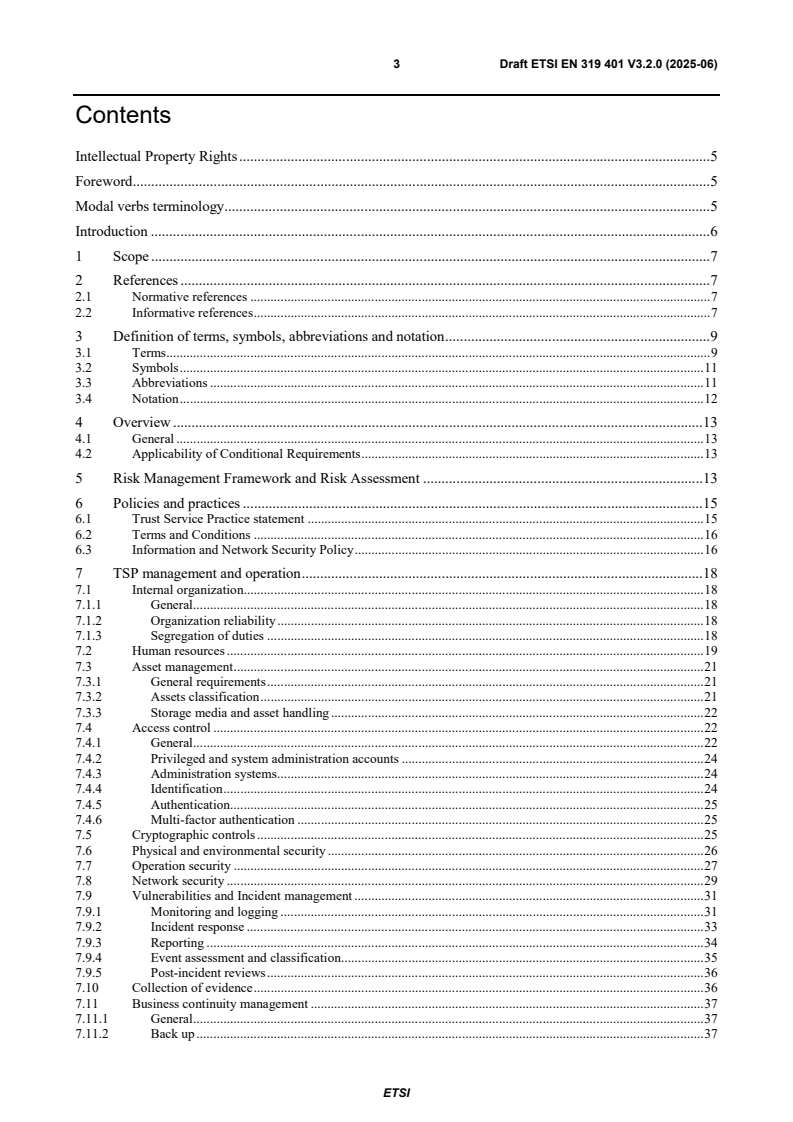
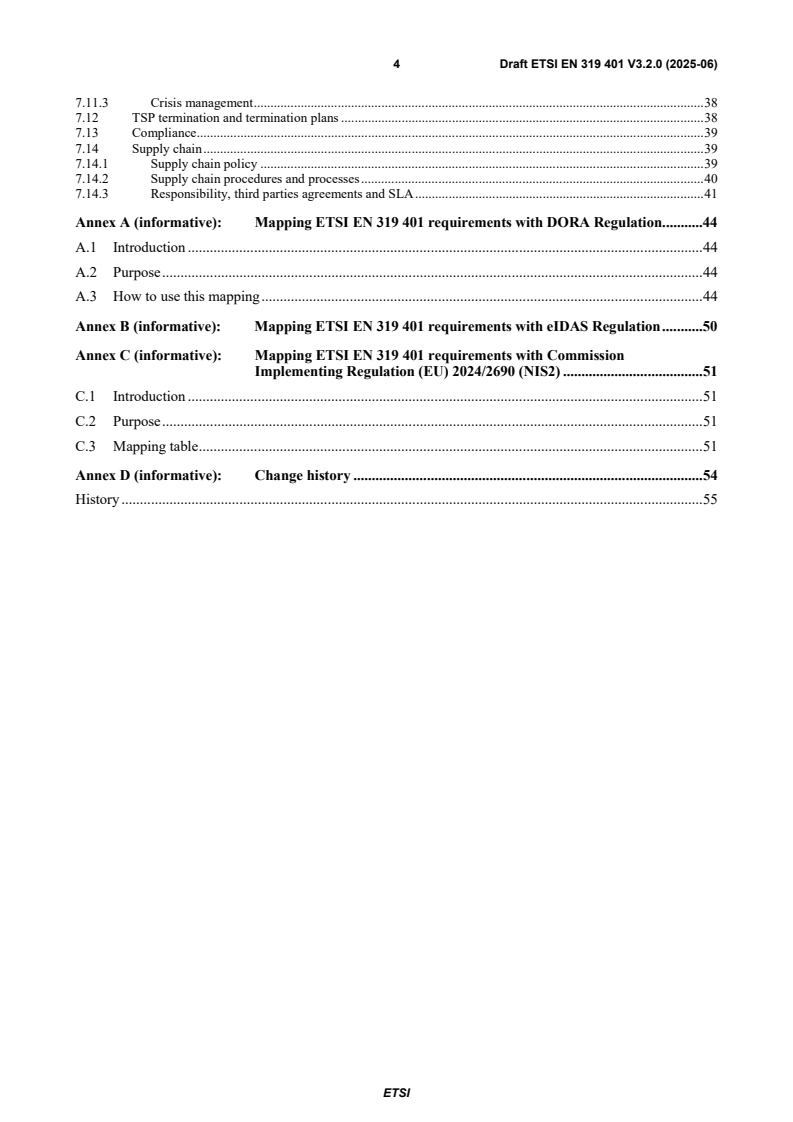
ETSI EN 319 401 V3.2.0 (2025-06) - Electronic Signatures and Trust Infrastructures (ESI); General Policy Requirements for Trust Service Providers
ETSI EN 319 401 V3.2.1 (2025-11) - Electronic Signatures and Trust Infrastructures (ESI); General Policy Requirements for Trust Service Providers

Frequently Asked Questions
ETSI EN 319 401 V3.2.1 (2026-01) is a standard published by the European Telecommunications Standards Institute (ETSI). Its full title is "Electronic Signatures and Trust Infrastructures (ESI); General Policy Requirements for Trust Service Providers". This standard covers: REN/ESI-0019401v321
REN/ESI-0019401v321
ETSI EN 319 401 V3.2.1 (2026-01) is available in PDF format for immediate download after purchase. The document can be added to your cart and obtained through the secure checkout process. Digital delivery ensures instant access to the complete standard document.
Standards Content (Sample)
Draft ETSI EN 319 401 V3.2.0 (2025-06)
EUROPEAN STANDARD
Electronic Signatures and Trust Infrastructures (ESI);
General Policy Requirements for
Trust Service Providers
2 Draft ETSI EN 319 401 V3.2.0 (2025-06)
Reference
REN/ESI-0019401v321
Keywords
cybersecurity, electronic signature, provider,
security, trust services
ETSI
650 Route des Lucioles
F-06921 Sophia Antipolis Cedex - FRANCE
Tel.: +33 4 92 94 42 00 Fax: +33 4 93 65 47 16
Siret N° 348 623 562 00017 - APE 7112B
Association à but non lucratif enregistrée à la
Sous-Préfecture de Grasse (06) N° w061004871
Important notice
The present document can be downloaded from the
ETSI Search & Browse Standards application.
The present document may be made available in electronic versions and/or in print. The content of any electronic and/or
print versions of the present document shall not be modified without the prior written authorization of ETSI. In case of any
existing or perceived difference in contents between such versions and/or in print, the prevailing version of an ETSI
deliverable is the one made publicly available in PDF format on ETSI deliver repository.
Users should be aware that the present document may be revised or have its status changed,
this information is available in the Milestones listing.
If you find errors in the present document, please send your comments to
the relevant service listed under Committee Support Staff.
If you find a security vulnerability in the present document, please report it through our
Coordinated Vulnerability Disclosure (CVD) program.
Notice of disclaimer & limitation of liability
The information provided in the present deliverable is directed solely to professionals who have the appropriate degree of
experience to understand and interpret its content in accordance with generally accepted engineering or
other professional standard and applicable regulations.
No recommendation as to products and services or vendors is made or should be implied.
In no event shall ETSI be held liable for loss of profits or any other incidental or consequential damages.
Any software contained in this deliverable is provided "AS IS" with no warranties, express or implied, including but not
limited to, the warranties of merchantability, fitness for a particular purpose and non-infringement of intellectual property
rights and ETSI shall not be held liable in any event for any damages whatsoever (including, without limitation, damages
for loss of profits, business interruption, loss of information, or any other pecuniary loss) arising out of or related to the use
of or inability to use the software.
Copyright Notification
No part may be reproduced or utilized in any form or by any means, electronic or mechanical, including photocopying and
microfilm except as authorized by written permission of ETSI.
The content of the PDF version shall not be modified without the written authorization of ETSI.
The copyright and the foregoing restriction extend to reproduction in all media.
© ETSI 2025.
All rights reserved.
ETSI
3 Draft ETSI EN 319 401 V3.2.0 (2025-06)
Contents
Intellectual Property Rights . 5
Foreword . 5
Modal verbs terminology . 5
Introduction . 6
1 Scope . 7
2 References . 7
2.1 Normative references . 7
2.2 Informative references . 7
3 Definition of terms, symbols, abbreviations and notation . 9
3.1 Terms . 9
3.2 Symbols . 11
3.3 Abbreviations . 11
3.4 Notation . 12
4 Overview . 13
4.1 General . 13
4.2 Applicability of Conditional Requirements . 13
5 Risk Management Framework and Risk Assessment . 13
6 Policies and practices . 15
6.1 Trust Service Practice statement . 15
6.2 Terms and Conditions . 16
6.3 Information and Network Security Policy . 16
7 TSP management and operation . 18
7.1 Internal organization. 18
7.1.1 General . 18
7.1.2 Organization reliability . 18
7.1.3 Segregation of duties . 18
7.2 Human resources . 19
7.3 Asset management . 21
7.3.1 General requirements . 21
7.3.2 Assets classification . 21
7.3.3 Storage media and asset handling . 22
7.4 Access control . 22
7.4.1 General . 22
7.4.2 Privileged and system administration accounts . 24
7.4.3 Administration systems . 24
7.4.4 Identification . 24
7.4.5 Authentication . 25
7.4.6 Multi-factor authentication . 25
7.5 Cryptographic controls . 25
7.6 Physical and environmental security . 26
7.7 Operation security . 27
7.8 Network security . 29
7.9 Vulnerabilities and Incident management . 31
7.9.1 Monitoring and logging . 31
7.9.2 Incident response . 33
7.9.3 Reporting . 34
7.9.4 Event assessment and classification . 35
7.9.5 Post-incident reviews . 36
7.10 Collection of evidence . 36
7.11 Business continuity management . 37
7.11.1 General . 37
7.11.2 Back up . 37
ETSI
4 Draft ETSI EN 319 401 V3.2.0 (2025-06)
7.11.3 Crisis management . 38
7.12 TSP termination and termination plans . 38
7.13 Compliance. 39
7.14 Supply chain . 39
7.14.1 Supply chain policy . 39
7.14.2 Supply chain procedures and processes . 40
7.14.3 Responsibility, third parties agreements and SLA . 41
Annex A (informative): Mapping ETSI EN 319 401 requirements with DORA Regulation . 44
A.1 Introduction . 44
A.2 Purpose . 44
A.3 How to use this mapping . 44
Annex B (informative): Mapping ETSI EN 319 401 requirements with eIDAS Regulation . 50
Annex C (informative): Mapping ETSI EN 319 401 requirements with Commission
Implementing Regulation (EU) 2024/2690 (NIS2) . 51
C.1 Introduction . 51
C.2 Purpose . 51
C.3 Mapping table . 51
Annex D (informative): Change history . 54
History . 55
ETSI
5 Draft ETSI EN 319 401 V3.2.0 (2025-06)
Intellectual Property Rights
Essential patents
IPRs essential or potentially essential to normative deliverables may have been declared to ETSI. The declarations
pertaining to these essential IPRs, if any, are publicly available for ETSI members and non-members, and can be
found in ETSI SR 000 314: "Intellectual Property Rights (IPRs); Essential, or potentially Essential, IPRs notified to
ETSI in respect of ETSI standards", which is available from the ETSI Secretariat. Latest updates are available on the
ETSI IPR online database.
Pursuant to the ETSI Directives including the ETSI IPR Policy, no investigation regarding the essentiality of IPRs,
including IPR searches, has been carried out by ETSI. No guarantee can be given as to the existence of other IPRs not
referenced in ETSI SR 000 314 (or the updates on the ETSI Web server) which are, or may be, or may become,
essential to the present document.
Trademarks
The present document may include trademarks and/or tradenames which are asserted and/or registered by their owners.
ETSI claims no ownership of these except for any which are indicated as being the property of ETSI, and conveys no
right to use or reproduce any trademark and/or tradename. Mention of those trademarks in the present document does
not constitute an endorsement by ETSI of products, services or organizations associated with those trademarks.
DECT™, PLUGTESTS™, UMTS™ and the ETSI logo are trademarks of ETSI registered for the benefit of its
Members. 3GPP™, LTE™ and 5G™ logo are trademarks of ETSI registered for the benefit of its Members and of the
3GPP Organizational Partners. oneM2M™ logo is a trademark of ETSI registered for the benefit of its Members and of ®
the oneM2M Partners. GSM and the GSM logo are trademarks registered and owned by the GSM Association.
Foreword
This draft European Standard (EN) has been produced by ETSI Technical Committee Electronic Signatures and Trust
Infrastructures (ESI), and is now submitted for the combined Public Enquiry and Vote phase of the ETSI EN Approval
Procedure (ENAP).
Proposed national transposition dates
Date of latest announcement of this EN (doa): 3 months after ETSI publication
Date of latest publication of new National Standard
or endorsement of this EN (dop/e): 6 months after doa
Date of withdrawal of any conflicting National Standard (dow): 6 months after doa
Modal verbs terminology
In the present document "shall", "shall not", "should", "should not", "may", "need not", "will", "will not", "can" and
"cannot" are to be interpreted as described in clause 3.2 of the ETSI Drafting Rules (Verbal forms for the expression of
provisions).
"must" and "must not" are NOT allowed in ETSI deliverables except when used in direct citation.
ETSI
6 Draft ETSI EN 319 401 V3.2.0 (2025-06)
Introduction
Building trust in the online environment is key to economic and social development. Lack of trust, in particular because
of a perceived lack of security, makes consumers, businesses and administrations hesitate to carry out transactions
electronically and to adopt new services. Trust service providers are often an essential element to establish trust
between parties transacting electronically, particularly in open public networks, and can be used, for example, to
provide trusted identity information and help establish secure communications between transacting parties. Examples of
such trust service providers are issuers of public key certificates, time-stamping service providers, providers of remote
electronic signature generation or validation services.
For participants of electronic commerce to have confidence in the security of these trust services they need to have
confidence that the Trust Service Providers (TSPs) have established a set of procedures, processes and security
measures in order to minimize the operational and financial threats and risks associated.
Further, the cybersecurity of all essential digital services is vital for digital transformation of Europe with digital
services and electronic transactions. The provision of eIDAS trust services is identified as an essential element of
Europe's digital infrastructure. The Directive (EU) 2022/2555 [i.13] of the European Parliament and of the Council of
14 December 2022 on measures for a high common level of cybersecurity across the Union, amending Regulation (EU)
No 910/2014 and Directive (EU) 2018/1972, and repealing Directive 2016/1148 (NIS2 Directive or NIS2) identifies in
article 3 that requirements for cybersecurity risk management measures are applicable, as essential entities, to Qualified
Trust Services Providers as per eIDAS Regulation. Furthermore, as eIDAS trust services are identified as fundamental
element of Europe's digital infrastructure and NIS 2 is applicable to eIDAS trust services the present document also
aims to meet the requirements of NIS2.
Furthermore, the present document has been updated to incorporate the requirements set forth in the Commission
Implementing Regulation (EU) 2024/2690 of 17 October 2024 [i.27] laying down rules for the application of Directive
(EU) 2022/2555 as regards technical and methodological requirements of cybersecurity risk-management measures and
further specification of the cases in which an incident is considered to be significant for trust service providers among
other essential entities.
The present document specifies baseline policy requirements on the operation and management practices of TSP
regardless the service they provide including cybersecurity requirements abiding NIS2 and its implementing
regulations. Other standards, addressing particular type of trust service, can build on the present document to identify
supplement requirements for particular type of trust service.
The present document is aiming to meet the general requirements to provide trust and confidence in electronic
transactions including, amongst others, applicable requirements from Regulation (EU) No 910/2014 [i.1].
EXAMPLE: ETSI EN 319 411-2 [i.7], annex A describes the application of the present document to the
requirements of Regulation (EU) No 910/2014 [i.1] requirements for TSPs issuing EU qualified
certificates.
ETSI
7 Draft ETSI EN 319 401 V3.2.0 (2025-06)
1 Scope
The present document specifies general policy requirements relating to Trust Service Providers (TSPs) that are
independent of the type of TSP. It defines policy requirements on the operation and management practices of TSPs.
Other specifications refine and extend these requirements as applicable to particular forms of TSP. The present
document does not specify how the requirements identified can be assessed by an independent party, including
requirements for information to be made available to such independent assessors, or requirements on such assessors.
The present document aims to support the requirements on NIS2 Directive [i.13] and addresses the general requirements
for security management and cybersecurity of trust services (qualified and non-qualified).
NOTE: See ETSI EN 319 403-1 [i.2] for details about requirements for conformity assessment bodies assessing
Trust Service Providers.
2 References
2.1 Normative references
References are either specific (identified by date of publication and/or edition number or version number) or
non-specific. For specific references, only the cited version applies. For non-specific references, the latest version of the
referenced document (including any amendments) applies.
Referenced documents which are not found to be publicly available in the expected location might be found in the
ETSI docbox.
NOTE: While any hyperlinks included in this clause were valid at the time of publication, ETSI cannot guarantee
their long-term validity.
The following referenced documents are necessary for the application of the present document.
Not applicable.
2.2 Informative references
References are either specific (identified by date of publication and/or edition number or version number) or
non-specific. For specific references, only the cited version applies. For non-specific references, the latest version of the
referenced document (including any amendments) applies.
NOTE: While any hyperlinks included in this clause were valid at the time of publication, ETSI cannot guarantee
their long-term validity.
The following referenced documents may be useful in implementing an ETSI deliverable or add to the reader's
understanding, but are not required for conformance to the present document.
[i.1] Regulation (EU) No 910/2014 of the European Parliament and of the Council of 23 July 2014 on
electronic identification and trust services for electronic transactions in the internal market and
repealing Directive 1999/93/EC.
[i.2] ETSI EN 319 403-1: "Electronic Signatures and Infrastructures (ESI); Trust Service Provider
Conformity Assessment; Part 1: Requirements for conformity assessment bodies assessing Trust
Service Providers".
[i.3] CA/Browser Forum: "Network and certificate system security requirements".
[i.4] Recommendation ITU-R TF.460-6 (2002): "Standard-frequency and time-signal emissions".
[i.5] ETSI EN 319 411-1: "Electronic Signatures and Trust Infrastructures (ESI); Policy and Security
Requirements for Trust Service Providers issuing certificates; Part 1: General requirements".
ETSI
8 Draft ETSI EN 319 401 V3.2.0 (2025-06)
[i.6] ETSI EN 301 549: "Accessibility requirements suitable for public procurement of ICT products
and services in Europe".
[i.7] ETSI EN 319 411-2: "Electronic Signatures and Trust Infrastructures (ESI); Policy and Security
Requirements for Trust Service Providers issuing certificates; Part 2: Requirements for trust
service providers issuing EU qualified certificates".
[i.8] Regulation (EU) 2016/679 of the European Parliament and of the Council of 27 April 2016 on the
protection of natural persons with regard to the processing of personal data and on the free
movement of such data, and repealing Directive 95/46/EC (General Data Protection Regulation).
[i.9] ETSI TS 119 431-1: "Electronic Signatures and Trust Infrastructures (ESI); Policy and security
requirements for trust service providers; Part 1: TSP services operating a remote QSCD / SCDev".
[i.10] ISO/IEC 27701:2019: "Security techniques - Extension to ISO/IEC 27001 and ISO/IEC 27002 for
privacy information management - Requirements and guidelines".
[i.11] ISO/IEC 27002:2022: "Information security, cybersecurity and privacy protection - information
security controls".
[i.12] ISO/IEC 27005:2022: "Information security, cybersecurity and privacy protection - Guidance on
managing information security risks".
[i.13] Directive (EU) 2022/2555 of the European Parliament and of the Council of 14 December 2022 on
measures for a high common level of cybersecurity across the Union, amending Regulation (EU)
No 910/2014 and Directive (EU) 2018/1972, and repealing Directive (EU) 2016/1148 (NIS
2 Directive).
[i.14] ETSI EN 319 421: "Electronic Signatures and Trust Infrastructures (ESI); Policy and Security
Requirements for Trust Service Providers issuing Time-Stamps".
[i.15] ETSI TS 119 441: "Electronic Signatures and Infrastructures (ESI); Policy requirements for TSP
providing signature validation services".
[i.16] ETSI TS 119 461: "Electronic Signatures and Trust Infrastructures (ESI); Policy and security
requirements for trust service components providing identity proofing of trust service subjects".
[i.17] ETSI TS 119 511: "Electronic Signatures and Infrastructures (ESI); Policy and security
requirements for trust service providers providing long-term preservation of digital signatures or
general data using digital signature techniques".
[i.18] ETSI EN 319 521: "Electronic Signatures and Infrastructures (ESI); Policy and security
requirements for Electronic Registered Delivery Service Providers".
[i.19] ETSI EN 319 531: "Electronic Signatures and Infrastructures (ESI); Policy and security
requirements for Registered Electronic Mail Service Providers".
[i.20] ISO Guide 73:2009: "Risk management - Vocabulary".
[i.21] Regulation (EU) 2022/2554 of the European Parliament and of the Council of 14 December 2022
on digital operational resilience for the financial sector and amending Regulations (EC)
No 1060/2009, (EU) No 648/2012, (EU) No 600/2014, (EU) No 909/2014 and (EU) 2016/1011
(DORA).
[i.22] Directive (EU) 2022/2557 of the European Parliament and of the Council of 14 December 2022 on
the resilience of critical entities and repealing Council Directive 2008/114/EC.
[i.23] Regulation (EU) 2024/2847 of the European Parliament and of the Council of 23 October 2024 on
horizontal cybersecurity requirements for products with digital elements and amending
Regulations (EU) No 168/2013 and (EU) 2019/1020 and Directive (EU) 2020/1828 (Cyber
Resilience Act).
[i.24] Regulation (EU) 2022/2065 of the European Parliament and of the Council of 19 October 2022 on
a Single Market For Digital Services and amending Directive 2000/31/EC (Digital Services Act).
ETSI
9 Draft ETSI EN 319 401 V3.2.0 (2025-06)
[i.25] Regulation (EU) 2022/868 of the European Parliament and of the Council of 30 May 2022 on
European data governance and amending Regulation (EU) 2018/1724 (Data Governance Act).
[i.26] Regulation (EU) 2024/1183 of the European Parliament and of the Council of 11 April 2024
amending Regulation (EU) No 910/2014 as regards establishing the European Digital Identity
Framework.
[i.27] Commission Implementing Regulation (EU) 2024/2690 of 17 October 2024 laying down rules for
the application of Directive (EU) 2022/2555 as regards technical and methodological requirements
of cybersecurity risk-management measures and further specification of the cases in which an
incident is considered to be significant with regard to DNS service providers, TLD name registries,
cloud computing service providers, data centre service providers, content delivery network
providers, managed service providers, managed security service providers, providers of online
market places, of online search engines and of social networking services platforms, and trust
service providers.
[i.28] ETSI TS 119 312 (V1.5.1): "Electronic Signatures and Trust Infrastructures (ESI); Cryptographic
Suites".
3 Definition of terms, symbols, abbreviations and
notation
3.1 Terms
For the purposes of the present document, the following terms apply:
access control: physical and logical access to assets that is authorized and/or restricted based on business and
information security requirements
NOTE: Source: ISO/IEC 27002:2022 [i.11].
asset: anything that has value to the organization
NOTE: Source: ISO/IEC 27002:2022 [i.11].
attack: successful or unsuccessful unauthorized attempt to destroy, alter, disable, gain access to an asset or any attempt
to expose, steal, or make unauthorized use of an asset
NOTE: Source: ISO/IEC 27002:2022 [i.11].
authentication: provision of assurance that a claimed characteristic of an entity is correct
NOTE: Source: ISO/IEC 27002:2022 [i.11].
authenticity: property that an entity is what it claims to be
NOTE: Source: ISO/IEC 27002:2022 [i.11].
Coordinated Universal Time (UTC): time scale based on the second as defined in Recommendation
ITU-R TF.460-6 [i.4]
cybersecurity: activities necessary to protect network and information systems, the users of such systems, and other
persons affected by cyber threats
cyber threat: potential circumstance, event or action that could damage, disrupt or otherwise adversely impact network
and information systems, the users of such systems and other persons
impact: harm that may be suffered when a threat compromises an information asset
ETSI
10 Draft ETSI EN 319 401 V3.2.0 (2025-06)
incident: any event compromising the availability, authenticity, integrity or confidentiality of stored, transmitted or
processed data or of the services offered by, or accessible via, network and information systems
NOTE: Source: NIS2 Directive [i.13].
incident handling: any actions and procedures aiming to prevent, detect, analyse, and contain or to respond to and
recover from an incident
NOTE: Source: NIS2 Directive [i.13].
information security breach: compromise of information security that leads to the undesired destruction, loss,
alteration, disclosure of, or access to, protected information transmitted, stored or otherwise processed
NOTE: Source: ISO/IEC 27002:2022 [i.11].
information security event: occurrence indicating a possible information security breach or failure of security controls
NOTE: Source: ISO/IEC 27002:2022 [i.11].
information security incident: one or multiple related and identified information security events that can harm an
organization's assets or compromise its operations
NOTE: Source: ISO/IEC 27002:2022 [i.11].
information security incident management: exercise of a consistent and effective approach to the handling of
information security incidents
NOTE: Source: ISO/IEC 27002:2022 [i.11].
information system: set of applications, services, information technology assets, or other information-handling
components
NOTE: Source: ISO/IEC 27002:2022 [i.11].
large-scale cybersecurity incident: incident whose disruption exceeds a Member State's capacity to respond to it or
with a significant impact on at least two Member States
NOTE: Source: NIS2 Directive [i.13].
multi-factor authentication: authentication mechanism consisting of two or more of the independent categories of
credentials (knowledge, possession and inherence factor) to verify the user's identity for a login or other transaction
near miss: event that could have compromised the availability, authenticity, integrity or confidentiality of stored,
transmitted or processed data or of the services offered by, or accessible via, network and information systems, but was
successfully prevented from transpiring or did not materialize
NOTE: Source: NIS2 Directive [i.13].
policy: intentions and direction of an organization, as formally expressed by its top management
NOTE: Source: ISO/IEC 27002:2022 [i.11].
procedure: specified way to carry out an activity or a process
NOTE: Source: ISO/IEC 27002:2022 [i.11].
process: set of interrelated or interacting activities that uses or transforms inputs to deliver a result
NOTE: Source: ISO/IEC 27002:2022 [i.11].
relying party: natural or legal person that relies upon an electronic identification or a trust service
NOTE: Relying parties include parties verifying a digital signature using a public key certificate.
risk: potential for loss or disruption caused by an incident and is to be expressed as a combination of the magnitude of
such loss or disruption and the likelihood of occurrence of that incident
ETSI
11 Draft ETSI EN 319 401 V3.2.0 (2025-06)
risk analysis: process of estimating the likelihood that an event will create an impact and include as necessary
components, the foreseeability of a threat, the expected effectiveness of Safeguards, and an evaluated result
risk assessment: overall process of risk identification, risk analysis and risk evaluation
NOTE: Source: ISO Guide 73:2009 [i.20].
risk management: process for analysing, mitigating, overseeing, and reducing risk
risk treatment: process to modify risk
NOTE: Source: ISO Guide 73:2009 [i.20].
subscriber: legal or natural person bound by agreement with a trust service provider to any subscriber obligations
trust service: electronic service which enhances trust and confidence in electronic transactions
NOTE: This definition is intended to cover trust services as defined in Regulation (EU) No 910/2014 [i.1],
although its formulation allows for applicability beyond that specific regulatory framework.
trust service component: one part of the overall service of a TSP
EXAMPLE: Those identified in clause 4.4 of ETSI EN 319 411-1 [i.5]. Also, ETSI TS 119 431-1 [i.9] defines
requirements for a Server Signing Application Service Component (SSASC) which can be
implemented as part of TSP's service which also includes other service components.
NOTE: Other standards, including ETSI standards, can specify requirements for other service components which
can form part of a wider TSP's service.
trust service policy: set of rules that indicates the applicability of a trust service to a particular community and/or class
of application with common security requirements
NOTE: A trust service policy describes what is offered and provides information about the level of the service. It
is defined independently of the specific details of the specific operating environment of a TSP; a trust
service policy can apply to a community to which several TSPs belong that abide by the common set of
rules specified in that policy. It can be defined for example by the TSP, by standards, by national
(e.g. government) or international organizations, by the customers (subscribers) of the TSP and it is not
necessarily part of the TSP's documentation.
trust service practice statement: statement of the practices that a TSP employs in providing a trust service
NOTE: See clause 6.2 for further information on practice statement.
Trust Service Provider (TSP): entity which provides one or more trust services
trust service token: physical or binary (logical) object generated or issued as a result of the use of a trust service
NOTE: Examples of trust service tokens are: certificates, CRLs, time-stamp tokens, OCSP responses.
vulnerability: weakness of an asset or control that can be exploited by one or more threats
NOTE: Source: ISO/IEC 27002:2022 [i.11].
3.2 Symbols
Void.
3.3 Abbreviations
For the purposes of the present document, the following abbreviations apply:
CA Certification Authority
CER Critical Entities Resilience
NOTE: See Directive (EU) 2022/2557 [i.22].
ETSI
12 Draft ETSI EN 319 401 V3.2.0 (2025-06)
CRA Cyber Resilience Act
NOTE: See Regulation (EU) 2024/2847 [i.23].
CSIRT Computer Security Incident Response Team
DGA Data Governance Act
NOTE: See Regulation (EU) 2022/868 [i.25].
DORA Digital Operational Resilience Act
NOTE: See Regulation (EU) 2022/2554 [i.21].
DSA Digital Services Act
NOTE: See Regulation (EU) 2022/2065 [i.24].
eIDAS electronic IDentification, Authentication and trust Services
NOTE: Informal name for Regulation (EU) No 910/2014 [i.1].
eIDAS2 Regulation (EU) 2024/1183 amending eIDAS
NOTE: See Regulation (EU) 2024/1183 [i.26].
ICT Information & Communication Technology
IP Internet Protocol
IT Information Technology
NIS2 Directive (EU) 2022/2555 [i.13]
SLA Service-Level Agreement
SSASC Server Signing Application Service Component
TSP Trust Service Provider
UTC Coordinated Universal Time
3.4 Notation
The requirements identified in the present document include:
a) requirements applicable to any TSP. Such requirements are indicated by clauses without any additional
marking;
b) requirements applicable under certain conditions. Such requirements are indicated by clauses marked by
"[CONDITIONAL]";
c) requirements that include several choices which ought to be selected according to the applicable situation.
Such requirements are indicated by clauses marked by "[CHOICE]";
d) Requirements where the TSP's implementation may be determined based on proportionality criteria as
described in clause 4.1. Such requirements are indicated by "[PRO]".
Each requirement is identified as follows:
<3 letters identifier> - < the clause number> - <2 digit number - incremental>.
The service components are:
• REQ: General requirement applicable to any TSP
• PRO: Requirements where the TSP's implementation may be determined based on proportionality criteria as
described in clause 4.1.
ETSI
13 Draft ETSI EN 319 401 V3.2.0 (2025-06)
4 Overview
4.1 General
Trust services can encompass but is not limited to the issuance of public key certificates, provision of registration
services, time-stamping services, long term preservation services, e-delivery services and/or signature validation
services.
These policy requirements are not meant to imply any restrictions on charging for TSP's services.
The requirements specified in the present document are mandatory for TSPs and shall be implemented as indicated,
subject to the proportionality criteria established in clause 4.2.
When implementing controls of clause 7, guidance given in ISO/IEC 27002:2022 [i.11] should be applied as
appropriate.
NOTE: The details of controls required to meet an objective is a balance between achieving the necessary
confidence whilst minimizing the restrictions on the techniques that a TSP can employ in providing
services.
4.2 Applicability of Conditional Requirements
REQ-4.2.01: When implementing the requirements in the present document, the TSP shall take due account of:
• the degree of its exposure to risks;
• the TSP's size;
• the likelihood of occurrence of incidents; and
• the incident's severity, including their societal and economic impact.
REQ-4.2.02: Requirements indicated by "[PRO]" shall be implemented based on proportionality criteria. In addition:
REQ-4.2.03: The TSP shall document the analysis of applicability of such requirements as part of their risk
management framework.
REQ-4.2.04: This analysis and its outcomes shall be maintained as part of the risk assessment documentation and be
available for review by relevant authorities.
REQ-4.2.05: PRO requirements shall not be dismissed without proper justification regardless of the TSP's size or scope
of operations.
REQ-4.2.06: The TSP shall ensure that the cumulative effect of any non-applied PRO requirements does not
compromise the overall security posture of their services or undermine the objectives of the present document.
5 Risk Management Framework and Risk Assessment
REQ-5-01: The TSP shall:
a) perform and document risk assessments to identify, analyse and evaluate trust service risks taking into account
business and technical issues;
b) establish, implement and document a risk treatment plan based on the risk assessment results;
c) establish procedures for identification, analysis, assessment and treatment of risks ('cybersecurity risk
management process'). The cybersecurity risk management process shall be an integral part of the TSP's
overall risk management process, where applicable;
ETSI
14 Draft ETSI EN 319 401 V3.2.0 (2025-06)
d) establish, implement and apply a policy and procedures to assess whether the cybersecurity risk-management
measures taken by the TSP are effectively implemented and maintained;
e) establish and maintain an appropriate risk management framework to identify and address the risks posed to
the security of network and information systems; and
f) review and, where appropriate, update the policy and procedures at planned intervals and when significant
incidents or significant changes to operations or risks occur.
REQ-5-02: The TSP shall, based on the risk assessment results, establish, implement and monitor a risk treatment plan.
The risk treatment plan shall ensure that the level of security is commensurate to the degree of risk.
NOTE: See ISO/IEC 27005:2022 [i.12] for guidance on information security risk management as part of an
information security management system.
REQ-5 -03: The TSP shall determine all security requirements and operational procedures that are necessary to
implement the risk treatment measures chosen, as documented in the information security policy and the trust service
practice statement (see clause 6).
REQ-5-04: The TSP shall review and, where appropriate, update the risk assessment results and the risk treatment plan
at planned intervals and at least annually, and when significant changes to operations or risks or significant incidents
occur.
REQ-5-05: The TSP's management bodies or, where applicable, the persons who are accountable and have the
authority to manage risks shall:
a) approve the risk assessment framework, including risk assessment plan and the cybersecurity risk management
process; and
b) accept the residual risk identified.
REQ-5-06: When identifying and prioritising appropriate risk treatment options and measures, the TSP shall take into
account:
a) the risk assessment results;
b) the results of the procedure to assess the effectiveness of cybersecurity risk-management measures;
c) the cost of implementation in relation to the expected benefit;
d) the asset classification referred to in clause 7.3.2; and
e) the business impact analysis referred to in the business continuity plan.
REQ-5-07: As part of the cybersecurity risk management process, the TSP shall:
a) follow a risk management methodology;
b) establish the risk tolerance level in accordance with the risk appetite of the TSP;
c) establish and maintain relevant risk criteria;
d) in line with an all-hazards approach, identify and document the risks posed to the security of network and
information systems, in particular in relation to third parties and risks that could lead to disruptions in the
availability, integrity, authenticity and confidentiality of the network and information systems, including the
identification of single point of failures;
e) analyse the risks posed to the security of network and information systems, including threat, likelihood,
impact, and risk level, taking into account cyber threat intelligence and vulnerabilities;
f) evaluate the identified risks based on the risk criteria;
g) identify and prioritise appropriate risk treatment options and measures;
h) continuously monitor the implementation of the risk treatment measure
...
Final draft ETSI EN 319 401 V3.2.1 (2025-11)
EUROPEAN STANDARD
Electronic Signatures and Trust Infrastructures (ESI);
General Policy Requirements for
Trust Service Providers
2 Final draft ETSI EN 319 401 V3.2.1 (2025-11)
Reference
REN/ESI-0019401v321
Keywords
cybersecurity, electronic signature, provider,
security, trust services
ETSI
650 Route des Lucioles
F-06921 Sophia Antipolis Cedex - FRANCE
Tel.: +33 4 92 94 42 00 Fax: +33 4 93 65 47 16
Siret N° 348 623 562 00017 - APE 7112B
Association à but non lucratif enregistrée à la
Sous-Préfecture de Grasse (06) N° w061004871
Important notice
The present document can be downloaded from the
ETSI Search & Browse Standards application.
The present document may be made available in electronic versions and/or in print. The content of any electronic and/or
print versions of the present document shall not be modified without the prior written authorization of ETSI. In case of any
existing or perceived difference in contents between such versions and/or in print, the prevailing version of an ETSI
deliverable is the one made publicly available in PDF format on ETSI deliver repository.
Users should be aware that the present document may be revised or have its status changed,
this information is available in the Milestones listing.
If you find errors in the present document, please send your comments to
the relevant service listed under Committee Support Staff.
If you find a security vulnerability in the present document, please report it through our
Coordinated Vulnerability Disclosure (CVD) program.
Notice of disclaimer & limitation of liability
The information provided in the present deliverable is directed solely to professionals who have the appropriate degree of
experience to understand and interpret its content in accordance with generally accepted engineering or
other professional standard and applicable regulations.
No recommendation as to products and services or vendors is made or should be implied.
In no event shall ETSI be held liable for loss of profits or any other incidental or consequential damages.
Any software contained in this deliverable is provided "AS IS" with no warranties, express or implied, including but not
limited to, the warranties of merchantability, fitness for a particular purpose and non-infringement of intellectual property
rights and ETSI shall not be held liable in any event for any damages whatsoever (including, without limitation, damages
for loss of profits, business interruption, loss of information, or any other pecuniary loss) arising out of or related to the use
of or inability to use the software.
Copyright Notification
No part may be reproduced or utilized in any form or by any means, electronic or mechanical, including photocopying and
microfilm except as authorized by written permission of ETSI.
The content of the PDF version shall not be modified without the written authorization of ETSI.
The copyright and the foregoing restriction extend to reproduction in all media.
© ETSI 2025.
All rights reserved.
ETSI
3 Final draft ETSI EN 319 401 V3.2.1 (2025-11)
Contents
Intellectual Property Rights . 5
Foreword . 5
Modal verbs terminology . 5
Introduction . 6
1 Scope . 7
2 References . 7
2.1 Normative references . 7
2.2 Informative references . 7
3 Definition of terms, symbols, abbreviations and notation . 9
3.1 Terms . 9
3.2 Symbols . 11
3.3 Abbreviations . 11
3.4 Notation . 12
4 Overview . 12
4.1 General . 12
4.2 Applicability of Conditional Requirements . 13
5 Risk Management Framework and Risk Assessment . 13
6 Policies and practices . 15
6.1 Trust Service Practice statement . 15
6.2 Terms and Conditions . 16
6.3 Information and Network Security Policy . 17
7 TSP management and operation . 18
7.1 Internal organization. 18
7.1.1 General . 18
7.1.2 Organization reliability . 18
7.1.3 Segregation of duties . 18
7.2 Human resources . 19
7.3 Asset management . 21
7.3.1 General requirements . 21
7.3.2 Assets classification . 21
7.3.3 Storage media and asset handling . 22
7.4 Access control . 22
7.4.1 General . 22
7.4.2 Privileged and system administration accounts . 24
7.4.3 Administration systems . 24
7.4.4 Identification . 24
7.4.5 Authentication . 24
7.4.6 Multi-factor authentication . 25
7.5 Cryptographic controls . 25
7.6 Physical and environmental security . 26
7.7 Operation security . 27
7.8 Network security . 29
7.9 Vulnerabilities and Incident management . 31
7.9.1 Monitoring and logging . 31
7.9.2 Incident response . 32
7.9.3 Reporting . 34
7.9.4 Event assessment and classification . 35
7.9.5 Post-incident reviews . 36
7.10 Collection of evidence . 36
7.11 Business continuity management . 37
7.11.1 General . 37
7.11.2 Back up . 37
ETSI
4 Final draft ETSI EN 319 401 V3.2.1 (2025-11)
7.11.3 Crisis management . 38
7.12 TSP termination and termination plans . 38
7.13 Compliance. 39
7.14 Supply chain . 39
7.14.1 Supply chain policy . 39
7.14.2 Supply chain procedures and processes . 40
7.14.3 Responsibility, third parties agreements and SLA . 41
Annex A (informative): Mapping ETSI EN 319 401 requirements with DORA Regulation . 44
A.1 Introduction . 44
A.2 Purpose . 44
A.3 How to use this mapping . 44
Annex B (informative): Mapping ETSI EN 319 401 requirements with eIDAS Regulation . 50
Annex C (informative): Mapping ETSI EN 319 401 requirements with Commission
Implementing Regulation (EU) 2024/2690 (NIS2) . 51
C.1 Introduction . 51
C.2 Purpose . 51
C.3 Mapping table . 51
Annex D (informative): Change history . 54
History . 55
ETSI
5 Final draft ETSI EN 319 401 V3.2.1 (2025-11)
Intellectual Property Rights
Essential patents
IPRs essential or potentially essential to normative deliverables may have been declared to ETSI. The declarations
pertaining to these essential IPRs, if any, are publicly available for ETSI members and non-members, and can be
found in ETSI SR 000 314: "Intellectual Property Rights (IPRs); Essential, or potentially Essential, IPRs notified to
ETSI in respect of ETSI standards", which is available from the ETSI Secretariat. Latest updates are available on the
ETSI IPR online database.
Pursuant to the ETSI Directives including the ETSI IPR Policy, no investigation regarding the essentiality of IPRs,
including IPR searches, has been carried out by ETSI. No guarantee can be given as to the existence of other IPRs not
referenced in ETSI SR 000 314 (or the updates on the ETSI Web server) which are, or may be, or may become,
essential to the present document.
Trademarks
The present document may include trademarks and/or tradenames which are asserted and/or registered by their owners.
ETSI claims no ownership of these except for any which are indicated as being the property of ETSI, and conveys no
right to use or reproduce any trademark and/or tradename. Mention of those trademarks in the present document does
not constitute an endorsement by ETSI of products, services or organizations associated with those trademarks.
DECT™, PLUGTESTS™, UMTS™ and the ETSI logo are trademarks of ETSI registered for the benefit of its
Members. 3GPP™, LTE™ and 5G™ logo are trademarks of ETSI registered for the benefit of its Members and of the
3GPP Organizational Partners. oneM2M™ logo is a trademark of ETSI registered for the benefit of its Members and of ®
the oneM2M Partners. GSM and the GSM logo are trademarks registered and owned by the GSM Association.
Foreword
This final draft European Standard (EN) has been produced by ETSI Technical Committee Electronic Signatures and
Trust Infrastructures (ESI), and is now submitted for the Vote phase of the ETSI EN Approval Procedure.
Proposed national transposition dates
Date of latest announcement of this EN (doa): 3 months after ETSI publication
Date of latest publication of new National Standard
or endorsement of this EN (dop/e): 6 months after doa
Date of withdrawal of any conflicting National Standard (dow): 6 months after doa
Modal verbs terminology
In the present document "shall", "shall not", "should", "should not", "may", "need not", "will", "will not", "can" and
"cannot" are to be interpreted as described in clause 3.2 of the ETSI Drafting Rules (Verbal forms for the expression of
provisions).
"must" and "must not" are NOT allowed in ETSI deliverables except when used in direct citation.
ETSI
6 Final draft ETSI EN 319 401 V3.2.1 (2025-11)
Introduction
Building trust in the online environment is key to economic and social development. Lack of trust, in particular because
of a perceived lack of security, makes consumers, businesses and administrations hesitate to carry out transactions
electronically and to adopt new services. Trust service providers are often an essential element to establish trust
between parties transacting electronically, particularly in open public networks, and can be used, for example, to
provide trusted identity information and help establish secure communications between transacting parties. Examples of
such trust service providers are issuers of public key certificates, time-stamping service providers, providers of remote
electronic signature generation or validation services.
For participants of electronic commerce to have confidence in the security of these trust services they need to have
confidence that the Trust Service Providers (TSPs) have established a set of procedures, processes and security
measures in order to minimize the operational and financial threats and risks associated.
Further, the cybersecurity of all essential digital services is vital for digital transformation of Europe with digital
services and electronic transactions. The provision of eIDAS trust services is identified as an essential element of
Europe's digital infrastructure. The Directive (EU) 2022/2555 [i.13] of the European Parliament and of the Council of
14 December 2022 on measures for a high common level of cybersecurity across the Union, amending Regulation (EU)
No 910/2014 and Directive (EU) 2018/1972, and repealing Directive 2016/1148 (NIS2 Directive or NIS2) identifies in
article 3 that requirements for cybersecurity risk management measures are applicable, as essential entities, to Qualified
Trust Services Providers as per eIDAS Regulation. Furthermore, as eIDAS trust services are identified as fundamental
element of Europe's digital infrastructure and NIS 2 is applicable to eIDAS trust services the present document also
aims to meet the requirements of NIS2.
Furthermore, the present document has been updated to incorporate the requirements set forth in the Commission
Implementing Regulation (EU) 2024/2690 of 17 October 2024 [i.27] laying down rules for the application of Directive
(EU) 2022/2555 as regards technical and methodological requirements of cybersecurity risk-management measures and
further specification of the cases in which an incident is considered to be significant for trust service providers among
other essential entities.
The present document specifies baseline policy requirements on the operation and management practices of TSP
regardless the service they provide including cybersecurity requirements abiding NIS2 and its implementing
regulations. Other standards, addressing particular type of trust service, can build on the present document to identify
supplement requirements for particular type of trust service.
The present document is aiming to meet the general requirements to provide trust and confidence in electronic
transactions including, amongst others, applicable requirements from Regulation (EU) No 910/2014 [i.1].
EXAMPLE: ETSI EN 319 411-2 [i.7], annex A describes the application of the present document to the
requirements of Regulation (EU) No 910/2014 [i.1] requirements for TSPs issuing EU qualified
certificates.
ETSI
7 Final draft ETSI EN 319 401 V3.2.1 (2025-11)
1 Scope
The present document specifies general policy requirements relating to Trust Service Providers (TSPs) that are
independent of the type of TSP. It defines policy requirements on the operation and management practices of TSPs.
Other specifications refine and extend these requirements as applicable to particular forms of TSP. The present
document does not specify how the requirements identified can be assessed by an independent party, including
requirements for information to be made available to such independent assessors, or requirements on such assessors.
The present document aims to support the requirements on NIS2 Directive [i.13] and addresses the general requirements
for security management and cybersecurity of trust services (qualified and non-qualified).
NOTE: See ETSI EN 319 403-1 [i.2] for details about requirements for conformity assessment bodies assessing
Trust Service Providers.
2 References
2.1 Normative references
References are either specific (identified by date of publication and/or edition number or version number) or
non-specific. For specific references, only the cited version applies. For non-specific references, the latest version of the
referenced document (including any amendments) applies.
Referenced documents which are not found to be publicly available in the expected location might be found in the
ETSI docbox.
NOTE: While any hyperlinks included in this clause were valid at the time of publication, ETSI cannot guarantee
their long-term validity.
The following referenced documents are necessary for the application of the present document.
[1] ETSI TS 119 312 (V1.5.1): "Electronic Signatures and Trust Infrastructures (ESI); Cryptographic
Suites".
2.2 Informative references
References are either specific (identified by date of publication and/or edition number or version number) or
non-specific. For specific references, only the cited version applies. For non-specific references, the latest version of the
referenced document (including any amendments) applies.
NOTE: While any hyperlinks included in this clause were valid at the time of publication, ETSI cannot guarantee
their long-term validity.
The following referenced documents may be useful in implementing an ETSI deliverable or add to the reader's
understanding, but are not required for conformance to the present document.
[i.1] Regulation (EU) No 910/2014 of the European Parliament and of the Council of 23 July 2014 on
electronic identification and trust services for electronic transactions in the internal market and
repealing Directive 1999/93/EC.
[i.2] ETSI EN 319 403-1: "Electronic Signatures and Infrastructures (ESI); Trust Service Provider
Conformity Assessment; Part 1: Requirements for conformity assessment bodies assessing Trust
Service Providers".
[i.3] CA/Browser Forum: "Network and certificate system security requirements".
[i.4] Recommendation ITU-R TF.460-6 (2002): "Standard-frequency and time-signal emissions".
[i.5] ETSI EN 319 411-1: "Electronic Signatures and Trust Infrastructures (ESI); Policy and Security
Requirements for Trust Service Providers issuing certificates; Part 1: General requirements".
ETSI
8 Final draft ETSI EN 319 401 V3.2.1 (2025-11)
[i.6] ETSI EN 301 549: "Accessibility requirements suitable for public procurement of ICT products
and services in Europe".
[i.7] ETSI EN 319 411-2: "Electronic Signatures and Trust Infrastructures (ESI); Policy and Security
Requirements for Trust Service Providers issuing certificates; Part 2: Requirements for trust
service providers issuing EU qualified certificates".
[i.8] Regulation (EU) 2016/679 of the European Parliament and of the Council of 27 April 2016 on the
protection of natural persons with regard to the processing of personal data and on the free
movement of such data, and repealing Directive 95/46/EC (General Data Protection Regulation).
[i.9] ETSI TS 119 431-1: "Electronic Signatures and Trust Infrastructures (ESI); Policy and security
requirements for trust service providers; Part 1: TSP services operating a remote QSCD / SCDev".
[i.10] ISO/IEC 27701:2019: "Security techniques - Extension to ISO/IEC 27001 and ISO/IEC 27002 for
privacy information management - Requirements and guidelines".
[i.11] ISO/IEC 27002:2022: "Information security, cybersecurity and privacy protection - information
security controls".
[i.12] ISO/IEC 27005:2022: "Information security, cybersecurity and privacy protection - Guidance on
managing information security risks".
[i.13] Directive (EU) 2022/2555 of the European Parliament and of the Council of 14 December 2022 on
measures for a high common level of cybersecurity across the Union, amending Regulation (EU)
No 910/2014 and Directive (EU) 2018/1972, and repealing Directive (EU) 2016/1148
(NIS 2 Directive).
[i.14] ETSI EN 319 421: "Electronic Signatures and Trust Infrastructures (ESI); Policy and Security
Requirements for Trust Service Providers issuing Time-Stamps".
[i.15] ETSI TS 119 441: "Electronic Signatures and Infrastructures (ESI); Policy requirements for TSP
providing signature validation services".
[i.16] ETSI TS 119 461: "Electronic Signatures and Trust Infrastructures (ESI); Policy and security
requirements for trust service components providing identity proofing of trust service subjects".
[i.17] ETSI TS 119 511: "Electronic Signatures and Infrastructures (ESI); Policy and security
requirements for trust service providers providing long-term preservation of digital signatures or
general data using digital signature techniques".
[i.18] ETSI EN 319 521: "Electronic Signatures and Infrastructures (ESI); Policy and security
requirements for Electronic Registered Delivery Service Providers".
[i.19] ETSI EN 319 531: "Electronic Signatures and Infrastructures (ESI); Policy and security
requirements for Registered Electronic Mail Service Providers".
[i.20] ISO Guide 73:2009: "Risk management - Vocabulary".
[i.21] Regulation (EU) 2022/2554 of the European Parliament and of the Council of 14 December 2022
on digital operational resilience for the financial sector and amending Regulations (EC)
No 1060/2009, (EU) No 648/2012, (EU) No 600/2014, (EU) No 909/2014 and (EU) 2016/1011
(DORA).
[i.22] Directive (EU) 2022/2557 of the European Parliament and of the Council of 14 December 2022 on
the resilience of critical entities and repealing Council Directive 2008/114/EC.
[i.23] Regulation (EU) 2024/2847 of the European Parliament and of the Council of 23 October 2024 on
horizontal cybersecurity requirements for products with digital elements and amending
Regulations (EU) No 168/2013 and (EU) 2019/1020 and Directive (EU) 2020/1828 (Cyber
Resilience Act).
[i.24] Regulation (EU) 2022/2065 of the European Parliament and of the Council of 19 October 2022 on
a Single Market For Digital Services and amending Directive 2000/31/EC (Digital Services Act).
ETSI
9 Final draft ETSI EN 319 401 V3.2.1 (2025-11)
[i.25] Regulation (EU) 2022/868 of the European Parliament and of the Council of 30 May 2022 on
European data governance and amending Regulation (EU) 2018/1724 (Data Governance Act).
[i.26] Regulation (EU) 2024/1183 of the European Parliament and of the Council of 11 April 2024
amending Regulation (EU) No 910/2014 as regards establishing the European Digital Identity
Framework.
[i.27] Commission Implementing Regulation (EU) 2024/2690 of 17 October 2024 laying down rules for
the application of Directive (EU) 2022/2555 as regards technical and methodological requirements
of cybersecurity risk-management measures and further specification of the cases in which an
incident is considered to be significant with regard to DNS service providers, TLD name registries,
cloud computing service providers, data centre service providers, content delivery network
providers, managed service providers, managed security service providers, providers of online
market places, of online search engines and of social networking services platforms, and trust
service providers.
3 Definition of terms, symbols, abbreviations and
notation
3.1 Terms
For the purposes of the present document, the following terms apply:
access control: physical and logical access to assets that is authorized and/or restricted based on business and
information security requirements
NOTE: Source: ISO/IEC 27002:2022 [i.11].
asset: anything that has value to the organization
NOTE: Source: ISO/IEC 27002:2022 [i.11].
attack: successful or unsuccessful unauthorized attempt to destroy, alter, disable, gain access to an asset or any attempt
to expose, steal, or make unauthorized use of an asset
NOTE: Source: ISO/IEC 27002:2022 [i.11].
authentication: provision of assurance that a claimed characteristic of an entity is correct
NOTE: Source: ISO/IEC 27002:2022 [i.11].
authenticity: property that an entity is what it claims to be
NOTE: Source: ISO/IEC 27002:2022 [i.11].
Coordinated Universal Time (UTC): time scale based on the second as defined in Recommendation
ITU-R TF.460-6 [i.4]
cybersecurity: activities necessary to protect network and information systems, the users of such systems, and other
persons affected by cyber threats
cyber threat: potential circumstance, event or action that could damage, disrupt or otherwise adversely impact network
and information systems, the users of such systems and other persons
impact: harm that may be suffered when a threat compromises an information asset
incident: any event compromising the availability, authenticity, integrity or confidentiality of stored, transmitted or
processed data or of the services offered by, or accessible via, network and information systems
NOTE: Source: NIS2 Directive [i.13].
ETSI
10 Final draft ETSI EN 319 401 V3.2.1 (2025-11)
incident handling: any actions and procedures aiming to prevent, detect, analyse, and contain or to respond to and
recover from an incident
NOTE: Source: NIS2 Directive [i.13].
information security breach: compromise of information security that leads to the undesired destruction, loss,
alteration, disclosure of, or access to, protected information transmitted, stored or otherwise processed
NOTE: Source: ISO/IEC 27002:2022 [i.11].
information security event: occurrence indicating a possible information security breach or failure of security controls
NOTE: Source: ISO/IEC 27002:2022 [i.11].
information security incident: one or multiple related and identified information security events that can harm an
organization's assets or compromise its operations
NOTE: Source: ISO/IEC 27002:2022 [i.11].
information security incident management: exercise of a consistent and effective approach to the handling of
information security incidents
NOTE: Source: ISO/IEC 27002:2022 [i.11].
information system: set of applications, services, information technology assets, or other information-handling
components
NOTE: Source: ISO/IEC 27002:2022 [i.11].
large-scale cybersecurity incident: incident whose disruption exceeds a Member State's capacity to respond to it or
with a significant impact on at least two Member States
NOTE: Source: NIS2 Directive [i.13].
multi-factor authentication: authentication mechanism consisting of two or more of the independent categories of
credentials (knowledge, possession and inherence factor) to verify the user's identity for a login or other transaction
near miss: event that could have compromised the availability, authenticity, integrity or confidentiality of stored,
transmitted or processed data or of the services offered by, or accessible via, network and information systems, but was
successfully prevented from transpiring or did not materialize
NOTE: Source: NIS2 Directive [i.13].
policy: intentions and direction of an organization, as formally expressed by its top management
NOTE: Source: ISO/IEC 27002:2022 [i.11].
procedure: specified way to carry out an activity or a process
NOTE: Source: ISO/IEC 27002:2022 [i.11].
process: set of interrelated or interacting activities that uses or transforms inputs to deliver a result
NOTE: Source: ISO/IEC 27002:2022 [i.11].
relying party: natural or legal person that relies upon an electronic identification or a trust service
NOTE: Relying parties include parties verifying a digital signature using a public key certificate.
risk: potential for loss or disruption caused by an incident and is to be expressed as a combination of the magnitude of
such loss or disruption and the likelihood of occurrence of that incident
risk analysis: process of estimating the likelihood that an event will create an impact and include as necessary
components, the foreseeability of a threat, the expected effectiveness of Safeguards, and an evaluated result
risk assessment: overall process of risk identification, risk analysis and risk evaluation
NOTE: Source: ISO Guide 73:2009 [i.20].
ETSI
11 Final draft ETSI EN 319 401 V3.2.1 (2025-11)
risk management: process for analysing, mitigating, overseeing, and reducing risk
risk treatment: process to modify risk
NOTE: Source: ISO Guide 73:2009 [i.20].
subscriber: legal or natural person bound by agreement with a trust service provider to any subscriber obligations
trust service: electronic service which enhances trust and confidence in electronic transactions
NOTE: This definition is intended to cover trust services as defined in Regulation (EU) No 910/2014 [i.1],
although its formulation allows for applicability beyond that specific regulatory framework.
trust service component: one part of the overall service of a TSP
EXAMPLE: Those identified in clause 4.4 of ETSI EN 319 411-1 [i.5]. Also, ETSI TS 119 431-1 [i.9] defines
requirements for a Server Signing Application Service Component (SSASC) which can be
implemented as part of TSP's service which also includes other service components.
NOTE: Other standards, including ETSI standards, can specify requirements for other service components which
can form part of a wider TSP's service.
trust service policy: set of rules that indicates the applicability of a trust service to a particular community and/or class
of application with common security requirements
NOTE: A trust service policy describes what is offered and provides information about the level of the service. It
is defined independently of the specific details of the specific operating environment of a TSP; a trust
service policy can apply to a community to which several TSPs belong that abide by the common set of
rules specified in that policy. It can be defined for example by the TSP, by standards, by national
(e.g. government) or international organizations, by the customers (subscribers) of the TSP and it is not
necessarily part of the TSP's documentation.
trust service practice statement: statement of the practices that a TSP employs in providing a trust service
NOTE: See clause 6.2 for further information on practice statement.
Trust Service Provider (TSP): entity which provides one or more trust services
trust service token: physical or binary (logical) object generated or issued as a result of the use of a trust service
NOTE: Examples of trust service tokens are: certificates, CRLs, time-stamp tokens, OCSP responses.
vulnerability: weakness of an asset or control that can be exploited by one or more threats
NOTE: Source: ISO/IEC 27002:2022 [i.11].
3.2 Symbols
Void.
3.3 Abbreviations
For the purposes of the present document, the following abbreviations apply:
CA Certification Authority
CER Critical Entities Resilience
NOTE: See Directive (EU) 2022/2557 [i.22].
CRA Cyber Resilience Act
NOTE: See Regulation (EU) 2024/2847 [i.23].
CSIRT Computer Security Incident Response Team
ETSI
12 Final draft ETSI EN 319 401 V3.2.1 (2025-11)
DGA Data Governance Act
NOTE: See Regulation (EU) 2022/868 [i.25].
DORA Digital Operational Resilience Act
NOTE: See Regulation (EU) 2022/2554 [i.21].
DSA Digital Services Act
NOTE: See Regulation (EU) 2022/2065 [i.24].
eIDAS electronic IDentification, Authentication and trust Services
NOTE: Informal name for Regulation (EU) No 910/2014 [i.1] amended by Regulation (EU) 2024/1183 [i.26].
ICT Information & Communication Technology
IP Internet Protocol
IT Information Technology
SLA Service-Level Agreement
SSASC Server Signing Application Service Component
TSP Trust Service Provider
UTC Coordinated Universal Time
3.4 Notation
The requirements identified in the present document include:
a) requirements applicable to any TSP. Such requirements are indicated by clauses without any additional
marking;
b) requirements applicable under certain conditions. Such requirements are indicated by clauses marked by
"[CONDITIONAL]";
c) requirements that include several choices which ought to be selected according to the applicable situation.
Such requirements are indicated by clauses marked by "[CHOICE]";
d) Requirements where the TSP's implementation may be determined based on proportionality criteria as
described in clause 4.1. Such requirements are indicated by "[PRO]".
Each requirement is identified as follows:
<3 letters identifier> - < the clause number> - <2 digit number - incremental>.
The service components are:
• REQ: General requirement applicable to any TSP.
• PRO: Requirements where the TSP's implementation may be determined based on proportionality criteria as
described in clause 4.1.
4 Overview
4.1 General
Trust services can encompass but is not limited to the issuance of public key certificates, provision of registration
services, time-stamping services, long term preservation services, e-delivery services and/or signature validation
services.
These policy requirements are not meant to imply any restrictions on charging for TSP's services.
ETSI
13 Final draft ETSI EN 319 401 V3.2.1 (2025-11)
The requirements specified in the present document are mandatory for TSPs and shall be implemented as indicated,
subject to the proportionality criteria established in clause 4.2.
When implementing controls of clause 7, guidance given in ISO/IEC 27002:2022 [i.11] should be applied as
appropriate.
NOTE: The details of controls required to meet an objective is a balance between achieving the necessary
confidence whilst minimizing the restrictions on the techniques that a TSP can employ in providing
services.
4.2 Applicability of Conditional Requirements
REQ-4.2.01: When implementing the requirements in the present document, the TSP shall take due account of:
• the degree of its exposure to risks;
• the TSP's size;
• the likelihood of occurrence of incidents; and
• the incident's severity, including their societal and economic impact.
REQ-4.2.02: Requirements indicated by "[PRO]" shall be implemented based on proportionality criteria. In addition:
EXAMPLE: Examples of how proportionality criteria can be applied include:
- a micro-sized TSP with limited resources can implement compensating controls where full segregation of
duties is not feasible, such as enhanced management oversight or increased monitoring and logging;
- a TSP operating in a single Member State with a limited number of users can implement less complex
redundancy arrangements than a TSP operating across multiple Member States; or
- a TSP providing services with lower criticality can apply less frequent security testing intervals than
those providing highly critical services.
REQ-4.2.03: The TSP shall document the analysis of applicability of such requirements as part of their risk
management framework.
REQ-4.2.04: This analysis and its outcomes shall be maintained as part of the risk assessment documentation and be
available for review by relevant authorities.
REQ-4.2.05: PRO requirements shall not be dismissed without proper justification regardless of the TSP's size or scope
of operations.
REQ-4.2.06: The TSP shall ensure that the cumulative effect of any non-applied PRO requirements does not
compromise the overall security posture of their services or undermine the objectives of the present document.
5 Risk Management Framework and Risk Assessment
REQ-5-01: The TSP shall:
a) perform and document risk assessments to identify, analyse and evaluate trust service risks taking into account
business and technical issues;
b) establish, implement and document a risk treatment plan based on the risk assessment results;
c) establish procedures for identification, analysis, assessment and treatment of risks ('cybersecurity risk
management process'). The cybersecurity risk management process shall be an integral part of the TSP's
overall risk management process, where applicable;
d) establish, implement and apply a policy and procedures to assess whether the cybersecurity risk-management
measures taken by the TSP are effectively implemented and maintained;
ETSI
14 Final draft ETSI EN 319 401 V3.2.1 (2025-11)
e) establish and maintain an appropriate risk management framework to identify and address the risks posed to
the security of network and information systems; and
f) review and, where appropriate, update the policy and procedures at planned intervals, at least annually, and
when significant incidents or significant changes to operations or risks occur.
REQ-5-02: The TSP shall, based on the risk assessment results, establish, implement and monitor a risk treatment plan.
The risk treatment plan shall ensure that the level of security is commensurate to the degree of risk.
NOTE: See ISO/IEC 27005:2022 [i.12] for guidance on information security risk management as part of an
information security management system.
REQ-5 -03: The TSP shall determine all security requirements and operational procedures that are necessary to
implement the risk treatment measures chosen, as documented in the information security policy and the trust service
practice statement (see clause 6).
REQ-5-04: The TSP shall review and, where appropriate, update the risk assessment results and the risk treatment plan
at planned intervals and at least annually, and when significant changes to operations or risks or significant incidents
occur.
REQ-5-05: The TSP's management bodies or, where applicable, the persons who are accountable and have the
authority to manage risks shall:
a) approve the risk assessment framework, including risk assessment plan and the cybersecurity risk management
process; and
b) accept the residual risk identified.
REQ-5-06: When identifying and prioritising appropriate risk treatment options and measures, the TSP shall take into
account:
a) the risk assessment results;
b) the results of the procedure to assess the effectiveness of cybersecurity risk-management measures;
c) the cost of implementation in relation to the expected benefit;
d) the asset classification referred to in clause 7.3.2; and
e) the business impact analysis referred to in the business continuity plan.
REQ-5-07: As part of the cybersecurity risk management process, the TSP shall:
a) follow a risk management methodology;
b) establish the risk tolerance level in accordance with the risk appetite of the TSP;
NOTE: For the purposes of this requirement:
• 'Risk appetite' refers to the amount and type of risk that a TSP is willing to accept in pursuit of its business
objectives, typically expressed as a high-level statement approved by management bodies.
• 'Risk tolerance level' refer
...
SLOVENSKI STANDARD
oSIST prEN 319 401 V3.2.0:2025
01-julij-2025
Elektronski podpisi in infrastrukture zaupanja (ESI) - Politika splošnih zahtev za
ponudnike storitev zaupanja
Electronic Signatures and Trust Infrastructures (ESI) - General Policy Requirements for
Trust Service Providers
Ta slovenski standard je istoveten z: ETSI EN 319 401 V3.2.0 (2025-06)
ICS:
03.080.99 Druge storitve Other services
35.040.01 Kodiranje informacij na Information coding in general
splošno
oSIST prEN 319 401 V3.2.0:2025 en
2003-01.Slovenski inštitut za standardizacijo. Razmnoževanje celote ali delov tega standarda ni dovoljeno.
oSIST prEN 319 401 V3.2.0:2025
oSIST prEN 319 401 V3.2.0:2025
Draft ETSI EN 319 401 V3.2.0 (2025-06)
EUROPEAN STANDARD
Electronic Signatures and Trust Infrastructures (ESI);
General Policy Requirements for
Trust Service Providers
oSIST prEN 319 401 V3.2.0:2025
2 Draft ETSI EN 319 401 V3.2.0 (2025-06)
Reference
REN/ESI-0019401v321
Keywords
cybersecurity, electronic signature, provider,
security, trust services
ETSI
650 Route des Lucioles
F-06921 Sophia Antipolis Cedex - FRANCE
Tel.: +33 4 92 94 42 00 Fax: +33 4 93 65 47 16
Siret N° 348 623 562 00017 - APE 7112B
Association à but non lucratif enregistrée à la
Sous-Préfecture de Grasse (06) N° w061004871
Important notice
The present document can be downloaded from the
ETSI Search & Browse Standards application.
The present document may be made available in electronic versions and/or in print. The content of any electronic and/or
print versions of the present document shall not be modified without the prior written authorization of ETSI. In case of any
existing or perceived difference in contents between such versions and/or in print, the prevailing version of an ETSI
deliverable is the one made publicly available in PDF format on ETSI deliver repository.
Users should be aware that the present document may be revised or have its status changed,
this information is available in the Milestones listing.
If you find errors in the present document, please send your comments to
the relevant service listed under Committee Support Staff.
If you find a security vulnerability in the present document, please report it through our
Coordinated Vulnerability Disclosure (CVD) program.
Notice of disclaimer & limitation of liability
The information provided in the present deliverable is directed solely to professionals who have the appropriate degree of
experience to understand and interpret its content in accordance with generally accepted engineering or
other professional standard and applicable regulations.
No recommendation as to products and services or vendors is made or should be implied.
In no event shall ETSI be held liable for loss of profits or any other incidental or consequential damages.
Any software contained in this deliverable is provided "AS IS" with no warranties, express or implied, including but not
limited to, the warranties of merchantability, fitness for a particular purpose and non-infringement of intellectual property
rights and ETSI shall not be held liable in any event for any damages whatsoever (including, without limitation, damages
for loss of profits, business interruption, loss of information, or any other pecuniary loss) arising out of or related to the use
of or inability to use the software.
Copyright Notification
No part may be reproduced or utilized in any form or by any means, electronic or mechanical, including photocopying and
microfilm except as authorized by written permission of ETSI.
The content of the PDF version shall not be modified without the written authorization of ETSI.
The copyright and the foregoing restriction extend to reproduction in all media.
© ETSI 2025.
All rights reserved.
ETSI
oSIST prEN 319 401 V3.2.0:2025
3 Draft ETSI EN 319 401 V3.2.0 (2025-06)
Contents
Intellectual Property Rights . 5
Foreword . 5
Modal verbs terminology . 5
Introduction . 6
1 Scope . 7
2 References . 7
2.1 Normative references . 7
2.2 Informative references . 7
3 Definition of terms, symbols, abbreviations and notation . 9
3.1 Terms . 9
3.2 Symbols . 11
3.3 Abbreviations . 11
3.4 Notation . 12
4 Overview . 13
4.1 General . 13
4.2 Applicability of Conditional Requirements . 13
5 Risk Management Framework and Risk Assessment . 13
6 Policies and practices . 15
6.1 Trust Service Practice statement . 15
6.2 Terms and Conditions . 16
6.3 Information and Network Security Policy . 16
7 TSP management and operation . 18
7.1 Internal organization. 18
7.1.1 General . 18
7.1.2 Organization reliability . 18
7.1.3 Segregation of duties . 18
7.2 Human resources . 19
7.3 Asset management . 21
7.3.1 General requirements . 21
7.3.2 Assets classification . 21
7.3.3 Storage media and asset handling . 22
7.4 Access control . 22
7.4.1 General . 22
7.4.2 Privileged and system administration accounts . 24
7.4.3 Administration systems . 24
7.4.4 Identification . 24
7.4.5 Authentication . 25
7.4.6 Multi-factor authentication . 25
7.5 Cryptographic controls . 25
7.6 Physical and environmental security . 26
7.7 Operation security . 27
7.8 Network security . 29
7.9 Vulnerabilities and Incident management . 31
7.9.1 Monitoring and logging . 31
7.9.2 Incident response . 33
7.9.3 Reporting . 34
7.9.4 Event assessment and classification . 35
7.9.5 Post-incident reviews . 36
7.10 Collection of evidence . 36
7.11 Business continuity management . 37
7.11.1 General . 37
7.11.2 Back up . 37
ETSI
oSIST prEN 319 401 V3.2.0:2025
4 Draft ETSI EN 319 401 V3.2.0 (2025-06)
7.11.3 Crisis management . 38
7.12 TSP termination and termination plans . 38
7.13 Compliance. 39
7.14 Supply chain . 39
7.14.1 Supply chain policy . 39
7.14.2 Supply chain procedures and processes . 40
7.14.3 Responsibility, third parties agreements and SLA . 41
Annex A (informative): Mapping ETSI EN 319 401 requirements with DORA Regulation . 44
A.1 Introduction . 44
A.2 Purpose . 44
A.3 How to use this mapping . 44
Annex B (informative): Mapping ETSI EN 319 401 requirements with eIDAS Regulation . 50
Annex C (informative): Mapping ETSI EN 319 401 requirements with Commission
Implementing Regulation (EU) 2024/2690 (NIS2) . 51
C.1 Introduction . 51
C.2 Purpose . 51
C.3 Mapping table . 51
Annex D (informative): Change history . 54
History . 55
ETSI
oSIST prEN 319 401 V3.2.0:2025
5 Draft ETSI EN 319 401 V3.2.0 (2025-06)
Intellectual Property Rights
Essential patents
IPRs essential or potentially essential to normative deliverables may have been declared to ETSI. The declarations
pertaining to these essential IPRs, if any, are publicly available for ETSI members and non-members, and can be
found in ETSI SR 000 314: "Intellectual Property Rights (IPRs); Essential, or potentially Essential, IPRs notified to
ETSI in respect of ETSI standards", which is available from the ETSI Secretariat. Latest updates are available on the
ETSI IPR online database.
Pursuant to the ETSI Directives including the ETSI IPR Policy, no investigation regarding the essentiality of IPRs,
including IPR searches, has been carried out by ETSI. No guarantee can be given as to the existence of other IPRs not
referenced in ETSI SR 000 314 (or the updates on the ETSI Web server) which are, or may be, or may become,
essential to the present document.
Trademarks
The present document may include trademarks and/or tradenames which are asserted and/or registered by their owners.
ETSI claims no ownership of these except for any which are indicated as being the property of ETSI, and conveys no
right to use or reproduce any trademark and/or tradename. Mention of those trademarks in the present document does
not constitute an endorsement by ETSI of products, services or organizations associated with those trademarks.
DECT™, PLUGTESTS™, UMTS™ and the ETSI logo are trademarks of ETSI registered for the benefit of its
Members. 3GPP™, LTE™ and 5G™ logo are trademarks of ETSI registered for the benefit of its Members and of the
3GPP Organizational Partners. oneM2M™ logo is a trademark of ETSI registered for the benefit of its Members and of ®
the oneM2M Partners. GSM and the GSM logo are trademarks registered and owned by the GSM Association.
Foreword
This draft European Standard (EN) has been produced by ETSI Technical Committee Electronic Signatures and Trust
Infrastructures (ESI), and is now submitted for the combined Public Enquiry and Vote phase of the ETSI EN Approval
Procedure (ENAP).
Proposed national transposition dates
Date of latest announcement of this EN (doa): 3 months after ETSI publication
Date of latest publication of new National Standard
or endorsement of this EN (dop/e): 6 months after doa
Date of withdrawal of any conflicting National Standard (dow): 6 months after doa
Modal verbs terminology
In the present document "shall", "shall not", "should", "should not", "may", "need not", "will", "will not", "can" and
"cannot" are to be interpreted as described in clause 3.2 of the ETSI Drafting Rules (Verbal forms for the expression of
provisions).
"must" and "must not" are NOT allowed in ETSI deliverables except when used in direct citation.
ETSI
oSIST prEN 319 401 V3.2.0:2025
6 Draft ETSI EN 319 401 V3.2.0 (2025-06)
Introduction
Building trust in the online environment is key to economic and social development. Lack of trust, in particular because
of a perceived lack of security, makes consumers, businesses and administrations hesitate to carry out transactions
electronically and to adopt new services. Trust service providers are often an essential element to establish trust
between parties transacting electronically, particularly in open public networks, and can be used, for example, to
provide trusted identity information and help establish secure communications between transacting parties. Examples of
such trust service providers are issuers of public key certificates, time-stamping service providers, providers of remote
electronic signature generation or validation services.
For participants of electronic commerce to have confidence in the security of these trust services they need to have
confidence that the Trust Service Providers (TSPs) have established a set of procedures, processes and security
measures in order to minimize the operational and financial threats and risks associated.
Further, the cybersecurity of all essential digital services is vital for digital transformation of Europe with digital
services and electronic transactions. The provision of eIDAS trust services is identified as an essential element of
Europe's digital infrastructure. The Directive (EU) 2022/2555 [i.13] of the European Parliament and of the Council of
14 December 2022 on measures for a high common level of cybersecurity across the Union, amending Regulation (EU)
No 910/2014 and Directive (EU) 2018/1972, and repealing Directive 2016/1148 (NIS2 Directive or NIS2) identifies in
article 3 that requirements for cybersecurity risk management measures are applicable, as essential entities, to Qualified
Trust Services Providers as per eIDAS Regulation. Furthermore, as eIDAS trust services are identified as fundamental
element of Europe's digital infrastructure and NIS 2 is applicable to eIDAS trust services the present document also
aims to meet the requirements of NIS2.
Furthermore, the present document has been updated to incorporate the requirements set forth in the Commission
Implementing Regulation (EU) 2024/2690 of 17 October 2024 [i.27] laying down rules for the application of Directive
(EU) 2022/2555 as regards technical and methodological requirements of cybersecurity risk-management measures and
further specification of the cases in which an incident is considered to be significant for trust service providers among
other essential entities.
The present document specifies baseline policy requirements on the operation and management practices of TSP
regardless the service they provide including cybersecurity requirements abiding NIS2 and its implementing
regulations. Other standards, addressing particular type of trust service, can build on the present document to identify
supplement requirements for particular type of trust service.
The present document is aiming to meet the general requirements to provide trust and confidence in electronic
transactions including, amongst others, applicable requirements from Regulation (EU) No 910/2014 [i.1].
EXAMPLE: ETSI EN 319 411-2 [i.7], annex A describes the application of the present document to the
requirements of Regulation (EU) No 910/2014 [i.1] requirements for TSPs issuing EU qualified
certificates.
ETSI
oSIST prEN 319 401 V3.2.0:2025
7 Draft ETSI EN 319 401 V3.2.0 (2025-06)
1 Scope
The present document specifies general policy requirements relating to Trust Service Providers (TSPs) that are
independent of the type of TSP. It defines policy requirements on the operation and management practices of TSPs.
Other specifications refine and extend these requirements as applicable to particular forms of TSP. The present
document does not specify how the requirements identified can be assessed by an independent party, including
requirements for information to be made available to such independent assessors, or requirements on such assessors.
The present document aims to support the requirements on NIS2 Directive [i.13] and addresses the general requirements
for security management and cybersecurity of trust services (qualified and non-qualified).
NOTE: See ETSI EN 319 403-1 [i.2] for details about requirements for conformity assessment bodies assessing
Trust Service Providers.
2 References
2.1 Normative references
References are either specific (identified by date of publication and/or edition number or version number) or
non-specific. For specific references, only the cited version applies. For non-specific references, the latest version of the
referenced document (including any amendments) applies.
Referenced documents which are not found to be publicly available in the expected location might be found in the
ETSI docbox.
NOTE: While any hyperlinks included in this clause were valid at the time of publication, ETSI cannot guarantee
their long-term validity.
The following referenced documents are necessary for the application of the present document.
Not applicable.
2.2 Informative references
References are either specific (identified by date of publication and/or edition number or version number) or
non-specific. For specific references, only the cited version applies. For non-specific references, the latest version of the
referenced document (including any amendments) applies.
NOTE: While any hyperlinks included in this clause were valid at the time of publication, ETSI cannot guarantee
their long-term validity.
The following referenced documents may be useful in implementing an ETSI deliverable or add to the reader's
understanding, but are not required for conformance to the present document.
[i.1] Regulation (EU) No 910/2014 of the European Parliament and of the Council of 23 July 2014 on
electronic identification and trust services for electronic transactions in the internal market and
repealing Directive 1999/93/EC.
[i.2] ETSI EN 319 403-1: "Electronic Signatures and Infrastructures (ESI); Trust Service Provider
Conformity Assessment; Part 1: Requirements for conformity assessment bodies assessing Trust
Service Providers".
[i.3] CA/Browser Forum: "Network and certificate system security requirements".
[i.4] Recommendation ITU-R TF.460-6 (2002): "Standard-frequency and time-signal emissions".
[i.5] ETSI EN 319 411-1: "Electronic Signatures and Trust Infrastructures (ESI); Policy and Security
Requirements for Trust Service Providers issuing certificates; Part 1: General requirements".
ETSI
oSIST prEN 319 401 V3.2.0:2025
8 Draft ETSI EN 319 401 V3.2.0 (2025-06)
[i.6] ETSI EN 301 549: "Accessibility requirements suitable for public procurement of ICT products
and services in Europe".
[i.7] ETSI EN 319 411-2: "Electronic Signatures and Trust Infrastructures (ESI); Policy and Security
Requirements for Trust Service Providers issuing certificates; Part 2: Requirements for trust
service providers issuing EU qualified certificates".
[i.8] Regulation (EU) 2016/679 of the European Parliament and of the Council of 27 April 2016 on the
protection of natural persons with regard to the processing of personal data and on the free
movement of such data, and repealing Directive 95/46/EC (General Data Protection Regulation).
[i.9] ETSI TS 119 431-1: "Electronic Signatures and Trust Infrastructures (ESI); Policy and security
requirements for trust service providers; Part 1: TSP services operating a remote QSCD / SCDev".
[i.10] ISO/IEC 27701:2019: "Security techniques - Extension to ISO/IEC 27001 and ISO/IEC 27002 for
privacy information management - Requirements and guidelines".
[i.11] ISO/IEC 27002:2022: "Information security, cybersecurity and privacy protection - information
security controls".
[i.12] ISO/IEC 27005:2022: "Information security, cybersecurity and privacy protection - Guidance on
managing information security risks".
[i.13] Directive (EU) 2022/2555 of the European Parliament and of the Council of 14 December 2022 on
measures for a high common level of cybersecurity across the Union, amending Regulation (EU)
No 910/2014 and Directive (EU) 2018/1972, and repealing Directive (EU) 2016/1148 (NIS
2 Directive).
[i.14] ETSI EN 319 421: "Electronic Signatures and Trust Infrastructures (ESI); Policy and Security
Requirements for Trust Service Providers issuing Time-Stamps".
[i.15] ETSI TS 119 441: "Electronic Signatures and Infrastructures (ESI); Policy requirements for TSP
providing signature validation services".
[i.16] ETSI TS 119 461: "Electronic Signatures and Trust Infrastructures (ESI); Policy and security
requirements for trust service components providing identity proofing of trust service subjects".
[i.17] ETSI TS 119 511: "Electronic Signatures and Infrastructures (ESI); Policy and security
requirements for trust service providers providing long-term preservation of digital signatures or
general data using digital signature techniques".
[i.18] ETSI EN 319 521: "Electronic Signatures and Infrastructures (ESI); Policy and security
requirements for Electronic Registered Delivery Service Providers".
[i.19] ETSI EN 319 531: "Electronic Signatures and Infrastructures (ESI); Policy and security
requirements for Registered Electronic Mail Service Providers".
[i.20] ISO Guide 73:2009: "Risk management - Vocabulary".
[i.21] Regulation (EU) 2022/2554 of the European Parliament and of the Council of 14 December 2022
on digital operational resilience for the financial sector and amending Regulations (EC)
No 1060/2009, (EU) No 648/2012, (EU) No 600/2014, (EU) No 909/2014 and (EU) 2016/1011
(DORA).
[i.22] Directive (EU) 2022/2557 of the European Parliament and of the Council of 14 December 2022 on
the resilience of critical entities and repealing Council Directive 2008/114/EC.
[i.23] Regulation (EU) 2024/2847 of the European Parliament and of the Council of 23 October 2024 on
horizontal cybersecurity requirements for products with digital elements and amending
Regulations (EU) No 168/2013 and (EU) 2019/1020 and Directive (EU) 2020/1828 (Cyber
Resilience Act).
[i.24] Regulation (EU) 2022/2065 of the European Parliament and of the Council of 19 October 2022 on
a Single Market For Digital Services and amending Directive 2000/31/EC (Digital Services Act).
ETSI
oSIST prEN 319 401 V3.2.0:2025
9 Draft ETSI EN 319 401 V3.2.0 (2025-06)
[i.25] Regulation (EU) 2022/868 of the European Parliament and of the Council of 30 May 2022 on
European data governance and amending Regulation (EU) 2018/1724 (Data Governance Act).
[i.26] Regulation (EU) 2024/1183 of the European Parliament and of the Council of 11 April 2024
amending Regulation (EU) No 910/2014 as regards establishing the European Digital Identity
Framework.
[i.27] Commission Implementing Regulation (EU) 2024/2690 of 17 October 2024 laying down rules for
the application of Directive (EU) 2022/2555 as regards technical and methodological requirements
of cybersecurity risk-management measures and further specification of the cases in which an
incident is considered to be significant with regard to DNS service providers, TLD name registries,
cloud computing service providers, data centre service providers, content delivery network
providers, managed service providers, managed security service providers, providers of online
market places, of online search engines and of social networking services platforms, and trust
service providers.
[i.28] ETSI TS 119 312 (V1.5.1): "Electronic Signatures and Trust Infrastructures (ESI); Cryptographic
Suites".
3 Definition of terms, symbols, abbreviations and
notation
3.1 Terms
For the purposes of the present document, the following terms apply:
access control: physical and logical access to assets that is authorized and/or restricted based on business and
information security requirements
NOTE: Source: ISO/IEC 27002:2022 [i.11].
asset: anything that has value to the organization
NOTE: Source: ISO/IEC 27002:2022 [i.11].
attack: successful or unsuccessful unauthorized attempt to destroy, alter, disable, gain access to an asset or any attempt
to expose, steal, or make unauthorized use of an asset
NOTE: Source: ISO/IEC 27002:2022 [i.11].
authentication: provision of assurance that a claimed characteristic of an entity is correct
NOTE: Source: ISO/IEC 27002:2022 [i.11].
authenticity: property that an entity is what it claims to be
NOTE: Source: ISO/IEC 27002:2022 [i.11].
Coordinated Universal Time (UTC): time scale based on the second as defined in Recommendation
ITU-R TF.460-6 [i.4]
cybersecurity: activities necessary to protect network and information systems, the users of such systems, and other
persons affected by cyber threats
cyber threat: potential circumstance, event or action that could damage, disrupt or otherwise adversely impact network
and information systems, the users of such systems and other persons
impact: harm that may be suffered when a threat compromises an information asset
ETSI
oSIST prEN 319 401 V3.2.0:2025
10 Draft ETSI EN 319 401 V3.2.0 (2025-06)
incident: any event compromising the availability, authenticity, integrity or confidentiality of stored, transmitted or
processed data or of the services offered by, or accessible via, network and information systems
NOTE: Source: NIS2 Directive [i.13].
incident handling: any actions and procedures aiming to prevent, detect, analyse, and contain or to respond to and
recover from an incident
NOTE: Source: NIS2 Directive [i.13].
information security breach: compromise of information security that leads to the undesired destruction, loss,
alteration, disclosure of, or access to, protected information transmitted, stored or otherwise processed
NOTE: Source: ISO/IEC 27002:2022 [i.11].
information security event: occurrence indicating a possible information security breach or failure of security controls
NOTE: Source: ISO/IEC 27002:2022 [i.11].
information security incident: one or multiple related and identified information security events that can harm an
organization's assets or compromise its operations
NOTE: Source: ISO/IEC 27002:2022 [i.11].
information security incident management: exercise of a consistent and effective approach to the handling of
information security incidents
NOTE: Source: ISO/IEC 27002:2022 [i.11].
information system: set of applications, services, information technology assets, or other information-handling
components
NOTE: Source: ISO/IEC 27002:2022 [i.11].
large-scale cybersecurity incident: incident whose disruption exceeds a Member State's capacity to respond to it or
with a significant impact on at least two Member States
NOTE: Source: NIS2 Directive [i.13].
multi-factor authentication: authentication mechanism consisting of two or more of the independent categories of
credentials (knowledge, possession and inherence factor) to verify the user's identity for a login or other transaction
near miss: event that could have compromised the availability, authenticity, integrity or confidentiality of stored,
transmitted or processed data or of the services offered by, or accessible via, network and information systems, but was
successfully prevented from transpiring or did not materialize
NOTE: Source: NIS2 Directive [i.13].
policy: intentions and direction of an organization, as formally expressed by its top management
NOTE: Source: ISO/IEC 27002:2022 [i.11].
procedure: specified way to carry out an activity or a process
NOTE: Source: ISO/IEC 27002:2022 [i.11].
process: set of interrelated or interacting activities that uses or transforms inputs to deliver a result
NOTE: Source: ISO/IEC 27002:2022 [i.11].
relying party: natural or legal person that relies upon an electronic identification or a trust service
NOTE: Relying parties include parties verifying a digital signature using a public key certificate.
risk: potential for loss or disruption caused by an incident and is to be expressed as a combination of the magnitude of
such loss or disruption and the likelihood of occurrence of that incident
ETSI
oSIST prEN 319 401 V3.2.0:2025
11 Draft ETSI EN 319 401 V3.2.0 (2025-06)
risk analysis: process of estimating the likelihood that an event will create an impact and include as necessary
components, the foreseeability of a threat, the expected effectiveness of Safeguards, and an evaluated result
risk assessment: overall process of risk identification, risk analysis and risk evaluation
NOTE: Source: ISO Guide 73:2009 [i.20].
risk management: process for analysing, mitigating, overseeing, and reducing risk
risk treatment: process to modify risk
NOTE: Source: ISO Guide 73:2009 [i.20].
subscriber: legal or natural person bound by agreement with a trust service provider to any subscriber obligations
trust service: electronic service which enhances trust and confidence in electronic transactions
NOTE: This definition is intended to cover trust services as defined in Regulation (EU) No 910/2014 [i.1],
although its formulation allows for applicability beyond that specific regulatory framework.
trust service component: one part of the overall service of a TSP
EXAMPLE: Those identified in clause 4.4 of ETSI EN 319 411-1 [i.5]. Also, ETSI TS 119 431-1 [i.9] defines
requirements for a Server Signing Application Service Component (SSASC) which can be
implemented as part of TSP's service which also includes other service components.
NOTE: Other standards, including ETSI standards, can specify requirements for other service components which
can form part of a wider TSP's service.
trust service policy: set of rules that indicates the applicability of a trust service to a particular community and/or class
of application with common security requirements
NOTE: A trust service policy describes what is offered and provides information about the level of the service. It
is defined independently of the specific details of the specific operating environment of a TSP; a trust
service policy can apply to a community to which several TSPs belong that abide by the common set of
rules specified in that policy. It can be defined for example by the TSP, by standards, by national
(e.g. government) or international organizations, by the customers (subscribers) of the TSP and it is not
necessarily part of the TSP's documentation.
trust service practice statement: statement of the practices that a TSP employs in providing a trust service
NOTE: See clause 6.2 for further information on practice statement.
Trust Service Provider (TSP): entity which provides one or more trust services
trust service token: physical or binary (logical) object generated or issued as a result of the use of a trust service
NOTE: Examples of trust service tokens are: certificates, CRLs, time-stamp tokens, OCSP responses.
vulnerability: weakness of an asset or control that can be exploited by one or more threats
NOTE: Source: ISO/IEC 27002:2022 [i.11].
3.2 Symbols
Void.
3.3 Abbreviations
For the purposes of the present document, the following abbreviations apply:
CA Certification Authority
CER Critical Entities Resilience
NOTE: See Directive (EU) 2022/2557 [i.22].
ETSI
oSIST prEN 319 401 V3.2.0:2025
12 Draft ETSI EN 319 401 V3.2.0 (2025-06)
CRA Cyber Resilience Act
NOTE: See Regulation (EU) 2024/2847 [i.23].
CSIRT Computer Security Incident Response Team
DGA Data Governance Act
NOTE: See Regulation (EU) 2022/868 [i.25].
DORA Digital Operational Resilience Act
NOTE: See Regulation (EU) 2022/2554 [i.21].
DSA Digital Services Act
NOTE: See Regulation (EU) 2022/2065 [i.24].
eIDAS electronic IDentification, Authentication and trust Services
NOTE: Informal name for Regulation (EU) No 910/2014 [i.1].
eIDAS2 Regulation (EU) 2024/1183 amending eIDAS
NOTE: See Regulation (EU) 2024/1183 [i.26].
ICT Information & Communication Technology
IP Internet Protocol
IT Information Technology
NIS2 Directive (EU) 2022/2555 [i.13]
SLA Service-Level Agreement
SSASC Server Signing Application Service Component
TSP Trust Service Provider
UTC Coordinated Universal Time
3.4 Notation
The requirements identified in the present document include:
a) requirements applicable to any TSP. Such requirements are indicated by clauses without any additional
marking;
b) requirements applicable under certain conditions. Such requirements are indicated by clauses marked by
"[CONDITIONAL]";
c) requirements that include several choices which ought to be selected according to the applicable situation.
Such requirements are indicated by clauses marked by "[CHOICE]";
d) Requirements where the TSP's implementation may be determined based on proportionality criteria as
described in clause 4.1. Such requirements are indicated by "[PRO]".
Each requirement is identified as follows:
<3 letters identifier> - < the clause number> - <2 digit number - incremental>.
The service components are:
• REQ: General requirement applicable to any TSP
• PRO: Requirements where the TSP's implementation may be determined based on proportionality criteria as
described in clause 4.1.
ETSI
oSIST prEN 319 401 V3.2.0:2025
13 Draft ETSI EN 319 401 V3.2.0 (2025-06)
4 Overview
4.1 General
Trust services can encompass but is not limited to the issuance of public key certificates, provision of registration
services, time-stamping services, long term preservation services, e-delivery services and/or signature validation
services.
These policy requirements are not meant to imply any restrictions on charging for TSP's services.
The requirements specified in the present document are mandatory for TSPs and shall be implemented as indicated,
subject to the proportionality criteria established in clause 4.2.
When implementing controls of clause 7, guidance given in ISO/IEC 27002:2022 [i.11] should be applied as
appropriate.
NOTE: The details of controls required to meet an objective is a balance between achieving the necessary
confidence whilst minimizing the restrictions on the techniques that a TSP can employ in providing
services.
4.2 Applicability of Conditional Requirements
REQ-4.2.01: When implementing the requirements in the present document, the TSP shall take due account of:
• the degree of its exposure to risks;
• the TSP's size;
• the likelihood of occurrence of incidents; and
• the incident's severity, including their societal and economic impact.
REQ-4.2.02: Requirements indicated by "[PRO]" shall be implemented based on proportionality criteria. In addition:
REQ-4.2.03: The TSP shall document the analysis of applicability of such requirements as part of their risk
management framework.
REQ-4.2.04: This analysis and its outcomes shall be maintained as part of the risk assessment documentation and be
available for review by relevant authorities.
REQ-4.2.05: PRO requirements shall not be dismissed without proper justification regardless of the TSP's size or scope
of operations.
REQ-4.2.06: The TSP shall ensure that the cumulative effect of any non-applied PRO requirements does not
compromise the overall security posture of their services or undermine the objectives of the present document.
5 Risk Management Framework and Risk Assessment
REQ-5-01: The TSP shall:
a) perform and document risk assessments to identify, analyse and evaluate trust service risks taking into account
business and technical issues;
b) establish, implement and document a risk treatment plan based on the risk assessment results;
c) establish procedures for identification, analysis, assessment and treatment of risks ('cybersecurity risk
management process'). The cybersecurity risk management process shall be an integral part of the TSP's
overall risk management process, where applicable;
ETSI
oSIST prEN 319 401 V3.2.0:2025
14 Draft ETSI EN 319 401 V3.2.0 (2025-06)
d) establish, implement and apply a policy and procedures to assess whether the cybersecurity risk-management
measures taken by the TSP are effectively implemented and maintained;
e) establish and maintain an appropriate risk management framework to identify and address the risks posed to
the security of network and information systems; and
f) review and, where appropriate, update the policy and procedures at planned intervals and when significant
incidents or significant changes to operations or risks occur.
REQ-5-02: The TSP shall, based on the risk assessment results, establish, implement and monitor a risk treatment plan.
The risk treatment plan shall ensure that the level of security is commensurate to the degree of risk.
NOTE: See ISO/IEC 27005:2022 [i.12] for guidance on information security risk management as part of an
information security management system.
REQ-5 -03: The TSP shall determine all security requirements and operational procedures that are necessary to
implement the risk treatment measures chosen, as documented in the information security policy and the trust service
practice statement (see clause 6).
REQ-5-04: The TSP shall review and, where appropriate, update the risk assessment results and the risk treatment plan
at planned intervals and at least annually, and when significant changes to operations or risks or significant incidents
occur.
REQ-5-05: The TSP's management bodies or, where applicable, the persons who are accountable and have the
authority to manage risks shall:
a) approve the risk assessment framework, including risk assessment plan and the cybersecurity risk management
process; and
b) accept the residual risk identified.
REQ-5-06: When identifying and prioritising appropriate risk treatment options and measures, the TSP shall take into
account:
a) the risk assessment results;
b) the results of the procedure to assess the effectiveness of cybersecurity risk-management measures;
c) the cost of implementation in re
...
Questions, Comments and Discussion
Ask us and Technical Secretary will try to provide an answer. You can facilitate discussion about the standard in here.
Loading comments...