


ETSI ES 202 336-1 V1.3.1 (2025-04)
Environmental Engineering (EE); Monitoring and Control Interface for Infrastructure Equipment (Power, Cooling and Building Environment Systems used in Telecommunication Networks) Part 1: Generic Interface
Environmental Engineering (EE); Monitoring and Control Interface for Infrastructure Equipment (Power, Cooling and Building Environment Systems used in Telecommunication Networks) Part 1: Generic Interface
RES/EE-02105
Okoljski inženiring (EE) - Nadzorovalni in krmilni vmesnik za infrastrukturno opremo (elektroenergetski, hladilni in stavbni okoljski sistemi v telekomunikacijskih omrežjih) - 1. del: Generični vmesnik
Ta dokument se uporablja za nadzor in krmiljenje infrastrukturnega okolja, tj. elektroenergetskih, hladilnih in stavbnih okoljskih sistemov v telekomunikacijskih središčih in dostopovnih omrežjih ter za nadzor energetskih in okoljskih parametrov, pri čemer so upoštevani parametri napajanja, energije in okolja (PEE) za opremo IKT v telekomunikacijskih ali podatkovnih središčih oziroma v prostorih strank. Ključnega pomena je interoperabilnost heterogenih upravljalnih vmesnikov in sistemov z opremo različnih ponudnikov. Ta dokument podaja splošen pristop od opreme do upravljalnega sistema. Večdelni dokument je sestavljen iz splošnega glavnega dela (ta dokument) in več delov za posamezne kategorije opreme. Ta dokument določa: • načrte opreme na lokaciji in njeno razdelitev na funkcionalne podsklope (npr. enosmerni sistem, ki uvaja naslednje dele tega večdelnega dokumenta); • splošni nabor izmenjanih informacij, potrebnih v vmesniku opreme, ki je naveden za vsak element opreme, zajete v naslednjih delih tega večdelnega dokumenta; • minimalno zahtevo za omrežno arhitekturo, ki omogoča določeno združljivost s starim obstoječim vmesnikom, in mehanizem za izmenjavo podatkov med omrežnimi elementi; • protokol podatkovnega vmesnika za oddaljeno ali lokalno upravljanje lokacije (vmesnik stroj-stroj (MMI)) in vmesnik človek-stroj (HMI) za nadzor in krmiljenje; • priporočila za upravljalno omrežje, kot so zanesljivost, varnostno kopiranje podatkov, skladnost in sinhronizacija podatkov v celotnem upravljalnem omrežju, odzivni čas, zaznavanje napak ter delni izpad storitve v primeru okvare; • natančnost meritev parametrov napajanja, energije in okolja.
General Information
Standards Content (Sample)
Final draft ETSI ES 202 336-1 V1.3.0 (2025-02)
ETSI STANDARD
Environmental Engineering (EE);
Monitoring and Control Interface for Infrastructure Equipment
(Power, Cooling and Building Environment Systems used in
Telecommunication Networks)
Part 1: Generic Interface
2 Final draft ETSI ES 202 336-1 V1.3.0 (2025-02)
Reference
RES/EE-02105
Keywords
control, interface, management, power, system
ETSI
650 Route des Lucioles
F-06921 Sophia Antipolis Cedex - FRANCE
Tel.: +33 4 92 94 42 00 Fax: +33 4 93 65 47 16
Siret N° 348 623 562 00017 - APE 7112B
Association à but non lucratif enregistrée à la
Sous-Préfecture de Grasse (06) N° w061004871
Important notice
The present document can be downloaded from the
ETSI Search & Browse Standards application.
The present document may be made available in electronic versions and/or in print. The content of any electronic and/or
print versions of the present document shall not be modified without the prior written authorization of ETSI. In case of any
existing or perceived difference in contents between such versions and/or in print, the prevailing version of an ETSI
deliverable is the one made publicly available in PDF format on ETSI deliver repository.
Users should be aware that the present document may be revised or have its status changed,
this information is available in the Milestones listing.
If you find errors in the present document, please send your comments to
the relevant service listed under Committee Support Staff.
If you find a security vulnerability in the present document, please report it through our
Coordinated Vulnerability Disclosure (CVD) program.
Notice of disclaimer & limitation of liability
The information provided in the present deliverable is directed solely to professionals who have the appropriate degree of
experience to understand and interpret its content in accordance with generally accepted engineering or
other professional standard and applicable regulations.
No recommendation as to products and services or vendors is made or should be implied.
No representation or warranty is made that this deliverable is technically accurate or sufficient or conforms to any law
and/or governmental rule and/or regulation and further, no representation or warranty is made of merchantability or fitness
for any particular purpose or against infringement of intellectual property rights.
In no event shall ETSI be held liable for loss of profits or any other incidental or consequential damages.
Any software contained in this deliverable is provided "AS IS" with no warranties, express or implied, including but not
limited to, the warranties of merchantability, fitness for a particular purpose and non-infringement of intellectual property
rights and ETSI shall not be held liable in any event for any damages whatsoever (including, without limitation, damages
for loss of profits, business interruption, loss of information, or any other pecuniary loss) arising out of or related to the use
of or inability to use the software.
Copyright Notification
No part may be reproduced or utilized in any form or by any means, electronic or mechanical, including photocopying and
microfilm except as authorized by written permission of ETSI.
The content of the PDF version shall not be modified without the written authorization of ETSI.
The copyright and the foregoing restriction extend to reproduction in all media.
© ETSI 2025.
All rights reserved.
ETSI
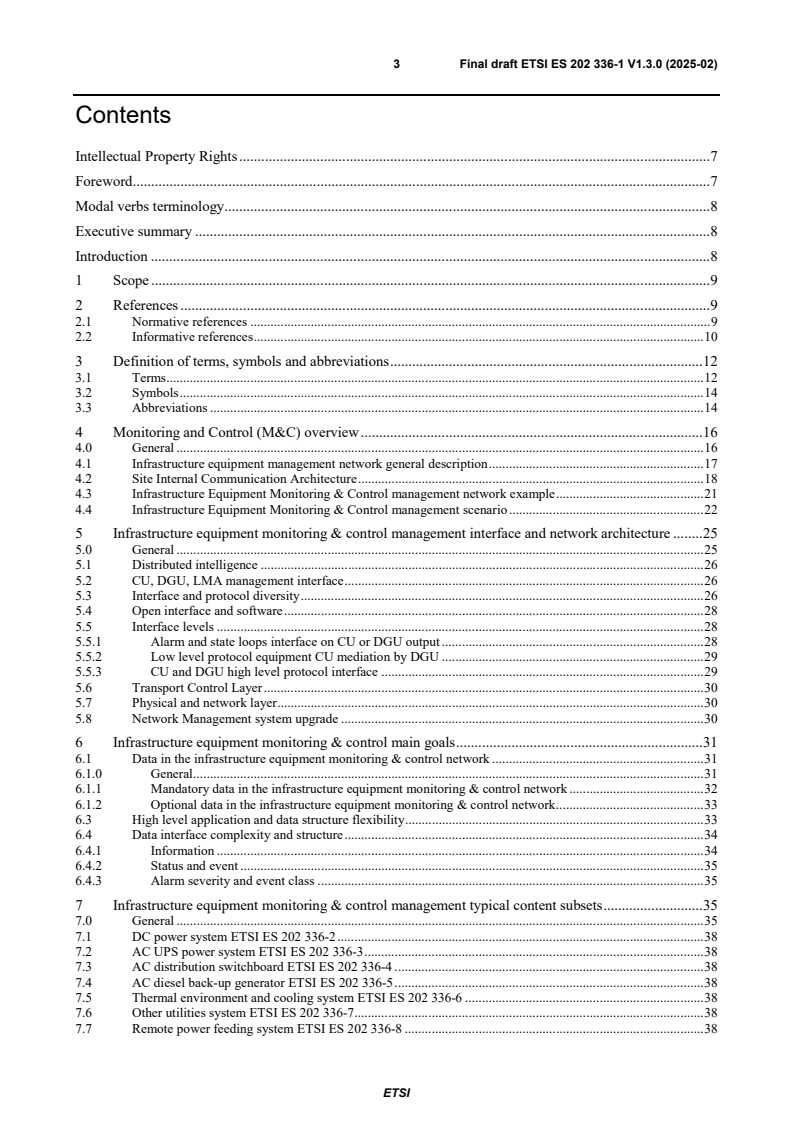
3 Final draft ETSI ES 202 336-1 V1.3.0 (2025-02)
Contents
Intellectual Property Rights . 7
Foreword . 7
Modal verbs terminology . 8
Executive summary . 8
Introduction . 8
1 Scope . 9
2 References . 9
2.1 Normative references . 9
2.2 Informative references . 10
3 Definition of terms, symbols and abbreviations . 12
3.1 Terms . 12
3.2 Symbols . 14
3.3 Abbreviations . 14
4 Monitoring and Control (M&C) overview . 16
4.0 General . 16
4.1 Infrastructure equipment management network general description . 17
4.2 Site Internal Communication Architecture . 18
4.3 Infrastructure Equipment Monitoring & Control management network example . 21
4.4 Infrastructure Equipment Monitoring & Control management scenario . 22
5 Infrastructure equipment monitoring & control management interface and network architecture . 25
5.0 General . 25
5.1 Distributed intelligence . 26
5.2 CU, DGU, LMA management interface . 26
5.3 Interface and protocol diversity . 26
5.4 Open interface and software . 28
5.5 Interface levels . 28
5.5.1 Alarm and state loops interface on CU or DGU output . 28
5.5.2 Low level protocol equipment CU mediation by DGU . 29
5.5.3 CU and DGU high level protocol interface . 29
5.6 Transport Control Layer . 30
5.7 Physical and network layer . 30
5.8 Network Management system upgrade . 30
6 Infrastructure equipment monitoring & control main goals . 31
6.1 Data in the infrastructure equipment monitoring & control network . 31
6.1.0 General . 31
6.1.1 Mandatory data in the infrastructure equipment monitoring & control network . 32
6.1.2 Optional data in the infrastructure equipment monitoring & control network . 33
6.3 High level application and data structure flexibility . 33
6.4 Data interface complexity and structure . 34
6.4.1 Information . 34
6.4.2 Status and event . 35
6.4.3 Alarm severity and event class . 35
7 Infrastructure equipment monitoring & control management typical content subsets . 35
7.0 General . 35
7.1 DC power system ETSI ES 202 336-2 . 38
7.2 AC UPS power system ETSI ES 202 336-3 . 38
7.3 AC distribution switchboard ETSI ES 202 336-4 . 38
7.4 AC diesel back-up generator ETSI ES 202 336-5 . 38
7.5 Thermal environment and cooling system ETSI ES 202 336-6 . 38
7.6 Other utilities system ETSI ES 202 336-7 . 38
7.7 Remote power feeding system ETSI ES 202 336-8 . 38
ETSI
4 Final draft ETSI ES 202 336-1 V1.3.0 (2025-02)
7.8 Alternative power systems ETSI ES 202 336-9 . 38
7.9 AC inverter power system ETSI ES 202 336-10 . 38
7.10 Battery system with integrated control and monitoring information model ETSI ES 202 336-11 . 38
7.11 ICT equipment power, energy, and environmental parameters monitoring information model ETSI
ES 202 336-12 . 38
8 Principle of Power, Energy, Environmental parameters (PEE) measurement . 39
8.0 General . 39
8.1 Power and energy consumption measurement . 39
8.2 Voltage, current measurement . 40
8.3 Accuracy of PEE measurement . 40
8.3.1 Electrical measurement accuracy . 40
8.3.2 Compatibility with IEC standard . 41
8.4 Local acquisition record . 42
8.5 Accuracy verification . 42
8.6 Data transmission period . 43
8.7 Local record saving . 43
9 Supervisor functions and performance . 43
9.0 General . 43
10 Data structure format for exchange between CU or DGU and LMA or RMA by infrastructure
equipment monitoring & control agent . 44
10.0 General . 44
10.1 Standard elements of any equipment, system or subsystem . 45
10.1.1 Standard elements . 45
10.1.2 Alarm and event message . 45
10.1.3 The element . 46
10.1.4 The element . 48
10.1.5 The element . 49
10.1.6 The element . 50
10.1.7 The element. 51
10.1.8 The element . 53
10.1.9 The element . 53
10.2 The element . 54
10.2.0 General . 54
10.2.1 Recommendation about the of the element . 54
10.3 The element . 55
Annex A (informative): Communication between LMA/RMA and infrastructure equipment
monitoring & control agent using YANG/NETCONF and REST . 57
A.0 Introduction . 57
A.1 Communication initiated by the LMA/RMA . 58
A.1.0 Introduction . 58
A.1.1 The GET method . 58
A.1.2 The POST method . 60
A.2 Communication initiated by DGU/CU . 60
Annex B (informative): Data Coherence and reliability for infrastructure equipment
monitoring & control . 61
B.0 Introduction . 61
B.1 Data integrity, coherence and management network reliability . 61
B.2 Application data coherence and integrity . 61
B.3 Naming and data origin . 62
B.4 CU, DGU reliability . 62
B.5 LMA reliability . 62
ETSI
5 Final draft ETSI ES 202 336-1 V1.3.0 (2025-02)
B.6 RMA reliability . 63
B.7 Ethernet and IP network reliability . 63
B.8 Computer and OS reliability. 63
B.9 Application reliability. 63
Annex C (informative): Network element functions and software architecture and choices . 65
C.1 General description. 65
C.2 Functions of the RMA . 66
C.3 Data analysis . 66
C.4 Safety monitoring input provision . 67
C.5 Software working and development environment . 67
Annex D (informative): Network capacity and timing . 68
D.0 Introduction . 68
D.1 Management and Network Capacity . 68
D.2 Memory capacity . 68
D.3 Timing performance . 68
Annex E (informative): Overview of the XML format . 70
E.0 Introduction . 70
E.1 XML . 70
E.2 XML declaration . 70
E.3 XML element, XML root element and XML child element . 70
E.4 XML document . 71
E.5 XML Attribute . 71
E.6 XML Schema . 71
E.7 XML Schema Datatypes . 71
E.8 XSL Languages . 72
E.9 XSLT . 73
E.10 XPath . 73
Annex F (informative): Hints about the choice of OSI or IP models, physical network layers
and intranet-Ethernet access protocols . 74
F.0 Introduction . 74
F.1 OSI and IP models . 74
F.2 Details on IP layers. 75
F.2.1 Application Layer . 75
F.2.2 Transport Layer . 76
F.2.3 Network Layer . 76
F.2.4 Link Layer . 76
F.3 Internet- Ethernet access protocol PPPoE, PPPoA, PoS . 77
F.3.1 PPPoE . 77
F.3.2 PPP service . 78
F.3.3 Other PPP . 78
ETSI
6 Final draft ETSI ES 202 336-1 V1.3.0 (2025-02)
Annex G (informative): Common API . 79
Annex H (informative): State of the art of power, energy measurement and monitoring
systems . 81
H.0 Introduction . 81
H.1 Acquisition and remote metering principles. 81
H.2 General description of measurement . 83
H.2.1 General principle . 83
H.2.2 Measurement sensors . 83
Annex I (informative): Bibliography . 88
Annex (informative): Change history . 89
History . 90
ETSI
7 Final draft ETSI ES 202 336-1 V1.3.0 (2025-02)
Intellectual Property Rights
Essential patents
IPRs essential or potentially essential to normative deliverables may have been declared to ETSI. The declarations
pertaining to these essential IPRs, if any, are publicly available for ETSI members and non-members, and can be
found in ETSI SR 000 314: "Intellectual Property Rights (IPRs); Essential, or potentially Essential, IPRs notified to
ETSI in respect of ETSI standards", which is available from the ETSI Secretariat. Latest updates are available on the
ETSI IPR online database.
Pursuant to the ETSI Directives including the ETSI IPR Policy, no investigation regarding the essentiality of IPRs,
including IPR searches, has been carried out by ETSI. No guarantee can be given as to the existence of other IPRs not
referenced in ETSI SR 000 314 (or the updates on the ETSI Web server) which are, or may be, or may become,
essential to the present document.
Trademarks
The present document may include trademarks and/or tradenames which are asserted and/or registered by their owners.
ETSI claims no ownership of these except for any which are indicated as being the property of ETSI, and conveys no
right to use or reproduce any trademark and/or tradename. Mention of those trademarks in the present document does
not constitute an endorsement by ETSI of products, services or organizations associated with those trademarks.
DECT™, PLUGTESTS™, UMTS™ and the ETSI logo are trademarks of ETSI registered for the benefit of its
Members. 3GPP™, LTE™ and 5G™ logo are trademarks of ETSI registered for the benefit of its Members and of the
3GPP Organizational Partners. oneM2M™ logo is a trademark of ETSI registered for the benefit of its Members and of ®
the oneM2M Partners. GSM and the GSM logo are trademarks registered and owned by the GSM Association.
Foreword
This final draft ETSI Standard (ES) has been produced by ETSI Technical Committee Environmental Engineering (EE),
and is now submitted for the ETSI Membership Approval Procedure.
The present document is part 1 of a multi-part deliverable covering Environmental Engineering (EE); Monitoring and
Control Interface for Infrastructure Equipment (power, cooling and building environment systems used in
telecommunication networks), as identified below:
Part 1: "Generic Interface";
Part 2: "DC power system control and monitoring information model";
Part 3: "AC UPS power system control and monitoring information model";
Part 4: "AC distribution power system control and monitoring information model";
Part 5: "AC diesel back-up generator system control and monitoring information model";
Part 6: "Air Conditioning System control and monitoring information model";
Part 7: "Other utilities system control and monitoring information model";
Part 8: "Remote Power Feeding System control and monitoring information model";
Part 9: "Alternative Power Systems";
Part 10: "AC inverter power system control and monitoring information model";
Part 11: "Battery system with integrated control and monitoring information model";
Part 12: "ICT equipment power, energy and environmental parameters monitoring information model".
ETSI
8 Final draft ETSI ES 202 336-1 V1.3.0 (2025-02)
Modal verbs terminology
In the present document "shall", "shall not", "should", "should not", "may", "need not", "will", "will not", "can" and
"cannot" are to be interpreted as described in clause 3.2 of the ETSI Drafting Rules (Verbal forms for the expression of
provisions).
"must" and "must not" are NOT allowed in ETSI deliverables except when used in direct citation.
Executive summary
The present document will describe the generic monitoring and control interface for infrastructure equipment. The
present document should follow a two-stage approach:
a) protocol-independent information modelling;
b) protocol-specific data modelling e.g. in YAML/JSON.
The present document applies to monitoring and control of Infrastructure Environment i.e. power, cooling and building
environment systems for telecommunication centres and access network locations; also the monitoring energy and
environmental parameters for Information Communication Technology (ICT) equipment in telecommunications sites or
datacenter or customer premises are considered.
Interoperability of heterogeneous management interfaces and systems with multi-vendor equipment is the key issue.
The present document gives a general approach from equipment to management system.
The multi-part deliverable is composed of a generic core part (the present document) and several specific parts for
equipment category.
The present document defines:
• The site equipment maps and its division in functional subsets e.g. DC system which introduces part 2 and
following parts of this multi-part deliverable.
• The generic set of exchanged information required at the interface of equipment, which is instanced for each
equipment subset in part 2 and following parts of this multi-part deliverable.
• The minimum requirement for network architecture allowing some compatibility with old existing interface
and the mechanism to exchange data between network elements.
• The data interface protocol for remote or local site management (Machine to Machine Interface MMI) and
Human Machine Interface HMI for monitoring and controlling.
• Recommendations for a management network such as dependability, data back-up, data coherence and
synchronization all along the management network, response time, fault detection and partial service in case of
failure.
• The Measurement accuracy of Power, Energy and Environmental parameters (PEE).
An architecture for monitoring Power, Energy and Environmental parameters (PEE) for data originated by different
types of site infrastructure equipment is defined.
Introduction
The present document was developed jointly by ETSI TC EE and ITU-T Study Group 5. It is published respectively by
ITU and ETSI as Recommendation ITU-T L.MCI Gen [i.33] and ETSI ES 202 336-1 (the present document), which are
technically equivalent.
ETSI
9 Final draft ETSI ES 202 336-1 V1.3.0 (2025-02)
1 Scope
The present document applies to monitoring and control of Infrastructure Environment i.e. power, cooling and building
environment systems for telecommunication centres and access network locations; also, the monitoring of energy and
environmental parameters: Power Energy Environmental (PEE) parameters for ICT equipment in telecommunications
sites or datacenter or customer premises are considered.
Interoperability of heterogeneous management interfaces and systems with multi-vendor equipment is the key issue.
The present document gives a general approach from equipment to management system.
The multi-part deliverable is composed of a generic core part (the present document) and several specific parts for
equipment category.
The present document defines:
• The site equipment maps and its division in functional subsets e.g. DC system which introduces following
parts of this multi-part deliverable.
• The generic set of exchanged information required at the interface of equipment, which is instanced for each
equipment covered by following parts of this multi-part deliverable.
• The minimum requirement for network architecture allowing some compatibility with old existing interface
and the mechanism to exchange data between network elements.
• The data interface protocol for remote or local site management (Machine to Machine Interface MMI) and
Human Machine Interface HMI for monitoring and controlling.
• Recommendations for a management network such as dependability, data back-up, data coherence and
synchronization all along the management network, response time, fault detection and partial service in case of
failure.
• The Measurement accuracy of Power, Energy and Environmental Parameters (PEE).
2 References
2.1 Normative references
References are either specific (identified by date of publication and/or edition number or version number) or
non-specific. For specific references, only the cited version applies. For non-specific references, the latest version of the
referenced document (including any amendments) applies.
Referenced documents which are not found to be publicly available in the expected location might be found in the
ETSI docbox.
NOTE: While any hyperlinks included in this clause were valid at the time of publication, ETSI cannot guarantee
their long term validity.
The following referenced documents are necessary for the application of the present document.
[1] Recommendation ITU-T M.3010: "Principles for a Telecommunications management network".
[2] Recommendation ITU-T M.3100: "Generic network information model".
[3] Recommendation ITU-T X.733: "Information technology - Open Systems Interconnection -
Systems Management: Alarm reporting function".
[4] IEC 60839-5-1: "Alarm and electronic security systems – Part 5-1: Alarm transmission systems –
General requirements".
[5] Void.
ETSI
10 Final draft ETSI ES 202 336-1 V1.3.0 (2025-02)
[6] IETF RFC 7540: "Hypertext Transfer Protocol Version 2 (HTTP/2)".
[7] ISO/IEC 7498: "Open Systems Interconnection (OSI) — Basic Reference Model".
[8] IEEE 802™ series (all parts): "IEEE Standard for Telecommunications and Information Exchange
Between systems - Local and metropolitan area networks".
[9] IETF RFC 8259: "The JavaScript Object Notation (JSON) Data Interchange Format".
[10] IETF RFC 7950: "The YANG 1.1 Data Modeling Language".
[11] ETSI EN 300 019-1-3: "Environmental Engineering (EE); Environmental conditions and
environmental tests for telecommunications equipment; Part 1-3: Classification of environmental
conditions; Stationary use at weatherprotected locations".
[12] ETSI TS 132 130: "Universal Mobile Telecommunications System (UMTS); LTE;
Telecommunication management; Network sharing; Concepts and requirements(3GPP
TS 32.130)".
2.2 Informative references
References are either specific (identified by date of publication and/or edition number or version number) or
non-specific. For specific references, only the cited version applies. For non-specific references, the latest version of the
referenced document (including any amendments) applies.
NOTE: While any hyperlinks included in this clause were valid at the time of publication, ETSI cannot guarantee
their long term validity.
The following referenced documents are not necessary for the application of the present document but they assist the
user with regard to a particular subject area.
[i.1] ETSI TR 102 336: "Environmental Engineering (EE); Power and cooling system control and
monitoring guidance".
[i.2] Void.
[i.3] IETF RFC 2516: "A Method for Transmitting PPP Over Ethernet (PPPoE)".
[i.4] IETF RFC 1191: "Path MTU discovery".
[i.5] IETF RFC 871: "Perspective on the ARPANET reference model".
[i.6] IETF RFC 1662: "PPP in HDLC-like Framing".
[i.7] IETF RFC 1994: "PPP Challenge Handshake Authentication Protocol (CHAP)".
[i.8] IETF RFC 2364: "PPP Over AAL5".
[i.9] IETF RFC 2615: "PPP over SONET/SDH".
[i.10] IETF RFC 1661: "The Point-to-Point Protocol (PPP)".
[i.11] ISO/IEC 8327: "Information technology — Open Systems Interconnection — Connection-oriented
Session protocol: Protocol specification".
[i.12] ETSI ES 202 336-2: "Environmental Engineering (EE); Monitoring and control interface for
infrastructure equipment (Power, Cooling and environment systems used in telecommunication
networks); Part 2: DC power system control and monitoring information model".
[i.13] ETSI ES 202 336-3: "Environmental Engineering (EE); Monitoring and Control Interface for
Infrastructure Equipment (Power, Cooling and Building Environment Systems used in
Telecommunication Networks); Part 3: AC UPS power system control and monitoring information
model".
ETSI
11 Final draft ETSI ES 202 336-1 V1.3.0 (2025-02)
[i.14] ETSI ES 202 336-4: "Environmental Engineering (EE); Monitoring and Control Interface for
Infrastructure Equipment (Power, Cooling and Building Environment Systems used in
Telecommunication Networks); Part 4: AC distribution power system control and monitoring
information model".
[i.15] ETSI ES 202 336-5: "Environmental Engineering (EE); Monitoring and Control Interface for
Infrastructure Equipment (Power, Cooling and Building Environment Systems used in
Telecommunication Networks); Part 5: AC diesel back-up generator system control and
monitoring information model".
[i.16] ETSI ES 202 336-6: "Environmental Engineering (EE); Monitoring and Control Interface for
Infrastructure Equipment (Power, Cooling and Building Environment Systems used in
Telecommunication Networks); Part 6: Air Conditioning System control and monitoring
information model".
[i.17] ETSI ES 202 336-7: "Environmental Engineering (EE); Monitoring and Control Interface for
Infrastructure Equipment (Power, Cooling and Building Environment Systems used in
Telecommunication Networks); Part 7: Other utilities system control and monitoring information
model".
[i.18] ETSI ES 202 336-8: "Environmental Engineering (EE); Monitoring and Control Interface for
Infrastructure Equipment (Power, Cooling and Building Environment Systems used in
Telecommunication Networks); Part 8: Remote Power Feeding System control and monitoring
information model".
[i.19] ETSI ES 202 336-9: "Environmental Engineering (EE); Monitoring and Control Interface for
Infrastructure Equipment (Power, Cooling and Building Environment Systems used in
Telecommunication Networks); Part 9: Alternative Power Systems".
[i.20] ETSI ES 202 336-10: "Environmental Engineering (EE); Monitoring and Control Interface for
Infrastructure Equipment (Power, Cooling and Building Environment Systems used in
Telecommunication Networks); Part 10: AC inverter power system control and monitoring
information model".
[i.21] ETSI ES 202 336-11: "Environmental Engineering (EE); Monitoring and control interface for
infrastructure equipment (Power, Cooling and environment systems used in telecommunication
networks); Part 11: Battery system with integrated control and monitoring information model".
[i.22] ETSI ES 202 336-12: "Environmental Engineering (EE); Monitoring and control interface for
infrastructure equipment (power, cooling and building environment systems used in
telecommunication networks); Part 12: ICT equipment power, energy and environmental
parameters monitoring information model".
[i.23] ETSI EN 300 132-1: "Equipment Engineering (EE); Power supply interface at the input to
Information and Communication Technology (ICT) equipment; Part 1: Alternating Current (AC)".
[i.24] ETSI EN 300 132-2: "Environmental Engineering (EE); Power supply interface at the input of
Information and Communication Technology (ICT) equipment; Part 2: -48 V Direct Current
(DC)".
[i.25] ETSI EN 300 132-3: "Environmental Engineering (EE); Power supply interface at the input of
Information and Communication Technology (ICT) equipment; Part 3: Up to 400 V Direct Current
(DC)".
[i.26] Recommendation ITU-T X.25: "Interface between Data Terminal Equipment (DTE) and Data
Circuit-terminating Equipment (DCE) for terminals operating in the packet mode and connected to
public data networks by dedicated circuit".
[i.27] LT0511 RevB datasheet: "Linear Technology LTC 1966 precision micropower RMS to DC
converter".
[i.28] Mark Strzegowski: "Realizing the Full Potential of Your AMI Deployment with Meter Diagnostic
Data", Analog Device.
ETSI
12 Final draft ETSI ES 202 336-1 V1.3.0 (2025-02)
[i.29] ETSI EN 300 019-1-4: "Environmental Engineering (EE); Environmental conditions and
environmental tests for telecommunications equipment; Part 1-4: Classification of environmental
conditions; Stationary use at non-weatherprotected locations".
[i.30] ETSI ES 203 700: "Environmental Engineering (EE); Sustainable power feeding solutions for 5G
network".
NOTE: ETSI ES 203 700 is technically equivalent to Recommendation ITU-T L.1210: "Sustainable power-
feeding solutions for 5G networks".
[i.31] Recommendation ITU-T L.1382: "Smart energy solution for telecommunication rooms".
[i.32] IEC 61557-12: 2018 /AMD (2021): "Electrical safety in low voltage distribution systems up to
1 000 V AC and 1 500 V DC. - Equipment for testing, measuring or monitoring of protective
measures - Part 12: Power metering and monitoring devices".
[i.33] Recommendation ITU-T L.MCI Gen: "Monitoring and Control Interface for Infrastructure
Equipment (Power, Cooling and Building Environment Systems used in Telecommunication
Networks) Part 1: Generic Interface". ®
: "XML Schema Part 2: Datatypes Second Edition".
[i.34] W3C
3 Definition of terms, symbols and abbreviations
3.1 Terms
For the purposes of the present document, the following terms apply:
alarm: any information signalling abnormal state, i.e. different to specified normal state of hardware, software,
environment condition (temperature, humidity, etc.)
NOTE: The alarm signal can be understood by itself by an operator and have at least one severity qualification or
codification (colour, level, etc.).
alarm loop: electrical loop which open or closed state correspond to alarm start (set) or end (clear) state
alarm message: text parts of the alarm structure
alarm structure: organized set of information fields in an alarm data frame (time stamp, set/clear, text, etc.)
client post: any device (laptop, PDA, console, etc.) connected to servers via the operation system
...
ETSI STANDARD
Environmental Engineering (EE);
Monitoring and Control Interface for Infrastructure Equipment
(Power, Cooling and Building Environment Systems used in
Telecommunication Networks)
Part 1: Generic Interface
2 ETSI ES 202 336-1 V1.3.1 (2025-04)
Reference
RES/EE-02105
Keywords
control, interface, management, power, system
ETSI
650 Route des Lucioles
F-06921 Sophia Antipolis Cedex - FRANCE
Tel.: +33 4 92 94 42 00 Fax: +33 4 93 65 47 16
Siret N° 348 623 562 00017 - APE 7112B
Association à but non lucratif enregistrée à la
Sous-Préfecture de Grasse (06) N° w061004871
Important notice
The present document can be downloaded from the
ETSI Search & Browse Standards application.
The present document may be made available in electronic versions and/or in print. The content of any electronic and/or
print versions of the present document shall not be modified without the prior written authorization of ETSI. In case of any
existing or perceived difference in contents between such versions and/or in print, the prevailing version of an ETSI
deliverable is the one made publicly available in PDF format on ETSI deliver repository.
Users should be aware that the present document may be revised or have its status changed,
this information is available in the Milestones listing.
If you find errors in the present document, please send your comments to
the relevant service listed under Committee Support Staff.
If you find a security vulnerability in the present document, please report it through our
Coordinated Vulnerability Disclosure (CVD) program.
Notice of disclaimer & limitation of liability
The information provided in the present deliverable is directed solely to professionals who have the appropriate degree of
experience to understand and interpret its content in accordance with generally accepted engineering or
other professional standard and applicable regulations.
No recommendation as to products and services or vendors is made or should be implied.
No representation or warranty is made that this deliverable is technically accurate or sufficient or conforms to any law
and/or governmental rule and/or regulation and further, no representation or warranty is made of merchantability or fitness
for any particular purpose or against infringement of intellectual property rights.
In no event shall ETSI be held liable for loss of profits or any other incidental or consequential damages.
Any software contained in this deliverable is provided "AS IS" with no warranties, express or implied, including but not
limited to, the warranties of merchantability, fitness for a particular purpose and non-infringement of intellectual property
rights and ETSI shall not be held liable in any event for any damages whatsoever (including, without limitation, damages
for loss of profits, business interruption, loss of information, or any other pecuniary loss) arising out of or related to the use
of or inability to use the software.
Copyright Notification
No part may be reproduced or utilized in any form or by any means, electronic or mechanical, including photocopying and
microfilm except as authorized by written permission of ETSI.
The content of the PDF version shall not be modified without the written authorization of ETSI.
The copyright and the foregoing restriction extend to reproduction in all media.
© ETSI 2025.
All rights reserved.
ETSI
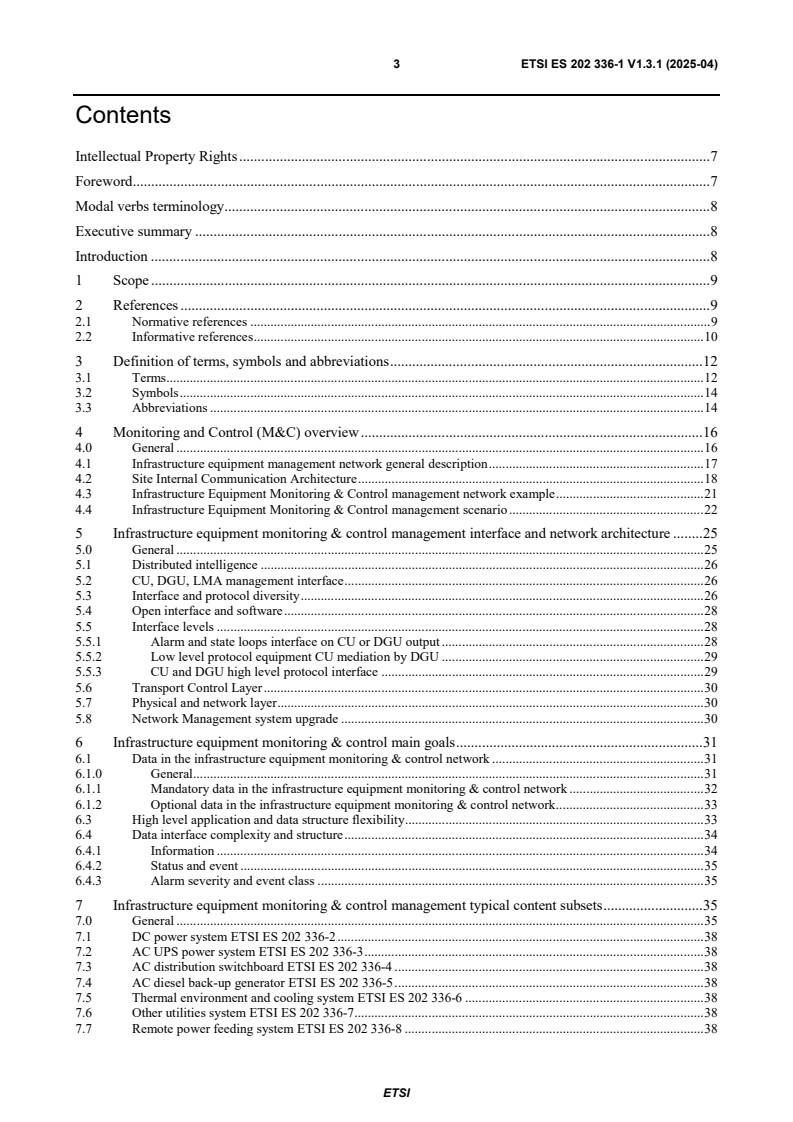
3 ETSI ES 202 336-1 V1.3.1 (2025-04)
Contents
Intellectual Property Rights . 7
Foreword . 7
Modal verbs terminology . 8
Executive summary . 8
Introduction . 8
1 Scope . 9
2 References . 9
2.1 Normative references . 9
2.2 Informative references . 10
3 Definition of terms, symbols and abbreviations . 12
3.1 Terms . 12
3.2 Symbols . 14
3.3 Abbreviations . 14
4 Monitoring and Control (M&C) overview . 16
4.0 General . 16
4.1 Infrastructure equipment management network general description . 17
4.2 Site Internal Communication Architecture . 18
4.3 Infrastructure Equipment Monitoring & Control management network example . 21
4.4 Infrastructure Equipment Monitoring & Control management scenario . 22
5 Infrastructure equipment monitoring & control management interface and network architecture . 25
5.0 General . 25
5.1 Distributed intelligence . 26
5.2 CU, DGU, LMA management interface . 26
5.3 Interface and protocol diversity . 26
5.4 Open interface and software . 28
5.5 Interface levels . 28
5.5.1 Alarm and state loops interface on CU or DGU output . 28
5.5.2 Low level protocol equipment CU mediation by DGU . 29
5.5.3 CU and DGU high level protocol interface . 29
5.6 Transport Control Layer . 30
5.7 Physical and network layer . 30
5.8 Network Management system upgrade . 30
6 Infrastructure equipment monitoring & control main goals . 31
6.1 Data in the infrastructure equipment monitoring & control network . 31
6.1.0 General . 31
6.1.1 Mandatory data in the infrastructure equipment monitoring & control network . 32
6.1.2 Optional data in the infrastructure equipment monitoring & control network . 33
6.3 High level application and data structure flexibility . 33
6.4 Data interface complexity and structure . 34
6.4.1 Information . 34
6.4.2 Status and event . 35
6.4.3 Alarm severity and event class . 35
7 Infrastructure equipment monitoring & control management typical content subsets . 35
7.0 General . 35
7.1 DC power system ETSI ES 202 336-2 . 38
7.2 AC UPS power system ETSI ES 202 336-3 . 38
7.3 AC distribution switchboard ETSI ES 202 336-4 . 38
7.4 AC diesel back-up generator ETSI ES 202 336-5 . 38
7.5 Thermal environment and cooling system ETSI ES 202 336-6 . 38
7.6 Other utilities system ETSI ES 202 336-7 . 38
7.7 Remote power feeding system ETSI ES 202 336-8 . 38
ETSI
4 ETSI ES 202 336-1 V1.3.1 (2025-04)
7.8 Alternative power systems ETSI ES 202 336-9 . 38
7.9 AC inverter power system ETSI ES 202 336-10 . 38
7.10 Battery system with integrated control and monitoring information model ETSI ES 202 336-11 . 38
7.11 ICT equipment power, energy, and environmental parameters monitoring information model ETSI
ES 202 336-12 . 38
8 Principle of Power, Energy, Environmental parameters (PEE) measurement . 39
8.0 General . 39
8.1 Power and energy consumption measurement . 39
8.2 Voltage, current measurement . 40
8.3 Accuracy of PEE measurement . 40
8.3.1 Electrical measurement accuracy . 40
8.3.2 Compatibility with IEC standard . 41
8.4 Local acquisition record . 42
8.5 Accuracy verification . 42
8.6 Data transmission period . 43
8.7 Local record saving . 43
9 Supervisor functions and performance . 43
9.0 General . 43
10 Data structure format for exchange between CU or DGU and LMA or RMA by infrastructure
equipment monitoring & control agent . 44
10.0 General . 44
10.1 Standard elements of any equipment, system or subsystem . 45
10.1.1 Standard elements . 45
10.1.2 Alarm and event message . 45
10.1.3 The element . 46
10.1.4 The element . 48
10.1.5 The element . 49
10.1.6 The element . 50
10.1.7 The element. 51
10.1.8 The element . 53
10.1.9 The element . 53
10.2 The element . 54
10.2.0 General . 54
10.2.1 Recommendation about the of the element . 54
10.3 The element . 55
Annex A (informative): Communication between LMA/RMA and infrastructure equipment
monitoring & control agent using YANG/NETCONF and REST . 57
A.0 Introduction . 57
A.1 Communication initiated by the LMA/RMA . 58
A.1.0 Introduction . 58
A.1.1 The GET method . 58
A.1.2 The POST method . 60
A.2 Communication initiated by DGU/CU . 60
Annex B (informative): Data Coherence and reliability for infrastructure equipment
monitoring & control . 61
B.0 Introduction . 61
B.1 Data integrity, coherence and management network reliability . 61
B.2 Application data coherence and integrity . 61
B.3 Naming and data origin . 62
B.4 CU, DGU reliability . 62
B.5 LMA reliability . 62
ETSI
5 ETSI ES 202 336-1 V1.3.1 (2025-04)
B.6 RMA reliability . 63
B.7 Ethernet and IP network reliability . 63
B.8 Computer and OS reliability. 63
B.9 Application reliability. 63
Annex C (informative): Network element functions and software architecture and choices . 65
C.1 General description. 65
C.2 Functions of the RMA . 66
C.3 Data analysis . 66
C.4 Safety monitoring input provision . 67
C.5 Software working and development environment . 67
Annex D (informative): Network capacity and timing . 68
D.0 Introduction . 68
D.1 Management and Network Capacity . 68
D.2 Memory capacity . 68
D.3 Timing performance . 68
Annex E (informative): Overview of the XML format . 70
E.0 Introduction . 70
E.1 XML . 70
E.2 XML declaration . 70
E.3 XML element, XML root element and XML child element . 70
E.4 XML document . 71
E.5 XML Attribute . 71
E.6 XML Schema . 71
E.7 XML Schema Datatypes . 71
E.8 XSL Languages . 72
E.9 XSLT . 73
E.10 XPath . 73
Annex F (informative): Hints about the choice of OSI or IP models, physical network layers
and intranet-Ethernet access protocols . 74
F.0 Introduction . 74
F.1 OSI and IP models . 74
F.2 Details on IP layers. 75
F.2.1 Application Layer . 75
F.2.2 Transport Layer . 76
F.2.3 Network Layer . 76
F.2.4 Link Layer . 76
F.3 Internet- Ethernet access protocol PPPoE, PPPoA, PoS . 77
F.3.1 PPPoE . 77
F.3.2 PPP service . 78
F.3.3 Other PPP . 78
ETSI
6 ETSI ES 202 336-1 V1.3.1 (2025-04)
Annex G (informative): Common API . 79
Annex H (informative): State of the art of power, energy measurement and monitoring
systems . 81
H.0 Introduction . 81
H.1 Acquisition and remote metering principles. 81
H.2 General description of measurement . 83
H.2.1 General principle . 83
H.2.2 Measurement sensors . 83
Annex I (informative): Bibliography . 88
Annex (informative): Change history . 89
History . 90
ETSI
7 ETSI ES 202 336-1 V1.3.1 (2025-04)
Intellectual Property Rights
Essential patents
IPRs essential or potentially essential to normative deliverables may have been declared to ETSI. The declarations
pertaining to these essential IPRs, if any, are publicly available for ETSI members and non-members, and can be
found in ETSI SR 000 314: "Intellectual Property Rights (IPRs); Essential, or potentially Essential, IPRs notified to
ETSI in respect of ETSI standards", which is available from the ETSI Secretariat. Latest updates are available on the
ETSI IPR online database.
Pursuant to the ETSI Directives including the ETSI IPR Policy, no investigation regarding the essentiality of IPRs,
including IPR searches, has been carried out by ETSI. No guarantee can be given as to the existence of other IPRs not
referenced in ETSI SR 000 314 (or the updates on the ETSI Web server) which are, or may be, or may become,
essential to the present document.
Trademarks
The present document may include trademarks and/or tradenames which are asserted and/or registered by their owners.
ETSI claims no ownership of these except for any which are indicated as being the property of ETSI, and conveys no
right to use or reproduce any trademark and/or tradename. Mention of those trademarks in the present document does
not constitute an endorsement by ETSI of products, services or organizations associated with those trademarks.
DECT™, PLUGTESTS™, UMTS™ and the ETSI logo are trademarks of ETSI registered for the benefit of its
Members. 3GPP™, LTE™ and 5G™ logo are trademarks of ETSI registered for the benefit of its Members and of the
3GPP Organizational Partners. oneM2M™ logo is a trademark of ETSI registered for the benefit of its Members and of ®
the oneM2M Partners. GSM and the GSM logo are trademarks registered and owned by the GSM Association.
Foreword
This ETSI Standard (ES) has been produced by ETSI Technical Committee Environmental Engineering (EE).
The present document is part 1 of a multi-part deliverable covering Environmental Engineering (EE); Monitoring and
Control Interface for Infrastructure Equipment (power, cooling and building environment systems used in
telecommunication networks), as identified below:
Part 1: "Generic Interface";
Part 2: "DC power system control and monitoring information model";
Part 3: "AC UPS power system control and monitoring information model";
Part 4: "AC distribution power system control and monitoring information model";
Part 5: "AC diesel back-up generator system control and monitoring information model";
Part 6: "Air Conditioning System control and monitoring information model";
Part 7: "Other utilities system control and monitoring information model";
Part 8: "Remote Power Feeding System control and monitoring information model";
Part 9: "Alternative Power Systems";
Part 10: "AC inverter power system control and monitoring information model";
Part 11: "Battery system with integrated control and monitoring information model";
Part 12: "ICT equipment power, energy and environmental parameters monitoring information model".
ETSI
8 ETSI ES 202 336-1 V1.3.1 (2025-04)
Modal verbs terminology
In the present document "shall", "shall not", "should", "should not", "may", "need not", "will", "will not", "can" and
"cannot" are to be interpreted as described in clause 3.2 of the ETSI Drafting Rules (Verbal forms for the expression of
provisions).
"must" and "must not" are NOT allowed in ETSI deliverables except when used in direct citation.
Executive summary
The present document will describe the generic monitoring and control interface for infrastructure equipment. The
present document should follow a two-stage approach:
a) protocol-independent information modelling;
b) protocol-specific data modelling e.g. in YAML/JSON.
The present document applies to monitoring and control of Infrastructure Environment i.e. power, cooling and building
environment systems for telecommunication centres and access network locations; also the monitoring energy and
environmental parameters for Information Communication Technology (ICT) equipment in telecommunications sites or
datacenter or customer premises are considered.
Interoperability of heterogeneous management interfaces and systems with multi-vendor equipment is the key issue.
The present document gives a general approach from equipment to management system.
The multi-part deliverable is composed of a generic core part (the present document) and several specific parts for
equipment category.
The present document defines:
• The site equipment maps and its division in functional subsets e.g. DC system which introduces part 2 and
following parts of this multi-part deliverable.
• The generic set of exchanged information required at the interface of equipment, which is instanced for each
equipment subset in part 2 and following parts of this multi-part deliverable.
• The minimum requirement for network architecture allowing some compatibility with old existing interface
and the mechanism to exchange data between network elements.
• The data interface protocol for remote or local site management (Machine to Machine Interface MMI) and
Human Machine Interface HMI for monitoring and controlling.
• Recommendations for a management network such as dependability, data back-up, data coherence and
synchronization all along the management network, response time, fault detection and partial service in case of
failure.
• The Measurement accuracy of Power, Energy and Environmental parameters (PEE).
An architecture for monitoring Power, Energy and Environmental parameters (PEE) for data originated by different
types of site infrastructure equipment is defined.
Introduction
The present document was developed jointly by ETSI TC EE and ITU-T Study Group 5. It is published respectively by
ITU and ETSI as Recommendation ITU-T L.MCI Gen [i.33] and ETSI ES 202 336-1 (the present document), which are
technically equivalent.
ETSI
9 ETSI ES 202 336-1 V1.3.1 (2025-04)
1 Scope
The present document applies to monitoring and control of Infrastructure Environment i.e. power, cooling and building
environment systems for telecommunication centres and access network locations; also, the monitoring of energy and
environmental parameters: Power Energy Environmental (PEE) parameters for ICT equipment in telecommunications
sites or datacenter or customer premises are considered.
Interoperability of heterogeneous management interfaces and systems with multi-vendor equipment is the key issue.
The present document gives a general approach from equipment to management system.
The multi-part deliverable is composed of a generic core part (the present document) and several specific parts for
equipment category.
The present document defines:
• The site equipment maps and its division in functional subsets e.g. DC system which introduces following
parts of this multi-part deliverable.
• The generic set of exchanged information required at the interface of equipment, which is instanced for each
equipment covered by following parts of this multi-part deliverable.
• The minimum requirement for network architecture allowing some compatibility with old existing interface
and the mechanism to exchange data between network elements.
• The data interface protocol for remote or local site management (Machine to Machine Interface MMI) and
Human Machine Interface HMI for monitoring and controlling.
• Recommendations for a management network such as dependability, data back-up, data coherence and
synchronization all along the management network, response time, fault detection and partial service in case of
failure.
• The Measurement accuracy of Power, Energy and Environmental Parameters (PEE).
2 References
2.1 Normative references
References are either specific (identified by date of publication and/or edition number or version number) or
non-specific. For specific references, only the cited version applies. For non-specific references, the latest version of the
referenced document (including any amendments) applies.
Referenced documents which are not found to be publicly available in the expected location might be found in the
ETSI docbox.
NOTE: While any hyperlinks included in this clause were valid at the time of publication, ETSI cannot guarantee
their long term validity.
The following referenced documents are necessary for the application of the present document.
[1] Recommendation ITU-T M.3010: "Principles for a Telecommunications management network".
[2] Recommendation ITU-T M.3100: "Generic network information model".
[3] Recommendation ITU-T X.733: "Information technology - Open Systems Interconnection -
Systems Management: Alarm reporting function".
[4] IEC 60839-5-1: "Alarm and electronic security systems - Part 5-1: Alarm transmission systems -
General requirements".
[5] Void.
ETSI
10 ETSI ES 202 336-1 V1.3.1 (2025-04)
[6] IETF RFC 7540: "Hypertext Transfer Protocol Version 2 (HTTP/2)".
[7] ISO/IEC 7498: "Information technology - Open Systems Interconnection - Basic Reference
Model".
[8] IEEE 802™ series (all parts): "IEEE Standard for Telecommunications and Information Exchange
Between systems - Local and metropolitan area networks".
[9] IETF RFC 8259: "The JavaScript Object Notation (JSON) Data Interchange Format".
[10] IETF RFC 7950: "The YANG 1.1 Data Modeling Language".
[11] ETSI EN 300 019-1-3: "Environmental Engineering (EE); Environmental conditions and
environmental tests for telecommunications equipment; Part 1-3: Classification of environmental
conditions; Stationary use at weatherprotected locations".
[12] ETSI TS 132 130: "Universal Mobile Telecommunications System (UMTS); LTE;
Telecommunication management; Network sharing; Concepts and requirements(3GPP
TS 32.130)".
2.2 Informative references
References are either specific (identified by date of publication and/or edition number or version number) or
non-specific. For specific references, only the cited version applies. For non-specific references, the latest version of the
referenced document (including any amendments) applies.
NOTE: While any hyperlinks included in this clause were valid at the time of publication, ETSI cannot guarantee
their long term validity.
The following referenced documents are not necessary for the application of the present document but they assist the
user with regard to a particular subject area.
[i.1] ETSI TR 102 336: "Environmental Engineering (EE); Power and cooling system control and
monitoring guidance".
[i.2] Void.
[i.3] IETF RFC 2516: "A Method for Transmitting PPP Over Ethernet (PPPoE)".
[i.4] IETF RFC 1191: "Path MTU discovery".
[i.5] IETF RFC 871: "Perspective on the ARPANET reference model".
[i.6] IETF RFC 1662: "PPP in HDLC-like Framing".
[i.7] IETF RFC 1994: "PPP Challenge Handshake Authentication Protocol (CHAP)".
[i.8] IETF RFC 2364: "PPP Over AAL5".
[i.9] IETF RFC 2615: "PPP over SONET/SDH".
[i.10] IETF RFC 1661: "The Point-to-Point Protocol (PPP)".
[i.11] ISO/IEC 8327: "Information technology — Open Systems Interconnection — Connection-oriented
Session protocol: Protocol specification".
[i.12] ETSI ES 202 336-2: "Environmental Engineering (EE); Monitoring and control interface for
infrastructure equipment (Power, Cooling and environment systems used in telecommunication
networks); Part 2: DC power system control and monitoring information model".
[i.13] ETSI ES 202 336-3: "Environmental Engineering (EE); Monitoring and Control Interface for
Infrastructure Equipment (Power, Cooling and Building Environment Systems used in
Telecommunication Networks); Part 3: AC UPS power system control and monitoring information
model".
ETSI
11 ETSI ES 202 336-1 V1.3.1 (2025-04)
[i.14] ETSI ES 202 336-4: "Environmental Engineering (EE); Monitoring and Control Interface for
Infrastructure Equipment (Power, Cooling and Building Environment Systems used in
Telecommunication Networks); Part 4: AC distribution power system control and monitoring
information model".
[i.15] ETSI ES 202 336-5: "Environmental Engineering (EE); Monitoring and Control Interface for
Infrastructure Equipment (Power, Cooling and Building Environment Systems used in
Telecommunication Networks); Part 5: AC diesel back-up generator system control and
monitoring information model".
[i.16] ETSI ES 202 336-6: "Environmental Engineering (EE); Monitoring and Control Interface for
Infrastructure Equipment (Power, Cooling and Building Environment Systems used in
Telecommunication Networks); Part 6: Air Conditioning System control and monitoring
information model".
[i.17] ETSI ES 202 336-7: "Environmental Engineering (EE); Monitoring and Control Interface for
Infrastructure Equipment (Power, Cooling and Building Environment Systems used in
Telecommunication Networks); Part 7: Other utilities system control and monitoring information
model".
[i.18] ETSI ES 202 336-8: "Environmental Engineering (EE); Monitoring and Control Interface for
Infrastructure Equipment (Power, Cooling and Building Environment Systems used in
Telecommunication Networks); Part 8: Remote Power Feeding System control and monitoring
information model".
[i.19] ETSI ES 202 336-9: "Environmental Engineering (EE); Monitoring and Control Interface for
Infrastructure Equipment (Power, Cooling and Building Environment Systems used in
Telecommunication Networks); Part 9: Alternative Power Systems".
[i.20] ETSI ES 202 336-10: "Environmental Engineering (EE); Monitoring and Control Interface for
Infrastructure Equipment (Power, Cooling and Building Environment Systems used in
Telecommunication Networks); Part 10: AC inverter power system control and monitoring
information model".
[i.21] ETSI ES 202 336-11: "Environmental Engineering (EE); Monitoring and control interface for
infrastructure equipment (Power, Cooling and environment systems used in telecommunication
networks); Part 11: Battery system with integrated control and monitoring information model".
[i.22] ETSI ES 202 336-12: "Environmental Engineering (EE); Monitoring and control interface for
infrastructure equipment (power, cooling and building environment systems used in
telecommunication networks); Part 12: ICT equipment power, energy and environmental
parameters monitoring information model".
[i.23] ETSI EN 300 132-1: "Equipment Engineering (EE); Power supply interface at the input to
Information and Communication Technology (ICT) equipment; Part 1: Alternating Current (AC)".
[i.24] ETSI EN 300 132-2: "Environmental Engineering (EE); Power supply interface at the input of
Information and Communication Technology (ICT) equipment; Part 2: -48 V Direct Current
(DC)".
[i.25] ETSI EN 300 132-3: "Environmental Engineering (EE); Power supply interface at the input of
Information and Communication Technology (ICT) equipment; Part 3: Up to 400 V Direct Current
(DC)".
[i.26] Recommendation ITU-T X.25: "Interface between Data Terminal Equipment (DTE) and Data
Circuit-terminating Equipment (DCE) for terminals operating in the packet mode and connected to
public data networks by dedicated circuit".
[i.27] LT0511 RevB datasheet: "Linear Technology LTC 1966 precision micropower RMS to DC
converter".
[i.28] Mark Strzegowski: "Realizing the Full Potential of Your AMI Deployment with Meter Diagnostic
Data", Analog Device.
ETSI
12 ETSI ES 202 336-1 V1.3.1 (2025-04)
[i.29] ETSI EN 300 019-1-4: "Environmental Engineering (EE); Environmental conditions and
environmental tests for telecommunications equipment; Part 1-4: Classification of environmental
conditions; Stationary use at non-weatherprotected locations".
[i.30] ETSI ES 203 700: "Environmental Engineering (EE); Sustainable power feeding solutions for 5G
network".
NOTE: ETSI ES 203 700 is technically equivalent to Recommendation ITU-T L.1210: "Sustainable power-
feeding solutions for 5G networks".
[i.31] Recommendation ITU-T L.1382: "Smart energy solution for telecommunication rooms".
[i.32] IEC 61557-12: 2018 /AMD (2021): "Electrical safety in low voltage distribution systems up to
1 000 V AC and 1 500 V DC. - Equipment for testing, measuring or monitoring of protective
measures - Part 12: Power metering and monitoring devices".
[i.33] Recommendation ITU-T L.MCI Gen: "Monitoring and Control Interface for Infrastructure
Equipment (Power, Cooling and Building Environment Systems used in Telecommunication
Networks) Part 1: Generic Interface". ®
Recommendation: "XML Schema Part 2: Datatypes Second Edition".
[i.34] W3C
3 Definition of terms, symbols and abbreviations
3.1 Terms
For the purposes of the present document, the following terms apply:
alarm: any information signalling abnormal state, i.e. different to specified normal state of hardware, software,
environment condition (temperature, humidity, etc.)
NOTE: The alarm signal can be understood by itself by an operator and have at least one severity qualification or
codification (colour, level, etc.).
alarm loop: electrical loop which open or closed state correspond to alarm start (set) or end (clear) state
alarm message: text parts of the alarm structure
alarm structure: organized set of information fields in an alarm data frame (time stamp, set/clear, text, etc.)
client post: any device (laptop, PDA, console, etc.) connected to servers via the operation system networks to perform
maintenance or supervision operations
NOTE: It is independent of object class and object properties. The most common functions are GET and SET,
equivalent to monitor and cont
...
SLOVENSKI STANDARD
01-september-2025
Okoljski inženiring (EE) - Nadzorovalni in krmilni vmesnik za infrastrukturno
opremo (elektroenergetski, hladilni in stavbni okoljski sistemi v
telekomunikacijskih omrežjih) - 1. del: Generični vmesnik
Environmental Engineering (EE) - Monitoring and Control Interface for Infrastructure
Equipment (Power, Cooling and Building Environment Systems used in
Telecommunication Networks) - Part 1: Generic Interface
Ta slovenski standard je istoveten z: ETSI ES 202 336-1 V1.3.1 (2025-04)
ICS:
19.040 Preskušanje v zvezi z Environmental testing
okoljem
33.050.01 Telekomunikacijska Telecommunication terminal
terminalska oprema na equipment in general
splošno
2003-01.Slovenski inštitut za standardizacijo. Razmnoževanje celote ali delov tega standarda ni dovoljeno.
ETSI STANDARD
Environmental Engineering (EE);
Monitoring and Control Interface for Infrastructure Equipment
(Power, Cooling and Building Environment Systems used in
Telecommunication Networks)
Part 1: Generic Interface
2 ETSI ES 202 336-1 V1.3.1 (2025-04)
Reference
RES/EE-02105
Keywords
control, interface, management, power, system
ETSI
650 Route des Lucioles
F-06921 Sophia Antipolis Cedex - FRANCE
Tel.: +33 4 92 94 42 00 Fax: +33 4 93 65 47 16
Siret N° 348 623 562 00017 - APE 7112B
Association à but non lucratif enregistrée à la
Sous-Préfecture de Grasse (06) N° w061004871
Important notice
The present document can be downloaded from the
ETSI Search & Browse Standards application.
The present document may be made available in electronic versions and/or in print. The content of any electronic and/or
print versions of the present document shall not be modified without the prior written authorization of ETSI. In case of any
existing or perceived difference in contents between such versions and/or in print, the prevailing version of an ETSI
deliverable is the one made publicly available in PDF format on ETSI deliver repository.
Users should be aware that the present document may be revised or have its status changed,
this information is available in the Milestones listing.
If you find errors in the present document, please send your comments to
the relevant service listed under Committee Support Staff.
If you find a security vulnerability in the present document, please report it through our
Coordinated Vulnerability Disclosure (CVD) program.
Notice of disclaimer & limitation of liability
The information provided in the present deliverable is directed solely to professionals who have the appropriate degree of
experience to understand and interpret its content in accordance with generally accepted engineering or
other professional standard and applicable regulations.
No recommendation as to products and services or vendors is made or should be implied.
No representation or warranty is made that this deliverable is technically accurate or sufficient or conforms to any law
and/or governmental rule and/or regulation and further, no representation or warranty is made of merchantability or fitness
for any particular purpose or against infringement of intellectual property rights.
In no event shall ETSI be held liable for loss of profits or any other incidental or consequential damages.
Any software contained in this deliverable is provided "AS IS" with no warranties, express or implied, including but not
limited to, the warranties of merchantability, fitness for a particular purpose and non-infringement of intellectual property
rights and ETSI shall not be held liable in any event for any damages whatsoever (including, without limitation, damages
for loss of profits, business interruption, loss of information, or any other pecuniary loss) arising out of or related to the use
of or inability to use the software.
Copyright Notification
No part may be reproduced or utilized in any form or by any means, electronic or mechanical, including photocopying and
microfilm except as authorized by written permission of ETSI.
The content of the PDF version shall not be modified without the written authorization of ETSI.
The copyright and the foregoing restriction extend to reproduction in all media.
© ETSI 2025.
All rights reserved.
ETSI
3 ETSI ES 202 336-1 V1.3.1 (2025-04)
Contents
Intellectual Property Rights . 7
Foreword . 7
Modal verbs terminology . 8
Executive summary . 8
Introduction . 8
1 Scope . 9
2 References . 9
2.1 Normative references . 9
2.2 Informative references . 10
3 Definition of terms, symbols and abbreviations . 12
3.1 Terms . 12
3.2 Symbols . 14
3.3 Abbreviations . 14
4 Monitoring and Control (M&C) overview . 16
4.0 General . 16
4.1 Infrastructure equipment management network general description . 17
4.2 Site Internal Communication Architecture . 18
4.3 Infrastructure Equipment Monitoring & Control management network example . 21
4.4 Infrastructure Equipment Monitoring & Control management scenario . 22
5 Infrastructure equipment monitoring & control management interface and network architecture . 25
5.0 General . 25
5.1 Distributed intelligence . 26
5.2 CU, DGU, LMA management interface . 26
5.3 Interface and protocol diversity . 26
5.4 Open interface and software . 28
5.5 Interface levels . 28
5.5.1 Alarm and state loops interface on CU or DGU output . 28
5.5.2 Low level protocol equipment CU mediation by DGU . 29
5.5.3 CU and DGU high level protocol interface . 29
5.6 Transport Control Layer . 30
5.7 Physical and network layer . 30
5.8 Network Management system upgrade . 30
6 Infrastructure equipment monitoring & control main goals . 31
6.1 Data in the infrastructure equipment monitoring & control network . 31
6.1.0 General . 31
6.1.1 Mandatory data in the infrastructure equipment monitoring & control network . 32
6.1.2 Optional data in the infrastructure equipment monitoring & control network . 33
6.3 High level application and data structure flexibility . 33
6.4 Data interface complexity and structure . 34
6.4.1 Information . 34
6.4.2 Status and event . 35
6.4.3 Alarm severity and event class . 35
7 Infrastructure equipment monitoring & control management typical content subsets . 35
7.0 General . 35
7.1 DC power system ETSI ES 202 336-2 . 38
7.2 AC UPS power system ETSI ES 202 336-3 . 38
7.3 AC distribution switchboard ETSI ES 202 336-4 . 38
7.4 AC diesel back-up generator ETSI ES 202 336-5 . 38
7.5 Thermal environment and cooling system ETSI ES 202 336-6 . 38
7.6 Other utilities system ETSI ES 202 336-7 . 38
7.7 Remote power feeding system ETSI ES 202 336-8 . 38
ETSI
4 ETSI ES 202 336-1 V1.3.1 (2025-04)
7.8 Alternative power systems ETSI ES 202 336-9 . 38
7.9 AC inverter power system ETSI ES 202 336-10 . 38
7.10 Battery system with integrated control and monitoring information model ETSI ES 202 336-11 . 38
7.11 ICT equipment power, energy, and environmental parameters monitoring information model ETSI
ES 202 336-12 . 38
8 Principle of Power, Energy, Environmental parameters (PEE) measurement . 39
8.0 General . 39
8.1 Power and energy consumption measurement . 39
8.2 Voltage, current measurement . 40
8.3 Accuracy of PEE measurement . 40
8.3.1 Electrical measurement accuracy . 40
8.3.2 Compatibility with IEC standard . 41
8.4 Local acquisition record . 42
8.5 Accuracy verification . 42
8.6 Data transmission period . 43
8.7 Local record saving . 43
9 Supervisor functions and performance . 43
9.0 General . 43
10 Data structure format for exchange between CU or DGU and LMA or RMA by infrastructure
equipment monitoring & control agent . 44
10.0 General . 44
10.1 Standard elements of any equipment, system or subsystem . 45
10.1.1 Standard elements . 45
10.1.2 Alarm and event message . 45
10.1.3 The element . 46
10.1.4 The element . 48
10.1.5 The element . 49
10.1.6 The element . 50
10.1.7 The element. 51
10.1.8 The element . 53
10.1.9 The element . 53
10.2 The element . 54
10.2.0 General . 54
10.2.1 Recommendation about the of the element . 54
10.3 The element . 55
Annex A (informative): Communication between LMA/RMA and infrastructure equipment
monitoring & control agent using YANG/NETCONF and REST . 57
A.0 Introduction . 57
A.1 Communication initiated by the LMA/RMA . 58
A.1.0 Introduction . 58
A.1.1 The GET method . 58
A.1.2 The POST method . 60
A.2 Communication initiated by DGU/CU . 60
Annex B (informative): Data Coherence and reliability for infrastructure equipment
monitoring & control . 61
B.0 Introduction . 61
B.1 Data integrity, coherence and management network reliability . 61
B.2 Application data coherence and integrity . 61
B.3 Naming and data origin . 62
B.4 CU, DGU reliability . 62
B.5 LMA reliability . 62
ETSI
5 ETSI ES 202 336-1 V1.3.1 (2025-04)
B.6 RMA reliability . 63
B.7 Ethernet and IP network reliability . 63
B.8 Computer and OS reliability. 63
B.9 Application reliability. 63
Annex C (informative): Network element functions and software architecture and choices . 65
C.1 General description. 65
C.2 Functions of the RMA . 66
C.3 Data analysis . 66
C.4 Safety monitoring input provision . 67
C.5 Software working and development environment . 67
Annex D (informative): Network capacity and timing . 68
D.0 Introduction . 68
D.1 Management and Network Capacity . 68
D.2 Memory capacity . 68
D.3 Timing performance . 68
Annex E (informative): Overview of the XML format . 70
E.0 Introduction . 70
E.1 XML . 70
E.2 XML declaration . 70
E.3 XML element, XML root element and XML child element . 70
E.4 XML document . 71
E.5 XML Attribute . 71
E.6 XML Schema . 71
E.7 XML Schema Datatypes . 71
E.8 XSL Languages . 72
E.9 XSLT . 73
E.10 XPath . 73
Annex F (informative): Hints about the choice of OSI or IP models, physical network layers
and intranet-Ethernet access protocols . 74
F.0 Introduction . 74
F.1 OSI and IP models . 74
F.2 Details on IP layers. 75
F.2.1 Application Layer . 75
F.2.2 Transport Layer . 76
F.2.3 Network Layer . 76
F.2.4 Link Layer . 76
F.3 Internet- Ethernet access protocol PPPoE, PPPoA, PoS . 77
F.3.1 PPPoE . 77
F.3.2 PPP service . 78
F.3.3 Other PPP . 78
ETSI
6 ETSI ES 202 336-1 V1.3.1 (2025-04)
Annex G (informative): Common API . 79
Annex H (informative): State of the art of power, energy measurement and monitoring
systems . 81
H.0 Introduction . 81
H.1 Acquisition and remote metering principles. 81
H.2 General description of measurement . 83
H.2.1 General principle . 83
H.2.2 Measurement sensors . 83
Annex I (informative): Bibliography . 88
Annex (informative): Change history . 89
History . 90
ETSI
7 ETSI ES 202 336-1 V1.3.1 (2025-04)
Intellectual Property Rights
Essential patents
IPRs essential or potentially essential to normative deliverables may have been declared to ETSI. The declarations
pertaining to these essential IPRs, if any, are publicly available for ETSI members and non-members, and can be
found in ETSI SR 000 314: "Intellectual Property Rights (IPRs); Essential, or potentially Essential, IPRs notified to
ETSI in respect of ETSI standards", which is available from the ETSI Secretariat. Latest updates are available on the
ETSI IPR online database.
Pursuant to the ETSI Directives including the ETSI IPR Policy, no investigation regarding the essentiality of IPRs,
including IPR searches, has been carried out by ETSI. No guarantee can be given as to the existence of other IPRs not
referenced in ETSI SR 000 314 (or the updates on the ETSI Web server) which are, or may be, or may become,
essential to the present document.
Trademarks
The present document may include trademarks and/or tradenames which are asserted and/or registered by their owners.
ETSI claims no ownership of these except for any which are indicated as being the property of ETSI, and conveys no
right to use or reproduce any trademark and/or tradename. Mention of those trademarks in the present document does
not constitute an endorsement by ETSI of products, services or organizations associated with those trademarks.
DECT™, PLUGTESTS™, UMTS™ and the ETSI logo are trademarks of ETSI registered for the benefit of its
Members. 3GPP™, LTE™ and 5G™ logo are trademarks of ETSI registered for the benefit of its Members and of the
3GPP Organizational Partners. oneM2M™ logo is a trademark of ETSI registered for the benefit of its Members and of ®
the oneM2M Partners. GSM and the GSM logo are trademarks registered and owned by the GSM Association.
Foreword
This ETSI Standard (ES) has been produced by ETSI Technical Committee Environmental Engineering (EE).
The present document is part 1 of a multi-part deliverable covering Environmental Engineering (EE); Monitoring and
Control Interface for Infrastructure Equipment (power, cooling and building environment systems used in
telecommunication networks), as identified below:
Part 1: "Generic Interface";
Part 2: "DC power system control and monitoring information model";
Part 3: "AC UPS power system control and monitoring information model";
Part 4: "AC distribution power system control and monitoring information model";
Part 5: "AC diesel back-up generator system control and monitoring information model";
Part 6: "Air Conditioning System control and monitoring information model";
Part 7: "Other utilities system control and monitoring information model";
Part 8: "Remote Power Feeding System control and monitoring information model";
Part 9: "Alternative Power Systems";
Part 10: "AC inverter power system control and monitoring information model";
Part 11: "Battery system with integrated control and monitoring information model";
Part 12: "ICT equipment power, energy and environmental parameters monitoring information model".
ETSI
8 ETSI ES 202 336-1 V1.3.1 (2025-04)
Modal verbs terminology
In the present document "shall", "shall not", "should", "should not", "may", "need not", "will", "will not", "can" and
"cannot" are to be interpreted as described in clause 3.2 of the ETSI Drafting Rules (Verbal forms for the expression of
provisions).
"must" and "must not" are NOT allowed in ETSI deliverables except when used in direct citation.
Executive summary
The present document will describe the generic monitoring and control interface for infrastructure equipment. The
present document should follow a two-stage approach:
a) protocol-independent information modelling;
b) protocol-specific data modelling e.g. in YAML/JSON.
The present document applies to monitoring and control of Infrastructure Environment i.e. power, cooling and building
environment systems for telecommunication centres and access network locations; also the monitoring energy and
environmental parameters for Information Communication Technology (ICT) equipment in telecommunications sites or
datacenter or customer premises are considered.
Interoperability of heterogeneous management interfaces and systems with multi-vendor equipment is the key issue.
The present document gives a general approach from equipment to management system.
The multi-part deliverable is composed of a generic core part (the present document) and several specific parts for
equipment category.
The present document defines:
• The site equipment maps and its division in functional subsets e.g. DC system which introduces part 2 and
following parts of this multi-part deliverable.
• The generic set of exchanged information required at the interface of equipment, which is instanced for each
equipment subset in part 2 and following parts of this multi-part deliverable.
• The minimum requirement for network architecture allowing some compatibility with old existing interface
and the mechanism to exchange data between network elements.
• The data interface protocol for remote or local site management (Machine to Machine Interface MMI) and
Human Machine Interface HMI for monitoring and controlling.
• Recommendations for a management network such as dependability, data back-up, data coherence and
synchronization all along the management network, response time, fault detection and partial service in case of
failure.
• The Measurement accuracy of Power, Energy and Environmental parameters (PEE).
An architecture for monitoring Power, Energy and Environmental parameters (PEE) for data originated by different
types of site infrastructure equipment is defined.
Introduction
The present document was developed jointly by ETSI TC EE and ITU-T Study Group 5. It is published respectively by
ITU and ETSI as Recommendation ITU-T L.MCI Gen [i.33] and ETSI ES 202 336-1 (the present document), which are
technically equivalent.
ETSI
9 ETSI ES 202 336-1 V1.3.1 (2025-04)
1 Scope
The present document applies to monitoring and control of Infrastructure Environment i.e. power, cooling and building
environment systems for telecommunication centres and access network locations; also, the monitoring of energy and
environmental parameters: Power Energy Environmental (PEE) parameters for ICT equipment in telecommunications
sites or datacenter or customer premises are considered.
Interoperability of heterogeneous management interfaces and systems with multi-vendor equipment is the key issue.
The present document gives a general approach from equipment to management system.
The multi-part deliverable is composed of a generic core part (the present document) and several specific parts for
equipment category.
The present document defines:
• The site equipment maps and its division in functional subsets e.g. DC system which introduces following
parts of this multi-part deliverable.
• The generic set of exchanged information required at the interface of equipment, which is instanced for each
equipment covered by following parts of this multi-part deliverable.
• The minimum requirement for network architecture allowing some compatibility with old existing interface
and the mechanism to exchange data between network elements.
• The data interface protocol for remote or local site management (Machine to Machine Interface MMI) and
Human Machine Interface HMI for monitoring and controlling.
• Recommendations for a management network such as dependability, data back-up, data coherence and
synchronization all along the management network, response time, fault detection and partial service in case of
failure.
• The Measurement accuracy of Power, Energy and Environmental Parameters (PEE).
2 References
2.1 Normative references
References are either specific (identified by date of publication and/or edition number or version number) or
non-specific. For specific references, only the cited version applies. For non-specific references, the latest version of the
referenced document (including any amendments) applies.
Referenced documents which are not found to be publicly available in the expected location might be found in the
ETSI docbox.
NOTE: While any hyperlinks included in this clause were valid at the time of publication, ETSI cannot guarantee
their long term validity.
The following referenced documents are necessary for the application of the present document.
[1] Recommendation ITU-T M.3010: "Principles for a Telecommunications management network".
[2] Recommendation ITU-T M.3100: "Generic network information model".
[3] Recommendation ITU-T X.733: "Information technology - Open Systems Interconnection -
Systems Management: Alarm reporting function".
[4] IEC 60839-5-1: "Alarm and electronic security systems - Part 5-1: Alarm transmission systems -
General requirements".
[5] Void.
ETSI
10 ETSI ES 202 336-1 V1.3.1 (2025-04)
[6] IETF RFC 7540: "Hypertext Transfer Protocol Version 2 (HTTP/2)".
[7] ISO/IEC 7498: "Information technology - Open Systems Interconnection - Basic Reference
Model".
[8] IEEE 802™ series (all parts): "IEEE Standard for Telecommunications and Information Exchange
Between systems - Local and metropolitan area networks".
[9] IETF RFC 8259: "The JavaScript Object Notation (JSON) Data Interchange Format".
[10] IETF RFC 7950: "The YANG 1.1 Data Modeling Language".
[11] ETSI EN 300 019-1-3: "Environmental Engineering (EE); Environmental conditions and
environmental tests for telecommunications equipment; Part 1-3: Classification of environmental
conditions; Stationary use at weatherprotected locations".
[12] ETSI TS 132 130: "Universal Mobile Telecommunications System (UMTS); LTE;
Telecommunication management; Network sharing; Concepts and requirements(3GPP
TS 32.130)".
2.2 Informative references
References are either specific (identified by date of publication and/or edition number or version number) or
non-specific. For specific references, only the cited version applies. For non-specific references, the latest version of the
referenced document (including any amendments) applies.
NOTE: While any hyperlinks included in this clause were valid at the time of publication, ETSI cannot guarantee
their long term validity.
The following referenced documents are not necessary for the application of the present document but they assist the
user with regard to a particular subject area.
[i.1] ETSI TR 102 336: "Environmental Engineering (EE); Power and cooling system control and
monitoring guidance".
[i.2] Void.
[i.3] IETF RFC 2516: "A Method for Transmitting PPP Over Ethernet (PPPoE)".
[i.4] IETF RFC 1191: "Path MTU discovery".
[i.5] IETF RFC 871: "Perspective on the ARPANET reference model".
[i.6] IETF RFC 1662: "PPP in HDLC-like Framing".
[i.7] IETF RFC 1994: "PPP Challenge Handshake Authentication Protocol (CHAP)".
[i.8] IETF RFC 2364: "PPP Over AAL5".
[i.9] IETF RFC 2615: "PPP over SONET/SDH".
[i.10] IETF RFC 1661: "The Point-to-Point Protocol (PPP)".
[i.11] ISO/IEC 8327: "Information technology — Open Systems Interconnection — Connection-oriented
Session protocol: Protocol specification".
[i.12] ETSI ES 202 336-2: "Environmental Engineering (EE); Monitoring and control interface for
infrastructure equipment (Power, Cooling and environment systems used in telecommunication
networks); Part 2: DC power system control and monitoring information model".
[i.13] ETSI ES 202 336-3: "Environmental Engineering (EE); Monitoring and Control Interface for
Infrastructure Equipment (Power, Cooling and Building Environment Systems used in
Telecommunication Networks); Part 3: AC UPS power system control and monitoring information
model".
ETSI
11 ETSI ES 202 336-1 V1.3.1 (2025-04)
[i.14] ETSI ES 202 336-4: "Environmental Engineering (EE); Monitoring and Control Interface for
Infrastructure Equipment (Power, Cooling and Building Environment Systems used in
Telecommunication Networks); Part 4: AC distribution power system control and monitoring
information model".
[i.15] ETSI ES 202 336-5: "Environmental Engineering (EE); Monitoring and Control Interface for
Infrastructure Equipment (Power, Cooling and Building Environment Systems used in
Telecommunication Networks); Part 5: AC diesel back-up generator system control and
monitoring information model".
[i.16] ETSI ES 202 336-6: "Environmental Engineering (EE); Monitoring and Control Interface for
Infrastructure Equipment (Power, Cooling and Building Environment Systems used in
Telecommunication Networks); Part 6: Air Conditioning System control and monitoring
information model".
[i.17] ETSI ES 202 336-7: "Environmental Engineering (EE); Monitoring and Control Interface for
Infrastructure Equipment (Power, Cooling and Building Environment Systems used in
Telecommunication Networks); Part 7: Other utilities system control and monitoring information
model".
[i.18] ETSI ES 202 336-8: "Environmental Engineering (EE); Monitoring and Control Interface for
Infrastructure Equipment (Power, Cooling and Building Environment Systems used in
Telecommunication Networks); Part 8: Remote Power Feeding System control and monitoring
information model".
[i.19] ETSI ES 202 336-9: "Environmental Engineering (EE); Monitoring and Control Interface for
Infrastructure Equipment (Power, Cooling and Building Environment Systems used in
Telecommunication Networks); Part 9: Alternative Power Systems".
[i.20] ETSI ES 202 336-10: "Environmental Engineering (EE); Monitoring and Control Interface for
Infrastructure Equipment (Power, Cooling and Building Environment Systems used in
Telecommunication Networks); Part 10: AC inverter power system control and monitoring
information model".
[i.21] ETSI ES 202 336-11: "Environmental Engineering (EE); Monitoring and control interface for
infrastructure equipment (Power, Cooling and environment systems used in telecommunication
networks); Part 11: Battery system with integrated control and monitoring information model".
[i.22] ETSI ES 202 336-12: "Environmental Engineering (EE); Monitoring and control interface for
infrastructure equipment (power, cooling and building environment systems used in
telecommunication networks); Part 12: ICT equipment power, energy and environmental
parameters monitoring information model".
[i.23] ETSI EN 300 132-1: "Equipment Engineering (EE); Power supply interface at the input to
Information and Communication Technology (ICT) equipment; Part 1: Alternating Current (AC)".
[i.24] ETSI EN 300 132-2: "Environmental Engineering (EE); Power supply interface at the input of
Information and Communication Technology (ICT) equipment; Part 2: -48 V Direct Current
(DC)".
[i.25] ETSI EN 300 132-3: "Environmental Engineering (EE); Power supply interface at the input of
Information and Communication Technology (ICT) equipment; Part 3: Up to 400 V Direct Current
(DC)".
[i.26] Recommendation ITU-T X.25: "Interface between Data Terminal Equipment (DTE) and Data
Circuit-terminating Equipment (DCE) for terminals operating in the packet mode and connected to
public data networks by dedicated circuit".
[i.27] LT0511 RevB datasheet: "Linear Technology LTC 1966 precision micropower RMS to DC
converter".
[i.28] Mark Strzegowski: "Realizing the Full Potential of Your AMI Deployment with Meter Diagnostic
Data", Analog Device.
ETSI
12 ETSI ES 202 336-1 V1.3.1 (2025-04)
[i.29] ETSI EN 300 019-1-4: "Environmental Engineering (EE); Environmental conditions and
environmental tests for telecommunications equipment; Part 1-4: Classification of environmental
conditions; Stationary use at non-weatherprotected locations".
[i.30] ETSI ES 203 700: "Environmental Engineering (EE); Sustainable power feeding solutions for 5G
network".
NOTE: ETSI ES 203 700 is technically equivalent to Recommendation ITU-T L.1210: "Sustainable power-
feeding solutions for 5G networks".
[i.31] Recommendation ITU-T L.1382: "Smart energy solution for telecommunication rooms".
[i.32] IEC 61557-12: 2018 /AMD (2021): "Electrical safety in low voltage distribution systems up to
1 000 V AC and 1 500 V DC. - Equipment for testing, measuring or moni
...
Questions, Comments and Discussion
Ask us and Technical Secretary will try to provide an answer. You can facilitate discussion about the standard in here.
Loading comments...