

ETSI EN 303 204 V3.1.1 (2021-03)
Fixed Short Range Devices (SRD) in data networks; Radio equipment to be used in the 870 MHz to 876 MHz frequency range with power levels ranging up to 500 mW e.r.p.; Harmonised Standard for access to the radio spectrum
General Information
- Abstract
REN/ERM-TG28-555
- Status
- Not Published
- Technical Committee
- ERM TG28 - ERM Generic SRD's
- Current Stage
- 12 - Citation in the OJ
- Due Date
- 21-Jun-2021
- Completion Date
- 20-Jul-2021
Buy Documents
ETSI EN 303 204 V3.0.0 (2020-05) - Fixed Short Range Devices (SRD) in data networks; Radio equipment to be used in the 870 MHz to 876 MHz frequency range with power levels ranging up to 500 mW; Harmonised Standard for access to the radio spectrum
ETSI EN 303 204 V3.1.0 (2020-12) - Fixed Short Range Devices (SRD) in data networks; Radio equipment to be used in the 870 MHz to 876 MHz frequency range with power levels ranging up to 500 mW e.r.p.; Harmonised Standard for access to the radio spectrum
ETSI EN 303 204 V3.1.1 (2021-03) - Fixed Short Range Devices (SRD) in data networks; Radio equipment to be used in the 870 MHz to 876 MHz frequency range with power levels ranging up to 500 mW e.r.p.; Harmonised Standard for access to the radio spectrum

Overview
ETSI EN 303 204 V3.1.1 (2021-03) (identical to ETSI EN 303 204 V3.1.1) is a harmonised European standard that specifies technical characteristics and measurement methods for fixed Short Range Devices (SRD) used in data networks in the 870 MHz to 876 MHz frequency band. It covers radio equipment with power levels up to 500 mW e.r.p. and defines requirements for device classes that form fixed network topologies: Type 1a terminal nodes, Type 1b network nodes, and Type 1c network access points, all supporting adaptive power control.
Key topics and technical requirements
The standard addresses both transmitter and receiver performance, conformance testing and environmental profiles. Major technical topics include:
- Operating frequency range and channel spacing within 870–876 MHz
- Effective Radiated Power (e.r.p.) limits (up to 500 mW) and transient power behaviour
- Adaptive/automatic power control requirements and conformance criteria
- Frequency stability (including low-voltage conditions and frequency drift)
- Occupied bandwidth and transmission bandwidth specifications
- Unwanted emissions: out-of-band and spurious emissions limits and measurement methods
- Duty cycle and transmission timing (long- and short-term behaviour)
- Receiver performance: sensitivity, maximum input level, clear channel assessment (CCA) threshold, co‑channel rejection and adjacent-channel selectivity
- Measurement and conformance procedures and environmental test profiles
These topics are presented with specific limits, test descriptions and conformance criteria in the full text of the standard.
Practical applications
SIST EN 303 204 is intended for manufacturers, integrators and test laboratories designing and verifying fixed SRD radio equipment for data networks operating in the 870–876 MHz band. Typical practical uses include:
- Fixed wireless sensor and telemetry networks
- Network access points that bridge SRD networks to external services
- Industrial and enterprise data links where fixed SRD topologies are required
- Product compliance testing for CE marking and national spectrum access
Compliance with this harmonised standard helps demonstrate conformity with regulatory access conditions for the radio spectrum and facilitates market entry across European markets.
Who should use this standard
- Radio equipment manufacturers and RF design engineers
- Certification and conformity assessment bodies
- Test and calibration laboratories performing SRD testing
- Network architects and integrators deploying fixed SRD data networks
- National regulators and spectrum managers referencing harmonised access rules
Related standards and references
- ETSI EN 303 204 V3.1.1 (2021) - base ETSI harmonised deliverable
- Reference groups and test guidance (e.g., REN/ERM-TG28) and other ETSI/EN SRD standards for adjacent bands
Keywords: SIST EN 303 204, EN 303 204 V3.1.1, Short Range Devices, SRD, 870–876 MHz, 500 mW e.r.p., harmonised standard, radio spectrum, SRD testing, data networks.
Buy Documents
ETSI EN 303 204 V3.0.0 (2020-05) - Fixed Short Range Devices (SRD) in data networks; Radio equipment to be used in the 870 MHz to 876 MHz frequency range with power levels ranging up to 500 mW; Harmonised Standard for access to the radio spectrum
ETSI EN 303 204 V3.1.0 (2020-12) - Fixed Short Range Devices (SRD) in data networks; Radio equipment to be used in the 870 MHz to 876 MHz frequency range with power levels ranging up to 500 mW e.r.p.; Harmonised Standard for access to the radio spectrum
ETSI EN 303 204 V3.1.1 (2021-03) - Fixed Short Range Devices (SRD) in data networks; Radio equipment to be used in the 870 MHz to 876 MHz frequency range with power levels ranging up to 500 mW e.r.p.; Harmonised Standard for access to the radio spectrum
Frequently Asked Questions
ETSI EN 303 204 V3.1.1 (2021-03) is a standard published by the European Telecommunications Standards Institute (ETSI). Its full title is "Fixed Short Range Devices (SRD) in data networks; Radio equipment to be used in the 870 MHz to 876 MHz frequency range with power levels ranging up to 500 mW e.r.p.; Harmonised Standard for access to the radio spectrum". This standard covers: REN/ERM-TG28-555
REN/ERM-TG28-555
ETSI EN 303 204 V3.1.1 (2021-03) is available in PDF format for immediate download after purchase. The document can be added to your cart and obtained through the secure checkout process. Digital delivery ensures instant access to the complete standard document.
Standards Content (Sample)
Draft ETSI EN 303 204 V3.0.0 (2020-05)
HARMONISED EUROPEAN STANDARD
Fixed Short Range Devices (SRD) in data networks;
Radio equipment to be used in the 870 MHz to 876 MHz
frequency range with power levels ranging up to 500 mW;
Harmonised Standard for access to the radio spectrum
2 Draft ETSI EN 303 204 V3.0.0 (2020-05)
Reference
REN/ERM-TG28-555
Keywords
harmonised standard, radio, SRD, testing
ETSI
650 Route des Lucioles
F-06921 Sophia Antipolis Cedex - FRANCE
Tel.: +33 4 92 94 42 00 Fax: +33 4 93 65 47 16
Siret N° 348 623 562 00017 - NAF 742 C
Association à but non lucratif enregistrée à la
Sous-Préfecture de Grasse (06) N° 7803/88
Important notice
The present document can be downloaded from:
http://www.etsi.org/standards-search
The present document may be made available in electronic versions and/or in print. The content of any electronic and/or
print versions of the present document shall not be modified without the prior written authorization of ETSI. In case of any
existing or perceived difference in contents between such versions and/or in print, the prevailing version of an ETSI
deliverable is the one made publicly available in PDF format at www.etsi.org/deliver.
Users of the present document should be aware that the document may be subject to revision or change of status.
Information on the current status of this and other ETSI documents is available at
https://portal.etsi.org/TB/ETSIDeliverableStatus.aspx
If you find errors in the present document, please send your comment to one of the following services:
https://portal.etsi.org/People/CommiteeSupportStaff.aspx
Copyright Notification
No part may be reproduced or utilized in any form or by any means, electronic or mechanical, including photocopying
and microfilm except as authorized by written permission of ETSI.
The content of the PDF version shall not be modified without the written authorization of ETSI.
The copyright and the foregoing restriction extend to reproduction in all media.
© ETSI 2020.
All rights reserved.
DECT™, PLUGTESTS™, UMTS™ and the ETSI logo are trademarks of ETSI registered for the benefit of its Members.
3GPP™ and LTE™ are trademarks of ETSI registered for the benefit of its Members and
of the 3GPP Organizational Partners.
oneM2M™ logo is a trademark of ETSI registered for the benefit of its Members and
of the oneM2M Partners. ®
GSM and the GSM logo are trademarks registered and owned by the GSM Association.
ETSI
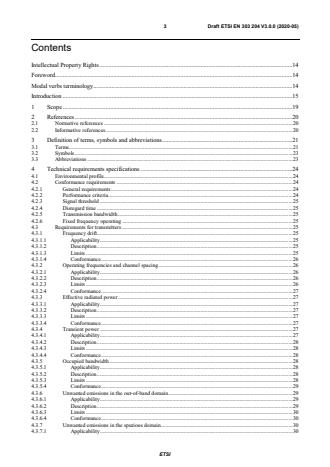
3 Draft ETSI EN 303 204 V3.0.0 (2020-05)
Contents
Intellectual Property Rights . 14
Foreword . 14
Modal verbs terminology . 14
Introduction . 15
1 Scope . 19
2 References . 20
2.1 Normative references . 20
2.2 Informative references . 20
3 Definition of terms, symbols and abbreviations . 21
3.1 Terms . 21
3.2 Symbols . 23
3.3 Abbreviations . 23
4 Technical requirements specifications . 24
4.1 Environmental profile . 24
4.2 Conformance requirements . 24
4.2.1 General requirements . 24
4.2.2 Performance criteria . 24
4.2.3 Signal threshold . 25
4.2.4 Disregard time . 25
4.2.5 Transmission bandwidth . 25
4.2.6 Fixed frequency operating . 25
4.3 Requirements for transmitters . 25
4.3.1 Frequency drift . 25
4.3.1.1 Applicability. 25
4.3.1.2 Description . 25
4.3.1.3 Limits . 25
4.3.1.4 Conformance . 26
4.3.2 Operating frequencies and channel spacing . 26
4.3.2.1 Applicability. 26
4.3.2.2 Description . 26
4.3.2.3 Limits . 26
4.3.2.4 Conformance . 27
4.3.3 Effective radiated power . 27
4.3.3.1 Applicability. 27
4.3.3.2 Description . 27
4.3.3.3 Limits . 27
4.3.3.4 Conformance . 27
4.3.4 Transient power . 27
4.3.4.1 Applicability. 27
4.3.4.2 Description . 28
4.3.4.3 Limits . 28
4.3.4.4 Conformance . 28
4.3.5 Occupied bandwidth . 28
4.3.5.1 Applicability. 28
4.3.5.2 Description . 28
4.3.5.3 Limits . 28
4.3.5.4 Conformance . 29
4.3.6 Unwanted emissions in the out-of-band domain . 29
4.3.6.1 Applicability. 29
4.3.6.2 Description . 29
4.3.6.3 Limits . 30
4.3.6.4 Conformance . 30
4.3.7 Unwanted emissions in the spurious domain . 30
4.3.7.1 Applicability. 30
ETSI
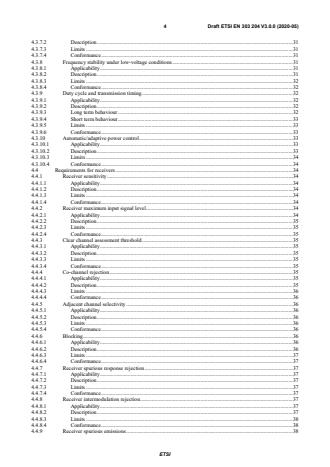
4 Draft ETSI EN 303 204 V3.0.0 (2020-05)
4.3.7.2 Description . 31
4.3.7.3 Limits . 31
4.3.7.4 Conformance . 31
4.3.8 Frequency stability under low-voltage conditions . 31
4.3.8.1 Applicability. 31
4.3.8.2 Description . 31
4.3.8.3 Limits . 32
4.3.8.4 Conformance . 32
4.3.9 Duty cycle and transmission timing . 32
4.3.9.1 Applicability. 32
4.3.9.2 Description . 32
4.3.9.3 Long term behaviour . 32
4.3.9.4 Short term behaviour . 33
4.3.9.5 Limits . 33
4.3.9.6 Conformance . 33
4.3.10 Automatic/adaptive power control . 33
4.3.10.1 Applicability. 33
4.3.10.2 Description . 33
4.3.10.3 Limits . 34
4.3.10.4 Conformance . 34
4.4 Requirements for receivers . 34
4.4.1 Receiver sensitivity . 34
4.4.1.1 Applicability. 34
4.4.1.2 Description . 34
4.4.1.3 Limits . 34
4.4.1.4 Conformance . 34
4.4.2 Receiver maximum input signal level . 34
4.4.2.1 Applicability. 34
4.4.2.2 Description . 35
4.4.2.3 Limits . 35
4.4.2.4 Conformance . 35
4.4.3 Clear channel assessment threshold . 35
4.4.3.1 Applicability. 35
4.4.3.2 Description . 35
4.4.3.3 Limits . 35
4.4.3.4 Conformance . 35
4.4.4 Co-channel rejection . 35
4.4.4.1 Applicability. 35
4.4.4.2 Description . 35
4.4.4.3 Limits . 36
4.4.4.4 Conformance . 36
4.4.5 Adjacent channel selectivity . 36
4.4.5.1 Applicability. 36
4.4.5.2 Description . 36
4.4.5.3 Limits . 36
4.4.5.4 Conformance . 36
4.4.6 Blocking . 36
4.4.6.1 Applicability. 36
4.4.6.2 Description . 36
4.4.6.3 Limits . 37
4.4.6.4 Conformance . 37
4.4.7 Receiver spurious response rejection . 37
4.4.7.1 Applicability. 37
4.4.7.2 Description . 37
4.4.7.3 Limits . 37
4.4.7.4 Conformance . 37
4.4.8 Receiver intermodulation rejection . 37
4.4.8.1 Applicability. 37
4.4.8.2 Description . 37
4.4.8.3 Limits . 38
4.4.8.4 Conformance . 38
4.4.9 Receiver spurious emissions . 38
ETSI
5 Draft ETSI EN 303 204 V3.0.0 (2020-05)
4.4.9.1 Applicability. 38
4.4.9.2 Description . 38
4.4.9.3 Limits . 38
4.4.9.4 Conformance . 38
4.5 Requirements for polite spectrum access . 38
4.5.1 Listen before talk . 38
4.5.1.1 Applicability. 38
4.5.1.2 Description . 38
4.5.1.3 Limits . 39
4.5.1.4 Conformance . 39
4.5.2 Short control signalling transmissions . 39
4.5.2.1 Applicability. 39
4.5.2.2 Description . 39
4.5.2.3 Limits . 40
4.5.2.4 Conformance . 41
4.6 Functional requirements . 41
4.6.1 General considerations . 41
4.6.2 Network access point . 41
4.6.2.1 Applicability. 41
4.6.2.2 Description . 41
4.6.2.3 Limits . 41
4.6.2.4 Conformance . 41
5 Testing for compliance with technical requirements . 42
5.1 Environmental conditions for testing . 42
5.2 General conditions for testing . 42
5.2.1 General considerations . 42
5.2.2 Presentation of equipment for testing purposes . 42
5.2.2.1 General Considerations . 42
5.2.2.2 Choice of model for testing . 42
5.2.2.2.1 General considerations . 42
5.2.2.2.2 EUT with an external RF connector . 42
5.2.2.2.3 EUT without an external RF connector . 43
5.2.2.3 Testing of modular equipment . 43
5.2.2.4 Transmitter shut-off facility . 43
5.2.2.5 Battery saving circuit . 43
5.2.2.6 Test power source . 44
5.2.2.6.1 General considerations . 44
5.2.2.6.2 External test power source . 44
5.2.2.6.3 Internal test power source . 44
5.2.3 Normal and extreme test conditions. 44
5.2.3.1 Normal temperature and humidity . 44
5.2.3.2 Extreme temperatures . 44
5.2.3.2.1 Procedure for tests at extreme temperatures . 44
5.2.3.2.2 Procedure for equipment designed for continuous operation . 45
5.2.3.2.3 Procedure for equipment designed for intermittent operation . 45
5.2.3.2.4 Extreme temperature ranges . 45
5.2.3.3 Normal test power source . 45
5.2.3.3.1 Mains voltage . 45
5.2.3.3.2 Regulated lead-acid battery power sources . 45
5.2.3.3.3 Other power sources . 46
5.2.3.4 Extreme test source voltages . 46
5.2.3.4.1 Mains voltage . 46
5.2.3.4.2 Regulated lead-acid battery power sources . 46
5.2.3.4.3 Power sources using other types of batteries . 46
5.2.3.4.4 Other power sources . 46
5.2.4 Conducted measurements . 46
5.2.4.1 Artificial antenna . 46
5.2.4.2 Voltage Standing Wave Ratio (VSWR) . 46
5.2.5 Radiated measurements . 47
5.2.6 Measuring receiver . 47
5.2.6.1 General considerations . 47
ETSI
6 Draft ETSI EN 303 204 V3.0.0 (2020-05)
5.2.6.2 Reference Bandwidth . 47
5.2.7 Transmitter test signals . 48
5.2.8 Applicable measurement methods . 48
5.2.9 Modes of operation . 49
5.2.9.1 Test mode . 49
5.2.9.2 Transmitter operation . 49
5.2.9.3 Testing of multi-frequency or channel agile equipment . 50
5.2.9.4 Non-uniform maximum transmit power . 50
5.3 Conformance methods of measurement for transmitters . 50
5.3.1 Frequency drift . 50
5.3.1.1 Test conditions . 50
5.3.1.2 Measurement procedure . 51
5.3.2 Operating frequencies . 52
5.3.2.1 Test conditions . 52
5.3.2.2 Measurement procedure . 52
5.3.3 Effective radiated power . 53
5.3.3.1 Test conditions . 53
5.3.3.2 Radiated measurement procedure . 53
5.3.3.3 Conducted measurement procedure . 55
5.3.4 Transient power . 55
5.3.4.1 Test conditions . 55
5.3.4.2 Measurement procedure . 56
5.3.5 Occupied bandwidth . 57
5.3.5.1 Test conditions . 57
5.3.5.2 Measurement procedure . 57
5.3.6 Unwanted emissions in the out-of-band domain . 59
5.3.6.1 Test conditions . 59
5.3.6.2 Measurement procedure . 60
5.3.7 Unwanted emissions in the spurious domain . 61
5.3.7.1 Test conditions . 61
5.3.7.2 Radiated measurement . 62
5.3.7.3 Cabinet radiation measurement . 62
5.3.7.4 Conducted measurement . 62
5.3.7.5 Measurement procedure . 62
5.3.7.5.1 Conducted measurement. 62
5.3.7.5.2 Radiated measurement . 63
5.3.8 Frequency stability under low-voltage conditions . 64
5.3.8.1 Test conditions . 64
5.3.8.2 Measurement procedure . 64
5.3.9 Duty cycle and transmission timing . 65
5.3.9.1 Long term behaviour . 65
5.3.9.1.1 Test conditions . 65
5.3.9.1.2 Measurement procedure . 65
5.3.9.2 Short term behaviour . 66
5.3.9.2.1 Test conditions . 66
5.3.9.2.2 Measurement procedure . 66
5.3.10 Automatic/adaptive power control . 67
5.3.10.1 Test conditions . 67
5.3.10.2 Measurement procedure . 67
5.4 Conformance test suites for receivers . 68
5.4.1 Receiver sensitivity . 68
5.4.1.1 Test conditions . 68
5.4.1.2 Radiated measurement . 68
5.4.1.3 Conducted measurement . 71
5.4.1.4 Measurement procedure . 71
5.4.2 Receiver maximum input signal level . 72
5.4.2.1 Test conditions . 72
5.4.2.2 Radiated measurement . 72
5.4.2.3 Conducted measurement . 73
5.4.2.4 Measurement procedure . 73
5.4.3 Clear channel assessment threshold . 74
5.4.3.1 Test conditions . 74
ETSI
7 Draft ETSI EN 303 204 V3.0.0 (2020-05)
5.4.3.2 Radiated measurement . 74
5.4.3.3 Conducted measurement . 74
5.4.3.4 Measurement procedure . 75
5.4.4 Co-channel rejection . 76
5.4.4.1 Test conditions . 76
5.4.4.2 Measurement procedure . 76
5.4.5 Adjacent channel selectivity . 77
5.4.5.1 Test conditions . 77
5.4.5.2 Measurement procedure . 77
5.4.6 Blocking and spurious response rejection . 78
5.4.6.1 Test conditions . 78
5.4.6.2 Measurement procedure . 78
5.4.7 Intermodulation rejection . 79
5.4.7.1 Test conditions . 79
5.4.7.2 Radiated measurement procedure . 80
5.4.7.3 Conducted measurement procedure . 81
5.4.7.4 Measurement procedure . 82
5.4.8 Receiver spurious emissions . 82
5.4.8.1 Test conditions . 82
5.4.8.2 Radiated measurement . 83
5.4.8.3 Cabinet radiation measurement . 83
5.4.8.4 Conducted measurement . 83
5.4.8.5 Measurement procedure . 83
5.4.8.5.1 Conducted measurement. 83
5.
...
Final draft ETSI EN 303 204 V3.1.0 (2020-12)
HARMONISED EUROPEAN STANDARD
Fixed Short Range Devices (SRD) in data networks;
Radio equipment to be used in the 870 MHz to 876 MHz
frequency range with power levels
ranging up to 500 mW e.r.p.;
Harmonised Standard for access to the radio spectrum
2 Final draft ETSI EN 303 204 V3.1.0 (2020-12)
Reference
REN/ERM-TG28-555
Keywords
harmonised standard, radio, SRD, testing
ETSI
650 Route des Lucioles
F-06921 Sophia Antipolis Cedex - FRANCE
Tel.: +33 4 92 94 42 00 Fax: +33 4 93 65 47 16
Siret N° 348 623 562 00017 - NAF 742 C
Association à but non lucratif enregistrée à la
Sous-Préfecture de Grasse (06) N° 7803/88
Important notice
The present document can be downloaded from:
http://www.etsi.org/standards-search
The present document may be made available in electronic versions and/or in print. The content of any electronic and/or
print versions of the present document shall not be modified without the prior written authorization of ETSI. In case of any
existing or perceived difference in contents between such versions and/or in print, the prevailing version of an ETSI
deliverable is the one made publicly available in PDF format at www.etsi.org/deliver.
Users of the present document should be aware that the document may be subject to revision or change of status.
Information on the current status of this and other ETSI documents is available at
https://portal.etsi.org/TB/ETSIDeliverableStatus.aspx
If you find errors in the present document, please send your comment to one of the following services:
https://portal.etsi.org/People/CommiteeSupportStaff.aspx
Copyright Notification
No part may be reproduced or utilized in any form or by any means, electronic or mechanical, including photocopying
and microfilm except as authorized by written permission of ETSI.
The content of the PDF version shall not be modified without the written authorization of ETSI.
The copyright and the foregoing restriction extend to reproduction in all media.
© ETSI 2020.
All rights reserved.
DECT™, PLUGTESTS™, UMTS™ and the ETSI logo are trademarks of ETSI registered for the benefit of its Members.
3GPP™ and LTE™ are trademarks of ETSI registered for the benefit of its Members and
of the 3GPP Organizational Partners.
oneM2M™ logo is a trademark of ETSI registered for the benefit of its Members and
of the oneM2M Partners. ®
GSM and the GSM logo are trademarks registered and owned by the GSM Association.
ETSI
3 Final draft ETSI EN 303 204 V3.1.0 (2020-12)
Contents
Intellectual Property Rights . 14
Foreword . 14
Modal verbs terminology . 14
Introduction . 15
1 Scope . 19
2 References . 20
2.1 Normative references . 20
2.2 Informative references . 20
3 Definition of terms, symbols and abbreviations . 21
3.1 Terms . 21
3.2 Symbols . 23
3.3 Abbreviations . 23
4 Technical requirements specifications . 24
4.1 Environmental profile . 24
4.2 Conformance requirements . 24
4.2.1 General requirements . 24
4.2.2 Performance criteria . 24
4.2.3 Signal threshold . 25
4.2.4 Disregard time . 25
4.2.5 Transmission bandwidth . 25
4.2.6 Fixed frequency operating . 25
4.3 Requirements for transmitters . 25
4.3.1 Frequency drift . 25
4.3.1.1 Applicability. 25
4.3.1.2 Description . 25
4.3.1.3 Limits . 25
4.3.1.4 Conformance . 26
4.3.2 Operating frequencies and channel spacing . 26
4.3.2.1 Applicability. 26
4.3.2.2 Description . 26
4.3.2.3 Limits . 26
4.3.2.4 Conformance . 27
4.3.3 Effective radiated power . 27
4.3.3.1 Applicability. 27
4.3.3.2 Description . 27
4.3.3.3 Limits . 27
4.3.3.4 Conformance . 27
4.3.4 Transient power . 28
4.3.4.1 Applicability. 28
4.3.4.2 Description . 28
4.3.4.3 Limits . 28
4.3.4.4 Conformance . 28
4.3.5 Occupied bandwidth . 28
4.3.5.1 Applicability. 28
4.3.5.2 Description . 28
4.3.5.3 Limits . 28
4.3.5.4 Conformance . 29
4.3.6 Unwanted emissions in the out-of-band domain . 29
4.3.6.1 Applicability. 29
4.3.6.2 Description . 29
4.3.6.3 Limits . 30
4.3.6.4 Conformance . 30
4.3.7 Unwanted emissions in the spurious domain . 30
4.3.7.1 Applicability. 30
ETSI
4 Final draft ETSI EN 303 204 V3.1.0 (2020-12)
4.3.7.2 Description . 31
4.3.7.3 Limits . 31
4.3.7.4 Conformance . 31
4.3.8 Frequency stability under low-voltage conditions . 31
4.3.8.1 Applicability. 31
4.3.8.2 Description . 31
4.3.8.3 Limits . 32
4.3.8.4 Conformance . 32
4.3.9 Duty cycle and transmission timing . 32
4.3.9.1 Applicability. 32
4.3.9.2 Description . 32
4.3.9.3 Long term behaviour . 32
4.3.9.4 Short term behaviour . 33
4.3.9.5 Limits . 33
4.3.9.6 Conformance . 33
4.3.10 Automatic/adaptive power control . 33
4.3.10.1 Applicability. 33
4.3.10.2 Description . 33
4.3.10.3 Limits . 34
4.3.10.4 Conformance . 34
4.4 Requirements for receivers . 34
4.4.1 Receiver sensitivity . 34
4.4.1.1 Applicability. 34
4.4.1.2 Description . 34
4.4.1.3 Limits . 34
4.4.1.4 Conformance . 34
4.4.2 Receiver maximum input signal level . 34
4.4.2.1 Applicability. 34
4.4.2.2 Description . 35
4.4.2.3 Limits . 35
4.4.2.4 Conformance . 35
4.4.3 Clear channel assessment threshold . 35
4.4.3.1 Applicability. 35
4.4.3.2 Description . 35
4.4.3.3 Limits . 35
4.4.3.4 Conformance . 35
4.4.4 Co-channel rejection . 35
4.4.4.1 Applicability. 35
4.4.4.2 Description . 35
4.4.4.3 Limits . 36
4.4.4.4 Conformance . 36
4.4.5 Adjacent channel selectivity . 36
4.4.5.1 Applicability. 36
4.4.5.2 Description . 36
4.4.5.3 Limits . 36
4.4.5.4 Conformance . 36
4.4.6 Blocking . 36
4.4.6.1 Applicability. 36
4.4.6.2 Description . 36
4.4.6.3 Limits . 37
4.4.6.4 Conformance . 37
4.4.7 Receiver spurious response rejection . 37
4.4.7.1 Applicability. 37
4.4.7.2 Description . 37
4.4.7.3 Limits . 37
4.4.7.4 Conformance . 37
4.4.8 Receiver intermodulation rejection . 37
4.4.8.1 Applicability. 37
4.4.8.2 Description . 37
4.4.8.3 Limits . 38
4.4.8.4 Conformance . 38
4.4.9 Receiver spurious emissions . 38
ETSI
5 Final draft ETSI EN 303 204 V3.1.0 (2020-12)
4.4.9.1 Applicability. 38
4.4.9.2 Description . 38
4.4.9.3 Limits . 38
4.4.9.4 Conformance . 38
4.5 Requirements for polite spectrum access . 38
4.5.1 Listen before talk . 38
4.5.1.1 Applicability. 38
4.5.1.2 Description . 38
4.5.1.3 Limits . 39
4.5.1.4 Conformance . 39
4.5.2 Short control signalling transmissions . 39
4.5.2.1 Applicability. 39
4.5.2.2 Description . 39
4.5.2.3 Limits . 40
4.5.2.4 Conformance . 41
4.6 Functional requirements . 41
4.6.1 General considerations . 41
4.6.2 Network access point . 41
4.6.2.1 Applicability. 41
4.6.2.2 Description . 41
4.6.2.3 Limits . 41
4.6.2.4 Conformance . 41
5 Testing for compliance with technical requirements . 42
5.1 Environmental conditions for testing . 42
5.2 General conditions for testing . 42
5.2.1 General considerations . 42
5.2.2 Presentation of equipment for testing purposes . 42
5.2.2.1 General Considerations . 42
5.2.2.2 Choice of model for testing . 42
5.2.2.2.1 General considerations . 42
5.2.2.2.2 EUT with an external RF connector . 42
5.2.2.2.3 EUT without an external RF connector . 43
5.2.2.3 Testing of modular equipment . 43
5.2.2.4 Transmitter shut-off facility . 43
5.2.2.5 Battery saving circuit . 43
5.2.2.6 Test power source . 44
5.2.2.6.1 General considerations . 44
5.2.2.6.2 External test power source . 44
5.2.2.6.3 Internal test power source . 44
5.2.3 Normal and extreme test conditions. 44
5.2.3.1 Normal temperature and humidity . 44
5.2.3.2 Extreme temperatures . 44
5.2.3.2.1 Procedure for tests at extreme temperatures . 44
5.2.3.2.2 Procedure for equipment designed for continuous operation . 45
5.2.3.2.3 Procedure for equipment designed for intermittent operation . 45
5.2.3.2.4 Extreme temperature ranges . 45
5.2.3.3 Normal test power source . 45
5.2.3.3.1 Mains voltage . 45
5.2.3.3.2 Regulated lead-acid battery power sources . 45
5.2.3.3.3 Other power sources . 45
5.2.3.4 Extreme test source voltages . 46
5.2.3.4.1 Mains voltage . 46
5.2.3.4.2 Regulated lead-acid battery power sources . 46
5.2.3.4.3 Power sources using other types of batteries . 46
5.2.3.4.4 Other power sources . 46
5.2.4 Conducted measurements . 46
5.2.4.1 Artificial antenna . 46
5.2.4.2 Voltage Standing Wave Ratio (VSWR) . 46
5.2.5 Radiated measurements . 46
5.2.6 Measuring receiver . 47
5.2.6.1 General considerations . 47
ETSI
6 Final draft ETSI EN 303 204 V3.1.0 (2020-12)
5.2.6.2 Reference Bandwidth . 47
5.2.7 Transmitter test signals . 47
5.2.8 Applicable measurement methods . 48
5.2.9 Modes of operation . 49
5.2.9.1 Test mode . 49
5.2.9.2 Transmitter operation . 49
5.2.9.3 Testing of multi-frequency or channel agile equipment . 50
5.2.9.4 Non-uniform maximum transmit power . 50
5.3 Conformance methods of measurement for transmitters . 50
5.3.1 Frequency drift . 50
5.3.1.1 Test conditions . 50
5.3.1.2 Measurement procedure . 51
5.3.2 Operating frequencies . 52
5.3.2.1 Test conditions . 52
5.3.2.2 Measurement procedure . 52
5.3.3 Effective radiated power . 53
5.3.3.1 Test conditions . 53
5.3.3.2 Radiated measurement procedure . 53
5.3.3.3 Conducted measurement procedure . 55
5.3.4 Transient power . 55
5.3.4.1 Test conditions . 55
5.3.4.2 Measurement procedure . 56
5.3.5 Occupied bandwidth . 57
5.3.5.1 Test conditions . 57
5.3.5.2 Measurement procedure . 57
5.3.6 Unwanted emissions in the out-of-band domain . 59
5.3.6.1 Test conditions . 59
5.3.6.2 Measurement procedure . 60
5.3.7 Unwanted emissions in the spurious domain . 61
5.3.7.1 Test conditions . 61
5.3.7.2 Radiated measurement . 62
5.3.7.3 Cabinet radiation measurement . 62
5.3.7.4 Conducted measurement . 62
5.3.7.5 Measurement procedure . 62
5.3.7.5.1 Conducted measurement. 62
5.3.7.5.2 Radiated measurement . 63
5.3.8 Frequency stability under low-voltage conditions . 64
5.3.8.1 Test conditions . 64
5.3.8.2 Measurement procedure . 64
5.3.9 Duty cycle and transmission timing . 65
5.3.9.1 Long term behaviour . 65
5.3.9.1.1 Test conditions . 65
5.3.9.1.2 Measurement procedure . 65
5.3.9.2 Short term behaviour . 66
5.3.9.2.1 Test conditions . 66
5.3.9.2.2 Measurement procedure . 66
5.3.10 Automatic/adaptive power control . 67
5.3.10.1 Test conditions . 67
5.3.10.2 Conducted measurement procedure . 67
5.3.10.3 Radiated measurement procedure . 68
5.3.10.4 Measurement procedure . 68
5.4 Conformance test suites for receivers . 69
5.4.1 Receiver sensitivity . 69
5.4.1.1 Test conditions . 69
5.4.1.2 Radiated measurement . 69
5.4.1.3 Conducted measurement . 72
5.4.1.4 Measurement procedure . 72
5.4.2 Receiver maximum input signal level . 73
5.4.2.1 Test conditions . 73
5.4.2.2 Radiated measurement . 73
5.4.2.3 Conducted measurement . 73
5.4.2.4 Measurement procedure . 74
ETSI
7 Final draft ETSI EN 303 204 V3.1.0 (2020-12)
5.4.3 Clear channel assessment threshold . 74
5.4.3.1 Test conditions . 74
5.4.3.2 Radiated measurement . 75
5.4.3.3 Conducted measurement . 75
5.4.3.4 Measurement procedure . 76
5.4.4 Co-channel rejection . 77
5.4.4.1 Test conditions . 77
5.4.4.2 Measurement procedure . 77
5.4.5 Adjacent channel selectivity . 78
5.4.5.1 Test conditions . 78
5.4.5.2 Measurement procedure . 78
5.4.6 Blocking and spurious response rejection . 79
5.4.6.1 Test conditions . 79
5.4.6.2 Measurement procedure . 79
5.4.7 Intermodulation rejection . 80
5.4.7.1 Test conditions . 80
5.4.7.2 Radiated measurement procedure . 81
5.4.7.3 Conducted measurement procedure . 82
5.4.7.4 Measurement procedure . 83
5.4.8 Receiver spurious emissions . 83
5.4.8.1 Test conditions . 83
5.4.8.2 Radiated measurement . 84
5.4.8.3 Cabinet radiation measurement . 84
5.4.8.4 Conducted measurement .
...
HARMONISED EUROPEAN STANDARD
Fixed Short Range Devices (SRD) in data networks;
Radio equipment to be used in the 870 MHz to 876 MHz
frequency range with power levels
ranging up to 500 mW e.r.p.;
Harmonised Standard for access to the radio spectrum
2 ETSI EN 303 204 V3.1.1 (2021-03)
Reference
REN/ERM-TG28-555
Keywords
harmonised standard, radio, SRD, testing
ETSI
650 Route des Lucioles
F-06921 Sophia Antipolis Cedex - FRANCE
Tel.: +33 4 92 94 42 00 Fax: +33 4 93 65 47 16
Siret N° 348 623 562 00017 - NAF 742 C
Association à but non lucratif enregistrée à la
Sous-Préfecture de Grasse (06) N° 7803/88
Important notice
The present document can be downloaded from:
http://www.etsi.org/standards-search
The present document may be made available in electronic versions and/or in print. The content of any electronic and/or
print versions of the present document shall not be modified without the prior written authorization of ETSI. In case of any
existing or perceived difference in contents between such versions and/or in print, the prevailing version of an ETSI
deliverable is the one made publicly available in PDF format at www.etsi.org/deliver.
Users of the present document should be aware that the document may be subject to revision or change of status.
Information on the current status of this and other ETSI documents is available at
https://portal.etsi.org/TB/ETSIDeliverableStatus.aspx
If you find errors in the present document, please send your comment to one of the following services:
https://portal.etsi.org/People/CommiteeSupportStaff.aspx
Copyright Notification
No part may be reproduced or utilized in any form or by any means, electronic or mechanical, including photocopying
and microfilm except as authorized by written permission of ETSI.
The content of the PDF version shall not be modified without the written authorization of ETSI.
The copyright and the foregoing restriction extend to reproduction in all media.
© ETSI 2021.
All rights reserved.
DECT™, PLUGTESTS™, UMTS™ and the ETSI logo are trademarks of ETSI registered for the benefit of its Members.
3GPP™ and LTE™ are trademarks of ETSI registered for the benefit of its Members and
of the 3GPP Organizational Partners.
oneM2M™ logo is a trademark of ETSI registered for the benefit of its Members and
of the oneM2M Partners. ®
GSM and the GSM logo are trademarks registered and owned by the GSM Association.
ETSI
3 ETSI EN 303 204 V3.1.1 (2021-03)
Contents
Intellectual Property Rights . 14
Foreword . 14
Modal verbs terminology . 14
Introduction . 15
1 Scope . 19
2 References . 20
2.1 Normative references . 20
2.2 Informative references . 20
3 Definition of terms, symbols and abbreviations . 21
3.1 Terms . 21
3.2 Symbols . 23
3.3 Abbreviations . 23
4 Technical requirements specifications . 24
4.1 Environmental profile . 24
4.2 Conformance requirements . 24
4.2.1 General requirements . 24
4.2.2 Performance criteria . 24
4.2.3 Signal threshold . 25
4.2.4 Disregard time . 25
4.2.5 Transmission bandwidth . 25
4.2.6 Fixed frequency operating . 25
4.3 Requirements for transmitters . 25
4.3.1 Frequency drift . 25
4.3.1.1 Applicability. 25
4.3.1.2 Description . 25
4.3.1.3 Limits . 25
4.3.1.4 Conformance . 26
4.3.2 Operating frequencies and channel spacing . 26
4.3.2.1 Applicability. 26
4.3.2.2 Description . 26
4.3.2.3 Limits . 26
4.3.2.4 Conformance . 27
4.3.3 Effective radiated power . 27
4.3.3.1 Applicability. 27
4.3.3.2 Description . 27
4.3.3.3 Limits . 27
4.3.3.4 Conformance . 27
4.3.4 Transient power . 28
4.3.4.1 Applicability. 28
4.3.4.2 Description . 28
4.3.4.3 Limits . 28
4.3.4.4 Conformance . 28
4.3.5 Occupied bandwidth . 28
4.3.5.1 Applicability. 28
4.3.5.2 Description . 28
4.3.5.3 Limits . 28
4.3.5.4 Conformance . 29
4.3.6 Unwanted emissions in the out-of-band domain . 29
4.3.6.1 Applicability. 29
4.3.6.2 Description . 29
4.3.6.3 Limits . 30
4.3.6.4 Conformance . 30
4.3.7 Unwanted emissions in the spurious domain . 30
4.3.7.1 Applicability. 30
ETSI
4 ETSI EN 303 204 V3.1.1 (2021-03)
4.3.7.2 Description . 31
4.3.7.3 Limits . 31
4.3.7.4 Conformance . 31
4.3.8 Frequency stability under low-voltage conditions . 31
4.3.8.1 Applicability. 31
4.3.8.2 Description . 31
4.3.8.3 Limits . 32
4.3.8.4 Conformance . 32
4.3.9 Duty cycle and transmission timing . 32
4.3.9.1 Applicability. 32
4.3.9.2 Description . 32
4.3.9.3 Long term behaviour . 32
4.3.9.4 Short term behaviour . 33
4.3.9.5 Limits . 33
4.3.9.6 Conformance . 33
4.3.10 Automatic/adaptive power control . 33
4.3.10.1 Applicability. 33
4.3.10.2 Description . 33
4.3.10.3 Limits . 34
4.3.10.4 Conformance . 34
4.4 Requirements for receivers . 34
4.4.1 Receiver sensitivity . 34
4.4.1.1 Applicability. 34
4.4.1.2 Description . 34
4.4.1.3 Limits . 34
4.4.1.4 Conformance . 34
4.4.2 Receiver maximum input signal level . 34
4.4.2.1 Applicability. 34
4.4.2.2 Description . 35
4.4.2.3 Limits . 35
4.4.2.4 Conformance . 35
4.4.3 Clear channel assessment threshold . 35
4.4.3.1 Applicability. 35
4.4.3.2 Description . 35
4.4.3.3 Limits . 35
4.4.3.4 Conformance . 35
4.4.4 Co-channel rejection . 35
4.4.4.1 Applicability. 35
4.4.4.2 Description . 35
4.4.4.3 Limits . 36
4.4.4.4 Conformance . 36
4.4.5 Adjacent channel selectivity . 36
4.4.5.1 Applicability. 36
4.4.5.2 Description . 36
4.4.5.3 Limits . 36
4.4.5.4 Conformance . 36
4.4.6 Blocking . 36
4.4.6.1 Applicability. 36
4.4.6.2 Description . 36
4.4.6.3 Limits . 37
4.4.6.4 Conformance . 37
4.4.7 Receiver spurious response rejection . 37
4.4.7.1 Applicability. 37
4.4.7.2 Description . 37
4.4.7.3 Limits . 37
4.4.7.4 Conformance . 37
4.4.8 Receiver intermodulation rejection . 37
4.4.8.1 Applicability. 37
4.4.8.2 Description . 37
4.4.8.3 Limits . 38
4.4.8.4 Conformance . 38
4.4.9 Receiver spurious emissions . 38
ETSI
5 ETSI EN 303 204 V3.1.1 (2021-03)
4.4.9.1 Applicability. 38
4.4.9.2 Description . 38
4.4.9.3 Limits . 38
4.4.9.4 Conformance . 38
4.5 Requirements for polite spectrum access . 38
4.5.1 Listen before talk . 38
4.5.1.1 Applicability. 38
4.5.1.2 Description . 38
4.5.1.3 Limits . 39
4.5.1.4 Conformance . 39
4.5.2 Short control signalling transmissions . 39
4.5.2.1 Applicability. 39
4.5.2.2 Description . 39
4.5.2.3 Limits . 40
4.5.2.4 Conformance . 41
4.6 Functional requirements . 41
4.6.1 General considerations . 41
4.6.2 Network access point . 41
4.6.2.1 Applicability. 41
4.6.2.2 Description . 41
4.6.2.3 Limits . 41
4.6.2.4 Conformance . 41
5 Testing for compliance with technical requirements . 42
5.1 Environmental conditions for testing . 42
5.2 General conditions for testing . 42
5.2.1 General considerations . 42
5.2.2 Presentation of equipment for testing purposes . 42
5.2.2.1 General Considerations . 42
5.2.2.2 Choice of model for testing . 42
5.2.2.2.1 General considerations . 42
5.2.2.2.2 EUT with an external RF connector . 42
5.2.2.2.3 EUT without an external RF connector . 43
5.2.2.3 Testing of modular equipment . 43
5.2.2.4 Transmitter shut-off facility . 43
5.2.2.5 Battery saving circuit . 43
5.2.2.6 Test power source . 44
5.2.2.6.1 General considerations . 44
5.2.2.6.2 External test power source . 44
5.2.2.6.3 Internal test power source . 44
5.2.3 Normal and extreme test conditions. 44
5.2.3.1 Normal temperature and humidity . 44
5.2.3.2 Extreme temperatures . 44
5.2.3.2.1 Procedure for tests at extreme temperatures . 44
5.2.3.2.2 Procedure for equipment designed for continuous operation . 45
5.2.3.2.3 Procedure for equipment designed for intermittent operation . 45
5.2.3.2.4 Extreme temperature ranges . 45
5.2.3.3 Normal test power source . 45
5.2.3.3.1 Mains voltage . 45
5.2.3.3.2 Regulated lead-acid battery power sources . 45
5.2.3.3.3 Other power sources . 45
5.2.3.4 Extreme test source voltages . 46
5.2.3.4.1 Mains voltage . 46
5.2.3.4.2 Regulated lead-acid battery power sources . 46
5.2.3.4.3 Power sources using other types of batteries . 46
5.2.3.4.4 Other power sources . 46
5.2.4 Conducted measurements . 46
5.2.4.1 Artificial antenna . 46
5.2.4.2 Voltage Standing Wave Ratio (VSWR) . 46
5.2.5 Radiated measurements . 46
5.2.6 Measuring receiver . 47
5.2.6.1 General considerations . 47
ETSI
6 ETSI EN 303 204 V3.1.1 (2021-03)
5.2.6.2 Reference Bandwidth . 47
5.2.7 Transmitter test signals . 47
5.2.8 Applicable measurement methods . 48
5.2.9 Modes of operation . 49
5.2.9.1 Test mode . 49
5.2.9.2 Transmitter operation . 49
5.2.9.3 Testing of multi-frequency or channel agile equipment . 50
5.2.9.4 Non-uniform maximum transmit power . 50
5.3 Conformance methods of measurement for transmitters . 50
5.3.1 Frequency drift . 50
5.3.1.1 Test conditions . 50
5.3.1.2 Measurement procedure . 51
5.3.2 Operating frequencies . 52
5.3.2.1 Test conditions . 52
5.3.2.2 Measurement procedure . 52
5.3.3 Effective radiated power . 53
5.3.3.1 Test conditions . 53
5.3.3.2 Radiated measurement procedure . 53
5.3.3.3 Conducted measurement procedure . 55
5.3.4 Transient power . 55
5.3.4.1 Test conditions . 55
5.3.4.2 Measurement procedure . 56
5.3.5 Occupied bandwidth . 57
5.3.5.1 Test conditions . 57
5.3.5.2 Measurement procedure . 57
5.3.6 Unwanted emissions in the out-of-band domain . 59
5.3.6.1 Test conditions . 59
5.3.6.2 Measurement procedure . 60
5.3.7 Unwanted emissions in the spurious domain . 61
5.3.7.1 Test conditions . 61
5.3.7.2 Radiated measurement . 62
5.3.7.3 Cabinet radiation measurement . 62
5.3.7.4 Conducted measurement . 62
5.3.7.5 Measurement procedure . 62
5.3.7.5.1 Conducted measurement. 62
5.3.7.5.2 Radiated measurement . 63
5.3.8 Frequency stability under low-voltage conditions . 64
5.3.8.1 Test conditions . 64
5.3.8.2 Measurement procedure . 64
5.3.9 Duty cycle and transmission timing . 65
5.3.9.1 Long term behaviour . 65
5.3.9.1.1 Test conditions . 65
5.3.9.1.2 Measurement procedure . 65
5.3.9.2 Short term behaviour . 66
5.3.9.2.1 Test conditions . 66
5.3.9.2.2 Measurement procedure . 66
5.3.10 Automatic/adaptive power control . 67
5.3.10.1 Test conditions . 67
5.3.10.2 Conducted measurement procedure . 67
5.3.10.3 Radiated measurement procedure . 68
5.3.10.4 Measurement procedure . 68
5.4 Conformance test suites for receivers . 69
5.4.1 Receiver sensitivity . 69
5.4.1.1 Test conditions . 69
5.4.1.2 Radiated measurement . 69
5.4.1.3 Conducted measurement . 72
5.4.1.4 Measurement procedure . 72
5.4.2 Receiver maximum input signal level . 73
5.4.2.1 Test conditions . 73
5.4.2.2 Radiated measurement . 73
5.4.2.3 Conducted measurement . 73
5.4.2.4 Measurement procedure . 74
ETSI
7 ETSI EN 303 204 V3.1.1 (2021-03)
5.4.3 Clear channel assessment threshold . 74
5.4.3.1 Test conditions . 74
5.4.3.2 Radiated measurement . 75
5.4.3.3 Conducted measurement . 75
5.4.3.4 Measurement procedure . 76
5.4.4 Co-channel rejection . 77
5.4.4.1 Test conditions . 77
5.4.4.2 Measurement procedure . 77
5.4.5 Adjacent channel selectivity . 78
5.4.5.1 Test conditions . 78
5.4.5.2 Measurement procedure . 78
5.4.6 Blocking and spurious response rejection . 79
5.4.6.1 Test conditions . 79
5.4.6.2 Measurement procedure . 79
5.4.7 Intermodulation rejection . 80
5.4.7.1 Test conditions . 80
5.4.7.2 Radiated measurement procedure . 81
5.4.7.3 Conducted measurement procedure . 82
5.4.7.4 Measurement procedure . 83
5.4.8 Receiver spurious emissions . 83
5.4.8.1 Test conditions . 83
5.4.8.2 Radiated measurement . 84
5.4.8.3 Cabinet radiation measurement . 84
5.4.8.4 Conducted measurement . 84
5.4.8.5 Measurement procedure .
...
SLOVENSKI STANDARD
01-maj-2021
Naprave kratkega dosega (SRD) v podatkovnih omrežjih - Radijska oprema, ki se
uporablja v frekvenčnem območju od 870 MHz do 876 MHz z močnostnimi nivoji
do največ 500 mW e.r.p. - Harmonizirani standard za dostop do radijskega spektra
Fixed Short Range Devices (SRD) in data networks - Radio equipment to be used in the
870 MHz to 876 MHz frequency range with power levels ranging up to 500 mW e.r.p. -
Harmonised Standard for access to the radio spectrum
Ta slovenski standard je istoveten z: ETSI EN 303 204 V3.1.1 (2021-03)
ICS:
33.060.20 Sprejemna in oddajna Receiving and transmitting
oprema equipment
2003-01.Slovenski inštitut za standardizacijo. Razmnoževanje celote ali delov tega standarda ni dovoljeno.
HARMONISED EUROPEAN STANDARD
Fixed Short Range Devices (SRD) in data networks;
Radio equipment to be used in the 870 MHz to 876 MHz
frequency range with power levels
ranging up to 500 mW e.r.p.;
Harmonised Standard for access to the radio spectrum
2 ETSI EN 303 204 V3.1.1 (2021-03)
Reference
REN/ERM-TG28-555
Keywords
harmonised standard, radio, SRD, testing
ETSI
650 Route des Lucioles
F-06921 Sophia Antipolis Cedex - FRANCE
Tel.: +33 4 92 94 42 00 Fax: +33 4 93 65 47 16
Siret N° 348 623 562 00017 - NAF 742 C
Association à but non lucratif enregistrée à la
Sous-Préfecture de Grasse (06) N° 7803/88
Important notice
The present document can be downloaded from:
http://www.etsi.org/standards-search
The present document may be made available in electronic versions and/or in print. The content of any electronic and/or
print versions of the present document shall not be modified without the prior written authorization of ETSI. In case of any
existing or perceived difference in contents between such versions and/or in print, the prevailing version of an ETSI
deliverable is the one made publicly available in PDF format at www.etsi.org/deliver.
Users of the present document should be aware that the document may be subject to revision or change of status.
Information on the current status of this and other ETSI documents is available at
https://portal.etsi.org/TB/ETSIDeliverableStatus.aspx
If you find errors in the present document, please send your comment to one of the following services:
https://portal.etsi.org/People/CommiteeSupportStaff.aspx
Copyright Notification
No part may be reproduced or utilized in any form or by any means, electronic or mechanical, including photocopying
and microfilm except as authorized by written permission of ETSI.
The content of the PDF version shall not be modified without the written authorization of ETSI.
The copyright and the foregoing restriction extend to reproduction in all media.
© ETSI 2021.
All rights reserved.
DECT™, PLUGTESTS™, UMTS™ and the ETSI logo are trademarks of ETSI registered for the benefit of its Members.
3GPP™ and LTE™ are trademarks of ETSI registered for the benefit of its Members and
of the 3GPP Organizational Partners.
oneM2M™ logo is a trademark of ETSI registered for the benefit of its Members and
of the oneM2M Partners. ®
GSM and the GSM logo are trademarks registered and owned by the GSM Association.
ETSI
3 ETSI EN 303 204 V3.1.1 (2021-03)
Contents
Intellectual Property Rights . 14
Foreword . 14
Modal verbs terminology . 14
Introduction . 15
1 Scope . 19
2 References . 20
2.1 Normative references . 20
2.2 Informative references . 20
3 Definition of terms, symbols and abbreviations . 21
3.1 Terms . 21
3.2 Symbols . 23
3.3 Abbreviations . 23
4 Technical requirements specifications . 24
4.1 Environmental profile . 24
4.2 Conformance requirements . 24
4.2.1 General requirements . 24
4.2.2 Performance criteria . 24
4.2.3 Signal threshold . 25
4.2.4 Disregard time . 25
4.2.5 Transmission bandwidth . 25
4.2.6 Fixed frequency operating . 25
4.3 Requirements for transmitters . 25
4.3.1 Frequency drift . 25
4.3.1.1 Applicability. 25
4.3.1.2 Description . 25
4.3.1.3 Limits . 25
4.3.1.4 Conformance . 26
4.3.2 Operating frequencies and channel spacing . 26
4.3.2.1 Applicability. 26
4.3.2.2 Description . 26
4.3.2.3 Limits . 26
4.3.2.4 Conformance . 27
4.3.3 Effective radiated power . 27
4.3.3.1 Applicability. 27
4.3.3.2 Description . 27
4.3.3.3 Limits . 27
4.3.3.4 Conformance . 27
4.3.4 Transient power . 28
4.3.4.1 Applicability. 28
4.3.4.2 Description . 28
4.3.4.3 Limits . 28
4.3.4.4 Conformance . 28
4.3.5 Occupied bandwidth . 28
4.3.5.1 Applicability. 28
4.3.5.2 Description . 28
4.3.5.3 Limits . 28
4.3.5.4 Conformance . 29
4.3.6 Unwanted emissions in the out-of-band domain . 29
4.3.6.1 Applicability. 29
4.3.6.2 Description . 29
4.3.6.3 Limits . 30
4.3.6.4 Conformance . 30
4.3.7 Unwanted emissions in the spurious domain . 30
4.3.7.1 Applicability. 30
ETSI
4 ETSI EN 303 204 V3.1.1 (2021-03)
4.3.7.2 Description . 31
4.3.7.3 Limits . 31
4.3.7.4 Conformance . 31
4.3.8 Frequency stability under low-voltage conditions . 31
4.3.8.1 Applicability. 31
4.3.8.2 Description . 31
4.3.8.3 Limits . 32
4.3.8.4 Conformance . 32
4.3.9 Duty cycle and transmission timing . 32
4.3.9.1 Applicability. 32
4.3.9.2 Description . 32
4.3.9.3 Long term behaviour . 32
4.3.9.4 Short term behaviour . 33
4.3.9.5 Limits . 33
4.3.9.6 Conformance . 33
4.3.10 Automatic/adaptive power control . 33
4.3.10.1 Applicability. 33
4.3.10.2 Description . 33
4.3.10.3 Limits . 34
4.3.10.4 Conformance . 34
4.4 Requirements for receivers . 34
4.4.1 Receiver sensitivity . 34
4.4.1.1 Applicability. 34
4.4.1.2 Description . 34
4.4.1.3 Limits . 34
4.4.1.4 Conformance . 34
4.4.2 Receiver maximum input signal level . 34
4.4.2.1 Applicability. 34
4.4.2.2 Description . 35
4.4.2.3 Limits . 35
4.4.2.4 Conformance . 35
4.4.3 Clear channel assessment threshold . 35
4.4.3.1 Applicability. 35
4.4.3.2 Description . 35
4.4.3.3 Limits . 35
4.4.3.4 Conformance . 35
4.4.4 Co-channel rejection . 35
4.4.4.1 Applicability. 35
4.4.4.2 Description . 35
4.4.4.3 Limits . 36
4.4.4.4 Conformance . 36
4.4.5 Adjacent channel selectivity . 36
4.4.5.1 Applicability. 36
4.4.5.2 Description . 36
4.4.5.3 Limits . 36
4.4.5.4 Conformance . 36
4.4.6 Blocking . 36
4.4.6.1 Applicability. 36
4.4.6.2 Description . 36
4.4.6.3 Limits . 37
4.4.6.4 Conformance . 37
4.4.7 Receiver spurious response rejection . 37
4.4.7.1 Applicability. 37
4.4.7.2 Description . 37
4.4.7.3 Limits . 37
4.4.7.4 Conformance . 37
4.4.8 Receiver intermodulation rejection . 37
4.4.8.1 Applicability. 37
4.4.8.2 Description . 37
4.4.8.3 Limits . 38
4.4.8.4 Conformance . 38
4.4.9 Receiver spurious emissions . 38
ETSI
5 ETSI EN 303 204 V3.1.1 (2021-03)
4.4.9.1 Applicability. 38
4.4.9.2 Description . 38
4.4.9.3 Limits . 38
4.4.9.4 Conformance . 38
4.5 Requirements for polite spectrum access . 38
4.5.1 Listen before talk . 38
4.5.1.1 Applicability. 38
4.5.1.2 Description . 38
4.5.1.3 Limits . 39
4.5.1.4 Conformance . 39
4.5.2 Short control signalling transmissions . 39
4.5.2.1 Applicability. 39
4.5.2.2 Description . 39
4.5.2.3 Limits . 40
4.5.2.4 Conformance . 41
4.6 Functional requirements . 41
4.6.1 General considerations . 41
4.6.2 Network access point . 41
4.6.2.1 Applicability. 41
4.6.2.2 Description . 41
4.6.2.3 Limits . 41
4.6.2.4 Conformance . 41
5 Testing for compliance with technical requirements . 42
5.1 Environmental conditions for testing . 42
5.2 General conditions for testing . 42
5.2.1 General considerations . 42
5.2.2 Presentation of equipment for testing purposes . 42
5.2.2.1 General Considerations . 42
5.2.2.2 Choice of model for testing . 42
5.2.2.2.1 General considerations . 42
5.2.2.2.2 EUT with an external RF connector . 42
5.2.2.2.3 EUT without an external RF connector . 43
5.2.2.3 Testing of modular equipment . 43
5.2.2.4 Transmitter shut-off facility . 43
5.2.2.5 Battery saving circuit . 43
5.2.2.6 Test power source . 44
5.2.2.6.1 General considerations . 44
5.2.2.6.2 External test power source . 44
5.2.2.6.3 Internal test power source . 44
5.2.3 Normal and extreme test conditions. 44
5.2.3.1 Normal temperature and humidity . 44
5.2.3.2 Extreme temperatures . 44
5.2.3.2.1 Procedure for tests at extreme temperatures . 44
5.2.3.2.2 Procedure for equipment designed for continuous operation . 45
5.2.3.2.3 Procedure for equipment designed for intermittent operation . 45
5.2.3.2.4 Extreme temperature ranges . 45
5.2.3.3 Normal test power source . 45
5.2.3.3.1 Mains voltage . 45
5.2.3.3.2 Regulated lead-acid battery power sources . 45
5.2.3.3.3 Other power sources . 45
5.2.3.4 Extreme test source voltages . 46
5.2.3.4.1 Mains voltage . 46
5.2.3.4.2 Regulated lead-acid battery power sources . 46
5.2.3.4.3 Power sources using other types of batteries . 46
5.2.3.4.4 Other power sources . 46
5.2.4 Conducted measurements . 46
5.2.4.1 Artificial antenna . 46
5.2.4.2 Voltage Standing Wave Ratio (VSWR) . 46
5.2.5 Radiated measurements . 46
5.2.6 Measuring receiver . 47
5.2.6.1 General considerations . 47
ETSI
6 ETSI EN 303 204 V3.1.1 (2021-03)
5.2.6.2 Reference Bandwidth . 47
5.2.7 Transmitter test signals . 47
5.2.8 Applicable measurement methods . 48
5.2.9 Modes of operation . 49
5.2.9.1 Test mode . 49
5.2.9.2 Transmitter operation . 49
5.2.9.3 Testing of multi-frequency or channel agile equipment . 50
5.2.9.4 Non-uniform maximum transmit power . 50
5.3 Conformance methods of measurement for transmitters . 50
5.3.1 Frequency drift . 50
5.3.1.1 Test conditions . 50
5.3.1.2 Measurement procedure . 51
5.3.2 Operating frequencies . 52
5.3.2.1 Test conditions . 52
5.3.2.2 Measurement procedure . 52
5.3.3 Effective radiated power . 53
5.3.3.1 Test conditions . 53
5.3.3.2 Radiated measurement procedure . 53
5.3.3.3 Conducted measurement procedure . 55
5.3.4 Transient power . 55
5.3.4.1 Test conditions . 55
5.3.4.2 Measurement procedure . 56
5.3.5 Occupied bandwidth . 57
5.3.5.1 Test conditions . 57
5.3.5.2 Measurement procedure . 57
5.3.6 Unwanted emissions in the out-of-band domain . 59
5.3.6.1 Test conditions . 59
5.3.6.2 Measurement procedure . 60
5.3.7 Unwanted emissions in the spurious domain . 61
5.3.7.1 Test conditions . 61
5.3.7.2 Radiated measurement . 62
5.3.7.3 Cabinet radiation measurement . 62
5.3.7.4 Conducted measurement . 62
5.3.7.5 Measurement procedure . 62
5.3.7.5.1 Conducted measurement. 62
5.3.7.5.2 Radiated measurement . 63
5.3.8 Frequency stability under low-voltage conditions . 64
5.3.8.1 Test conditions . 64
5.3.8.2 Measurement procedure . 64
5.3.9 Duty cycle and transmission timing . 65
5.3.9.1 Long term behaviour . 65
5.3.9.1.1 Test conditions . 65
5.3.9.1.2 Measurement procedure . 65
5.3.9.2 Short term behaviour . 66
5.3.9.2.1 Test conditions . 66
5.3.9.2.2 Measurement procedure . 66
5.3.10 Automatic/adaptive power control . 67
5.3.10.1 Test conditions . 67
5.3.10.2 Conducted measurement procedure . 67
5.3.10.3 Radiated measurement procedure . 68
5.3.10.4 Measurement procedure . 68
5.4 Conformance test suites for receivers . 69
5.4.1 Receiver sensitivity . 69
5.4.1.1 Test conditions . 69
5.4.1.2 Radiated measurement . 69
5.4.1.3 Conducted measurement . 72
5.4.1.4 Measurement procedure . 72
5.4.2 Receiver maximum input signal level . 73
5.4.2.1 Test conditions . 73
5.4.2.2 Radiated measurement . 73
5.4.2.3 Conducted measurement . 73
5.4.2.4 Measurement procedure . 74
ETSI
7 ETSI EN 303 204 V3.1.1 (2021-03)
5.4.3 Clear channel assessment threshold . 74
5.4.3.1 Test conditions . 74
5.4.3.2 Radiated measurement . 75
5.4.3.3 Conducted measurement . 75
5.4.3.4 Measurement procedure . 76
5.4.4 Co-channel rejection . 77
5.4.4.1 Test conditions . 77
5.4.4.2 Measurement procedure . 77
5.4.5 Adjacent channel selectivity . 78
5.4.5.1 Test conditions . 78
5.4.5.2 Measurement procedure . 78
5.4.6 Blocking and spurious response rejection . 79
5.4.6.1 Test conditions . 79
5.4.6.2 Measurement procedure . 79
5.4.7 Intermodulation rejection . 80
5.4.7.1 Test conditions . 80
5.4.7.2 Radiated measurement procedure .
...