


ETSI EN 319 522-3 V1.2.1 (2024-01)
Electronic Signatures and Infrastructures (ESI); Electronic Registered Delivery Services; Part 3: Formats
Electronic Signatures and Infrastructures (ESI); Electronic Registered Delivery Services; Part 3: Formats
REN/ESI-0019522-3v121
Elektronski podpisi in infrastruktura (ESI) - Storitve elektronske priporočene dostave - 3. del: Formati
Ta dokument določa format semantične vsebine (metapodatki, dokazovanje, prepoznavanje, skupna storitvena infrastruktura), ki se pretaka prek različnih vmesnikov storitev elektronske priporočene dostave (ERDS), kot je opredeljeno v standardu ETSI EN 319 522-2 [1].
General Information
Standards Content (Sample)
Draft ETSI EN 319 522-3 V1.2.0 (2023-10)
EUROPEAN STANDARD
Electronic Signatures and Infrastructures (ESI);
Electronic Registered Delivery Services;
Part 3: Formats
2 Draft ETSI EN 319 522-3 V1.2.0 (2023-10)
Reference
REN/ESI-0019522-3v121
Keywords
e-delivery services, registered e-delivery services,
registered electronic mail
ETSI
650 Route des Lucioles
F-06921 Sophia Antipolis Cedex - FRANCE
Tel.: +33 4 92 94 42 00 Fax: +33 4 93 65 47 16
Siret N° 348 623 562 00017 - APE 7112B
Association à but non lucratif enregistrée à la
Sous-Préfecture de Grasse (06) N° w061004871
Important notice
The present document can be downloaded from:
https://www.etsi.org/standards-search
The present document may be made available in electronic versions and/or in print. The content of any electronic and/or
print versions of the present document shall not be modified without the prior written authorization of ETSI. In case of any
existing or perceived difference in contents between such versions and/or in print, the prevailing version of an ETSI
deliverable is the one made publicly available in PDF format at www.etsi.org/deliver.
Users of the present document should be aware that the document may be subject to revision or change of status.
Information on the current status of this and other ETSI documents is available at
https://portal.etsi.org/TB/ETSIDeliverableStatus.aspx
If you find errors in the present document, please send your comment to one of the following services:
https://portal.etsi.org/People/CommiteeSupportStaff.aspx
If you find a security vulnerability in the present document, please report it through our
Coordinated Vulnerability Disclosure Program:
https://www.etsi.org/standards/coordinated-vulnerability-disclosure
Notice of disclaimer & limitation of liability
The information provided in the present deliverable is directed solely to professionals who have the appropriate degree of
experience to understand and interpret its content in accordance with generally accepted engineering or
other professional standard and applicable regulations.
No recommendation as to products and services or vendors is made or should be implied.
In no event shall ETSI be held liable for loss of profits or any other incidental or consequential damages.
Any software contained in this deliverable is provided "AS IS" with no warranties, express or implied, including but not
limited to, the warranties of merchantability, fitness for a particular purpose and non-infringement of intellectual property
rights and ETSI shall not be held liable in any event for any damages whatsoever (including, without limitation, damages
for loss of profits, business interruption, loss of information, or any other pecuniary loss) arising out of or related to the use
of or inability to use the software.
Copyright Notification
No part may be reproduced or utilized in any form or by any means, electronic or mechanical, including photocopying and
microfilm except as authorized by written permission of ETSI.
The content of the PDF version shall not be modified without the written authorization of ETSI.
The copyright and the foregoing restriction extend to reproduction in all media.
© ETSI 2023.
All rights reserved.
ETSI
3 Draft ETSI EN 319 522-3 V1.2.0 (2023-10)
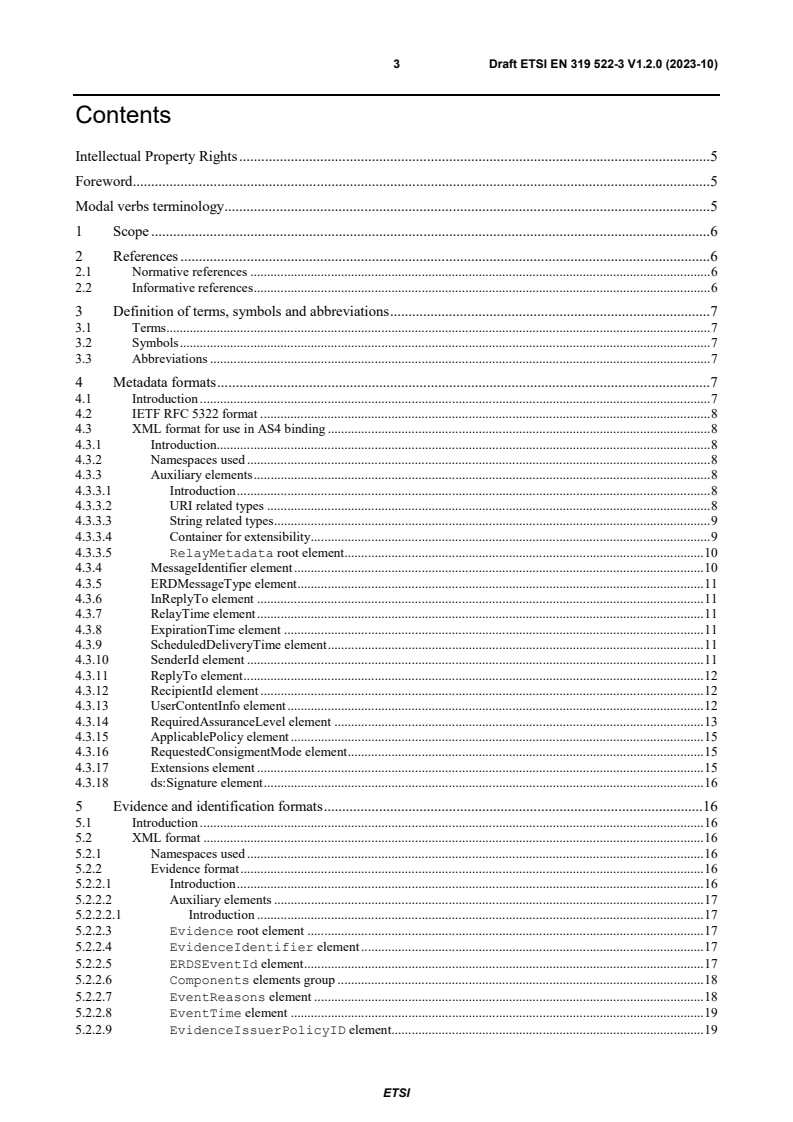
Contents
Intellectual Property Rights . 5
Foreword . 5
Modal verbs terminology . 5
1 Scope . 6
2 References . 6
2.1 Normative references . 6
2.2 Informative references . 6
3 Definition of terms, symbols and abbreviations . 7
3.1 Terms . 7
3.2 Symbols . 7
3.3 Abbreviations . 7
4 Metadata formats . 7
4.1 Introduction . 7
4.2 IETF RFC 5322 format . 8
4.3 XML format for use in AS4 binding . 8
4.3.1 Introduction. 8
4.3.2 Namespaces used . 8
4.3.3 Auxiliary elements . 8
4.3.3.1 Introduction . 8
4.3.3.2 URI related types . 8
4.3.3.3 String related types . 9
4.3.3.4 Container for extensibility . 9
4.3.3.5 RelayMetadata root element . 10
4.3.4 MessageIdentifier element . 10
4.3.5 ERDMessageType element . 11
4.3.6 InReplyTo element . 11
4.3.7 RelayTime element . 11
4.3.8 ExpirationTime element . 11
4.3.9 ScheduledDeliveryTime element . 11
4.3.10 SenderId element . 11
4.3.11 ReplyTo element . 12
4.3.12 RecipientId element . 12
4.3.13 UserContentInfo element . 12
4.3.14 RequiredAssuranceLevel element . 13
4.3.15 ApplicablePolicy element . 15
4.3.16 RequestedConsigmentMode element . 15
4.3.17 Extensions element . 15
4.3.18 ds:Signature element . 16
5 Evidence and identification formats . 16
5.1 Introduction . 16
5.2 XML format . 16
5.2.1 Namespaces used . 16
5.2.2 Evidence format . 16
5.2.2.1 Introduction . 16
5.2.2.2 Auxiliary elements . 17
5.2.2.2.1 Introduction . 17
5.2.2.3 Evidence root element . 17
5.2.2.4 EvidenceIdentifier element . 17
5.2.2.5 ERDSEventId element . 17
5.2.2.6 Components elements group . 18
5.2.2.7 EventReasons element . 18
5.2.2.8 EventTime element . 19
5.2.2.9 EvidenceIssuerPolicyID element. 19
ETSI
4 Draft ETSI EN 319 522-3 V1.2.0 (2023-10)
5.2.2.10 EntityDetailsType type . 19
5.2.2.11 Identity element . 20
5.2.2.12 CertificateDetailsType type . 20
5.2.2.13 EvidenceIssuerDetails element . 22
5.2.2.14 AssuranceLevelsDetailsType type . 22
5.2.2.15 UserDetailsType type . 22
5.2.2.16 SenderDetails element . 22
5.2.2.17 SenderDelegateDetails element . 23
5.2.2.18 RecipientDetails element . 23
5.2.2.19 RecipientsDelegateDetails element . 23
5.2.2.20 SubmissionTime element . 24
5.2.2.21 EvidenceRefersToRecipient element . 24
5.2.2.22 MessageIdentifier element . 24
5.2.2.23 UserContentInfo element . 25
5.2.2.24 ForwardedToExternalSystem element . 25
5.2.2.25 ExternalERDSDetails element . 25
5.2.2.26 TransactionLogInformation element . 25
5.2.2.27 Extensions element . 25
5.2.2.28 ds:Signature element . 26
6 Common Service Infrastructure (CSI) formats . 26
6.1 Routing information . 26
6.2 Trust information . 26
6.3 Capability management . 26
6.3.1 Recipient metadata (recipient capabilities) . 26
6.3.2 ERDS metadata (ERDS capabilities) . 26
Annex A (normative): XML schema files. 28
A.1 XML Schema file location for namespace http://uri.etsi.org/19522/v1# . 28
Annex B (informative): Change History . 29
History . 30
ETSI
5 Draft ETSI EN 319 522-3 V1.2.0 (2023-10)
Intellectual Property Rights
Essential patents
IPRs essential or potentially essential to normative deliverables may have been declared to ETSI. The declarations
pertaining to these essential IPRs, if any, are publicly available for ETSI members and non-members, and can be
found in ETSI SR 000 314: "Intellectual Property Rights (IPRs); Essential, or potentially Essential, IPRs notified to
ETSI in respect of ETSI standards", which is available from the ETSI Secretariat. Latest updates are available on the
ETSI Web server (https://ipr.etsi.org/).
Pursuant to the ETSI Directives including the ETSI IPR Policy, no investigation regarding the essentiality of IPRs,
including IPR searches, has been carried out by ETSI. No guarantee can be given as to the existence of other IPRs not
referenced in ETSI SR 000 314 (or the updates on the ETSI Web server) which are, or may be, or may become,
essential to the present document.
Trademarks
The present document may include trademarks and/or tradenames which are asserted and/or registered by their owners.
ETSI claims no ownership of these except for any which are indicated as being the property of ETSI, and conveys no
right to use or reproduce any trademark and/or tradename. Mention of those trademarks in the present document does
not constitute an endorsement by ETSI of products, services or organizations associated with those trademarks.
DECT™, PLUGTESTS™, UMTS™ and the ETSI logo are trademarks of ETSI registered for the benefit of its
Members. 3GPP™ and LTE™ are trademarks of ETSI registered for the benefit of its Members and of the 3GPP
Organizational Partners. oneM2M™ logo is a trademark of ETSI registered for the benefit of its Members and of the ®
oneM2M Partners. GSM and the GSM logo are trademarks registered and owned by the GSM Association.
Foreword
This draft European Standard (EN) has been produced by ETSI Technical Committee Electronic Signatures and
Infrastructures (ESI), and is now submitted for the combined Public Enquiry and Vote phase of the ETSI standards EN
Approval Procedure.
The present document is part 3 of a multi-part deliverable. Full details of the entire series can be found in part 1 [i.10].
Proposed national transposition dates
Date of latest announcement of this EN (doa): 3 months after ETSI publication
Date of latest publication of new National Standard
or endorsement of this EN (dop/e): 6 months after doa
Date of withdrawal of any conflicting National Standard (dow): 6 months after doa
Modal verbs terminology
In the present document "shall", "shall not", "should", "should not", "may", "need not", "will", "will not", "can" and
"cannot" are to be interpreted as described in clause 3.2 of the ETSI Drafting Rules (Verbal forms for the expression of
provisions).
"must" and "must not" are NOT allowed in ETSI deliverables except when used in direct citation.
ETSI
6 Draft ETSI EN 319 522-3 V1.2.0 (2023-10)
1 Scope
The present document specifies the format for the semantic content (metadata, evidence, identification, and Common
Service Infrastructure) that flows across the different interfaces of an Electronic Registered Delivery Service (ERDS) as
defined in ETSI EN 319 522-2 [1].
2 References
2.1 Normative references
References are either specific (identified by date of publication and/or edition number or version number) or
non-specific. For specific references, only the cited version applies. For non-specific references, the latest version of the
referenced document (including any amendments) applies.
Referenced documents which are not found to be publicly available in the expected location might be found at
https://docbox.etsi.org/Reference/.
NOTE: While any hyperlinks included in this clause were valid at the time of publication, ETSI cannot guarantee
their long term validity.
The following referenced documents are necessary for the application of the present document.
[1] ETSI EN 319 522-2: "Electronic Signatures and Infrastructures (ESI); Electronic Registered
Delivery Services; Part 2: Semantic contents". ®
[2] W3C Recommendation: "XML Signature Syntax and Processing. Version 1.1, 11 April 2013".
[3] IETF RFC 3061: "A URN Namespace of Object Identifiers".
[4] CEF eIDAS Technical Sub-group: "eIDAS SAML Attribute profile". Version 1.1.2. October 2016.
[5] OASIS: "Assertions and Protocols for the OASIS Security Assertion Markup Language (SAML)
V2.0", March 2005.
[6] IETF RFC 5646: "Tags for Identifying Languages".
[7] IETF RFC 5035: "Enhanced Security Services (ESS) Update: Adding CertID Algorithm Agility".
[8] OASIS: "Service Metadata Publishing (SMP) Version 1.0", OASIS standard, August 2017.
[9] ETSI EN 319 532-3: "Electronic Signatures and Infrastructures (ESI); Registered Electronic Mail
(REM) Services; Part 3: Formats".
[10] ETSI EN 319 522-4-3: "Electronic Signatures and Infrastructures (ESI); Electronic Registered
Delivery Services; Part 4: Bindings; Sub-part 3: Capability/requirements bindings".
2.2 Informative references
References are either specific (identified by date of publication and/or edition number or version number) or
non-specific. For specific references, only the cited version applies. For non-specific references, the latest version of the
referenced document (including any amendments) applies.
NOTE: While any hyperlinks included in this clause were valid at the time of publication, ETSI cannot guarantee
their long term validity.
The following referenced documents are not necessary for the application of the present document but they assist the
user with regard to a particular subject area.
ETSI
7 Draft ETSI EN 319 522-3 V1.2.0 (2023-10)
[i.1] Commission Implementing Regulation (EU) 2015/1502 of 8 September 2015 on setting out
minimum technical specifications and procedures for assurance levels for electronic identification
means pursuant to Article 8(3) of Regulation (EU) No 910/2014 of the European Parliament and of
the Council on electronic identification and trust services for electronic transactions in the internal
market.
[i.2] NIST Special Publication 800-63: "Digital Identity Guidelines".
[i.3] NIST Special Publication 800-63-A: "Digital Identity Guidelines. Enrolment and Identity Proofing
Requirements".
[i.4] NIST Special Publication 800-63-B: "Digital Identity Guidelines. Authentication and Lifecycle
Management".
[i.5] NIST Special Publication 800-63-C: "Digital Identity Guidelines. Federation and Assertions".
[i.6] IETF RFC 5322: "Internet Message Format".
[i.7] ETSI EN 319 132-1: "Electronic Signatures and Infrastructures (ESI); XAdES digital signatures;
Part 1: Building blocks and XAdES baseline signatures".
[i.8] IETF RFC 7522: "Security Assertion Markup Language (SAML) 2.0 Profile for OAuth 2.0 Client
Authentication and Authorization Grants".
[i.9] ETSI TS 119 612: "Electronic Signatures and Infrastructures (ESI); Trusted Lists".
[i.10] ETSI EN 319 522-1: "Electronic Signatures and Infrastructures (ESI); Electronic Registered
Delivery Services; Part 1: Framework and Architecture".
[i.11] OASIS: "AS4 Profile of ebMS 3.0 Version 1.0, OASIS Standard", January 2013.
[i.12] ETSI EN 319 522-4-1: "Electronic Signatures and Infrastructures (ESI); Electronic Registered
Delivery Services; Part 4: Bindings; Sub-part 1: Message delivery bindings".
3 Definition of terms, symbols and abbreviations
3.1 Terms
For the purposes of the present document, the terms given in ETSI EN 319 522-1 [i.10] apply.
3.2 Symbols
Void.
3.3 Abbreviations
For the purposes of the present document, the abbreviations given in ETSI EN 319 522-1 [i.10] apply.
4 Metadata formats
4.1 Introduction
The following clause aims at providing specific formats for metadata components identified in ETSI EN 319 522-2 [1],
clause 6. Clause 4.2 maps metadata components in IETF RFC 5322 format; clause 4.3 maps metadata components in
AS4 format [i.6].
ETSI
8 Draft ETSI EN 319 522-3 V1.2.0 (2023-10)
Other mappings can be provided by future versions of the present document or by other parties.
In clause 4.3, all XML elements are given for information only. In case of conflict with the XML Schema file whose
location is detailed in clause A.1, the Schema file shall take precedence.
4.2 IETF RFC 5322 format
Specification for the mapping of ERDS metadata in an IETF RFC 5322 [i.6] format shall be as specified in ETSI
EN 319 532-3 [9].
4.3 XML format for use in AS4 binding
4.3.1 Introduction
This clause defines an XML format for the ERDS relay metadata as defined in ETSI EN 319 522-2 [1], clause 6, which
is to be included in the AS4 message that is exchanged between ERDSs. Although its primary use is in the AS4
bindings it may also be used in other bindings.
4.3.2 Namespaces used
Table 1 shows the URIs corresponding to the namespaces and the prefixes associated to them in the present document.
Table 1: Namespaces URIs and prefixes
Namespace's URI Namespace's prefix
http://uri.etsi.org/19522/v1# erds
http://www.w3.org/2001/XMLSchema xs
http://www.w3.org/2000/09/xmldsig# ds
urn:oasis:names:tc:SAML:2.0:assertion saml
Below follows a copy of the xs:schema element of the XML Schema file whose location is detailed in clause A.1 and
that defines the namespace whose URI is http://uri.etsi.org/19522/v1#:
xmlns:ds="http://www.w3.org/2000/09/xmldsig#" xmlns:xs="http://www.w3.org/2001/XMLSchema"
xmlns="http://uri.etsi.org/19522/v1#" xmlns:saml="urn:oasis:names:tc:SAML:2.0:assertion">
schemaLocation="http://www.w3.org/2001/xml.xsd"/>
schemaLocation="http://www.w3.org/TR/2002/REC-xmldsig-core-20020212/xmldsig-core-schema.xsd"/>
4.3.3 Auxiliary elements
4.3.3.1 Introduction
The present clause provides details of a number of auxiliary types and elements used in throughout the XML Schema
file whose location is detailed in clause A.1.
4.3.3.2 URI related types
The present clause defines a number of types whose instances' values are URIs.
These types shall be defined as in XML Schema file whose location is detailed in clause A.1 and is copied below for
information:
ETSI
9 Draft ETSI EN 319 522-3 V1.2.0 (2023-10)
Instances of NonEmptyURIType type shall have a non-empty URI as value.
Instances of NonEmptyAttributedURIType shall have a non-empty URI as value. The xml:lang attribute shall
identify a language using the language code as specified in IETF RFC 5646 [6]. The scheme attribute shall indicate
the scheme for the URI value of the element.
Instances of NonEmptyMultiLangURIType shall have a non-empty URI as value. The xml:lang attribute shall
identify a language using the language code as specified in IETF RFC 5646 [6].
4.3.3.3 String related types
The present clause defines a number of types whose instances' values are strings.
These types shall be defined as in XML Schema file whose location is detailed in clause A.1 and is copied below for
information:
Instances of NonEmptyStringType type shall have a non-empty string as value.
Instances of NonEmptyAttributedStringType type shall have a non-empty string as value. The type attribute
shall indicate the type of the corresponding string value.
4.3.3.4 Container for extensibility
The present clause defines the Any element that may have any content.
The present clause also defines the AnyType type whose instances may have any content.
ETSI
10 Draft ETSI EN 319 522-3 V1.2.0 (2023-10)
They are specified for serving as placeholders for contents that are not specified in the present document.
This Any element shall be defined as in XML Schema file whose location is detailed in clause A.1 and is copied below
for information:
4.3.3.5 RelayMetadata root element
The root element of the XML document containing the ERDS metadata shall be the RelayMetadata element.
This element shall be defined as in XML Schema file whose location is detailed in clause A.1 and is copied below for
information:
Metadata documents shall have "EN319522v1.1.1" as value for version attribute.
Attribute version shall implement the semantics specified in clause 6.2.1 of ETSI EN 319 522-2 [1].
Clauses from 4.3.4 to 4.3.18 provide XML Schema definitions and requirements on its components.
4.3.4 MessageIdentifier element
The MessageIdentifier element shall have the semantics of component MD11 as specified in clause 6.2.11 of
ETSI EN 319 522-2 [1].
This element shall be defined as in XML Schema file whose location is detailed in clause A.1 and is copied below for
information:
ETSI
11 Draft ETSI EN 319 522-3 V1.2.0 (2023-10)
4.3.5 ERDMessageType element
The ERDMessageType element shall have the semantics of component MD13 as specified in clause 6.2.13 of ETSI
EN 319 522-2 [1].
The type of this element shall be defined as in XML Schema file whose location is detailed in clause A.1 and is copied
below for information. It enumerates the ERD message types as defined in Table 1 in clause 4 of ETSI
EN 319 522-2 [1]:
4.3.6 InReplyTo element
The optional InReplyTo element shall have the semantics of component MD12 as specified in clause 6.2.12 of ETSI
EN 319 522-2 [1].
The type of this element shall be a message identifier as defined by the MessageIdentifierType type definition
in XML Schema file whose location is detailed in clause A.1 and is copied in clause 4.3.4 for information.
4.3.7 RelayTime element
The optional RelayTime element shall have the semantics of component MD02 as specified in clause 6.2.2 of ETSI
EN 319 522-2 [1]. The 'Z' indicator for UTC may be used.
4.3.8 ExpirationTime element
The optional ExpirationTime element shall have the semantics of component MD03 as specified in clause 6.2.3 of
ETSI EN 319 522-2 [1]. The 'Z' indicator for UTC may be used.
4.3.9 ScheduledDeliveryTime element
The optional ScheduledDeliveryTime element shall have the semantics of component MD07 as specified in
clause 6.2.7 of ETSI EN 319 522-2 [1]. The 'Z' indicator for UTC may be used.
4.3.10 SenderId element
The SenderId element shall have the semantics of component MD08 as specified in clause 6.2.8 of ETSI
EN 319 522-2 [1].
The type of this element shall be defined as in XML Schema file whose location is detailed in clause A.1 and is copied
below for information:
ETSI
12 Draft ETSI EN 319 522-3 V1.2.0 (2023-10)
The content of this element shall contain the identifier of the sender. The attribute IdentifierSchemeName shall
contain the identifier of the naming scheme for assigning identifiers to users.
4.3.11 ReplyTo element
The optional ReplyTo element shall have the semantics of component MD09 as specified in clause 6.2.9 of ETSI
EN 319 522-2 [1].
The type of this element shall be the identifier of the user as defined by the EntityIdentifierType type
definition in XML Schema file whose location is detailed in clause A.1 and which is copied in the previous clause for
information.
4.3.12 RecipientId element
The optional RecipientId element shall have the semantics of component MD10 as specified in clause 6.2.10 of
ETSI EN 319 522-2 [1].
The type of this element shall be the identifier of the user as defined by the EntityIdentifierType type
definition in XML Schema file whose location is detailed in clause A.1 and which is copied in clause 4.3.10 for
information.
4.3.13 UserContentInfo element
The UserContentInfo element shall have the semantics of component MD14 as specified in clause 6.2.14 of ETSI
EN 319 522-2 [1].
This element shall be defined as in XML Schema file whose location is detailed in clause A.1 and is copied below for
information:
If included in the metadata document the AppLayerIdentifier child shall contain a string indicating the
application layer identifier assigned to the user content.
When used in the metadata document the ComposingParts child shall contain an integer value indicating the
number of parts of the user content.
ETSI
13 Draft ETSI EN 319 522-3 V1.2.0 (2023-10)
The PartsInfo child shall contain one or more PartInfo children each one containing detailed information of one
of the parts of the user content.
Identifier child element of PartInfo shall contain the identifier of the corresponding part of the user content.
ContentType child element of PartInfo shall indicate the type of content of the corresponding part of the user
content.
Child element ds:DigestMethod of PartInfo may be used to indicate the algorithm used for computing the
digest value of the corresponding part of the user content.
Child element ds:DigestValue of PartInfo may be used to include the base-64 encoded digest value of the
corresponding part of the user content as computed using the digest algorithm indicated in the aforementioned
ds:DigestMethod child element.
NOTE: When using the AS4 binding to exchange ERD messages between ERDS as defined in ETSI
EN 319 522-4-1 [i.12] the digest algorithm and value are already included in the message header and
there is no need to include these again the metadata document.
4.3.14 RequiredAssuranceLevel element
The optional RequiredAssuranceLevel element shall have the semantics of component MD04 as specified in
clause 6.2.4 of ETSI EN 319 522-2 [1].
The type of this element shall be defined as in XML Schema file whose location is detailed in clause A.1 and is copied
below for information:
minOccurs="0"/>
type="AuthenticationDetsAndAssuranceLevelType"/>
ETSI
14 Draft ETSI EN 319 522-3 V1.2.0 (2023-10)
Each instance of AssuranceLevelDetailsType type shall contain detailed information of a certain assurance
level.
Instances of AssuranceLevelDetailsType type may support schemes that define separated assurance levels for
authentication process, identity proof processes, and an assertion protocol in case there is a federation for
communicating authentication and identity information.
EXAMPLE 1: The Commission Implementing Regulation (EU) 2015/1502 [i.1] specifies three assurance levels
for identity proof and authentication processes. Each one would require one instance of
AssuranceLevelDetailsType type.
EXAMPLE 2: NIST Special Publications 800-63 [i.2], 800-63-A [i.3], 800-63-B [i.4] and 800-63-C [i.5]
providing guidelines to federal agencies for implementing digital identification and authentication
also provide means for managing these three different assurance levels if required. Each one would
require one instance of AssuranceLevelDetailsType type.
One instance of AssuranceLevelDetailsType type may also support schemes that define a unique global
assurance level jointly assigned to the identification proof and authentication processes.
The AssuranceLevel child element of instances of AssuranceLevelDetailsType shall indicate the value of
an assurance level.
The PolicyID child element of instances of AssuranceLevelDetailsType shall identify the policy that
defined the different assurance levels.
The PolicyIDDetails child element of instances of AssuranceLevelDetailsType shall contain relevant
textual details of the policy that defined the different assurance levels.
The PolicyIDDetailsResources child element of instances of AssuranceLevelDetailsType shall
contain a list of URIs pointing to resources providing details of the policy that defined the different assurance levels,
each one in a certain language. The xml:lang attribute of each URI child element shall indicate the language used in
the resource pointed by this element.
Each instance of AssuranceLevelsDetailsType shall convey either:
• a global assurance level jointly assigned to the identification proof and authentication processes, supported by
the GlobalAssuranceLevel and AuthenticationDetails children elements; or
• separated information related to the assurance levels of identification proof process, authentication process and
the assertion protocols in federated environments, supported by the sequence of
AuthenticationDetsAndAssuranceLevel, IdentityProofAssuranceLevel, and
FederationAssuranceLevel children elements.
GlobalAssuranceLevel child element of an instance of AssuranceLevelsDetailsType shall contain the
information of a unique global assurance level jointly assigned to the identification proof and authentication processes.
One instance of AuthenticationDetailsType type (as the AuthenticationDetails child element of an
instance of AssuranceLevelsDetailsType) shall contain
...
EUROPEAN STANDARD
Electronic Signatures and Infrastructures (ESI);
Electronic Registered Delivery Services;
Part 3: Formats
2 ETSI EN 319 522-3 V1.2.1 (2024-01)
Reference
REN/ESI-0019522-3v121
Keywords
e-delivery services, registered e-delivery services,
registered electronic mail
ETSI
650 Route des Lucioles
F-06921 Sophia Antipolis Cedex - FRANCE
Tel.: +33 4 92 94 42 00 Fax: +33 4 93 65 47 16
Siret N° 348 623 562 00017 - APE 7112B
Association à but non lucratif enregistrée à la
Sous-Préfecture de Grasse (06) N° w061004871
Important notice
The present document can be downloaded from:
https://www.etsi.org/standards-search
The present document may be made available in electronic versions and/or in print. The content of any electronic and/or
print versions of the present document shall not be modified without the prior written authorization of ETSI. In case of any
existing or perceived difference in contents between such versions and/or in print, the prevailing version of an ETSI
deliverable is the one made publicly available in PDF format at www.etsi.org/deliver.
Users of the present document should be aware that the document may be subject to revision or change of status.
Information on the current status of this and other ETSI documents is available at
https://portal.etsi.org/TB/ETSIDeliverableStatus.aspx
If you find errors in the present document, please send your comment to one of the following services:
https://portal.etsi.org/People/CommiteeSupportStaff.aspx
If you find a security vulnerability in the present document, please report it through our
Coordinated Vulnerability Disclosure Program:
https://www.etsi.org/standards/coordinated-vulnerability-disclosure
Notice of disclaimer & limitation of liability
The information provided in the present deliverable is directed solely to professionals who have the appropriate degree of
experience to understand and interpret its content in accordance with generally accepted engineering or
other professional standard and applicable regulations.
No recommendation as to products and services or vendors is made or should be implied.
In no event shall ETSI be held liable for loss of profits or any other incidental or consequential damages.
Any software contained in this deliverable is provided "AS IS" with no warranties, express or implied, including but not
limited to, the warranties of merchantability, fitness for a particular purpose and non-infringement of intellectual property
rights and ETSI shall not be held liable in any event for any damages whatsoever (including, without limitation, damages
for loss of profits, business interruption, loss of information, or any other pecuniary loss) arising out of or related to the use
of or inability to use the software.
Copyright Notification
No part may be reproduced or utilized in any form or by any means, electronic or mechanical, including photocopying and
microfilm except as authorized by written permission of ETSI.
The content of the PDF version shall not be modified without the written authorization of ETSI.
The copyright and the foregoing restriction extend to reproduction in all media.
© ETSI 2024.
All rights reserved.
ETSI
3 ETSI EN 319 522-3 V1.2.1 (2024-01)
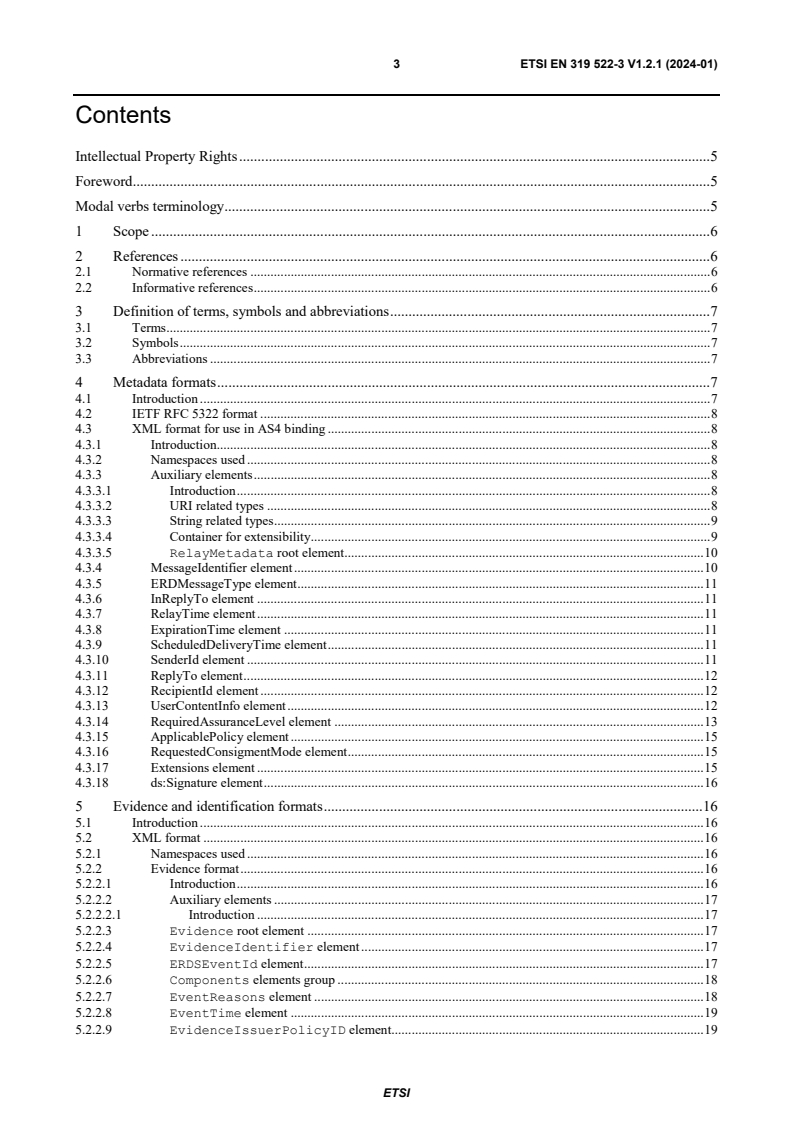
Contents
Intellectual Property Rights . 5
Foreword . 5
Modal verbs terminology . 5
1 Scope . 6
2 References . 6
2.1 Normative references . 6
2.2 Informative references . 6
3 Definition of terms, symbols and abbreviations . 7
3.1 Terms . 7
3.2 Symbols . 7
3.3 Abbreviations . 7
4 Metadata formats . 7
4.1 Introduction . 7
4.2 IETF RFC 5322 format . 8
4.3 XML format for use in AS4 binding . 8
4.3.1 Introduction. 8
4.3.2 Namespaces used . 8
4.3.3 Auxiliary elements . 8
4.3.3.1 Introduction . 8
4.3.3.2 URI related types . 8
4.3.3.3 String related types . 9
4.3.3.4 Container for extensibility . 9
4.3.3.5 RelayMetadata root element . 10
4.3.4 MessageIdentifier element . 10
4.3.5 ERDMessageType element . 11
4.3.6 InReplyTo element . 11
4.3.7 RelayTime element . 11
4.3.8 ExpirationTime element . 11
4.3.9 ScheduledDeliveryTime element . 11
4.3.10 SenderId element . 11
4.3.11 ReplyTo element . 12
4.3.12 RecipientId element . 12
4.3.13 UserContentInfo element . 12
4.3.14 RequiredAssuranceLevel element . 13
4.3.15 ApplicablePolicy element . 15
4.3.16 RequestedConsigmentMode element . 15
4.3.17 Extensions element . 15
4.3.18 ds:Signature element . 16
5 Evidence and identification formats . 16
5.1 Introduction . 16
5.2 XML format . 16
5.2.1 Namespaces used . 16
5.2.2 Evidence format . 16
5.2.2.1 Introduction . 16
5.2.2.2 Auxiliary elements . 17
5.2.2.2.1 Introduction . 17
5.2.2.3 Evidence root element . 17
5.2.2.4 EvidenceIdentifier element . 17
5.2.2.5 ERDSEventId element . 17
5.2.2.6 Components elements group . 18
5.2.2.7 EventReasons element . 18
5.2.2.8 EventTime element . 19
5.2.2.9 EvidenceIssuerPolicyID element. 19
ETSI
4 ETSI EN 319 522-3 V1.2.1 (2024-01)
5.2.2.10 EntityDetailsType type . 19
5.2.2.11 Identity element . 20
5.2.2.12 CertificateDetailsType type . 20
5.2.2.13 EvidenceIssuerDetails element . 22
5.2.2.14 AssuranceLevelsDetailsType type . 22
5.2.2.15 UserDetailsType type . 22
5.2.2.16 SenderDetails element . 22
5.2.2.17 SenderDelegateDetails element . 23
5.2.2.18 RecipientDetails element . 23
5.2.2.19 RecipientsDelegateDetails element . 23
5.2.2.20 SubmissionTime element . 24
5.2.2.21 EvidenceRefersToRecipient element . 24
5.2.2.22 MessageIdentifier element . 24
5.2.2.23 UserContentInfo element . 25
5.2.2.24 ForwardedToExternalSystem element . 25
5.2.2.25 ExternalERDSDetails element . 25
5.2.2.26 TransactionLogInformation element . 25
5.2.2.27 Extensions element . 25
5.2.2.28 ds:Signature element . 26
6 Common Service Infrastructure (CSI) formats . 26
6.1 Routing information . 26
6.2 Trust information . 26
6.3 Capability management . 26
6.3.1 Recipient metadata (recipient capabilities) . 26
6.3.2 ERDS metadata (ERDS capabilities) . 26
Annex A (normative): XML schema files. 28
A.1 XML Schema file location for namespace http://uri.etsi.org/19522/v1# . 28
Annex B (informative): Change History . 29
History . 30
ETSI
5 ETSI EN 319 522-3 V1.2.1 (2024-01)
Intellectual Property Rights
Essential patents
IPRs essential or potentially essential to normative deliverables may have been declared to ETSI. The declarations
pertaining to these essential IPRs, if any, are publicly available for ETSI members and non-members, and can be
found in ETSI SR 000 314: "Intellectual Property Rights (IPRs); Essential, or potentially Essential, IPRs notified to
ETSI in respect of ETSI standards", which is available from the ETSI Secretariat. Latest updates are available on the
ETSI Web server (https://ipr.etsi.org/).
Pursuant to the ETSI Directives including the ETSI IPR Policy, no investigation regarding the essentiality of IPRs,
including IPR searches, has been carried out by ETSI. No guarantee can be given as to the existence of other IPRs not
referenced in ETSI SR 000 314 (or the updates on the ETSI Web server) which are, or may be, or may become,
essential to the present document.
Trademarks
The present document may include trademarks and/or tradenames which are asserted and/or registered by their owners.
ETSI claims no ownership of these except for any which are indicated as being the property of ETSI, and conveys no
right to use or reproduce any trademark and/or tradename. Mention of those trademarks in the present document does
not constitute an endorsement by ETSI of products, services or organizations associated with those trademarks.
DECT™, PLUGTESTS™, UMTS™ and the ETSI logo are trademarks of ETSI registered for the benefit of its
Members. 3GPP™ and LTE™ are trademarks of ETSI registered for the benefit of its Members and of the 3GPP
Organizational Partners. oneM2M™ logo is a trademark of ETSI registered for the benefit of its Members and of the ®
oneM2M Partners. GSM and the GSM logo are trademarks registered and owned by the GSM Association.
Foreword
This European Standard (EN) has been produced by ETSI Technical Committee Electronic Signatures and
Infrastructures (ESI).
The present document is part 3 of a multi-part deliverable. Full details of the entire series can be found in part 1 [i.10].
National transposition dates
Date of adoption of this EN: 3 January 2024
Date of latest announcement of this EN (doa): 30 April 2024
Date of latest publication of new National Standard
or endorsement of this EN (dop/e): 31 October 2024
Date of withdrawal of any conflicting National Standard (dow): 31 October 2024
Modal verbs terminology
In the present document "shall", "shall not", "should", "should not", "may", "need not", "will", "will not", "can" and
"cannot" are to be interpreted as described in clause 3.2 of the ETSI Drafting Rules (Verbal forms for the expression of
provisions).
"must" and "must not" are NOT allowed in ETSI deliverables except when used in direct citation.
ETSI
6 ETSI EN 319 522-3 V1.2.1 (2024-01)
1 Scope
The present document specifies the format for the semantic content (metadata, evidence, identification, and Common
Service Infrastructure) that flows across the different interfaces of an Electronic Registered Delivery Service (ERDS) as
defined in ETSI EN 319 522-2 [1].
2 References
2.1 Normative references
References are either specific (identified by date of publication and/or edition number or version number) or
non-specific. For specific references, only the cited version applies. For non-specific references, the latest version of the
referenced document (including any amendments) applies.
Referenced documents which are not found to be publicly available in the expected location might be found at
https://docbox.etsi.org/Reference/.
NOTE: While any hyperlinks included in this clause were valid at the time of publication, ETSI cannot guarantee
their long term validity.
The following referenced documents are necessary for the application of the present document.
[1] ETSI EN 319 522-2: "Electronic Signatures and Infrastructures (ESI); Electronic Registered
Delivery Services; Part 2: Semantic contents". ®
[2] W3C Recommendation: "XML Signature Syntax and Processing. Version 1.1, 11 April 2013".
[3] IETF RFC 3061: "A URN Namespace of Object Identifiers".
[4] CEF eIDAS Technical Sub-group: "eIDAS SAML Attribute profile". Version 1.1.2. October 2016.
[5] OASIS: "Assertions and Protocols for the OASIS Security Assertion Markup Language (SAML)
V2.0", March 2005.
[6] IETF RFC 5646: "Tags for Identifying Languages".
[7] IETF RFC 5035: "Enhanced Security Services (ESS) Update: Adding CertID Algorithm Agility".
[8] OASIS: "Service Metadata Publishing (SMP) Version 1.0", OASIS standard, August 2017.
[9] ETSI EN 319 532-3: "Electronic Signatures and Infrastructures (ESI); Registered Electronic Mail
(REM) Services; Part 3: Formats".
[10] ETSI EN 319 522-4-3: "Electronic Signatures and Infrastructures (ESI); Electronic Registered
Delivery Services; Part 4: Bindings; Sub-part 3: Capability/requirements bindings".
2.2 Informative references
References are either specific (identified by date of publication and/or edition number or version number) or
non-specific. For specific references, only the cited version applies. For non-specific references, the latest version of the
referenced document (including any amendments) applies.
NOTE: While any hyperlinks included in this clause were valid at the time of publication, ETSI cannot guarantee
their long term validity.
The following referenced documents are not necessary for the application of the present document but they assist the
user with regard to a particular subject area.
ETSI
7 ETSI EN 319 522-3 V1.2.1 (2024-01)
[i.1] Commission Implementing Regulation (EU) 2015/1502 of 8 September 2015 on setting out
minimum technical specifications and procedures for assurance levels for electronic identification
means pursuant to Article 8(3) of Regulation (EU) No 910/2014 of the European Parliament and of
the Council on electronic identification and trust services for electronic transactions in the internal
market.
[i.2] NIST Special Publication 800-63: "Digital Identity Guidelines".
[i.3] NIST Special Publication 800-63-A: "Digital Identity Guidelines. Enrolment and Identity Proofing
Requirements".
[i.4] NIST Special Publication 800-63-B: "Digital Identity Guidelines. Authentication and Lifecycle
Management".
[i.5] NIST Special Publication 800-63-C: "Digital Identity Guidelines. Federation and Assertions".
[i.6] IETF RFC 5322: "Internet Message Format".
[i.7] ETSI EN 319 132-1: "Electronic Signatures and Infrastructures (ESI); XAdES digital signatures;
Part 1: Building blocks and XAdES baseline signatures".
[i.8] IETF RFC 7522: "Security Assertion Markup Language (SAML) 2.0 Profile for OAuth 2.0 Client
Authentication and Authorization Grants".
[i.9] ETSI TS 119 612: "Electronic Signatures and Infrastructures (ESI); Trusted Lists".
[i.10] ETSI EN 319 522-1: "Electronic Signatures and Infrastructures (ESI); Electronic Registered
Delivery Services; Part 1: Framework and Architecture".
[i.11] OASIS: "AS4 Profile of ebMS 3.0 Version 1.0, OASIS Standard", January 2013.
[i.12] ETSI EN 319 522-4-1: "Electronic Signatures and Infrastructures (ESI); Electronic Registered
Delivery Services; Part 4: Bindings; Sub-part 1: Message delivery bindings".
3 Definition of terms, symbols and abbreviations
3.1 Terms
For the purposes of the present document, the terms given in ETSI EN 319 522-1 [i.10] apply.
3.2 Symbols
Void.
3.3 Abbreviations
For the purposes of the present document, the abbreviations given in ETSI EN 319 522-1 [i.10] apply.
4 Metadata formats
4.1 Introduction
The following clause aims at providing specific formats for metadata components identified in ETSI EN 319 522-2 [1],
clause 6. Clause 4.2 maps metadata components in IETF RFC 5322 format; clause 4.3 maps metadata components in
AS4 format [i.6].
ETSI
8 ETSI EN 319 522-3 V1.2.1 (2024-01)
Other mappings can be provided by future versions of the present document or by other parties.
In clause 4.3, all XML elements are given for information only. In case of conflict with the XML Schema file whose
location is detailed in clause A.1, the Schema file shall take precedence.
4.2 IETF RFC 5322 format
Specification for the mapping of ERDS metadata in an IETF RFC 5322 [i.6] format shall be as specified in ETSI
EN 319 532-3 [9].
4.3 XML format for use in AS4 binding
4.3.1 Introduction
This clause defines an XML format for the ERDS relay metadata as defined in ETSI EN 319 522-2 [1], clause 6, which
is to be included in the AS4 message that is exchanged between ERDSs. Although its primary use is in the AS4
bindings it may also be used in other bindings.
4.3.2 Namespaces used
Table 1 shows the URIs corresponding to the namespaces and the prefixes associated to them in the present document.
Table 1: Namespaces URIs and prefixes
Namespace's URI Namespace's prefix
http://uri.etsi.org/19522/v1# erds
http://www.w3.org/2001/XMLSchema xs
http://www.w3.org/2000/09/xmldsig# ds
urn:oasis:names:tc:SAML:2.0:assertion saml
Below follows a copy of the xs:schema element of the XML Schema file whose location is detailed in clause A.1 and
that defines the namespace whose URI is http://uri.etsi.org/19522/v1#:
xmlns:ds="http://www.w3.org/2000/09/xmldsig#" xmlns:xs="http://www.w3.org/2001/XMLSchema"
xmlns="http://uri.etsi.org/19522/v1#" xmlns:saml="urn:oasis:names:tc:SAML:2.0:assertion">
schemaLocation="http://www.w3.org/2001/xml.xsd"/>
schemaLocation="http://www.w3.org/TR/2002/REC-xmldsig-core-20020212/xmldsig-core-schema.xsd"/>
4.3.3 Auxiliary elements
4.3.3.1 Introduction
The present clause provides details of a number of auxiliary types and elements used in throughout the XML Schema
file whose location is detailed in clause A.1.
4.3.3.2 URI related types
The present clause defines a number of types whose instances' values are URIs.
These types shall be defined as in XML Schema file whose location is detailed in clause A.1 and is copied below for
information:
ETSI
9 ETSI EN 319 522-3 V1.2.1 (2024-01)
Instances of NonEmptyURIType type shall have a non-empty URI as value.
Instances of NonEmptyAttributedURIType shall have a non-empty URI as value. The xml:lang attribute shall
identify a language using the language code as specified in IETF RFC 5646 [6]. The scheme attribute shall indicate
the scheme for the URI value of the element.
Instances of NonEmptyMultiLangURIType shall have a non-empty URI as value. The xml:lang attribute shall
identify a language using the language code as specified in IETF RFC 5646 [6].
4.3.3.3 String related types
The present clause defines a number of types whose instances' values are strings.
These types shall be defined as in XML Schema file whose location is detailed in clause A.1 and is copied below for
information:
Instances of NonEmptyStringType type shall have a non-empty string as value.
Instances of NonEmptyAttributedStringType type shall have a non-empty string as value. The type attribute
shall indicate the type of the corresponding string value.
4.3.3.4 Container for extensibility
The present clause defines the Any element that may have any content.
The present clause also defines the AnyType type whose instances may have any content.
ETSI
10 ETSI EN 319 522-3 V1.2.1 (2024-01)
They are specified for serving as placeholders for contents that are not specified in the present document.
This Any element shall be defined as in XML Schema file whose location is detailed in clause A.1 and is copied below
for information:
4.3.3.5 RelayMetadata root element
The root element of the XML document containing the ERDS metadata shall be the RelayMetadata element.
This element shall be defined as in XML Schema file whose location is detailed in clause A.1 and is copied below for
information:
Metadata documents shall have "EN319522v1.1.1" as value for version attribute.
Attribute version shall implement the semantics specified in clause 6.2.1 of ETSI EN 319 522-2 [1].
Clauses from 4.3.4 to 4.3.18 provide XML Schema definitions and requirements on its components.
4.3.4 MessageIdentifier element
The MessageIdentifier element shall have the semantics of component MD11 as specified in clause 6.2.11 of
ETSI EN 319 522-2 [1].
This element shall be defined as in XML Schema file whose location is detailed in clause A.1 and is copied below for
information:
ETSI
11 ETSI EN 319 522-3 V1.2.1 (2024-01)
4.3.5 ERDMessageType element
The ERDMessageType element shall have the semantics of component MD13 as specified in clause 6.2.13 of ETSI
EN 319 522-2 [1].
The type of this element shall be defined as in XML Schema file whose location is detailed in clause A.1 and is copied
below for information. It enumerates the ERD message types as defined in Table 1 in clause 4 of ETSI
EN 319 522-2 [1]:
4.3.6 InReplyTo element
The optional InReplyTo element shall have the semantics of component MD12 as specified in clause 6.2.12 of ETSI
EN 319 522-2 [1].
The type of this element shall be a message identifier as defined by the MessageIdentifierType type definition
in XML Schema file whose location is detailed in clause A.1 and is copied in clause 4.3.4 for information.
4.3.7 RelayTime element
The optional RelayTime element shall have the semantics of component MD02 as specified in clause 6.2.2 of ETSI
EN 319 522-2 [1]. The 'Z' indicator for UTC may be used.
4.3.8 ExpirationTime element
The optional ExpirationTime element shall have the semantics of component MD03 as specified in clause 6.2.3 of
ETSI EN 319 522-2 [1]. The 'Z' indicator for UTC may be used.
4.3.9 ScheduledDeliveryTime element
The optional ScheduledDeliveryTime element shall have the semantics of component MD07 as specified in
clause 6.2.7 of ETSI EN 319 522-2 [1]. The 'Z' indicator for UTC may be used.
4.3.10 SenderId element
The SenderId element shall have the semantics of component MD08 as specified in clause 6.2.8 of ETSI
EN 319 522-2 [1].
The type of this element shall be defined as in XML Schema file whose location is detailed in clause A.1 and is copied
below for information:
ETSI
12 ETSI EN 319 522-3 V1.2.1 (2024-01)
The content of this element shall contain the identifier of the sender. The attribute IdentifierSchemeName shall
contain the identifier of the naming scheme for assigning identifiers to users.
4.3.11 ReplyTo element
The optional ReplyTo element shall have the semantics of component MD09 as specified in clause 6.2.9 of ETSI
EN 319 522-2 [1].
The type of this element shall be the identifier of the user as defined by the EntityIdentifierType type
definition in XML Schema file whose location is detailed in clause A.1 and which is copied in the previous clause for
information.
4.3.12 RecipientId element
The optional RecipientId element shall have the semantics of component MD10 as specified in clause 6.2.10 of
ETSI EN 319 522-2 [1].
The type of this element shall be the identifier of the user as defined by the EntityIdentifierType type
definition in XML Schema file whose location is detailed in clause A.1 and which is copied in clause 4.3.10 for
information.
4.3.13 UserContentInfo element
The UserContentInfo element shall have the semantics of component MD14 as specified in clause 6.2.14 of ETSI
EN 319 522-2 [1].
This element shall be defined as in XML Schema file whose location is detailed in clause A.1 and is copied below for
information:
If included in the metadata document the AppLayerIdentifier child shall contain a string indicating the
application layer identifier assigned to the user content.
When used in the metadata document the ComposingParts child shall contain an integer value indicating the
number of parts of the user content.
ETSI
13 ETSI EN 319 522-3 V1.2.1 (2024-01)
The PartsInfo child shall contain one or more PartInfo children each one containing detailed information of one
of the parts of the user content.
Identifier child element of PartInfo shall contain the identifier of the corresponding part of the user content.
ContentType child element of PartInfo shall indicate the type of content of the corresponding part of the user
content.
Child element ds:DigestMethod of PartInfo may be used to indicate the algorithm used for computing the
digest value of the corresponding part of the user content.
Child element ds:DigestValue of PartInfo may be used to include the base-64 encoded digest value of the
corresponding part of the user content as computed using the digest algorithm indicated in the aforementioned
ds:DigestMethod child element.
NOTE: When using the AS4 binding to exchange ERD messages between ERDS as defined in ETSI
EN 319 522-4-1 [i.12] the digest algorithm and value are already included in the message header and
there is no need to include these again the metadata document.
4.3.14 RequiredAssuranceLevel element
The optional RequiredAssuranceLevel element shall have the semantics of component MD04 as specified in
clause 6.2.4 of ETSI EN 319 522-2 [1].
The type of this element shall be defined as in XML Schema file whose location is detailed in clause A.1 and is copied
below for information:
minOccurs="0"/>
type="AuthenticationDetsAndAssuranceLevelType"/>
ETSI
14 ETSI EN 319 522-3 V1.2.1 (2024-01)
Each instance of AssuranceLevelDetailsType type shall contain detailed information of a certain assurance
level.
Instances of AssuranceLevelDetailsType type may support schemes that define separated assurance levels for
authentication process, identity proof processes, and an assertion protocol in case there is a federation for
communicating authentication and identity information.
EXAMPLE 1: The Commission Implementing Regulation (EU) 2015/1502 [i.1] specifies three assurance levels
for identity proof and authentication processes. Each one would require one instance of
AssuranceLevelDetailsType type.
EXAMPLE 2: NIST Special Publications 800-63 [i.2], 800-63-A [i.3], 800-63-B [i.4] and 800-63-C [i.5]
providing guidelines to federal agencies for implementing digital identification and authentication
also provide means for managing these three different assurance levels if required. Each one would
require one instance of AssuranceLevelDetailsType type.
One instance of AssuranceLevelDetailsType type may also support schemes that define a unique global
assurance level jointly assigned to the identification proof and authentication processes.
The AssuranceLevel child element of instances of AssuranceLevelDetailsType shall indicate the value of
an assurance level.
The PolicyID child element of instances of AssuranceLevelDetailsType shall identify the policy that
defined the different assurance levels.
The PolicyIDDetails child element of instances of AssuranceLevelDetailsType shall contain relevant
textual details of the policy that defined the different assurance levels.
The PolicyIDDetailsResources child element of instances of AssuranceLevelDetailsType shall
contain a list of URIs pointing to resources providing details of the policy that defined the different assurance levels,
each one in a certain language. The xml:lang attribute of each URI child element shall indicate the language used in
the resource pointed by this element.
Each instance of AssuranceLevelsDetailsType shall convey either:
• a global assurance level jointly assigned to the identification proof and authentication processes, supported by
the GlobalAssuranceLevel and AuthenticationDetails children elements; or
• separated information related to the assurance levels of identification proof process, authentication process and
the assertion protocols in federated environments, supported by the sequence of
AuthenticationDetsAndAssuranceLevel, IdentityProofAssuranceLevel, and
FederationAssuranceLevel children elements.
GlobalAssuranceLevel child element of an instance of AssuranceLevelsDetailsType shall contain the
information of a unique global assurance level jointly assigned to the identification proof and authentication processes.
One instance of AuthenticationDetailsType type (as the AuthenticationDetails child element of an
instance of AssuranceLevelsDetailsType) shall contain details of one authentication process within either a
saml:Assertion element or the sequence formed by AuthenticationTime and AuthenticationMethod
children elements.
The sa
...
SLOVENSKI STANDARD
01-marec-2024
Elektronski podpisi in infrastruktura (ESI) - Storitve elektronske priporočene
dostave - 3. del: Formati
Electronic Signatures and Infrastructures (ESI) - Electronic Registered Delivery Services
- Part 3: Formats
Ta slovenski standard je istoveten z: ETSI EN 319 522-3 V1.2.1 (2024-01)
ICS:
35.040.01 Kodiranje informacij na Information coding in general
splošno
2003-01.Slovenski inštitut za standardizacijo. Razmnoževanje celote ali delov tega standarda ni dovoljeno.
EUROPEAN STANDARD
Electronic Signatures and Infrastructures (ESI);
Electronic Registered Delivery Services;
Part 3: Formats
2 ETSI EN 319 522-3 V1.2.1 (2024-01)
Reference
REN/ESI-0019522-3v121
Keywords
e-delivery services, registered e-delivery services,
registered electronic mail
ETSI
650 Route des Lucioles
F-06921 Sophia Antipolis Cedex - FRANCE
Tel.: +33 4 92 94 42 00 Fax: +33 4 93 65 47 16
Siret N° 348 623 562 00017 - APE 7112B
Association à but non lucratif enregistrée à la
Sous-Préfecture de Grasse (06) N° w061004871
Important notice
The present document can be downloaded from:
https://www.etsi.org/standards-search
The present document may be made available in electronic versions and/or in print. The content of any electronic and/or
print versions of the present document shall not be modified without the prior written authorization of ETSI. In case of any
existing or perceived difference in contents between such versions and/or in print, the prevailing version of an ETSI
deliverable is the one made publicly available in PDF format at www.etsi.org/deliver.
Users of the present document should be aware that the document may be subject to revision or change of status.
Information on the current status of this and other ETSI documents is available at
https://portal.etsi.org/TB/ETSIDeliverableStatus.aspx
If you find errors in the present document, please send your comment to one of the following services:
https://portal.etsi.org/People/CommiteeSupportStaff.aspx
If you find a security vulnerability in the present document, please report it through our
Coordinated Vulnerability Disclosure Program:
https://www.etsi.org/standards/coordinated-vulnerability-disclosure
Notice of disclaimer & limitation of liability
The information provided in the present deliverable is directed solely to professionals who have the appropriate degree of
experience to understand and interpret its content in accordance with generally accepted engineering or
other professional standard and applicable regulations.
No recommendation as to products and services or vendors is made or should be implied.
In no event shall ETSI be held liable for loss of profits or any other incidental or consequential damages.
Any software contained in this deliverable is provided "AS IS" with no warranties, express or implied, including but not
limited to, the warranties of merchantability, fitness for a particular purpose and non-infringement of intellectual property
rights and ETSI shall not be held liable in any event for any damages whatsoever (including, without limitation, damages
for loss of profits, business interruption, loss of information, or any other pecuniary loss) arising out of or related to the use
of or inability to use the software.
Copyright Notification
No part may be reproduced or utilized in any form or by any means, electronic or mechanical, including photocopying and
microfilm except as authorized by written permission of ETSI.
The content of the PDF version shall not be modified without the written authorization of ETSI.
The copyright and the foregoing restriction extend to reproduction in all media.
© ETSI 2024.
All rights reserved.
ETSI
3 ETSI EN 319 522-3 V1.2.1 (2024-01)
Contents
Intellectual Property Rights . 5
Foreword . 5
Modal verbs terminology . 5
1 Scope . 6
2 References . 6
2.1 Normative references . 6
2.2 Informative references . 6
3 Definition of terms, symbols and abbreviations . 7
3.1 Terms . 7
3.2 Symbols . 7
3.3 Abbreviations . 7
4 Metadata formats . 7
4.1 Introduction . 7
4.2 IETF RFC 5322 format . 8
4.3 XML format for use in AS4 binding . 8
4.3.1 Introduction. 8
4.3.2 Namespaces used . 8
4.3.3 Auxiliary elements . 8
4.3.3.1 Introduction . 8
4.3.3.2 URI related types . 8
4.3.3.3 String related types . 9
4.3.3.4 Container for extensibility . 9
4.3.3.5 RelayMetadata root element . 10
4.3.4 MessageIdentifier element . 10
4.3.5 ERDMessageType element . 11
4.3.6 InReplyTo element . 11
4.3.7 RelayTime element . 11
4.3.8 ExpirationTime element . 11
4.3.9 ScheduledDeliveryTime element . 11
4.3.10 SenderId element . 11
4.3.11 ReplyTo element . 12
4.3.12 RecipientId element . 12
4.3.13 UserContentInfo element . 12
4.3.14 RequiredAssuranceLevel element . 13
4.3.15 ApplicablePolicy element . 15
4.3.16 RequestedConsigmentMode element . 15
4.3.17 Extensions element . 15
4.3.18 ds:Signature element . 16
5 Evidence and identification formats . 16
5.1 Introduction . 16
5.2 XML format . 16
5.2.1 Namespaces used . 16
5.2.2 Evidence format . 16
5.2.2.1 Introduction . 16
5.2.2.2 Auxiliary elements . 17
5.2.2.2.1 Introduction . 17
5.2.2.3 Evidence root element . 17
5.2.2.4 EvidenceIdentifier element . 17
5.2.2.5 ERDSEventId element . 17
5.2.2.6 Components elements group . 18
5.2.2.7 EventReasons element . 18
5.2.2.8 EventTime element . 19
5.2.2.9 EvidenceIssuerPolicyID element. 19
ETSI
4 ETSI EN 319 522-3 V1.2.1 (2024-01)
5.2.2.10 EntityDetailsType type . 19
5.2.2.11 Identity element . 20
5.2.2.12 CertificateDetailsType type . 20
5.2.2.13 EvidenceIssuerDetails element . 22
5.2.2.14 AssuranceLevelsDetailsType type . 22
5.2.2.15 UserDetailsType type . 22
5.2.2.16 SenderDetails element . 22
5.2.2.17 SenderDelegateDetails element . 23
5.2.2.18 RecipientDetails element . 23
5.2.2.19 RecipientsDelegateDetails element . 23
5.2.2.20 SubmissionTime element . 24
5.2.2.21 EvidenceRefersToRecipient element . 24
5.2.2.22 MessageIdentifier element . 24
5.2.2.23 UserContentInfo element . 25
5.2.2.24 ForwardedToExternalSystem element . 25
5.2.2.25 ExternalERDSDetails element . 25
5.2.2.26 TransactionLogInformation element . 25
5.2.2.27 Extensions element . 25
5.2.2.28 ds:Signature element . 26
6 Common Service Infrastructure (CSI) formats . 26
6.1 Routing information . 26
6.2 Trust information . 26
6.3 Capability management . 26
6.3.1 Recipient metadata (recipient capabilities) . 26
6.3.2 ERDS metadata (ERDS capabilities) . 26
Annex A (normative): XML schema files. 28
A.1 XML Schema file location for namespace http://uri.etsi.org/19522/v1# . 28
Annex B (informative): Change History . 29
History . 30
ETSI
5 ETSI EN 319 522-3 V1.2.1 (2024-01)
Intellectual Property Rights
Essential patents
IPRs essential or potentially essential to normative deliverables may have been declared to ETSI. The declarations
pertaining to these essential IPRs, if any, are publicly available for ETSI members and non-members, and can be
found in ETSI SR 000 314: "Intellectual Property Rights (IPRs); Essential, or potentially Essential, IPRs notified to
ETSI in respect of ETSI standards", which is available from the ETSI Secretariat. Latest updates are available on the
ETSI Web server (https://ipr.etsi.org/).
Pursuant to the ETSI Directives including the ETSI IPR Policy, no investigation regarding the essentiality of IPRs,
including IPR searches, has been carried out by ETSI. No guarantee can be given as to the existence of other IPRs not
referenced in ETSI SR 000 314 (or the updates on the ETSI Web server) which are, or may be, or may become,
essential to the present document.
Trademarks
The present document may include trademarks and/or tradenames which are asserted and/or registered by their owners.
ETSI claims no ownership of these except for any which are indicated as being the property of ETSI, and conveys no
right to use or reproduce any trademark and/or tradename. Mention of those trademarks in the present document does
not constitute an endorsement by ETSI of products, services or organizations associated with those trademarks.
DECT™, PLUGTESTS™, UMTS™ and the ETSI logo are trademarks of ETSI registered for the benefit of its
Members. 3GPP™ and LTE™ are trademarks of ETSI registered for the benefit of its Members and of the 3GPP
Organizational Partners. oneM2M™ logo is a trademark of ETSI registered for the benefit of its Members and of the ®
oneM2M Partners. GSM and the GSM logo are trademarks registered and owned by the GSM Association.
Foreword
This European Standard (EN) has been produced by ETSI Technical Committee Electronic Signatures and
Infrastructures (ESI).
The present document is part 3 of a multi-part deliverable. Full details of the entire series can be found in part 1 [i.10].
National transposition dates
Date of adoption of this EN: 3 January 2024
Date of latest announcement of this EN (doa): 30 April 2024
Date of latest publication of new National Standard
or endorsement of this EN (dop/e): 31 October 2024
Date of withdrawal of any conflicting National Standard (dow): 31 October 2024
Modal verbs terminology
In the present document "shall", "shall not", "should", "should not", "may", "need not", "will", "will not", "can" and
"cannot" are to be interpreted as described in clause 3.2 of the ETSI Drafting Rules (Verbal forms for the expression of
provisions).
"must" and "must not" are NOT allowed in ETSI deliverables except when used in direct citation.
ETSI
6 ETSI EN 319 522-3 V1.2.1 (2024-01)
1 Scope
The present document specifies the format for the semantic content (metadata, evidence, identification, and Common
Service Infrastructure) that flows across the different interfaces of an Electronic Registered Delivery Service (ERDS) as
defined in ETSI EN 319 522-2 [1].
2 References
2.1 Normative references
References are either specific (identified by date of publication and/or edition number or version number) or
non-specific. For specific references, only the cited version applies. For non-specific references, the latest version of the
referenced document (including any amendments) applies.
Referenced documents which are not found to be publicly available in the expected location might be found at
https://docbox.etsi.org/Reference/.
NOTE: While any hyperlinks included in this clause were valid at the time of publication, ETSI cannot guarantee
their long term validity.
The following referenced documents are necessary for the application of the present document.
[1] ETSI EN 319 522-2: "Electronic Signatures and Infrastructures (ESI); Electronic Registered
Delivery Services; Part 2: Semantic contents". ®
[2] W3C Recommendation: "XML Signature Syntax and Processing. Version 1.1, 11 April 2013".
[3] IETF RFC 3061: "A URN Namespace of Object Identifiers".
[4] CEF eIDAS Technical Sub-group: "eIDAS SAML Attribute profile". Version 1.1.2. October 2016.
[5] OASIS: "Assertions and Protocols for the OASIS Security Assertion Markup Language (SAML)
V2.0", March 2005.
[6] IETF RFC 5646: "Tags for Identifying Languages".
[7] IETF RFC 5035: "Enhanced Security Services (ESS) Update: Adding CertID Algorithm Agility".
[8] OASIS: "Service Metadata Publishing (SMP) Version 1.0", OASIS standard, August 2017.
[9] ETSI EN 319 532-3: "Electronic Signatures and Infrastructures (ESI); Registered Electronic Mail
(REM) Services; Part 3: Formats".
[10] ETSI EN 319 522-4-3: "Electronic Signatures and Infrastructures (ESI); Electronic Registered
Delivery Services; Part 4: Bindings; Sub-part 3: Capability/requirements bindings".
2.2 Informative references
References are either specific (identified by date of publication and/or edition number or version number) or
non-specific. For specific references, only the cited version applies. For non-specific references, the latest version of the
referenced document (including any amendments) applies.
NOTE: While any hyperlinks included in this clause were valid at the time of publication, ETSI cannot guarantee
their long term validity.
The following referenced documents are not necessary for the application of the present document but they assist the
user with regard to a particular subject area.
ETSI
7 ETSI EN 319 522-3 V1.2.1 (2024-01)
[i.1] Commission Implementing Regulation (EU) 2015/1502 of 8 September 2015 on setting out
minimum technical specifications and procedures for assurance levels for electronic identification
means pursuant to Article 8(3) of Regulation (EU) No 910/2014 of the European Parliament and of
the Council on electronic identification and trust services for electronic transactions in the internal
market.
[i.2] NIST Special Publication 800-63: "Digital Identity Guidelines".
[i.3] NIST Special Publication 800-63-A: "Digital Identity Guidelines. Enrolment and Identity Proofing
Requirements".
[i.4] NIST Special Publication 800-63-B: "Digital Identity Guidelines. Authentication and Lifecycle
Management".
[i.5] NIST Special Publication 800-63-C: "Digital Identity Guidelines. Federation and Assertions".
[i.6] IETF RFC 5322: "Internet Message Format".
[i.7] ETSI EN 319 132-1: "Electronic Signatures and Infrastructures (ESI); XAdES digital signatures;
Part 1: Building blocks and XAdES baseline signatures".
[i.8] IETF RFC 7522: "Security Assertion Markup Language (SAML) 2.0 Profile for OAuth 2.0 Client
Authentication and Authorization Grants".
[i.9] ETSI TS 119 612: "Electronic Signatures and Infrastructures (ESI); Trusted Lists".
[i.10] ETSI EN 319 522-1: "Electronic Signatures and Infrastructures (ESI); Electronic Registered
Delivery Services; Part 1: Framework and Architecture".
[i.11] OASIS: "AS4 Profile of ebMS 3.0 Version 1.0, OASIS Standard", January 2013.
[i.12] ETSI EN 319 522-4-1: "Electronic Signatures and Infrastructures (ESI); Electronic Registered
Delivery Services; Part 4: Bindings; Sub-part 1: Message delivery bindings".
3 Definition of terms, symbols and abbreviations
3.1 Terms
For the purposes of the present document, the terms given in ETSI EN 319 522-1 [i.10] apply.
3.2 Symbols
Void.
3.3 Abbreviations
For the purposes of the present document, the abbreviations given in ETSI EN 319 522-1 [i.10] apply.
4 Metadata formats
4.1 Introduction
The following clause aims at providing specific formats for metadata components identified in ETSI EN 319 522-2 [1],
clause 6. Clause 4.2 maps metadata components in IETF RFC 5322 format; clause 4.3 maps metadata components in
AS4 format [i.6].
ETSI
8 ETSI EN 319 522-3 V1.2.1 (2024-01)
Other mappings can be provided by future versions of the present document or by other parties.
In clause 4.3, all XML elements are given for information only. In case of conflict with the XML Schema file whose
location is detailed in clause A.1, the Schema file shall take precedence.
4.2 IETF RFC 5322 format
Specification for the mapping of ERDS metadata in an IETF RFC 5322 [i.6] format shall be as specified in ETSI
EN 319 532-3 [9].
4.3 XML format for use in AS4 binding
4.3.1 Introduction
This clause defines an XML format for the ERDS relay metadata as defined in ETSI EN 319 522-2 [1], clause 6, which
is to be included in the AS4 message that is exchanged between ERDSs. Although its primary use is in the AS4
bindings it may also be used in other bindings.
4.3.2 Namespaces used
Table 1 shows the URIs corresponding to the namespaces and the prefixes associated to them in the present document.
Table 1: Namespaces URIs and prefixes
Namespace's URI Namespace's prefix
http://uri.etsi.org/19522/v1# erds
http://www.w3.org/2001/XMLSchema xs
http://www.w3.org/2000/09/xmldsig# ds
urn:oasis:names:tc:SAML:2.0:assertion saml
Below follows a copy of the xs:schema element of the XML Schema file whose location is detailed in clause A.1 and
that defines the namespace whose URI is http://uri.etsi.org/19522/v1#:
xmlns:ds="http://www.w3.org/2000/09/xmldsig#" xmlns:xs="http://www.w3.org/2001/XMLSchema"
xmlns="http://uri.etsi.org/19522/v1#" xmlns:saml="urn:oasis:names:tc:SAML:2.0:assertion">
schemaLocation="http://www.w3.org/2001/xml.xsd"/>
schemaLocation="http://www.w3.org/TR/2002/REC-xmldsig-core-20020212/xmldsig-core-schema.xsd"/>
4.3.3 Auxiliary elements
4.3.3.1 Introduction
The present clause provides details of a number of auxiliary types and elements used in throughout the XML Schema
file whose location is detailed in clause A.1.
4.3.3.2 URI related types
The present clause defines a number of types whose instances' values are URIs.
These types shall be defined as in XML Schema file whose location is detailed in clause A.1 and is copied below for
information:
ETSI
9 ETSI EN 319 522-3 V1.2.1 (2024-01)
Instances of NonEmptyURIType type shall have a non-empty URI as value.
Instances of NonEmptyAttributedURIType shall have a non-empty URI as value. The xml:lang attribute shall
identify a language using the language code as specified in IETF RFC 5646 [6]. The scheme attribute shall indicate
the scheme for the URI value of the element.
Instances of NonEmptyMultiLangURIType shall have a non-empty URI as value. The xml:lang attribute shall
identify a language using the language code as specified in IETF RFC 5646 [6].
4.3.3.3 String related types
The present clause defines a number of types whose instances' values are strings.
These types shall be defined as in XML Schema file whose location is detailed in clause A.1 and is copied below for
information:
Instances of NonEmptyStringType type shall have a non-empty string as value.
Instances of NonEmptyAttributedStringType type shall have a non-empty string as value. The type attribute
shall indicate the type of the corresponding string value.
4.3.3.4 Container for extensibility
The present clause defines the Any element that may have any content.
The present clause also defines the AnyType type whose instances may have any content.
ETSI
10 ETSI EN 319 522-3 V1.2.1 (2024-01)
They are specified for serving as placeholders for contents that are not specified in the present document.
This Any element shall be defined as in XML Schema file whose location is detailed in clause A.1 and is copied below
for information:
4.3.3.5 RelayMetadata root element
The root element of the XML document containing the ERDS metadata shall be the RelayMetadata element.
This element shall be defined as in XML Schema file whose location is detailed in clause A.1 and is copied below for
information:
Metadata documents shall have "EN319522v1.1.1" as value for version attribute.
Attribute version shall implement the semantics specified in clause 6.2.1 of ETSI EN 319 522-2 [1].
Clauses from 4.3.4 to 4.3.18 provide XML Schema definitions and requirements on its components.
4.3.4 MessageIdentifier element
The MessageIdentifier element shall have the semantics of component MD11 as specified in clause 6.2.11 of
ETSI EN 319 522-2 [1].
This element shall be defined as in XML Schema file whose location is detailed in clause A.1 and is copied below for
information:
ETSI
11 ETSI EN 319 522-3 V1.2.1 (2024-01)
4.3.5 ERDMessageType element
The ERDMessageType element shall have the semantics of component MD13 as specified in clause 6.2.13 of ETSI
EN 319 522-2 [1].
The type of this element shall be defined as in XML Schema file whose location is detailed in clause A.1 and is copied
below for information. It enumerates the ERD message types as defined in Table 1 in clause 4 of ETSI
EN 319 522-2 [1]:
4.3.6 InReplyTo element
The optional InReplyTo element shall have the semantics of component MD12 as specified in clause 6.2.12 of ETSI
EN 319 522-2 [1].
The type of this element shall be a message identifier as defined by the MessageIdentifierType type definition
in XML Schema file whose location is detailed in clause A.1 and is copied in clause 4.3.4 for information.
4.3.7 RelayTime element
The optional RelayTime element shall have the semantics of component MD02 as specified in clause 6.2.2 of ETSI
EN 319 522-2 [1]. The 'Z' indicator for UTC may be used.
4.3.8 ExpirationTime element
The optional ExpirationTime element shall have the semantics of component MD03 as specified in clause 6.2.3 of
ETSI EN 319 522-2 [1]. The 'Z' indicator for UTC may be used.
4.3.9 ScheduledDeliveryTime element
The optional ScheduledDeliveryTime element shall have the semantics of component MD07 as specified in
clause 6.2.7 of ETSI EN 319 522-2 [1]. The 'Z' indicator for UTC may be used.
4.3.10 SenderId element
The SenderId element shall have the semantics of component MD08 as specified in clause 6.2.8 of ETSI
EN 319 522-2 [1].
The type of this element shall be defined as in XML Schema file whose location is detailed in clause A.1 and is copied
below for information:
ETSI
12 ETSI EN 319 522-3 V1.2.1 (2024-01)
The content of this element shall contain the identifier of the sender. The attribute IdentifierSchemeName shall
contain the identifier of the naming scheme for assigning identifiers to users.
4.3.11 ReplyTo element
The optional ReplyTo element shall have the semantics of component MD09 as specified in clause 6.2.9 of ETSI
EN 319 522-2 [1].
The type of this element shall be the identifier of the user as defined by the EntityIdentifierType type
definition in XML Schema file whose location is detailed in clause A.1 and which is copied in the previous clause for
information.
4.3.12 RecipientId element
The optional RecipientId element shall have the semantics of component MD10 as specified in clause 6.2.10 of
ETSI EN 319 522-2 [1].
The type of this element shall be the identifier of the user as defined by the EntityIdentifierType type
definition in XML Schema file whose location is detailed in clause A.1 and which is copied in clause 4.3.10 for
information.
4.3.13 UserContentInfo element
The UserContentInfo element shall have the semantics of component MD14 as specified in clause 6.2.14 of ETSI
EN 319 522-2 [1].
This element shall be defined as in XML Schema file whose location is detailed in clause A.1 and is copied below for
information:
If included in the metadata document the AppLayerIdentifier child shall contain a string indicating the
application layer identifier assigned to the user content.
When used in the metadata document the ComposingParts child shall contain an integer value indicating the
number of parts of the user content.
ETSI
13 ETSI EN 319 522-3 V1.2.1 (2024-01)
The PartsInfo child shall contain one or more PartInfo children each one containing detailed information of one
of the parts of the user content.
Identifier child element of PartInfo shall contain the identifier of the corresponding part of the user content.
ContentType child element of PartInfo shall indicate the type of content of the corresponding part of the user
content.
Child element ds:DigestMethod of PartInfo may be used to indicate the algorithm used for computing the
digest value of the corresponding part of the user content.
Child element ds:DigestValue of PartInfo may be used to include the base-64 encoded digest value of the
corresponding part of the user content as computed using the digest algorithm indicated in the aforementioned
ds:DigestMethod child element.
NOTE: When using the AS4 binding to exchange ERD messages between ERDS as defined in ETSI
EN 319 522-4-1 [i.12] the digest algorithm and value are already included in the message header and
there is no need to include these again the metadata document.
4.3.14 RequiredAssuranceLevel element
The optional RequiredAssuranceLevel element shall have the semantics of component MD04 as specified in
clause 6.2.4 of ETSI EN 319 522-2 [1].
The type of this element shall be defined as in XML Schema file whose location is detailed in clause A.1 and is copied
below for information:
minOccurs="0"/>
type="AuthenticationDetsAndAssuranceLevelType"/>
ETSI
14 ETSI EN 319 522-3 V1.2.1 (2024-01)
Each instance of AssuranceLevelDetailsType type shall contain detailed information of a certain assurance
level.
Instances of AssuranceLevelDetailsType type may support schemes that define separated assurance levels for
authentication process, identity proof processes, and an assertion protocol in case there is a federation for
communicating authentication and identity information.
EXAMPLE 1: The Commission Implementing Regulation (EU) 2015/1502 [i.1] specifies three assurance levels
for identity proof and authentication processes. Each one would require one instance of
AssuranceLevelDetailsType type.
EXAMPLE 2: NIST Special Publications 800-63 [i.2], 800-63-A [i.3], 800-63-B [i.4] and 800-63-C [i.5]
providing guidelines to federal agencies for implementing digital identification and authentication
also provide means for managing these three different assurance levels if required. Each one would
require one instance of AssuranceLevelDetailsType type.
One instance of AssuranceLevelDetailsType type may also support schemes that define a unique global
assurance level jointly assigned to the identification proof and authentication processes.
The AssuranceLevel child element of instances of AssuranceLevelDetailsType shall indicate the value of
an assurance level.
The PolicyID child element of instances of AssuranceLevelDetailsType shall identify the policy that
defined the different assurance levels.
The PolicyIDDetails child element of instances of AssuranceLevelDetailsType shall contain relevant
textual details of the policy that defined the different assurance levels.
The PolicyIDDetailsResources child element of instances of AssuranceLevelDetailsType shall
contain a list of URIs pointing to resources providing details of the policy that defined the different assurance levels,
each one in a certain language. The xml:lang attribute of each URI child element shall indicate the language used
...
Questions, Comments and Discussion
Ask us and Technical Secretary will try to provide an answer. You can facilitate discussion about the standard in here.
Loading comments...