


ETSI TS 101 211 V1.13.1 (2021-05)
Digital Video Broadcasting (DVB); Implementation and usage of Service Information (SI)
Digital Video Broadcasting (DVB); Implementation and usage of Service Information (SI)
RTS/JTC-DVB-394
General Information
Standards Content (Sample)
TECHNICAL SPECIFICATION
Digital Video Broadcasting (DVB);
Implementation and usage
of Service Information (SI)
2 ETSI TS 101 211 V1.13.1 (2021-05)
Reference
RTS/JTC-DVB-394
Keywords
broadcasting, digital, DVB, MPEG, TV, video
ETSI
650 Route des Lucioles
F-06921 Sophia Antipolis Cedex - FRANCE
Tel.: +33 4 92 94 42 00 Fax: +33 4 93 65 47 16
Siret N° 348 623 562 00017 - APE 7112B
Association à but non lucratif enregistrée à la
Sous-Préfecture de Grasse (06) N° w061004871
Important notice
The present document can be downloaded from:
http://www.etsi.org/standards-search
The present document may be made available in electronic versions and/or in print. The content of any electronic and/or
print versions of the present document shall not be modified without the prior written authorization of ETSI. In case of any
existing or perceived difference in contents between such versions and/or in print, the prevailing version of an ETSI
deliverable is the one made publicly available in PDF format at www.etsi.org/deliver.
Users of the present document should be aware that the document may be subject to revision or change of status.
Information on the current status of this and other ETSI documents is available at
https://portal.etsi.org/TB/ETSIDeliverableStatus.aspx
If you find errors in the present document, please send your comment to one of the following services:
https://portal.etsi.org/People/CommiteeSupportStaff.aspx
Notice of disclaimer & limitation of liability
The information provided in the present deliverable is directed solely to professionals who have the appropriate degree of
experience to understand and interpret its content in accordance with generally accepted engineering or
other professional standard and applicable regulations.
No recommendation as to products and services or vendors is made or should be implied.
No representation or warranty is made that this deliverable is technically accurate or sufficient or conforms to any law
and/or governmental rule and/or regulation and further, no representation or warranty is made of merchantability or fitness
for any particular purpose or against infringement of intellectual property rights.
In no event shall ETSI be held liable for loss of profits or any other incidental or consequential damages.
Any software contained in this deliverable is provided "AS IS" with no warranties, express or implied, including but not
limited to, the warranties of merchantability, fitness for a particular purpose and non-infringement of intellectual property
rights and ETSI shall not be held liable in any event for any damages whatsoever (including, without limitation, damages
for loss of profits, business interruption, loss of information, or any other pecuniary loss) arising out of or related to the use
of or inability to use the software.
Copyright Notification
No part may be reproduced or utilized in any form or by any means, electronic or mechanical, including photocopying and
microfilm except as authorized by written permission of ETSI.
The content of the PDF version shall not be modified without the written authorization of ETSI.
The copyright and the foregoing restriction extend to reproduction in all media.
© ETSI 2021.
© European Broadcasting Union 2021.
All rights reserved.
ETSI
3 ETSI TS 101 211 V1.13.1 (2021-05)
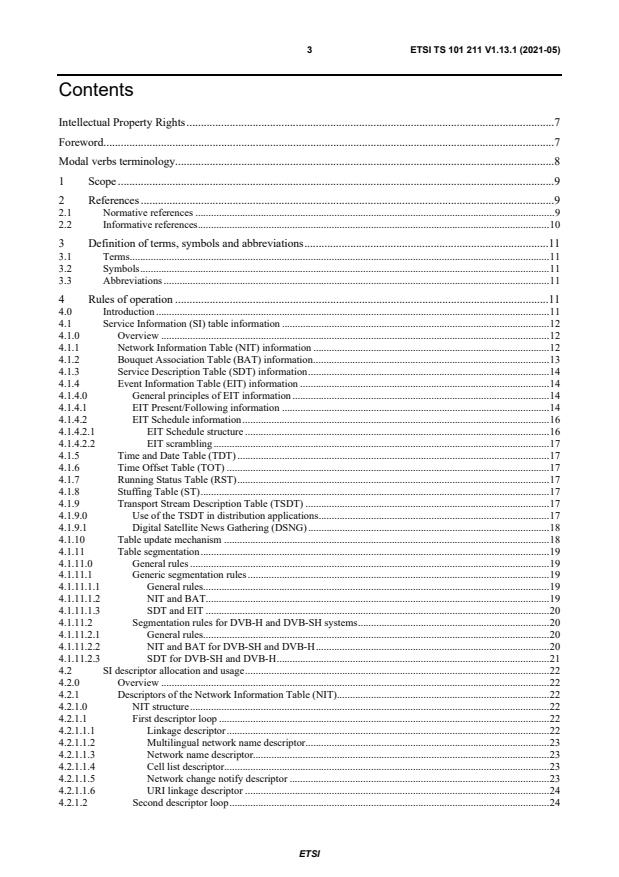
Contents
Intellectual Property Rights . 7
Foreword . 7
Modal verbs terminology . 8
1 Scope . 9
2 References . 9
2.1 Normative references . 9
2.2 Informative references . 10
3 Definition of terms, symbols and abbreviations . 11
3.1 Terms . 11
3.2 Symbols . 11
3.3 Abbreviations . 11
4 Rules of operation . 11
4.0 Introduction . 11
4.1 Service Information (SI) table information . 12
4.1.0 Overview . 12
4.1.1 Network Information Table (NIT) information . 12
4.1.2 Bouquet Association Table (BAT) information . 13
4.1.3 Service Description Table (SDT) information . 14
4.1.4 Event Information Table (EIT) information . 14
4.1.4.0 General principles of EIT information . 14
4.1.4.1 EIT Present/Following information . 14
4.1.4.2 EIT Schedule information . 16
4.1.4.2.1 EIT Schedule structure . 16
4.1.4.2.2 EIT scrambling . 17
4.1.5 Time and Date Table (TDT) . 17
4.1.6 Time Offset Table (TOT) . 17
4.1.7 Running Status Table (RST) . 17
4.1.8 Stuffing Table (ST) . 17
4.1.9 Transport Stream Description Table (TSDT) . 17
4.1.9.0 Use of the TSDT in distribution applications . 17
4.1.9.1 Digital Satellite News Gathering (DSNG) . 18
4.1.10 Table update mechanism . 18
4.1.11 Table segmentation . 19
4.1.11.0 General rules . 19
4.1.11.1 Generic segmentation rules . 19
4.1.11.1.1 General rules . 19
4.1.11.1.2 NIT and BAT . 19
4.1.11.1.3 SDT and EIT . 20
4.1.11.2 Segmentation rules for DVB-H and DVB-SH systems . 20
4.1.11.2.1 General rules . 20
4.1.11.2.2 NIT and BAT for DVB-SH and DVB-H . 20
4.1.11.2.3 SDT for DVB-SH and DVB-H . 21
4.2 SI descriptor allocation and usage . 22
4.2.0 Overview . 22
4.2.1 Descriptors of the Network Information Table (NIT) . 22
4.2.1.0 NIT structure . 22
4.2.1.1 First descriptor loop . 22
4.2.1.1.1 Linkage descriptor . 22
4.2.1.1.2 Multilingual network name descriptor . 23
4.2.1.1.3 Network name descriptor. 23
4.2.1.1.4 Cell list descriptor. 23
4.2.1.1.5 Network change notify descriptor . 23
4.2.1.1.6 URI linkage descriptor . 24
4.2.1.2 Second descriptor loop . 24
ETSI
4 ETSI TS 101 211 V1.13.1 (2021-05)
4.2.1.2.1 Delivery system descriptors . 24
4.2.1.2.2 Service list descriptor . 24
4.2.1.2.3 Frequency list descriptor . 25
4.2.1.2.4 Cell frequency link descriptor . 25
4.2.2 Descriptors of the Bouquet Association Table (BAT) . 25
4.2.2.0 BAT structure . 25
4.2.2.1 First descriptor loop . 25
4.2.2.1.1 Bouquet name descriptor . 25
4.2.2.1.2 CA identifier descriptor . 25
4.2.2.1.3 Country availability descriptor . 25
4.2.2.1.4 Linkage descriptor . 26
4.2.2.1.5 Multilingual bouquet name descriptor . 26
4.2.2.2 Second descriptor loop . 26
4.2.2.2.1 Service list descriptor . 26
4.2.3 Descriptors of the Service Description Table (SDT) . 27
4.2.3.0 SDT structure . 27
4.2.3.1 Announcement support descriptor . 27
4.2.3.2 CA identifier descriptor . 27
4.2.3.3 Component descriptor . 27
4.2.3.4 Country availability descriptor . 28
4.2.3.5 Data_broadcast_descriptor . 28
4.2.3.6 Linkage descriptor . 28
4.2.3.7 Mosaic descriptor . 28
4.2.3.8 Multilingual service name descriptor . 28
4.2.3.9 NVOD reference descriptor . 29
4.2.3.10 Service descriptor . 29
4.2.3.11 Service availability descriptor . 29
4.2.3.11.0 General rules . 29
4.2.3.11.1 Network Implementation Considerations . 30
4.2.3.11.2 IRD implementation considerations . 30
4.2.3.12 Service relocated descriptor . 31
4.2.3.13 Telephone descriptor . 31
4.2.3.14 Time shifted service descriptor . 31
4.2.4 Descriptors of the Event Information Table (EIT) . 32
4.2.4.0 EIT structure . 32
4.2.4.1 CA identifier descriptor . 32
4.2.4.2 Component descriptor . 32
4.2.4.3 Content descriptor . 33
4.2.4.4 Data_broadcast_descriptor . 33
4.2.4.5 Extended event descriptor . 33
4.2.4.6 Linkage descriptor . 33
4.2.4.7 Multilingual component descriptor . 34
4.2.4.8 Parental rating descriptor . 34
4.2.4.9 PDC descriptor . 34
4.2.4.10 Short event descriptor . 34
4.2.4.11 Telephone descriptor . 34
4.2.4.12 Time shifted event descriptor . 35
4.2.5 Descriptors of the Time Offset Table (TOT) . 35
4.2.5.0 TOT structure . 35
4.2.5.1 Local time offset descriptor. 35
4.2.6 Descriptors of the Program Map Table (PMT) . 36
4.2.6.0 PMT structure . 36
4.2.6.1 AC-3 descriptor . 36
4.2.6.2 Adaptation field data descriptor . 36
4.2.6.3 Ancillary data descriptor . 36
4.2.6.4 Audio preselection descriptor. 36
4.2.6.5 Data broadcast id descriptor . 37
4.2.6.6 Enhanced AC-3 descriptor . 37
4.2.6.7 Mosaic descriptor . 37
4.2.6.8 Related content descriptor . 37
4.2.6.9 Scrambling descriptor . 37
4.2.6.10 Service move descriptor . 37
ETSI
5 ETSI TS 101 211 V1.13.1 (2021-05)
4.2.6.11 Stream identifier descriptor . 38
4.2.6.12 Subtitling descriptor . 38
4.2.6.13 Supplementary audio descriptor . 38
4.2.6.14 T2-MI descriptor . 38
4.2.6.15 Teletext descriptor . 38
4.2.6.16 VBI data descriptor . 38
4.2.6.17 VBI teletext descriptor . 39
4.2.6.18 DTS Descriptor . 39
4.2.6.19 DTS-HD Descriptor . 39
4.2.6.20 DTS Neural Descriptor . 39
4.2.6.21 AC-4 descriptor . 39
4.2.6.22 TTML subtitling descriptor . 39
4.2.6.23 DTS-UHD descriptor . 39
4.2.7 Other descriptors . 40
4.2.7.1 Private data specifier descriptor . 40
4.2.7.2 Stuffing descriptor . 40
4.2.7.3 Data broadcast descriptor . 40
4.2.7.4 Transport stream descriptor . 40
4.2.7.5 Target region and target region name descriptors . 41
4.2.7.5.1 General Description . 41
4.2.7.5.2 Region selection by the IRD . 41
4.2.7.6 URI linkage descriptor . 42
4.2.7.7 FTA content management descriptor . 42
4.2.8 ISO/IEC 13818-1 descriptors . 42
4.2.9 Unknown descriptors . 42
4.3 Program Specific Information (PSI) and DVB SI operational interaction states . 43
4.4 Minimum repetition rates . 43
4.4.1 Satellite and cable delivery systems . 43
4.4.2 Terrestrial delivery systems . 44
4.4.3 PSI repetition rates . 44
4.5 Terrestrial systems . 45
4.5.0 General rules . 45
4.5.1 The use of alternative frequencies for multiplexes . 45
4.5.2 Regional or local services . 46
4.5.3 Hand-over . 48
4.5.3.1 General description of the requirements . 48
4.5.3.2 Hand-over by means of the frequency_list_descriptor . 49
4.5.3.3 The occurrence of tuning failures . 50
4.5.3.4 Hand-over methods with a reduced risk of tuning failures . 51
4.5.3.4.0 General principles . 51
4.5.3.4.1 Local SI insertion . 52
4.5.3.4.2 Cell identification . 52
4.5.3.4.3 Performance enhancement with GPS data . 52
4.5.3.4.4 Two front-end solution . 52
4.5.3.5 Performance considerations . 53
4.5.3.6 Receiver guidelines for hand-over . 53
4.5.3.6.1 Hand-over by means of the frequency_list_descriptor . 53
4.5.3.6.2 Hand-over by means of cell identification . 54
4.5.3.6.3 Hand-over by means of cell description and GPS position . 54
4.5.3.6.4 Hand-over with two-front-end solutions . 55
4.5.3.7 Additional linkage modes . 55
4.5.3.8 Additional remarks . 56
4.6 Text string formatting . 56
4.6.0 General rules . 56
4.6.1 Use of control codes in names . 56
4.6.2 Use of control codes in text . 57
4.6.3 Use of UTF-8 . 57
5 Applications . 57
5.0 Introduction . 57
5.1 NVOD services . 57
5.2 Mosaic services . 59
ETSI
6 ETSI TS 101 211 V1.13.1 (2021-05)
5.2.1 General considerations . 59
5.2.2 Relationship between mosaic service and SI/PSI Tables . 60
5.3 Transitions at broadcast delivery system boundaries . 61
5.3.0 Introduction. 61
5.3.1 Seamless transitions . 61
5.3.2 Non-seamless transitions without re-multiplexing. 62
5.3.3 Transitions with re-multiplexing . 62
5.4 Announcements . 63
6 Storage media . 63
6.0 General principles. 63
6.1 Program Association Table (PAT) . 63
6.2 Program Map Table (PMT) . 63
6.3 SI tables (NIT, SDT, EIT, BAT, RST, TDT, TOT) . 63
6.4 Selection Information Table (SIT) . 64
6.5 Discontinuity Information Table (DIT) . 64
Annex A (informative): Bibliography . 65
Annex B (informative): Change History . 66
History . 67
ETSI
7 ETSI TS 101 211 V1.13.1 (2021-05)
Intellectual Property Rights
Essential patents
IPRs essential or potentially essential to normative deliverables may have been declared to ETSI. The declarations
pertaining to these essential IPRs, if any, are publicly available for ETSI members and non-members, and can be
found in ETSI SR 000 314: "Intellectual Property Rights (IPRs); Essential, or potentially Essential, IPRs notified to
ETSI in respect of ETSI standards", which is available from the ETSI Secretariat. Latest updates are available on the
ETSI Web server (https://ipr.etsi.org/).
Pursuant to the ETSI Directives including the ETSI IPR Policy, no investigation regarding the essentiality of IPRs,
including IPR searches, has been carried out by ETSI. No guarantee can be given as to the existence of other IPRs not
referenced in ETSI SR 000 314 (or the updates on the ETSI Web server) which are, or may be, or may become,
essential to the present document.
Trademarks
The present document may include trademarks and/or tradenames which are asserted and/or registered by their owners.
ETSI claims no ownership of these except for any which are indicated as being the property of ETSI, and conveys no
right to use or reproduce any trademark and/or tradename. Mention of those trademarks in the present document does
not constitute an endorsement by ETSI of products, services or organizations associated with those trademarks.
DECT™, PLUGTESTS™, UMTS™ and the ETSI logo are trademarks of ETSI registered for the benefit of its
Members. 3GPP™ and LTE™ are trademarks of ETSI registered for the benefit of its Members and of the 3GPP
Organizational Partners. oneM2M™ logo is a trademark of ETSI registered for the benefit of its Members and of the ®
oneM2M Partners. GSM and the GSM logo are trademarks registered and owned by the GSM Association.
Foreword
This Technical Specification (TS) has been produced by Joint Technical Committee (JTC) Broadcast of the European
Broadcasting Union (EBU), Comité Européen de Normalisation ELECtrotechnique (CENELEC) and the European
Telecommunications Standards Institute (ETSI).
NOTE: The EBU/ETSI JTC Broadcast was established in 1990 to co-ordinate the drafting of standards in the
specific field of broadcasting and related fields. Since 1995 the JTC Broadcast became a tripartite body
by including in the Memorandum of Understanding also CENELEC, which is responsible for the
standardization of radio and television receivers. The EBU is a professional association of broadcasting
organizations whose work includes the co-ordination of its members' activities in the technical, legal,
programme-making and programme-exchange domains. The EBU has active members in about
60 countries in the European broadcasting area; its headquarters is in Geneva.
European Broadcasting Union
CH-1218 GRAND SACONNEX (Geneva)
Switzerland
Tel: +41 22 717 21 11
Fax: +41 22 717 24 81
The DVB Project is an industry-led consortium of broadcasters, manufacturers, network operators, software developers,
regulators and others from around the world committed to designing open, interoperable technical specifications for the
global delivery of digital media and broadcast services. DVB specifications cover all aspects of digital television from
transmission through interfacing, conditional access and interactivity for digital video, audio and data. The consortium
came together in 1993.
ETSI
8 ETSI TS 101 211 V1.13.1 (2021-05)
Modal verbs terminology
In the present document "shall", "shall not", "should", "should not", "may", "need not", "will", "will not", "can" and
"cannot" are to be interpreted as described in clause 3.2 of the ETSI Drafting Rules (Verbal forms for the expression of
provisions).
"must" and "must not" are NOT allowed in ETSI deliverables except when used in direct citation.
ETSI
9 ETSI TS 101 211 V1.13.1 (2021-05)
1 Scope
The present document provides implementation guidelines for the use and implementation of the DVB Service
Information (SI) coding in a DVB digital TV environment including satellite- cable- and terrestrial networks.
The guidelines are intended to be highly recommended rules for the usage of the DVB SI syntax specified in ETSI
EN 300 468 [1]. As such, they facilitate the efficient and reliable implementation of basic user-interaction functions in
Integrated Receiver-Decoders (IRD).
The rules apply to broadcasters, network operators as well as manufacturers.
The rules are specified in the form of constraints on the DVB SI streams or in terms of intended interpretation by IRDs.
The specification of these functions in no way prohibits IRD manufacturers from including additional features, and
should not be interpreted as stipulating any form of upper limit to the performance.
The guidelines do not cover features related to user-interface details or advanced Electronic Program Guides (EPG).
Such issues are left to the marketplace.
NOTE: It is highly recommended that the IRD should be designed to allow for future compatible extensions to
the DVB SI syntax. All the fields "reserved" (for ISO), "reserved_future_use" (for ETSI), and "user
defined" in the ETSI EN 300 468 [1] should be ignored by IRDs designed not to make use of them. The
"reserved" and "reserved_future_use" fields may be specified in the future by the respective bodies,
whereas the "user defined" fields will not be standardized.
The present document uses the terminology defined in ETSI EN 300 468 [1] and should be read in conjunction with that
EN.
2 References
2.1 Normative references
References are either specific (identified by date of publication and/or edition number or version number) or
non-specific. For specific references, only the cited version applies. For non-specific references, the latest version of the
referenced document (including any amendments) applies.
Referenced documents which are not found to be publicly available in the expected location might be found at
https://docbox.etsi.org/Reference/.
NOTE: While any hyperlinks included in this clause were valid at the time of publication, ETSI cannot guarantee
their long term validity.
The following referenced documents are necessary for the application of the present document.
[1] ETSI EN 300 468: "Digital Video Broadcasting (DVB); Specification for Service Information (SI)
in DVB systems".
[2] ISO/IEC 13818-1: "Information technology -- Generic coding of moving pictures and associated
audio information: Systems".
ETSI
10 ETSI TS 101 211 V1.13.1 (2021-05)
2.2 Informative references
References are either specific (identified by date of publication and/or edition number or version number) or
non-specific. For specific references, only the cited version applies. For non-specific references, the latest version of the
referenced document (including any amendments) applies.
NOTE: While any hyperlinks included in this clause were valid at the time of publication, ETSI cannot guarantee
their long term validity.
The following referenced documents are not necessary for the application of the present document but they assist the
user with regard to a particular subject area.
[i.1] ETSI EN 300 472: "Digital Video Broadcasting (DVB); Specification for conveying ITU-R
System B Teletext in DVB bitstreams".
[i.2] ETSI TS 101 162: "Digital Video Broadcasting (DVB); Allocation of identifiers and codes for
Digital Video Broadcasting (DVB) systems".
[i.3] ETSI EN 301 192: "Digital Video Broadcasting (DVB); DVB specification for data broadcasting".
[i.4] ETSI TR 101 202: "Digital Video Broadcasting (DVB); Implementation guidelines for Data
Broadcasting".
[i.5] Void.
[i.6] ETSI EN 300 744: "Digital Video Broadcasting (DVB); Framing structure, channel coding and
modulation for digital terrestrial television".
[i.7] ETSI TS 101 154: "Digital Video Broadcasting (DVB); Specification for the use of Video and
Audio Coding in Broadcast and Broadband Applications".
[i.8] ETSI EN 301 775: "Digital Video Broadcasting (DVB); Specification for the carriage of Vertical
Blanking Information (VBI) data in DVB bitstreams".
[i.9] ETSI EN 301 210: "Digital Video Broadcasting (DVB); Framing structure, channel coding and
modulation for Digital Satellite News Gathering (DSNG) and other contribution applications by
satellite".
[i.10] ETSI EN 300 231: "Television systems; Specification of the domestic video Programme Delivery
Control system (PDC)".
[i.11] ISO/IEC 13818-3: "Information technology -- Generic coding of moving pictures and associated
audio information -- Part 3: Audio".
[i.12] ISO/IEC 11172-3: "Information technology -- Coding of moving pictures and associated audio for
digital storage media at up to about 1,5 Mbit/s -- Part 3: Audio".
[i.13] ETSI EN 300 743: "Digital Video Broadcasting (DVB); Subtitling systems".
[i.14] ETSI EN 300 401: "Radio Broadcasting Systems; Digital Audio Broadcasting (DAB) to mobile,
portable and fixed receivers".
[i.15] ETSI TS 102 006: "Digital Video Broadcasting (DVB); Specification for System Software Update
in DVB Systems".
[i.16] Void.
[i.17] ETSI TS 102 201: "Digital Video Broadcasting (DVB); Interfaces for DVB Integrated Receiver
Decoder (DVB-IRD)".
[i.18] ETSI ETS 300 801: "Digital Video Broadcasting (DVB); Interaction channel through Public
Switched Telecommunications Network (PSTN) / Integrated Services Digital Networks (ISDN)".
[i.19] ETSI EN 301 193: "Digital Video Broadcasting (DVB); Interaction channel through the Digital
Enhanced Cordless Telecommunications (DECT)".
ETSI
11 ETSI TS 101 211 V1.13.1 (2021-05)
[i.20] ISO 639-2: "Codes for the representation of names of languages -- Part 2: Alpha-3 code".
TM
[i.21] ETSI TS 103 205: "Digital Video Broadcasting (DVB); Extensions to the CI Plus
Specification".
[i.22] ETSI TS 102 034: "Digital Video Broadcasting (DVB); Transport of MPEG-2 TS Based DVB
Services over IP Based Networks".
[i.23] ETSI TS 103 286-2: "Digital Video Broadcasting (DVB); Companion Screens and Streams;
Part 2: Content Identification and Media Synchronization".
[i.24] ETSI TS 102 323: "Digital Video Broadcasting (DVB); Carriage and signalling of TV-Anytime
information in DVB transport streams".
[i.25] DVB BlueBook A174: "Digital Video Broadcasting (DVB); TTML subtitling systems".
[i.26] ETSI TS 102 773: "Digital Video Broadcasting (DV
...
Questions, Comments and Discussion
Ask us and Technical Secretary will try to provide an answer. You can facilitate discussion about the standard in here.
Loading comments...