


ETSI TR 103 181-3 V1.1.1 (2016-08)
Short Range Devices (SRD) using Ultra Wide Band (UWB); Part 3: Worldwide UWB regulations between 3,1 and 10,6 GHz
Short Range Devices (SRD) using Ultra Wide Band (UWB); Part 3: Worldwide UWB regulations between 3,1 and 10,6 GHz
DTR/ERM-TGUWB-124
General Information
Standards Content (Sample)
TECHNICAL REPORT
Short Range Devices (SRD)
using Ultra Wide Band (UWB);
Part 3: Worldwide UWB regulations between 3,1 and 10,6 GHz
2 ETSI TR 103 181-3 V1.1.1 (2016-08)
Reference
DTR/ERM-TGUWB-124
Keywords
radio, SRD, UWB
ETSI
650 Route des Lucioles
F-06921 Sophia Antipolis Cedex - FRANCE
Tel.: +33 4 92 94 42 00 Fax: +33 4 93 65 47 16
Siret N° 348 623 562 00017 - NAF 742 C
Association à but non lucratif enregistrée à la
Sous-Préfecture de Grasse (06) N° 7803/88
Important notice
The present document can be downloaded from:
http://www.etsi.org/standards-search
The present document may be made available in electronic versions and/or in print. The content of any electronic and/or
print versions of the present document shall not be modified without the prior written authorization of ETSI. In case of any
existing or perceived difference in contents between such versions and/or in print, the only prevailing document is the
print of the Portable Document Format (PDF) version kept on a specific network drive within ETSI Secretariat.
Users of the present document should be aware that the document may be subject to revision or change of status.
Information on the current status of this and other ETSI documents is available at
https://portal.etsi.org/TB/ETSIDeliverableStatus.aspx
If you find errors in the present document, please send your comment to one of the following services:
https://portal.etsi.org/People/CommiteeSupportStaff.aspx
Copyright Notification
No part may be reproduced or utilized in any form or by any means, electronic or mechanical, including photocopying
and microfilm except as authorized by written permission of ETSI.
The content of the PDF version shall not be modified without the written authorization of ETSI.
The copyright and the foregoing restriction extend to reproduction in all media.
© European Telecommunications Standards Institute 2016.
All rights reserved.
TM TM TM
DECT , PLUGTESTS , UMTS and the ETSI logo are Trade Marks of ETSI registered for the benefit of its Members.
TM
3GPP and LTE™ are Trade Marks of ETSI registered for the benefit of its Members and
of the 3GPP Organizational Partners.
GSM® and the GSM logo are Trade Marks registered and owned by the GSM Association.
ETSI
3 ETSI TR 103 181-3 V1.1.1 (2016-08)
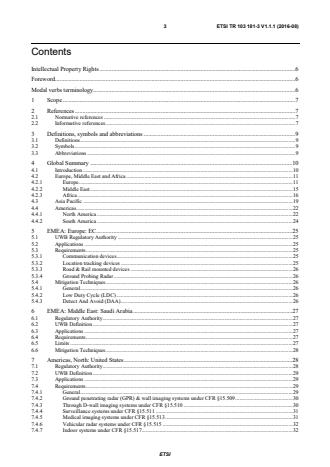
Contents
Intellectual Property Rights . 6
Foreword . 6
Modal verbs terminology . 6
1 Scope . 7
2 References . 7
2.1 Normative references . 7
2.2 Informative references . 7
3 Definitions, symbols and abbreviations . 9
3.1 Definitions . 9
3.2 Symbols . 9
3.3 Abbreviations . 9
4 Global Summary . 10
4.1 Introduction . 10
4.2 Europe, Middle East and Africa . 11
4.2.1 Europe . 11
4.2.2 Middle East . 15
4.2.3 Africa . 16
4.3 Asia Pacific . 19
4.4 Americas. 22
4.4.1 North America . 22
4.4.2 South America . 24
5 EMEA: Europe: EC . 25
5.1 UWB Regulatory Authority . 25
5.2 Applications . 25
5.3 Requirements . 25
5.3.1 Communication devices . 25
5.3.2 Location tracking devices . 25
5.3.3 Road & Rail mounted devices . 26
5.3.4 Ground Probing Radar . 26
5.4 Mitigation Techniques . 26
5.4.1 General . 26
5.4.2 Low Duty Cycle (LDC) . 26
5.4.3 Detect And Avoid (DAA) . 26
6 EMEA: Middle East: Saudi Arabia . 27
6.1 Regulatory Authority . 27
6.2 UWB Definition . 27
6.3 Applications . 27
6.4 Requirements . 27
6.5 Limits . 27
6.6 Mitigation Techniques . 28
7 Americas, North: United States . 28
7.1 Regulatory Authority . 28
7.2 UWB Definition . 29
7.3 Applications . 29
7.4 Requirements . 29
7.4.1 General . 29
7.4.2 Ground penetrating radar (GPR) & wall imaging systems under CFR §15.509 . 30
7.4.3 Through D-wall imaging systems under CFR §15.510 . 30
7.4.4 Surveillance systems under CFR §15.511 . 31
7.4.5 Medical imaging systems under CFR §15.513 . 31
7.4.6 Vehicular radar systems under CFR §15.515 . 32
7.4.7 Indoor systems under CFR §15.517 . 32
ETSI
4 ETSI TR 103 181-3 V1.1.1 (2016-08)
7.4.8 Handheld systems under CFR §15.519 . 32
7.4.9 Wideband systems under CFR section §15.250 . 33
7.5 Limits . 33
7.5.1 Ground penetrating radar & wall imaging systems under §15.509 . 33
7.5.2 Through-wall imaging systems under CFR §15.510 . 34
7.5.2.1 For through-wall imaging systems operating with the UWB bandwidth below 960 MHz . 34
7.5.2.2 For equipment operating with fC and fM between 1 990 MHz and 10 600 MHz . 35
7.5.3 Surveillance systems under CFR §15.511 . 35
7.5.4 Medical imaging systems under CFR §15.513 . 36
7.5.5 Vehicular radar systems under CFR §15.515 . 37
7.5.6 Indoor systems under CFR §15.517 . 37
7.5.7 Handheld systems under CFR §15.519 . 38
7.5.8 Wideband Systems under CFR §15.250 . 39
7.6 Mitigation Techniques . 40
7.7 FCC Waivers . 40
8 Americas, North: Canada . 41
8.1 Regulatory Authority . 41
8.2 UWB Definition . 41
8.3 Applications . 41
8.3.1 Indoor Communication Devices . 41
8.3.2 Handheld Communication Devices . 41
8.3.3 Ground penetrating radar . 42
8.3.4 In-wall radar imaging. 42
8.3.5 Through-wall imaging . 43
8.3.6 Radar surveillance. 43
8.3.7 Medical radar imaging . 43
8.4 Limits . 44
8.4.1 Radiated emissions at or below 960 MHz . 44
8.4.2 Indoor Communication Devices . 44
8.4.3 Handheld Communication Devices . 45
8.4.4 Ground Penetrating Radar (GPR) . 46
8.4.5 In-wall Imaging Radar . 46
8.4.6 Through-wall Imaging Radar . 47
8.4.7 Radar Surveillance Devices . 48
8.4.8 Medical Radar Imaging Devices . 48
8.5 Mitigation Techniques . 49
8.6 Measurement Techniques . 49
9 Asia: Australia . 49
9.1 Regulatory Authority . 49
9.2 UWB Definition . 49
9.3 Applications . 49
9.4 Requirements . 49
9.5 Limits . 50
9.6 Mitigation Techniques . 50
10 Asia: China . 51
10.1 Regulatory Authority . 51
10.2 UWB Definition . 51
10.3 Applications . 51
10.4 Requirements . 51
10.5 Limits . 51
10.6 Mitigation Techniques . 52
11 Asia: Japan . 52
11.1 Regulatory Authority . 52
11.2 UWB Definition . 52
11.3 Applications . 52
11.4 Requirements . 53
11.5 Limits . 53
11.6 Mitigation Techniques . 53
ETSI
5 ETSI TR 103 181-3 V1.1.1 (2016-08)
12 Asia: Korea . 54
12.1 Regulatory Authority . 54
12.2 UWB Definition . 54
12.3 Applications . 54
12.4 Requirements . 54
12.5 Limits . 54
12.6 Mitigation Techniques . 54
13 Asia: Malaysia . 55
13.1 Regulatory authority . 55
13.2 UWB Definition . 55
13.3 Applications . 55
13.4 Requirements . 55
13.4.1 General . 55
13.4.2 Communication Devices . 55
13.4.3 Automotive radar devices . 56
13.4.4 Imaging Devices . 56
13.5 Limits . 56
13.5.1 Communication devices . 56
13.5.2 Automotive radar devices . 57
13.5.3 Ground, in-wall & through-wall probing devices . 58
13.6 Mitigation Techniques . 58
14 Asia: New Zealand . 59
14.1 Regulatory Authority . 59
14.2 UWB Definition . 59
14.3 Applications . 59
14.4 Requirements . 59
14.5 Limits . 59
15 Asia: Singapore . 60
15.1 Regulatory authority . 60
15.2 UWB Definition . 60
15.3 Applications . 60
15.4 Requirements . 60
15.4.1 Generic requirements . 60
15.4.2 Communications Systems . 60
15.4.3 Radar / Imaging systems . 61
15.5 Limits . 61
15.5.1 Communications Systems . 61
15.5.2 Radar/Imaging systems . 62
16 Summary Application Support . 63
History . 64
ETSI
6 ETSI TR 103 181-3 V1.1.1 (2016-08)
Intellectual Property Rights
IPRs essential or potentially essential to the present document may have been declared to ETSI. The information
pertaining to these essential IPRs, if any, is publicly available for ETSI members and non-members, and can be found
in ETSI SR 000 314: "Intellectual Property Rights (IPRs); Essential, or potentially Essential, IPRs notified to ETSI in
respect of ETSI standards", which is available from the ETSI Secretariat. Latest updates are available on the ETSI Web
server (https://ipr.etsi.org/).
Pursuant to the ETSI IPR Policy, no investigation, including IPR searches, has been carried out by ETSI. No guarantee
can be given as to the existence of other IPRs not referenced in ETSI SR 000 314 (or the updates on the ETSI Web
server) which are, or may be, or may become, essential to the present document.
Foreword
This Technical Report (TR) has been produced by ETSI Technical Committee Electromagnetic compatibility and Radio
spectrum Matters (ERM).
The present document is part 3 of a multi-part deliverable covering UWB signal characteristics and related mitigation
techniques, as identified below:
Part 1: "UWB signal characteristics and overview CEPT&ECC and EC regulation";
Part 2: "UWB mitigation techniques";
Part 3: "Worldwide UWB regulations between 3,1 GHz and 10,6 GHz".
Modal verbs terminology
In the present document "should", "should not", "may", "need not", "will", "will not", "can" and "cannot" are to be
interpreted as described in clause 3.2 of the ETSI Drafting Rules (Verbal forms for the expression of provisions).
"must" and "must not" are NOT allowed in ETSI deliverables except when used in direct citation.
ETSI
7 ETSI TR 103 181-3 V1.1.1 (2016-08)
1 Scope
The present document presents a summary of the worldwide regulatory situation relating to UWB.
NOTE: The present document is a snapshot of the known UWB regulation world wide at May 2016. The reader is
invited to report any changes and additional information on UWB regulations and standards to ETSI.
2 References
2.1 Normative references
As informative publications shall not contain normative references this clause shall remain empty.
2.2 Informative references
References are either specific (identified by date of publication and/or edition number or version number) or
non-specific. For specific references, only the cited version applies. For non-specific references, the latest version of the
referenced document (including any amendments) applies.
NOTE: While any hyperlinks included in this clause were valid at the time of publication, ETSI cannot guarantee
their long term validity.
The following referenced documents are not necessary for the application of the present document but they assist the
user with regard to a particular subject area.
[i.1] ETSI EN 302 065-1 (V1.3.1): "Electromagnetic compatibility and Radio spectrum Matters (ERM);
Short Range Devices (SRD) using Ultra Wide Band technology (UWB); Harmonized EN covering
the essential requirements of article 3.2 of the R&TTE Directive; Part 1: Requirements for Generic
UWB applications".
[i.2] ETSI EN 302 065-2 (V1.1.1): "Electromagnetic compatibility and Radio spectrum Matters (ERM);
Short Range Devices (SRD) using Ultra Wide Band technology (UWB); Harmonized EN covering
the essential requirements of article 3.2 of the R&TTE Directive; Part 2: Requirements for UWB
location tracking".
[i.3] ETSI EN 302 065-3 (V1.1.1): "Electromagnetic compatibility and Radio spectrum Matters (ERM);
Short Range Devices (SRD) using Ultra Wide Band technology (UWB); Harmonized EN covering
the essential requirements of article 3.2 of the R&TTE Directive; Part 3: Requirements for UWB
devices for road and rail vehicles".
[i.4] ETSI EN 302 066-1: "ETSI EN 306 066-1: "Electromagnetic compatibility and Radio spectrum
Matters (ERM); Short Range Devices (SRD); Ground- and Wall- Probing Radar applications;
Part 1: Technical characteristics and test methods".
[i.5] ETSI EN 302 066-2: "Electromagnetic compatibility and Radio spectrum Matters (ERM); Ground-
and Wall- Probing Radar applications (GPR/WPR) imaging systems; Part 2: Harmonized EN
covering essential requirements of article 3.2 of the R&TTE Directive".
[i.6] Industry Canada: "Devices Using Ultra-Wideband (UWB) Technology", RSS-220, Issue 1,
March 2009.
[i.7] FCC Code of Federal Regulations 47.
[i.8] CITC RI085 Issue 1, 10/01/2010.
[i.9] Radio communications (Low Interference Potential Devices) Class Licence Variation Notice 2010
(No. 1) and subsequent amendments including compilation made 14th July 2014.
[i.10] MIIT File 354.
ETSI
8 ETSI TR 103 181-3 V1.1.1 (2016-08)
[i.11] ARIB: "UWB (Ultra-Wideband) Radio Systems", STD-T91 Version 2.0.
[i.12] KCC Radio Equipment Rules: "Revised 3/13/2012" KCC notice No. 2012-12.
[i.13] Communications and Multimedia Commission SKMM SRSP-549 UWB.
[i.14] New Zealand Gazette, 31/7/2008, No. 119, p. 3145.
[i.15] IDA: "Technical Specification for Ultra Wideband (UWB) Devices", Issue 1 Rev1, May 2011.
[i.16] ETSI TR 103 181-1 (V1.1.1): "Short Range Devices (SRD) using Ultra Wide Band (UWB);
Technical Report Part 1: UWB signal characteristics and overview CEPT/ECC and EC
regulation".
[i.17] ETSI TR 103 181-2 (V1.1.1): "Electromagnetic compatibility and Radio spectrum Matters (ERM);
Short Range Devices (SRD) using Ultra Wide Band (UWB);Transmission characteristics Part 2:
UWB mitigation techniques".
[i.18] ETSI EN 302 065 (V1.2.1): "Electromagnetic compatibility and Radio spectrum Matters (ERM);
Short Range Devices (SRD) using Ultra Wide Band technology (UWB) for communications
purposes; Harmonized EN covering the essential requirements of article 3.2 of the R&TTE
Directive".
[i.19] Recommendation ITU-R SM 1754: "Measurement techniques of ultra-wideband transmissions".
[i.20] Recommendation ITU-R SM.1757: "Impact of devices using ultra-wideband technology on
systems operating within radiocommunication services".
[i.21] ETSI TS 103 060: "Electromagnetic compatibility and Radio spectrum Matters (ERM); Short
Range Devices (SRD); Method for a harmonized definition of Duty Cycle Template (DCT)
transmission as a passive mitigation technique used by short range devices and related
conformance test methods".
[i.22] ECC Recommendation 70-03: "Relating to the use of Short Range Devices (SRD)".
[i.23] ECC Decision 06(04): "The availability of frequency bands for the introduction of Wide Band
Digital Land Mobile PMR/PAMR in the 400 MHz and 800/900 MHz bands".
[i.24] ETSI EN 302 500-2: "Electromagnetic compatibility and Radio spectrum Matters (ERM); Short
Range Devices (SRD) using Ultra WideBand (UWB) technology; Location Tracking equipment
operating in the frequency range from 6 GHz to 8,5 GHz; Part 2: Harmonized EN covering
essential requirements of article 3.2 of the R&TTE Directive".
[i.25] ETSI EN 301 489-1: "Electromagnetic compatibility and Radio spectrum Matters (ERM);
ElectroMagnetic Compatibility (EMC) standard for radio equipment and services;
Part 1: Common technical requirements".
[i.26] ETSI EN 301 489-32: "Electromagnetic compatibility and Radio spectrum Matters (ERM);
ElectroMagnetic Compatibility (EMC) standard for radio equipment and services;
Part 32: Specific conditions for Ground and Wall Probing Radar applications".
[i.27] ETSI EN 301 489-33: "Electromagnetic compatibility and Radio spectrum Matters (ERM);
ElectroMagnetic Compatibility (EMC) standard for radio equipment and services;
Part 33: Specific conditions for Ultra Wide Band (UWB) communications devices".
[i.28] Addendum 16 the GRFC decision May 7, 2007, No. 07-20-03-001.
[i.29] Addendum to the GRFC decision from December 15, 2009, No. 5/9/02-05-02.
ETSI
9 ETSI TR 103 181-3 V1.1.1 (2016-08)
3 Definitions, symbols and abbreviations
3.1 Definitions
For the purposes of the present document, the following definitions apply:
activity factor: reflects the effective transmission time ratio
maximum mean e.i.r.p. spectral density: highest signal strength measured in any direction at any frequency within
the defined range
NOTE: The mean e.i.r.p. spectral density is measured with a 1 MHz resolution bandwidth, an RMS detector and
an averaging time of 1 ms or less.
maximum peak e.i.r.p.: highest signal strength measured in any direction at any frequency within the defined range
NOTE: The peak e.i.r.p. is measured within a 50 MHz bandwidth centred on the frequency at which the highest
mean radiated power occurs.
3.2 Symbols
For the purposes of the present document, the symbols given in ETSI TS 103 060 [i.21] and the following apply:
fC Centre frequency
f frequency at which the highest radiated emission occurs
M
3.3 Abbreviations
For the purposes of the present document, the following abbreviations apply:
AC Alternating Current
ACMA Australian Communications and Media Authority
ARIB Association of Radio Industries and Businesses (Japan)
CEPT Commission Européenne des Postes et Télécommunications
CFR Code of Federal Regulations (USA)
CISPR Comité International Spécial des Perturbations Radioélectriques
CITC Communications and Information Technology Commission (Saudi Arabia)
DAA Detect And Avoid
e.i.r.p equivalent isotropically radiated power
EC European Commission
ECC European Communication Comity
EIRP Effective Isotropic Radiated Power
EMEA Europe, Middle East and Africa
FCC Federal Communications Commission (USA)
GPR Ground Probing Radar
GRFC General Radio Frequency Centre
IDA Info-communication Development Authority of Singapore
ILAC International Laboratory Accreditation Cooperation
KCC Korean Communication Commission (Korea)
LAES Location tracking Application for Emergency and disaster Situations
LDC Low Duty Cycle
MIIT Ministry of Industry & Information Technology (China)
RLM Robotic Lawn Mower
RMS Root Mean Square
SKMM Suruhanjaya Komunikasi dan Multimedia Malaysia (Malaysian Communications and Multimedia
Commission)
TBC To Be Confirmed
UAE United Arab Emirates
ETSI
10 ETSI TR 103 181-3 V1.1.1 (2016-08)
USA United States of America
WPR Wall Probing Radar
4 Global Summary
4.1 Introduction
This clause presents a summary of the global regulatory situation relating to UWB in the frequency range from 3,1 GHz
to 10,6 GHz. Each jurisdiction in the world is considered and the current situation presented in tabular form. This clause
is only concerned with UWB as a communications medium, it does not concern itself with other UWB uses for which
there may be additional regulations (e.g. ground penetrating radar, through wall imaging systems or automotive radar
applications).
Colours are used to give a visual indication of the status with the following meanings.
Table 1: Colour legend
Table Colour What does this mean?
Specific UWB regulations exist in the named jurisdiction
Specific UWB regulations do not exist in the named jurisdiction. Either:
• the regulatory regime remains to be clarified; or
• the regulations that most typically apply (usually FCC or ETSI) are listed
The various headings in the tables that follow have the following meanings.
Table 2: Heading legend
Table Heading What does this mean? Potential responses
Country The name of the jurisdiction
Do Specific UWB Has the communications regulatory body in Y = Yes
regulations exist? this jurisdiction introduced specific N = No
regulations governing the use of UWB in
this jurisdiction?
What is the regulatory What is the source of the regulations Where the jurisdiction has implemented
regime? governing the use of UWB in this specific regulations the source reference is
jurisdiction? listed.
Where the jurisdiction has not implemented
specific regulations, the usual approach to
such matters is described
What frequency range is What range of frequencies is permitted to Given in GHz range of frequencies
permitted? be used for UWB transmission at the mean e.g. 6,0 - 8,5 GHz
EIRP under the applicable regulatory
regime?
Do these regulations permit Does the applicable regulatory regime Y = Yes, regulations permit use outdoors
outdoor use? permit use of UWB outdoors? TBC = To be confirmed
N = No, regulations do not permit use
outdoors
e.i.r.p. (dBm / MHz) What is the maximum value of mean power Where known this is given in dBm / MHz
spectral density permitted under the otherwise it is marked as TBC
applicable regulatory regime?
Emission profile What is the spectral emissions profile This column refers to later clause in the
allowed under the applicable regulatory present document
regime?
ETSI
11 ETSI TR 103 181-3 V1.1.1 (2016-08)
4.2 Europe, Middle East and Africa
4.2.1 Europe
A short overview is given in table 3, for more details please check, clause 5 and ETSI TR 103 181-1 [i.16].
Table 3: Overview Europe
Do Do these Max mean
specific What frequency range is regs permit e.i.r.p.
Country What is the regulatory regime? Emission Profile
UWB regs permitted (GHz)? outdoor (dBm /
exist? use? MHz)
3,1 - 4,8 (see note)
ECC Rec 70-03 [i.22] / ECC Decision 06(04) [i.23] /
1 Albania Y 6,0 - 8,5 Y -41,3 ETSI clause 5
ETSI EN 302 065 [i.18]
8,5 - 9,0 (see note)
2 Andorra N Generally will approve ETSI compliant equipment 3,1 - 9,0 Y -41,3 ETSI clause 5
3,1 - 4,8 (see note)
ECC Rec 70-03 [i.22] / ECC Decision 06(04) [i.23] /
3 Austria Y 6,0 - 8,5 Y -41,3 ETSI clause 5
ETSI EN 302 065 [i.18]
8,5 - 9,0 (see note)
4 Belarus N Generally will approve ETSI compliant equipment 3,1 - 9,0 Y -41,3 ETSI clause 5
ECC Rec 70-03 [i.22] / ECC Decision 06(04) [i.23] / 3,1 - 4,8 (see note)
5 Belgium Y ETSI EN 302 065 [i.18] 6,0 - 8,5 Y -41,3 ETSI clause 5
8,5 - 9,0 (see note)
ECC Rec 70-03 [i.22] / ECC Decision 06(04) [i.23] / 3,1 - 4,8 (see note)
Bosnia &
6 Y ETSI EN 302 065 [i.18] 6,0 - 8,5 Y -41,3 ETSI clause 5
Herzegovina
8,5 - 9,0 (see note)
ECC Rec 70-03 [i.22] / ECC Decision 06(04) [i.23] / 3,1 - 4,8 (see note)
7 Bulgaria Y ETSI EN 302 065 [i.18] 6,0 - 8,5 Y -41,3 ETSI clause 5
8,5 - 9,0 (see note)
3,1 - 4,8 (see note)
Telecoms matters overseen by government of
8 Canary Islands Y 6,0 - 8,5 Y -41,3 ETSI clause 5
Spain
8,5 - 9,0 (see note)
ECC Rec 70-03 [i.22] / ECC Decision 06(04) [i.23] / 3,1 - 4,8 (see note)
9 Croatia Y ETSI EN 302 065 [i.18] 6,0 - 8,5 Y -41,3 ETSI clause 5
8,5 - 9,0 (see note)
ECC Rec 70-03 [i.22] / ECC Decision 06(04) [i.23] / 3,1 - 4,8 (see note)
10 Cyprus Y ETSI EN 302 065 [i.18] 6,0 - 8,5 Y -41,3 ETSI clause 5
8,5 - 9,0 (see note)
ECC Rec 70-03 [i.22] / ECC Decision 06(04) [i.23] / 3,1 - 4,8 (see note)
11 Czech Republic Y ETSI EN 302 065 [i.18] 6,0 - 8,5 Y -41,3 ETSI clause 5
8,5 - 9,0 (see note)
ETSI
12 ETSI TR 103 181-3 V1.1.1 (2016-08)
Do Do these Max mean
specific What frequency range is regs permit e.i.r.p.
Country What is the regulatory regime? Emission Profile
UWB regs permitted (GHz)? outdoor (dBm /
exist? use? MHz)
ECC Rec 70-03 [i.22] / ECC Decision 06(04) [i.23] / 3,1 - 4,8 (see note)
12 Denmark Y ETSI EN 302 065 [i.18] 6,0 - 8,5 Y -41,3 ETSI clause 5
8,5 - 9,0 (see note)
ECC Rec 70-03 [i.22] / ECC Decision 06(04) [i.23] / 3,1 - 4,8 (see note)
13 Estonia Y ETSI EN 302 065 [i.18] 6,0 - 8,5 Y -41,3 ETSI clause 5
8,5 - 9,0 (see note)
ECC Rec 70-03 [i.22] / ECC Decision 06(04) [i.23] / 3,1 - 4,8 (see note 1)
14 Finland Y ETSI EN 302 065 [i.18] 6,0 - 8,5 Y -41,3 ETSI clause 5
8,5 - 9,0 (see note)
ECC Rec 70-03 [i.22] / ECC Decision 06(04) [i.23] / 3,1 - 4,8 (see note)
15 France Y ETSI EN 302 065 [i.18] 6,0 - 8,5 Y -41,3 ETSI clause 5
8,5 - 9,0 (see note)
ECC Rec 70-03 [i.22] / ECC Decision 06(04) [i.23] / 3,1 - 4,8 (see note)
16 Germany Y ETSI EN 302 065 [i.18] 6,0 - 8,5 Y -41,3 ETSI clause 5
8,5 - 9,0 (see note)
3,1 - 4,8 (see note)
17 Gibraltar N Generally will approve ETSI compliant equipment 6,0 - 8,5 Y -41,3 ETSI clause 5
8,5 - 9,0 (see note)
ECC Rec 70-03 [i.22] / ECC Decision 06(04) [i.23] / 3,1 - 4,8 (see note)
18 Greece Y ETSI EN 302 065 [i.18] 6,0 - 8,5 Y -41,3 ETSI clause 5
8,5 - 9,0 (see note)
ECC Rec 70-03 [i.22] / ECC Decision 06(04) [i.23] / 3,1 - 4,8 (see note)
19 Hungary Y ETSI EN 302 065 [i.18] 6,0 - 8,5 Y -41,3 ETSI clause 5
8,5 - 9,0 (see note)
ECC Rec 70-03 [i.22] / ECC Decision 06(04) [i.23] / 3,1 - 4,8 (see note)
20 Iceland Y ETSI EN 302 065 [i.18] 6,0 - 8,5 Y -41,3 ETSI clause 5
8,5 - 9,0 (see note)
ECC Rec 70-03 [i.22] / ECC Decision 06(04) [i.23] / 3,1 - 4,8 (see note)
21 Ireland Y ETSI EN 302 065 [i.18] 6,0 - 8,5 Y -41,3 ETSI clause 5
8,5 - 9,0 (see note)
ECC Rec 70-03 [i.22] / ECC Decision 06(04) [i.23] / 3,1 - 4,8 (see note)
22 Italy Y ETSI EN 302 065 [i.18] 6,0 - 8,5 Y -41,3 ETSI clause 5
8,5 - 9,0 (see note)
ECC Rec 70-03 [i.22] / ECC Decision 06(04) [i.23] / 3,1 - 4,8 (see note)
23 Latvia Y ETSI EN 302 065 [i.18] 6,0 - 8,5 Y -41,3 ETSI clause 5
8,5 - 9,0 (see note)
ECC Rec 70-03 [i.22] / ECC Decision 06(04) [i.23]/ 3,1 - 4,8 (see note)
24 Lithuania Y ETSI EN 302 065 [i.18] 6,0 - 8,5 Y -41,3 ETSI clause 5
8,5 - 9,0 (see note)
ETSI
13 ETSI TR 103 181-3 V1.1.1 (2016-08)
Do Do these Max mean
specific What frequency range is regs permit e.i.r.p.
Country What is the regulatory regime? Emission Profile
UWB regs permitted (GHz)? outdoor (dBm /
exist? use? MHz)
ECC Rec 70-03 [i.22] / ECC Decision 06(04) [i.23] / 3,1 - 4,8 (see note)
25 Luxembourg Y ETSI EN 302 065 [i.18] 6
...
Questions, Comments and Discussion
Ask us and Technical Secretary will try to provide an answer. You can facilitate discussion about the standard in here.
Loading comments...