


ETSI EN 303 203-1 V1.1.1 (2014-11)
Electromagnetic compatibility and Radio spectrum Matters (ERM); Short Range Devices (SRD); Medical Body Area Network Systems (MBANSs) operating in the 2 483,5 MHz to 2 500 MHz range; Part 1: Technical characteristics and test methods
Electromagnetic compatibility and Radio spectrum Matters (ERM); Short Range Devices (SRD); Medical Body Area Network Systems (MBANSs) operating in the 2 483,5 MHz to 2 500 MHz range; Part 1: Technical characteristics and test methods
DEN/ERM-TG30-304
Elektromagnetna združljivost in zadeve v zvezi z radijskim spektrom (ERM) - Naprave kratkega dosega - Medicinska omrežja za merjenje parametrov človeškega telesa (MBANs), ki delujejo v frekvenčnem območju od 2 483,5 MHz do 2 500 MHz - 1. del: Tehnične karakteristike in preskusne metode
Ta standard določa tehnične karakteristike in preskusne metode za medicinska omrežja za merjenje parametrov človeškega telesa, ki delujejo v frekvenčnem območju od 2483,5 MHz do 2500 MHz. Ta standard bo obravnaval zahtevo CEPT WGFM v dokumentu ERM(13)49b017, da bo za izboljšanje združljivosti med MBANS in LP-AMI preiskani ustrezni mehanizmi za deljenje spektra.
General Information
Standards Content (Sample)
Draft ETSI EN 303 203-1 V1.1.0 (2014-07)
EUROPEAN STANDARD
Electromagnetic compatibility
and Radio spectrum Matters (ERM);
Short Range Devices (SRD);
Medical Body Area Network Systems (MBANSs)
operating in the 2 483,5 MHz to 2 500 MHz range;
Part 1: Technical characteristics and test methods
2 Draft ETSI EN 303 203-1 V1.1.0 (2014-07)
Reference
DEN/ERM-TG30-304
Keywords
health, network, testing, radio, SRD, system
ETSI
650 Route des Lucioles
F-06921 Sophia Antipolis Cedex - FRANCE
Tel.: +33 4 92 94 42 00 Fax: +33 4 93 65 47 16
Siret N° 348 623 562 00017 - NAF 742 C
Association à but non lucratif enregistrée à la
Sous-Préfecture de Grasse (06) N° 7803/88
Important notice
The present document can be downloaded from:
http://www.etsi.org
The present document may be made available in electronic versions and/or in print. The content of any electronic and/or
print versions of the present document shall not be modified without the prior written authorization of ETSI. In case of any
existing or perceived difference in contents between such versions and/or in print, the only prevailing document is the
print of the Portable Document Format (PDF) version kept on a specific network drive within ETSI Secretariat.
Users of the present document should be aware that the document may be subject to revision or change of status.
Information on the current status of this and other ETSI documents is available at
http://portal.etsi.org/tb/status/status.asp
If you find errors in the present document, please send your comment to one of the following services:
http://portal.etsi.org/chaircor/ETSI_support.asp
Copyright Notification
No part may be reproduced or utilized in any form or by any means, electronic or mechanical, including photocopying
and microfilm except as authorized by written permission of ETSI.
The content of the PDF version shall not be modified without the written authorization of ETSI.
The copyright and the foregoing restriction extend to reproduction in all media.
© European Telecommunications Standards Institute 2014.
All rights reserved.
TM TM TM
DECT , PLUGTESTS , UMTS and the ETSI logo are Trade Marks of ETSI registered for the benefit of its Members.
TM
3GPP and LTE™ are Trade Marks of ETSI registered for the benefit of its Members and
of the 3GPP Organizational Partners.
GSM® and the GSM logo are Trade Marks registered and owned by the GSM Association.
ETSI
3 Draft ETSI EN 303 203-1 V1.1.0 (2014-07)
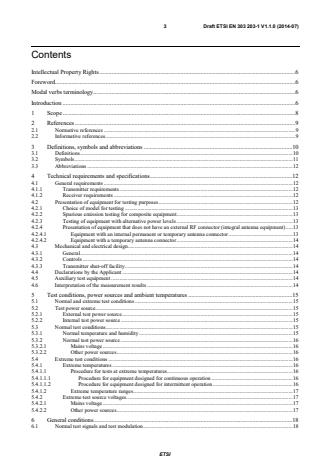
Contents
Intellectual Property Rights . 6
Foreword . 6
Modal verbs terminology . 6
Introduction . 6
1 Scope . 8
2 References . 9
2.1 Normative references . 9
2.2 Informative references . 9
3 Definitions, symbols and abbreviations . 10
3.1 Definitions . 10
3.2 Symbols . 11
3.3 Abbreviations . 12
4 Technical requirements and specifications . 12
4.1 General requirements . 12
4.1.1 Transmitter requirements . 12
4.1.2 Receiver requirements . 12
4.2 Presentation of equipment for testing purposes . 12
4.2.1 Choice of model for testing . 13
4.2.2 Spurious emission testing for composite equipment . 13
4.2.3 Testing of equipment with alternative power levels . 13
4.2.4 Presentation of equipment that does not have an external RF connector (integral antenna equipment) . 13
4.2.4.1 Equipment with an internal permanent or temporary antenna connector . 13
4.2.4.2 Equipment with a temporary antenna connector . 14
4.3 Mechanical and electrical design . 14
4.3.1 General . 14
4.3.2 Controls . 14
4.3.3 Transmitter shut-off facility . 14
4.4 Declarations by the Applicant . 14
4.5 Auxiliary test equipment . 14
4.6 Interpretation of the measurement results . 14
5 Test conditions, power sources and ambient temperatures . 15
5.1 Normal and extreme test conditions . 15
5.2 Test power source . 15
5.2.1 External test power source . 15
5.2.2 Internal test power source . 15
5.3 Normal test conditions . 15
5.3.1 Normal temperature and humidity . 15
5.3.2 Normal test power source . 16
5.3.2.1 Mains voltage . 16
5.3.2.2 Other power sources . 16
5.4 Extreme test conditions . 16
5.4.1 Extreme temperatures . 16
5.4.1.1 Procedure for tests at extreme temperatures . 16
5.4.1.1.1 Procedure for equipment designed for continuous operation . 16
5.4.1.1.2 Procedure for equipment designed for intermittent operation . 16
5.4.1.2 Extreme temperature ranges . 17
5.4.2 Extreme test source voltages . 17
5.4.2.1 Mains voltage . 17
5.4.2.2 Other power sources . 17
6 General conditions . 18
6.1 Normal test signals and test modulation . 18
ETSI
4 Draft ETSI EN 303 203-1 V1.1.0 (2014-07)
6.1.1 Normal modulation test signals for data . 18
6.2 Antennas . 18
6.3 Test fixture . 18
6.4 Test sites and general arrangements for radiated measurements . 19
6.5 Modes of operation of the transmitter . 19
6.6 Measuring receiver . 19
7 Measurement uncertainty . 20
8 Methods of measurement and limits for transmitter parameters . 20
8.1 Frequency error . 21
8.1.1 Definition . 21
8.1.1.1 Method of measurement for systems with an unmodulated carrier frequency operating mode . 21
8.1.1.2 Method of measurement for systems with a modulated output frequency . 21
8.1.2 Limits . 22
8.2 Emission bandwidth measurement . 22
8.2.1 Definition . 22
8.2.1.1 Method of measurement . 22
8.2.2 Limits . 22
8.3 Effective isotropic radiated power of the fundamental emission . 23
8.3.1 Definition . 23
8.3.1.1 Methods of measurement . 23
8.3.2 Limits . 24
8.4 Spurious emissions . 24
8.4.1 Definition . 24
8.4.1.1 Method of measuring the effective radiated power of spurious emissions. 24
8.4.2 Limits . 25
8.5 Out-of-band emissions . 26
8.5.1 Definition . 26
8.5.2 Methods of measurement . 26
8.5.3 Limits . 27
8.6 Frequency stability under low voltage conditions . 27
8.6.1 Definition . 27
8.6.1.1 Method of measurement . 28
8.6.2 Limits . 28
8.7 MBANS with restricted duty cycle . 28
8.7.1 Definitions . 28
8.7.2 Declaration of Duty Cycle . 28
8.7.3 Limit for duty cycle and maximum number of transmissions . 28
9 Methods of measurement and limits for receiver parameters . 28
9.1 Spurious radiation. 29
9.1.1 Definition . 29
9.1.1.1 Method of measuring the effective radiated power of spurious radiations. 29
9.1.2 Limits . 30
10 Requirements and Measuring Methods for Monitoring Systems . 30
10.1 Purpose . 30
10.2 General Remarks on the Measurement Configuration . 30
10.3 Adaptive Frequency Agility . 31
10.4 LBT threshold power level . 32
10.4.1 Measurement method using frequency administration commands . 32
10.4.2 Results based on above test method . 33
10.4.3 Limit . 33
10.5 Monitoring system bandwidth . 33
10.6 Minimum channel monitoring period . 33
10.6.1 Measurement method using frequency administration commands . 33
10.6.2 Results based on above test method . 33
10.6.3 Limit . 34
10.7 Channel access based on ambient levels relative to the calculated access LBT threshold level, P . 34
Th
10.7.1 Accessing an unoccupied channel. 34
10.7.2 Results accessing an unoccupied channel . 34
10.7.3 Accessing the Least Interfered Channel. 34
ETSI
5 Draft ETSI EN 303 203-1 V1.1.0 (2014-07)
10.7.4 Results accessing the LIC . 35
10.7.5 Limits . 35
Annex A (normative): Radiated measurements . 36
A.1 Test sites and arrangements for radiated measurements . 36
A.1.1 Outdoor test site . 36
A.1.2 Indoor test site . 36
A.1.3 Shielded anechoic test site . 37
A.2 Antennas . 39
A.2.1 Test antenna . 39
A.2.2 Substitution antenna . 39
A.3 Test practice and auxiliary test equipment . 40
A.3.1 Measuring distance . 40
A.3.2 Auxiliary cables . 40
Annex B (informative): Change History . 41
Annex C (informative): Bibliography . 42
History . 43
ETSI
6 Draft ETSI EN 303 203-1 V1.1.0 (2014-07)
Intellectual Property Rights
IPRs essential or potentially essential to the present document may have been declared to ETSI. The information
pertaining to these essential IPRs, if any, is publicly available for ETSI members and non-members, and can be found
in ETSI SR 000 314: "Intellectual Property Rights (IPRs); Essential, or potentially Essential, IPRs notified to ETSI in
respect of ETSI standards", which is available from the ETSI Secretariat. Latest updates are available on the ETSI Web
server (http://ipr.etsi.org).
Pursuant to the ETSI IPR Policy, no investigation, including IPR searches, has been carried out by ETSI. No guarantee
can be given as to the existence of other IPRs not referenced in ETSI SR 000 314 (or the updates on the ETSI Web
server) which are, or may be, or may become, essential to the present document.
Foreword
This draft European Standard (EN) has been produced by ETSI Technical Committee Electromagnetic compatibility
and Radio spectrum Matters (ERM), and is now submitted for the combined Public Enquiry and Vote phase of the ETSI
standards EN Approval Procedure.
The present document is part 1 of a multi-part deliverable covering Medical Body Area Network Systems (MBANSs)
operating in the 2 483,5 MHz to 2 500 MHz range, as described in the systems reference document for the equipment,
TR 101 557 [i.1], and as identified below:
Part 1: "Technical characteristics and test methods";
Part 2: "Harmonized EN covering the essential requirements of article 3.2 of the R&TTE Directive".
Proposed national transposition dates
Date of latest announcement of this EN (doa): 3 months after ETSI publication
Date of latest publication of new National Standard
or endorsement of this EN (dop/e): 6 months after doa
Date of withdrawal of any conflicting National Standard (dow): 6 months after doa
Modal verbs terminology
In the present document "shall", "shall not", "should", "should not", "may", "may not", "need", "need not", "will",
(Verbal forms
"will not", "can" and "cannot" are to be interpreted as described in clause 3.2 of the ETSI Drafting Rules
for the expression of provisions).
"must" and "must not" are NOT allowed in ETSI deliverables except when used in direct citation.
Introduction
The present document is part of a set of standards developed by ETSI and is designed to fit in a modular structure to
cover all radio and telecommunications terminal equipment within the scope of the R&TTE Directive [i.3]. The
modular structure is shown in EG 201 399 [i.4].
The present document describes the technical characteristics and test and performance requirements for Medical Body
Area Network Systems (MBANSs) operating in the 2 483,5 MHz to 2 500 MHz frequency range.
ETSI
7 Draft ETSI EN 303 203-1 V1.1.0 (2014-07)
Medical Body Area Networks are short-range low-power wireless networks, consisting of a plurality of body-worn
sensor devices and/or actuator devices and a hub device placed on/around the human body. The on-body sensor devices
are responsible for measuring key patient-specific information, such as the temperature, pulse, blood glucose level,
electrocardiogram, blood pressure level and respiratory function readings. The hub device acts as a central controller to
maintain the connections with all devices associated with its MBANS and is responsible for device
association/de-association and channel selection. The hub device also typically receives the data collected from the
various sensor devices on the body and may, depending on applications, process the data locally and/or further forward
it to a remote central station (e.g. remote nursing station) via an appropriate wired/wireless link for centralized
processing, display and storage.
Usually, MBANS devices are highly resource-constrained in terms of battery capacity, MCU capability and memory
size. Therefore, simple and low-power MBANS solutions are preferred from the application point of view. Currently,
most of mature low-power low-cost short-range radio solutions have spectrum efficiency around or less than 1 bps/Hz
and it is expected that MBANS solutions will have similar spectrum efficiency. Also to prolong battery life, MBANS
devices are expected to transmit with a limited duty cycle. The MBANS devices' duty cycle is not more than 10 % for
in-hospital applications and not more than 2 % for in-home applications.
In addition to the technical specifications, the present document provides measurement methods for MBANS equipment
which should support operation in healthcare facility mode or home mode, or both modes. These measurement methods
are to be implemented throughout the process of manufacturing and putting onto the market. And, if the MBANS
equipment is required to be checked for the purpose of market surveillance, it should be tested also in accordance with
the methods of measurement specified in the present document.
The present document is structured as follows:
• Clauses 1 through 3 provide a general description of the types of equipment covered by the present document
and the definitions of terms and symbols and abbreviations used.
• Clause 4 provides details of presentation of equipment for testing.
• Clauses 5 and 6 specify the test and general conditions for testing of the equipment.
• Clause 7 defines measurement uncertainties of the test system and gives the maximum measurement
uncertainty values which should not be exceeded.
• Clause 8 specifies the measurement of transmitter parameters, related to spectrum utilization, and which are
required to be measured, including frequency error, emission bandwidth, e.i.r.p. of the emission, spurious and
out-of-band emissions, and frequency stability.
• Clause 9 specifies measurement methods and limits for receiver parameters.
• Clause 10 provides the requirements and measuring methods for monitoring systems, primarily designed to
minimize the possibility of disturbance between MBANS equipment and other users of the 2 483,5 MHz to
2 500 MHz frequency range.
• Annex A (normative) gives the specifications concerning radiated measurements.
• Annex B (informative) provides the change history.
• Annex C (informative) provides bibliography.
ETSI
8 Draft ETSI EN 303 203-1 V1.1.0 (2014-07)
1 Scope
The present document covers the minimum characteristics of Medical Body Area Network System (MBANS),
including the spectrum monitoring and access requirements, considered necessary in order to make the best use of the
available spectrum within the 2 483,5 MHz to2 500 MHz frequency range and to avoid harmful interference between
MBANS and other users of this band. It does not necessarily include all the characteristics which may be required by a
user, nor does it necessarily represent the optimum performance achievable.
The types of devices that can belong to MBANSs are on-body and off-body medical sensors, patient monitoring devices
and medical actuators covered by the Medical Device Directive (Directive 93/42/EEC [i.7]).
The present document applies to the following MBANS applications which are considered to operate indoor:
• MBANS operating in the healthcare facility
• MBANS operating in the patient's home
The present document contains the following basic technical characteristics of MBANS radio equipment which are also
addressed in annex 2 of CEPT/ERC/REC 70-03 [i.2]:
• Healthcare facility MBANS with 1 mW maximum e.i.r.p. and not more than 10 % duty cycle over a maximum
emission bandwidth of 3 MHz.
• Patient's home MBANS with 10 mW maximum e.i.r.p. and not more than 2 % duty cycle over a maximum
emission bandwidth of 3 MHz.
ETSI
9 Draft ETSI EN 303 203-1 V1.1.0 (2014-07)
2 References
References are either specific (identified by date of publication and/or edition number or version number) or
non-specific. For specific references, only the cited version applies. For non-specific references, the latest version of the
referenced document (including any amendments) applies.
Referenced documents which are not found to be publicly available in the expected location might be found at
http://docbox.etsi.org/Reference.
NOTE: While any hyperlinks included in this clause were valid at the time of publication, ETSI cannot guarantee
their long term validity.
2.1 Normative references
The following referenced documents are necessary for the application of the present document.
[1] CISPR 16-2-3 (2010): "Specification for radio disturbance and immunity measuring apparatus and
methods - Part 2-3: Methods of measurement of disturbances and immunity - Radiated disturbance
measurements".
[2] ETSI TR 100 028 (V1.4.1): "Electromagnetic compatibility and Radio spectrum Matters (ERM);
Uncertainties in the measurement of mobile radio equipment characteristics".
2.2 Informative references
The following referenced documents are not necessary for the application of the present document but they assist the
user with regard to a particular subject area.
[i.1] ETSI TR 101 557: "Electromagnetic compatibility and Radio spectrum Matters (ERM); System
Reference document (SRdoc); Medical Body Area Network Systems (MBANSs) in the
1 785 MHz to 2 500 MHz range".
[i.2] CEPT/ERC/REC 70-03: "Relating to the use of Short Range Devices (SRD)".
[i.3] Directive 1999/5/EC of the European Parliament and of the Council of 9 March 1999 on radio
equipment and telecommunications terminal equipment and the mutual recognition of their
conformity (R&TTE Directive).
[i.4] ETSI EG 201 399 (V2.2.1): "Electromagnetic compatibility and Radio spectrum Matters (ERM);
A guide to the production of Harmonized Standards for application under the R&TTE Directive".
[i.5] CEPT/ERC/REC 74-01: "Unwanted emissions in the spurious domain".
[i.6] Recommendation ITU-T O.153: "Basic parameters for the measurement of error performance at
bit rates below the primary rate".
[i.7] Directive 93/42/EEC of the Council of 14 June 1993 concerning medical devices.
ETSI
10 Draft ETSI EN 303 203-1 V1.1.0 (2014-07)
3 Definitions, symbols and abbreviations
3.1 Definitions
For the purposes of the present document, the following terms and definitions apply:
Adaptive Frequency Agility (AFA): ability to determine and change to an unoccupied or least interfered sub-band or
channel of operation in order to maximize spectrum utilization
composite equipment: any combined equipment made of two or more individual products or functions
NOTE: The individual products or functions in composite equipment might be subject to different technical
standards.
conducted measurements: measurements that are made using a direct connection to the equipment under test
dedicated antenna: removable antenna supplied and tested with the radio equipment, designed as an indispensable part
of the equipment
duly authorized healthcare professional: physician or other individual authorized by law to provide healthcare
services using prescription medical devices
duty cycle: ratio, expressed as a percentage, of the maximum transmitter "on" time monitored over one hour, relative to
a one hour period
NOTE: See clause 8.7.
effective isotropically radiated power (e.i.r.p.): product of the power supplied to the antenna and the antenna gain in a
given direction relative to an isotropic antenna
NOTE: See clause 8.3.
effective radiated power: power radiated within the emission bandwidth of the EUT in the direction of the maximum
level under specified conditions of measurements in the presence of modulation or without modulation as appropriate
emission bandwidth: measured as the width of the signal between the points on either side of centre frequency that are
20 dB down relative to the maximum level of the modulated signal
frequency administration commands: commands, exclusively intended for testing purposes, which place the unit
under test in a specific frequency configuration, such as a channel or sub-set of channels
frequency error: difference between the nominal frequency as measured on the devices under test and under normal
test conditions and the frequency under extreme conditions
frequency range: range of operating frequencies over which the equipment can be adjusted
NOTE: See also clause 8.1.1.
frequency stability under low voltage condition: ability of the equipment to remain on the nominal operating
frequency when the battery voltage falls below the lower extreme voltage level
NOTE: See also clause 8.6.1.
healthcare facility: hospital or other establishment where medical care is provided by authorized healthcare
professionals
healthcare facility mode: operational regime by which MBANS equipment is intended to be operated exclusively
within healthcare facilities
home mode: operational regime by which MBANS equipment is intended to be operated exclusively within patient
residences
integral antenna: permanent fixed antenna, which may be built-in, designed as an indispensable part of the equipment
ETSI
11 Draft ETSI EN 303 203-1 V1.1.0 (2014-07)
LBT threshold power level: ambient signal power level above which the monitoring system selects spectrum for
MBANS transmissions according to the next available channel
Least Interfered Channel (LIC): channel, among the available channels, that has the lowest potential for causing
disturbance to or receiving disturbance from other users of the band
Listen Before Talk (LBT): combination of the listen mode followed by the talk mode
listen mode: action taken by an interrogator to detect an unoccupied sub-band or channel
medical actuator: medical device responsible for performing an action on the human body for diagnostic and/or
therapeutic purposes (e.g. an infusion pump)
Medical Body Area Network System (MBANS): low power radio system used for the indoor transmission of non-
voice data to and from medical devices for the purposes of monitoring, diagnosing and treating patients as prescribed by
duly authorized healthcare professionals
NOTE: A MBANS consists of one or more on-body wireless medical sensor devices and/or medical actuator
devices that can communicate with a monitoring device placed on/around the human body. Such
monitoring devices, in their role of MBANS hub, display and process physiological parameters from
MBANS devices and may also forward them (e.g. to a central nurse station) by using wired or wireless
technologies other than MBANSs. MBANS hubs control MBANS devices for the purpose of providing
monitoring, diagnosis and treatment of patients. Implantable devices are not part of MBANSs.
MBANS hub: medical device that selects the frequency of operation, gives instructions to participating devices of the
MBANS, and controls system operation
medical device: any instrument, apparatus, appliance, material or other article, falling under the Medical Device
Directive (Directive 93/42/EEC [i.7]), whether used alone or in combination, together with any accessories or software
for its proper functioning, intended by the manufacturer to be used for human beings in the:
• diagnosis, prevention, monitoring, treatment or alleviation of disease or injury;
• investigation, replacement or modification of the anatomy or of a physiological process;
• control of conception.
medical sensor: medical device responsible for the collection of physiological parameters for diagnostic and/or
therapeutic purposes
monitoring system: circuitry that assures conformity with the spectrum access protocol requirements based on Listen
Before Talk, Adaptive Frequency Agility and selection of the Least Interfered Channel for operation (LIC) or the
unoccupied sub-band or channel
out-of-band emissions: emissions on a frequency or frequencies immediately outside the necessary emission
bandwidth, which result from the modulation process, but excluding emissions in the spurious domain
Power Spectral Density (PSD): amount of the total power inside the measuring receiver bandwidth expressed in
dBm/Hz
spurious domain emissions: emissions at frequencies separated by more than 250 % of the occupied bandwidth from
the centre of the occupied spectrum
spurious radiations from the receiver: components at any frequency, generated and radiated by active receiver
circuitry and the antenna
NOTE: See clause 9.1.1.
talk mode: transmission of intentional radiation by a transmitter
3.2 Symbols
For the purposes of the present document, the following symbols apply:
B emission bandwidth
ETSI
12 Draft ETSI EN 303 203-1 V1.1.0 (2014-07)
dB decibel
dBm absolute power level referred to one milliwatt
e.i.r.p. effective isotropically radiated power
f frequency
f channel centre frequency
c
fe frequency under extreme conditions
G Antenna Gain
P power
ppm parts per million
R distance
P maximum threshold power level (see clause 10)
Th
T temperature
t time
λ wavelength (lambda)
3.3 Abbreviations
For the purposes of the present document, the following abbreviations apply:
AC Alternating Current
AFA Adaptive Frequency Agility
BW Bandwidth
CW Continuous Wave
DC Direct Current
DUT Device Under Test
EMC ElectroMagnetic Compatibility
EUT Equipment Under Test
LBT Listen Before Talk
LIC Least Interfered Channel
MBANS Medical Body Area Network System
MCU Micro Controller Unit
PSD Power Spectral Density
r.m.s. root mean square
RBW Resolution BandWidth
RF Radio Frequency
SRD Short Range Device
VSWR Voltage Standing Wave Ratio
4 Technical requirements and specifications
4.1 General requirements
4.1.1 Transmitter requirements
See clause 8 for transmitter requirements.
4.1.2 Receiver requirements
See clause 9 for receiver requirements.
4.2 Presentation of equipment for testing purposes
Each equipment submitted for testing shall fulfil the requirements of the present document on all frequencies over
which it is intended to operate. Compliance with this requirement should be shown by testing each unit on a frequency
near 2 490 MHz according to its intended function.
ETSI
13 Draft ETSI EN 303 203-1 V1.1.0 (2014-07)
The provider shall declare the range of operating conditions and power requirements, as applicable; to establish the
appropriate test conditions.
Additionally, technical documentation and operating manuals, sufficient to make the test, shall be supplied for all
MBANS devices.
Measurements shall be performed, according to the present document, on samples of equipment defined in clause 4.2.
The physical arrangement used for the testing shall be fully documented in the test report.
4.2.1 Choice of model for testing
The provider shall supply one or more samples of each model or type of transmitter, as appropriate for testing. Any
ancillary equipment needed for testing shall be provided as requested by the testing laboratory.
Depending on its intended use, MBANS equipment shall operate in either healthcare facility mode or home mode. The
provider shall declare whether the MBANS equipment supports operation in healthcare facility mode, home mode, or
both modes. The transmitter parameter tests according to clause 8 shall be carried out in all supported modes, as
declared by the provider. Different test limits may be applicable for healthcare facility mode and home mode.
If an equipment has several optional features, considered not to affect the RF parameters, then the tests need only to be
performed on the equipment configured with that combination of features considered to be the most complex or most
likely to affect the RF parameters, as proposed by the provider, agreed to by the test laboratory and recorded in the test
report.
4.2.2 Spurious emission testing for composite equipment
A composite equipment consisting of an MBANS transmitter and a specific type of host equipment such as a computer
for digital data recovery or programming/controlling the MBANS device should be tested according to the following
requirements.
For emission tests, the most appropriate EMC standard shall be applied to the non-radio part of the host equipment.
The emissions requirements in the applicable clauses of the present document apply only to the MBANS radio part of
the composite equipment.
In the case where the radio device is integrated and cannot operate independently, emissions from the non-radio part
shall be tested with the radio part disabled.
With the radio operating in transmit, receive and standby (if applicable) modes, the emission requirements of the
present document shall be applied.
Additional requirements and limits for multi radio equipment are set out in the relevant radio product standards
applicable to the other radio parts.
4.2.3 Testing of equipment with alternative power levels
Equipment designed to operate with different emitted powers shall have each transmitter parameter tested on samples of
equipment defined in clause 4.2.1. See clause 8 for details on testing. Spurious emissions tests shall be performed in
accordance with requirements in clause 8.4.
4.2.4 Presentation of equipment that does not have an external RF
connector (integral antenna equipment)
4.2.4.1 Equipment with an internal permanent or temporary antenna connector
The means to access and/or implement the internal permanent or temporary connector shall be stated by the provider
with the aid of a diagram. The fact that use has been made of the internal antenna connection, or of a temporary
connection, to facilitate measurements shall be recorded in the test report.
ETSI
14 Draft ETSI EN 303 203-1 V1.1.0 (2014-07)
4.2.4.2 Equipment with a temporary antenna connector
The provider may submit one set of equipment with the normal antenna connected, to enable the radiated measurements
to be made. The provider shall attend the test laboratory at the conclusion of the radiated measurements, to disconnect
...
EUROPEAN STANDARD
Electromagnetic compatibility
and Radio spectrum Matters (ERM);
Short Range Devices (SRD);
Medical Body Area Network Systems (MBANSs)
operating in the 2 483,5 MHz to 2 500 MHz range;
Part 1: Technical characteristics and test methods
2 ETSI EN 303 203-1 V1.1.1 (2014-11)
Reference
DEN/ERM-TG30-304
Keywords
health, network, radio, SRD, system, testing
ETSI
650 Route des Lucioles
F-06921 Sophia Antipolis Cedex - FRANCE
Tel.: +33 4 92 94 42 00 Fax: +33 4 93 65 47 16
Siret N° 348 623 562 00017 - NAF 742 C
Association à but non lucratif enregistrée à la
Sous-Préfecture de Grasse (06) N° 7803/88
Important notice
The present document can be downloaded from:
http://www.etsi.org
The present document may be made available in electronic versions and/or in print. The content of any electronic and/or
print versions of the present document shall not be modified without the prior written authorization of ETSI. In case of any
existing or perceived difference in contents between such versions and/or in print, the only prevailing document is the
print of the Portable Document Format (PDF) version kept on a specific network drive within ETSI Secretariat.
Users of the present document should be aware that the document may be subject to revision or change of status.
Information on the current status of this and other ETSI documents is available at
http://portal.etsi.org/tb/status/status.asp
If you find errors in the present document, please send your comment to one of the following services:
http://portal.etsi.org/chaircor/ETSI_support.asp
Copyright Notification
No part may be reproduced or utilized in any form or by any means, electronic or mechanical, including photocopying
and microfilm except as authorized by written permission of ETSI.
The content of the PDF version shall not be modified without the written authorization of ETSI.
The copyright and the foregoing restriction extend to reproduction in all media.
© European Telecommunications Standards Institute 2014.
All rights reserved.
TM TM TM
DECT , PLUGTESTS , UMTS and the ETSI logo are Trade Marks of ETSI registered for the benefit of its Members.
TM
3GPP and LTE™ are Trade Marks of ETSI registered for the benefit of its Members and
of the 3GPP Organizational Partners.
GSM® and the GSM logo are Trade Marks registered and owned by the GSM Association.
ETSI
3 ETSI EN 303 203-1 V1.1.1 (2014-11)
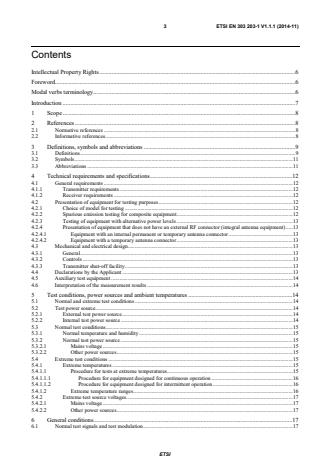
Contents
Intellectual Property Rights . 6
Foreword . 6
Modal verbs terminology . 6
Introduction . 7
1 Scope . 8
2 References . 8
2.1 Normative references . 8
2.2 Informative references . 8
3 Definitions, symbols and abbreviations . 9
3.1 Definitions . 9
3.2 Symbols . 11
3.3 Abbreviations . 11
4 Technical requirements and specifications . 12
4.1 General requirements . 12
4.1.1 Transmitter requirements . 12
4.1.2 Receiver requirements . 12
4.2 Presentation of equipment for testing purposes . 12
4.2.1 Choice of model for testing . 12
4.2.2 Spurious emission testing for composite equipment . 12
4.2.3 Testing of equipment with alternative power levels . 13
4.2.4 Presentation of equipment that does not have an external RF connector (integral antenna equipment) . 13
4.2.4.1 Equipment with an internal permanent or temporary antenna connector . 13
4.2.4.2 Equipment with a temporary antenna connector . 13
4.3 Mechanical and electrical design . 13
4.3.1 General . 13
4.3.2 Controls . 13
4.3.3 Transmitter shut-off facility . 13
4.4 Declarations by the Applicant . 13
4.5 Auxiliary test equipment . 14
4.6 Interpretation of the measurement results . 14
5 Test conditions, power sources and ambient temperatures . 14
5.1 Normal and extreme test conditions . 14
5.2 Test power source . 14
5.2.1 External test power source . 14
5.2.2 Internal test power source . 14
5.3 Normal test conditions . 15
5.3.1 Normal temperature and humidity . 15
5.3.2 Normal test power source . 15
5.3.2.1 Mains voltage . 15
5.3.2.2 Other power sources . 15
5.4 Extreme test conditions . 15
5.4.1 Extreme temperatures . 15
5.4.1.1 Procedure for tests at extreme temperatures . 15
5.4.1.1.1 Procedure for equipment designed for continuous operation . 16
5.4.1.1.2 Procedure for equipment designed for intermittent operation . 16
5.4.1.2 Extreme temperature ranges . 16
5.4.2 Extreme test source voltages . 17
5.4.2.1 Mains voltage . 17
5.4.2.2 Other power sources . 17
6 General conditions . 17
6.1 Normal test signals and test modulation . 17
ETSI
4 ETSI EN 303 203-1 V1.1.1 (2014-11)
6.1.1 Normal modulation test signals for data . 17
6.2 Antennas . 17
6.3 Test fixture . 17
6.4 Test sites and general arrangements for radiated measurements . 18
6.5 Modes of operation of the transmitter . 18
6.6 Measuring receiver . 18
7 Measurement uncertainty . 19
8 Methods of measurement and limits for transmitter parameters . 20
8.1 Frequency error . 20
8.1.1 Definition . 20
8.1.1.1 Method of measurement for systems with an unmodulated carrier frequency operating mode . 20
8.1.1.2 Method of measurement for systems with a modulated output frequency . 21
8.1.2 Limits . 21
8.2 Emission bandwidth measurement . 21
8.2.1 Definition . 21
8.2.1.1 Method of measurement . 21
8.2.2 Limits . 22
8.3 Effective isotropic radiated power of the fundamental emission . 22
8.3.1 Definition . 22
8.3.1.1 Methods of measurement . 22
8.3.2 Limits . 23
8.4 Spurious emissions . 23
8.4.1 Definition . 23
8.4.1.1 Method of measuring the effective radiated power of spurious emissions. 23
8.4.2 Limits . 25
8.5 Out-of-band emissions . 25
8.5.1 Definition . 25
8.5.2 Methods of measurement . 25
8.5.3 Limits . 27
8.6 Frequency stability under low voltage conditions . 27
8.6.1 Definition . 27
8.6.1.1 Method of measurement . 27
8.6.2 Limits . 27
8.7 MBANS with restricted duty cycle . 27
8.7.1 Definitions . 27
8.7.2 Declaration of Duty Cycle . 28
8.7.3 Limit for duty cycle and maximum number of transmissions . 28
9 Methods of measurement and limits for receiver parameters . 28
9.1 Spurious radiation. 28
9.1.1 Definition . 28
9.1.1.1 Method of measuring the effective radiated power of spurious radiations. 28
9.1.2 Limits . 29
10 Requirements and Measuring Methods for Monitoring Systems . 30
10.1 Purpose . 30
10.2 General Remarks on the Measurement Configuration . 30
10.3 Adaptive Frequency Agility . 30
10.4 LBT threshold power level . 32
10.4.1 Measurement method using frequency administration commands . 32
10.4.2 Results based on above test method . 32
10.4.3 Limit . 32
10.5 Monitoring system bandwidth . 32
10.6 Minimum channel monitoring period . 32
10.6.1 Measurement method using frequency administration commands . 33
10.6.2 Results based on above test method . 33
10.6.3 Limit . 33
10.7 Channel access based on ambient levels relative to the calculated access LBT threshold level, P . 33
Th
10.7.1 Accessing an unoccupied channel. 33
10.7.2 Results accessing an unoccupied channel . 34
10.7.3 Accessing the Least Interfered Channel. 34
ETSI
5 ETSI EN 303 203-1 V1.1.1 (2014-11)
10.7.4 Results accessing the LIC . 34
10.7.5 Limits . 34
Annex A (normative): Radiated measurements . 35
A.1 Test sites and arrangements for radiated measurements . 35
A.1.1 Outdoor test site . 35
A.1.2 Indoor test site . 35
A.1.3 Shielded anechoic test site . 36
A.2 Antennas . 38
A.2.1 Test antenna . 38
A.2.2 Substitution antenna . 38
A.3 Test practice and auxiliary test equipment . 39
A.3.1 Measuring distance . 39
A.3.2 Auxiliary cables . 39
Annex B (informative): Change History . 40
Annex C (informative): Bibliography . 41
History . 42
ETSI
6 ETSI EN 303 203-1 V1.1.1 (2014-11)
Intellectual Property Rights
IPRs essential or potentially essential to the present document may have been declared to ETSI. The information
pertaining to these essential IPRs, if any, is publicly available for ETSI members and non-members, and can be found
in ETSI SR 000 314: "Intellectual Property Rights (IPRs); Essential, or potentially Essential, IPRs notified to ETSI in
respect of ETSI standards", which is available from the ETSI Secretariat. Latest updates are available on the ETSI Web
server (http://ipr.etsi.org).
Pursuant to the ETSI IPR Policy, no investigation, including IPR searches, has been carried out by ETSI. No guarantee
can be given as to the existence of other IPRs not referenced in ETSI SR 000 314 (or the updates on the ETSI Web
server) which are, or may be, or may become, essential to the present document.
Foreword
This European Standard (EN) has been produced by ETSI Technical Committee Electromagnetic compatibility and
Radio spectrum Matters (ERM).
The present document is part 1 of a multi-part deliverable covering Medical Body Area Network Systems (MBANSs)
operating in the 2 483,5 MHz to 2 500 MHz range, as described in the systems reference document for the equipment,
TR 101 557 [i.1], and as identified below:
Part 1: "Technical characteristics and test methods";
Part 2: "Harmonized EN covering the essential requirements of article 3.2 of the R&TTE Directive".
National transposition dates
Date of adoption of this EN: 30 October 2014
Date of latest announcement of this EN (doa): 31 January 2015
Date of latest publication of new National Standard
or endorsement of this EN (dop/e): 31 July 2015
Date of withdrawal of any conflicting National Standard (dow): 31 July 2015
Modal verbs terminology
In the present document "shall", "shall not", "should", "should not", "may", "may not", "need", "need not", "will",
"will not", "can" and "cannot" are to be interpreted as described in clause 3.2 of the ETSI Drafting Rules (Verbal forms
for the expression of provisions).
"must" and "must not" are NOT allowed in ETSI deliverables except when used in direct citation.
ETSI
7 ETSI EN 303 203-1 V1.1.1 (2014-11)
Introduction
The present document is part of a set of standards developed by ETSI and is designed to fit in a modular structure to
cover all radio and telecommunications terminal equipment within the scope of the R&TTE Directive [i.3]. The
modular structure is shown in EG 201 399 [i.4].
The present document describes the technical characteristics and test and performance requirements for Medical Body
Area Network Systems (MBANSs) operating in the 2 483,5 MHz to 2 500 MHz frequency range.
Medical Body Area Networks are short-range low-power wireless networks, consisting of a plurality of body-worn
sensor devices and/or actuator devices and a hub device placed on/around the human body. The on-body sensor devices
are responsible for measuring key patient-specific information, such as the temperature, pulse, blood glucose level,
electrocardiogram, blood pressure level and respiratory function readings. The hub device acts as a central controller to
maintain the connections with all devices associated with its MBANS and is responsible for device
association/de-association and channel selection. The hub device also typically receives the data collected from the
various sensor devices on the body and may, depending on applications, process the data locally and/or further forward
it to a remote central station (e.g. remote nursing station) via an appropriate wired/wireless link for centralized
processing, display and storage.
Usually, MBANS devices are highly resource-constrained in terms of battery capacity, MCU capability and memory
size. Therefore, simple and low-power MBANS solutions are preferred from the application point of view. Currently,
most of mature low-power low-cost short-range radio solutions have spectrum efficiency around or less than 1 bps/Hz
and it is expected that MBANS solutions will have similar spectrum efficiency. Also to prolong battery life, MBANS
devices are expected to transmit with a limited duty cycle. The MBANS devices' duty cycle is not more than 10 % for
in-hospital applications and not more than 2 % for in-home applications.
In addition to the technical specifications, the present document provides measurement methods for MBANS equipment
which should support operation in healthcare facility mode or home mode, or both modes. These measurement methods
are to be implemented throughout the process of manufacturing and putting onto the market. And, if the MBANS
equipment is required to be checked for the purpose of market surveillance, it should be tested also in accordance with
the methods of measurement specified in the present document.
The present document is structured as follows:
• Clauses 1 through 3 provide a general description of the types of equipment covered by the present document
and the definitions of terms and symbols and abbreviations used.
• Clause 4 provides details of presentation of equipment for testing.
• Clauses 5 and 6 specify the test and general conditions for testing of the equipment.
• Clause 7 defines measurement uncertainties of the test system and gives the maximum measurement
uncertainty values which should not be exceeded.
• Clause 8 specifies the measurement of transmitter parameters, related to spectrum utilization, and which are
required to be measured, including frequency error, emission bandwidth, e.i.r.p. of the emission, spurious and
out-of-band emissions, and frequency stability.
• Clause 9 specifies measurement methods and limits for receiver parameters.
• Clause 10 provides the requirements and measuring methods for monitoring systems, primarily designed to
minimize the possibility of disturbance between MBANS equipment and other users of the 2 483,5 MHz to
2 500 MHz frequency range.
• Annex A (normative) gives the specifications concerning radiated measurements.
• Annex B (informative) provides the change history.
• Annex C (informative) provides bibliography.
ETSI
8 ETSI EN 303 203-1 V1.1.1 (2014-11)
1 Scope
The present document covers the minimum characteristics of Medical Body Area Network System (MBANS),
including the spectrum monitoring and access requirements, considered necessary in order to make the best use of the
available spectrum within the 2 483,5 MHz to2 500 MHz frequency range and to avoid harmful interference between
MBANS and other users of this band. It does not necessarily include all the characteristics which may be required by a
user, nor does it necessarily represent the optimum performance achievable.
The types of devices that can belong to MBANSs are on-body and off-body medical sensors, patient monitoring devices
and medical actuators covered by the Medical Device Directive (Directive 93/42/EEC [i.7]).
The present document applies to the following MBANS applications which are considered to operate indoor:
• MBANS operating in the healthcare facility
• MBANS operating in the patient's home
The present document contains the following basic technical characteristics of MBANS radio equipment which are also
addressed in annex 2 of CEPT/ERC/REC 70-03 [i.2]:
• Healthcare facility MBANS with 1 mW maximum e.i.r.p. and not more than 10 % duty cycle over a maximum
emission bandwidth of 3 MHz.
• Patient's home MBANS with 10 mW maximum e.i.r.p. and not more than 2 % duty cycle over a maximum
emission bandwidth of 3 MHz.
2 References
References are either specific (identified by date of publication and/or edition number or version number) or
non-specific. For specific references, only the cited version applies. For non-specific references, the latest version of the
referenced document (including any amendments) applies.
Referenced documents which are not found to be publicly available in the expected location might be found at
http://docbox.etsi.org/Reference.
NOTE: While any hyperlinks included in this clause were valid at the time of publication, ETSI cannot guarantee
their long term validity.
2.1 Normative references
The following referenced documents are necessary for the application of the present document.
[1] CISPR 16-2-3 (2010): "Specification for radio disturbance and immunity measuring apparatus and
methods - Part 2-3: Methods of measurement of disturbances and immunity - Radiated disturbance
measurements".
[2] ETSI TR 100 028 (V1.4.1): "Electromagnetic compatibility and Radio spectrum Matters (ERM);
Uncertainties in the measurement of mobile radio equipment characteristics".
2.2 Informative references
The following referenced documents are not necessary for the application of the present document but they assist the
user with regard to a particular subject area.
[i.1] ETSI TR 101 557: "Electromagnetic compatibility and Radio spectrum Matters (ERM); System
Reference document (SRdoc); Medical Body Area Network Systems (MBANSs) in the
1 785 MHz to 2 500 MHz range".
ETSI
9 ETSI EN 303 203-1 V1.1.1 (2014-11)
[i.2] CEPT/ERC/REC 70-03: "Relating to the use of Short Range Devices (SRD)".
[i.3] Directive 1999/5/EC of the European Parliament and of the Council of 9 March 1999 on radio
equipment and telecommunications terminal equipment and the mutual recognition of their
conformity (R&TTE Directive).
[i.4] ETSI EG 201 399 (V2.2.1): "Electromagnetic compatibility and Radio spectrum Matters (ERM);
A guide to the production of Harmonized Standards for application under the R&TTE Directive".
[i.5] CEPT/ERC/REC 74-01: "Unwanted emissions in the spurious domain".
[i.6] Recommendation ITU-T O.153: "Basic parameters for the measurement of error performance at
bit rates below the primary rate".
[i.7] Directive 93/42/EEC of the Council of 14 June 1993 concerning medical devices.
3 Definitions, symbols and abbreviations
3.1 Definitions
For the purposes of the present document, the following terms and definitions apply:
Adaptive Frequency Agility (AFA): ability to determine and change to an unoccupied or least interfered sub-band or
channel of operation in order to maximize spectrum utilization
composite equipment: any combined equipment made of two or more individual products or functions
NOTE: The individual products or functions in composite equipment might be subject to different technical
standards.
conducted measurements: measurements that are made using a direct connection to the equipment under test
dedicated antenna: removable antenna supplied and tested with the radio equipment, designed as an indispensable part
of the equipment
duly authorized healthcare professional: physician or other individual authorized by law to provide healthcare
services using prescription medical devices
duty cycle: ratio, expressed as a percentage, of the maximum transmitter "on" time monitored over one hour, relative to
a one hour period
NOTE: See clause 8.7.
effective isotropically radiated power (e.i.r.p.): product of the power supplied to the antenna and the antenna gain in a
given direction relative to an isotropic antenna
NOTE: See clause 8.3.
effective radiated power: power radiated within the emission bandwidth of the EUT in the direction of the maximum
level under specified conditions of measurements in the presence of modulation or without modulation as appropriate
emission bandwidth: measured as the width of the signal between the points on either side of centre frequency that are
20 dB down relative to the maximum level of the modulated signal
frequency administration commands: commands, exclusively intended for testing purposes, which place the unit
under test in a specific frequency configuration, such as a channel or sub-set of channels
frequency error: difference between the nominal frequency as measured on the devices under test and under normal
test conditions and the frequency under extreme conditions
frequency range: range of operating frequencies over which the equipment can be adjusted
NOTE: See also clause 8.1.1.
ETSI
10 ETSI EN 303 203-1 V1.1.1 (2014-11)
frequency stability under low voltage condition: ability of the equipment to remain on the nominal operating
frequency when the battery voltage falls below the lower extreme voltage level
NOTE: See also clause 8.6.1.
healthcare facility: hospital or other establishment where medical care is provided by authorized healthcare
professionals
healthcare facility mode: operational regime by which MBANS equipment is intended to be operated exclusively
within healthcare facilities
home mode: operational regime by which MBANS equipment is intended to be operated exclusively within patient
residences
integral antenna: permanent fixed antenna, which may be built-in, designed as an indispensable part of the equipment
LBT threshold power level: ambient signal power level above which the monitoring system selects spectrum for
MBANS transmissions according to the next available channel
Least Interfered Channel (LIC): channel, among the available channels, that has the lowest potential for causing
disturbance to or receiving disturbance from other users of the band
Listen Before Talk (LBT): combination of the listen mode followed by the talk mode
listen mode: action taken by an interrogator to detect an unoccupied sub-band or channel
medical actuator: medical device responsible for performing an action on the human body for diagnostic and/or
therapeutic purposes (e.g. an infusion pump)
Medical Body Area Network System (MBANS): low power radio system used for the indoor transmission of non-
voice data to and from medical devices for the purposes of monitoring, diagnosing and treating patients as prescribed by
duly authorized healthcare professionals
NOTE: A MBANS consists of one or more on-body wireless medical sensor devices and/or medical actuator
devices that can communicate with a monitoring device placed on/around the human body. Such
monitoring devices, in their role of MBANS hub, display and process physiological parameters from
MBANS devices and may also forward them (e.g. to a central nurse station) by using wired or wireless
technologies other than MBANSs. MBANS hubs control MBANS devices for the purpose of providing
monitoring, diagnosis and treatment of patients. Implantable devices are not part of MBANSs.
MBANS hub: medical device that selects the frequency of operation, gives instructions to participating devices of the
MBANS, and controls system operation
medical device: any instrument, apparatus, appliance, material or other article, falling under the Medical Device
Directive (Directive 93/42/EEC [i.7]), whether used alone or in combination, together with any accessories or software
for its proper functioning, intended by the manufacturer to be used for human beings in the:
• diagnosis, prevention, monitoring, treatment or alleviation of disease or injury;
• investigation, replacement or modification of the anatomy or of a physiological process;
• control of conception.
medical sensor: medical device responsible for the collection of physiological parameters for diagnostic and/or
therapeutic purposes
monitoring system: circuitry that assures conformity with the spectrum access protocol requirements based on Listen
Before Talk, Adaptive Frequency Agility and selection of the Least Interfered Channel for operation (LIC) or the
unoccupied sub-band or channel
out-of-band emissions: emissions on a frequency or frequencies immediately outside the necessary emission
bandwidth, which result from the modulation process, but excluding emissions in the spurious domain
Power Spectral Density (PSD): amount of the total power inside the measuring receiver bandwidth expressed in
dBm/Hz
ETSI
11 ETSI EN 303 203-1 V1.1.1 (2014-11)
spurious domain emissions: emissions at frequencies separated by more than 250 % of the occupied bandwidth from
the centre of the occupied spectrum
spurious radiations from the receiver: components at any frequency, generated and radiated by active receiver
circuitry and the antenna
NOTE: See clause 9.1.1.
talk mode: transmission of intentional radiation by a transmitter
3.2 Symbols
For the purposes of the present document, the following symbols apply:
B emission bandwidth
dB decibel
dBm absolute power level referred to one milliwatt
e.i.r.p. effective isotropically radiated power
f frequency
f channel centre frequency
c
fe frequency under extreme conditions
G Antenna Gain
P power
ppm parts per million
R distance
P maximum threshold power level (see clause 10)
Th
T temperature
t time
λ wavelength (lambda)
3.3 Abbreviations
For the purposes of the present document, the following abbreviations apply:
AC Alternating Current
AFA Adaptive Frequency Agility
BW Bandwidth
CW Continuous Wave
DC Direct Current
DUT Device Under Test
EMC ElectroMagnetic Compatibility
EUT Equipment Under Test
LBT Listen Before Talk
LIC Least Interfered Channel
MBANS Medical Body Area Network System
MCU Micro Controller Unit
PSD Power Spectral Density
r.m.s. root mean square
RBW Resolution BandWidth
RF Radio Frequency
SRD Short Range Device
VSWR Voltage Standing Wave Ratio
ETSI
12 ETSI EN 303 203-1 V1.1.1 (2014-11)
4 Technical requirements and specifications
4.1 General requirements
4.1.1 Transmitter requirements
See clause 8 for transmitter requirements.
4.1.2 Receiver requirements
See clause 9 for receiver requirements.
4.2 Presentation of equipment for testing purposes
Each equipment submitted for testing shall fulfil the requirements of the present document on all frequencies over
which it is intended to operate. Compliance with this requirement should be shown by testing each unit on a frequency
near 2 490 MHz according to its intended function.
The provider shall declare the range of operating conditions and power requirements, as applicable; to establish the
appropriate test conditions.
Additionally, technical documentation and operating manuals, sufficient to make the test, shall be supplied for all
MBANS devices.
Measurements shall be performed, according to the present document, on samples of equipment defined in clause 4.2.
The physical arrangement used for the testing shall be fully documented in the test report.
4.2.1 Choice of model for testing
The provider shall supply one or more samples of each model or type of transmitter, as appropriate for testing. Any
ancillary equipment needed for testing shall be provided as requested by the testing laboratory.
Depending on its intended use, MBANS equipment shall operate in either healthcare facility mode or home mode. The
provider shall declare whether the MBANS equipment supports operation in healthcare facility mode, home mode, or
both modes. The transmitter parameter tests according to clause 8 shall be carried out in all supported modes, as
declared by the provider. Different test limits may be applicable for healthcare facility mode and home mode.
If an equipment has several optional features, considered not to affect the RF parameters, then the tests need only to be
performed on the equipment configured with that combination of features considered to be the most complex or most
likely to affect the RF parameters, as proposed by the provider, agreed to by the test laboratory and recorded in the test
report.
4.2.2 Spurious emission testing for composite equipment
A composite equipment consisting of an MBANS transmitter and a specific type of host equipment such as a computer
for digital data recovery or programming/controlling the MBANS device should be tested according to the following
requirements.
For emission tests, the most appropriate EMC standard shall be applied to the non-radio part of the host equipment.
The emissions requirements in the applicable clauses of the present document apply only to the MBANS radio part of
the composite equipment.
In the case where the radio device is integrated and cannot operate independently, emissions from the non-radio part
shall be tested with the radio part disabled.
With the radio operating in transmit, receive and standby (if applicable) modes, the emission requirements of the
present document shall be applied.
ETSI
13 ETSI EN 303 203-1 V1.1.1 (2014-11)
Additional requirements and limits for multi radio equipment are set out in the relevant radio product standards
applicable to the other radio parts.
4.2.3 Testing of equipment with alternative power levels
Equipment designed to operate with different emitted powers shall have each transmitter parameter tested on samples of
equipment defined in clause 4.2.1. See clause 8 for details on testing. Spurious emissions tests shall be performed in
accordance with requirements in clause 8.4.
4.2.4 Presentation of equipment that does not have an external RF
connector (integral antenna equipment)
4.2.4.1 Equipment with an internal permanent or temporary antenna connector
The means to access and/or implement the internal permanent or temporary connector shall be stated by the provider
with the aid of a diagram. The fact that use has been made of the internal antenna connection, or of a temporary
connection, to facilitate measurements shall be recorded in the test report.
4.2.4.2 Equipment with a temporary antenna connector
The provider may submit one set of equipment with the normal antenna connected, to enable the radiated measurements
to be made. The provider shall attend the test laboratory at the conclusion of the radiated measurements, to disconnect
the antenna and fit the temporary connector. The testing laboratory staff shall not connect or disconnect any temporary
antenna connector unless directed to do so by the testing laboratory.
Alternatively, the provider may submit two sets of equipment to the test laboratory, one fit
...
2003-01.Slovenski inštitut za standardizacijo. Razmnoževanje celote ali delov tega standarda ni dovoljeno.RYElectromagnetic compatibility and Radio spectrum Matters (ERM) - Short Range Devices (SRD) - Medical Body Area Network Systems (MBANSs) operating in the 2 483,5 MHz to 2 500 MHz range - Part 1: Technical characteristics and test methods35.240.80Uporabniške rešitve IT v zdravstveni tehnikiIT applications in health care technology33.100.01Elektromagnetna združljivost na splošnoElectromagnetic compatibility in general33.060.99Druga oprema za radijske komunikacijeOther equipment for radiocommunicationsICS:Ta slovenski standard je istoveten z:EN 303 203-1 Version 1.1.1SIST EN 303 203-1 V1.1.1:2014en01-december-2014SIST EN 303 203-1 V1.1.1:2014SLOVENSKI
STANDARD
operating in the 2 483,5 MHz to 2 500 MHz range; Part 1: Technical characteristics and test methods
EUROPEAN STANDARD SIST EN 303 203-1 V1.1.1:2014
ETSI ETSI EN 303 203-1 V1.1.1 (2014-11) 2
Reference DEN/ERM-TG30-304 Keywords health, network, radio, SRD, system, testing ETSI 650 Route des Lucioles F-06921 Sophia Antipolis Cedex - FRANCE
Tel.: +33 4 92 94 42 00
Fax: +33 4 93 65 47 16
Siret N° 348 623 562 00017 - NAF 742 C Association à but non lucratif enregistrée à la Sous-Préfecture de Grasse (06) N° 7803/88
Important notice The present document can be downloaded from: http://www.etsi.org The present document may be made available in electronic versions and/or in print. The content of any electronic and/or print versions of the present document shall not be modified without the prior written authorization of ETSI. In case of any existing or perceived difference in contents between such versions and/or in print, the only prevailing document is the print of the Portable Document Format (PDF) version kept on a specific network drive within ETSI Secretariat. Users of the present document should be aware that the document may be subject to revision or change of status. Information on the current status of this and other ETSI documents is available at http://portal.etsi.org/tb/status/status.asp If you find errors in the present document, please send your comment to one of the following services: http://portal.etsi.org/chaircor/ETSI_support.asp Copyright Notification No part may be reproduced or utilized in any form or by any means, electronic or mechanical, including photocopying and microfilm except as authorized by written permission of ETSI. The content of the PDF version shall not be modified without the written authorization of ETSI. The copyright and the foregoing restriction extend to reproduction in all media.
© European Telecommunications Standards Institute 2014. All rights reserved.
DECTTM, PLUGTESTSTM, UMTSTM and the ETSI logo are Trade Marks of ETSI registered for the benefit of its Members. 3GPPTM and LTE™ are Trade Marks of ETSI registered for the benefit of its Members and of the 3GPP Organizational Partners. GSM® and the GSM logo are Trade Marks registered and owned by the GSM Association. SIST EN 303 203-1 V1.1.1:2014
ETSI ETSI EN 303 203-1 V1.1.1 (2014-11) 3 Contents Intellectual Property Rights . 6 Foreword . 6 Modal verbs terminology . 6 Introduction . 7 1 Scope . 8 2 References . 8 2.1 Normative references . 8 2.2 Informative references . 8 3 Definitions, symbols and abbreviations . 9 3.1 Definitions . 9 3.2 Symbols . 11 3.3 Abbreviations . 11 4 Technical requirements and specifications . 12 4.1 General requirements . 12 4.1.1 Transmitter requirements . 12 4.1.2 Receiver requirements . 12 4.2 Presentation of equipment for testing purposes . 12 4.2.1 Choice of model for testing . 12 4.2.2 Spurious emission testing for composite equipment . 12 4.2.3 Testing of equipment with alternative power levels . 13 4.2.4 Presentation of equipment that does not have an external RF connector (integral antenna equipment) . 13 4.2.4.1 Equipment with an internal permanent or temporary antenna connector . 13 4.2.4.2 Equipment with a temporary antenna connector . 13 4.3 Mechanical and electrical design . 13 4.3.1 General . 13 4.3.2 Controls . 13 4.3.3 Transmitter shut-off facility . 13 4.4 Declarations by the Applicant . 13 4.5 Auxiliary test equipment . 14 4.6 Interpretation of the measurement results . 14 5 Test conditions, power sources and ambient temperatures . 14 5.1 Normal and extreme test conditions . 14 5.2 Test power source . 14 5.2.1 External test power source . 14 5.2.2 Internal test power source . 14 5.3 Normal test conditions . 15 5.3.1 Normal temperature and humidity . 15 5.3.2 Normal test power source . 15 5.3.2.1 Mains voltage . 15 5.3.2.2 Other power sources . 15 5.4 Extreme test conditions . 15 5.4.1 Extreme temperatures . 15 5.4.1.1 Procedure for tests at extreme temperatures . 15 5.4.1.1.1 Procedure for equipment designed for continuous operation . 16 5.4.1.1.2 Procedure for equipment designed for intermittent operation . 16 5.4.1.2 Extreme temperature ranges . 16 5.4.2 Extreme test source voltages . 17 5.4.2.1 Mains voltage . 17 5.4.2.2 Other power sources . 17 6 General conditions . 17 6.1 Normal test signals and test modulation . 17 SIST EN 303 203-1 V1.1.1:2014
ETSI ETSI EN 303 203-1 V1.1.1 (2014-11) 4 6.1.1 Normal modulation test signals for data . 17 6.2 Antennas . 17 6.3 Test fixture . 17 6.4 Test sites and general arrangements for radiated measurements . 18 6.5 Modes of operation of the transmitter . 18 6.6 Measuring receiver . 18 7 Measurement uncertainty . 19 8 Methods of measurement and limits for transmitter parameters . 20 8.1 Frequency error . 20 8.1.1 Definition . 20 8.1.1.1 Method of measurement for systems with an unmodulated carrier frequency operating mode . 20 8.1.1.2 Method of measurement for systems with a modulated output frequency . 21 8.1.2 Limits . 21 8.2 Emission bandwidth measurement . 21 8.2.1 Definition . 21 8.2.1.1 Method of measurement . 21 8.2.2 Limits . 22 8.3 Effective isotropic radiated power of the fundamental emission . 22 8.3.1 Definition . 22 8.3.1.1 Methods of measurement . 22 8.3.2 Limits . 23 8.4 Spurious emissions . 23 8.4.1 Definition . 23 8.4.1.1 Method of measuring the effective radiated power of spurious emissions. 23 8.4.2 Limits . 25 8.5 Out-of-band emissions . 25 8.5.1 Definition . 25 8.5.2 Methods of measurement . 25 8.5.3 Limits . 27 8.6 Frequency stability under low voltage conditions . 27 8.6.1 Definition . 27 8.6.1.1 Method of measurement . 27 8.6.2 Limits . 27 8.7 MBANS with restricted duty cycle . 27 8.7.1 Definitions . 27 8.7.2 Declaration of Duty Cycle . 28 8.7.3 Limit for duty cycle and maximum number of transmissions . 28 9 Methods of measurement and limits for receiver parameters . 28 9.1 Spurious radiation. 28 9.1.1 Definition . 28 9.1.1.1 Method of measuring the effective radiated power of spurious radiations. 28 9.1.2 Limits . 29 10 Requirements and Measuring Methods for Monitoring Systems . 30 10.1 Purpose . 30 10.2 General Remarks on the Measurement Configuration . 30 10.3 Adaptive Frequency Agility . 30 10.4 LBT threshold power level . 32 10.4.1 Measurement method using frequency administration commands . 32 10.4.2 Results based on above test method . 32 10.4.3 Limit . 32 10.5 Monitoring system bandwidth . 32 10.6 Minimum channel monitoring period . 32 10.6.1 Measurement method using frequency administration commands . 33 10.6.2 Results based on above test method . 33 10.6.3 Limit . 33 10.7 Channel access based on ambient levels relative to the calculated access LBT threshold level, PTh . 33 10.7.1 Accessing an unoccupied channel. 33 10.7.2 Results accessing an unoccupied channel . 34 10.7.3 Accessing the Least Interfered Channel. 34 SIST EN 303 203-1 V1.1.1:2014
ETSI ETSI EN 303 203-1 V1.1.1 (2014-11) 5 10.7.4 Results accessing the LIC . 34 10.7.5 Limits . 34 Annex A (normative): Radiated measurements . 35 A.1 Test sites and arrangements for radiated measurements . 35 A.1.1 Outdoor test site . 35 A.1.2 Indoor test site . 35 A.1.3 Shielded anechoic test site . 36 A.2 Antennas . 38 A.2.1 Test antenna . 38 A.2.2 Substitution antenna . 38 A.3 Test practice and auxiliary test equipment . 39 A.3.1 Measuring distance . 39 A.3.2 Auxiliary cables . 39 Annex B (informative): Change History . 40 Annex C (informative): Bibliography . 41 History . 42
ETSI ETSI EN 303 203-1 V1.1.1 (2014-11) 6 Intellectual Property Rights IPRs essential or potentially essential to the present document may have been declared to ETSI. The information pertaining to these essential IPRs, if any, is publicly available for ETSI members and non-members, and can be found in ETSI SR 000 314: "Intellectual Property Rights (IPRs); Essential, or potentially Essential, IPRs notified to ETSI in respect of ETSI standards", which is available from the ETSI Secretariat. Latest updates are available on the ETSI Web server (http://ipr.etsi.org). Pursuant to the ETSI IPR Policy, no investigation, including IPR searches, has been carried out by ETSI. No guarantee can be given as to the existence of other IPRs not referenced in ETSI SR 000 314 (or the updates on the ETSI Web server) which are, or may be, or may become, essential to the present document. Foreword This European Standard (EN) has been produced by ETSI Technical Committee Electromagnetic compatibility and Radio spectrum Matters (ERM). The present document is part 1 of a multi-part deliverable covering Medical Body Area Network Systems (MBANSs) operating in the 2 483,5 MHz to 2 500 MHz range, as described in the systems reference document for the equipment, TR 101 557 [i.1], and as identified below: Part 1: "Technical characteristics and test methods"; Part 2: "Harmonized EN covering the essential requirements of article 3.2 of the R&TTE Directive".
National transposition dates Date of adoption of this EN: 30 October 2014 Date of latest announcement of this EN (doa): 31 January 2015 Date of latest publication of new National Standard or endorsement of this EN (dop/e):
31 July 2015 Date of withdrawal of any conflicting National Standard (dow): 31 July 2015
Modal verbs terminology In the present document "shall", "shall not", "should", "should not", "may", "may not", "need", "need not", "will", "will not", "can" and "cannot" are to be interpreted as described in clause 3.2 of the ETSI Drafting Rules (Verbal forms for the expression of provisions). "must" and "must not" are NOT allowed in ETSI deliverables except when used in direct citation. SIST EN 303 203-1 V1.1.1:2014
ETSI ETSI EN 303 203-1 V1.1.1 (2014-11) 7 Introduction The present document is part of a set of standards developed by ETSI and is designed to fit in a modular structure to cover all radio and telecommunications terminal equipment within the scope of the R&TTE Directive [i.3]. The modular structure is shown in EG 201 399 [i.4]. The present document describes the technical characteristics and test and performance requirements for Medical Body Area Network Systems (MBANSs) operating in the 2 483,5 MHz to 2 500 MHz frequency range.
Medical Body Area Networks are short-range low-power wireless networks, consisting of a plurality of body-worn sensor devices and/or actuator devices and a hub device placed on/around the human body. The on-body sensor devices are responsible for measuring key patient-specific information, such as the temperature, pulse, blood glucose level, electrocardiogram, blood pressure level and respiratory function readings. The hub device acts as a central controller to maintain the connections with all devices associated with its MBANS and is responsible for device association/de-association and channel selection. The hub device also typically receives the data collected from the various sensor devices on the body and may, depending on applications, process the data locally and/or further forward it to a remote central station (e.g. remote nursing station) via an appropriate wired/wireless link for centralized processing, display and storage.
Usually, MBANS devices are highly resource-constrained in terms of battery capacity, MCU capability and memory size. Therefore, simple and low-power MBANS solutions are preferred from the application point of view. Currently, most of mature low-power low-cost short-range radio solutions have spectrum efficiency around or less than 1 bps/Hz and it is expected that MBANS solutions will have similar spectrum efficiency. Also to prolong battery life, MBANS devices are expected to transmit with a limited duty cycle. The MBANS devices' duty cycle is not more than 10 % for in-hospital applications and not more than 2 % for in-home applications.
In addition to the technical specifications, the present document provides measurement methods for MBANS equipment which should support operation in healthcare facility mode or home mode, or both modes. These measurement methods are to be implemented throughout the process of manufacturing and putting onto the market. And, if the MBANS equipment is required to be checked for the purpose of market surveillance, it should be tested also in accordance with the methods of measurement specified in the present document. The present document is structured as follows: • Clauses 1 through 3 provide a general description of the types of equipment covered by the present document and the definitions of terms and symbols and abbreviations used. • Clause 4 provides details of presentation of equipment for testing. • Clauses 5 and 6 specify the test and general conditions for testing of the equipment. • Clause 7 defines measurement uncertainties of the test system and gives the maximum measurement uncertainty values which should not be exceeded. • Clause 8 specifies the measurement of transmitter parameters, related to spectrum utilization, and which are required to be measured, including frequency error, emission bandwidth, e.i.r.p. of the emission, spurious and out-of-band emissions, and frequency stability.
• Clause 9 specifies measurement methods and limits for receiver parameters. • Clause 10 provides the requirements and measuring methods for monitoring systems, primarily designed to minimize the possibility of disturbance between MBANS equipment and other users of the 2 483,5 MHz to 2 500 MHz frequency range. • Annex A (normative) gives the specifications concerning radiated measurements. • Annex B (informative) provides the change history. • Annex C (informative) provides bibliography. SIST EN 303 203-1 V1.1.1:2014
ETSI ETSI EN 303 203-1 V1.1.1 (2014-11) 8 1 Scope The present document covers the minimum characteristics of Medical Body Area Network System (MBANS), including the spectrum monitoring and access requirements, considered necessary in order to make the best use of the available spectrum within the 2 483,5 MHz to2 500 MHz frequency range and to avoid harmful interference between MBANS and other users of this band. It does not necessarily include all the characteristics which may be required by a user, nor does it necessarily represent the optimum performance achievable.
The types of devices that can belong to MBANSs are on-body and off-body medical sensors, patient monitoring devices and medical actuators covered by the Medical Device Directive (Directive 93/42/EEC [i.7]). The present document applies to the following MBANS applications which are considered to operate indoor: • MBANS operating in the healthcare facility • MBANS operating in the patient's home The present document contains the following basic technical characteristics of MBANS radio equipment which are also addressed in annex 2 of CEPT/ERC/REC 70-03 [i.2]: • Healthcare facility MBANS with 1 mW maximum e.i.r.p. and not more than 10 % duty cycle over a maximum emission bandwidth of 3 MHz. • Patient's home MBANS with 10 mW maximum e.i.r.p. and not more than 2 % duty cycle over a maximum emission bandwidth of 3 MHz. 2 References References are either specific (identified by date of publication and/or edition number or version number) or non-specific. For specific references, only the cited version applies. For non-specific references, the latest version of the referenced document (including any amendments) applies. Referenced documents which are not found to be publicly available in the expected location might be found at http://docbox.etsi.org/Reference. NOTE: While any hyperlinks included in this clause were valid at the time of publication, ETSI cannot guarantee their long term validity. 2.1 Normative references The following referenced documents are necessary for the application of the present document. [1] CISPR 16-2-3 (2010): "Specification for radio disturbance and immunity measuring apparatus and methods - Part 2-3: Methods of measurement of disturbances and immunity - Radiated disturbance measurements". [2] ETSI TR 100 028 (V1.4.1): "Electromagnetic compatibility and Radio spectrum Matters (ERM); Uncertainties in the measurement of mobile radio equipment characteristics". 2.2 Informative references The following referenced documents are not necessary for the application of the present document but they assist the user with regard to a particular subject area. [i.1] ETSI TR 101 557: "Electromagnetic compatibility and Radio spectrum Matters (ERM); System Reference document (SRdoc); Medical Body Area Network Systems (MBANSs) in the
1 785 MHz to 2 500 MHz range". SIST EN 303 203-1 V1.1.1:2014
ETSI ETSI EN 303 203-1 V1.1.1 (2014-11) 9 [i.2] CEPT/ERC/REC 70-03: "Relating to the use of Short Range Devices (SRD)". [i.3] Directive 1999/5/EC of the European Parliament and of the Council of 9 March 1999 on radio equipment and telecommunications terminal equipment and the mutual recognition of their conformity (R&TTE Directive). [i.4] ETSI EG 201 399 (V2.2.1): "Electromagnetic compatibility and Radio spectrum Matters (ERM); A guide to the production of Harmonized Standards for application under the R&TTE Directive". [i.5] CEPT/ERC/REC 74-01: "Unwanted emissions in the spurious domain". [i.6] Recommendation ITU-T O.153: "Basic parameters for the measurement of error performance at bit rates below the primary rate". [i.7] Directive 93/42/EEC of the Council of 14 June 1993 concerning medical devices. 3 Definitions, symbols and abbreviations 3.1 Definitions For the purposes of the present document, the following terms and definitions apply: Adaptive Frequency Agility (AFA): ability to determine and change to an unoccupied or least interfered sub-band or channel of operation in order to maximize spectrum utilization composite equipment: any combined equipment made of two or more individual products or functions NOTE: The individual products or functions in composite equipment might be subject to different technical standards. conducted measurements: measurements that are made using a direct connection to the equipment under test dedicated antenna: removable antenna supplied and tested with the radio equipment, designed as an indispensable part of the equipment duly authorized healthcare professional: physician or other individual authorized by law to provide healthcare services using prescription medical devices duty cycle: ratio, expressed as a percentage, of the maximum transmitter "on" time monitored over one hour, relative to a one hour period NOTE: See clause 8.7. effective isotropically radiated power (e.i.r.p.): product of the power supplied to the antenna and the antenna gain in a given direction relative to an isotropic antenna NOTE: See clause 8.3. effective radiated power: power radiated within the emission bandwidth of the EUT in the direction of the maximum level under specified conditions of measurements in the presence of modulation or without modulation as appropriate emission bandwidth: measured as the width of the signal between the points on either side of centre frequency that are 20 dB down relative to the maximum level of the modulated signal frequency administration commands: commands, exclusively intended for testing purposes, which place the unit under test in a specific frequency configuration, such as a channel or sub-set of channels frequency error: difference between the nominal frequency as measured on the devices under test and under normal test conditions and the frequency under extreme conditions frequency range: range of operating frequencies over which the equipment can be adjusted NOTE: See also clause 8.1.1. SIST EN 303 203-1 V1.1.1:2014
ETSI ETSI EN 303 203-1 V1.1.1 (2014-11) 10 frequency stability under low voltage condition: ability of the equipment to remain on the nominal operating frequency when the battery voltage falls below the lower extreme voltage level NOTE: See also clause 8.6.1. healthcare facility: hospital or other establishment where medical care is provided by authorized healthcare professionals
healthcare facility mode: operational regime by which MBANS equipment is intended to be operated exclusively within healthcare facilities home mode: operational regime by which MBANS equipment is intended to be operated exclusively within patient residences integral antenna: permanent fixed antenna, which may be built-in, designed as an indispensable part of the equipment LBT threshold power level: ambient signal power level above which the monitoring system selects spectrum for MBANS transmissions according to the next available channel Least Interfered Channel (LIC): channel, among the available channels, that has the lowest potential for causing disturbance to or receiving disturbance from other users of the band Listen Before Talk (LBT): combination of the listen mode followed by the talk mode listen mode: action taken by an interrogator to detect an unoccupied sub-band or channel medical actuator: medical device responsible for performing an action on the human body for diagnostic and/or therapeutic purposes (e.g. an infusion pump) Medical Body Area Network System (MBANS): low power radio system used for the indoor transmission of non-voice data to and from medical devices for the purposes of monitoring, diagnosing and treating patients as prescribed by duly authorized healthcare professionals NOTE: A MBANS consists of one or more on-body wireless medical sensor devices and/or medical actuator devices that can communicate with a monitoring device placed on/around the human body. Such monitoring devices, in their role of MBANS hub, display and process physiological parameters from MBANS devices and may also forward them (e.g. to a central nurse station) by using wired or wireless technologies other than MBANSs. MBANS hubs control MBANS devices for the purpose of providing monitoring, diagnosis and treatment of patients. Implantable devices are not part of MBANSs. MBANS hub: medical device that selects the frequency of operation, gives instructions to participating devices of the MBANS, and controls system operation medical device: any instrument, apparatus, appliance, material or other article, falling under the Medical Device Directive (Directive 93/42/EEC [i.7]), whether used alone or in combination, together with any accessories or software for its proper functioning, intended by the manufacturer to be used for human beings in the: • diagnosis, prevention, monitoring, treatment or alleviation of disease or injury; • investigation, replacement or modification of the anatomy or of a physiological process; • control of conception. medical sensor: medical device responsible for the collection of physiological parameters for diagnostic and/or therapeutic purposes monitoring system: circuitry that assures conformity with the spectrum access protocol requirements based on Listen Before Talk, Adaptive Frequency Agility and selection of the Least Interfered Channel for operation (LIC) or the unoccupied sub-band or channel out-of-band emissions: emissions on a frequency or frequencies immediately outside the necessary emission bandwidth, which result from the modulation process, but excluding emissions in the spurious domain Power Spectral Density (PSD): amount of the total power inside the measuring receiver bandwidth expressed in dBm/Hz SIST EN 303 203-1 V1.1.1:2014
ETSI ETSI EN 303 203-1 V1.1.1 (2014-11) 11 spurious domain emissions: emissions at frequencies separated by more than 250 % of the occupied bandwidth from the centre of the occupied spectrum spurious radiations from the receiver: components at any frequency, generated and radiated by active receiver circuitry and the antenna NOTE: See clause 9.1.1. talk mode: transmission of intentional radiation by a transmitter 3.2 Symbols For the purposes of the present document, the following symbols apply: B emission bandwidth dB decibel dBm absolute power level referred to one milliwatt e.i.r.p. effective isotropically radiated power f frequency fc channel centre frequency fe frequency under extreme conditions G Antenna Gain P power ppm parts per million R distance PTh maximum threshold power level (see clause 10) T temperature t time λ wavelength (lambda) 3.3 Abbreviations For the purposes of the present document, the following abbreviations apply: AC Alternating Current AFA Adaptive Frequency Agility BW Bandwidth CW Continuous Wave DC Direct Current DUT Device Under Test EMC ElectroMagnetic Compatibility EUT Equipment Under Test LBT Listen Before Talk LIC Least Interfered Channel MBANS Medical Body Area Network System MCU Micro Controller Unit PSD Power Spectral Density r.m.s. root mean square RBW Resolution BandWidth RF Radio Frequency SRD Short Range Device VSWR Voltage Standing Wave Ratio SIST EN 303 203-1 V1.1.1:2014
ETSI ETSI EN 303 203-1 V1.1.1 (2014-11) 12 4 Technical requirements and specifications 4.1 General requirements 4.1.1 Transmitter requirements See clause 8 for transmitter requirements. 4.1.2 Receiver requirements See clause 9 for receiver requirements. 4.2 Presentation of equipment for testing purposes Each equipment submitted for testing shall fulfil the requirements of the present document on all frequencies over which it is intended to operate. Compliance with this requirement should be shown by testing each unit on a frequency near 2 490 MHz according to its intended function. The provider shall declare the range of operating conditions and power requirements, as applicable; to establish the appropriate test conditions. Additionally, technical documentation and operating manuals, sufficient to make the test, shall be supplied for all MBANS devices. Measurements shall be performed, according to the present document, on samples of equipment defined in clause 4.2. The physical arrangement used for the testing shall be fully documented in the test report. 4.2.1 Choice of model for testing The provider shall supply one or more samples of each model or type of transmitter, as appropriate for testing. Any ancillary equipment needed for testing shall be provided as requested by the testing laboratory. Depending on its intended use, MBANS equipment shall operate in either healthcare facility mode or home mode. The provider shall declare whether the MBANS equipment supports operation in healthcare facility mode, home mode, or both modes. The transmitter parameter tests according to clause 8 shall be carried out in all supported modes, as declared by the provider. Different test limits may be applicable for healthcare facility mode and home mode.
If an equipment has several optional features, considered not to affect the RF parameters, then the tests need only to be performed on the equipment configured with that combination of features considered to be the most complex or most likely to affect the RF parameters, as proposed by the provider, agreed to by the test laboratory and recorded in the test report. 4.2.2 Spurious emission testing for composite equipment A composite equipment consisting of an MBANS transmitter and a specific type of host equipment such as a computer for digital data recovery or programming/controlling the MBANS device should be tested according to the following requirements. For emission tests, the most appropriate EMC standard shall be applied to the non-radio part of the host equipment.
The emissions requirements in the applicable clauses of the present document apply only to the MBANS radio part of the composite equipment. In the case where the radio device is integrated and cannot operate independently, emissions from the non-radio part shall be tested with the radio part disabled. With the radio operating in transmit, receive and standby (if applicable) modes, the emission requirements of the present document shall be applied. SIST EN 303 203-1 V1.1.1:2014
ETSI ETSI EN 303 203-1 V1.1.1 (2014-11) 13 Additional requirements and limits for multi radio equipment are set out in the relevant radio product standards applicable to the other radio parts. 4.2.3 Testing of equipment with alternative power levels Equipment designed to operate with different emitted powers shall have each transmitter parameter tested on samples of equipment defined in clause 4.2.1. See clause 8 for details on testing. Spurious emissions tests shall be performed in accordance with requirements in clause 8.4. 4.2.4 Presentation of equipment that does not have an external RF connector (integral antenna equipment) 4.2.4.1 Equipment with an internal permanent or temporary antenna connector The means to access and/or implement the internal permanent or temporary connector shall be stated by the provider with the aid of a diagram. The fact that use has been made of the internal antenna connection, or of a temporary connection, to facilitate measurements shall be recorded in the test report. 4.2.4.2 Equipment with a temporary antenna connector The provider may submit one set of equipment with the normal antenna connected, to enable the radiated measurements to be made. The provider shall attend the test laboratory at the conclusion of the radiated measurements, to disconnect the antenna and fit the temporary connector. The testing laboratory staff shall not connect or disconnect any temporary antenna connector unless directed to do so by the testing laboratory. Alternatively, the provider may submit two sets of equipment to the test laboratory, one fitted with a tempor
...
Questions, Comments and Discussion
Ask us and Technical Secretary will try to provide an answer. You can facilitate discussion about the standard in here.
Loading comments...