


ETSI TS 119 182-1 V1.1.1 (2021-03)
Electronic Signatures and Infrastructures (ESI); JAdES digital signatures; Part 1: Building blocks and JAdES baseline signatures
Electronic Signatures and Infrastructures (ESI); JAdES digital signatures; Part 1: Building blocks and JAdES baseline signatures
DTS/ESI-0019182-1
Elektronski podpisi in infrastruktura (ESI) - Digitalni podpisi JAdES - 1. del: Gradniki in izhodiščni podpisi JAdES
General Information


Standards Content (Sample)
TECHNICAL SPECIFICATION
Electronic Signatures and Infrastructures (ESI);
JAdES digital signatures;
Part 1: Building blocks and JAdES baseline signatures
2 ETSI TS 119 182-1 V1.1.1 (2021-03)
Reference
DTS/ESI-0019182-1
Keywords
electronic signature, JSON
ETSI
650 Route des Lucioles
F-06921 Sophia Antipolis Cedex - FRANCE
Tel.: +33 4 92 94 42 00 Fax: +33 4 93 65 47 16
Siret N° 348 623 562 00017 - NAF 742 C
Association à but non lucratif enregistrée à la
Sous-Préfecture de Grasse (06) N° 7803/88
Important notice
The present document can be downloaded from:
http://www.etsi.org/standards-search
The present document may be made available in electronic versions and/or in print. The content of any electronic and/or
print versions of the present document shall not be modified without the prior written authorization of ETSI. In case of any
existing or perceived difference in contents between such versions and/or in print, the prevailing version of an ETSI
deliverable is the one made publicly available in PDF format at www.etsi.org/deliver.
Users of the present document should be aware that the document may be subject to revision or change of status.
Information on the current status of this and other ETSI documents is available at
https://portal.etsi.org/TB/ETSIDeliverableStatus.aspx
If you find errors in the present document, please send your comment to one of the following services:
https://portal.etsi.org/People/CommiteeSupportStaff.aspx
Copyright Notification
No part may be reproduced or utilized in any form or by any means, electronic or mechanical, including photocopying
and microfilm except as authorized by written permission of ETSI.
The content of the PDF version shall not be modified without the written authorization of ETSI.
The copyright and the foregoing restriction extend to reproduction in all media.
© ETSI 2021.
All rights reserved.
DECT™, PLUGTESTS™, UMTS™ and the ETSI logo are trademarks of ETSI registered for the benefit of its Members.
3GPP™ and LTE™ are trademarks of ETSI registered for the benefit of its Members and
of the 3GPP Organizational Partners.
oneM2M™ logo is a trademark of ETSI registered for the benefit of its Members and
of the oneM2M Partners. ®
GSM and the GSM logo are trademarks registered and owned by the GSM Association.
ETSI
3 ETSI TS 119 182-1 V1.1.1 (2021-03)
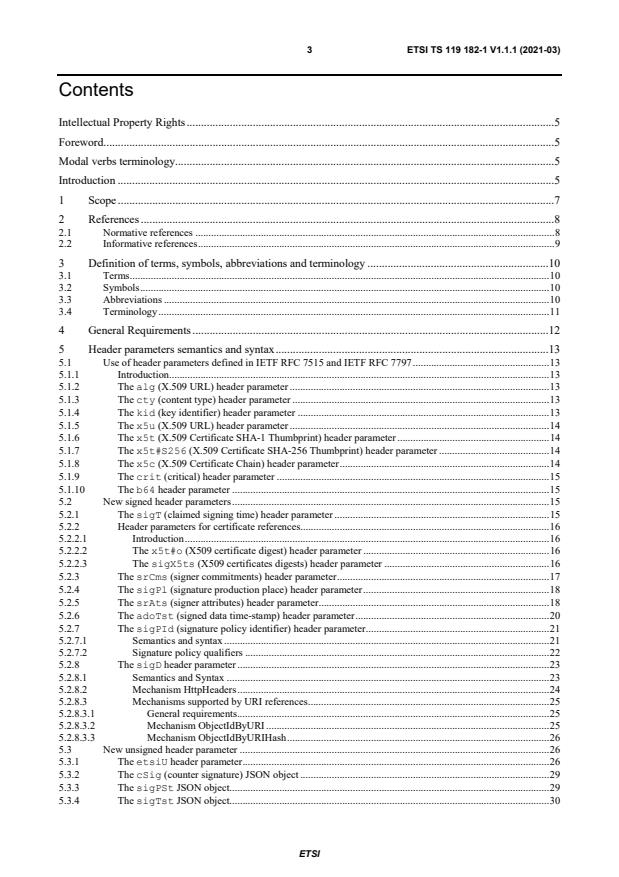
Contents
Intellectual Property Rights . 5
Foreword . 5
Modal verbs terminology . 5
Introduction . 5
1 Scope . 7
2 References . 8
2.1 Normative references . 8
2.2 Informative references . 9
3 Definition of terms, symbols, abbreviations and terminology . 10
3.1 Terms . 10
3.2 Symbols . 10
3.3 Abbreviations . 10
3.4 Terminology . 11
4 General Requirements . 12
5 Header parameters semantics and syntax . 13
5.1 Use of header parameters defined in IETF RFC 7515 and IETF RFC 7797 . 13
5.1.1 Introduction. 13
5.1.2 The alg (X.509 URL) header parameter . 13
5.1.3 The cty (content type) header parameter . 13
5.1.4 The kid (key identifier) header parameter . 13
5.1.5 The x5u (X.509 URL) header parameter . 14
5.1.6 The x5t (X.509 Certificate SHA-1 Thumbprint) header parameter . 14
5.1.7 The x5t#S256 (X.509 Certificate SHA-256 Thumbprint) header parameter . 14
5.1.8 The x5c (X.509 Certificate Chain) header parameter . 14
5.1.9 The crit (critical) header parameter . 15
5.1.10 The b64 header parameter . 15
5.2 New signed header parameters . 15
5.2.1 The sigT (claimed signing time) header parameter . 15
5.2.2 Header parameters for certificate references. 16
5.2.2.1 Introduction . 16
5.2.2.2 The x5t#o (X509 certificate digest) header parameter . 16
5.2.2.3 The sigX5ts (X509 certificates digests) header parameter . 16
5.2.3 The srCms (signer commitments) header parameter . 17
5.2.4 The sigPl (signature production place) header parameter . 18
5.2.5 The srAts (signer attributes) header parameter . 18
5.2.6 The adoTst (signed data time-stamp) header parameter . 20
5.2.7 The sigPId (signature policy identifier) header parameter . 21
5.2.7.1 Semantics and syntax . 21
5.2.7.2 Signature policy qualifiers . 22
5.2.8 The sigD header parameter . 23
5.2.8.1 Semantics and Syntax . 23
5.2.8.2 Mechanism HttpHeaders . 24
5.2.8.3 Mechanisms supported by URI references . 25
5.2.8.3.1 General requirements . 25
5.2.8.3.2 Mechanism ObjectIdByURI . 25
5.2.8.3.3 Mechanism ObjectIdByURIHash . 26
5.3 New unsigned header parameter . 26
5.3.1 The etsiU header parameter . 26
5.3.2 The cSig (counter signature) JSON object . 29
5.3.3 The sigPSt JSON object. 29
5.3.4 The sigTst JSON object. 30
ETSI
4 ETSI TS 119 182-1 V1.1.1 (2021-03)
5.3.5 JSON objects for validation data values . 30
5.3.5.1 The xVals JSON array . 30
5.3.5.2 The rVals JSON object . 31
5.3.5.3 The axVals JSON array . 32
5.3.5.4 The arVals JSON object . 32
5.3.6 JSON values for long term availability and integrity of validation material . 33
5.3.6.1 The tstVD JSON object . 33
5.3.6.2 The arcTst JSON object . 34
5.3.6.2.1 Semantics and syntax . 34
5.3.6.2.2 Computation of message-imprint . 34
5.4 Generally useful syntax . 36
5.4.1 The oId data type . 36
5.4.2 The pkiOb data type . 37
5.4.3 Container for electronic time-stamps . 37
5.4.3.1 Introduction . 37
5.4.3.2 Containers for electronic time-stamps . 38
5.4.3.3 The tstContainer type . 38
6 JAdES baseline signatures. 39
6.1 Signature levels . 39
6.2 General requirements . 40
6.2.1 Algorithm requirements . 40
6.2.2 Notation for requirements . 40
6.3 Requirements on JAdES components and services . 42
Annex A (normative): Additional components Specification . 47
A.1 Components for validation data . 47
A.1.1 The xRefs JSON array . 47
A.1.2 The rRefs JSON object . 48
A.1.3 The axRefs JSON array . 50
A.1.4 The arRefs JSON object . 51
A.1.5 Time-stamps on references to validation data . 52
A.1.5.1 The sigRTst JSON object . 52
A.1.5.1.1 General . 52
A.1.5.1.2 Computation of the message imprint with Base64url incorporation . 52
A.1.5.1.3 Computation of the message imprint with JSON clear incorporation . 52
A.1.5.2 The rfsTst JSON object. 53
A.1.5.2.1 Semantics and syntax . 53
A.1.5.2.2 Computation of the message imprint with Base64url incorporation . 53
A.1.5.2.3 Computation of the message imprint with clear JSON incorporation . 53
Annex B (normative): JSON Schema files . 54
B.1 JSON Schema files location for JAdES components . 54
Annex C (informative): Correspondence between XAdES tags and JAdES tags. 55
C.1 Correspondence between XAdES qualifying properties tags and JAdES component tags . 55
Annex D (normative): Alternative mechanisms for long term availability and integrity of
validation data . 56
Annex E (normative): Digest algorithms identifiers for JAdES signatures. 57
Annex F (informative): Change History . 58
History . 59
ETSI
5 ETSI TS 119 182-1 V1.1.1 (2021-03)
Intellectual Property Rights
Essential patents
IPRs essential or potentially essential to normative deliverables may have been declared to ETSI. The information
pertaining to these essential IPRs, if any, is publicly available for ETSI members and non-members, and can be found
in ETSI SR 000 314: "Intellectual Property Rights (IPRs); Essential, or potentially Essential, IPRs notified to ETSI in
respect of ETSI standards", which is available from the ETSI Secretariat. Latest updates are available on the ETSI Web
server (https://ipr.etsi.org/).
Pursuant to the ETSI IPR Policy, no investigation, including IPR searches, has been carried out by ETSI. No guarantee
can be given as to the existence of other IPRs not referenced in ETSI SR 000 314 (or the updates on the ETSI Web
server) which are, or may be, or may become, essential to the present document.
Trademarks
The present document may include trademarks and/or tradenames which are asserted and/or registered by their owners.
ETSI claims no ownership of these except for any which are indicated as being the property of ETSI, and conveys no
right to use or reproduce any trademark and/or tradename. Mention of those trademarks in the present document does
not constitute an endorsement by ETSI of products, services or organizations associated with those trademarks.
Foreword
This Technical Specification (TS) has been produced by ETSI Technical Committee Electronic Signatures and
Infrastructures (ESI).
The present document is part 1 of a multi-part deliverable covering JAdES digital signatures, as identified below:
Part 1: "Building blocks and JAdES baseline signatures";
Part 2: "Extended JAdES signatures".
One JSON schema file, whose location is detailed in clause B.1 and which contain JSON Schema definitions
complements the present document.
The present document has taken as starting point the paper [i.18] "Bringing JSON signatures to ETSI AdES framework:
meet JAdES signatures", by Juan Carlos Cruellas, in Computer Standards and Interfaces, Volume 71, August 2020.
Modal verbs terminology
In the present document "shall", "shall not", "should", "should not", "may", "need not", "will", "will not", "can" and
"cannot" are to be interpreted as described in clause 3.2 of the ETSI Drafting Rules (Verbal forms for the expression of
provisions).
"must" and "must not" are NOT allowed in ETSI deliverables except when used in direct citation.
Introduction
Electronic commerce has emerged as a frequent way of doing business between companies across local, wide area and
global networks. Trust in this way of doing business is essential for the success and continued development of
electronic commerce. It is therefore important that companies using this electronic means of doing business have
suitable security controls and mechanisms in place to protect their transactions and to ensure trust and confidence with
their business partners. In this respect digital signatures are an important security component that can be used to protect
information and provide trust in electronic business.
ETSI
6 ETSI TS 119 182-1 V1.1.1 (2021-03)
The present document is intended to cover digital signatures supported by PKI and public key certificates, and aims to
meet the general requirements of the international community to provide trust and confidence in electronic transactions,
including, amongst other, applicable requirements from Regulation (EU) No 910/2014 [i.1].
The present document can be used for any transaction between an individual and a company, between two companies,
between an individual and a governmental body, etc. The present document is independent of any environment. It can
be applied to any environment e.g. smart cards, SIM cards, special programs for electronic signatures, etc.
The present document is part of a rationalized framework of standards (see ETSI TR 119 000 [i.4]).
ETSI
7 ETSI TS 119 182-1 V1.1.1 (2021-03)
1 Scope
The present document:
1) Specifies a JSON [1] format for AdES signatures (JAdES signatures hereinafter) built on JSON Web
Signatures (JWS hereinafter) as specified in IETF RFC 7515 [2]. For this, the present document:
- Extends the JSON Web Signatures specified in IETF RFC 7515 [2] by defining an additional set of
JSON header parameters that can be incorporated in the JOSE Header (either in its JWS Protected
Header or its JWS Unprotected Header parts). Many of these new header parameters have the same
semantics as the attributes/properties defined in CAdES [i.2] and XAdES [4] digital signatures. Other
header parameters are defined to meet specific requirements that current JSON Web Signatures cannot
meet (e.g. for explicitly referencing detached JWS Payload). These new header parameters and their
corresponding types are defined in a JSON schema.
- Specifies the mechanisms for incorporating the aforementioned JSON components in JSON Web
Signatures [2] to build JAdES signatures, offering the same features as CAdES and XAdES in JSON
syntax, and therefore fulfilling the same requirements (such as the long-term validity of digital
signatures).
2) Defines four levels of JAdES baseline signatures addressing incremental requirements to maintain the validity
of the signatures over the long term. Each level requires the presence of certain JAdES header parameters,
suitably profiled for reducing the optionality as much as possible. The aforementioned levels provide the basic
features necessary for a wide range of business and governmental use cases for electronic procedures and
communications to be applicable to a wide range of communities when there is a clear need for
interoperability of digital signatures used in electronic documents.
EXAMPLE: An example of requirements raised in specific domains is signing HTTP messages exchanged by
parties in certain environments, which require signing both the HTTP body and some specific http
headers. The format specified in IETF RFC 7515 [2] does not provide any native mechanism for
individually identifying a detached JWS Payload. Clause 5.2.8 of the present document defines
sigD, a new JSON header parameter that allows to identify one or more detached data objects
which, suitably processed and concatenated, form the detached JWS Payload.
Procedures for creation, augmentation, and validation of JAdES digital signatures are out of scope.
NOTE 1: ETSI EN 319 102-1 [i.3] specifies procedures for creation, augmentation and validation of other types of
AdES digital signatures.
The present multi-part deliverable aims at supporting electronic signatures independent of any specific regulatory
framework.
NOTE 2: Specifically, but not exclusively, it is the aim that JAdES digital signatures specified in the present
multi-part deliverable can be used to meet the requirements of electronic signatures, advanced electronic
signatures, qualified electronic signatures, electronic seals, advanced electronic seals, and qualified
electronic seals as defined in Regulation (EU) No 910/2014 [i.1].
ETSI
8 ETSI TS 119 182-1 V1.1.1 (2021-03)
2 References
2.1 Normative references
References are either specific (identified by date of publication and/or edition number or version number) or
non-specific. For specific references, only the cited version applies. For non-specific references, the latest version of the
referenced document (including any amendments) applies.
Referenced documents which are not found to be publicly available in the expected location might be found at
https://docbox.etsi.org/Reference.
NOTE: While any hyperlinks included in this clause were valid at the time of publication, ETSI cannot guarantee
their long term validity.
The following referenced documents are necessary for the application of the present document.
[1] IETF RFC 8259 (December 2017): "The JavaScript Object Notation (JSON) Data Interchange
Format".
[2] IETF RFC 7515 (May 2015): "JSON Web Signature (JWS)".
[3] IETF RFC 3061 (February 2001): "A URN Namespace of Object Identifiers".
[4] ETSI EN 319 132-1: "Electronic Signatures and Infrastructures (ESI); XAdES digital signatures;
Part 1: Building blocks and XAdES baseline signatures".
[5] IETF RFC 5035 (August 2007): "Enhanced Security Services (ESS) Update: Adding CertID
Algorithm Agility".
[6] Recommendation ITU-T X.509: "Information technology - Open Systems Interconnection - The
Directory: Public-key and attribute certificate frameworks".
[7] IETF RFC 3161 (August 2001): "Internet X.509 Public Key Infrastructure Time Stamp Protocol
(TSP)".
[8] IETF RFC 5280 (May 2008): "Internet X.509 Public Key Infrastructure Certificate and Certificate
Revocation List (CRL) Profile".
[9] IETF RFC 6960 (June 2013): "X.509 Internet Public Key Infrastructure Online Certificate Status
Protocol - OCSP".
[10] IETF RFC 5816 (April 2010): "ESSCertIDv2 Update for RFC 3161".
[11] IETF RFC 3494 (March 2003): "Lightweight Directory Access Protocol version 2 (LDAPv2) to
Historic Status".
[12] IETF RFC 4648 (October 2006): "The Base16, Base32, and Base64 Data Encodings".
[13] IETF RFC 3230 (January 2002): "Instance Digests in HTTP".
[14] IETF RFC 7797 (February 2016): "JSON Web Signature (JWS) Unencoded Payload Option".
[15] IETF RFC 3339 (July 2002): "Date and Time on the Internet: Timestamps".
[16] IETF RFC 7518 (May 2015): "JSON Web Algorithms (JWA)".
[17] IETF RFC 3986 (January 2005): "Uniform Resource Identifier (URI): Generic Syntax".
[18] IETF RFC 2616 (June 1999): "Hypertext Transfer Protocol - HTTP/1.1".
[19] draft-handrews-json-schema-01 (March 2018): "JSON Schema: A Media Type for Describing
JSON Documents".
ETSI
9 ETSI TS 119 182-1 V1.1.1 (2021-03)
[20] draft-handrews-json-schema-validation-01 (March 2018): "JSON Schema Validation: A
Vocabulary for Structural Validation of JSON".
[21] ETSI TS 119 312 (V1.3.1): "Electronic Signatures and Infrastructures (ESI); Cryptographic
Suites".
[22] FIPS Publication 180-4 (August 2015): "Secure Hash Standard (SHS)", National Institute of
Standards and Technology.
[23] FIPS Publication 202 (August 2015): "SHA-3 Standard: Permutation-Based Hash and Extendable-
Output Functions", National Institute of Standards and Technology.
2.2 Informative references
References are either specific (identified by date of publication and/or edition number or version number) or
non-specific. For specific references, only the cited version applies. For non-specific references, the latest version of the
referenced document (including any amendments) applies.
NOTE: While any hyperlinks included in this clause were valid at the time of publication, ETSI cannot guarantee
their long term validity.
The following referenced documents are not necessary for the application of the present document but they assist the
user with regard to a particular subject area.
[i.1] Regulation (EU) No 910/2014 of the European Parliament and of the Council on electronic
identification and trust services for electronic transactions in the internal market and repealing
Directive 1999/93/EC. OJ L 257, 28.08.2014, p. 73-114.
[i.2] ETSI EN 319 122-1: "Electronic Signatures and Infrastructures (ESI); CAdES digital signatures;
Part 1: Building blocks and CAdES baseline signatures".
[i.3] ETSI EN 319 102-1: "Electronic Signatures and Infrastructures (ESI); Procedures for Creation and
Validation of AdES Digital Signatures; Part 1: Creation and Validation".
[i.4] ETSI TR 119 000: "Electronic Signatures and Infrastructures (ESI); The framework for
standardization of signatures: overview".
[i.5] ETSI TR 119 001: "Electronic Signatures and Infrastructures (ESI); The framework for
standardization of signatures; Definitions and abbreviations".
[i.6] ETSI TR 119 100: "Electronic Signatures and Infrastructures (ESI); Guidance on the use of
standards for signature creation and validation".
[i.7] ETSI TS 119 172-1: "Electronic Signatures and Infrastructures (ESI); Signature Policies; Part 1:
Building blocks and table of contents for human readable signature policy documents".
[i.8] OASIS Standard: "Assertions and Protocols for the OASIS Security Assertion Markup Language
(SAML) V2.0".
[i.9] ETSI TS 101 533-1: "Electronic Signatures and Infrastructures (ESI); Data Preservation Systems
Security; Part 1: Requirements for Implementation and Management".
[i.10] IETF RFC 4998: "Evidence Record Syntax (ERS)".
[i.11] W3C Recommendation (19 November 2019): "Verifiable Credentials Data Model 1.0".
[i.12] draft-cavage-http-signatures-10 (May 2018): "Signing HTTP Messages".
[i.13] JSON Schema Specification in json-schema.org website.
NOTE: Available at https://json-schema.org/specification.html.
[i.14] draft-handrews-json-schema-02 (September 2019): "JSON Schema: A Media Type for Describing
JSON Documents".
ETSI
10 ETSI TS 119 182-1 V1.1.1 (2021-03)
[i.15] draft-handrews-json-schema-validation-02 (September 2019): "JSON Schema Validation: A
Vocabulary for Structural Validation of JSON".
[i.16] IETF RFC 7517 (May 2015): "JSON Web Key (JWK)".
[i.17] ISO 3166-1: "Codes for the representation of names of countries and their subdivisions --
Part 1: Country code".
[i.18] Juan Carlos Cruellas: "Bringing JSON signatures to ETSI AdES framework: meet JAdES
signatures". Computer Standards and Interfaces, Volume 71, August 2020.
3 Definition of terms, symbols, abbreviations and
terminology
3.1 Terms
For the purposes of the present document, the terms given in ETSI TR 119 001 [i.5], IETF RFC 7515 [2] and the
following apply:
JAdES signature: JSON Web Signature
NOTE: As specified in IETF RFC 7515 [2], or other parts of this multi-part deliverable.
JWS Signature Value: digital signature cryptographic value calculated over a sequence of octets derived from the JWS
Protected Header and data to be signed
NOTE 1: IETF RFC 7515 [2] uses the term JWS Signature for this concept. The present document does not use this
term, but the JWS Signature Value, for the sake of terminological coherence of other AdES
specifications.
NOTE 2: The present document uses the term JSON Web Signature, as defined by IETF RFC 7515 [2], i.e. for
denoting the JSON data structure for representing a digitally signed message.
3.2 Symbols
Void.
3.3 Abbreviations
For the purposes of the present document, the following abbreviations apply:
ASCII American Standard Code For Information Interchange
ASN.1 Abstract Syntax Notation 1
CA Certification Authority
CRL Certificate Revocation List
FIPS Federal Information Processing Standards
HTTP Hyper Text Transfer Protocol
IETF Internet Engineering Task Force
ISO International Organization for Standardization
ITU-T International Telecommunication Union Telecommunication Standardization Sector
JOSE JSON Object Signing and Encryption
JSON JavaScript Object Notation
JWS JSON Web Signature
OCSP Online Certificate Status Protocol
OID Object IDentifier
PKI Public Key Infrastructure
RFC Request For Comments
SAML Security Assertion Markup Language
ETSI
11 ETSI TS 119 182-1 V1.1.1 (2021-03)
SHA Secure Hash Algorithm
SIM Subscriber Identification Module
SPO Service Provision Option
URI Uniform Resource Identifier
URL Uniform Resource Locator
URN Uniform Resource Name
UTC Coordinated Universal Time
3.4 Terminology
The present document adopts, wherever it is possible the same terminology as the terminology used in IETF
RFC 7515 [2] and in IETF RFC 8259 [1].
Therefore, within the present document, the term "JSON Web Signature" shall denote the JSON structure specified in
IETF RFC 7515 [2].
The present document uses the term "JSON value" for denoting JSON objects, or JSON arrays, or JSON numbers, or
JSON strings, i.e. a subset of the potential meanings of "JSON value" listed in clause 3 of IETF RFC 8259 [1].
The present document uses the term "header parameter" for denoting a JSON object, JSON array, JSON number, or
JSON string, which is member either of the JWS Protected Header or the JWS Unprotected Header specified in IETF
RFC 8259 [1].
The present document uses the term "member" for denoting a JSON object's member, as specified in clause 4 of IETF
RFC 8259 [1].
The present document uses the term "element" or "element of the array" for denoting the contents of a position within a
JSON array (specified in clause 5 of IETF RFC 8259 [1]).
NOTE: These last terms will be used for denoting each of the JSON values that will be added to the etsiU
JSON array (specified in clause 5.3.1 of the present document), which will be incorporated in the JWS
Unprotected header as a header parameter. Therefore, these JSON values will play, within the present
document, an equivalent role to the role played by the unsigned attributes in CAdES and the unsigned
qualifying properties in XAdES.
The present document uses the term "JAdES component" or "component" for denoting any JAdES signature
constituent, regardless it is a header parameter, a member of a JSON Object, an element of a JSON array, or any other
JSON Value.
The present document uses this special font for denoting tags of JAdES components.
As for the names of the header parameters and elements of the etsiU JSON array, the following criteria and
conventions have been used:
1) The names have been selected to have a maxim length of 8 characters; most of the names are shorter.
2) The names of header parameters qualifying the signature itself use to start with "sig".
3) The names of header parameters qualifying the signer use to start with "sr".
4) The names of header parameters qualifying the data to be signed use to start with "sd".
5) The names of header parameters dealing with time-stamp tokens use to finalize with "tst".
6) The names of header parameters dealing with certificates use to start or contain "x" (following the convention
of IETF RFC 7515 [2], which defines the header parameters x5u, x5c, x5t, and x5t#S256).
7) The names of header parameters dealing with revocation values (CRLs or OCSP responses) use to start or
contain "r".
8) The names of header parameters dealing with attribute certificates or the corresponding revocation values use
to start "a".
ETSI
12 ETSI TS 119 182-1 V1.1.1 (2021-03)
9) The names of header parameters dealing with values (of certificates or revocation values) use to contain
"Vals".
10) The names of header parameters dealing with references (to certificates or revocation values) use to contain
"Refs" (except x5t, and x5t#S256, which have been defined in IETF RFC 7515 [2], contain references to
certificates, and do not include it).
4 General Requirements
The JAdES components defined in the present document shall be carried within the JOSE header as specified in IETF
RFC 7515 [2].
All the JAdES signed header parameters specified in clause 5.2 of the present document, as well as: cty, kid, crit,
and x5u header parameters specified in IETF RFC 7515 [2] and further profiled in clause 5.1 of the present document,
if required to be present, shall be incorporated as header parameters of the JWS Protected Header of the JSON Web
Signature, specified in IETF RFC 7515 [2].
JAdES signatures may be serialized using either JWS Compact Serialization or JWS JSON Serialization as specified in
clause 3 of IETF RFC 7515 [2].
JWS Unprotected Header in JAdES signatures shall contain only one header parameter, namely the etsiU header
parameter (specified in clause 5.3 of the present document), which is defined as a JSON array.
NOTE 1: The rationale for this is that the JWS Unprotected Header is a JSON object, and no order may be inferred
in its different members. This is the reason why the present document defines etsiU header parameter as
a JSON array.
NOTE 2: The elements of this JSON array will contain JSON values that play for JAdES signatures the same role
as the role played by the unsigned attributes for CAdES signatures, and the role played by the unsigned
qualifying properties for XAdES signatures.
NOTE 3: An immediate consequence is that a time-stamp token present within the arcTst object specified in
clause 5.3.6.2 of the present document, protects the JWS Payload, the JWS Protected Header, the JAdES
Signature Value, and the etsiU header parameter within the JWS Unprotected Header.
Header parameters defined by IETF RFC 7515 [2] and IETF RFC 7797 [14] not further profiled within the present
document may be added as header parameters within the JAdES signature, following the requirements specified in the
present document.
In JAdES signatures, the JWS Payload may be attached or detached.
Detached JWS Payload may either be one detached object, or result from the concatenation of more than one detached
data objects. See the specification of sigD signed header parameter in clause 5.2.8 of the present document.
NOTE 4: At the moment of producing the present document, JSON Schema was under development. The working
draft being used at the present document was the one specified by draft-handrews-json-schema-01 [19],
and draft-handrews-json-schema-validation-01 [20]. These documents, though, do not correspond to the
latest version (draft-handrews-json-schema-02 [i.14], and draft-handrews-json-schema-
validation-02 [i.15]) due to the fact that tools checking correctness of JSON schema files have not been
yet completed. The drafts of JSON schema specifications may be accessed at JSON Schema Specification
in json-schema.org website [i.13].
NOTE 5: Although at the moment of producing the present document there exist several proposals for JSON
canonicalization algorithms, none have been formally adopted by any standardisation organization.
Nevertheless, the present document uses placeholders for identifiers of canonicalization algorithms in a
number of components that could use them if such algorithms are standardized in the future.
ETSI
13 ETSI TS 119 182-1 V1.1.1 (2021-03)
5 Header parameters semantics and syntax
5.1 Use of header parameters defined in IETF RFC 7515 and
IETF RFC 7797
5.1.1 Introduction
This clause defines additional requirements for the use of some of header parameters specified in IETF RFC 7515 [2].
JAdES signatures may incorporate any of the header parameters specified in IETF RFC 7515 [2] and IETF
RFC 7797 [14].
NOTE: Clause 6.3 also specifies requirements (mainly of presence and cardinality), for the use of some of the
header parameters specified in IETF RFC 7515 [2] for JAdES baseline signatures.
5.1.2 The alg (X.509 URL) header parameter
Semantics
The alg header parameter shall be a signed header parameter that qualifies the signature.
The alg header parameter shall have the semantics specified in IETF RFC 7515 [2], clause 4.1.1.
Syntax
The alg header parameter shall have the syntax specified in IETF RFC 7515 [2], clause 4.1.1.
Its value should be one of the algorithms for digital signatures recommended by in ETSI TS 119 312 [21].
5.1.3 The cty (content type) header parameter
Semantics
The cty header parameter shall be a signed header parameter that qualifies the JWS Payload.
The cty header parameter shall have the semantics specified in IETF RFC 7515 [2], clause 4.1.10.
The cty header parameter should not be present if the sigD header parameter, specified in clause 5.2.8 of the present
document, is present within the JAdES signature.
The cty header parameter should not be present if the content type is implied by the JWS Payload.
The cty header parameter shall not be present if the JWS Payload is a (counter-signed) signature.
NOTE: The sigD header parameter has one member that contains information of the format and type of the
constituents of the JWS Payload.
Syntax
The cty header parameter shall have the syntax specified in IETF RFC 7515 [2], clause 4.1.10.
5.1.4 The kid (key identifier) header parameter
Semantics
The kid header parameter shall be a signed header parameter that qualifies the signature.
The kid header parameter shall have the semantics specified in IETF RFC 7515 [2], clause 4.1.4.
ETSI
14 ETSI TS 119 182-1 V1.1.1 (2021-03)
The content of kid header parameter shall be the base64 (IETF RFC 4648 [12]) encoding of one DER-encoded
instance of type IssuerSerial type defined in IETF RFC 5035 [5].
The header parameter kid shall be used as a hint that can help to identify the signing certificate if other header
parameters referencing or containing the signing certificate are present in the JAdES signature.
Syntax
The kid header parameter shall have the syntax specified in IETF RFC 7515 [2], clause 4.1.4.
5.1.5 The x5u (X.509 URL) header parameter
Semantics
The x5u header parameter shall be a signed header parameter that qualifies the signature.
The x5u header parameter shall have the semantics specified in IETF RFC 7515 [2], clause 4.1.5.
The x5u member shall be used as a hint, as implementations can have alternative ways for retrieving the referenced
certificate if it is not found at the referenced place.
Syntax
The x5u header parameter shall have the syntax specified in IETF RFC 7515 [2], clause 4.1.5.
5.1.6 The x5t (X.509 Certificate SHA-1 Thumbprint) header parameter
JAdES signatures shall not contain the x5t header parameter specified in clause 4.1.7 of IETF RFC 7515 [2].
5.1.7 The x5t#S256 (X.509 Certificate SHA-256 Thumbprint) header
parameter
Semantics
The x5t#S256 shall be a signed header parameter that qualifies the signature.
The x5t#S256 header parameter shall have the semantics specified in IETF RFC 7515 [2], clause 4.1.8.
Syntax
The x5t#S256 header parameter shall have the syntax specified in IETF RFC 7515 [2], clause 4.1.8.
A JAdES signature shall have at least one of the following header parameters in its JWS Protected Header: x5t#S256
(specified in clause 4.1.8 of IETF RFC 7515 [2]), x5c (specified in clause 4.1.6 of IETF RFC 7515 [2]), sigX5ts
(specified in clause 5.2.2.3 of the present document), or x5t#o (specified in clause 5.2.2 of the present document).
NOTE 1: The simultaneous presence of x5t#S256 and x5t#o header parameters is allowed for facilitating
interoperability whilst implementations migrate from x5t#S256 to x5t#o.
NOTE 2: Profiles of JAdES can allow some of the combinations of the aforementioned header parameters.
5.1.8 The x5c (X.509 Certificate Chain) header parameter
Semantics
The x5c header parameter shall be a signed header parameter.
The x5c header parameter shall have the semantics specified in IETF RFC 7515 [2], clause 4.1.6.
Syntax
The x5c header parameter shall have the syntax specified in IETF RFC 7515 [2], clause 4.1.6.
ETSI
15 ETSI TS 119 182-1 V1.1.1 (2021-03)
5.1.9 The crit (critical) header parameter
Semantics
The crit header parameter shall be a signed header parameter that qualifies the signature.
The crit header parameter shall have the semantics specified in IETF RFC 7515 [2], clause 4.1.11.
The JAdES signatures incorporating any signed header parameter specified in cla
...
SLOVENSKI STANDARD
01-september-2021
Elektronski podpisi in infrastruktura (ESI) - Digitalni podpisi JAdES - 1. del:
Gradniki in izhodiščni podpisi JAdES
Electronic Signatures and Infrastructures (ESI) - JAdES digital signatures - Part 1:
Building blocks and JAdES baseline signatures
Ta slovenski standard je istoveten z: ETSI TS 119 182-1 V1.1.1 (2021-03)
ICS:
35.040.01 Kodiranje informacij na Information coding in general
splošno
2003-01.Slovenski inštitut za standardizacijo. Razmnoževanje celote ali delov tega standarda ni dovoljeno.
TECHNICAL SPECIFICATION
Electronic Signatures and Infrastructures (ESI);
JAdES digital signatures;
Part 1: Building blocks and JAdES baseline signatures
2 ETSI TS 119 182-1 V1.1.1 (2021-03)
Reference
DTS/ESI-0019182-1
Keywords
electronic signature, JSON
ETSI
650 Route des Lucioles
F-06921 Sophia Antipolis Cedex - FRANCE
Tel.: +33 4 92 94 42 00 Fax: +33 4 93 65 47 16
Siret N° 348 623 562 00017 - NAF 742 C
Association à but non lucratif enregistrée à la
Sous-Préfecture de Grasse (06) N° 7803/88
Important notice
The present document can be downloaded from:
http://www.etsi.org/standards-search
The present document may be made available in electronic versions and/or in print. The content of any electronic and/or
print versions of the present document shall not be modified without the prior written authorization of ETSI. In case of any
existing or perceived difference in contents between such versions and/or in print, the prevailing version of an ETSI
deliverable is the one made publicly available in PDF format at www.etsi.org/deliver.
Users of the present document should be aware that the document may be subject to revision or change of status.
Information on the current status of this and other ETSI documents is available at
https://portal.etsi.org/TB/ETSIDeliverableStatus.aspx
If you find errors in the present document, please send your comment to one of the following services:
https://portal.etsi.org/People/CommiteeSupportStaff.aspx
Copyright Notification
No part may be reproduced or utilized in any form or by any means, electronic or mechanical, including photocopying
and microfilm except as authorized by written permission of ETSI.
The content of the PDF version shall not be modified without the written authorization of ETSI.
The copyright and the foregoing restriction extend to reproduction in all media.
© ETSI 2021.
All rights reserved.
DECT™, PLUGTESTS™, UMTS™ and the ETSI logo are trademarks of ETSI registered for the benefit of its Members.
3GPP™ and LTE™ are trademarks of ETSI registered for the benefit of its Members and
of the 3GPP Organizational Partners.
oneM2M™ logo is a trademark of ETSI registered for the benefit of its Members and
of the oneM2M Partners. ®
GSM and the GSM logo are trademarks registered and owned by the GSM Association.
ETSI
3 ETSI TS 119 182-1 V1.1.1 (2021-03)
Contents
Intellectual Property Rights . 5
Foreword . 5
Modal verbs terminology . 5
Introduction . 5
1 Scope . 7
2 References . 8
2.1 Normative references . 8
2.2 Informative references . 9
3 Definition of terms, symbols, abbreviations and terminology . 10
3.1 Terms . 10
3.2 Symbols . 10
3.3 Abbreviations . 10
3.4 Terminology . 11
4 General Requirements . 12
5 Header parameters semantics and syntax . 13
5.1 Use of header parameters defined in IETF RFC 7515 and IETF RFC 7797 . 13
5.1.1 Introduction. 13
5.1.2 The alg (X.509 URL) header parameter . 13
5.1.3 The cty (content type) header parameter . 13
5.1.4 The kid (key identifier) header parameter . 13
5.1.5 The x5u (X.509 URL) header parameter . 14
5.1.6 The x5t (X.509 Certificate SHA-1 Thumbprint) header parameter . 14
5.1.7 The x5t#S256 (X.509 Certificate SHA-256 Thumbprint) header parameter . 14
5.1.8 The x5c (X.509 Certificate Chain) header parameter . 14
5.1.9 The crit (critical) header parameter . 15
5.1.10 The b64 header parameter . 15
5.2 New signed header parameters . 15
5.2.1 The sigT (claimed signing time) header parameter . 15
5.2.2 Header parameters for certificate references. 16
5.2.2.1 Introduction . 16
5.2.2.2 The x5t#o (X509 certificate digest) header parameter . 16
5.2.2.3 The sigX5ts (X509 certificates digests) header parameter . 16
5.2.3 The srCms (signer commitments) header parameter . 17
5.2.4 The sigPl (signature production place) header parameter . 18
5.2.5 The srAts (signer attributes) header parameter . 18
5.2.6 The adoTst (signed data time-stamp) header parameter . 20
5.2.7 The sigPId (signature policy identifier) header parameter . 21
5.2.7.1 Semantics and syntax . 21
5.2.7.2 Signature policy qualifiers . 22
5.2.8 The sigD header parameter . 23
5.2.8.1 Semantics and Syntax . 23
5.2.8.2 Mechanism HttpHeaders . 24
5.2.8.3 Mechanisms supported by URI references . 25
5.2.8.3.1 General requirements . 25
5.2.8.3.2 Mechanism ObjectIdByURI . 25
5.2.8.3.3 Mechanism ObjectIdByURIHash . 26
5.3 New unsigned header parameter . 26
5.3.1 The etsiU header parameter . 26
5.3.2 The cSig (counter signature) JSON object . 29
5.3.3 The sigPSt JSON object. 29
5.3.4 The sigTst JSON object. 30
ETSI
4 ETSI TS 119 182-1 V1.1.1 (2021-03)
5.3.5 JSON objects for validation data values . 30
5.3.5.1 The xVals JSON array . 30
5.3.5.2 The rVals JSON object . 31
5.3.5.3 The axVals JSON array . 32
5.3.5.4 The arVals JSON object . 32
5.3.6 JSON values for long term availability and integrity of validation material . 33
5.3.6.1 The tstVD JSON object . 33
5.3.6.2 The arcTst JSON object . 34
5.3.6.2.1 Semantics and syntax . 34
5.3.6.2.2 Computation of message-imprint . 34
5.4 Generally useful syntax . 36
5.4.1 The oId data type . 36
5.4.2 The pkiOb data type . 37
5.4.3 Container for electronic time-stamps . 37
5.4.3.1 Introduction . 37
5.4.3.2 Containers for electronic time-stamps . 38
5.4.3.3 The tstContainer type . 38
6 JAdES baseline signatures. 39
6.1 Signature levels . 39
6.2 General requirements . 40
6.2.1 Algorithm requirements . 40
6.2.2 Notation for requirements . 40
6.3 Requirements on JAdES components and services . 42
Annex A (normative): Additional components Specification . 47
A.1 Components for validation data . 47
A.1.1 The xRefs JSON array . 47
A.1.2 The rRefs JSON object . 48
A.1.3 The axRefs JSON array . 50
A.1.4 The arRefs JSON object . 51
A.1.5 Time-stamps on references to validation data . 52
A.1.5.1 The sigRTst JSON object . 52
A.1.5.1.1 General . 52
A.1.5.1.2 Computation of the message imprint with Base64url incorporation . 52
A.1.5.1.3 Computation of the message imprint with JSON clear incorporation . 52
A.1.5.2 The rfsTst JSON object. 53
A.1.5.2.1 Semantics and syntax . 53
A.1.5.2.2 Computation of the message imprint with Base64url incorporation . 53
A.1.5.2.3 Computation of the message imprint with clear JSON incorporation . 53
Annex B (normative): JSON Schema files . 54
B.1 JSON Schema files location for JAdES components . 54
Annex C (informative): Correspondence between XAdES tags and JAdES tags. 55
C.1 Correspondence between XAdES qualifying properties tags and JAdES component tags . 55
Annex D (normative): Alternative mechanisms for long term availability and integrity of
validation data . 56
Annex E (normative): Digest algorithms identifiers for JAdES signatures. 57
Annex F (informative): Change History . 58
History . 59
ETSI
5 ETSI TS 119 182-1 V1.1.1 (2021-03)
Intellectual Property Rights
Essential patents
IPRs essential or potentially essential to normative deliverables may have been declared to ETSI. The information
pertaining to these essential IPRs, if any, is publicly available for ETSI members and non-members, and can be found
in ETSI SR 000 314: "Intellectual Property Rights (IPRs); Essential, or potentially Essential, IPRs notified to ETSI in
respect of ETSI standards", which is available from the ETSI Secretariat. Latest updates are available on the ETSI Web
server (https://ipr.etsi.org/).
Pursuant to the ETSI IPR Policy, no investigation, including IPR searches, has been carried out by ETSI. No guarantee
can be given as to the existence of other IPRs not referenced in ETSI SR 000 314 (or the updates on the ETSI Web
server) which are, or may be, or may become, essential to the present document.
Trademarks
The present document may include trademarks and/or tradenames which are asserted and/or registered by their owners.
ETSI claims no ownership of these except for any which are indicated as being the property of ETSI, and conveys no
right to use or reproduce any trademark and/or tradename. Mention of those trademarks in the present document does
not constitute an endorsement by ETSI of products, services or organizations associated with those trademarks.
Foreword
This Technical Specification (TS) has been produced by ETSI Technical Committee Electronic Signatures and
Infrastructures (ESI).
The present document is part 1 of a multi-part deliverable covering JAdES digital signatures, as identified below:
Part 1: "Building blocks and JAdES baseline signatures";
Part 2: "Extended JAdES signatures".
One JSON schema file, whose location is detailed in clause B.1 and which contain JSON Schema definitions
complements the present document.
The present document has taken as starting point the paper [i.18] "Bringing JSON signatures to ETSI AdES framework:
meet JAdES signatures", by Juan Carlos Cruellas, in Computer Standards and Interfaces, Volume 71, August 2020.
Modal verbs terminology
In the present document "shall", "shall not", "should", "should not", "may", "need not", "will", "will not", "can" and
"cannot" are to be interpreted as described in clause 3.2 of the ETSI Drafting Rules (Verbal forms for the expression of
provisions).
"must" and "must not" are NOT allowed in ETSI deliverables except when used in direct citation.
Introduction
Electronic commerce has emerged as a frequent way of doing business between companies across local, wide area and
global networks. Trust in this way of doing business is essential for the success and continued development of
electronic commerce. It is therefore important that companies using this electronic means of doing business have
suitable security controls and mechanisms in place to protect their transactions and to ensure trust and confidence with
their business partners. In this respect digital signatures are an important security component that can be used to protect
information and provide trust in electronic business.
ETSI
6 ETSI TS 119 182-1 V1.1.1 (2021-03)
The present document is intended to cover digital signatures supported by PKI and public key certificates, and aims to
meet the general requirements of the international community to provide trust and confidence in electronic transactions,
including, amongst other, applicable requirements from Regulation (EU) No 910/2014 [i.1].
The present document can be used for any transaction between an individual and a company, between two companies,
between an individual and a governmental body, etc. The present document is independent of any environment. It can
be applied to any environment e.g. smart cards, SIM cards, special programs for electronic signatures, etc.
The present document is part of a rationalized framework of standards (see ETSI TR 119 000 [i.4]).
ETSI
7 ETSI TS 119 182-1 V1.1.1 (2021-03)
1 Scope
The present document:
1) Specifies a JSON [1] format for AdES signatures (JAdES signatures hereinafter) built on JSON Web
Signatures (JWS hereinafter) as specified in IETF RFC 7515 [2]. For this, the present document:
- Extends the JSON Web Signatures specified in IETF RFC 7515 [2] by defining an additional set of
JSON header parameters that can be incorporated in the JOSE Header (either in its JWS Protected
Header or its JWS Unprotected Header parts). Many of these new header parameters have the same
semantics as the attributes/properties defined in CAdES [i.2] and XAdES [4] digital signatures. Other
header parameters are defined to meet specific requirements that current JSON Web Signatures cannot
meet (e.g. for explicitly referencing detached JWS Payload). These new header parameters and their
corresponding types are defined in a JSON schema.
- Specifies the mechanisms for incorporating the aforementioned JSON components in JSON Web
Signatures [2] to build JAdES signatures, offering the same features as CAdES and XAdES in JSON
syntax, and therefore fulfilling the same requirements (such as the long-term validity of digital
signatures).
2) Defines four levels of JAdES baseline signatures addressing incremental requirements to maintain the validity
of the signatures over the long term. Each level requires the presence of certain JAdES header parameters,
suitably profiled for reducing the optionality as much as possible. The aforementioned levels provide the basic
features necessary for a wide range of business and governmental use cases for electronic procedures and
communications to be applicable to a wide range of communities when there is a clear need for
interoperability of digital signatures used in electronic documents.
EXAMPLE: An example of requirements raised in specific domains is signing HTTP messages exchanged by
parties in certain environments, which require signing both the HTTP body and some specific http
headers. The format specified in IETF RFC 7515 [2] does not provide any native mechanism for
individually identifying a detached JWS Payload. Clause 5.2.8 of the present document defines
sigD, a new JSON header parameter that allows to identify one or more detached data objects
which, suitably processed and concatenated, form the detached JWS Payload.
Procedures for creation, augmentation, and validation of JAdES digital signatures are out of scope.
NOTE 1: ETSI EN 319 102-1 [i.3] specifies procedures for creation, augmentation and validation of other types of
AdES digital signatures.
The present multi-part deliverable aims at supporting electronic signatures independent of any specific regulatory
framework.
NOTE 2: Specifically, but not exclusively, it is the aim that JAdES digital signatures specified in the present
multi-part deliverable can be used to meet the requirements of electronic signatures, advanced electronic
signatures, qualified electronic signatures, electronic seals, advanced electronic seals, and qualified
electronic seals as defined in Regulation (EU) No 910/2014 [i.1].
ETSI
8 ETSI TS 119 182-1 V1.1.1 (2021-03)
2 References
2.1 Normative references
References are either specific (identified by date of publication and/or edition number or version number) or
non-specific. For specific references, only the cited version applies. For non-specific references, the latest version of the
referenced document (including any amendments) applies.
Referenced documents which are not found to be publicly available in the expected location might be found at
https://docbox.etsi.org/Reference.
NOTE: While any hyperlinks included in this clause were valid at the time of publication, ETSI cannot guarantee
their long term validity.
The following referenced documents are necessary for the application of the present document.
[1] IETF RFC 8259 (December 2017): "The JavaScript Object Notation (JSON) Data Interchange
Format".
[2] IETF RFC 7515 (May 2015): "JSON Web Signature (JWS)".
[3] IETF RFC 3061 (February 2001): "A URN Namespace of Object Identifiers".
[4] ETSI EN 319 132-1: "Electronic Signatures and Infrastructures (ESI); XAdES digital signatures;
Part 1: Building blocks and XAdES baseline signatures".
[5] IETF RFC 5035 (August 2007): "Enhanced Security Services (ESS) Update: Adding CertID
Algorithm Agility".
[6] Recommendation ITU-T X.509: "Information technology - Open Systems Interconnection - The
Directory: Public-key and attribute certificate frameworks".
[7] IETF RFC 3161 (August 2001): "Internet X.509 Public Key Infrastructure Time Stamp Protocol
(TSP)".
[8] IETF RFC 5280 (May 2008): "Internet X.509 Public Key Infrastructure Certificate and Certificate
Revocation List (CRL) Profile".
[9] IETF RFC 6960 (June 2013): "X.509 Internet Public Key Infrastructure Online Certificate Status
Protocol - OCSP".
[10] IETF RFC 5816 (April 2010): "ESSCertIDv2 Update for RFC 3161".
[11] IETF RFC 3494 (March 2003): "Lightweight Directory Access Protocol version 2 (LDAPv2) to
Historic Status".
[12] IETF RFC 4648 (October 2006): "The Base16, Base32, and Base64 Data Encodings".
[13] IETF RFC 3230 (January 2002): "Instance Digests in HTTP".
[14] IETF RFC 7797 (February 2016): "JSON Web Signature (JWS) Unencoded Payload Option".
[15] IETF RFC 3339 (July 2002): "Date and Time on the Internet: Timestamps".
[16] IETF RFC 7518 (May 2015): "JSON Web Algorithms (JWA)".
[17] IETF RFC 3986 (January 2005): "Uniform Resource Identifier (URI): Generic Syntax".
[18] IETF RFC 2616 (June 1999): "Hypertext Transfer Protocol - HTTP/1.1".
[19] draft-handrews-json-schema-01 (March 2018): "JSON Schema: A Media Type for Describing
JSON Documents".
ETSI
9 ETSI TS 119 182-1 V1.1.1 (2021-03)
[20] draft-handrews-json-schema-validation-01 (March 2018): "JSON Schema Validation: A
Vocabulary for Structural Validation of JSON".
[21] ETSI TS 119 312 (V1.3.1): "Electronic Signatures and Infrastructures (ESI); Cryptographic
Suites".
[22] FIPS Publication 180-4 (August 2015): "Secure Hash Standard (SHS)", National Institute of
Standards and Technology.
[23] FIPS Publication 202 (August 2015): "SHA-3 Standard: Permutation-Based Hash and Extendable-
Output Functions", National Institute of Standards and Technology.
2.2 Informative references
References are either specific (identified by date of publication and/or edition number or version number) or
non-specific. For specific references, only the cited version applies. For non-specific references, the latest version of the
referenced document (including any amendments) applies.
NOTE: While any hyperlinks included in this clause were valid at the time of publication, ETSI cannot guarantee
their long term validity.
The following referenced documents are not necessary for the application of the present document but they assist the
user with regard to a particular subject area.
[i.1] Regulation (EU) No 910/2014 of the European Parliament and of the Council on electronic
identification and trust services for electronic transactions in the internal market and repealing
Directive 1999/93/EC. OJ L 257, 28.08.2014, p. 73-114.
[i.2] ETSI EN 319 122-1: "Electronic Signatures and Infrastructures (ESI); CAdES digital signatures;
Part 1: Building blocks and CAdES baseline signatures".
[i.3] ETSI EN 319 102-1: "Electronic Signatures and Infrastructures (ESI); Procedures for Creation and
Validation of AdES Digital Signatures; Part 1: Creation and Validation".
[i.4] ETSI TR 119 000: "Electronic Signatures and Infrastructures (ESI); The framework for
standardization of signatures: overview".
[i.5] ETSI TR 119 001: "Electronic Signatures and Infrastructures (ESI); The framework for
standardization of signatures; Definitions and abbreviations".
[i.6] ETSI TR 119 100: "Electronic Signatures and Infrastructures (ESI); Guidance on the use of
standards for signature creation and validation".
[i.7] ETSI TS 119 172-1: "Electronic Signatures and Infrastructures (ESI); Signature Policies; Part 1:
Building blocks and table of contents for human readable signature policy documents".
[i.8] OASIS Standard: "Assertions and Protocols for the OASIS Security Assertion Markup Language
(SAML) V2.0".
[i.9] ETSI TS 101 533-1: "Electronic Signatures and Infrastructures (ESI); Data Preservation Systems
Security; Part 1: Requirements for Implementation and Management".
[i.10] IETF RFC 4998: "Evidence Record Syntax (ERS)".
[i.11] W3C Recommendation (19 November 2019): "Verifiable Credentials Data Model 1.0".
[i.12] draft-cavage-http-signatures-10 (May 2018): "Signing HTTP Messages".
[i.13] JSON Schema Specification in json-schema.org website.
NOTE: Available at https://json-schema.org/specification.html.
[i.14] draft-handrews-json-schema-02 (September 2019): "JSON Schema: A Media Type for Describing
JSON Documents".
ETSI
10 ETSI TS 119 182-1 V1.1.1 (2021-03)
[i.15] draft-handrews-json-schema-validation-02 (September 2019): "JSON Schema Validation: A
Vocabulary for Structural Validation of JSON".
[i.16] IETF RFC 7517 (May 2015): "JSON Web Key (JWK)".
[i.17] ISO 3166-1: "Codes for the representation of names of countries and their subdivisions --
Part 1: Country code".
[i.18] Juan Carlos Cruellas: "Bringing JSON signatures to ETSI AdES framework: meet JAdES
signatures". Computer Standards and Interfaces, Volume 71, August 2020.
3 Definition of terms, symbols, abbreviations and
terminology
3.1 Terms
For the purposes of the present document, the terms given in ETSI TR 119 001 [i.5], IETF RFC 7515 [2] and the
following apply:
JAdES signature: JSON Web Signature
NOTE: As specified in IETF RFC 7515 [2], or other parts of this multi-part deliverable.
JWS Signature Value: digital signature cryptographic value calculated over a sequence of octets derived from the JWS
Protected Header and data to be signed
NOTE 1: IETF RFC 7515 [2] uses the term JWS Signature for this concept. The present document does not use this
term, but the JWS Signature Value, for the sake of terminological coherence of other AdES
specifications.
NOTE 2: The present document uses the term JSON Web Signature, as defined by IETF RFC 7515 [2], i.e. for
denoting the JSON data structure for representing a digitally signed message.
3.2 Symbols
Void.
3.3 Abbreviations
For the purposes of the present document, the following abbreviations apply:
ASCII American Standard Code For Information Interchange
ASN.1 Abstract Syntax Notation 1
CA Certification Authority
CRL Certificate Revocation List
FIPS Federal Information Processing Standards
HTTP Hyper Text Transfer Protocol
IETF Internet Engineering Task Force
ISO International Organization for Standardization
ITU-T International Telecommunication Union Telecommunication Standardization Sector
JOSE JSON Object Signing and Encryption
JSON JavaScript Object Notation
JWS JSON Web Signature
OCSP Online Certificate Status Protocol
OID Object IDentifier
PKI Public Key Infrastructure
RFC Request For Comments
SAML Security Assertion Markup Language
ETSI
11 ETSI TS 119 182-1 V1.1.1 (2021-03)
SHA Secure Hash Algorithm
SIM Subscriber Identification Module
SPO Service Provision Option
URI Uniform Resource Identifier
URL Uniform Resource Locator
URN Uniform Resource Name
UTC Coordinated Universal Time
3.4 Terminology
The present document adopts, wherever it is possible the same terminology as the terminology used in IETF
RFC 7515 [2] and in IETF RFC 8259 [1].
Therefore, within the present document, the term "JSON Web Signature" shall denote the JSON structure specified in
IETF RFC 7515 [2].
The present document uses the term "JSON value" for denoting JSON objects, or JSON arrays, or JSON numbers, or
JSON strings, i.e. a subset of the potential meanings of "JSON value" listed in clause 3 of IETF RFC 8259 [1].
The present document uses the term "header parameter" for denoting a JSON object, JSON array, JSON number, or
JSON string, which is member either of the JWS Protected Header or the JWS Unprotected Header specified in IETF
RFC 8259 [1].
The present document uses the term "member" for denoting a JSON object's member, as specified in clause 4 of IETF
RFC 8259 [1].
The present document uses the term "element" or "element of the array" for denoting the contents of a position within a
JSON array (specified in clause 5 of IETF RFC 8259 [1]).
NOTE: These last terms will be used for denoting each of the JSON values that will be added to the etsiU
JSON array (specified in clause 5.3.1 of the present document), which will be incorporated in the JWS
Unprotected header as a header parameter. Therefore, these JSON values will play, within the present
document, an equivalent role to the role played by the unsigned attributes in CAdES and the unsigned
qualifying properties in XAdES.
The present document uses the term "JAdES component" or "component" for denoting any JAdES signature
constituent, regardless it is a header parameter, a member of a JSON Object, an element of a JSON array, or any other
JSON Value.
The present document uses this special font for denoting tags of JAdES components.
As for the names of the header parameters and elements of the etsiU JSON array, the following criteria and
conventions have been used:
1) The names have been selected to have a maxim length of 8 characters; most of the names are shorter.
2) The names of header parameters qualifying the signature itself use to start with "sig".
3) The names of header parameters qualifying the signer use to start with "sr".
4) The names of header parameters qualifying the data to be signed use to start with "sd".
5) The names of header parameters dealing with time-stamp tokens use to finalize with "tst".
6) The names of header parameters dealing with certificates use to start or contain "x" (following the convention
of IETF RFC 7515 [2], which defines the header parameters x5u, x5c, x5t, and x5t#S256).
7) The names of header parameters dealing with revocation values (CRLs or OCSP responses) use to start or
contain "r".
8) The names of header parameters dealing with attribute certificates or the corresponding revocation values use
to start "a".
ETSI
12 ETSI TS 119 182-1 V1.1.1 (2021-03)
9) The names of header parameters dealing with values (of certificates or revocation values) use to contain
"Vals".
10) The names of header parameters dealing with references (to certificates or revocation values) use to contain
"Refs" (except x5t, and x5t#S256, which have been defined in IETF RFC 7515 [2], contain references to
certificates, and do not include it).
4 General Requirements
The JAdES components defined in the present document shall be carried within the JOSE header as specified in IETF
RFC 7515 [2].
All the JAdES signed header parameters specified in clause 5.2 of the present document, as well as: cty, kid, crit,
and x5u header parameters specified in IETF RFC 7515 [2] and further profiled in clause 5.1 of the present document,
if required to be present, shall be incorporated as header parameters of the JWS Protected Header of the JSON Web
Signature, specified in IETF RFC 7515 [2].
JAdES signatures may be serialized using either JWS Compact Serialization or JWS JSON Serialization as specified in
clause 3 of IETF RFC 7515 [2].
JWS Unprotected Header in JAdES signatures shall contain only one header parameter, namely the etsiU header
parameter (specified in clause 5.3 of the present document), which is defined as a JSON array.
NOTE 1: The rationale for this is that the JWS Unprotected Header is a JSON object, and no order may be inferred
in its different members. This is the reason why the present document defines etsiU header parameter as
a JSON array.
NOTE 2: The elements of this JSON array will contain JSON values that play for JAdES signatures the same role
as the role played by the unsigned attributes for CAdES signatures, and the role played by the unsigned
qualifying properties for XAdES signatures.
NOTE 3: An immediate consequence is that a time-stamp token present within the arcTst object specified in
clause 5.3.6.2 of the present document, protects the JWS Payload, the JWS Protected Header, the JAdES
Signature Value, and the etsiU header parameter within the JWS Unprotected Header.
Header parameters defined by IETF RFC 7515 [2] and IETF RFC 7797 [14] not further profiled within the present
document may be added as header parameters within the JAdES signature, following the requirements specified in the
present document.
In JAdES signatures, the JWS Payload may be attached or detached.
Detached JWS Payload may either be one detached object, or result from the concatenation of more than one detached
data objects. See the specification of sigD signed header parameter in clause 5.2.8 of the present document.
NOTE 4: At the moment of producing the present document, JSON Schema was under development. The working
draft being used at the present document was the one specified by draft-handrews-json-schema-01 [19],
and draft-handrews-json-schema-validation-01 [20]. These documents, though, do not correspond to the
latest version (draft-handrews-json-schema-02 [i.14], and draft-handrews-json-schema-
validation-02 [i.15]) due to the fact that tools checking correctness of JSON schema files have not been
yet completed. The drafts of JSON schema specifications may be accessed at JSON Schema Specification
in json-schema.org website [i.13].
NOTE 5: Although at the moment of producing the present document there exist several proposals for JSON
canonicalization algorithms, none have been formally adopted by any standardisation organization.
Nevertheless, the present document uses placeholders for identifiers of canonicalization algorithms in a
number of components that could use them if such algorithms are standardized in the future.
ETSI
13 ETSI TS 119 182-1 V1.1.1 (2021-03)
5 Header parameters semantics and syntax
5.1 Use of header parameters defined in IETF RFC 7515 and
IETF RFC 7797
5.1.1 Introduction
This clause defines additional requirements for the use of some of header parameters specified in IETF RFC 7515 [2].
JAdES signatures may incorporate any of the header parameters specified in IETF RFC 7515 [2] and IETF
RFC 7797 [14].
NOTE: Clause 6.3 also specifies requirements (mainly of presence and cardinality), for the use of some of the
header parameters specified in IETF RFC 7515 [2] for JAdES baseline signatures.
5.1.2 The alg (X.509 URL) header parameter
Semantics
The alg header parameter shall be a signed header parameter that qualifies the signature.
The alg header parameter shall have the semantics specified in IETF RFC 7515 [2], clause 4.1.1.
Syntax
The alg header parameter shall have the syntax specified in IETF RFC 7515 [2], clause 4.1.1.
Its value should be one of the algorithms for digital signatures recommended by in ETSI TS 119 312 [21].
5.1.3 The cty (content type) header parameter
Semantics
The cty header parameter shall be a signed header parameter that qualifies the JWS Payload.
The cty header parameter shall have the semantics specified in IETF RFC 7515 [2], clause 4.1.10.
The cty header parameter should not be present if the sigD header parameter, specified in clause 5.2.8 of the present
document, is present within the JAdES signature.
The cty header parameter should not be present if the content type is implied by the JWS Payload.
The cty header parameter shall not be present if the JWS Payload is a (counter-signed) signature.
NOTE: The sigD header parameter has one member that contains information of the format and type of the
constituents of the JWS Payload.
Syntax
The cty header parameter shall have the syntax specified in IETF RFC 7515 [2], clause 4.1.10.
5.1.4 The kid (key identifier) header parameter
Semantics
The kid header parameter shall be a signed header parameter that qualifies the signature.
The kid header parameter shall have the semantics specified in IETF RFC 7515 [2], clause 4.1.4.
ETSI
14 ETSI TS 119 182-1 V1.1.1 (2021-03)
The content of kid header parameter shall be the base64 (IETF RFC 4648 [12]) encoding of one DER-encoded
instance of type IssuerSerial type defined in IETF RFC 5035 [5].
The header parameter kid shall be used as a hint that can help to identify the signing certificate if other header
parameters referencing or containing the signing certificate are present in the JAdES signature.
Syntax
The kid header parameter shall have the syntax specified in IETF RFC 7515 [2], clause 4.1.4.
5.1.5 The x5u (X.509 URL) header parameter
Semantics
The x5u header parameter shall be a signed header parameter that qualifies the signature.
The x5u header parameter shall have the semantics specified in IETF RFC 7515 [2], clause 4.1.5.
The x5u member shall be used as a hint, as implementations can have alternative ways for retrieving the referenced
certificate if it is not found at the referenced place.
Syntax
The x5u header parameter shall have the syntax specified in IETF RFC 7515 [2], clause 4.1.5.
5.1.6 The x5t (X.509 Certificate SHA-1 Thumbprint) header parameter
JAdES signatures shall not contain the x5t header parameter specified in clause 4.1.7 of IETF RFC 7515 [2].
5.1.7 The x5t#S256 (X.509 Certificate SHA-256 Thumbprint) header
parameter
Semantics
The x5t#S256 shall be a signed header parameter that qualifies the signature.
The x5t#S256 header parameter shall have the semantics specified in IETF RFC 7515 [2], clause 4.1.8.
Syntax
The x5t#S256 header parameter shall have the syntax specified in IETF RFC 7515 [2], clause 4.1.8.
A JAdES signature shall have at least one of
...
Questions, Comments and Discussion
Ask us and Technical Secretary will try to provide an answer. You can facilitate discussion about the standard in here.
Loading comments...