


ETSI TS 103 601 V2.1.1 (2024-03)
Intelligent Transport Systems (ITS); Security; Security management messages communication requirements and distribution protocols; Release 2
Intelligent Transport Systems (ITS); Security; Security management messages communication requirements and distribution protocols; Release 2
RTS/ITS-005115
General Information
Standards Content (Sample)
TECHNICAL SPECIFICATION
Intelligent Transport Systems (ITS);
Security;
Security management messages communication
requirements and distribution protocols;
Release 2
2 ETSI TS 103 601 V2.1.1 (2024-03)
Reference
RTS/ITS-005115
Keywords
ITS, protocol, security
ETSI
650 Route des Lucioles
F-06921 Sophia Antipolis Cedex - FRANCE
Tel.: +33 4 92 94 42 00 Fax: +33 4 93 65 47 16
Siret N° 348 623 562 00017 - APE 7112B
Association à but non lucratif enregistrée à la
Sous-Préfecture de Grasse (06) N° w061004871
Important notice
The present document can be downloaded from:
https://www.etsi.org/standards-search
The present document may be made available in electronic versions and/or in print. The content of any electronic and/or
print versions of the present document shall not be modified without the prior written authorization of ETSI. In case of any
existing or perceived difference in contents between such versions and/or in print, the prevailing version of an ETSI
deliverable is the one made publicly available in PDF format at www.etsi.org/deliver.
Users of the present document should be aware that the document may be subject to revision or change of status.
Information on the current status of this and other ETSI documents is available at
https://portal.etsi.org/TB/ETSIDeliverableStatus.aspx
If you find errors in the present document, please send your comment to one of the following services:
https://portal.etsi.org/People/CommiteeSupportStaff.aspx
If you find a security vulnerability in the present document, please report it through our
Coordinated Vulnerability Disclosure Program:
https://www.etsi.org/standards/coordinated-vulnerability-disclosure
Notice of disclaimer & limitation of liability
The information provided in the present deliverable is directed solely to professionals who have the appropriate degree of
experience to understand and interpret its content in accordance with generally accepted engineering or
other professional standard and applicable regulations.
No recommendation as to products and services or vendors is made or should be implied.
No representation or warranty is made that this deliverable is technically accurate or sufficient or conforms to any law
rule and/or regulation and further, no representation or warranty is made of merchantability or fitness
and/or governmental
for any particular purpose or against infringement of intellectual property rights.
In no event shall ETSI be held liable for loss of profits or any other incidental or consequential damages.
Any software contained in this deliverable is provided "AS IS" with no warranties, express or implied, including but not
limited to, the warranties of merchantability, fitness for a particular purpose and non-infringement of intellectual property
rights and ETSI shall not be held liable in any event for any damages whatsoever (including, without limitation, damages
for loss of profits, business interruption, loss of information, or any other pecuniary loss) arising out of or related to the use
of or inability to use the software.
Copyright Notification
No part may be reproduced or utilized in any form or by any means, electronic or mechanical, including photocopying and
microfilm except as authorized by written permission of ETSI.
The content of the PDF version shall not be modified without the written authorization of ETSI.
The copyright and the foregoing restriction extend to reproduction in all media.
© ETSI 2024.
All rights reserved.
ETSI
3 ETSI TS 103 601 V2.1.1 (2024-03)
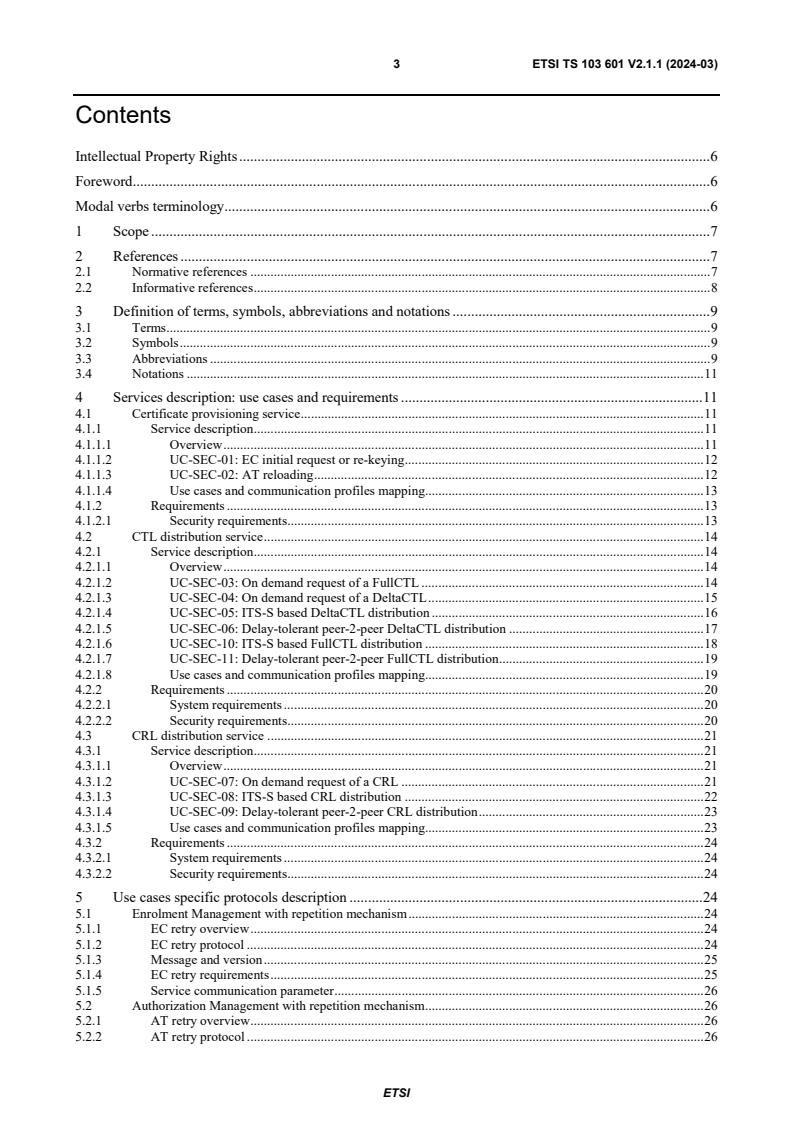
Contents
Intellectual Property Rights . 6
Foreword . 6
Modal verbs terminology . 6
1 Scope . 7
2 References . 7
2.1 Normative references . 7
2.2 Informative references . 8
3 Definition of terms, symbols, abbreviations and notations . 9
3.1 Terms . 9
3.2 Symbols . 9
3.3 Abbreviations . 9
3.4 Notations . 11
4 Services description: use cases and requirements . 11
4.1 Certificate provisioning service . 11
4.1.1 Service description . 11
4.1.1.1 Overview . 11
4.1.1.2 UC-SEC-01: EC initial request or re-keying . 12
4.1.1.3 UC-SEC-02: AT reloading . 12
4.1.1.4 Use cases and communication profiles mapping. 13
4.1.2 Requirements . 13
4.1.2.1 Security requirements. 13
4.2 CTL distribution service . 14
4.2.1 Service description . 14
4.2.1.1 Overview . 14
4.2.1.2 UC-SEC-03: On demand request of a FullCTL . 14
4.2.1.3 UC-SEC-04: On demand request of a DeltaCTL . 15
4.2.1.4 UC-SEC-05: ITS-S based DeltaCTL distribution . 16
4.2.1.5 UC-SEC-06: Delay-tolerant peer-2-peer DeltaCTL distribution . 17
4.2.1.6 UC-SEC-10: ITS-S based FullCTL distribution . 18
4.2.1.7 UC-SEC-11: Delay-tolerant peer-2-peer FullCTL distribution . 19
4.2.1.8 Use cases and communication profiles mapping. 19
4.2.2 Requirements . 20
4.2.2.1 System requirements . 20
4.2.2.2 Security requirements. 20
4.3 CRL distribution service . 21
4.3.1 Service description . 21
4.3.1.1 Overview . 21
4.3.1.2 UC-SEC-07: On demand request of a CRL . 21
4.3.1.3 UC-SEC-08: ITS-S based CRL distribution . 22
4.3.1.4 UC-SEC-09: Delay-tolerant peer-2-peer CRL distribution . 23
4.3.1.5 Use cases and communication profiles mapping. 23
4.3.2 Requirements . 24
4.3.2.1 System requirements . 24
4.3.2.2 Security requirements. 24
5 Use cases specific protocols description . 24
5.1 Enrolment Management with repetition mechanism . 24
5.1.1 EC retry overview . 24
5.1.2 EC retry protocol . 24
5.1.3 Message and version . 25
5.1.4 EC retry requirements . 25
5.1.5 Service communication parameter . 26
5.2 Authorization Management with repetition mechanism . 26
5.2.1 AT retry overview . 26
5.2.2 AT retry protocol . 26
ETSI
4 ETSI TS 103 601 V2.1.1 (2024-03)
5.2.3 Message and version . 27
5.2.4 AT retry requirements . 27
5.3 Peer-to-peer CRL/CTL distribution protocol . 28
5.3.1 Overview . 28
5.3.2 Peer-to-peer CRL/CTL request/response protocol . 29
5.3.3 Message and version . 30
5.3.4 Peer-to-peer CRL/CTL request message . 30
5.3.4.1 General . 30
5.3.4.2 Generation of a Peer-to-peer CRL request . 30
5.3.4.3 Generation of a Peer-to-peer Delta CTL request . 31
5.3.4.4 Generation of a Peer-to-peer Full CTL request . 32
5.3.5 Peer-to-peer CRL/CTL response message . 33
5.3.6 P2P CRL/CTL request message trigger, repetition and termination . 33
5.3.7 Protocol communication parameter . 34
5.4 ITS-S based CRL/DeltaCTL broadcast protocol . 34
5.4.1 Overview . 34
5.4.2 CRL/DeltaCTL broadcast protocol . 34
5.4.3 Message and version . 35
5.4.4 Protocol communication parameter . 37
5.5 ITS-S based Full CTL broadcast protocol . 37
5.5.1 Overview . 37
5.5.2 P2P Response distribution protocol . 38
5.5.3 Message and version . 39
5.5.4 Protocol communication parameters . 40
6 Communication profiles . 41
6.1 CPS_001 . 41
6.2 CPS_002 . 41
6.3 CPS_003 . 42
6.4 CPS_004 . 42
Annex A (normative): PICS pro forma . 43
A.1 The right to copy . 43
A.2 Guidance for completing the PICS pro forma . 43
A.2.1 Purposes and structure . 43
A.2.2 Abbreviations and conventions . 43
A.2.3 Instructions for completing the PICS pro forma. 44
A.3 Identification of the Equipment . 45
A.3.1 Introduction . 45
A.3.2 Date of the statement . 45
A.3.3 Equipment Under Test identification . 45
A.3.4 Product supplier . 45
A.3.5 Client . 46
A.3.6 PICS contact person . 46
A.4 Identification of the protocol . 47
A.5 Global statement of conformance . 47
A.6 PICS pro forma tables . 47
Annex B (informative): EC Retry scenario examples . 51
B.1 EC Request lost . 51
B.2 EC response lost . 51
Annex C (informative): Survey of fragmentation/segmentation mechanisms and coding
techniques . 53
Annex D (normative): ASN.1 specification of the Segmented CTL Response Message . 54
Annex E (informative): Change History . 55
ETSI
5 ETSI TS 103 601 V2.1.1 (2024-03)
History . 56
ETSI
6 ETSI TS 103 601 V2.1.1 (2024-03)
Intellectual Property Rights
Essential patents
IPRs essential or potentially essential to normative deliverables may have been declared to ETSI. The declarations
pertaining to these essential IPRs, if any, are publicly available for ETSI members and non-members, and can be
found in ETSI SR 000 314: "Intellectual Property Rights (IPRs); Essential, or potentially Essential, IPRs notified to
ETSI in respect of ETSI standards", which is available from the ETSI Secretariat. Latest updates are available on the
ETSI Web server (https://ipr.etsi.org/).
Pursuant to the ETSI Directives including the ETSI IPR Policy, no investigation regarding the essentiality of IPRs,
including IPR searches, has been carried out by ETSI. No guarantee can be given as to the existence of other IPRs not
referenced in ETSI SR 000 314 (or the updates on the ETSI Web server) which are, or may be, or may become,
essential to the present document.
Trademarks
The present document may include trademarks and/or tradenames which are asserted and/or registered by their owners.
ETSI claims no ownership of these except for any which are indicated as being the property of ETSI, and conveys no
right to use or reproduce any trademark and/or tradename. Mention of those trademarks in the present document does
not constitute an endorsement by ETSI of products, services or organizations associated with those trademarks.
DECT™, PLUGTESTS™, UMTS™ and the ETSI logo are trademarks of ETSI registered for the benefit of its
Members. 3GPP™ and LTE™ are trademarks of ETSI registered for the benefit of its Members and of the 3GPP
Organizational Partners. oneM2M™ logo is a trademark of ETSI registered for the benefit of its Members and of the ®
oneM2M Partners. GSM and the GSM logo are trademarks registered and owned by the GSM Association.
Foreword
This Technical Specification (TS) has been produced by ETSI Technical Committee Intelligent Transport Systems
(ITS).
Modal verbs terminology
In the present document "shall", "shall not", "should", "should not", "may", "need not", "will", "will not", "can" and
"cannot" are to be interpreted as described in clause 3.2 of the ETSI Drafting Rules (Verbal forms for the expression of
provisions).
"must" and "must not" are NOT allowed in ETSI deliverables except when used in direct citation.
ETSI
7 ETSI TS 103 601 V2.1.1 (2024-03)
1 Scope
The present document defines communication requirements and profiles to support communications from/to ITS-S
stations (e.g. fixed road side ITS-S, mobile ITS-S) for the support of security management services specified in ETSI
TS 102 941 [2] (i.e. certificate management, trust and revocation lists distribution).
The present document also defines the related protocol handling for the selected messages as well as the requirements
for the lower layer protocol stacks and for the Security Management entity in order to support message dissemination
and reception.
2 References
2.1 Normative references
References are either specific (identified by date of publication and/or edition number or version number) or
non-specific. For specific references, only the cited version applies. For non-specific references, the latest version of the
referenced document (including any amendments) applies.
Referenced documents which are not found to be publicly available in the expected location might be found at
https://docbox.etsi.org/Reference.
NOTE: While any hyperlinks included in this clause were valid at the time of publication, ETSI cannot guarantee
their long term validity.
The following referenced documents are necessary for the application of the present document.
[1] ETSI TS 102 940: "Intelligent Transport Systems (ITS); Security; ITS communications security
architecture and security management; Release 2".
[2] ETSI TS 102 941: "Intelligent Transport Systems (ITS); Security; Trust and Privacy Management;
Release 2".
[3] ETSI TS 103 097: "Intelligent Transport Systems (ITS); Security; Security header and certificate
formats; Release 2".
[4] ETSI TS 103 248 (V2.3.1): "Intelligent Transport Systems (ITS); GeoNetworking; Port Numbers
for the Basic Transport Protocol (BTP); Release 2".
[5] ETSI TS 103 836-4-1: "Intelligent Transport Systems (ITS); Vehicular communications;
GeoNetworking; Part 4: Geographical addressing and forwarding for point-to-point and point-to-
multipoint communications; Sub-part 1: Media-Independent Functionality; Release 2".
[6] ETSI TS 102 965: "Intelligent Transport Systems (ITS); Application Object Identifier (ITS-AID);
Registration; Release 2".
[7] Recommendation ITU-T X.696: "Information technology - ASN.1 encoding rules: Specification of
Octet Encoding Rules (OER)".
[8] IEEE Std 1609.2™-2022: "IEEE Standard for Wireless Access in Vehicular Environments -
Security Services for Applications and Management Messages".
ETSI
8 ETSI TS 103 601 V2.1.1 (2024-03)
2.2 Informative references
References are either specific (identified by date of publication and/or edition number or version number) or
non-specific. For specific references, only the cited version applies. For non-specific references, the latest version of the
referenced document (including any amendments) applies.
NOTE: While any hyperlinks included in this clause were valid at the time of publication, ETSI cannot guarantee
their long term validity.
The following referenced documents are not necessary for the application of the present document but they assist the
user with regard to a particular subject area.
[i.1] IEEE 802.11™: "IEEE Standard for Information technology - Telecommunications and
information exchange between systems - Local and metropolitan area networks-Specific
requirements - Part 11: Wireless LAN Medium Access Control (MAC) and Physical Layer (PHY)
Specifications".
[i.2] ETSI EN 302 890-1: "Intelligent Transport Systems (ITS); Facilities layer function; Part 1:
Services Announcement (SA) specification".
[i.3] ISO/IEC 9646-7 (1995): "Information technology - Open Systems Interconnection - Conformance
testing methodology and framework - Part 7: Implementation Conformance Statements".
[i.4] ISO/IEC 8824-1:2015: "Information technology -- Abstract Syntax Notation One (ASN.1):
Specification of basic notation".
[i.5] ETSI TS 103 836: Intelligent Transport Systems (ITS); Vehicular Communications;
GeoNetworking; Part 6: Internet Integration; Sub-part 1: Transmission of IPv6 Packets over
GeoNetworking Protocols.
[i.6] C. Fragouli et al: "Network coding: an instant primer", ACM SIGCOMM Computer
Communication Review, Vol. 36, No. 1, January 2006, pp 63-68.
[i.7] Pouya Ostovari, Jie Wu, and Abdallah Khreishah: "Network Coding Techniques for Wireless and
Sensor Networks", 18 January 2015.
[i.8] Philip A. Chou and Yunnan Wu: "Network Coding for the Internet and Wireless Networks",
Microsoft Report MSR-TR-2007-70, June 2007.
[i.9] Farhan Jamil, Anam Javaid, Tariq Umer, Mubashir Husain Rehmani: "A comprehensive survey of
network coding in vehicular ad-hoc networks", Wireless Networks, May 2016.
[i.10] Robert H. Morelos-Zaragoza: The Art of Error Correcting Coding, Second Edition, John Wiley &
Sons, 2006, ISBN: 0470015586.
[i.11] IETF RFC 6726: "FLUTE - File Delivery over Unidirectional Transport", November 2012.
[i.12] IETF RFC 5651, M. Luby, M. Watson, L. Vicisano: "Layered Coding Transport (LCT) Building
Block", October 2009.
[i.13] IETF RFC 5052, M. Watson, M. Luby, and L. Vicisano: "Forward Error Correction (FEC)
Building Block", August 2007.
ETSI
9 ETSI TS 103 601 V2.1.1 (2024-03)
3 Definition of terms, symbols, abbreviations and
notations
3.1 Terms
For the purposes of the present document, the terms given in ETSI TS 102 940 [1], ETSI TS 102 941 [2] and the
following apply:
CTL/CRL Distribution Application: software application supported by an ITS-S that enables a relay service for
storing and distribution of CTL/CRL to other ITS-S
Maximum Transmission Unit (MTU): maximum packet size in octets that can be conveyed in one piece over a data
link
3.2 Symbols
For the purposes of the present document, the following symbols apply:
N1 number of attempts that an ITS-S is authorized to do after the sending of the EC request. Note that
N1 is a non-negative integer (N1 ≥ 0)
N1 = 0 means that no EC retry is possible
N1 = 1 means that after sending the EC request and not having received the response (because of EC
request loss or EC response loss), the ITS-S can use the EC retry service only one time
N2 it is the number of attempts that an ITS-S is authorized to do after the sending of the AT request.
Note that N2 is a non-negative integer (N1 ≥ 0).
N2 = 0 means that no AT retry is possible
N2 = 1 means that after sending the AT request and not having received the response (because of AT
request loss or AT response loss), the ITS-S can use the AT retry service only one time
T1 time interval between two successive repeated EC requests that are performed by an ITS-S
T2 life-time duration of the created EC request by the requesting ITS-S
T3 time interval between the reception/storage of the context information of the initial EC Request
and the last incoming/repeated EC request received by an EA
T4 time interval between two successive repetitions of the same AT request that are performed by an
ITS-S
T5 life-time duration of the created AT by the requesting ITS-S
T6 time interval between the reception/storage of the context information of the initial AT Request
and the last incoming/repeated AT request received by an AA
T maximum waiting time before a responder ITS-S which has received a request for a specific CTL
P2pctldMax
or a broadcasting ITS-S starts transmitting the successive segments containing the full CTL, after
listening to detect if another ITS-S has not already started to send the same CTL
d repetition duration of the CTL or CRL broadcast transmission in days or in seconds. If d=0 then
the list is transmitted only once
f repetition frequency of the CTL or CRL broadcast transmission in millihertz
N total number of consecutive segments transmitted by the Sender which applies segmentation of the
total
original message, e.g. a FullCtl
3.3 Abbreviations
For the purposes of the present document, the following abbreviations apply:
5G-NR 5G New Radio
AA Authorization Authority
AES Advanced Encryption Standard
AID Application Identifier
ALC Asynchronous layered coding
ASN Abstract Syntax Notation
AT Authorization Ticket
B2B Business to Business
ETSI
10 ETSI TS 103 601 V2.1.1 (2024-03)
BTP Basic Transport Protocol
CA Certification Authority
CAM Cooperative Awareness Message
CCMS Cooperative-ITS Certificate Management System
CP Certificate Policy
CPOC C-ITS Point Of Contact
CRL Certificate Revocation List
CTL Certificate Trust List
CXLDA CRL/CTL Distribution Application
DC Distribution Centre
EA Enrollment Authority
EC Enrollment Credential
ECTL European Certificate Trust List
EN European Norm
FDT File Delivery Table
FEC Forward Error Correction
F-PDU Facilities Layer Protocol Data Unit
GBC GeoBroadCast
GN GeoNetworking
GN_SAP GeoNetworking_Service Access Point
GN6 GeoNetworking over IPv6
GUC GeoUniCast
HTTP Hyper Text Transfer Protocol
IP Internet Protocol
ITS Intelligent Transport System
ITS-G5 5 GHz wireless communication
ITS-S Intelligent Transport System - Station
LCT Layer Coding Transport
MTU Maximum Transmission Unit
NR New Radio
OER Octet Encoding Rules
OID Object Identification number
P2P Peer-to-Peer
P2PCXLD Peer-to-peer CRL/CTL Distribution service
PDU Protocol Data Unit
PICS Protocol Implementation Conformance Statement
PKI Public Key Infrastructure
PSID Provider Service Identifier
RA Router Advertisement
RAN Radio Access Network
RCA Root Certification Authority
R-ITS-S Roadside ITS-S
RMT Reliable Multicast Transport
RSU Road Side Unit
SAM Service Advertisement Message
SCH Service CHannel
SCRM Segmented CTL Response Message
SHA Secure Hash Algorithm
SHB Single Hop Broadcast
SLAAC StateLess Address Auto-Configuration
SM-PDU Security Management PDU
TA Trust Anchor
TCP Transmission Control Protocol
TLM Trust List Manager
TS Technical Specification
UC Use Case
UPER Unaligned Packed Encoding Rule
URL Uniform Resource Locator
V2X Vehicle to Everything
V-ITS-S Vehicle ITS-S
WLAN Wireless Local Area Network
ETSI
11 ETSI TS 103 601 V2.1.1 (2024-03)
3.4 Notations
For the purposes of the present document, the notations given in ETSI TS 102 940 [1] apply.
4 Services description: use cases and requirements
4.1 Certificate provisioning service
4.1.1 Service description
4.1.1.1 Overview
The certificates reloading service consists for an ITS-S to request EC/AT to the PKI in an online and automatic manner.
EC requests are not frequent as an ITS-S usually requests one EC at the beginning of its lifecycle and then renews its
EC in advance before the end of its key validity period [2]. However, AT are requested much more often. Indeed when
an ITS-S has only a few remaining Ats it requests new ones to the PKI.
Figure 1 depicts the service from a V-ITS-S and a R-ITS-S point of view:
1) (Green arrow) - A V-ITS-S is within the radio coverage of a RAN access point that provides Internet
connectivity (e.g. cellular base station, Wi-Fi hotspot, R-ITS-S, etc.). The V-ITS-S thus sends its EC/AT
request to the PKI via the RAN access point and the Gateway. The PKI processes the request and sends back
immediately its response to the V-ITS-S.
2) (Orange arrows) - A R-ITS-S is connected to the Internet either wired (e.g. optical fibre, Ethernet, etc.) or ®
wirelessly via a RAN access point (e.g. cellular base station, Wi-Fi hotspot, etc.). The R-ITS-S thus sends its
EC/AT request to the PKI directly (wire) or via the RAN access point and the Gateway. The PKI processes the
request and sends back immediately its response to the R-ITS-S.
NOTE: In the present document, the RAN Access Point and the Gateway are differentiated. The RAN Access
Point is hardware that provides radio access and the Gateway is the relaying software that links the local
network with the Internet. However the Gateway may be integrated in the RAN Access Point.
Figure 1: Example of certificates reloading service for a V-ITS-S (green) and a R-ITS-S (orange)
ETSI
12 ETSI TS 103 601 V2.1.1 (2024-03)
4.1.1.2 UC-SEC-01: EC initial request or re-keying
Use Case ID: UC-SEC-01
Use Case Name: Enrolment credential initial request or re-keying.
Priority: Mandatory.
Related
ITS-S is registered in the PKI.
Requirement: ITS-S has Ipv6 connectivity.
Primary Actor ITS-S.
Description ITS-S requests an EC to the EA. After verification, the EA replies positively by
sending back the requested EC to the ITS-S.
Preconditions ITS-S has its canonical key pair, a canonical identifier, the URL of the EA and the EA
certificate.
ITS-S is already registered in EA database.
ITS-S has Ipv6 connectivity.
If a wireless connectivity is used, the ITS-S shall be under the radio coverage of an
access point that provides Ipv6 connectivity.
Success End Condition ITS-S receives its EC from the EA.
Failed End Condition ITS-S does not receive its EC.
Involved components Security layer.
Main Success Scenario 1) ITS-S creates the EC request and sends it to the EA.
2) The EA verifies the EC request (as specified in ETSI TS 102 941 [2]) and sends
the EC response to the ITS-S.
3) ITS-S receives its EC delivered by the EA.
Extensions
None.
Variations (Alternatives) If the ITS-S does not receive a response from the EA, it may resume the same EC
request to the EA until a maximum retry threshold or maximum delay is reached.
Notice that the ITS-S may select another communication profile to resend its request.
If the above procedure failed and the ITS-S has still not received its EC and its
current EC has expired, the ITS-S notifies the user or the manufacturer/device
operator about the situation.
Includes
Security Characteristics
Authentication Yes Integrity Yes
Confidentiality Yes Authorization Yes
Anonymity No Pseudonymity No
privacy privacy
Availability Yes Plausibility No
Auditability (Accountability) Yes Jurisdictional Access -
4.1.1.3 UC-SEC-02: AT reloading
Use Case ID: UC-SEC-02
Use Case Name: Authorization ticket reloading.
Priority: Mandatory.
Related ITS-S is registered in the PKI.
Requirement: ITS-S has a valid EC.
ITS-S has Ipv6 connectivity.
Primary Actor ITS-S.
Description
ITS-S requests an AT to the AA. After verifications, the AA replies positively by
sending back the requested AT to the ITS-S.
Preconditions
ITS-S has its canonical key pair, a canonical identifier, its EC certificate and
associated private key, the URL of the AA and the AA certificate.
ITS-S is already registered in EA database.
ITS-S has Ipv6 connectivity.
If wireless connectivity is used, the ITS-S shall be under the radio coverage of an
access point that provides Ipv6 connectivity.
Success End Condition ITS-S receives its AT from the AA.
Failed End Condition ITS-S does not receive its AT.
Involved components Security layer.
ETSI
13 ETSI TS 103 601 V2.1.1 (2024-03)
Main Success Scenario 1) ITS-S creates the AT request and sends it to the AA.
2) The AA verifies the AT request (as specified in ETSI TS 102 941 [2]) and sends
the AT reply to the ITS-S.
3) ITS-S receives its AT delivered by the AA.
Extensions
None.
Variations (Alternatives) If the ITS-S does not receive a response from the AA, it may resume the same AT
request to the AA until a maximum retry threshold or maximum delay is reached.
Notice that the ITS-S may select another communication profile to resend its request.
If the above procedure failed and the ITS-S has still not received its AT, the ITS-S
may create a new AT request and sends it to another AA.
Includes
Security Characteristics
Authentication Yes Integrity Yes
Confidentiality Yes Authorization Yes
Anonymity No Pseudonymity Yes
privacy privacy
Availability Yes Plausibility No
Auditability (Accountability) Yes Jurisdictional Access -
4.1.1.4 Use cases and communication profiles mapping
Table 1 summarizes the communication profiles that can be used for each use case. Details of the communication
profiles are provided in clause 6 of the present document.
Table 1: Mapping between use cases and communication profiles
CPS_001 CPS_002 CPS_003 CPS_004
R-ITS-S X
UC-SEC-01
V-ITS-S X (see note) X
R-ITS-S X
UC-SEC-02
V-ITS-S
X X
NOTE: CPS_001 cannot be used to request the first EC as the ITS-S has
no AT yet to sign the GN packet.
4.1.2 Requirements
4.1.2.1 Security requirements
The PKI management protocols shall satisfy the following basic set of security objectives:
• Authentication/authorization control: authentication consists to be sure of the identity which sends data.
Authorization control is the verification of an access policy, based on a trusted authentication. Authenticate all
entities participating in the protocol is required to prevent illegitimate persons to enter in the system, or to
access some unauthorized resources or services.
• Integrity: the integrity of all transmitted data is important to ensure that the contents of the received data are
not altered.
• Confidentiality/Privacy: the enrolment/authorization request data and the delivered certificates in responses
shall only be accessed by authorized entities. The real identity of ITS Station has to be protected, by
cryptographic mechanisms and depending on the type of data sent.
• Non-repudiation/Traceability: non-repudiation is necessary to prevent ITS Station or others entities from
denying the transmission or the content of their messages. Traceability, which is the warranty that an entity
cannot refute the emission or reception of information, is also extremely important.
• Unlinkability: ability of a user to make multiple uses of resources or services without others being able to link
these uses together.
• Anonymity: ability of a user to use a resource or service without disclosing the user's identity.
ETSI
14 ETSI TS 103 601 V2.1.1 (2024-03)
4.2 CTL distribution service
4.2.1 Service description
4.2.1.1 Overview
Within the CCMS framework, the CTL or ECTL is generated and issued by the Root CA or the TLM and published by
a DC or CPOC to be made available to all the participants of the trusted C-ITS system, as specified in ETSI
TS 102 940 [1]. The issuance of a new CTL (or ECTL) should be done periodically as well as on specific conditions
triggered by a security management event or a security incident such as the revocation of an entity of the CCMS.
For each new update of the CTL issued by a Root CA, the Root CA shall provide the base CTL information (fullCTL)
and the corresponding Delta CTL (deltaCTL) following the data structures' format specified in ETSI TS 102 941 [2].
For each new update of the ECTL issued by the TLM, the TLM shall provide the base CTL information (fullCTL) and
the corresponding Delta CTL (deltaCTL) following the data structures' format specified in ETSI TS 102 941 [2].
The receiving C-ITS stations shall maintain and store the latest certificate trust lists to apply signature and certificate
chain validation on received messages (as specified in ETSI TS 103 097 [3]). The transmission and distribution process
of certificate trust lists to all the C-ITS stations and to the CCMS entities should be provided efficiently and in a timely
manner.
For interoperability purpose, ETSI TS 102 941 [2] specifies the interface with the DC to distribute the base CTL and
corresponding delta CTL information and the interface with the CPOC to distribute the base ECTL and corresponding
delta ECTL information. In ETSI TS 102 941 [2], clause D.1, a basic mandatory protocol is specified using HTTP v1.1
GET. Other optional protocols may be proposed e.g. for broadcasting over a short-range wireless communication or
other radio broadcasting technologies (e.g. LTE, 5G, satellite or terrestrial broadcast system).
4.2.1.2 UC-SEC-03: On demand request of a FullCTL
This use case allows an ITS-S to update its certificate trust list information by requesting the Full CTL to the
corresponding CPOC (which distributes the ECTL published by a TLM) or DC (which distributes the CTL published by
a RCA).
In this use case, the ITS-S shall use the communication profile as specified in ETSI TS 102 941 [2], clause D.1. It is
agnostic from the underlying communication medium.
Use Case ID: UC-SEC-03
Use Case Name:
Get Certificate Trust List.
Priority: Mandatory.
Related V-ITS-S or R-ITS-S stores CPOC or DC access point received at initialization or via the prior
Requirement: base ECTL or CTL. V-ITS-S or R-ITS-S has an available cellular network connection (3G/4G,
LTE or 5G NR) or a short-range wireless interface to a RSU providing internet communication.
Primary Actor ITS station.
Description
ITS Station wants to update the signed list of trusted PKI authorities published by the
TLM (ECTL) or the CTL published by its own Root CA or by other Root CAs (CTL
distributed by a Distribution Centre).
Preconditions -
Success End Condition ITS station received the latest (base) CTL or ECTL and was able to check its validity
and store it in its local secure memory storage.
Failed End Condition -
Involved components CPOC or DC, Security layer of the ITS-S, HTTP over TCP-IP, cellular or ITS-G5
communication via a R-ITS-S connected to Internet.
Main Success Scenario 1) ITS Station sends request to CPOC or DC. The communication profile is specified
in ETSI TS 102 941 [2], clause D.1 and figure C.1 for cellular communication
stack.
2) CPOC or DC returns CTL.
ETSI
15 ETSI TS 103 601 V2.1.1
...
Questions, Comments and Discussion
Ask us and Technical Secretary will try to provide an answer. You can facilitate discussion about the standard in here.
Loading comments...